

Lehman Brothers filed for bankruptcy on the 15th of September, 20081.
Within weeks, the entire global financial system was teetering on collapse — or at least, so we were told. At gun point, the American government responded by deploying the largest financial intervention in history, permanently transforming the relationship between central banks, commercial banks, and the general public.
Not a single citizen got to vote on any of it. In fact, scarcely a single citizen was ever told the full story.
A number of people have asked for alternative ways to contribute but substack subscriptions, so here they are. To those who did — thank you. It’s very much appreciated.
BuyMeACoffee https://buymeacoffee.com/escapekey
Bitcoin 33ZTTSBND1Pv3YCFUk2NpkCEQmNFopxj5C
Ethereum 0x1fe599E8b580bab6DDD9Fa502CcE3330d033c63c
The Ethic
‘Too big to fail‘ is less of an economic principle, and more of an ethical claim that certain institutions are so important to the common good that their survival overrides democratic consent, legal precedent, and moral hazard.
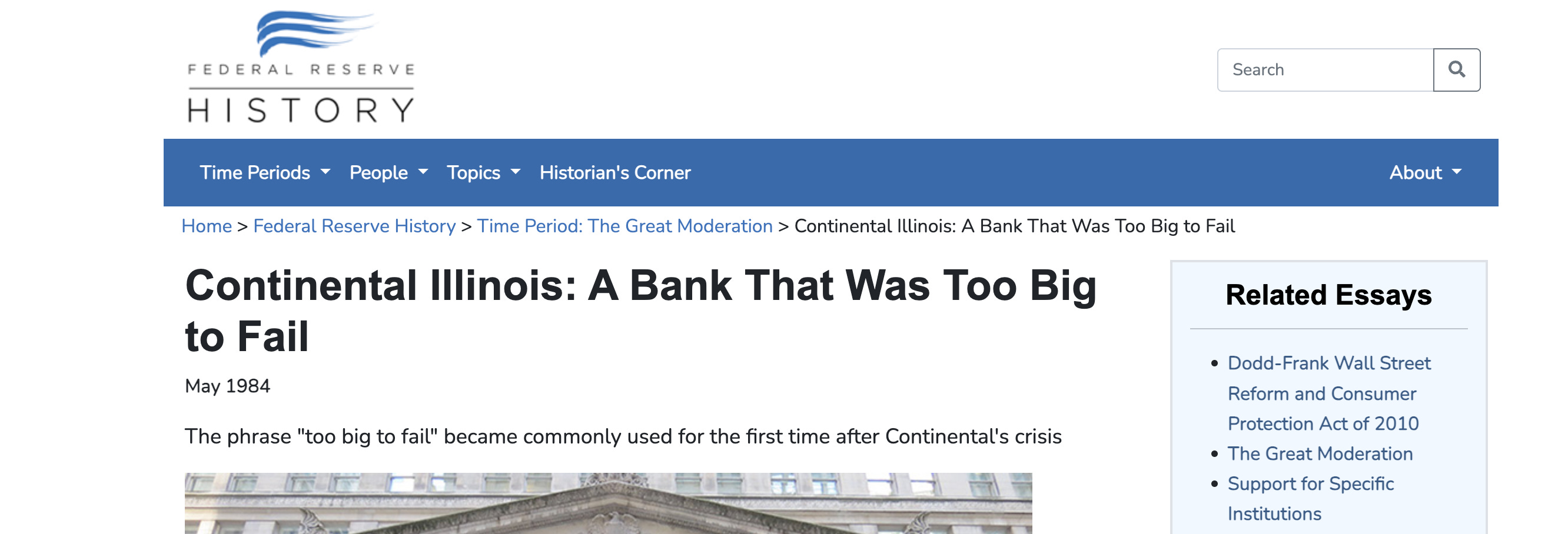
The phrase went mainstream through a 1984 Congressional hearing, when Comptroller of the Currency C. Todd Conover used it to describe the reason for rescuing Continental Illinois2. But the logic is far older, and has justified every expansion of the clearing function for two centuries: the system is too complex for ordinary people to understand, the risk is too severe for ordinary politics to manage, and the experts must act now — before it’s too late, and more importantly, before there’s even time to debate.
‘Systemic risk‘ is the 2008 equivalent of ‘planetary emergency‘. ‘Financial stability‘ is the 2008 variant of ‘public health‘. The vocabulary changes with the event but the function doesn’t. A crisis is declared, and it authorises the intervention — every time.
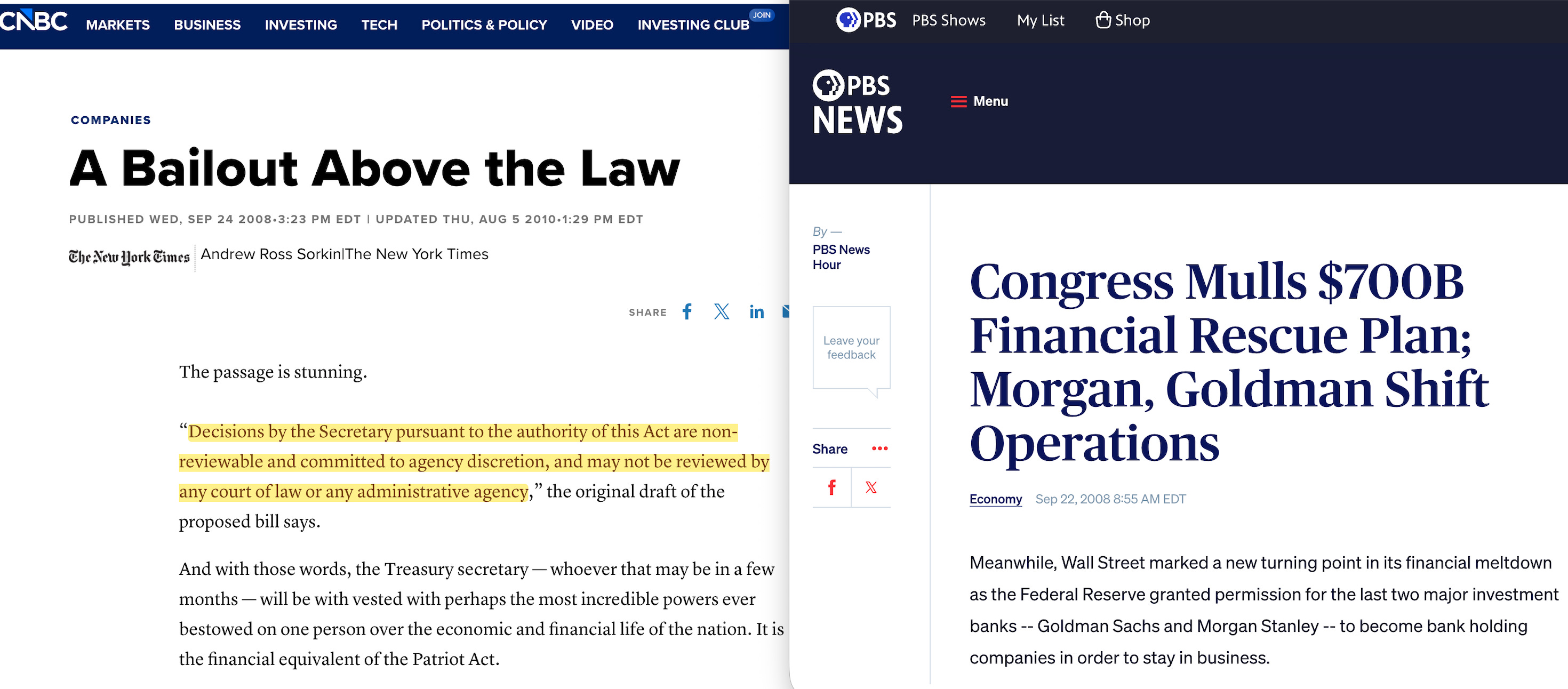
Henry ‘Hank’ Paulson, Secretary of the Treasury and former CEO of Goldman Sachs, presented Congress with a three-page proposal requesting $700 billion in discretionary spending authority with virtually no oversight3. Section 8 of the original draft read4:
Decisions by the Secretary pursuant to the authority of this Act are non-reviewable and committed to agency discretion, and may not be reviewed by any court of law or any administrative agency
Non-reviewable. Committed to agency discretion. Beyond the reach of courts.
This is not emergency legislation. This is the clearinghouse demanding immunity — precisely the same immunity that central banks enjoy through ‘independence‘, that the WHO sought through the Pandemic Treaty, and that every clearing function demands as its price of participation.


The Standard
The ethic authorises the intervention. But the intervention requires rules that determine what qualifies, what does not, and who decides.
Basel III emerged from 20085. It is a regulatory standard — the equivalent of CPA Order 39 for Iraq or the EU acquis for Serbia.
Agreed in 2010 by the Basel Committee on Banking Supervision, housed at the Bank for International Settlements in Basel — always Basel, it dictates how much capital banks must hold, what’s considered capital, and how risk is measured. The committee has no democratic mandate, and its decisions are not treaties — they are ‘standards‘ that member jurisdictions implement through domestic legislation. No parliament votes on Basel, yet every parliament implements it.
The mechanism is identical to the FATF, to ISO, to the Codex Alimentarius. An unelected body sets a standard. Jurisdictions that fail to implement it face consequences — greylisting, loss of banking access, trade sanctions. The ‘voluntary’ standard becomes mandatory without ever being legislated at the international level.
What matters here is that the capital requirements don’t just regulate banks — they regulate the economy through banks. They determine what can be banked, what can be insured and what eventually becomes ‘stranded’6.
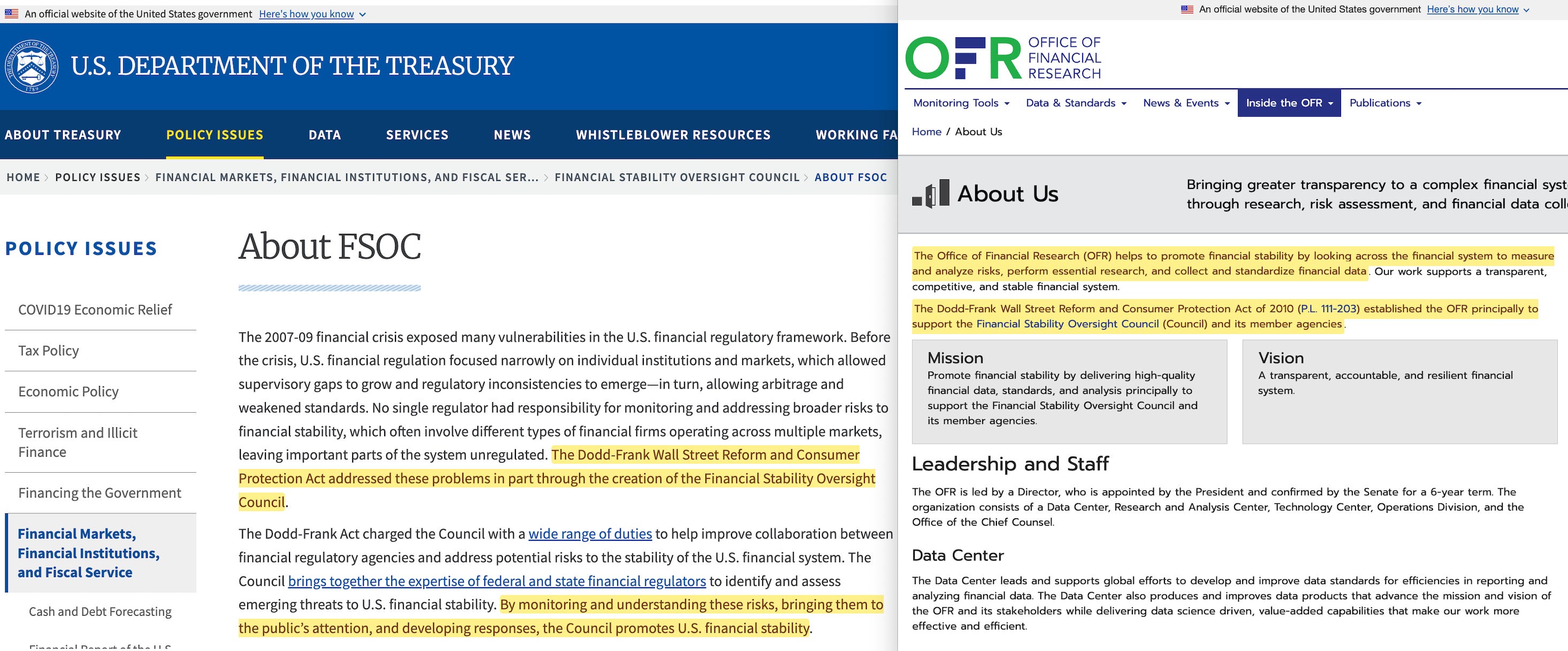
The Dodd-Frank Act7 performed this function in the US — 848 pages of legislation, expanded to over 22,000 pages through implementation8. It created the Financial Stability Oversight Council, empowered to designate institutions as ‘systemically important‘, and the Office of Financial Research9 — more data collection, more reporting… more indicators feeding the models.
The regulatory response to 2008 did not reduce the power of the clearing function — it cemented it. Too-big-to-fail wasn’t ended — it was codified. And the ‘ethical’ terms that Dodd-Frank embedded in financial regulation — ‘best interest‘, ‘fiduciary duty‘, ‘conflict of interest‘ — didn’t originate with the crisis. It was pre-positioned through the Sarbanes-Oxley Act of 200210, itself a response to Enron, which triggered almost simultaneous ‘ethical’ corporate governance codes across a dozen jurisdictions. The ethic precedes the crisis, the crisis authorises the regulation, and the regulation embeds the ethic. That ‘ethic’ is now called Corporate Social Responsibility — and its enforcement mechanism is called ESG.
The moment the ethic became a score, it became a clearing condition — capital flows to acceptable entities, and all others are ‘stranded’.


The Clearing Function
With an ethic declared and the standard defined, someone has to decide who qualifies. That is the clearing function — and in September 2008, the Federal Reserve operated it in broad daylight. The decisions were not neutral.
Bear Stearns — absorbed. In March 2008, the Fed brokered and partially financed JPMorgan’s acquisition of Bear Stearns11. Bear’s counterparty obligations were preserved, and JPMorgan received $30 billion in Fed guarantees against Bear’s toxic assets through Maiden Lane LLC12. Bear Stearns did not fail. It was cleared — absorbed into a larger node that the Fed deemed of systemic importance.
Lehman Brothers — sacrificed. Six months later, Lehman was allowed to collapse13. No buyer was found — or rather, no buyer was facilitated. Barclays was interested but the deal fell through, in part because the UK’s Financial Services Authority refused to waive shareholder approval requirements14. The Fed and Treasury chose not to extend the guarantees they had provided for Bear, and Lehman’s failure triggered a global credit freeze15.
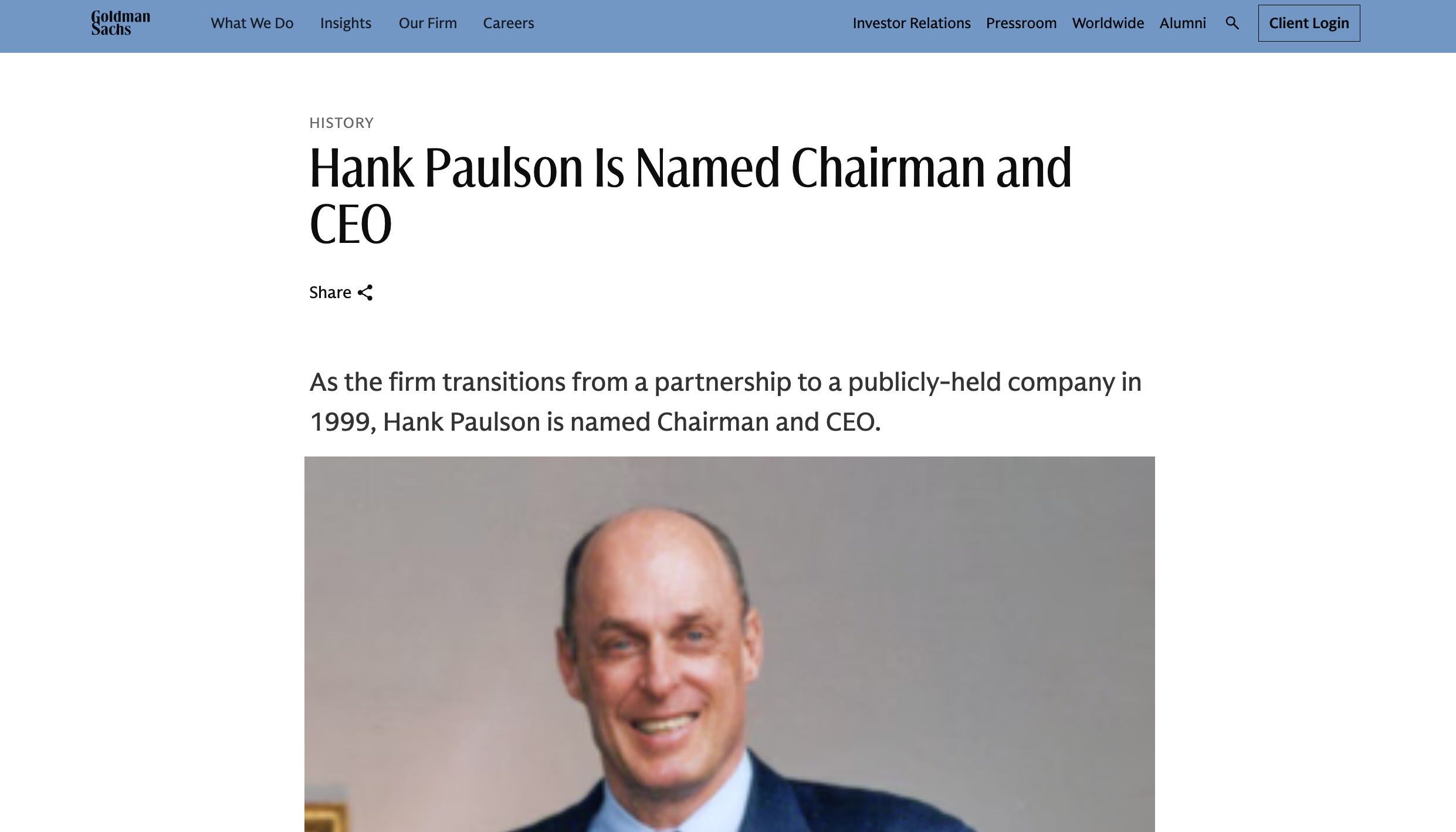
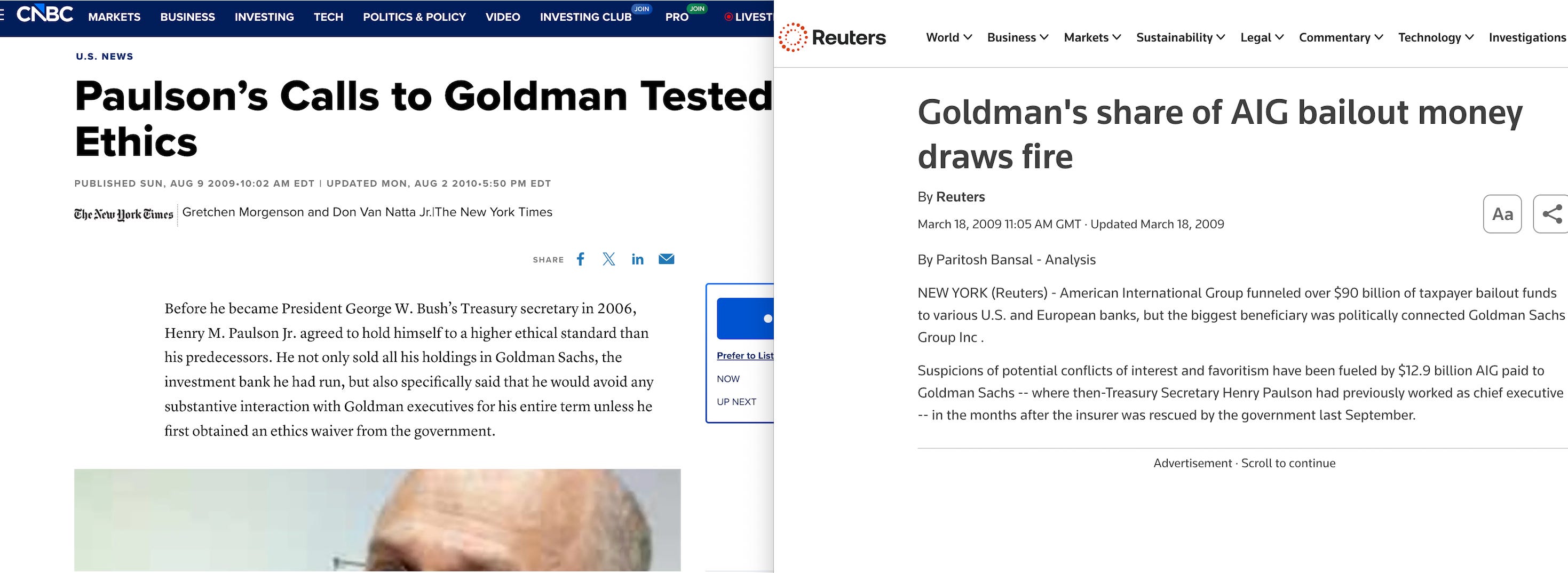
But why save Bear and not Lehman? The official explanation involves counterparty exposure, collateral quality, and legal authority. But Henry Paulson — the then-acting Treasury Secretary — was the former CEO of Goldman Sachs16. Lehman Brothers was Goldman’s principal competitor17, and it was they who stood to benefit most from Lehman’s disappearance. Goldman subsequently received $12.9 billion from the AIG bailout18, converted to a bank holding company with Fed access19, and emerged from the crisis as the dominant firm on Wall Street.
The clearing function called the shots. One organisation was absorbed while the other was sacrificed — and its sacrifice became the crisis that justified everything that followed.
AIG — rescued. Two days after Lehman’s collapse, the Fed extended an $85 billion credit facility to AIG20, eventually expanding to $182 billion21. AIG wasn’t a bank — it was an insurance company that had written credit default swaps on mortgage-backed securities, effectively insuring bets made by the banks. If AIG failed, every bank with CDS protection from AIG would realise that the insurance wouldn’t pay out. AIG was saved because the banks needed AIG’s guarantees to remain solvent. The Fed didn’t rescue AIG. It rescued the banks through AIG — and Goldman’s $12.9 billion was paid out at par, one hundred cents on the dollar, when the market value of the underlying contracts was a mere fraction22.
Paulson had obtained an ethics waiver to participate in decisions affecting his former firm. Clearly, that’s how it works in Washington — you waive the conflict and carry on regardless23.
The clearing function claims to be neutral infrastructure — merely ‘facilitating‘ settlement between counterparties — but in 2008 it determined what settles, who survives… and who pays.
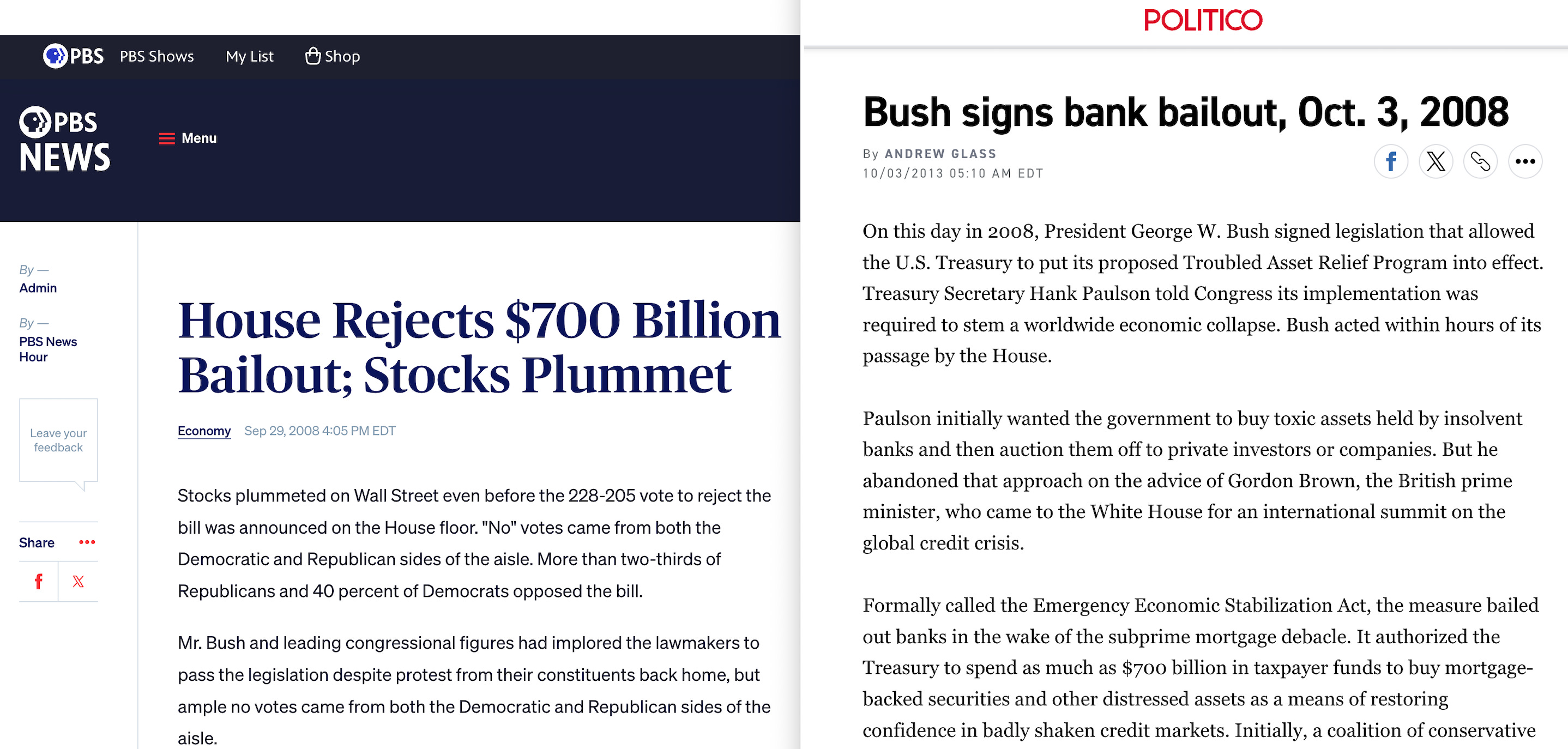
Congress rejected the first TARP vote on 29 September24. The Dow fell 778 points — the largest single-day point drop in history at that time25. Four days later Congress voted again; this time it passed26.
The market was the enforcement mechanism. Refuse the clearing function’s terms, and the settlement layer punishes you. Truss and Kwarteng discovered the same in 2022. The sequence is identical — propose something the clearing function hasn’t approved, watch the market respond, reverse course or be removed. But this pattern traces back even further. Because on Black Tuesday itself — 29 October 1929 — JP Morgan cabled his negotiators with the terms for what the BIS should become: a real bank, free from government control, with statutes ‘so drawn as to leave ample powers to formulate rules and regulations for the convenient conduct of the Bank‘
The crash buried the cable, and the BIS was founded four months later with a mandate the Hague Agreement never authorised.


The Settlement
The settlement was not a single programme. It was a cascade.
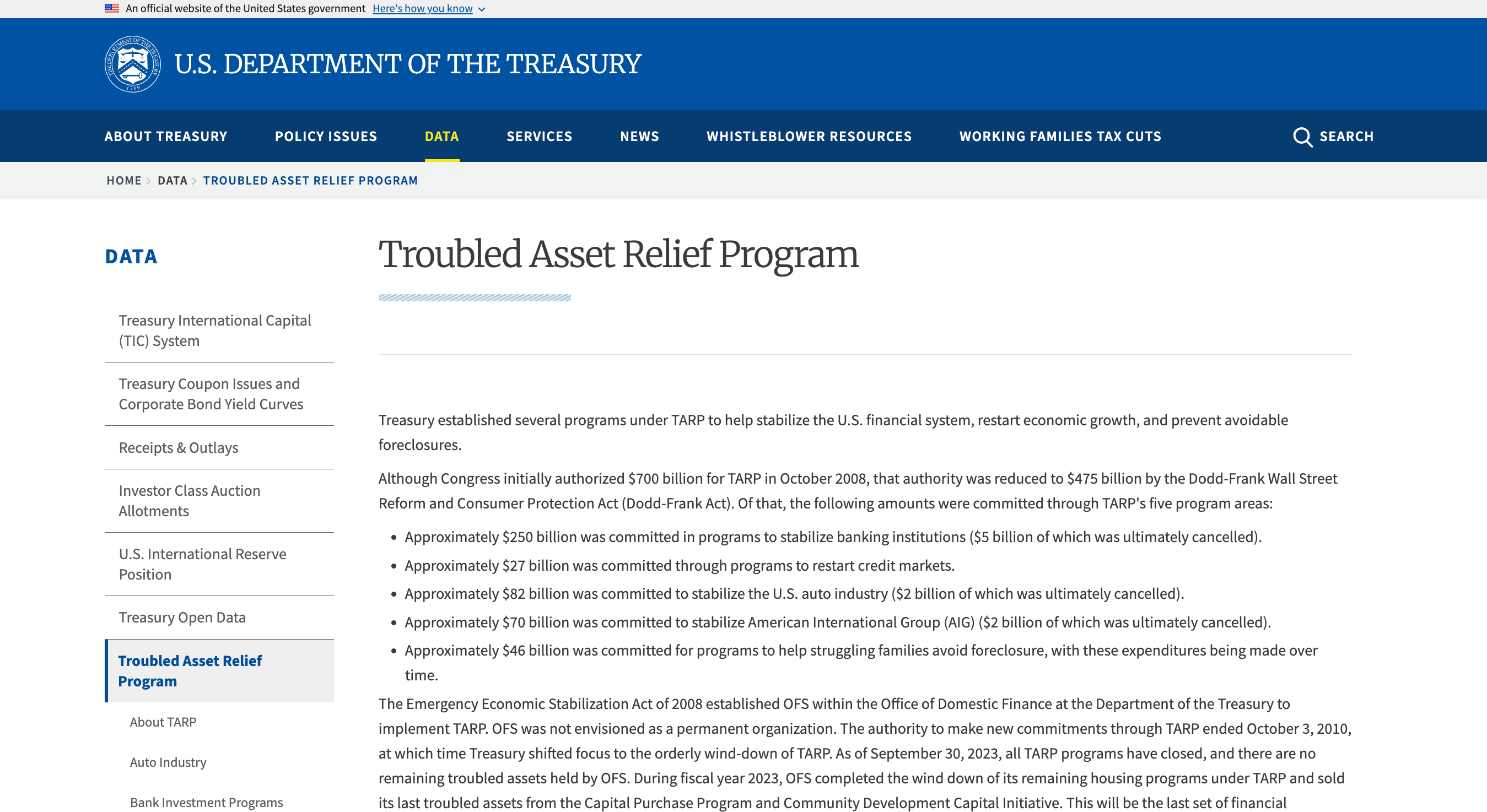
TARP — the Troubled Asset Relief Program — was sold as an asset purchase programme. The government would buy toxic assets from banks, hold them until markets recovered, and sell them at a profit. But within weeks, TARP had been converted into a capital injection programme27. The Treasury purchased preferred stock in banks — $125 billion in the first nine institutions alone, on terms that were presented as non-negotiable. The nine CEOs of the largest US banks were called to a meeting at the Treasury on 13 October 2008 and told they would accept the capital whether they wanted it or not28.
Alongside TARP came Maiden Lane which absorbed Bear’s toxic assets, the $182 billion AIG credit facility, FDIC guarantees on bank debt, and the Fed’s alphabet soup of emergency lending facilities (TAF, TSLF, PDCF, CPFF, AMLF, MMIFF)29. Each one was presented as temporary, yet each one expanded the central bank’s balance sheet and operational reach into territory it had never previously occupied.
But the settlement that mattered — the one that never unwound — was quantitative easing30.
Between November 2008 and October 2014, the Federal Reserve purchased approximately $4.5 trillion in Treasury securities and mortgage-backed securities through three rounds of QE. The stated purpose was to lower long-term interest rates and stimulate economic activity. But the operational effect was to place the central bank at the centre of every major financial market — permanently.
QE made the Fed the market maker of last resort. By purchasing MBS at scale, the Fed set the price floor for mortgage-backed securities. By purchasing Treasuries at scale, it set the benchmark yield for the entire fixed-income market. Every asset price in the economy became, at least to some degree, an outcome of Fed policy.
The Fed didn’t just facilitate transactions between buyers and sellers — it became the buyer. It absorbed the toxic assets that the private sector couldn’t clear, placed them on its own balance sheet, determining the price at which the system would settle.
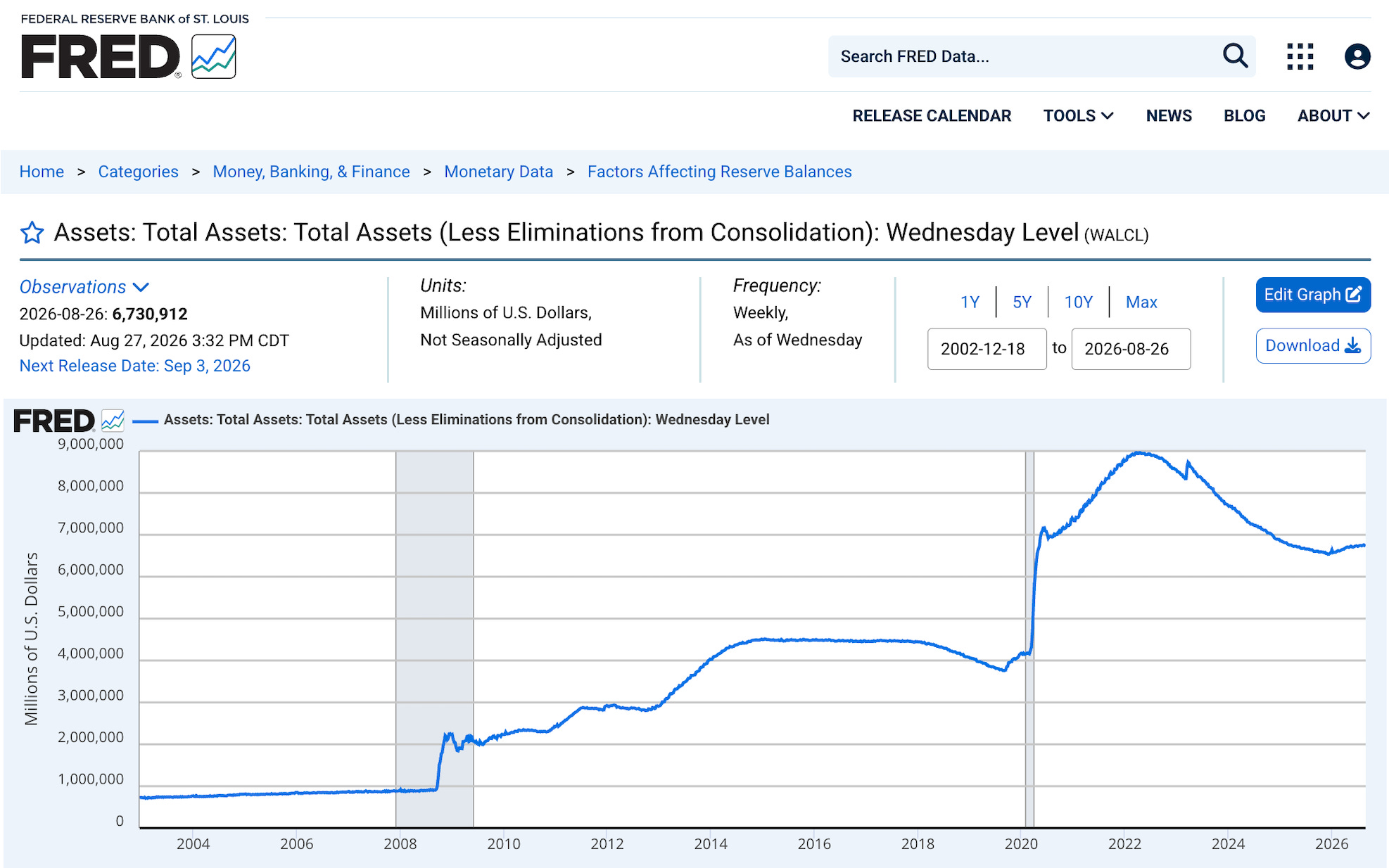
The balance sheet never returned to pre-crisis levels31. QE1 ended, and was swiftly followed by QE2, then followed by Operation Twist. QE3 — ‘QE Infinity‘ — came next. Each round was presented as temporary, but the emergency powers gradually became the permanent operating framework.
When COVID arrived twelve years later, the infrastructure was already in place. The Fed expanded its balance sheet to nearly $9 trillion32 — purchasing not just Treasuries and MBS but corporate bonds, municipal bonds, and ETFs. It took the clearing function that 2008 had established and extended it into every remaining corner of the financial system.

The Conditionality
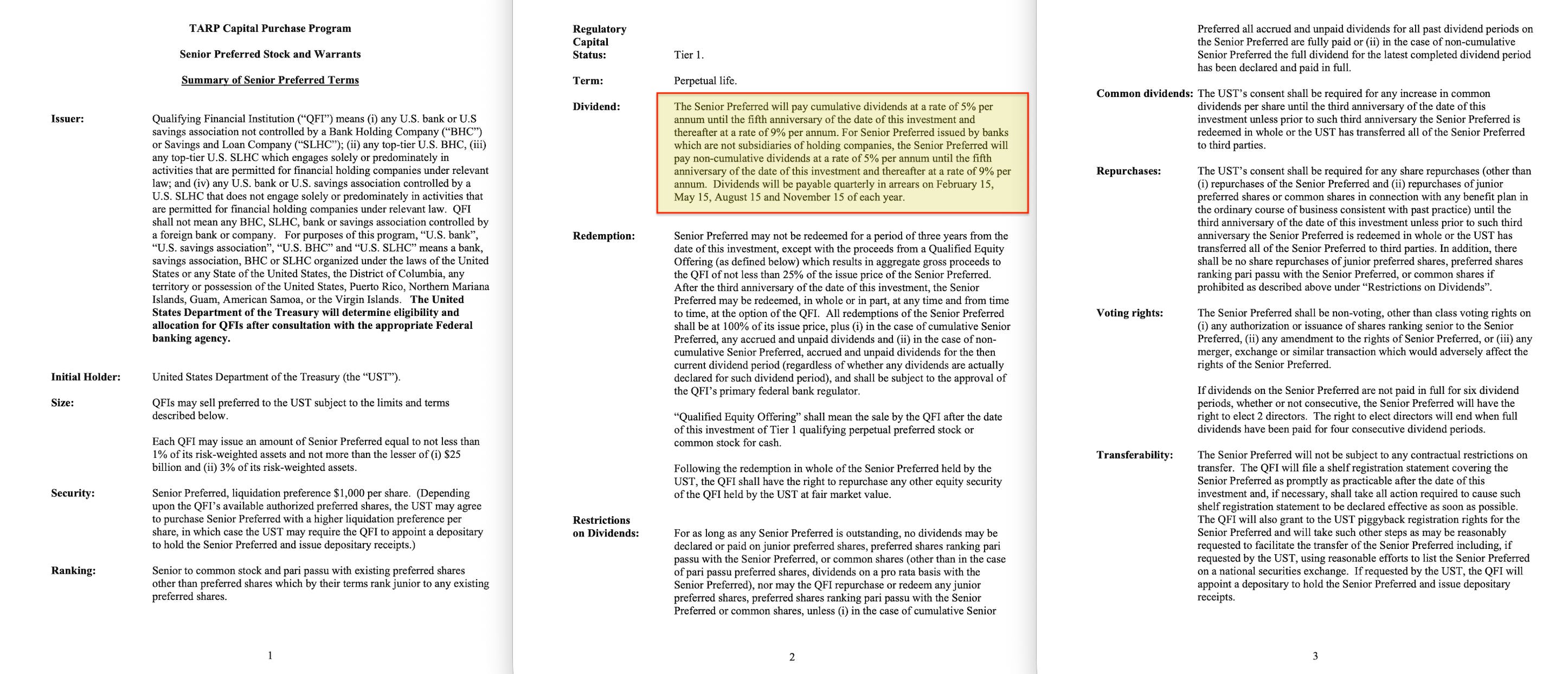
The terms applied upward — to the banks — were remarkably generous. The preferred stock carried a 5% dividend for the first five years, increasing to 9% thereafter33. No restrictions on executive compensation survived the final legislation intact. Banks used TARP funds to pay bonuses34, acquire competitors, and buy back their own shares once markets recovered, thus increasing share price.
The terms applied downward — to the people — were not.
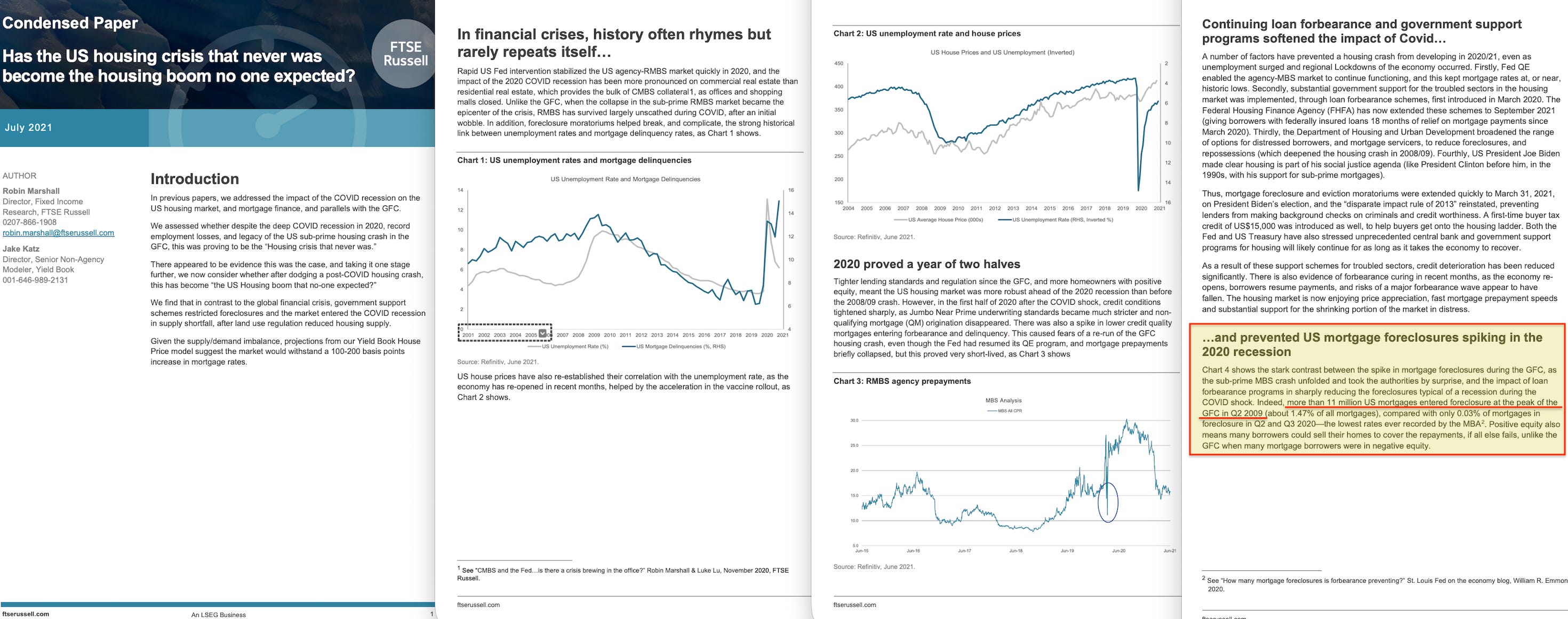
Between 2008 and 2014, more than 11 million American homes entered foreclosure35. The banks that had created, packaged, sold, and insured the toxic mortgages were rescued, while the homeowners who had been sold those mortgages were not. HAMP — the Home Affordable Modification Program — was allocated $75 billion but disbursed a mere fraction36. Banks routinely lost paperwork ‘by accident’, imposed dual-tracking (pursuing foreclosure while ostensibly negotiating modifications), and used robo-signing to process forclosures at industrial scale37.
The assets moved from dispersed private ownership to concentrated institutional ownership. Blackstone’s subsidiary, Invitation Homes, became the largest single-family rental landlord in the United States38, purchasing thousands of foreclosed properties at distressed prices, funded — no, really — by credit facilities from the same banks that had just been rescued with public money.
The homeowner lost his home to the bailed out asset manager, who bought at a steep discount. The former owner became a tenant to the organisations which bailed out using the former owner’s taxes. Ownership was out, conditional access in.
The Thread
This was a global matter, and Mark Carney is the connective tissue to what came next.
Governor of the Bank of Canada from 2008 to 201339. Chairman of the Financial Stability Board from 2011 to 201840 — created by the G20 in 2009 specifically to coordinate the post-crisis regulatory response. Governor of the Bank of England from 2013 to 202041. UN Special Envoy on Climate Action and Finance from 201942. Co-chair of the Glasgow Financial Alliance for Net Zero (GFANZ)43.
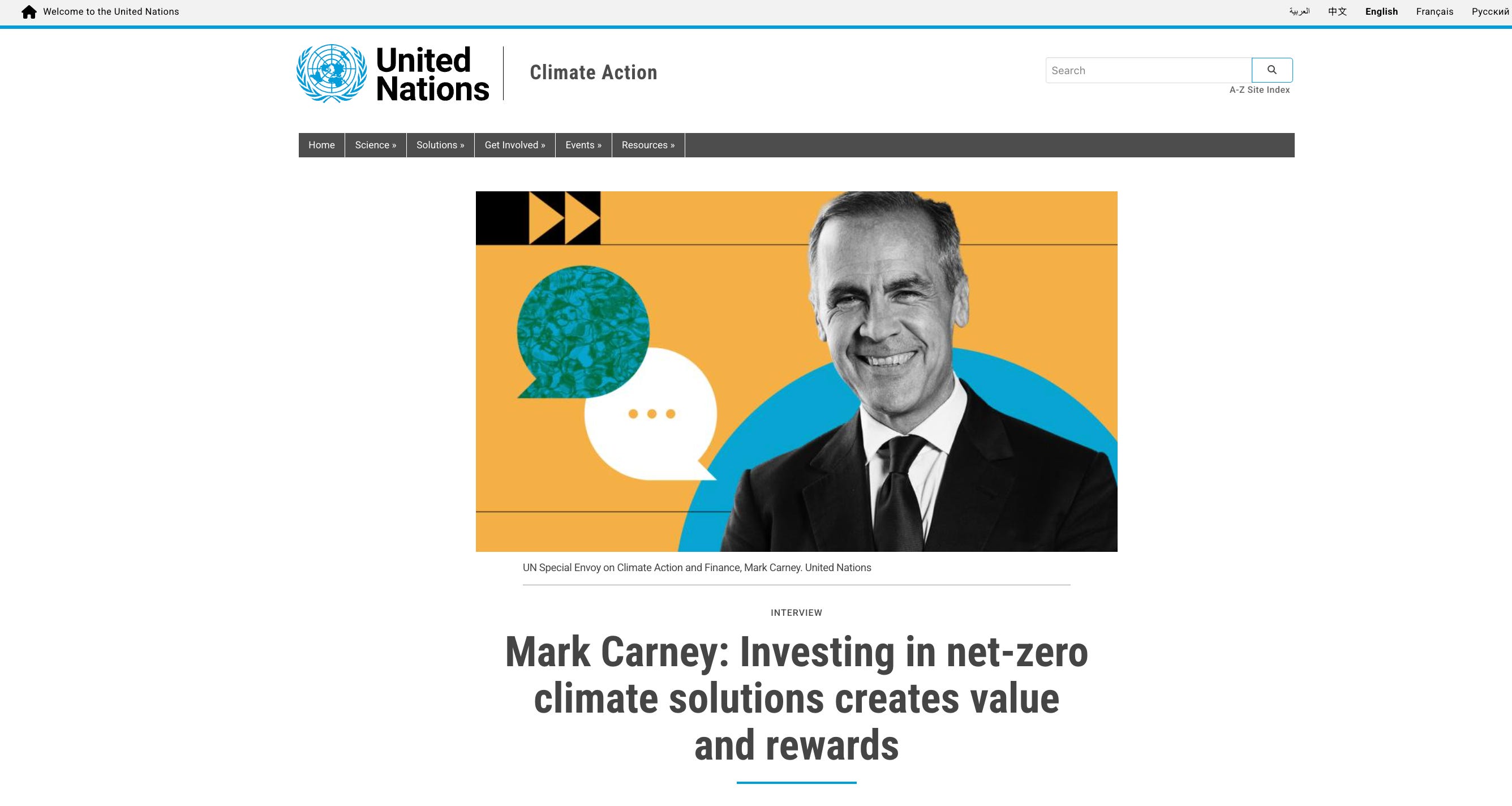
Perhaps more than any other, one man turned financial crisis to climate finance — and no one elected him to any of it. He was subsequently appointed President of Chatham House44 — the institution that invented the rule ensuring that what is said at private convenings cannot be attributed to any participant.

At the FSB, Carney oversaw the development of the standards that became Basel III. At the Bank of England, he introduced the climate stress test — using the same infrastructure built for financial stability to assess ‘climate-related financial risk‘. His 2015 Lloyd’s of London speech — ‘Tragedy of the Horizon‘45 — explicitly framed climate change as a financial stability issue, bringing it within the central bank’s existing mandate without requiring any new legislation.
The stranded asset mechanism is the bridge. The same capital-weighting framework that Basel III uses to determine how much reserve a bank must hold against a given asset class can be recalibrated to strand any asset of choice. Carbon intensity today. ‘Nature Value-at-Risk‘ tomorrow. The framework is agnostic, and can be applied to anything the NGFS deem to threaten financial stability with complete impunity.
GFANZ — Carney’s net-zero finance alliance — committed over $130 trillion in private capital to ‘align with net zero‘46. That alignment is enforced through the same architecture: disclosure requirements (TCFD), risk assessments (NGFS scenarios), capital weighting (Basel), and compliance verification (assurance frameworks). Every component was built or expanded after 2008.
2008 triggered the creation of the framework, and Carney took it from finance to climate. The same framework is now being driven into AI governance, health security, and digital identity.
Because to a central banker, everything triggers ‘financial stability’ — it’s just a matter of framing.


The Transformation
Before 2008, central banks operated primarily through monetary policy — adjusting base interest rates, by and large. After 2008, central banks operated as participants — setting market prices through balance sheet operations.
This is not a minor development. It is a structural transformation of the same kind that the CPA orders imposed on Iraq.
Nobody frames it that way, obviously. The CPA rewrote Iraqi commercial law by decree, while the Fed rewrote American asset prices by purchase order ‘out of necessity’. One required boots on the ground, the other required daily fear-mongering in the media. The output — an economy manipulated by an unelected authority operating beyond democratic challenge — is the same. The ordoliberals proposed placing economic authority above democratic politics to protect the competitive order — the Bundesbank model. What 2008 delivered was the placement without the purpose.
The Fed wasn’t placed above politics to maintain the market. It was placed above politics to become the market — which is closer to Fabian technocratic administration than anything Röpke envisioned.


Before 2008, the Federal Reserve’s balance sheet was approximately $900 billion47. By 2014, it was $4.5 trillion. By 2022, it had grown to $8.9 trillion. The clearing function grew tenfold in fourteen years — and every dollar of that growth represents a decision made without democratic input about which assets the central bank would purchase, at what price, and therefore which sectors of the economy would receive support.
If you were an asset owner, your net worth soared. If you didn’t… well, then you lost. That’s really all there is to it. Housing became unaffordable, and wages stagnated while asset valuations soared. The wealth gap widened to levels not seen since the 1920s48. And at every point, the central bank insisted it was merely providing ‘accomodation‘ — neutral infrastructure, processing flows, stabilising the system.
The neutrality claim is the source of its power — and the source of its immunity. Yet it is never truly held accountable for any of its decisions. Ever. Even when those decisions hyper-accelerate wealth concentration with the top 1% of the population at the cost of everyone else. When ‘Occupy Wall Street’ eventually came along, they by and large protested against commercial banks, investment firms, corporate greed, and the political influence of the wealthiest 1%49 — few ever connected this to the policies made at the Federal Reserve. Not a single major protest ever took place in front 33 Liberty Street, likely because it received heavy police presence.

When the assets that QE inflated began to generate consumer inflation in 2021, the Fed initially called it ‘transitory‘50. When it proved otherwise, it raised rates — collapsing Silicon Valley Bank, Signature Bank, and First Republic in March 202351. The Fed then created the Bank Term Funding Program to prevent contagion52 — another emergency facility, another expansion, another intervention presented as temporary, another undemocratic decision taken without accountability in sight.
The cycle keeps self-reinforcing itself. The clearing function creates the instability through its interventions, then uses the instability to justify further intervention. Each crisis expands the mandate, and the baseline never returns. In simple terms — it’s a ratchet.
The pattern is not unique to the Fed. The Bank of England ran the same sequence — the Tripartite Authority failed in 200853, so the Financial Services Act 2012 transferred more power to the BoE54; the BoE then failed to prevent the pension fund crisis in 2022, and the Fabian Society’s 2023 response (‘In Tandem’) was to propose giving the BoE influence over fiscal policy itself.
When Truss and Kwarteng attempted to conduct fiscal policy without first clearing it with the BoE, the market punished them in real time — the same enforcement mechanism the first TARP vote triggered — and they were removed within weeks. The lesson to every subsequent politician was unmistakable: you do not move without the central bank’s approval.
Each failure is assigned to the arrangement, never to the institution. And the remedy is always the same — more power for the institution that failed in its duty, with no accountability in sight.

The Product
2008 is the hinge.
Before 2008, the financial clearing function operated primarily in the background — setting interest rates, managing reserves, supervising banks through examination. Nobody — apart from Ron Paul, and a few Austrian economists such as Peter Schiff — much cared what the Fed did, because nobody much noticed, and the few who did were painted by CNBC as raving lunatics. After 2008, it operated in the foreground — purchasing assets, determining prices, designating institutions as systemically important, and extending its supervisory reach into climate, technology, and public health. And no-one was ever offered an opportunity to vote on this.
Everything documented across this series — the stranded asset mechanism, the NGFS scenarios, the Basel capital weighting, the FATF compliance framework, the blended finance architecture, the programmable money infrastructure — all of it runs on machinery that 2008 either built or permanently expanded.
The financial crisis did not create the clearing function. The Bank of England Clearing House existed in 1773, while The Federal Reserve was established in 1913 following the crash of 1907. The BIS was founded in 1930 in response to German war reparations. But 2008 is when the clearing function went from operating within the financial system to operating as the financial system.


The destination is now clearly visible. The BIS Innovation Hub and the Bank of England jointly designed Project Rosalind — a CBDC API which includes a three-party lock function. A future CBDC transaction will involve a payer, payee, and a third party that sets conditions on whether the transaction is allowed to execute. What this amounts to is a clearing function, applied at the level of the individual transaction level, automated, with conditionality set by people not elected democratically, nor ever being held accountable. What this means is that money ceases to be money itself, and becomes requests for permissions to transact.
Meanwhile, the EU insists the digital euro is not ‘programmable money‘ — and technically that’s correct, because the currency unit itself carries no conditions. But the EU Digital Identity Wallet does. If the wallet checks your carbon allowance before executing each transaction, the money doesn’t need to be programmable, because the wallet is.
And it began with a litany of crimes for which nobody was held accountable.


No senior executive of a major bank went to prison for the fraud that caused the crisis55. The Department of Justice under Eric Holder — held in contempt of Congress in 201256 — pursued settlements rather than prosecutions. The banks paid fines from shareholder funds and continued operating.
The defining feature of every clearinghouse is a total absence of responsibility — financial, political, and informational. The neutrality claim isn’t only the source of its power — it’s the source of its immunity. By presenting itself as infrastructure, the clearing function determines outcomes while shouldering none of the consequences.
The people who lost their homes didn’t write the CDS contracts. The people who lost their savings didn’t structure the CDOs. The people who lost their jobs didn’t lobby for the deregulation that made it possible. Yet they were made to pay. And while the mainstream media fanned the flames of injustice, in particular relating to corporate pay packages on Wall Street, the central banks exploited the opportunity, seizing power without accountability.


The institutions which caused the crash were made whole — at public expense — and emerged larger, more powerful, more concentrated, and more deeply embedded in the architecture of governance than they had been before the crisis began. And — largely shielded from scrutiny — the central banks kept the ratchet going, ensuring power was only redistributed in one direction while everyone was distracted by outrageous commercial bank executive compensation packages.
And the CDO tranche structure that caused it all? It didn’t disappear. It was redesigned. The architecture now called ‘blended finance‘ uses the identical model — senior tranche, junior tranche — but with public money explicitly positioned in the first-loss slot. Taxpayer capital absorbs the downside so private investors face de-risked returns in the senior position.
The lesson of 2008 wasn’t that the tranche system was dangerous. It was that the wrong suckers were holding the junior position. The fix was to call it ‘development finance’, and backstop it by the public. And when the Global South eventually fail to service their financial commitments, it’s the Global North who will stand to lose it all. This will be presented as an emergency during a future crisis, calling for yet more facilitator subsidy — while the central bank pushes the ratchet even further along.
It’s almost as though that was the point all along.
Almost.


This is fascinating stuff, thank you. I am very interested in the transformation of the global financial system, beginning around 1996 with major milestones of 2000 and 2008.
In my simplistic view, Greenspan modified the role of interest rates from being an indication of financial health, to controlling financial "health" by governing the speed of debt growth. This was done by spooking Bush Jr who wasn't all that informed, to put it mildly.
The dotcom bubble and then the 9/11 event were well-timed to implement this reform.
Then, in 2008 they got a little scared of the implications of the new system, and attempted to raise interest rates. This caused quite a problem since the economy *was* debt at this point, and interest rates were the cost of doing business.
Flash forward to 2017, the adventure had run its course, interest rates were at zero, as they must be, but banks are wringing their hands. If interest rates stay zero or go less than zero the banks would be completely dependent on QE instead of interest payments to survive- not a viable option.
At the last moment there was COVID which allowed the banks to create a 20 trillion dollar global liquidity buffer so interest rates could be raised without causing another, far greater, 2008 event.
And Fannie and Freddie - taxpayers - were the backstops to Clinton 'encouraging' banks to lend to folks that couldn't pay it back.