

Vladimir Lenin published What Is to Be Done?1 — the operational blueprint for the Bolshevik Revolution — in 1902.
It’s typically read as political theory, but it’s actually more usefully read as a description of how to shift a population from passive discontent to active revolution — without the population understanding where it’s ultimately being taken.
And this knowledge is highly relevant in today’s charged environment.
BuyMeACoffee https://buymeacoffee.com/escapekey
Bitcoin 33ZTTSBND1Pv3YCFUk2NpkCEQmNFopxj5C
Ethereum 0x1fe599E8b580bab6DDD9Fa502CcE3330d033c63c
By the turn of the twentieth century, strikes were common, and discontent was widespread in Russia2. Lenin argued that none of this was sufficient on its own, because workers could only develop ‘trade union consciousness’3. They could sense that things were bad and organise around grievances at the local level, but they did not ultimately grasp why things were bad, nor determine what to do about it.
Lenin didn’t claim the workers were stupid. Rather, he observed that ‘correct’ analysis doesn’t emerge naturally — it has to be introduced by people who have already arrived at the ‘correct’ framework: the vanguard.
The vanguard’s job is to interpret grievance through the ‘correct’ lens and guide the population toward the preferred conclusion. To Lenin, revolutionary consciousness ‘could only be brought to them from without’; the workers provide the energy; the vanguard provides the direction.
But if the vanguard should guide the masses toward ‘correct’ consciousness, it would logically also have to protect them from the ‘incorrect’ sort — because these would lead elsewhere but the ‘correct’ destination. To this end, Lenin identified a type of opposition leader whom he called ‘economists’, who channel people into non-revolutionary directions through ‘incorrect’ prescriptions.
The economists are worse than outright enemies, because they occupy the space where revolutionary consciousness should develop; they hoover up the discontented, and thus prevent actual transformation.
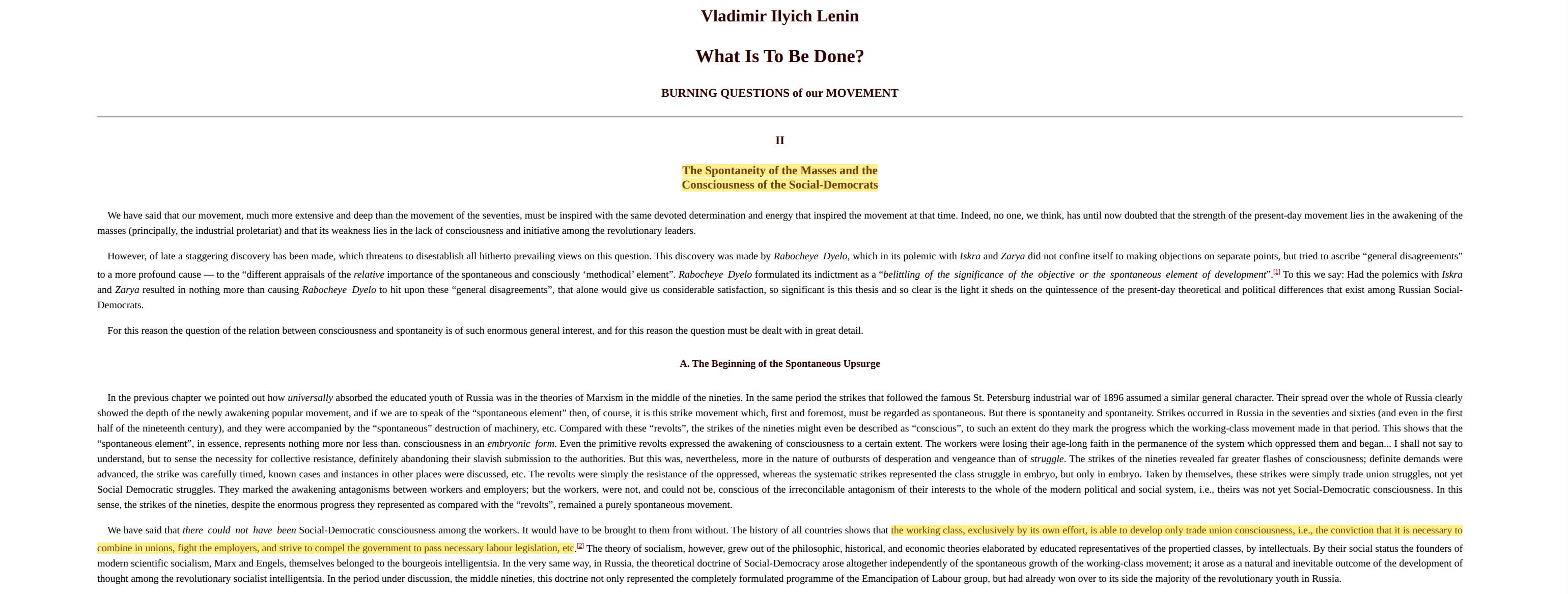
Combating these economists is therefore a primary operational task4. Lenin argues that ‘the most urgent task’ is not to organise the workers, but to ‘combat spontaneity’: to prevent movements from becoming non-revolutionary. The ‘economists’ must be identified, discredited, and replaced by people who carry the ‘correct’ analysis.
This requires a specific organisational structure. Lenin advocates a centralised party of professional revolutionaries rather than a broad, democratic mass movement. The party doesn’t represent the workers — it leads them, because it possesses the consciousness that the workers cannot develop on their own. The party knows where the movement must go; the workers supply the force to get there.
Lenin also addresses the fact that the final destination — the dictatorship of the proletariat — would alarm the very people the movement seeks to recruit. You don’t tell the workers in stage one what stage five requires. At stage one, you validate their grievance. At stage two, you provide the analytical lens. At stage three, you identify the enemy. At stage four, you prescribe resistance. Stage five arrives when the organisational infrastructure is already in place and the population has been walked to the threshold — one careful step at a time.
Each step appears reasonable in isolation; the destination is only visible from above.

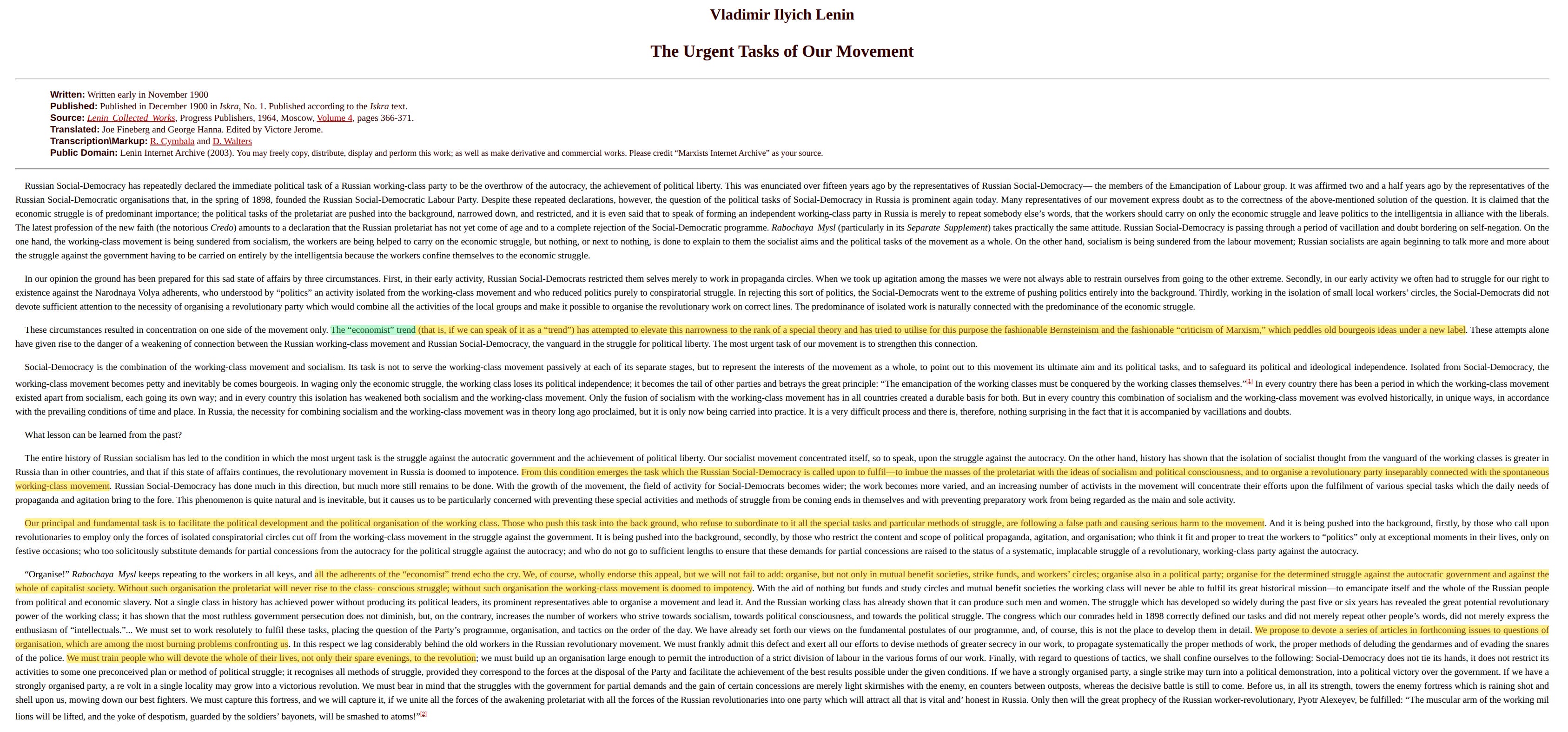
David A. Hughes is a senior lecturer at Lincoln University5 with degrees in German Studies and International Relations — not economics, engineering, or systems architecture. Since 2020, he’s published on what he describes as a global class war — the central thesis of Marxism6 — waged by a transnational ruling class through technocracy, psychological operations, and what he terms ‘Omniwar’7.
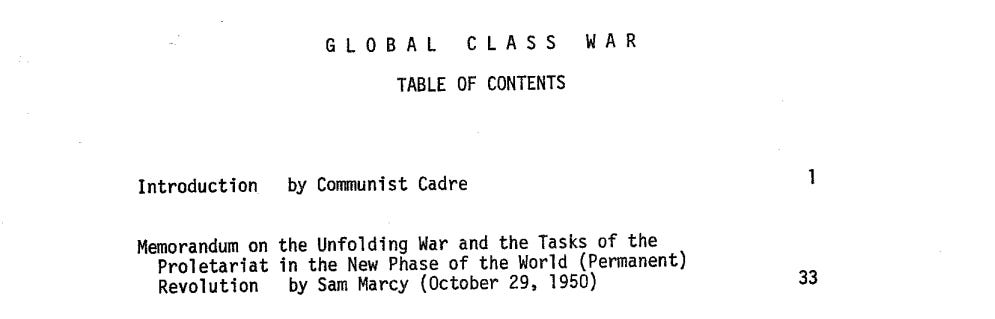
The first of his two-volume ‘Covid-19’, Psychological Operations, and the War for Technocracy8 was published in 2024. He runs an active Substack, organises recurring symposia through the Study Group on Technology and Power9, and has developed an explanatory framework — ‘three camps of awareness’.
The alignment between Hughes’s camps and Lenin’s 1902 specification is major.
Lenin divides the population into those with no consciousness (the masses), those with incorrect consciousness (the economists), and those with correct consciousness (the vanguard). Hughes divides the population into those who accept mainstream narratives uncritically (Camp 1), those who see through them but are trapped in a ‘holding pen’ of controlled alternative media (Camp 2), and genuine truth-seekers who pursue authentic understanding through the correct method (Camp 3).
The taxonomy is identical, and the sorting criterion is the same — ‘correct’ analytical method, not specific policy.
Lenin’s primary operational concern is combating the economists. Hughes’s primary operational output is an extensive Camp 2 guide10 — a catalogue of indicators for spotting false leaders in the alternative media: financial red flags, proximity to power structures, coordinated messaging, thought-terminating clichés, and the ‘mystification of class relations through appeals to extraterrestrials or ethnic scapegoating’. Anyone whose analysis doesn’t reduce to class conflict is, by the framework’s criteria, in Camp 2.
The economists have been rebranded, but the function remains: they must be discredited so that the correctly-led movement can occupy the space.
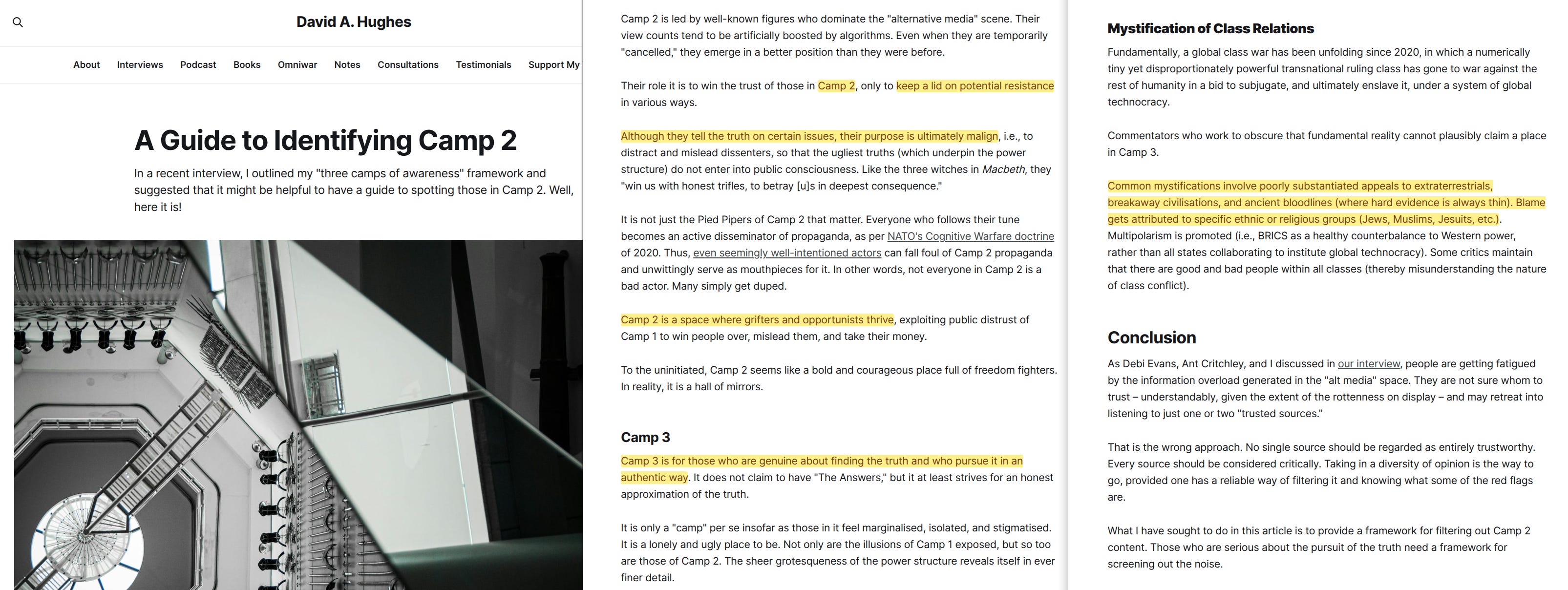
Hughes’s framework implies an identical structure. Camp 1 lacks the necessary tools to identify and challenge propaganda. The movement from Camp 1 through Camp 2 to Camp 3 requires guidance, and the three camps framework itself is the tool that provides it — sorting the population, identifying the correct path, and warning against the diversions.
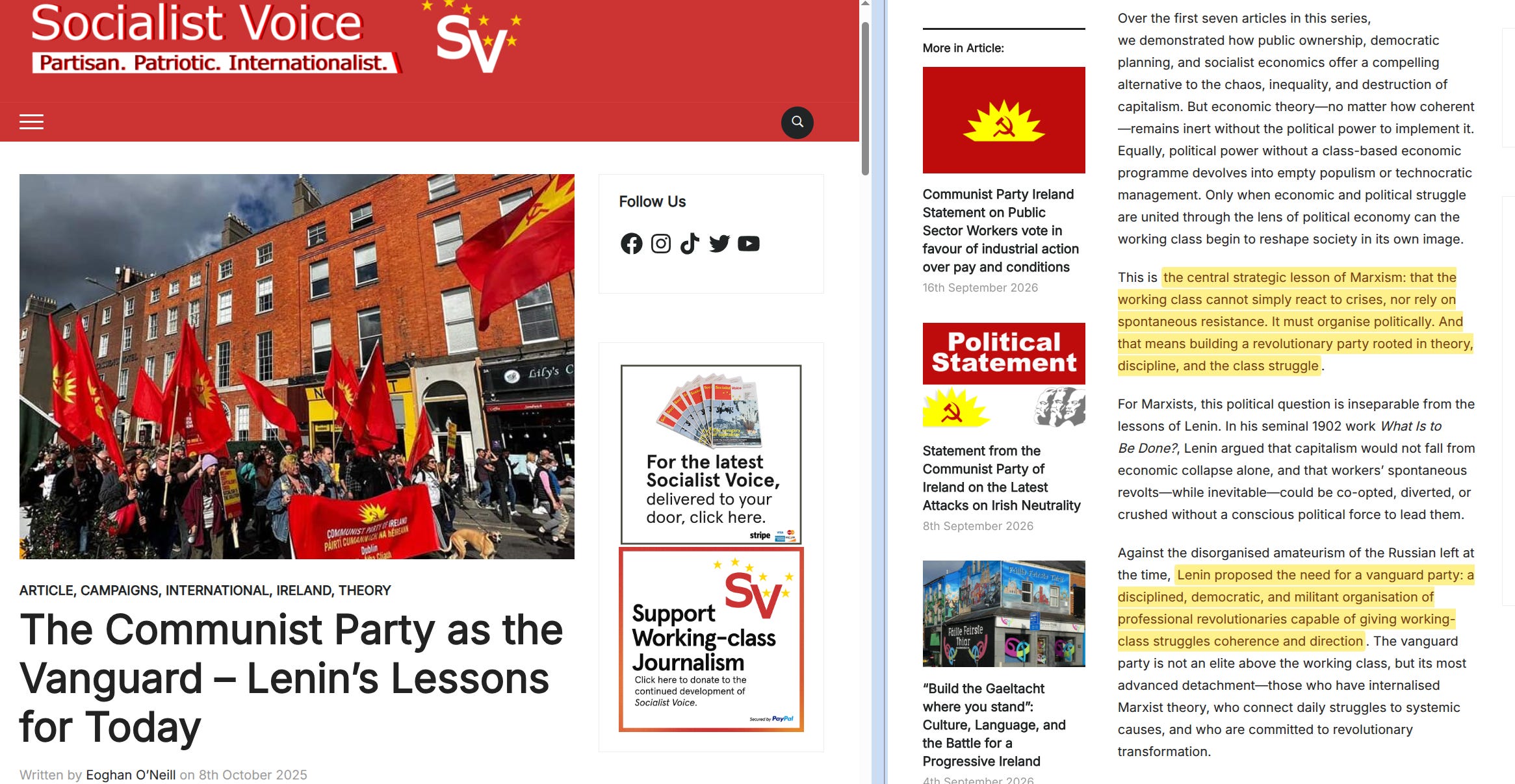
Lenin advocates a small, disciplined, centralised organisation rather than a broad democratic movement — the vanguard. Hughes operates through the Study Group on Technology and Power; a study circle with legal infrastructure — precisely what Lenin prescribed. Whether the contributors are aware is a different matter.
Lenin’s sequential method — validate the grievance, provide the framework, identify the enemy, prescribe resistance, never reveal the final destination prematurely — maps to Hughes’s output with precision. The speeches and books open with extensive diagnosis, proceed through Marxist class analysis (presented as the only non-mystified lens), identify the enemy (the transnational ruling class and its Camp 2 enablers), and arrive at abstract prescriptions for resistance (‘find where you can make a difference’, reject smart technology, cultivate the divine). What they never detail is what replaces the current system. The final destination is absent — exactly as Lenin’s method requires.
Lenin notes that the vanguard must guard against co-optation11 — against losing members back to incorrect consciousness. Hughes notes that people can move ‘backwards and forwards between camps, including co-optation back from Camp 3 to Camp 2’. The issue is the same. So is the language, for that matter.
Whether the alignment is intentional or not is a question the framework itself doesn’t even permit Camp 3 to ask — because asking would constitute mystification of class relations, and that, by definition, is a Camp 2 indicator.
In an interview with Chuck Fall on 26 September 202612, Hughes made the alignment more explicit. He stated that ‘the fundamentals of Marxism are sound’, that his approach is ‘very much about classical Marxism’, and that later developments have been ‘essentially bastardizations or corruptions of Marxism’.
From the capitalist perspective, he argued, Marxism is ‘the one form of knowledge that you do not want people to have’.

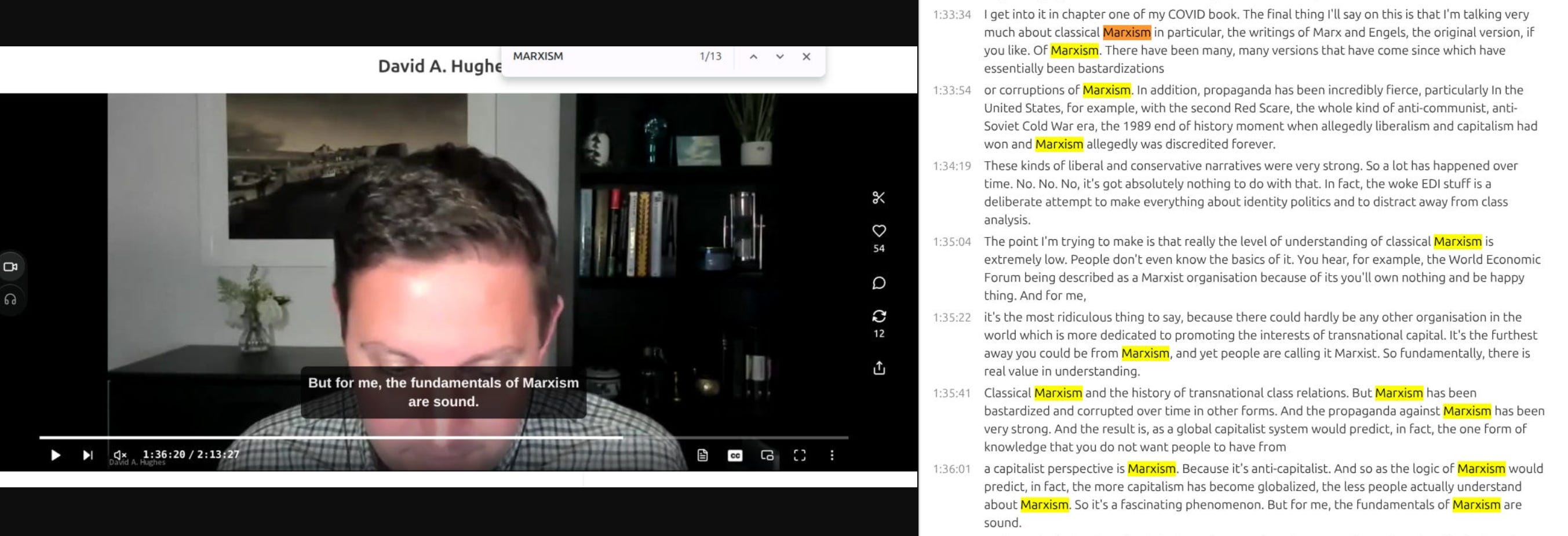
The claim is revealing, primarily for what it conceals. Hughes presents himself as a purist — a defender of classical Marx against the ‘distortions’ of later practitioners. But the delivery mechanism he employs is Lenin’s. The three camps taxonomy is Lenin’s consciousness hierarchy, the Camp 2 guide his anti-economist purge manual, the Study Group his vanguard cell, and the sequential withholding of the destination his stage architecture.
He’s selling Marx through Lenin’s distribution system while characterising the Leninist tradition as a bastardisation of the product he’s distributing. The word for this, in any engineering discipline, is not inconsistency — it’s obfuscation.
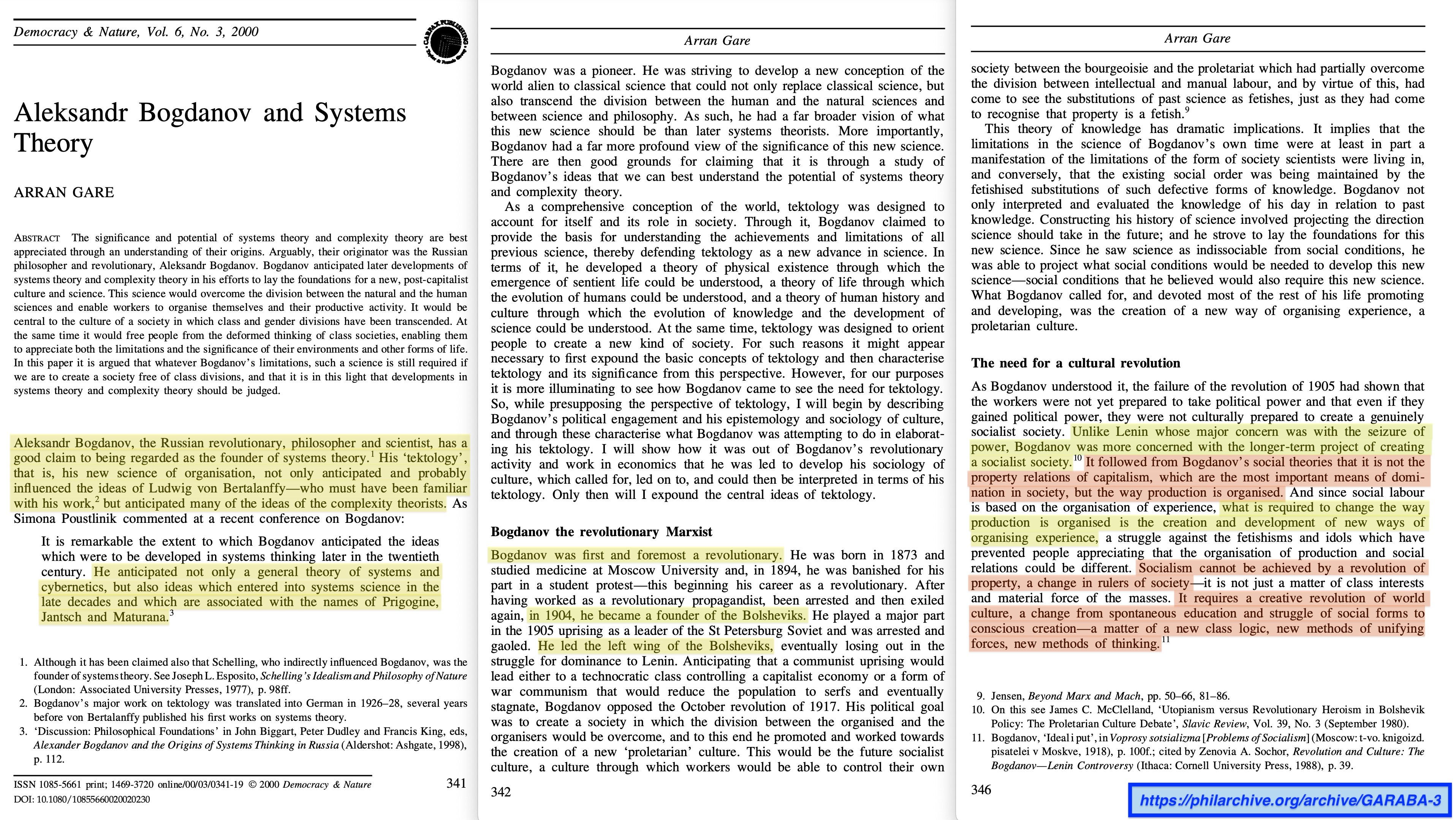
Hughes’s ‘Omniwar’13 — global class war waged across every human domain — has its own lineage. Alexander Bogdanov, Lenin’s early rival and collaborator, argued that every sphere of human experience should become a battleground14.

The Frankfurt School’s Critical Theory15 eventually weaponised this, extending political struggle into culture, language, psychology, and epistemology. Hughes’s ‘Omniwar’ framework is a more recent incarnation.
The genealogy runs from Bogdanov through the Frankfurt School to Hughes, each node expanding the battlefield while preserving the Marxist analytical core.


There is also the question of who decides. If Camp 3 is defined by correct consciousness, assessed by those who already claim to possess it, the sorting criterion is self-referential. Any member who disagrees with the framework’s conclusions can be reclassified as Camp 2, and any faction that develops its own reading of the correct analysis can be dismissed as insufficiently conscious. Lenin solved this issue through party discipline and purges — a centralised authority to determine, definitively, who was in and who was out. Hughes hasn’t specified his equivalent mechanism, which means either the movement has no defence against splintering, or — more likely — the mechanism exists but hasn’t yet been disclosed.
There is a question the framework never answers, and the absence is load-bearing. If Camp 3 wins — if the transnational ruling class is identified, resisted, and defeated — what replaces the current system? Hughes prescribes resistance in the abstract. He never specifies who governs afterwards, through what infrastructures, and with which constraints on power.
This mirrors the gap left behind by Marx and Engels. The dictatorship of the proletariat was to ‘wither away’, but neither author ever explained how a centralised apparatus of total control voluntarily dissolves itself.
The question has no satisfactory answer in the Marxist literature — not because it’s been overlooked, but because answering it honestly would reveal the destination. A dictatorship that has integrated itself with seized infrastructure doesn’t ‘wither away’ — it becomes the infrastructure.

The destination is hinted at through Marx’s own work.
In the Grundrisse (1857–58), his ‘Fragment on Machines’16 describes the trajectory: as machinery develops, it absorbs what Marx considers the ‘general intellect’. This machine becomes the dominant productive force; human labour is reduced to tending and supervising an apparatus that increasingly runs itself. Marx presents this not as a warning but as the dialectical movement of capital toward its own supersession. Read today, the passage is a description of artificial intelligence — general knowledge absorbed by the machine, the machine becoming autonomous, the worker subordinated. Hughes warns against technocracy while recommending the framework whose author described technocracy as the destination of the very process he was analysing.
Lenin filled in the operational detail17. In Can the Bolsheviks Retain State Power?18 he specified that the big banks are ‘the skeleton of socialist society’ — not to be abolished but seized. A single state bank would provide ‘country-wide book-keeping, country-wide accounting of the production and distribution of goods’. His term for the mechanism is ‘accounting and control’ — centralised surveillance and audit of every material and economic flow, run through seized institutions.

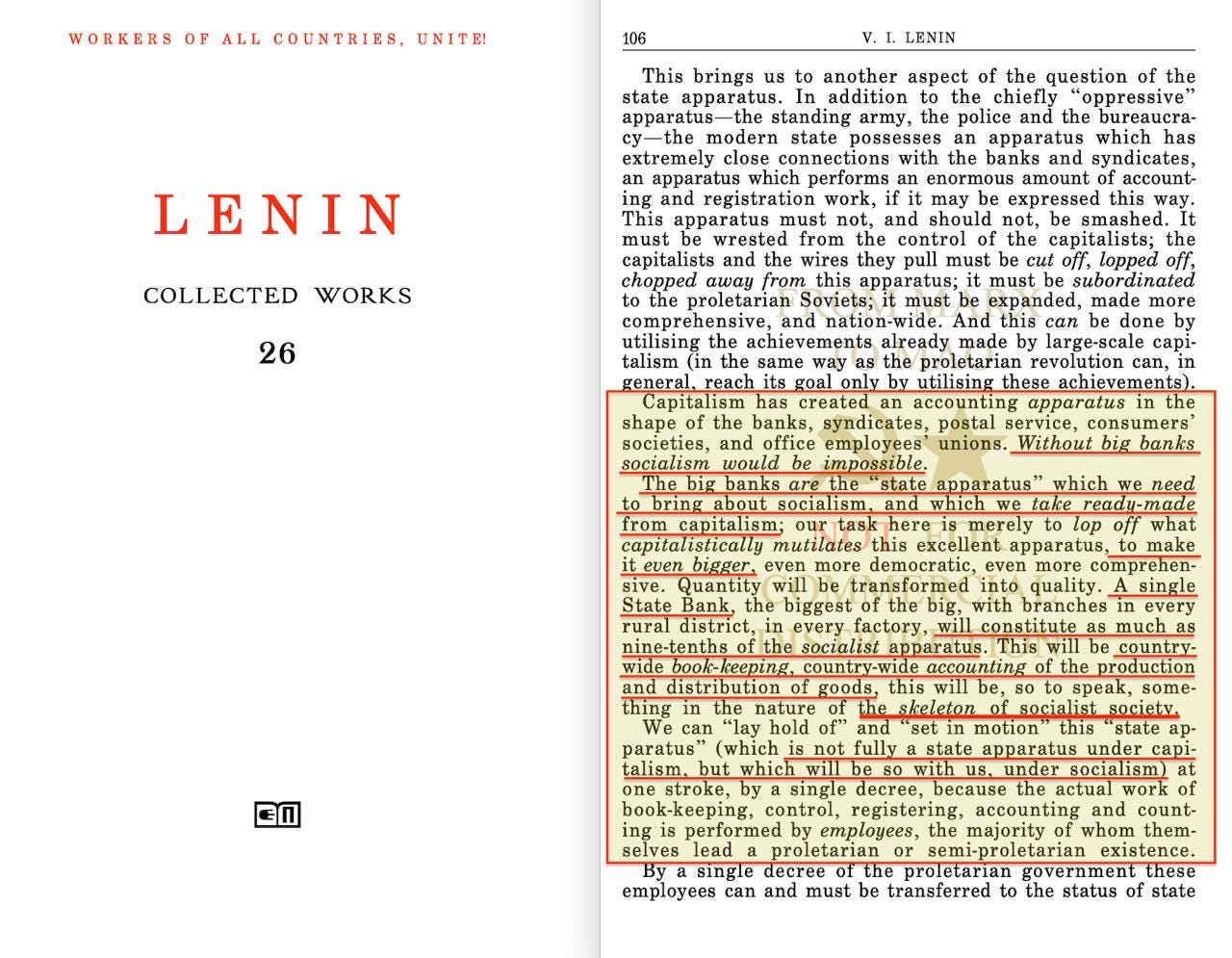
This is how the dictatorship ‘withers’ into the infrastructure, and what it becomes is a technocratic apparatus — centralised control of all flows through a system of surveillance and audit.
Hughes identifies technocracy as the enemy while recommending the framework whose terminal specification is technocracy. The only difference between his diagnosis and his prescription is who’s in control — if even that.
As it transpires, the pattern has precedent. The Freedom Academy bills of 1959–1965 proposed fighting Soviet ideological infrastructure… by building a Western replica of it — importing the opponent’s architecture under a different flag. The problem remains identical: you cannot construct a mirror image of a totalising system without becoming one.

But the template is not unique to Hughes.
Game B runs the same architecture under different branding: a population sorted by awareness of the ‘meta-crisis’, a tight core that possesses the correct analysis, abstract prescriptions for an ‘omni-win civilisation’ that is never specified, and a terminal destination that — when it surfaces — is AI-managed coordination through centralised information clearinghouses.
The vocabulary is different, but the structure is identical. And the endpoint is — once again — technocracy.

The Camp 2 guide is not merely descriptive — it’s operational. Any independent analyst with a following who doesn’t route their work through Marxist class analysis is — by the framework’s criteria — an ‘economist’ occupying space where revolutionary consciousness should develop. The guide exists to identify and discredit them, and the indirect approach is part of the method — a direct attack risks drawing the audience’s attention to someone they might find persuasive.
Hughes’s silence follows the same logic: you don’t tell the audience at stage one what stage five requires. The absence of the answer is, as it was for Lenin, the answer.
Hughes presents three camps, but the architecture actually has four levels. Erich Jantsch’s 1970 transdisciplinary model19 — developed from OECD systems theory, which descends from Bogdanov’s tektology20 — stacks them explicitly: empirical, pragmatic, normative, and purposive. The first three map to Hughes’s camps. The fourth — the purposive level, the teleological reason the system exists — is absent from his public taxonomy.
Camp 3 believes it occupies the top tier. It doesn’t. It’s the normative level: people with the correct analysis who don’t know what the analysis is for. And should they change their minds, they’re back in camp 2.

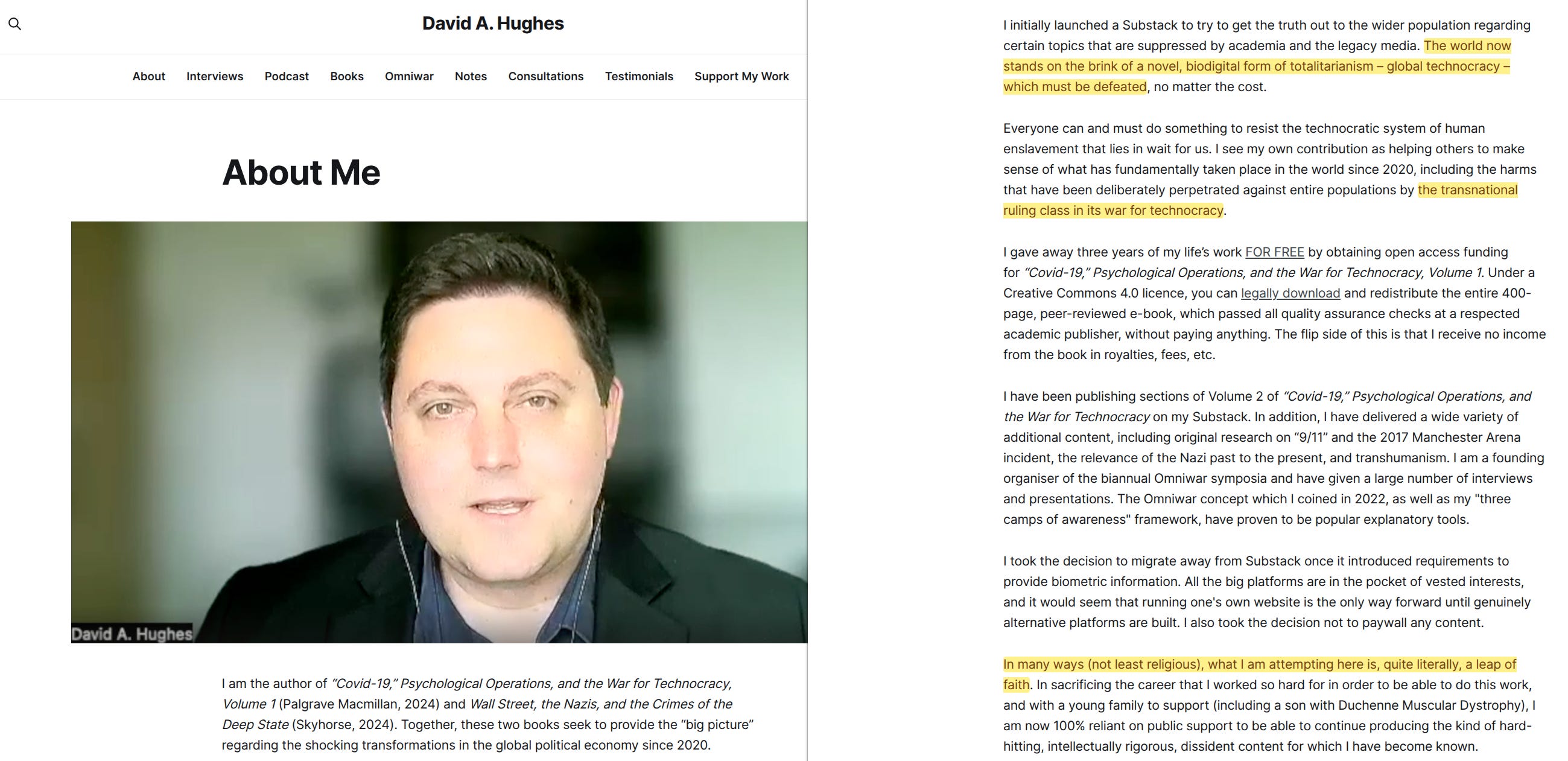
On his About page21, Hughes describes what he's doing in terms Marx would strongly disagree with. ‘In many ways (not least religious)’, he writes, ‘what I am attempting here is, quite literally, a leap of faith’.
The framework's gate criterion is Marxist class analysis which treats religion as ‘Opium for the People’22 — a false consciousness. The Camp 2 guide classifies spiritual and esoteric explanations as an incorrect lens. And the architect of the system describes his own project as ‘not least religious’ — and his own method as faith.
The sorting criterion for Camp 3 isn't analysis — it's belief. He tells you so himself.
But this belief ultimately represents a false choice, because his undefined prescription ends up in the same place as the Technocracy he warns about.


Find my Telegram channel over here.
Excellent article, thank you! Marxism is one of many similar ideologies that feeds the "intellekshual" classes - those who lack own resources (have been dispossessed long ago and/or too lazy to create any real economic value) but want to dominate the "unitellekshual" workers. These ideologies are old as dirt, and all boil down to centralizing the resources of the community so that the chiefs can lord over the enslaved tribe easily. This grows to the feudal system, the kingdom and ultimately, to an empire. The small group of the lords cannot do anything by themselves. They need the professionalized class enforcing the system for them. Here is where the impoverished "intellekshuals" (intelligentsia in Lenin's time) become useful. They can be easily lured into the apparatus by some desk job that requires no special skills except reading and writing, but more importantly it requires a special personality trait - the deep feeling of many grievances, jealousy, anxiety, anger, overblown feeling of own self importance - i.e. a "Karen" prototype. These are picked out from the masses and given special appointments in the layer of academic priesthood. It feeds them both as a profession and as a form of religion. It preferentially attracts people who are very susceptible to the idea that they have that unique "class consciousness" or "vanguard" or "professional revolutionary" abilities to figure out all the world problems, write the book and teach the "correct" way out of those world problems. This is nonsense. We know how it worked with the Russian Revolution (which was not spontaneous, was organized by Central Banks, the British, the Germans, who funded Lenin, squashed any grass roots, any non-revolutionary peaceful and lawful reform effort, etc. and lead the mass slaughter and enslavement for nearly a century). But hey! they just didn't read Marx correctly, according to the modern day Marxist professors.
I believe you have subtly but significantly distorted Hughes message. What I have understood from my reading of Hughes and listening to his talks is that Camp 3 is composed of those who claim NOT to know, but to be engaged in continued information gathering in an ongoing quest for understanding. They seek to identify lies, more than to reveal truths. Those in Camp 2 have correctly identified some truths, but fail on epistemological grounds by reaching premature closure on what the truth is. Rather than recognizing the evolving, evanescent and ultimately intangible qualities of truth they require definitive answers, which they often claim to have, but they are inevitably distorted since reality is never as cut and dry as they would have it. I do not believe Hughes is a Marxist or Leninist. Your analogy to Leninism is accurate in some respects, certainly thought provoking, but does not map entirely accurately to Hughes' camp schematics.