
The Predictive State
A Follow-Up to ‘Skynet’

The ‘Skynet’ essay covered two deployments; this follow-up shows the same pattern spreading across public-facing agencies, and beyond the United States. Budget cuts or expanding missions push demand beyond what people can handle; AI fills the gap, oversight gets pushed further down the chain, and classification or sheer complexity makes outside review harder.
Skynet, in short, is booting up on both sides of the Atlantic.
Find me on Telegram:

The Regulatory Layer
FDA — Drug Approval Decisions
On December 1, 2025, the FDA announced it will use agentic AI for ‘pre-market reviews, review validation, post-market surveillance, inspections and compliance’1; 70% of staff already use Elsa, an earlier AI tool2.
DOGE cuts left the FDA about 20% understaffed, and the Office of Digital Transformation is reportedly down around 40%34. Reviewers working on AI and brain-computer interfaces were hit especially hard5 — a field UNESCO has flagged as needing stronger safeguards for dignity and autonomy. That capacity crunch makes agentic triage the default approach to review.
‘It’s really a nightmare,’ one FDA official told Axios. ‘Things that used to function are no longer functioning’6.
IRS — Audit Selection
The IRS is expanding AI-driven audit selection7; TIGTA lists 68 AI modernisation projects (27 related to enforcement) as DOGE cuts remove nearly a third of revenue agents89. The models scan returns for inconsistencies, flag high-risk taxpayers, and rank cases for follow-up. Audit risk increasingly becomes something the model defines, while human judgment — and the ability to challenge it — keeps shrinking.
Social Security Administration — Benefits Processing
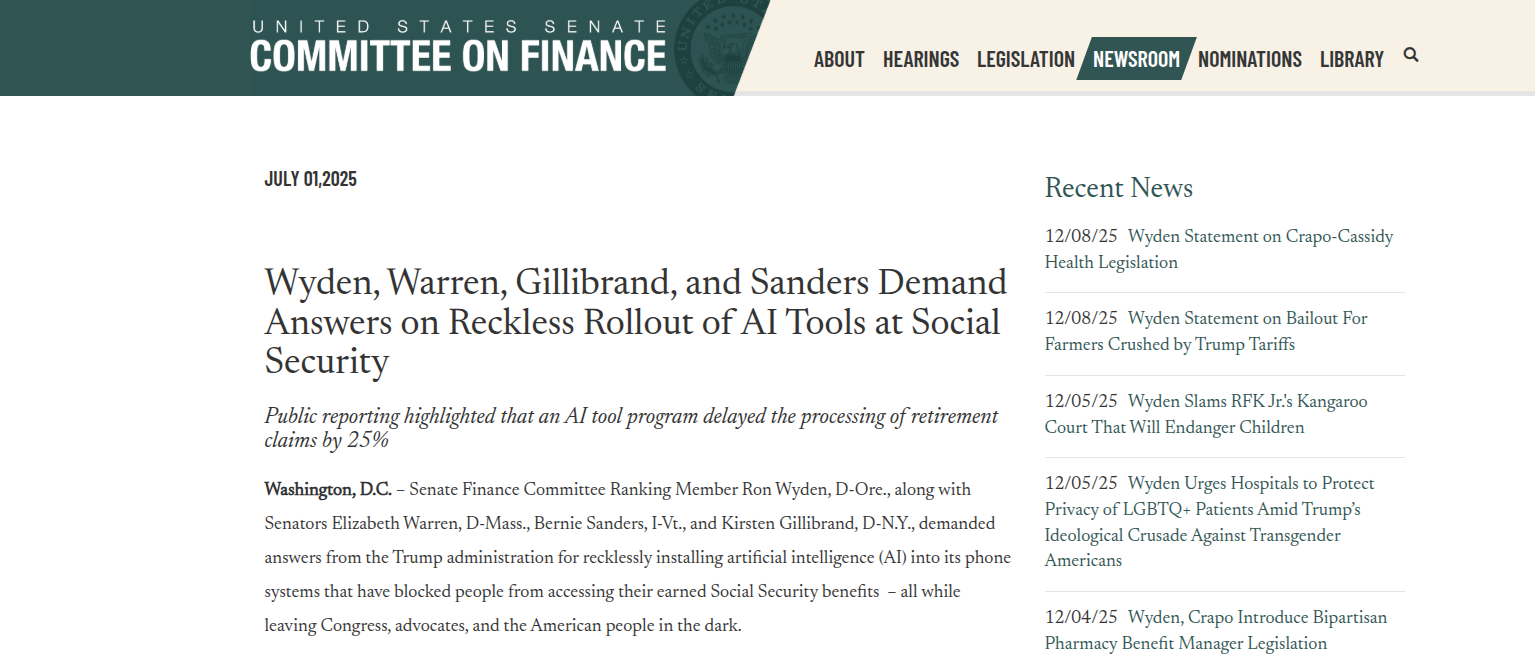
In September 2025, the SSA automated 1.6 million of roughly 5.1 million 800-number calls and used AI to speed up $15.1 billion in retroactive payments1011. A fraud-detection chatbot was rolled back after it produced only two potential flags out of 111,000 calls, which triggered Senate scrutiny12.
For 73 million Americans receiving benefits13, the government interface is increasingly mediated by systems that can still hallucinate. UNESCO recommends AI interactions that are identifiable and easy to refuse — a tough fit with large-scale call deflection.
The Surveillance Layer
DHS — 105 AI Use Cases
DHS’s 2024 inventory lists 105 AI use cases in immigration (up from 39 in 2023); CBP operates 591415. The system is drifting from border enforcement toward domestic, city-level surveillance16. The Northern Border programme runs 22 sites aimed at ‘complete domain awareness’17; sixteen use cases involve facial recognition.
The Classified Layer
Azure OpenAI Service is now authorised for all U.S. Government classification levels, including top secret (ICD503)1819. Palantir’s AIP, Gotham, Foundry, and Apollo run in Azure Government Secret and Top Secret clouds20. In practice, more and more national security decision-making is happening on commercial AI infrastructure.
The Defence Consolidation
In December 2024, Palantir and Anduril announced a consortium ‘to ensure that the US government leads the world in artificial intelligence’21. The partnership combines Palantir’s data integration with Anduril’s autonomous systems22.
Palantir holds the $480 million Maven contract for AI-driven battlefield analysis; Anduril holds a $100 million CDAO award for edge integration and Lattice mesh networking23. Their stated problem: ‘Exabytes of defence data, indispensable for AI training, are currently evaporating’. Military operations generate huge volumes of data that older systems struggle to store and connect. Meanwhile, Palantir’s market value has surged to $169 billion — surpassing Lockheed Martin24.
Security Concerns
An internal Army memo assessed the Anduril-Palantir NGC2 platform as ‘very high risk’: any authorised user could reportedly access all data regardless of clearance level, with no logging25; and third-party apps reportedly contained dozens of high-severity vulnerabilities. Anduril said these concerns ‘have been addressed’26.

Predictive Enforcement
DOJ — From Investigation to Prediction
In June 2025, the DOJ’s National Health Care Fraud Takedown charged 324 defendants ($14.6 billion in intended losses)27 using a new Health Care Fraud Data Fusion Centre. It draws on AI, cloud computing, and advanced analytics to spot patterns before cases are even reported. The DOJ called this ‘a fundamental shift from reactive investigation to predictive enforcement’.
This looks a lot like anticipatory governance28 — the framework Al Gore and Leon Fuerth outlined in the 2000s — now put into practice. The state no longer waits for violations to surface; it models risk and intervenes earlier. A December 2024 report on AI in criminal justice described use across the system: biometrics, facial recognition, automated licence plate recognition, predictive policing, and sentencing risk assessments29. The state increasingly sees through AI systems — and uses them to predict which citizens may need intervention.


The Capacity Pattern
     Condition         AI Insert Point  Decision Type  Gap
---  ----------------  ---------------  ------------  ---------------
FDA  20% staff cut;    Agentic          Drug          Speed exceeds
      40% tech office   review AI        approval      review
IRS  ~1/3 revenue      Audit selection  Enforcement   Algorithm
      agents cut        models           targeting     opacity
SSA  Service load +    Automated call   Benefits      Hallucination
      staffing crisis   handling         access        risk
DHS  Mission           105 use cases    Surveillance  Classification
      expansion                          /entry
DOJ  Enforcement       Predictive       Prosecution   Pre-crime
      scaling + data    enforcement      targeting     logic
      fusion
The pattern is consistent: trigger → AI insertion → oversight pushed downstream → limited external visibility. Each rollout responds to a real capacity problem — which is why the pattern keeps spreading. UNESCO’s framework is more conditional than most summaries admit, but capacity-driven rollouts flip the sequence: adoption first, justification later.
The Integration Pressure
What stops FDA review, IRS targeting, SSA triage, DHS surveillance, and DOJ prediction from becoming parts of the same system? A standardised identity–cloud–model–compliance stack across agencies makes interoperability the default choice in procurement. Shared data improves models. And externally defined ‘AI ethics’30 becomes the default mode of governance31.
UNESCO explicitly encourages a ‘digital commons’ approach to data32, greater interoperability of tools and interfaces, and collaborative trusted data spaces. In a vendor-standardised environment, that kind of guidance can speed up cross-agency model alignment.
Integration won’t arrive as a headline. It will show up gradually, buried under other headlines.
The Control Plane
What governs this surface?
The clearest global rule-set sits at the top: the UNESCO Recommendation on the Ethics of Artificial Intelligence (2021), backed by 193 member states33. It sets the core language, without precisely defining what each term means in practice: human dignity, fairness, transparency, human oversight, accountability. UNESCO recommends Ethical Impact Assessments for public-sector AI34, including monitoring across the system’s lifecycle and formal ways for citizens to take part. It also frames human oversight as something that can include public oversight, not just internal sign-off.
The control plane is where norms turn into settings:
Set globally — UNESCO principles, 193 states
Interpreted by vendors — reward signals, refusal policies
Enforced through money — CBDC conditional payments
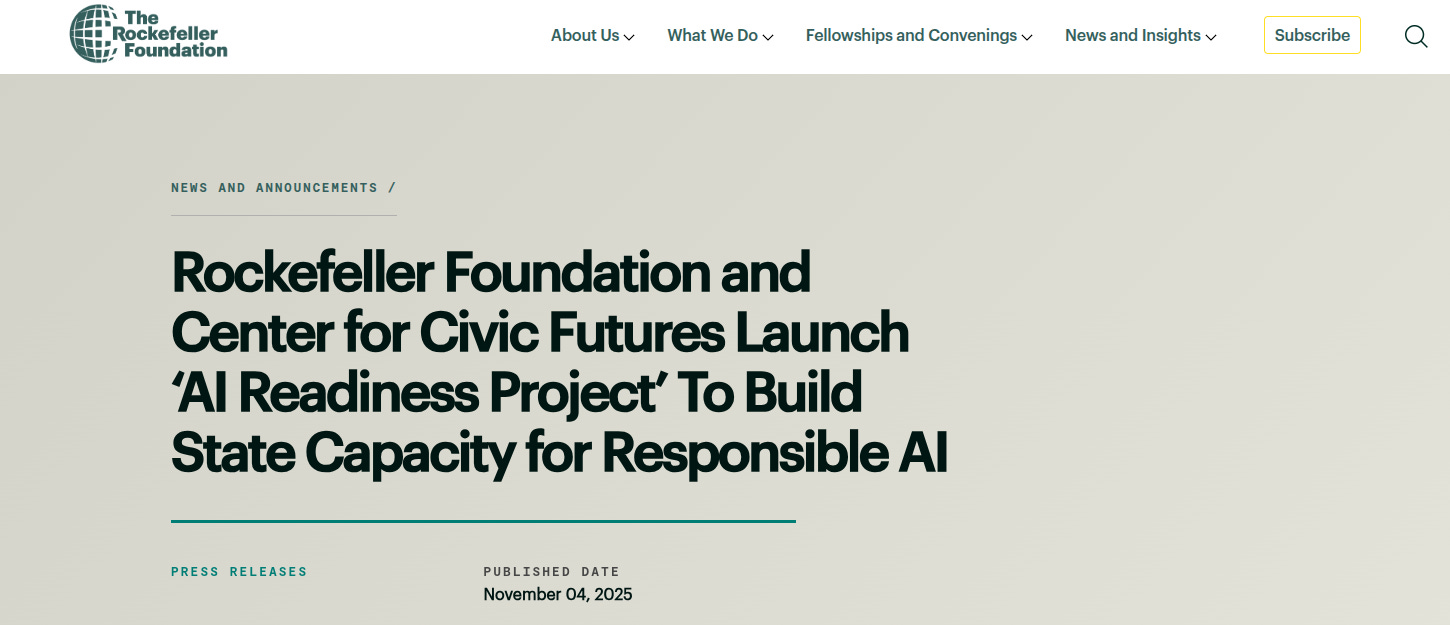
UNESCO provides the principles; vendors translate them into reward logic and refusal policies; agencies inherit those constraints when they deploy AI. Agencies can define use cases and add guardrails, but they don’t control the underlying reward logic built into the base models they rely on.
Right now, this normative peak has no direct enforcement mechanism. But the conditions for one are starting to take shape.
Moses Hess35 is an early hinge in this architecture. He helped establish the idea that social justice is not just a moral aim, but a structural requirement: the economy is the channel through which morality becomes real. In his framing, justice is embedded, not merely legislated. That’s an early version of governance-by-infrastructure: the ethical goal becomes a design requirement, and the economy becomes the enforcement mechanism.


Project Rosalind36 (BIS Innovation Hub, Bank of England, 2023) developed an API design for retail CBDCs that can enable conditional payments — a three-party lock where a third party clears the transaction between payer and payee. Conditions could include time limits, geographic restrictions, or compliance checks such as carbon credit availability. If this link is formalised — even partly — the ethics layer gains real-world monetary force. Non-compliance becomes transactional: a gate on economic participation.


Once enforcement runs through payment rails, a social credit-style regime becomes structurally possible — more a matter of settings than public policy announcements. Approved purchases clear instantly; flagged transactions get held for review; repeated non-compliance can trigger step-by-step restrictions. China has implemented a more explicit version of this logic. A Western version wouldn’t need to be named to work in similar ways.
Read cybernetically, this starts to resemble a functional version of Marx’s fifth plank: the centralisation of credit through a state bank with an exclusive monopoly. We don’t yet have a single world central bank. But we do have growing standardisation of payment rails, compliance rules, and data-driven risk scoring that could converge into something plank-5-like in effect. Once credit is centralised and programmable, other policy goals can be delivered through it. AI becomes the administrative engine that makes high-speed centralisation workable — triaging claims, linking data, accelerating decision cycles beyond human oversight, and turning conditionality into default infrastructure. Plank 5 is the keystone; AI makes it scale.

The translation layer — where principles turn into settings — sits with companies. The enforcement layer — where compliance becomes a condition of payment — sits with central banks. UNESCO provides the vocabulary. The vendors write the dictionary.
UNESCO warns against abuse of dominant market positions across the AI life cycle — a concern that becomes sharper when public-sector AI is routed through a handful of providers.
Yet it’s UNESCO who sets the global ‘ethics’ principles37. A handful of companies implement them through AI, while central banks control the monetary gate. One Hessian control plane — ethics embedded in economic infrastructure — operating outside sovereign control.



The International Parallel
The original essay treated Phase 3 — global export — as something still ahead. But international rollout is already happening in parallel.
United Kingdom — The Clearest Parallel
The same capacity-crunch pattern shows up:
Civil Service: 10,000+ job cuts38; Cabinet Office shedding 2,100 roles39 (a third of workforce). ‘Humphrey’ AI tools deployed to ‘cut back on consultant spending and speed up work’40. Target: 15% cost reduction through AI41.
NHS: KPMG advised NHS Grampian to replace up to 40% of back-office staff with AI to address budget pressures42; Microsoft 365 Copilot trial across 90 NHS organisations43; £180m framework for AI diagnostics and predictive analytics44.
Platform Consolidation: July 2025 — Google Cloud partnership for public services modernisation (100,000 civil servants to be trained)45; same month, OpenAI strategic partnership signed by Peter Kyle and Sam Altman46.
Infrastructure: £14 billion committed for data centre buildout47; ‘AI Growth Zones’ to fast-track planning permission48.
Predictably, Fabian capacity logic supplies the UK justification layer: a hollowed-out state, rising mission complexity, and the political need for faster throughput. Once that story becomes common sense, AI insertion stops looking like a constitutional rupture and starts looking like responsible modernisation4950.
Mission accomplished.

European Union — Slower but Converging
The EU may move more slowly on the legal front, but it’s catching up quickly on infrastructure:
April 2025: AI Continent Action Plan to ‘make Europe a global leader in AI’51
October 2025: Apply AI Strategy — ‘accelerating AI adoption across strategic sectors and the public sector’52
11 sectoral flagships including healthcare, defence, public sector53
AI Factories and Gigafactories for large-scale computing infrastructure54
€1.3 billion Digital Europe Programme 2025-202755
Cloud and AI Development Act in progress to address reliance on non-EU providers56
Member states aren’t waiting for Brussels. Denmark’s Muni chatbot now serves 37 municipalities57; Estonia’s Kratt framework links 120+ public agencies through interoperable AI58.

The Vendor Convergence
Google, Microsoft, and OpenAI are signing partnerships with UK, EU, and US governments in the same window59: the US (Genesis, GenAI.mil) in November–December 202560; the UK (Google, OpenAI) in July 2025; the EU (Apply AI Strategy) in October 202561. Same vendors, same efficiency story, same capacity squeeze creating the opening.
The same habit of not asking voters first.
The ‘single surface’ risk isn’t national but transnational. Data centres are the base layer; what runs on them is increasingly the same commercial AI infrastructure, no matter which flag flies over the building.


What Runs on This Hardware
The ‘Skynet’ essay argued that the constitutional order was designed for a different kind of machine. This follow-up shows the mismatch isn’t theoretical.
The infrastructure runs at a different speed. By the time oversight meets, the system has already iterated. By the time legislation is drafted, the parameters have changed. By the time public debate takes shape, capacity has been cut and the AI is already in place. Anticipatory governance was originally framed as foresight in support of democratic deliberation.
What’s emerging now is anticipatory governance without the deliberation — prediction as an administrative done deal. The direction of travel is clear: surveillance translated into ‘SDG indicators’62, fed into Digital Twins for forward modelling63. In that world, ‘fairness’ stops being a value debated in public and becomes a threshold enforced by Artificial Intelligence — with the risk of automatic targeting of those who diverge from what the system defines as ‘acceptable’ outcomes.
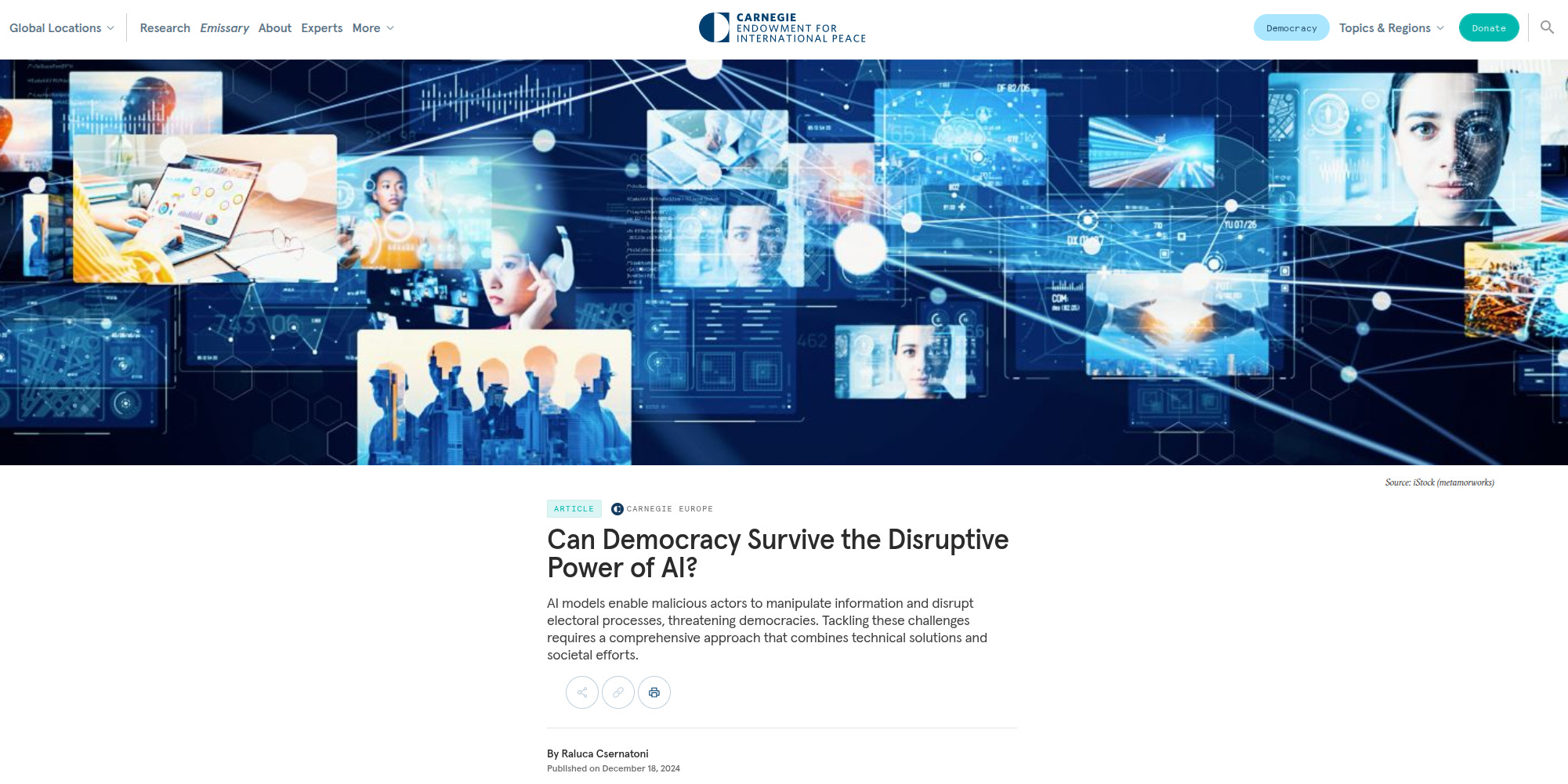
What’s changing is how legitimacy gets produced: from judgment to throughput, from deliberation to triage, from accountability to permission boundaries. The question is whether democratic oversight can move faster than the system’s update cycle64.
Carnegie doesn’t appear to think so.


The more of your essays that I read, esc, the more I realize that everything we are seeing, and hearing, from everyone, is theater. There were a few that I thought I could continue to hang with; but you've ruined that for me. I was on to the obvious actors who are knowingly deceiving us, but there were a few that seemed smarter than the rest, and not acting... but now I see that they are just clueless... and rearranging chairs on today's Titanic. It's ludicrous. I should thank you for saving me a lot of time. By helping me to see though the nonsense, it forces me to leave them all behind. And I've reached the point where there's no one in my world to talk with about your essays, as no one will keep up. I'm not pretending like I really understand all that you're writing about - I'm a healthnut for goodness sakes - but I figure that over time, I will become familiar enough with the terminology, the mechanisms, and the players, so that I will be able to engage with others, given the opportunity. Right now, I'm in total sponge mode.
How do you keep producing this volume of research and writing ? That alone blows my mind. You cover the <big picture> structure link in my latest piece. I think of it as an information tapestry fiber art project. Weaving. It's my best hope for organizing my thinking thru time at least. Used the piece that summarizes yr 'architecture' series. Keep pattern recognizing, Repeating the warning about the payment rails social credit until most people can see the risk... thanks!