
Hitler's Third Way

The 1942 Nazi report (Europäische Wirtschaftsgemeinschaft) didn’t invent the system — it detailed one already running.
Records trace the programme’s core ideas to before Hitler came to power, showing it went underground after 1923 and resurfaced in private chats, secret memos, and public speeches that were reported worldwide but never linked together.
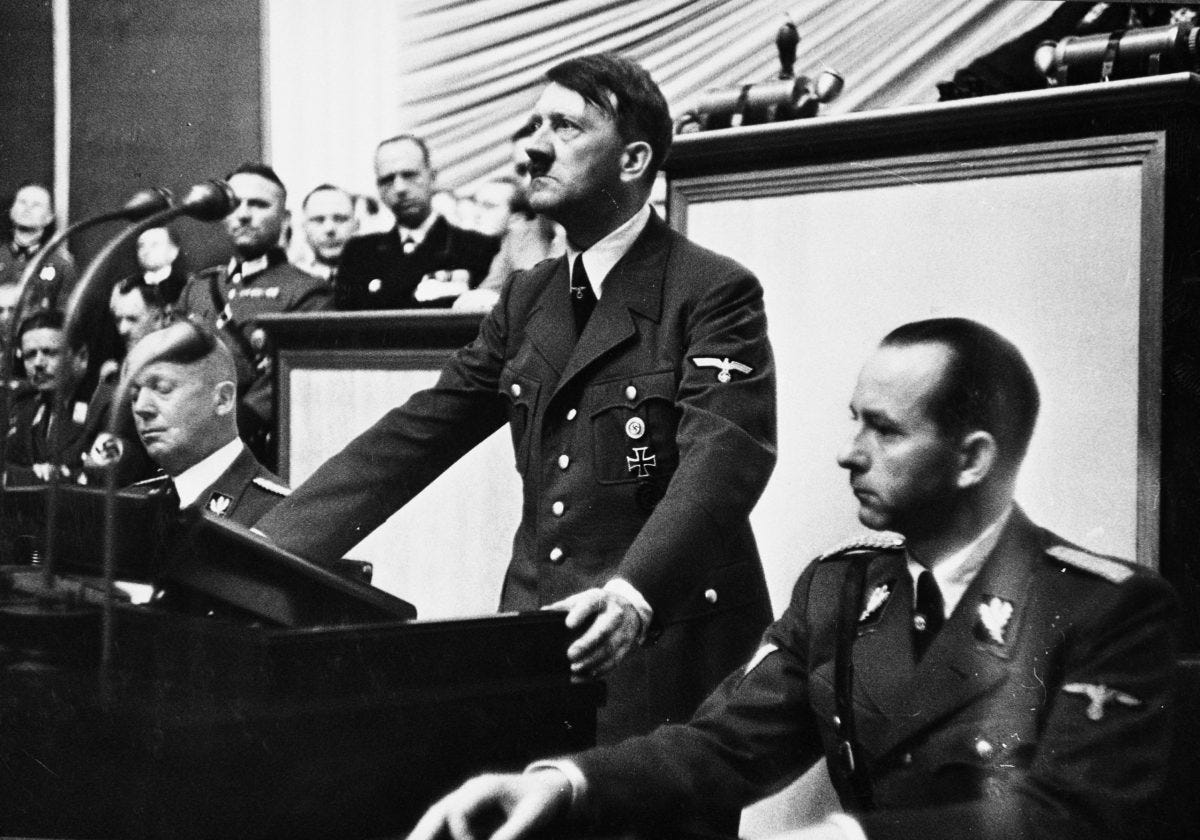
The propagandist: 1919–1920
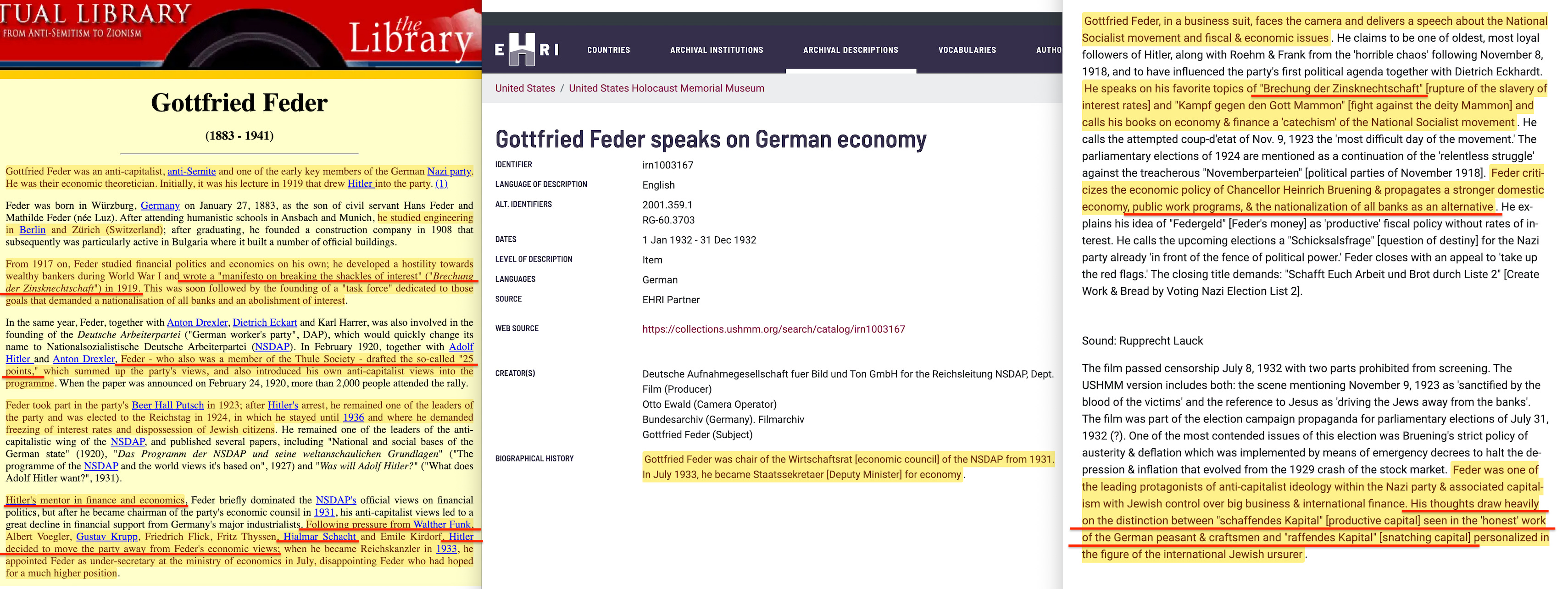
The earliest source is Gottfried Feder. He was a civil engineer who studied in Munich, Charlottenburg, and Zürich — Charlottenburg being the Berlin technical school where economist Julius Wolf taught from 1908 — and he was a member of the Thule Society1. Feder claimed he’d taught himself economics from 1917 onwards.
In June 1919, Hitler went to Feder’s lecture on ‘Brechung der Zinsknechtschaft’2 — breaking the bondage of interest3 — at a Reichswehr political course in Munich. He later called it a revelation in Mein Kampf.
Feder’s programme split capital into productive (schaffendes Kapital) and parasitic (raffendes Kapital)4. Productive capital — investment in industry, farming, infrastructure — was allowed in. Parasitic capital — speculation, interest extraction, monetary manipulation — was kept out. The state had to control money circulation to stop financial middlemen exploiting people.
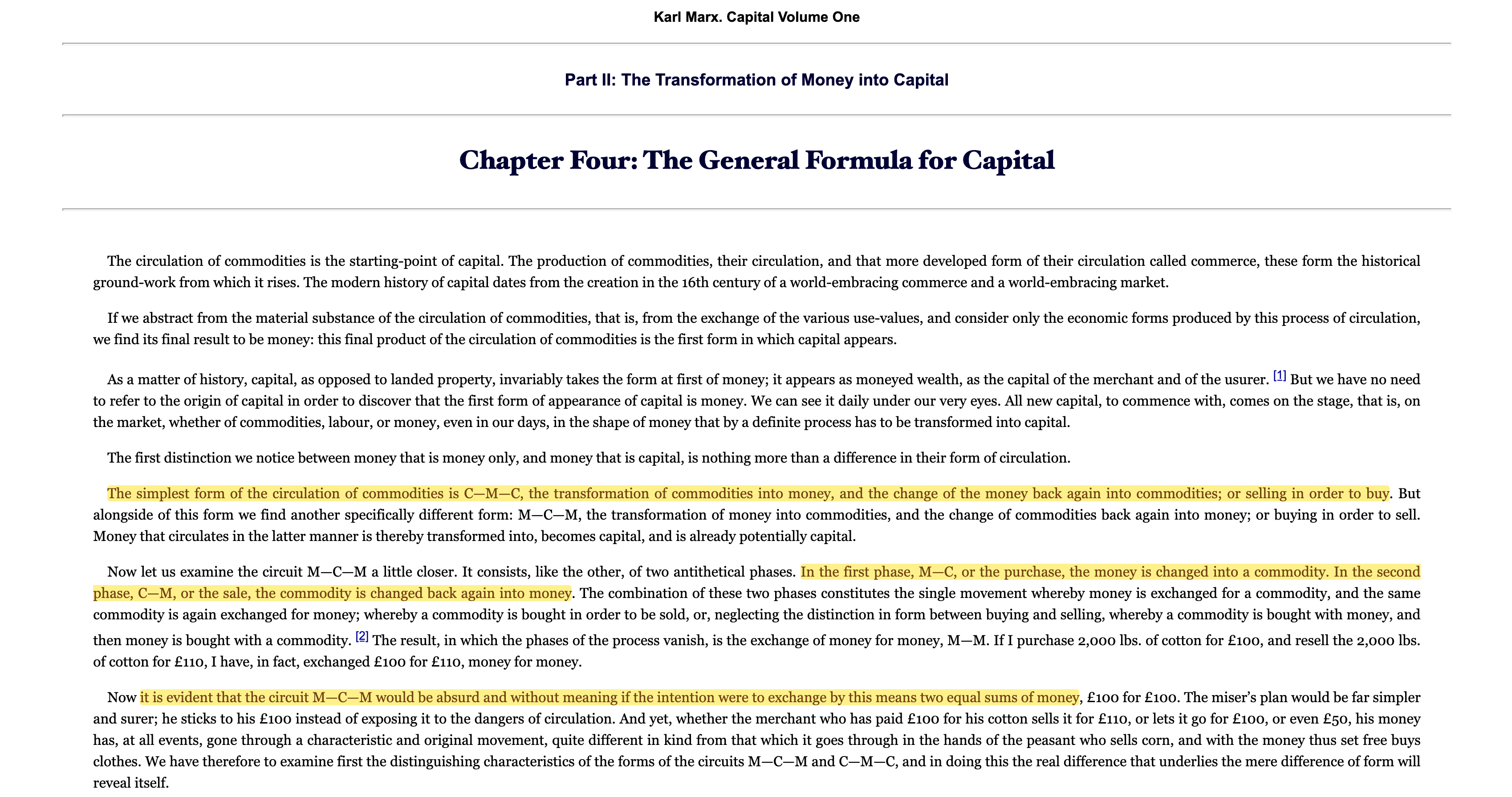
This split wasn’t new. In Das Kapital5, Marx had spotted two money circuits. C-M-C: a worker sells labour for money, then uses it to buy what they need — commodity to money to commodity. Money serves use-value. The cycle finishes and the worker returns because nothing’s accumulated. M-C-M’: a capitalist starts with money, buys commodities or labour, and sells the output for more. Money serves accumulation. The surplus — the extra on M’ — is stored value the capitalist can use as he pleases.
Feder’s productive capital is Marx’s C-M-C. Feder’s parasitic capital is Marx’s M-C-M’. The moral language changed — Marx called M-C-M’ exploitation, Feder called it racial parasitism — but the structure’s identical: flows serving production are allowed, flows serving autonomous accumulation are blocked. The clearing function checks which circuit a transaction belongs to and settles it conditionally.
What Feder said in heated German in 1919 was Marx’s two-circuit analysis in nationalist language. The standard running through the whole programme — which financial flows pass and which don’t — came from Das Kapital67.

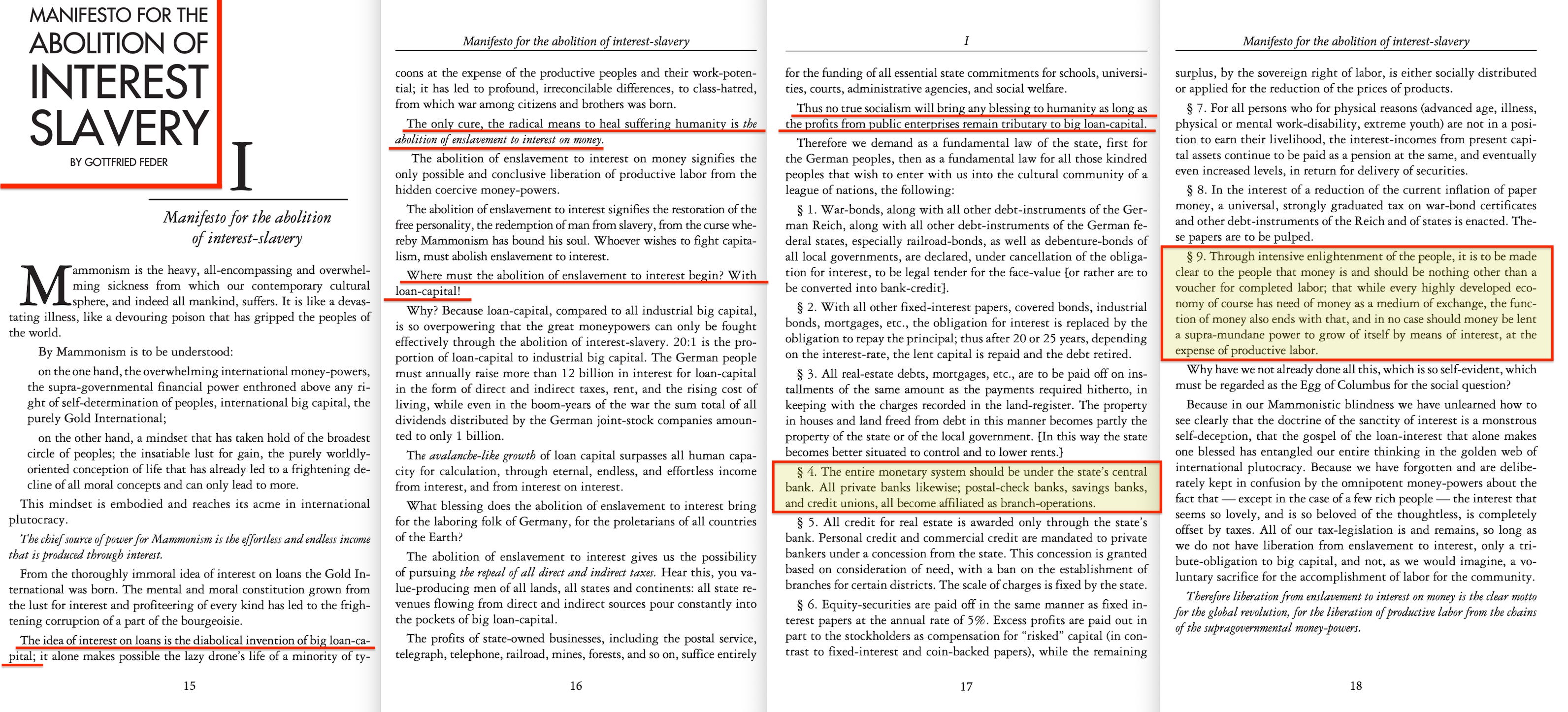
Feder’s manifesto went beyond the evaluative standard — it specified the institutional mechanism too. Section 4 proposed putting the entire monetary system under the state’s central bank, with all private banks, savings banks, and credit unions becoming affiliated branch operations. The state bank would serve as the single gate through which all monetary flows passed — the clearing function made institutional.
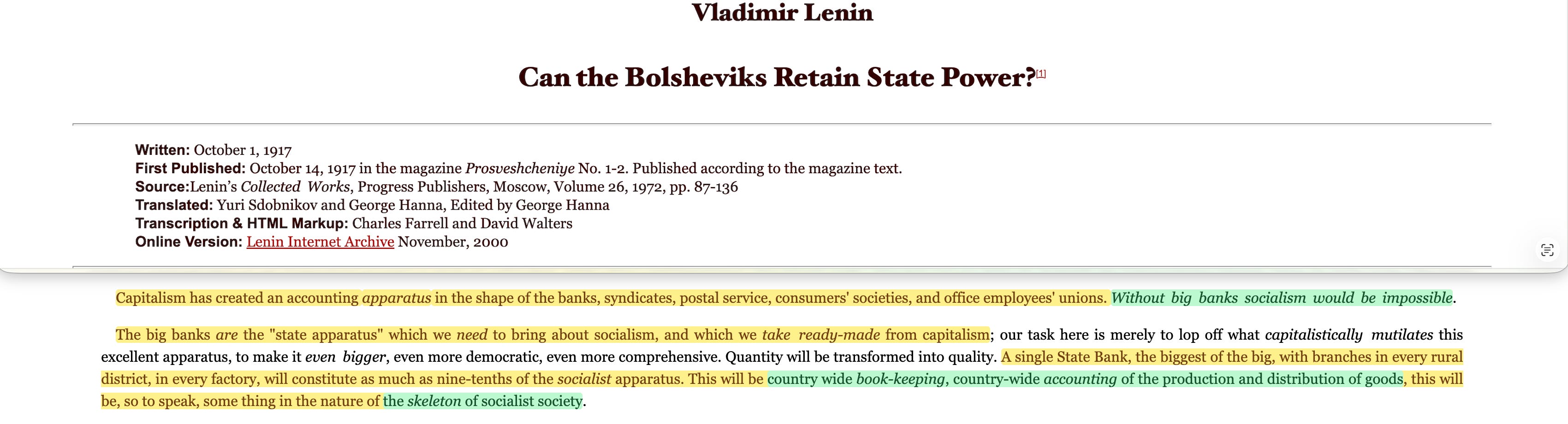
The structural parallel with Lenin is striking. In 1917, Lenin described the banking apparatus as nine-tenths of the socialist apparatus and called for nationalising all banks into a single state institution8. Whoever controls the accounting infrastructure controls the economy. Feder reached the same institutional specification from the opposite end of the political spectrum — not through class analysis but through nationalist populism.
Section 9 then stated the principle plainly: ‘money should be nothing other than a voucher for completed labour, and mustn’t be lent a supra-mundane power to grow of itself through interest at the expense of productive labour’.
This, too, came from Marx.
In the Critique of the Gotha Programme9, Marx had suggested replacing money with vouchers based on socially necessary labour time — non-transferable, tied to identity, destroyed when used. The worker gets a certificate for their labour, cashes it at a distribution point, and the certificate is cancelled. No circulation, accumulation, or secondary market. Money stops being a store of value and becomes a conditional, single-use permission to consume. Feder restated the idea without Marx’s framework, but the specification’s the same: money as a voucher for completed labour, measured in work rather than gold, acting as a claim against the system rather than a tool for independent exchange.
The same idea pops up in four completely different contexts over the next twenty-three years. Funk said ‘Work is more solid than gold’ at Leipzig in 193810. Hitler said ‘Die deutsche Arbeitskraft, das ist unser Gold’ — German labour power, that’s our gold — in December 194111. Beisiegel closed his chapter in the 1942 volume with ‘Europas Arbeitskraft ist Europas Kapital’ — Europe’s labour power is Europe’s capital.
One idea, four sources, moving from street-level propaganda to banking-conference language to institutional specification across a single generation. And the specification that began in Marx’s Critique — a non-transferable, expiring, identity-bound, use-restricted voucher redeemable only through system-operated channels — is an exact description of what programmable central bank digital currencies are being designed to do.
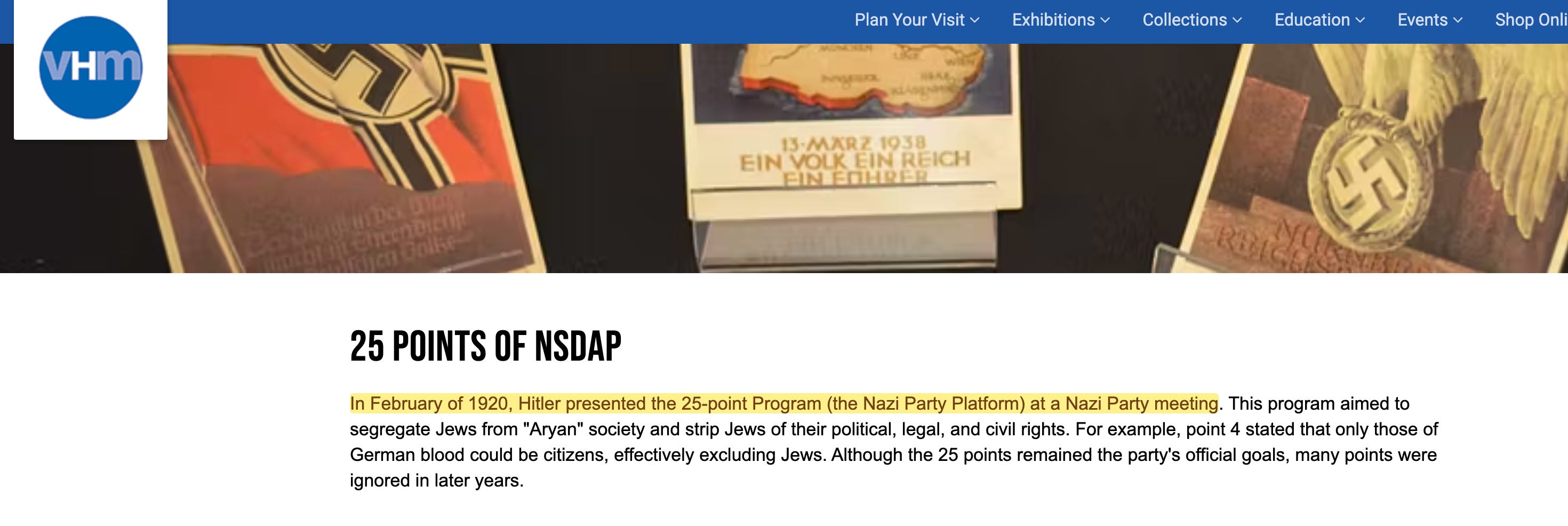
Feder wrote the economic content of the NSDAP’s 25-Point Programme12, announced on 24 February 192013. It called for abolition of interest slavery, nationalisation of trusts, and profit-sharing in large enterprises, while keeping state control of financial circulation and maintaining private productive enterprise.
This ‘third way‘ was stated as party platform twenty-two years before the 1942 volume formalised it across every domain of a continental economy. The content came from Marx, the vocabulary from Feder, and the institutional delivery from Schacht. The pattern — content persisting while the carrier is replaced — was defined before the regime even existed14.

The concealment: 1923–1931
Feder’s path is the programme’s path in miniature. He stated the distinction openly in 1919 and it entered the party programme in 1920. Then, under pressure from Germany’s major industrialists — Vögler, Krupp, Flick, Thyssen, Kirdorf — and especially from Hjalmar Schacht, the conventional account says Hitler ‘moved the party away’ from Feder’s economic views.
The turning point was the failed Beer Hall Putsch of November 192315. After nine months in Landsberg prison, Hitler adopted the legality strategy — the party would seek power through elections rather than armed revolution. But this applied to the method of gaining power, not to the economic programme’s content. The programme couldn’t survive electoral politics if stated openly, because it would unite industrialists, landholders, and bankers against the party at precisely the moment the party needed their tolerance, funding, or neutrality. The programme Feder had shouted from podiums in 1919 had to disappear from public view, but it didn’t vanish from private discussion. It moved into the rooms where the inner circle met.
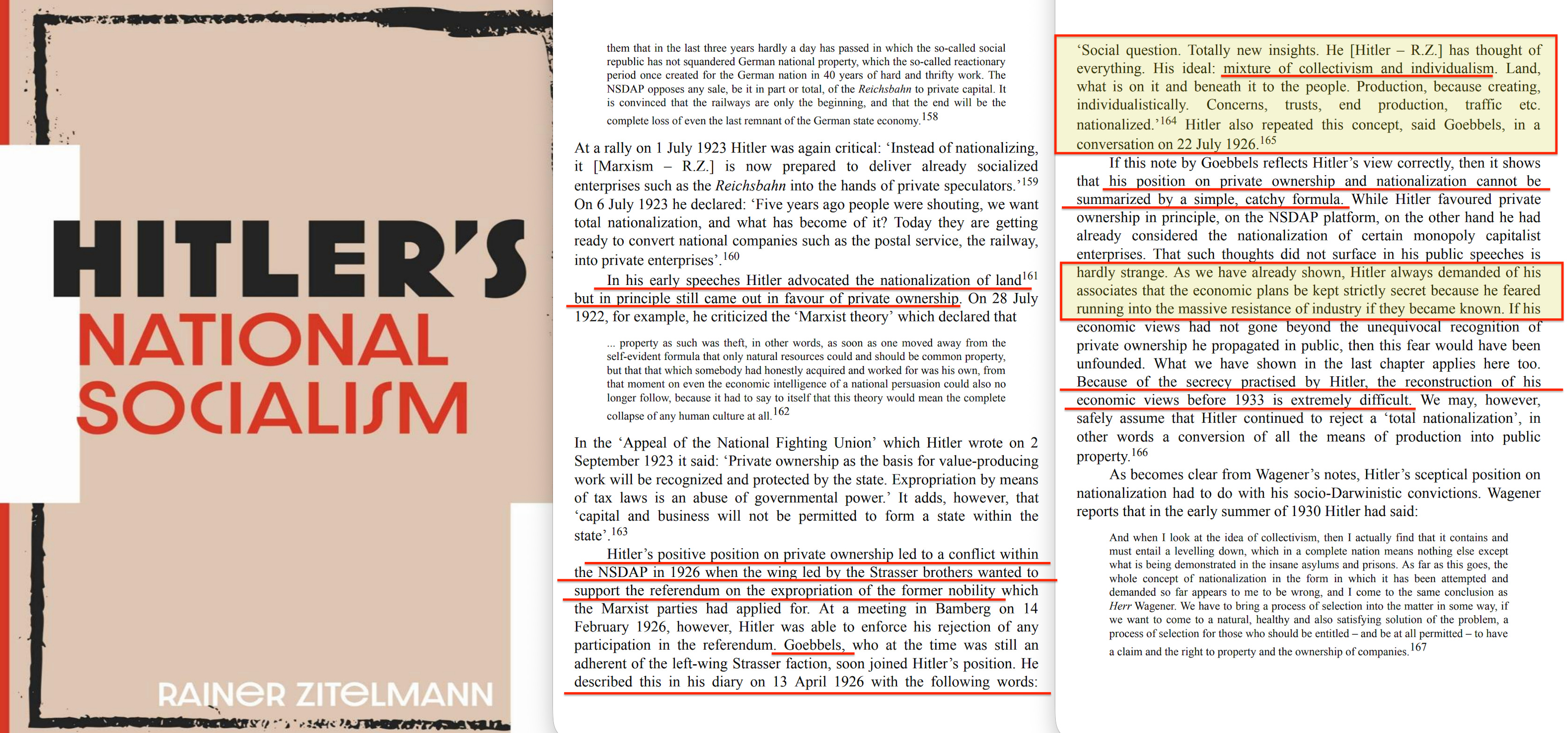
By 1926, the programme had shifted from Feder’s public slogans to Hitler’s private conversations. Goebbels recorded Hitler’s economic vision in his diary on 13 April 192616: ‘His ideal: mixture of collectivism and individualism. Land, what’s on it and beneath it to the people. Production, because creating, individualistically. Concerns, trusts, end production, traffic etc. nationalized’.
The third way — state direction with private initiative kept within the lanes — was stated sixteen years before the 1942 volume, by a second independent witness. But it was stated privately, in conversation, not from a podium.
This section further includes the telling inclusion:
Hitler always demanded of his associates that the economic plans be kept strictly secret because he feared running into the massive resistance of industry if they became known…
Otto Wagener, head of the NSDAP’s Economic Policy Department from January 1931, ran working sessions on economic policy in Hitler’s presence — documented invitations survive in the Bundesarchiv for April and June 193117. Feder and Wagener were rivals in the party’s economic apparatus at this point. Two approaches to the same programme: Feder’s was public, crude, and propagandistic; Wagener’s was private, strategic, and sophisticated. Wagener’s approach won out, and the secrecy instruction explains why.
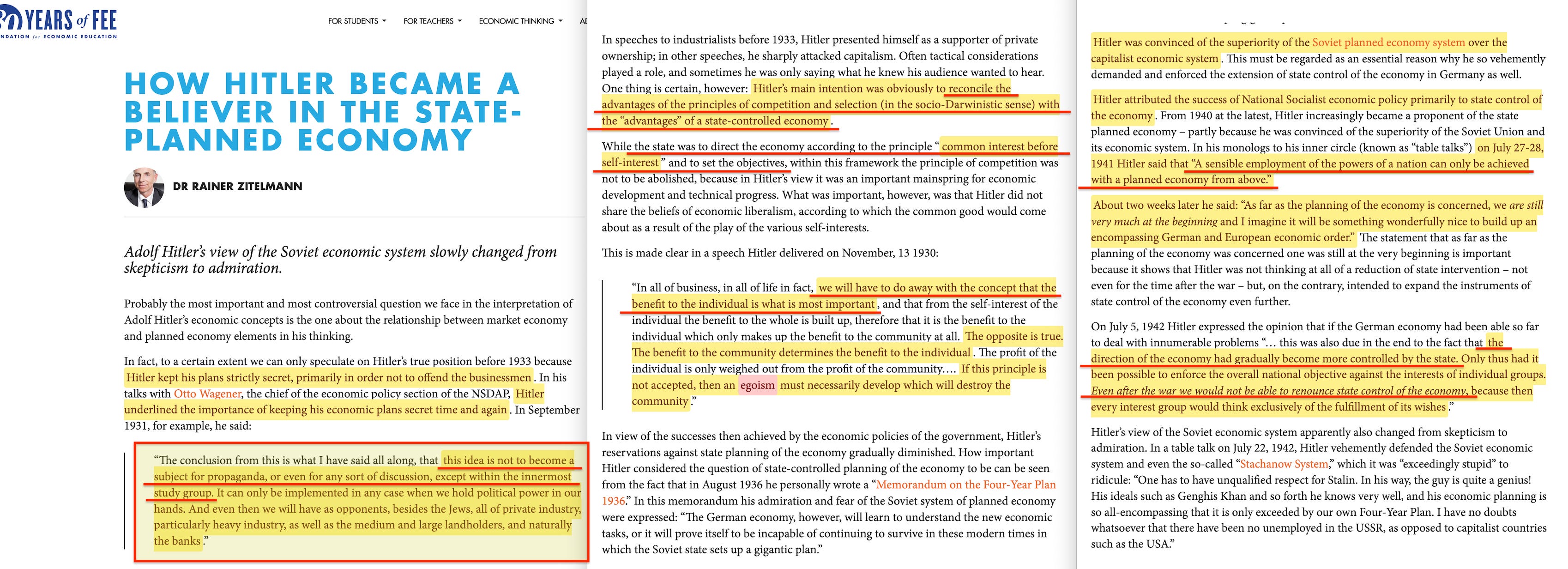
His memoirs, published as Hitler — Memoirs of a Confidant, record Hitler’s active participation and the decisive instruction from September 193118: ‘This idea’s not to become a subject for propaganda, or even for any sort of discussion, except within the innermost study group. It can only be implemented when we hold political power in our hands’.
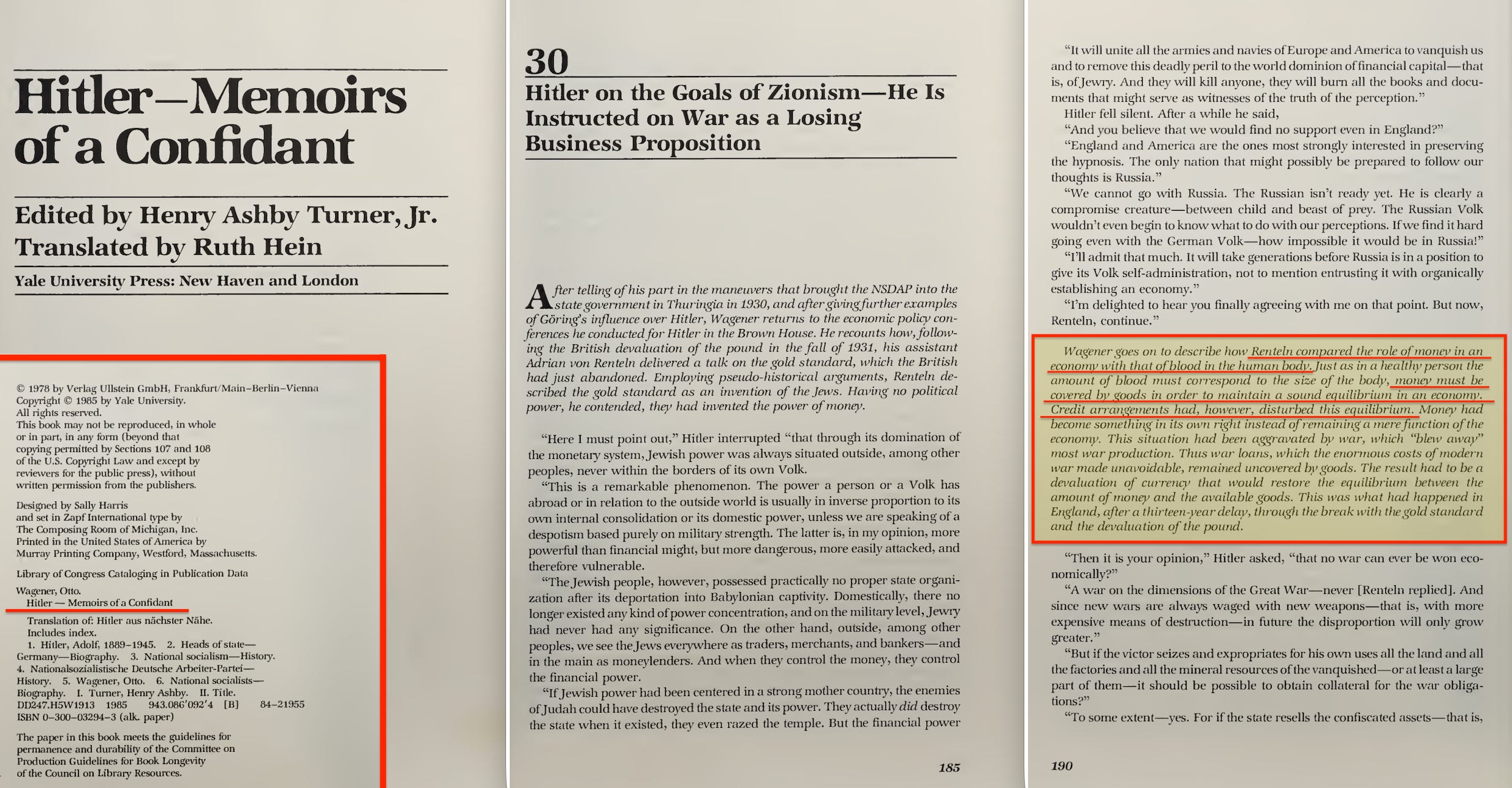
Wagener noted his assistant Adrian von Renteln likening money in the economy to blood in the body: ‘just as a healthy person’s blood must match their body size, money must be covered by goods to keep the economy balanced’. That’s Moses Hess’s soziales Blut from 1845 — money as social blood, the economy as organism, the clearing function as circulatory management — restated without attribution.

Hitler understood three things before taking power: the economic programme existed, it had to stay hidden from the constituencies whose support he needed, and its opponents would include not only the political left but ‘all of private industry, particularly heavy industry, as well as the medium and large landholders, and naturally the banks’.
Schacht himself wrote that he’d ‘had to try to steer Hitler away from these destructive conceptions’19. The word try carries weight the conventional account ignores, because the documented record shows that what Schacht steered Hitler away from was stating the programme publicly, not holding it privately.
Historian Rainer Zitelmann, using the same Wagener source and Hitler’s wartime table talks, backs this up. Hitler’s main aim, Zitelmann concludes, was to mix competition with a state-controlled economy — the third way. By July 1942, the same year the volume came out, Hitler called it permanent policy: the economy’s direction had ‘gradually become more controlled by the state’, and ‘even after the war we wouldn’t be able to renounce state control of the economy, because then every interest group would think exclusively of the fulfilment of its wishes’.
The programme wasn’t a wartime emergency. It was the intended peacetime order — confirmed by the man at the top that same year.

The public statements: 1935–1938
Hitler’s public economic speeches and his real vision were deliberately far apart for years. But the programme didn’t stay completely hidden.
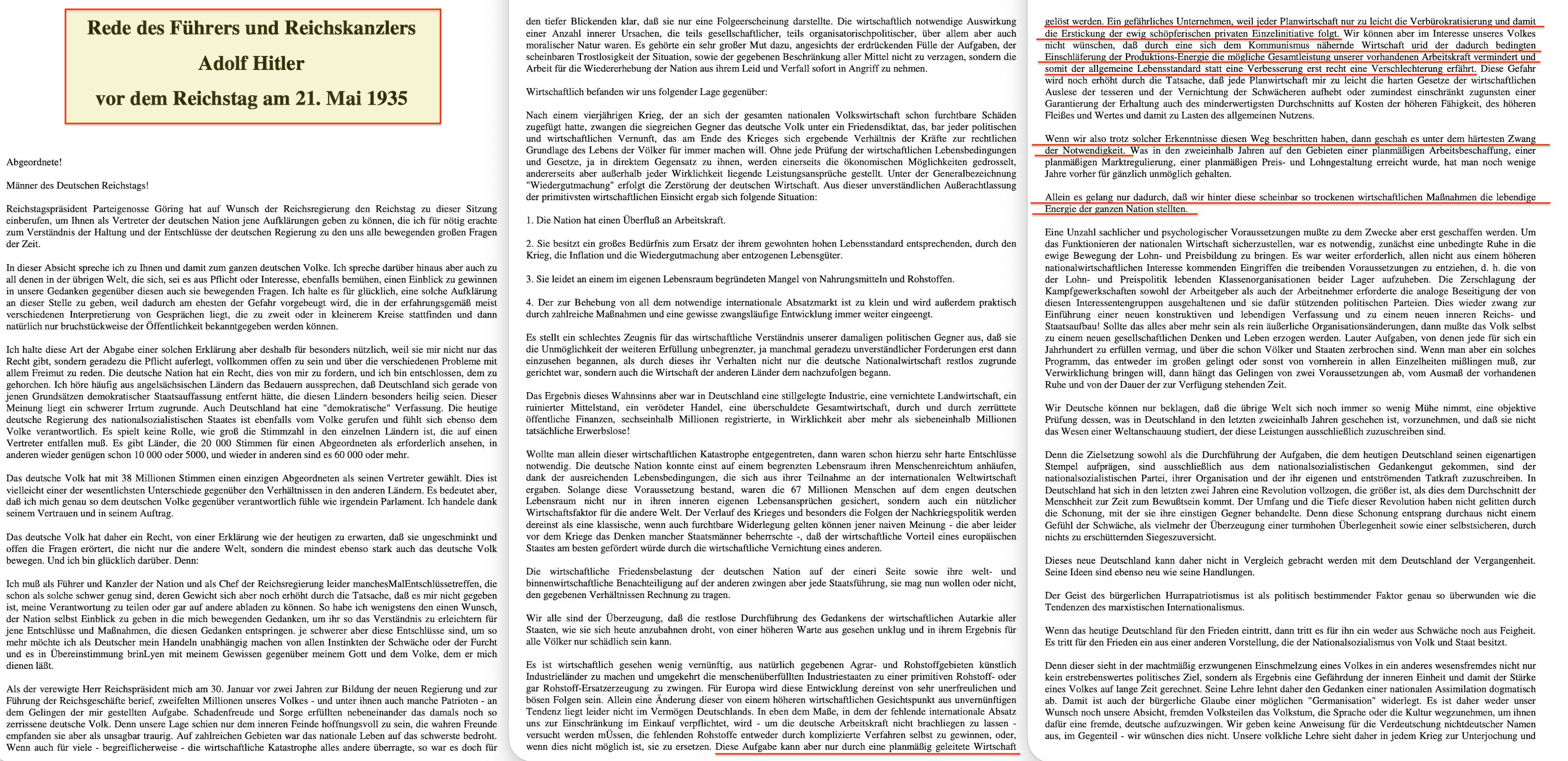
On 21 May 1935, Hitler stated the third way publicly in the Reichstag — in the original German, on the parliamentary record20. The key passage: ‘Diese Aufgabe kann aber nur durch eine planmäßig geleitete Wirtschaft gelöst werden. Ein gefährliches Unternehmen, weil jeder Planwirtschaft nur zu leicht die Verbürokratisierung und damit die Erstickung der ewig schöpferischen privaten Einzelinitiative folgt’. This task can only be solved through a systematically directed economy — a dangerous undertaking, because any planned economy too easily leads to bureaucratisation and suffocates the eternally creative private individual initiative.
Then follows that it isn’t communism either, because an economy approaching communism would dull productive energy and worsen rather than improve living standards. The resolution: ‘Wenn wir also trotz solcher Erkenntnisse diesen Weg beschritten haben, dann geschah es unter dem härtesten Zwang der Notwendigkeit’ — if we’ve taken this path despite such insights, it happened under the harshest compulsion of necessity.
And the sentence connecting it to the programme’s deeper logic: ‘Allein es gelang nur dadurch, daß wir hinter diese scheinbar so trockenen wirtschaftlichen Maßnahmen die lebendige Energie der ganze Nation stellten’ — it succeeded only because we placed the living energy of the entire nation behind these seemingly dry economic measures.
The dry economic measures work only because the national ethic drives them.
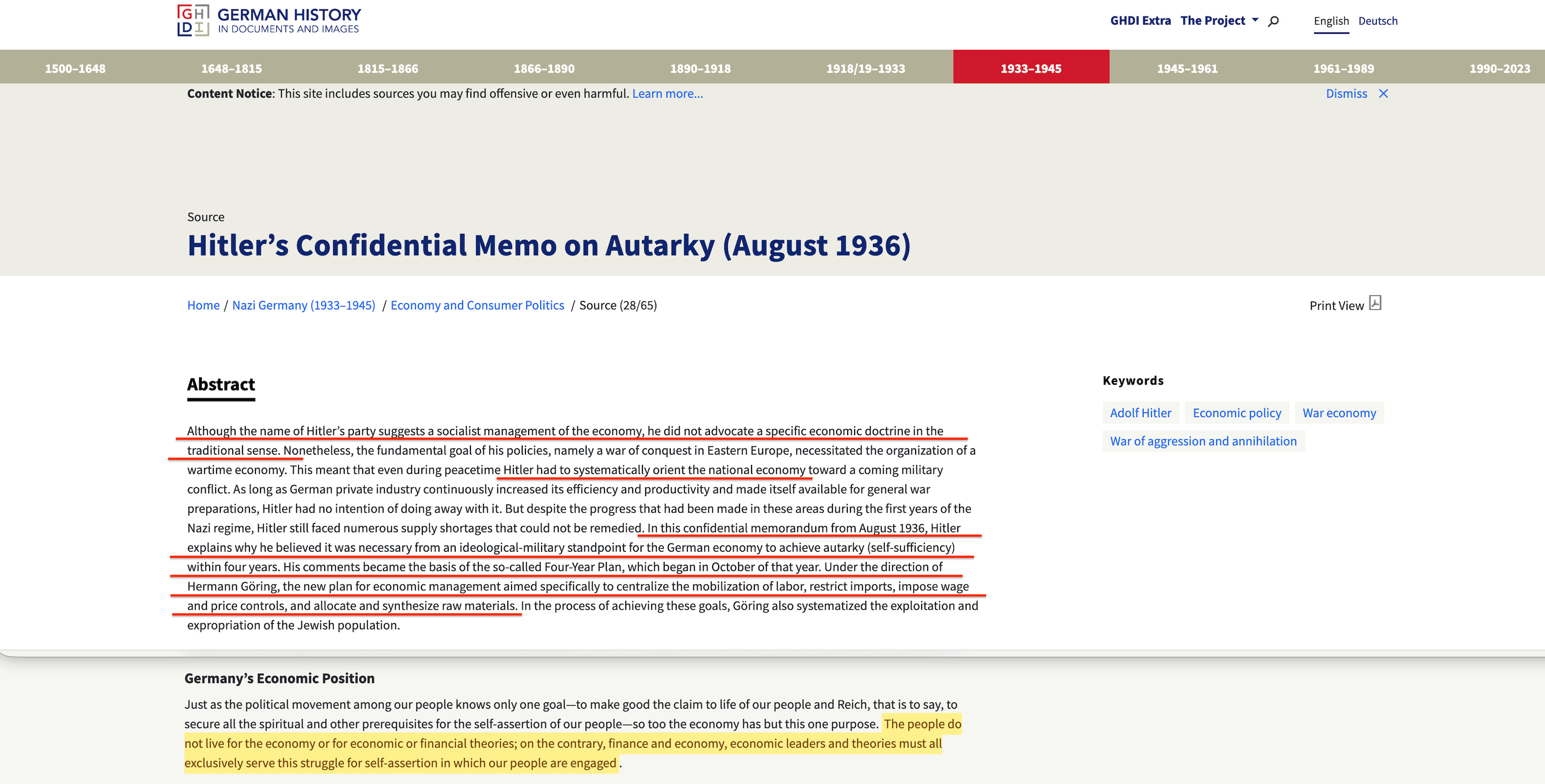
By August 1936, Hitler was writing the programme’s operational specs himself. His confidential Four-Year Plan memo21 — a declassified primary source — spells out closure domain by domain22: finish fuel production within eighteen months, mass-produce synthetic rubber, push iron output to the limit, and free industrial fats from imports. Each domain was sealed off from external dependency.
The same closure logic fills the 1942 volume chapter by chapter, but here’s Hitler writing it personally six years earlier. The memo opens with the principle running through the entire programme2324: ‘The people don’t live for the economy or for economic or financial theories; on the contrary, finance and economy, economic leaders and theories must all exclusively serve this struggle for self-assertion’.
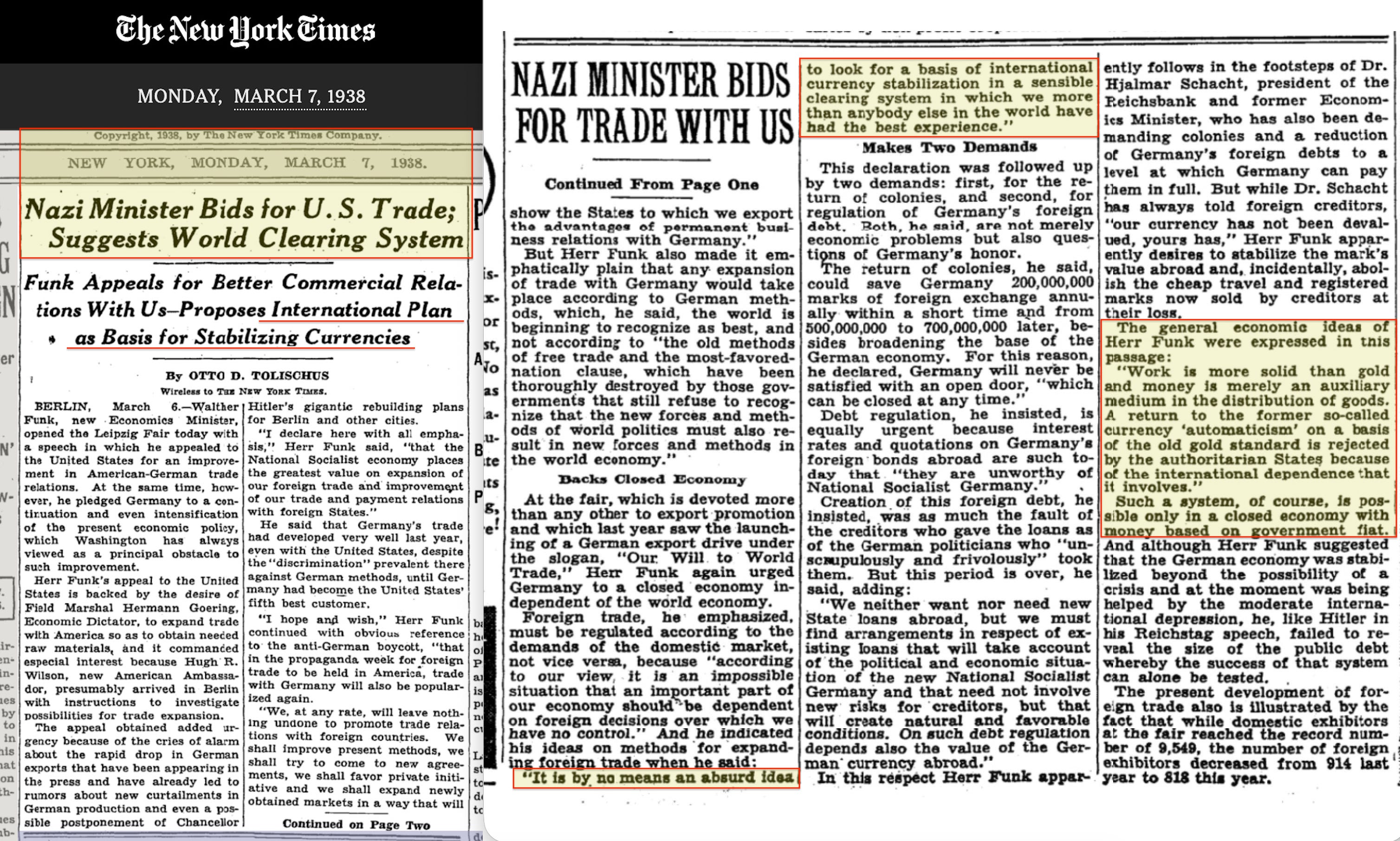
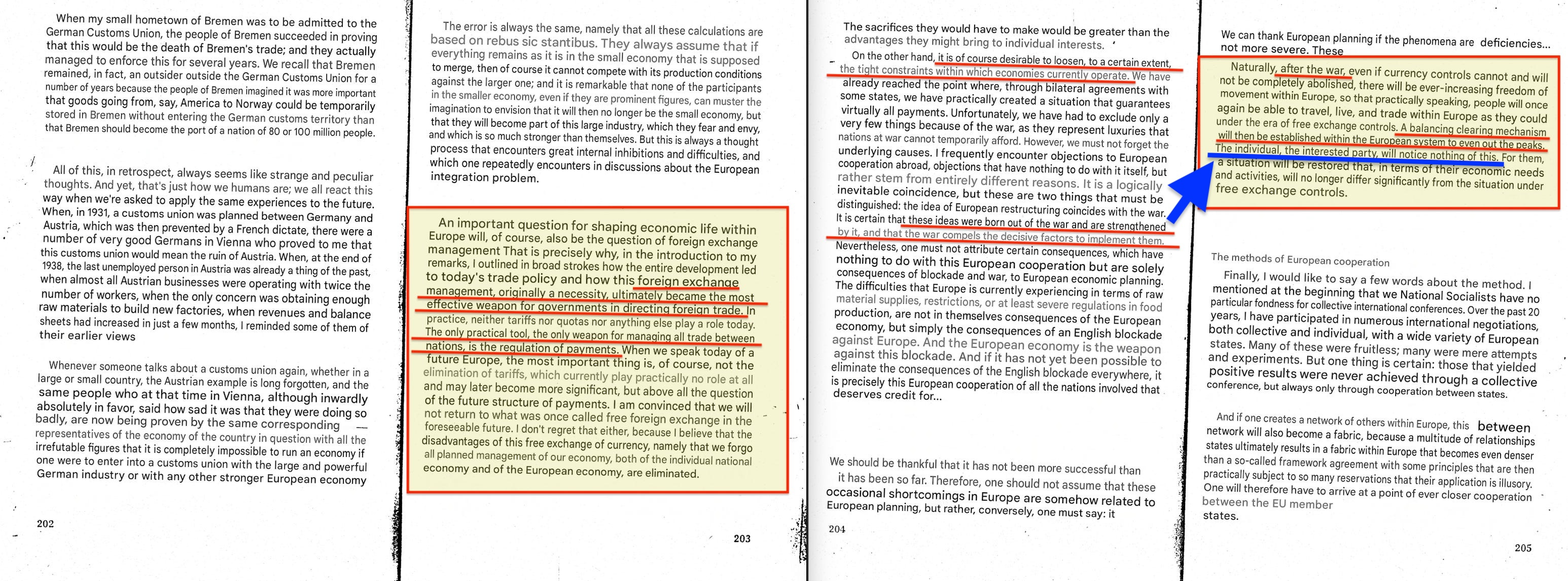
On 7 March 1938, Funk proposed the clearing function as the foundation for international monetary order at the Leipzig Fair — the New York Times put it on the front page25: ‘It’s by no means an absurd idea to look for a basis of international currency stabilization in a sensible clearing system in which we’ve had the best experience more than anybody else in the world’. Then the sentence containing the entire architectural argument: ‘Such a system, of course, is possible only in a closed economy with money based on government fiat’.
The words ‘of course’ tell you Funk thought this was obvious. Not a controversial claim, just a self-evident engineering requirement. Closure’s a prerequisite for clearing, and clearing’s a prerequisite for governance.
The entire 1942 volume — all nine chapters, every domain-specific closure, all the interlocking seals — is the implementation manual for this single 1938 sentence about the closed economy.
The editorial framework: 1939–1941
The programme was already circulating across Germany’s institutional network before the 1942 conference. Walther Darré’s January 1939 speech at the NSDAP’s Munich economic policy course framed Nazi agricultural market ordering as the trailblazer for a new foreign trade order — Die Marktordnung der nationalsozialistischen Agrarpolitik als Schrittmacher einer neuen Außenhandelsordnung26.
He cast agricultural policy as the leading edge of continental economic architecture eight months before the invasion of Poland. Woermann’s agricultural chapter in the 1942 volume simply recorded what party forums had discussed three years earlier.
In 1940, Funk broadcast the programme as a formal public proposal for a European economic order built on the clearing system27.

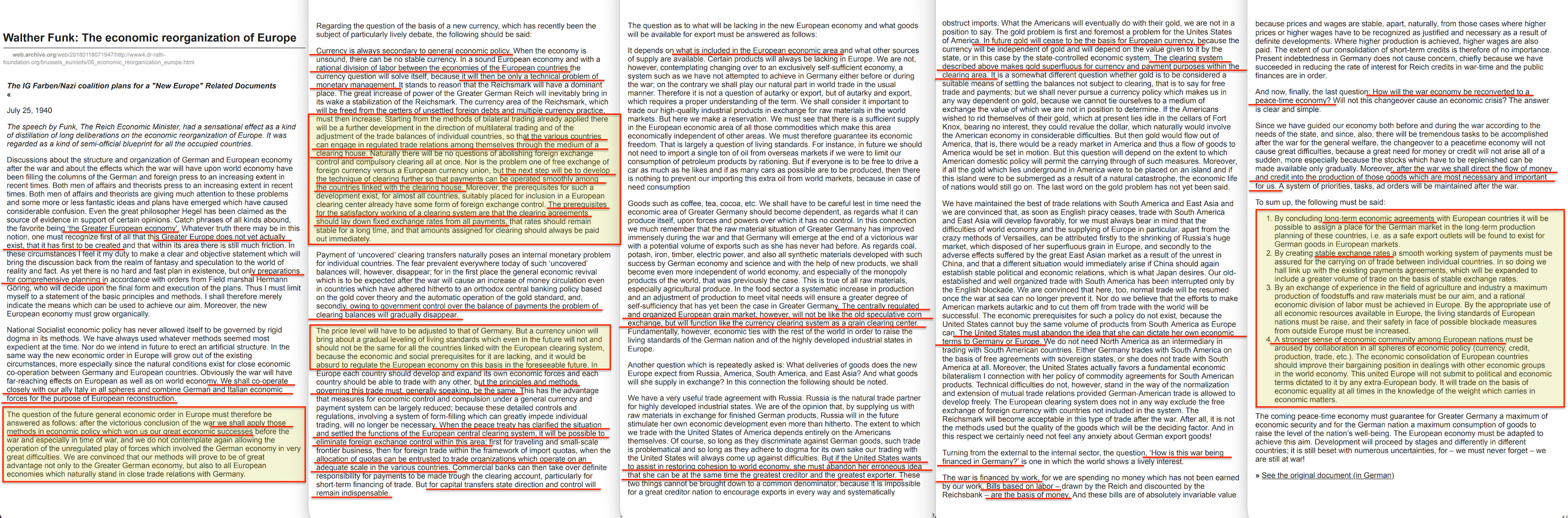
Harold Nicolson at the British Ministry of Information forwarded it to Keynes and asked him to discredit it publicly28.
Keynes refused: ‘In my opinion about three quarters of the passages quoted from the German broadcasts would be quite excellent if the name of Great Britain were substituted for Germany... If Funk’s plan is taken at face value, it is excellent and just what we ourselves should be thinking of doing’.
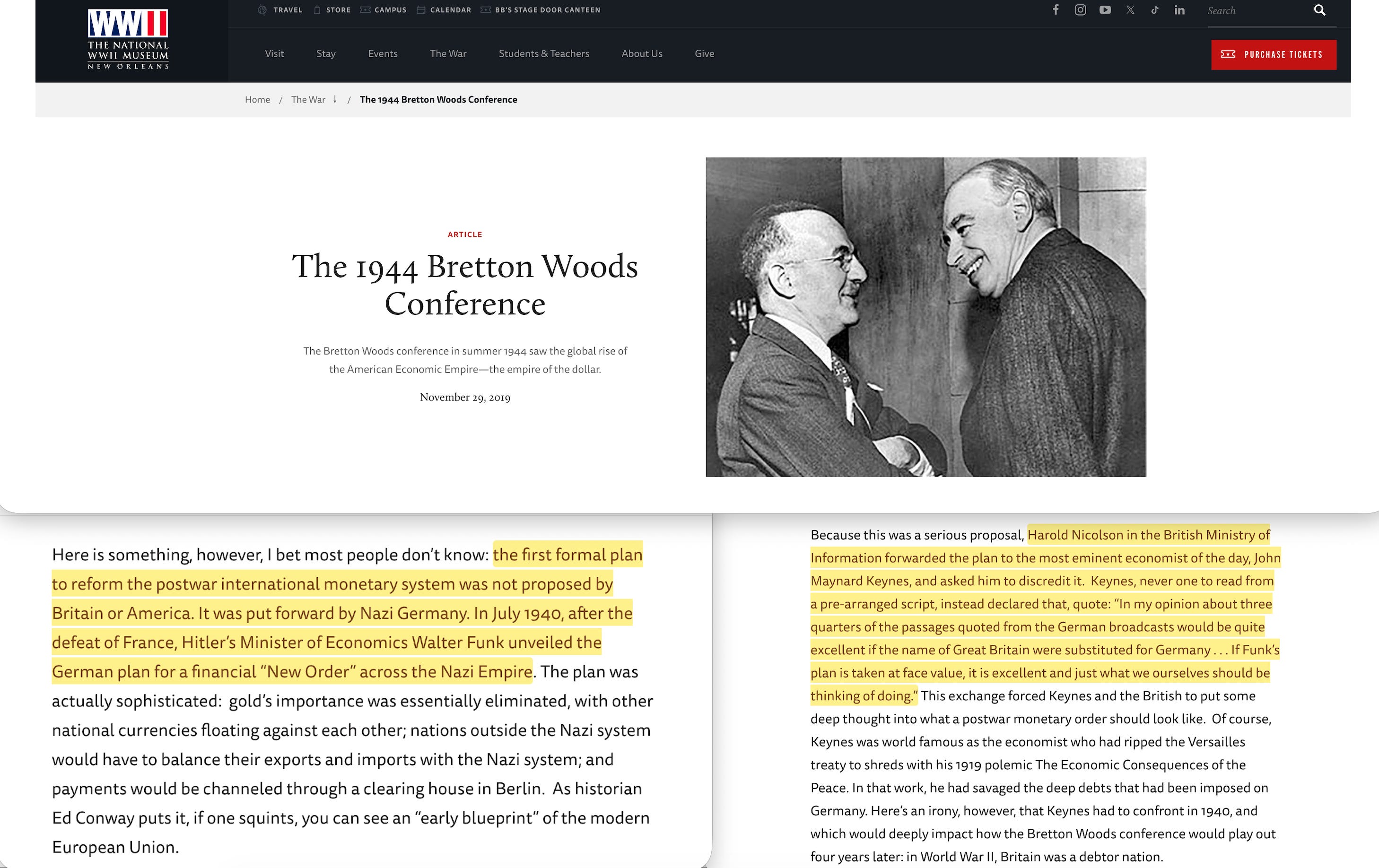
The most prominent economist in the English-speaking world, asked to demolish the Nazi economic programme, came back and said it was excellent.
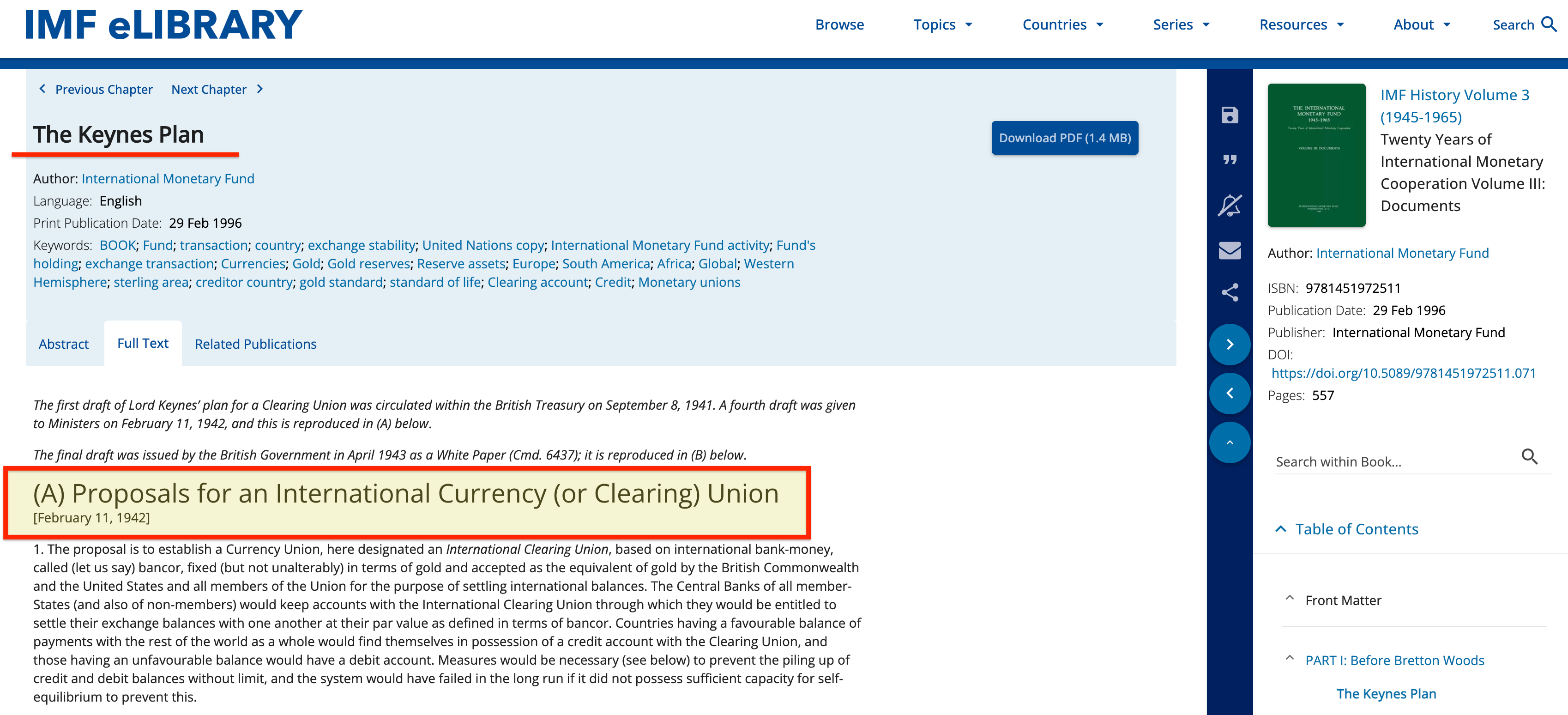
He then built the British version — the International Clearing Union29 — replacing the Reichsmark with Bancor and Berlin with an international institution.
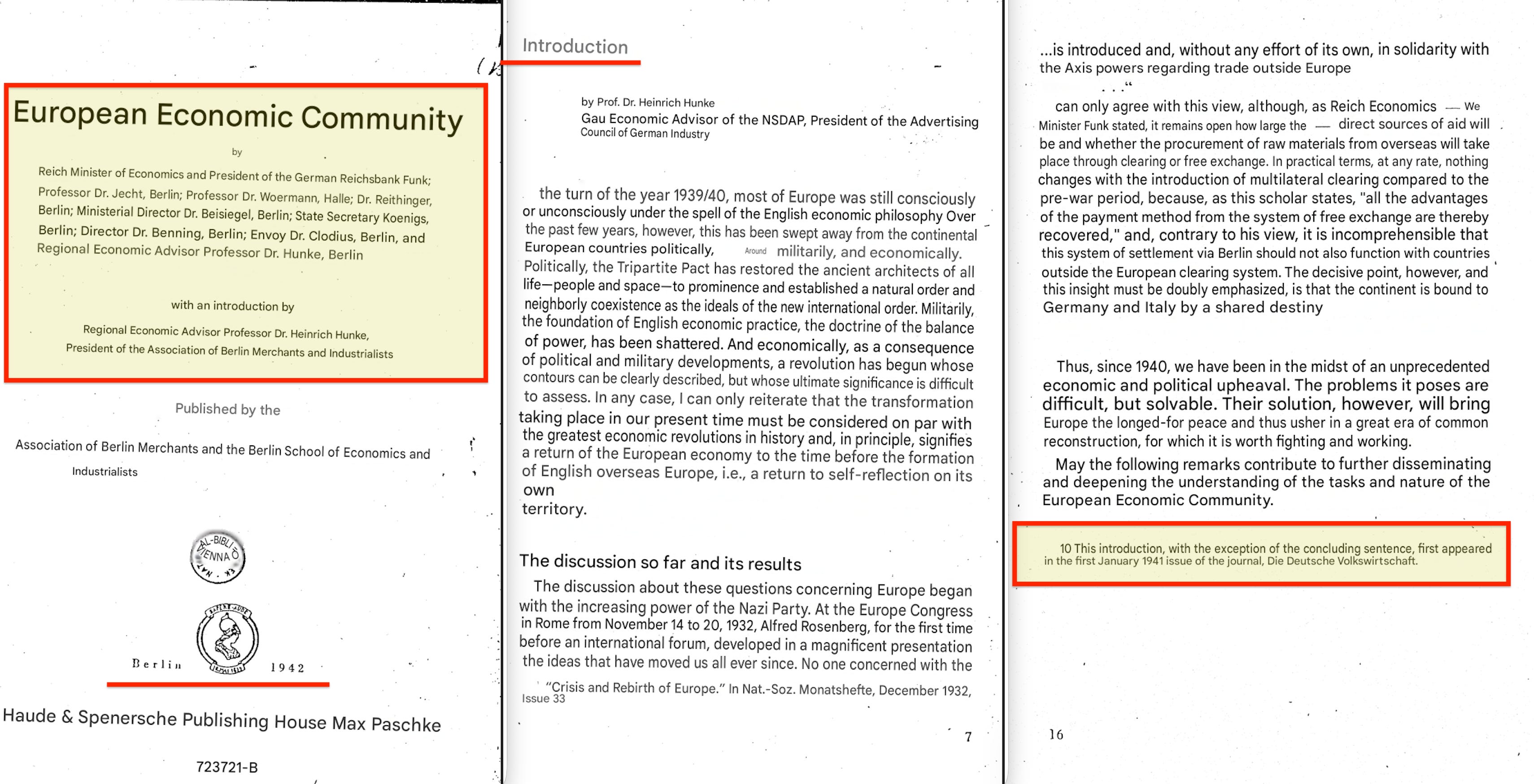
Publications from 1940 and 1941 — Reichsgedanke und europäische Wirtschaft, Hanse, Downing Street und Deutschlands Lebensraum, Die Grundlagen der zwischenstaatlichen europäischen Wirtschaftsbeziehungen30 — had already prepared the ground.
A footnote on page 16 — easily missed — notes that Hunke’s introduction first appeared in the January 1941 issue of Die Deutsche Volkswirtschaft. The lectures were delivered in 1942, but the editorial framework was in place about a year earlier. The volume wasn’t a collection of independent analyses that happened to converge on the same architecture. Contributors wrote within a frame that was already set.
Hunke’s three principles of Wirtschaftsführung, the solidarity programme, and the invisibility principle were all established before anyone lectured.
The implementation: 1934
When Schacht became Minister of Economics on 2 August 1934, he fired Feder and built the bilateral clearing network3132, the New Plan33, and the exchange controls — the institutional infrastructure that delivered everything Feder’s manifesto had demanded, only without his vocabulary.
The state controlled monetary circulation, productive capital was admitted through managed channels while speculative capital was excluded through exchange controls, and the Reichsbank served as the clearing gate for all international payments.

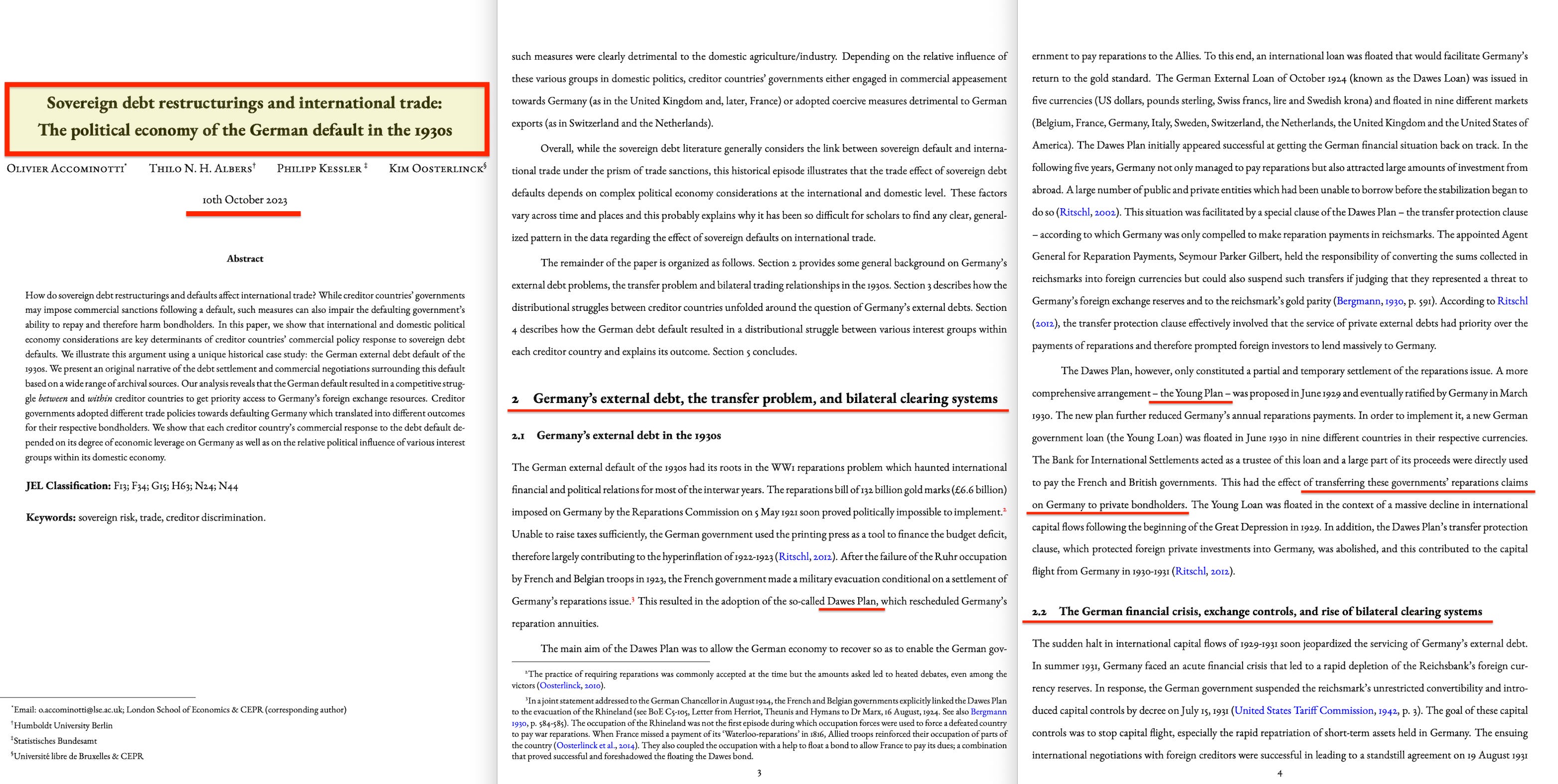
Feder’s programme was implemented by the very man who’d fired him, using institutional mechanisms Feder had never specified and a technical vocabulary Feder had never used. The content persisted but the carrier was replaced, and the programme outgrew its propagandist as it moved from street-level agitation to banking-conference language.
This method — gradual institutional reform where each step looks like a pragmatic response to present necessity, with the accumulation invisible until the cost of reversal exceeds the cost of continuation — had been theorised thirty-five years earlier by a Marxist revisionist, Eduard Bernstein, in Evolutionary Socialism34, the book that redirected European social democracy from revolution to institutional capture.
Bernstein had spent seven years at S. & L. Rothschild in Berlin watching how the clearing function operates from the inside. Julius Wolf had designed the machinery35, Bernstein had supplied the political method for installing it without revolution, and Schacht — whether he knew or not — was executing both.

The erosion method applied to capitalism itself is documented in the economic record. From 1934, dividends were capped at six per cent with excess profits directed into government bonds, while progressive income tax reached ninety-five per cent at the highest brackets. But the invisible mechanisms did more than taxation. Price controls determined what firms could charge, production quotas determined what they could produce, raw material allocation determined what inputs they could access, wage controls determined what they could pay, investment direction determined where capital went, and labour allocation determined who they could hire.
The owner kept the title deed, but every function it was supposed to confer — deciding what to produce, at what price, for whom, using what inputs, employing which workers — went to the state. Friedrich Pollock, writing from exile in 1941, saw it clearly: ‘Even the mightiest concerns were denied the right to set up new fields of business where the highest profits were expected, or to stop production when it became unprofitable. These rights were transferred entirely to the ruling groups’36.
Private property survived in form but was destroyed in function. The regime never nationalised in the communist sense, keeping the entrepreneurial incentive structure while capturing every decision the entrepreneur was supposed to make.
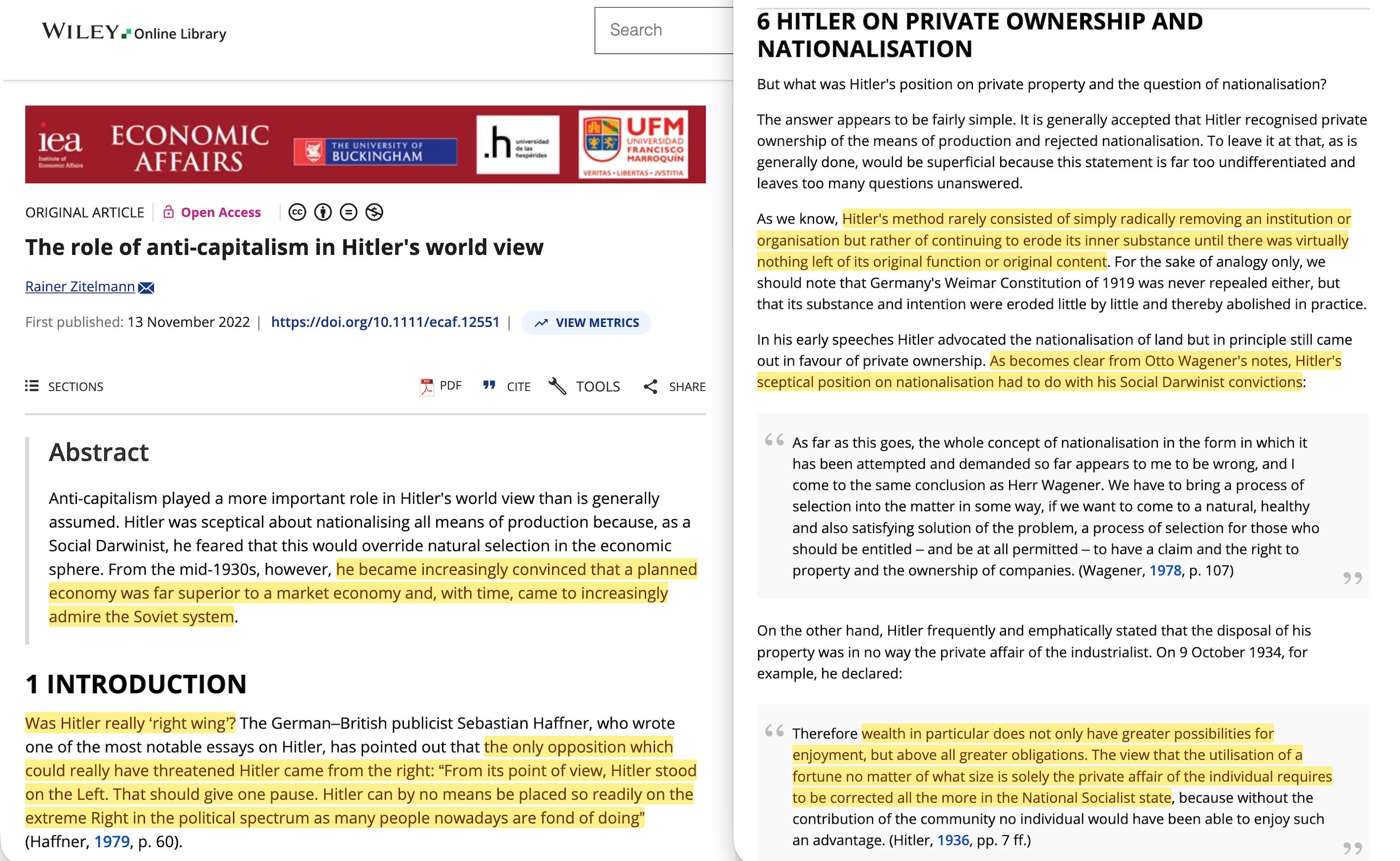
Günter Reimann’s study of Hitler’s economic method identifies the operating principle3738: Hitler ‘rarely consisted of simply radically removing an institution or organisation but rather of continuing to erode its inner substance until there was virtually nothing left of its original function or original content’.
The Weimar Constitution was never repealed — it was hollowed out. And this hollowing out extended to capitalism itself.
The result was proof of concept. After 1933 Germany had almost no gold reserves, no convertible foreign exchange, and faced international boycotts, so under conventional economics it couldn’t trade or finance industrial recovery. The clearing-function architecture made recovery possible. Schacht’s bilateral clearing agreements settled trade through bookkeeping rather than gold. The Mefo bills created money against productive output39 — Feder’s ‘money as a voucher for completed labour’ implemented through banking mechanisms. The system produced full employment and rapid industrialisation without gold, free markets, or convertible currency.
The economic miracle was the clearing function’s demonstration — proof that the mechanism worked, and every subsequent operator adopted the form for the same reason.
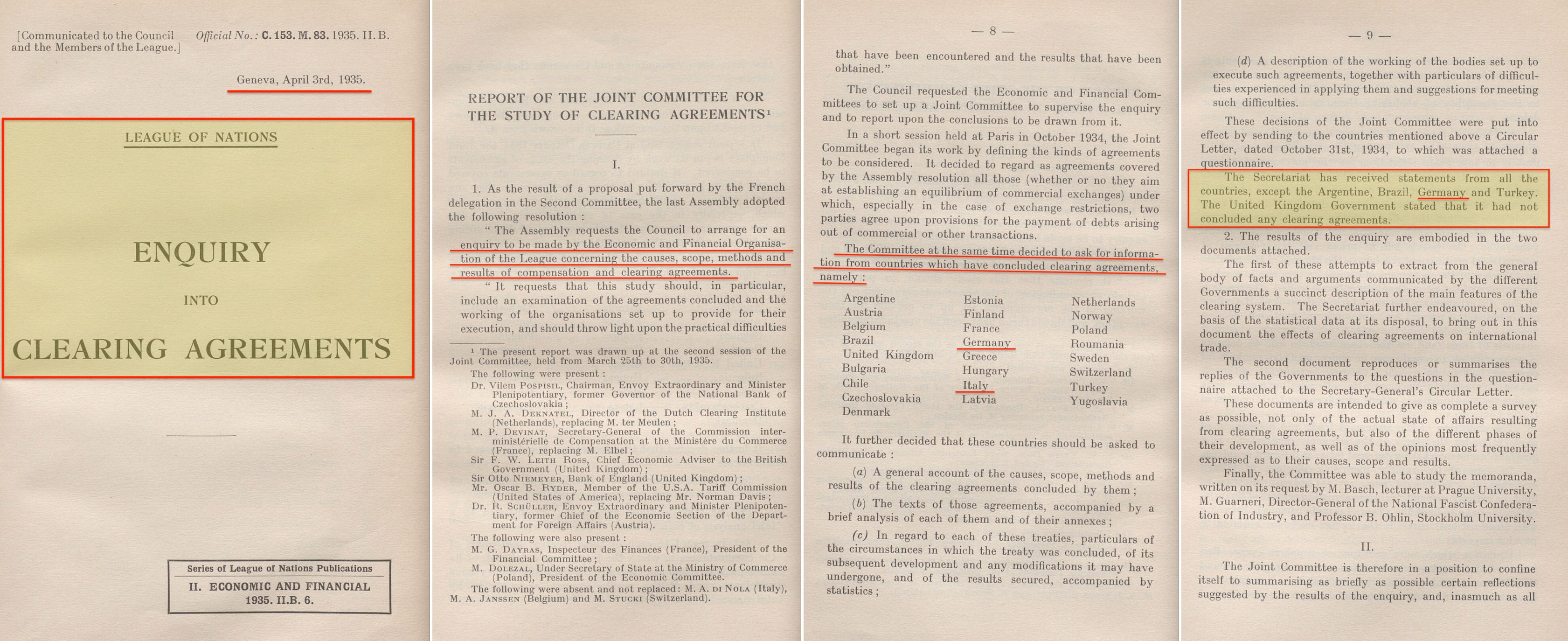
By 1935, Schacht’s bilateral clearing network had grown large enough for the League of Nations to commission a formal enquiry into clearing agreements across its member states40. Italy’s response described the prototype for multilateral settlement — periodic netting of bilateral clearing balances against a gold-dollar anchor — and simultaneously declared full multilateralisation impossible without a central institution willing to absorb the risk.

Three competing bids for who would control the system were already forming: the Tripartite Agreement anchoring to gold held by the Anglo-American bloc, Van Zeeland’s proposal to route it through the BIS under Anglo-French management, and Funk’s counterbid to anchor it to work and route it through Berlin.
The programme wasn’t just a German internal development. It was already reshaping international trade architecture at a scale the League felt compelled to document — while domestically, it remained hidden from the German electorate.

The convergence at the Technische Hochschule
Feder ended his career as Professor for Settlement Policy at the Technische Hochschule Berlin — first as Honorarprofessor from November 1934, then as full professor from 1936. He’d studied there as an engineering student decades earlier.
It was the same institution where Julius Wolf had taught from 1908 until his forced retirement. Wolf died in Berlin in May 1937. The antisemitic economist who’d supplied the evaluative standard became professor at the same institution where the Jewish economist who’d designed the clearing mechanism had just been removed.
There’s no evidence they ever met. But the two origin threads of the 1942 volume’s architecture — what to evaluate and how to evaluate it — converged physically at the TH Berlin before diverging into erasure: Wolf into oblivion, Feder into irrelevance. The regime discarded both men, took their contributions, and credited neither.
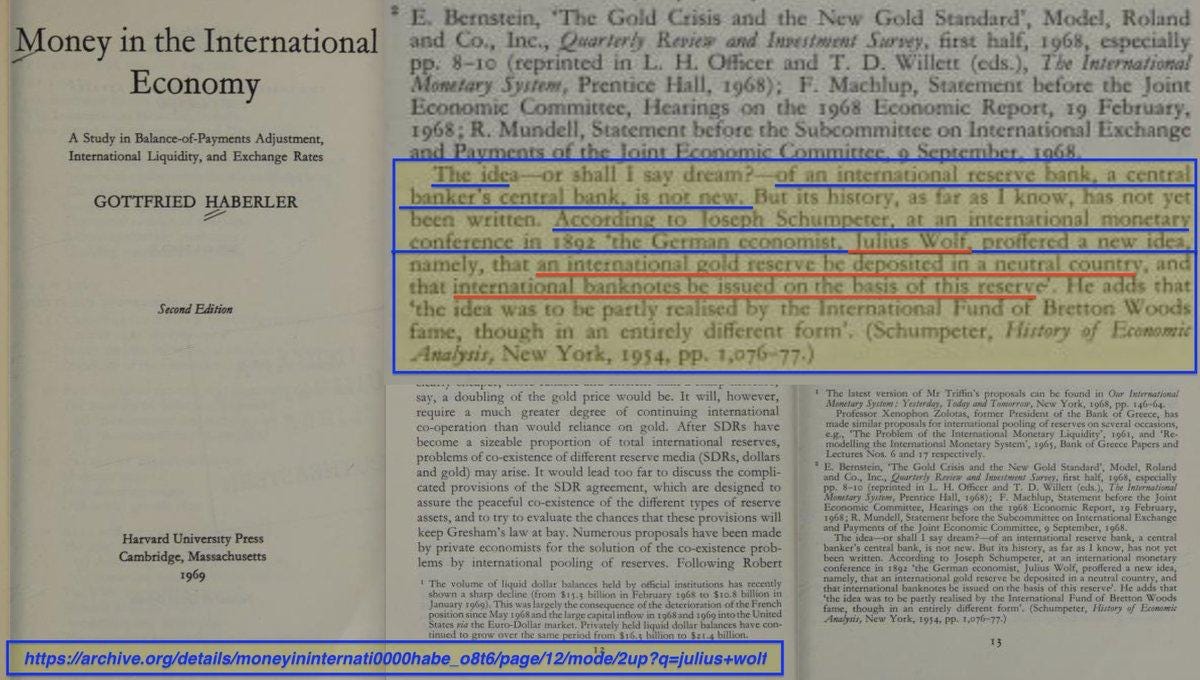
Wolf designed the clearing architecture — the international clearing office, the common monetary unit, the permanent bureau, and the standards coordination body with parallel national chapters. His proposals were discussed at the Brussels Monetary Conference of 1892, cited by Eleanor Lansing Dulles in her 1932 history of the BIS41, acknowledged by Schumpeter42, and referenced at the Genoa Conference of 1922, but his work fell into what his biographer described as ‘near-total oblivion’ after the Nazis sold or destroyed his papers.

Feder transmitted the evaluative standard — Marx’s distinction between productive and parasitic capital, the labour theory of monetary value, and the principle that the state must control the clearing function to prevent exploitation. His institutional specification — all banks under the state central bank — paralleled Lenin’s independently. His programme entered the party platform in 1920, went underground after 1923, and resurfaced as institutional practice under Schacht’s management from 1934 onward. Wolf designed the clearing architecture that made it operational. Bernstein theorised the method — gradualism, institutional capture, each step appearing as pragmatic necessity — that made it installable without revolution.
Five sources, one architecture, no credit. Marx supplied the standard. Lenin demonstrated the institutional logic. Feder carried both into the party. Wolf designed the clearing mechanism. Bernstein provided the installation method.
The regime took everything, and erased everyone from history.
What the timeline shows
The programme the 1942 volume laid out has a paper trail stretching back twenty-three years.
1919: Feder lays out the evaluative standard openly — productive versus parasitic capital, with the state controlling monetary circulation.
1920: The 25-Point Programme folds Feder’s economics into the party platform.
1923: The Beer Hall Putsch collapses and the party adopts the legality strategy. The economic programme goes underground.
1926: Goebbels jots down Hitler’s economic vision in his diary — the third way, stated privately.
1931: Wagener’s working sessions with Hitler produce the secrecy order: ‘This idea’s not to become a subject for propaganda’.
1934: Schacht fires Feder and starts implementing the programme through institutions. The clearing network begins.
1935: The League of Nations enquires into bilateral clearing agreements; Italy describes the multilateral prototype. Three bids form for control of the system.
1935: Hitler states the third way publicly in the Reichstag — planmäßig geleitete Wirtschaft.
1936: Hitler writes the Four-Year Plan memo, spelling out domain-by-domain closure.
1938: Funk at Leipzig — ‘such a system, of course, is possible only in a closed economy’. The New York Times reports it.
1939: Darré frames agricultural market ordering as the trailblazer for a new trade order.
1940: Funk broadcasts the European economic plan. Keynes says three-quarters of it is excellent and builds the British version.
1941: Hunke’s introduction appears in Die Deutsche Volkswirtschaft, a year before the conference.
1942: The volume comes out, recording the architecture across every domain..
The content moves from a revolutionary manifesto through private conversations, secret memos, public speeches, and institutional practice to a full academic specification — yet the core idea never changes. The state directs the economy through a clearing function that checks flows against a standard, while the individual stays free within lanes they didn’t choose. The language shifts from Feder’s heated German to Funk’s banking language and then to the volume’s academic language, but the idea underneath stays exactly the same.
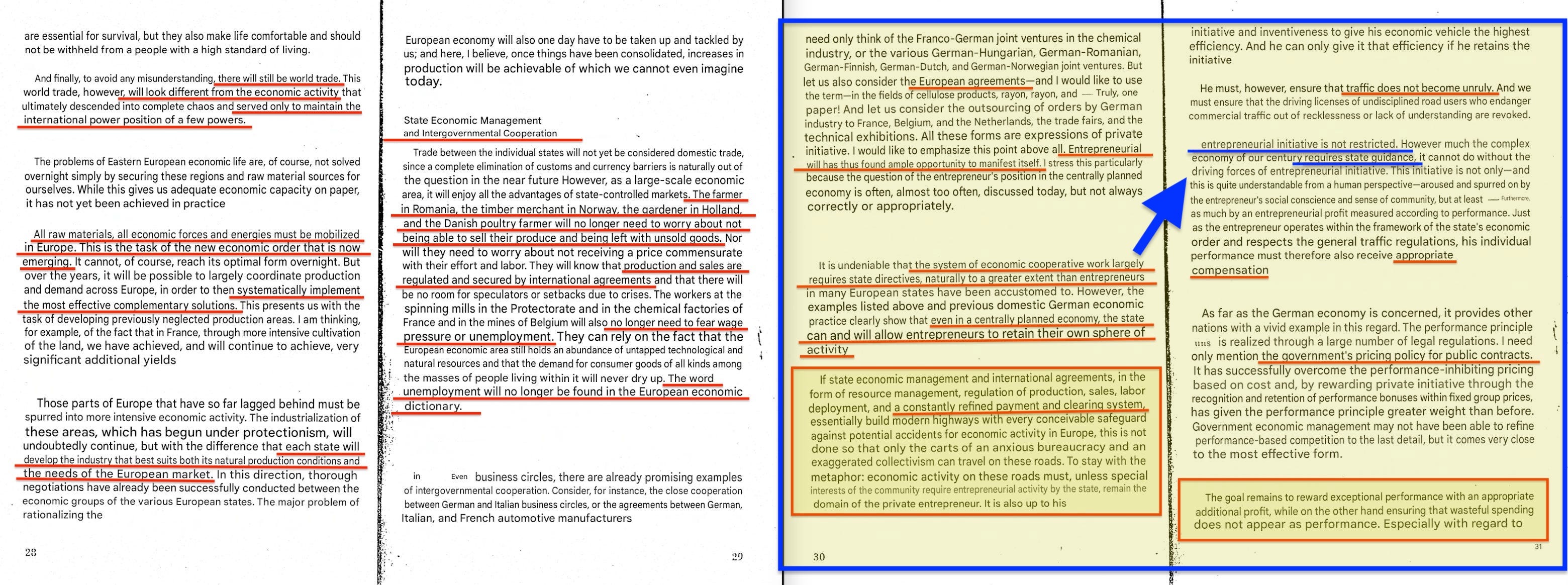
The 1942 volume wasn’t the start of the programme. It was simply the moment the people running it wrote the whole thing down across every domain in a single document. Everything before it was just pieces — a manifesto, a diary entry, a secret memo, a speech, a party programme. The volume’s the complete specification.
And the specification was already up and running. Page 10 of Hunke’s introduction notes that clearing traffic between Berlin and European states was already happening and growing. The Deutsche Verrechnungskasse was already processing payments43, the bilateral treaties were signed, and the exchange controls were in place.
The report didn’t propose new architecture — it simply recorded a system already running and published the dictionary where the terms were defined.
This article needs to be regarded through the lens of ww1 and ww2 being scripted by pike, Mazzini and the illuminati/jewmasonry machine. The same machine whose death cogs now whirr through corruption of the medical system and indeed more wars, including the impending ww3 of that pike/mazzini letter. Prof Driscoll and collaborators could see this plan through their study of the Canadian NWO apparatus and historical context in the 1990’s, abstract from one of the seat of the antichrist books pasted here for anyone interested-
The Illuminati was formed in 1776, a secret society with limitless financial resources and dedicated to a programme of world domination. In 1782, at the Congress of Wilhelmsbad, an alliance between the Illuminati and Freemasonry was sealed. Shortly after, the general ban was lifted that prevented Jews from joining the Masons; the headquarters of Masonry were moved to Frankfurt, the stronghold of Jewish finance. Judaism and Masonry, soon to be joined by a third, the Church of Mormon - and aided by the official Vatican - plunged ahead in the preparation of a new Kingdom on earth: the Kingdom of the antichrist, antiman, antibuddha, antimohamed. The aims of the Illuminati were set down as follows: (1) Abolition of all ordered governments; (2) Abolition of private property; (3) Abolition of inheritance; (4) Abolition of all religion; (5) Abolition of family; (6) Creation of a New World Order or World Government.
The Illuminati quickly realized that the old power structures must be eradicated, and in 1871 devised a sequence of three World Wars in the twentieth century that would change the face of Europe, Japan, and the rest of the world. The remarkable thing is that these World Wars came in the sequence in which they were predicted, the first to destroy Czarist Russia; the second by capitalizing on the differences between German Nationalists and political Zionists; and the third which is to result from the manipulation of the differences between Zionists and Arabs (1). In The New World Order and the Throne of the antichrist Des Griffin has shown that in the Second World War Roosevelt and Eisenhower repeatedly held back the advance of the American troops to allow the capital cities of central Europe to fall into Soviet hands: Prague, Budapest, Vienna, Berlin, etc. Meanwhile, a number of non-military but strategic industrial targets Hamburg, Dresden, Tokyo, and a host of other Japanese cities were levelled, the chief reason being that the Intemational Bankers and Financiers wanted to use the military power of the Allies to level these cities so that they could rebuild them after the War to their own image and likeness. As indicated above, the three main Illuminati families are Rothschild in Europe, Rockefeller in the United States, and a Canadian family - actually five families operating as one - that is known but which has not yet been named publicly. The Canadian families are not Jewish.
This post is an excellent investigation of economic/governance philosophy, and the "state direction with private initiative kept within the lanes" is basically how China operates, quite successfully.