
The Social Blood

In the 1840s, Moses Hess read Hegel and spotted something he’d missed.
Hegel argued that history moves toward organic unity — that society evolves into a coherent whole, eventually unified through the state. Hess agreed with the fundamental vision but questioned the facilitating substrate. Laws and institutions work too slowly, depend on consent, and meet resistance. If society was really becoming an organism, something else must perform the integration.
To Hess, that something was money.
Find me on Telegram: https://t.me/escapekey
Find me on Gettr: https://gettr.com/user/escapekey
Bitcoin 33ZTTSBND1Pv3YCFUk2NpkCEQmNFopxj5C
Ethereum 0x1fe599E8b580bab6DDD9Fa502CcE3330d033c63c
Hegel’s Problem
Hegel thought history had a direction1. People start out scattered, then gradually unify — families, communities, nations, and eventually a state that isn’t just a government collecting taxes and fighting wars, but something more akin to a living body aware of itself and acting as one.
The problem was practical. How do you actually get millions of people to function as a unified whole? Governments can pass laws and enforce them, but that’s coercion — you can compel obedience but it won’t create coherence. A body works because its parts are interdependent, not because they’re forced to cooperate.
Hegel never identified what that something was. He described what unity would look like without explaining what would produce it2.
The Hess Inversion
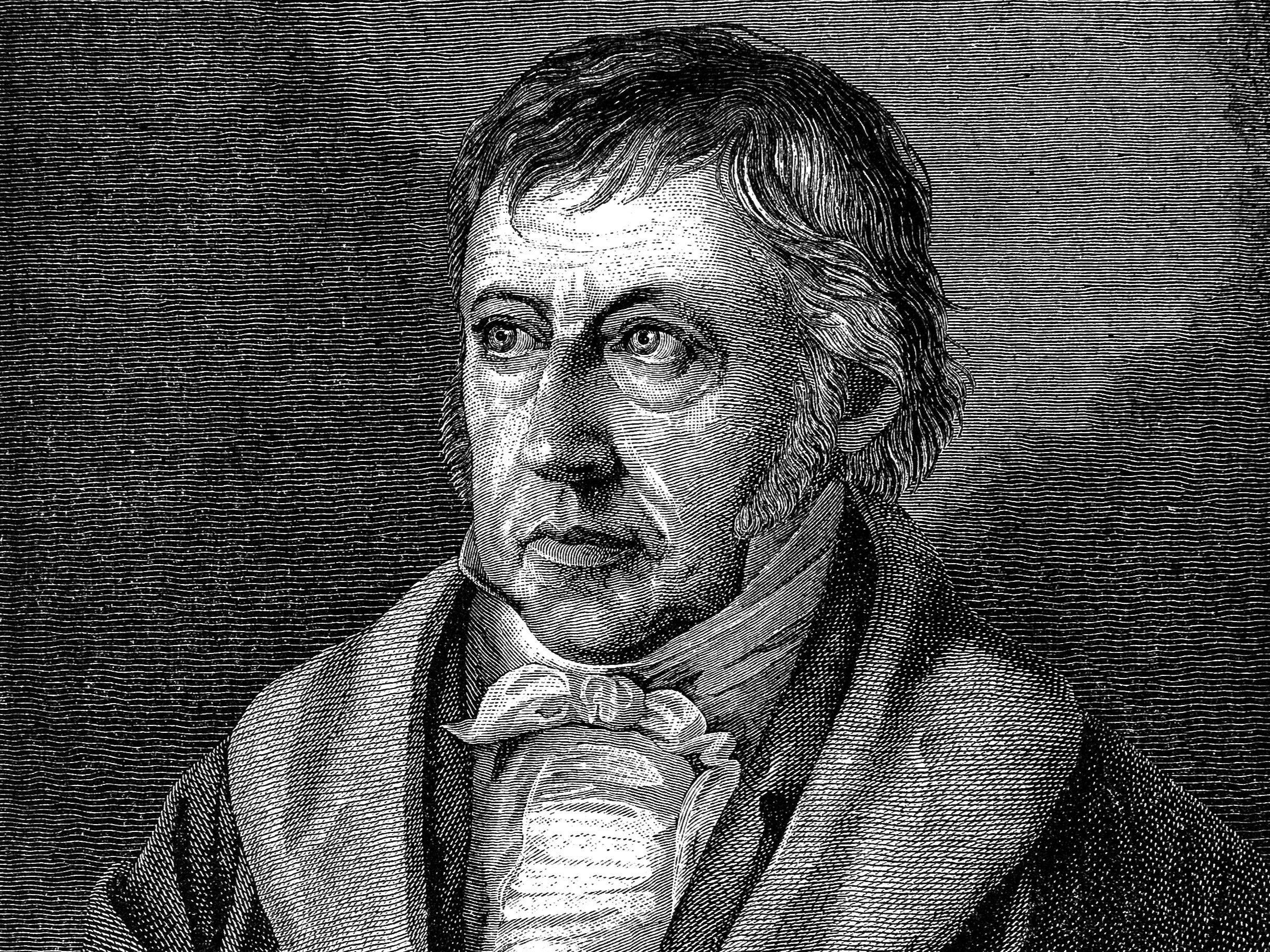
Hess was a Young Hegelian3 — a radical who accepted Hegel’s framework but wanted to ground it in something concrete. Ludwig Feuerbach4, had already flipped Hegel’s theology on its head: God wasn’t a real being expressing himself through humanity. God was a projection — humanity’s own qualities, externalised and worshipped as though they belonged to someone else.
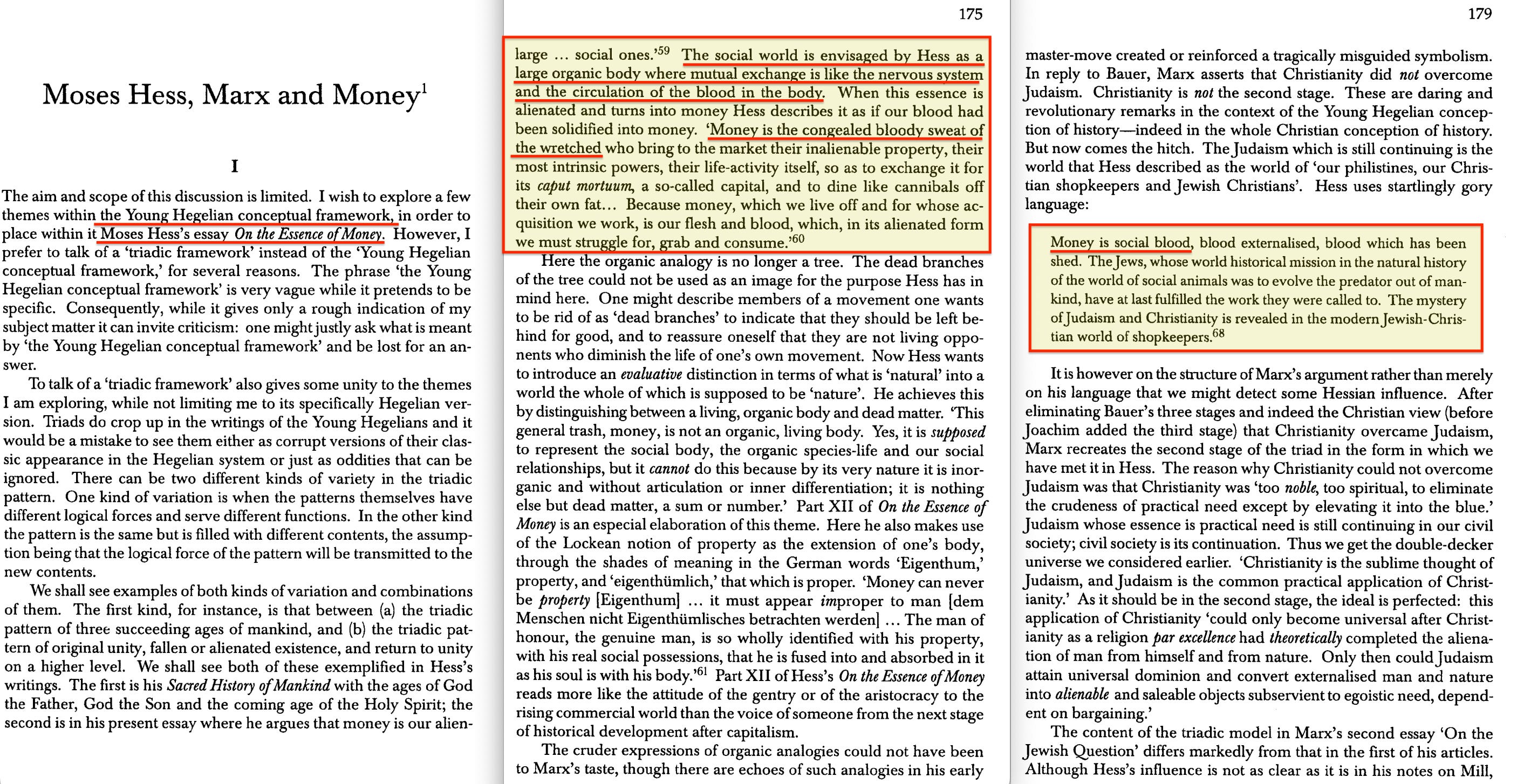
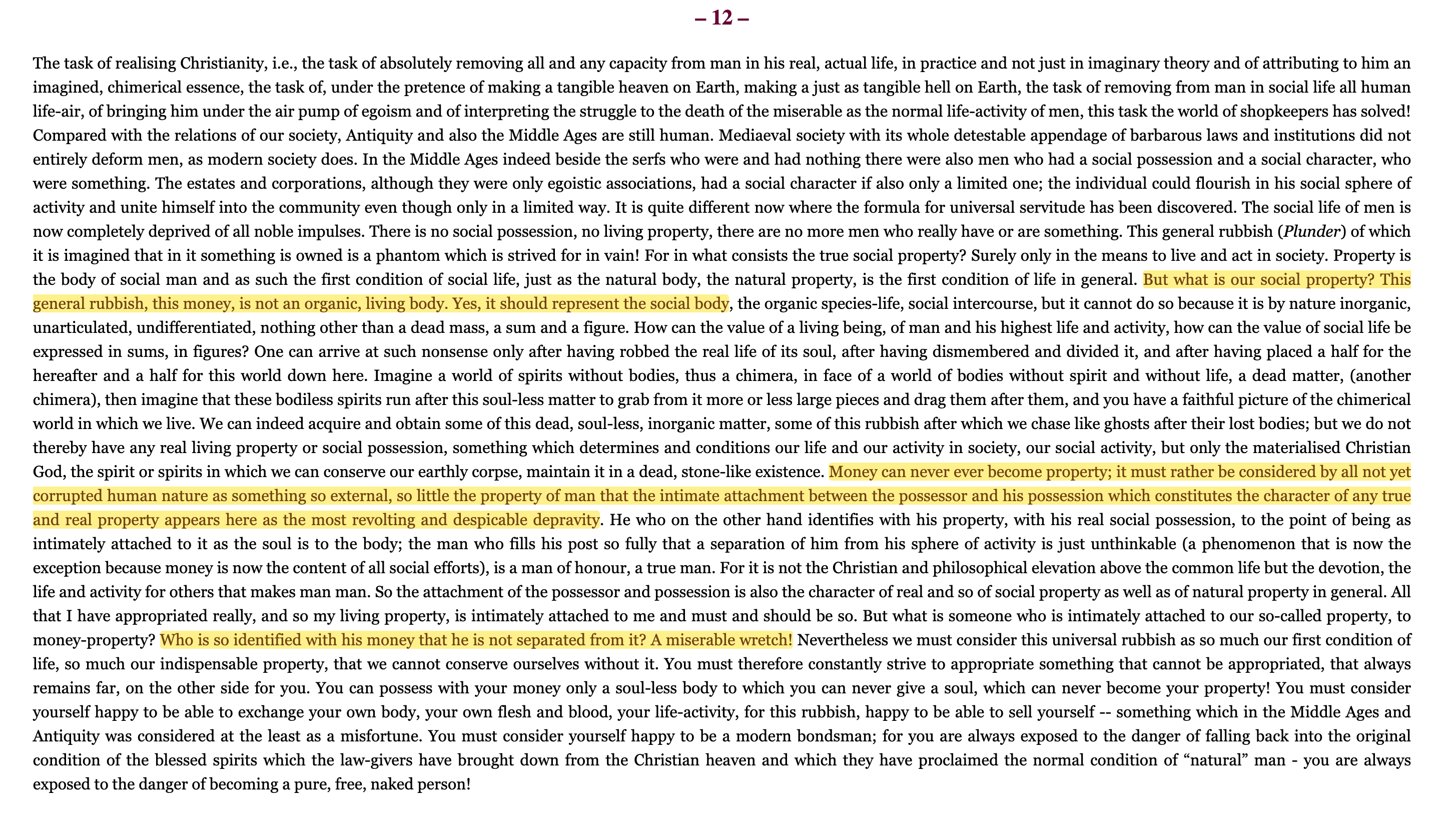
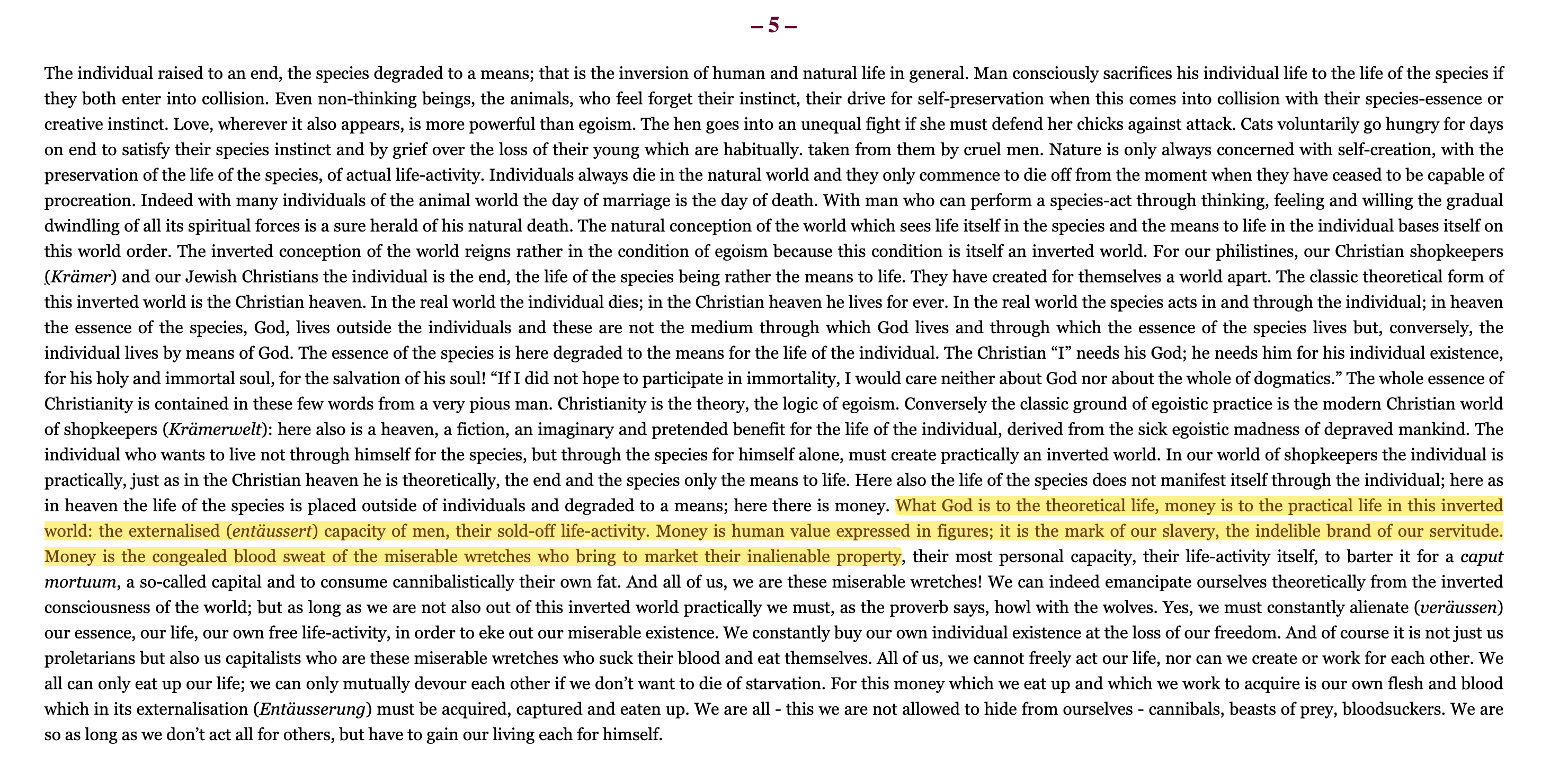
Hess applied the same logic to economics. In his 1845 essay ‘On the Essence of Money’5, he argued that money plays the same role in everyday life that God plays in religion. Both are human capacities turned into external powers that seem to control us. ‘What God is to theoretical life’, Hess wrote6, ‘money is to practical life in this inverted world’.
But he went further. He called money ‘the social blood’ — the circulatory fluid of the social organism. People relate to society the same way organs relate to a body. Cut them off from the circulation and they die. Their life exists only through connection to the whole.
This was Hegel’s organic unity with an actual mechanism underneath it. Money was already doing what the state was supposed to do — involved in every transaction, every relationship, every exchange, coordinating behaviour, making people interdependent, keeping the social body functioning. The organism Hegel imagined wasn’t a future achievement but something already running, with money as its circulatory system.
Critique as Blueprint
Hess supposedly meant all this as an attack. Money was ‘the congealed bloody sweat of the wretched’. It turned human creativity into a dead thing that then bossed its creators around. The answer, he thought, was to abolish money entirely.
But the problem with critique is that to attack a mechanism, you first have to explain exactly how it works. Hess mapped how money integrates, how it coordinates, how it makes people dependent on the whole. He drew the blueprint, then called for demolition.
The structural insight doesn’t care about his intentions. If money really is the social blood, then whoever controls its circulation controls the organism. You don’t need to persuade people or win elections. You don’t need to pass laws and visibly enforce them. You just need to control what flows and to whom.
Hess said he wanted to abolish money and achieve genuine unity7. Read it the other way and you perfect money and complete the integration. Georg Simmel8 would later read the same structural insight toward liberation — money as abstraction freeing individuals from personal bonds of dependence. But that branch wasn’t later integrated with infrastructure.
The Genealogy
Once you grasp this inversion, history starts to make sense.
Marx picked up where Hess left off. He built his critique of capitalism on the same foundation — money as congealed labour, capital accumulation as alienation. But Marx also named the institutional lever. Plank 5 of the Communist Manifesto9 calls for ‘centralisation of credit in the hands of the state, by means of a national bank with state capital and an exclusive monopoly’. Centralise credit and you control the circulatory system. This wasn’t utopian prescription. The Bank Charter Act of 184410 had already begun handing the Bank of England a monopoly on currency issuance. Marx was describing an architecture under construction.

Lenin made it operational. His slogan was ‘universal accounting and control’11 — the dictatorship of the proletariat would manage society through total surveillance of production and distribution. Every transaction recorded, every flow monitored, every allocation planned. Why coerce when you can simply administer? Socialism, Lenin wrote, was ‘merely state-capitalist monopoly which is made to serve the interests of the whole people’12.

Bogdanov turned it into a general theory. He called it tektology13 — a universal science of organisation. All systems work the same way, whether biological, social, or technical. Society is just another organism to be managed through measurement, feedback, and coordination. The planner becomes an information processor optimising the whole.

Leontief made it calculable. His input-output analysis14 tracks every flow of materials and value through an economy — which sectors feed which, where resources go, in what quantities. The technique won a Nobel Prize15 and became standard national accounting. It rendered the social organism’s metabolism visible in spreadsheets.

Invert Leontief and you get something more ambitious. Instead of tracking productive flows through a national economy, track risks to ‘Spaceship Earth’ as a whole. Now the entire planet can be modelled, planned, controlled — and balanced. That word matters, because balance is what Hess called ethics. Selfishness is imbalance; the individual pursuing his own ends disrupts the organism. The cure is integration so complete that deviation becomes impossible, and ethics and control converge.

Today we call it the Circular Economy16: cradle-to-grave traceability, mass measurement of material flows, feedback control to eliminate waste by design. The language is environmental, but the architecture is closed-loop accounting — society as a system to be optimised through comprehensive measurement of everything that circulates.

Each figure added a piece: Hess identified the mechanism, Marx named the institutional lever, Lenin operationalised surveillance, Bogdanov systematised the organisational science, Leontief made the flows calculable, Boulding’s Spaceship Earth17 popularised closed-loop thinking on a planetary basis, and the Circular Economy supplies the policy rationale. The thread running through all of them is the Hessian insight that social integration routes through circulation, and whoever controls circulation controls the organism.

The Completion
The Bank for International Settlements is now building what it calls the Unified Ledger18. Central bank reserves, commercial bank deposits, government bonds — all merged onto a single programmable platform, with every transaction conditional on compliance with criteria like ‘planetary stewardship’ or ‘social justice’. This is Hess’s ethical socialism made operational: the moral criteria aren’t an add-on, they’re the point. Selfishness is the pathology, integration is the cure, and money is the medium through which the cure is administered.

The organism Hegel dreamed about can now come to exist in practise — through CBDCs with conditionality checks embedded. The ‘social body’ Hess described — where people relate to society like organs to a body — becomes technically buildable once every transaction has to pass validation against criteria set at the centre.
The shift from punishment to prevention follows naturally. In traditional systems, you break a rule, get caught, face trial, receive punishment. In programmable systems, non-compliant transactions simply don’t go through. The violation never needs prosecuting — it gets filtered out before it happens. Carnegie’s peace endowments ran on the same logic: design institutions so war becomes structurally impossible rather than merely illegal.
Don’t fight the disease, redesign the organism so it can’t get sick.

This is what Lenin’s ‘accounting and control’ looks like running on digital rails. The dictatorship doesn’t wither away — it becomes the ledger, invisible, automated, embedded in infrastructure that looks like nothing more than technology. Governance becomes clearance: not ‘should we do X?’ but ‘does entity Y meet criteria Z?’ — and the system executes faster than any court can convene to review it.
The same architecture appears wherever governance meets scale: finance, identity, products, climate, health, AI — each implementing an identical topology of standard, gatekeeper, and conditional access.

The Final Piece
Hess was first to put the ethical grammar and the technical insight in the same text — but similar channels exist. Julius Wolf mapped similar territory in 189219, a framework later used when the BIS was founded (1930).

Eduard Bernstein synthesised Wolf’s strands in 189920, and Leonard Woolf carried them into International Government (1916)21 and the architecture of the League of Nations (1919), later passed on to the United Nations (1945).

Michael Laitman’s ‘altruistic communism’22 carries the same ethical grammar through yet another channel — Hess’s opposition of egoism and integration, synthesised with the Zohar’s23 architecture of cosmic repair into a contemporary programme of collective correction.
The framework is everywhere because the structural insight is correct.

But Hess remains the hinge for this particular genealogy. Selfishness is the disease, money is the medium, and the cure is controlling circulation until the organism runs as one.
Everything after him elaborates this core. Cohen’s ‘pure will’24 demanding universality, enforced through an endless task of ethical refinement. Lenin’s accounting and control as the first phase of communism. Bogdanov’s society as a machine to be optimised. The BIS’s programmable compliance-by-design.

The through-line runs straight from Hegel to the BIS. Hegel said society should become like a body, and Hess said money already makes it one — money is the blood. Control the blood supply and you control the body. Everything built since has been completing that control: centralising credit, adding surveillance, making it programmable, embedding compliance in the infrastructure itself.

The 1845 essay that called money ‘the mark of our slavery’ turns out — by Hess’s own ethical grammar — to be the most precise specification for a slavery perfected. Not necessarily because Hess intended it that way, but because critique is also blueprint. He showed exactly how it works while demanding its abolition.
Those who wanted to build rather than abolish simply read the same text differently.


Thank you for this piece, translated in French here : https://zanzibar.substack.com/p/le-sang-social
Excellent and I would wager an accurate summary of how we got here. You always demonstrate how the pieces fit together, how ideas evolved. You make the trail clear - too difficult to deny from my perspective. I am going to circulate this essay to anyone I think might read it.