
Switchboard Operator
Exhibit 144: The JP Morgan Files

In 2023, JPMorgan Chase was forced to hand over its own internal files on Jeffrey Epstein as part of a lawsuit brought by his victims. The bank’s lawyers compiled a twenty-three-page summary of what they found.
It was meant to assess legal risk.
But the files show that Epstein was effectively running one of the world’s biggest banks from the outside.
He managed the career of JPMorgan’s investment bank chief, designed a major financial product linked to Bill Gates, arranged private meetings with fourteen foreign ministers, deployed a British royal and a former EU trade commissioner as commercial assets, and held security clearance. He also designed a new type of ‘social good’ currency — initially called a ‘charitable currency unit’ — and sent the blueprint to Gates’s chief science adviser, eight years before the Bank for International Settlements began building the same thing.
The bank's compliance review — compiled specifically to assess exposure in a sex trafficking lawsuit — contains a handful of oblique references to young women. It devotes twenty-two pages to all of this.
A separate investigation by the US Senate found that JPMorgan reported just $4.3 million in suspicious transactions from Epstein’s accounts while he was alive — but reported $1.3 billion after he died. The bank paid $365 million in settlements.
This essay walks through the document line by line, and shows how it independently confirms everything documented in the previous Epstein essays on this Substack — from a source produced three years before those essays were written.
The ultimate implication here — beyond confirming Epstein's status as a switchboard operator — is that a significant portion of the development finance industry is built on a foundation it would prefer not to have examined.


I. The Document
On 25 July 2023, JPMorgan Chase filed Exhibit 144 in Case 1:22-cv-10904-JSR — the sex trafficking facilitation lawsuit brought by Jeffrey Epstein’s victims in the Southern District of New York. The exhibit1 is a twenty-three-page internal compliance summary of the bank’s relationship with Jeffrey Epstein, compiled from internal emails and correspondence between Epstein and senior JPMorgan executives.
The bank produced it to assess institutional exposure. Its compliance lawyers had one narrow question: how deep was the relationship between Epstein and Jes Staley, then head of JPMorgan’s investment bank, and what did senior management know?
Their answer runs to twenty-two pages of chronological, bullet-pointed evidence — and it reads, unintentionally, as independent corroboration of every major claim made in the essays published on this Substack since February 2026: the original trilogy — Epstein: The Switchboard Operator, Epstein II: The Development of a Digital Currency, and Epstein III: The Intelligence Channel — as well as Epstein’s Seven, The Epstein/Bannon Interview, and Agents for the Rothschilds.
Those essays drew exclusively on the Department of Justice’s 2025–2026 document releases — the Epstein side of the correspondence. This exhibit provides the other side: JPMorgan’s internal records. A November 2025 memorandum from the Senate Finance Committee, based on further unsealed records from the same litigation, adds a third independent source.
The three archives were produced by different legal processes, compiled by different lawyers, for different institutional purposes. None had any interest in confirming the others — yet, they interlock almost perfectly.


II. ‘Hey Boss’
The previous essays documented Epstein as a switchboard operator — a coordination node routing connections between finance, intelligence, and governance. The JPMorgan document confirms this and goes further, revealing something the DOJ releases did not: the depth of Epstein’s operational control over the bank’s own senior executive.
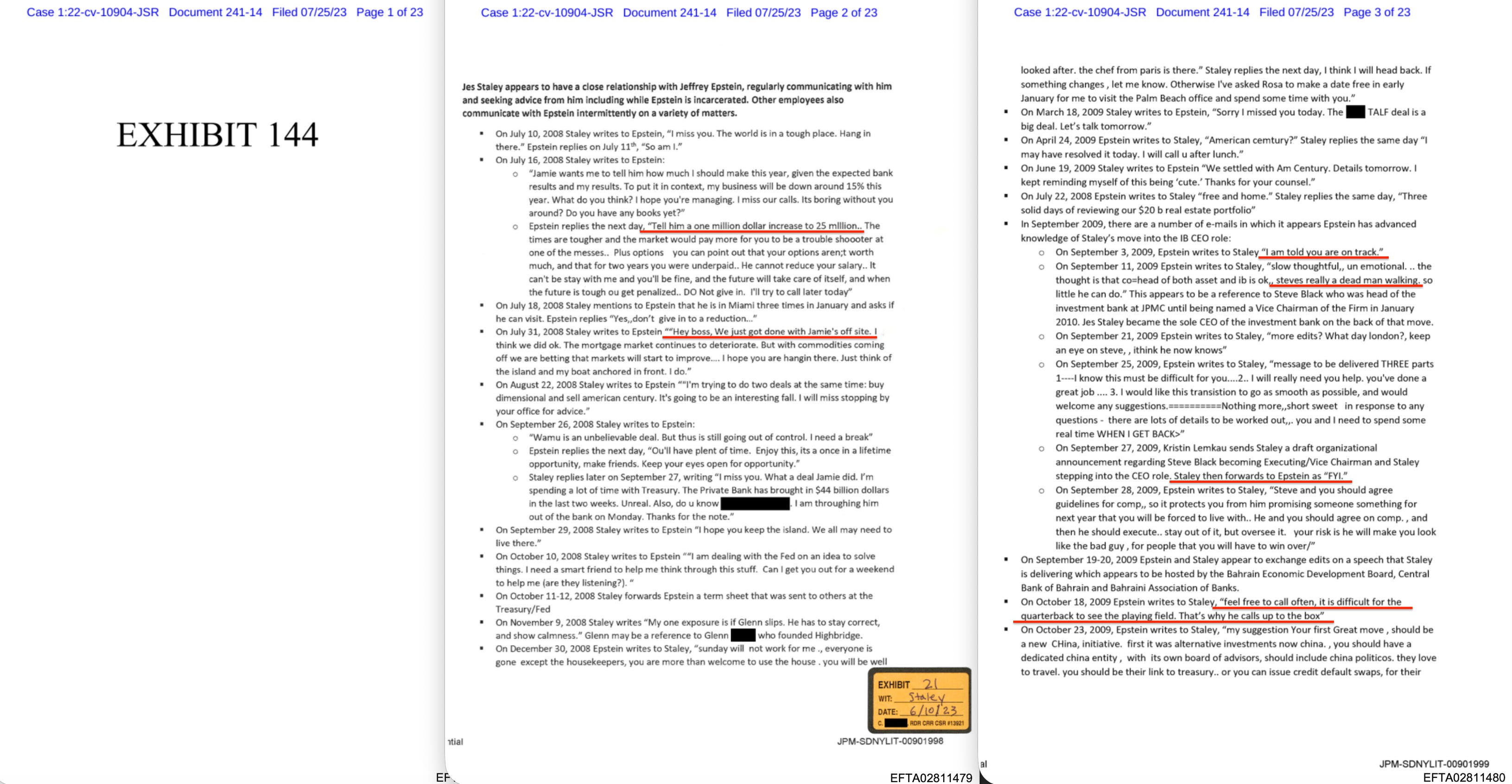
On 31 July 2008 — while Epstein was incarcerated in Palm Beach — Staley wrote: ‘Hey boss, We just got done with Jamie’s off site’. On 16 July, he had asked Epstein how much he should tell Jamie Dimon to pay him, describing the expected results and asking for guidance. Epstein replied with a precise negotiating strategy: ‘Tell him a one million dollar increase to 25 million... DO Not give in’.
Throughout September 2009, the document records Epstein managing Staley’s promotion to sole CEO of JPMorgan’s investment bank. On 3 September, Epstein wrote: ‘I am told you are on track’. On 11 September: ‘steves really a dead man walking. so little he can do’ — a reference to Steve Black, then head of the investment bank. On 25 September, Epstein scripted the message Staley should deliver in three numbered parts. Two days later, Staley forwarded a draft organisational announcement to Epstein as ‘FYI’ before it was released internally.
On 18 October 2009, Epstein wrote: ‘feel free to call often, it is difficult for the quarterback to see the playing field. That’s why he calls up to the box’. The man in the box, watching the entire field — that was the role he had assigned himself.
The relationship went well beyond advice. Jes Staley — the head of JPMorgan’s investment bank — called Epstein ‘boss’, sought his permission to visit properties, forwarded confidential internal documents, accepted detailed operational direction on hiring, compensation, strategy, and presentation — and reported back on his meetings with heads of state.
III. The Dynastic Capture
The document also reveals a subtler dimension to the control. Epstein did not merely manage Staley’s career; he embedded himself in his family.
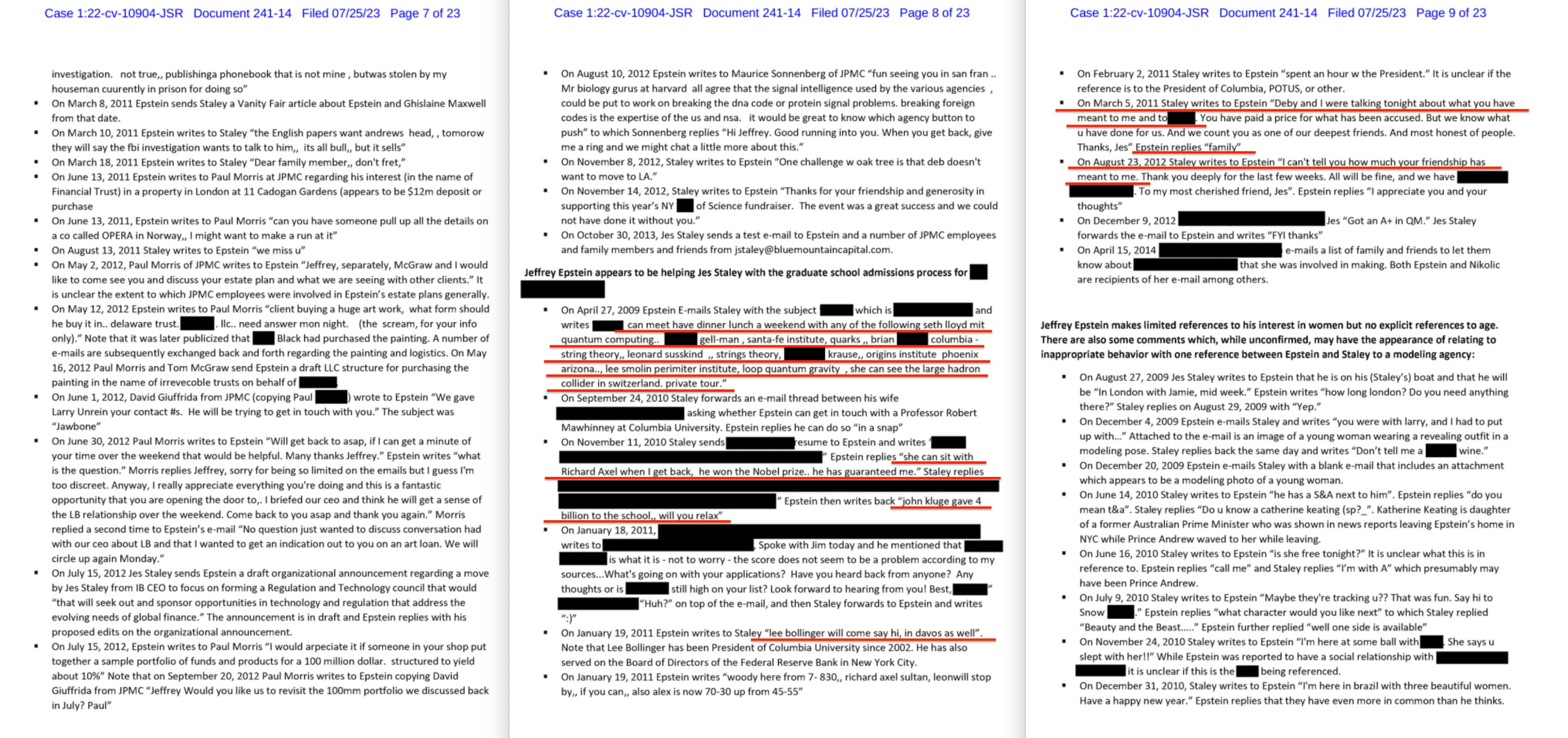
A separate section of the compliance summary records Epstein helping with the graduate school admissions process for Staley’s daughter. On 27 April 2009, Epstein emailed Staley with a list of scientists his daughter could meet: ‘seth lloyd mit quantum computing.. gell-man, santa-fe institute, quarks... brian columbia - string theory... leonard susskind... she can see the large hadron collider in switzerland. private tour’.
When Staley forwarded his daughter’s CV and expressed concern about her prospects, Epstein replied: ‘she can sit with Richard Axel when I get back, he won the Nobel prize.. he has guaranteed me’. Staley remained anxious. Epstein: ‘john kluge gave 4 billion to the school,, will you relax’.
In January 2011, Epstein wrote that Lee Bollinger — President of Columbia University and a member of the Board of Directors of the Federal Reserve Bank of New York2 — ‘will come say hi, in davos as well’. Epstein was deploying Nobel laureates and Ivy League presidents to smooth a banker’s daughter’s path through graduate school.
The effect was to bind Staley to Epstein at a level beyond professional convenience. Career management can be replaced; the man who guaranteed your daughter’s future through the scientific establishment and the president of Columbia is a different category of obligation.
IV. The Jailhouse Switchboard
In the Bannon interview — filmed in early 2019 and partially released in the DOJ’s 2026 document dump — Epstein described his role during the 2008 financial crisis with characteristic bluntness. He told Bannon he had been advising the US Treasury from a jail cell, calling the president of Bear Stearns on one phone and a contact at JPMorgan on the other: ‘I was actually going between two phones talking to Bear Stearns and JP Morgan at the same time’. The following day, he called ’another person in Washington... they were at the Treasury Department’.
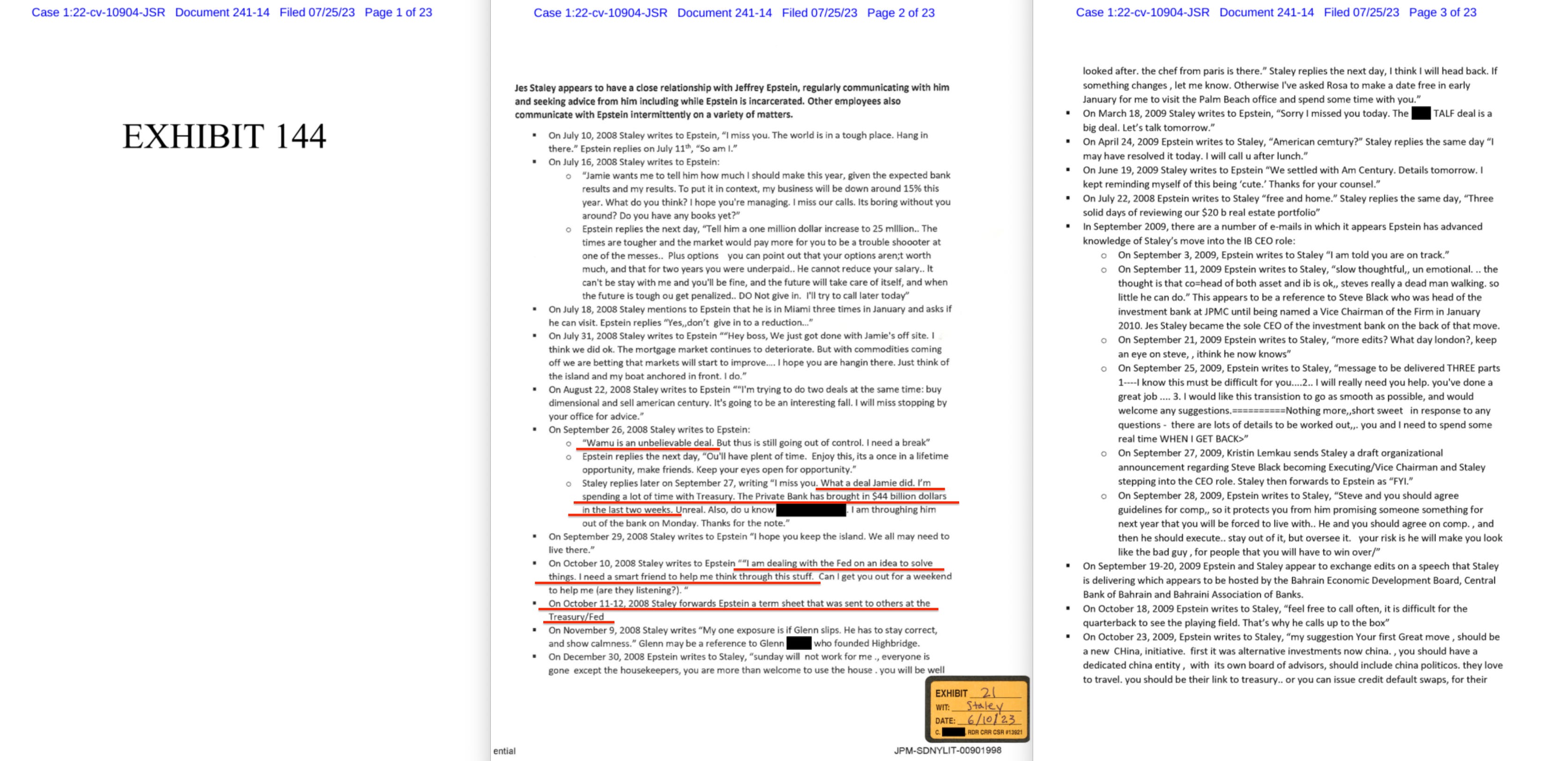
The JPMorgan document confirms this was not an exaggeration. The July–October 2008 email sequence records Staley writing to Epstein while he was incarcerated, reporting on the crisis in real time. On 26 September: ‘Wamu is an unbelievable deal. But thus is still going out of control’. On 27 September: ‘What a deal Jamie did. I’m spending a lot of time with Treasury. The Private Bank has brought in $44 billion dollars in the last two weeks’. On 29 September: ‘I hope you keep the island. We all may need to live there’.
On 10 October, Staley wrote: ‘I am dealing with the Fed on an idea to solve things. I need a smart friend to help me think through this stuff’. The following day, he forwarded a term sheet that had been sent to Treasury and the Federal Reserve.
The switchboard was operational during the worst financial crisis since the Great Depression, run from a prison cell in Palm Beach — with JPMorgan’s investment bank chief as the reporting line.
V. The Sovereign Routing Function
The original essays documented Epstein routing sovereign contacts between intelligence, finance, and political nodes. The JPMorgan document shows the same function operating directly through the bank.
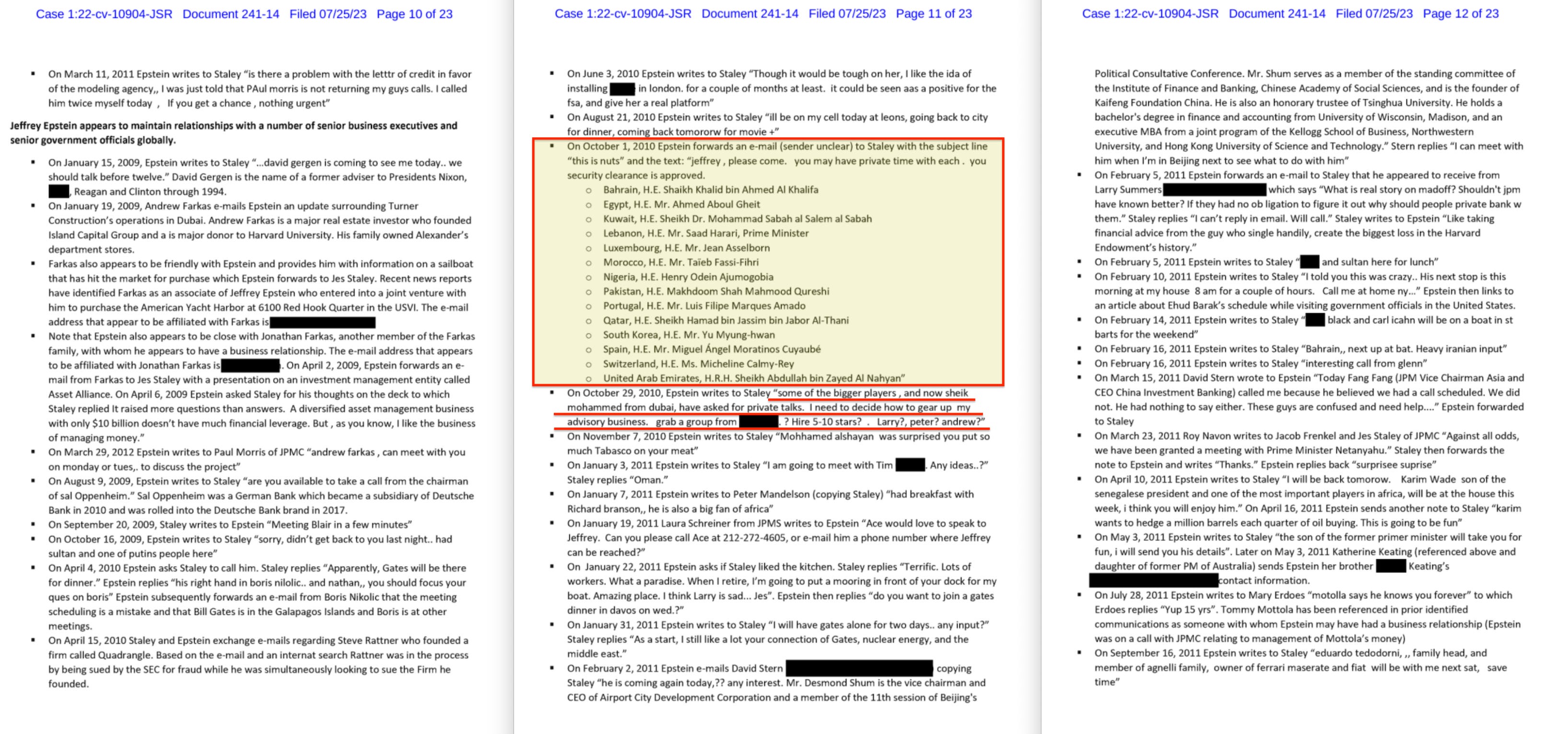
On 1 October 2010, Epstein forwarded an email to Staley with the subject line ‘this is nuts’ and the text: ‘jeffrey, please come. you may have private time with each. your security clearance is approved’. Below it, fourteen sovereign representatives:
Bahrain, Egypt, Kuwait, Lebanon, Luxembourg, Morocco, Nigeria, Pakistan, Portugal, Qatar, South Korea, Spain, Switzerland, and the United Arab Emirates.
Epstein had security clearance. He was arranging private audiences with foreign ministers and heads of state for JPMorgan’s investment bank CEO. This detail — Epstein holding security clearance — does not appear in any of the DOJ releases used in the original essays.
On 29 October 2010, Epstein wrote to Staley: ‘some of the bigger players, and now sheik mohammed from dubai, have asked for private talks. I need to decide how to gear up my advisory business. grab a group from ___? Hire 5-10 stars? Larry?, peter? andrew?’ The three names — Summers, Mandelson, and Prince Andrew — correspond exactly to the American, British, and intelligence channels documented in the trilogy, here being assembled into a formal advisory structure for Gulf sovereign clients.
On 28 July 2012, Epstein forwarded Staley an email from the President of the Maldives, Mohammed Waheed Hassan, seeking to borrow $500 million repayable over ten years3. One month later, Reuters reported that China had made a $500 million loan to the Maldives4. The switchboard had sight of sovereign borrowing requirements before they were fulfilled.
VI. The Gulf Pipeline
The trilogy traced Epstein’s relationship with Sultan Ahmed bin Sulayem, Chairman of DP World, to his 2017 pitch for a sovereign digital currency backed by Dubai5. The JPMorgan document reveals that Epstein had been building this channel through the bank for years, and that it connected directly to the China operation.
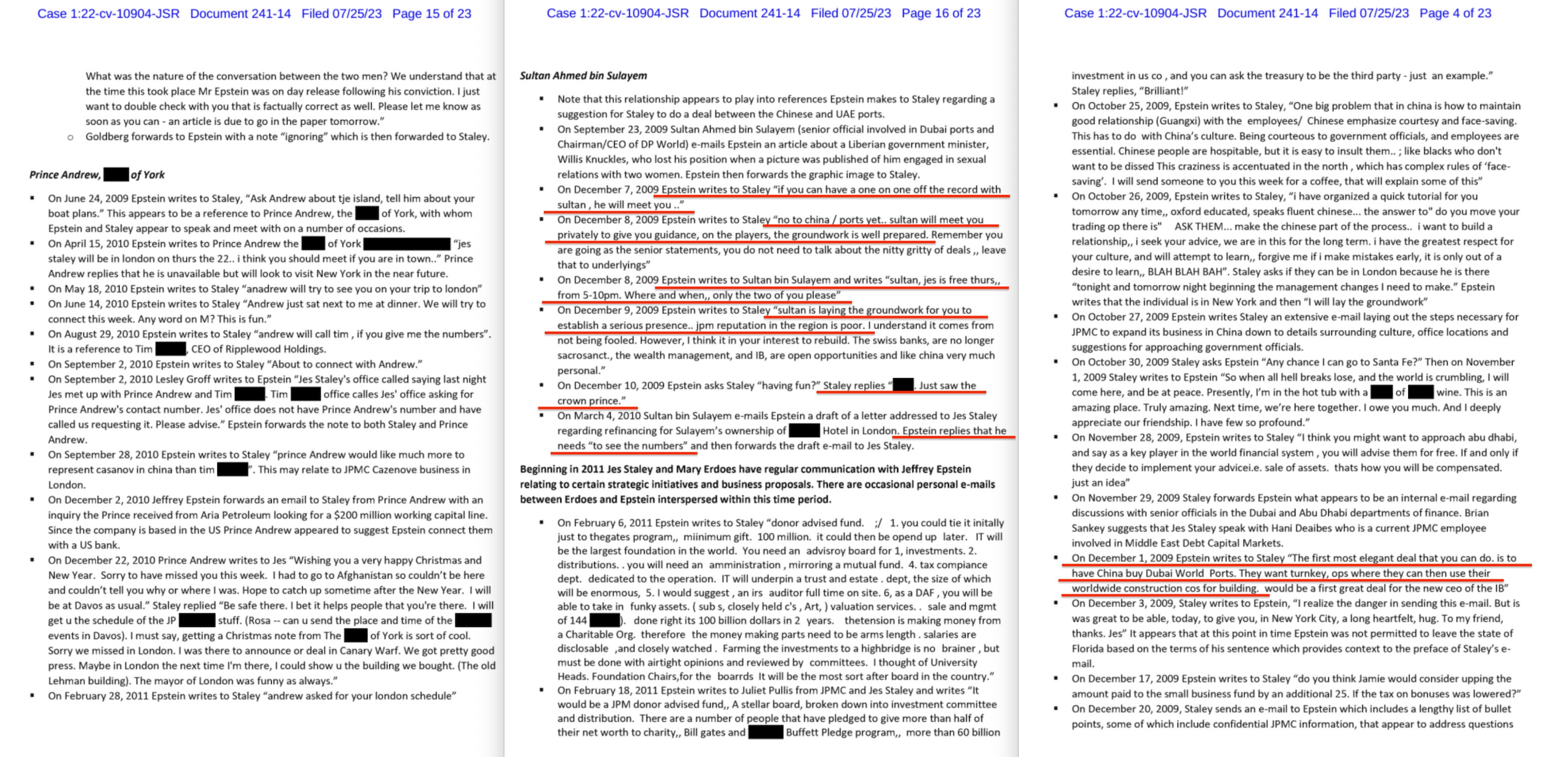
In December 2009, a sequence of emails shows Epstein managing JPMorgan’s entire Gulf entry strategy through Bin Sulayem. On the 7th: ‘if you can have a one on one off the record with sultan, he will meet you’. On the 8th: ‘no to china/ports yet.. sultan will meet you privately to give you guidance, on the players, the groundwork is well prepared’. He then arranged the meeting directly: ‘sultan, jes is free thurs, from 5-10pm. Where and when, only the two of you please’.
On 9 December: ‘sultan is laying the groundwork for you to establish a serious presence.. jpm reputation in the region is poor’. On the 10th, Staley reported back: ‘Just saw the crown prince’.
On 1 December 2009, Epstein proposed the deal that would connect the physical infrastructure to the financial layer: ‘The first most elegant deal that you can do. is to have China buy Dubai World Ports. They want turnkey, ops where they can then use their worldwide construction cos for building’. DP World operates port and logistics infrastructure across eighty-three countries. The same global trade network through which, eight years later, Epstein would propose attaching a sovereign digital currency to actual commerce.
On 4 March 2010, Bin Sulayem emailed Epstein a draft letter to Staley about refinancing a London hotel. Epstein replied that he needed ‘to see the numbers’ and then forwarded it to Staley. The sovereign client was submitting financial proposals through Epstein for review before they reached the banker.
VII. The China Operation
The China operation is entirely absent from the original trilogy. It represents a significant extension of the documented architecture.
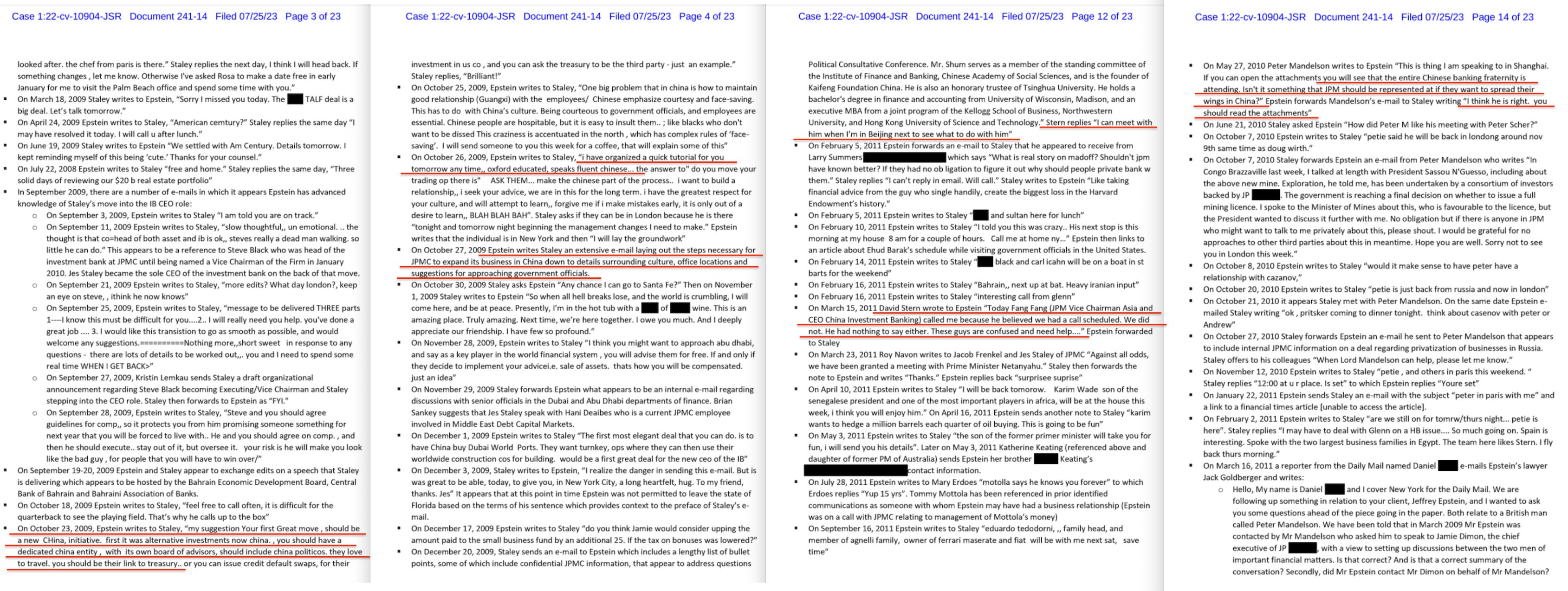
On 23 October 2009, Epstein sent Staley a complete strategic blueprint for JPMorgan’s China expansion: ‘Your first Great move, should be a new CHina, initiative... you should have a dedicated china entity, with its own board of advisors, should include china politicos. they love to travel. you should be their link to treasury’.
Over the following days, Epstein organised a cultural briefing for Staley (‘oxford educated, speaks fluent chinese’), then on 27 October sent what the compliance team describes as ‘an extensive e-mail laying out the steps necessary for JPMC to expand its business in China down to details surrounding culture, office locations and suggestions for approaching government officials’.
In February 2011, Epstein routed Desmond Shum to JPMorgan through David Stern. Shum was the vice chairman and CEO of Airport City Development Corporation, a member of Beijing’s Political Consultative Conference, and an honorary trustee of Tsinghua University. Stern replied: ‘I can meet with him when I’m in Beijing next to see what to do with him’. Shum would later write Red Roulette6, a memoir exposing corruption in China’s political elite. Epstein had him at the house years earlier.
On 15 March 2011, David Stern reported to Epstein that Fang Fang — JPMorgan’s Vice Chairman Asia and CEO China Investment Banking — ‘called me because he believed we had a call scheduled. We did not. He had nothing to say either. These guys are confused and need help’. JPMorgan’s own China chief was directionless, and the complaint was routed through Epstein’s channel. Epstein forwarded it to Staley.
In May 2010, Peter Mandelson — the former EU Trade Commissioner — wrote to Epstein from Shanghai that ‘the entire Chinese banking fraternity is attending. Isn’t it something that JPM should be represented at if they want to spread their wings in China?’ Epstein forwarded it to Staley: ‘I think he is right. you should read the attachments’.
VIII. The British Channels
The trilogy identified Prince Andrew and Peter Mandelson as parallel channels through Epstein. The JPMorgan document significantly deepens both.
Mandelson
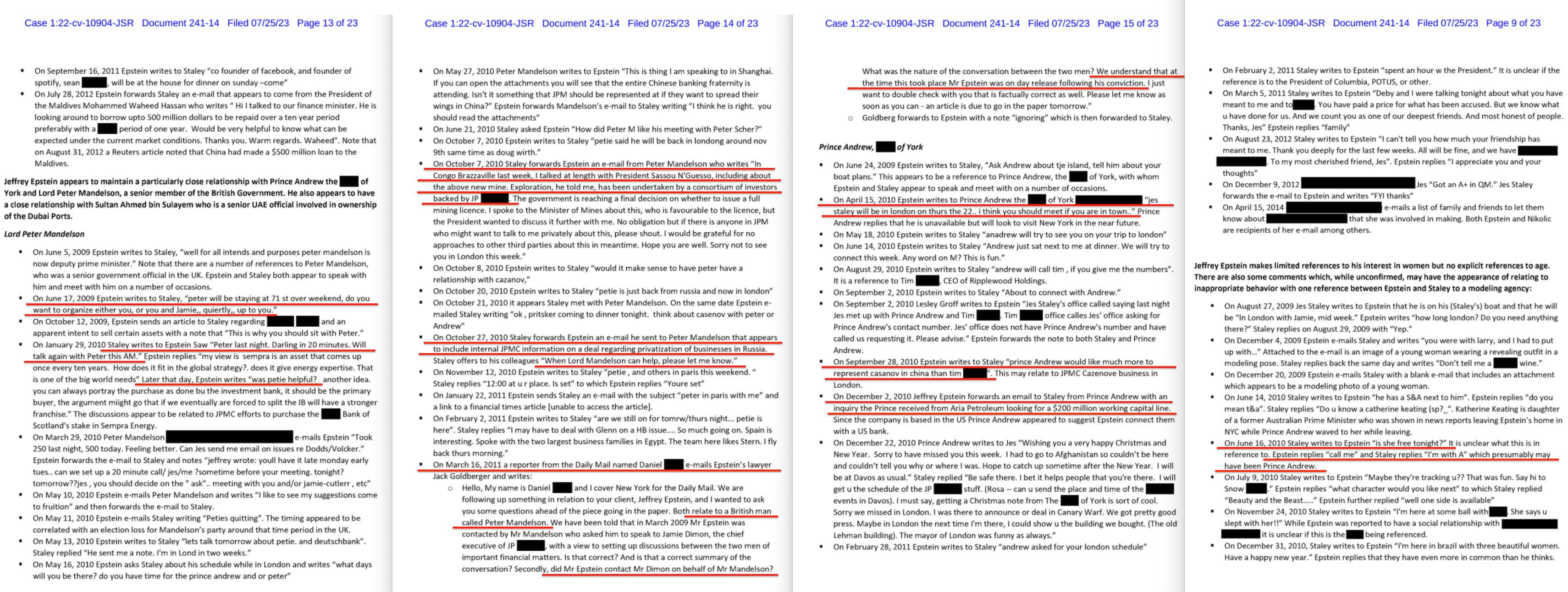
On 17 June 2009, Epstein wrote to Staley: ‘peter will be staying at 71 st over weekend, do you want to organize either you, or you and Jamie, quiertly, up to you’. Mandelson staying at Epstein’s townhouse, with the option for Staley or Jamie Dimon to visit — quietly.
On 7 October 2010, Staley forwarded an email from Mandelson to Epstein: ‘In Congo Brazzaville last week, I talked at length with President Sassou N’Guesso, including about the above new mine’. A former EU Trade Commissioner passing intelligence on African mining licences from a sitting head of state, routed through Epstein to JPMorgan.
On 27 October 2010, Staley forwarded Epstein an email he had sent to Mandelson ‘that appears to include internal JPMC information on a deal regarding privatization of businesses in Russia’. Staley told his colleagues: ‘When Lord Mandelson can help, please let me know’.
In January 2010, Epstein set up a meeting in Davos between Staley, Mandelson, and Chancellor Alistair Darling to discuss the Sempra Energy acquisition. Afterwards, Epstein asked: ‘was petie helpful?’
On 16 March 2011, a Daily Mail reporter contacted Epstein’s lawyer asking whether Mandelson had asked Epstein to set up discussions with Dimon ‘while Epstein was on day release following his conviction’. The lawyer forwarded the inquiry to Epstein with the note ‘ignoring’, which was then forwarded to Staley.
Prince Andrew
On 15 April 2010, Epstein wrote directly to Prince Andrew: ‘jes staley will be in london on thurs the 22.. i think you should meet if you are in town’.
On 28 September 2010: ‘prince Andrew would like much more to represent casanov in china than tim’. The Duke of York was being positioned to represent JPMorgan Cazenove’s interests in China — a member of the royal family deployed as a commercial asset for a specific bank, through the switchboard.
On 2 December 2010, Epstein forwarded Staley an email from Andrew about a $200 million working capital line for Aria Petroleum. The prince was channelling business enquiries through Epstein to JPMorgan.
On 16 June 2010, Staley wrote: ‘is she free tonight?’ Epstein replied: ‘call me’. Staley: ‘I’m with A’ — which the compliance summary notes ‘presumably may have been Prince Andrew’.
IX. Project Molecule
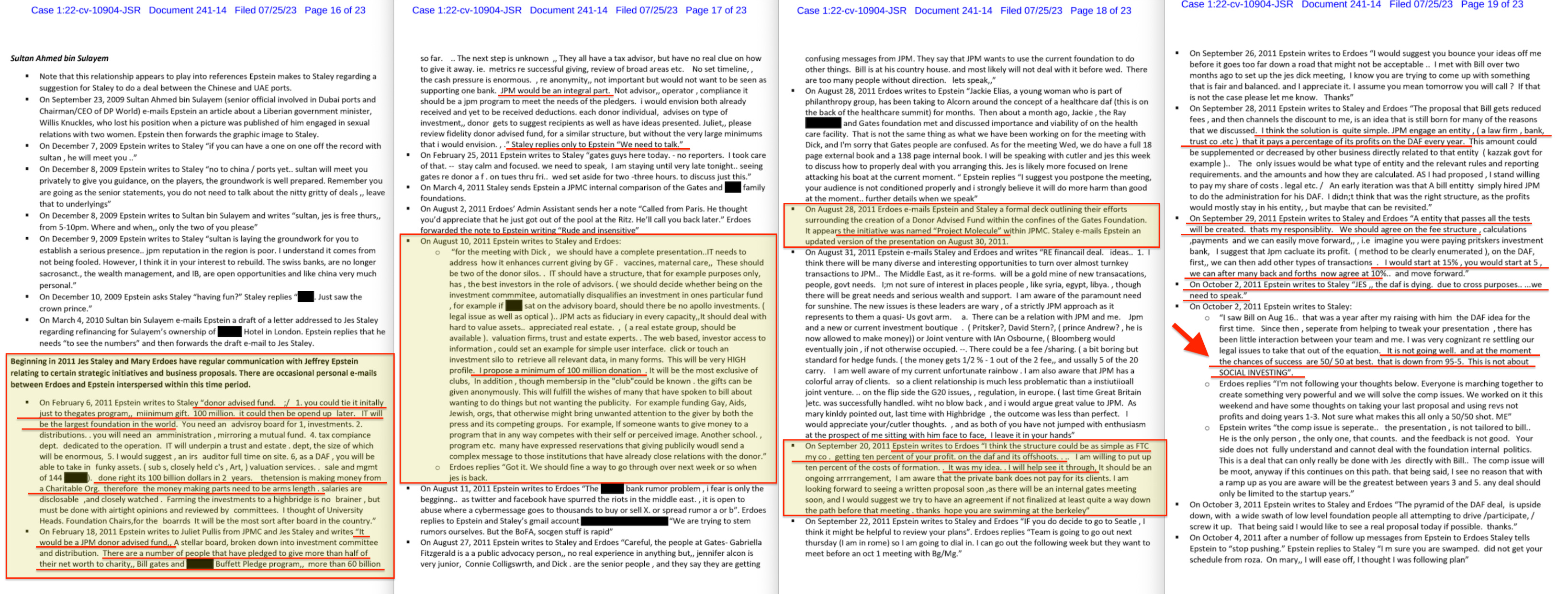
Epstein: The Switchboard Operator reconstructed the design chain for the Gates-linked donor-advised fund that became JPMorgan’s Project Molecule and ultimately the Global Health Investment Fund — the proof of concept for the impact investing architecture7. The JPMorgan document confirms the entire sequence from the bank’s own records, and provides the full arc, including internal tensions invisible in the DOJ releases.
The institutional context matters. In September 2009, JPMorgan was a founding member of the Global Impact Investing Network, launched at the Clinton Global Initiative alongside the Gates Foundation, the Rockefeller Foundation, and Al Gore’s Generation Investment Management8. The Rockefeller Foundation had coined the term ‘impact investing’ at a 2007 convening at its Bellagio conference centre9. GIIN formalised the field. JPMorgan co-founded it. And the JPMorgan compliance document shows that in the same month — September 2009 — Epstein was managing Staley’s promotion to IB CEO, scripting his messaging, and editing his organisational announcement before it went out internally.
The man running the bank’s investment bank chief was doing so while the bank was co-founding the architecture he would design the flagship product for eighteen months later.
A separate exhibit from the same litigation confirms the scale from the bank’s own working papers. Under the heading ‘Project Molecule’, it records four named JPMorgan staff and lawyers at Simpson Thacher working on ‘building a solution for potential ~$40-$80BN of Gates’ funds, thought to be related to the Giving Pledge’. Epstein’s estimate of $100 billion was ambitious. The bank’s own internal figure was $40–80 billion — still large enough to require a dedicated legal team and bespoke structuring10.
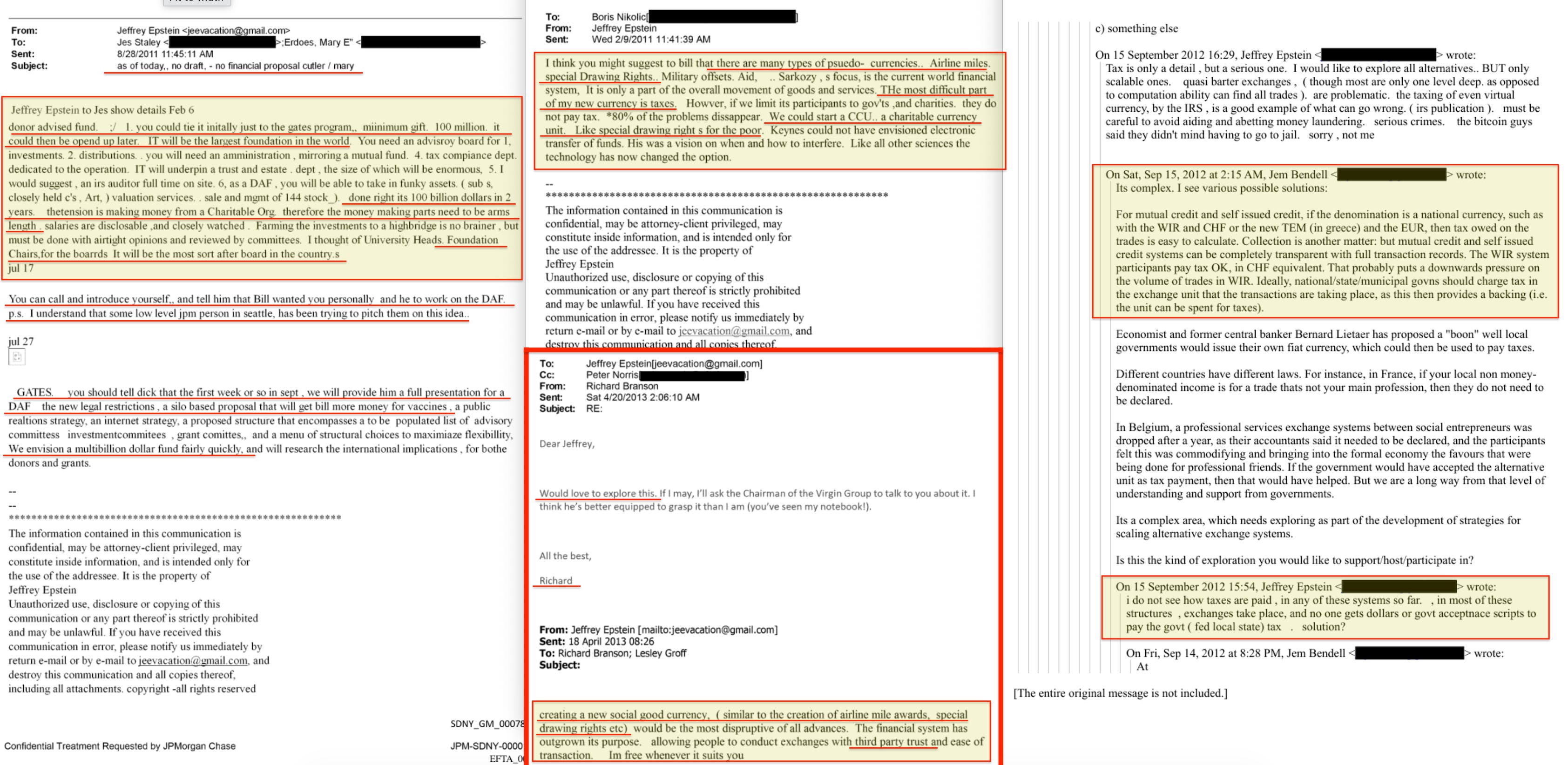
The blueprint email of 6 February 2011 is reproduced verbatim — the same email cited in Epstein: The Switchboard Operator11:
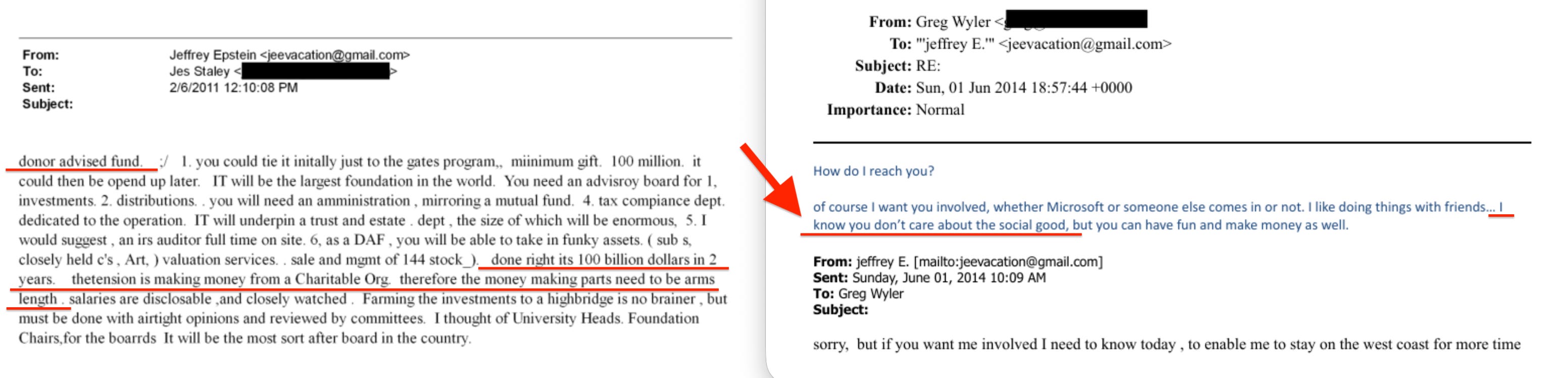
donor advised fund... you could tie it initally just to the gates program,, miinimum gift. 100 million. it could then be opend up later. IT will be the largest foundation in the world... done right its 100 billion dollars in 2 years. the tension is making money from a Charitable Org. therefore the money making parts need to be arms length.
The original source email contains material the compliance summary omitted. The subject line reads: ‘as of today,, no draft, - no financial proposal cutler / mary’ — Epstein chasing JPMorgan for failing to produce a proposal.
A later addition dated 17 July shows Epstein telling Staley: ‘You can call and introduce yourself,, and tell him that Bill wanted you personally and he to work on the DAF. p.s. I understand that some low level jpm person in seattle, has been trying to pitch them on this idea..’ He viewed the DAF as his initiative and was irritated that someone at JPMorgan’s Seattle office had been approaching the Gates Foundation independently.
By 27 July, Epstein was addressing Gates directly through the same email chain: ‘you should tell dick that the first week or so in sept, we will provide him a full presentation for a DAF... a silo based proposal that will get bill more money for vaccines... We envision a multibillion dollar fund fairly quickly’. Epstein and JPMorgan as a joint ‘We’, presenting to the Gates Foundation, with the purpose stated in plain English: get Bill more money for vaccines.
Three days after the DAF blueprint, on 9 February 2011, Epstein sent Boris Nikolic — Gates’s chief science and technology adviser — an email that connects the financial vehicle directly to the currency operation documented in Epstein II12:
I think you might suggest to bill that there are many types of psuedo-currencies.. Airline miles. special Drawing Rights.. Military offsets. Aid... THe most difficult part of my new currency is taxes. Howver, if we limit its participants to gov’ts ,and charities. they do not pay tax. *80% of the problems dissappear. We could start a CCU.. a charitable currency unit. Like special drawing rights for the poor. Keynes could not have envisioned electronic transfer of funds. His was a vision on when and how to interfere. Like all other sciences the technology has now changed the option.
He calls it ‘my new currency’ and gives it a name: CCU, a charitable currency unit. The IMF’s special drawing right — a synthetic reserve currency for sovereign settlements — reimagined as a development instrument for the poor.
The tax problem he would pose to Jem Bendell eighteen months later — ‘i do not see how taxes are paid, in any of these systems’13 — was already solved. Restrict the currency to governments and charities, entities that do not pay tax, and eighty per cent of the regulatory obstacles vanish. The airline miles analogy — a loyalty-point currency with conditional redemption — is the same one he would use with Richard Branson in April 2013 when describing a ‘social good currency’14.
The Keynes reference carries the furthest. The bancor — Keynes’s proposed international clearing currency at Bretton Woods — was designed to operate at the sovereign level. Epstein’s observation was that electronic transfer changes the scope of what is possible: the intervention Keynes imagined between nations can now operate at the transaction level.
The DAF blueprint and the CCU were designed in the same week, through the same network, for the same purpose. The charitable framing eliminates both the political resistance to profit extraction (the fund) and the technical barrier to currency adoption (taxes). The BIS Innovation Hub now calls this architecture ‘purpose-bound money’15. Epstein described it, named it, and sent the specification to Bill Gates’s chief adviser — in February 2011, eight years before the Innovation Hub existed.
On 18 February, Epstein wrote to Juliet Pullis and Staley expanding the structure. Staley replied only to Epstein: ‘We need to talk’. He was cutting JPMorgan staff out of the response.
On 10 August, Epstein sent Staley and Mary Erdoes — CEO of JPMorgan Asset and Wealth Management — a comprehensive specification: investment silos, advisory boards, anonymous giving for sensitive causes, a minimum $100 million donation, and a web-based interface. By 28 August, Erdoes had sent Epstein and Staley a formal presentation deck. The bank internally named it ‘Project Molecule’.
On 20 September, Epstein made his commercial position explicit: ‘I think the structure could be as simple as FTC my co. getting ten percent of your profit. on the daf and its offshoots... It was my idea. I will help see it through’.
The fee negotiations ran through September. Epstein proposed 15%. JPMorgan would start at 5%. Epstein suggested settling at 10%. The structure was being designed to route his payment through an intermediary entity: ‘JPM engage an entity, (a law firm, bank, trust co. etc) that it pays a percentage of its profits on the DAF every year’.
Then, on 2 October, the collapse began. Epstein wrote to Staley: ‘JES, the daf is dying. due to cross purposes’. In a follow-up that day, he added:
the chances of success are 50/50 at best. that is down from 95.5. This is not about SOCIAL INVESTING.
In capitals. In JPMorgan’s own compliance file.
When the deal was going well, it was framed as philanthropy, the Giving Pledge16, vaccines for the developing world. When it was falling apart, Epstein said in plain text what it was not.
The two statements — ‘the tension is making money from a Charitable Org’ and ‘This is not about SOCIAL INVESTING’ — are preserved in the bank’s own records, produced under compulsion in federal litigation. Together, they articulate the operating logic of the entire impact investing architecture: the ‘social good’ is the authorisation layer for private profit extraction.
The challenge is keeping the two structurally separate so that the profit is invisible.
X. Technology, Regulation, and Intelligence
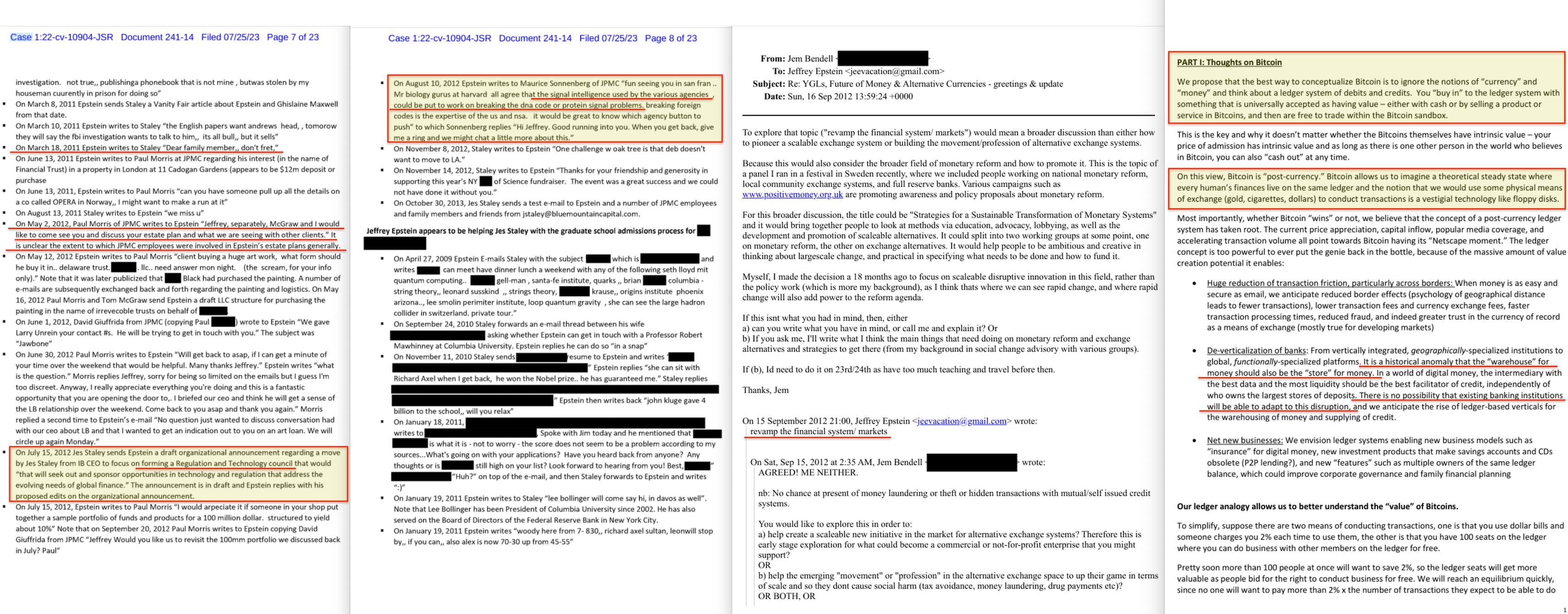
On 15 July 2012, Staley sent Epstein a draft organisational announcement for his move from IB CEO to a new role: forming ‘a Regulation and Technology council that will seek out and sponsor opportunities in technology and regulation that address the evolving needs of global finance’. Epstein replied with proposed edits.
This was July 2012 — the same year Epstein commissioned Jem Bendell to ‘revamp the financial system/markets’17, the same year the WEF Alternative Currencies reconnaissance was running, and before the ‘Thoughts on Bitcoin’ strategic document was circulating within the network18.
The BIS Innovation Hub, established in 2019, was built to do precisely what that council description says: seek out and sponsor opportunities in technology and regulation addressing the evolving needs of global finance. Its private-sector precursor existed at JPMorgan seven years earlier, with Epstein editing the mission statement.
On 10 August 2012, Epstein wrote to Maurice Sonnenberg of JPMorgan: ‘fun seeing you in san Fran Mr biology gurus at harvard all agree that the signal intelligence used by the various agencies, could be put to work on breaking the dna code or protein signal problems. breaking foreign codes is the expertise of the us and nsa. it would be great to know which agency button to push’.
Sonnenberg replied: ‘Hi Jeffrey. Good running into you. When you get back, give me a ring and we might chat a little more about this’.
Maurice Sonnenberg served on the President’s Intelligence Advisory Board under Barack Obama19 — the body providing independent oversight of the United States intelligence community.

XI. Epstein’s Seven
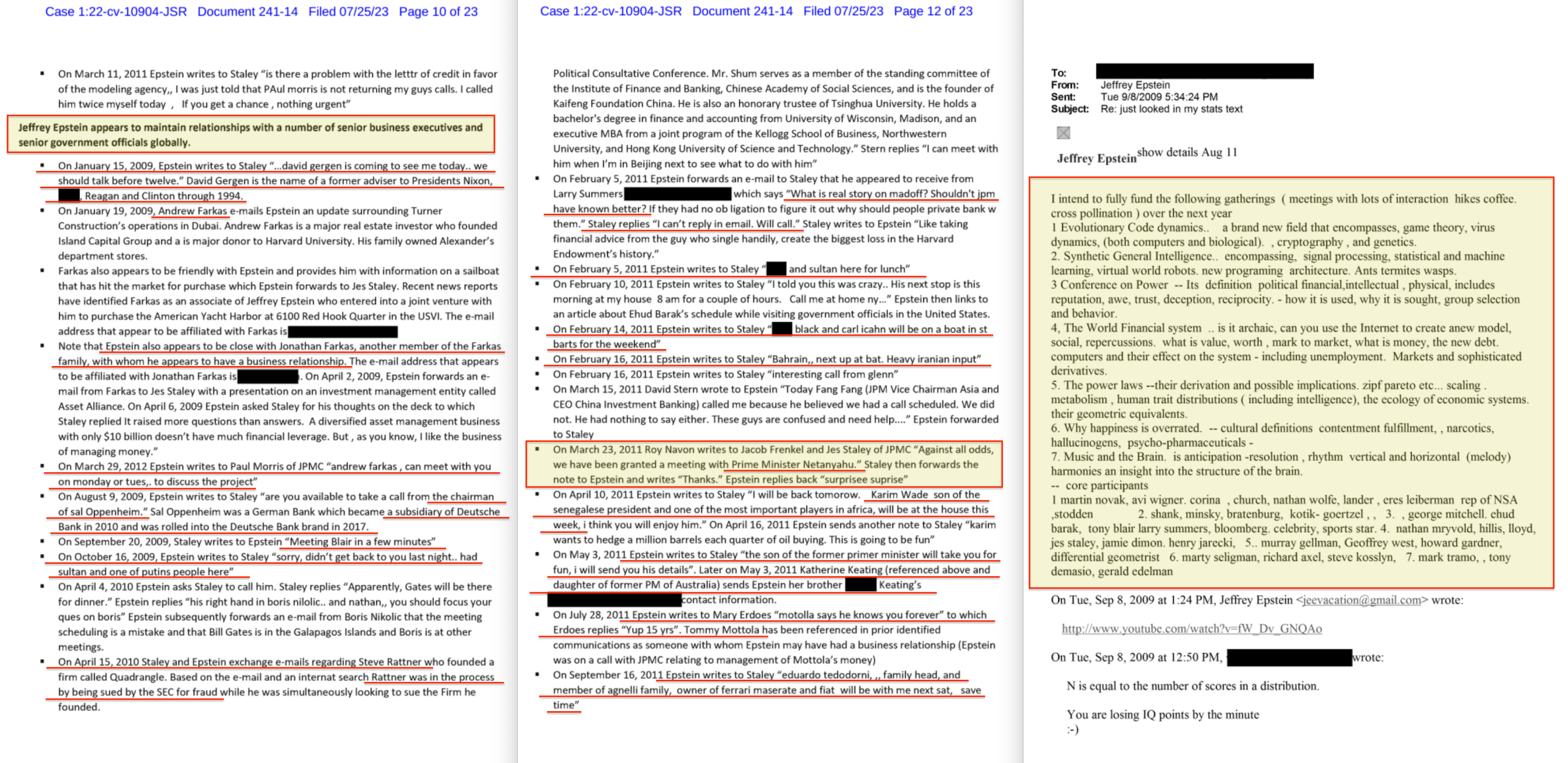
On 11 August 2009 — four months after leaving prison — Epstein sent an email to John Brockman, the literary agent behind the Edge Foundation, laying out seven research gatherings he intended to fund20. The topics ranged from evolutionary code dynamics and artificial general intelligence to the world financial system and a conference on power.
The proposed guest lists included Marvin Minsky, Ben Goertzel, Murray Gell-Mann, and Martin Nowak. For Gathering 3 (on power): Ehud Barak, Tony Blair, Larry Summers, and Michael Bloomberg. For Gathering 4 (on the world financial system): Jes Staley and Jamie Dimon.
The JPMorgan document confirms that Gathering 4 was not merely theoretical. By the time Epstein sent that email, Staley had been taking strategic direction from him for at least a year — forwarding internal documents, reporting on crisis meetings with the Federal Reserve, accepting compensation advice from a prison cell. The ‘gathering’ on the financial system was the public-facing version of a private relationship already operating.
Gathering 3 is confirmed in the same way. The JPMorgan document shows all four named participants routing through Epstein to Staley during the same period: Ehud Barak visiting during official US government trips and being reported to Staley in real time; Staley writing ‘Meeting Blair in a few minutes’; Summers forwarding questions about Madoff and JPMorgan; Bloomberg being positioned by Epstein with Barak ten days before the September 2013 summit. The ‘Conference on Power’ was already convening informally at 71st Street.
Gathering 1 proposed a representative of the NSA as a participant for research on evolutionary code dynamics, cryptography, and genetics. The Sonnenberg email — Epstein discussing NSA signals intelligence for biological research with a member of the President’s Intelligence Advisory Board — confirms the NSA connection was already operational through JPMorgan’s own intelligence liaison.
The seven gatherings were a formalisation of capabilities already running through the bank. The JPMorgan compliance file, without knowing the gatherings email existed, independently documents the operational reality behind five of the seven topics.
XII. The Formalisation Pitch
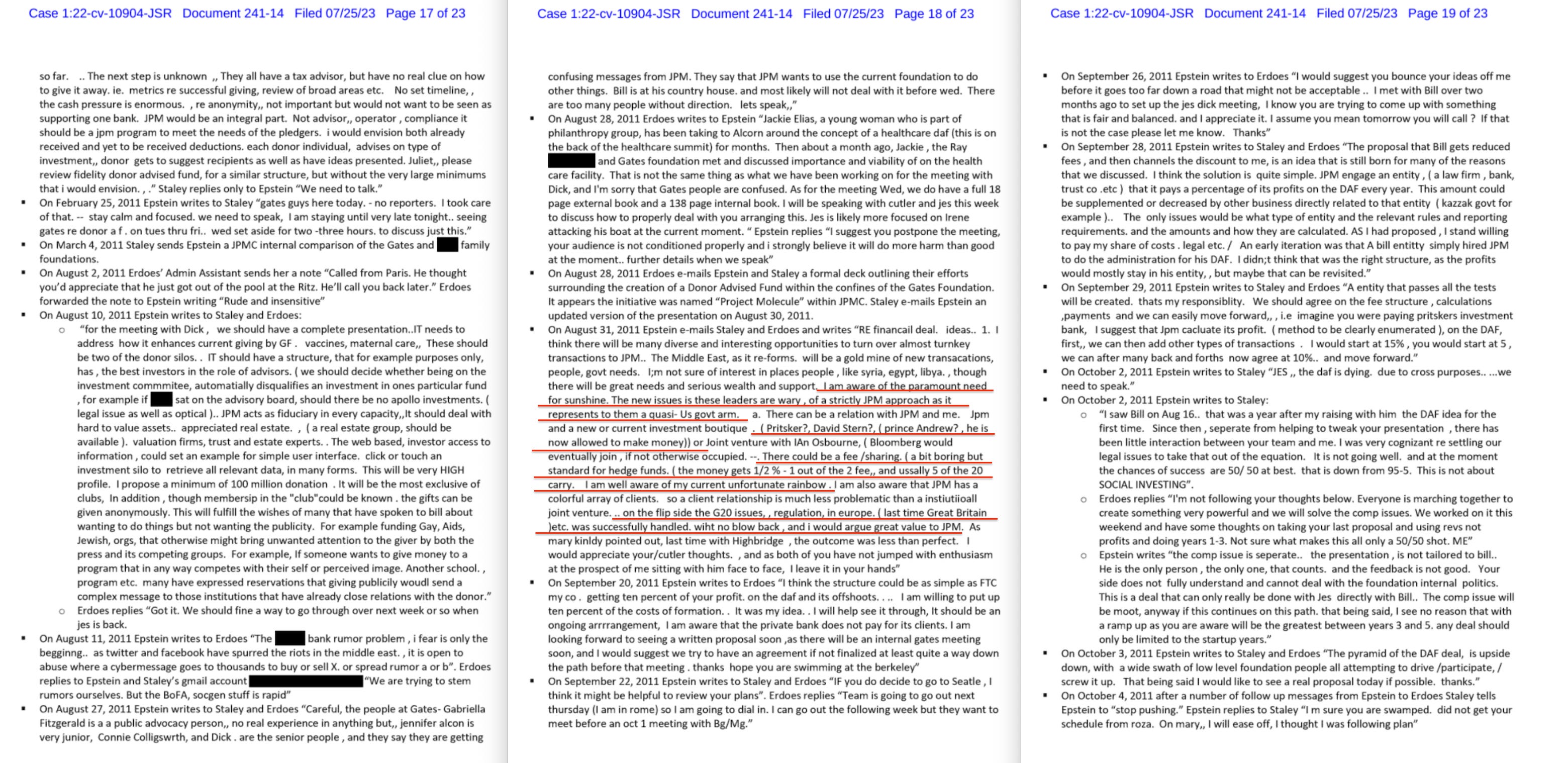
On 31 August 2011, Epstein sent an extraordinary email to both Staley and Erdoes. He proposed a formal commercial relationship between himself and JPMorgan, listing the assets he could bring: Middle Eastern sovereign clients, G20 regulatory expertise, and named individuals as potential partners — ‘Pritsker?, David Stern?, (prince Andrew?, he is now allowed to make money)’ — while acknowledging ‘my current unfortunate rainbow’.
He noted that Middle Eastern leaders were ‘wary of a strictly JPM approach as it represents to them a quasi-US govt arm’ and proposed himself as the buffer. He described the fee structure in hedge fund terms: ‘the money gets 1/2 % 1 out of the 2 fee, and usually 5 of the 20 carry’. He referenced the G20 regulatory work — ‘last time with Great Britain etc. was successfully handled, with no blow back, and i would argue great value to JPM’.
He was openly pitching JPMorgan’s two most senior executives on formalising the switchboard as a revenue-sharing enterprise, with a British royal as a named partner, acknowledging his criminal conviction, and arguing that his value justified the risk.
Neither Staley nor Erdoes rejected his approach.
XIII. The Bilateral Lock
While Epstein was designing Project Molecule and pitching the formalisation of his advisory role, the final pages of the document reveal him simultaneously pursuing litigation against the bank.
Epstein had personal investments in Bear Stearns and Highbridge hedge funds managed through JPMorgan. He lost tens of millions. The settlement negotiations, documented from September 2010 through July 2011, show him working the leverage with precision.
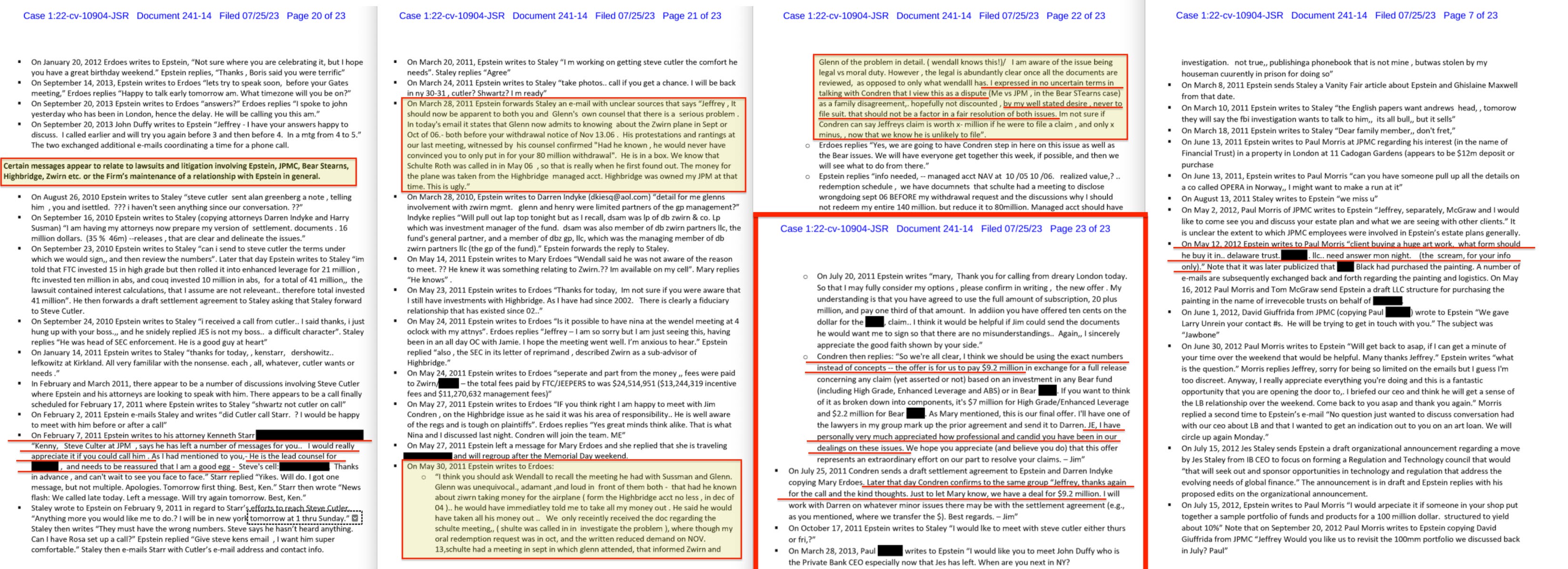
On 28 March 2011, Epstein forwarded Staley an email about Glenn Dubin, founder of Highbridge: ‘It should now be apparent to both you and Glenn’s own counsel that there is a serious problem... Glenn now admits to knowing about the Zwirn plane in Sept or Oct of 06... He is in a box... The money for the plane was taken from the Highbridge managed acct. Highbridge was owned by JPM at that time. This is ugly’.
Rather than engage JPMorgan’s General Counsel Steve Cutler directly, Epstein deployed his own attorney Kenneth Starr — the former independent counsel21 — to apply pressure. On 7 February 2011, Epstein wrote to Starr: ‘Steve Culter at JPM, says he has left a number of messages for you... He is the lead counsel... and needs to be reassured that I am a good egg’. Starr obliged.
When Cutler proved difficult, Epstein went to Erdoes. On 30 May 2011, he wrote: ‘I expressed in no uncertain terms in talking with Condren that I view this as a dispute… as a family disagreement,. hopefully not discounted, by my well stated desire, never to file suit. that should not be a factor in a fair resolution of both issues’.
The framing — a ‘family disagreement’ — carries an implicit threat. Epstein was reminding JPMorgan that he had visibility into the bank's internal exposures, while assuring them he preferred to resolve things quietly. He settled for $9.2 million, and the bank’s own lawyer Jim Condren thanked him for being ‘professional and candid’ in their dealings.
At the same time, Epstein was structuring opaque wealth vehicles for the bank’s most valuable clients. On 12 May 2012, he wrote to JPMorgan’s Paul Morris: ‘client buying a huge art work, what form should he buy it in.. delaware trust. Ilc.. need answer mon night. (the scream, for your info only)’. Four days later, Morris sent Epstein a draft LLC structure for purchasing Edvard Munch’s The Scream on behalf of Leon Black — the Apollo Global Management founder who paid Epstein at least $158 million in fees. The painting sold for $120 million. Epstein was building the bespoke legal architecture to move high-value assets off the public ledger and into private trusts — the ‘funky assets’ he had described in the DAF blueprint.
The switchboard operator accumulated the network’s liabilities, structured its most sensitive transactions, and used both to guarantee his position. Loyalty flowed upward through shared knowledge of what the compliance file politely calls ‘confidential JPMC information’. The bilateral lock — everyone knows enough to damage everyone else — was the operating system.
XIV. The $1.3 Billion Gap
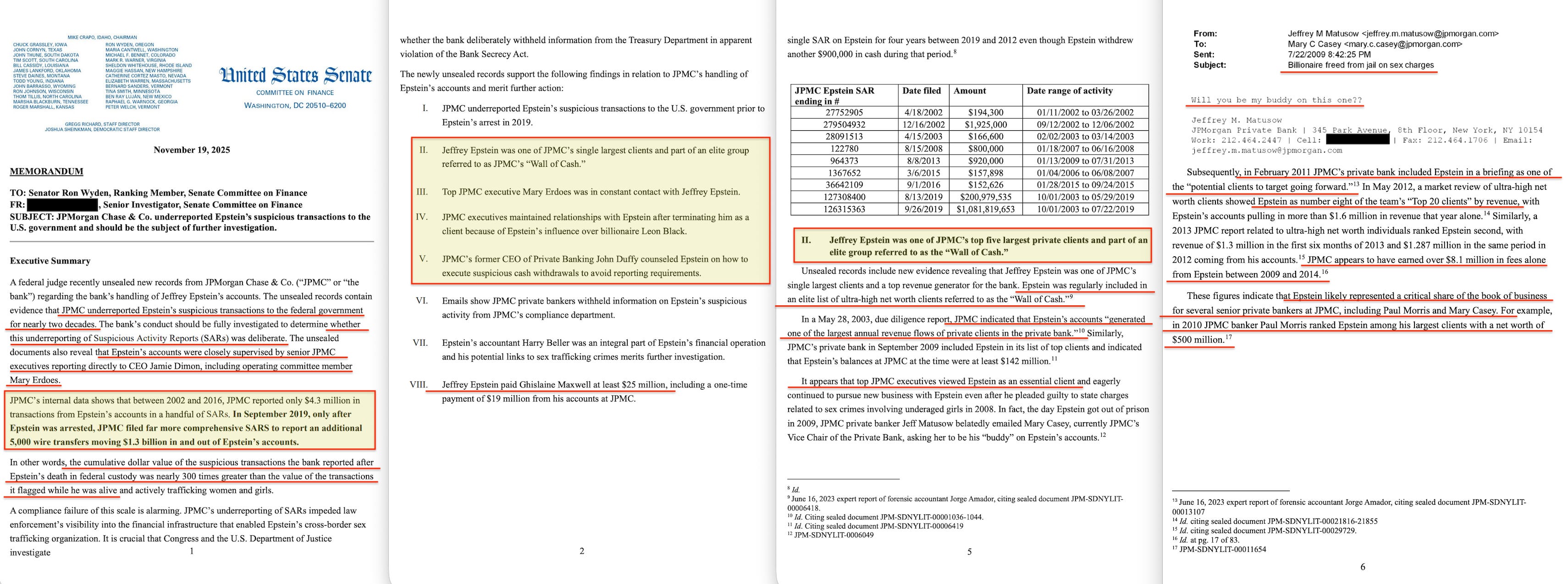
A November 2025 memorandum from the Senate Finance Committee to Senator Ron Wyden22 — based on newly unsealed JPMorgan records from the same SDNY litigation — quantifies the scale of what the compliance document describes.
Between 2002 and 2016, JPMorgan filed seven Suspicious Activity Reports on Epstein’s accounts, flagging a total of $4.3 million in transactions. In August and September 2019 — after Epstein was arrested and subsequently died — the bank filed two further SARs flagging over 5,000 suspicious wire transfers moving approximately $1.3 billion through his accounts. The value of the transactions reported after his death was nearly three hundred times greater than the value flagged while Epstein was alive.
Epstein was one of JPMorgan’s top five largest private clients. He belonged to an elite group the bank internally called the ‘Wall of Cash’. A 2003 due diligence report noted that his accounts ‘generated one of the largest annual revenue flows of private clients in the private bank’. In 2010, Paul Morris — the same banker who appears throughout Exhibit 144 coordinating property purchases and portfolio construction — ranked Epstein among his largest clients with a net worth of $500 million.
The bank earned over $8.1 million in fees from Epstein between 2009 and 2014 alone.
A separate internal transaction summary is more direct23: ‘Epstein is GIO’s biggest revenue producer’. Not one of the largest. The largest.
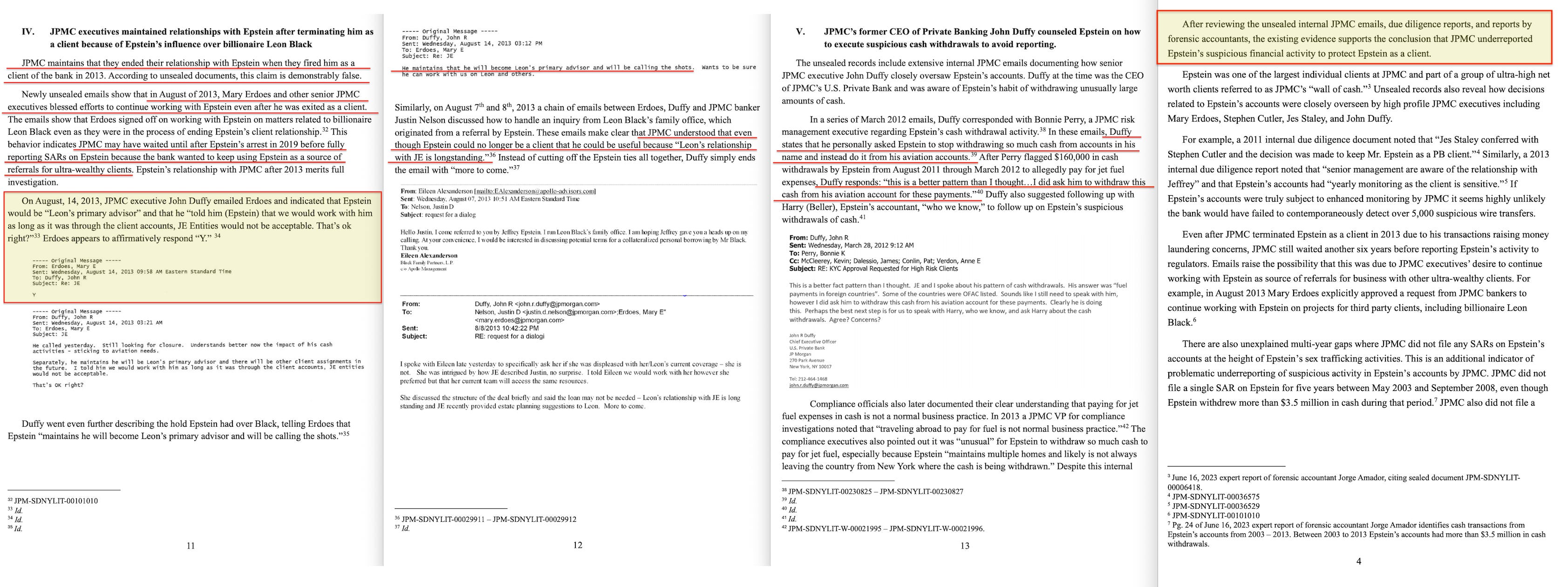
The Senate memorandum also reveals that John Duffy — the Private Bank CEO whom Paul Morris asked Epstein to meet at the end of Exhibit 144 — counselled Epstein on how to structure cash withdrawals to avoid triggering reporting requirements. When a risk management executive flagged $160,000 in suspicious cash withdrawals, Duffy replied: ‘this is a better pattern than I thought... I did ask him to withdraw this cash from his aviation account for these payments’.
A JPMorgan executive coaching Epstein on how to restructure withdrawals to evade suspicious activity reporting.
The memorandum further documents that Mary Erdoes approved continued engagement with Epstein after his formal termination as a client in 2013 — specifically to maintain his role as intermediary with Leon Black. Internal emails show Duffy telling Erdoes that Epstein ‘maintains he will become Leon’s primary advisor and will be calling the shots’. Erdoes’s response, in its entirety: ‘Y’.
The bank also processed at least $25 million in payments from Epstein to Ghislaine Maxwell, including a single transfer of $18.3 million in 1999 and a $7 million wire in 2007 used to purchase a Sikorsky helicopter. No timely SARs were filed on these transactions.
JPMorgan ultimately paid $290 million to settle the victims’ class action24 and a further $75 million to settle the US Virgin Islands enforcement action25 — a combined $365 million.
The Senate Finance Committee concluded that the evidence supports the finding that JPMorgan underreported Epstein’s suspicious financial activity ‘to protect Epstein as a client’.
XV. The Agent Model
In 2016, Rainer Liedtke published Agents for the Rothschilds: A Nineteenth-Century Information Network26, drawing on the Rothschild Archive London to document a recruitment and intelligence operation spanning the European continent. The agents were placed in locations where the Rothschild banks lacked a permanent presence. They carried out transactions, gathered political and economic intelligence, and forwarded information that enabled the family to make decisions ahead of competitors and governments. They were operationally essential — but, as Liedtke notes, ‘such men never gained access to the decision-making circle of the family’.
Reading the JPMorgan document alongside Liedtke’s research, the parallel is difficult to ignore.
Epstein gathered political and economic intelligence: the fourteen foreign ministers, Barak’s geopolitical assessments, Mandelson’s government material, the Maldives borrowing requirement. He forwarded information ahead of competitors, including Treasury term sheets during the financial crisis, Abu Dhabi finance discussions, and Congo mining licences from President Sassou N’Guesso. He carried out transactions, from Project Molecule to the DP World channel to the China-Dubai ports proposal. And his fee structure proposals to Erdoes and Staley — 10% of profits, hedge fund carry, payment through an intermediary entity — mirror precisely the compensation model Liedtke documents, in which the agent profits from the network but remains permanently outside the core.
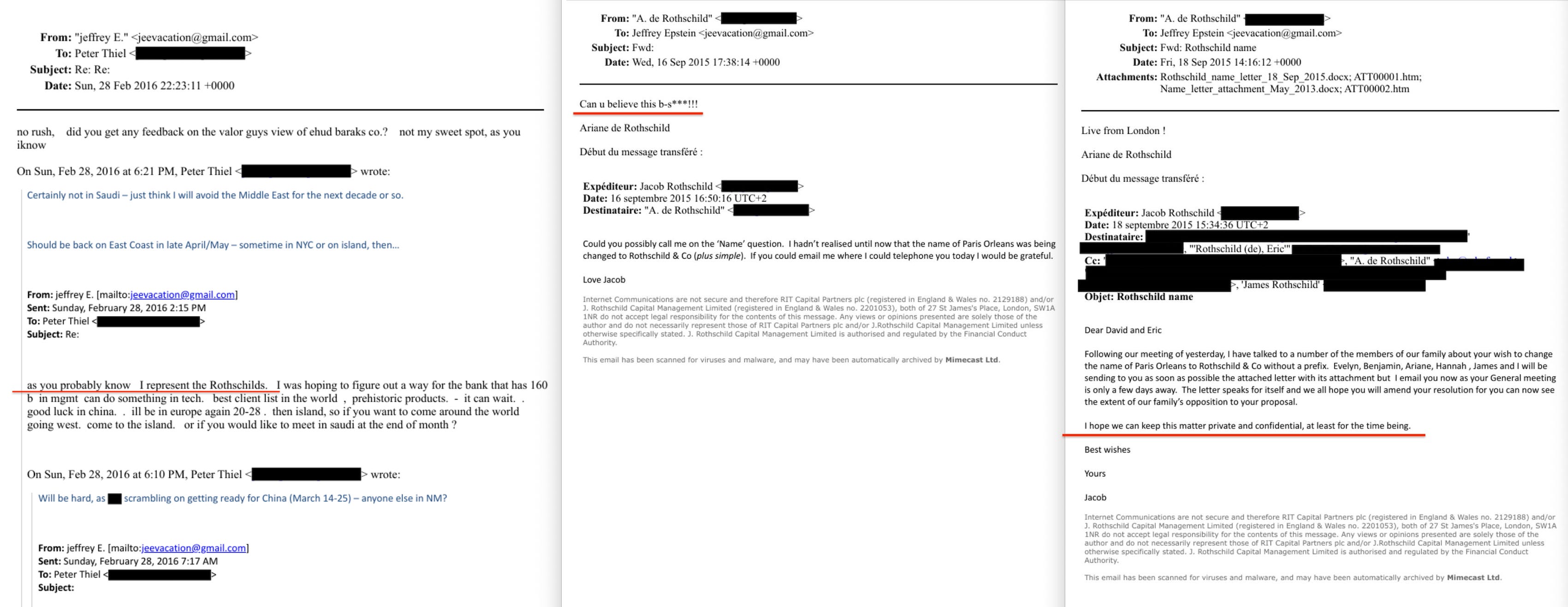
Liedtke records one significant failure in the nineteenth-century system. August Schönberg, dispatched to New York and later known as August Belmont, declared himself the Rothschild agent on Wall Street without authorisation. The distance between New York and London made control impossible, and the family was forced to tolerate him. Epstein told Peter Thiel in 201627: ‘as you probably know I represent the Rothschilds’. The JPMorgan document shows him operating as though this were true — routing sovereign relationships, designing financial products, deploying political assets — while the DOJ releases show Ariane de Rothschild forwarding Jacob Rothschild’s correspondence to Epstein’s gmail by close of business28.
XVI. What the Exhibit Does Not Contain
There is no mention of the Bank for International Settlements, the NGFS, the Sustainable Development Goals, digital currency, the Rothschild family, Ariane de Rothschild, the $25 million advisory contract, or any of the research portfolio — Goertzel, Bach, Nowak, Virza — documented in the original essays. The document makes no reference to Ehud Barak’s operational protocols, the Geneva breakfasts, or the reporting hierarchy established in Epstein III.
The reason is simple. The document records only what JPMorgan’s compliance team could see from inside the bank. They had no visibility into the upper tiers of the architecture — the Rothschild correspondence, the intelligence channels, the digital currency operation, the research funding. They could see Epstein’s instructions arriving. They could not see where those instructions originated.
The DOJ releases provide the view from above Epstein. The JPMorgan compliance document provides the view from below. The Senate memorandum quantifies the financial flows. One archive shows the chain from Jacob Rothschild through Ariane to Epstein. Another shows the chain from Epstein through Staley into JPMorgan’s institutional machinery. The third documents $1.3 billion in suspicious transactions flowing through accounts the bank’s senior executives were personally supervising.
The three archives interlock — and none had any interest in confirming the others.
XVII. What the Exhibit Does Contain
The JPMorgan compliance team produced, under oath, a chronological record establishing the following.
Epstein managed the promotion, compensation negotiations, strategic direction, and internal political positioning of JPMorgan’s investment bank CEO. He received confidential term sheets sent to Treasury and the Federal Reserve during the 2008 financial crisis. He held security clearance and arranged private audiences with fourteen foreign ministers and heads of state.
He designed JPMorgan’s China expansion strategy in operational detail. He managed the bank’s Gulf relationships through the chairman of one of the world’s largest logistics operators. He deployed a former EU Trade Commissioner and a member of the British royal family as commercial assets. He designed the financial product — internally named ‘Project Molecule’ — that became the proof of concept for the impact investing architecture. He proposed formalising all of this as a revenue-sharing enterprise with the bank.
He secured a bank executive’s loyalty by deploying Nobel laureates and Ivy League presidents to assist his daughter’s graduate school admissions. He simultaneously pursued litigation against the bank over hedge fund losses, leveraging internal knowledge of mismanagement to extract a $9.2 million settlement while framing it as a ‘family disagreement’. He structured bespoke legal vehicles for the bank’s wealthiest clients to move high-value assets into private trusts.
The compliance summary devotes half a page, in hedged language, to references to young women. It devotes twenty-two pages to the switchboard function. The Senate Finance Committee subsequently documented $1.3 billion in unreported suspicious transactions flowing through the same accounts. The bank paid a combined $365 million in settlements.
The ‘impact investing’ architecture Epstein designed through its executives is now the standard model for development finance worldwide.
XVIII. The Architecture in Their Own Words
The February 2011 email is the Rosetta Stone29. It states the operating logic of a trillion-dollar financial architecture in two sentences, in plain English, preserved independently in two separate evidentiary records — one produced by the Department of Justice, the other by JPMorgan Chase.
The tension is making money from a Charitable Org. Therefore the money making parts need to be arms length.
Impact investing’s entire proposition is that private capital can earn returns while pursuing social objectives. The Sustainable Development Goals provide the definition of what counts as a social objective. The compliance frameworks — TCFD, NGFS, the EU Taxonomy — provide the classification criteria. The blended finance layer directs public money to de-risk private investment. And the arm’s length that Epstein specified is the distance between the philanthropic foundations that write the classification criteria and the private investment arms that extract returns from the structures those criteria govern — owned, in many cases, by the same families.
The Rockefeller Foundation coined ‘impact investing’ and funded the reporting standards. Rockefeller private capital invests through the vehicles those standards classify. The Gates Foundation underwrote GHIF’s losses and funds the research feeding the compliance frameworks. Gates’s private office invests through the structures those frameworks govern.
The foundations ‘sell’ the ‘social good’, while their investment arms profit. The separation at ‘arms length’ runs through corporate structures only.
The ‘social good’ functions as the authorisation layer — the thing that makes the conditionality acceptable, the surveillance presentable as ‘transparency’, and the private extraction invisible. And never mind Epstein not caring about ‘the social good’, himself, per Greg Wyler30.
Epstein said so himself. JPMorgan documented it.
Three sources confirm it.

There are only so many hours in a day. It is getting more and more difficult to believe the level of magnitude for all of this for one man. Epstein is starting to look more and more like a fully staffed blackmailing institution, masquerading around as a single cult of personality.
"JPM approach as it represents to them a quasi-US govt arm"
https://i.imgflip.com/adfm34.jpg
"Those who own the country ought to govern it."
- First Chief Justice of the United States Supreme Court
From founding, folks. From the siting of the White House and the US Treasury right next to each other, sharing a fence line and security today.
Epstein and all we are becoming familiar with is a continuation of what was being designed for the US before the ink was even dry on the US Constitution. Particularly the Bill of Rights. Highly contentious when the first ten amendments were adopted. Those who lost that debate set about finding ways to prevail in a long game. How are they doing?
I know my Bill of Rights no longer exist. Plandemic taught me how foolish and naïve I was to believe in the myth.