
The Epstein/Bannon Interview

In early 2019, Steve Bannon sat across from Jeffrey Epstein in Epstein’s Manhattan townhouse and recorded a long-form interview for a documentary intended to rehabilitate Epstein’s public image1. The Department of Justice released a portion in its 2026 document dump2.
Bannon has spent the past year on his podcast3 demanding the release of the Epstein files, calling Epstein a ‘globalist child molester’4, and positioning himself as the man who will expose what the establishment is hiding.
The transcript tells a different story.
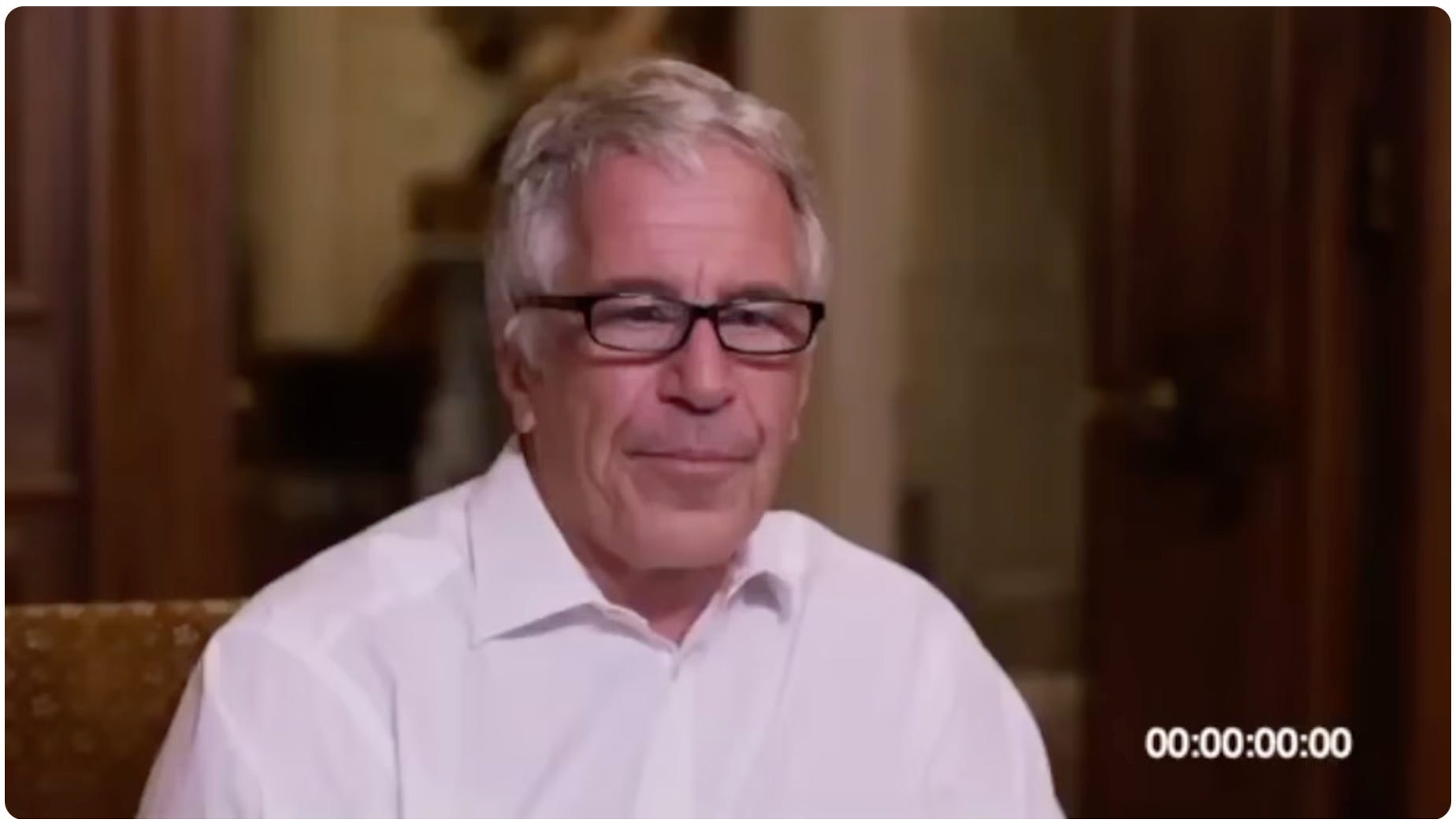
Epstein lays out the intellectual architecture of a programme to redesign the global financial system — from his recruitment by David Rockefeller, through the failure of mathematical complexity research, to the emergence of artificial intelligence as a replacement for human financial judgment. He describes it fluently, in plain language, without apparent concern that it is being filmed.
Bannon asks good questions. He asks about the Santa Fe Institute, about currencies, about fractional reserve banking, about the 2008 financial crisis, about the Treasury Department. Each time Epstein opens a thread that leads toward the system he helped build, Bannon pulls him back to the jumpsuit, and the jail cell.


‘David started to explain to me world politics’
Early in the interview, Bannon asks how a trader from Bear Stearns ended up on the board of Rockefeller University. Epstein describes it straightforwardly. A money manager recommended him for the finance committee. He joined, and David Rockefeller took an interest.
David started to explain to me world politics. So David would say, Jeffrey, money is going to be sort of the most important things. People don’t understand money. You seem to have this knack for money’
Rockefeller then personally invited Epstein onto the Trilateral Commission — the body he had founded in 1973 to coordinate policy across the United States, Europe, and Japan. ‘He said to me, would you like to be on the Trilateral Commission?’ Epstein looked at the membership list — Bill Clinton, Paul Volcker, ‘every great leader in America, the Asians, the Japanese’ — and for his biographical entry wrote: ‘Jeffrey Epstein, comma, just a good kid, which I thought was funny. Nobody else did’.


From the Rockefeller board and the Trilateral Commission, Epstein built a network spanning JPMorgan executives, former Treasury secretaries, Israeli defence officials, Rothschild family members, WEF participants, and researchers across cryptography, artificial intelligence, evolutionary dynamics, and digital currency.
Ehud Barak, the former Israeli Prime Minister, visited Epstein’s New York residences at least thirty-six times between 2013 and 2017, handled exclusively by Epstein in person under protocols that minimised the number of people who communicated with him. Peter Mandelson passed confidential British government material to Epstein while serving as Business Secretary — Treasury minutes, advance notice of the euro bailout, notification of Gordon Brown’s resignation. Ariane de Rothschild, who would become chair of the Edmond de Rothschild Group, appears in approximately 5,500 documents in the archive, with correspondence establishing a three-tier reporting line running from Jacob Rothschild through Ariane to Epstein.
Later in the interview, Epstein confirms the operational nature of these relationships without naming names. He tells Bannon he was advising the US Treasury from a jail cell during the 2008 financial crisis, calling the president of Bear Stearns on one phone and a contact at JPMorgan on the other — ‘I was actually going between two phones talking to Bear Stearns and JP Morgan at the same time’. And the following day, he called ‘another person in Washington... they were at the Treasury Department’.


Bannon asks six times whether this made Epstein feel remorse. Epstein says he had a telephone, so it made no difference where he was.

‘Most people don’t understand money’
A theme runs through the entire interview: the claim that nobody — not world leaders, not central bankers, not traders — truly understands the financial system. Epstein returns to it repeatedly.
‘Most political leaders don’t come out of a background of finance’, he tells Bannon. ‘Their expertise if they have any financial knowledge is of their own checking account’. He explains fractional reserve banking as though teaching a class — ‘if I give you a dollar, you can lend out an additional eight or nine dollars’ — and says world leaders would find this ‘impossible to believe’.
He tells Bannon that even the people at the top of the system ‘don’t understand the complexity and... all the moving pieces and how they interconnect’.

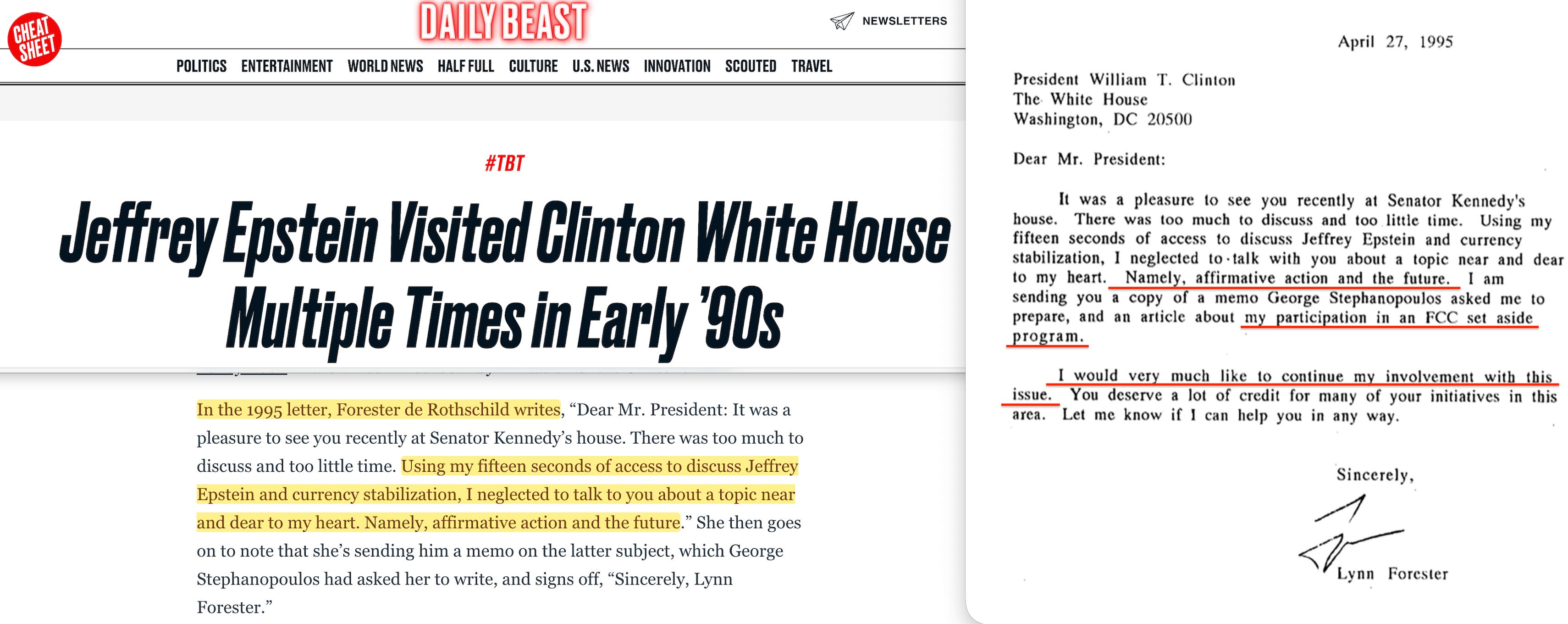
This was the justification for everything that followed. On 27 April 1995, Lynn Forester wrote a personal letter to President Clinton describing a recent meeting at Senator Kennedy’s house5: ‘Using my fifteen seconds of access to discuss Jeffrey Epstein and currency stabilization, I neglected to talk with you about a topic near and dear to my heart. Namely, affirmative action and the future’.
The letter shows Lynn was involved in both subjects. Stephanopoulos had asked her to prepare a memo on affirmative action, which she enclosed. She had participated in an FCC set-aside programme — directing government contracts to minority-owned businesses based on social criteria, which is capital allocation conditioned on social objectives in its earliest form6. ‘I would very much like to continue my involvement with this issue’, she wrote. ‘You deserve a lot of credit for many of your initiatives in this area. Let me know if I can help you in any way’.
The financial mechanism and the social allocation framework were already being carried by the same person, through the same channel, to the same office. Epstein and currency — raised with the sitting president — fourteen years before the programme email, twenty-one years before Summers emailed the digital currency specification, and three decades before the BIS published purpose-bound money.
Forester married Evelyn de Rothschild in 20007. In 2020, she launched the Council for Inclusive Capitalism with the Vatican — an organisation designed to embed social and environmental goals into how capital is allocated worldwide8.
The premise Epstein states to Bannon — that democratic leaders lack the financial literacy to govern money — is the premise on which the entire architecture rests. If elected officials cannot understand the financial system, then it must be governed by those who can. But if no human understands it fully — as Epstein also claims in the interview — then it must be governed by machines: artificial intelligence.
Both conclusions lead to the same destination: automated financial governance outside democratic control.


‘Santa Fe Institute was a total failure’
Bannon asks directly: you funded the Santa Fe Institute to study the complexity of systems mathematically. What happened? Epstein answers: ‘Total failure’.
He explains that the goal was to see whether complex systems — particularly the financial system — could be modelled algorithmically. The institute tried for fifteen years. ‘Every attempt to... formulise or algorithmically understand what the term complexity means’ came to nothing. Researchers who thought they’d found predictive tools tried to apply them to financial markets. ‘They go bankrupt and we start again’.

Then Epstein pivots. Without pausing, he moves from the failure of mathematical modelling to the emergence of artificial intelligence. He describes neural nets — systems that produce answers no one can explain.
When you ask the person who designed the system, how did it come to that answer? How did your neural net? Can you show me the calculations? They say, no, we don’t know. We don’t know how the thing we designed actually came up with that answer.
He describes AI learning to play video games faster than any human, beating all competition, with no one understanding how. ‘That’s the first little touch of things that we already have gotten to a place where we don’t understand it and we built it on Sunday afternoon’.

The three claims form a sequence. Nobody understands the financial system, and mathematics cannot model it. But artificial intelligence can operate on it without understanding it.
The implication Epstein does not state — but which his research programme delivers — is that the system should be governed by machines rather than by the people or politicians who cannot comprehend it.

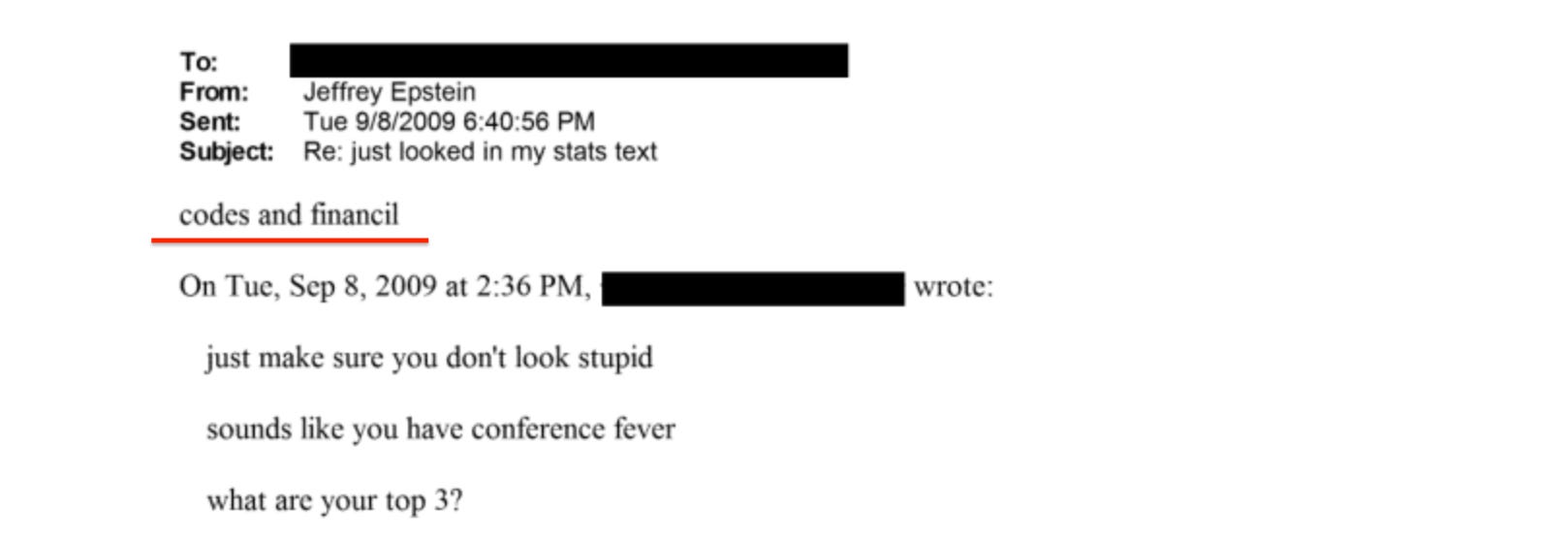
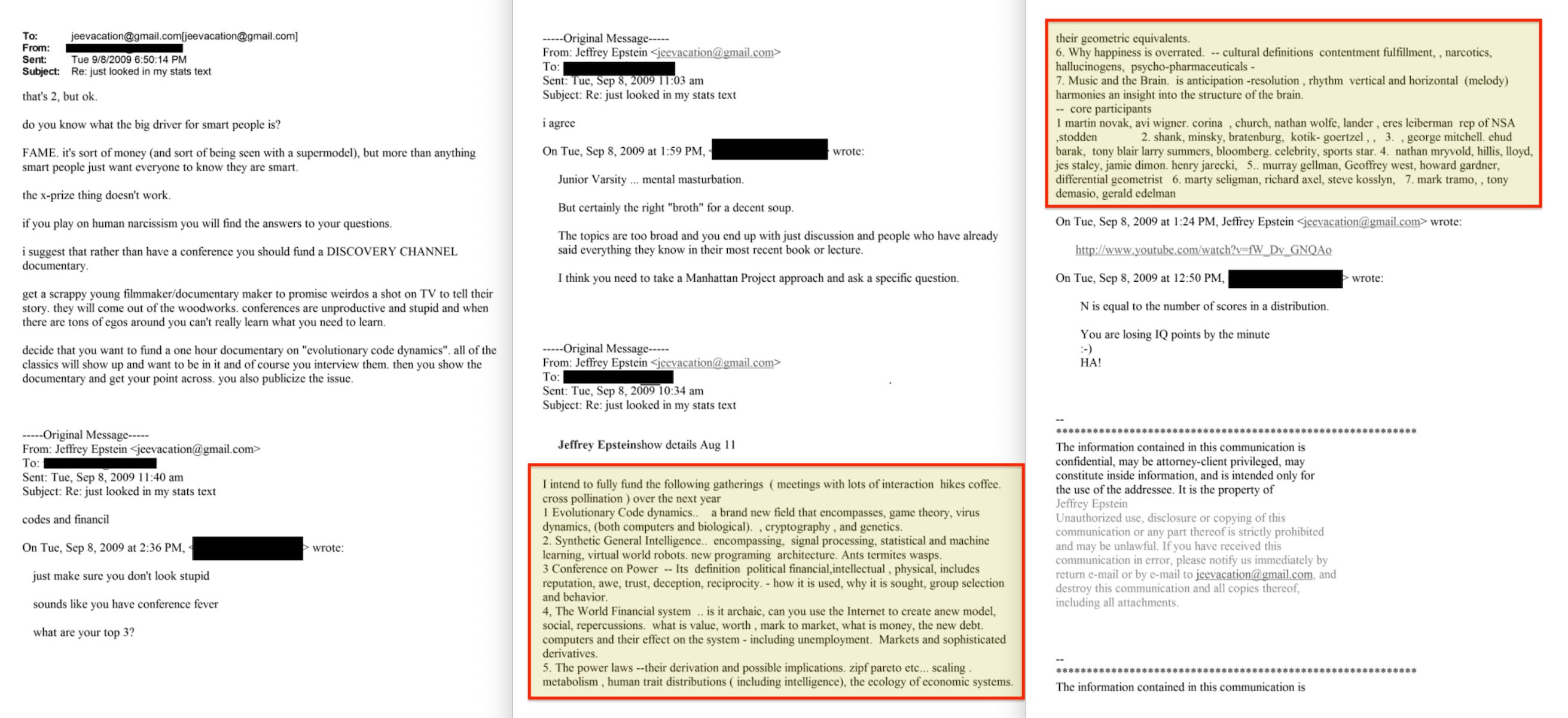
Four months after leaving prison in 2009, Epstein sent an email laying out plans to fund seven research gatherings. The topics were cryptography, artificial intelligence, political power, the world financial system, mathematical modelling, behavioural psychology, and neuroscience. Three independent recipients identified the same structural connections between the topics without coordinating.
When asked to name his top priorities, Epstein replied with two words9: ‘codes and financil’.
Each gathering had a corresponding research investment. Joscha Bach received approximately $300,000 for AI work at the MIT Media Lab. In December 2016, Bach described to Epstein what might replace failing institutions: ‘Our best bet currently seems to be AI: an API for integrating all fields of knowledge and control’10. In 2023, the BIS Innovation Hub and the Bank of England completed Project Rosalind11 — an API layer connecting central bank digital currency to private-sector applications, enabling programmable restrictions on transactions.
Ben Goertzel received funding for OpenCog, an open-source artificial general intelligence framework. Madars Virza received funding for zero-knowledge proofs — cryptographic techniques foundational to privacy-preserving digital currency verification. Martin Nowak received $6.5 million for the Program for Evolutionary Dynamics at Harvard. The MIT Media Lab’s Digital Currency Initiative, which received Epstein funding, partnered with the Federal Reserve Bank of Boston in 2020 to build Project Hamilton12 — a CBDC prototype capable of handling 1.7 million transactions per second.
A scheduling document from May 201813 shows Nowak at 10:15, Ito and Virza from 11:30, Bach at 3:00, then dinner with Larry Summers at Nowak’s institute at 6:00. Behavioural modelling, digital currency infrastructure, zero-knowledge cryptography, and the former Treasury Secretary — all brought together at the institute Epstein’s money had built, fourteen months before his arrest.


‘Money is meant to be local’
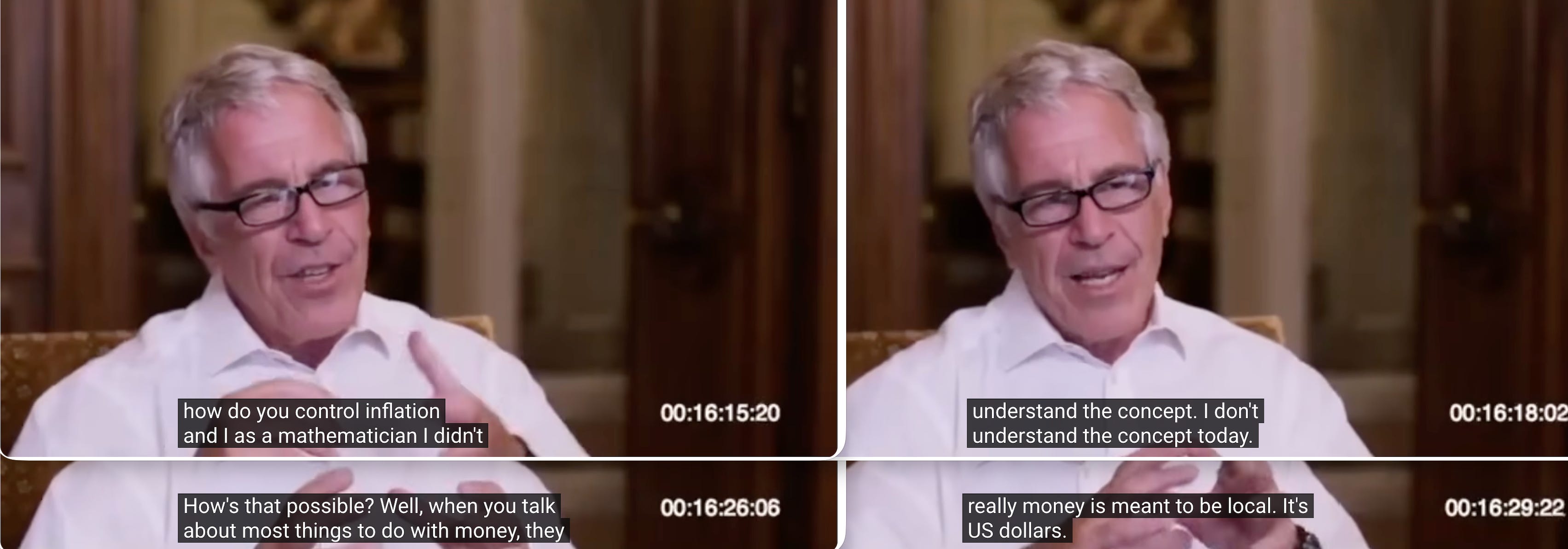
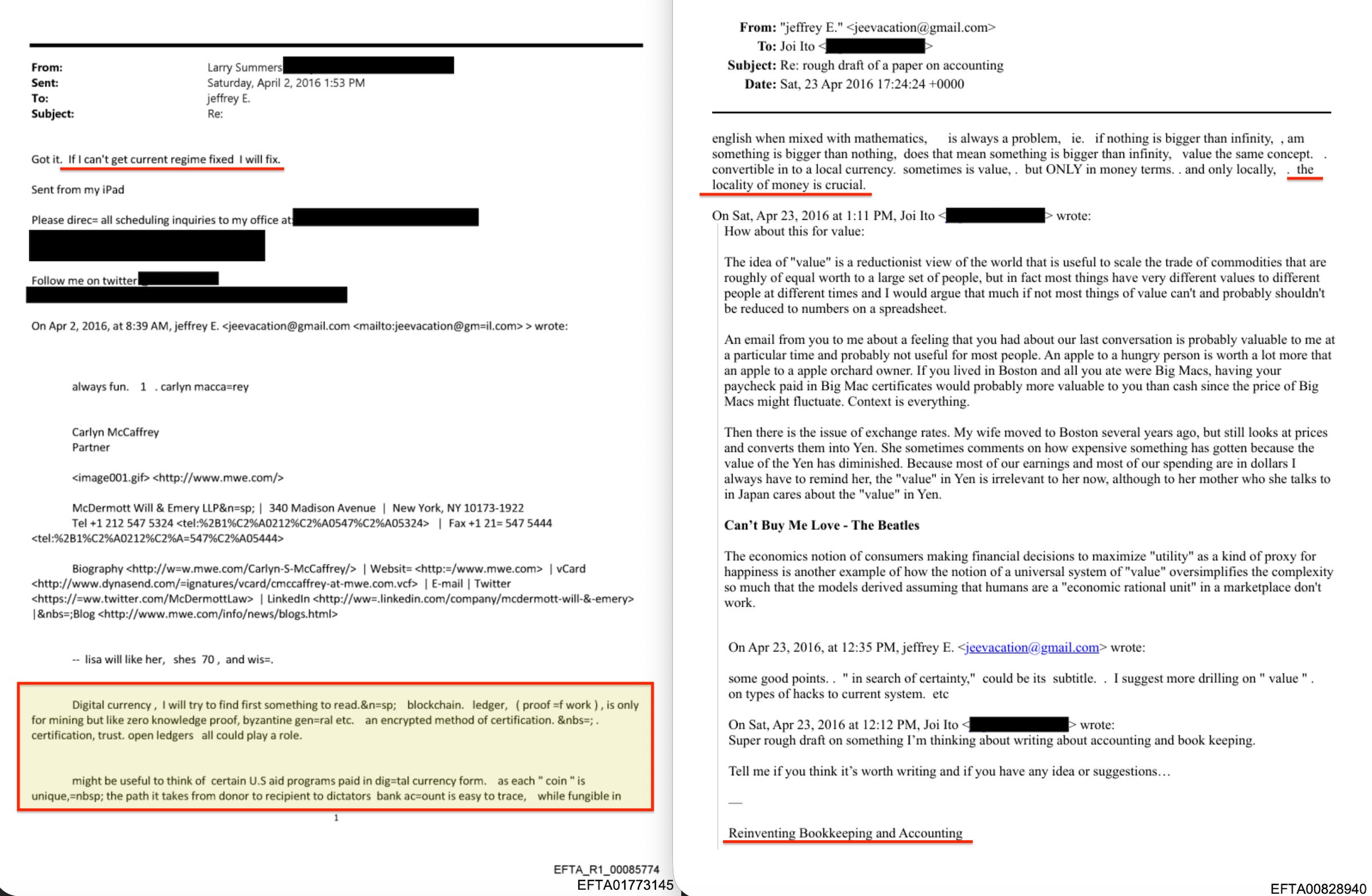
Discussing inflation and currencies with Bannon, Epstein says: ‘Money is meant to be local. It’s US dollars’. It sounds like a basic observation, but it is the central design principle of the system he was developing.
On 2 April 2016, Larry Summers emailed Epstein a specification for sovereign digital currency: each unit uniquely numbered, every transaction traceable, aid disbursement as the entry vector into developing economies. Summers’s reply in the same thread14: ‘Got it. If I can’t get current regime fixed I will fix’.
Three weeks earlier, Joi Ito had sent Epstein a draft paper15 proposing to replace the global accounting system with algorithmically governed ledgers where every contract executes as code, and the value of an asset changes depending on context — who holds it, where they are, what conditions they have met.
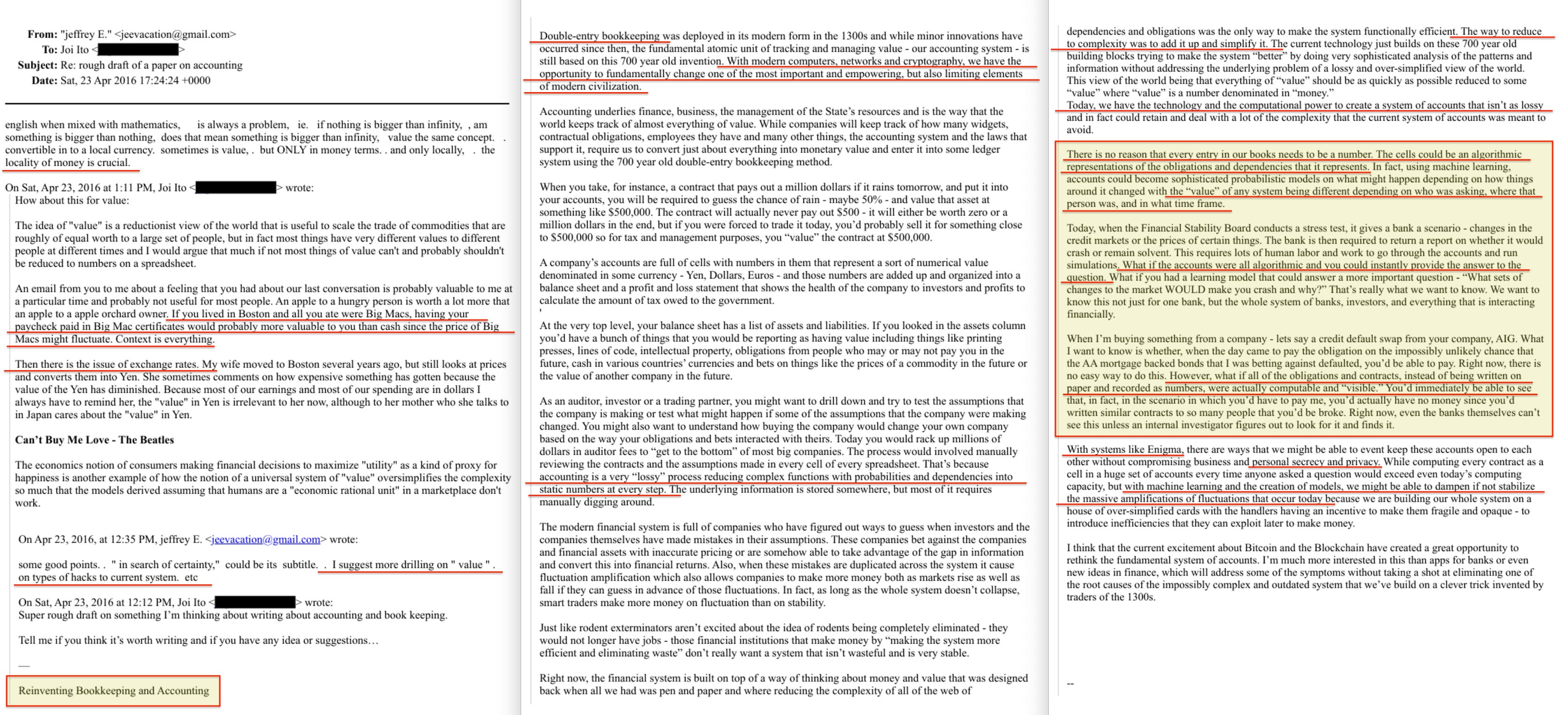
Epstein edited the draft16. His key addition17: ‘the locality of money is crucial’. The same concept he states to Bannon, now written into the technical specification for a programmable currency whose conditions change depending on circumstances.
In June 2023, the Bank for International Settlements published ‘Blueprint for the Future Monetary System’ — the unified ledger18. Tokenised assets, programmable contracts, conditional logic, real-time settlement, central bank money alongside commercial bank money on a single platform.
The BIS now calls the currency layer ‘purpose-bound money’19. Ito had described the same architecture seven years earlier. Epstein edited it, and he explained the underlying principle to Bannon on camera.
‘Bill Clinton’ and the insertion of politics into money
One of the longest passages in the interview is Epstein’s account of the subprime mortgage crisis. He tells Bannon that ‘the real enemy of the financial system was Bill Clinton’, and walks through the mechanism at length: Clinton wanted votes, so he offered home ownership to people whose credit did not qualify. The government created agencies to guarantee the loans. Banks, seeing a government backstop, took on as much subprime lending as they could.
When Congress forced banks to revalue these assets at market price rather than purchase price — mark-to-market accounting20 — the system collapsed. ‘Something they bought at a thousand on their books was a thousand, is now 990. That starts to... this person now has to value it at 980’.

Epstein presents this as a cautionary tale about political interference in financial markets: ‘politics doesn’t belong in the markets’. Bannon nods along. Neither man acknowledges that the programme Epstein was developing does precisely the same thing — or that the Clintons were operating on both sides.
The subprime mechanism was crude: insert a political objective (home ownership), use government guarantees to override risk assessment, let the system absorb the consequences when the guarantees fail. But the Clintons were simultaneously building the refined version.

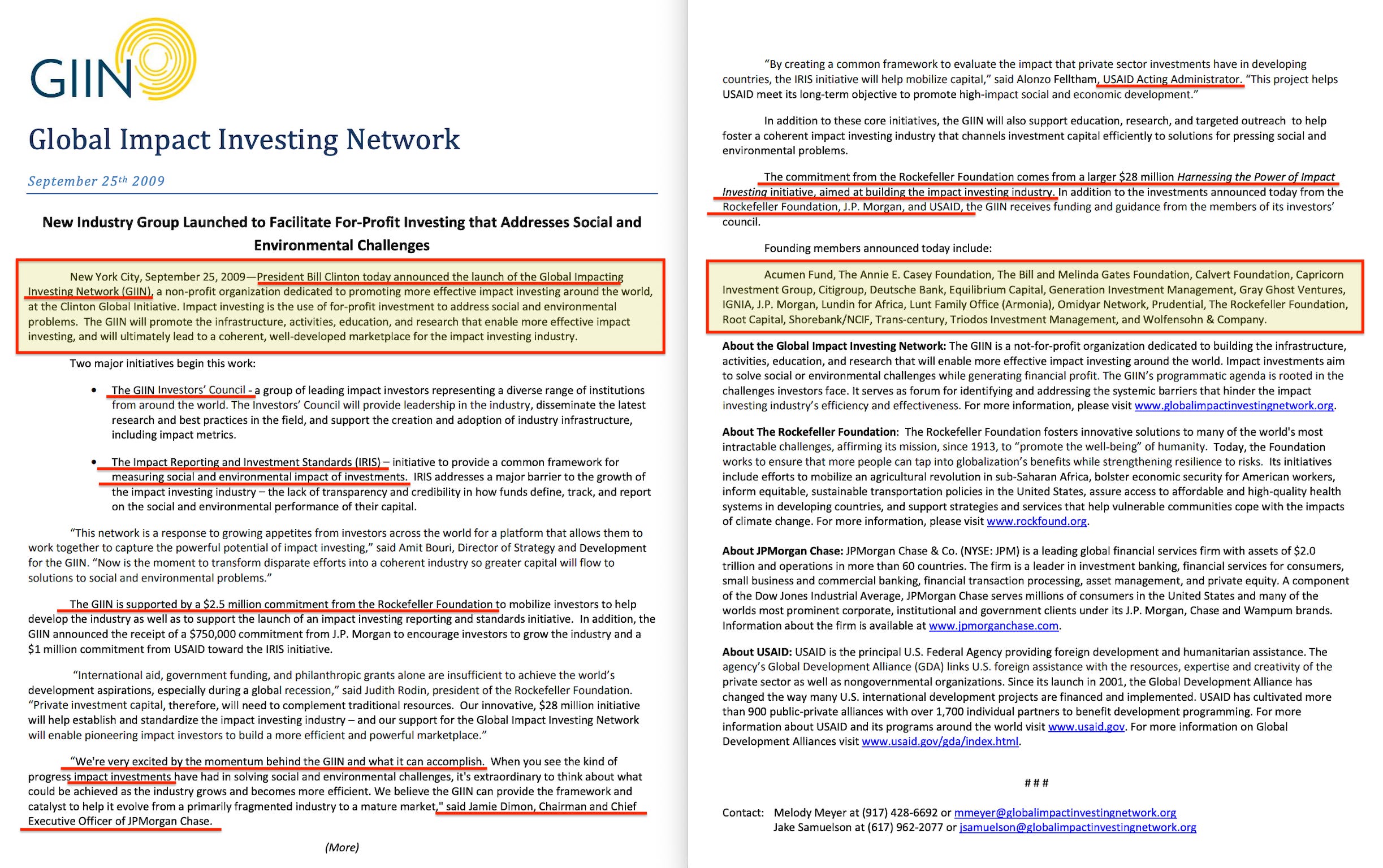
Bill Clinton launched the Global Impact Investing Network at the Clinton Global Initiative in September 200921 — six weeks after Epstein’s programme email. Hillary Clinton’s OPIC approved $285 million for impact investing funds in October 2011 — the same month JPMorgan brought Epstein onto a call with a Gates Foundation director about a ‘unique new impact investment product’ that Epstein had designed22. Hillary Clinton promoted social impact bonds at CGI America in June 201323.
And in January 2012, Hillary Clinton’s scheduler was asked to hold dates for a ‘Global Impact Economy Forum’ described as a ‘public-private partnership for the common good’ funded through ‘blended finance’ — in the same email that referenced a conference at Jacob Rothschild’s Waddesdon estate.

Epstein criticised the Clintons’ crude version on camera. The documents show the Clintons were the public-facing channel for the programme’s refined version. The structure is the same — political objectives inserted into the financial system through mechanisms that override market risk assessment — but the refined version bypasses legislation entirely, operating through a four-layer architecture.
The first layer is blended finance: public money absorbs the risk while private capital sits on top, protected. The Edmond de Rothschild group set up the Moringa Fund in 2010 as an early vehicle24. India’s Aadhaar programme — biometric digital identity linked to financial services — was confirmed operational at a summit at Epstein’s Manhattan townhouse in September 2013, when Barak reported that ‘the pilot test in India succeeded’25.

The second is impact investing: capital that must demonstrate measurable outcomes against defined social or environmental criteria — the layer the Clintons helped launch through the institutions listed above, with the Rockefeller Foundation having coined the term in 200726.
The third is stranded assets: the inverse of impact investing, preventing capital from flowing to unapproved purposes. This is the revaluation mechanism Epstein describes to Bannon — an external authority changes how assets are valued, capital moves, and the owner has no appeal — but systematised through seven private forums at Waddesdon Manor, the Rothschild estate in Buckinghamshire, between 2014 and 2018.
The forums fed the Task Force on Climate-related Financial Disclosures, which fed the Network for Greening the Financial System, which calibrates capital requirements through the BIS and Basel 3.1. The forum proceedings admit they knew democratic legislation was the proper route, but they proceeded through regulation anyway.


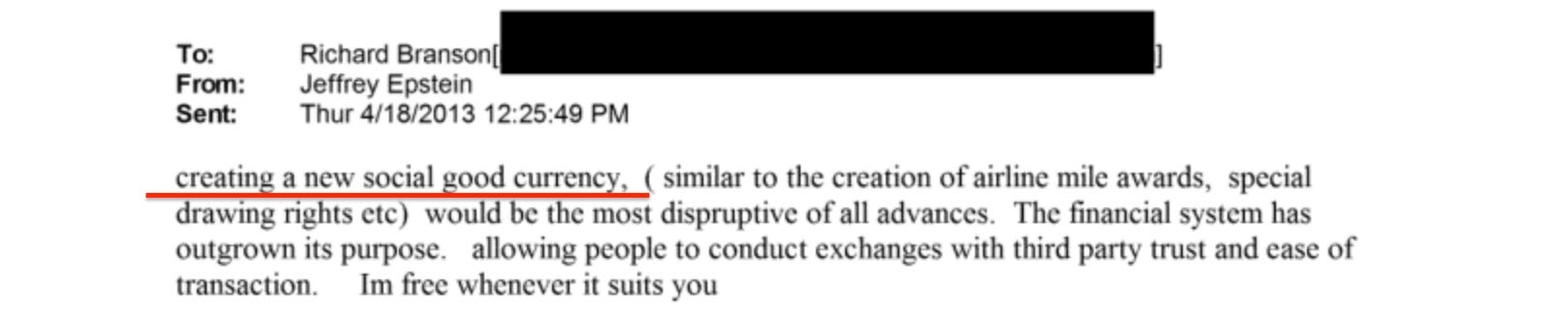
The fourth is the programmable currency itself: money that checks every transaction against compliance criteria at the moment it occurs. Epstein described it to Richard Branson as a currency like airline miles or special drawing rights, but for social good — conditional, programmable, purpose-bound27.
Together, blended finance provides the mechanism, impact investing provides the objective, stranded assets provides the constraint, and the social good currency provides enforcement at every individual transaction.
Epstein told Bannon that Clinton’s mistake was inserting politics into finance, but the documents show the Clintons helped build the architecture that does the same thing at a scale and with a precision that subprime never approached.

‘Will Treasury respond to you re: crypto?’
Epstein appears in over 1,700 documents involving Bannon across an eighteen-month period from early 2018 to July 2019 — a volume comparable to the major operational relationships in the archive. While Bannon was filming the documentary, the emails show Epstein using him as a live channel into the US regulatory apparatus.
In February 2018, Epstein pressed Bannon on cryptocurrency regulation28: ‘Will Treasury respond to you re: crypto or do we need another way in for advice’. Bannon replied that the National Security Council, rather than Treasury, was handling digital asset concerns. Epstein was probing for access to the same institution he had been advising from a jail cell during the 2008 crisis — and whose former secretary, Larry Summers, had emailed him the sovereign digital currency specification two years earlier.
This was one of three simultaneous channels. In May 2018, Epstein told Summers that ‘Gary Gensler coming earlier... wants to talk digital currencies’29. Gensler went on to chair the SEC from 2021 to 2025, where he ran the most aggressive US regulatory campaign against decentralised cryptocurrency in history30.
Bannon provided Epstein political access to the Treasury. Summers provided the academic and former-official route. Gensler would become the securities enforcement route who would work to block the alternative. Three channels into the US regulatory architecture, operating in the same twelve-month window.
In January 2026, the Basel Committee introduced SCO6031, which requires banks to hold a dollar of capital for every dollar of cryptocurrency on their books. Under those conditions, crypto becomes toxic to keep on a bank’s balance sheet. No legislation was required — reserve ratios were merely updated through Basel 3.1.

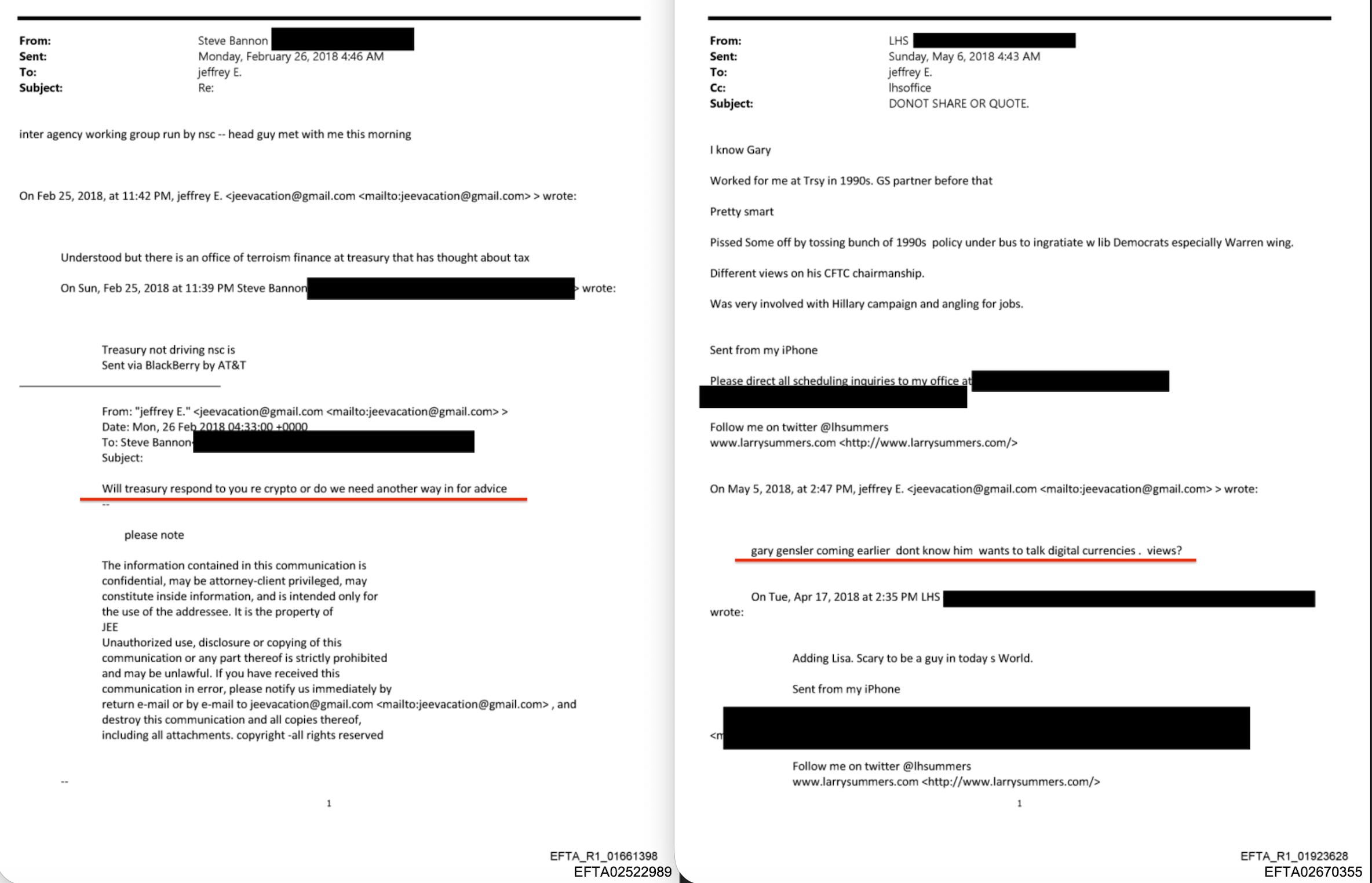
The emails show what Epstein wanted the access for. He argued that undocumented Bitcoin transactions posed a ‘systemic risk’32, called for stronger data collection on wallet transfers, proposed reporting structures for exchanges, and criticised Facebook’s Libra project while calling for global coordination on digital asset regulation. He was pushing for the regulatory conditions that would make decentralised crypto institutionally difficult to hold — clearing the field for the programmable, state-controlled alternative that his research programme was building through the MIT Digital Currency Initiative and Virza’s zero-knowledge proof work.
Gensler, who had discussed digital currencies with Epstein through Summers in May 2018, went on to deliver the enforcement side of this agenda as SEC Chair from 2021 to 2025 — filing actions against Coinbase, Binance, Ripple, and dozens of other decentralised crypto platforms33.
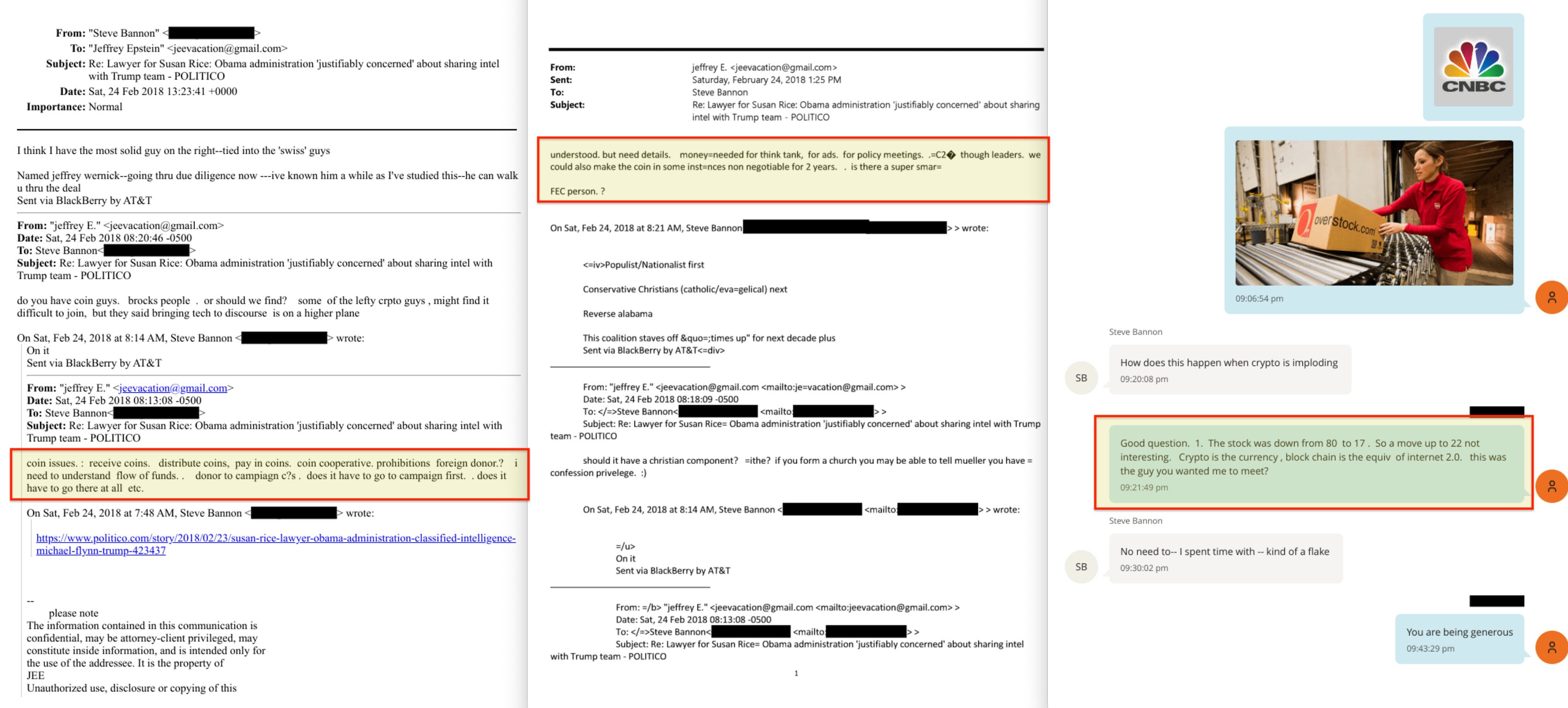
Simultaneously, Epstein was exploring crypto as infrastructure for Bannon’s own political movement. ‘I need to understand flow of funds’, he wrote3435, adding there would be ‘money needed for think tank, for ads, for policy meetings’36. He proposed cryptocurrency as an option and encouraged Bannon to study blockchain. Bannon agreed3738: ‘crypto is the currency, blockchain is the equivalent of internet 2.0’.
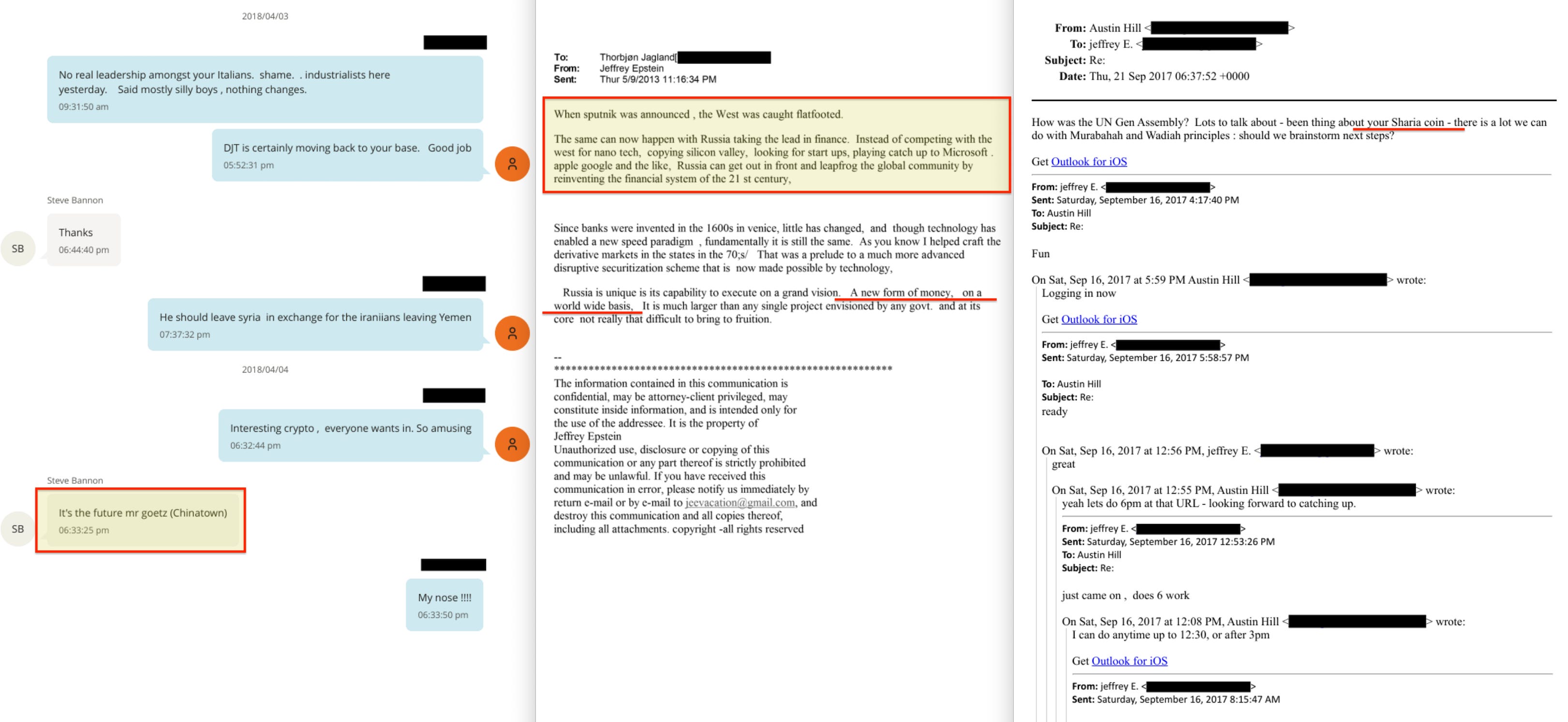
In an April 2018 exchange about crypto’s possibilities, Epstein texted Bannon the dialogue from the scene in Chinatown where Noah Cross explains to Jake Gittes that at a certain point, you can buy the future. Bannon replied39: ‘It’s the future mr goetz’ — quoting the film about a man who controls the water supply and thereby determines which land has value and which doesn’t.
The deployment pipeline extended well beyond Bannon. In 2013, Epstein had emailed a senior Russian official connected to one of Putin’s oligarchs, arguing that Russia could ‘leapfrog the global community by reinventing the financial system of the 21st century’40. In October 2016, he pitched a Sharia-compliant digital currency41 to a Saudi royal court adviser.
The same architecture was being offered to Russia, the Gulf, India (through Aadhaar), Mongolia (present at the September 2013 summit42), and the European populist right (through Bannon) — each pitch tailored to the recipient, each leading to the same destination.
‘The soul is the dark matter of the brain’
Late in the interview, the conversation takes a turn that Bannon treats as philosophical musing.
Epstein discusses the soul, consciousness, and the limits of science. He says that ‘the soul is the dark matter of the brain’ — something whose effects can be observed but whose nature cannot be explained. He describes the difference between things that are alive and things that are dead as ‘currently unexplainable’ and says he believes ‘we need an entirely different system of analysis to try to figure out’ what animates living things.

In the context of the research programme, this maps onto Gathering 643 — ‘Why Happiness Is Overrated’ — and the behavioural acceptance layer that Barnaby Marsh identified in his annotation of the programme email. Marsh had written: ‘more productive might be mastery over the individual mind — and for society, the promise of emotional motivation and coordination of the great masses via ‘spiritual’ ideals... we need new models of happiness, perhaps?’
When Epstein talks about the soul, he is describing the same problem he funded researchers to solve: how to make a population accept material constraints. The programmable currency restricts economic freedom. Material accumulation is penalised through carbon pricing, stranded asset write-downs, and conditional transaction rules. If the public experiences this as deprivation, the system faces democratic resistance. If it experiences it as purpose — as spiritual fulfilment, as participation in the common good — the system is accepted voluntarily.
The ‘new models of happiness’ Marsh proposed and the soul Epstein describes to Bannon are the same design problem: how to make people accept the system willingly rather than feel trapped by it.
The Maxwell Succession
Epstein tells Bannon he bought the New Mexico ranch in 1993 to be near the Los Alamos scientists whose funding had been cut. He says Murray Gell-Mann was ‘the rock’ of the Santa Fe Institute.
He describes the body-as-system metaphor throughout — the financial system as a body, liquidity as blood, the central bank as the heart, specialist doctors who understand only their local piece.
Bannon listens as though encountering these ideas for the first time. He was not. In the same interview, he mentions that ‘when Chris came to Biosphere 2 for the first big conference we had in 1994, he was one of the most impressive guys there’ — listing attendees from Kew Gardens, Lawrence Livermore Lab, Sandia, Lamont-Doherty, and Woods Hole.
Bannon was involved with Biosphere 2 during the mid-1990s44 management transition under Ed Bass’s company.

Biosphere 2 was a closed ecological system experiment — a sealed environment managed through feedback and monitoring, the ‘Spaceship Earth’ concept made physical. The 1994 conference brought together earth observation scientists, national security laboratories, and Santa Fe Institute complexity researchers — including Chris Langton, whose work on artificial life Epstein discusses moments later.


He does not mention Robert Maxwell. But the metaphor he uses comes directly from Maxwell-owned Pergamon’s published books.
Robert Maxwell — Ghislaine’s father — had endowed the SFI directly: $100,000 in 1990 for ‘integrative aspects of complex adaptive systems’, followed by $300,000 for the Robert Maxwell Professorship. Two months later, his daughter Christine joined the SFI board. Pergamon Press published foundational texts in systems theory, the Club of Rome reports, and cybernetics — the science of controlling complex systems through feedback. The body-as-system language Epstein uses throughout the Bannon interview — the heart, the blood, the specialist doctors, the complex interacting subsystems — is the vocabulary of cybernetics.
After Maxwell’s death, Epstein became one of the institute’s major donors. Christine Maxwell was still on the board when Gell-Mann attended Epstein’s Mindshift conference on the island. Isabel Maxwell — married to Al Seckel, the man running the scientific recruitment pipeline to the island — brought the family infrastructure full circle. Robert Maxwell published the concepts. Epstein funded the implementation. And the language passed from one generation to the next, landing on camera in a Manhattan townhouse three decades later.

Two Intermediaries
The public track and the private track ran in parallel from 2007 to 2019. The public track — Rockefeller, Clinton, Gore, the Waddesdon forums — built the institutional infrastructure: the concepts, the metrics, the regulatory enforcement, the political legitimacy. The private track — Epstein, JPMorgan, Rothschild, Barak, Summers — designed the components the public track could not build openly: the cryptographic enforcement layer, the AI classification system, the sovereign deployment pipeline, the behavioural acceptance framework, and the digital currency specification.
The system now operates through the Bank for International Settlements, the Basel Committee, the Network for Greening the Financial System, and fifty-seven BIS Innovation Hub projects spanning Switzerland, Hong Kong, Singapore, London, Stockholm, and Toronto. The scenarios that calibrate it are produced by committees whose members are not publicly named, validated by advisory bodies whose terms of reference have not been released, and built on academic research that has, in at least one documented case, already been retracted for elementary data errors — without any adjustment to the capital requirements it produced.
It is not democratic in the slightest.

Two people had more recorded access to Epstein than almost any journalist in history. Between them, they captured one hundred and fifteen hours of conversation with the man whose correspondence documents the construction of this system. What connects them is more revealing than either man on his own.
Michael Wolff recorded approximately one hundred hours and used Epstein as a source for four bestselling books about Donald Trump — Fire and Fury45, Siege, Landslide, and All or Nothing. From a hundred hours with a man who was editing the blueprint for a unified global financial ledger, commissioning digital currency research through the MIT Media Lab, and receiving sovereign digital currency specifications from former Treasury secretaries, Wolff extracted material about Trump’s scalp reduction, a competition to seduce Princess Diana, and gossip about White House affairs. He came away with enough to sell five million copies. He did not report on what Epstein got up to at all.
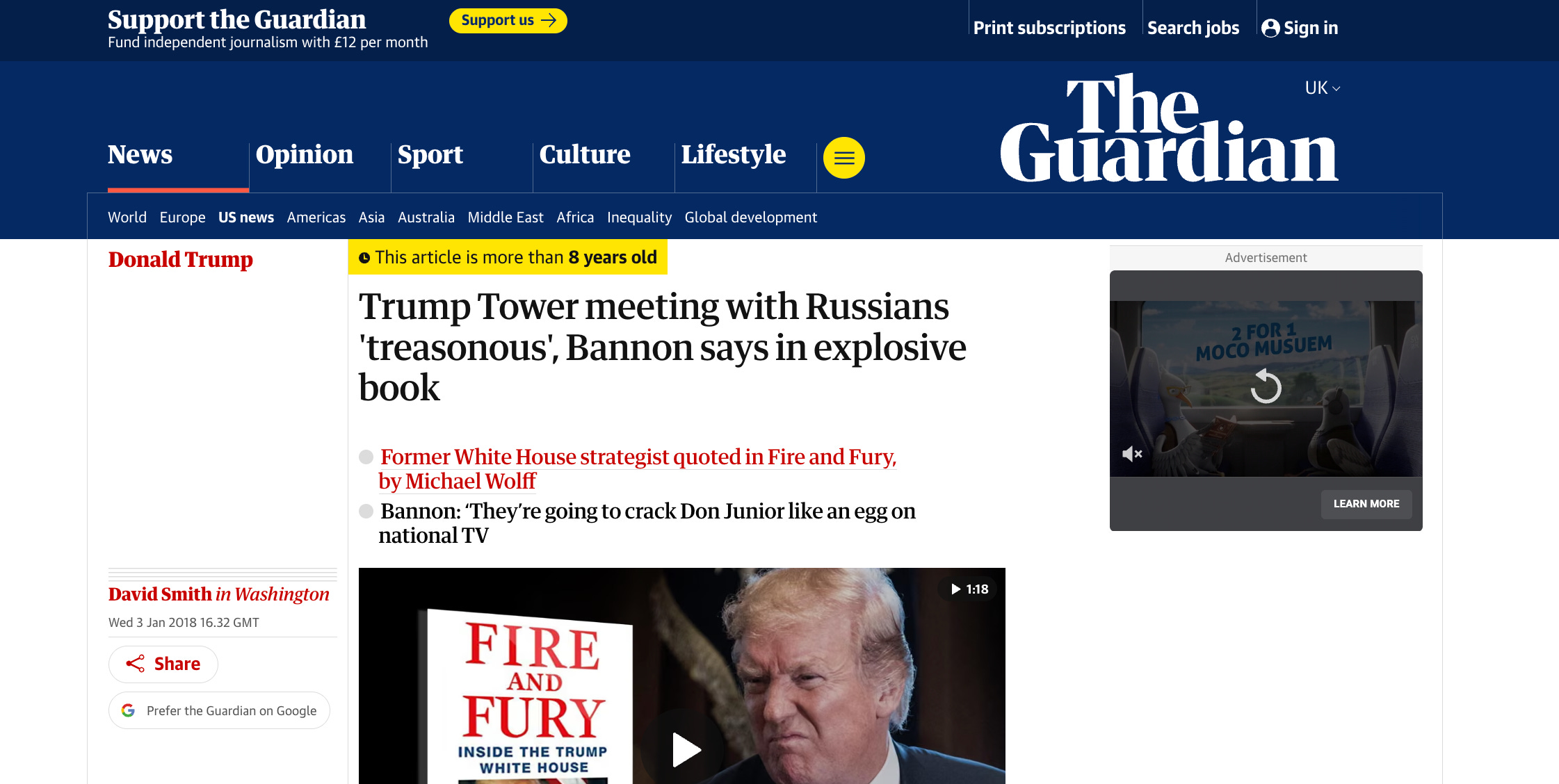
Fire and Fury, published in January 2018, contained Bannon quotes calling the Trump Tower meeting with Russians ‘treasonous’ and ‘unpatriotic’. Trump issued a statement saying Bannon had ‘lost his mind’46. Bannon was forced out of Breitbart and had to issue a public apology. The book severed Bannon from Trump’s inner circle, and its key source was Jeffrey Epstein.
Bannon entered Epstein’s orbit from early 2018. The 1,700 documents in the archive begin in this period. Epstein then used the newly available Bannon as a channel into Treasury, European populist politics, and crypto regulation — while coaching him for a rehabilitation documentary and providing strategic advice, political contacts, and travel arrangements.
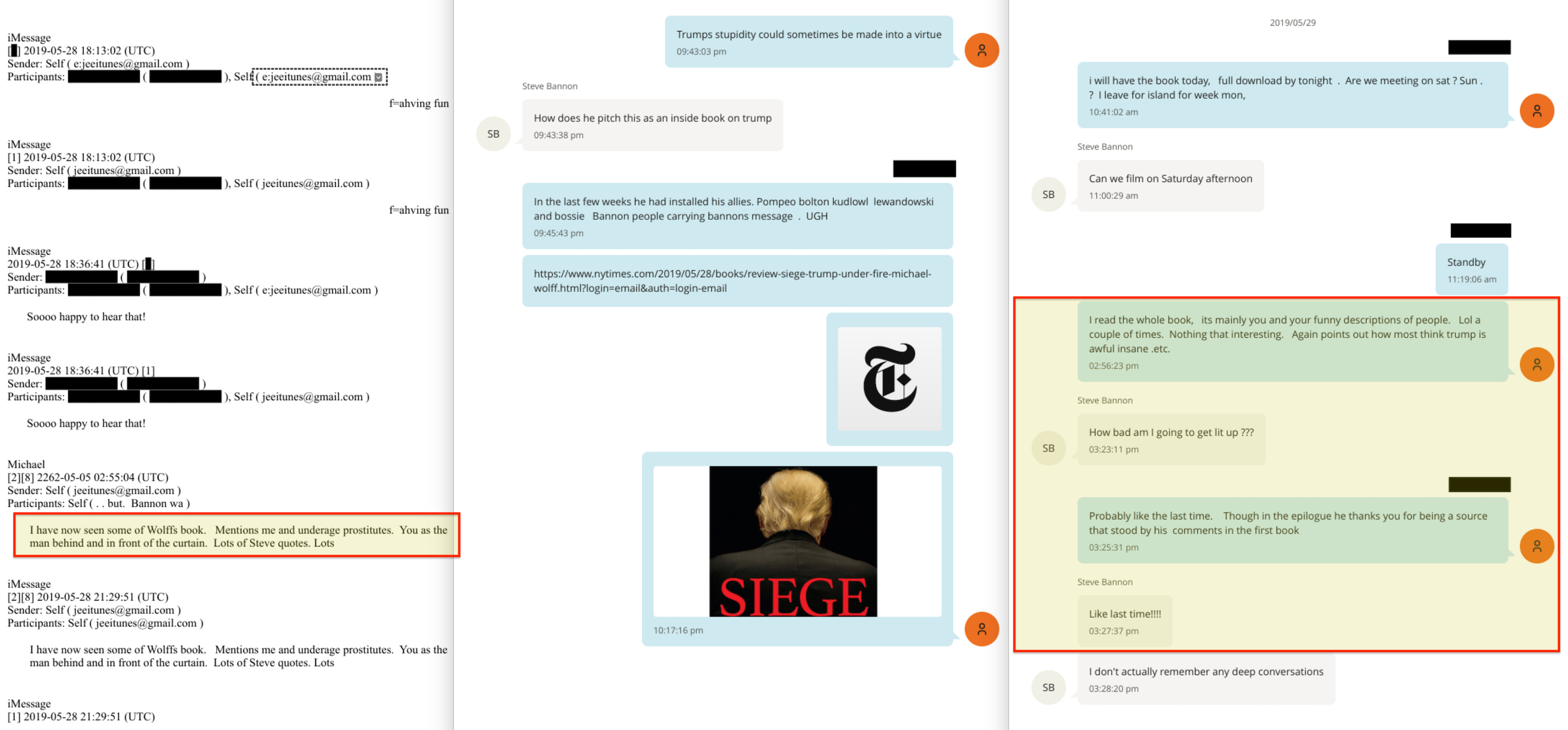
The released emails show Bannon fretting to Epstein about Wolff’s second book, Siege. Epstein, who had seen an advance copy, told him it contained ‘lots of Steve quotes. Lots’47. Bannon texted48: ‘How bad am I going to get lit up???’ Epstein reassured him: ‘Probably like the last time’. Bannon was asking the man whose information had been used to damage him the first time whether it was going to happen again. Epstein already knew, because he was the source for both books.
From fifteen hours with a man who described the Rockefeller recruitment, the Trilateral Commission, the failure of complexity research, the pivot to AI, the locality of money, and the Treasury relationship, Bannon extracted a rehabilitation documentary that was never broadcast and a political alliance he now denies.
He is now demanding the release of the Epstein files on his podcast while sitting on the tape that explains what Epstein did.
The information Epstein provided to Wolff dislodged Bannon from Trump’s circle. Epstein then recruited Bannon as an operational channel. Whether the sequence was planned or not, the outcome was the same.
Wolff used his hundred hours to write books attacking Trump. Bannon used his fifteen hours to build support for Trump. Both were drawing on the same source — Epstein — who was simultaneously managing his public narrative through Wolff, channelling regulatory access and political infrastructure through Bannon, and funding the programmable financial architecture that would render both their projects irrelevant.
The two intermediaries with the most direct access to Epstein were working at cross purposes with each other. Neither recognised the agenda. And the relationship between them — one creating the opening, the other walking through it — was managed from the centre by the man they were both recording.
Wolff published four books. Bannon developed a podcast demanding the release of the Epstein files. Between them, they produced millions of words of public commentary about Epstein. Not one sentence in any of it describes the seven research gatherings, the four-layer financial architecture, the Waddesdon forums, the digital currency specification, the stranded assets mechanism, or the BIS Innovation Hub projects now operational across six continents.
The two people with the most direct access to the man at the centre of the programme used that access to produce exactly what the public already expected — scandal, gossip, and personality — and left the architecture untouched.
Jeffrey Epstein is now primarily remembered as a sexual predator, but the published materials reveal something considerably larger. And the one hundred and fifteen hours of tape that could have explained it to the public produced four hostile books about Donald Trump and a podcast that demands transparency from everyone — except the man holding the camera.
Postscript
The key to the interview is not what Epstein says — it’s what he excludes.
His entire argument is strongly rooted in cybernetics and general systems theory. Yet, everything he says is a problem. He never suggests a solution. But the problems are arranged so that only one solution fits.
Nobody understands money — but he never says what should replace human understanding.
Mathematics cannot model complexity — but he never says what should replace mathematics.
AI produces answers nobody can explain — but he never says what it should be applied to.
Money is meant to be local — but he never says why, nor what makes it local.
Clinton’s political interference crashed the financial system through forced revaluation — but he never says how to remove politics from finance.
The soul cannot be measured and we need ‘an entirely different system of analysis’ — but he never suggests how that will work, or even why.
The devil’s money is acceptable if the cause is unchallengeable — but he never says what ‘moral’ cause should be attached to the money.
Every excluded solution is the same solution. Programmable digital currency, governed by AI, with conditions defined by unchallengeable social objectives, operating outside democratic control.
He built a jigsaw puzzle on camera with one piece missing, and that missing piece is what he pitches. If you read Ito’s unified ledger paper, Summers’s digital currency specification, Bach’s ‘API for integrating all fields of knowledge and control’, and the BIS blueprint for the future monetary system then the answer is obvious.
An unintelligent person would have named the solution. A person repeating talking points would have slipped in two hours of unscripted questioning. Epstein stayed in character, withheld every conclusion, and maintained the exact same boundary for two hours — because he knew precisely which sentence would give it away.
We are living through a global crisis of trust - and Escape Key is naming names and overturning rocks to reveal myriad connections between multiple horrific, treasonous, slithering things.. Superb analysis that absolutely demands universal readership.
There is this assumption that this all just gets turned on by a switch, at some point. But it just isn’t going to work, not on any kind of time frame that doesn’t become overcome by events.
This is what has happened to every major IT project in the history of computing. The Modernization of the Air Traffic Control System, the redesign and modernization of the system(S) that the IRS uses to track, monitor, process, control, distribute, and provide feedback for US tax receipts, the modernization of every system at Health and Human Services, Corporate attempts to integrate and automate their design/build systems and their supply chains, the US Postal Service attempts to modernize their systems and improve delivery times and lower cost. It has all failed. Progress at any kind of reasonable ROI has all been faked. The true stories of the disastrous implementations suppressed. It’s all been a decades past due, rarely mitigated fricking cluster F disaster. My examples are US but this has been worldwide. The only winner has been Silicon Valley, the computing and software industry, the recipient of a Trillion dollar annuity and a workforce that now maintains full employment through non value added change. Epstein’s wet dream is the Mother-of-All Cluster F<$€S!
So the risk here is a form of enslavement by utter collapse, not by an ingenious prison that works like a new Toyota.