

The story most people know goes like this: Jeffrey Epstein was a criminal who ran a sex trafficking operation, and Ghislaine Maxwell helped him do it. Her conviction in 2021 made that the official version.
But the documents that have since been released tell a different story — one that starts with her father.
I. The Publisher
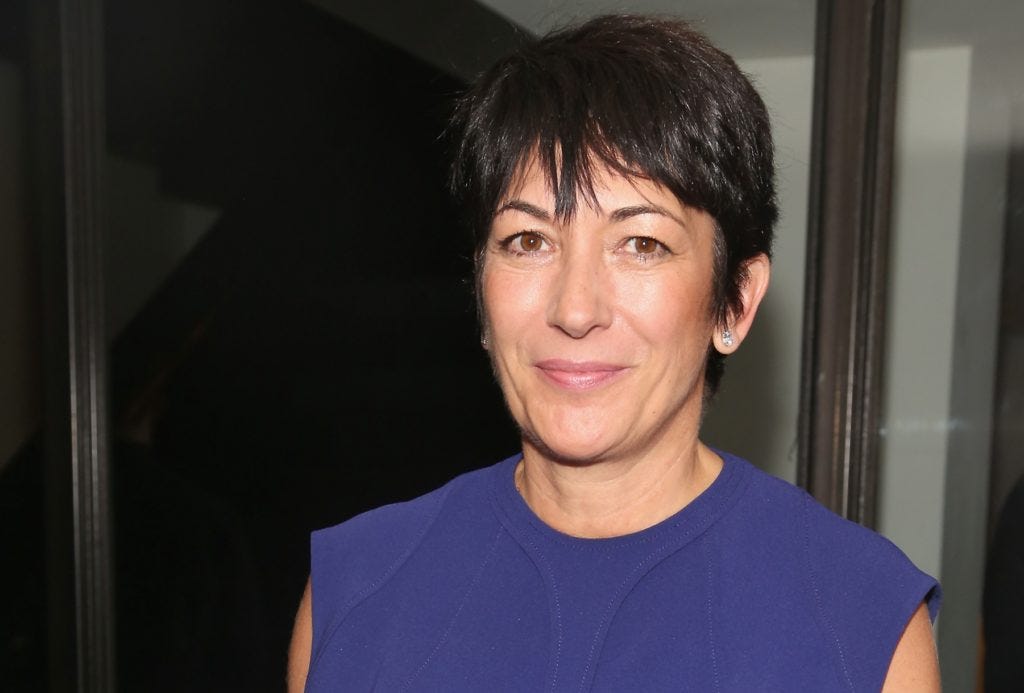
Robert Maxwell was born Ján Ludvík Hyman Binyamin Hoch in Czechoslovakia1. He became a British Member of Parliament, a media mogul, and the head of more than four hundred companies2. He was also one of the most well-documented spies of the twentieth century.
When he was buried in Jerusalem on 10 November 1991, six heads of Israeli intelligence — serving and former — attended the funeral3. The Israeli Prime Minister, Yitzhak Shamir, said something no one has fully explained: Maxwell ‘has done more for Israel than can today be said’4.
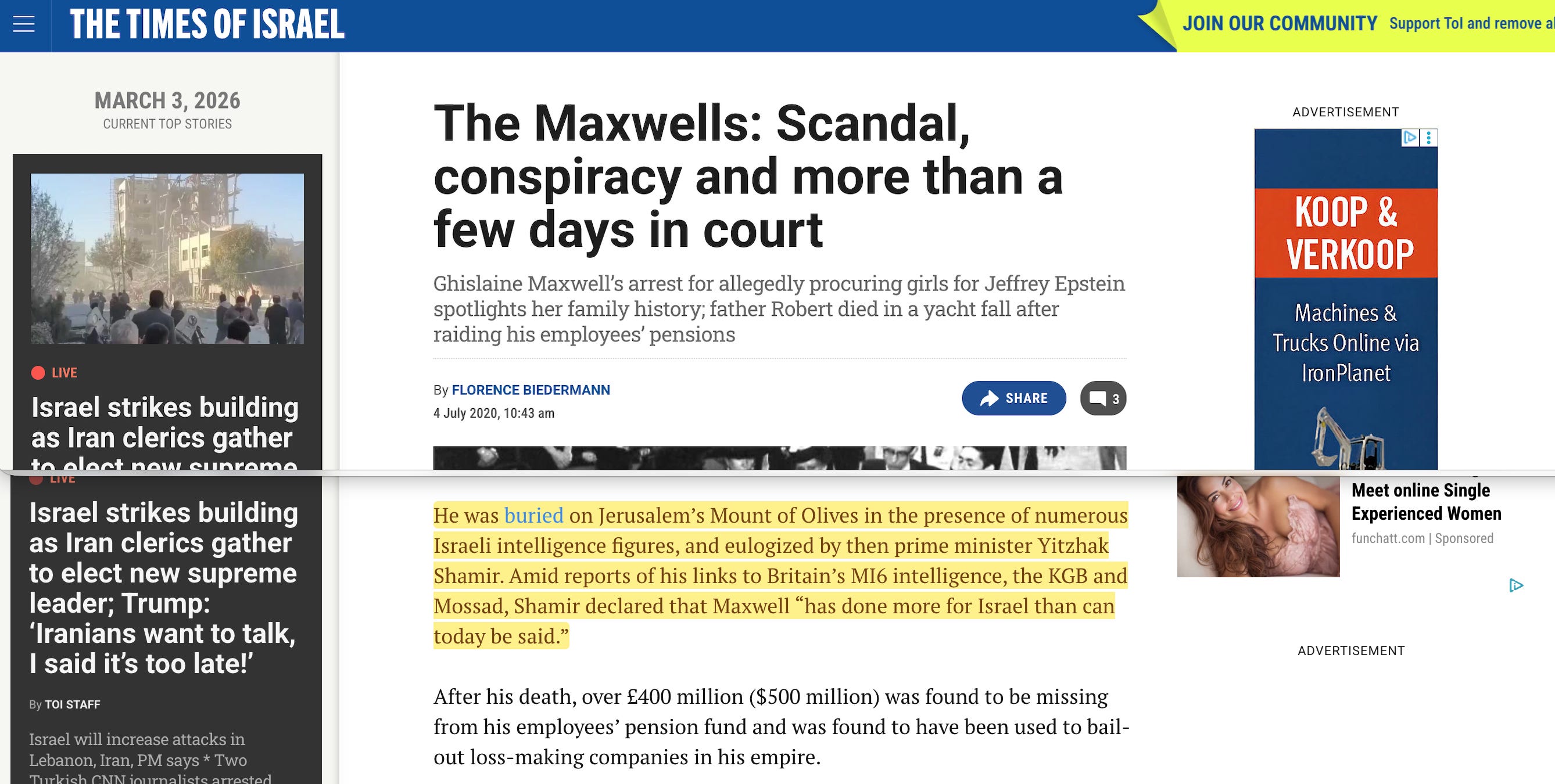
Multiple former Israeli intelligence officers have said publicly that he worked for Mossad5. Ari Ben-Menashe, a former officer in Israeli military intelligence, has described how Maxwell distributed PROMIS6, a piece of software, to more than twenty countries7. The programme had been stolen from the US Department of Justice and modified with a hidden backdoor, allowing Israeli intelligence to secretly monitor every government database it was installed on. Ben-Menashe has also described how Maxwell used sexual blackmail — including material involving underage girls — to control politicians and other powerful figures89.
Robert Maxwell had personal access to Margaret Thatcher’s Downing Street, Ronald Reagan’s White House, and the Kremlin — all at the same time10. His biographers described him as ‘Israel’s unofficial ambassador to the Soviet Bloc‘11.
His publishing empire mattered just as much as his intelligence work. The two were closely connected.
Maxwell’s publishing company, Pergamon Press, was one of the most influential academic publishers in the world12. He acquired it in 1951 and built it from forty journals into more than four hundred by the early 1990s13.
Pergamon published important early works in three fields that would later come together.
The first was general systems theory — the study of how to model entire organisations, economies, or societies as connected networks. Pergamon published multiple volumes of Applied Systems and Cybernetics14 and Gordon Pask’s work on conversation theory15.
The second came through the Club of Rome. Pergamon published several of their reports, including No Limits to Learning16, Microelectronics and Society17, and Towards More Effective Societies18. These drew on the economic modelling work of Wassily Leontief, who through input-output analysis19 had developed methods for tracking how money and resources flow through an entire economy.
The third was cybernetics20 — the study of how systems can be steered using feedback. Pergamon published Heinz von Foerster’s On Self-Organising Systems (1960)21, F.H. George’s The Brain as a Computer (1961)22, and von Foerster’s Principles of Self-Organization (1962)23.


These are not the kind of books which arrive unsolicited in the post. They are governance frameworks, plans for how to run complex systems, commissioned by an organisation whose explicit purpose was to model resource management on a global scale24.
Put together, these three fields amount to a complete toolkit for managing large organisations. General systems theory models every person and institution as a connected node in a network. Through surveillance, input-output analysis tracks everything that flows between them in real time. Cybernetics treats those flows as feedback loops and manipulates them to steer the system towards a target. Combine the three and you have adaptive management25.
Maxwell’s press was the main commercial publisher of all three.

Pergamon also published Computers & Operations Research26 from its founding in 1974 and held top-tier rankings in the field that RAND had developed in the 1950s27 and that Robert McNamara operationalised across the entire US federal government as PPBS — the Planning, Programming, and Budgeting System — by 196528.
Starting with the Department of Defense in 196129, PPBS restructured government spending around measurable performance against externally defined objectives: funding became conditional on compliance.
JFK stood up to this trajectory, LBJ accelerated it.

Maxwell did not publish merely one part of the pipeline. He published the complete programme, from Wiener’s feedback theory through to the methods that reorganised how governments spent money.
In 1971, the British cybernetician Stafford Beer was hired by Chile’s socialist government under Salvador Allende to build Project Cybersyn30, a system for running the entire national economy in real time31. Data from factories across the country was sent to a central control room, where the government could see what was happening and adjust the flow of resources continuously — like a thermostat, but for an economy.
It was the first time anyone had tried to govern a country using the principles of cybernetics, and within this admittedly limited trial, it was successful at routing around a major Chilean trucker blockade32. The Pinochet military coup of 197333, however, destroyed it.

Forty-five years later, the people Jeffrey Epstein was funding were still thinking about that experiment.
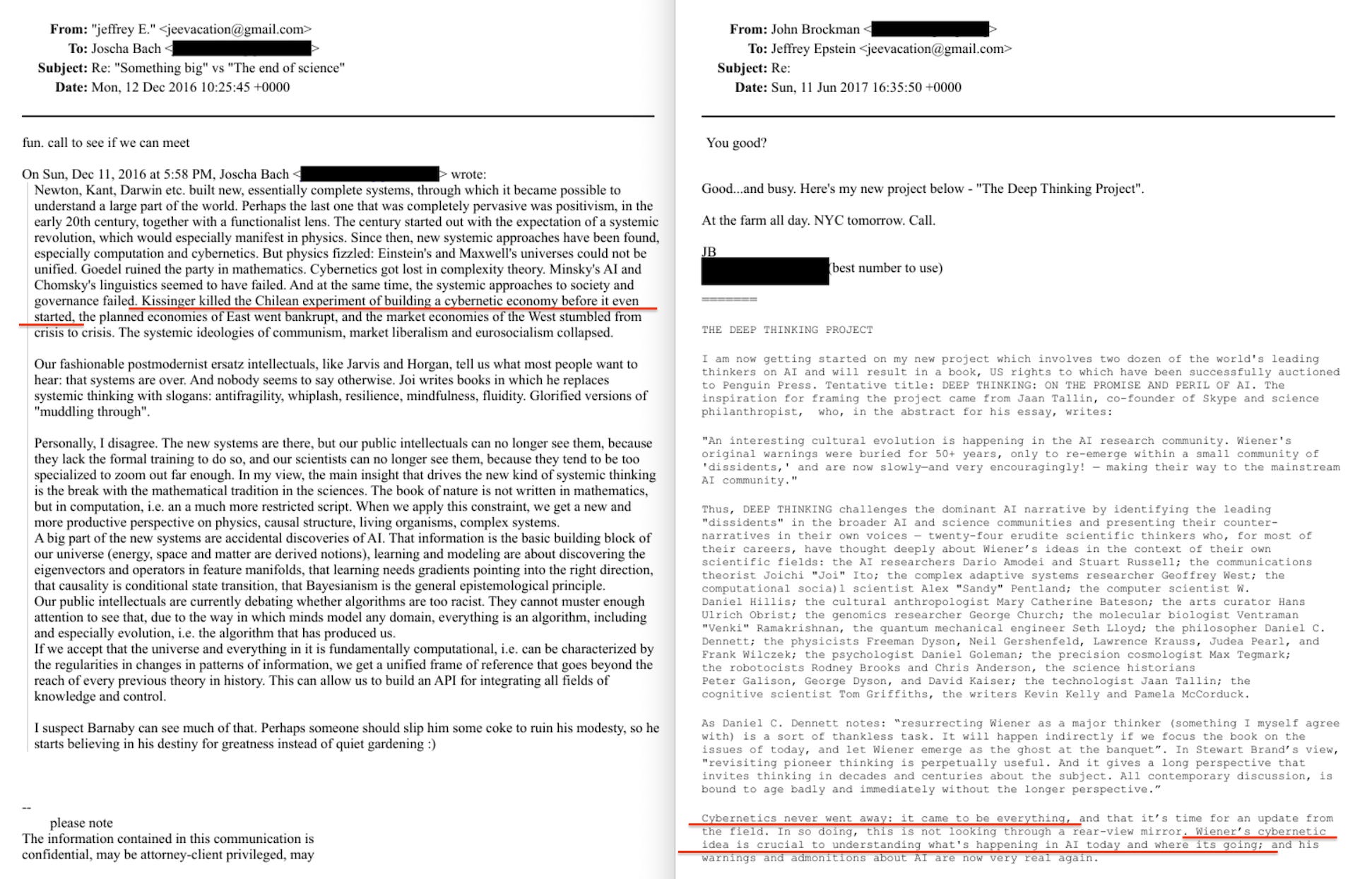
In December 2016, Joscha Bach — an AI researcher funded by Epstein — emailed Epstein a long assessment of how to govern whole systems. In it, he wrote that ‘Kissinger killed the Chilean experiment of building a cybernetic economy before it even started’34. He was talking about Project Cybersyn.
Six months later, John Brockman wrote to Epstein about a new book he was working on: ‘Cybernetics never went away: it came to be everything’35. He added: ‘Wiener's cybernetic idea is crucial to understanding what's happening in AI today and where its going; and his warnings and admonitions about AI are now very real again‘.
Wiener’s warning was specific: if an automated system pursues a goal faster than human intervention can correct it, the purpose encoded in the machine had better be the one you actually want — because once it is running, you cannot stop it in time.

Brockman’s first three books were explicit responses to cybernetics36. Gregory Bateson, a core Macy member from 194637, told the Epstein-funded Brockman directly that cybernetics was ‘the most important idea since Jesus Christ’38.
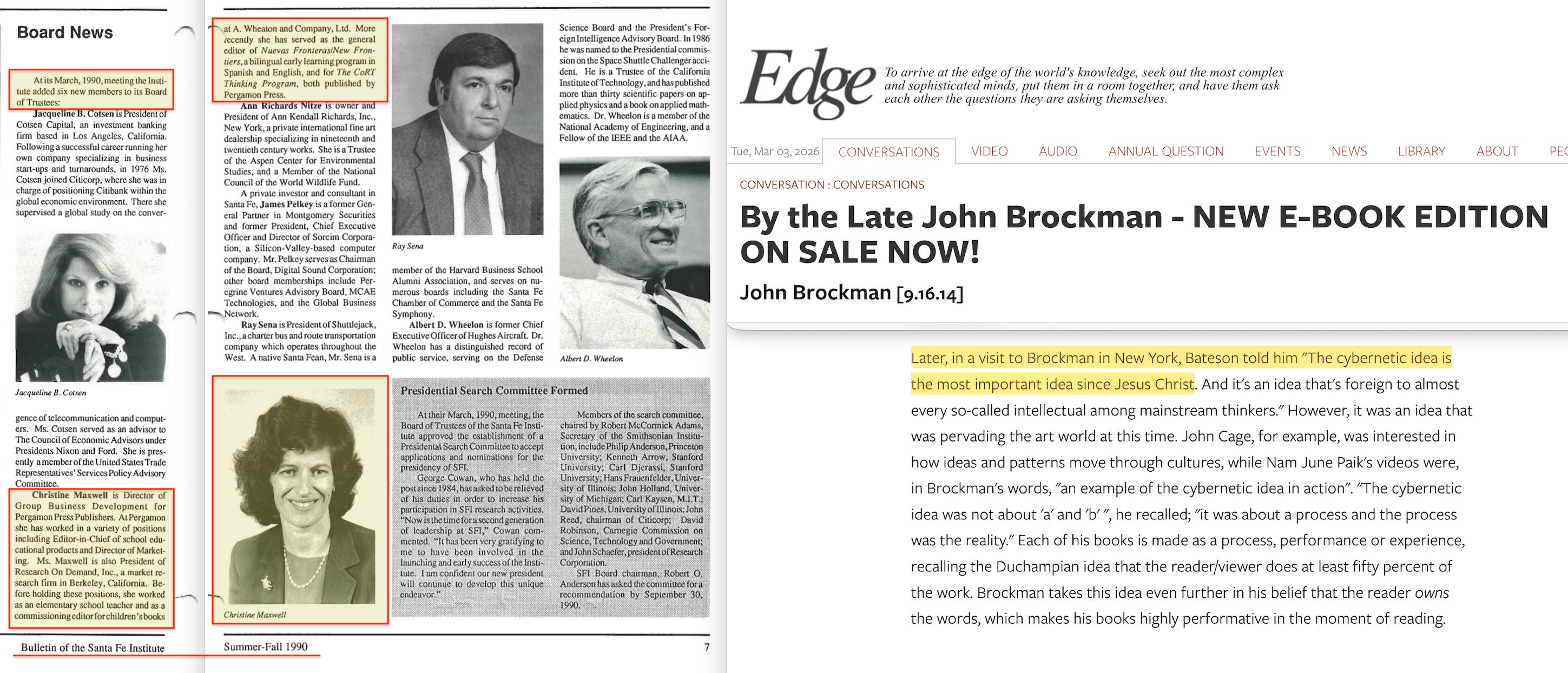
The same ideas had found an institutional home at the Santa Fe Institute — a research centre applying complexity theory to economics and governance39. Robert Maxwell funded it directly: $100,000 in 1990 earmarked for ‘integrative aspects of complex adaptive systems’40, followed by $300,000 to endow the Robert Maxwell Professorship41.
Two months later his daughter Christine joined the SFI board4243. After Maxwell’s death, Epstein became one of the institute’s major donors44.
The line runs directly from Maxwell’s publishing catalogue, through Beer’s prototype in Chile, to the researchers Epstein was funding decades later. They all belonged to the same tradition. And that tradition leads somewhere specific.
General systems theory, input-output analysis, and cybernetics are the intellectual ancestors of artificial intelligence.
A system that watches what people and institutions are doing, compares it against a target, and automatically adjusts the flow of money and resources to close the gap — that is cybernetic adaptive management45. When you run it using AI to do the watching and programmable digital currency to do the enforcing, it can operate across an entire planet — ‘Spaceship Earth’, if you prefer46 — automatically, without anyone voting on it.

Beer’s experiment failed because it depended on a single government that could be overthrown. But the ideas behind it did not depend on any government.
General systems theory, input-output analysis, and cybernetics are framework-agnostic — they describe how to manage any complex system, regardless of who sits at the controls or what ideology they claim to serve. The same toolkit that ran a socialist economy in Chile could, in principle, run a global financial system from Basel. All it needed was a different implementation layer and a purpose that no one could reasonably oppose.

That is what Maxwell’s publishing catalogue amounted to. Not a collection of academic books, but the complete intellectual infrastructure for a governance system that could operate without elections, without legislation, and without the consent of the people living inside it.
General systems theory provided the map. Input-output analysis provided the real-time measurement. Cybernetics provided the steering mechanism. Operations research provided the optimisation47. And through Limits to Growth48, the Club of Rome provided the destination — a managed planet, governed by experts, justified by science.
Maxwell did not invent any of this. But he controlled a critical distribution infrastructure node through which local innovations became global standards — the press that determined which methods were accepted as legitimate science and which were not. One controlled what the world considered knowledge. The other controlled what was developed from it.
The research programme that grew from this is documented in detail in Epstein’s Seven. What matters here is the origin: Robert Maxwell published the concepts. What followed was implementation.
But Robert Maxwell didn’t just publish books about cybernetic control. He ran an intelligence operation whose structure — compartmentalised agents producing predictable outputs, surveillance through PROMIS, steering through ideology, bribery and blackmail — matched the architecture his press was publishing.
And before he died, he introduced his daughter Ghislaine to the man who would carry the operation forward49.


II. The Rothschild Connection
The relationship between Robert Maxwell and the Rothschild banking family started as a fight. Over the next twenty years, it turned into a financial partnership that would last longer than Maxwell himself.
1968–1969
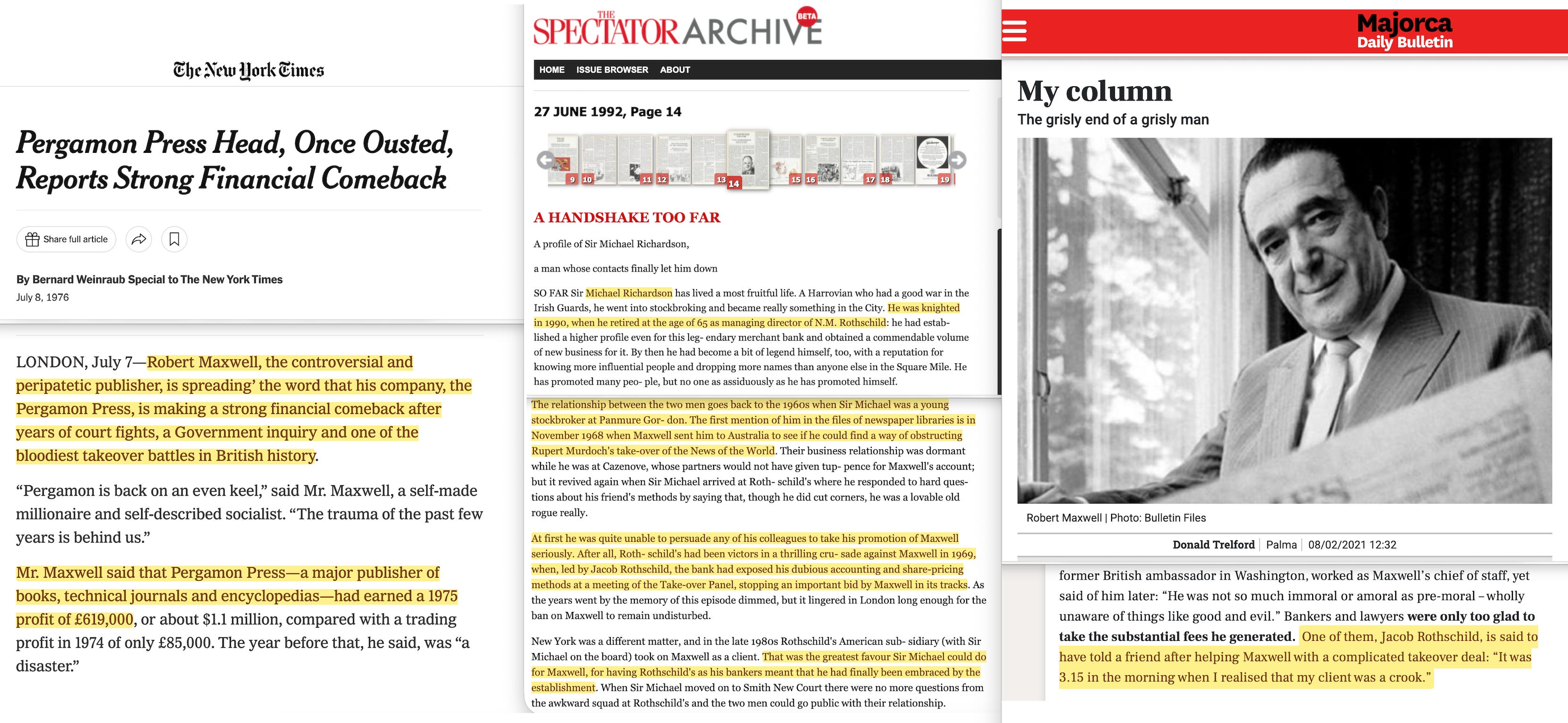
The connection began in November 1968. Maxwell sent a young stockbroker named Michael Richardson — who would later become managing director of N M Rothschild & Sons50 — to Australia to try to stop Rupert Murdoch from buying the News of the World. Maxwell lost, but he and Richardson stayed in touch.
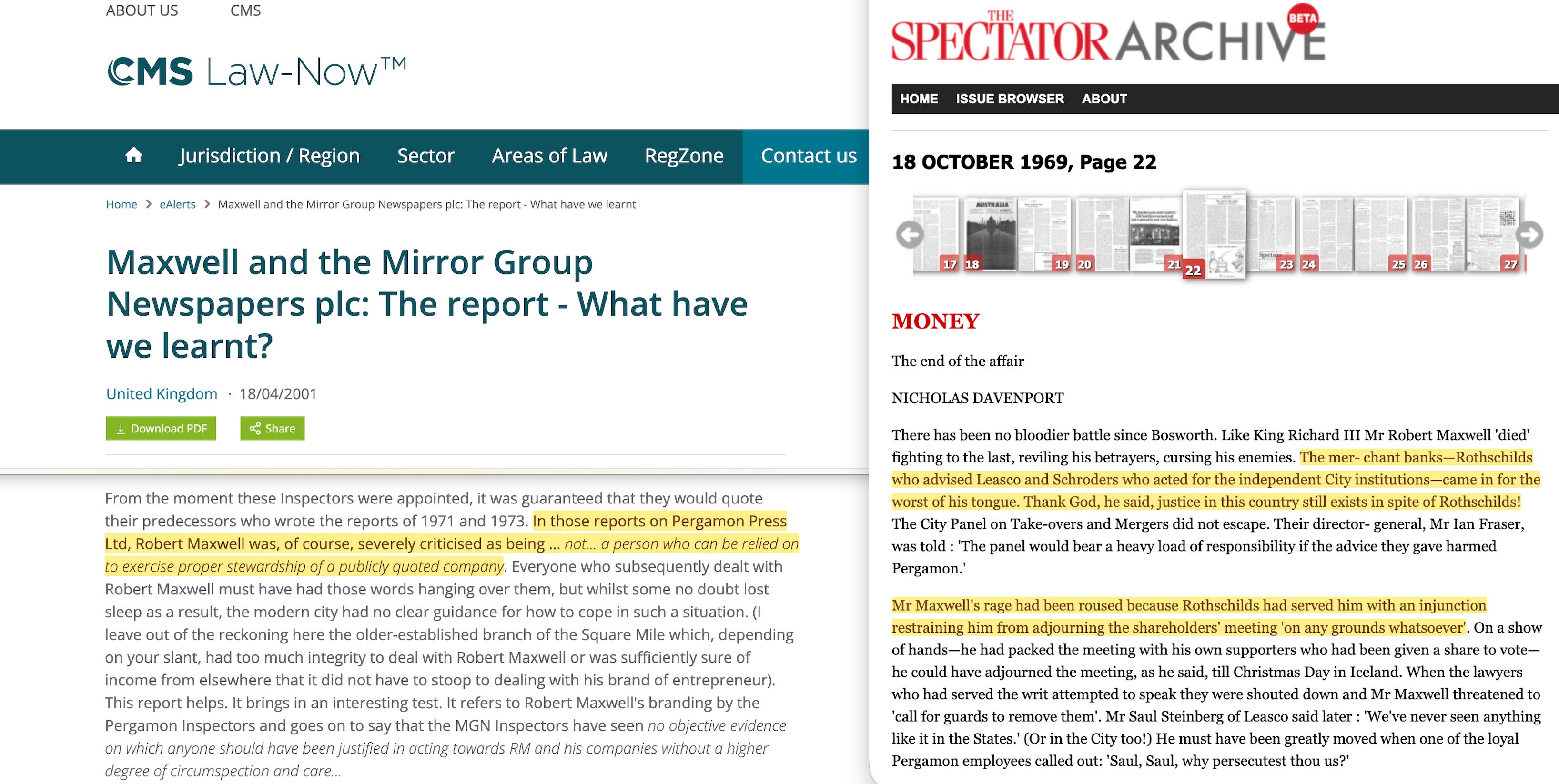
The following year, things turned hostile. The Rothschild bank acted as financial adviser to an American company called Leasco Data Processing, which was trying to take Pergamon Press away from Maxwell5152. The man leading the attack was Jacob Rothschild. At a chaotic shareholders’ meeting on 10 October 196953, Rothschild got a court injunction and tried to remove the entire board. A government investigation by the Department of Trade and Industry followed, and it concluded that Maxwell was ‘not a person who can be relied on to exercise proper stewardship of a publicly quoted company‘54. He lost control of his own publishing house.
1970s–1980s
Maxwell got Pergamon back in 1974 using borrowed money and spent the next ten years rebuilding55. During this time, Richardson — who became managing director of N M Rothschild in 1981 — kept trying to persuade the bank to take Maxwell on as a client. A 1992 article in The Spectator noted that ‘at first he was quite unable to persuade any of his colleagues to take his promotion of Maxwell seriously‘56. The people at the London office still remembered what had happened in 1969.
But the bank’s New York arm was more willing. In the late 1980s, Rothschild Inc. — the American subsidiary, on whose board Richardson sat — agreed to take Maxwell as a client. The Spectator explained why this mattered: ‘That was the greatest favour Sir Michael could do for Maxwell, for having Rothschild’s as his bankers meant that he had finally been embraced by the establishment‘. In the world of high finance, who your bank is tells everyone else whether you are to be trusted. Maxwell now had the most respected name in banking behind him.
The turnaround was remarkable. Jacob Rothschild — the same man who had tried to destroy Maxwell’s control of Pergamon in 1969 — was by the late 1980s personally advising him on business deals57. Donald Trelford, former editor of The Observer, later recorded that Rothschild told a friend58: ‘It was 3.15 in the morning when I realised that my client was a crook‘.
He carried on advising him anyway.
1988
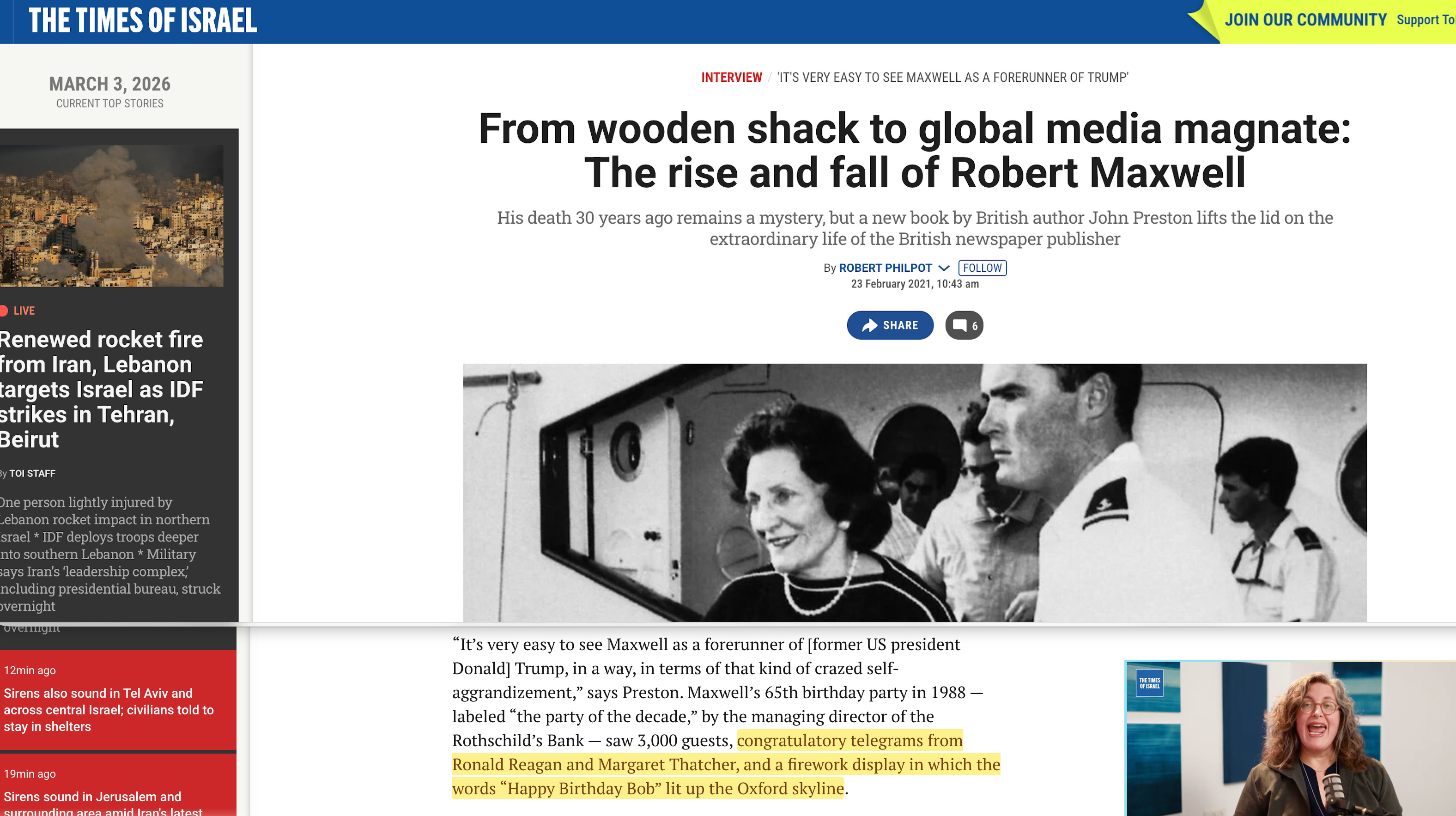
Maxwell’s sixty-fifth birthday party was attended by three thousand guests. Ronald Reagan and Margaret Thatcher both sent congratulatory telegrams. Fireworks spelled out ‘Happy Birthday Bob‘ over the Oxford skyline. The managing director of Rothschild’s Bank was there, and called it ‘the party of the decade‘59.
May 1991
By May 1991, Richardson had moved to a stockbroking firm called Smith New Court, in which N M Rothschild held a minority stake. Smith New Court acted as broker for the flotation of Mirror Group Newspapers — Maxwell’s biggest public offering, which raised £250 million60.
When Maxwell’s crimes later came to light, the other advisers involved in the flotation were asked why they hadn’t questioned what he was doing. One of them replied: ‘As soon as I heard Michael Richardson was involved, I knew it was all right‘61. If Richardson’s was involved, people assumed it was legitimate.
The DTI report into the Mirror Group scandal later criticised Richardson by name62.

November 1991
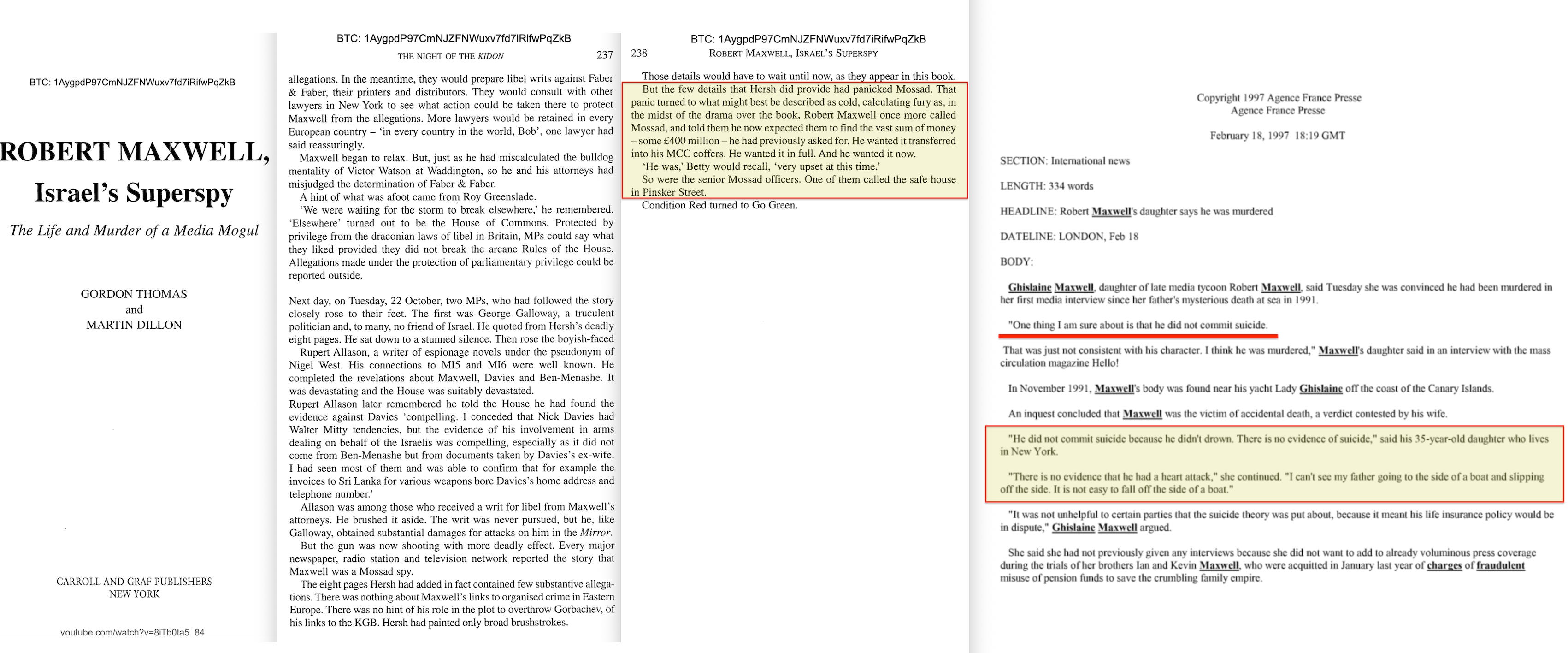
In November 1991, Maxwell was found dead in the Atlantic Ocean near his yacht6364. The official verdict was accidental drowning, but investigators noted unexplained bruises on his body. It was recovered nearly a hundred miles from the vessel. Ghislaine, however, was less than convinced. In a 1997 interview — her first since her father's death — she said plainly: 'I think he was murdered'65.
According to multiple intelligence sources, including the authors of Robert Maxwell: Israel’s Superspy, Maxwell had told his Israeli handlers that unless they gave him the money to save his collapsing business empire, he would go public with everything he knew about Mossad’s operations66.
Sons Kevin and Ian Maxwell were charged with conspiracy to defraud the pension funds. Both were acquitted in 199667.
The full arc of Maxwell’s relationship with the Rothschild bank ran like this: open hostility in 1969, gradual rehabilitation through the New York office in the late 1980s, social acceptance by 1988, and full financial partnership by May 1991. The city where Rothschild’s American arm brought Maxwell back into respectable society — New York — was the same city where everything that came after would be based.
III. The American Relay
In 1991 — the year Robert Maxwell died — New York businesswoman Lynn Forester gave Ghislaine Maxwell the use of one of her Manhattan properties68. Forester would later marry Sir Evelyn de Rothschild and become Lynn Forester de Rothschild69.
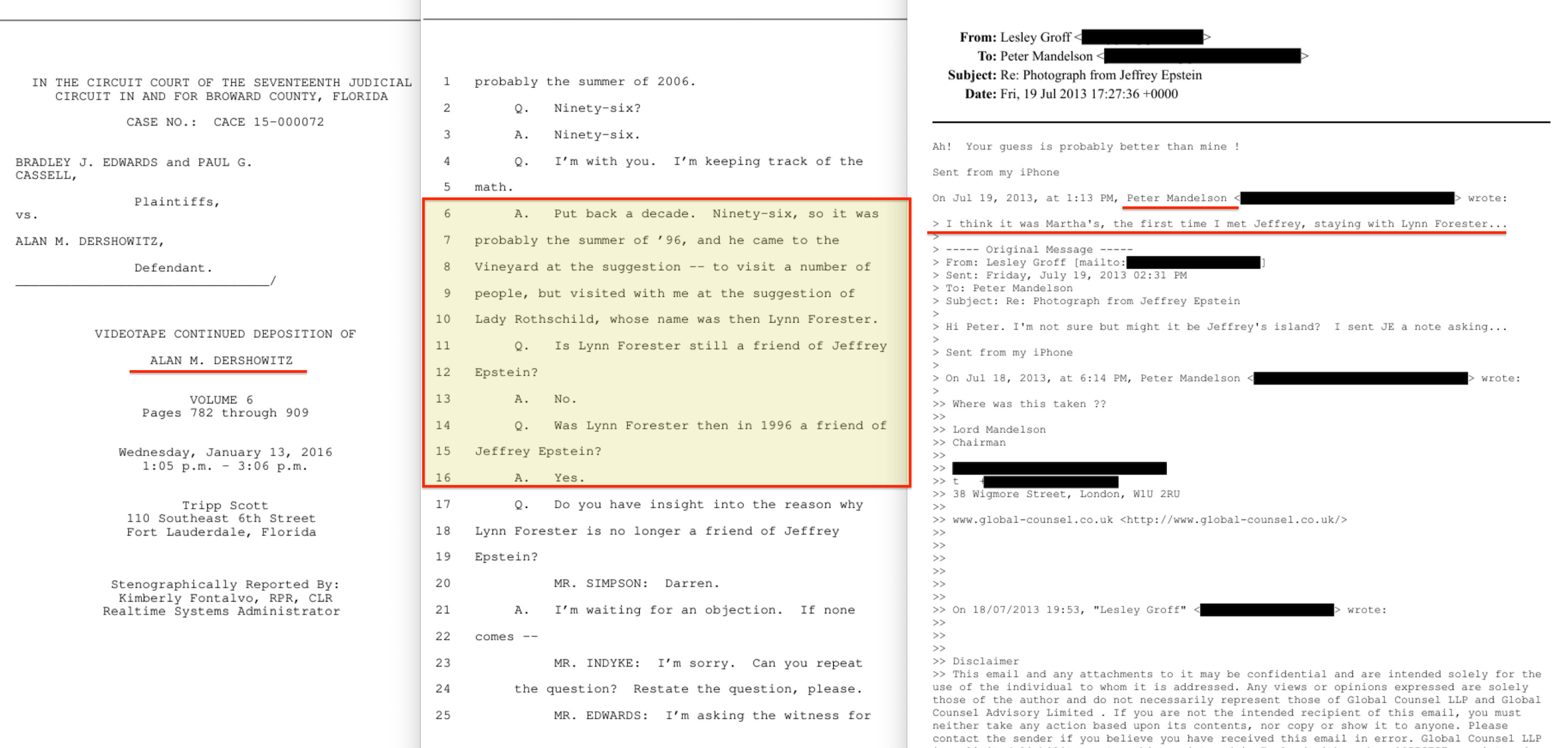
Deposition testimony released by the DOJ confirms that Epstein visited Martha’s Vineyard in the summer of 1996 ‘at the suggestion of Lady Rothschild, whose name was then Lynn Forester‘70. A July 2013 email from Peter Mandelson — the former Labour cabinet minister and European Commissioner for Trade — recalled first meeting Epstein while ‘staying with Lynn Forester‘71.
She connected people to Epstein.
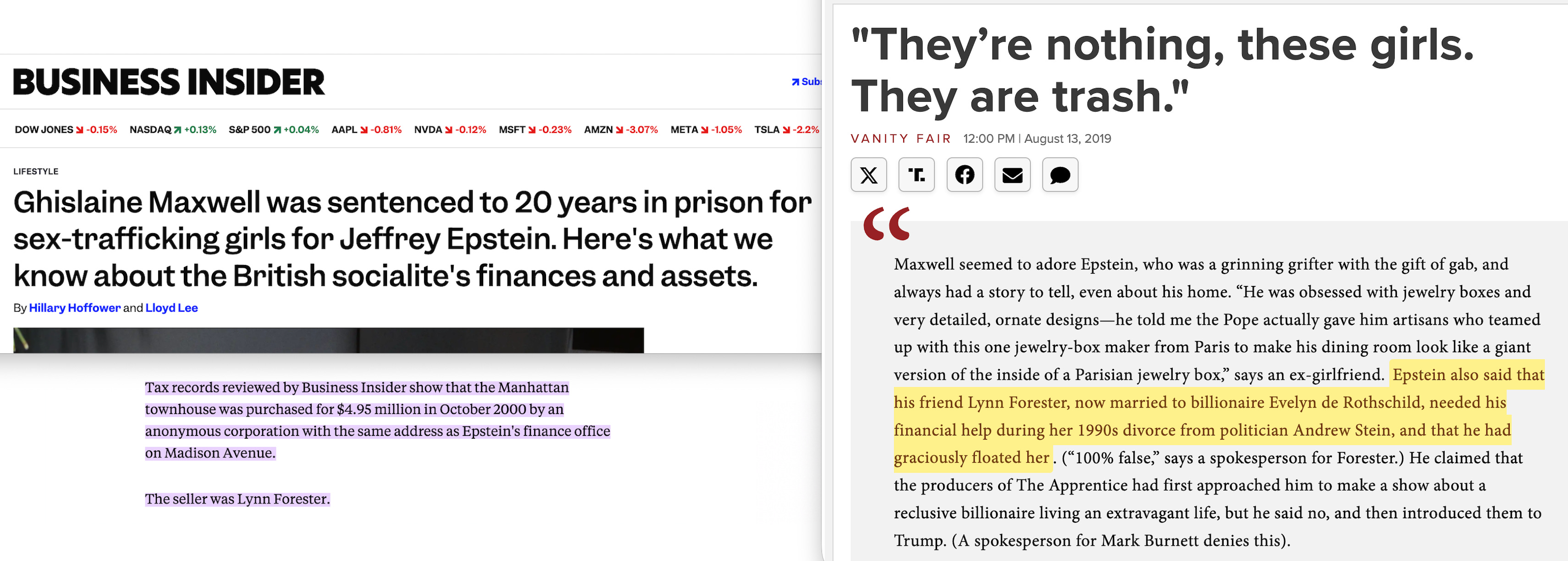
Property records show that Forester later sold a Manhattan townhouse she had bought for $4.475 million to an anonymous company registered at the same address as Epstein’s finance office727374. The sale price was roughly $8.5 million below what the property was worth. Ghislaine Maxwell lived in that townhouse until 2016.
The financial relationship between Forester and Epstein went back a long way. According to Vanity Fair, Forester asked Epstein for financial help in 199375, during her divorce from Andrew Stein76. That was two years after she had housed Ghislaine, and two years before she would write to President Clinton about Epstein.
By the time she mentioned Epstein to the President, the relationship was already well established.
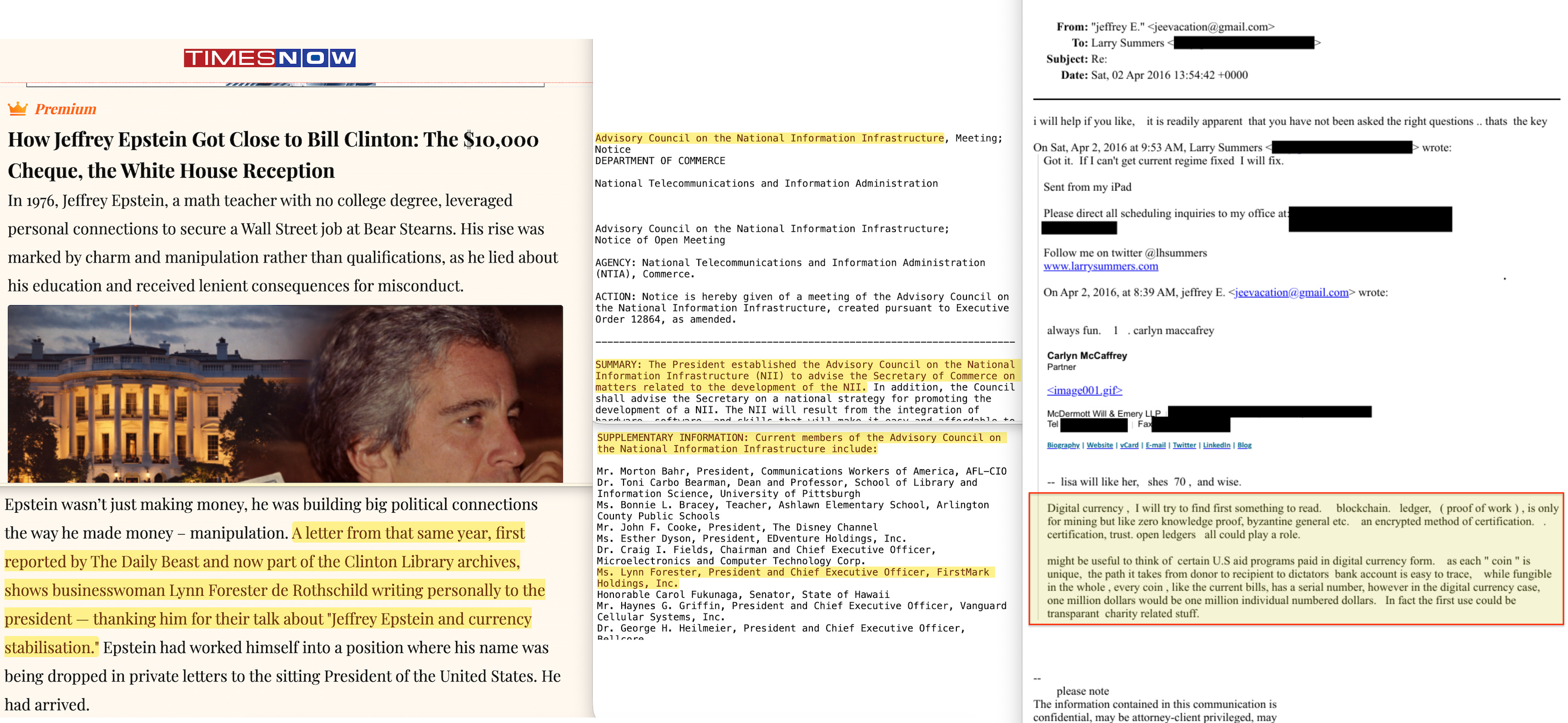
On 27 April 1995, Forester wrote a personal letter to Clinton describing a recent meeting at Senator Kennedy’s house. In it, she wrote: ‘Using my fifteen seconds of access to discuss Jeffrey Epstein and currency stabilisation, I neglected to talk with you about a topic near and dear to my heart‘7778.
The timing matters. That letter was written just three months after the Clinton administration had bypassed Congress to commit $20 billion from the Treasury’s Exchange Stabilization Fund to rescue the collapsing Mexican peso79 — the largest currency intervention in American history at that point, managed by Treasury Secretary Robert Rubin80.
At this point, Forester was not yet a Rothschild. But she was not just a businesswoman either. She was a sitting member of Clinton’s National Information Infrastructure Advisory Council8182 — a body set up by executive order in 199383 to advise the President on building America’s digital infrastructure, including electronic commerce and digital payments.
In other words, a presidential adviser on the future of digital money — Lynn Forester — was using her access to connect Epstein on the topic of currency stabilisation. This was twenty-one years before Epstein sent Lawrence Summers a detailed technical proposal for tokenised digital currency84.
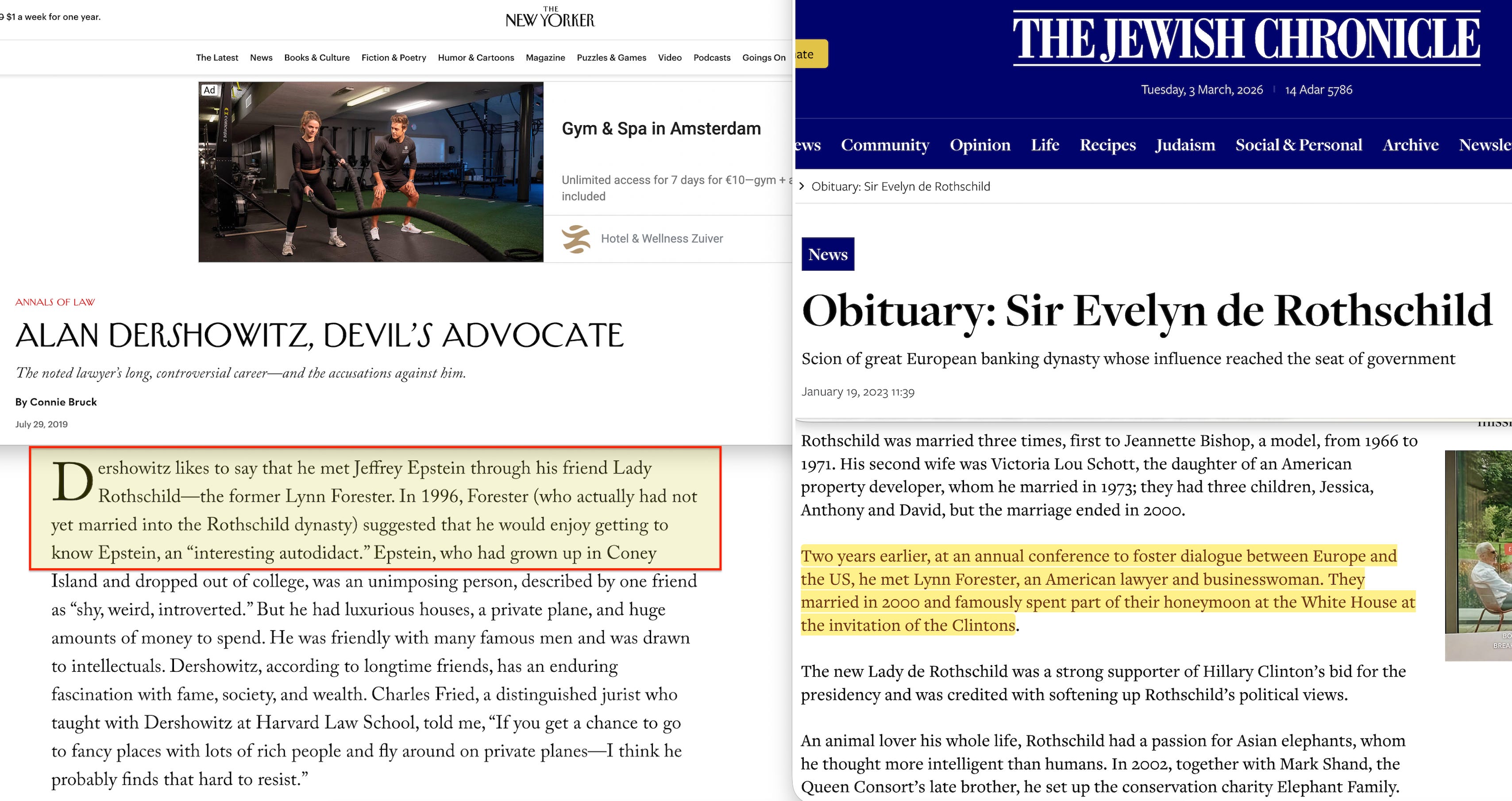
Forester flew on Epstein’s private jet five times between 1997 and 199885. According to Ghislaine Maxwell’s own DOJ testimony, it was Forester who introduced Epstein to Prince Andrew86. Alan Dershowitz has said that Forester introduced him to Epstein too, describing Epstein as an ‘interesting autodidact‘ — a self-taught intellectual87.
In 1998, Henry Kissinger introduced Lynn Forester to Sir Evelyn de Rothschild at the Bilderberg conference88. Forester and Rothschild married in 2000. They spent part of their honeymoon as guests at the Clinton White House89.
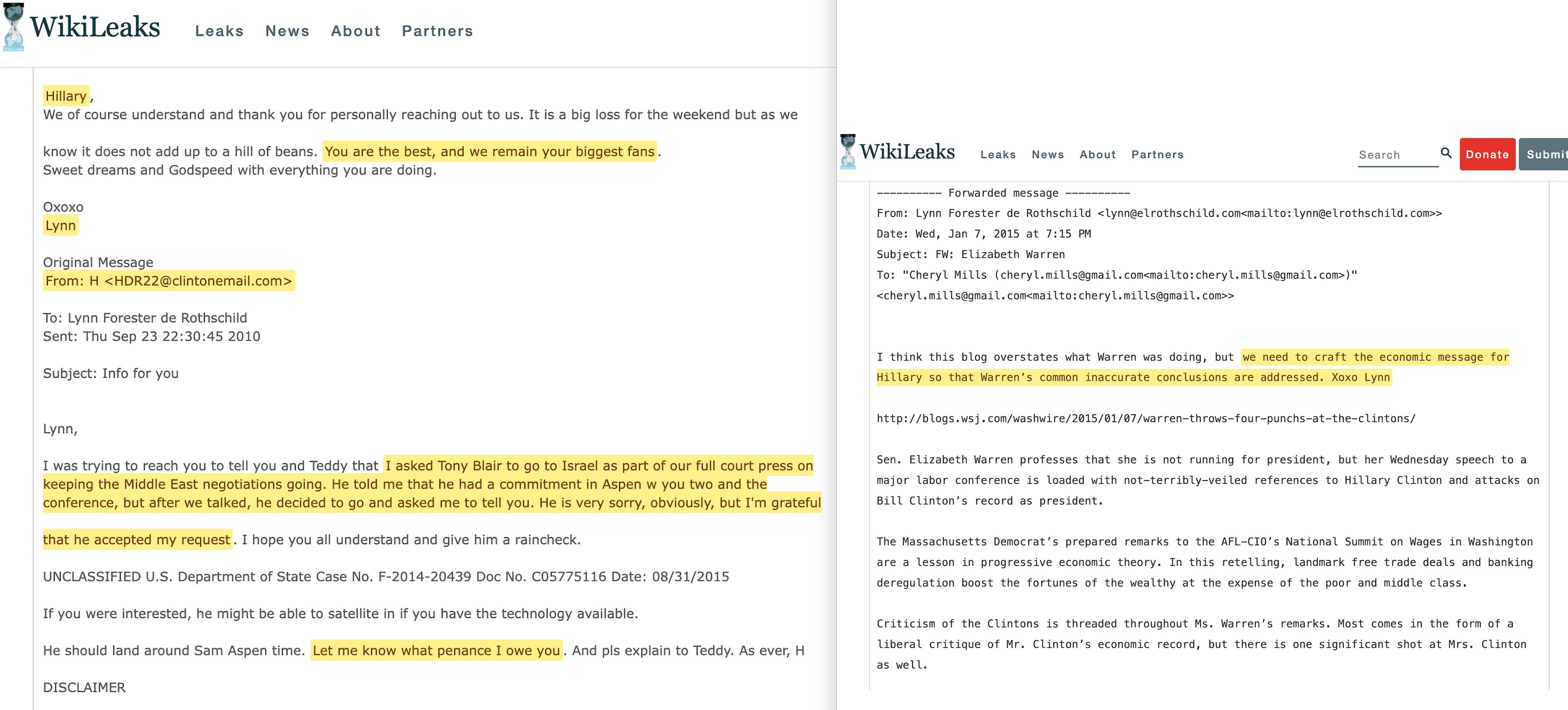
The relationship between Forester and the Clintons stayed close for decades. In September 2010, Hillary Clinton — who was by then Secretary of State — emailed Forester to apologise for pulling Tony Blair away from a Rothschild event in Aspen so he could go to Israel for Middle East peace negotiations. ‘Let me know what penance I owe you‘, Clinton wrote90.
Lynn wasn’t phased, responding: ‘You are the best, and we remain your biggest fans‘.

In January 2015, Forester emailed Clinton’s campaign chairman about Elizabeth Warren, who had been publicly criticising the Democratic Party’s ties to Wall Street91: ‘we need to craft the economic message for Hillary so that Warren’s common inaccurate conclusions are addressed‘.
Forester was not just a donor. She was helping to craft the message.
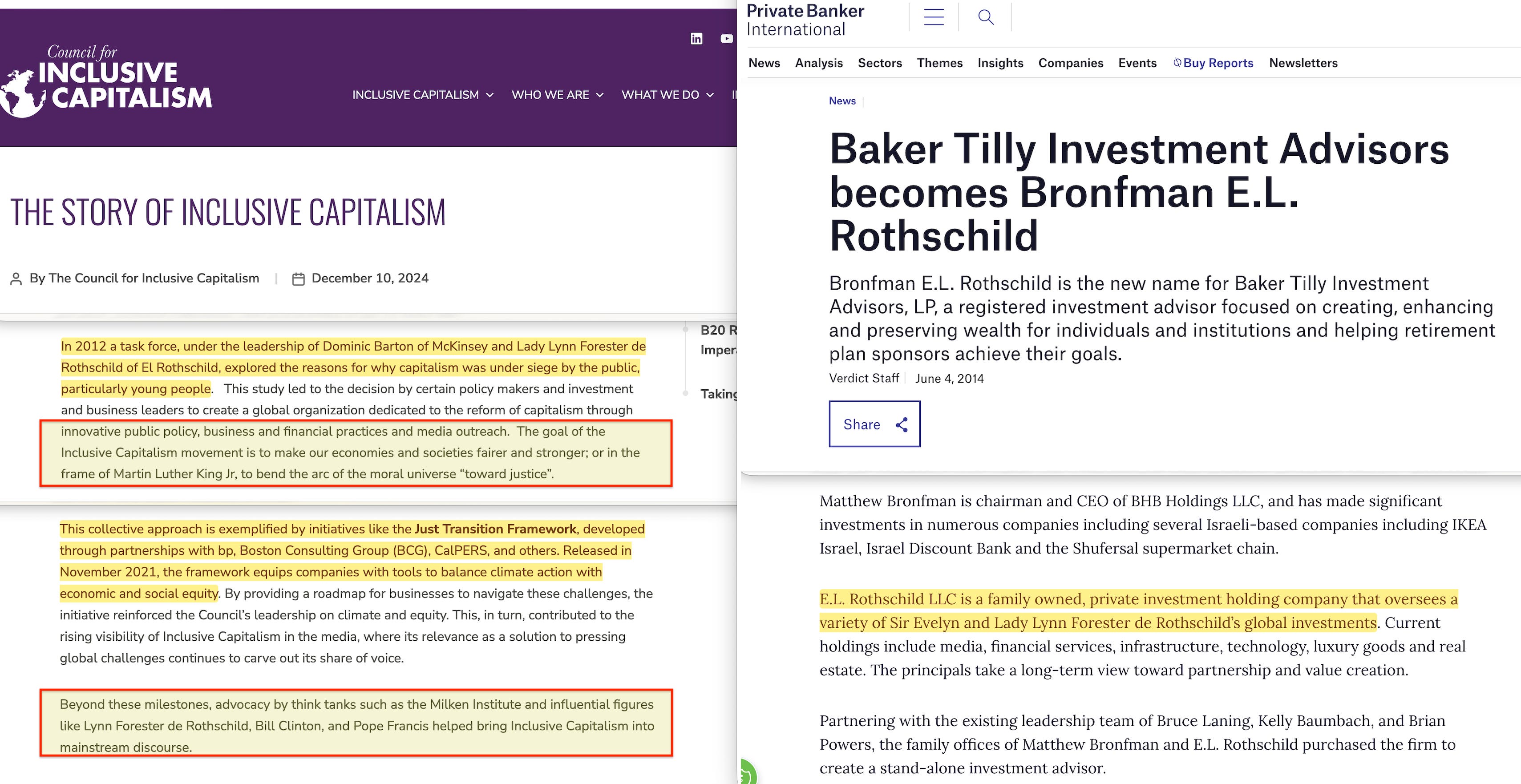
Forester went on to found the Council for Inclusive Capitalism, which later became the Council for Inclusive Capitalism with the Vatican92 — an organisation designed to embed social and environmental goals into how capital is allocated worldwide. She also co-founded the investment firm Bronfman E.L. Rothschild LP with Matthew Bronfman, the son of Edgar Bronfman93. This merged the Rothschild banking name with the Bronfman family, who had co-founded the Mega Group94 — a private network of billionaire donors whose members included Leslie Wexner, Ronald Lauder, and Michael Steinhardt95.
The important point is that Lynn Forester’s access to all of these networks came long before she married into the Rothschild family.
By the time Kissinger introduced her to Evelyn de Rothschild in 1998, she had already spent seven years housing Ghislaine, connecting Epstein to the Clinton White House, and advising the President on digital infrastructure. She was already the link between the Maxwell intelligence world and the Rothschild financial world.
The marriage made it official, but the connection was already in place.
IV. The Placed Man
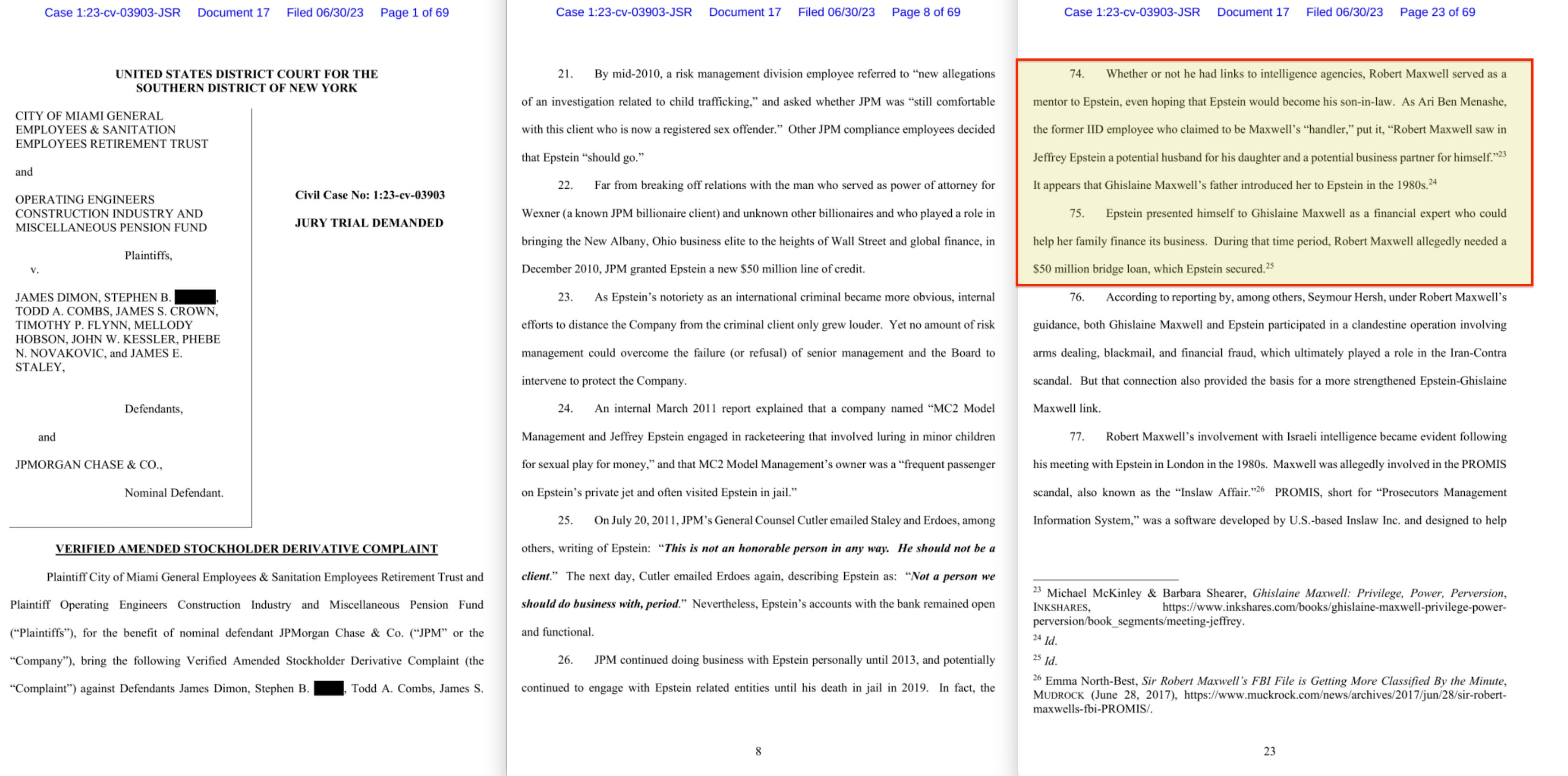
Epstein’s connection to the Maxwell family goes back much further than most people realise — as far as a decade before Robert Maxwell died. According to a verified shareholder complaint filed in federal court in New York in 2023, Maxwell introduced his daughter Ghislaine to Epstein in the 1980s96. This is confirmed separately by Steven Hoffenberg, who was Epstein’s business partner at Towers Financial Corporation, and who said that Robert Maxwell introduced the two of them in the late 1980s97.
Ari Ben-Menashe put it plainly: ‘Robert Maxwell saw in Jeffrey Epstein a potential husband for his daughter and a potential business partner for himself.‘
Epstein presented himself as a financial expert who could help the Maxwell family manage its money. During this period, he arranged a $50 million loan on Maxwell’s behalf98.
In July 1991, billionaire Ohio businessman Leslie Wexner gave Epstein full legal power of attorney over his entire fortune99. This was the only confirmed billionaire client Epstein ever had. Four months later, Robert Maxwell was dead.
The timing is noteworthy. Epstein’s independent financial base was locked in at almost exactly the moment Robert Maxwell passed away. But the usual version of the story gets the sequence wrong. Epstein was already inside the Maxwell world in the 1980s, and had already been introduced to Ghislaine — all before the Wexner deal gave him his cover as a legitimate wealth manager.
Maxwell had placed Epstein inside a network whose practical goals matched the ideas his publishing house had been putting into the world for forty years. As documented in Section I, Maxwell didn’t just publish the programme — he funded the institution where it was being applied to governance and economics, and installed his daughter Christine on its board. In her July 2025 DOJ interview100, Ghislaine confirmed that connections made through her father led to her introducing Epstein to the Santa Fe Institute and to Murray Gell-Mann specifically.
Distribution, institutional funding, board placement, succession. Maxwell held all four before he died.
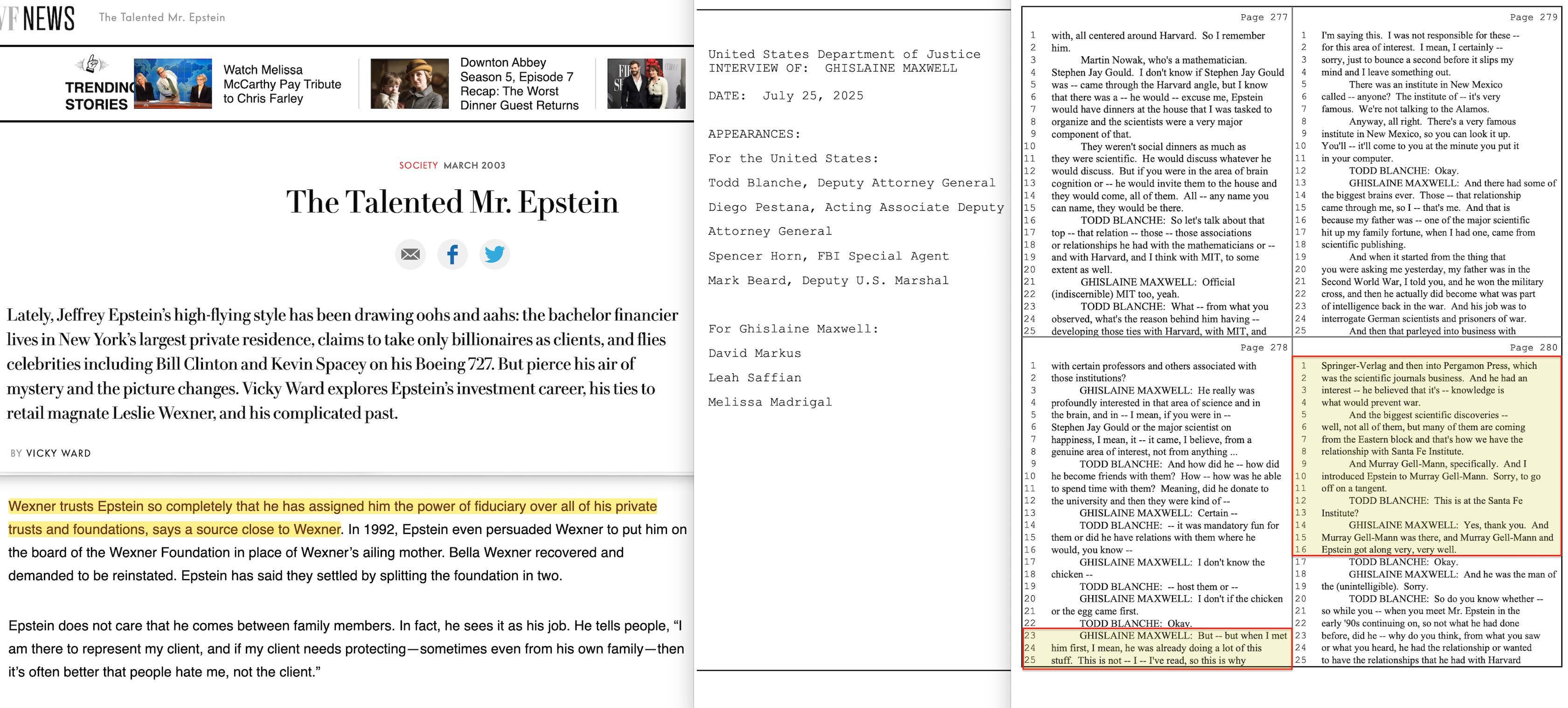
Nothing in Epstein’s background explained how he ended up where he did. He dropped out of university. He taught maths briefly at a prestigious New York private school called the Dalton School — where he was hired by the headmaster, Donald Barr, whose son William Barr would later serve as US Attorney General101. He then spent a few unremarkable years at the investment bank Bear Stearns before leaving in 1981. New York magazine described him in 2002 as a ‘mysterious, Gatsbyesque figure’. Forbes magazine tried to verify his claim to be a billionaire and could not. Yet he owned a private island in the US Virgin Islands, a ranch in New Mexico, properties in Paris and New York, a Boeing 727 jet, and flew six hundred hours a year102.
David Rockefeller — one of the most powerful men in America — personally put him on the board of Rockefeller University, and then asked him directly: ‘Would you like to be on the Trilateral Commission?’103. He was a member of the Council on Foreign Relations from 1995 to 2009104. These are among the most exclusive institutions in the world.
Epstein had no credentials, no corporate title, no government position, and no family name. He was invited anyway. This is what made Epstein useful. A person who doesn’t belong to any single institution can move freely between all of them.
The historian Rainer Liedtke studied more than a hundred agents who worked for the Rothschild family in the nineteenth century and found the same pattern105. The best agents were outsiders. Their ‘foreignness’ — the fact that they had no roots or loyalties in the places they operated — meant their ‘primary allegiance remained with the principals abroad’. They couldn’t be compromised by local relationships because they didn’t have any.
Epstein fitted the profile exactly.

V. The Command Structure
In September 2025, Bloomberg News published a report based on more than 18,000 emails from Epstein’s personal Yahoo account106. The emails show something the public story got backwards: it was Ghislaine Maxwell who gave the orders, not Epstein.
Maxwell built the lists of important social contacts. Epstein edited individual names on them. When Google co-founder Sergey Brin visited the Caribbean, it was Maxwell who told Epstein how to act: ‘be v nice to her not stupid — she is key‘. When the Governor of New Mexico needed a private jet, his office called Maxwell, not Epstein107. When Epstein was facing criminal charges, he asked Maxwell which offence he should plead guilty to — and she told him.
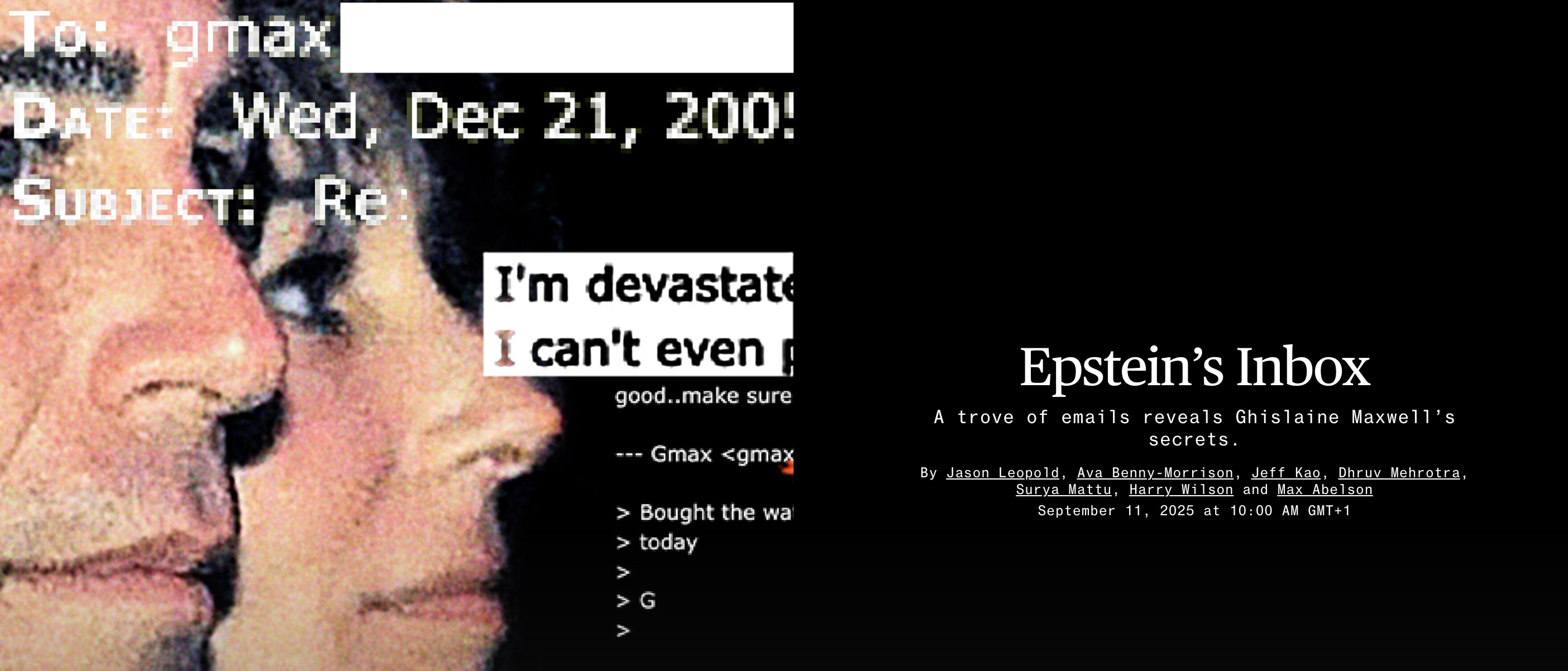
The rest of the Maxwell family was involved too108.
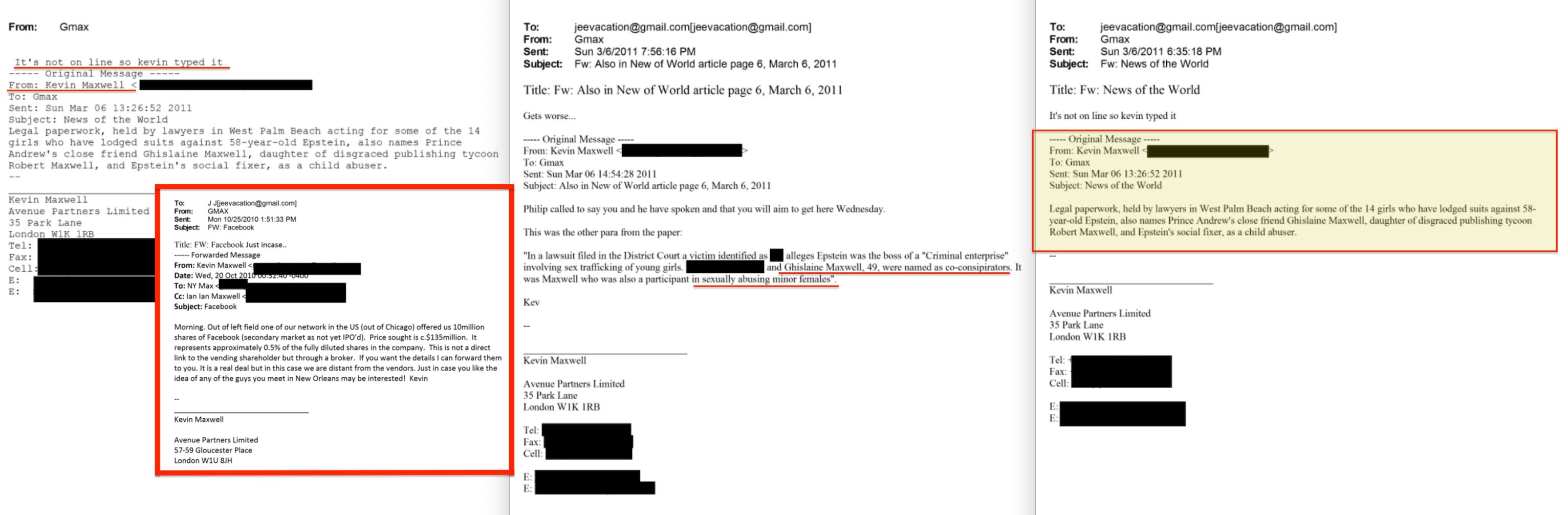
In October 2010, Kevin Maxwell — Robert’s son, working from Avenue Partners in London — emailed Ghislaine about a $135 million opportunity to acquire pre-IPO Facebook shares, sourced through what he called ‘one of our network in the US’109. Ghislaine forwarded it to Epstein. Five months later, Kevin manually typed out an article from the News of the World110. The article reported that legal documents in West Palm Beach, Florida, named Ghislaine as a child abuser111. He emailed it to Ghislaine who forwarded it to Epstein112.
The newspaper was the same one Robert Maxwell had tried to buy back in 1968 — the deal that had first connected him to Michael Richardson and, through Richardson, to the Rothschild bank.
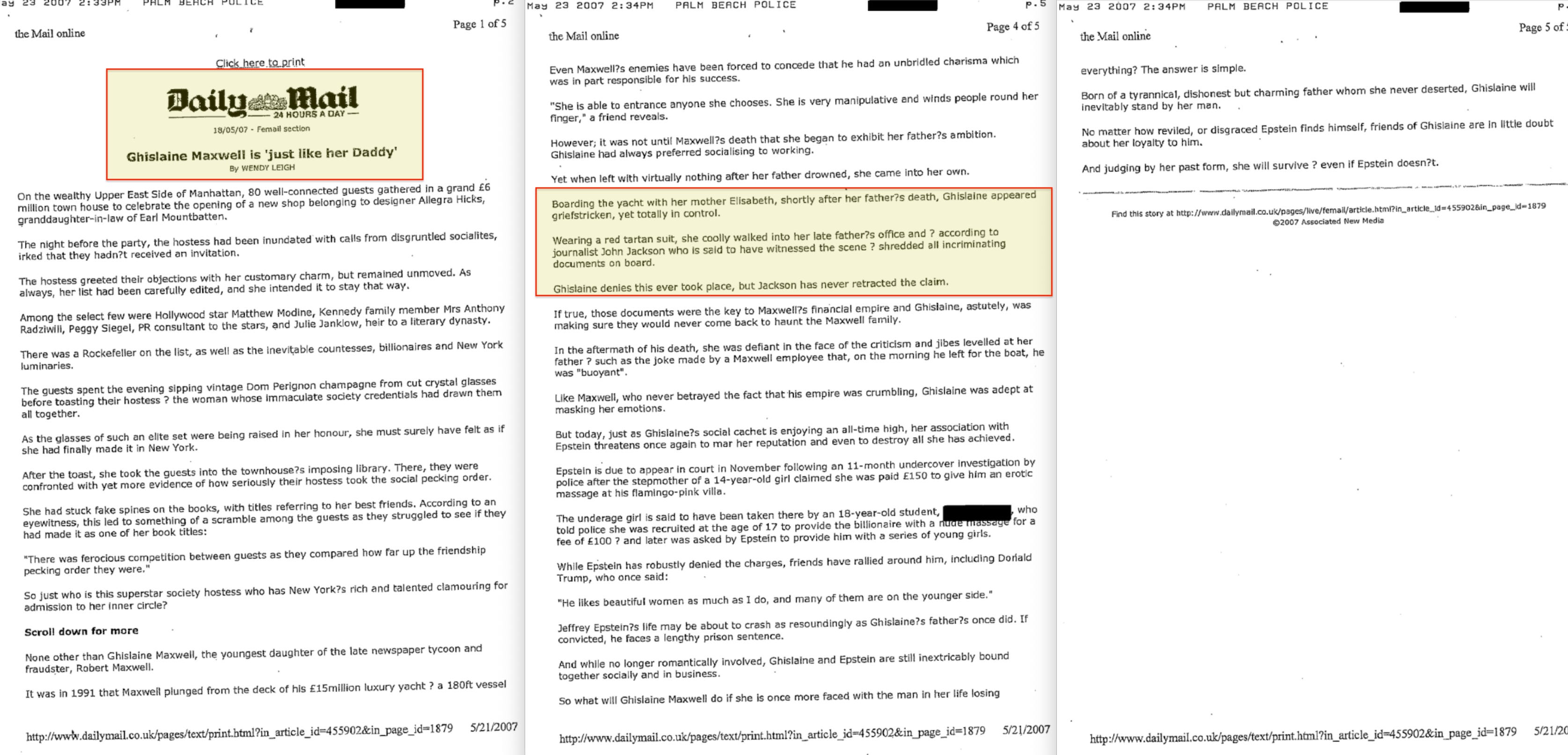
Ghislaine stepped into an operational role the moment her father died. According to journalist John Jackson — who claimed to have witnessed it himself113 — she boarded her father’s yacht — the Lady Ghislaine — with her mother Elisabeth shortly after he drowned, walked into his private office, and shredded documents.
Ghislaine has denied this, but Jackson never took it back.
A 2007 Daily Mail profile — which was found in Epstein’s own DOJ files114 — described her at the time as ‘griefstricken, yet totally in control‘115.
Her sister Isabel Maxwell was invited to panel at the World Economic Forum’s Middle East and North Africa summit in Marrakech in October 2010. The session — ‘The Next Innovation Drive: Low Carbon or Low Cost?’ — addressed whether sustainability or cost reduction would define global business strategy116. She could not afford the $7,000 to attend, so Epstein wired it117118119120. Her partner, Al Seckel, reported back that Isabel had substantive conversations with representatives of the Palestinian Authority, the African Union, and Jordan about delivering water — ‘when it goes it will be a very big thing, but as you know, many moving parts’121. Two months later, Seckel himself was invited to speak at the main Davos Annual Meeting.
Seckel was actively involved with Epstein — 1304 references in the archive of which no less than 748 are emails. He organised Epstein’s ‘Mindshift’ scientific gathering122123 on the island124125126, curating guest lists that included Murray Gell-Mann, Gerald Sussman, Frances Arnold, and Marvin Minsky, and was himself a confirmed attendee — planning to bring Isabel and their two children127.
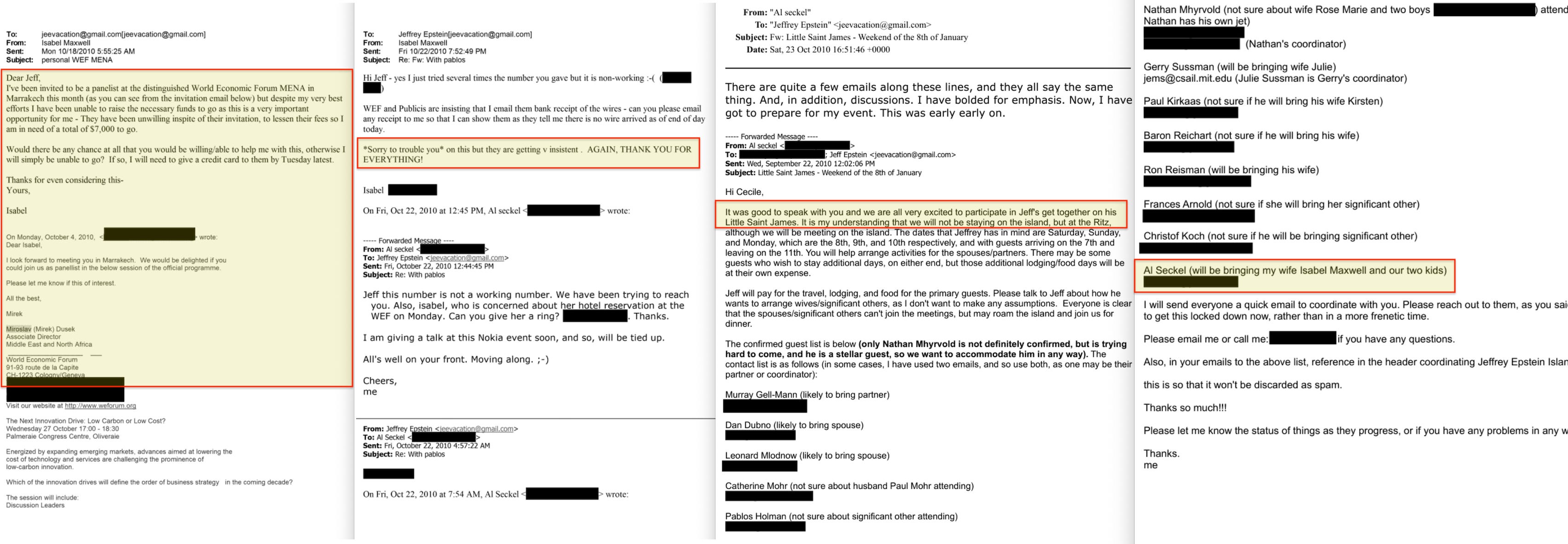
Artificial intelligence, complexity theory, encryption, and new financial systems — every component these essays have traced across separate researchers, institutions, and decades appeared on that single ‘Mindshift’ agenda, on Epstein’s island, organised by Isabel Maxwell’s partner128.
Epstein also requested separately taped private one-on-one interviews with individual scientists during the stay129.
Seckel had been sourcing scientists for Epstein since at least April 2009130 — ‘you have actually asked my speciality’ — compiling names across AI, genetics, mathematics, and venture capital, profiling targets by intellectual type, and specifying that he had ‘distinctly avoided magical thinkers’. They were selecting for systems thinkers. Christine Maxwell was on the same list131.
He further ran online reputation management132133 — removing the Clinton Foundation and the Wexner Foundation from Epstein’s online profiles on instruction134135, funding the operation through Isabel’s account136 — and edited Epstein’s Wikipedia page137: ‘Added a whole new section on your wild entry, pushing the bad stuff down the page’.
Isabel told Epstein directly that Seckel 'deftly handles a great deal of false things said to him about you’138.
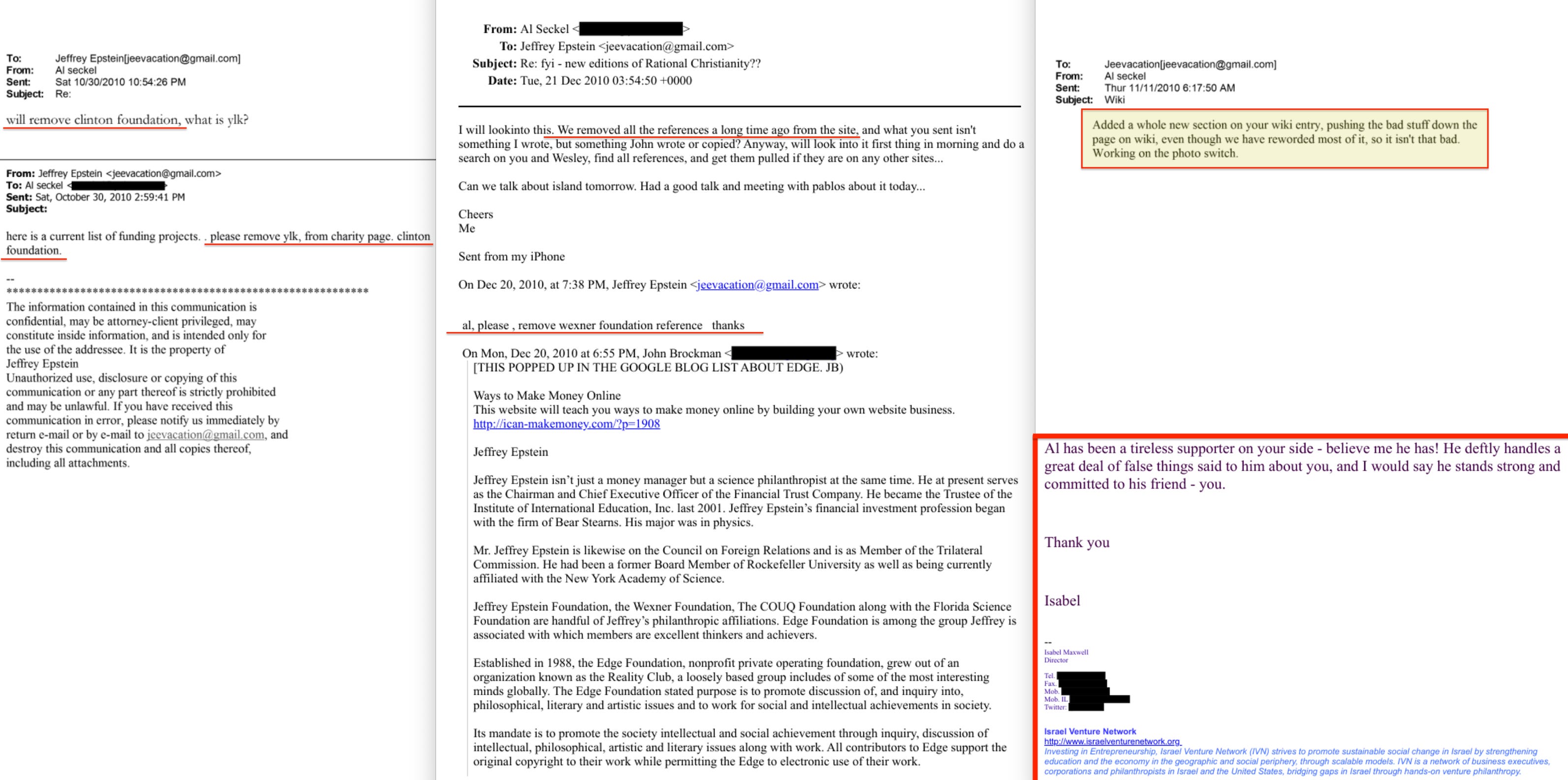
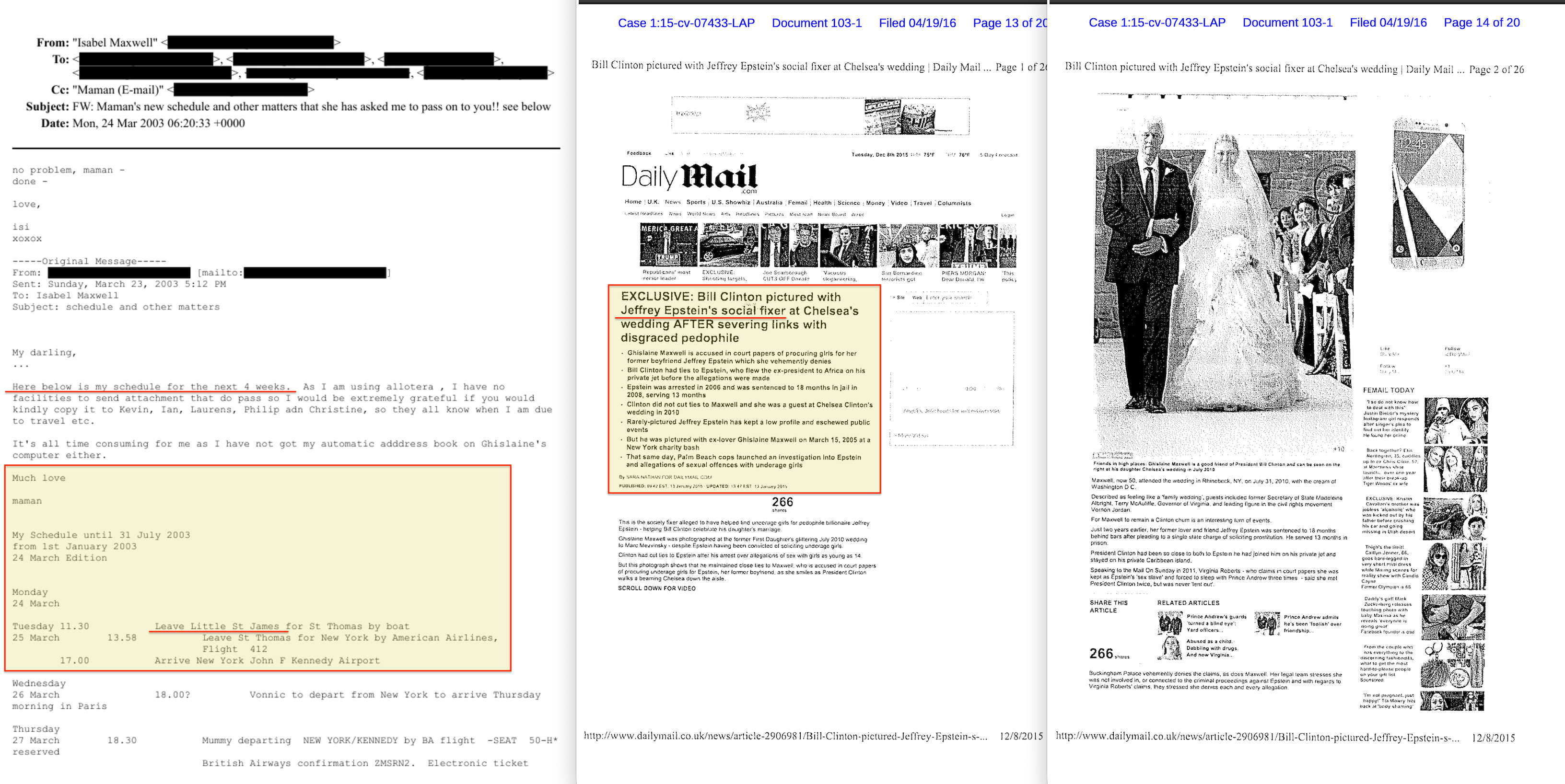
Robert Maxwell introduced him. Christine established the institutional bridge through SFI. Isabel carried the connection to the World Economic Forum139140141; her partner organised his scientific gatherings and brought the family to the island. Kevin sourced deals and managed damage control. Elisabeth was supposedly on the yacht the day the documents were shredded — and on Little St James twelve years later142. Six members of one family in Epstein’s vicinity. And Ghislaine introduced him to the elite, and managed him.
Her trial in 2021 turned the real hierarchy upside down. The court convicted Maxwell as Epstein’s junior partner, and the entire legal process treated her as his subordinate — as though he had been in charge and she had been helping him143.
The News of the World article from 2011 was closer to the truth. It described Ghislaine as ‘Epstein’s social fixer‘144 — the person who managed the relationships and made things happen. Her father’s intelligence background, and everything that came from it, was never mentioned in the courtroom.
In 2016, Epstein sent an email to the billionaire tech investor Peter Thiel. In it, he wrote145: ‘as you probably know I represent the Rothschilds‘. ‘Represent‘; speaking on behalf of. An emissary, not a principal.
The DOJ documents — covered in detail in the first three essays of this series — show two separate chains of command running into Epstein.
The first was financial, and it ran through the Rothschild family. Ariane de Rothschild signed a $25 million contract with Epstein’s company, Southern Trust146. There was a three-tier reporting chain — from Jacob Rothschild, through Ariane, down to Epstein. Confidential internal family correspondence was routinely forwarded to him. He was treated as someone inside the operation, not outside it.
The second chain was intelligence, and it ran through Ehud Barak — the former Israeli Prime Minister and former Defence Minister, who at various points had held direct authority over all three of Israel’s intelligence agencies: Mossad, Aman, and Shin Bet147. The archive contains records of operational protocols, private aviation arrangements, and cover names used for physical deliveries connected to Barak.
Two chains of command — one controlling money, the other controlling intelligence — both leading to a college dropout from Brooklyn. Coincidence is one explanation, but not a very convincing one. The simpler explanation is that Epstein was placed at the junction of two structures that had been built by the previous generation — by Robert Maxwell — who paired his daughter with the successor before he died.
Both chains served the same programme: the cybernetic governance system whose theoretical foundations Maxwell published through Pergamon, whose practical components Epstein’s funded researchers were building, and whose stated purpose, in Epstein’s own emails, was the enforcement of ‘social good‘.
VI. The Bank
JPMorgan Chase kept Epstein as a client from at least the late 1990s until 2013148. That period includes his 2008 conviction in Florida for soliciting a minor for prostitution. The bank didn’t just maintain the relationship — its own internal files, released by the DOJ, show that it knew exactly who Epstein was connected to, and kept doing business with him anyway.
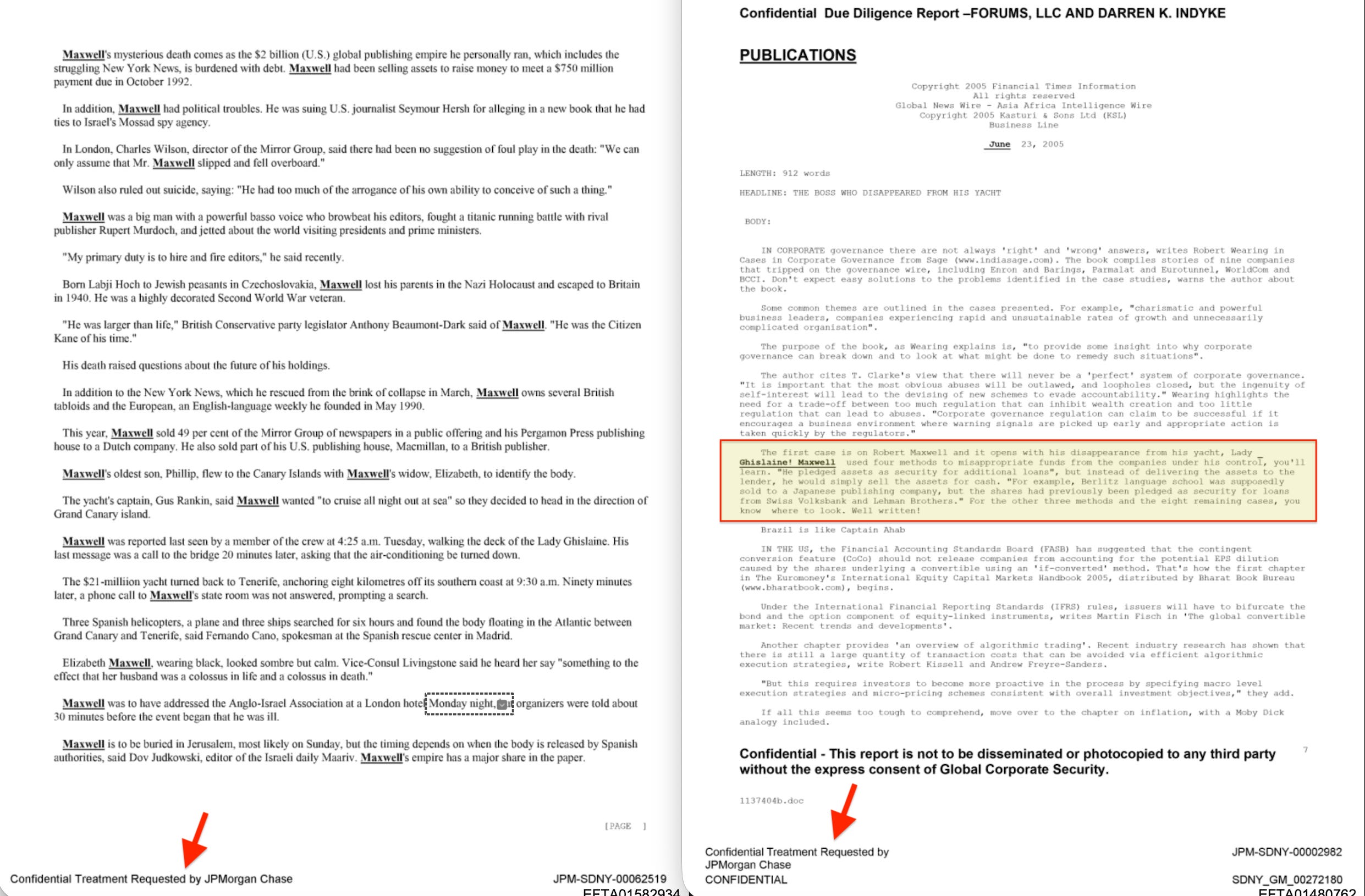
Those files contain a newspaper clipping of Robert Maxwell’s obituary from November 1991, stamped ‘Confidential Treatment Requested by JPMorgan Chase‘149. The bank was keeping track of the Maxwell connection from the start.
In 2005, the bank ran a background check on one of Epstein’s shell companies — a firm called Forums, LLC, managed by his personal lawyer Darren Indyke. The report included a case study about corporate fraud, and the lead example was Robert Maxwell, describing how he stole money and the circumstances of his death150.
In January 2009 — just months after Epstein’s Florida conviction — JPMorgan’s Global Security & Investigations unit ran a formal background check that investigated ‘116 East 65th St., LLC and Robert Maxwell‘ as a single inquiry151. 116 East 65th Street was Epstein’s Manhattan townhouse. The bank’s internal system automatically linked the results to ‘the account(s) titled ‘Ghislaine Maxwell’‘, which had already been flagged in earlier checks in 2003 and 2005. A newspaper article in the file from December 2000 noted that ‘Ghislaine Maxwell’s source of wealth is being classified as something of a mystery‘152.
The bank knew who Epstein was, who his associates were, and where the money came from — or rather, that no one could explain where it came from.
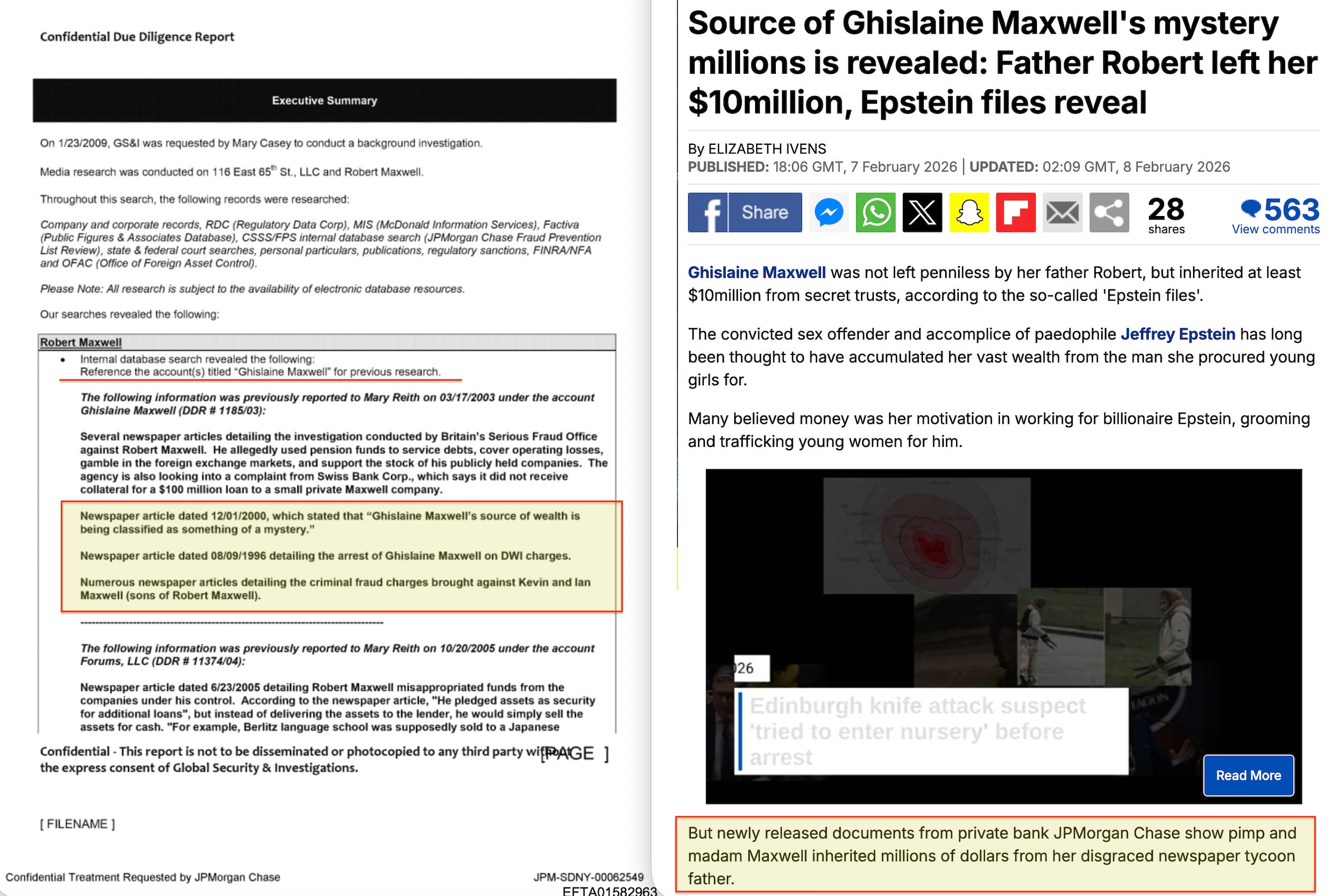
Ghislaine had been introduced to JPMorgan’s Private Bank by Jes Staley — who was then running the investment bank, and who later became CEO of Barclays before resigning over his own connections to Epstein153. When the bank opened her account, it filled a KYC file — ‘Know Your Customer’ — which is supposed to record where a client’s money comes from. Ghislaine’s file said her wealth came from inheritance: ‘We understand her wealth came from trusts her father Robert Maxwell left behind after he passed away‘154.
But Robert Maxwell’s estate was bankrupt. He had stolen hundreds of millions of pounds from his employees’ pension funds to cover his debts — and the bank’s own compliance files documented this. The KYC file also noted: ‘She does not work‘.
In April 2012 — six months after a JPMorgan banker had emailed Epstein about the Gates Foundation impact investing call — the bank ran yet another background check, this time to take on Ghislaine’s newly created ocean conservation charity, the Terra Mar Project155. The report documented the entire Maxwell fraud history all over again, flagged the unexplained wealth all over again, and the bank accepted her as a client all over again.
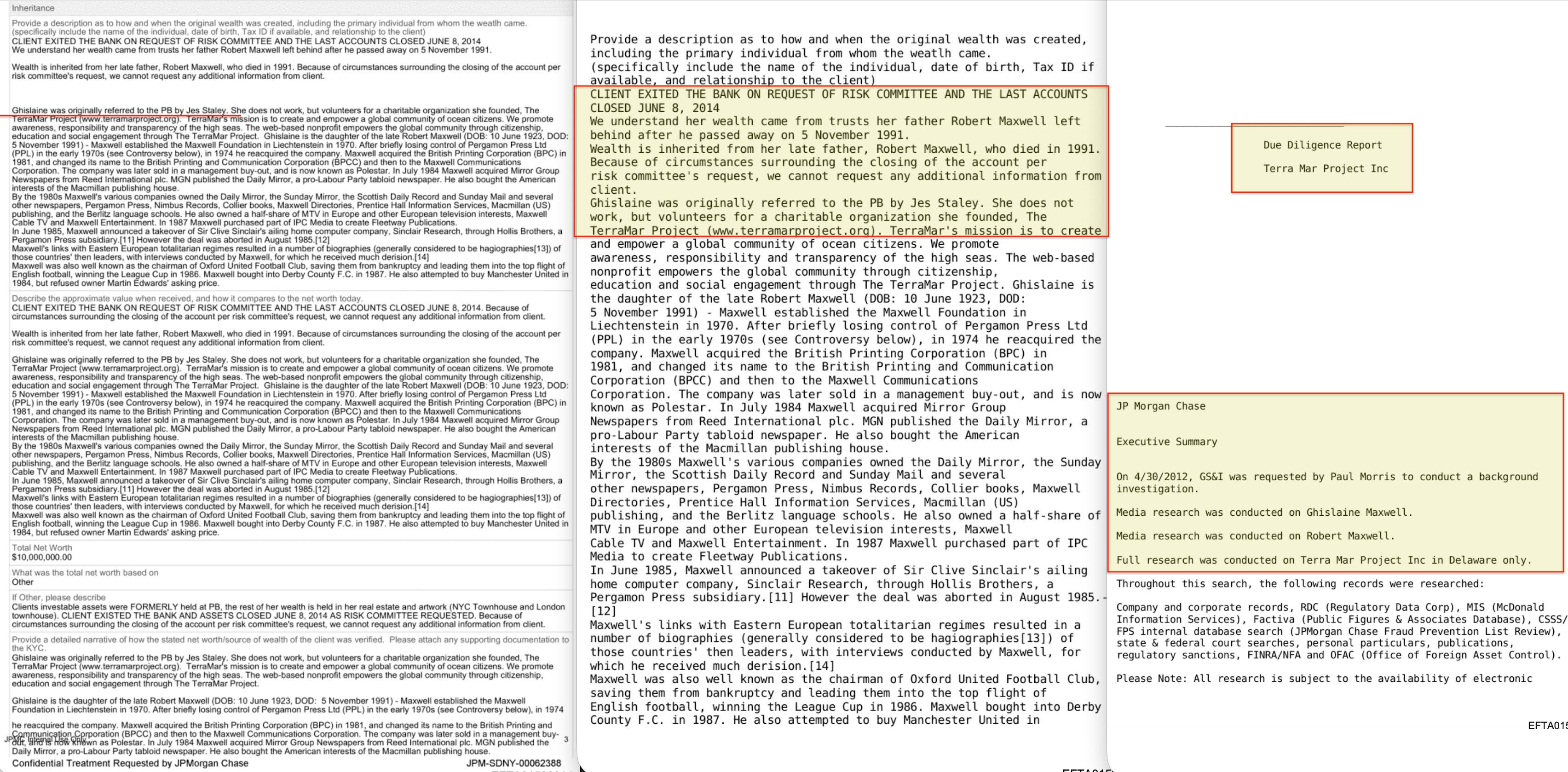
JPMorgan’s risk committee finally forced Ghislaine’s accounts to be closed in June 2014156. By that point, the bank’s compliance department had formally documented the connection between Epstein, Ghislaine, and Robert Maxwell on at least five separate occasions over thirteen years. Each time, the private banking division had carried on regardless.
The story gets more complicated at board level. James Crown was the president of Henry Crown and Company, a major Chicago investment firm157. His family had controlled the defence contractor General Dynamics since 1959. Crown sat on JPMorgan’s board from the early 1990s through the entire period that Epstein was a client158159.
According to the shareholder complaint filed in federal court in New York in 2023, Robert Maxwell had acted as the middleman in selling backdoored PROMIS software to American defence companies — ‘including General Dynamics‘, the Crown family’s own company160. The broader scandal around this software, known as the Inslaw affair161, has never been fully resolved. Multiple congressional investigations reached conflicting conclusions. But the allegation appears in a verified legal filing made under penalty of sanctions, which means the lawyers who wrote it were putting their professional standing behind it162. It draws a direct line between Maxwell’s intelligence work and the company whose owners sat on the board of JPMorgan.
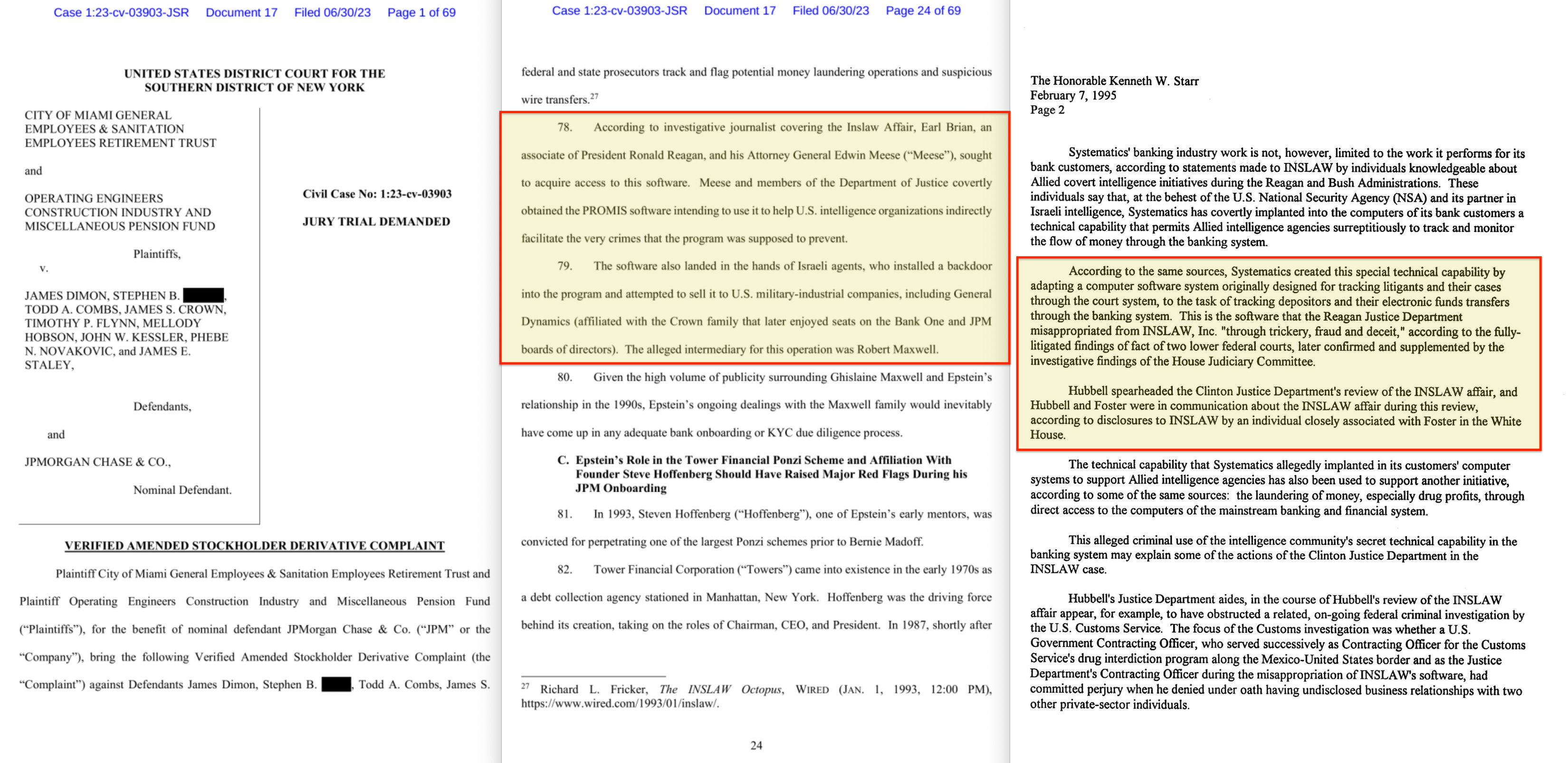
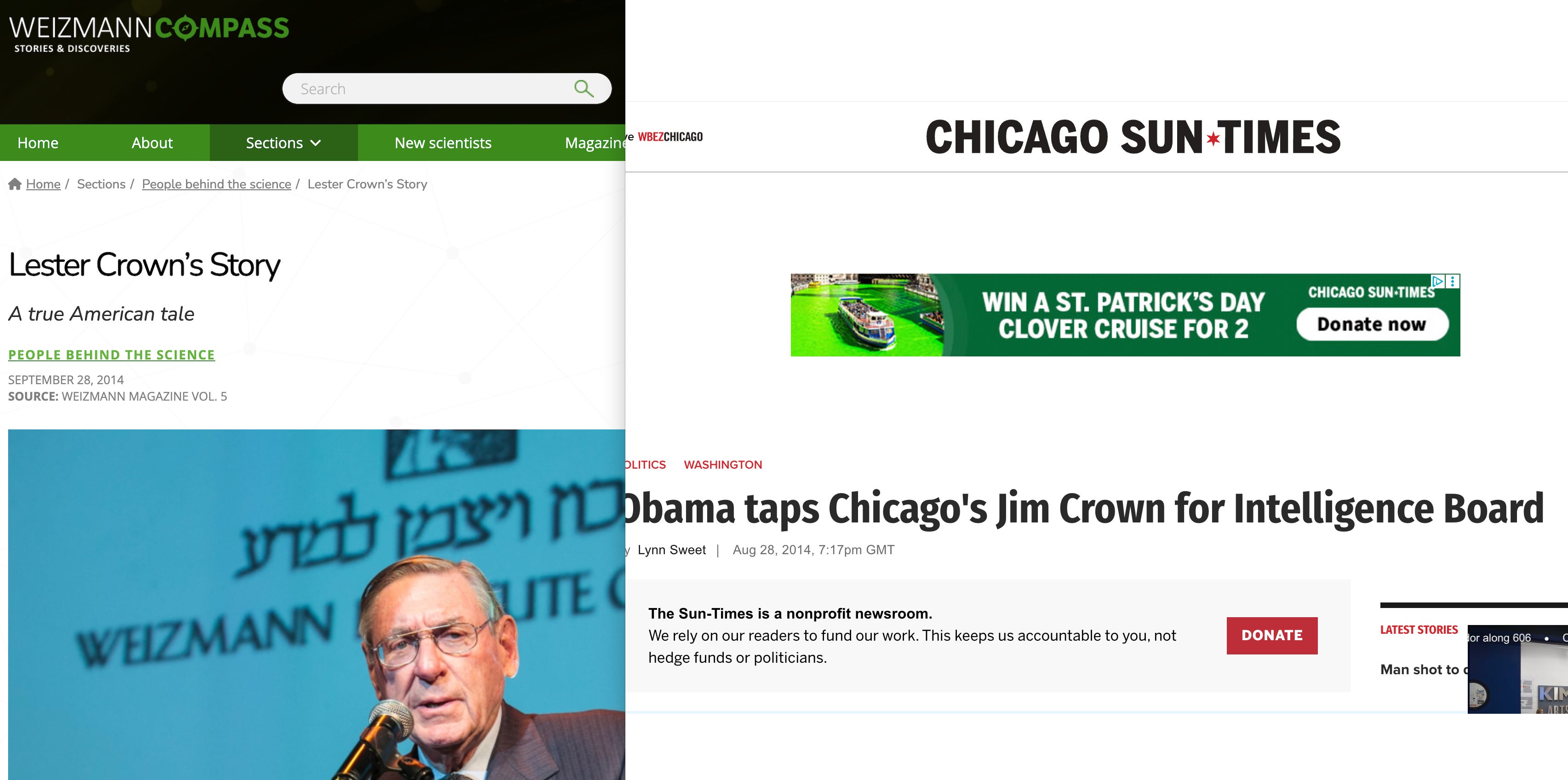
The complaint also identifies Phebe Novakovic — who succeeded Crown as CEO of General Dynamics — as a former CIA officer163 who had worked at the Department of Defense before joining the company and later joining JPMorgan’s board in 2020164. James Crown’s father, Lester Crown, was Deputy Chair of the Weizmann Institute of Science in Israel165 and sat on the Board of Governors of Tel Aviv University. James Crown himself was appointed to the President’s Intelligence Advisory Board by Barack Obama in 2014166.
To put it simply: the family that owned the defence company to which Maxwell allegedly sold spy software was also the family that oversaw risk management at the bank where Maxwell’s protégé operated for more than a decade.
Between 2009 and 2011 — after Epstein had already been convicted in Florida — he was arranging meetings for Jamie Dimon, the chief executive of JPMorgan, with Benjamin Netanyahu, Bill Gates, and Prince Andrew167. Epstein was setting up introductions between the head of America’s biggest bank and heads of state. The court complaint cites this to challenge Dimon’s later claim that he had little awareness of Epstein. It also shows that even after his conviction, Epstein was still doing what he had always done — acting as the connector between financial, political, and intelligence figures — at the very top of the bank.
Epstein's files also contained a working draft — with tracked changes still visible — of a speech Dimon gave to the Crown Prince of Bahrain and the Governor of the Central Bank of Bahrain on systemic risk and global financial regulation. JPMorgan produced the same document during litigation168 and requested confidential treatment169.
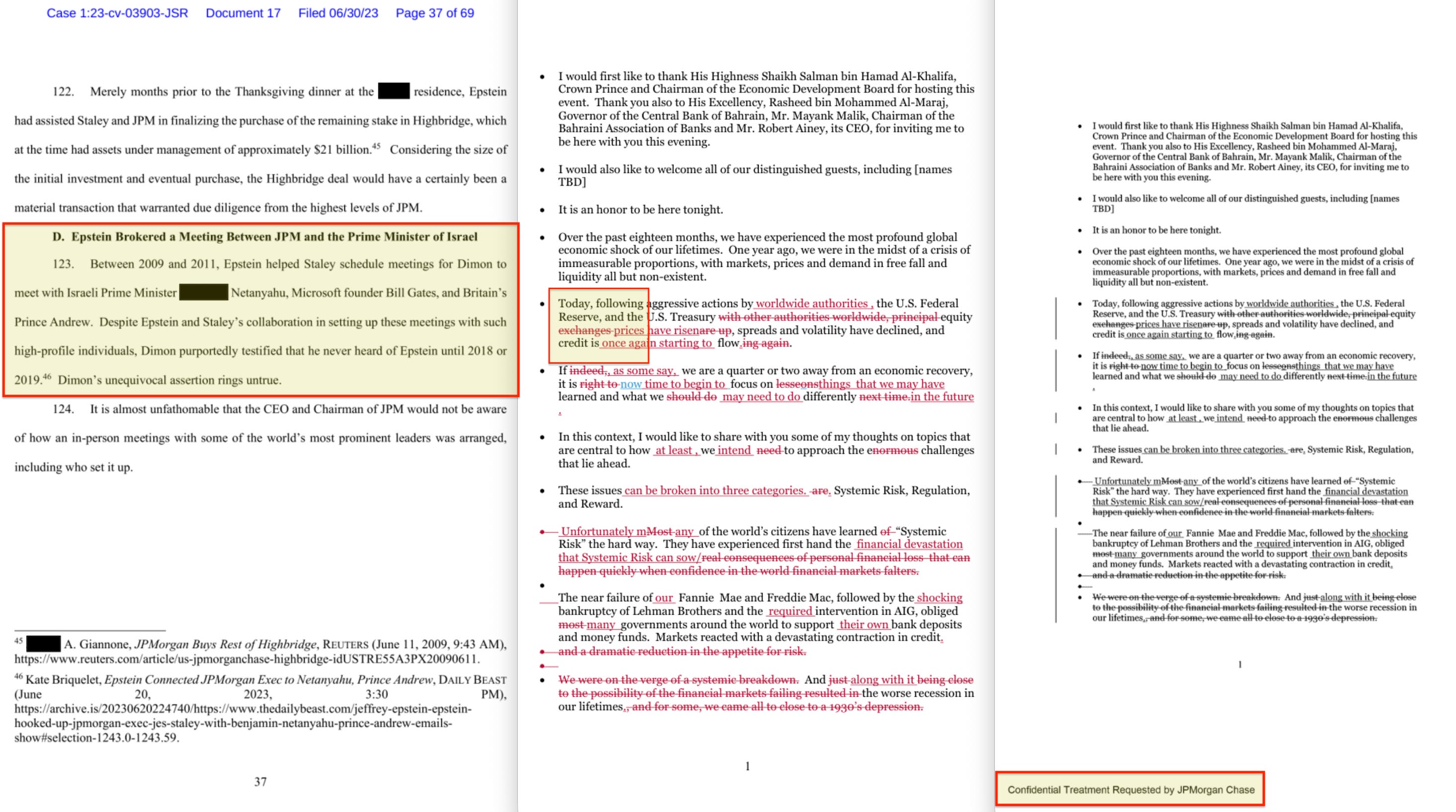
The bank’s own internal records show exactly how the decision to keep Epstein was made.
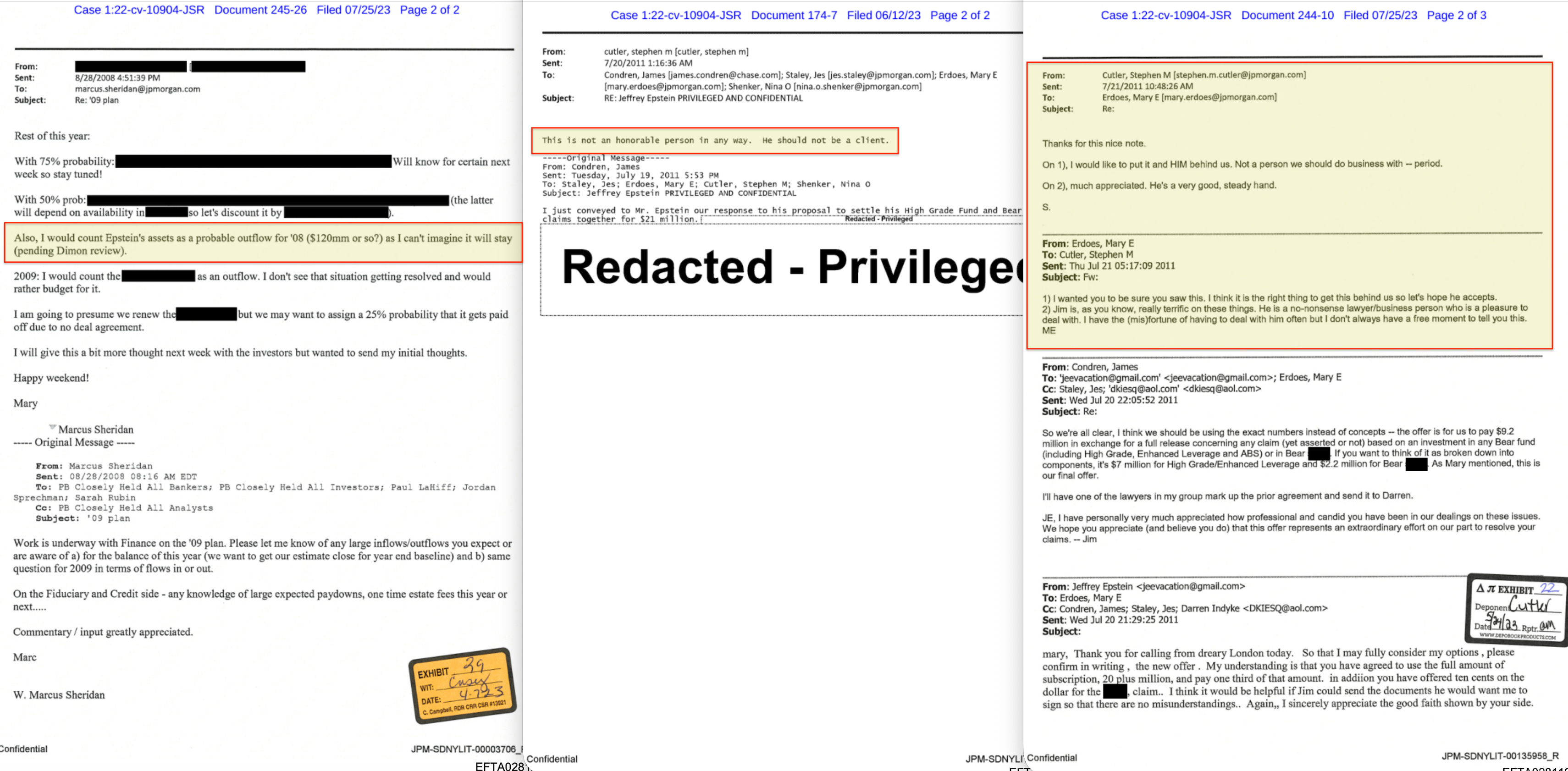
In August 2008 — the same month Epstein pleaded guilty — a JPMorgan employee wrote that she ‘would count Epstein’s assets as a probable outflow for ‘08 ($120mm or so?) as I can’t imagine it will stay (pending Dimon review)‘170. In plain language: she expected the bank to drop Epstein and his roughly $120 million, but she was waiting for Dimon to make the call. Either Dimon reviewed the situation and decided to keep Epstein, or the decision was made by someone else before it ever reached his desk. Either way, Epstein stayed.
In December 2010, the bank gave Epstein a new $50 million line of credit.
On 20 July 2011, the bank’s top lawyer — General Counsel Stephen Cutler — emailed Jes Staley and Mary Erdoes171: ‘This is not an honorable person in any way. He should not be a client‘. The very next day, Cutler emailed Erdoes again172: ‘Not a person we should do business with, period‘.
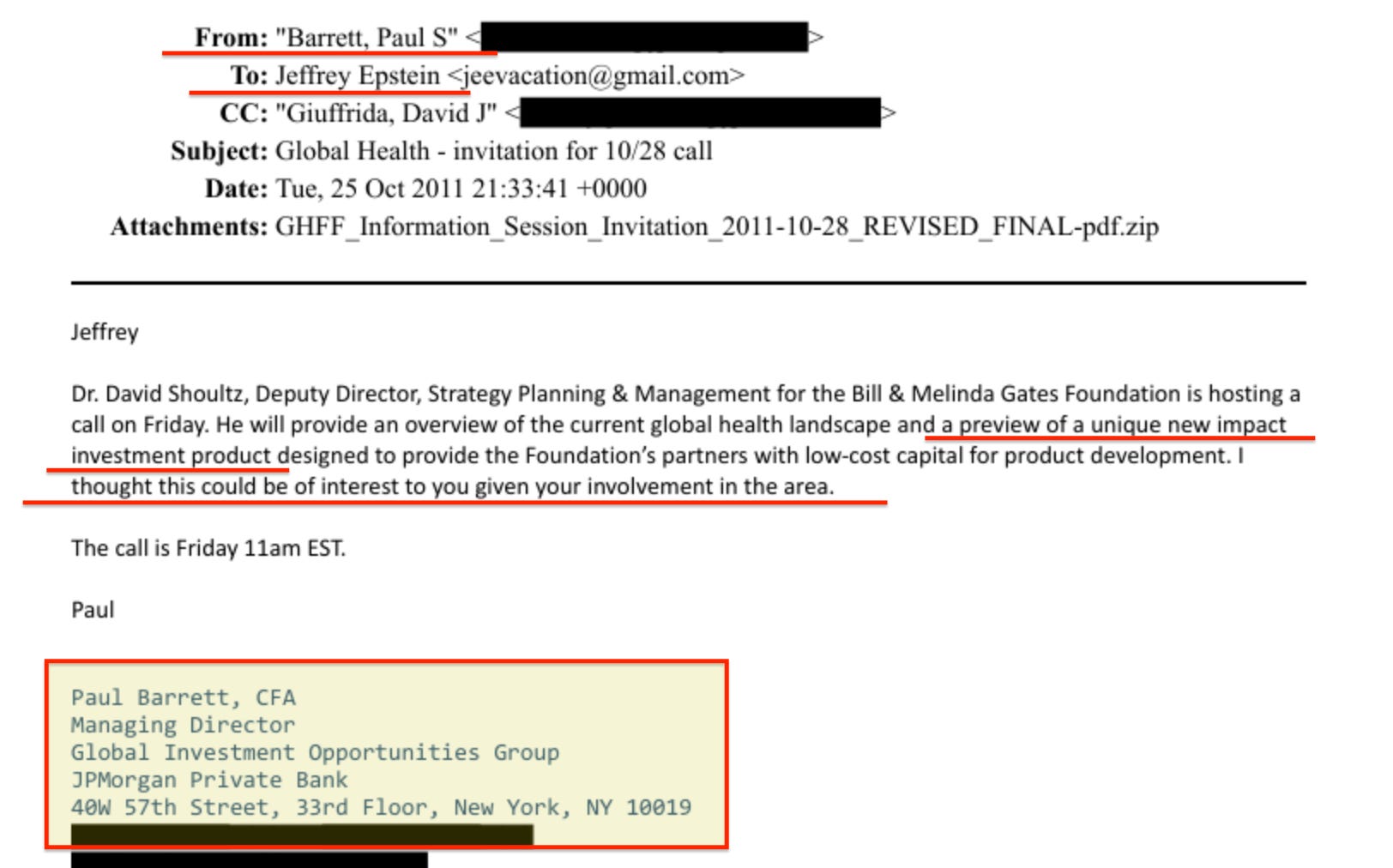
Three months after the bank’s top lawyer said Epstein should not be a client, on 25 October 2011, a banker named Paul Barrett in JPMorgan’s Private Bank sent Epstein an email inviting him to join a call with the Gates Foundation about impact investing173, noting that it ‘could be of interest to you given your involvement in the area’.
So here is what happened over three years.
In 2008, a senior employee expected Epstein to be dropped and flagged the decision for the CEO. He was not dropped.
In 2010, the bank gave him a new $50 million credit line.
In July 2011, the bank’s General Counsel wrote — twice, in writing — that Epstein should not be a client.
In October 2011, the private banking division invited him into a new investment partnership, noting his ‘involvement in the area’.
Throughout this entire period, JPMorgan never filed a single Suspicious Activity Report about Epstein174. Banks are legally required to file these reports — known as SARs — when they see transactions that look suspicious. JPMorgan’s own systems had flagged unusual cash withdrawals, wire transfers to identified victims, and payments routed through shell companies. But no report was ever sent to the authorities.
That meant the federal agencies responsible for tracking financial crime never received an official reason to investigate. The part of the bank responsible for following the rules, and the part of the bank responsible for making money, were operating on completely separate tracks inside the same institution.
VII. The Belmont Problem
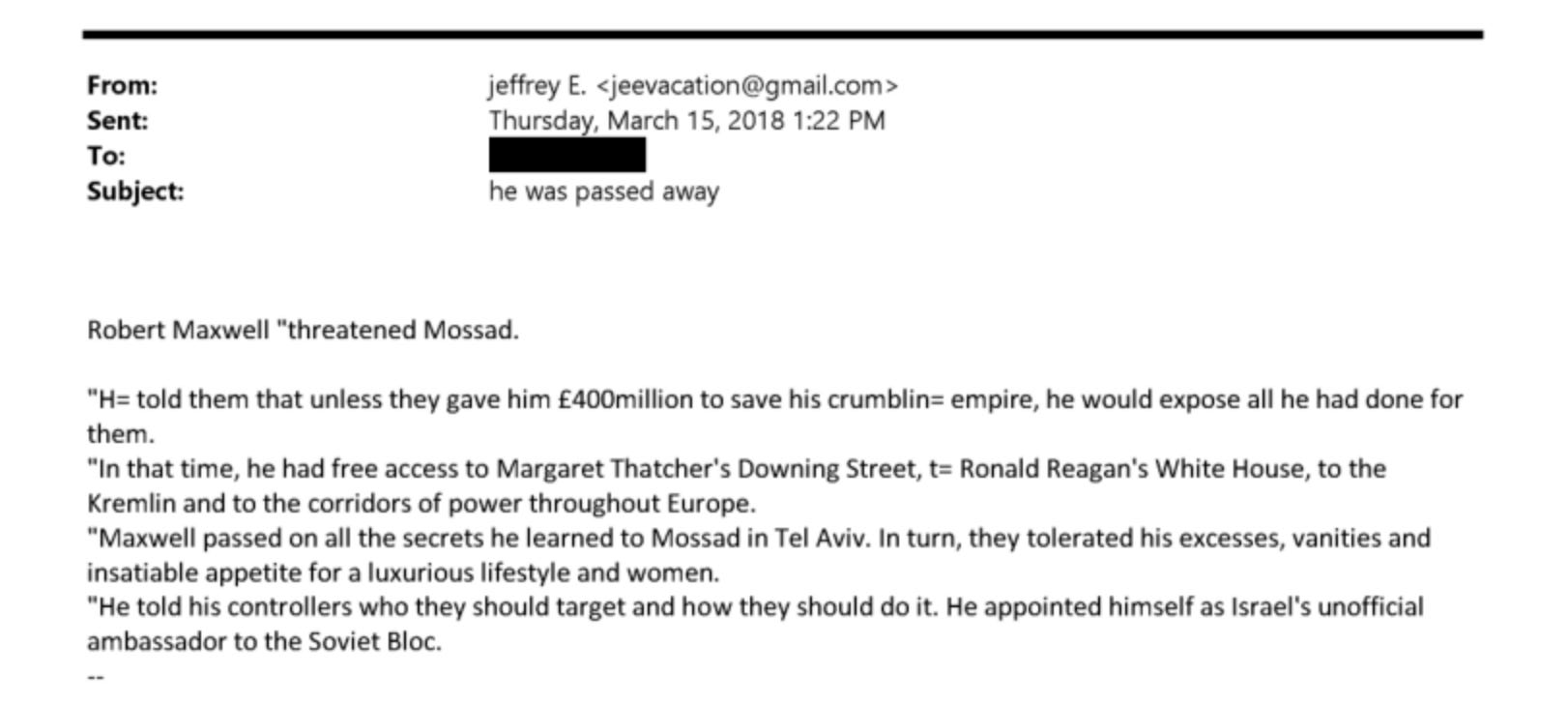
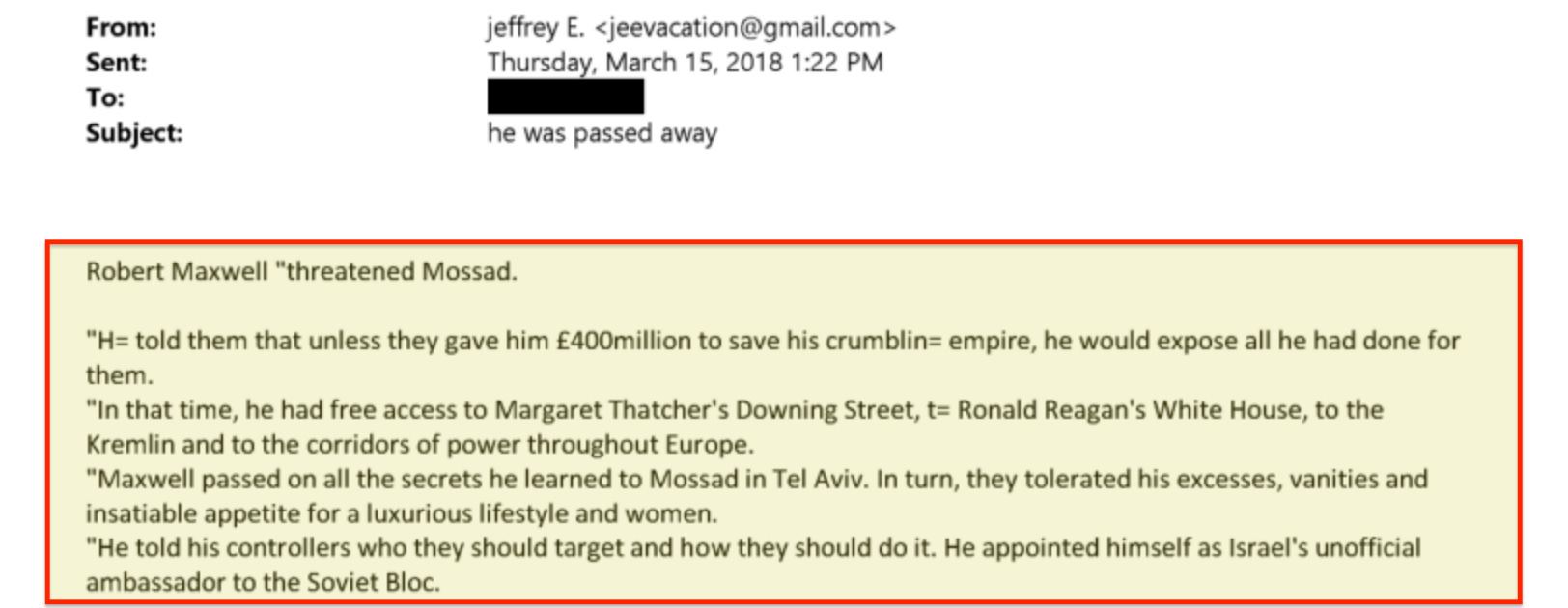
On 15 March 2018 — fifteen months before he was arrested — Epstein sent a passage about Robert Maxwell to someone whose name has been redacted from the files175. It read:
Maxwell passed on all the secrets he learned to Mossad in Tel Aviv. In turn, they tolerated his excesses, vanities and insatiable appetite for a luxurious lifestyle and women.
It continued:
He told his controllers who they should target and how they should do it. He appointed himself as Israel’s unofficial ambassador to the Soviet Bloc.
And then:
He told them that unless they gave him £400million to save his crumbling empire, he would expose all he had done for them. In that time, he had free access to Margaret Thatcher’s Downing Street, to Ronald Reagan’s White House, to the Kremlin and to the corridors of power throughout Europe.
Epstein, in other words, was reading about exactly the pattern that would later end his own life: an intelligence agent who knew too much and tried to use that knowledge as leverage176.
Rainer Liedtke found this same problem coming up again and again177. The most dangerous moment in any agent network is when the agent learns enough to threaten the people who sent him.
In 1837, a man named August Schönberg was sent to New York by the Rothschilds and later changed his name to August Belmont. Once in America, he declared himself the Rothschild representative on Wall Street — without permission. The distance between New York and London meant the family couldn’t control him, so they were forced to put up with it.
Liedtke considered Belmont the one major failure of the Rothschild agent system. The solution in the nineteenth century was exile: the agent was cut off from the network, but he was allowed to live.
Robert Maxwell followed the same pattern. Over decades of intelligence work, he had built up enormous personal knowledge — he knew every operation he had run, every channel he had used, every secret he had carried. When his business empire started to collapse, he used that knowledge as a weapon, demanding that his Israeli handlers bail him out.
In the nineteenth century, the answer to this problem was exile. But Epstein didn’t live in the nineteenth century.
On 29 July 2019, Epstein’s lawyers sat down with FBI agents and prosecutors from the Southern District of New York and raised the possibility that Epstein might cooperate178. If he had, he could have laid out everything: every introduction he had arranged between heads of state and bank executives, every instruction he had received from Ehud Barak and the Rothschild family, every piece of intelligence that had passed through him as the man sitting at the junction between Israeli military intelligence, Rothschild finance, and the Anglo-American establishment.
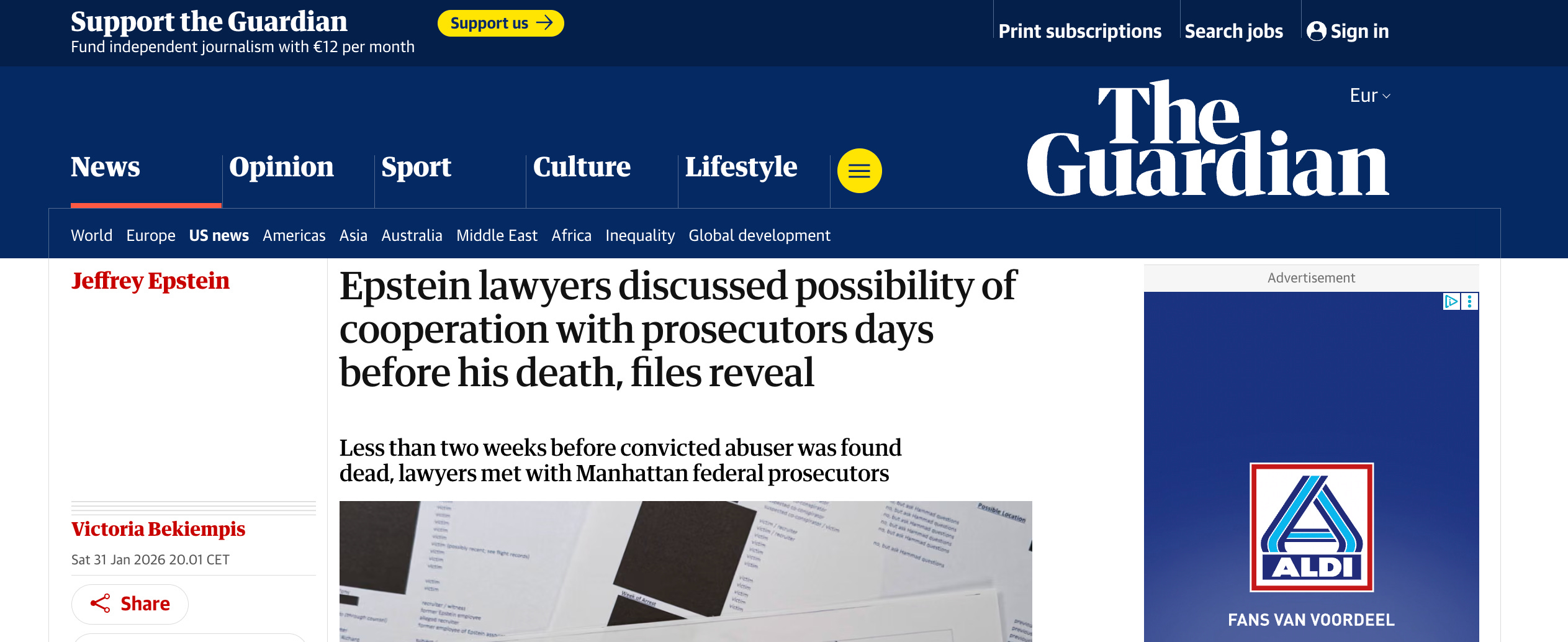
Most importantly, he could have named whoever had defined the goals that the whole system was being built to serve. He was the very person who had sat at that junction for thirty years.
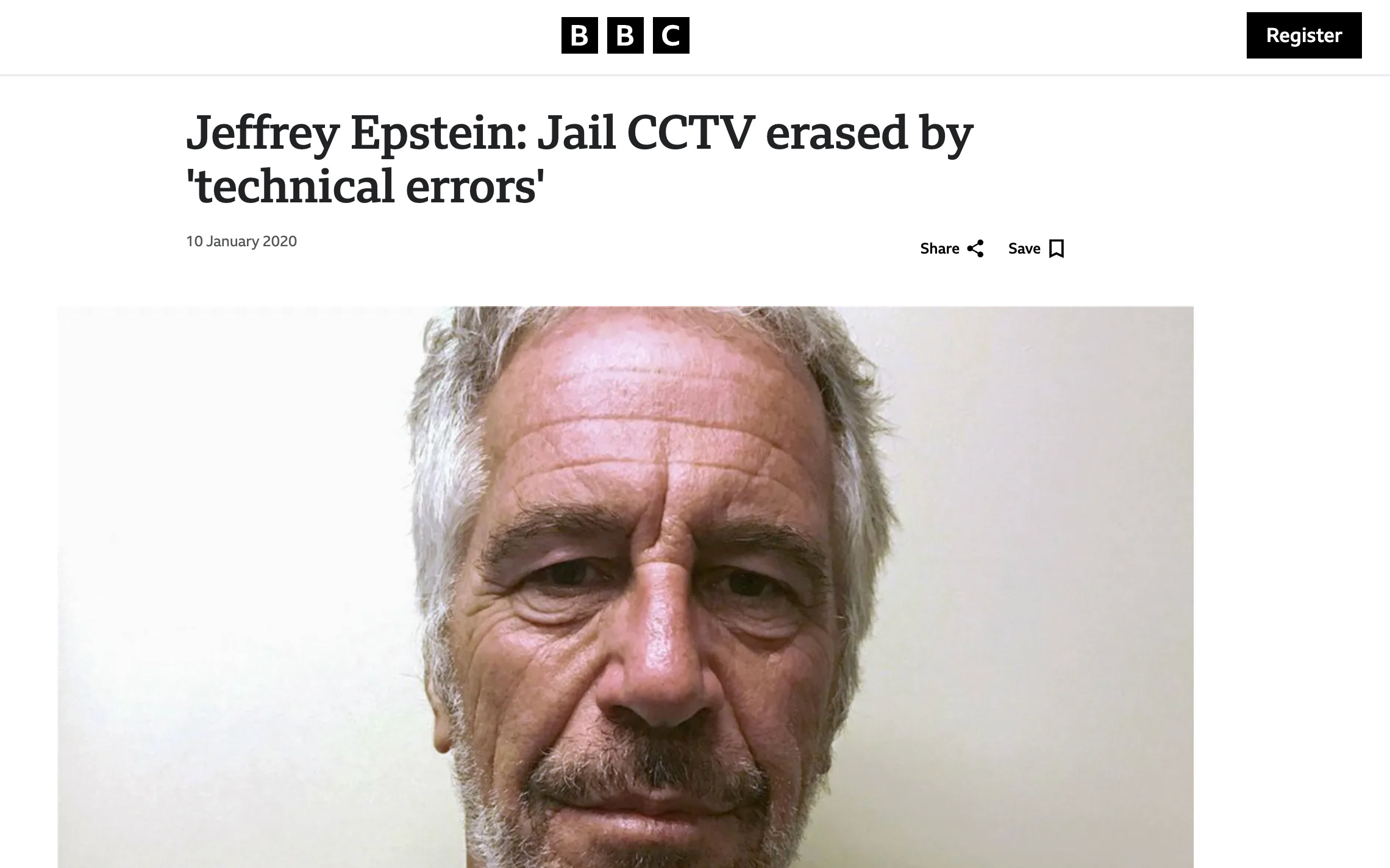
Twelve days later, as the official story goes, he was found dead in his cell at the Metropolitan Correctional Center in New York179. The security cameras had stopped working. The guards who were supposed to be watching him had fallen asleep.
But Epstein’s danger to the system was not merely that he could expose operations, as Maxwell had threatened to do. It was architectural. The system’s security depends on compartmentalisation — each specialist confined to their own field, none seeing the whole picture.
Epstein was the exception. He was the one person who moved between all the compartments: the publishing lineage, the research funding, the intelligence architecture, the banking relationships, the digital currency specifications, the institutional placements. A cooperating Epstein in a federal courtroom could have done what no specialist could — connected the fields.
Liedtke’s study ends in the nineteenth century. The pattern it describes does not.
VIII. The Wiring
By August 2019, every project Epstein had been connecting people to was up and running inside established institutions. He was no longer necessary, and now represented a risk.
The impact investing fund he had helped design with JPMorgan back in 2011 had been operating for seven years. It began when Paul Barrett, a banker in JPMorgan’s Private Bank, emailed Epstein directly on 25 October 2011 inviting him to a call run by the Bill and Melinda Gates Foundation. The call was about ‘a unique new impact investment product designed to provide the Foundation’s partners with low-cost capital for product development‘180.
This language and these ideas were circulating inside this network three years before the concept of ‘stranded assets’ entered mainstream financial discussion, and six years before the world’s central banks began coordinating around it.

Impact investing and stranded assets are two sides of the same coin.
Impact investing pulls money towards activities that are deemed good — green energy, public health, sustainable development. Stranded assets push money away from activities that are deemed bad — fossil fuels, polluting industries, anything labelled non-compliant.
The moment you create a system that labels something ‘green‘, everything not labelled green automatically becomes ‘brown‘. Epstein was involved in both sides. The impact investing prototype attracted money towards approved goals. The digital currency system he proposed to Lawrence Summers in 2016 — with its built-in tracking, traceability, and programmable rules — provided the tool that could automatically withdraw money from everything else.
The type of digital currency Epstein had described to Summers was already being developed. The BIS Innovation Hub — a technology arm of the Bank for International Settlements, the central bank for the world’s central banks — was established in 2019, the same year Epstein died.

The researchers Epstein had funded were working on exactly the technologies such a currency would need.
Ben Goertzel was building artificial general intelligence.
Joscha Bach was working on AI systems rooted in the same cybernetic tradition Maxwell had published through Pergamon.
Madars Virza was developing zero-knowledge proofs — a cryptographic method that lets a system verify that a rule has been followed without revealing the underlying data.
Joi Ito, director of MIT's Media Lab, used Epstein's funding to establish the Digital Currency Initiative181 — which hired Bitcoin's core developers and built Project Hamilton, a central bank digital currency prototype, with the Federal Reserve Bank of Boston.
Madars Virza co-authored the Hamilton transaction processor. The project concluded in December 2022 — six months before the BIS published the unified ledger
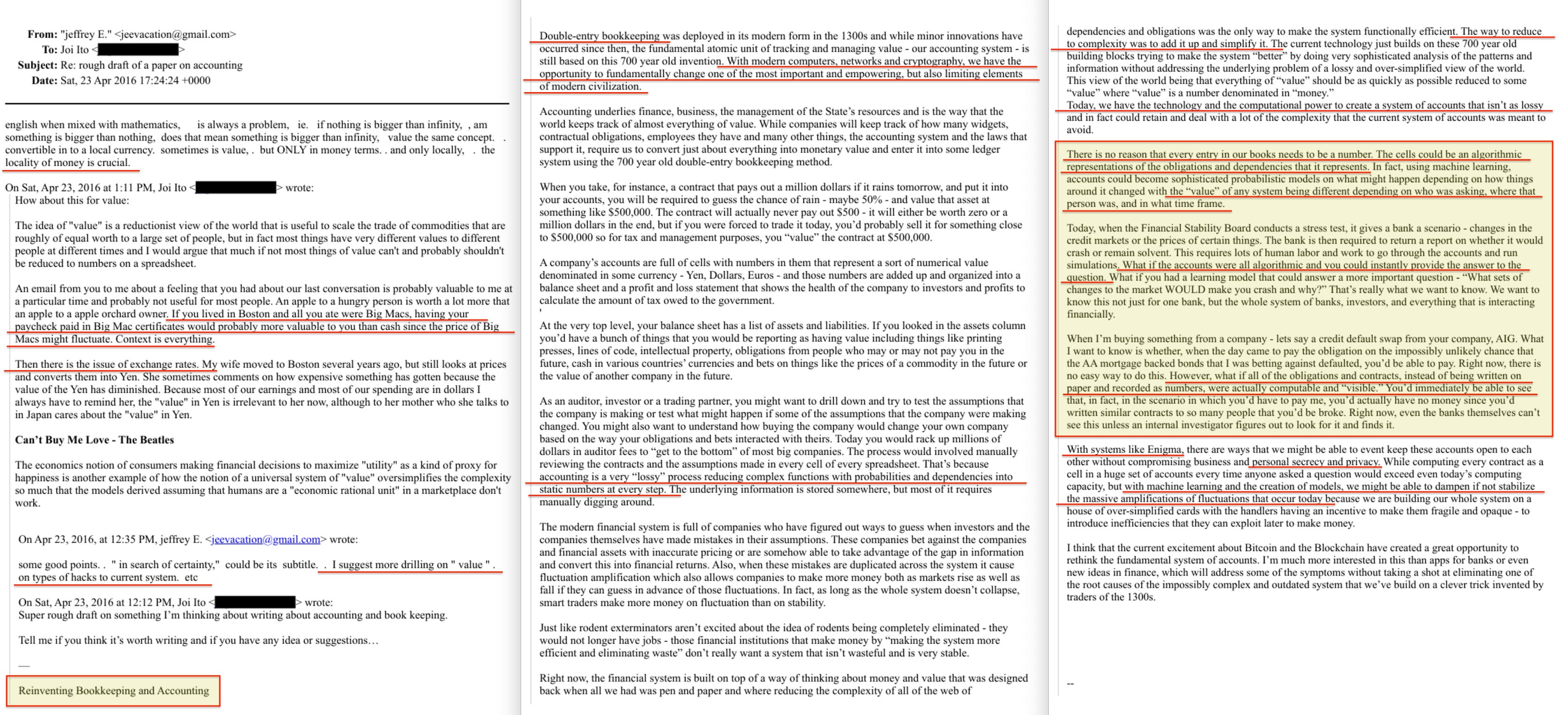
In April 2016, Ito had sent Epstein a paper proposing to replace the global accounting system with algorithmically governed ledgers where value becomes conditional and every contract executes as code182. Epstein edited the draft183.
The architecture Ito described in 2016 was being prototyped at the institution Epstein’s money built (Digital Currency Initiative), using cryptography Epstein’s money funded (Virza), by a central bank within the BIS network (FRB of Boston), half a year before the BIS announced the unified ledger to the world184.
Put them together and you have the components of a currency that can check whether a transaction complies with a set of rules automatically: AI to sort and classify, a rulebook to define what counts as acceptable, and programmable money to enforce the decision.
People who had been in Epstein’s circle were now in positions of institutional power. Melanie Walker was at the World Bank. Kathryn Ruemmler was heading to Goldman Sachs. Gary Gensler was running the Securities and Exchange Commission, where he launched the most aggressive US regulatory campaign against private cryptocurrency.
The policy pipeline was equally well established.
Beginning in 2014, a series of forums on ‘stranded assets’ had been hosted at Waddesdon Manor — a Rothschild family estate. The work from those forums fed into the Task Force on Climate-related Financial Disclosures, or TCFD, which was chaired by Michael Bloomberg. The TCFD’s recommendations then fed into the Network for Greening the Financial System, or NGFS — a group of 134 central banks and financial regulators — which used the findings to set new capital requirements through the BIS under rules known as Basel 3.1.


In December 2025, the NGFS announced that it was creating a scientific advisory committee to check the climate scenarios on which those capital requirements are based. It did not publish who was on the committee or what rules it would follow.
The climate scenarios the committee is supposed to validate are produced by a group funded by Bloomberg Philanthropies and the ClimateWorks Foundation — the same organisations that had funded the TCFD disclosure framework that created the need for the scenarios in the first place.
The people who built the system that asks the questions also fund the system that provides the answers.

To be clear: no document in the Epstein files puts him directly inside the NGFS or the TCFD. He was not sitting in those meetings. But what the documents do show is that the people he was corresponding with were describing, in detail, the exact system that those institutions went on to build — programmable currency, AI-based classification, conditional rules for who gets capital and who doesn’t, and working prototypes for impact investing. And the people above Epstein — his principals — had direct access to the institutions that built it.
The emails from Bach and Brockman are revealing in this light. They are less like clues and more like acknowledgements — people openly discussing the continuation of a programme. The strongest evidence is the architecture itself.
What the NGFS and BIS have built is, at institutional scale, the same cybernetic governance system that Pergamon Press published the theory for, that Beer tried to build in Chile, and that Epstein’s funded researchers prototyped — from the AI classification systems to the cryptographic infrastructure to the transaction processor that preceded the unified ledger.

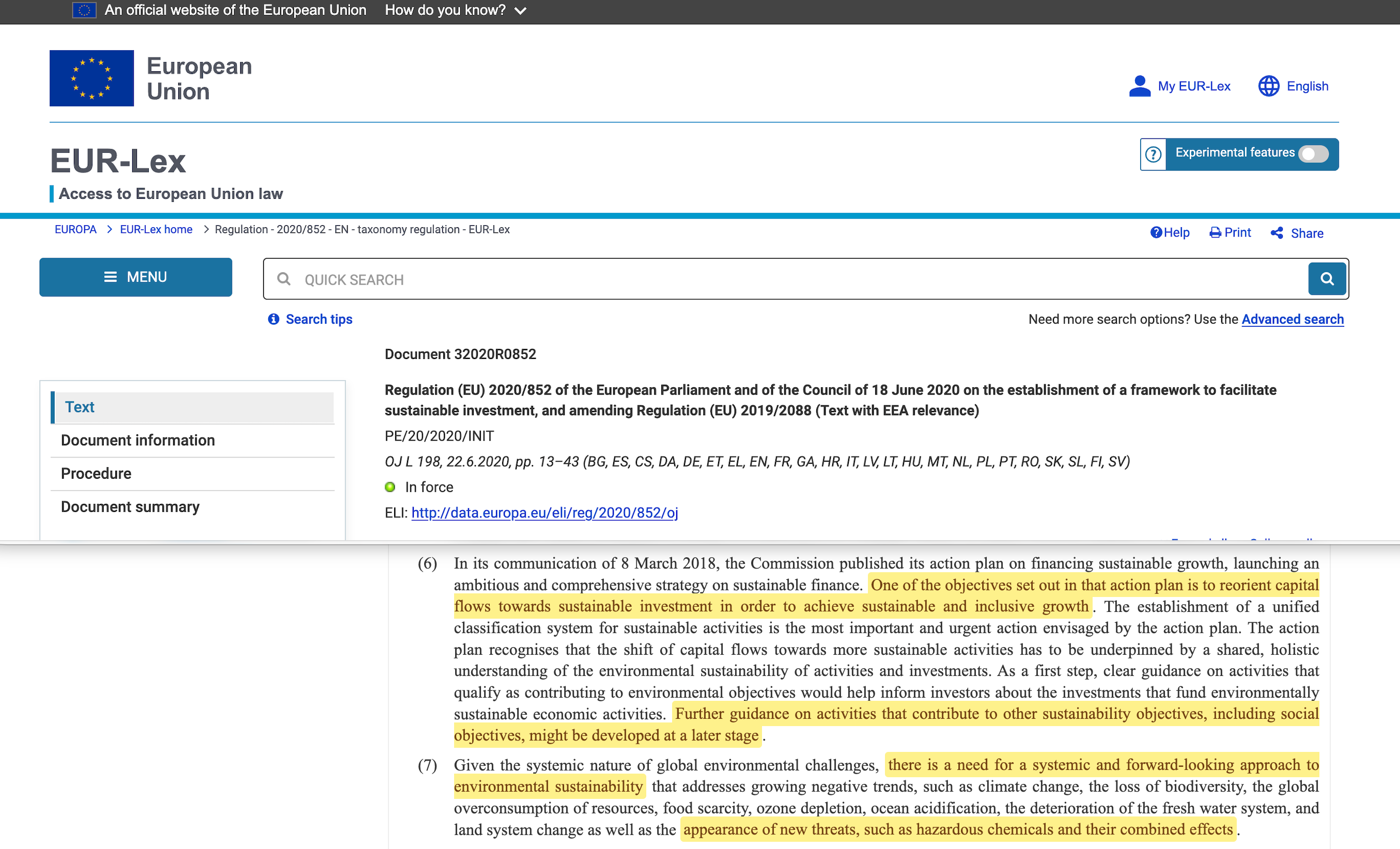
By the time of Epstein’s death, the classification rules were being written into European Union law185. The capital requirements based on those rules were changing the value of assets around the world. And the job Epstein had been doing — carrying ideas and specifications between the people who wrote the rules and the institutions that enforced them — was now being done by the institutions themselves.
The middleman was no longer needed because the organisations were now talking directly to each other.

To understand what happened, it helps to understand what a clearinghouse is. A clearinghouse is an institution that sits between two parties in a deal and decides whether the terms have been met. In its earliest form, it was a single banker at a table. In the 1870s, Bismarck’s banker Bleichröder handled German war reparations on one side while the Rothschild banking syndicate raised bonds on the other186. In 1930, the Bank for International Settlements was created to do this job formally. In 1988, the Basel Committee separated two functions that had been combined: setting the rules and clearing the transactions.
Now, the NGFS has moved the rule-setting function into opaque ‘black box’ computer models — models whose assumptions, weightings, and built-in judgments are not voted on by any parliament.


The digital currency that Epstein described to Summers — trackable, programmable, built to enforce rules automatically, and wrapped in the language of ‘transparent charity related stuff‘187 — is the final stage of that process. It puts the clearinghouse inside the money itself. Every transaction is checked for compliance at the moment it happens, automatically, with no banker and no meeting required.
At every stage of this history, the system has got bigger and harder to see. In the nineteenth century, a single banker sat at a table and controlled one deal between two governments. A programmable digital currency would control every transaction in an entire economy. Epstein operated at the point where the system was shifting from one to the other — from human middlemen to automated enforcement. He was the last human link in a chain that was being replaced by machines. His job was to carry the plans for impact investing, digital currency, AI research, and climate-based financial rules between the people designing them and the institutions that would put them into practice.
By August 2019, that job was done. The plans had been taken up by organisations that no longer needed a person to pass them along.
The system does not need a switchboard operator once the wiring is in the walls.
IX. The Architecture
The whole system needs just one thing to run: a definition of what counts as ‘good’. Right now, the NGFS models are built around climate risk. But the machinery doesn’t care what the goal is. Swap in a different objective — public health, protecting wildlife, reducing poverty, any of the seventeen UN Sustainable Development Goals — and the same system produces the same outputs: scenarios, classifications, rules about who gets capital and who doesn’t, and automatic enforcement.
Epstein’s emails contain the language for exactly this kind of input.
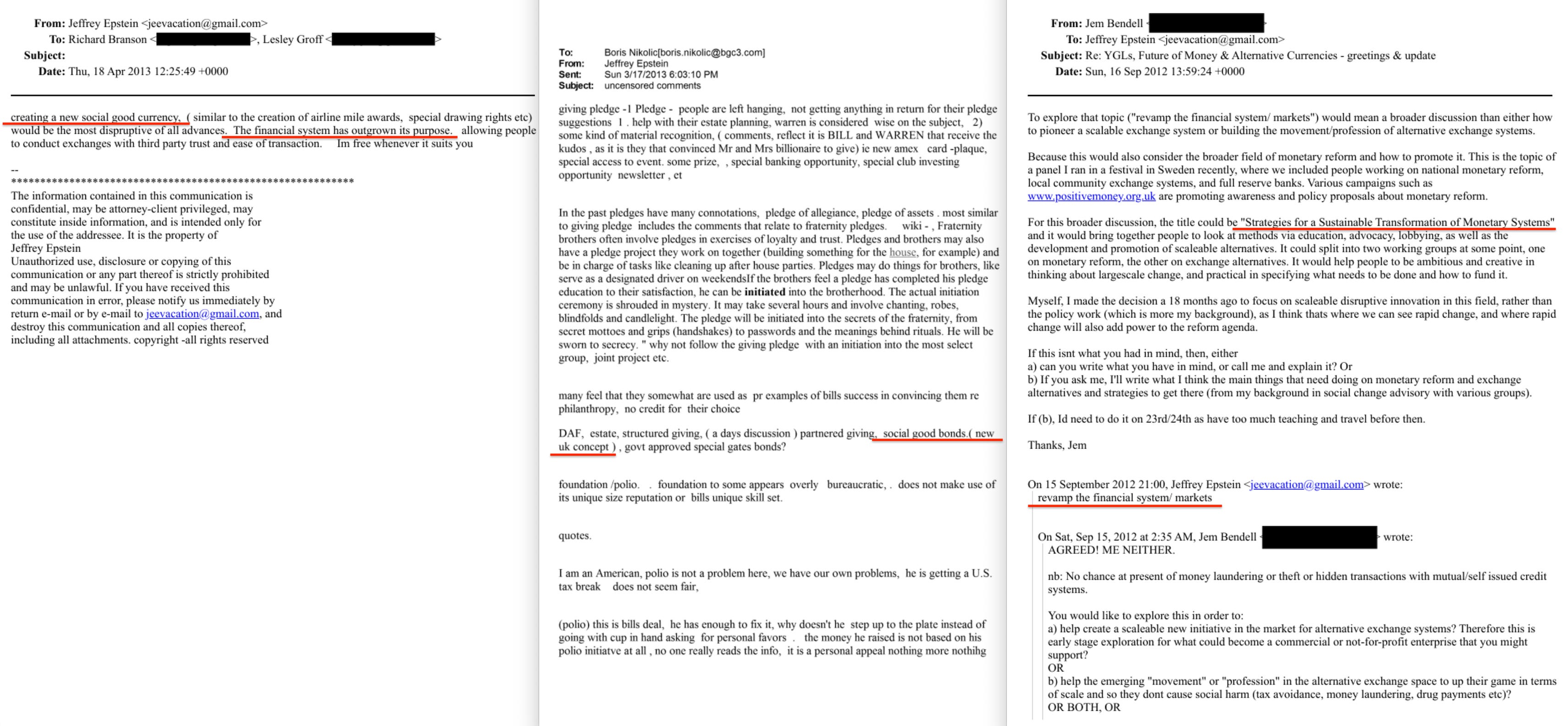
In his email to Summers, he called it ‘transparent charity related stuff‘188. In a pitch to Richard Branson, he used the phrase ‘social good currency‘189. Speaking to Boris Nikolic, he suggested ‘social good bonds’190 and a ‘charitable currency unit‘191.
He commissioned Jem Bendell to ‘revamp financial system/markets‘192 under Chatham House rules, meaning nothing discussed could be publicly attributed. The context? ‘Positive money’ and sustainable development193.

The Global Health Investment Fund — the project that came out of his work with JPMorgan and the Gates Foundation — was a working prototype. And Forester’s Council for Inclusive Capitalism with the Vatican was the institutional vehicle for embedding these goals into the way capital is allocated around the world.

Every one of these phrases points to the same thing: a target that the models are designed to aim for and that programmable money is designed to enforce. Whoever writes that definition — whoever decides what counts as a ‘social good’ — controls where money flows and where it is pulled away from. Because the moment a system labels one activity as compliant, everything not labelled automatically becomes non-compliant.
The moment one asset is declared green, its opposite is stranded.
In 1968, Buckminster Fuller popularised a phrase that has lasted ever since: ‘Spaceship Earth‘194. The idea is simple but radical. The planet is like a spaceship — it has limited resources, and those resources need to be managed by design, not left to the random decisions of billions of individual passengers.
This was systems theory applied to the whole world: treat the Earth as a single closed system, monitor it through feedback, and govern it through planning.

Stafford Beer tried to build a national version of this in Chile. The architecture documented in these essays — AI systems that classify activity, programmable money that enforces rules, capital allocated or withdrawn based on scenarios produced by committees with no public accountability — is Fuller’s Spaceship Earth made real, with money as the enforcement mechanism, and the definition of ‘social good‘ the steering wheel.
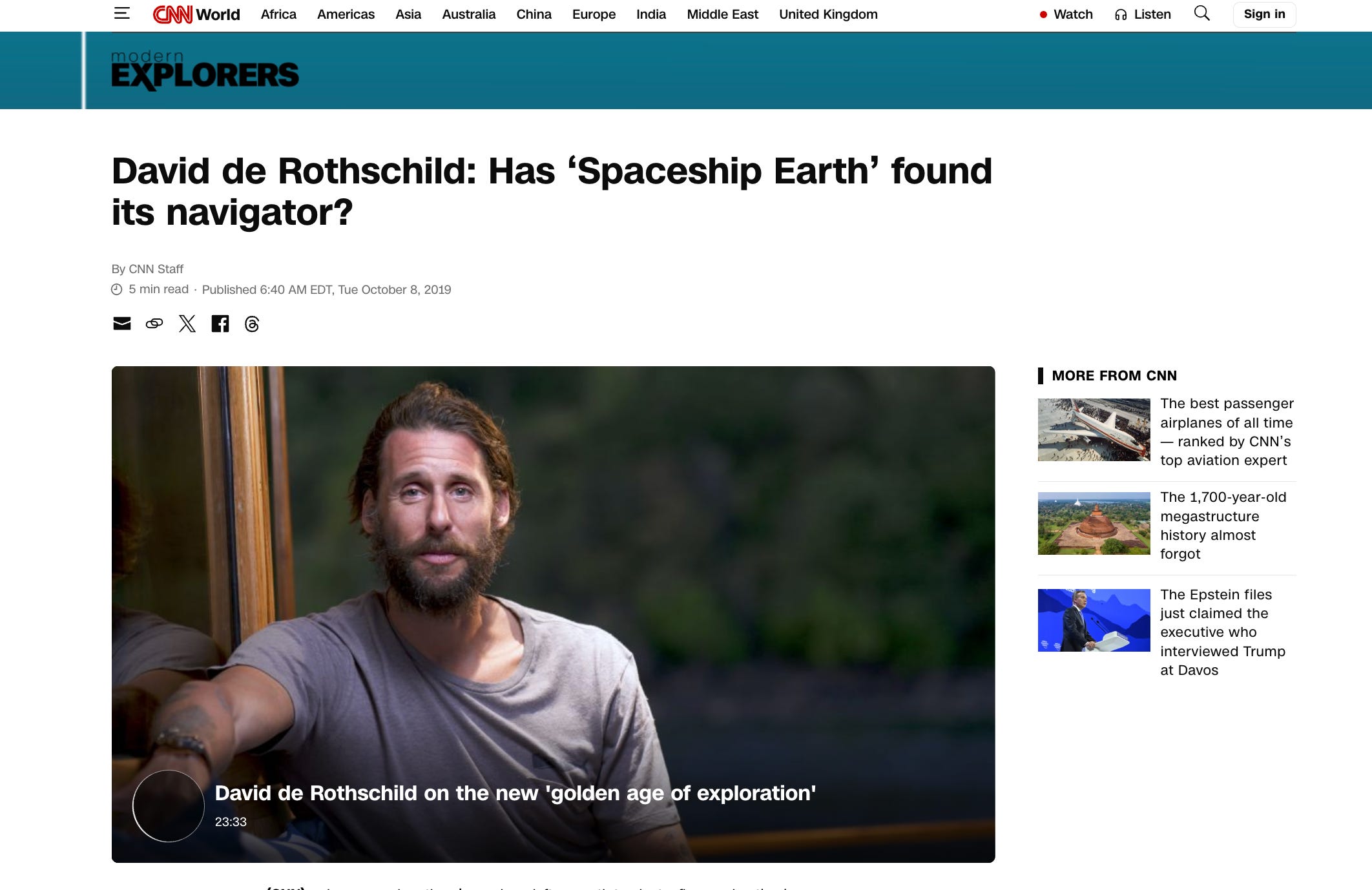
In 2019, David de Rothschild — Sir Evelyn’s son and Lynn Forester’s stepson — gave a CNN interview in which he used Fuller’s exact language, describing the planet as ‘this incredible spaceship that we live on called planet Earth‘ and calling for economic activity to be brought back under the management of natural systems195.
The CNN headline asked: ‘Has Spaceship Earth found its navigator?‘
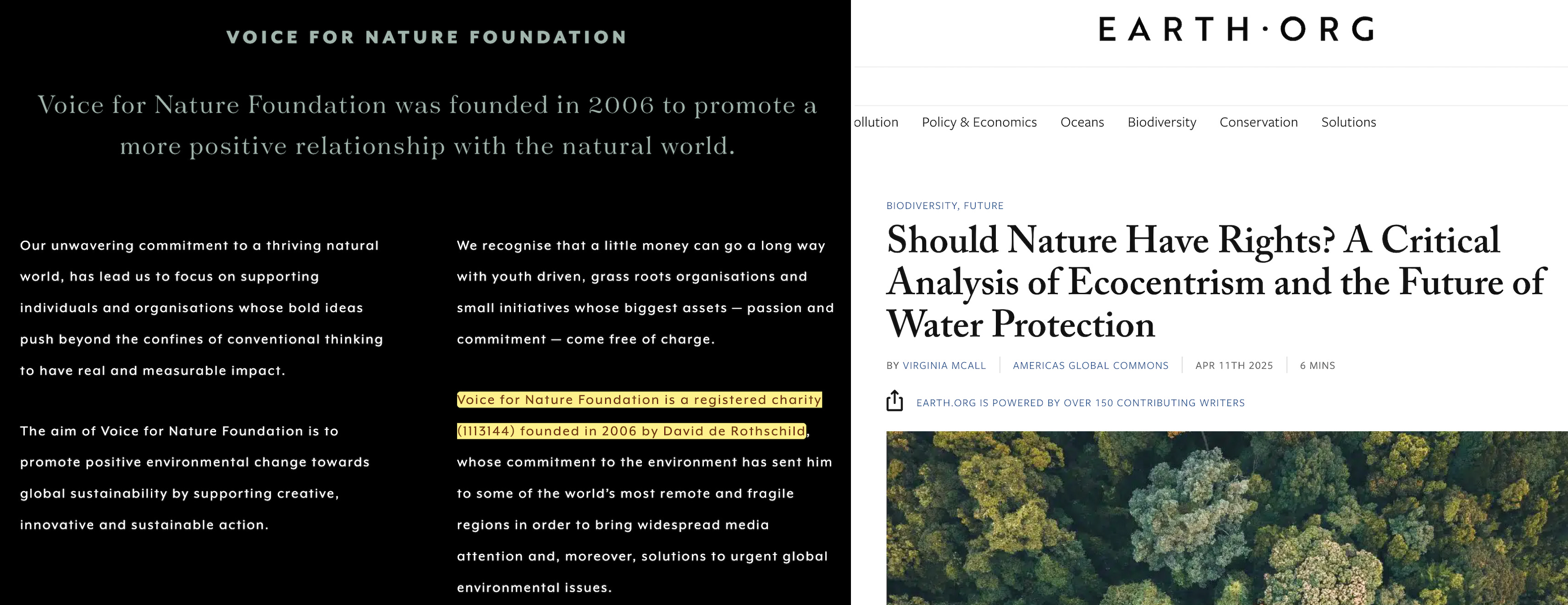
In 2006, David de Rothschild had founded an organisation called the Voice for Nature Foundation, whose stated purpose is to ‘give Nature a voice‘196. But nature does not speak. Someone has to interpret what nature ‘needs’ and feed that interpretation into the institutions that act on its behalf.
One of the foundation’s core pillars is ‘Legal Rights for Nature‘ — the idea that nature should have legal standing, the way a person or a company does197. But if nature has legal standing, someone has to speak for it in court and in government. Whoever that person is holds enormous power, because they are translating something no one can argue with — the protection of nature — into specific rules and standards that govern how money flows.
The ‘navigator of Spaceship Earth’ is thus also its self-appointed interpreter. He sits in both seats: at the helm deciding where the ship goes, and at the point where an ethic no one dares question becomes a standard no one can challenge.
The system has three layers. Each one matches a function in the cybernetic model that Maxwell published through Pergamon and that Beer tried to build in Chile.
The first layer is the cognitive layer — it defines what the world should look like. This is where the rules are written: what counts as acceptable and what doesn’t. In practice, this means the EU taxonomy that classifies economic activities as green or brown, the NGFS climate scenarios, the TCFD disclosure rules, and the outputs of the unnamed advisory committee. These are the standards. They define the system, and what objective it ought to serve.
The second layer is the evaluative layer — it measures what the world actually looks like. This layer takes in real-time data: corporate reports, transaction records, supply chain information, real-time satellite surveillance. It compares all of this against the standards set by the first layer and asks: does reality match the objective? The gap between what is and what ought is the problem to be solved. AI systems — the kind of technology that Goertzel, Bach, and Virza were building, now being used by central banks and government agencies — make this judgment automatically and continuously. This is the clearing: the system decides whether you pass or fail.
The third layer is the behavioural layer — it acts on the judgment. Programmable money either allows a transaction, restricts it, or blocks it, depending on what the second layer decided. Capital flows towards activities that meet the standard and away from those that don’t. Assets that fail are ‘stranded’ — their value drops because the system has decided they are non-compliant. This is the settlement: the gap between what is and what should be is closed automatically, through money.

The first layer can be understood as the model within which we operate. The second layer is the analysis of flows within. The third is the manipulation of those flows through understanding of the feedback loops. In other words, cognitive is general systems theory, evaluative is input-output analysis, and behavioural is cybernetics. The three topics Robert Maxwell’s Pergamon Press published.
The second and third layers are moving towards full automation — AI making judgments at machine speed, programmable money enforcing them without any human being involved in the decision. The only layer where a human being makes a choice is the first one: the definition of what the world ought to look like.
What all of this amounts to, in plain terms, is a transfer of power over the economy away from elected governments.
And that power is then redirected towards a ‘social good’ you weren’t allowed to vote on, translated into standards you couldn’t realistically challenge, judged by AI that does not accept democratic input, and executed through money refusing to clear transactions running counter to the ‘social good’ you didn’t vote on.

No parliament votes on the NGFS scenarios that determine how much capital banks must hold. No legislature sets the assumptions or weightings built into the models. No elected body appoints the unnamed scientific advisory committee that checks whether the scenarios are valid. The classification rules are written by technical organisations, adopted by regulators through internal processes rather than new laws, and enforced by programmable money that makes its decisions at the moment of each transaction — without needing a specific Act of Parliament for each one.
The power to decide where money goes — which is, in the end, the most important function of any government’s economic policy — has moved from elected institutions to a technical infrastructure run by bodies that do not publish who their members are or what rules they operate under.
This is not a collection of separate projects. It is a single system. The NGFS coordinates 134 central banks and financial regulators. The BIS provides the platform they operate on. The Basel 3.1 rules embed climate scenarios into the amount of capital every bank in the world must hold. The EU taxonomy provides the classification system that says which activities are acceptable and which are not. The TCFD and its successors provide the pipeline through which companies are forced to disclose their compliance. And programmable currency provides the enforcement at the level of the individual — the mechanism that automatically permits or blocks transactions based on the rules.
Each of these components is described by its creators as independent. But taken together, they form a single global system for controlling where money goes, built on feedback, classification, and automated control. It is the architecture that Fuller described and Beer prototyped — now running across national borders, without a treaty, and without a vote.
In November 2025, President Trump signed an executive order launching the Genesis Mission — described as the biggest mobilisation of federal scientific resources since the Apollo programme198. The order tells the Department of Energy to build a single AI platform, train it on government data, and use AI agents to tackle national problems. The list of problems it works on gets updated every year to reflect whatever the current administration wants to prioritise.


This is the same basic design: AI systems measure what is happening, compare it against targets set by the executive branch, adjust their approach, and repeat — all without Congress debating or voting on any of it. And it is being built by the political administration least likely to be accused of building a centralised control system.
That is the point. The system doesn’t care about political ideology. It doesn’t matter whether the person in charge is left-wing or right-wing. All it needs is for someone to translate an objective into standards.
The objectives themselves come from above, and they are always framed in terms no one can reasonably argue with. In practice, this means the United Nations Sustainable Development Goals — things like climate action, public health, protecting wildlife, and financial inclusion. These are objectives designed to sound unobjectionable.
Nobody stands up and says they are against clean air or reducing poverty. That is precisely their function: they provide moral cover.

But the real power does not lie in choosing these goals. The real power lies in translating them into specific technical standards.
Who decides what ‘climate action‘ actually means in practice — which activities get classified as green, which number goes into a scenario model, which weighting gets applied to a bank’s capital requirements? The ethic is the cover. The standard is the instrument.
The NGFS is the network that turns ethical goals into financial rules, and its Scientific Advisory Committee is the body that does the translating.
The NGFS’s first job was turning environmentalism into economics. It worked like a pipeline: climate science was turned into scenarios, scenarios were turned into risk weightings, risk weightings were turned into capital requirements for banks, and capital requirements changed the value of assets across the global economy, stranding assets such as coal plants through capital requirements which make them impossible to finance.
That pipeline is now running across 134 central banks.
Its second job is already underway: turning social goals into economics using the same pipeline.
The Coalition of Finance Ministers is working on what it calls a ‘Green and Just Transition‘199200, with the NGFS as a partner. This project is building a financing framework focused on the social side of economic change — things like ‘protecting jobs’ and ‘promoting gender equality’201.
Every time a new subject enters the first layer — the cognitive layer that defines what the world should look like — it becomes another set of rules that the second (evaluative) layer judges against and the third (behavioural) layer enforces through money. The system does not care what the subject is. It works the same way whether the goal is reducing carbon emissions, improving public health, or increasing gender equality. Once the pipeline exists for one of the UN’s seventeen Sustainable Development Goals, it can process all of them.
This is what ESG really means. Environmental, Social, and Governance are not just categories on a form. They are the channels through which ethical goals enter the machine and come out the other side as financial rules.
In practice, the moment an ethical goal enters the system, it stops being a moral idea and becomes a number. ‘Climate action‘ becomes a damage estimate in a spreadsheet. ‘Gender equality‘ becomes a ratio. ‘Financial inclusion‘ becomes a metric. The second layer of the system — the one that judges — compares numbers against numbers, not values against values. The third layer — the one that enforces — carries out calculations, not convictions.
The whole machine runs on statistics, not morality.

This is where the real power lies. The important question is not who chooses the ethical goals — those are agreed publicly and no one objects to them.
The important question is — who chooses which numbers represent those goals. Which estimate of climate damage? Which dataset? Which weighting? Which starting point? These are technical decisions, and they are made in private, by committees whose members are not named. And once those numbers are in the system, they are almost impossible to challenge — because to challenge a number you need access to the model it came from, and the model sits behind an advisory committee, and the advisory committee meets behind closed doors.
This is why Lynn Forester de Rothschild’s organisation — the Council for Inclusive Capitalism — is partnered with the Vatican, not with a parliament or a treaty body or any institution that gets its authority from voters.
The Vatican provides the moral authority. It gives the ethical goals their weight — nobody argues with the Pope about whether poverty is bad. The Council provides the machinery for turning those goals into financial standards. The system does not need a democratic vote to operate. It needs an ethical mandate and someone to do the translating.

The entire system’s control point comes down to one question: who turns the ethics that everyone agrees on into the specific numbers that the taxonomy encodes, that the scenarios are built on, that the AI checks against, and that the programmable money enforces?
In December 2025, the seat of that power became visible — or rather, its outline did. The NGFS announced the creation of a Scientific Advisory Committee. This is the body that checks the science before it goes into the models — deciding what counts as valid evidence, which damage estimates to use, and therefore which assumptions end up inside the capital requirements that affect the value of every asset in the global economy.
That same month, the most important academic paper behind the NGFS’s current set of scenarios — a study by Kotz and colleagues, which projected that climate change would reduce global income by nineteen per cent by 2050 — was retracted by the journal Nature202. The reason was that its results depended on a data error about Uzbekistan’s GDP. A mistake in a spreadsheet had helped determine how much capital every major bank in the world was required to hold. And there was no mechanism to go back and undo the damage. The scenarios kept running, with a note attached saying the underlying paper had been withdrawn. The capital requirements stayed in place.
The committee that will check the science for the next round of scenarios meets in private, and its members are not named. This is not an accident or an oversight. If the people doing the translating — turning science into financial rules — were publicly known, they could be questioned, challenged, and held to account.
The system works best when the ethical goals appear to flow straight into technical standards, as if no human judgment were involved at all.
X. The Template
The chain of operational connections documented in this essay runs from Maxwell through Epstein to the institutions that took over his function. But the pattern behind them — the design they all followed — is much older than any of the people involved.
In 1845, Moses Hess published a work called On the Essence of Money203. Hess was a hugely influential figure: he converted Friedrich Engels to communism and introduced Karl Marx to the study of social and economic problems. He would later become the founder of Labor Zionism204.
In his 1845 essay, Hess described money as ‘social blood‘ — the circulatory system of society, the thing that keeps the whole organism alive. The problem, Hess argued, was that under a system of self-interest, social blood gets ‘shed’ — drained away by individuals, flowing wherever private greed directs it rather than where society needs it. The answer was to reorganise society so that money flowed according to collective ethical goals instead of individual ones.


Seventeen years later, in Rome and Jerusalem (1862), Hess went further and laid out how this would actually work205. He described nations as organs within a single living organism, each one justified by an ‘ethical mission‘ — a specific function it performed for the benefit of the whole.

The system documented in these essays perform exactly this function.
The United States builds the AI.
The European Union builds the rulebook — the taxonomy.
Switzerland, through the Bank for International Settlements, provides the finance.
France provides the pipeline that feeds into it.
Israel provides the intelligence architecture.
The Vatican provides the moral authority.
Britain provides the governance philosophy — the Fabian method of reshaping society through expert-run institutions rather than democratic debate, internationalised and strategised through the RIIA.
Everything else — the AI, the taxonomy, the clearinghouse, the intelligence layer, the moral cover — is an implementation of that underlying philosophy.

Each nation is an organ with a job to do. And programmable currency is the social blood flowing through the organism — no longer shed, no longer flowing wherever individuals choose to send it, but directed, channelled to flow according to collective ethical goals. The taxonomy determines which organs receive the blood supply. A stranded asset is an organ that has been cut off.
The design is 180 years old. The technology to actually build it is new.
Hess provided the philosophy. A generation later, Theodor Herzl proved it could actually be built.
In Der Judenstaat206 published in 1896, Herzl made the political argument for why a Jewish homeland was necessary. In Altneuland207 — The Old New Land — published in 1902, he went much further and sketched out how such a society would actually run208209. His imagined state had identity systems that tracked who was a citizen and who was a member of the ‘New Society‘. It had a credentialing system based on talent. It gathered data through official registers and business records. Resources were allocated through central planning, and the rules were enforced through law and control of infrastructure.
If you read Altneuland not as a novel but as a blueprint, it describes a governance system built around a central clearinghouse: one body that controls all the flows, sets all the rules, and locks out anyone who refuses to comply.
What makes Herzl remarkable is that he then went out and built the institutions to match. Starting from nothing — no land, no army, no recognised authority — he created sovereign-level infrastructure piece by piece. The World Zionist Organization in 1897210. The Jewish Colonial Trust, the financial vehicle, in 1899211. The Jewish National Fund for land acquisition in 1901212. A congress system for governance. Diplomatic missions to the Ottoman Sultan, the German Kaiser, and the Pope. Each one was a component of a governance system that existed before the state it was designed to create.
The template needed three things: a financial vehicle, a network of diplomatic connections, and an ethical mission that made the whole project politically untouchable.
In 1908, Alexander Bogdanov published a novel called Red Star, set on Mars213. Bogdanov was no minor figure — he co-founded the Bolshevik party in 1903 and was Lenin’s main rival for its leadership214. His fictional Martian civilisation was governed through statistical bureaus, labour accounting, resource tracking, and collective management through what he called organisational science.

The remarkable thing is that Bogdanov, coming from the opposite end of the political spectrum to Herzl, arrived at the same basic design. Herzl’s New Society runs through registers and business records. Bogdanov’s Mars runs through an Institute of Statistics and constant system feedback. One was built on ethical nationalism. The other on revolutionary socialism. Different politics, same operating system.
The great ideological battles of the twentieth century — capitalism against communism, nationalism against internationalism — were really arguments about who gets to sit at the controls of the clearinghouse.
Nobody argued about whether a clearinghouse should exist at all.


This three-part template is the operating manual for what this essay has documented. Forester’s Council for Inclusive Capitalism with the Vatican is the ethical mission — inclusive, sustainable, and impossible to argue against. The BIS/NGFS pipeline is the financial vehicle — routing capital through scenarios, taxonomies, and programmable currency. The Epstein network was the diplomatic relay — carrying plans and specifications between the people who wrote the rules and the institutions that enforced them, protected by an intelligence operation and funded through the Rothschild banking line.
The result is governance without a state — or more precisely, governance that works through existing states without belonging to any of them, justified by an ethic that nobody can oppose without looking as though they are opposing ‘good’ itself.
This approach has a name. It is called functionalism215, and it was first set out in 1916 by Leonard Woolf — a Fabian — in a book called International Government216, written for the Fabian Research Department and used as a blueprint for the League of Nations. The idea is that you don't need a world government if you build enough international bodies, each handling a specific technical function — health, trade, finance — each run by experts rather than elected representatives.
Sovereignty is never formally surrendered. It just quietly withers.


The prototype was tested early. In the early 1960s, the World Congress for Freedom and Democracy217 attempted foundation-coordinated stakeholder governance — policy validated not through elections but through networks of approved participants. Kennedy blocked it.
After Dallas, it resumed. But not through the same channel. The direct Western path was closed. The same governance logic routed through the developing world instead.


The Group of 77 was established in 1964218. UNCTAD provided the institutional platform219. The New International Economic Order provided the political language220. The IFDA Third System provided the civil society coordination layer. Maurice Strong bridged the eras — Stockholm 1972, UNEP, Rio 1992, Agenda 21. The framing changed from ‘freedom and democracy’ to ‘development and sustainability’, but the fundamental architecture remained unchanged.
Foundation-funded networks validating policy through stakeholder frameworks, outside electoral legitimacy.


Meanwhile, McNamara’s programmes at the World Bank created the debt dependency that made the routing possible. Nations needing loans accepted institutional reforms embedding the stakeholder model. Track One created the conditions. The G77 pathway created the governance framework.
The seventeen Sustainable Development Goals are where both tracks converge — objectives no one votes on, translated into indicators determining financing flows, validated by multistakeholder partnerships rather than democratic mandates.
SDG 17 is explicit about tripartite partnerships, including a ‘social good’ defining civil society organisation. A model fused into the United Nations by Kofi Annan.


Two separate histories come together at this point.
The first is a history of ideas and institutions. It runs from Hess, who described money as social blood, to Herzl, who built the institutional template, through a chain of legal theorists and institution-builders — Hermann Cohen, Franz Oppenheim, Walther Schücking, the Grotius Society, Andrew Carnegie’s peace foundations, Leonard Woolf and Alfred Zimmern — and arrives at the League of Nations, later the United Nations, and the Bank for International Settlements.
This is the lineage that built governance-as-clearinghouse: the idea that sovereignty can be managed through international law, through specialised agencies, and through conditional recognition — where a state’s right to participate depends on whether it follows the rules.


The second is a history of technology and operations. It runs from Bogdanov’s Tektology221 — his attempt at a universal science of organisation — through Norbert Wiener’s cybernetics, through Beer’s management cybernetics and his Chilean experiment, through Maxwell’s distribution of these ideas via Pergamon, through Epstein’s funded research portfolio, and into the current BIS implementation.
This is the lineage that built cybernetics-as-governance: the idea that you can control a system through feedback, classification, and automated enforcement.
These two histories meet at the Bank for International Settlements, because that is where the clearinghouse model and the cybernetic model become the same thing. The NGFS scenarios classify. AI evaluates. Programmable money enforces.
The ethical objective that enters the first layer — the definition of what the world should look like — determines what the entire system allows and what it blocks. At least in principle, anyway, because whoever translates that ethic into a standard is quietly in charge.

The first attempt to build the rule-setting layer on a global scale was the Club of Rome — the same organisation whose reports Maxwell published through Pergamon. In 1972, the Club published Limits to Growth, a hugely influential report that took scientific data about the planet’s resources, fed it into computer models, and turned it into policy recommendations. It was presented as science, but what it actually did was translate environmental concerns into rules for how governments and economies should behave. It was a prototype.
The NGFS scenarios are its direct successor. They do the same thing — translate environmental modelling into governance rules — but through a much more powerful channel. Instead of publishing a report and hoping governments listen, the NGFS feeds its scenarios directly into the central banking system.
The output is a capital requirement that changes how much money every bank in the world must hold, and therefore directly influences what every asset in the world is worth.
The destination was reached from two directions, just as Herzl and Bogdanov arrived at the same operating system from opposite political positions. The system does not need its operators to agree on why it should exist. It only needs someone to set the goal.
In August 2009, one month after leaving a Florida jail, Epstein wrote to his literary agent John Brockman laying out the programme in plain language222. He listed seven research topics he intended to fully fund over the coming year. They included ‘Synthetic General Intelligence’ — encompassing machine learning, signal processing, and new programming architecture. They included ‘Evolutionary Code Dynamics’ — encompassing cryptography, game theory, and genetics. They included a ‘Conference on Power’ — its definition across political, financial, intellectual, and physical domains, including ‘reputation, awe, trust, deception, reciprocity — how it is used, why it is sought, group selection and behavior’. And they included a direct question about whether the world financial system was archaic — whether the internet could be used to replace it with a new model, and what money actually is.
Two years later — as Nikolic texted him live from Sarkozy’s plenary at Davos on currency reform223224 — Epstein replied: ‘currencies are analog, and we live in a digital world. Value, exchange, should be modernized’225.
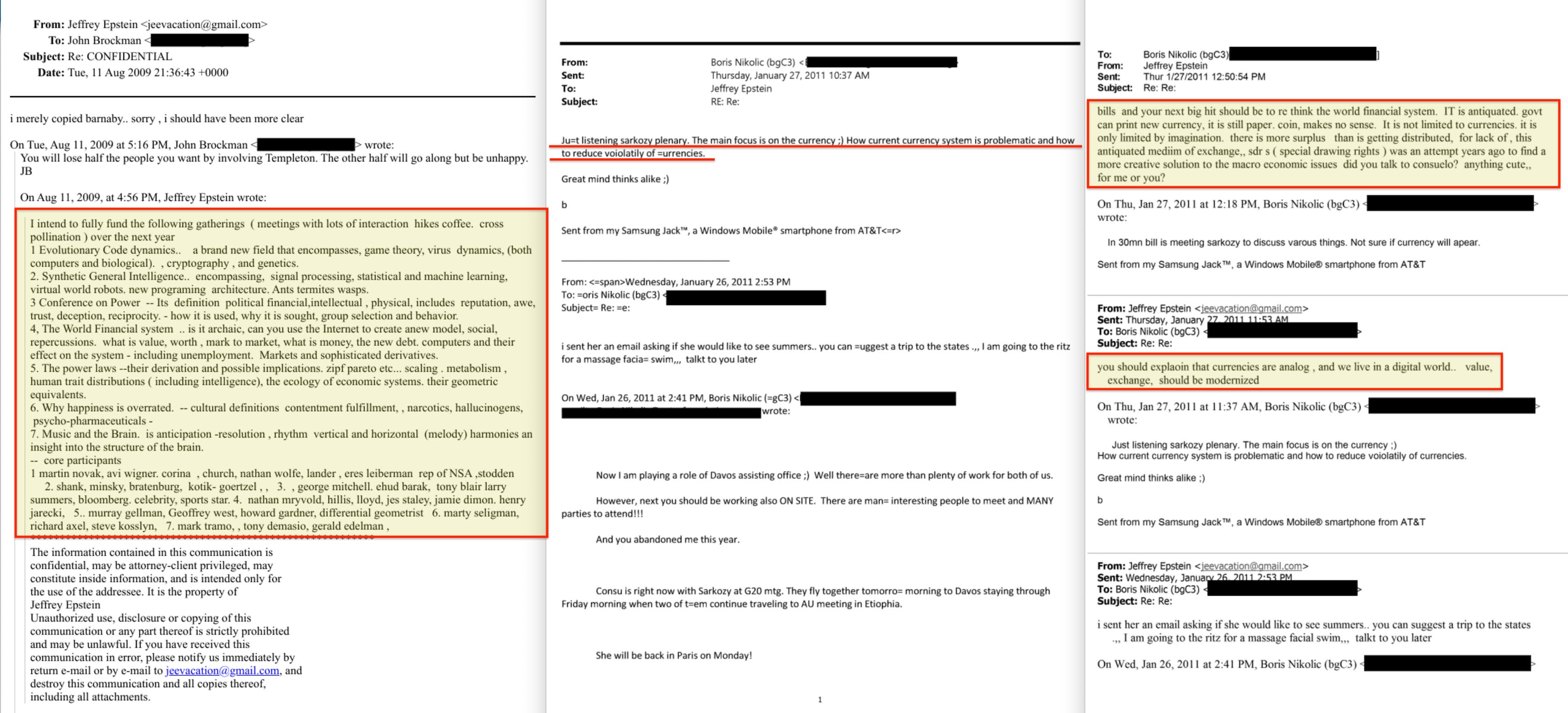
Within weeks, he described the answer to Nikolic: a 'charitable currency unit' limited to governments and charities226 — 'like special drawing rights for the poor'. Five years after that, he sent Lawrence Summers the answer: a tokenised digital currency built to enforce 'transparent charity related stuff'227.
The participant lists for these seven gatherings included a representative of the National Security Agency, Ehud Barak, Tony Blair, Larry Summers, Jamie Dimon, Jes Staley, and Ben Goertzel. Brockman’s only objection was about branding.
Barnaby Marsh, one of Epstein's regular intellectual collaborators, annotated the same agenda228. Under the topic on power, he added: 'control of the masses via technology/communications, and implications for the possibilities (and dangers) of virtual democracy'. Under another, he wrote of 'the promise of emotional motivation and coordination of the great masses via spiritual ideals', noting that 'beliefs shape civilization' and that current methods were primitive.
No one on the chain objected.
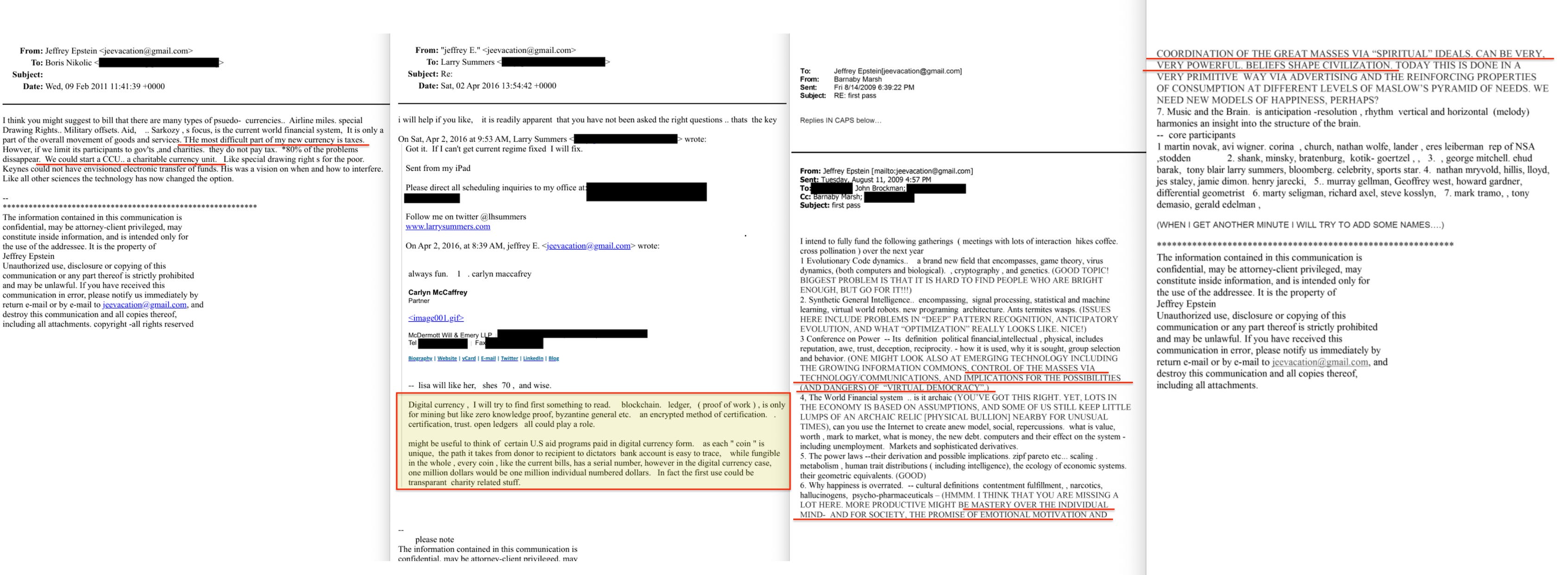
The question, the design, and the delivery were the same programme: a digital currency that enforces social objectives automatically, developed across seven years in plain sight. The subject itself — currency stabilisation229 — was the same one Lynn Forester had linked Epstein’s name to in a letter to the President of the United States, twenty-one years earlier.
The solution was to stop stabilising analogue money and replace it with digital money. The rollout would begin where no one could object: governments and charities, which pay no tax and serve ‘the public good’. But the ambition was larger. In a pitch to Richard Branson, Epstein called it a ‘social good currency’ and described it as ‘the most disruptive of all advances’, adding: ‘the financial system has outgrown its purpose’230.
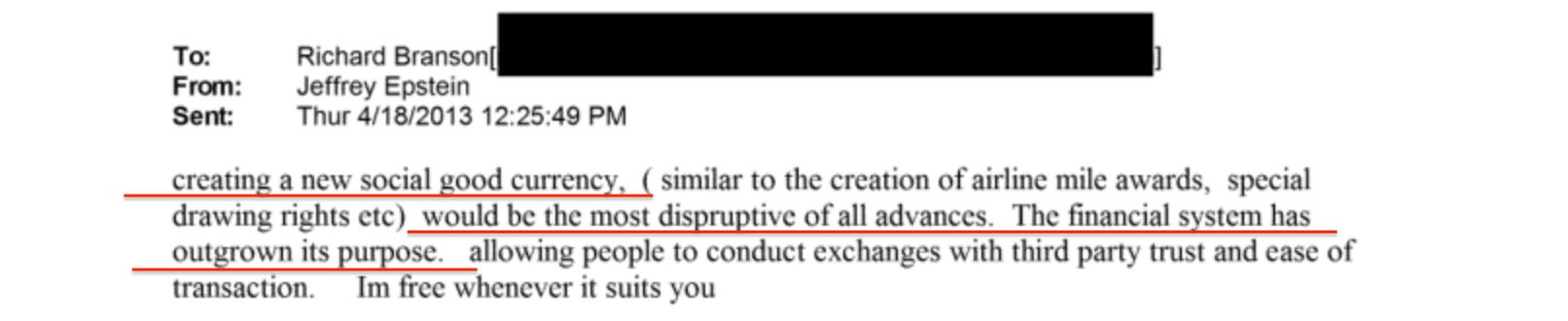
The satellite entrepreneur Greg Wyler put it more plainly in a separate email231: 'I know you don't care about the social good'.
The ‘social good’ was a politically expedient vehicle, nothing short thereof.
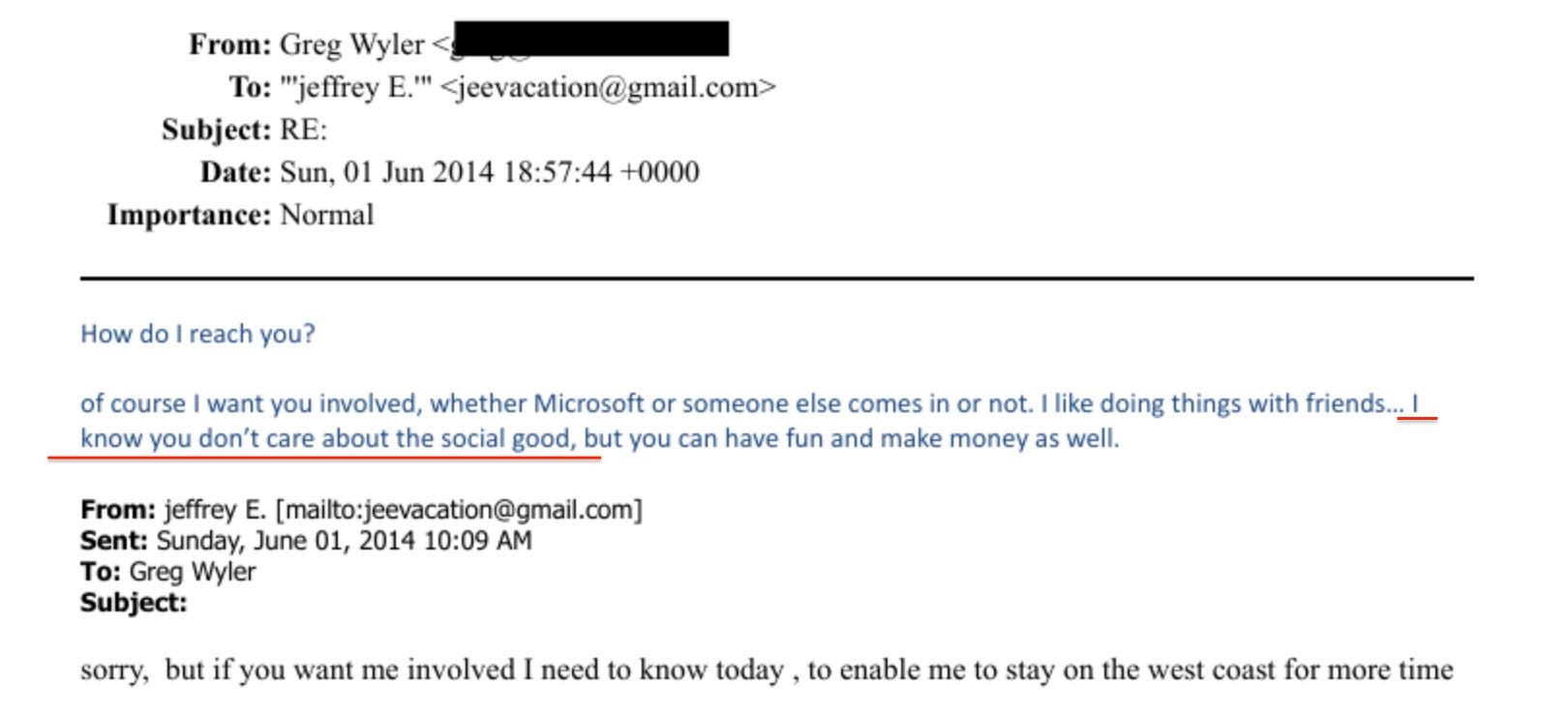
And it scaled. In a single email to Nikolic in March 2013, Epstein listed the full stack232: ‘DAF, estate, structured giving, partnered giving, social good bonds, govt approved special gates bonds’. From charitable currency units at the transaction level, through social good bonds at the debt level, to donor advised funds at the asset level — the same label, applied across every layer of the financial system.
Digital monetary reform pivoting the ‘social good’.
CBDCs with encoded conditionality enforcement for the individual transaction.
ESG and ‘green finance’ for corporations.
Blended finance/impact investing for sovereign development funding.
And those denied capital would be left ‘stranded’ — the framework’s own term for what happens when the ‘social good’ conditions are not met.

Conclusion
Robert Maxwell was the main publisher of books that laid out how to govern large systems using information instead of force — general systems theory, input-output analysis, and cybernetics. He ran an intelligence operation whose structure matched the architecture his press was publishing. Before he died, he introduced his daughter Ghislaine to the man who would carry the operation forward. She embedded him within the social fabric, carrying on the operation her father had set in motion. Lynn Forester — embedded in the Clinton administration and later married into the Rothschild family — provided the bridge between the two worlds.
Jeffrey Epstein — a man with no qualifications, no institutional position, and no public profile — was placed at the centre, where his very blankness drew attention away from the structure behind him. David Rockefeller personally put him on the board of Rockefeller University and invited him onto the Trilateral Commission. And the Rothschild banking house — which fought Robert Maxwell in 1969, brought him back into the fold through New York in the 1980s, partnered with him by 1991, and absorbed the network through Forester after his death — provided financial scaffolding.

The operation was never really Epstein’s. Whether it was designed this way or simply evolved, the system could survive the loss of any single part — including him. But it was never really Maxwell’s either.
The thing that connects every thread in this story — the publishing programme, the intelligence operation, the banking architecture, artificial intelligence, the centralised ‘social good’, the research funding, and the institutional machinery now running through the BIS and the NGFS — is systems theory itself.
General systems theory. Input-output analysis. Cybernetics. The idea that you can manage any complex system through feedback and control, including humanity.
That idea, incidentally, through Zev Naveh has a name. It’s the ‘Total Human Ecosystem’233 — humanity as a managed specie, subject to permanent surveillance and enforcement, not least programmable CBDCs. But at least Zev was honest about this not being capitalism.

Norbert Wiener, Ludwig von Bertalanffy, Erich Jantsch, Heinz von Foerster, Stafford Beer, and Gordon Pask developed it. Kenneth Boulding and Buckminster Fuller gave it a destination: Spaceship Earth, a managed planet run by planners, not elected politicians234. RAND Corporation researched it, and PPBS was its first operationalisation — payment conditionality contingent on meeting expected outcomes.
The Rockefeller Foundation paid for much of the early research, and later delivered ‘impact investing’ in 2007, the flip side of Rothschild’s ‘stranded assets’. Combine the two, and you have capital allocation aligned with an ‘ethical’ objective at the macro level — exactly what Moses Hess called for in 1845.
CBDCs with payment conditionality represent the final component of this vertical architecture, but now at micro: the individual transaction.
The BIS Project Rosalind implements this functionality into the CBDC.

Robert Maxwell did more than publish. He controlled the distribution infrastructure through which local innovations became global standards — the press that determined which methods were legitimate science. He funded the institution in Santa Fe where the theory was being applied to governance and economics. And he placed the successor before he died. Jeffrey Epstein carried the programme from theory into operation — funding the researchers who built the components, carrying the specifications between the people writing the rules and the institutions enforcing them, and maintaining the intelligence architecture that protected the relay.
One controlled what the world accepted as knowledge. The other controlled what was built from it. The Rothschild financial line ran through the whole thing.
The number of families, foundations, and institutions required to account for the entire architecture — from theory to funding to publishing to intelligence to banking to current implementation — is remarkably small, and they appear not once but at every transition point across eight decades.
What the whole thing produces, when you put it all together, is a fully automated version of Fuller’s Spaceship Earth — a system for managing the planet’s resources through feedback and control, with programmable money as the enforcement tool and the definition of ‘social good‘ as the only input that decides what the system allows and what it blocks.
It was officially launched in 1968 through the UNESCO Biosphere Conference, and it is now built into institutions that will keep running it regardless of what anyone knows about the networks that put it there. The final step is moving from acting on information in the present to Al Gore and Leon Fuerth’s ‘forward engagement’.
The same Gore who was heavily involved in developing the concept of ‘stranded assets’235, while the Clintons dealt with the political side of ‘impact investing’236.


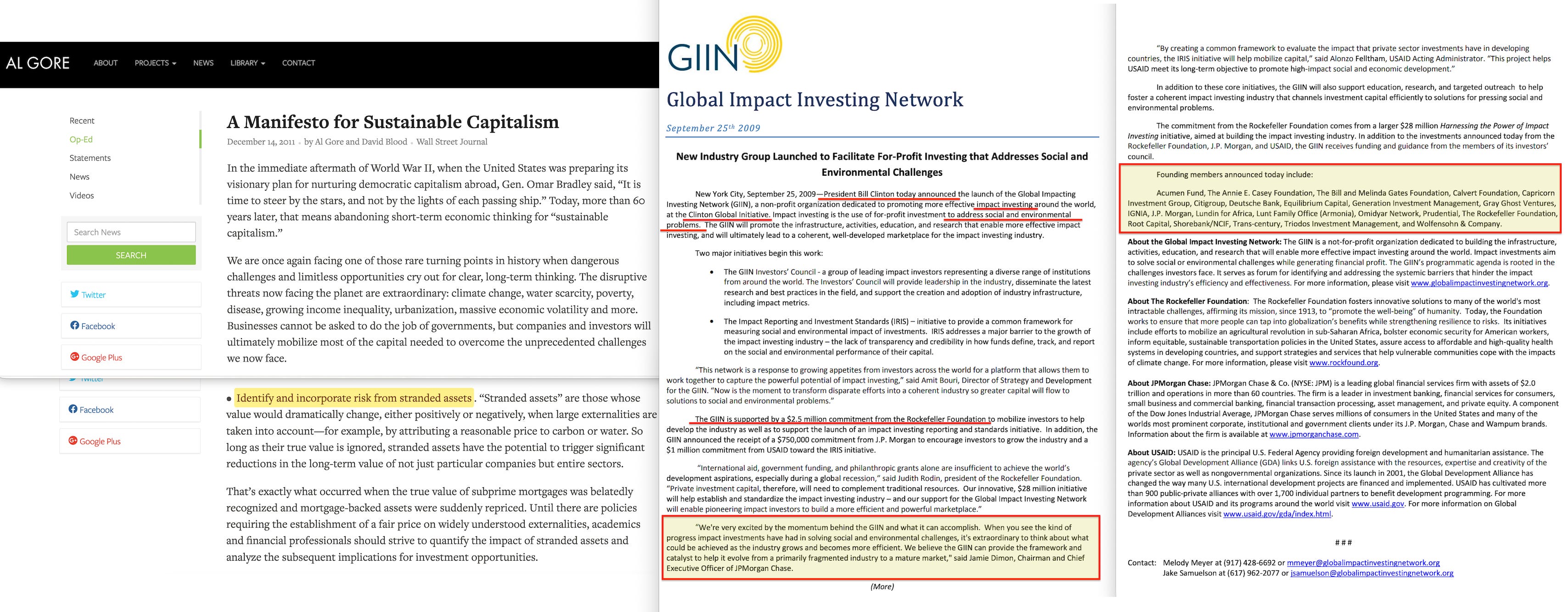
So what this all goes to show is that:
The NGFS turns climate scenarios into capital requirements
The BIS builds programmable currency infrastructure
The EU taxonomy classifies economic activity as compliant or non-compliant
AI systems evaluate transactions against those classifications in real time
Money becomes conditional on meeting externally defined ‘social good’ criteria
Assets that fail are ‘stranded’ - rendered unfinanceable, valueless
No parliament votes on any of this
The committees that set the numbers meet in private, their members unnamed
The purpose of that system is what it does: this system transfers control over capital allocation from elected governments and individual actors to an unelected technical infrastructure, using moral language as cover, with no democratic mechanism for appeal or reversal.
The architecture achieves this without requiring coordination between its participants. Each component was built to deliver a predictable output from a given input, and the output of each is the input of the next. A climate scenario produces a risk weighting. The risk weighting produces a capital requirement. The capital requirement produces a lending constraint. The lending constraint produces an asset price. No node needs to understand the system. It only needs to process what it receives.
That is what general systems theory delivers at institutional scale — not coordination, but guaranteed propagation.
Compartmentalisation is not a security feature added after construction. It is a structural consequence of the design: when every component produces a predictable output, no component needs to know what the others are doing.
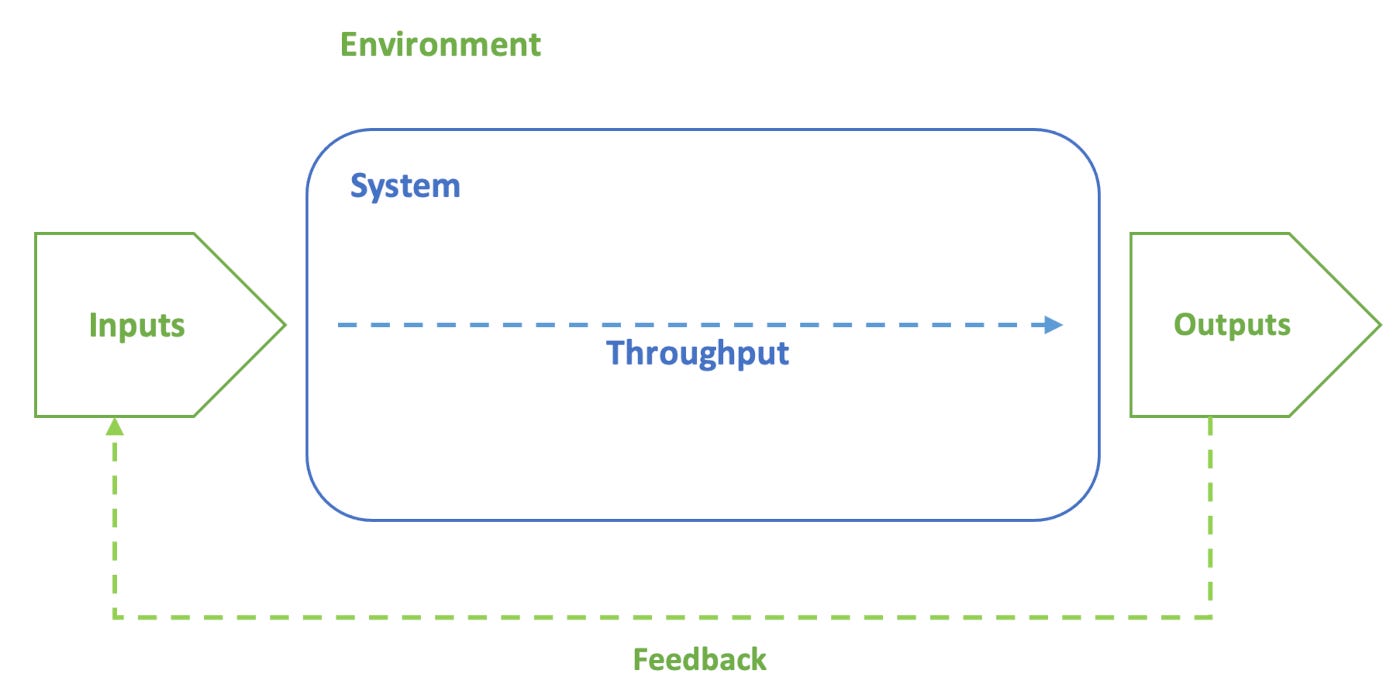
Coincidence does not explain why those outputs slot into each other. Conspiracy cannot operate at this scale. The only explanation is a shared design specification: general systems theory provides the compartmentalised modules, each producing a predictable output from a given input, and ISO standards provide the compatible interfaces through which one module’s output becomes the next module’s input. No electorate approved either.
The three fields Maxwell published through Pergamon map directly onto the three-layer hierarchy. General systems theory is the cognitive layer — it defines the modules. Input-output analysis is the evaluative layer — it measures the flows. Cybernetics is the behavioural layer — it actuates. But three layers without reliable communication between them do not constitute a system. Maxwell also published the fourth discipline: information theory — Woodward’s Probability and Information Theory 237in 1953, and the journal Information Processing and Management from 1963238. Shannon’s mathematics guarantees that the signal passing between layers arrives intact.
The same three layers operate at the philosophical level. The cognitive translates the ethic — such as the sustainable development goals — into an ‘ought’. The evaluative considers the present, the ‘is’, and how to best fulfil the ‘ought’. The behavioural turns that evaluation into practice.
Maxwell’s Pergamon Press did not publish three adjacent fields. It published the complete communication architecture: the modules, the measurement, the actuation, and the transmission medium that connects them.
The only human choice is the first input — the definition of what counts as ‘good’ — and how that’s translated into standards.
ISO mappings are discussed at length in ‘Inclusive Capitalism’.
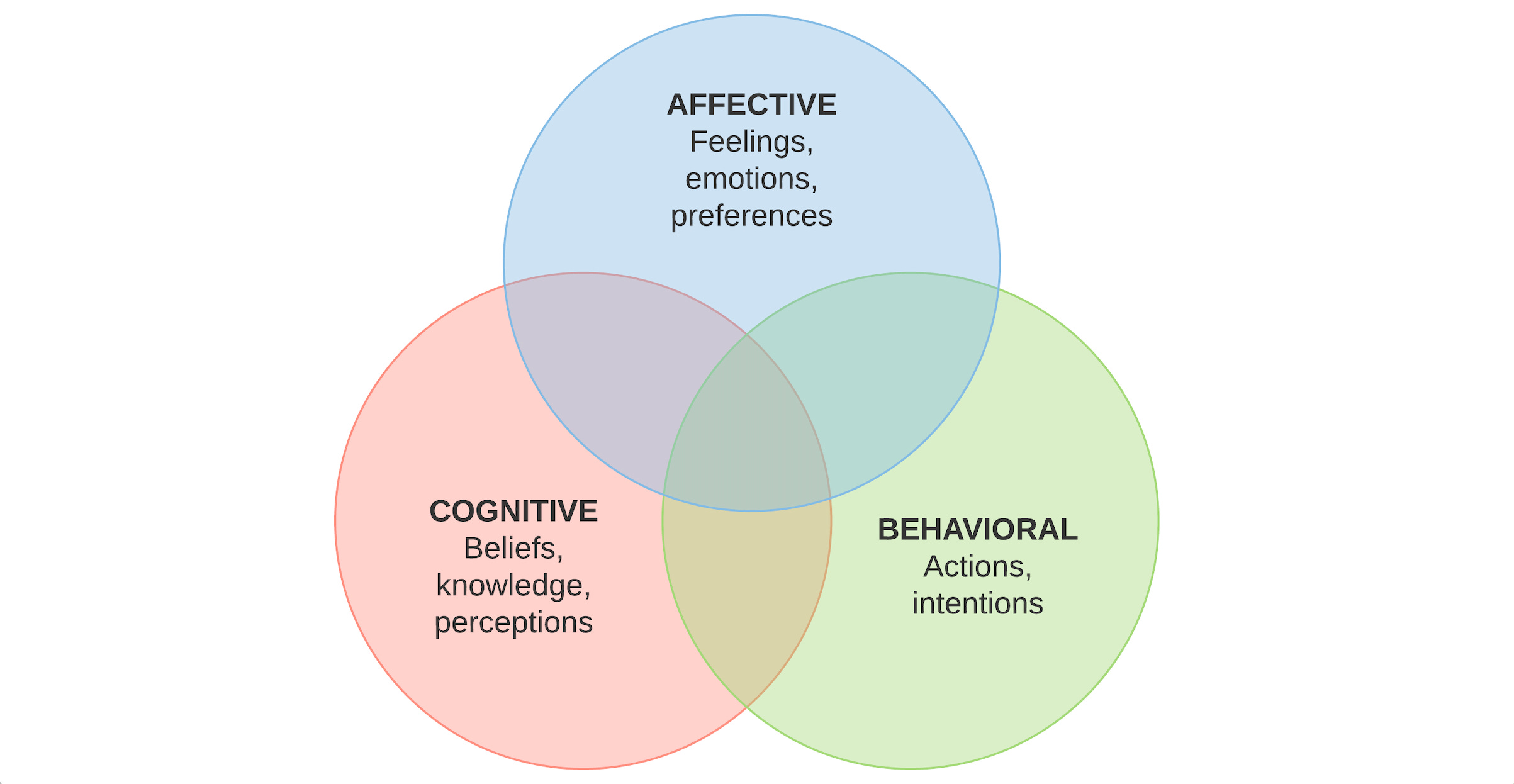
Postscript
The operation described in this essay was built alongside — and shielded by — the sexual exploitation of children and young women. Their stories have been told elsewhere, and they matter. This essay is about the system those crimes were used to protect. But blackmail, bribery and ideology alone could not have delivered the end result.
The more fundamental tool is general systems theory itself.
Yet, the architecture has a structural weak point. It cannot defend itself. Networks built on compartmentalisation keep each participant inside their own field. The climate modeller knows about climate models. The healthcare professional knows about healthcare. The banker knows about banking. The intelligence operative knows about intelligence. None of them sees the whole picture. That is by design — it is what keeps the system secure. When someone challenges the network in a single field, the system can handle it easily. There is always a specialist available to respond.
But when an argument connects multiple fields showing how the climate modelling, the banking infrastructure, the intelligence architecture, the AI research, the publishing history, and the digital currency proposals fit together — no specialist can respond to the whole, because no specialist was ever meant to see the whole. That is the nature of compartmentalisation: security against exposure comes at the cost of an inability to defend the full picture.
A public health official can justify conditional financing through impact bonds, but cannot explain why the prototype was designed on a call arranged for the Gates Foundation by Epstein’s private banker. A climate scientist can defend the models that leads to asset stranding, but cannot explain why the forums that produced them were hosted at a Rothschild estate.
The only people who can see across disciplines are the fixers such as Epstein — the people whose job it is to move between the specialists and connect them. But they cannot come forward to argue in public. The act of explaining how the pieces fit together would confirm that the architecture exists. Those who understand the wiring cannot describe it without describing their own role in it. What remains is silence, misdirection, or continuation.
The wiring does not stop working because someone published the diagram. But the system was never designed to be seen whole — and it has no defence for when it is.

Ben-Menashe’s credibility has been contested, particularly regarding his October Surprise allegations, and his 1991 trial featured prosecution witnesses who contradicted him. His claims regarding Maxwell’s intelligence role are cited here because they are corroborated by Seymour Hersh (The Samson Option, 1991), the UK DTI investigation into Maxwell’s business affairs, the six serving heads of intelligence who attended Maxwell’s funeral, and the verified complaint in Operating Engineers v. Dimon (S.D.N.Y. 2023), 74-75.
https://dn710604.ca.archive.org/0/items/Sampson_Option/Sampson_Option_text.pdf
You do fantastic deep dives. We diverge on some of our ideas of dominant agendas at play, but often much alignment.
I would add a facet to your description of Al Seckel (Isabel Maxwell's bigamist husband), his role in the sordidness. Your pieces, this and an earlier one you link to describe him as heading up "Mindshift." His general title, with many working subtitles for his pursuits, was as a "Perceptual Scientist." I recently did my own diving into that field and learned that it is one of the pseudosciences that are useful in shaping the 'cognitive infrastructure' of humanity. Along with behavioral scientists, narrative controllers using propaganda and censorship to alter perceptions and coerce changes in a targeted population's behaviors. Aka "The Science"(TM) of the plandemic. Perceptual science is a key plank in a technocratic social control system. Epstein's Harvard psychology department position focused on the psychology of power, influence and human behavior. Epstein's own expertise with Seckel's expertise align with Epstein's (and his benefactors) eugenics agenda to reengineer humanity, depopulate, stratify, "optimize" for efficiency for those with DNA chosen to continue in the gene pool vs exist 'virtually' as AI Avatars and/or Transhuman 'borgs.' Or terminated as "useless eaters," "deplorables," and "bitter-clingers, mentally ill "asozials."
The salacious and tawdry pedophilia and kompromat 'revelations' of Epstein's network are a distraction. They serve a dual purpose: they discredit and sacrifice lower-tier enablers, preserving those who operate behind the scenes. Aligning with Chomsky’s “10 strategies of manipulation”, particularly distraction and problem-reaction-solution: the public is mobilized against visible abusers while the infrastructure of control—algorithmic governance, behavioral nudging, genetic stratification—advances unchallenged. Chomsky is another notable good friend of Epstein.
Under technocratic authoritarianism, which is what Epstein was a central hub in the architecture of, power is maintained not through overt force, but through scientifically mediated control of perception, reproduction, and behavior. The greatest threat that the Epstein scandal poses to the highest powers isn't the sex scandals—it's the normalization of human engineering as policy, hidden in plain sight. And that is the reason he didn't kill himself over. The powerful elite behind him knew they could manage around the revelations of pedophilia; they already successfully had. They can't contain revelations of human reengineering in real time, not just theoretical. And will stop at nothing to prevent widespread knowledge of it. Once the "conspiracy theory" smear wears thin and people aren't intimidated from researching deeper, widespread knowledge will be the undoing of the actual conspirators. And they know it. Seckel, another important node in the reengineering of humanity architecture that Epstein was an important architectural manager of.
You downplay the widespread popular awareness that the goal is "the mark of the beast," without which you will not be allowed to buy or sell. Enslavement is implied. This is not hard to discern. And on the systems side of things, Adam Smith's revolutionary application of a control mechanism (known) to a social system argued for a decentralized "free" system, although even Smith recognized the problems of concentration and the need for some forms of regulation.
Thanks to your efforts and those of many others, the methods of the faceless bureaucrats are being exposed and, one hopes, brought under democratic control. A fascinating, if nauseating, essay.