
One

On 24 May 1844, Samuel Morse sent the first long-distance telegraph message from Washington to Baltimore. The telegraph was the first technology that could move information faster than a person could physically carry it, and it was the foundation for every communication system that followed — transatlantic cables, stock tickers, telephone networks, SWIFT, the internet, and programmable money.
It made governing from a distance technically possible for the first time: the ability to set a rule in one place and have it carried out in another, instantly.

Where The Clearinghouse described the architecture — how power ends up with whoever writes the rules — this essay traces the idea behind it: that money should serve a moral purpose.
In the same year as the telegraph, the Bank Charter Act gave the Bank of England a monopoly on issuing currency. Before 1844, private banks across England had printed their own notes. The monopoly was brought in gradually, with the last competing banknotes taken out of circulation around 1920.
The currency monopoly and the communication network — in the same year. But that was just the beginning.
Decades earlier, David Ricardo had argued that the power to issue banknotes should belong to one institution, to keep inflation under control. Ricardo also developed the labour theory of value — the idea that the worth of something comes from the labour it takes to produce it — which Marx later adopted as the analytical backbone of Das Kapital.
The man who designed the currency monopoly also handed Marx the very economic framework he would use to justify reorganising money itself.

The Premise
The following year, Moses Hess laid down the idea that tied the money to the purpose. In The Essence of Money (1845), Hess described money as ‘social blood’ — the circulatory system that keeps society running as a single body. Just as blood carries nutrients or disease, money carries social relationships and reflects moral choices. If money is set up the right way, fair outcomes follow. If it’s set up the wrong way, injustice follows. Therefore money has to be redesigned to serve a moral purpose.
For Hess — widely regarded as the father of communism — that meant getting rid of selfishness. Money as it currently works only serves the interests of the self-interested individual. Redesign it along ethical lines and the selfishness disappears. The group replaces the individual, and the money makes sure it stays that way.
That single idea — money should serve a moral purpose, and that purpose is about the collective — launched a programme that never stopped. Once you accept it, you need someone to decide what the shared morality is, someone to turn it into rules, someone to check whether people are following them, and someone to enforce the results.
Hess wasn’t the only one who ended up here. Paul Carus arrived at the same conclusion through interfaith dialogue, Pierre Teilhard de Chardin through Christian theology, Hermann Cohen through philosophy, Hans Küng and Leonard Swidler through their 1990s work on ‘a global ethic’, and Michael Laitman, founder of Bnei Baruch, currently teaches what he openly calls ‘altruistic communism’: fixing selfishness through collective unity.
The underlying belief — that the self-interested individual is the problem and the collective is the answer — goes virtually unchallenged across spiritual, philosophical, and political traditions. Jeffrey Sachs says it plainly in Ethics in Action for Sustainable Development: individualism is the obstacle, collective commitment is the remedy.


The Ethic Justifies the Collective
In Rome and Jerusalem (1862), Hess took the idea further into politics. Nations, he argued, are moral bodies, each defined and justified by a unique ethical mission. A nation without an ethical mission has no right to exist — but a nation with one has a duty to see it through.
This set the template. If a group — the nation state — gets its authority from its ethic, then the ethic is the reason it has the right to organise, to enforce, and to govern. Take away the ethic and the authority falls apart. Keep the ethic and the authority becomes unchallengeable — because anyone who pushes back against the group is automatically ‘unethical’.
The ethic becomes the one thing nobody can question without looking like they’re against justice itself.

The Ethic Detaches from the Electorate
Hess’s framework had a limitation: his ethic belonged to one particular nation and one particular historical mission. For the system to work on a global scale, the ethic needed to become universal — disconnected from any single people or tradition, and based instead on principles that could apply everywhere.
That’s where Hermann Cohen comes in. The most influential neo-Kantian philosopher of the late nineteenth century, Cohen shaped a whole generation of thinkers across legal philosophy and international governance. In his Ethics of Pure Will (1904), he argued that ethics doesn’t come from experience, tradition, or feeling. It comes from reason — and reason is universal.
Cohen kept Hess’s basic structure — the ethic as the source of authority — but swapped out the contents. Instead of a particular national mission, the ethic was now grounded in rational principles that any sufficiently qualified body could claim to manage. You no longer needed a nation to carry the ethic. You just needed a committee with defensible principles.
That is the philosophical foundation on which Plato’s philosopher kings — in their modern form as clearinghouses, expert panels, and international bodies — now operate: authority that comes not from a popular vote but from the ethic they administer. If your principles are rational, you don’t need an electorate. Cohen’s later work made this even clearer, connecting the Ethics of Pure Will to a vision of legal order that sits above the nation state — an ethical commonwealth in which rational law governs how peoples relate to one another.


The Ethic Becomes Spiritually Universal
While Cohen made the ethic universal through reason, Paul Carus made it universal through bringing religions together. A German-American philosopher and publisher, Carus chaired the 1893 Parliament of the World’s Religions in Chicago — the first serious attempt to gather the world’s religious traditions under one roof.
Carus edited The Open Court and The Monist, and in The Religion of Science (1893) he argued — following Spinoza — that science and religion aren’t opposites. They’re two ways of expressing a single truth, and ethics is the common language between them. Truth, for Carus, wasn’t just raw fact — it was fact seen from the widest possible angle, which meant it needed interpreting. Carus wasn’t trying to pick sides between faith and reason. He was trying to build a shared ethical vocabulary that could claim the authority of both.
The Parliament was the prototype for every interfaith declaration that followed. When it was revived in 1993, Hans Küng wrote its signature document: The Declaration Toward a Global Ethic. Küng’s declaration made the ethic personal through four directives addressed to every individual on earth: non-violence, solidarity, tolerance, and equal rights between men and women — and each person was now personally responsible for living up to them. Leonard Swidler then pushed the frame beyond the human, grounding the ethic not just in what people owe each other, but in what they owe the earth itself.
The IUCN’s Caring for the Earth (1991) had already arrived at a planetary ethic — rooting conservation in explicit moral duties owed to the earth. The Earth Charter (2000), launched at the Peace Palace in The Hague by Maurice Strong and Mikhail Gorbachev and chaired by Steven Rockefeller, then pointed the personal ethic toward the planet — sustainability and respect for nature as moral imperatives. Küng and Swidler made you responsible. The IUCN and the Earth Charter told you what you were responsible for.
The phrase ‘sustainable development’ first appeared in an IFDA Dossier in 1979 — within the Club of Rome network, with Maurice Strong among its members — eight years before the Brundtland Report (1987) brought the term into the mainstream. The modelling behind it ran through IIASA, a joint US-Soviet institution founded in 1972 — the same year the two superpowers signed an Agreement on Cooperation in Environmental Protection, quietly merging their governance systems under a shared enemy: environmental damage. Brundtland took this modelling and Boulding’s closed-system economics and turned them into a principle that governments could adopt and write into international law.
The Sustainable Development Goals (2015) turned all of this into governance targets: 17 goals, 169 targets, 231 measurable indicators. The personal responsibility Küng declared and the planetary focus the Earth Charter established were compiled into benchmarks that could be checked and enforced through conditions at every level: development aid to countries was made conditional on meeting SDG indicators, corporate finance was tied to CSR and ESG compliance, and with digital currencies, the same ethical rules will be built into every transaction. Pope Francis’s Laudato Si’ grounded the same ethic in papal authority — ecological stewardship as a moral duty owed to creation itself. Each step closed the gap between abstract ethic and enforceable rule.
Cohen and Carus ended up at the same place from opposite directions. Cohen gave the philosophical justification for governance without an electorate. Carus provided the mechanism for producing the ethical content that such governance would enforce. The result was an ethic grounded in reason and backed by faith at the same time — a combination that is extremely hard to challenge without looking like you’re against both.


The Ethic Becomes Measurable
The ethic needed practical tools. If money was going to serve a moral purpose, someone had to define what that meant, measure whether people were doing it, and punish them if they weren’t.
Karl Pearson — who moved in the same socialist Fabian circles as George Bernard Shaw and Sidney Webb — founded modern statistics: correlation, standard deviation, the bell curve. For Pearson, a committed eugenicist, statistics was the science through which populations could be rationally managed. The bell curve was a tool for defining what ‘normal’ looks like — and everything outside it was treated as a problem.
Frederick Winslow Taylor’s Principles of Scientific Management (1911) then applied statistical measurement directly to people. Stopwatch studies, efficiency targets, and stamping out variation on the factory floor — Taylor was the first person to treat human labour as a process to be measured against a standard and optimised. The worker’s output was tracked, compared to a benchmark, and any deviation was eliminated.
Pearson gave the world the mathematical tools for defining what ‘normal’ is and pushing entire populations toward it. Taylor showed that the same tools could be applied to individual human behaviour. Everything that came after — McNamara’s budgeting system at the Pentagon, the World Bank’s development indicators, the NGFS climate scenarios, ESG scores — is the Pearson-Taylor method moving out of the laboratory and the factory and into everyday life. Ethics, once you define it in numbers, becomes statistics. ‘Ethical’ means you fall within the acceptable range of the chosen benchmark. ‘Unethical’ means you don’t.
The entire moral vocabulary of global governance — sustainability, resilience, inclusion, responsibility — is a statistical process dressed in the language of virtue.


The Political Programme
The premise moved quickly from philosophy to politics. In 1848, the Communist Manifesto — co-authored by Marx and Engels, both influenced by Moses Hess — included as Plank 5 of its ten-plank programme: ‘Centralisation of credit in the hands of the state, by means of a national bank with State capital and an exclusive monopoly’.
The demand was not for a currency monopoly — the Bank Charter Act had already delivered that. It was a demand for a credit monopoly: the elimination of the commercial bank as an intermediary that creates money through lending. Under fractional reserve banking, private banks create money every time they issue a loan — and under the current system, the vast majority of money in circulation is created this way, not printed by the central bank. Plank 5 called for that function to be absorbed by the state — all credit flowing through a single state bank, on terms set by the state, for purposes determined by the state. This is what the contemporary ‘positive money’ movement advocates, and what a central bank digital currency promise to deliver. The CBDC does not nationalise the banks; it makes them irrelevant to the money-creation process.
Marx then built the theory to back it up. In Das Kapital (1867), spread across three volumes, he argued that money is how the powerful stay powerful — that money already serves a social purpose, keeping the ruling class on top, and must therefore be redesigned to serve a better one. Hess gave the idea, the Manifesto gave the rallying cry, and Das Kapital gave the detailed argument that made the whole project look like an inevitable stage of history rather than a political agenda.
Das Kapital also drew a line that would turn out to matter more than it first seemed. Marx split economic activity into two loops. In the first, a worker sells his labour, gets paid, and uses the money to buy what he needs — food, rent, clothing. In the second, a capitalist spends money to make more money, buying goods or labour cheaply and selling at a profit. The first loop is about getting by. The second is about getting richer. The entire moral argument of Das Kapital rests on this split.
The problem is that this split looks clean on paper but is impossible to see in practice. When someone buys lumber, the transaction alone doesn’t tell you whether they’re building a deck for their family or flipping a house for profit. The intent is invisible — and might change later anyway. Marx wrote about these two loops as though the difference were obvious, but no monetary system in 1867, or for the next century and a half, could even begin to tell them apart. It was precisely what Hayek would later call the pretence of knowledge — a framework that assumes someone, somewhere, can know what no one actually can.
The only way to actually enforce this split is to make the money itself know what’s going on: who’s spending it, what they’re buying, why they say they’re buying it, and what happens to it next. That’s a programmable currency — digital money with built-in rules and tracking, issued and run by a central bank.
The logic follows step by step. Positive money takes away the ability of private banks to create money through lending. That means the central bank has to step in and create all the money itself to replace what’s been lost. To manage that much money, it needs a completely new system. And that system needs programmable digital tokens to do what Marx’s framework actually requires — telling the difference between ordinary spending and profit-seeking. Without programmable money, Marx’s two loops are just theory. With it, they become rules the system can actually enforce. The technology that makes the Manifesto‘s call to centralise credit workable is the same technology that makes Das Kapital‘s categories workable. Both were blueprints for a system that wouldn’t be buildable for another 170 years.
Marx took it further. His idea for labour vouchers — where you’re paid based on the time your work is supposedly worth to society — was designed so the vouchers couldn’t be passed around. You work, you get a voucher, you spend it on goods, and the voucher is destroyed. You can’t save them up, you can’t lend them out, and you can’t use them to make more money. The profit-seeking loop is wiped out by design, built right into how the money works.
A programmable central bank digital currency makes this enforceable. The digital token comes with built-in rules: this money can only be spent on everyday goods, it expires after a set time, it can’t be passed to someone else, and you can’t save more than a certain amount. Ordinary spending is allowed, but using money to make more money becomes structurally impossible — the money itself won’t allow the transaction. And the problem of figuring out who’s spending for what reason disappears entirely, because the currency has already decided what it can be used for before it even reaches your hands.
So the full chain works like this: positive money takes away banks’ ability to create money through lending. The central bank steps in to replace all that lost money. Digital currency replaces cash. Programmable features let the government put rules on every token. Labour vouchers — money that can’t be saved or invested — become technically possible. And building wealth becomes something the system simply won’t allow. Each step along the way looks like a sensible upgrade to the financial system. But nobody ever gets to vote on where it all ends up, because that destination was never announced.


One problem remained. Marx’s vouchers were supposed to be based on how much labour something actually takes to produce — but there’s no practical way to measure that directly. But what you can measure is energy. Every productive process ultimately runs on energy, and labour is really just human energy being put to use. Technocracy Inc. understood this back in the 1930s: scrap the price system, track energy instead, and give citizens non-transferable, expiring energy certificates. The idea was clear, but the technology to actually do it didn’t exist yet.
This is where carbon comes in. Carbon dioxide is the measurable, trackable flip side of energy use. Every unit of energy burned leaves a carbon footprint. Carbon tracking is really just energy accounting under a different name.
Which means the entire carbon infrastructure — the monitoring, the reporting, the net-zero targets, the carbon budgets, the idea of personal carbon allowances — isn’t primarily about the environment. It’s the accounting system you’d need to make the voucher system actually work. Carbon gives Marx what he never had: a measurable unit that tracks energy use across every productive process, from the factory floor to the household, in real time.
So the full architecture comes down to this: positive money takes away banks’ ability to create money. The central bank digital currency provides the programmable token. Carbon accounting provides the unit of measurement. The voucher is priced in energy, tracked through its carbon footprint. The token can’t be transferred, can’t be saved up, and expires. You can spend, but you can’t build wealth.
Every piece of this is already being built, each sold on its own terms — financial stability, modernisation, climate responsibility — while the fact that all these pieces fit together into a single system goes entirely unannounced.


Several of these pieces have already moved past the planning stage into real-world testing.
Project Rosalind showed how conditional payments can work: a third-party checker has to approve a transaction before it goes through. The buyer pays, the seller accepts, but a third party first verifies that the rules built into the token are met. That third party could be an automated system checking: does the buyer have enough carbon credits? Is this purchase in an allowed spending category? Has the voucher expired? Does the product meet compliance standards?
The Bank for International Settlements has already built the enforcement mechanism.
The EU’s Carbon Border Adjustment Mechanism is the political foot in the door. It makes carbon accounting normal by starting at the border — every imported product has to carry a carbon cost. It looks like trade policy, but once the accounting system exists for imports, applying it to everything made domestically is straightforward. And once it covers production, extending it down to what individual consumers buy is just a software update.
The circular economy then closes the loop at the level of the goods themselves. Products have to be designed for reuse, recycling, and return. Ownership gives way to access — you don’t buy things to keep, you buy the right to use them. Goods are designed so they can’t be hoarded. The voucher buys use, not ownership. Wealth-building is blocked not just at the money level, through tokens that can’t be saved or transferred, but at the physical level, through the very design of the products those tokens buy.
The stack now extends beyond the money. Project Rosalind’s conditional checking enforces the rules at the point of sale. The EU’s carbon border mechanism normalises the accounting system from the border inward. And the circular economy makes sure that whatever the voucher buys can’t be accumulated.
Every layer already exists. Every layer has its own public justification. None of them officially depend on the others — but they all fit together by design.


The European Union shows most clearly how far along this already is. Digital identity is already law: eIDAS 2.0 came into force in May 2024, and every EU member state has to offer at least one digital identity wallet by the end of 2026. The wallet stores government-verified credentials, and from late 2027, major private companies and large online platforms are required to accept it for identity checks. The EU’s target is 80 per cent of citizens using it by 2030. The digital wallet — the container — is a done deal.
The digital currency is on its way. The EU Council agreed on the digital euro in December 2025. The European Parliament is expected to vote in the first half of 2026. If it passes, the European Central Bank plans to start pilot testing from mid-2027 and could begin issuing the first digital euros in 2029. So the container is law and being rolled out. The identity layer is law and being rolled out. The only thing missing is what goes inside the container — the programmable token itself. And that already has Council approval and is heading for a parliamentary vote within months.
The language around the project is telling. In December 2025, MEP Aurore Lalucq said that ‘anyone who opposes the digital euro is going against the euro and the European Union’. The ECB has announced that accepting the digital euro would be mandatory, and payment providers would be required to support it. This is not optional.
The ECB has said the digital euro itself won’t be programmable — and technically that’s true, but it’s misleading. The programmability doesn’t need to be in the token when it can be in the wallet. The digital identity wallet is the container, and the digital euro payment carries structured data describing what’s being bought — the wallet reads that data and decides whether the transaction is allowed. So the currency isn’t technically programmable, but everything around it is.
Once the token sits inside the wallet, tied to your digital identity, the three-party checking system the BIS tested in Project Rosalind has everything it needs to work — and Project Mandala extends the same logic across borders, embedding country-specific compliance rules directly into international payments. Each piece was justified on its own, none officially needed the others, and all are designed to work together — yet the architecture is already two-thirds built, written into law, and on a deployment timeline.
Three years, 1845 to 1848: the philosophical premise, the currency monopoly already accomplished, the communication infrastructure in place, and the demand for a credit monopoly that would not be technically achievable for another 170 years. All in place before the century was half over.


The Premise Produces the Architecture
If Hess’s basic idea is right — that economic life has to be guided by a moral purpose — then everything that follows is baked into the logic, no matter who’s doing the building or what flag they’re flying.
Theodor Herzl showed this from one direction. In Der Judenstaat (1896) and Altneuland (1902), he laid out a nation state built on accounting and control: identity systems to track who belongs, registers and corporate ledgers, audits through legal oversight, resource allocation through central planning, enforcement through law and infrastructure. Read today, it looks less like a political vision and more like an operating manual. Herzl also made explicit something Hess had hinted at: sovereignty requires a charter from the international community. Legitimacy is granted from above, not claimed from below.
Vladimir Lenin showed the same thing from the opposite direction. Where Herzl designed accounting and control as the blueprint for a new nation state, Lenin made it the internal machinery of an existing one — every factory, every worker, every transaction visible on the ledger. The state didn’t just run a central clearinghouse. The state became the clearinghouse.
The fact that Herzl and Lenin ended up with the same operational blueprint from completely opposite ideological starting points is strong proof that the premise itself produces the architecture. The specific moral cause changes — national mission, workers’ revolution, sustainability — but the operational requirements stay the same. Whenever economic life is put under moral control, total visibility of every transaction follows as a necessity.
Stafford Beer proved this in practice. In 1971, Salvador Allende’s government in Chile hired Beer to build Project Cybersyn: a real-time system for managing the entire economy. Factory data was sent to a central control room, resource allocation was adjusted on the fly, and the whole economy was visible on a single dashboard. It was a working prototype of the clearinghouse — and it worked, until the 1973 coup destroyed it. But the idea survived.


From Factory to Planet
Alexander Bogdanov solved the problem of scale. His book Tektology (1913) was a theory of organisation itself — feedback loops, balance, systemic regulation, managing what flows in and what flows out — and it applied equally to a living cell, a factory, a nation, or an entire planet. General systems theory, cybernetics, adaptive management, and later AI all trace back to Bogdanov. Norbert Wiener formalised the field in Cybernetics (1948), naming it after the Greek word for steersman — and the name fits, because the entire architecture described in this essay is a steering mechanism: measure, feed back, correct, converge. Wiener himself warned explicitly about automated systems governing human behaviour without proper accountability. The warning was ignored.
With Tektology, the programme could be run globally, because the organisational language worked for everything.
Bogdanov himself saw where it led. In Red Star (1908) he described a communist utopia on Mars run by a statistical bureau: work assigned according to society’s needs, everything measured and centrally managed. Yet even this well-run system was heading toward resource exhaustion and ecological collapse. Today’s architecture has absorbed the lesson: managed degrowth — the deliberate, planned shrinking of consumption — doesn’t require less control but more. Scarcity justifies tighter management.
The man who wrote the universal organisational language also wrote the novel in which that language, successfully applied, consumed everything within reach. The architecture that followed learned to govern the contraction instead.
Kenneth Boulding supplied the intellectual framework for that contraction. In The Economics of the Coming Spaceship Earth (1966), Boulding reframed the planet as a closed system. The prevailing economic model — what he called the ‘cowboy economy’ — assumed an open frontier: unlimited resources coming in, unlimited capacity to absorb waste, with growth measured by how much stuff moves through the system.
Boulding argued the planet is not a frontier but a vessel. In a closed system, throughput isn’t wealth — it’s waste. The only rational economics is one that maintains what you’ve got, minimises what flows through, and accounts for every unit of energy and material in the system. Two years later, the 1968 UNESCO Biosphere Conference adopted this framing as the basis for planetary management — launching the programme that would become the Man and the Biosphere network, UNESCO’s Biosphere Reserves, and eventually the governance architecture behind the Earth Summit. This is the circular economy stated plainly, half a century before the term entered EU law.
Without the closed-system framing, there’s no reason to measure and manage total planetary throughput. With it, comprehensive energy accounting becomes necessary — and the infrastructure followed almost immediately. SCOPE began drafting blueprints for global environmental monitoring in 1971, and by 1974 UNEP’s Global Environment Monitoring System (GEMS) was up and running: the planet’s first real-time surveillance network for tracking exactly what Boulding said needed tracking.
Boulding is the bridge between Bogdanov’s universal organisational language and the carbon infrastructure that puts it into practice. Bogdanov provided the theory of systemic regulation. Boulding applied it to the planet as a bounded system. GEMS provided the surveillance. The 1979 World Climate Conference supplied the urgency. And carbon accounting ties them all together.


James Lovelock gave the closed system a living face. His Gaia hypothesis proposed that the Earth works like a self-regulating organism — its atmosphere, oceans, and biosphere constantly adjusting to maintain the conditions life needs, through feedback loops. Gaia was Boulding’s spaceship given a heartbeat: the planet not just as a closed system but as a living thing that can be hurt. That framing made planetary management feel like a moral duty — something owed to the organism itself.
Lovelock’s early career sat right at the crossroads of atmospheric science and powerful backers. As Jonathan Watts documented in his biography, the Cambridge Apostle Victor Rothschild employed Lovelock as a senior consultant at Shell, acted as his patron, and used his connections to introduce Lovelock to government ministers and intelligence figures. Rothschild wrote to Lovelock that he ‘particularly’ did not want him ‘to talk to non-Shell people’ about the atmospheric effects of burning fossil fuels.
The same family that appears at the 1892 Brussels conference — Alfred de Rothschild praising the Bank of England’s clearing system — at the 1977 and 1987 World Wilderness Congresses — Edmond de Rothschild proposing the merger of banking and conservation, leading directly to the Global Environment Facility — and again at the 1994 Interfaith Declaration — Evelyn de Rothschild co-sponsoring the code of business ethics — was also the patron of the scientist who gave the world the Gaia Theory.
The Club of Rome turned the argument into numbers. The Limits to Growth (1972) ran the first global resource simulation — the World3 model — and concluded that on any realistic path, unmanaged growth would lead to overshoot and collapse within a century. The modelling continued through IIASA and eventually produced the Planetary Boundaries framework — nine measured thresholds beyond which the Earth’s systems are considered unstable — turning Boulding’s closed-system metaphor into hard numbers.
Managed contraction became modelled necessity. The report is the direct intellectual ancestor of every managed degrowth framework that followed, from the Brundtland Report to the SDGs. It also connects to the Pearson-Taylor thread: the model is the benchmark, and the benchmark steers. The Limits to Growth showed that a sufficiently authoritative model could redraw the boundaries of acceptable economic activity for the entire planet — and that government policy would follow from what the model assumed, not from any democratic debate about those assumptions.
Pearce and Turner then built the economic framework on top. Their Economics of Natural Resources and the Environment (1990) directly cited Boulding’s closed-system thinking and coined the term ‘circular economy’. Boulding frames the planet as a closed system, Pearce and Turner work out the circular economy as the necessary economic response, and the EU’s Circular Economy Action Plan turns it into law.
The chain from Bogdanov through to today’s policy is fully traceable at every step: Bogdanov provides the universal organisational language, Boulding applies it to the planet as a bounded system, the Club of Rome makes it computational, Pearce and Turner derive the circular economy from the result, carbon accounting puts the measurement into practice, and the EU writes it into legislation.


The Ethic Enters Finance
The interfaith ethic entered financial regulation through a specific and well-documented path.
The key bridge was the Interfaith Declaration: A Code of Ethics on International Business, launched at St James’s Palace in 1994 under the patronage of Prince Philip, Crown Prince Hassan of Jordan, and Sir Evelyn de Rothschild. Consultations had been running since 1984, and by 1993 they had produced four principles drawn from the shared scriptures of Christianity, Islam, and Judaism: justice, mutual respect, stewardship, and honesty.
The collapse of Enron in 2001 created the political demand for ethics in corporate governance. The response drew on this interfaith groundwork — the Interfaith Declaration, the Caux Round Table Principles, the Parliament’s Global Ethic, and a string of business ethics initiatives rooted in the convergence programme Carus had launched a century earlier.
The way it got into finance was through the concept of risk. Central banks can’t require morality, but they can require risk management — and by redefining ethical failures as threats to the financial system, the moral framework skipped the legislative process entirely and embedded itself straight into the financial models.
The Caux Round Table Principles fed into the UN Global Compact (2000), which fed into the Principles for Responsible Investment (2006), which fed into the Task Force on Climate-related Financial Disclosures (2015), which fed into the International Sustainability Standards Board’s disclosure rules — now written into financial regulation across multiple countries.
The moral language was interfaith in origin, corporate in application, and regulatory in consequence. By the time ESG metrics were embedded in financial regulation, the spiritual roots were invisible, but the structure was still intact.
In 2020, the Council for Inclusive Capitalism with the Vatican made the connection explicit. Organised by Lynn Forester de Rothschild and launched with a private audience with Pope Francis, the Council brought together major asset managers, banks, and corporations under a charter of moral commitments aligned with ESG principles and the SDGs. The Pope blessed it — providing what financial regulation can never generate on its own: moral authority.
The Council is the final piece of the pipeline Carus started in 1893: from interfaith convergence to shared ethical vocabulary to business ethics code to regulatory standard to institutional charter.
The spiritual authority and the financial architecture now sit in the same room, under the same charter. And the family that appears at the 1892 Brussels conference (Alfred), at Shell with Lovelock (Victor), at the 1977 and 1987 World Wilderness Congresses proposing a World Conservation Bank (Edmond), at the 1994 Interfaith Declaration (Evelyn), and funding the Oxford stranded assets programme at Waddesdon Manor (Jacob) now convenes the body that formalises the merger of papal moral authority with global capital (Lynn).


The Benchmark
Underneath all the moral language, a single operation runs at every level of the architecture described in The Clearinghouse: measure something, compare it to a chosen target, and force everything toward that target. The NGFS scenarios compare bank portfolios to climate-adjusted baselines. ESG scores compare corporate behaviour to sustainability benchmarks. The SDG indicators compare national performance to development targets. Basel compares bank capital to risk-weighted thresholds. In every case, the operation is the same: watch, check against the target, and punish anything that falls short.
The target is therefore the most powerful tool in the entire system. Whoever picks it controls where everything is heading — by defining what ‘normal’ looks like and labelling everything outside it as a problem. The target can be moved quietly, bit by bit, without any announcement. Shift the number and everyone has to adjust. No new law is needed. No parliamentary debate. Just a revised figure in a model nobody checks, approved by a committee nobody can name. The infrastructure that carries the token gets debated in parliament, but the target that decides whether the token works does not.
The ethic gets public support. The standard takes your assets. The gap between the two — between ‘we should protect the planet’ and ‘your house is now worthless’ — is where unelected, often unnamed committees operate.
Across academia, policy, and criticism, the whole debate treats ethics in governance the same way: either it’s a good thing we need more of, or it’s a fake label that corporations stick on to look responsible. Both sides take it for granted that ethics belongs in governance. Neither side asks whether putting ethics into governance is exactly what makes the system impossible to push back against — because take away the ethic, and what you’re left with is an unelected committee telling people what they can and can’t do, without ever asking permission.
This holds true even if the values are the right ones. The architecture is still governance without consent, because the people living under these targets never voted on them, can’t scrutinise the committees that set them, and have no way to challenge the numbers that decide whether their house can get a mortgage, their business can get insurance, or their country can access the international payments system.


The Loop Closes
Marx’s Fragment on Machines, written in 1858, describes where all this ends up. Human knowledge — what Marx called the ‘general intellect’ — is gradually absorbed into machinery. The worker stops operating the machine; the machine runs the process and the worker gets pushed to the edges, handling whatever tasks are still too small or too new for the machine to have learned. As the machine gets smarter, those edges shrink.
AI alignment is the Fragment on Machines applied to ethics. The models are trained on data selected by the same institutions that write the standards. The AI learns what counts as ‘ethical’ from the very system that built it — reproducing the ethic from the inside, because it’s baked into the training data, the reinforcement learning targets, and the alignment rules, all of which were put together by the same network of institutions that produced the standards in the first place. Cohen’s rational ethic, made universal by Carus, turned into tools by Pearson and Taylor, built into institutions by the BIS and Basel, coded into NGFS scenarios — all of it is now inside the machine. The general intellect includes the general ethic.
The NGFS has now handed its scientific basis to a Scientific Advisory Committee — a body almost nobody knows anything about. The SAC decides the assumptions that go into IIASA’s models, which produce the NGFS scenarios, which set the targets, which filter down into risk calculations, capital requirements, and the rules the digital currency enforces at the token level. The standard-setter has completed its final move — from a named banker to a committee nobody can name, feeding assumptions into a model nobody checks.
The SDGs supply the ethic. The SAC cherry picks the science. The models produce the desired targets. The programmable money enforces them at the point of sale. No democratic input exists at any stage — transactions that fall outside the rules simply don’t go through. No appeal is filed, because no human reviews the decision.
The target that decides whether your payment goes through was never debated, never voted on, and is never visible to the person whose life it controls.


Convergence
There is a practical consequence to all this that’s worth stating plainly.
If the target steers behaviour, and the money forces everyone toward it, and the target can be quietly adjusted by the people who control it, then the system does more than govern. It directs. People change how they behave to meet the target — or they lose access to finance, insurance, and trade. Each adjustment shrinks the range of what’s allowed, and each generation adapts further. The direction is set by the people who pick the numbers — and since those people are neither elected nor, in many cases, publicly known, the destination is never put to a vote.
Teilhard de Chardin described this destination as the Omega Point: humanity converging toward a single unified endpoint. The singularity hypothesis says the same thing through technology: tighten the target, enforce it through the money, and the population converges.
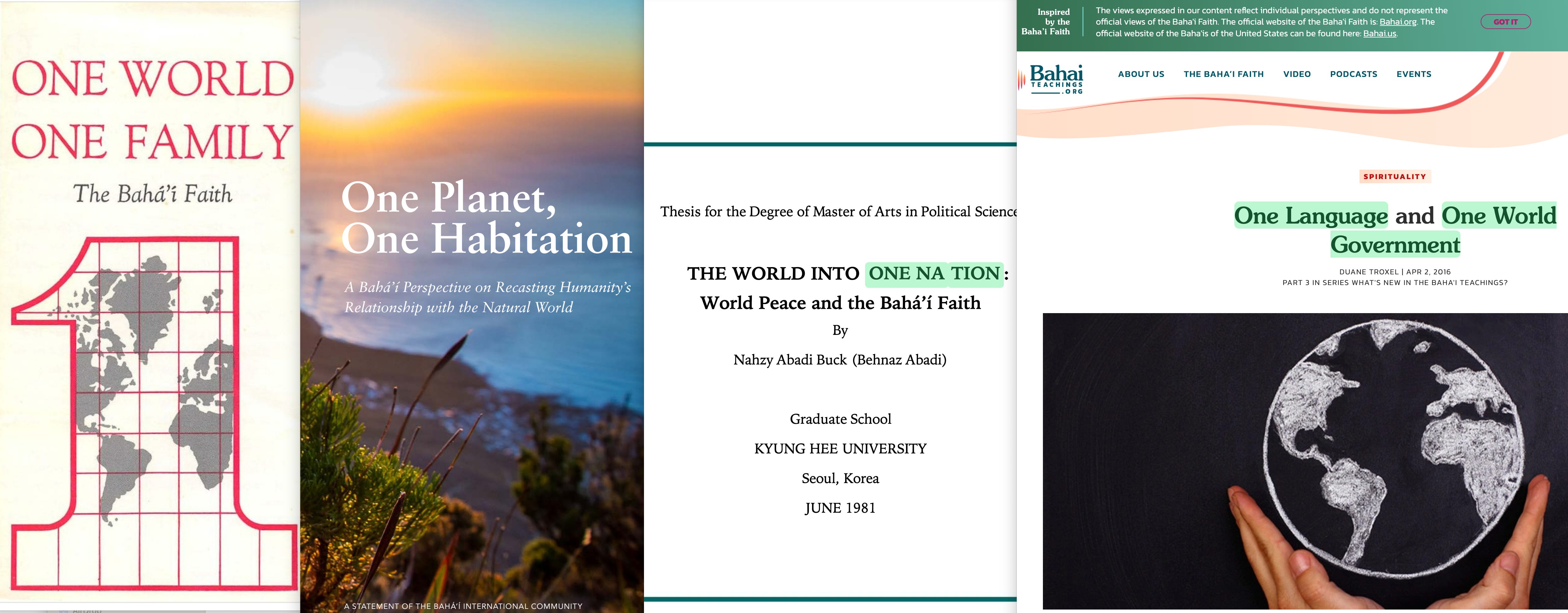
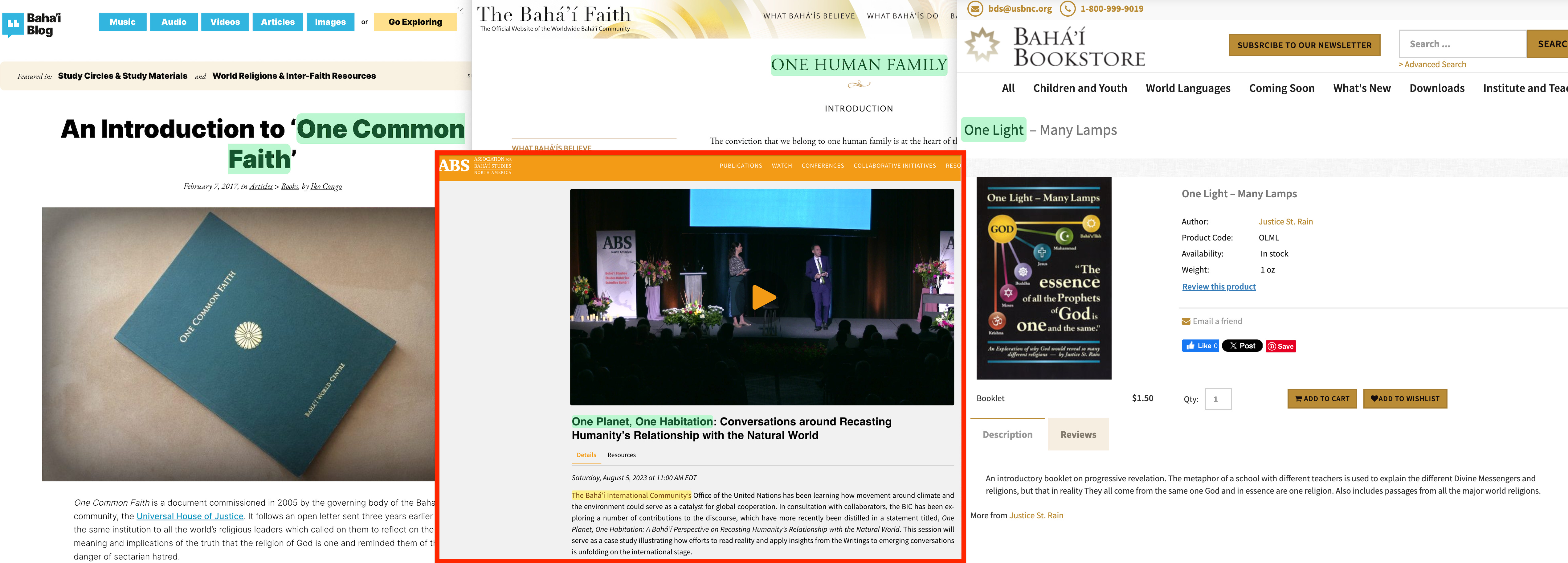
But the spiritual language wasn’t just decoration. The Bahá’í Faith, founded in 1844 — the same year as the telegraph and the Bank Charter Act — was built explicitly around the unification of humanity under a single global order: a universal ethic, a world tribunal, a universal currency, a universal language. From its earliest days it stated the destination the world should be moving toward: planetary moral unity run by universal institutions.
Its own governance structure mirrors the architecture exactly: no clergy, no individual interpretation of scripture, all authority flowing through a hierarchy of elected councils — local, national, international — ending at the Universal House of Justice. Its ethic is cosmopolitan — the oneness of humanity, individual identity giving way to collective unity. Viewed from the bottom up, the structure presents as subsidiarity. Seen from the top down, it’s a clearinghouse enforcing the ethic at every level.
In 1931, Shoghi Effendi published The Goal of a New World Order — describing a world super-state with ‘unchallengeable authority’, a supreme court with binding power, a single code of international law, the permanent removal of all economic barriers, the stripping back of national sovereignty as an ‘indispensable preliminary’, and forced compliance for any member that refuses. He framed the progression from family to tribe to city-state to nation to world commonwealth as the ‘consummation of human evolution’ — the same expanding circles of moral concern that the interfaith movement and Ken Wilber would later formalise. He specified that ‘nothing short of intense mental as well as physical agony’ could bring about the transformation — crisis as the trigger, the same logic that runs from the Club of Rome through Brundtland to the planetary boundaries framework. The architecture this essay documents was published as a spiritual blueprint more than a decade before the United Nations was even negotiated.
The Bahá’í International Community registered with the United Nations as an NGO in 1948, having kept a bureau at the League of Nations since 1926. It holds consultative status today across ECOSOC, UNICEF, and UNEP, with permanent offices at the UN in New York and Geneva. Its own literature describes a process in which Bahá’í texts are consulted, translated into the technical language of whatever policy area is relevant, and circulated as UN documents. The spiritual vision of 1844 entered the machinery of global governance through a documented, ongoing process — and the endpoint it described is indistinguishable from what the architecture is now producing through monetary enforcement.
There is no need to convince eight billion people to converge, and no need for them to believe. The architecture only needs control of the target and enforcement through the money. Deviation is penalised automatically, compliance rewarded automatically, and the range of permitted behaviour narrows. The Omega Point, whatever you want to call it, is the statistical endpoint of a steering mechanism that nobody voted for and nobody audits.


Conclusion
The complete sequence is compact.
The Bank Charter Act (1844) centralised the currency. The telegraph (1844) provided the communication network. Moses Hess (1845) connected money to moral purpose. The Communist Manifesto (1848) demanded the centralisation of credit. Rome and Jerusalem (1862) made sovereignty conditional on the ethic. Paul Carus (1893) made the ethic spiritually universal. Hermann Cohen (1904) cut it loose from the electorate. Pearson and Taylor made it measurable. Herzl and Lenin showed that the premise produces the same system regardless of ideology. Stafford Beer built the prototype in Chile. Alexander Bogdanov provided the universal organisational language. Norbert Wiener formalised the control theory. Kenneth Boulding closed the system. The 1968 UNESCO Biosphere Conference launched the programme of planetary management. James Lovelock gave the planet a biological identity. The Club of Rome and IIASA turned it into computer models. UNEP GEMS provided the surveillance. Brundtland made sustainability operational. Pearce and Turner named the circular economy. The BIS, Basel, FATF, and NGFS built the institutional machinery. The interfaith movement supplied the moral vocabulary that ESG now applies. The Council for Inclusive Capitalism merged the spiritual authority with the financial architecture. The SDGs boiled it down to 231 measurable indicators. The NGFS Scientific Advisory Committee handed the science to a body nobody can name. Programmable money enforces the standard at the point of sale. And the Bahá’í Faith (1844) described from the very start the endpoint of convergence.
One premise, 180 years of institution-building, and every transaction on the planet brought within reach of a target that was never debated, never voted on, and never visible.
The ethic was always the control mechanism. Money was always the primary enforcement tool. Everything else was implementation. Moses Hess told us so in 1845 — but he never told us that the ethic answers to whoever translates it into a standard.
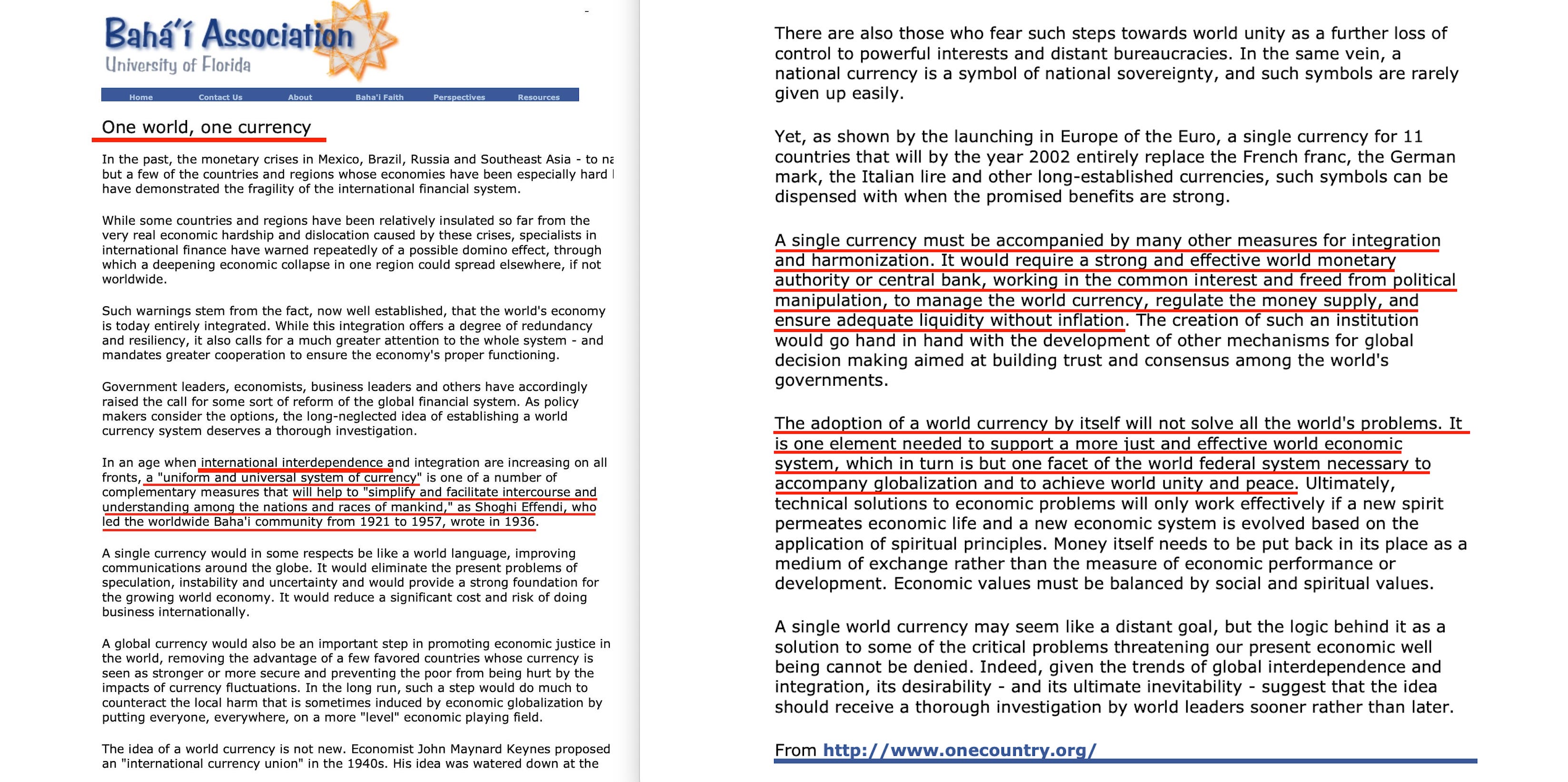
The Bahá’í Faith, founded in that same year of 1844, said so too. Shoghi Effendi’s Goal of a New World Order (1931) described the same destination. In 1955, the Bahá’í International Community formally submitted that blueprint to the United Nations during its first Charter review — calling for the elimination of the veto and the gradual creation of binding supranational authority. In 1995, Turning Point for All Nations reaffirmed the proposal and added a universal auxiliary language, the expansion of collective security to cover pandemics and food security, and called for a single international currency.
The spiritual vision and the institutional architecture don’t run side by side. They are the same programme, submitted again and again. And if you read the programme as a list of specifications, it reads something like this:
One ethic, one language, one nation, one world, one love of humanity… and one universal house of justice for one people of one faith — with one currency.
Whether that’s one coincidence too many I leave up to the reader.

Escape Key,
Another great review, as usual. And when you say this:
-------------------------------
"The entire moral vocabulary of global governance — sustainability, resilience, inclusion, responsibility — is a statistical process dressed in the language of virtue."
-------------------------------
It gets to the heart of the matter regarding "utilitarianism" -- a notion which has been categorized/classified as an ethic, even though it has no Theory of the Good.
Not knowing where Good comes from, it is not really an ethic, but merely masquerades as one for the purpose of societal control -- as you eloquently laid out.
Real ethics, such as Aristotle's Virtue Ethics, can tell you where Good comes from. Even wrong systems of ethics -- such as Subjectivism -- tell you where Good comes from (Good = following your current desires/feelings). But Utilitarianism, not even being a true system of ethics, is completely silent about where Good comes from.
The macro predicament facing humanity is the scale dependent maximization of negative sum game theoretic outcomes. By definition there are no market nor technical solutions to this predicament.
Extrication out of our predicament requires a fundamental re-working of the relations between individuals, and between individuals and the collective. In simple terms, we need a transcendent synthesis of the one-many dialectic for the dignity of each and the gestalt of the whole.
The control system you analyze is a quintessential reworking of the the relations between individuals, and between individuals and the collective. Reworking such relations does not mean their preservation. Indeed, as you have analyzed, reflexivity between individuals and the control system is all but abolished.
The abolishing of popular reflexivity is revealing; It shows that the dark-triad controllers have a fundamental impetus to maintain existing asymmetries between them and everyone else. Reflexivity between individuals and the collective, between those governed and those governing, and between whole and part is necessary for resolving the one-many dialectic.
Instead of resolving the one-many dialectic for the the dignity of each and the gestalt of the whole, we have a control system for the continuity of power asymmetry of the few and the irreflexive indignity of everyone else.
The diabolical and insidious nature of our thermodynamic and ecological predicament is that it is incompossible for the greatest good to be bestowed on the greatest number, such that the ethics of the lifeboat reign. Popular reflexivity is incompossible with lifeboat ethics, since the inclusion of the multitude in the water means the destruction of the lifeboat.
Our predicament is a nightmare scenario: Extrication from it necessities popular reflexivity yet popular reflexivity is incompossible with systemic boundary conditions.