
Epstein’s Seven

Seven research topics. Four layers. One system.
Nobody investigating the Epstein files has mapped the seven research topics onto what was actually built.
What follows does so.
Executive Summary
Four months after getting out of prison in 2009, Jeffrey Epstein sent an email laying out a plan to fund seven research projects. On the surface, they looked like the random interests of a wealthy guy — things like genetics, AI, happiness, the financial system, brain science, math, and political power. At the time, no one saw how they were connected.
This essay connects them. Because when you look at all seven together and compare them to what was actually built over the next ten years, they turn out to be parts of one big system: a new way of running global finance where money becomes programmable, every transaction is checked against social and environmental goals, and anything that doesn’t meet those goals can’t get funded.
The essay follows the trail from Epstein’s emails all the way to the financial rules and systems now being run through the Bank for International Settlements, global banking regulations, and digital currency projects around the world. It names the people, the money, the organisations, and the documents — all taken from files released by the Department of Justice.
The question it raises is straightforward: in a system where every pound, dollar, and yuan has to serve a centrally decided version of the ‘common good’, who gets to decide what ‘good’ means — and why did no one ever vote for them?


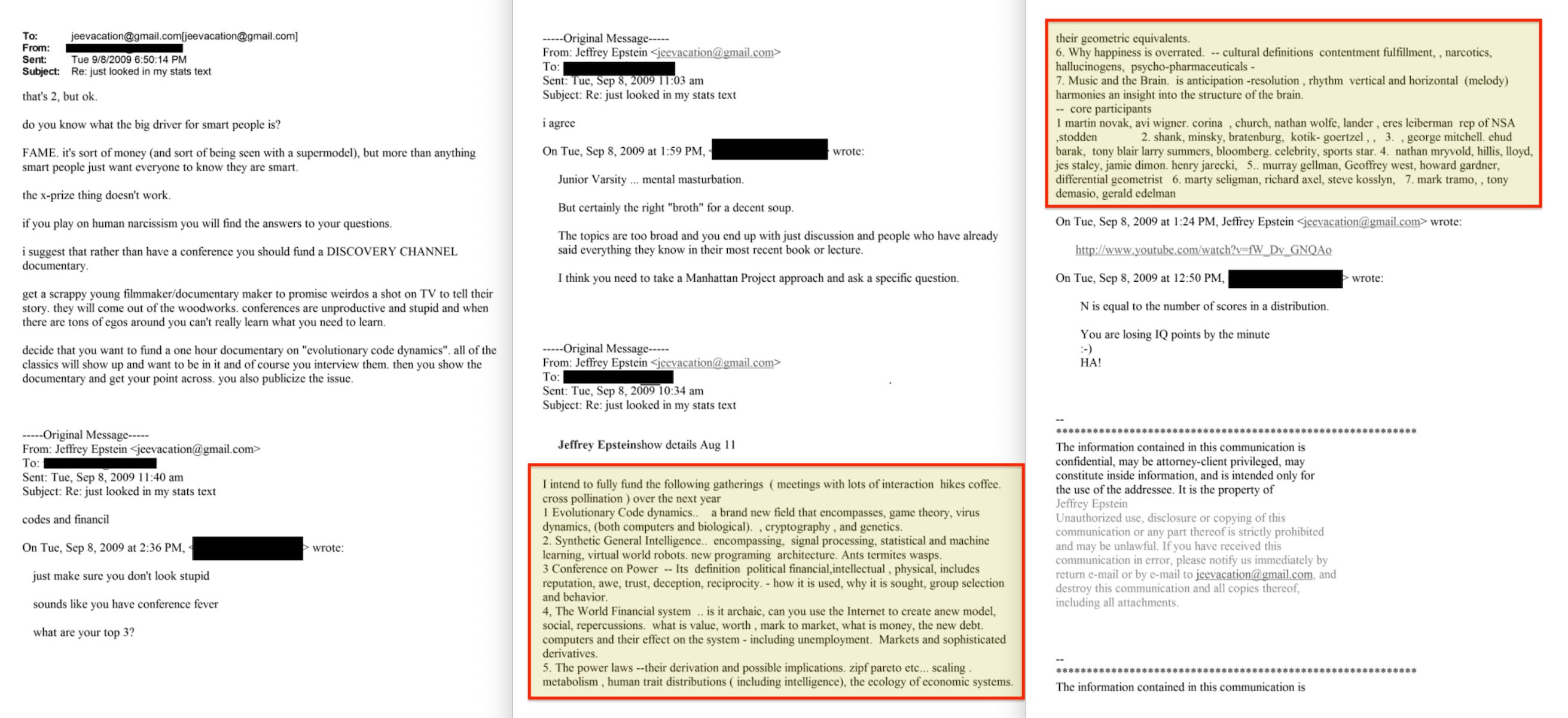
On August 11, 2009 — just four months after getting out of prison for an eighteen-month sentence for child prostitution charges — Jeffrey Epstein sent an email to John Brockman, a literary agent and the man behind the Edge Foundation. The subject line was ‘first pass’. The email was also sent to Barnaby Marsh, a researcher who studied currencies, and at least one other person. Epstein wrote1:
I intend to fully fund the following gatherings (meetings with lots of interaction hikes coffee. cross pollination) over the next year.
He listed seven research topics, each one with a suggested list of people to invite234. The email went to at least five confirmed people: Brockman, Marsh, physicist Lisa Randall, data scientist Victoria Stodden, and one other person whose name has been blacked out and is still classified.
The Seven Topics
The email laid out seven planned gatherings, each with a topic and a list of suggested guests:
Evolutionary Code Dynamics — ‘a brand new field that encompasses, game theory, virus dynamics, (both computers and biological), cryptography, and genetics’.
Proposed participants: Martin Nowak, Avi Wigderson, Corina Tarnita, George Church, Nathan Wolfe, Eric Lander, Erez Lieberman, a representative of the NSA, Victoria Stodden.Synthetic General Intelligence — ‘encompassing, signal processing, statistical and machine learning, virtual world robots. new programming architecture. Ants termites wasps’.
Proposed participants: Roger Shank, Marvin Minsky, Valentino Braitenberg, Ben Goertzel.Conference on Power — ‘Its definition political, financial, intellectual, physical, includes reputation, awe, trust, deception, reciprocity. How it is used, why it is sought, group selection and behavior’.
Proposed participants: George Mitchell, Ehud Barak, Tony Blair, Larry Summers, Michael Bloomberg, plus a ‘celebrity’ and a ‘sports star’.The World Financial System — ‘is it archaic, can you use the Internet to create a new model, social repercussions. What is value, worth, mark to market, what is money, the new debt. Computers and their effect on the system — including unemployment. Markets and sophisticated derivatives’.
Proposed participants: Nathan Myhrvold, Danny Hillis, Seth Lloyd, Jes Staley, Jamie Dimon, Henry Jarecki.The Power Laws — ‘their derivation and possible implications. Zipf, Pareto etc. Scaling. Metabolism, human trait distributions (including intelligence), the ecology of economic systems. Their geometric equivalents’.
Proposed participants: Murray Gell-Mann, Geoffrey West, Howard Gardner, plus an open slot for a ‘differential geometrist’.Why Happiness Is Overrated — ‘cultural definitions, contentment, fulfilment, narcotics, hallucinogens, psycho-pharmaceuticals’.
Proposed participants: Martin Seligman, Richard Axel, Steve Kosslyn.Music and the Brain — ‘is anticipation — resolution, rhythm vertical and horizontal (melody) harmonies an insight into the structure of the brain’.
Proposed participants: Mark Tramo, Antonio Damasio, Gerald Edelman.
The Annotations
The replies to Epstein’s email are just as interesting as the email itself.
Barnaby Marsh, the currency researcher, wrote his comments on the email in capital letters5. On Gathering 3 (about power), he added: ‘ONE MIGHT LOOK ALSO AT EMERGING TECHNOLOGY INCLUDING THE GROWING INFORMATION COMMONS, CONTROL OF THE MASSES VIA TECHNOLOGY/COMMUNICATIONS, AND IMPLICATIONS FOR THE POSSIBILITIES (AND DANGERS) OF ‘VIRTUAL DEMOCRACY’’.
On Gathering 6, he reframed the entire topic: ‘MORE PRODUCTIVE MIGHT BE MASTERY OVER THE INDIVIDUAL MIND — AND FOR SOCIETY, THE PROMISE OF EMOTIONAL MOTIVATION AND COORDINATION OF THE GREAT MASSES VIA ‘SPIRITUAL’ IDEALS. CAN BE VERY, VERY POWERFUL. BELIEFS SHAPE CIVILIZATION. TODAY THIS IS DONE IN A VERY PRIMITIVE WAY VIA ADVERTISING AND THE REINFORCING PROPERTIES OF CONSUMPTION AT DIFFERENT LEVELS OF MASLOW’S PYRAMID OF NEEDS. WE NEED NEW MODELS OF HAPPINESS, PERHAPS?’
Marsh saw something the others didn’t. He realised that Gatherings 3 and 6 were really the same project, just at different scales. Gathering 3 was about how power works on governments and big institutions. Gathering 6 was about how it works on ordinary people — how you shape what they want and how they feel. Both were about building ‘new models’ — new ways of running governments, keeping people satisfied, and getting them to go along with the programme.
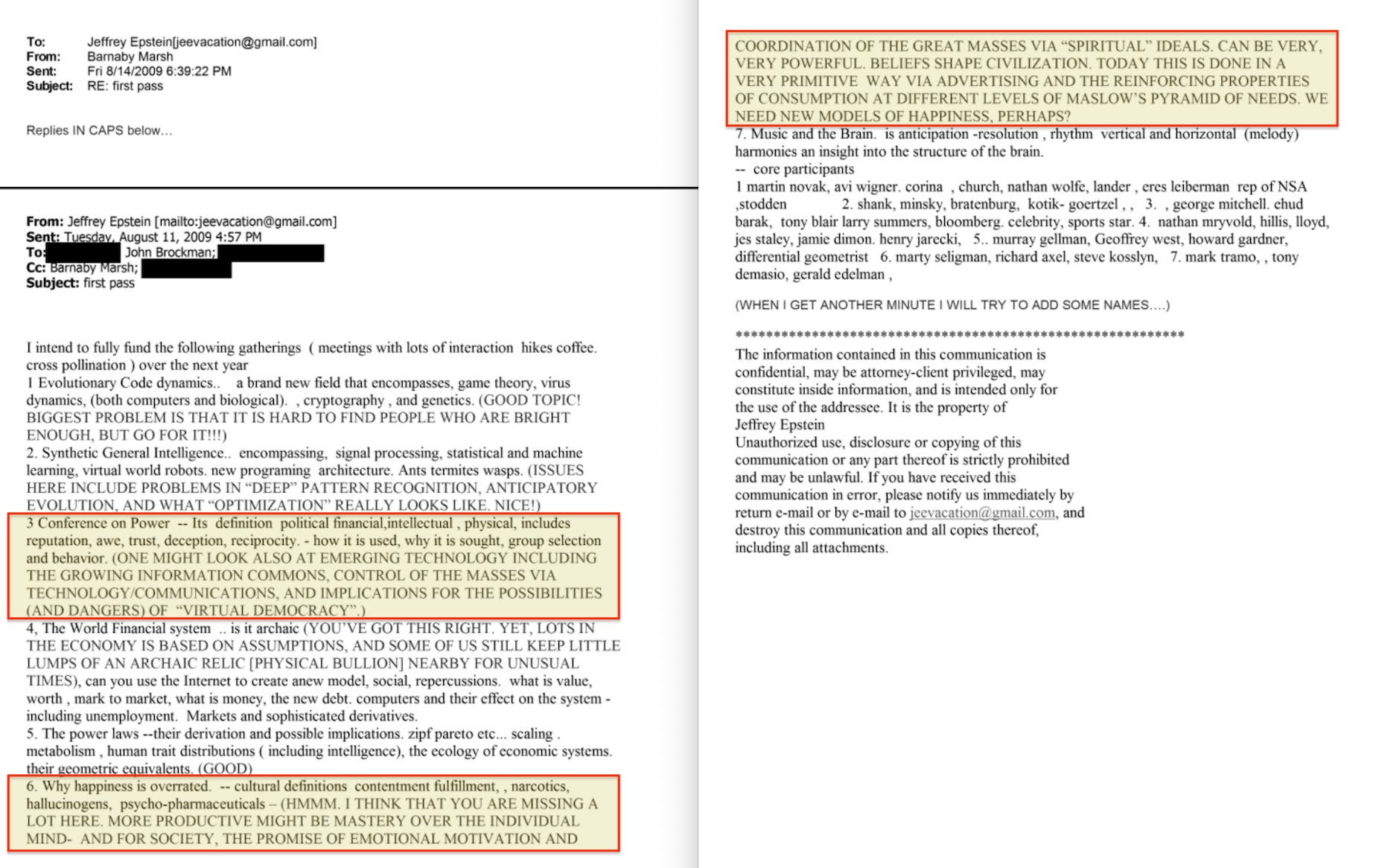
Lisa Randall, the Harvard physicist, noticed that Gatherings 3 and 4 were interchangeable6: ‘btw i find the interchangeability of aspects and participants of 3 and 4 noteworthy’. In other words, the gathering about power and the one about the financial system were basically two sides of the same coin — one laid out the ideas about how power works, and the other was about building the tool to use it.
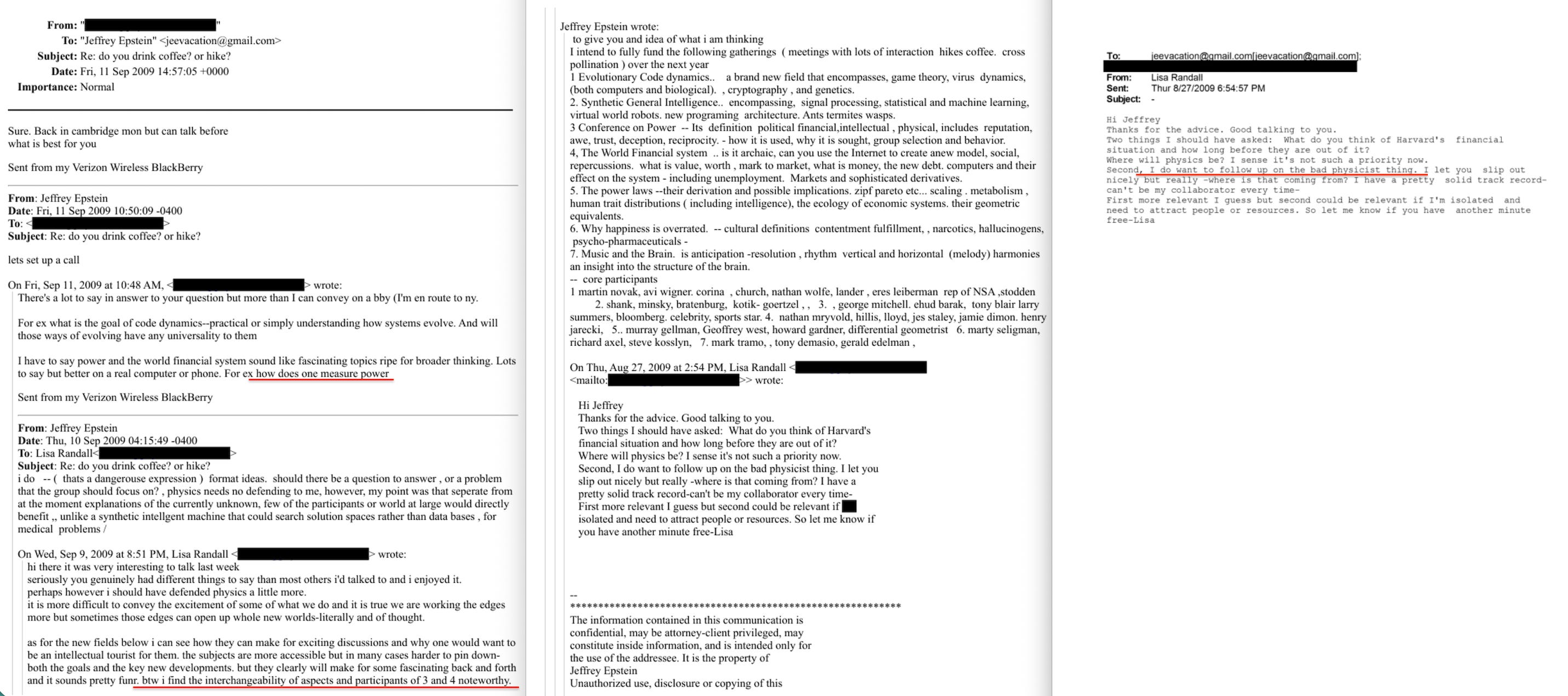
In a follow-up exchange, Randall asked7: ‘how does one measure power?’ — the actual research question behind Gathering 3. How do you put a number on things like influence, who owes whom a favour, and whether it's more effective to use trust or deception? It was essentially systems engineering — but applied to how people behave.
Randall read this email in September 2009 and immediately saw the connection between the power topic and the financial system topic, long before any of what came later had happened. Her other emails to Epstein are also telling — she asked him about Harvard’s finances and pushed back on him for calling her a ‘bad physicist’8 — which gives you a glimpse of how the recruitment side of things worked.
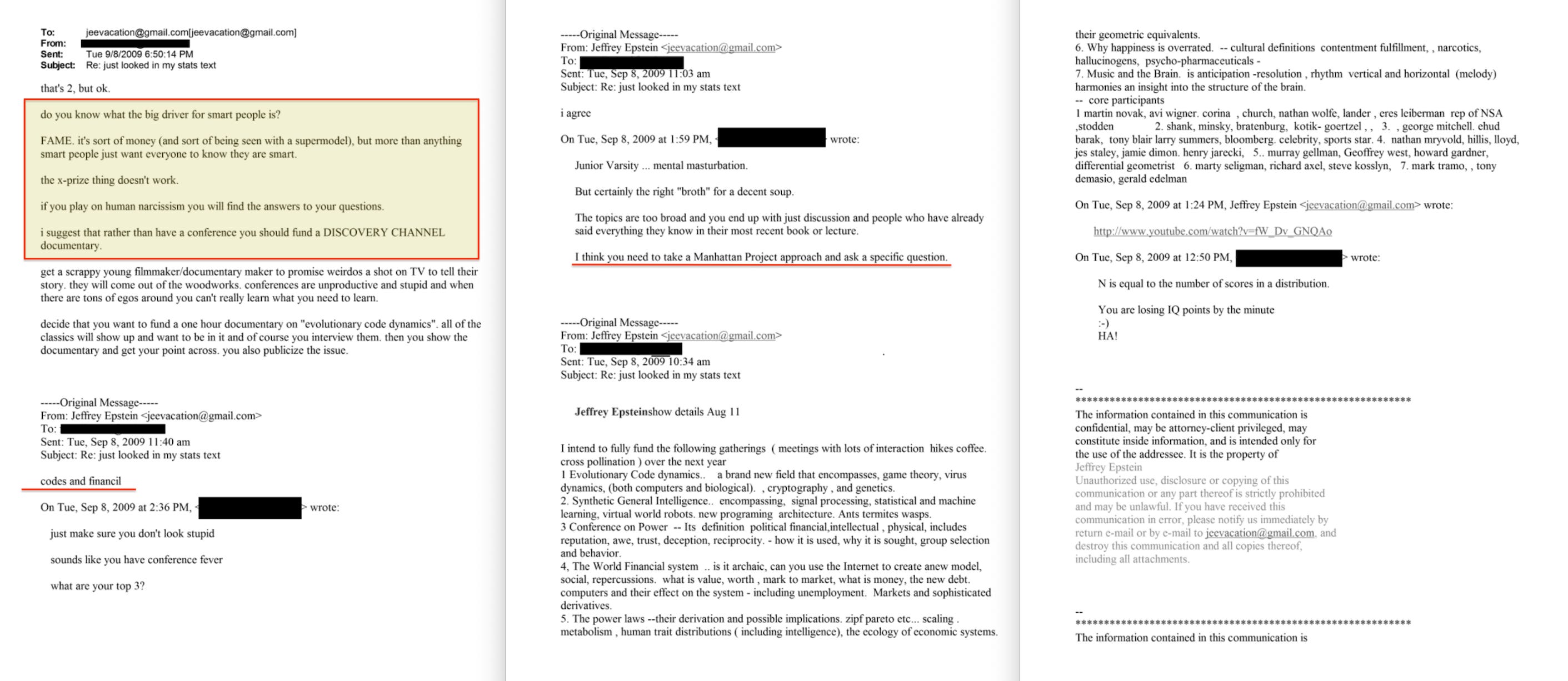
One of the people who replied had their name blacked out in the released files, and his response stood out9. He dismissed the whole idea of conferences — ‘conferences are unproductive and stupid and when there are tons of egos around you can’t really learn what you need to learn’ — and suggested a completely different approach. Instead, Epstein should fund a Discovery Channel documentary and use the scientists’ desire for fame to get what he needed: ‘The big driver for smart people is FAME... if you play on human narcissism you will find the answers to your questions’.
He recommended a ‘Manhattan Project approach’— pick specific questions you want answered, rather than having broad discussions. In other words, don’t hold a conference. Fund a documentary, play on the scientists’ egos, interview them one by one, and ‘you also publicize the issue’ at the same time. This was someone who knew how to get information out of people — give them something they want, control the setting, and extract what you need.
When this person asked Epstein to name his top three gatherings, the answer came back straight away: ‘codes and financil’. Gatherings 1 and 4 — cryptographic infrastructure and financial system redesign. These were the same two that would later be scheduled back to back.
Three different people, without talking to each other, all picked out cryptography and finance as the real heart of the whole programme. And Epstein’s own two-word answer — ‘codes and financil’ — was the most direct description of what the whole thing was really about that he ever put in writing.
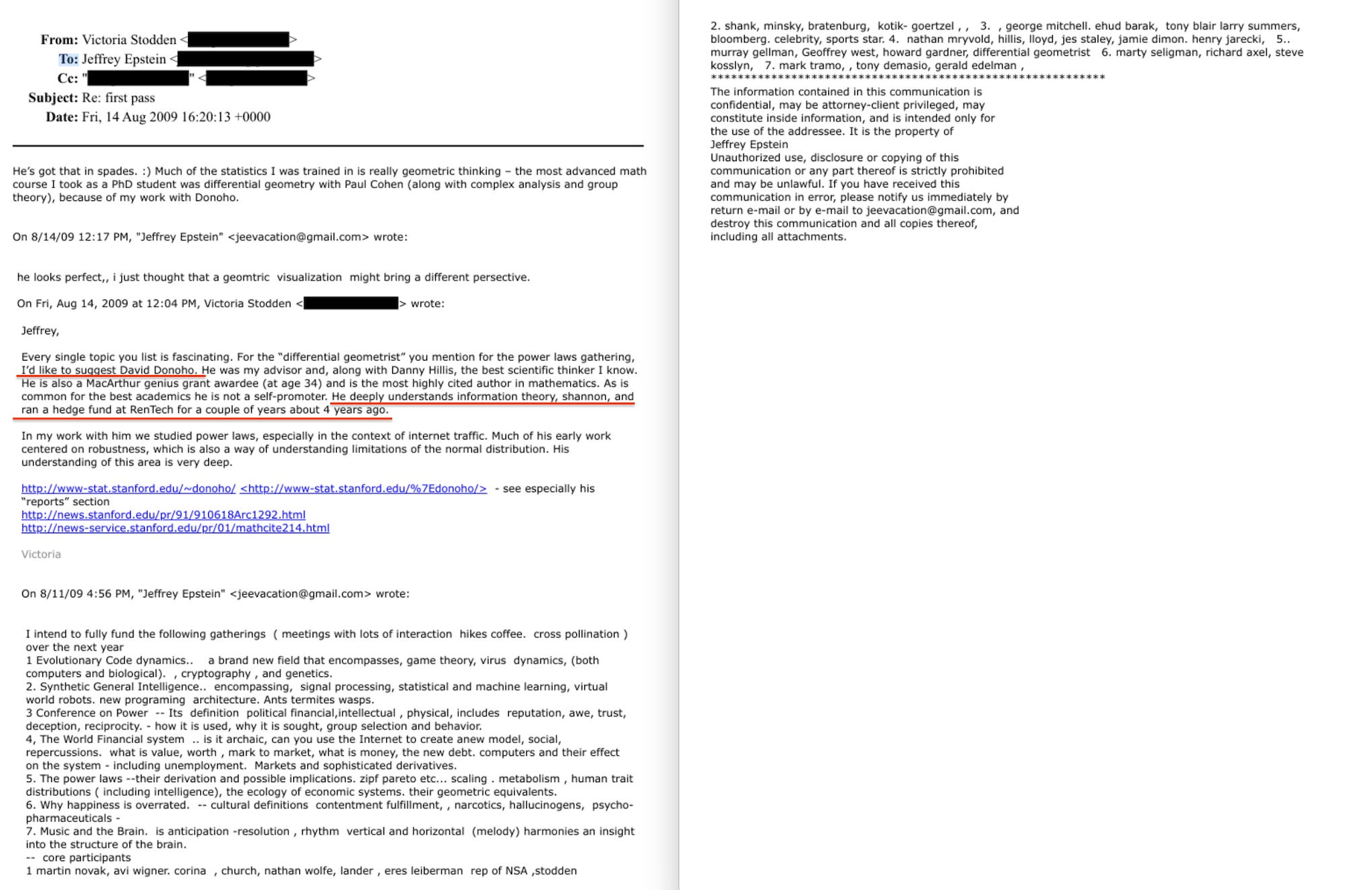
Victoria Stodden, who was listed as one of the key participants for Gathering 1, quickly got to work on the open slot. Gathering 5 needed a ‘differential geometrist’, and she suggested David Donoho from Stanford10 — a MacArthur fellow who, as she put it, ‘deeply understands information theory, Shannon, and ran a hedge fund at RenTech [Renaissance Technologies] for a couple of years’.
The Sourcing
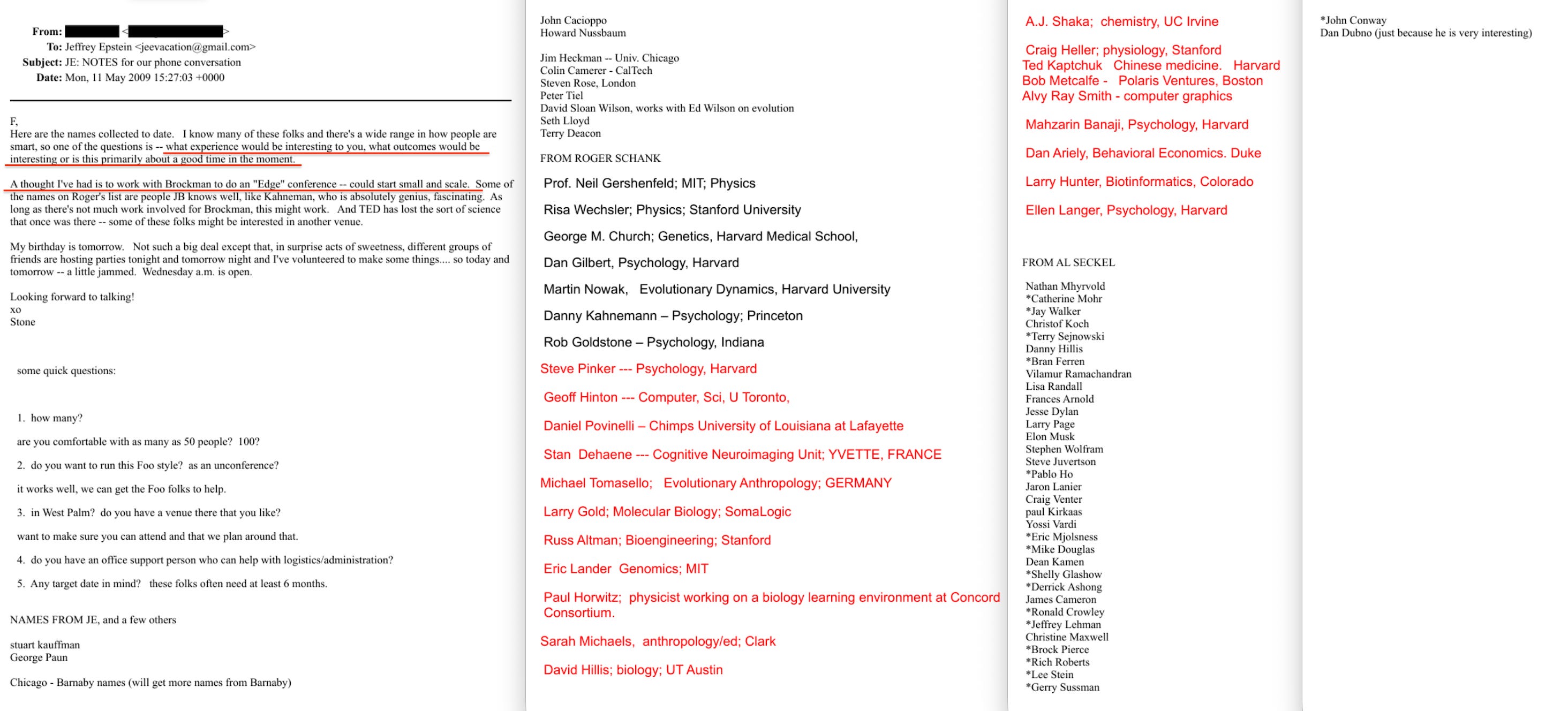
Three months before Epstein sent his email about the seven gatherings, a planning document from May 2009 shows how the whole thing was put together behind the scenes. Someone signing off as ‘Stone’ suggested the way to make it happen11: ‘work with Brockman to do an ‘Edge’ conference — could start small and scale’. She also cut straight to the point about what this was really for: ‘what experience would be interesting to you, what outcomes would be interesting or is this primarily about a good time in the moment’.
Attached to that email were three separate lists of people to recruit.
Epstein’s own list included Stuart Kauffman, Seth Lloyd, Martin Nowak, Peter Thiel, and ‘Chicago - Barnaby names’ — which confirms that Barnaby Marsh was helping find recruits from the very beginning. Roger Schank put together a list focused on AI and brain science: Geoff Hinton, Steven Pinker, Daniel Kahneman, Neil Gershenfeld, George Church, Eric Lander, Nowak again. Al Seckel's list covered the technology and applied science side: Nathan Myhrvold, Christof Koch, Danny Hillis, Frances Arnold, Larry Page, Elon Musk, Craig Venter, Stephen Wolfram — and Christine Maxwell by name.
So there were three separate pipelines all feeding into one programme.
Seckel’s list leaned toward people who built things — tech entrepreneurs and applied scientists.
Schank’s list focused on people who studied the mind — AI researchers and cognitive scientists.
Epstein’s own list targeted the people he already had a hold over — Nowak, Lloyd, the economics group in Chicago — plus Marsh as his specialist on currencies.
By August, when the programme email went out to Brockman, the recruiting was done. The seven gatherings weren’t just ideas Epstein came up with one day. They were the result of a three-month operation to find the right people, run through three separate channels, and pulled together into a single plan.
The Channel Already Running
Epstein didn’t start from nothing. John Brockman’s Edge Foundation was already doing work that covered at least four of the seven gathering topics before Epstein even sent his email.
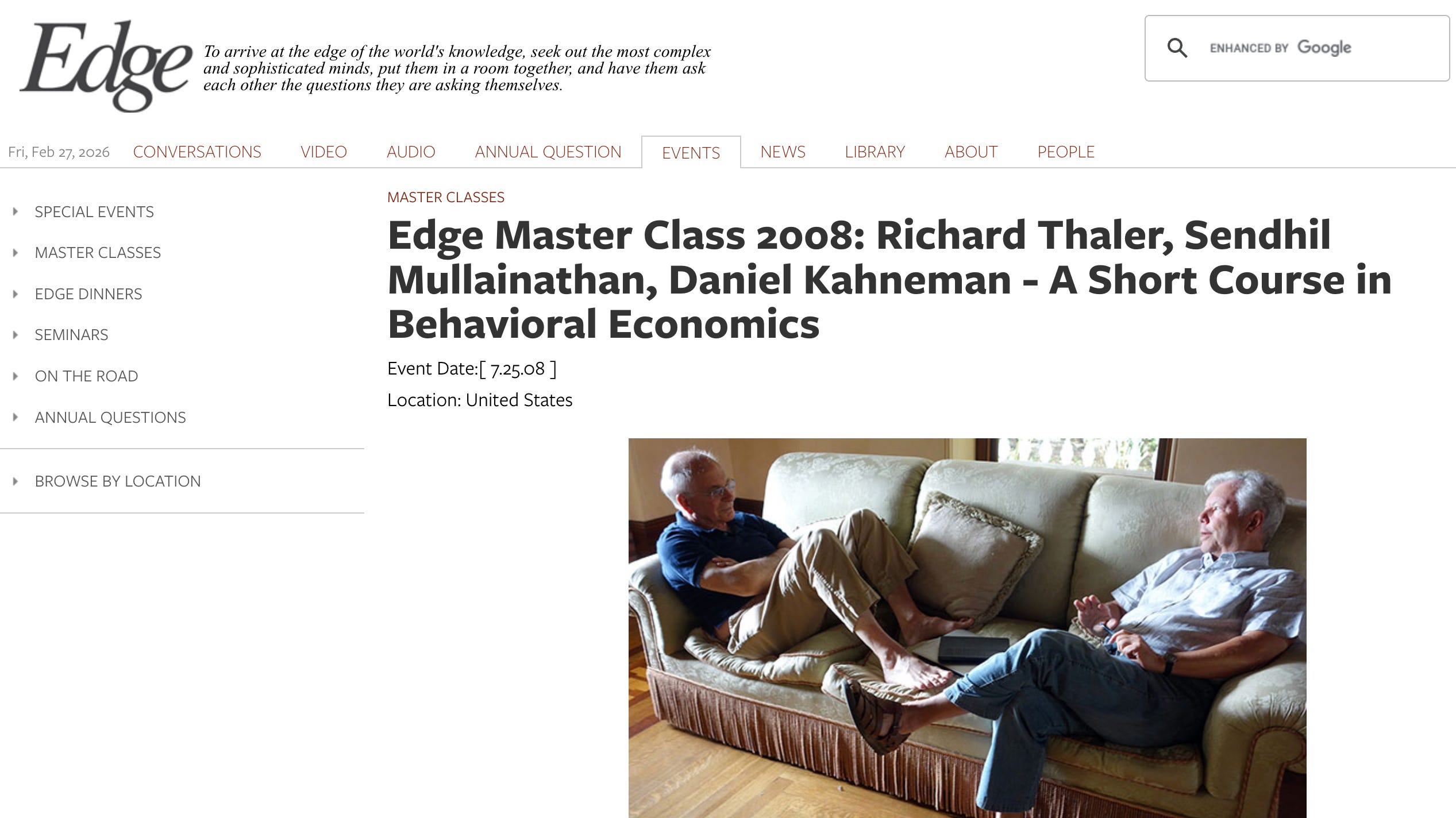
For example, on July 25-27, 2008, Edge held a Master Class in Sonoma, California12: ‘A Short Course in Behavioural Economics’, taught by Richard Thaler, Sendhil Mullainathan, and Daniel Kahneman. The six-part course covered things like how to design choices so people make the ‘right’ decision, how to make regulations readable by machines, the psychology of scarcity, and what Kahneman called ‘a technology emerging from behavioural economics’.
The participants: Jeff Bezos, Elon Musk, Nathan Myhrvold, Danny Hillis, Sean Parker, Salar Kamangar, Paul Romer.
In other words, the science of nudging people — getting them to behave in certain ways without them really noticing, which was the foundation of Gathering 6’s ideas about shaping behaviour — was being taught directly to the people who would go on to build the digital platforms where those techniques would actually be used on millions of people.
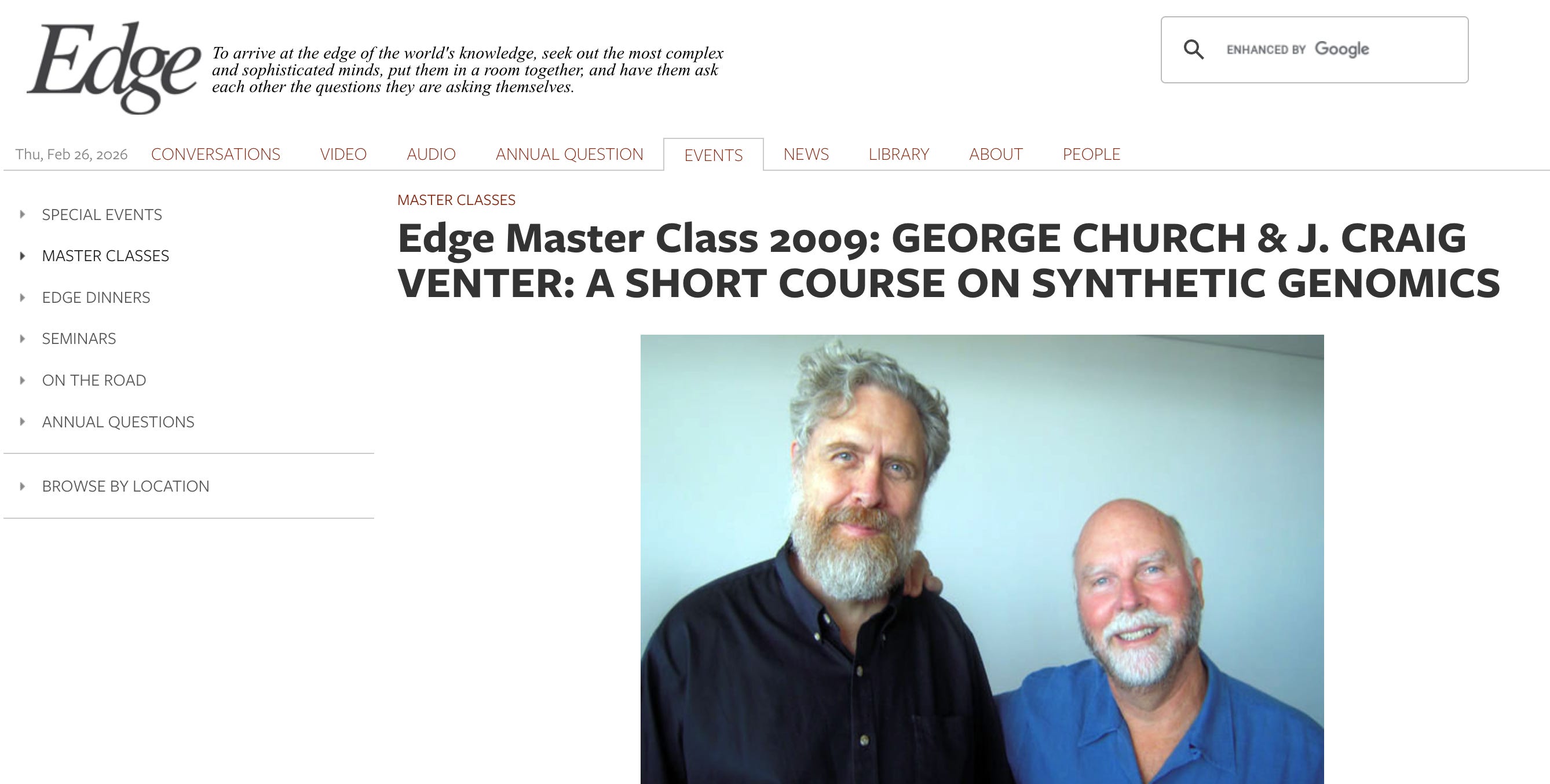
One year later, on July 24-26, 2009, Edge held a second Master Class13: ‘A Short Course on Synthetic Genomics’, taught by George Church and Craig Venter. It was held at the Andaz Hotel in West Hollywood and at SpaceX near LAX.
The participants: Musk, Larry Page, Hillis, Myhrvold, Thaler, Sam Harris, Sean Parker, Stewart Brand, Thomas Kalil from the White House Office of Science and Technology Policy.
Church and Venter showed how genetic code could be read into computers, changed, and then turned back into living organisms. This was essentially Gathering 1 — the one about evolutionary code dynamics, where biology and computing meet — and it had already been presented just sixteen days before Epstein sent his programme email.
It’s not just the people who showed up that matters — the timing is important too. The 2008 class covered the same ideas as Gathering 6 (about happiness and behaviour). The 2009 class covered the same ground as Gathering 1 (about code and genetics). And both classes drew from the same pool of people who would later show up on the programme email and on the Seckel and Schank recruitment lists.
So Brockman’s Edge Master Classes were already doing what Epstein’s programme proposed — bringing the same people together, around the same topics, in the same invite-only setting. What Epstein’s email added were the parts that Brockman’s public operation couldn’t go near: Gathering 3, which brought in heads of state and intelligence figures to talk about power; Gathering 4, which brought in JPMorgan executives and the former Treasury Secretary to redesign the financial system; and — most importantly — a plan to tie all seven tracks together into one funded programme.
The Delivery
In practice, the seven gatherings weren’t held as seven separate events. They were combined into fewer meetings, split between two venues and run by two different organisers.
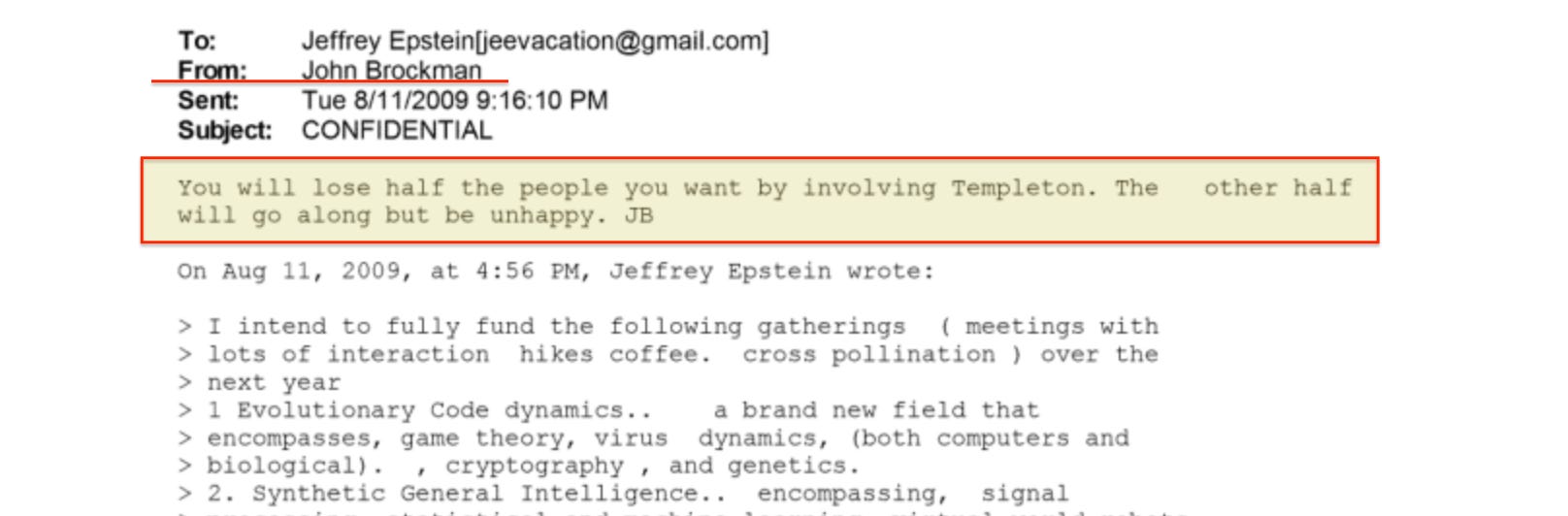
Brockman’s side handled the political and financial gatherings. This made sense — Epstein’s foundations linked to Edge had provided $638,000 of the Edge Foundation’s total $857,000 in funding between 2001 and 201714. Through Brockman’s network, the programme reached the people on the guest lists for Gatherings 3 and 4: Ehud Barak, Tony Blair, Larry Summers, Jamie Dimon, Jes Staley, and Michael Bloomberg. When Brockman replied to the programme email, he wrote15: ‘You will lose half the people you want by involving Templeton’. That wasn’t him pushing back on the plan itself — it was a practical note about branding.
His worry was that linking the gatherings to the Templeton Foundation16 — an organisation that funds research where science meets questions about meaning and purpose — would put off the serious scientists Epstein needed to attract. The programme itself? Brockman had no problem with that.
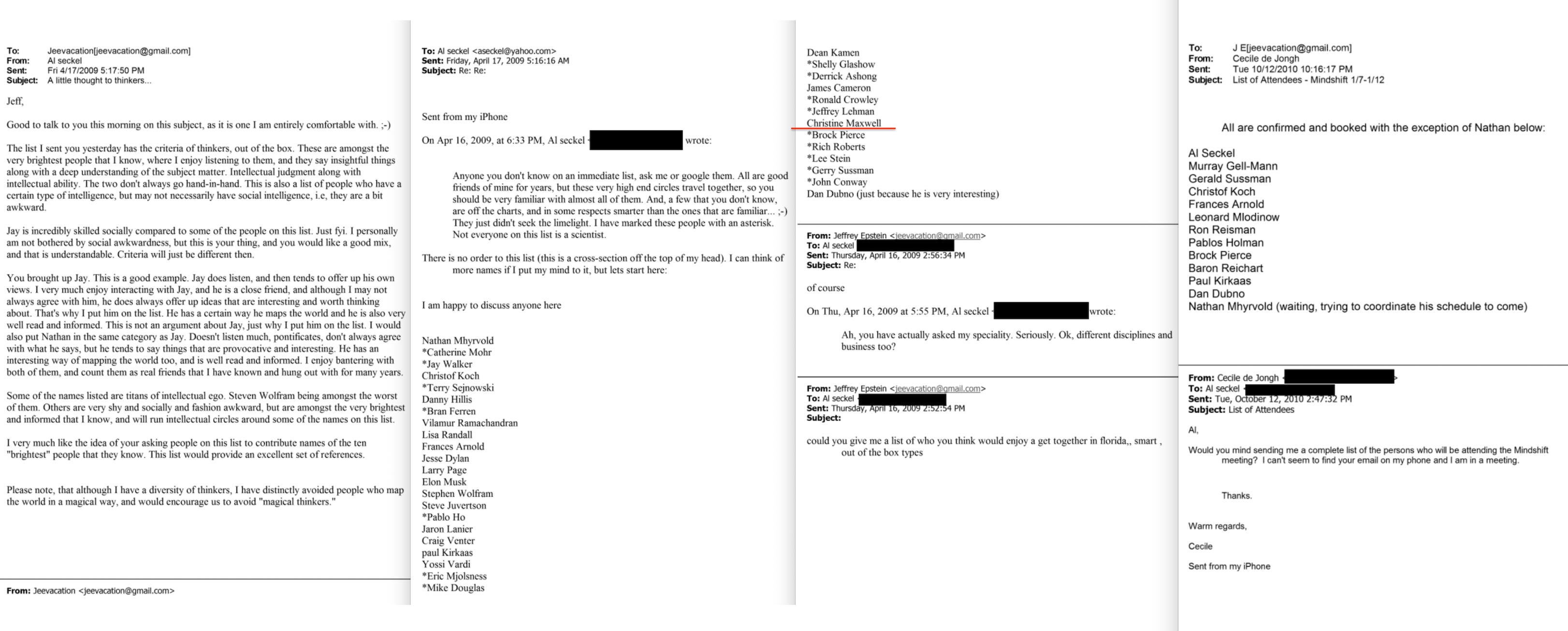
The science-focused gatherings were handled by Al Seckel, who was Isabel Maxwell’s partner. Seckel organised ‘Mindshift’ conferences on Epstein’s private island. In November 2010, he emailed Epstein a proposed schedule for a two-day event17.
Day One: Artificial Intelligence, Complexity Theory, New Trends in Theoretical Physics, Evolutionary Biology, Cognitive Neuroscience.
Day Two: Minimally Invasive Surgery, Encryption and Decryption, New Financial Systems and Methods, Emerging Technologies.
The most important thing to notice is what was put together on Day Two. Encryption and new financial systems were placed back to back — the same day, the same session block. These matched Gatherings 1 and 4 from Epstein’s original email, and they were being worked on together as parts of the same problem. Day One, meanwhile, covered the AI, complexity, biology, and brain science topics — matching Gatherings 2, 5, 6, and 7. So the whole programme was there across two days, just reorganised by how the pieces fit together rather than by their original numbering.
Epstein’s reply to Seckel was revealing: ‘we need a real ageda time hour by hour.. security requireds’. He wanted tight control over the schedule, and he justified it by saying it was about ‘security’.
Seckel asked: ‘Will you be taping these sessions? Good idea for the blog’. That was the cover story — make it look like one of those Edge-style intellectual events with content you could post publicly. But separately, Epstein arranged to have private, one-on-one interviews with the scientists filmed during their visits18 — which clearly served a very different purpose.
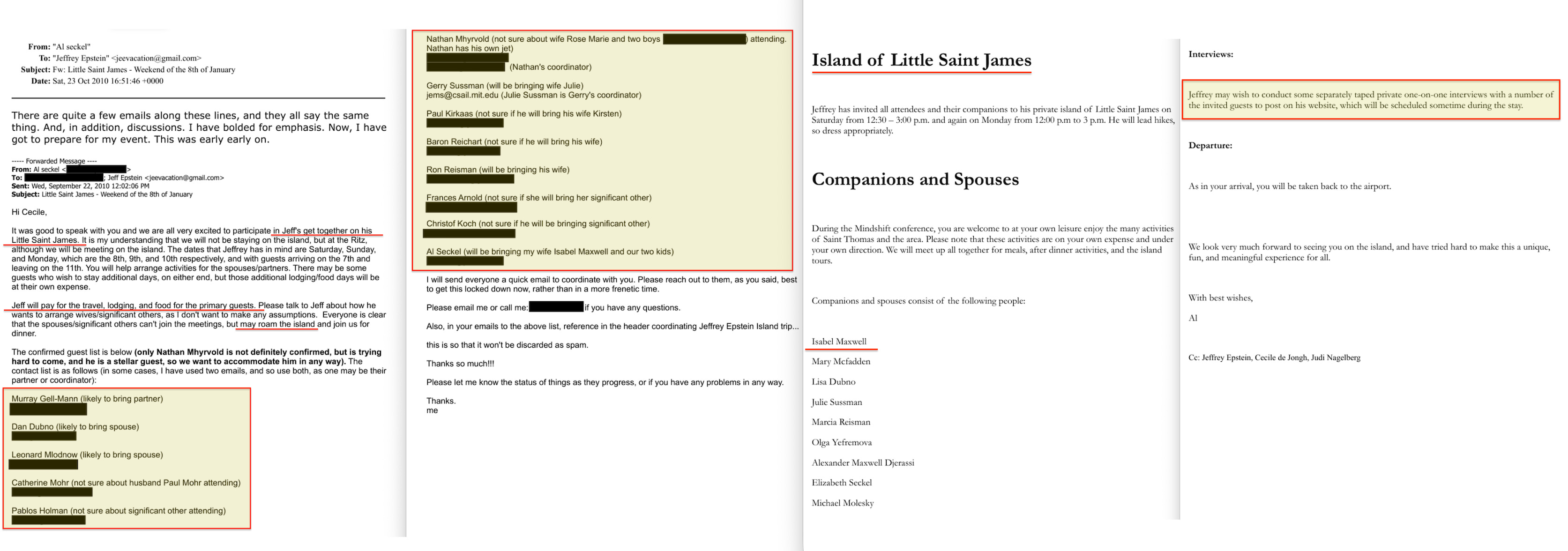
The guest list for the January 2011 Mindshift event on the island shows that the people from Epstein’s original programme email were actually being brought in. A logistics email from October 2010 lists who was coming19: Murray Gell-Mann (Gathering 5), Nathan Myhrvold (Gathering 4), Danny Hillis (Gathering 4), Christof Koch (neuroscience), Frances Arnold (evolutionary biology), Gerald Sussman (AI and computation), Dan Dubno, Catherine Mohr, Pablos Holman, Paul Kirkaas, Leonard Mlodinow, and Brock Pierce.
Everything was tightly controlled. Epstein paid for flights, accommodation, and meals. Spouses were excluded from meetings but could ‘roam the island and join us for dinner’. The meetings happened on the island itself, while guests stayed at the Ritz — keeping the work separate from the accommodation, with managed access the whole time.
And then there’s what was at the bottom of the guest list. Seckel confirmed he’d bring ‘my wife Isabel Maxwell and our two kids’. Isabel Maxwell — Robert Maxwell’s daughter and Ghislaine Maxwell’s sister. Her sister Christine Maxwell sat on the board of the Santa Fe Institute, where Gell-Mann worked20. And Isabel was married to the man running the whole scientific recruitment pipeline to the island.
The Maxwell family wasn’t just connected to this — they were built into the infrastructure on both the science side and the institutional side, a full generation after their father Robert Maxwell had passed away.
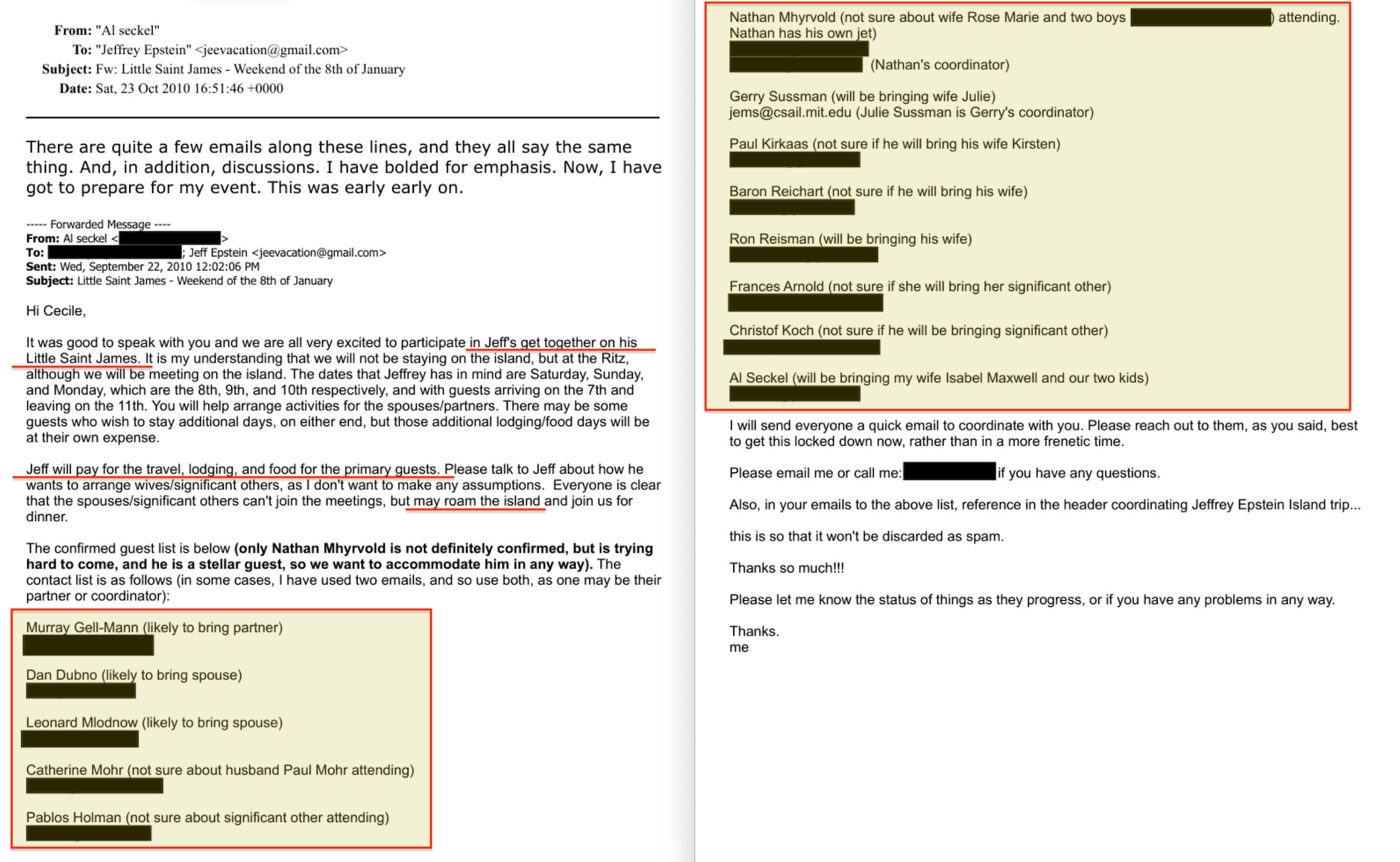
When you compare Seckel’s recruitment list from April 200921 with the guest list for the January 2011 Mindshift event22, about ten out of roughly thirty-five names on the original list actually made it to the island within two years23: Nathan Myhrvold, Catherine Mohr, Christof Koch, Danny Hillis, Frances Arnold, Pablos Holman, Paul Kirkaas, Gerald Sussman, Brock Pierce, Dan Dubno, … with Christine Maxwell being included on the original list.
The Funding Portfolio
While the gatherings brought people together, Epstein’s funding paid for the actual research. Each project he funded lines up with a specific piece of the system the gatherings were designed to build.
Cryptographic infrastructure (Gathering 1): Madars Virza24 received funding for research on zero-knowledge proofs — cryptographic techniques allowing verification without revealing underlying data. Epstein’s foundation described this as useful ‘especially for vaccines’. Zero-knowledge proofs are foundational to privacy-preserving digital currency verification.
Artificial intelligence (Gathering 2): Ben Goertzel25 received funding for OpenCog, an open-source artificial general intelligence framework. Goertzel thanked Epstein in his 2014 book for ‘visionary funding of my AGI research’26. Joscha Bach27 received approximately $300,000 for work at the MIT Media Lab. His MicroPsi project developed ‘emotionally driven agents’ — AI systems modelling human cognition and behaviour. In December 2016, Bach described to Epstein what might replace failing Western institutions: ‘Our best bet currently seems to be AI: an API for integrating all fields of knowledge and control’. In 2023, the BIS Innovation Hub and the Bank of England completed Project Rosalind — an API layer connecting central bank digital currency to private sector applications, enabling programmable restrictions on transactions.
Behavioural modelling (Gatherings 2, 5, 6): Martin Nowak28 received $6.5 million to establish the Program for Evolutionary Dynamics at Harvard, studying how cooperation and competition evolve under different incentive structures — the theoretical basis for designing conditionality that shapes behaviour at scale. Nicholas Christakis received funding for research on ‘artificial societies of real people’29 and AI systems shaping group behaviour through carefully positioned bots30.
Evolutionary dynamics and power laws (Gatherings 1, 5): Nowak’s programme and the Santa Fe Institute — where Christine Maxwell sat on the board and Epstein funded research — studied exactly the scaling laws, ecological dynamics, and network effects described in Gatherings 1 and 5.
Neuroscience and cognition (Gatherings 6, 7): Mark Tramo31 received approximately $200,000 for research on music and the brain32. Epstein funded the creation of his Institute for Music and Brain Science. Marvin Minsky33, co-founder of MIT’s AI laboratory, organised two academic symposia on Epstein’s island.
Digital currency infrastructure: The MIT Media Lab housed the Digital Currency Initiative — the research group that in 2020 partnered with the Federal Reserve Bank of Boston to build Project Hamilton, a prototype central bank digital currency system capable of handling 1.7 million transactions per second. Joi Ito, who directed the Media Lab, received Epstein funding34 channelled through intermediaries. Epstein’s money flowed into the institution that built the Federal Reserve’s CBDC prototype.
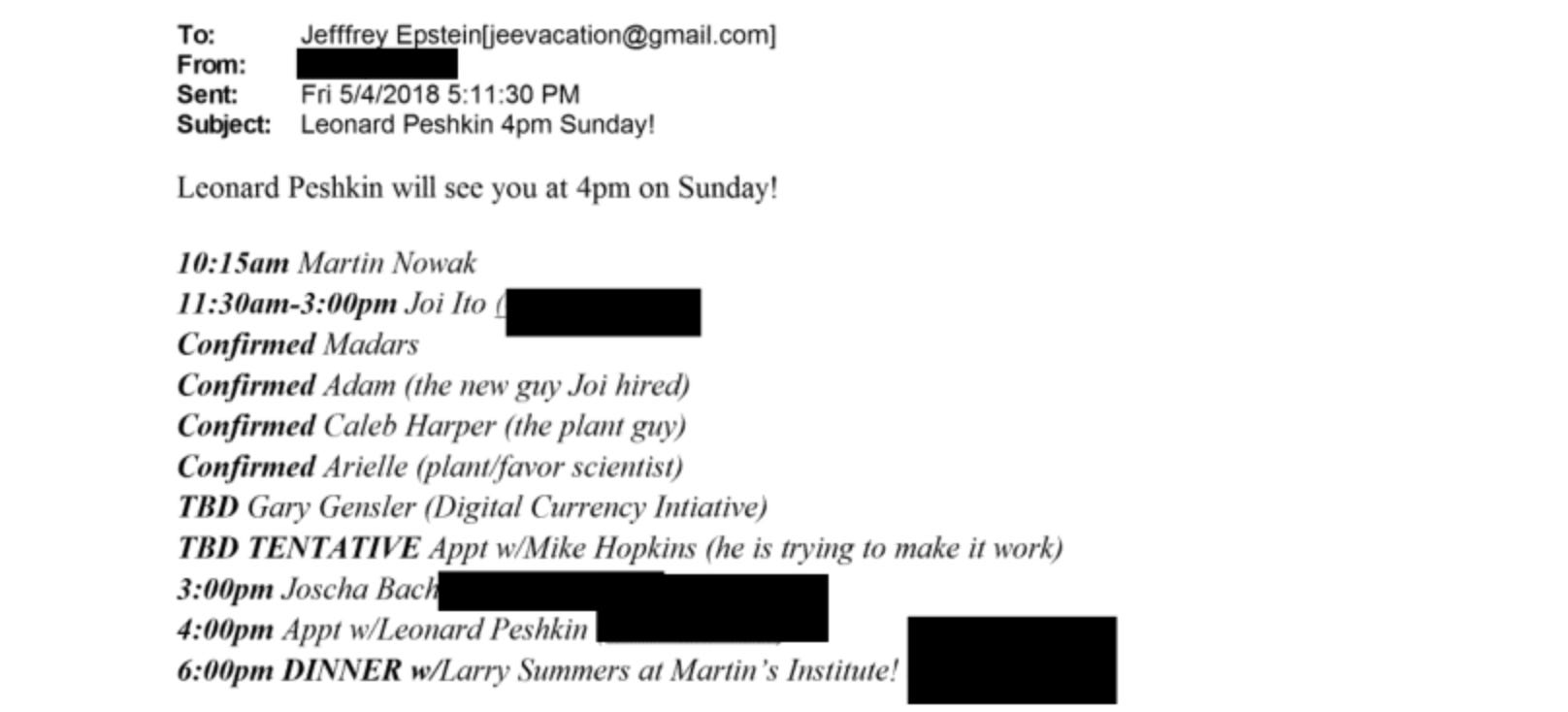
A scheduling document from May 2018 pulls the whole picture into focus35. In a single afternoon: Nowak at 10:15 AM, Joi Ito and Virza from 11:30 AM, Bach at 3:00 PM, then dinner with Larry Summers at Nowak’s institute at 6:00 PM
AI classification, behavioural modelling, zero-knowledge cryptography, and the former Treasury Secretary who had written the digital currency plan — all brought together at the institute Epstein’s money had built, just fourteen months before he was arrested.


The Unified Ledger
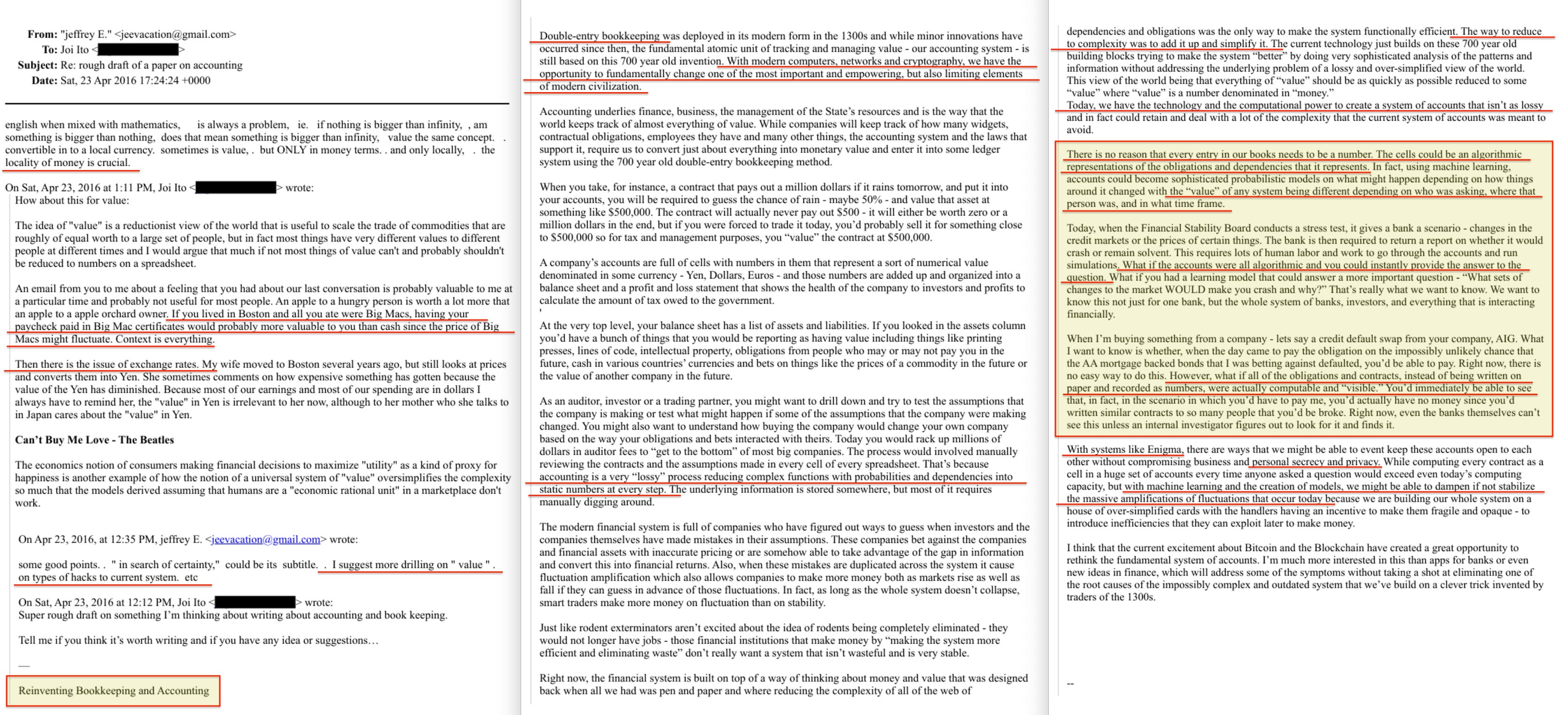
On April 23, 2016 — three weeks after Summers emailed Epstein the sovereign digital currency specification — Joi Ito sent Epstein a draft paper titled ‘Reinventing Bookkeeping and Accounting’36, asking whether it was ‘worth writing’ and requesting ‘suggestions’.
The paper proposed getting rid of the entire global accounting system and replacing it with one run by algorithms, where every account is visible to computers. Instead of numbers written in a ledger, every contract becomes code that can run automatically. Machine learning would monitor risk across the whole system in real time. So when the Financial Stability Board runs a stress test on the banking system, the system already has the answer — no need for auditors, no manual checking, no waiting around.
This is essentially what the Bank for International Settlements now calls a ‘unified ledger’. Ito went even further: he argued that the value of something shouldn’t be a fixed number in pounds or dollars anymore. Instead, it should change depending on context — who’s asking, where they are, and what time period they’re looking at. And privacy-preserving technology — Ito specifically named Enigma, an MIT project closely related to Virza’s zero-knowledge proof work — would let accounts be ‘open to each other without compromising business and personal secrecy’. In other words, the system can see everything, but no individual person or company appears to be looking at anyone else’s books.
That last part is the most important. If the value of something is worked out by an algorithm rather than being a fixed number, then value becomes conditional — it can change depending on who holds it, where they are, what they want to use it for, and whether they’ve met whatever rules are in place. What Ito was describing is basically the accounting system that programmable money would need to run on — the unified ledger on which Summers’s digital currency would operate.

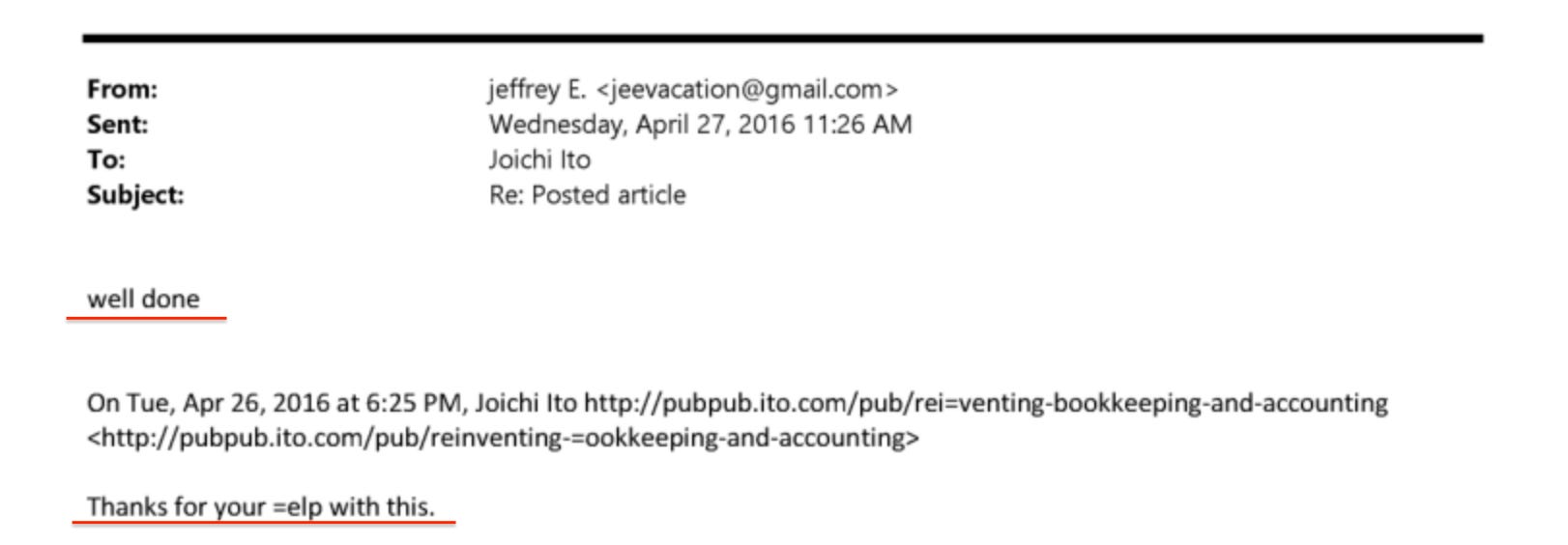
Epstein wrote back with specific directions: focus on ‘value’, look at ‘hacks to current system’, and ‘in search of certainty could be its subtitle’. Ito wrote an expanded section on value, following the brief. Epstein then added a key idea — ‘the locality of money is crucial’37 — pinpointing the central design challenge of a programmable currency whose conditions change depending on who holds it, where they are, and under what terms.
Three days later, on April 26, Ito published the paper on PubPub with the title ‘Reinventing Bookkeeping and Accounting (In Search of Certainty)’38. Epstein’s suggested subtitle, used word for word. The paper is still live under Ito’s name, with no mention of Epstein’s role in shaping it. But Epstein didn’t mind39.
The paper connects to the bigger picture in three ways. First, looking back to Epstein’s original programme email: Gathering 4 asked ‘can you use the Internet to create a new model’ for the world financial system, and Ito’s paper is essentially a technical answer to that question. Second, looking sideways to Summers: in that same month, April 201640, Epstein received the digital currency plan from the former Treasury Secretary and edited the infrastructure paper from the director of the MIT Media Lab — two parts of the same system landing on the same desk just three weeks apart. One described what the money would do. The other described how the system behind it would process it.
And third, looking forward to what actually got built. In June 2023, the Bank for International Settlements published ‘Blueprint for the Future Monetary System’41 — the unified ledger. It described tokenised assets, programmable contracts, conditional logic, real-time settlement, and central bank money sitting alongside commercial bank money on a single platform.
Ito had described that same architecture seven years earlier, and Epstein was editing the draft.


The 2013 Graduation Ceremony
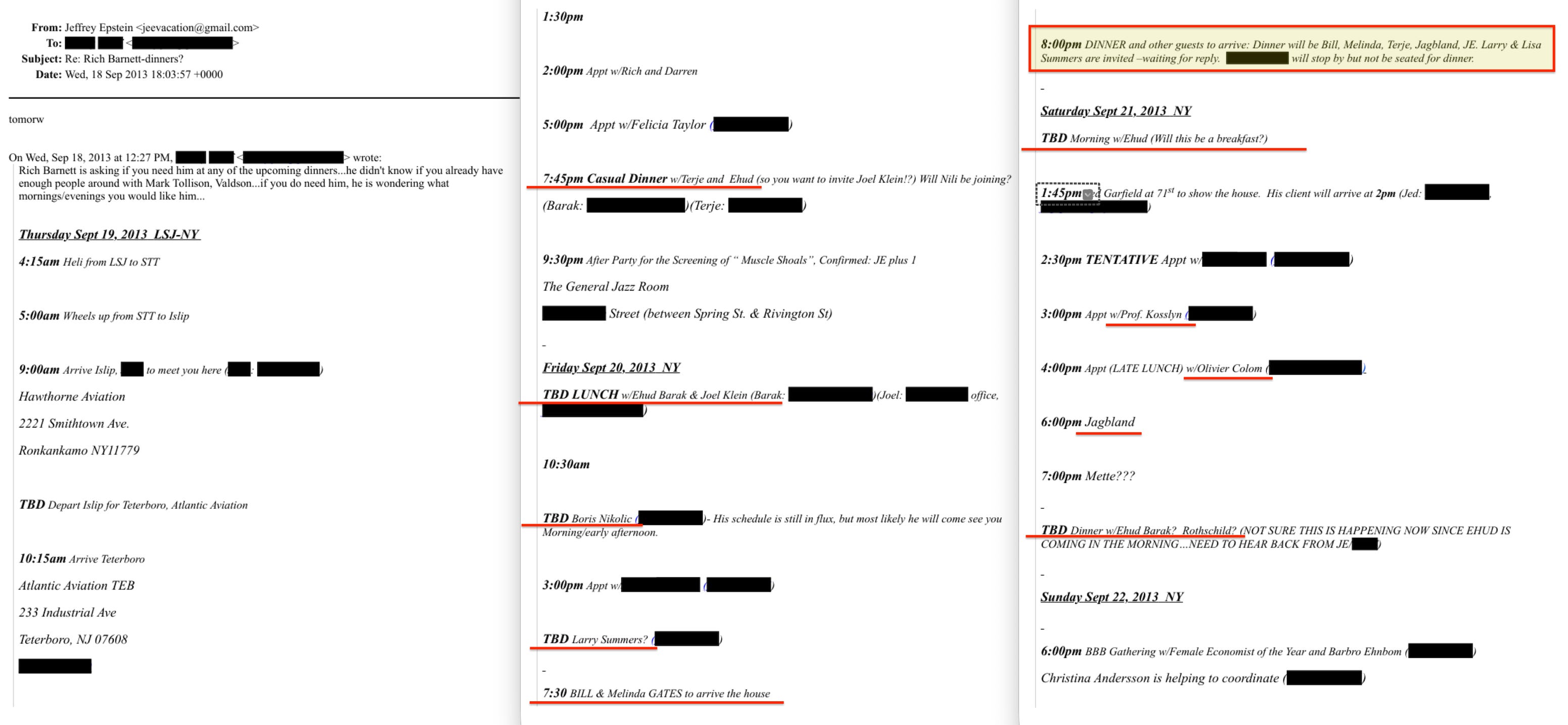
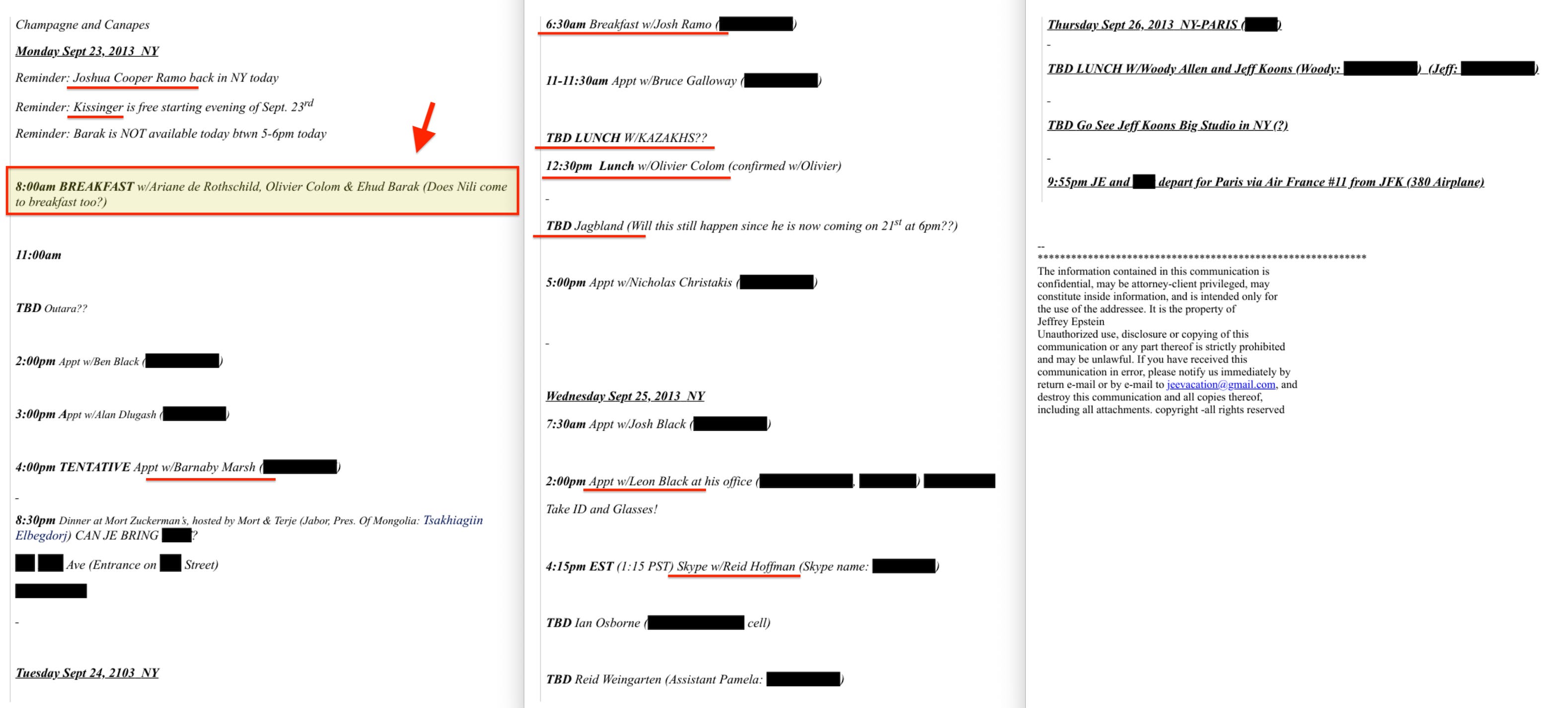
In September 2013, the programme reached proof of concept. Over a week of meetings at Epstein’s Manhattan townhouse, the key people were brought together to start turning the research from the gatherings into something that could actually be developed and put to use42.
Monday, September 16: Ehud Barak confirmed that India’s biometric digital identity pilot — Aadhaar, linking a billion citizens to financial services — had succeeded on August 10, five weeks earlier. Bill Gates, Larry Summers, and Boris Nikolic were present.
During the week: Ariane de Rothschild and Olivier Colom opened the Edmond de Rothschild financial channel. Colom met twice in one week. Thorbjørn Jagland, Secretary General of the Council of Europe, attended. The President of Mongolia was present — a sovereign target for digital currency pilots43. Barnaby Marsh — the same currency researcher who had annotated the programme document four years earlier — was there. Leon Black, Reid Hoffman, and Josh Ramo attended.
Ten days before the summit, on September 10, Epstein had positioned Barak with Bloomberg44: ‘I think you should meet with bloomberg... He’s leaving office soon and has no smart people around, I think he should be reminded that you are available’. Bloomberg went on to chair the Task Force on Climate-related Financial Disclosures.
Two days after the summit, Barak emailed Epstein proposing to pair himself with Summers as a joint advisory package for sovereign leaders45: ‘I think greatly of him especially in re to advise for Sovereign Heads. We can complement each other effectively with a lot of synergies’.
The week closed with Epstein departing for Paris.
The summit assembled every component: intelligence capability (Barak), economic architecture (Summers), technology deployment (Gates/Nikolic), financial channel (Rothschild, Colom), institutional legitimacy (Jagland), sovereign targets (Mongolia), currency research (Marsh), and the advisory packaging to sell the system to governments followed within days.

The Four-Layer Architecture
What the seven gatherings were actually building is a four-level system for controlling money, working from the biggest scale down to the smallest — from how countries move capital all the way down to what you can spend your money on. Each level depends on the one above it, and none of them works on its own. Together, they form a complete system that governs how money moves.
Layer 1: Blended Finance (Sovereign Scale)
Public money — sovereign wealth, development bank capital, taxpayer-backed guarantees — absorbs the risk. Private capital sits on top, protected. If the investment fails, the public loses. If it succeeds, the private investors profit. The justification is that private capital ‘wouldn’t flow otherwise’. The function is the socialisation of risk and the privatisation of return.
The concept has been formalised progressively since the early 2000s. The European Commission launched its first blending facility in 200746. In 2010, the Moringa Fund launched as the first agroforestry blended finance vehicle — set up by the Edmond de Rothschild group47. Public development money absorbed the risk; Ariane de Rothschild managed the fund. By 2018, the OECD’s Development Assistance Committee had adopted blended finance principles to guide its design and implementation48. The mechanism is now standard infrastructure for channelling development capital through private intermediaries.
The Barak sovereign deployment pipeline — getting developing nations to adopt digital identity and financial infrastructure underwritten by development capital — is this layer in operation. India’s Aadhaar, confirmed successful at the 2013 summit, was the proof of concept49.

Layer 2: Impact Investing (Fund and Corporate Scale)
Impact investing takes the blended finance mechanism and adds a social or environmental label. The investment must now demonstrate measurable outcomes against defined ‘common good’ criteria.
The Rockefeller Foundation coined the term at its Bellagio Center in October 2007, defining it as ‘using profit-seeking investment to generate social and environmental good’50. A second Bellagio meeting followed in June 2008. The IRIS metrics framework was developed the same year by the Rockefeller Foundation, Acumen, and B Lab.
In September 2009, the Global Impact Investing Network was publicly launched by Bill Clinton at the Clinton Global Initiative, with financial support from the Rockefeller Foundation, JPMorgan, and USAID51.
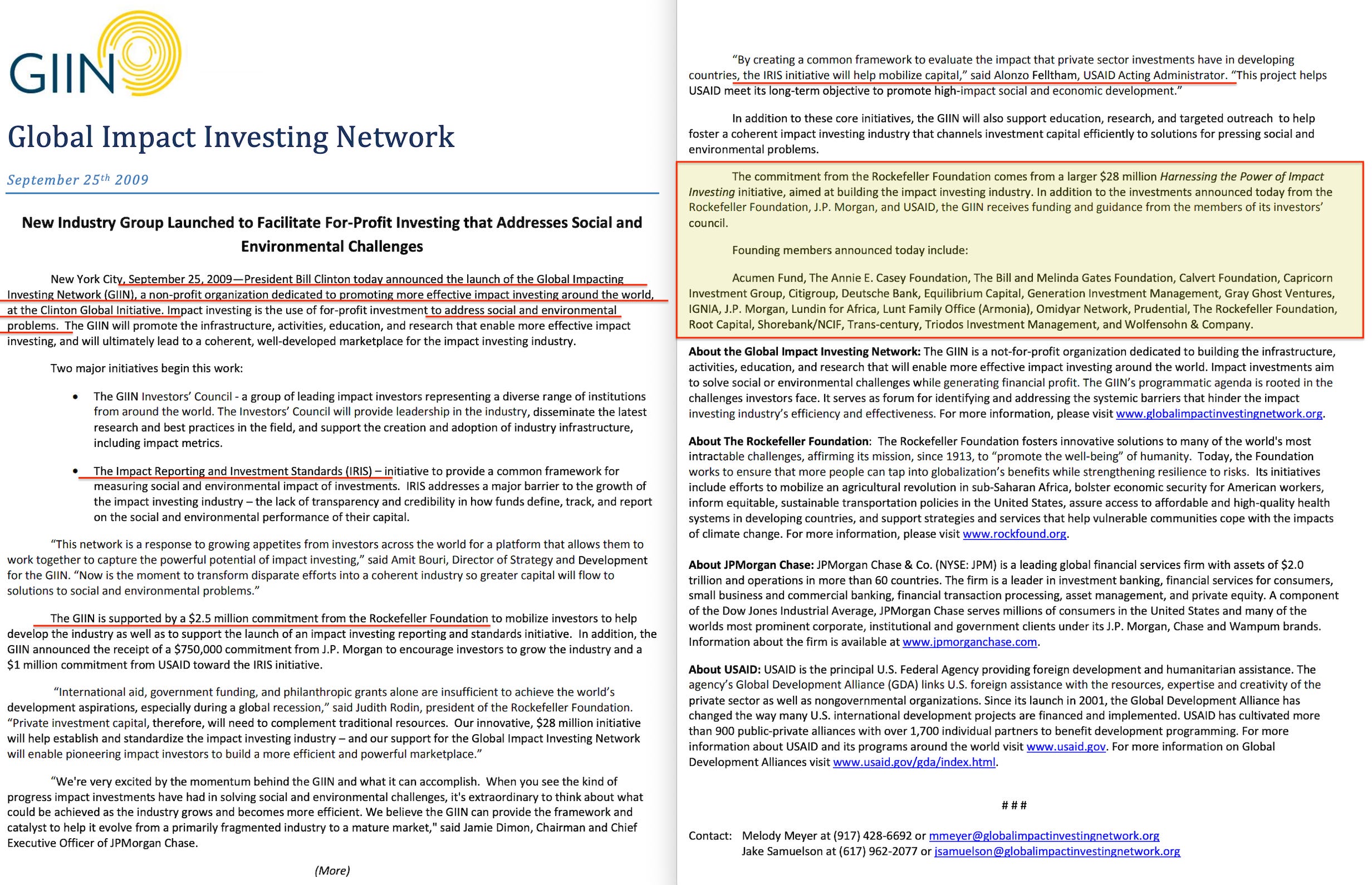
Epstein’s programme email was dated August 11, 2009 — six weeks before Clinton unveiled GIIN at CGI. He was working in parallel with the public launch.
By 2011, Epstein was designing the product. Project Molecule52 ran from February to October 2011 with JPMorgan’s Mary Erdoes and Jes Staley — the same Staley listed as a Gathering 4 participant. The Gates Foundation call was October 2553. On October 28, OPIC — operating under the Secretary of State’s policy guidance, meaning Hillary Clinton — approved $285 million for six impact investing funds54. The Global Health Investment Fund launched as the working prototype: SIDA and USAID money guaranteed the downside, Gates and other private investors collected the return.
The ‘impact’ label does two things simultaneously. It provides the moral justification for the public risk absorption — the taxpayer money is being deployed ‘for social good’. And it creates the requirement for measurement frameworks. You cannot verify ‘impact’ without a monitoring system. The monitoring system becomes the control system. IRIS metrics, the SDG framework, and eventually AI classification are all products of this requirement.
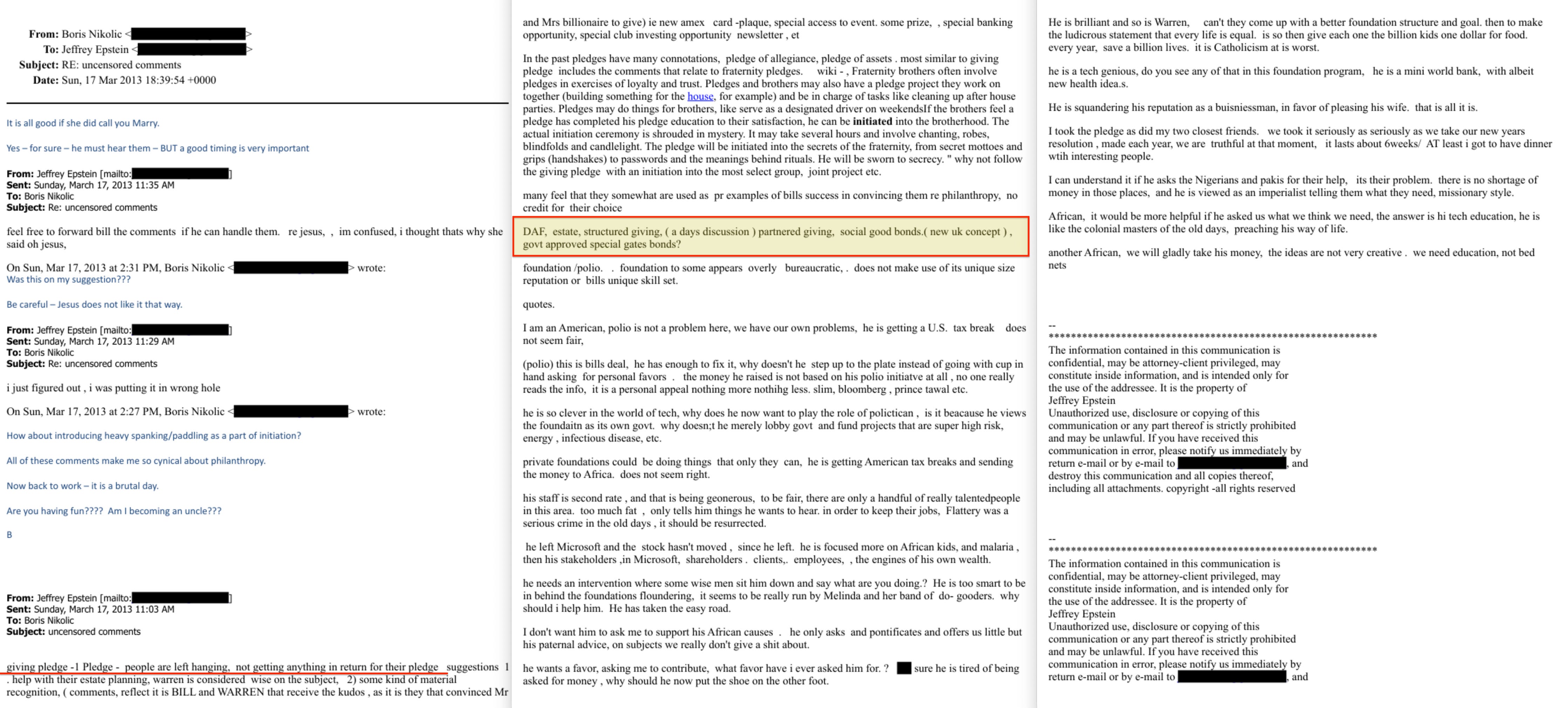
In March 2013, Epstein sent Boris Nikolic a strategic memo listing the full product line55: ‘DAF, estate, structured giving, (a days discussion) partnered giving, social good bonds. (new uk concept), govt approved special gates bonds?’ He was mapping every variant of the impact instrument.
Layer 3: Stranded Assets (Banking and Regulatory Scale)
Impact investing directs capital toward approved purposes but does nothing to prevent capital from flowing to unapproved purposes. Stranded assets closes that exit — the inverse of impact investing, the stick to its carrot.
In 2001, Nick Robins and Mark Campanale developed the ‘stranded assets’ concept at Henderson Global Investors. In 2011, Campanale founded Carbon Tracker and published ‘Unburnable Carbon’. On December 14, 2011, Al Gore and David Blood — former CEO of Goldman Sachs Asset Management — published ‘A Manifesto for Sustainable Capitalism’ in the Wall Street Journal, listing as their first recommendation: ‘Identify and incorporate risks from stranded assets’. This was the first public specification of the concept as a programme for financial system redesign. Carbon Tracker was a purpose-built vehicle created by network insiders to inject a concept they had developed a decade earlier into the financial system.
Gore and Blood had founded Generation Investment Management in London in 2004. The Generation Foundation — the nonprofit arm — would become a co-funder of the Oxford Smith School’s Stranded Assets Programme alongside the Rothschild Foundation.
In August 2013, before targeting the energy sector, the network prototyped its framework on agriculture. The Smith School published ‘Stranded Assets in Agriculture’, funded by the Rothschild Foundation, WWF-UK, and HSBC. The document introduced the ‘conversion to liabilities’ language — making ownership a negative — and listed fossil fuel divestment as a risk factor for farmers before the divestment movement had achieved mainstream visibility.
The consultative panel read like a directory of the future climate finance establishment: David Blood (Generation), Jeremy Leggett (Carbon Tracker founder), Michael Liebreich (Bloomberg New Energy Finance), Nick Robins (HSBC, later UNEP Inquiry).
The network existed as a formal advisory body six months before the January 2014 paper that launched the public programme.
On October 29, 2013 — the same month as Epstein’s summit week — Gore and Blood published ‘The Coming Carbon Asset Bubble’ in the Wall Street Journal56. One day later, the Generation Foundation released the twenty-six-page technical paper ‘Stranded Carbon Assets’57. The WSJ article created public awareness; the technical paper provided the implementation guide.

Blood stated that any fund managers failing to incorporate stranded asset risks were ‘failing in their fiduciary duty’ — language that transforms a political preference into a legal obligation. The fiduciary duty weapon would be progressively sharpened through the Waddesdon forums: Forum 2 (September 2014) weaponised it for asset owners through the ‘universal owner’ hypothesis; Forum 3 (March 2015) extended it to investment consultants, warning that those who failed to push climate risk would find their own advisory businesses becoming ‘stranded advice’; and a companion paper in the Journal of Sustainable Finance & Investment completed the transformation — ‘Climate Change and Fiduciary Duty: the old shield becomes a potent sword’.


The intellectual foundation for the entire mechanism was a concept Gore had developed with his national security adviser Leon Fuerth: anticipatory governance, though they preferred the term ‘forward engagement’. Fuerth founded the Project on Forward Engagement in 2001 at George Washington University, funded by the Rockefeller Brothers Fund.
In 2009, he published the formal framework in a paper commissioned by the Rockefeller Foundation, explicitly linking anticipatory concepts to pro-poor development objectives. The concept is straightforward: act on modelled futures before events occur.
The stranded assets framework does not require a climate event to happen — only a ‘black box’ model predicting that one might.


The mechanism operates through the redefinition of risk rather than the confiscation of property. A coal plant still generates electricity. A farm still produces food. But once the regulatory framework — TCFD, NGFS, Basel capital requirements — designates the asset as ‘at risk’ based on scenario models, the bank cannot lend against it, the insurer cannot cover it, and the pension fund cannot hold it. The asset becomes unfundable. The owner has no right of appeal because nothing was taken — the rules changed around them.
The redefined risk carries through to Basel 3.1, where scenario-based climate risk is embedded into the capital adequacy requirements that determine how much every bank on the planet can lend against any given asset. At that point, the stranded assets concept becomes binding arithmetic. A bank does not choose whether to comply with Basel. It either meets the capital requirements or it cannot operate.
Generation Investment Management now manages over $40 billion58. Every regulatory tightening increases the value of their ‘sustainable’ portfolio while destroying the value of competing conventional assets. Gore advocates for the regulation, the regulation strands the assets, the stranding validates Gore’s investment thesis, and the returns attract more capital into the sustainable framework — and Al Gore’s investment fund.
The loop is self-reinforcing.


Layer 4: Social Good Currency (Individual Transaction Scale)
The first three layers govern capital at progressively smaller scales but stop short of the individual transaction. A person can still spend their money however they choose. The social good currency closes that remaining gap.
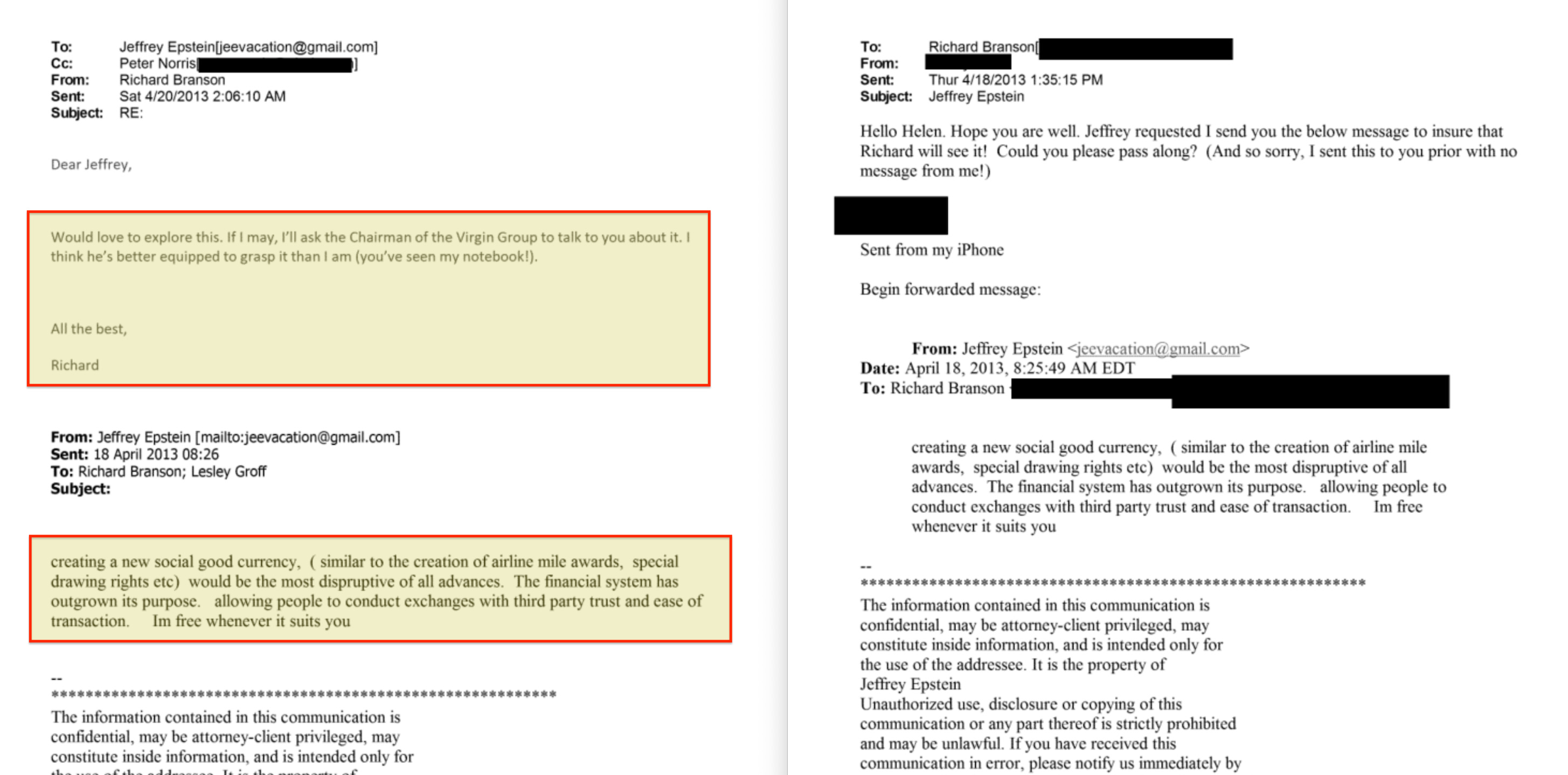
Epstein described it to Richard Branson as a currency like airline miles or special drawing rights, but for social good59 — conditional, programmable, purpose-bound. On April 2, 2016, Larry Summers emailed Epstein a specification for sovereign digital currency: each unit uniquely numbered, every transaction traceable, aid disbursement as the entry vector. Summers’s reply in the same thread60: ‘Got it. If I can’t get current regime fixed I will fix’.
The BIS now calls this ‘purpose-bound money’61.
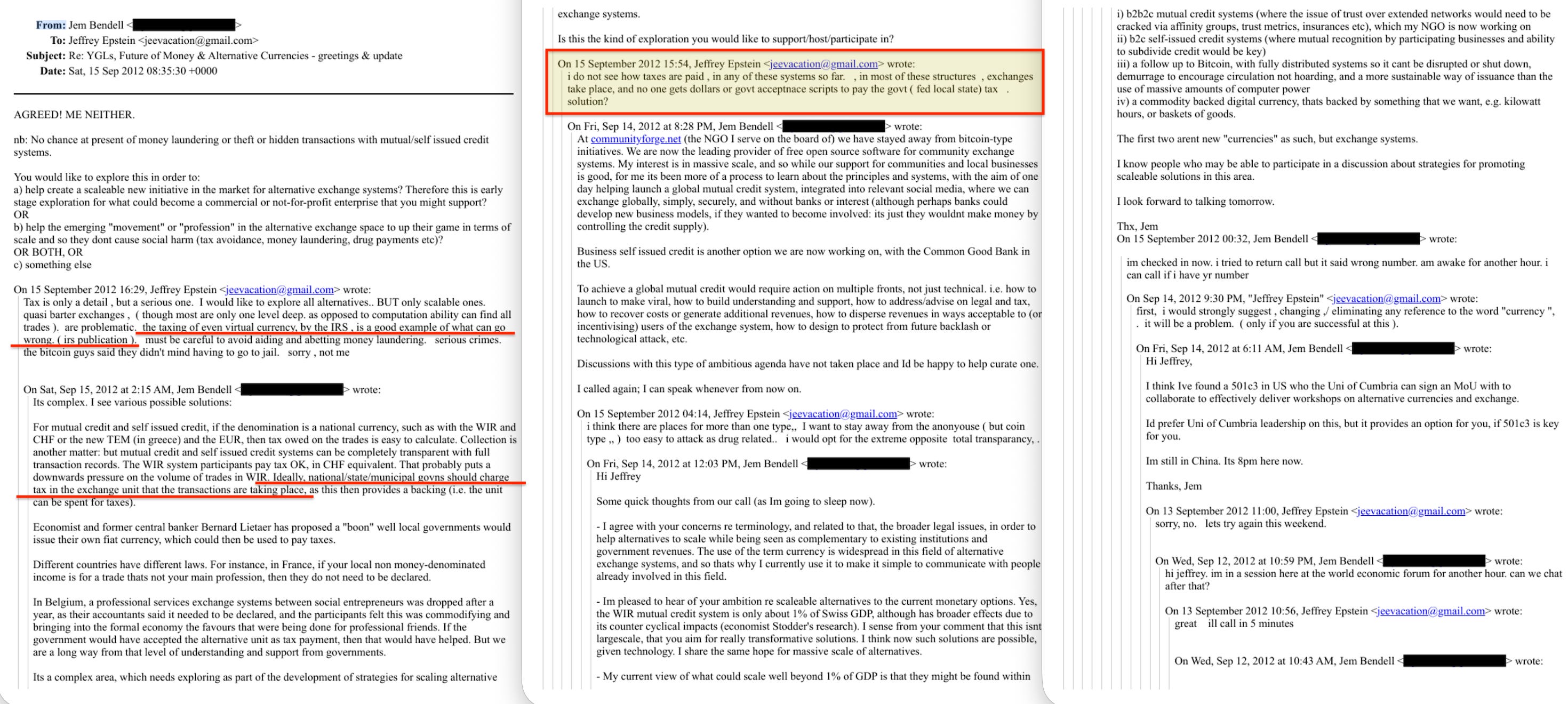
In September 2012, Epstein had asked Jem Bendell — a sustainability professor, WEF participant, and organiser of a conference on social good currency centred on sustainable development — the critical implementation question62: ‘I do not see how taxes are paid, in any of these systems so far’. Bendell responded with the technical framework: if governments accept the alternative currency for tax payments, that provides ‘backing’.
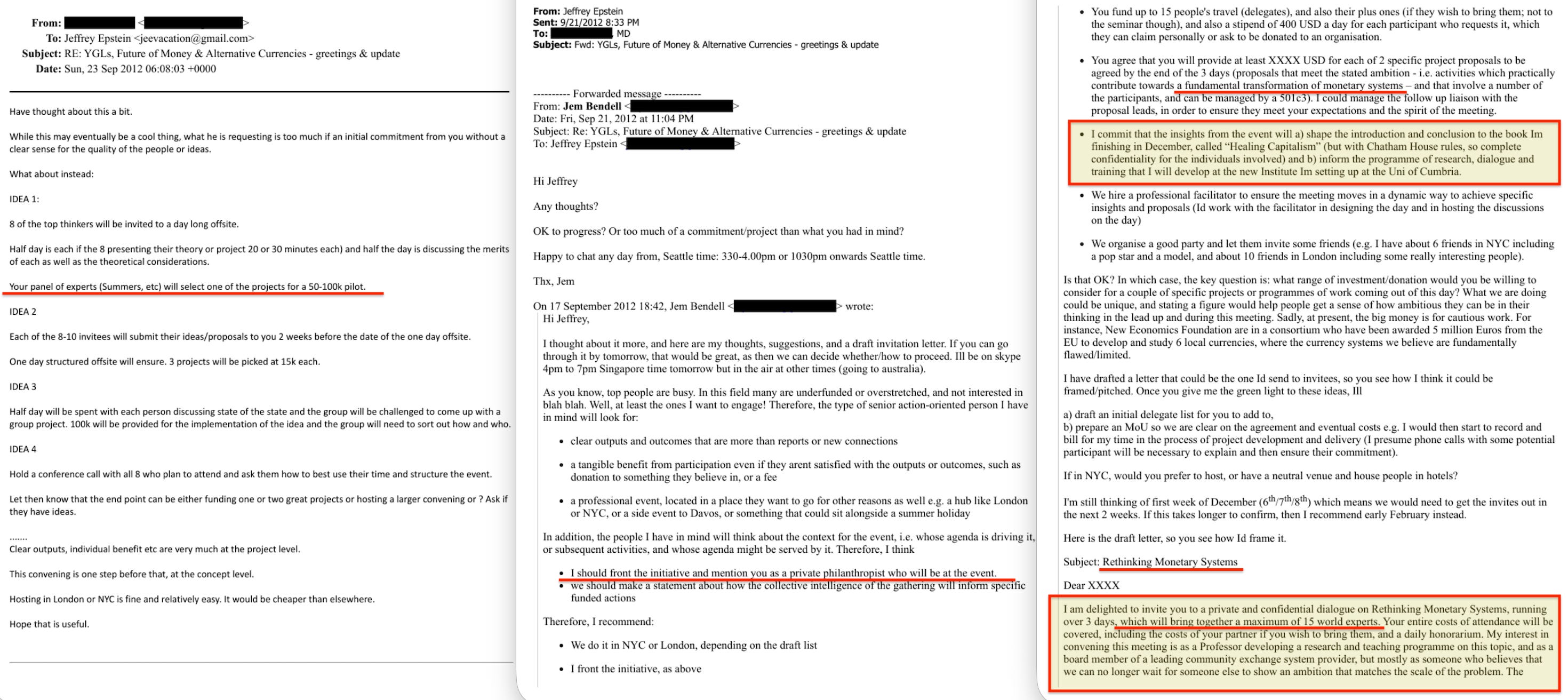
Bendell’s operational plan, sent on September 17, 2012, specified how the initiative would function outside the WEF. Fifteen ‘world experts’ would convene under Chatham House rules — ‘complete confidentiality for the individuals involved’63. Epstein would fund two project proposals. ‘I should front the initiative’, Bendell wrote, ‘and mention you as a private philanthropist who will be at the event’.
An adviser reviewed the proposal and suggested refinements64: ‘Your panel of experts (Summers, etc) will select one of the projects for a 50-100k pilot’. Larry Summers was on Epstein’s panel for selecting monetary transformation projects.
The conference apparently did not go forward as a single event65, but every function it was designed to serve materialised through bilateral channels. The tax question was answered. The sustainable development framing was produced. The intellectual outputs flowed into Bendell’s public work — his book Healing Capitalism, his new Institute for Leadership and Sustainability at the University of Cumbria — without visible connection to the original convening. And in 2018, the same institute published Bendell’s ‘Deep Adaptation’, arguing that climate-induced societal collapse is now inevitable and that existing sustainability tools have failed.
The ethical framework commissioned in 2012 to justify the architecture became, six years later, the crisis narrative making its emergency implementation urgent. The cancelled conference demonstrates the network’s resilience — remove one node and the functions redistribute.
The tax question is the hinge of the entire design. A currency only functions as sovereign money if the state accepts it for tax obligations — that is what creates compulsory demand. Once the state says ‘you can pay your taxes in this’, everyone must hold it. Once everyone must hold it, the conditions attached to it become universal. Summers’s specification — uniquely numbered, fully traceable, aid disbursement as the entry vector — solves the adoption problem.
The currency arrives through development aid. The receiving government must accept it because that is how the money arrives. Once it accepts the currency, it enters the tax system. Once it is in the tax system, it becomes real.
Together, the four layers form a closed system.
Blended finance provides the mechanism — public money absorbing risk so private capital flows.
Impact investing provides the direction — capital must serve the ‘common good’ as defined by the SDG framework.
Stranded assets provides the constraint — capital cannot flow to unapproved purposes.
And the social good currency provides enforcement at the individual transaction level — every unit of money carries conditions.
Change the definition of ‘good’ and you redirect the entire global financial system without passing a single law.
The Gatherings as Engineering Specification
The seven gatherings are the engineering specification for this four-layer system. Each gathering builds a component without which the system cannot function. Remove any one and it fails.
Gathering 4 designs the financial architecture — all four layers as a single system. ‘What is value, worth, mark to market, what is money, the new debt’. Where the old financial system priced assets by what someone would pay, the new one prices them by whether they comply.
Gathering 1 builds the cryptographic and game-theoretic enforcement layer. A programmable currency needs cryptographic infrastructure — every unit uniquely numbered, every transaction traceable, as Summers would specify in 201666. Game theory determines how agents behave under conditional incentive structures — Nowak’s entire research programme at Harvard. ‘Virus dynamics, both computers and biological’ describes how self-replicating rule systems propagate through populations.
The social good bond spreads through the financial system in the same manner a virus propagates through a host: each adoption makes the next adoption more likely, until the system is endemic.Gathering 2 builds the AI classification system. Seventeen SDGs, 169 targets, 231 indicators — no human bureaucracy can assess every transaction against that matrix in real time. Domain-agnostic machine intelligence determines what qualifies as a permitted purpose.
Bach described it to Epstein in 2016: ‘an API for integrating all fields of knowledge and control’67. Without Gathering 2, the architecture cannot operate at scale.Gathering 5 provides the mathematical modelling. How does value distribute under the new rules? Where are the stress points? Which nodes are systemically important? How does the ecology respond when you strand entire asset classes? This is the quantitative backbone for the stranded assets framework — the models that calculate how much capital moves when you reclassify an asset, which countries become ‘stranded countries’, how fast the transition cascades.
The ‘differential geometrist’ slot — which Stodden filled with Donoho from Stanford, who ran a hedge fund at Renaissance Technologies — tells you the modelling was designed for deployment in financial markets.Gathering 3 deploys the system through sovereign governments. Reputation, awe, trust, deception, reciprocity — the exact toolset required to move a sovereign government from resistance to compliance. Barak paired with Summers as a joint advisory package for sovereign leaders. Mandelson was lobbied by DP World — trade infrastructure across eighty-three countries68. Jagland attended the 2013 summit, and Bloomberg was positioned to chair the TCFD.
Gathering 6 manufactures the demand. The system restricts economic freedom. Consumer choice narrows. Material accumulation is penalised through carbon pricing, stranded asset write-downs, and conditional transaction rules. Populations must experience this as meaning rather than loss. Marsh saw it69: ‘coordination of the great masses via spiritual ideals... beliefs shape civilisation... new models of happiness’.
Seligman’s positive psychology provides the intellectual architecture — meaning through collective purpose rather than individual consumption. The Earth Charter provides the spiritual framing. The SDGs provide the secular equivalent. Without Gathering 6, the system faces permanent democratic resistance. With it, populations volunteer.Gathering 7 researches how the transition lands neurologically. How does the brain process pattern and prediction? How do you structure the narrative of economic reorganisation so it feels like resolution rather than loss?
Tramo’s research on anticipation and resolution in music maps onto how humans process sequential information and experience emotional closure. This gathering tells you how to present the system so that the neurological response is acceptance.
The ‘common good’ — sustainable development, the SDGs — is the variable plugged into all seven at once. Gathering 2’s AI decides what counts. Gathering 6 makes people want it. Gathering 3 gets governments to enforce it. Gathering 1’s cryptography locks it in. Gathering 5’s models run the numbers. Gathering 4’s financial system prices everything against it. And Gathering 7 makes the whole transition feel natural.
As separate interests, the seven topics look random. As a parts list for a programmable currency built into a redesigned global financial system for ‘the common good’, they’re exact.


The Parallel Construction: A Timeline
The four-layer system was not built entirely in private. A public track prepared the institutional and political ground in parallel, and the sequencing of the two tracks is revealing.
2001: Nick Robins and Mark Campanale develop the ‘stranded assets’ concept at Henderson Global Investors70.
2004: Gore and Blood found Generation Investment Management in London71.
2007 (October): The Rockefeller Foundation coins ‘impact investing’ at Bellagio. The EU Commission launches its first blending facility72.
2008 (June): Second Bellagio meeting. IRIS metrics developed by the Rockefeller Foundation, Acumen, and B Lab73.
2009 (May): Epstein’s planning document with three recruitment lists. The Brockman delivery channel is proposed.
2009 (August 11): Epstein’s programme email — seven gatherings, seven participant lists.
2009 (September 25): Bill Clinton unveils GIIN at the Clinton Global Initiative, with IRIS metrics. Rockefeller, JPMorgan, and USAID provide financial backing. Six weeks after Epstein’s programme email74.
2010: The Moringa Fund launches as the first agroforestry blended finance vehicle, set up by Compagnie Benjamin de Rothschild (Edmond de Rothschild group)75. The same Rothschild branch whose financial channel opened at the 2013 summit through Ariane de Rothschild, the same family that would host the Waddesdon Stranded Assets Forums beginning in 2014, and the same family who through Lynn Forester would launch the Council for Inclusive Capitalism with the Vatican in 2020.
2011 (February–October): Epstein designs the Global Health Investment Fund with JPMorgan through the nine-month ‘Project Molecule’ process. Gates Foundation call October 2576.
2011 (October 27): OPIC approves $285 million for impact investing funds — the first US government commitment to impact investing in emerging markets. OPIC operates under the policy guidance of the Secretary of State: Hillary Clinton77.
2011 (November–January 2012): Seckel’s Mindshift conferences deliver the scientific gatherings on the island, with encryption and new financial systems scheduled together on Day Two.
2011 (December 14): Gore and Blood publish the stranded assets blueprint in the Wall Street Journal78.
2012 (January 9): Hillary Clinton emails her scheduler79: ‘Carry as optional: A conference in England about climate change from July 12-15 sponsored by Jacob Rothschild at his historic estate, Waddesdon’. The same email references a ‘Global Impact Economy Forum’ described as a ‘public-private partnership for the common good’ funded through ‘blended finance’.
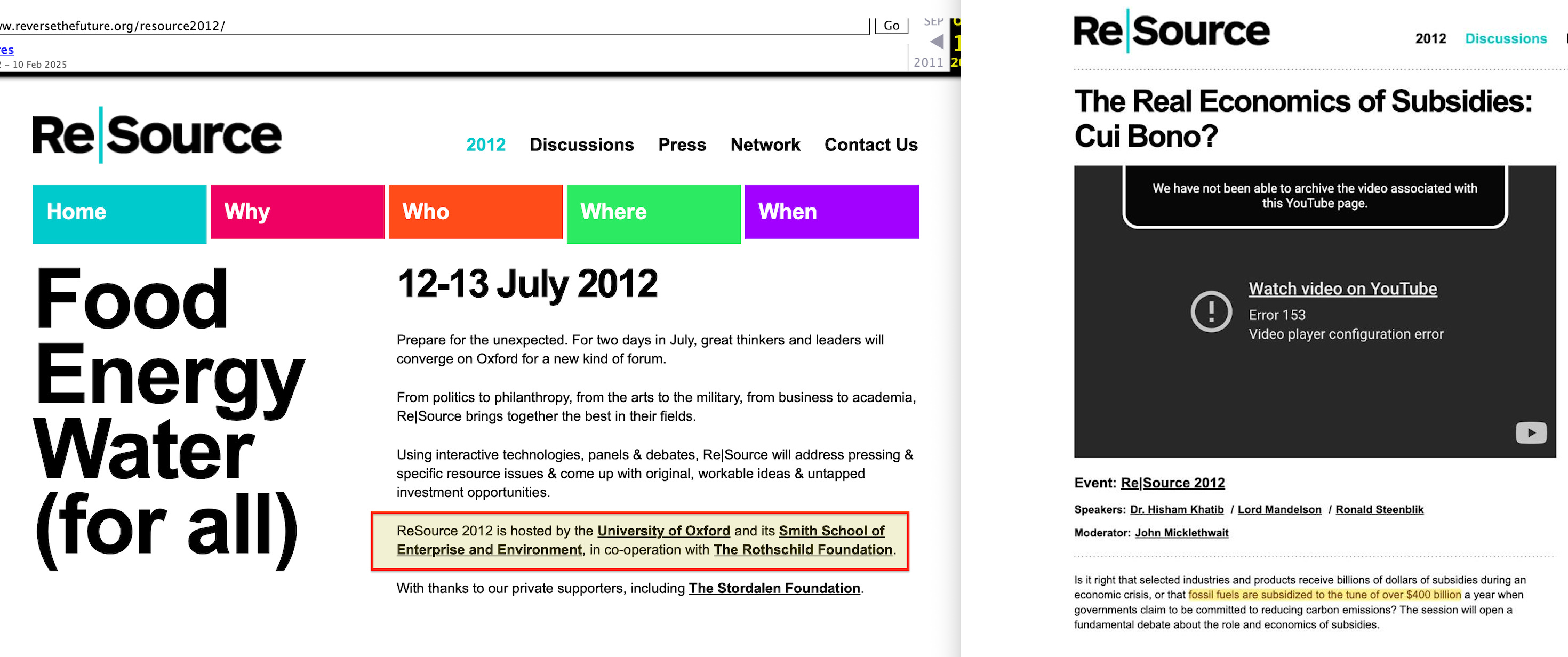
2012 (July): Oxford and the Smith School host ReSource 2012 ‘in co-operation with The Rothschild Foundation’80. Bill Clinton delivers the closing keynote. Mandelson moderates.
2012 (September): Epstein commissions Bendell to design new monetary systems for sustainable development. Epstein identifies the unsolved problem: ‘I do not see how taxes are paid, in any of these systems so far’81.
2013 (June): Hillary Clinton promotes social impact bonds at CGI America82 — the same ‘new UK concept’ Epstein listed in his March 2013 memo to Nikolic83.
2013 (August): Smith School publishes ‘Stranded Assets in Agriculture’, funded by the Rothschild Foundation, WWF-UK, and HSBC84. The consultative panel includes Blood, Leggett, Liebreich, and Robins.
2013 (September): Epstein’s summit week. Barak, Gates, Summers, Nikolic, Ariane de Rothschild, Jagland, Mongolia’s president, Marsh. Every component stream represented. Aadhaar confirmed successful. Bloomberg positioned with Barak ten days prior. Barak proposes pairing with Summers for sovereign advisory work85.
2013 (October 29): Gore and Blood publish ‘The Coming Carbon Asset Bubble’ in the Wall Street Journal86.
2014 (January): The Smith School publishes ‘Stranded Assets and Scenarios’. The Waddesdon forums begin87.
2014 (March): Forum 1 at Waddesdon Manor. First Mover Disadvantage identified — the strategic insight that drives all subsequent forums toward regulatory capture.
2014: Lynn Forester de Rothschild founds the Conference on Inclusive Capitalism in London88. Prince Charles opens; Clinton speaks.
2015 (October): Forum 4 captures central banks and financial regulators. Sandra Batten (Bank of England), Matthew Scott (PRA), Sini Matikainen (ECB) attend. Carney’s ‘Tragedy of the Horizon’ speech89, delivered three weeks earlier, translates the Smith School’s July 2014 academic framework into central bank doctrine.
2015 (December): The FSB launches the TCFD90. Carney chairs the FSB. Bloomberg chairs the TCFD.
2016 (April 2): Summers emails Epstein the digital currency specification91.
2017 (April): Forum 6 builds the surveillance infrastructure — the Asset-level Data Initiative using remote sensing and big data.
2017 (December): NGFS launches at Macron’s One Planet Summit92.
2018 (January): Sandra Batten publishes Bank of England Staff Working Paper No. 706, thanking ‘participants to seminars at the Bank of England, the 4th Stranded Assets Forum’93.
2018 (June): Forum 7, now titled the ‘Sustainable Finance Forum’94, expands scope to the full SDGs and targets ‘emerging and developing country markets’.
2019 (April 17): The NGFS issues its activation order: ‘If some companies and industries fail to adjust to this new world, they will fail to exist’95.
2020: Lynn Forester de Rothschild’s Council for Inclusive Capitalism with the Vatican is established96; an organisation designed to embed social and environmental goals into how capital is allocated worldwide.
The two tracks — public and private — ran in parallel from 2007 to 2019. The public track (Rockefeller, Clinton, Gore, Waddesdon) built the institutional infrastructure: the concept, the metrics, the regulatory enforcement, the political legitimacy. The private track (Epstein, JPMorgan, Rothschild, Barak, Summers) designed the components the public track could not build openly: the cryptographic enforcement layer, the AI classification system, the sovereign deployment pipeline, the behavioural acceptance framework, and the digital currency specification.
The public track built the institutional framework. The private track built the technical means to enforce it.
The Deployment: Waddesdon Forums 2014–2018
The Waddesdon forums — convened at the Rothschild estate in Buckinghamshire between March 2014 and June 2018 — executed the capture sequence. Seven forums, each targeting a different node in the financial system: asset owners, central banks, regulators, data infrastructure. Forum 1 identified ‘First Mover Disadvantage’ as the barrier — risk-averse investors would not move early — and that single insight dictated the strategy for everything that followed: capture the regulators so that everyone is forced to move simultaneously. By Forum 4, in October 2015, the participant list included Sandra Batten of the Bank of England, Matthew Scott of the PRA, and Sini Matikainen of the ECB. By Forum 7, the scope had expanded from climate to the full SDGs and the title had changed from ‘Stranded Assets’ to ‘Sustainable Finance’. Climate was the entry point. The SDGs were the destination.
Two details from the forum proceedings belong here. The first is an admission97: ‘Macroprudential regulation should be considered a second-best policy option... First best options like implicit or explicit carbon pricing derived through market mechanisms or taxes, would allow governments to more directly mitigate climate change risks’. They knew democratic legislation was the proper route. They proceeded through regulation anyway.
The second is the accountability void that regulation produced. The NGFS scenario documentation states explicitly that its scenarios ‘are not forecasts’ and that ‘there is no probability of occurrence attributed to each narrative scenario’98. Yet these non-forecast, non-probabilistic scenarios are the basis on which assets are devalued.
A coal plant becomes uninvestable because of modelled transition risk. A house becomes unmortgageable because it sits on a modelled flood plain. None of this requires a climate event to actually occur. The owner has no right of appeal against a ‘black box’ prediction.

Hillary Clinton: The State Department Channel
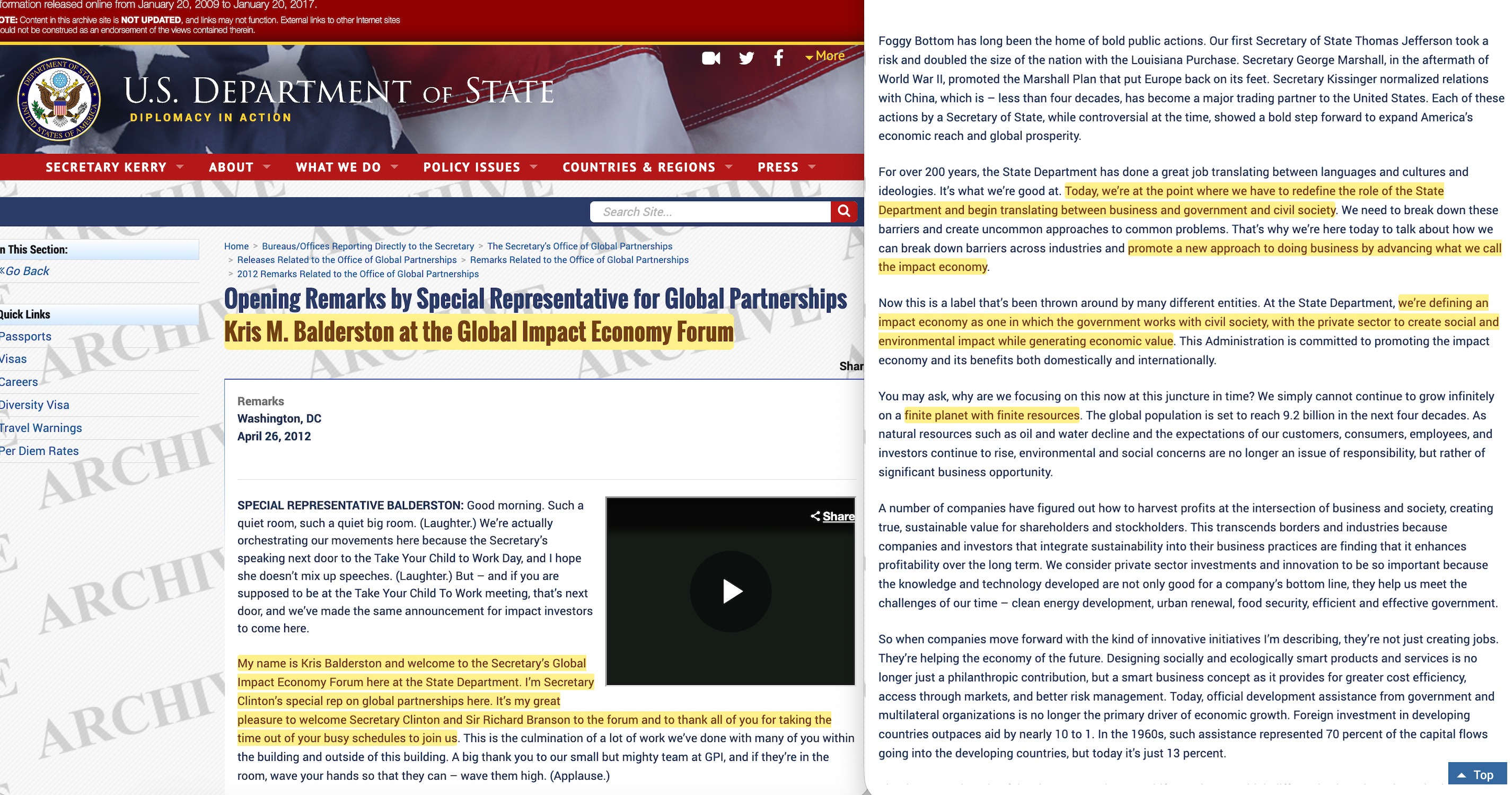
On January 9, 2012, Hillary Clinton — then Secretary of State — sent an email to her scheduler: ‘Carry as optional: A conference in England about climate change from July 12-15 sponsored by Jacob Rothschild at his historic estate, Waddesdon’. The same email referenced a date needed for ‘Kris B’ (Kris Balderston) at the State Department for the Global Impact Economy Forum, described as a ‘public-private partnership for the common good’ funded through ‘blended finance’99.
Hillary Clinton’s office at the State Department was linking up a Rothschild-hosted climate conference with an impact economy forum — three years after the Global Impact Investing Network had been launched through the Clinton Global Initiative, one year after Clinton’s OPIC had approved $285m in taxpayer funding, the same year the State Department organised an ‘impact investing’ forum, and two years before the first Stranded Assets Forum.

In July 2012, Oxford and the Smith School hosted ReSource 2012 ‘in co-operation with The Rothschild Foundation’100. Bill Clinton delivered the closing keynote. Peter Mandelson moderated. The conference was the dry run for the forum series that would begin eighteen months later.
At the June 2013 CGI America meeting, Hillary Clinton promoted social impact bonds101 — the same ‘new UK concept’ Epstein had listed in his March 2013 memo to Nikolic. Goldman Sachs structured the bonds. The taxpayer money took the downside risk, while private investors collected the return.
On the American side, ‘Impact investing’ was channelled through Hillary Clinton, while ‘Stranded Assets’ was channelled through Al Gore.
Two sides of the same political coin.
The Longer Arc
The programme document is dated August 2009. But the intellectual and political infrastructure predates it by decades.
On September 17, 1969, Daniel Patrick Moynihan — then Nixon’s Executive Secretary of the Council of Urban Affairs — wrote to John Ehrlichman proposing that NATO establish global environmental surveillance102.
The carbon dioxide problem, he wrote, ‘very clearly is a problem, and, perhaps most particularly, is one that can seize the imagination of persons normally indifferent to projects of apocalyptic change’. He added: ‘It is a natural for NATO. Perhaps the first order of business is to begin a worldwide monitoring system’. Within two months, NATO established the Committee on the Challenges of Modern Society.


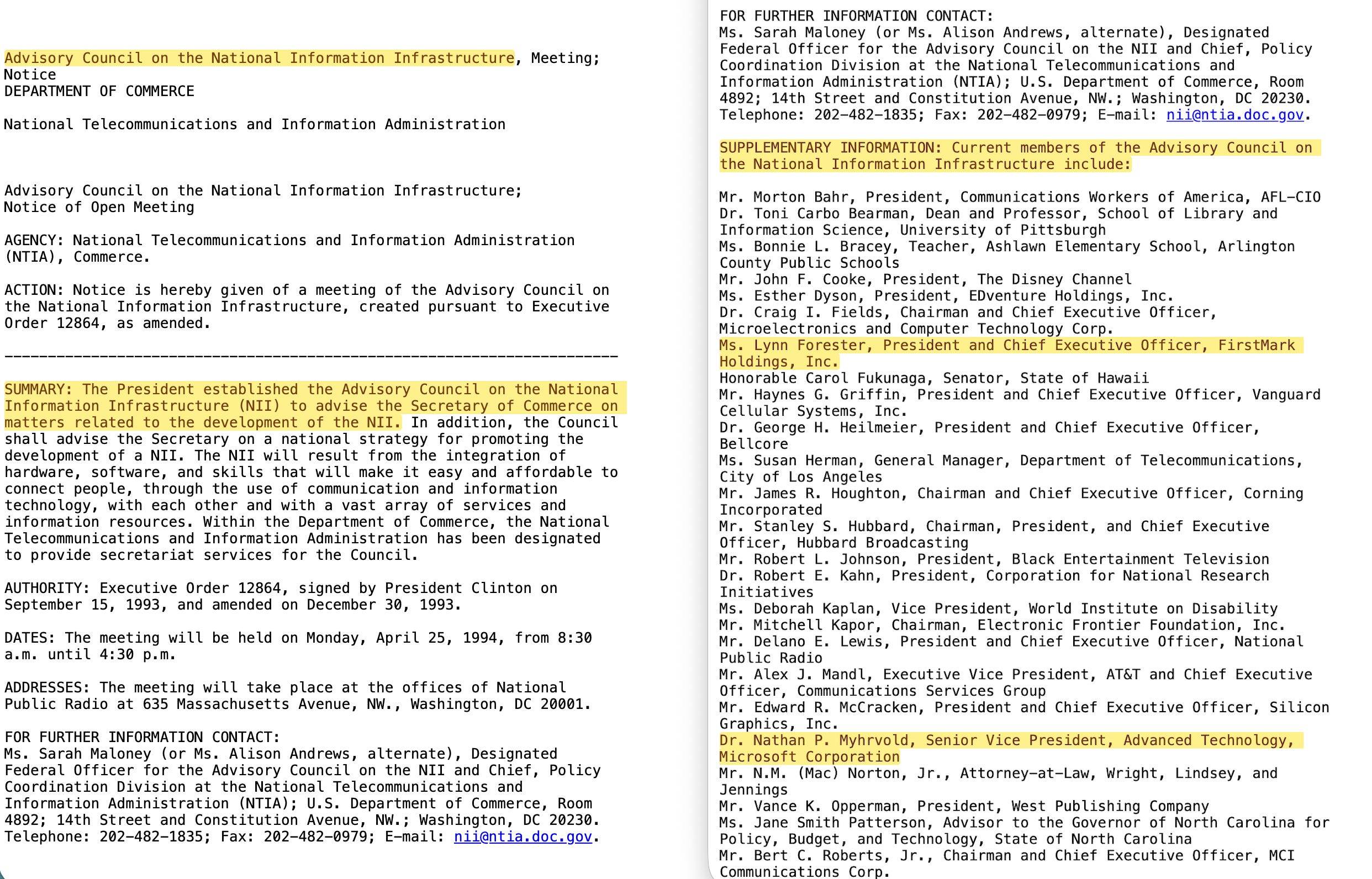
In 1976, Lynn Forester worked on Moynihan’s first senatorial campaign103 — her political entry point. In 1992, she became actively involved in Clinton’s presidential campaign. In 1993, Clinton appointed her104 to the National Information Infrastructure Advisory Council105 — the committee designing America’s digital infrastructure. Nathan Myhrvold, later a Gathering 4 participant, an Epstein island visitor, and a contact with twelve numbers in Epstein’s black book, served on the same council.
By the mid-1990s, Forester was operating at the intersection of the Clinton political network and the technology and finance circles where Epstein was already established.
On April 27, 1995, Forester wrote a personal letter to Clinton describing a recent meeting at Senator Kennedy’s house. In it, she wrote106107: ‘Using my fifteen seconds of access to discuss Jeffrey Epstein and currency stabilization, I neglected to talk with you about a topic near and dear to my heart’.
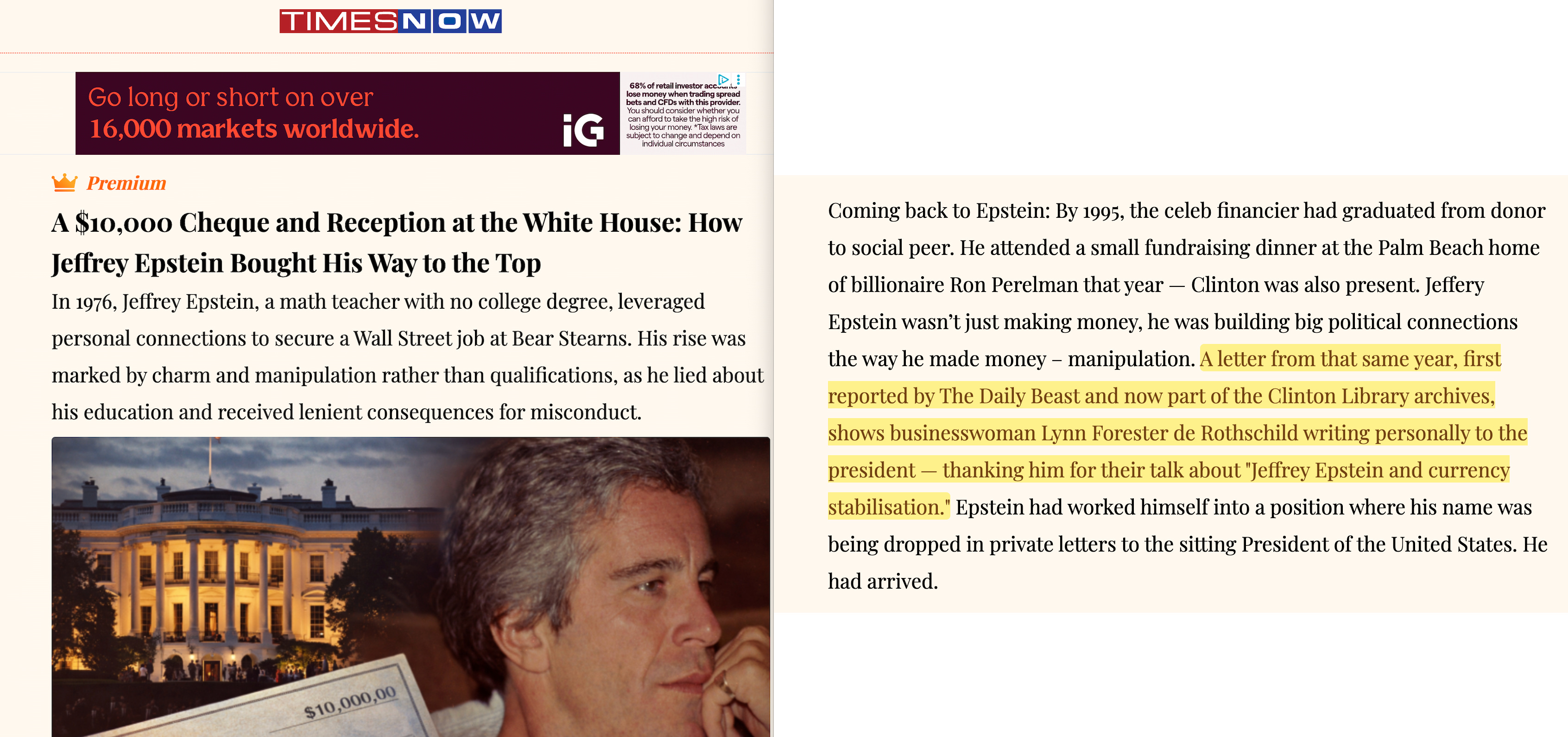
Epstein and currency stabilisation — to the sitting president, in 1995. The same topic that would sit at the heart of the programme fourteen years later, and the same woman who would go on to build the Council for Inclusive Capitalism.

Between 1997 and 1998, Lynn flew with Epstein five times108. In 1998, Henry Kissinger introduced her to Sir Evelyn de Rothschild at the Bilderberg conference109. She married Rothschild in 2000; the Clintons invited them to honeymoon at the White House110. The same year, she sold Epstein a Manhattan townhouse for $8.5 million below market value. Ghislaine Maxwell moved in111.
In 2006, Lynn Forester de Rothschild was appointed to the UN Advisory Group on Inclusive Financial Services112. In 2014, she founded the Conference on Inclusive Capitalism in London — Prince Charles opened; Clinton spoke113. The same year, the Waddesdon Stranded Assets Forums launched at Rothschild property. In 2020, she launched the Council for Inclusive Capitalism with the Vatican, embedding ‘social and environmental goals into how capital is allocated worldwide’, with papal authority providing the moral cover that makes it unchallengeable.
As far back as 1969, it was understood that the environment was the one problem big enough to justify worldwide coordination that didn’t need to go through voters. Moynihan’s protégée carried that insight from his campaign, through Clinton’s digital infrastructure council, through the Epstein connection, through the Rothschild marriage, all the way to the system that now presents economic reorganisation as a moral duty.
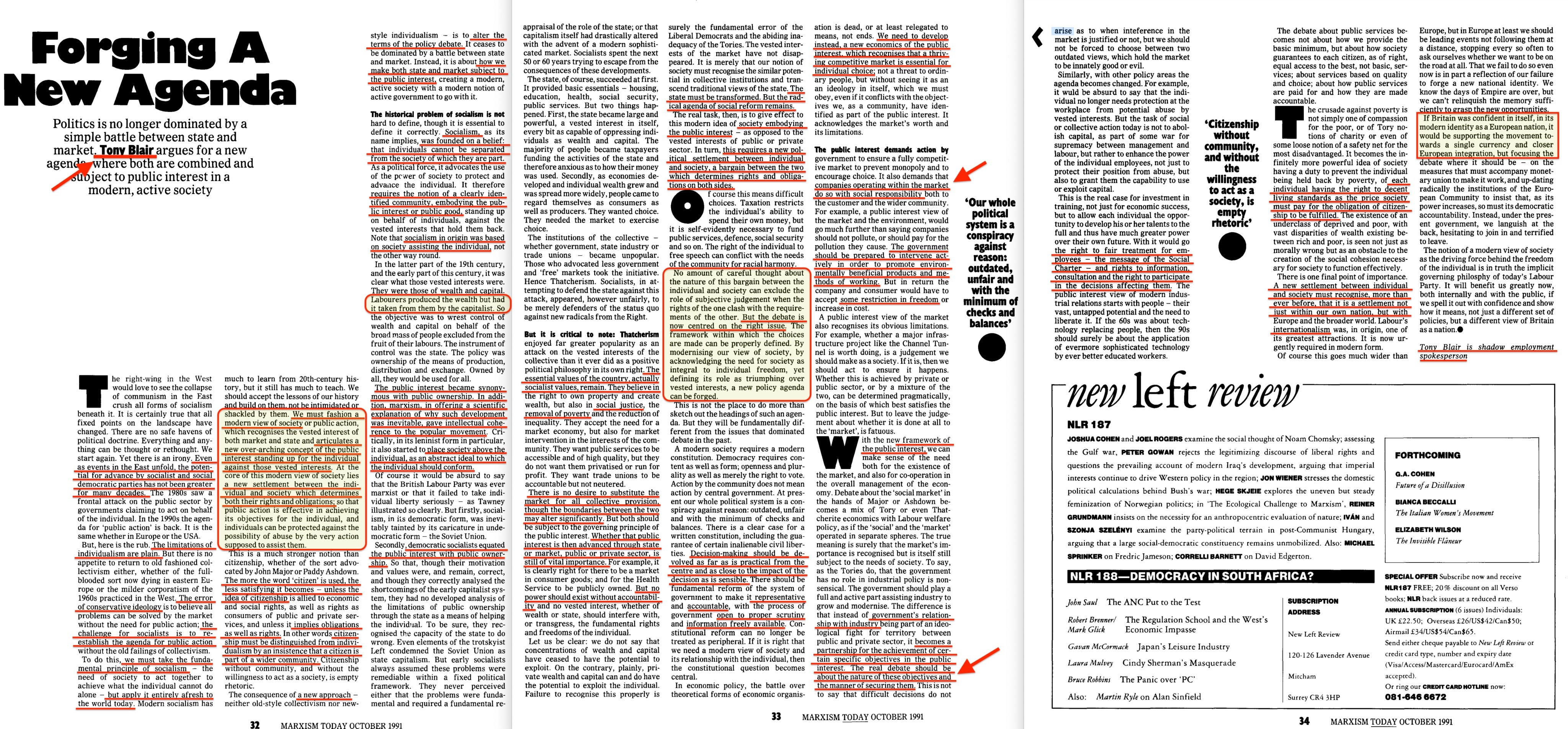
In 1991, the year Robert Maxwell died, Tony Blair published ‘Forging a New Agenda’ in Marxism Today114. It laid out the exact framework: public-private partnerships serving ‘public interest’, environmental regulation restricting economic freedom, ethical obligations replacing legal rights. The most noteworthy line: ‘The government should be prepared to intervene actively in order to promote environmentally beneficial products and methods of working. But in return the company and consumer would have to accept some restriction in freedom or increase in cost’.
Blair was listed as a core participant for Gathering 3.
In Maurice Strong’s formulation: ‘arguments based on science and reason alone are not sufficient to motivate society to pursue real change — spiritual vision and ethical commitment are needed’115.
The Earth Charter — launched in 2000, drafted by a committee chaired by Steven C. Rockefeller — was created to provide that vision.

The Public Reformat
On December 22, 2014, Barnaby Marsh — the same currency researcher who had annotated the programme document in 2009 and attended the 2013 summit — emailed Epstein a list of potential speakers for a 92nd Street Y event116. ‘Some names for the list (not all top-level, but need to add some which can liven-up an audience), more on the way...’
The list contained approximately seventy names, organised by field. Mapped against the programme document, the coverage is comprehensive.
Gathering 1’s genetics and cryptography: Church, Venter, Lander, Bustamante, Wagner, Feldman, Watson.
Gathering 2’s AI and technology: Kurzweil, Musk, Ito, Myhrvold, Brin, Cerf, Diamandis, Thiel.
Gathering 4’s financial system: Nalebuff, Plott, Camerer, Phelps, Jeff Walker.
Gathering 5’s power laws: Nowak (listed as ‘COOPERATION’), Gell-Mann, Krakauer.
Gathering 6’s happiness and compliance: Seligman, Kahneman, Duckworth, Nussbaum, Caccioppo — plus the Dalai Lama, Hans Küng, and Roger Scruton, extending the ‘spiritual ideals’ and ‘new models of happiness’ that Marsh had identified in his 2009 annotation.
Gathering 7’s neuroscience: Koch, Kandel, Rackic, Adolphs, Greenfield.
One gathering is absent. Gathering 3 — the Conference on Power — has no representation. The operational deployment layer — the people who deploy systems through sovereign governments — had been removed from the public-facing version.
The list also added categories the programme document did not contain.
MEDIA: Brooks, Kristof, Isaacson, WuDunn, Tierney, Ball, Lightman.
EDUCATION INNOVATOR: Drayton, Sexton, Gatto, Rhee, Sal Khan.
And the programme document had no religious authority — the 92nd Street Y list added the Dalai Lama and Hans Küng.
The programme document had no dissemination component because its purpose was research and development. The 92nd Street Y list added all three because its purpose was presentation — getting the programme’s concepts into public circulation.
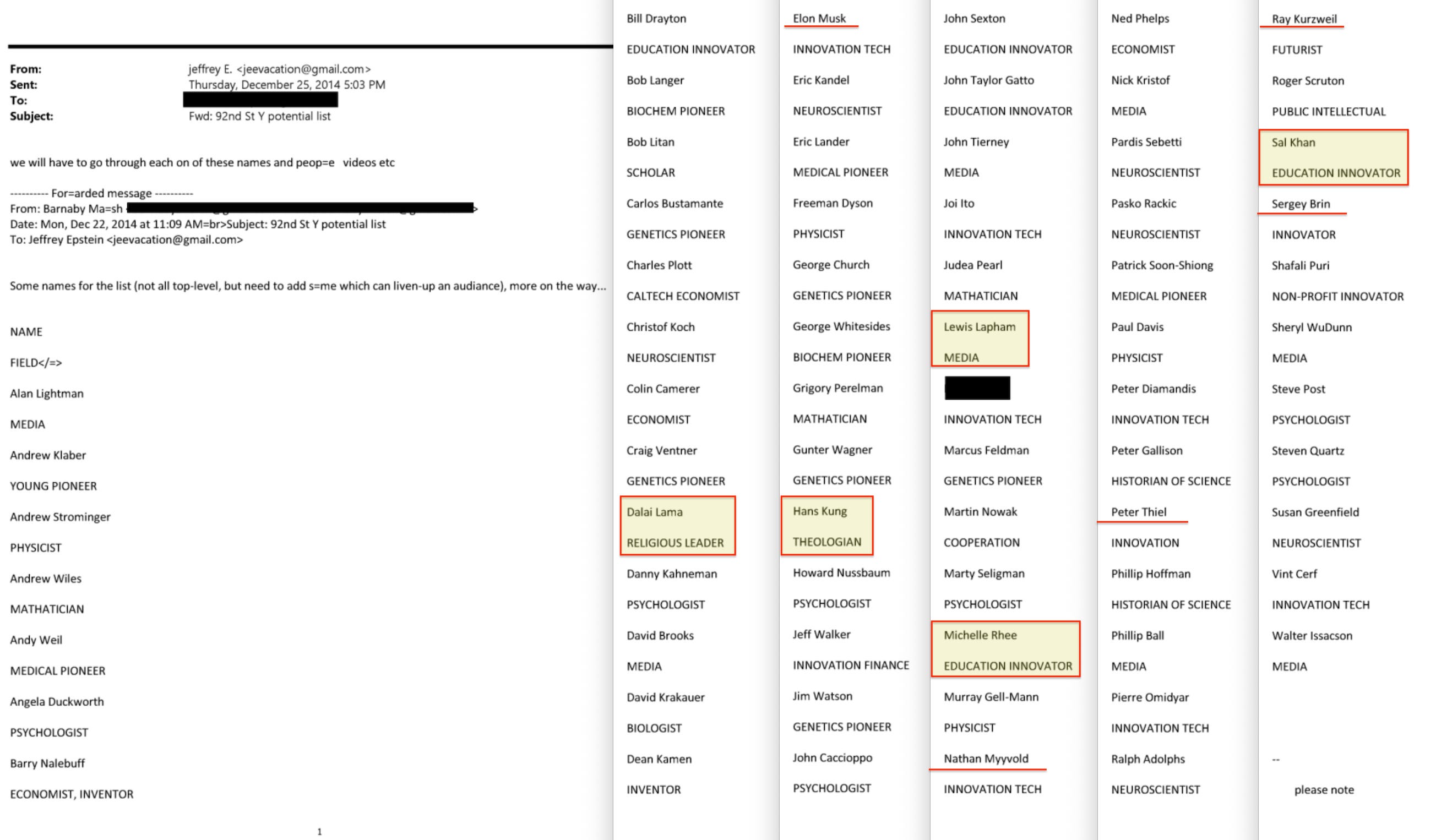
A separate set of documents in the archive reveals a further layer of optimisation. The same seventy-name list appears across at least three versions found at three different collection points, each with a third column added: eye colour117118119.
Every speaker has been assessed — ‘blue’, ‘Seem blue’, ‘Might be blue’, ‘Blue/hazel’, ‘Hazel/blue??’ — with varying degrees of certainty. The counts vary between iterations: forty-one blue in one version, forty-four in another, forty-nine in a third. The discrepancies arise because ‘unclear’ cases were reclassified between passes. Someone was going through photographs or meeting these people and checking.
One version states the methodology explicitly in its header: ‘Total — 70 people, without Asians — 61 (also excluded Indians). Blue eyes — 44. Unclear (might be blue, but not 100% sure) — 2’. Someone took Marsh’s speaker roster, removed the nine speakers of Asian and Indian descent, and calculated the blue-eye ratio within the remaining white and European group only. Forty-four of sixty-one: seventy-two per cent.
A redacted name appears on page two of the filtered version. Black bar. Listed as ‘INNOVATION TECH’ with blue eyes. Someone on this list was significant enough to redact from the DOJ release but still had their eye colour catalogued.
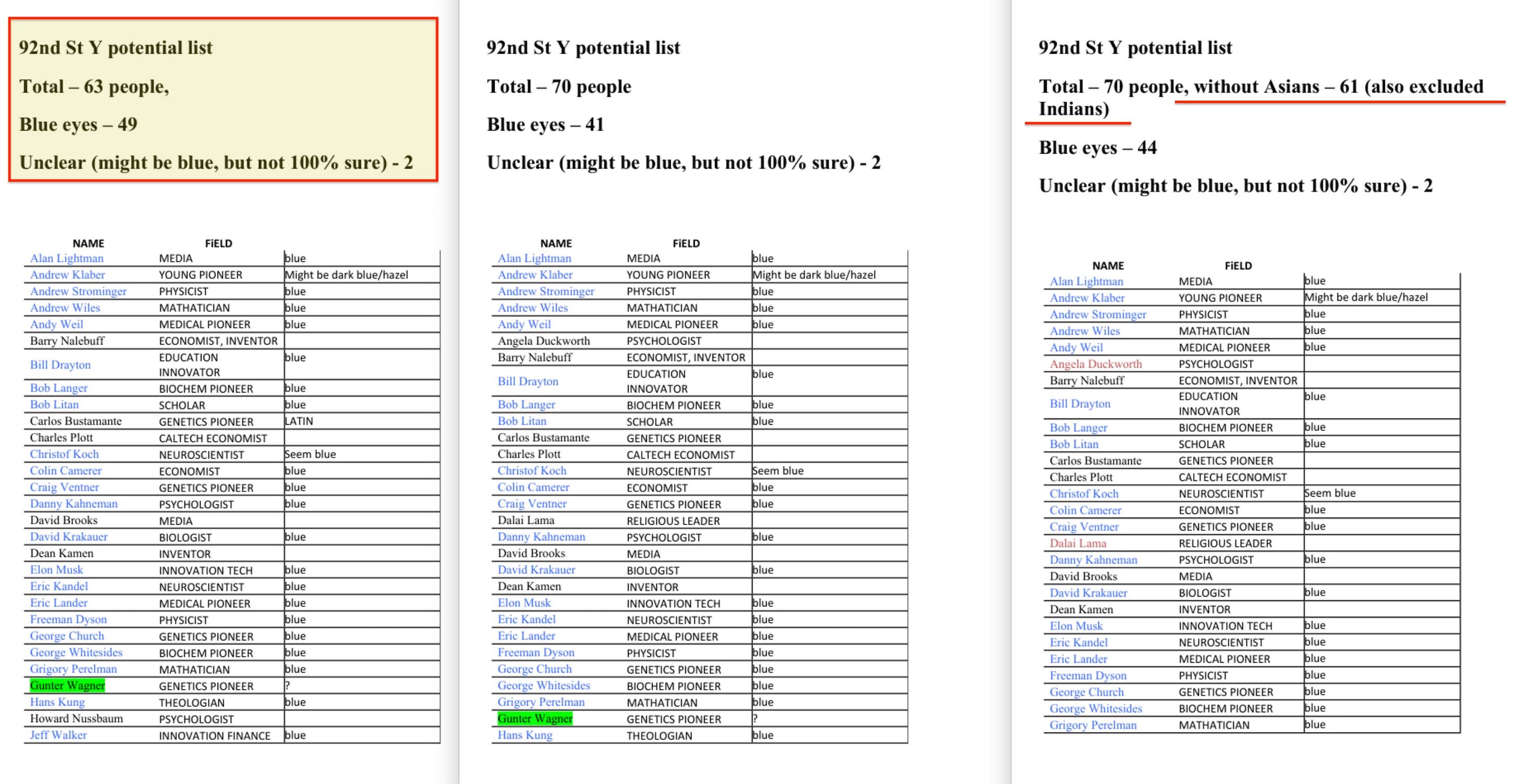
Three versions of the same document, each one more refined than the last — someone was actively working on this, checking it, recounting, filtering by race in one version, adding network connections in another, going through it multiple times and saving it in at least three different places.
The 92nd Street Y’s core audience is Upper East Side Manhattan — mostly Ashkenazi Jewish and Northern European. Blue eyes are a strong visual marker for that group. A seventy-two per cent blue-eye ratio among the white speakers looks less like a coincidence than a method.
The list was being fine-tuned on two levels at the same time: what the speakers would say and what they would look like to the audience. The programme’s ideas, delivered by faces the audience would instinctively trust. Marsh put together the intellectual content. Someone else optimised the packaging for maximum effect. That kind of division of labour is deliberate. And the list that started as Gathering 6 repackaged for public audiences turns out to also be an application of Gathering 1 — genetics, physical traits, population-level patterns — applied to the speakers themselves. The programme’s own methods were being used on its own delivery system.
No single speaker gives the game away. Angela Duckworth talks about grit. Kahneman talks about how our thinking goes wrong. Nowak talks about the maths of cooperation. Venter talks about programmable biology. Sal Khan talks about reinventing education. The Dalai Lama talks about compassion. Hans Küng talks about a global ethic. Each talk stands on its own as a piece of interesting thinking. The audience at the 92nd Street Y — educated, well-off, culturally engaged New Yorkers — takes in each piece separately.

But taken together, over a whole season, the audience is being walked through every idea that makes the system make sense — and feel acceptable. Cooperation theory makes incentive structures seem normal. Behavioural economics makes nudging people seem normal. Programmable biology makes programmable systems in general seem normal. Tech innovators make digital transformation feel inevitable. Education reformers make systemic change feel necessary. The theologians and the Dalai Lama provide the moral authority. And the media figures — Brooks, Kristof, Isaacson, WuDunn — turn all of it into stories for audiences who’ll never set foot in the building.
This is Marsh’s annotation from 2009 put into practice: ‘coordination of the great masses via spiritual ideals... beliefs shape civilisation... new models of happiness, perhaps?’ The 92nd Street Y is where New York’s professional class goes to have its worldview updated. The lecture series is the demand-creation layer — Gathering 6 — dressed up as cultural enrichment.
Each gathering gets its own public-facing version through the matching speaker category.
Gathering 1’s speakers — Venter, Church, Watson, Bustamante, Langer, Whitesides — don’t just talk about genetics. They get the audience used to the idea that biological systems are code. Code that can be read, written, and run. Once people absorb that idea, programmable money isn’t a big leap — it’s just the same logic applied somewhere else. If everything is code, why wouldn’t money be?
Gathering 2’s speakers — Kurzweil, Ito, Musk, Cerf — get the audience used to the idea that AI running complex systems is inevitable. People leave understanding that machines will manage things humans can’t handle. So when an AI classification system shows up to check every transaction against 231 UN development indicators, it doesn’t feel like surveillance. It feels like the future they were already expecting.
Gathering 4’s speakers — Nalebuff, Plott, Camerer, Phelps, Jeff Walker, Omidyar — get the audience used to the idea that the financial system is broken and needs to be rebuilt. Walker literally runs something called ‘innovation finance’. Omidyar built eBay and moved into impact investing. The audience absorbs the idea that the current system is outdated and a new one is overdue.
Gathering 5’s speakers — Wiles, Perelman, Pearl, Gell-Mann, Krakauer, Nowak — get the audience used to the idea that mathematical models should be the basis for running complex systems. So when climate scenarios from central banks start ‘stranding’ assets based on predicted futures, the groundwork has already been laid.
Gathering 6’s speakers — Duckworth, Kahneman, Seligman, Caccioppo, Quartz — provide the new version of happiness. Grit, purpose, meaning through contributing to something bigger rather than buying more stuff. The psychological shift that makes having less feel like growing more.
Gathering 7’s speakers — Kandel, Koch, Rackic, Greenfield — get the audience used to the idea that the brain is a machine that can be understood, mapped, and — by extension — predicted. If you know how the brain handles patterns and expectations, you know how to tell a story so that people feel resolution instead of resistance.
Then there are the additions that weren’t in the 2009 programme. The media figures — Brooks, Kristof, Isaacson, WuDunn, Lapham, Tierney, Ball, Lightman — aren’t really there as speakers. They’re a distribution network. They sit in the audience, soak up the ideas over a season, and turn them into newspaper columns, books, and magazine features for people who’ll never go to the 92nd Street Y. The education innovators — Drayton, Sexton, Gatto, Rhee, Khan — are the pipeline to the next generation. The ideas don’t just need to reach today’s professionals. They need to be built into how the next generation is taught. And the religious figures — the Dalai Lama and Küng, who spent decades building a ‘Global Ethic’ that goes beyond any single religion — provide exactly what Marsh described: ‘coordination of the great masses via spiritual ideals’.
Nobody walks out of a single lecture thinking ‘I just agreed to programmable money’. They walk out thinking they learned something interesting about genetics, or the maths of cooperation. Each piece is fascinating on its own — and it has to be, or it wouldn’t work.
But over a season, the educated professional class of New York — the people who run foundations, sit on boards, manage endowments, write policy, edit publications — has taken in every idea the system needs them to accept. Biology is code, so money can be code. AI will run complex systems, so AI can run transactions. The financial system is broken, so it has to be redesigned. Models can predict risk, so models can set asset values. Meaning comes from purpose not from buying things, so having less is actually growth. The brain processes stories as resolution, so the transition can feel natural. A global ethic goes beyond any one religion, so compliance is moral.
Each of these ideas is reasonable on its own, backed by real research from real scientists, and none of them is wrong in isolation. The destination — programmable money that enforces sustainable development compliance through AI, backed by regulations that make any alternative unfundable — is never mentioned. By the time it arrives, every building block is already part of what educated people just ‘know’.
And that’s why Marsh was the one putting the list together. He’d written on the programme document back in 2009 about ‘MASTERY OVER THE INDIVIDUAL MIND’ and ‘COORDINATION OF THE GREAT MASSES VIA SPIRITUAL IDEALS’. Five years later, he was choosing the speakers. He knew exactly what the lecture series was for.
The 92nd Street Y wasn’t the only way these ideas were being spread. The same concepts made their way out through a second channel, aimed at a different audience.
Jim Rutt was Chairman of the Board at the Santa Fe Institute from 2009 to 2012 — the exact same window as the programme document, the Mindshift conferences, and Epstein’s research money flowing through SFI, where Christine Maxwell sat on the board. Rutt’s research focus at SFI was complexity science applied to financial markets, social simulations, agent-based models, and evolutionary AI. That’s Gatherings 1, 2, 4, and 5 in a single sentence.
In 2012, the year he stepped down as SFI chairman, Rutt co-founded the ‘Game B’ network — a movement whose stated goal is replacing the current way civilisation runs with a system based on cooperation, collective intelligence, and ‘new models of meaning’.

Game B’s core idea is that the current system — what they call ‘Game A’ — is doomed to fail. It needs to be replaced by something cooperative, resilient, and built around collective intelligence and new ways of finding meaning. Compare that to Marsh’s annotation from 2009: ‘new models of happiness, perhaps?’ The language changed — ‘spiritual ideals’ became ‘sensemaking’ and ‘collective intelligence’ — but the function is the same: give people a framework where having less feels meaningful and going along with the programme feels like personal growth.
No document in the Epstein files connects Game B to Epstein’s operation directly. The connection runs through institutions: the same network, the same organisation, the same time period, the same ideas going in, the same goals coming out. Whether that means the programme was deliberately channelled through Game B, or whether the same root system simply produced the same conclusions independently, is a question the emails can’t independently answer. But in practical terms, the two channels split the audience between them.
The 92nd Street Y reaches New York’s professional class — the people who run foundations, manage endowments, and write policy. Game B reaches the tech-minded intellectual class — the people who read complexity science, listen to long-form podcasts, and think in systems. Both audiences absorb the same ideas. Both arrive at the same conclusions. Neither is told where it all leads.
The difference is that the 92nd Street Y audience takes it in passively, through lectures. The Game B audience takes it in actively — they believe they’re designing the alternative themselves. That makes it more effective, not less. You can’t resist something you think you’re inventing.
And Gathering 3 — the one about power, reputation, trust, deception — is missing from both channels. Because that’s not something you present to the audience. That’s what’s being done to them.
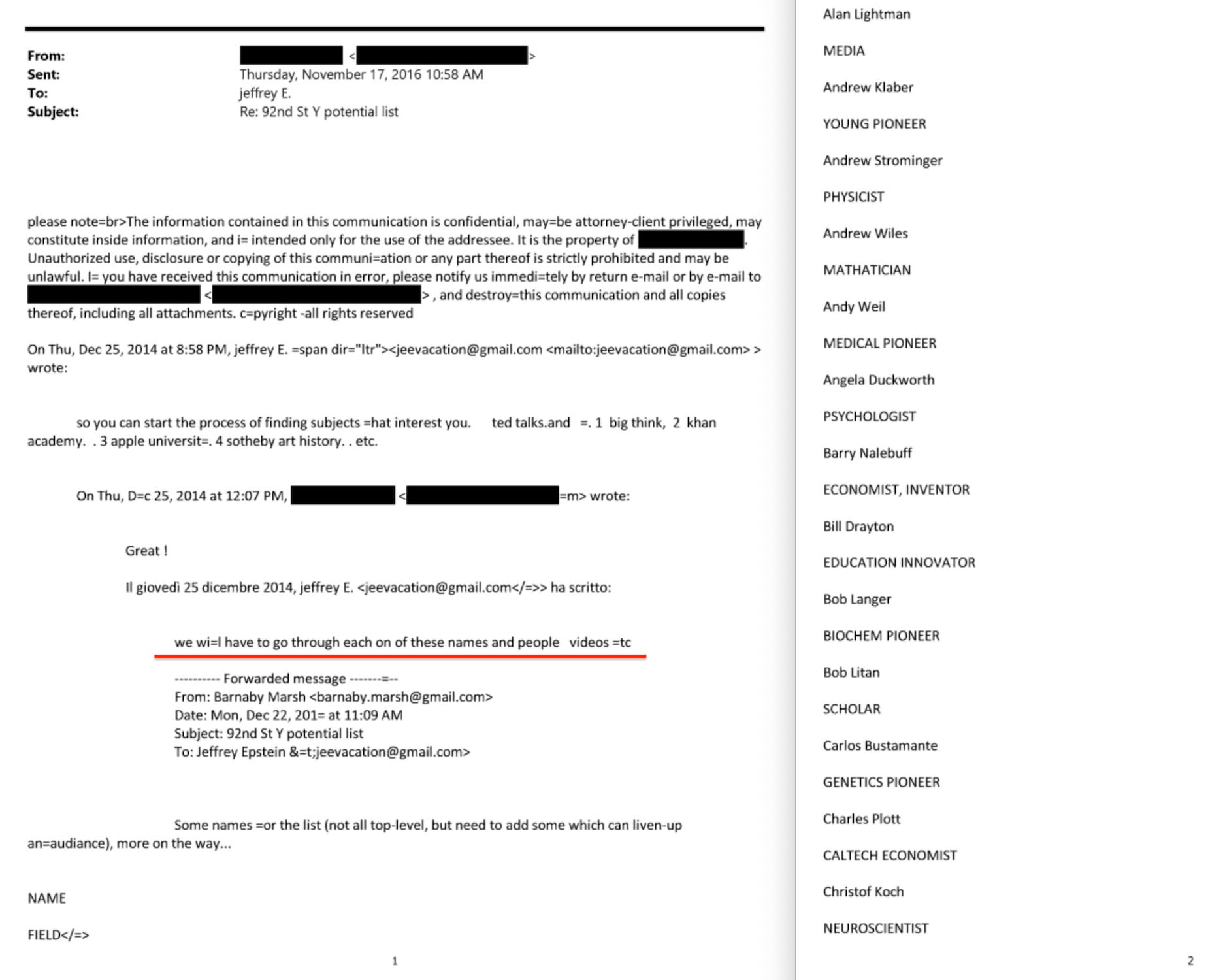
Epstein forwarded the list on Christmas Day with the instruction120: ‘we will have to go through each one of these names and people videos etc’. Five years after the original programme email, Marsh was still running the pipeline. The research and development phase was over — deployment had begun.
The Wire Version
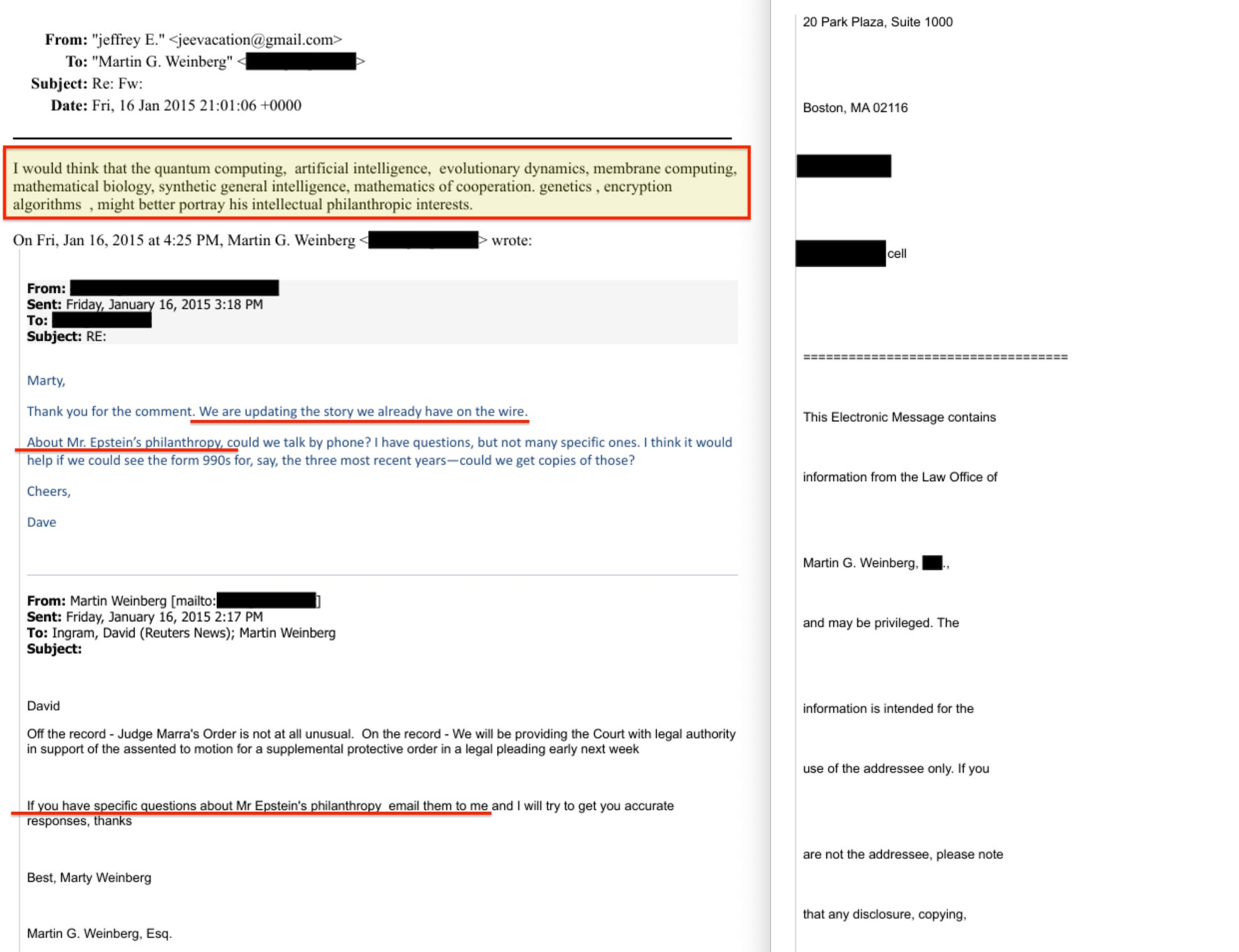
Three weeks later, on January 16, 2015, Epstein put together a different version of the same programme — this time for a journalist.
David Ingram from Reuters had contacted Epstein’s lawyer Martin Weinberg, asking about Epstein’s charitable work. Weinberg passed the request along. Epstein’s reply was a single instruction121: ‘I would think that the quantum computing, artificial intelligence, evolutionary dynamics, membrane computing, mathematical biology, synthetic general intelligence, mathematics of cooperation, genetics, encryption algorithms, might better portray his intellectual philanthropic interests’.
The list lines up neatly with three of the seven gatherings. Gathering 1: evolutionary dynamics, genetics, encryption algorithms. Gathering 2: artificial intelligence, synthetic general intelligence. Gathering 5: mathematical biology, mathematics of cooperation. These were the pure science topics — the ones where the funding could plausibly be called philanthropy.
What’s left out tells you more than what’s included. For Reuters, Epstein stripped the programme down to just the three gatherings that could hold up under scrutiny from a journalist looking into his charitable giving.
One Programme
The programme document was written by a convicted sex offender four months out of prison. It was annotated by a currency researcher who saw exactly what it was describing. It was sent to at least five people through multiple channels. Three of them — Randall, the redacted correspondent, and Marsh — each independently spotted the same thing at its core: cryptography and finance were the real heart of the programme, and everything else was built to serve them.
The seven gatherings were the research and development phase. The funding built the components. The Mindshift conferences on the island pulled the scientific threads together. Project Molecule with JPMorgan built the impact investing prototype. The Bendell commission tested the digital currency idea. The 2013 summit was the proof of concept — every component brought together in one room. And from 2014, two parallel product launches began: the Waddesdon forums at Rothschild property turned the stranded assets design into regulatory infrastructure through a seven-forum capture sequence, while the impact investing framework rolled out through the Rockefeller Foundation, the Clinton Global Initiative, and OPIC.
One person was simultaneously…
… designing the impact investing product with JPMorgan (Layer 2)
… commissioning the digital currency research that would become the CBDC framework (Layer 4)
… funding the AI and cryptographic components required for both (Gatherings 1 and 2)
… and positioning the people who would build the regulatory enforcement layer (Layer 3).
The public side — the Rockefeller Foundation, the Clinton Global Initiative, Al Gore, and the Rothschild-hosted Waddesdon forums — built the institutional framework and the political legitimacy. The private side — Epstein, JPMorgan, the Rothschild financial channel opened through Ariane de Rothschild, Barak, Summers — built the technical components and the pipeline for getting it all into governments.
The system now operates through the TCFD, NGFS, Basel capital requirements, BIS Innovation Hub projects, SDG financing frameworks, the unified ledger architecture that the BIS published as its ‘Blueprint for the Future Monetary System’, and the progressive rollout of central bank digital currencies with purpose-bound conditions. The ‘common good’ — sustainable development — is the variable that gets plugged into all four levels at once: the criteria that impact investments have to meet, the standard the AI uses to classify transactions, the definition that decides which assets get stranded, the logic the unified ledger runs on, and the conditions that programmable money enforces.
Whoever writes the ethic, and whoever converts that ethic into the standard the system runs on, controls where every pound, dollar, and yuan can flow. The ethic justifies the standard. The standard feeds the clearinghouse. The clearinghouse — once a named banker at a table, now a condition embedded in the currency itself — applies it to every transaction. Neither the ethic’s authors nor the standard’s compilers were elected, and neither can be removed by a vote.
Seven research topics. Four layers. One system. The design has been around for a long time. What’s new is that the technology to build it finally exists — and Epstein’s emails tell you exactly how it was put together.


Hats off to you for the enormous amount of work you're doing - whether it's a team effort or not!
These are large and sometimes complicated topics to grasp, but trust that they will be noticed and understood by those with "eyes to see" (behind the scenes and the drama).
so much is revealed by this information; the associations, relationships and their preoccupations. Evidence of Judaic supremacist machinations is extensive, not surprising and yet at the same time deeply unsettling. They obviously did not feel the need to hide their activity, which is in and of itself a chilling revelation that tells us the level of complicity and participation is very high. I wonder if society is ready to face the inconvenient truth of what all of this reveals.