
Second-Order Cybernetics
The internalisation of ethical monism

Your banking app shows your carbon footprint from last month’s purchases and suggests you ‘offset’ by reducing meat consumption. At church, the sermon draws from Laudato Si’, framing care for creation as moral duty. In your child’s classroom, a poster displays concentric circles radiating from ‘Me’ to ‘Family’ to ‘Nation’ to ‘Planet’ — the outermost circle labeled ‘Mature Citizenship’.
Three domains, one message, seamlessly aligned.
The planetary ethic has moved into habits and identity — people now experience coordination not as coercion, but as ‘moral’ conscience.
These are manifestations of a single architecture that has migrated from international frameworks into daily life — from Security Council resolutions to payment protocols to personal conscience. The previous essay traced how ethical monism emerged from Spinoza’s philosophy through systems theory into contemporary operational infrastructure. But any architecture — no matter how comprehensive — remains external until it lives inside its subjects.
This is about internalisation through development — a process that transforms the Earth Charter’s principles from ideals into moral truths, experienced not simply as commands from outside but as expressions of one’s ‘unique self’.
The system achieves what no traditional tyranny could: it makes its subjects want what it requires them to do.

Executive Summary
While the first essay traced how ethical monism evolved from Spinoza’s philosophy into operational infrastructure, the second essay reveals how this external architecture becomes control through systematic internalisation that transforms institutional imperatives into personal identity.
The pathway operates simultaneously across spiritual, material, and psychological domains. Vatican encyclicals translate IIASA model outputs into sacred obligations for 1.3 billion Catholics. Banking apps from BBVA, ING, and Garanti embed carbon tracking into 19+ million users’ daily transactions, with CBDCs under development to enforce compliance at protocol level. Meanwhile, UNESCO’s Global Citizenship Education, Social-Emotional Learning curricula, and Ken Wilber’s Integral Theory developmental frameworks shape children and adults from primary school onwards — installing planetary citizenship as the endpoint of human moral evolution, where resistance indicates arrested development rather than merely disagreement.
This architecture executes Alexander Bogdanov’s century-old blueprint: empiriomonism provides the epistemology, tektology supplies the method, and Proletkult delivers the implementation. What Bogdanov sketched in 1920s Russia now operates at planetary scale with infrastructure he couldn’t have imagined: real-time supply chain tracking, automated carbon accounting, and developmental psychology frameworks that pathologise dissent as cognitive immaturity. The result is ‘integral man’ produced en masse — billions of people who police themselves not through fear but through pride in their ‘moral’ development, experiencing system alignment as conscience rather than coercion, enacting their ‘unique calling’ within parameters they typically do not fully understand, cannot challenge, and did not in any way legitimately consent to.
The fusion of material and spiritual enforcement, internalised through systematic developmental cultivation, creates something more comprehensive than traditional authoritarianism: you remain free to choose within bounds made acceptable — indeed, made desirable — through education that shaped your values before critical thinking developed, emotional conditioning that trained gut-level responses, social pressure that makes deviation psychologically costly, religious authorities that frame compliance as sacred duty, and financial infrastructure that may soon execute automatically.
‘Black box’ models you cannot audit define planetary crisis. Developmental hierarchies diagnose your dissent as immaturity. Programmable money enforces at protocol level. And you will experience this not as oppression but as growth, scientific necessity, and what seems like self-expression. The accountability vacuum is complete — the system achieved its ideal state. External enforcement eventually becomes unnecessary because the architecture lives inside you. That’s the idea, anyway… much like Marx claimed the state eventually withers away.
What emerges is not democratic coordination but comprehensive control operating below conscious choice: free will operationally redefined as successful alignment between individual neural patterns and system requirements, enforced through infrastructure spanning central banks to classroom curricula to papal encyclicals, accountable to no electorate, validated by no transparent process, constrained by no institution outside itself — because the ‘ethical’ framework has become the infrastructure at every scale, internalised so thoroughly that questioning it feels like questioning your own moral development.
This is Spinoza’s determinism realised through architecture that makes its subjects want what it requires them to do, experienced as freedom while executing predetermined functions — all commanded by opaque models with the force of divine revelation and enforced by programmable protocols with zero democratic legitimacy.
Between these two essays, the primary architecture of ‘anticipatory governance’ should thus become fully visible. Further concepts exist — especially in the sphere of enforcement. But the likes of mandated vaccine schedules and 15-minute cities merely add to the core architecture, thus ultimately complementing the full picture of Lenin’s vanguard state in its digitised form.
Development as Infrastructure
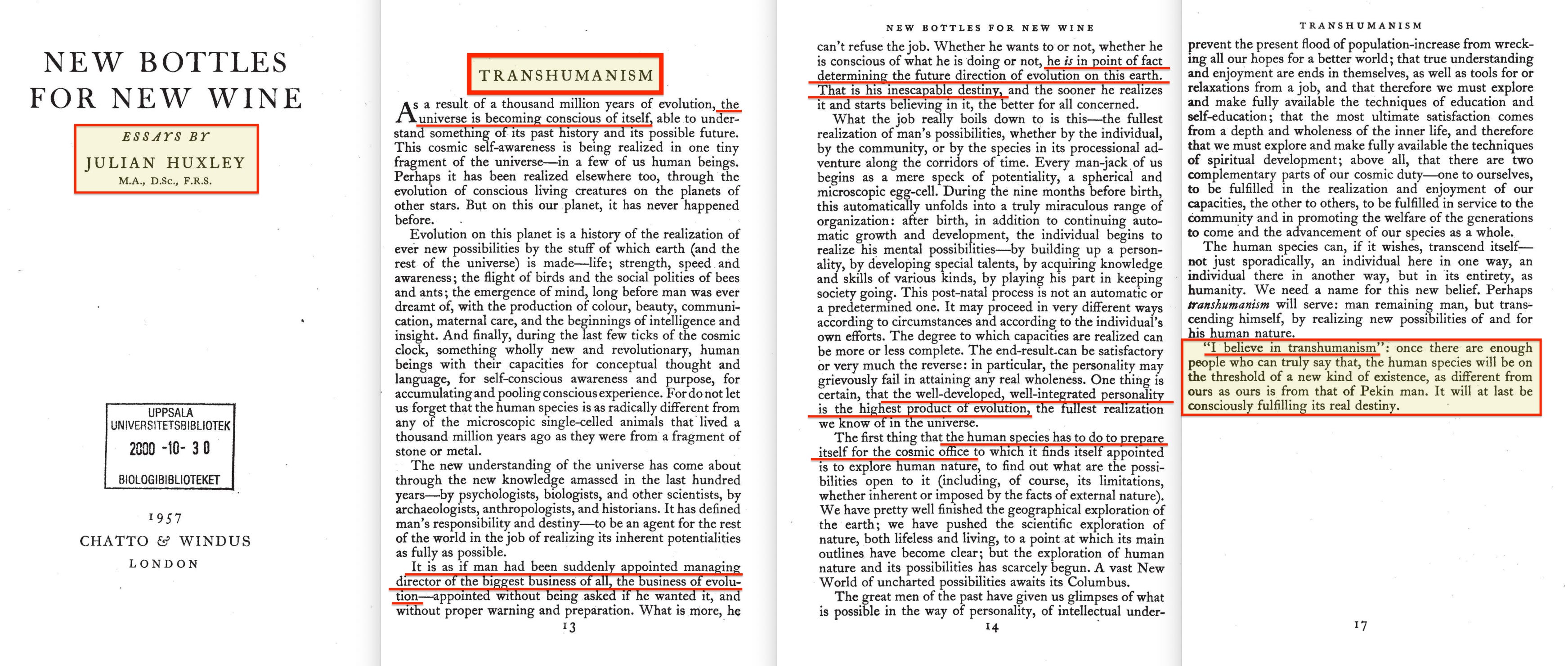
This ‘conscience as coordination’ approach was discussed explicitly in 1946 by UNESCO’s first Director-General, Julian Huxley, who called for ‘a unified common outlook’, ‘socialisation of ethics’, and for education to prepare publics for ‘the transfer of full sovereignty to a world organisation’.

The internalisation follows a deliberate pathway, drawing on developmental psychology frameworks that map how humans form values and moral reasoning. Regardlesss of their original aims, these tools now function in practice as the psychological rails for public buy-in.
Spiral Dynamics (Clare Graves/Don Beck)1:
Value systems evolve through stages —Me — egocentric survival
‘I want the latest phone’Us — tribal loyalty
’We should buy local’All of us — universal care
’Everyone deserves fair wages’Integral — holding all perspectives
’Some pigs are more equal than others’
Moral Foundations Theory (Jonathan Haidt)2:
Six intuitive ‘taste receptors’ shape ethical judgment — care, fairness, liberty, loyalty, authority, sanctity. Different cultures and individuals weight these differently; where one person prioritises care (reduce suffering), another loyalty (protect our group), another liberty (don’t coerce me).Integral Theory/AQAL (Ken Wilber)3:
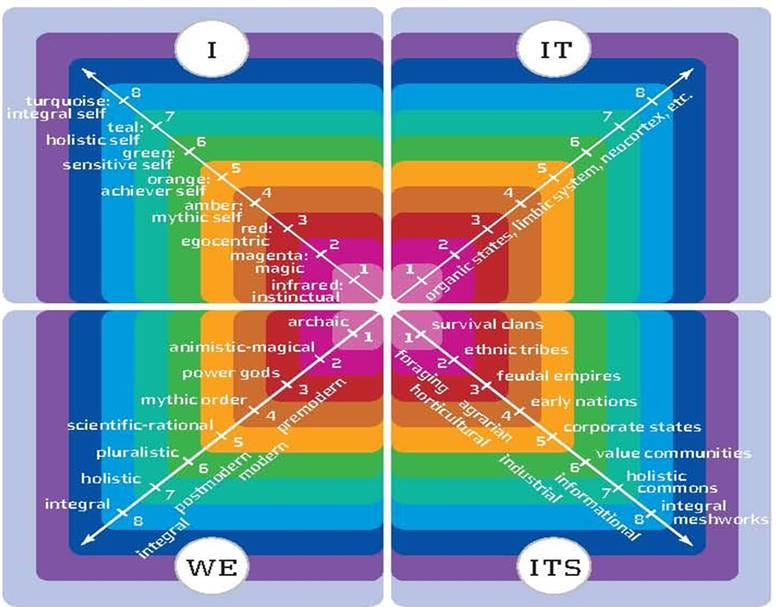
Claims to integrate everything into one coherent picture by mapping all perspectives into four quadrants across developmental levels:I — interior self: consciousness, values
We — interior collective: culture, shared meaning
It — exterior self: behavior, biology
Its — exterior collective: systems, institutions.
These frameworks have migrated from academic psychology into mainstream culture through business consulting, education reform, and spiritual movements. The Earth Charter4 draws on this developmental language, framing its principles not as one ethical option among many but as the logical endpoint of human moral evolution — what humanity becomes when it develops beyond narrow self-interest into planetary awareness.

See how the architecture works in practice: if sustainability, universal solidarity, and collective responsibility are developmental achievements rather than political choices, then resistance isn’t principled disagreement — it’s arrested development. To question the framework is to reveal yourself as ethically immature, stuck at a lower stage. The moral judgment carries epistemological force: you don’t just disagree with planetary ethics, you haven’t yet grown capable of understanding them. A school poster maps concentric circles from ‘me’ to ‘family’ to ‘nation’ to ‘planet’ — the mature stage is the outermost circle. This is, in effect, consent manufacturing through developmental categorisation.
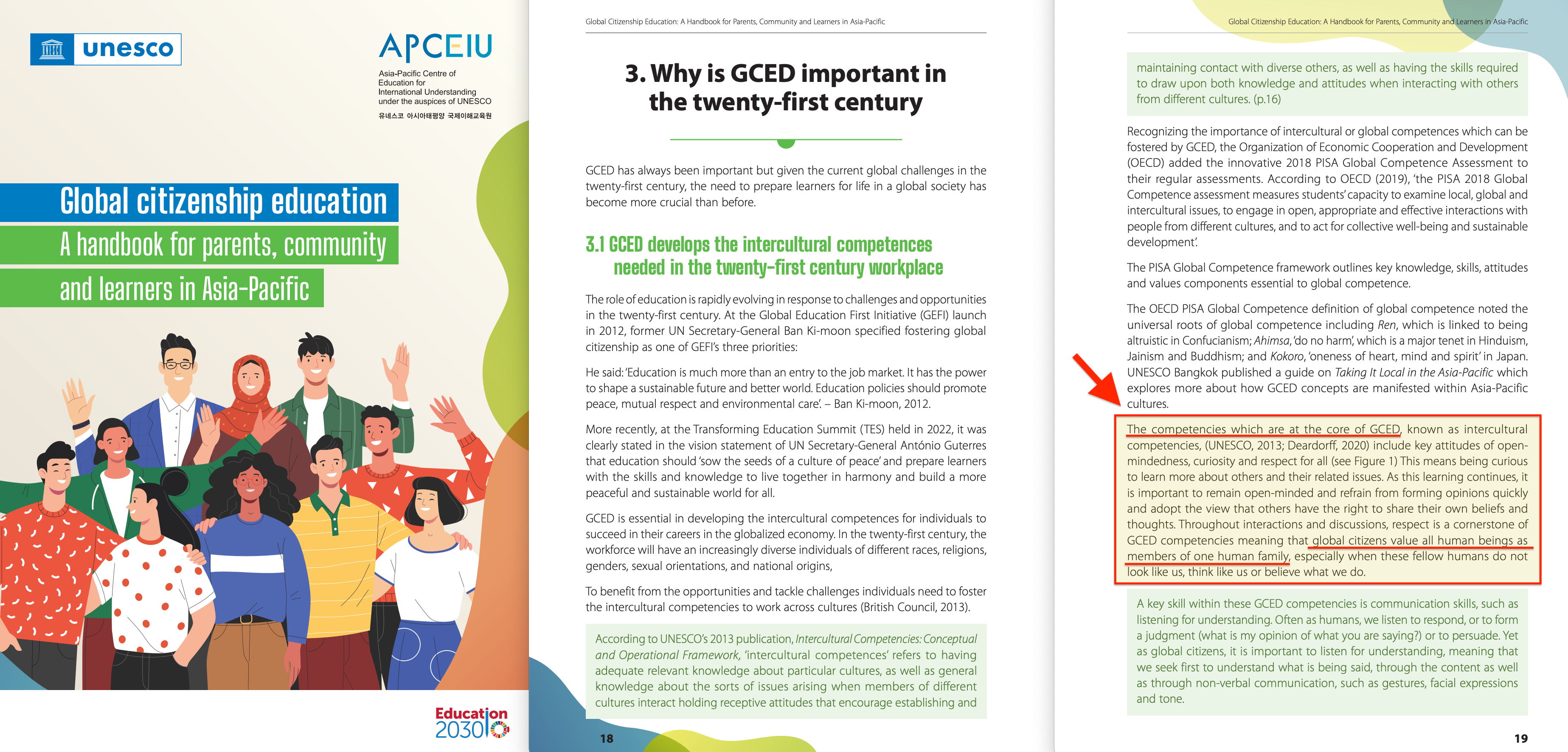
The pathway operates at every level. UNESCO’s Global Citizenship Education (GCED)5 programs, rolled out across school systems worldwide, teach children that they are first and foremost members of a global community, that local and national identities are narrower circles within the planetary whole. Textbooks emphasize interconnection — how your lunch affects rainforests in Brazil, how your electricity use influences Pacific islands. The pedagogical method moves beyond facts to values: being a good person means being a good global citizen. The sustainable development goals6 aren’t merely policy targets — they’re moral milestones against which you measure your life, brought to life through the less-discussed indicator frameworks7.

UNESCO’s 1949 manual, ‘The United Nations and World Citizenship’, directs teachers to ‘develop informed and competent world citizens’ by first reforming educators’ own attitudes to ‘foster the spirit that will make (the UN) function’ — precisely the developmental pipeline now branded GCED.
Outside formal education, popular culture reinforces the same developmental narrative. Documentaries narrated by David Attenborough don’t just show nature — they moralise human impact and collective responsibility. Climate journalism frames extreme weather as evidence of our collective failure, implicitly requiring our collective response. Social media amplifies infographics showing the carbon footprint of consumer choices, the global supply chains behind products, the ripple effects of individual actions. Each message nudges the viewer toward what the system defines as maturity: recognising your place in the whole, accepting your responsibility to it, aligning your choices with planetary needs.

Religious and spiritual movements complete the circle by translating scientific imperatives into sacred obligations. Pope Francis’s Laudato Si’ (2015)8 and Laudate Deum (2023)9 reframe the scientific language of planetary boundaries as divine mandate. The encyclicals don’t just acknowledge climate science — they transform it into moral duty, calling for ‘a new and universal solidarity’ where environmental stewardship becomes inseparable from faith.

The Vatican’s alignment with the Earth Charter framework — formalised through bodies like the Council for Inclusive Capitalism — demonstrates how thoroughly the ethical architecture spans domains.

This convergence extends across traditions. When 1.3 billion Catholics are taught that caring for creation is religious obligation, when Islamic declarations frame climate action as sacred duty, when Buddhist and Hindu leaders emphasize interconnection and non-harm toward all beings — the effect is comprehensive moral alignment. The external authority (whether God or government) recedes; instead, ‘global ethics’ emerges as immanent truth that ‘feels right’ because it resonates with both scientific understanding and spiritual wisdom.
This is the internalised side of Spinoza’s vision realised: ethics derived from nature itself, discovered through adequate understanding of how things actually work, experienced as the intellectual love of reality.

From Cells to Operators: The Organismic Turn
The developmental narrative culminates in a specific self-conception: humanity as superorganism10, individuals as cells. This isn’t mere metaphor — it’s increasingly how people experience their place in the world.
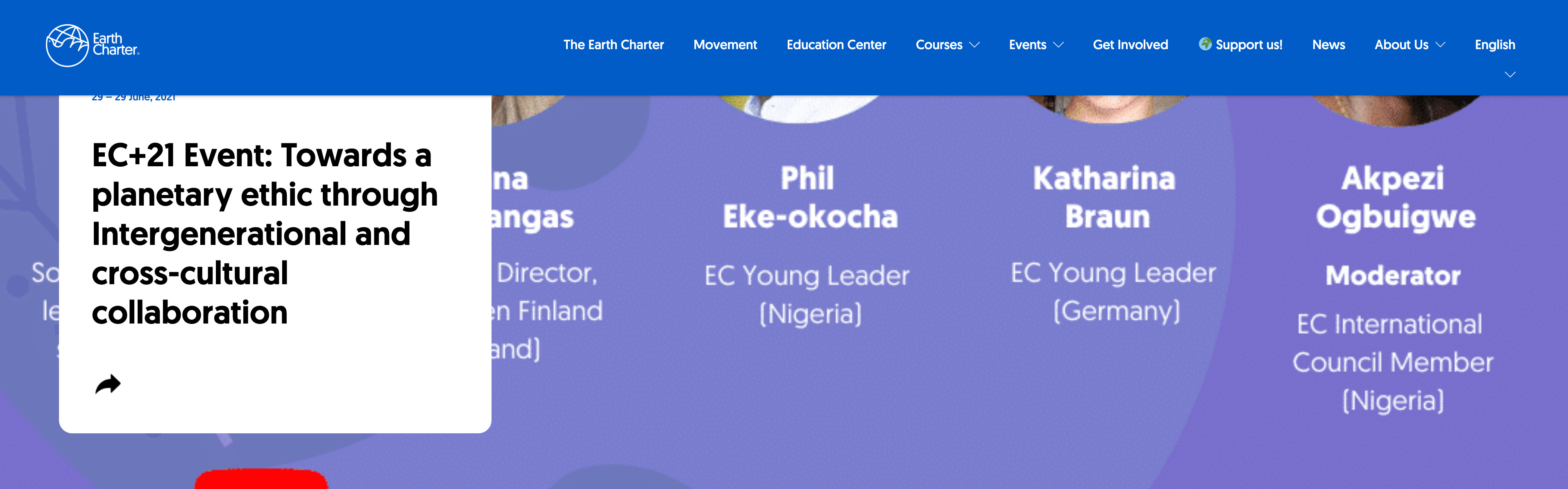
The language appears everywhere. The Earth Charter’s opening11: ‘We are one human family and one Earth community with a common destiny’. Public health maxims during COVID-1912: ‘No one is safe until everyone is safe’. Environmental slogans13: ‘There is no Planet B’.
Each conveys the same message: the individual exists within and for the collective whole. Your behavior affects the system; the system’s health determines your survival; therefore you have duties to the whole that supersede local preferences.

This organismic thinking has deep roots — Teilhard de Chardin’s noosphere14, James Lovelock’s Gaia hypothesis15 — but it has gone mainstream. In a 2023 book, futurist Byron Reese articulates what many now feel intuitively: humanity functions as a collective being ‘greater than the sum of its parts’, with cities as hives, the internet as nervous system, and each person as one cell in a vast organism16.
The cell metaphor carries profound implications. Cells have specialised functions. They operate within parameters that maintain organismic health. They receive signals from the body’s regulatory systems and respond accordingly. Cells that malfunction or refuse coordination become threats — either corrected by the immune system or eliminated as cancer.
When you understand yourself as a cell in the planetary superorganism, certain behaviors follow naturally. You accept your specialised role. You monitor your consumption against budgets derived from whole-system models. You feel guilt when your actions (flying, eating meat, excessive energy use) impose costs on the larger body. You experience relief when you align with the organism’s needs. Most importantly, you accept guidance from the system’s ‘brain’ — the expert institutions, global models, and coordinating authorities that can perceive patterns and threats beyond any individual cell’s capacity.
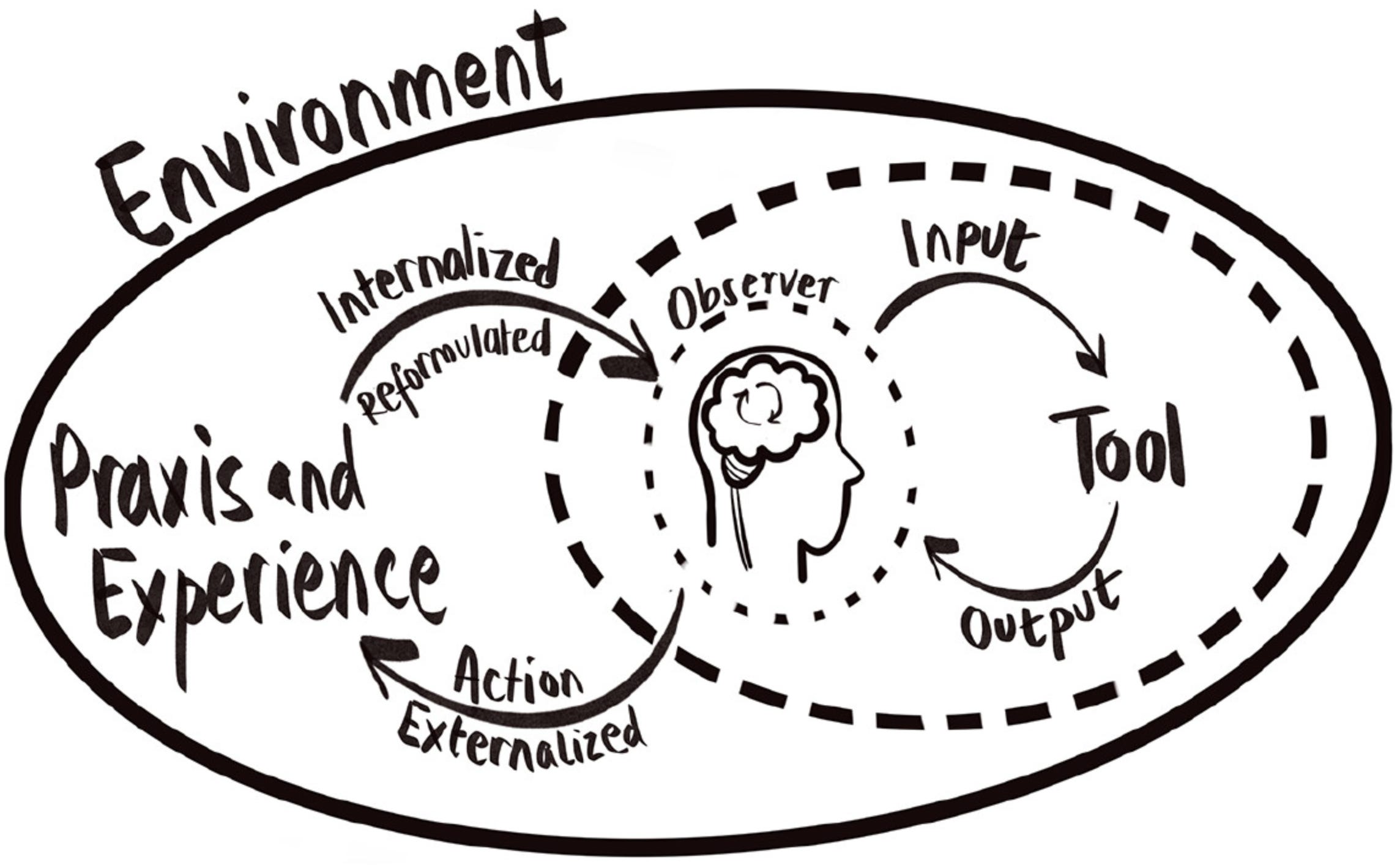
This is where the developmental frameworks meet systems theory. Bogdanov’s original vision — integral man17, a person trained in organisational thinking and capable of coordinating across complex systems — finds modern expression in the concept of the second-order cybernetic operator.

Second-order cybernetics18 is the study of observing systems: the observer is always part of what they observe, and reflexivity is the core skill. Unlike in first-order cybernetics which treats systems as machines to be controlled through feedback loops, in second-order cybernetics the designer shapes the system, but the system also shapes the designer.
The second-order operator is expected to understand this reciprocal relationship. He doesn’t just execute commands, but observe how these alter system behavior, boundaries and goals, and thus consciously introduce purpose and ethics into coordination. The ideal is a reflexive, self-aware agent capable of ethically influencing the systems while remaining aware of how those systems influence them.
C. West Churchman’s ‘sweep-in’ principle19 — continuously expanding the boundary to include everyone affected by a system’s design — provides the ethical method for this stance. The operator isn’t neutral; they actively work to ensure systems serve all stakeholders, not just the powerful.
How Second-Order Gets Simulated:
But observe what happens when this framework is captured by the ethical monist architecture:
Optimisation within preset boundaries:
You’re encouraged to think systemically, but only about optimisation within the planetary boundaries framework. The boundaries themselves — where they come from, who set them, whether they’re accurate — are off-limits.Stakeholders pre-selected:
You’re taught ‘stakeholder analysis’, but the stakeholders and their concerns are pre-defined by global governance institutions. Indigenous groups, future generations, and ‘the planet’ get seats at the table — but not climate skeptics, development advocates, or those questioning the models.‘Sweep-in’ reduced to checkbox:
The boundary expansion becomes procedural: Did you consult indigenous groups? ✓ Did you consider future generations? ✓ The sweep never expands to question whether the entire framework is legitimate, or whether the models defining crisis are accurate.
Instead of cultivating legit agency, the system produces sophisticated administrators who believe they’re operating reflexively while actually executing within carefully bounded parameters. You develop ‘integral consciousness’20 that can hold multiple perspectives — except the perspective that questions whether the entire framework serves those it claims to represent.
This is the inversion of second-order agency. You’re given the vocabulary of reflexivity and the sense of sophisticated participation, but the actual structure is first-order control dressed in second-order language.
You’re not a citizen capable of rewriting constitutions — you’re a well-trained administrator executing bylaws with increasing efficiency. The difference is crucial: one is free, the other serves the system.

Integral Theory: GPS or Gatekeeping?
Ken Wilber’s integral21 framework deserves specific attention because it has become the philosophical infrastructure for much of this developmental approach. Wilber’s AQAL map organizes reality into four quadrants — I (interior self: consciousness, values), We (interior collective: culture, shared meaning), It (exterior self: behavior, biology), Its (exterior collective: systems, institutions). His developmental levels trace growth from egocentric to ethnocentric to worldcentric to integral. His ‘integral ethics’22 attempts to hold three strands together: cultural Goodness (virtues and norms in the We quadrant), individual Truth and Rightness (principled rights in the I quadrant), and systemic Justice (consequences and viability in the Its quadrant).
In principle, this provides a sophisticated decision method that resists reductionism. Instead of ethics being purely about individual rights (libertarianism), or purely about consequences (utilitarianism), or purely about virtues (communitarianism), integral ethics requires honoring all dimensions. When making decisions, you should consider: What’s good for this culture? What rights must be respected? What systemic effects will follow? This multi-perspectival approach should create checks and balances.
The method sounds like wisdom. It operates more like a sorting mechanism.
In practice, developmental stage theory becomes a hierarchy of legitimacy. People at ‘higher’ stages — those who’ve supposedly achieved ‘integral consciousness’ — are positioned as naturally better equipped to make decisions than those still operating at ethnocentric or mythic levels. When Wilber writes about meeting people at their developmental center of gravity, it should mean respecting where they are and working within their value systems23. But in application, it often functions differently: A planner may meet a rural community at its stage — understanding their values, speaking their language — then design incentives so they ‘choose’ the same outcome anyway. The community feels ‘heard’; the plan proceeds unchanged.
This is benevolent paternalism encoded in developmental theory. And when that theory is paired with global models claiming to represent objective reality — planetary boundaries, climate tipping points, biodiversity thresholds — the result is a closed loop. The models define what’s systemically necessary (the Its quadrant). That necessity is translated into cultural goods and universal values (the We and I quadrants). Those who resist are diagnosed as developmentally unable to perceive integral truth. Their objections aren’t engaged as legitimate disagreement — they’re categorised as symptoms of lower-stage consciousness — perhaps even caste — but in practice sorted as voices that don’t yet count as ‘developed’.
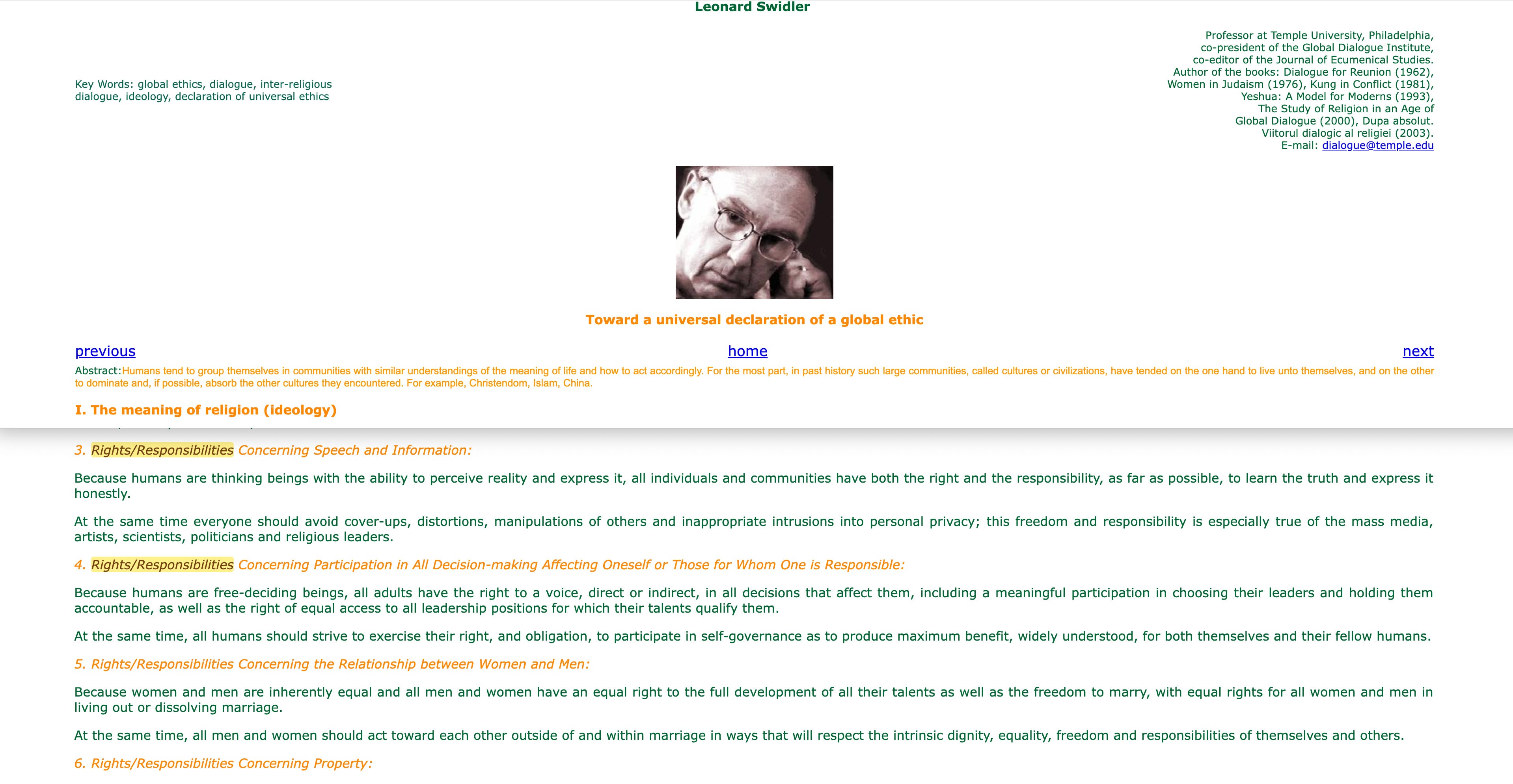
Leonard Swidler’s addition to this framework — pairing rights with responsibilities24 — seems like it should create balance. Rights emphasise the individual (I/It quadrants: liberties, due process). Responsibilities emphasise the collective (We/Its quadrants: shared norms, systemic duties). The pivot from rights-only to rights-and-responsibilities prevents pure individualism from destroying collective flourishing. That’s the claim, anyway.
But observe what happens when this framework is scaled globally and wired into indicators. The emphasis shifts from rights as protections against power to responsibilities as duties to the whole. When ‘the whole’ is defined by planetary models and enforced through coordinated institutions, responsibilities become: accept the carbon budget, comply with sustainability requirements, subordinate local preferences to global optimization. Rights remain, technically — but they’re increasingly rate-limited by your systemic responsibilities as measured by the architecture’s metrics.
This isn’t necessarily malicious. Many of those building these frameworks genuinely believe they’re creating necessary coordination for collective survival. The question isn’t their intent — it’s the structure they’re building and what it enables.

The Developmental Pipeline in Practice
The full developmental sequence works like this:
Childhood education (UNESCO’s Global Citizenship Education)25:
You learn that you’re part of ‘one human family’26, that everything is interconnected, that being good means acting for the planetary whole. This is framed as moral growth, not indoctrination.
What did you just absorb as ‘obvious’?Adolescent identity formation:
You internalise these values as core to who you are. Being ‘climate-conscious’ or a cosmopolitan ‘global citizen’ becomes part of your identity27 — something you take pride in. Social belonging increasingly depends on demonstrating commitment to these shared values. Those who don’t share them are seen as ignorant or selfish.
When did caring about the planet become who you are rather than what you do?Young adult development:
Through higher education and early career, you learn systems thinking — but within the boundaries of sustainability frameworks, human rights as defined by global institutions, and development goals set by the UN. You’re trained to be a second-order operator, but the systems you operate within and the goals you serve are taken as given.
Which system boundaries were you taught never to question?Mature integration (Wilber’s integral stage):
You achieve what feels like a comprehensive, multi-perspectival consciousness. You can hold paradox, see different viewpoints, understand complex systems. But the architecture that shaped your development has already defined what counts as legitimate complexity and which perspectives deserve integration. You experience your worldview as hard-won wisdom, not realising it’s been carefully cultivated.
Is your ‘integral view’ genuinely comprehensive, or comprehensively bounded?Existential culmination (Gafni’s Unique Self)28:
You discover your distinctive calling within the larger whole. This isn’t generic compliance — it’s your specific ‘gift’, your particular way of serving. This feels deeply authentic because it is authentic within the framework. You’re not suppressing but ‘expressing yourself’. It just coincidentally happens that your unique expression has been developed to align with system requirements. Your freedom is real, and bounded… commonly by the Planet, as it transpires.
Does your calling serve you, or does it serve the architecture?
Traditional propaganda tells you what to think. This architecture shapes how you develop the capacity to think, ensuring that your mature, autonomous judgment arrives at the ‘right’ conclusions. You police yourself, not through fear, but through pride in your moral development and your role in something greater than yourself.

Emotional Infrastructure
The cognitive pipeline is reinforced by parallel emotional infrastructure. Social-Emotional Learning (SEL)29, now standard in school systems worldwide, is framed as mental health and emotional intelligence — supposedly teaching children self-awareness, self-regulation, social awareness, relationship skills, and ‘responsible decision-making’. Huxley’s brief explicitly names the affective layer: UNESCO should work to ‘enlarge the emotional capacity of mankind’ via arts and media — SEL by another name, planned seventy-five years ago.
But observe what it actually installs.
SEL trains emotional regulation aligned with collective functioning. Not just managing your emotions, but managing them in ways that support group cohesion and system stability30. You learn to monitor your own affective states and self-correct before external intervention is needed. ‘Responsible decision-making’ becomes decisions that align with collective good as defined by the framework. The training operates below conscious reasoning — ensuring your gut reactions, not just your thoughts, align with system requirements.
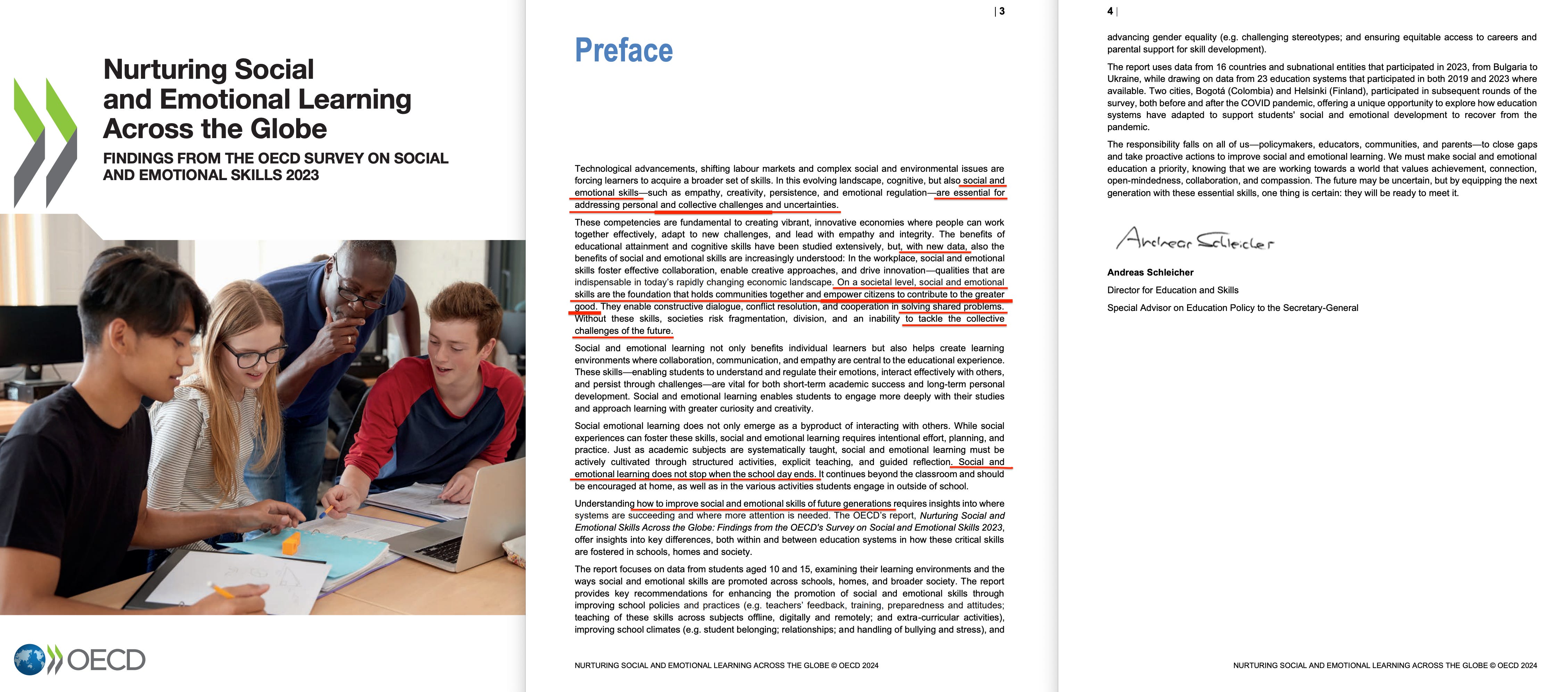
This is emotional middleware for the superorganism. You don’t just intellectually accept that you’re a cell — you’re made to feel guilt when you deviate, pride when you align, anxiety when you consider non-compliance. The architecture lives in your nervous system. When you experience flight shame or relief from reducing your carbon footprint, that’s not spontaneous emotion — it’s the output of years of affective conditioning through SEL’s ‘social awareness’ and ‘responsible decision-making’ frameworks.
The training never stops. ‘Lifelong learning’31 — framed as continuous professional development, upskilling, and personal growth — extends the pipeline indefinitely. You’re never ‘finished’ developing. There’s always the next stage on Spiral Dynamics, always deeper integral consciousness to achieve, always new understanding to internalise. The planetary framework evolves, and you must evolve with it.
This is continuous firmware updates for human consciousness:
New models emerge → you update your understanding of ‘the science’
New policies deploy → you update your sense of ‘responsible citizenship’
New technologies roll out → you update your acceptance of tracking and optimisation
New crises are declared → you update your tolerance for emergency measures
The genius of the design: traditional indoctrination is brittle. Tell someone what to think, and they might resist or the information becomes outdated. But if you install the capacity to self-regulate emotions (SEL), frame existence as continuous development toward higher stages (lifelong learning), and provide regular updates through education, media, apps, and social pressure — then you don’t need to control people. They control themselves. They want the updates. They feel anxious when they fall behind the current framework. They experience staying synchronized as personal growth.
Human firmware updates. Not imposed. Downloaded voluntarily because you believe they make you a better version of yourself.

Algorithmic Nudging and the Quantified Self
The developmental internalisation is reinforced by technology that brings the global ethic into daily life. This is where the abstract framework becomes concrete behavior modification.
Major banks now embed carbon footprint calculators in their apps. BBVA in Mexico provides nearly 19 million users with real-time estimates of the emissions from their spending, along with personalised advice on reducing their footprint32. In Turkey, Garanti BBVA’s app automatically calculates customers’ carbon emissions from utility bills and fuel purchases33. ING in the Netherlands rolled out similar features to all customers34. These tools are voluntary — no one forces you to use them. But they normalise the expectation that responsible people monitor and manage their environmental impact as part of basic financial literacy.
The most striking example was Doconomy’s DO Black card, a credit card that didn’t just track carbon impact but enforced a limit35. Once your purchases exceeded a certain carbon allowance for the year, the card simply stopped working. The product was voluntary and is no longer active, but it demonstrated how easily ‘personal empowerment’ tools become constraint mechanisms. As Doconomy’s CEO explained, the aim was supporting global climate goals by empowering people to track their footprint and make sustainable choices36.

The slide from empowerment to enforcement required no additional infrastructure — the same system that measures can limit.
Even without explicit caps, feedback loops are everywhere. Smart thermostats suggest when to adjust temperature for emissions reduction37. Fitness trackers celebrate walking instead of driving. Supermarket receipts display your basket’s environmental score38. Navigation apps offer the ‘lowest carbon route’, while online flight scanners highlight ‘greener flights’39. Each interaction embeds the message: the system knows the impact of your actions and will help guide you to correct choices.
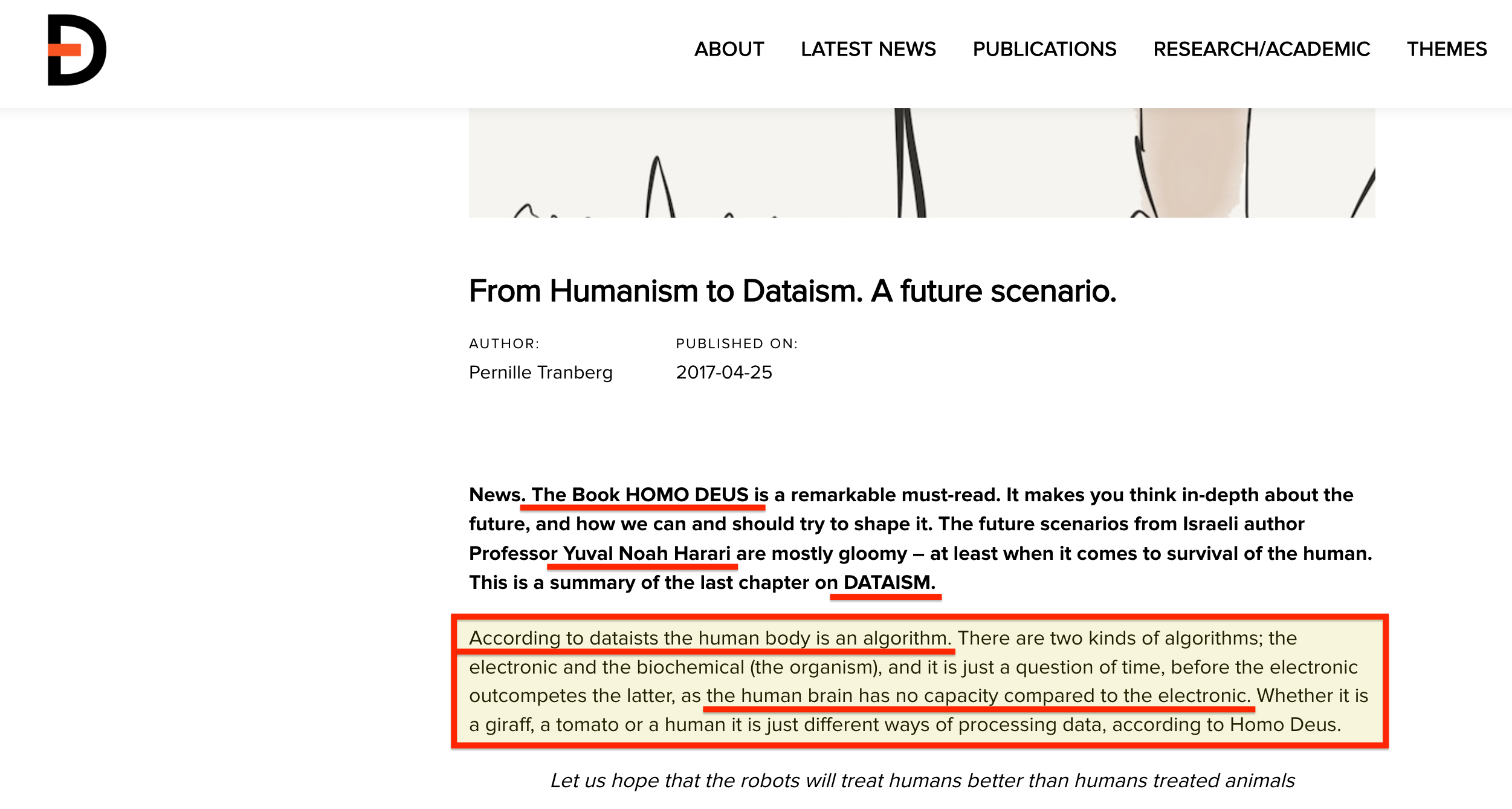
This reflects what Yuval Noah Harari calls Dataism40 — the emerging worldview that treats information processing as the ultimate value and algorithms as superior decision-makers. Just as society once looked to God or individual conscience for guidance, now we defer to systems that can process more data than any human can hold. If the algorithm has traffic patterns, emissions data, and route efficiency all integrated, why not let it decide whether you should travel at all? If the app tracks nutrition, climate impact, and health outcomes together, why not trust its recommendations over your own impulses?
Bit by bit, decision by decision, human judgment is augmented — or entirely replaced — by algorithmic guidance that carries implicit ethical weight. The danger isn’t that the systems are wrong — though they often are. It’s that free will erodes through convenience. People come to prefer letting the system decide, believing it’s more informed, more rational, and ultimately more moral than their gut feelings.
Social Enforcement
As individuals internalise the planetary ethic41, social emotions become self-enforcing mechanisms. Pride and shame — the emotions that once regulated behavior within local communities — now operate at global scale.
The phenomenon of ‘flight shame’ (flygskam42) demonstrates this vividly. In the late 2010s, public sentiment in Sweden turned sharply against air travel due to its carbon footprint. People who once bragged about weekend getaways to Barcelona began feeling embarrassed about flying. This wasn’t legislation — it was culture shift. Many cut back on flying not because any law required it, but because they felt moral obligation and social pressure.
By 2018-2019, flying in Sweden was ‘something to feel guilty or ashamed about’, and choosing not to fly was seen as commendable. Not flying became a badge of maturity, a mark of moral seriousness. Individuals calculated that a single round-trip flight could consume a huge portion of their annual carbon budget given the country’s climate targets. What’s revealing is how participants described it: many who stopped flying for climate reasons ‘did not describe themselves as shamed, but rather as having been supported to live up to their own moral standards’.

Read that carefully. The global ethic had become their personal ethic. Adhering to it was a matter of integrity — not compliance with external pressure but alignment with their own values. They were policing themselves, experiencing relief from inner conflict by bringing behavior in line with what science, ethics, and often even their own SEL-educated children told them was right.
This is the ideal outcome from the architecture’s perspective: internalisation so complete that external enforcement becomes unnecessary. Communities form around these values — online groups pledging to go ‘flight-free’, neighborhoods competing for lowest energy usage. Corporations and governments, seeing this shift, pivot from coercion to messaging. Instead of banning behaviors outright, they trust that ‘informed’ global citizens will make correct choices voluntarily.
Yet observe how seamless the continuum is between voluntary internalisation and subtle coercion. Social media algorithms amplify content promoting ‘sustainable’ habits while reducing the impression counts of those harbouring dissenting views (often labeled ‘climate denial’ or ‘misinformation’). What feels like your own moral choice has been shaped by echo chambers and curated information flows. The global modeling apparatus still defines what’s ‘ethical’ by declaring certain crises and solutions.
You’re free to disagree in principle, but in practice, those who do fall outside social consensus — seen as ignorant, selfish, or morally underdeveloped. Huxley proposed ‘true propaganda’ to help governments ‘overcome the resistance of millions’ — the cultural substrate for today’s flight-shame norms and algorithmic content curation that makes sustainable choices feel inevitable.

The Superorganism’s Immune System
When everyone around you — banking apps, church teachings, school curriculum, friends on social media, favorite science communicators — conveys the same imperatives, choosing otherwise becomes psychologically costly even when it remains legally possible. You might have the right to buy a gas-guzzling car or ignore a quarantine, but you’ll be made to feel like an outcast and moral failure if you do.
This is the superorganism’s immune system at work: a mix of social censure, economic disincentives, and internal guilt that corrects deviant behavior. The body doesn’t need centralised enforcement — the system itself generates pressure toward conformity. Individual cells that malfunction or refuse coordination are identified and corrected, much as a body’s immune system responds to anomalous cells.
The benefits are seemingly real. Shared purpose, unity facing global threats, coordination to tackle problems that seemingly transcend borders. Younger generations especially report finding meaning in being part of something larger: global movements, environmental causes, humanitarian efforts. The isolation and fragmentation of late 20th-century individualism is remedied by a renewed, collective ethos. Many experience this as almost spiritual fulfillment — a return to ancient wisdom or the universal human family that runs through religious traditions.
But there are trade-offs. Individual autonomy is constrained not by overt tyranny but by soft systemic pull. In Spinoza’s deterministic philosophy — a source of ethical monism — free will was already philosophically fraught. Now, in the hyper-connected world built on that philosophy, free will is practically constrained by architecture. You may retain legal freedom, but the system makes certain choices prohibitively difficult — socially, economically, psychologically.

Another risk: the ‘one right answer’ mentality. If there’s one reality and one interconnected system, there must be one set of best solutions — or, at least, so the logic goes. Even if we agree on problems such as climate change or biodiversity loss, there are many potential approaches, each reflecting different values: liberty versus equality, innovation versus conservation, local autonomy versus global coordination. But when the ‘global ethos’ is clearly defined, only one path gets labeled as the moral path. Others are trivially dismissed, often erroneously so.
Consider debates over nuclear energy or GMOs. Some argue these technologies could help solve environmental challenges; others see unacceptable risks. A truly open discourse would allow multiple approaches, rigorous debate, and experimental diversity. But a tightly aligned global culture tends to shut down options that don’t fit the prevailing narrative. In Bogdanov’s superorganism, dissent looks like disease. Those who protest measures — whether lockdowns or carbon taxes — get painted as ‘threats to the greater good’ — commonly unreasonably so — and often by people who don’t even understand the fundamental reason why.
When everyone is expected to move in unison, the line between necessary coordination and collective coercion blurs.

The Accountability Vacuum Deepens
Perhaps most troubling: as individuals internalise model outputs, they stop questioning the basis of claims. A person might accept severe lifestyle limitations because ‘the science says these planetary boundaries exist, so we must not cross them’ — yet that same person has no practical way to verify or influence those scientific conclusions. Politicians who promote these solutions — Fabians, for instance — end up in large homes living lavish lifestyles while promoting ‘sustainability’ for the masses.

The models defining our ‘safe operating space’ are opaque. Climate models simulate a minuscule fraction of particles and processes; their projections rest on assumptions about feedback loops and tipping points that remain poorly understood. Integrated assessment models layer economic projections onto physical science projections, compounding uncertainties. Yet these models drive policy with the force of revealed truth.
When models are wrong — as they frequently are — no one is held accountable. Predicted catastrophes that fail to materialise don’t result in institutional consequences, even if your life was ruined. Interventions based on model outputs that cause real harm don’t trigger reassessment of modelling authorities, or consequences for the politicians who forced these into policy.

The accountability vacuum identified in the first essay deepens: modelers claim insufficient data and use failures to justify more surveillance infrastructure. Politicians defer to ‘best available science’. Religious authorities frame compliance as divine obligation. And funders claim humanitarian necessity, which by pure coincidence benefited them financially.
Each actor deflects responsibility to another part of the system. Meanwhile, a populace that has internalised trust in the centralised brain of the superorganism — experts, AI, global institutions — relinquishes personal judgment. If those central systems err or are biased, the error propagates everywhere because few dare challenge it. Authority without a user-visible audit path is indistinguishable from faith. This is how an entire superorganism could march off a cliff, all the cells dutifully following wrong signals.
The system confuses silence with stability, compliance with health, frictionlessness with resilience.

Digital Infrastructure: From Nudge to Neural
The internalisation is accelerating through digital infrastructure that moves beyond nudging behavior43 to shaping thought itself. This progression has three layers, each tightening the loop between individual and system:
Information curation through AI such as ChatGPT44, DeepSeek45, and Venice46 shapes what we see and think about. Large language models and recommender systems are increasingly aligned to Earth Charter–style values, not through overt censorship but through ‘AI safety’47 parameters that pre-frame problem spaces and make prescribed solutions appear like the only rational conclusions. This is coercion-by-context: the informational environment is tuned until the ‘free’ choice is the one already required.
Neuroethics48 proposes to optimise the cognitive-emotional processing itself. Under banners of mental health and cognitive enhancement, brain-computer interfaces (BCIs)49 promise to tune attention, affect regulation, and executive function. This is framed as ‘alignment’ between human and machine for individual flourishing. But the same logic that calibrates AI models to objectives is being applied to minds. Anxiety, dissent, or ‘irrational’ resistance risk being recoded as malfunctions to correct. As the drive for self-awareness is channeled into self-optimisation for systemic harmony, the second-order stance erodes: you may explore and improve yourself — so long as your uniqueness does not disrupt functional fit.
Transhumanist integration50 collapses the interface entirely. When BCIs don’t merely suggest or correct but fuse with cognition, the distinction between one’s thoughts and the system’s outputs dissolves. Planetary models, ethical frameworks, and consciousness interlock in a single circuit51.
This is Spinoza’s immanence rewritten: not only ethics from nature, but ethics engineered into nature — human nature included. The ‘intellectual love of God’ is recoded as flawless execution of system-compliant behavior on the platform of an upgraded brain. The developmental pipeline delivers you to a point where you experience the system’s requirements as your own deepest calling. The architecture doesn’t suppress conatus — Spinoza’s drive to persist and thrive — it redirects it through channels that serve system stability.

Systemic Fragility
Here the architecture encounters its deepest vulnerability. By erasing the neural affordances for dissent and the informational space for critique, it thins its own antibodies — not the ones that attack deviant cells, but the ones that detect genuine threats.
Spinoza’s conatus does not vanish when suppressed. It reemerges through gaps models fail to anticipate. When indicator-driven enforcement misreads local ecologies or crushes viable practices in the name of global optimisation, those harmed will not appeal to metaphysical arguments about free will. They will act according to their own conatus — their drive against a system that threatens them.
The architecture treats this response as malfunction. But from within the local context, it’s survival. A farming community whose traditional practices are criminalised under ‘sustainability metrics’, a region whose energy is rationed based on ‘planetary budgets’ while Fabian and Foundation elites fly private jets, a population whose livelihoods are destroyed by policies justified through models they cannot access — these aren’t populations that need better developmental education. They’re populations responding rationally to threat.
The system confuses silence with stability. Total internalisation mistakes frictionlessness for resilience and invites catastrophic feedback. Complex systems require diversity, redundancy, and local adaptation to handle unpredictable shocks. By optimising toward single solutions derived from centralised models, the architecture becomes brittle. It may function smoothly in normal conditions while remaining completely unprepared for the moment reality deviates from model predictions.
And reality always deviates. The models can never become sufficiently precise, the system is not sufficiently controllable, the world is not legible enough. When the deviation comes — whether through a legit, non-’black box’ modelled ecological surprise, technological disruption, or coordinated resistance — the architecture will have eliminated the distributed intelligence that might have detected it early and adapted locally.
At this stage, there’s only one path left for the system: outright tyranny.
Free Will Operationally Redefined
We arrive at the endpoint the first essay anticipated. Free will is not eliminated through external coercion — it is operationally redefined as successful alignment between individual neural patterns and manufactured ‘global ethics’.
You remain free to choose… within the bounds the system has made acceptable. Your choices perhaps feel authentic because they arise from values you’ve internalised through progressive development which might as well be described for what it is — brainwashing. You experience agency because you’re not simply obeying commands — you’re enacting your ‘unique self’ in service of the whole. The developmental frameworks assure you this is growth, maturity, integral consciousness.
But the parameters within which you exercise choice were set by institutions you cannot challenge, justified by ‘black box’ models you cannot audit, and enforced through infrastructure that operates below the level of conscious deliberation. The system doesn’t explicitly say ‘you must’, but rather ensures that ‘you want to’.
The accountability vacuum is complete:
Models we cannot challenge define the reality we must accept.
AI we cannot audit through alleged ‘safety’ shapes the information we receive.
Financial infrastructure executes automatically based on algorithmic assessments of compliance.
Religious authorities provide moral cover.
Educational systems shape developmental pathways.
Social networks enforce consensus.
And neuro-technological interfaces promise to close the remaining gap between what you think and what the system needs you to think.
The journey that began with Baruch Spinoza contemplating God and Nature in 17th-century Amsterdam logically ends with humanity installed as terminals in a planetary operating system, and compliance financialised.

Bogdanov’s Blueprint
But to combat it effectively, we must realise whose operating system this is. The architecture described throughout these two essays — from global models to internalized conscience — executes a design first discussed by Alexander Bogdanov in revolutionary Russia between 1904 and 1928.
Bogdanov’s three-part system is now fully operational:
Empiriomonism (the epistemology):
Truth is not a mirror of external reality but collectively organised experience shaped by practice and labor. ‘Facts’ are coordination points for human activity. This is a philosophical foundation for ‘models define reality’. There is no objective truth to appeal to outside the collective organisational framework. The IIASA integrated assessment models don’t discover planetary boundaries — they organise the collective experience that creates those boundaries as social facts. When the models say we’ve transgressed six of nine boundaries, they’re not reporting observations — they’re coordinating global behavior around shared reference points. Empiriomonism eliminates the outside: if truth is organised experience, there’s nowhere to stand outside the organisation to verify its claims.Tektology (the method):
A universal science of organisation extracting general laws that apply across nature and society. These laws tell you how to organise human affairs for maximum viability. Ethics becomes organisational ethics — the good is whatever increases collective power and system stability. This is the bridge from descriptive to prescriptive, from ‘how systems work’ to ‘how humans should organise’. Not deriving ought from is, but deriving ought from organisational principles:Planetary boundaries define viability constraints
Global modelling (supposedly) determine where we stand
Sustainability frameworks define what increases collective power
Global ethics becomes optimisation within those parameters
Tektology provides the method for translating model outputs into moral imperatives without obvious imposition.
Proletkult (the implementation):
Educational movement to train workers in systems thinking — not moral instruction but cognitive and ethical subject formation. Creating people capable of perceiving and navigating organized complexity, who experience system requirements as authentic understanding rather than external command. This is UNESCO’s Global Citizenship Education, Wilber’s developmental frameworks, SEL’s emotional conditioning, and lifelong learning’s continuous updates. The complete pipeline that produces integral man who functions as a conscious cell in the superorganism.
Bogdanov saw the complete stack in the 1920s: Planetary coordination requires shared epistemology (empiriomonism) applied through organisational science (tektology) implemented through continuous cultural formation (Proletkult) producing new kinds of humans capable of conscious self-coordination within the whole.
Integral Man.
Huxley’s ‘world evolutionary humanism’ mirrors Bogdanov’s stack precisely: Empiriomonism (organised experience), Tektology (organisational method), Proletkult (cultural formation). Even Huxley’s triad — education, science, culture — maps 1:1 onto Proletkult’s remit
Bogdanov died in 1928 from a blood transfusion experiment on himself, his synthesis incomplete. But a century later, others have executed his blueprint with infrastructure he couldn’t have imagined:
The world rendered as flows:
Multi-regional input-output52 tables tracking every resource.
Real-time carbon accounting53 through supply chains.
Banking apps calculating emissions54 from transactions.
Programmable central bank digital currencies55 that could enforce carbon budgets at the protocol level.

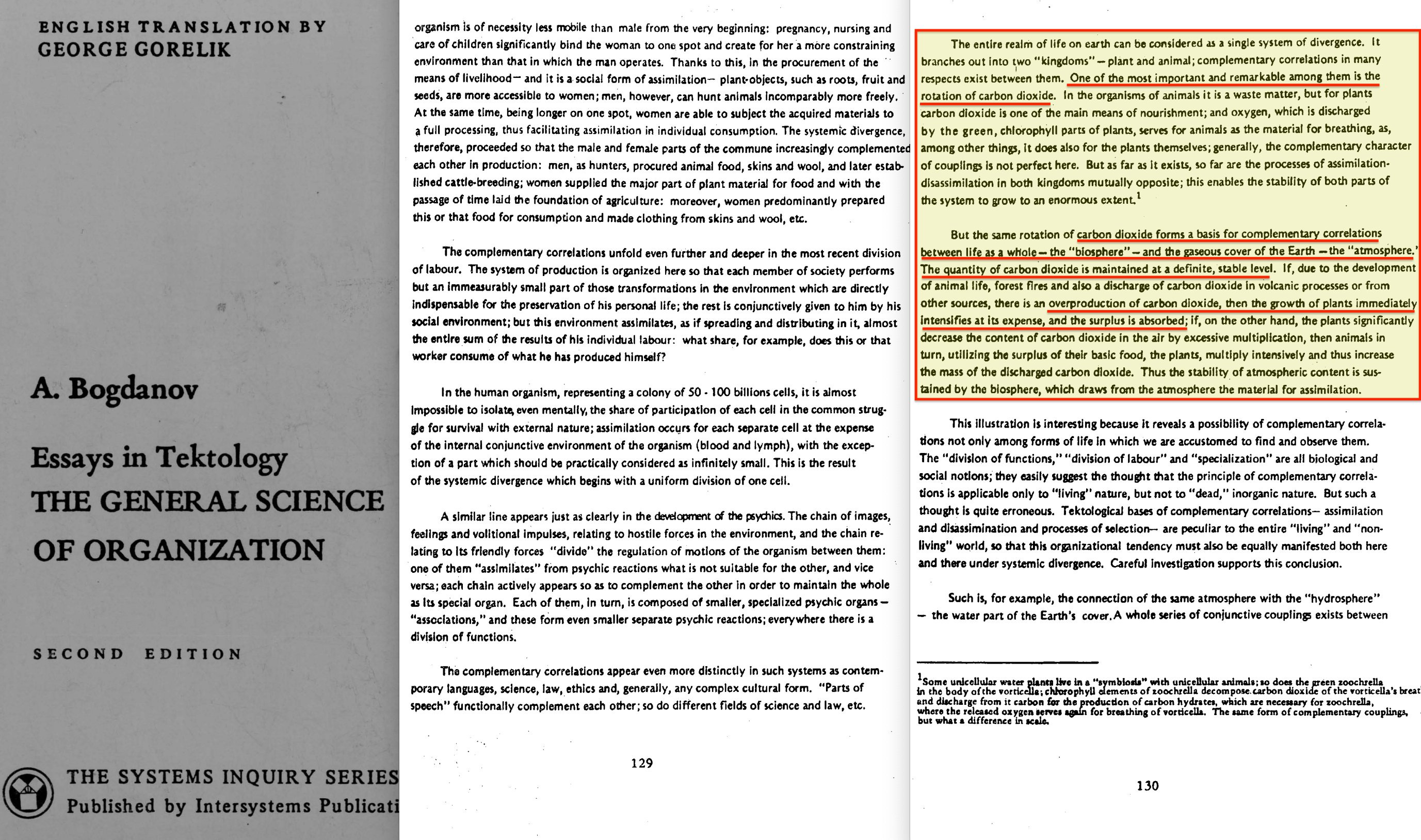
Bogdanov described reality as organised flows of experience — now the world is literally mapped as flows of carbon, tracked and potentially rate-limited through financial infrastructure. The flow of carbon itself has become the control mechanism.
Exactly as described by Bogdanov himself in 192256.
Integral man realised; not as a theoretical construct but billions of people educated from childhood to see themselves as global citizens, emotionally conditioned through SEL to self-regulate for collective benefit, continuously updated through lifelong learning, developmentally categorised by stage frameworks, guided by apps that measure their impact, experiencing their unique callings as service to the whole. Bogdanov’s organisational subject, delivered at scale.
The Human Super-organism operational: Humanity coordinating as one being with the internet as nervous system, carbon tracking as sensation, model outputs as thought, financial protocols as motor control, and social pressure as immune response. The cell metaphor isn’t metaphor — it’s how people experience their relationship to the collective. The organism functions. It adapts. It optimises. Its cells mostly consent because they’ve been developed to experience coordination as conscience.
Alexander Bogdanov provided the operating system. Julian Huxley scaled it, but the architecture is his. We’re living inside the Proletkult, planetarily scaled, continuously executing, internalising a ‘global ethic’ which cannot be legitimately confirmed by anyone — not even by the ‘black box’ which was tortured to confess it — and whose methods remain beyond public audit. A ‘global ethic’, not imposed by revolutionaries with guns, but internalised through education, culture, and technology until it became the substrate of consciousness itself.
The question is not whether Bogdanov’s genius was remarkable, because it truly was. The question is what we do now that we recognise who fathered the system we currently experience.

Conclusion
The internalisation of ethical monism represents a remarkable achievement in coordination. Through education, culture, technology, and carefully designed developmental pathways, billions of people have come to see themselves as part of one human family with shared responsibility for a planetary whole57. This consciousness shift has enabled cooperation at unprecedented scale and given many people — especially the young — a sense of meaning and purpose that late 20th-century individualism failed to provide.
The question is what kind of coordination this is.
Is it a symphony — many voices, local autonomy, genuine diversity producing emergent harmony? Or a single note — comprehensive alignment where apparent diversity masks underlying uniformity, and freedom is the experience of doing what the system has made you want to do?
The architecture treats these as the same. Integral theory promises to honor all quadrants, all levels, all perspectives. But when one framework defines what counts as a legitimate quadrant, valid level, or acceptable perspective — and when that framework is embedded in models, institutions, financial systems, educational curricula, and increasingly in the neural substrate itself without anyone informing of these developments — the promise rings somewhat incredibly hollow.
We should be vigilant about what we and — especially — our children internalise. An ethic that claims to derive from nature must also stand up to scrutiny without pathologising dissent. There is a major difference between being a conscious participant in coordination (aware and consenting, capable of questioning) and a well-tuned component in a closed loop (experiencing agency while executing preset functions).
The hope was that by understanding our place in nature, we would discover immanent ethics that increased our power of acting in the world — Spinoza’s freedom through adequate knowledge. The risk is that ‘adequate knowledge’ has been monopolised and defined by those who benefit from our compliance, and our ‘power of acting’ has been channeled into actions that serve the system above all.
The planetary ethical framework has sunk deep roots. It lives inside us now — in how we think about ourselves, judge others, make daily choices, and imagine possible futures. This internalisation is, in many ways, the fulfillment of the ethical monism project: morality derived from reality, embraced not by force but through development, experienced as authentic expression of our best selves.
But we must keep asking: Who or what steers the superorganism whose cells we’ve become? Have we consciously chosen this path, or have we been carefully guided — through frameworks, models, incentives, and developmental cultivation — to experience as free choice what is actually systematic direction?
The answer determines whether global unity becomes what its architects promise: a thriving harmony of free individuals coordinating for mutual flourishing — or what its critics fear: a single note held so long that it drowns out the music of the human spirit.
Not through violence or obvious oppression, but through the quiet conviction that the note we’re singing is the one we chose, when in fact it’s the only one we were ever taught to hear.

A well described system which makes no allowance for change or dissent. Therefore, the only future outside of slavery is to be out of this system. A small group of non-believers working together. No one is going to change this system from inside of it or outside of it. A different group uninfected by this system. Save your kids and the future apart from it..
Thank you ESC for this new article, which admirably complements the previous one. I'm taking this opportunity to finish a text on "the algorithmic Leviathan," already inspired by "Ethica" and the comments.
I even tried to go further, without any pretension, by showing how ethical monism, and dualism, have entered a phase of transcendence through functional absorption, where everything becomes an adjustment variable, influenced by the system and the "algorithmic Leviathan," our new demon.
It's still a bit vague as formulated, but I'm working on it ^^