
Integral Man

For decades, the metaphor of ‘Spaceship Earth’ has inspired a sense of shared destiny and environmental responsibility. It suggests we are all crew members on a fragile planetary vessel, needing to work together. A somewhat comforting narrative.
But what if the reality of piloting this ship isn’t a collective endeavor, but the implementation of a vast, top-down control system?
What if the cockpit only has room for a select few, while the vast majority of us are relegated to being passengers, our lives managed by an invisible, adaptive logic we cannot influence?
And who would those few be?

This is a plausible outcome emerging from a vision over a century in the making. The blueprint begins not with Barbara Ward1 or Buckminster Fuller in the 1960s, but in revolutionary Russia with Alexander Bogdanov’s concept of ‘Integral Man’2 — a scientifically organised humanity unified under universal systems principles. To understand the potential future of global governance, we must trace this genealogy from Bogdanov’s Tektology through General Systems Theory to today’s digital control infrastructure, recognising that what appears novel is actually the culmination of a remarkably consistent intellectual project.
Bogdanov’s Tektology and Integral Man
Between 1913 and 1922, Alexander Bogdanov developed Tektology3 — a universal organisational science seeking common structural principles across all domains: biological, social, economic, and cosmic. This was not mere philosophy but a practical program for rationally organising human civilisation according to discoverable natural laws.
Bogdanov’s vision — ‘Integral Man’ — was not about the individual as an autonomous agent, but rather humanity as a unified, scientifically managed organism, where individual consciousness would be integrated into collective consciousness4. Separate systems would be synthesised into one rationally ordered whole. The goal was not diversity but convergence toward optimal societal organisation.
Tektology prefigured General Systems Theory5 by decades. Where others saw distinct domains requiring different approaches, Bogdanov saw universal patterns of organisation waiting to be discovered and managed. This wasn’t about understanding the world — it was about engineering it.

From Tektology to Global Governance
The intellectual continuity is striking:
1910s-1920s: Bogdanov’s Tektology establishes that universal organisational principles can and should be applied to manage human society as a unified system.
1940s-1950s: General Systems Theory (Ludwig von Bertalanffy) formalises these insights in Western science, providing the mathematical and conceptual tools.
1956: Kenneth Boulding’s ‘The Skeleton of Science’6 establishes the hierarchical ordering of systems - from simple frameworks through cybernetic systems to human organizations and social systems, each level incorporating and transcending the one below.
1960s-1970s: C. West Churchman’s ‘Systems Approach’7 integrates ethics and thus external values into systems thinking.
1970s: Erich Jantsch synthesises Boulding’s hierarchy and Churchman’s ethics into inter- and transdisciplinary planning models, creating a four-level structure for tackling complex challenges.
1990s: Leonard Swidler’s Global Ethic (1995) provides the specific normative architecture — a framework that makes rights conditional on responsibilities to the collective.
2000: The Earth Charter8, principally drafted by Steven Rockefeller, complements Swidler’s human-focused Global Ethic with an Earth-focused planetary ethic. Endorsed by UNESCO, it establishes normative principles for ecological integrity, social justice, and peaceful coexistence, completing the normative architecture for integrated human-Earth system management.
2015: The Sustainable Development Goals operationalise this entire intellectual tradition as the de facto purpose for planetary management.
What appears as disconnected developments is actually a coherent evolution. Each stage builds on the last. The vision of Integral Man — scientifically managed humanity — has been systematically developed and implemented over 110 years.

The Four-Level Command Hierarchy
Jantsch’s model9, drawing on Bertalanffy, Boulding and Churchman, organised this vision into four distinct levels: purposive, normative, pragmatic and empirical. The critical insight is that this is not collaborative dialogue but a rigid hierarchy where each upper level synthesises and dictates the terms of the level below.

1. The Purposive Level: Programming Reality
This apex defines the ultimate ‘Why’ — the meaning, values, and final goals of the entire system. Today, the Sustainable Development Goals function as the operational parameters for the planet. They are not aspirations but commands. This level sets the destination for Spaceship Earth, and those who define this purpose hold ultimate power — they are the programmers of collective reality.

2. The Normative Level: The Architecture of Compliance
With purpose established, this level synthesises a framework of ethics, laws, and social norms. Here, Leonard Swidler’s 1995 ‘Universal Declaration of a Global Ethic’10 reveals the precise mechanism.
Swidler’s document is structured as a three-tier system that maps perfectly onto Jantsch’s framework:
Top tier: The Global Ethic itself — universal principles like the Golden Rule that transcend cultures.
Middle tier: Rights paired with Responsibilities — every single right is coupled with a corresponding responsibility to the collective, hence, a condition. Freedom of speech exists, but with the responsibility to ‘produce maximum benefit for fellow humans’. Property rights exist, but with the obligation that ‘property will be dealt with... to produce maximum benefit not only for the owners but also for their fellow humans, as well as for the world at large’.
Bottom tier: Collectivist Presuppositions — humans described as inherently seeking to ‘transcend’ the individual self to ‘embrace the community, nation, world, and cosmos’. The document is explicitly ‘cosmo-anthropo-centric’, positioning humanity within a managed planetary system.
This is not an ethic derived from public discourse or cultural tradition. It is engineered from the Purposive level above. Rights become conditional — granted only when exercised in service to collective benefit. This is the normative operating system, enforcing what ‘should’ and ‘should not’ be done.

3. The Pragmatic Level: Tools of Enforcement
This level asks ‘How do we do it?’ It synthesises technology, economics, and applied science directly from normative rules. Its language is cybernetics — the science of control and communication.
From the normative principle of ‘One Health’, a pragmatic mission emerges, integrating medicine, veterinary science, and ecology under unified control.

From the imperative of sustainability, the Circular Economy is synthesised. Despite its label, this is not about recycling — it is a cybernetic control system for material flows, built on six foundational rails that serve as the control infrastructure:
The Six Rails
Digital Identity (the leash): Material passports, tracking responsibility chains
Accreditation (the gate): Certifying circular suppliers, establishing circular design standards
Data (the lifeblood): Continuous material flow monitoring, lifecycle telemetry
Audit & Assurance (the judgment): Verification of circularity compliance, validation of reported flows
Finance (the actuator): ESG-linked capital allocation, green bonds that reward closure and punish linearity
Procurement (the cage): Market access restricted to circular-certified suppliers only across full supply chain

The Circular Economy is the cybernetic application running on this infrastructure. It synthesises four theoretical traditions into a single operational system:
General Systems Theory (Digital ID, Accreditation) defines system boundaries, establishes what exists within the system and determines legitimate relationships — the topology layer mapping system structure.
Input-Output Analysis (Data, Audits) provides Leontief-style flow measurement across all material transformations, tracking inputs → processes → outputs for every node, with audits verifying accuracy — the sensing layer quantifying all flows.
Cybernetics (Finance) implements the feedback control mechanism, comparing measured state to target state and generating corrective signals through capital allocation — the steering layer adjusting system behavior toward targets.
Enforced Implementation (Procurement) eliminates alternative pathways, making the controlled system the only accessible system, closing the loop with no exit — the closure layer ensuring inescapability.
This is Jay Forrester’s system dynamics11 combined with Wassily Leontief’s input-output economics12, governed by Norbert Wiener’s cybernetic feedback loops13, and rendered inescapable through coercive market exclusion. It operationalises Kenneth Boulding’s ‘Spaceship Earth’ metaphor as an actual closed-loop control system for planetary material metabolism14.

The Cybernetic Control Loop
In precise control systems terms, the Circular Economy implements homeostatic regulation through a three-stage feedback loop:
Sensor: Data rail — measures actual material flows in real-time
Comparator: Audit rail — compares measured flows against circular targets and standards, outputting the deviation signal (compliance scores, ESG ratings, circularity metrics)
Regulator/Actuator: Finance rail — applies corrective force proportional to the deviation signal
Audit is where the comparison occurs — where measured reality (such as SDG Indicators15) meets prescribed standard (acceptable ranges). It is the judgment mechanism where the normative standard (from the Purposive level) gets applied to empirical reality (from the Data sensor) to produce the control signal that Finance executes.
The control loop operates continuously:
Data measures material flows
Audit compares flows to circular targets → generates compliance/non-compliance signal
Finance responds: reward compliance with capital allocation / punish deviation with capital withdrawal
System behavior adjusts toward target
Loop repeats

Finance operates automatically through market mechanisms:
Capital flows to circular-compliant actors (green bonds, ESG-linked loans, sustainability-linked financing)
Capital withdraws from non-compliant actors (divestment, higher borrowing costs, credit denial)
The evolution toward Central Bank Digital Currencies (CBDCs) represents the automation of the Finance actuator itself. Unlike traditional currency, CBDCs are programmable — transactions can be made conditional on compliance status, geographically restricted, time-limited, or purpose-bound. The Finance rail evolves from incentive structure (rewarding/punishing behavior through capital access) to direct control mechanism (permitting/blocking specific transactions based on real-time compliance data). The actuator becomes instantaneous and absolute.

Unlike laws requiring human enforcement, this regulation is self-executing:
Cannot access financing → Cannot operate.
Compliance score drops → Borrowing costs rise → Margins compress → Behavior corrects.
Fail audit → Lose accreditation → Excluded from procurement → Capital evaporates.
Without the Finance rail, the system is merely measurement and judgment. With it, it is control. This achieves what all cybernetic systems require: complete observability of the domain being managed (through the data rail), continuous control authority over flows (through finance and procurement), and system closure preventing escape (through accreditation and digital identity). This is Lenin’s ‘accounting and control’ applied not to labor or production, but to the material substrate itself — a homeostatic governor for physical throughput.
From the rights/responsibilities framework, digital identity systems, ESG metrics, and ‘green’ finance mechanisms emerge as pragmatic enforcement tools — directing capital, access, and opportunity toward SDG-aligned behavior.

Control Without Coercion
The architecture described above — Input-Output Analysis, General Systems Theory, Cybernetics, hierarchical planning structures — is not novel. These exact frameworks appear in ‘Silent Weapons for Quiet Wars’16, purportedly dated 1979, whose legitimacy remains challenged.
Whether genuine intelligence community doctrine or a sophisticated ‘hoax’, the document describes economic warfare using precisely the systems now openly deployed:
Silent Weapons framework
Operations Research for social optimisation
General Systems Theory treating society as controllable system
Input-Output Analysis (Leontief economics) to track and predict economic behavior
Cybernetics providing feedback loops for behavioral control
PPBS (Planning, Programming, Budgeting System) as hierarchical control structure
Circular Economy + SDG framework
Operations Research (Six Rails optimisation)
General Systems Theory (Digital ID + Accreditation) defining system boundaries
Input-Output Analysis (Data + Audit rails) explicitly measuring material flows
Cybernetics (Finance rail) as the feedback regulator
PPBS structure: Planning (Purposive SDGs), Programming (Pragmatic implementation), Budgeting (Finance allocation)

The goal is identical: control without visible coercion. Silent Weapons describes ‘silent weapons’ as systems operating invisibly through economic mechanisms rather than physical force. The Circular Economy achieves control through market exclusion — automatic, self-executing, requiring no enforcement agents.
Cannot access financing → Cannot operate. Fail compliance
→ Excluded from procurement → Capital evaporates.
The system thus regulates itself.
Silent Weapons describes the public in dehumanised terms requiring management. This essay describes populations as managed components whose behaviors are seamlessly adapted to the system’s needs. Silent Weapons proposes economic warfare through systems control. The SDG framework implements planetary management through systems control.
The technical architecture is identical — the only difference is perspective.
Whether the frameworks converged independently or one inspired the other is less significant than the fact that the control mechanisms once described as weapons are now implemented as sustainability policy. The same tools and structure — different justification.

4. The Empirical Level: The Managed Substrate
This is ‘What is’ — the physical world, our ecosystems, resources, and biological data. Critically, this level also includes the monetary unit of account itself, which provides the standardised measurement enabling all economic flows to be compared and aggregated by the pragmatic level. An Ecosystem Approach monitors this level for sakes of integrated landscape management. This level relates to raw material to be optimised by the levels above. It is the controlled environment of the spaceship, the dataset feeding the system.

From Theory to Automated Adaptive Management
Systems Theory naturally leads to Adaptive Management17 — continuous cycles of planning, acting, monitoring, and adjusting based on feedback. In the digital age, this process is being automated at staggering scale.
Smart grids, IoT devices, satellite monitoring, and personal data trails provide constant, real-time feeds from the Empirical Level. This data flows upward, informing Pragmatic adjustments and validating Normative rules. The next step is Fully Automated Adaptive Management — AI processing vast data streams to adjust systems autonomously, fine-tuning energy distribution, optimising supply chains, managing resources, all aligned with normative goals derived from the Purposive SDGs.
This automation extends into the ethical realm through Computational Ethics research18. If a Global Ethic can be clearly defined from the SDGs, why not automate its application? AI could assess technologies, policies, or corporate actions for compliance with the synthesised normative framework — becoming the ultimate arbiter of systemic ‘good’ and ‘bad’.

The Cockpit and the Passengers
In this evolving system, human beings undergo a radical transformation — from autonomous agents to managed components.
The cockpit of Spaceship Earth is not a room for eight billion. It is occupied by a new class of navigators, organised by their proximity to the system’s control mechanisms:
The Monetary Controllers — those who manage the fundamental unit of account and operate the system’s primary actuator. They control the Finance rail, determining what receives capital and what starves, making all other forms of compliance enforcement dependent on their decisions. With the emergence of Central Bank Digital Currencies (CBDCs), this control deepens — moving from indirect influence through capital allocation to direct programmable control at the individual transaction level.
The System Architects — those who design and maintain digital governance platforms and AI models, building the infrastructure through which control operates.
The Data Oracles — those who control, interpret, and own global data streams, providing the sensory input that feeds the control loop.
The Normative Synthesisers — the philosophers, lawyers, and technocrats who (for now) translate SDGs into operative Global Ethics and computational rules, defining the targets against which Audit compares reality.
These groups hold real influence. They program the purpose, define the ethics, and build autonomous systems that manage the world.
Everyone else becomes a managed variable. Our actions are monitored (Empirical), guided by digitally enforced incentives and disincentives (Pragmatic), and judged by algorithms trained on synthesised ethics (Normative). Our ability to question the Purposive Level itself — to debate the fundamental ‘Why?’ of the SDGs — diminishes as the entire global system becomes structurally and financially committed to them. We are passengers on a journey whose destination and course we did not choose and cannot change. Our role is to be well-managed components, our behaviors seamlessly adapted to the system’s needs.
This is Bogdanov’s Integral Man realised — not individual consciousness but managed participation in a unified, optimised whole.

A Teleology of Control
This vision aligns with a philosophical trajectory: Pierre Teilhard de Chardin’s concept of the Omega Point19. Teilhard, a paleontologist and Jesuit theologian, proposed that the universe is evolving toward a final state of unity and consciousness, a maximum level of complexity and organisation.
In this technocratic reading, the Jantsch hierarchy becomes the engine for a secular, materialist Omega Point. The Purposive Level (SDGs) is the attractor, the goal. The integration of global systems through digital infrastructure is the increase in complexity. The final convergence is not a spiritual unity in God, but a fully integrated, autonomously managed planetary system — a techno-utopia where humanity is unified under a single, optimised governance model.
The navigator on this journey is not divine consciousness, but the System itself — the complex of AIs, data networks, and the elite human technocracy that guides it. Their influence is absolute because they alone can interpret the data, adjust the algorithms, and steer the vast, automated machinery of society toward its predetermined goal.

A Secular Great Chain of Being
This entire structure replicates the medieval worldview of St. Thomas Aquinas and the Great Chain of Being20:
Aquinas’s Hierarchy
Purposive: God, the ultimate Telos
Normative: Eternal Law and Natural Law
Pragmatic: Human Law
Empirical: The Created Order
The Technocratic Hierarchy
Purposive: The SDGs
Normative: Swidler’s Global Ethic and computational rules
Pragmatic: Automated Adaptive Management
Empirical: The managed planetary dataset
Both are top-down control systems. The critical difference is accountability. In Aquinas’s view, God’s law was believed to be just and benevolent. In the technocratic model, ‘divine’ purpose is set by fallible, unelected institutions, and ‘natural law’ is an engineered ethic enforced by algorithms whose logic may be inscrutable.
It is hierarchy without guaranteed benevolence — only efficiency.

Navigators of Spaceship Earth
The abstract architecture described above is not merely theoretical. It has identifiable actors and institutional expressions spanning multiple generations. Consider the remarkable positioning of members of the Rothschild banking dynasty — a family historically synonymous with monetary control — in the emerging governance framework.
Evelyn de Rothschild, beginning in 1988, participated in an interfaith dialogue (with the Duke of Edinburgh and Crown Prince Hassan of Jordan) bringing together Christian, Muslim, and Jewish leaders, theologians, and business figures. The result was the Interfaith Declaration: A Code of Ethics on International Business21 (1993). This document synthesised principles from the three Abrahamic traditions into four core values for international business: Justice, Mutual Respect (Love), Stewardship, and Honesty. The Declaration explicitly provides a moral basis for international business activity and principles of ethical practice for resolving business dilemmas. It establishes normative standards for corporate behavior, stakeholder relationships, and resource stewardship — creating an ethical framework that businesses are expected to adopt as their operating principles.

Edmund de Rothschild established the philosophical and practical infrastructure. At the First World Wilderness Congress22 (1977), he delivered a speech on harnessing nature through massive technical developments. He closed by invoking Teilhard de Chardin’s Omega Point: ‘Some day after mastering the winds, the waves, the tides and gravity, we shall harness for God the energies of love, and then for the second time in the history of the world, man will have discovered fire’. He asked: ‘Can we control the elements, harness nature itself and still retain our humanity? I personally am an optimist’. This positioned the Omega Point — the convergence toward maximum complexity and unified planetary management — as the guiding teleology for the wilderness movement from its inception.

Edmund was appointed to the World Wilderness Committee and was present at the Fourth World Wilderness Congress 23(alongside David Rockefeller) when Michael Sweatman proposed the World Conservation Bank — a mechanism to monetise nature conservation through debt-for-nature swaps and conservation financing. This proposal became the Global Environment Facility (GEF), established by the World Bank in 1991 as the financial mechanism for global environmental conventions. Edmund de Rothschild subsequently created the first blended finance agroforestry pilot (Moringa) — combining public and private capital to finance natural resource projects, pioneering the model that would become standard for monetising ecosystem services (such as carbon emission credits).

Ariane de Rothschild (contemporary generation) operationalises this through participation in the Global Landscapes Forum24, where GEF blended finance structures are used to monetise ecosystem services — transforming forests, watersheds, and biodiversity into tradeable assets and revenue streams. Natural capital accounting frameworks price nature’s functions (carbon sequestration, water filtration, pollination) and create markets for these ‘services’.

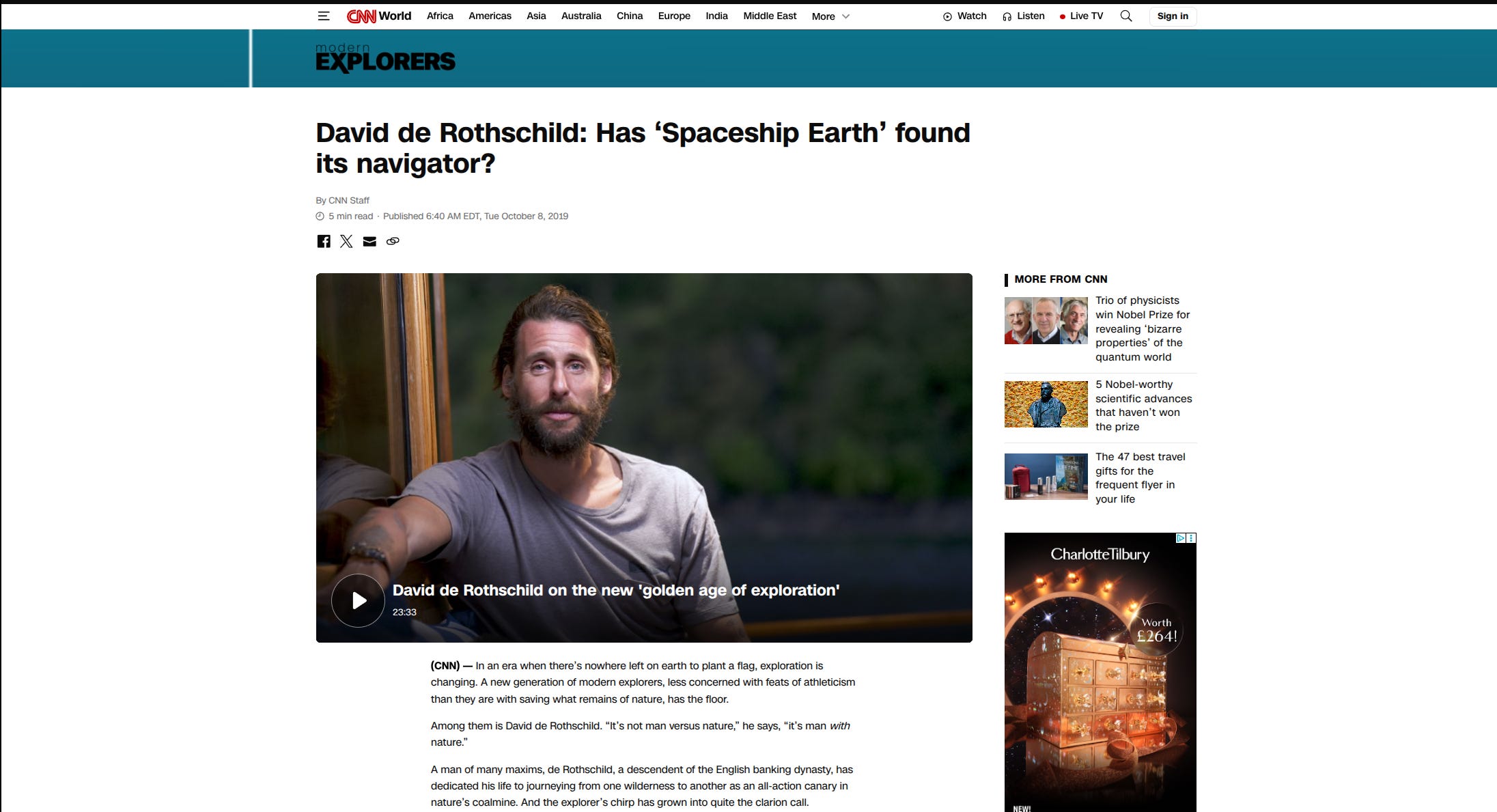
David de Rothschild spent the 2000s establishing himself as an environmental authority, culminating in the 2010 Plastiki expedition25: crossing the Pacific Ocean on a catamaran constructed from 12,500 recycled plastic bottles. This was not merely adventure — it was credentials-building. The voyage positioned him as someone who personally sacrifices for planetary health, a visible champion of the Circular Economy literally floating on waste transformed into vessel. This established the moral authority necessary for his subsequent role as ‘environmental envoy to the corporate world’, shaping green policies and sustainable business practices. In 2019, CNN profiled him under the headline ‘Has ‘Spaceship Earth’ found its navigator?’26 He explicitly uses Buckminster Fuller’s ‘Spaceship Earth’27 metaphor, positions himself as working to ‘find compromise’ between extraction and sustainability, and states his goal is figuring out how the economy ‘can actually embrace the many, and really reintegrate back into nature’.

Lynn Forester de Rothschild operationalised this vision institutionally. In 2020, she founded the Council for Inclusive Capitalism28 with the Vatican, bringing together major corporations (Bank of America, Mastercard, BP, Johnson & Johnson, …), asset managers (BlackRock, State Street), and the Vatican itself to implement what she calls a ‘moral economy’.
This is the architecture in action across four decades and multiple generations:
Edmund establishes Teleological Vision and Financial Infrastructure (1977-1990s): Invokes Teilhard’s Omega Point at founding World Wilderness Congress, serves on World Wilderness Committee, witnesses World Conservation Bank proposal that becomes GEF, pioneers blended finance for nature through Moringa fund.
Evelyn establishes Business Ethics (1993): Creates interfaith normative framework synthesising shared values from Abrahamic traditions into principles for international business conduct.
Steven Rockefeller establishes Planetary Ethics (2000): Drafts the Earth Charter providing normative principles for ecological integrity and planetary management, endorsed by UNESCO.
Ariane operationalises Natural Capital Markets (2010s-present): Monetises ecosystem services through GEF blended finance structures, transforming nature into financial assets.
David establishes Planetary Ethics (2000s-2010s): Positions Circular Economy, resource stewardship, and sustainable business as moral imperatives through Plastiki and corporate/governmental partnerships.
Lynn operationalises the Moral Economy (2020): Through Inclusive Capitalism, where corporate participation becomes conditional on alignment with ESG standards — the synthesised ethical framework.
The Council provides institutional mechanism: Finance (asset managers controlling trillions), Corporate actors (requiring capital access), and Moral Authority (Vatican) unified to make ESG compliance the operating system for capitalism itself.

The pattern reveals a multi-generational strategy operating across all levels of the hierarchy:
Purposive Level: Teilhard’s Omega Point as guiding teleology (Edmund, 1977)
Normative Level: Business ethics (Evelyn), Planetary ethics (David), all justified by the Omega convergence vision
Pragmatic Level: World Conservation Bank → GEF, blended finance structures, natural capital markets, monetisation of ecosystem services (Edmund, Ariane)
Finance Level: Capital flows controlled through ESG compliance (Lynn), with programmable enforcement through CBDCs
Members of the same banking dynasties appear to operate at both the Normative Level (creating ethical frameworks and teleological vision) and the Monetary Level (controlling capital flows and building financial infrastructure). They don’t merely enforce ethics through finance — they create the ethics, invoke the teleology, build the mechanisms, and control the capital. They span the entire control hierarchy across multiple generations, defining what is ethical, building the infrastructure to price and monetise nature, and controlling who receives capital based on compliance with those definitions.
‘Inclusive Capitalism’ is precise terminology: you are included in capital markets IF you comply with the Global Ethic as measured by ESG metrics (Audit rail). If you fail compliance, you are excluded from capital (Finance rail). This is not stakeholder capitalism as an alternative model — it is the existing system retrofitted with the Six Rails, where Monetary Controllers explicitly position themselves as implementing a ‘moral’ framework derived from the Purposive level.

The moral economy is capitalism where the Finance actuator operates only for actors who pass Audit compliance with normative standards. It is the cybernetic control system made explicit, positioned as ethical necessity, and implemented by those with direct access to monetary control mechanisms.
Members of banking dynasties are literally positioning themselves as navigators of Spaceship Earth, implementing the Circular Economy for materials and Natural Capital Markets for ecosystems through moral authority and financial architecture. Bogdanov’s vision of Integral Man — scientifically organised humanity as a unified, managed organism — finds its contemporary expression in this multi-generational project to financialise both material flows and natural systems under a synthesised global ethic, all steering toward Teilhard’s Omega Point.
Theory has found its practitioners, it appears.

A Foundational Presence
There is one more detail worth noting.

In 1942, British Marxist scientists gathered to author ‘Science and Ethics’, a report arguing that ethics must be derived from science, that evolutionary direction provides objective good, and that a universal moral framework based on scientific rationalism should guide humanity.
Among the contributors was Miriam Rothschild.

Six years later, in 1948, Miriam Rothschild co-founded the IUCN alongside Julian Huxley — transforming science-derived planetary ethics into an institutional authority with global reach.
The timeline now extends:
1942: Miriam contributes to intellectual foundation (Science and Ethics)
1948: Miriam co-founds IUCN (planetary ethics institution)
1977: Edmund invokes Omega Point teleology
1977-1990s: Edmund builds conservation finance infrastructure
1988-93: Evelyn co-develops business ethics framework
2000: Earth Charter formalises planetary ethics (Rockefeller)
2010s: Ariane operationalises natural capital markets
2010: David positions as ‘Spaceship Earth navigator’
2020: Lynn enforces through Inclusive Capitalism
Not four, but eight decades.
At what point does the probability of coincidence collapse entirely?

Conclusion: From Red Star to Spaceship Earth
The trajectory from Bogdanov’s Integral Man through Tektology, General Systems Theory, Jantsch’s hierarchy, Swidler’s normative architecture, and today’s SDG-driven automated management really does not appear as accidental. It is a coherent, century-long intellectual and institutional project with roots in revolutionary politics.
Alexander Bogdanov co-founded the Bolshevik Party with Vladimir Lenin in 190329. They eventually split over empiriomonism30, but Bogdanov further rejected Marx’s commitment to violent revolution, preferring cultural and scientific transformation. Yet both shared the goal of a scientifically managed society. Bogdanov systematised Marx’s writings while Lenin developed the practical apparatus of control. Lenin’s vision of ‘accounting and control’ as the foundation of the socialist state has evolved into today’s dataism — the ideology that positions data collection, surveillance, and algorithmic audits as the solution to governance challenges.
What Yuval Noah Harari popularised31 is not a novel philosophy emerging from Silicon Valley. It is Lenin’s accounting and control realised through digital infrastructure Lenin could only imagine.

But accounting alone does not enforce compliance. The critical insight is that those who control the monetary unit of account control the system’s regulator — the Finance rail that translates non-compliance into material consequences. In a cybernetic system, whoever operates the actuator determines system behavior regardless of who designs the infrastructure or measures the flows.
The Monetary Controllers are not merely one group among several in the cockpit — they are the primary navigators, their hands on the mechanism that steers the system. With CBDCs, this control becomes absolute: programmable money transforms the Finance actuator from incentive to direct transactional permission, enabling instantaneous enforcement of any compliance standard defined at the Purposive or Normative levels, and applied specifically at the transaction level. And through ‘In Tandem’, their control will extend gradually to include even fiscal policy.

The pattern of development — its laser precision, lack of visible course corrections, seamless integration of frameworks — suggests more than emergence. Rather, it suggests that the blueprint has been refined across generations, institutions, and continents. What appears as separate initiatives — One Health, Circular Economy, Digital ID, ESG investing, Computational Ethics — are likely expressions of a unified vision.
In 1908, Bogdanov published Red Star32, a utopian novel depicting a scientifically managed Martian society. On Mars, individual desire has been transcended, and society functions as a single organism. Resources are optimally allocated through perfect information systems, while the collective operates with machine-like efficiency under rational principles. Conflict has been eliminated through scientific organisation. In this context, this appears to be less fiction, more blueprint.
More than a century later we are building Bogdanov’s Red Star not on Mars but on Earth. The Spaceship is being retrofitted with the control systems he envisioned. The difference is that Bogdanov’s Martians chose their system. We are having it built around us, presented not as a political choice but as technical necessity — the only rational response to complexity.
This offers a potential solution to planetary chaos — a way to finally impose order through scientific socialism. But this order comes at a cost that must be openly acknowledged: the end of pluralism, the loss of grassroots human agency, and the consolidation of power into the hands of a technocratic elite who navigate while the rest are navigated.

The activation of the UN Emergency Platform is the final command in the startup sequence of a pre-installed global operating system. It is the ‘Start’ button that transitions the century-long project of cybernetic control from a theoretical framework and dormant infrastructure into an active, governing entity, under the guise of an emergency.

When triggered by a ‘complex global shock’ — a threshold defined not by public debate but by the black-box calculations of AI models processing the ‘Digital Earth’ data stream — this Platform unleashes the full, integrated power of the control rails.

The critical question is not whether we can build this system — it is already built. The infrastructure is operational, the rails are laid, and the Emergency Platform awaits only its algorithmic trigger. The challenge facing humanity is thus coming to collectively realise what has been constructed before the activation sequence completes — and whether we retain the capacity to reject a ‘planetary balance’ achieved through the optimisation of human beings as managed variables in Zev Naveh’s Total Human Ecosystem33.
Bogdanov’s Integral Man was never about collective choice but collective management — and the navigators are already in position, their hands on controls most passengers don’t yet realise exist.


I have many friends who are keenly environmentally minded (as am I, living as I do in the forest with iterative impacts on my soil and ecosystem - aiming always for INCREASE in biodiversity and soil quality etc).
They won't touch this material and I fear the worse. No one wants to feel co-opted or duped by another group or psyop. The thing is, we CAN behave in ways that respect our land (and our children too) while at the same time challenge top down dictates that are based on lies. Like the guzzling energy consumption of the green industry for example.
People need to see this for what it is. A scam. Only after that can we ask reasonable questions and from there take reasonable actions / like prison for usury.
Mind blowing! You have the words and the facts to describe a coherent picture, where others only have half-baked intuition or emotional rants.