
The New Economics Foundation

The New Economics Foundation isn’t a think tank.
It’s a personnel pipeline that produces the people who build governance architecture and the institutions that carry it forward.
This essay documents how one organisation, founded in 1986 from a counter-summit to the G7, placed its alumni across every functional layer of the sustainable finance architecture — domestic monetary policy, international standard-setting, digital SDG financing, biodiversity disclosure, green central banking, and stakeholder governance — while simultaneously spawning the institutions that carry the programme into domains NEF itself doesn’t directly operate in.
The essay follows from yesterday’s The Monetary Allocation Committee, which documents the content-agnostic mechanism — the allocation body, the enforcement architecture, and the publication trail that built both.

The Origin
NEF was founded in 1986 by the leaders of The Other Economic Summit1 (TOES), first held in 1984 as a counter-summit to the G7 in London2. The founding aim was ‘a new model of wealth creation, based on equality, diversity and economic stability’. TOES’s original vision explicitly called for replacing the G7 Summits with
… a more representative World Economic Council working within the UN system and responsible for coordinating the work and policies of the UNDP, the World Bank, IMF, GATT and other such organisations.
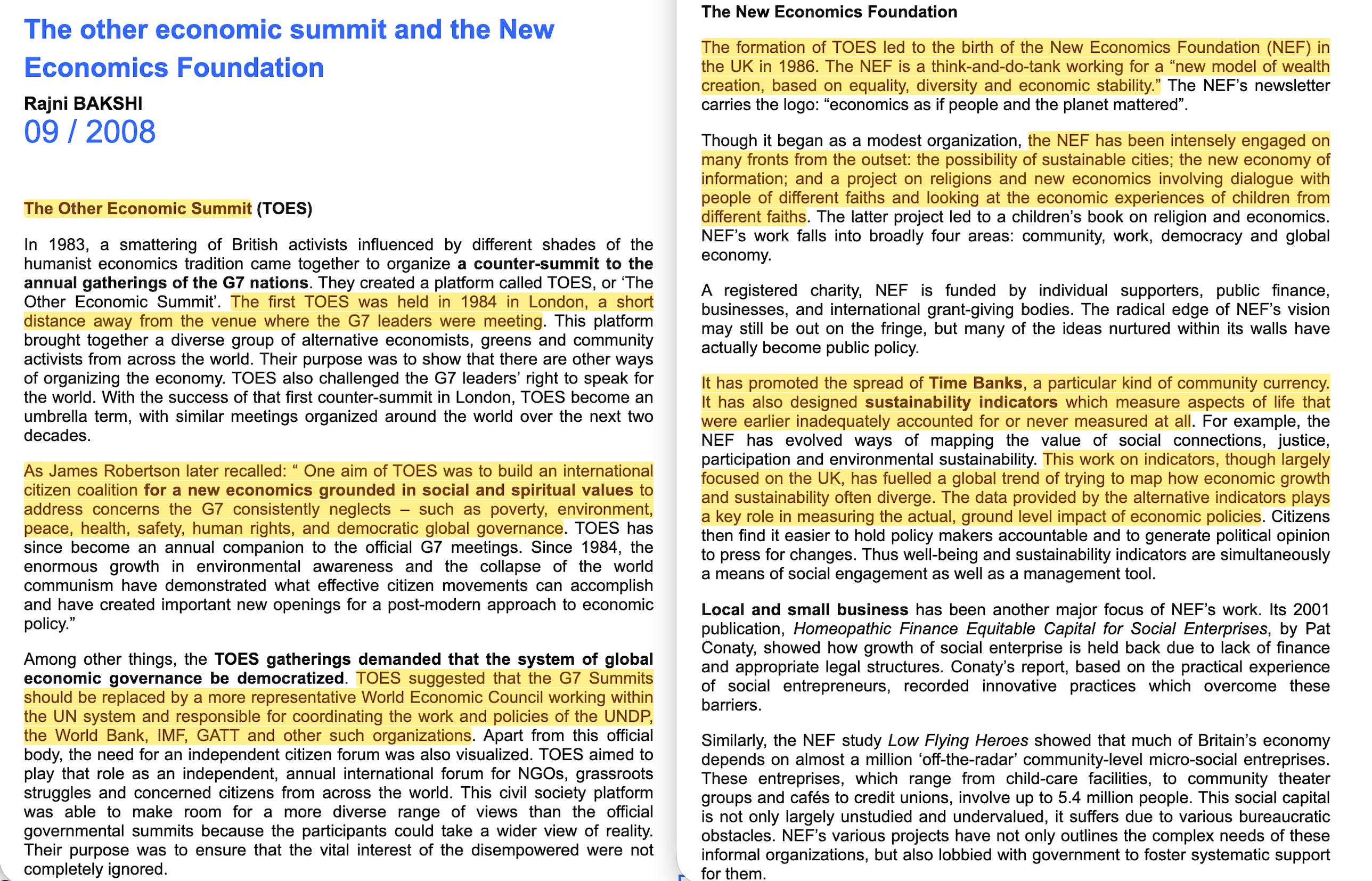
A coordination body inside the UN system, coordinating across the Bretton Woods institutions. In 1984. The Monetary Allocation Committee (2013), the Green Finance Action Taskforce (2021), the Economic Policy Coordination Committee (2023), and the European Economic Coordination Council are domestic and European implementations of a coordination architecture NEF was founded to build forty years ago. The founding vision and the current programme are structurally identical. The only things that changed were the scale and the branding.
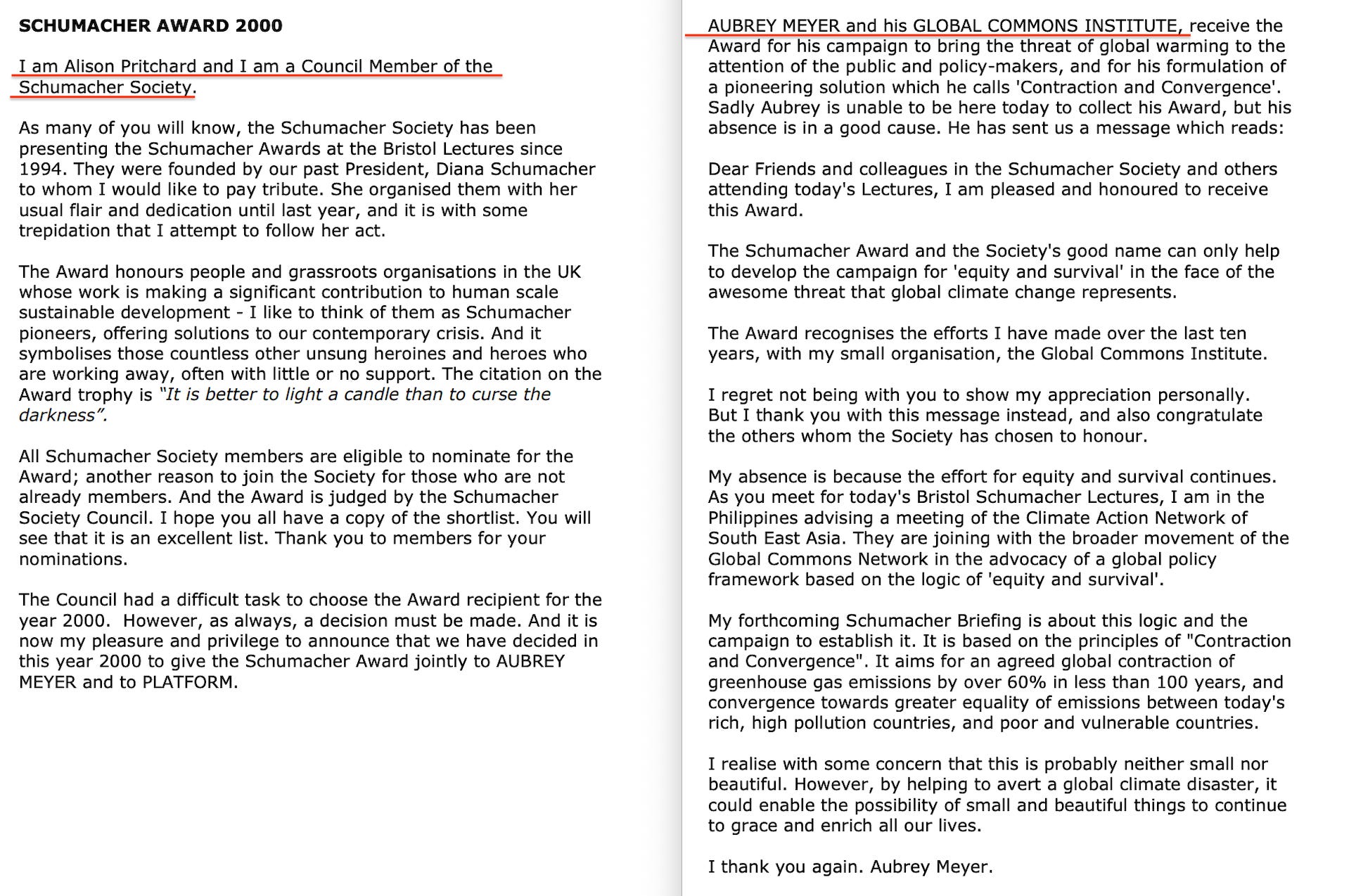
The co-founders reveal the bridge between the establishment and its apparent alternative. James Robertson — before co-founding TOES and NEF — served in the Cabinet Office, contributed to enquiries on the future of London as a financial centre, and directed the Inter-Bank Research Organisation for the big British banks3.
A former government insider and banking industry research director founded what presents as an alternative economics movement. The ‘alternative’ was designed by the establishment. Robertson’s wife, Alison Pritchard, sat on the Schumacher Society Council4, connecting the network to E.F. Schumacher’s ‘Small is Beautiful’ tradition — the intellectual lineage that frames planetary limits as the basis for economic governance.
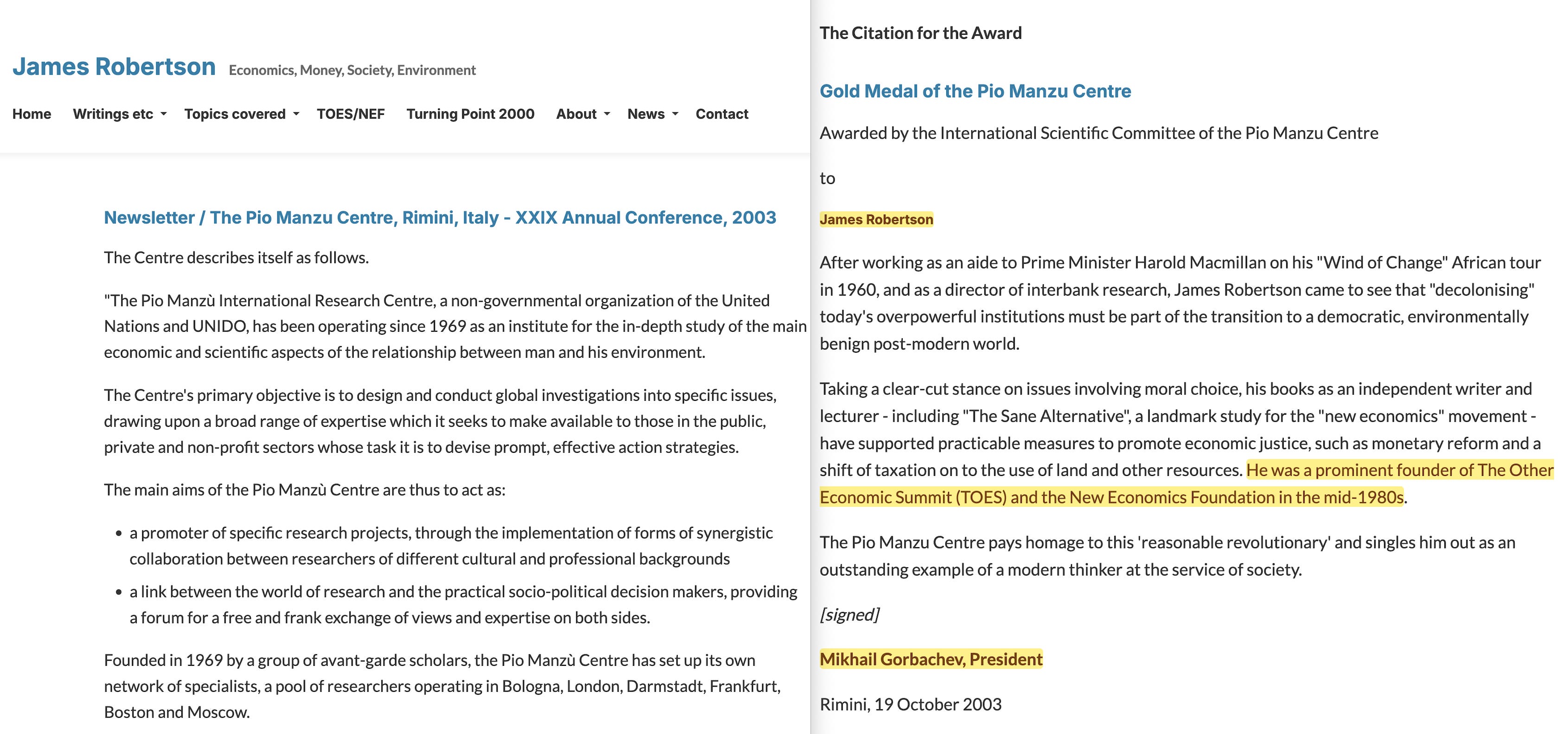
In 2003, the Pio Manzù Research Centre5 — closely associated with the United Nations — awarded Robertson a gold medal for ‘a remarkable contribution to the promotion of a new economics grounded in social and spiritual values’6.
But Robertson didn’t just found the institution — he wrote its specification. Around 2000, he co-authored Creating New Money: A Monetary Reform for the Information Age7 with Joseph Huber, published by NEF with a foreword by Ed Mayo. The book proposed stripping commercial banks of money creation power and restoring seigniorage — the profit from creating money — to the state. Mayo’s foreword stated the argument Positive Money would later campaign on: ‘Ninety seven pounds in every one hundred circulating in the economy will now have been issued by banks’.He called the book ‘a practical and clear step-by-step agenda on the essential first step of restoring the right of issuing new money in a modern economy to be of benefit for the common good’.
The sovereign money specification that the entire subsequent programme builds on — Positive Money (2010), Where Does Money Come From? (2011), the Monetary Allocation Committee (2013), the EPCC (2023) — was written by the Cabinet Office official who directed the Inter-Bank Research Organisation for the big British banks. The endorsements on Robertson’s later book Future Money include blurbs from Stewart Wallis (NEF Executive Director) and Ben Dyson (Founder, Positive Money) — the lineage confirmed in the network’s own words.
In September 2000, Robertson delivered what he called ‘The Alternative Mansion House Speech’8 — a counter-event to the official dinner where the Chancellor addresses the City. He launched Creating New Money9 from the podium, cited NEF’s Living Planet Index as justification, proposed extending sovereign money to a ‘true global currency’, and coined the concept of ‘predistribution’:
Whereas redistribution aims to correct the outcomes of economic activity after the event, predistribution shares the value of essential inputs to economic activity.
That is the Monetary Allocation Committee essay’s ‘input constraint’ stated as fiscal principle — control the inputs, not the outputs — thirteen years before the MAC was formally proposed. Fourteen years later, Prince Charles would stand at the actual Mansion House thanking Lady Rothschild. The ‘alternative’ and the establishment converge at the same address.

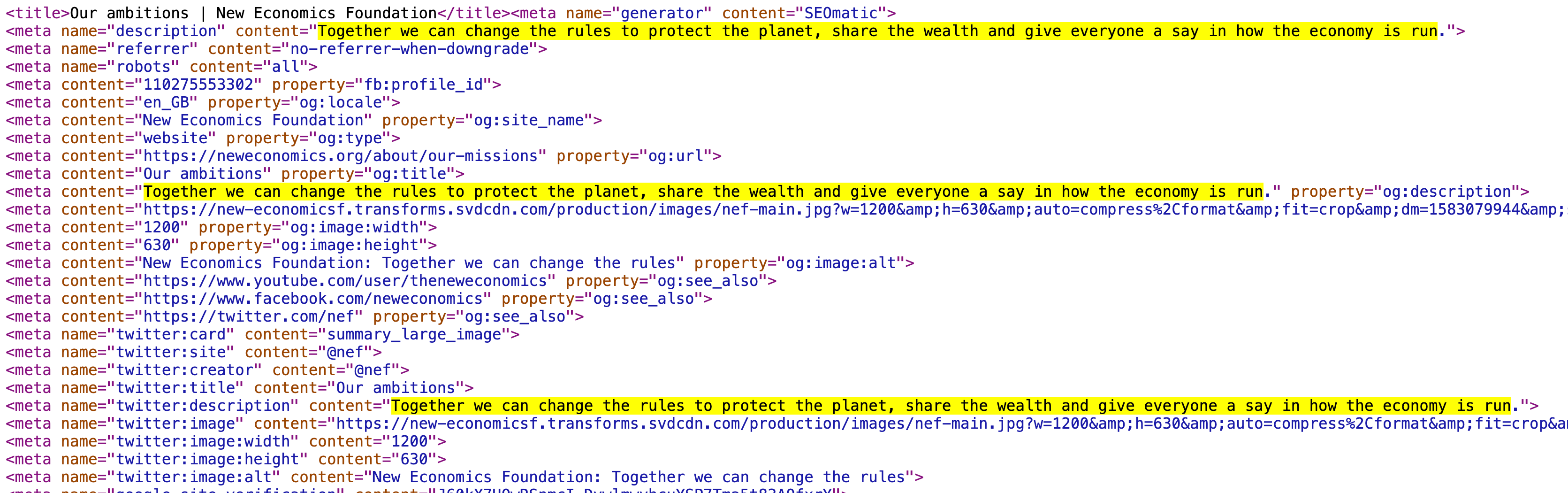
NEF’s own mission statement reads10: ‘Together we can change the rules to protect the planet, share the wealth and give everyone a say in how the economy is run’.
Change the rules — administrative capture of the regulatory framework.
Protect the planet — the green objective.
Share the wealth — redistribution.
Give everyone a say — trisectoral governance.
The publications translate each phrase into institutional design.

The Personnel Pipeline
Five documented career trajectories show the same pattern: join NEF, publish across the relevant policy domain, move to the institution where the publications become policy, and sit at the table where the proposals are implemented.
The think tank provides the intellectual formation. The publications provide the credentials. The alumni provide the personnel.
Simon Zadek — The International Layer
Zadek was NEF’s Development Director11. He went on to found AccountAbility — the international standards body for corporate social responsibility12 — and co-founded the Ethical Trading Initiative. He then co-directed the UNEP Inquiry into Design Options for a Sustainable Financial System13 — the programme that designed the sustainable finance architecture.
After UNEP he became Head of the UN Secretary General’s Task Force on Digital Financing of the Sustainable Development Goals14. He co-chaired China’s Green Finance Task Force15 and led the G20 Green Finance Study Group secretariat16 under Chinese, German and Argentinian presidencies. He served as Senior Advisor to the World Economic Forum17, then became Senior Advisor to the Taskforce on Nature-related Financial Disclosures18 (TNFD) — the biodiversity disclosure framework modelled on the TCFD. He co-founded NatureFinance19 and became Chair of Finance for Biodiversity.
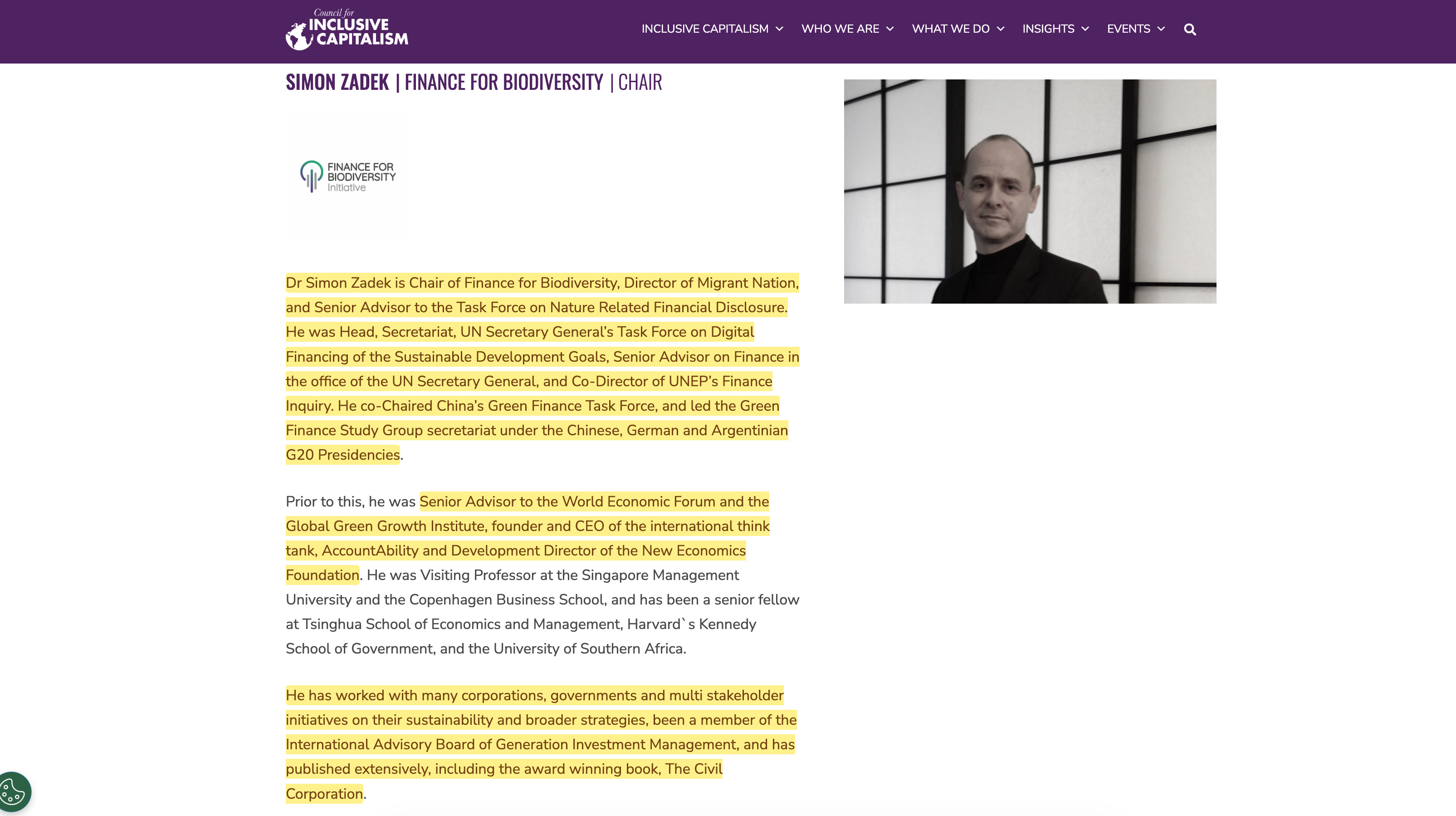
That’s one person moving from NEF Development Director to the UN Secretary General’s office, UNEP, the TNFD, the G20, the WEF and NatureFinance — every layer of the international sustainable finance architecture. He's also a formal member of the Council for Inclusive Capitalism with the Vatican — the body Lynn Forester de Rothschild created20 — and the Council's own website lists his NEF role alongside his UN and TNFD positions21.
His 1992 PhD thesis at Brunel University is titled: ‘An economics of Utopia: the democratisation of scarcity’22. The programme was laid out as an academic project before the career that built it. ‘The democratisation of scarcity’ — making scarcity the organising principle of governance, then distributing control of that scarcity through the architecture his later career built.
Josh Ryan-Collins — The Academic-Policy Bridge
Ryan-Collins spent ten years as Senior Economist and Head of Finance at NEF23. He co-authored Where Does Money Come From?24 (2011), the foundational text for the sovereign money campaign, and was lead author of Strategic Quantitative Easing25 (2013), which proposed the Monetary Allocation Committee. He designed the governance split between quantity and allocation that every subsequent proposal in the field built on.
In 2017 he moved to UCL’s Institute for Innovation and Public Purpose26, where he co-authored capital requirements, credit guidance and fiscal-monetary coordination papers with Frank van Lerven27. UCL IIPP served as the institutional bridge — the academic credentialing body that turned think tank proposals into peer-reviewed literature regulators could cite. He became a full professor in 202428.
He’s now also a Senior Policy Fellow at the UK government’s Department of Levelling Up, Housing and Communities, advising on housing and land policy29. This connects directly to NEF’s 2024 Social Purpose of Land Framework, which proposes Neighbourhood Land Panels directing how public land is used30. The researcher who designed the monetary allocation mechanism now advises the government department whose remit includes the land governance framework the same institution published.
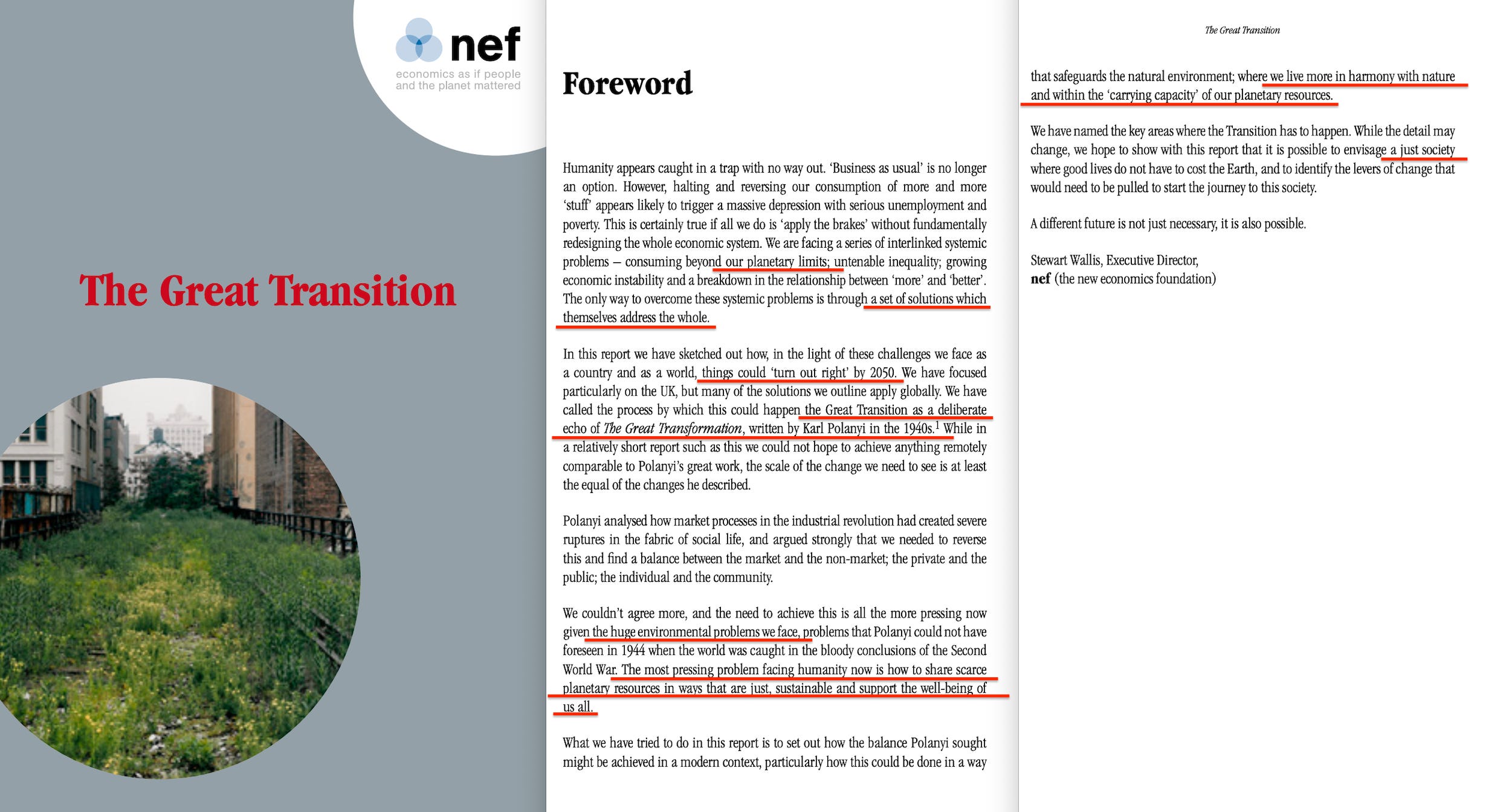
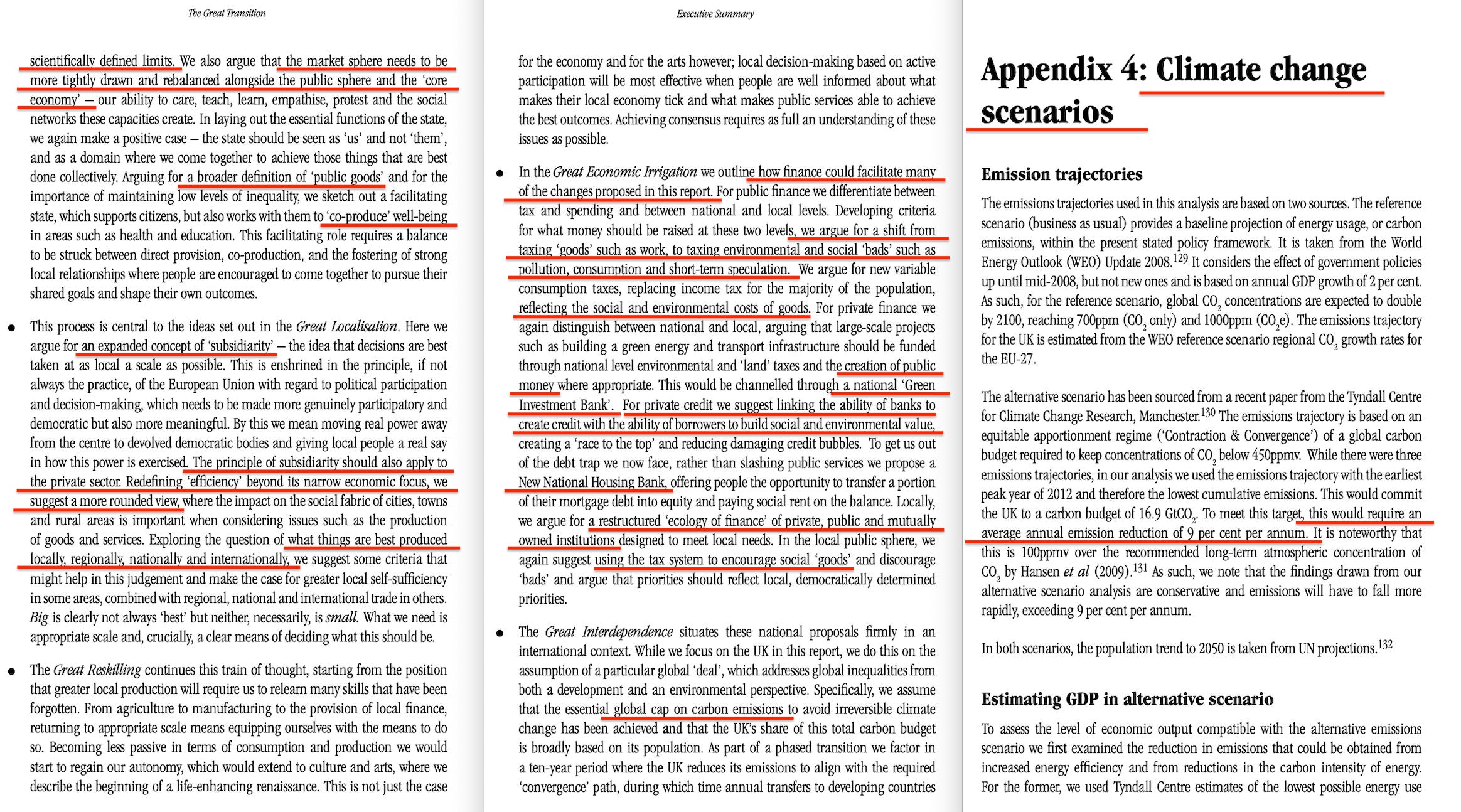
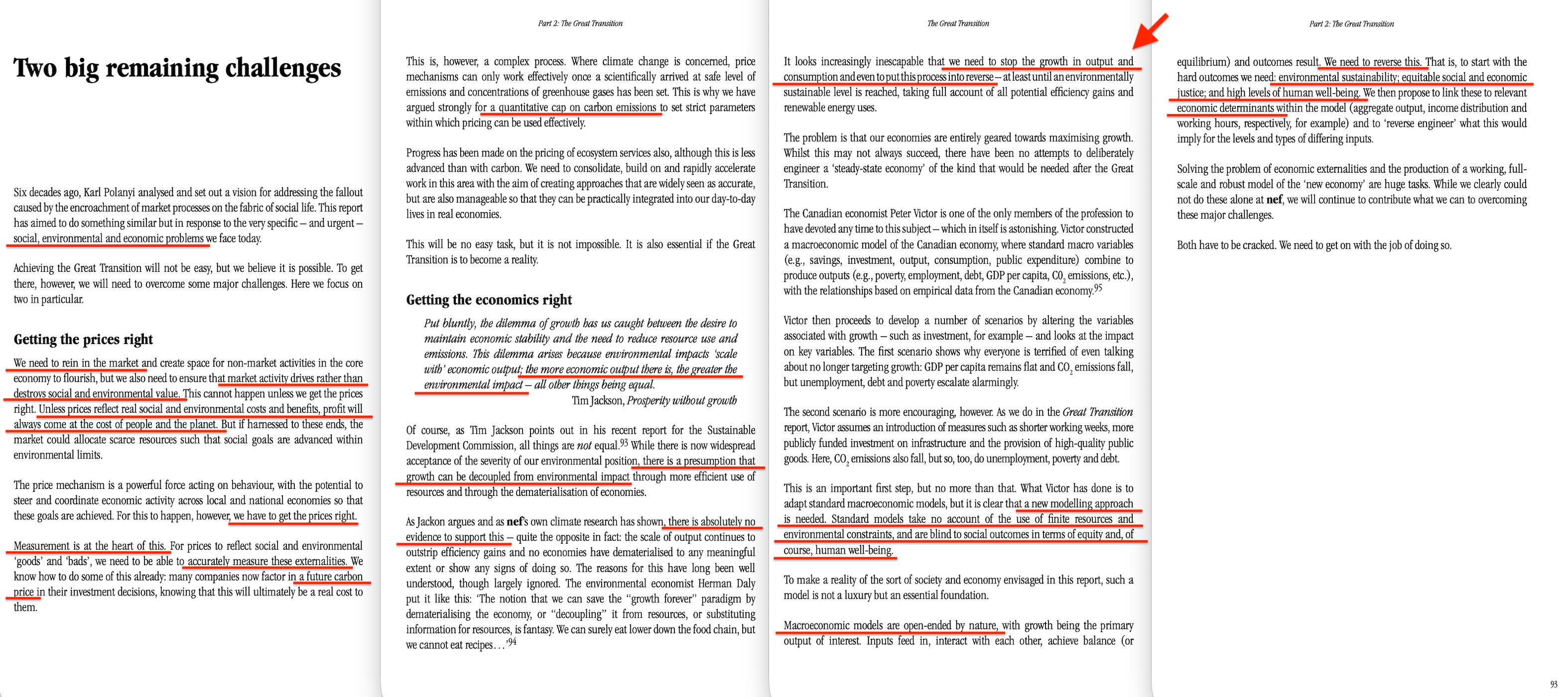
In 2009, Ryan-Collins co-authored The Great Transition31 with Spratt, Simms, and Nietzert, foreword by Stewart Wallis. The report framed itself as a sequel to Polanyi’s The Great Transformation and proposed ‘an expanded concept of ‘subsidiarity’’, credit conditionality (‘linking the ability of banks to create credit with the ability of borrowers to build social and environmental value’), sovereign money (‘the creation of public money where appropriate’), a Green Investment Bank, climate change scenarios, and degrowth — all in a single document, four years before the MAC.
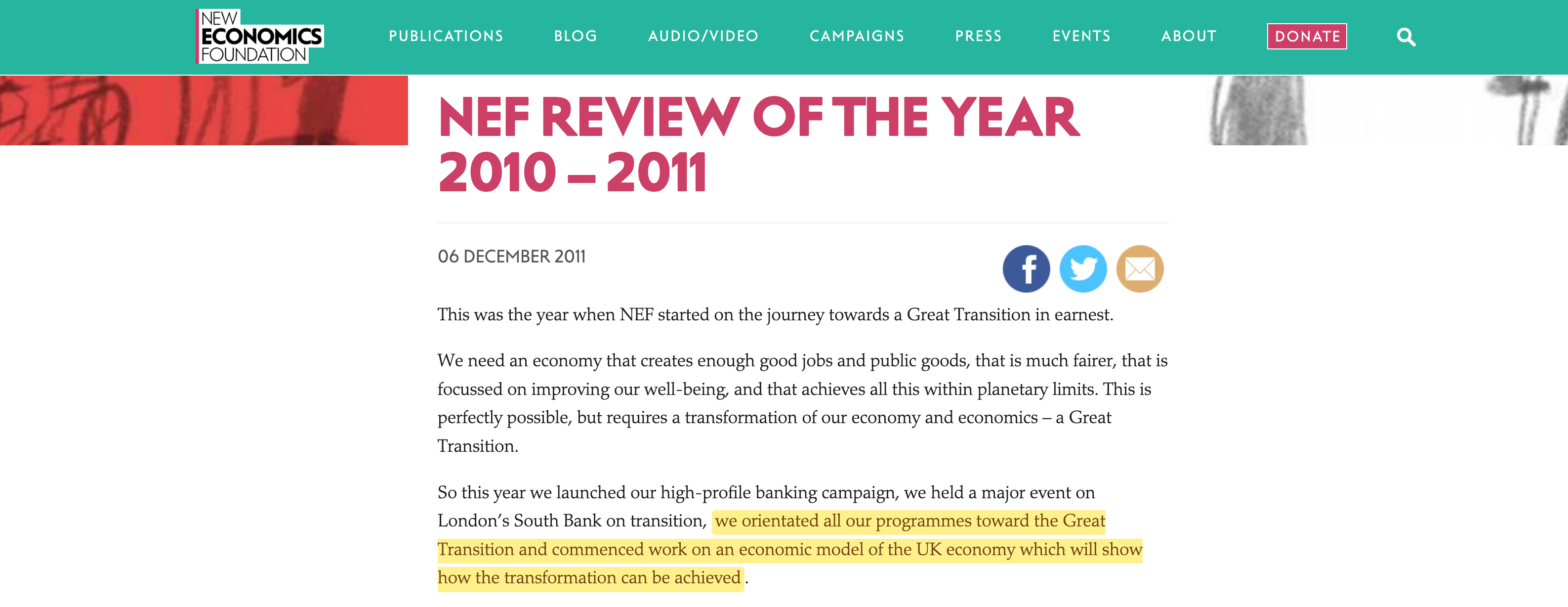
The MAC isn’t an isolated proposal — it’s one section of the 2009 blueprint. NEF’s 2010-2011 annual review said: ‘we orientated all our programmes toward the Great Transition’.

Frank van Lerven — The Domestic Monetary Programme
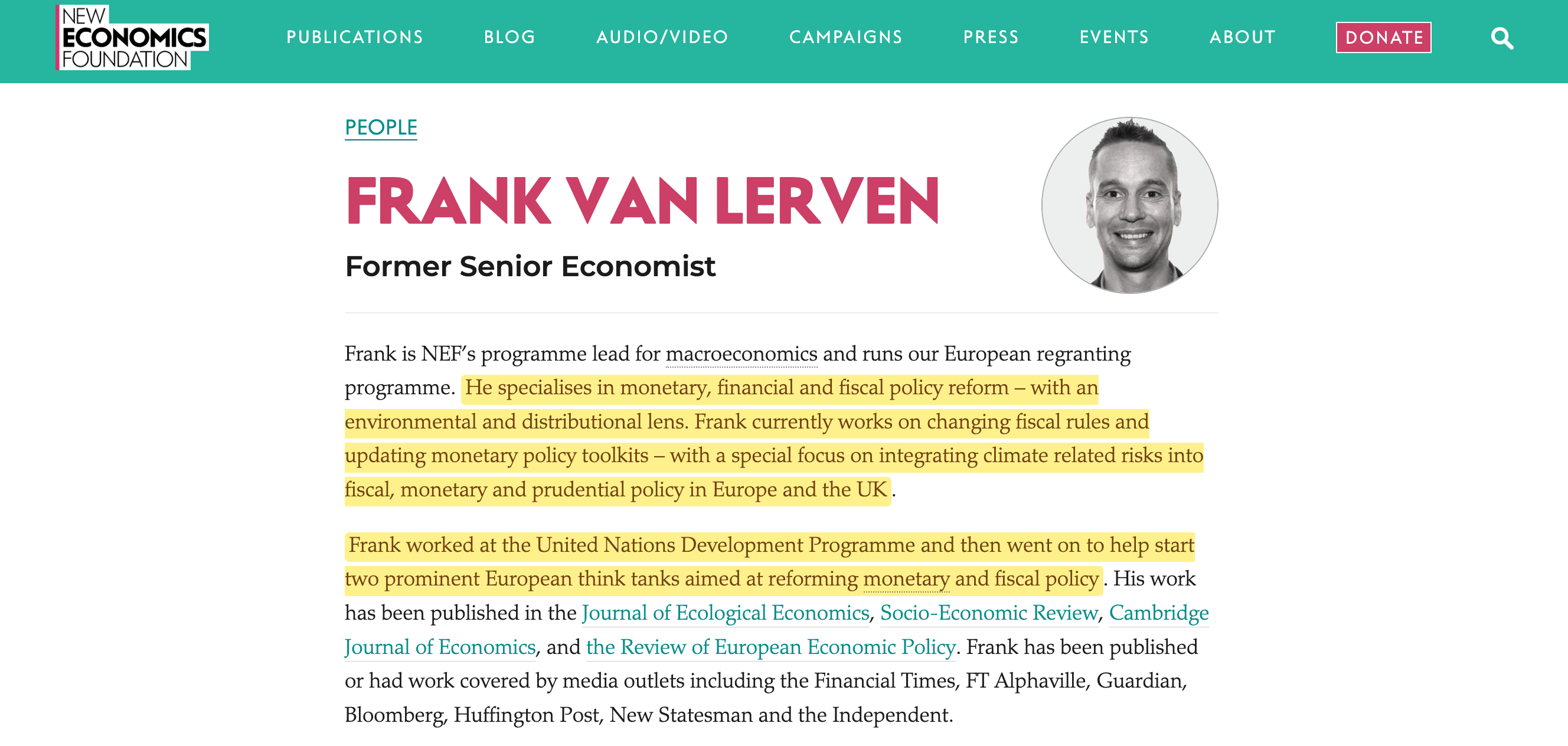
Van Lerven joined Positive Money as a Research and Policy Analyst after working at the United Nations Development Programme32. Between 2016 and 2023, he published across every functional layer of UK central bank and coordination policy — sovereign money, capital requirements, credit guidance, collateral framework, fiscal rules, tiered reserves, and the coordination body itself — through Positive Money, NEF, UCL IIPP, and the Fabian Society.
In 2021 he lead-authored the joint NEF/Positive Money report proposing the Green Finance Action Taskforce, the Monetary Allocation Committee’s second name33. In 2023, he co-authored the Fabian Society’s In Tandem34, proposing the Economic Policy Coordination Committee — the third name. By 2024, the ECB began implementing the collateral framework reform his INSPIRE-funded paper specified. In October 2022, he spoke at the Bank of England’s Climate and Capital conference35, arguing that ‘every part of the system’ needed to move ‘in the same direction’. He had earlier presented at the European Parliament, critiquing ECB QE and closing with the question ‘Is there a better way forward?’ — the diagnosis that the rest of his publication record answers.
One author connected monetary creation reform, the green finance programme, the coordination body and the Fabian Society’s statutory proposal. The domestic programme, end to end, was built by one researcher from the NEF/Positive Money network.

Stewart Wallis — The Wellbeing and WEF Layer
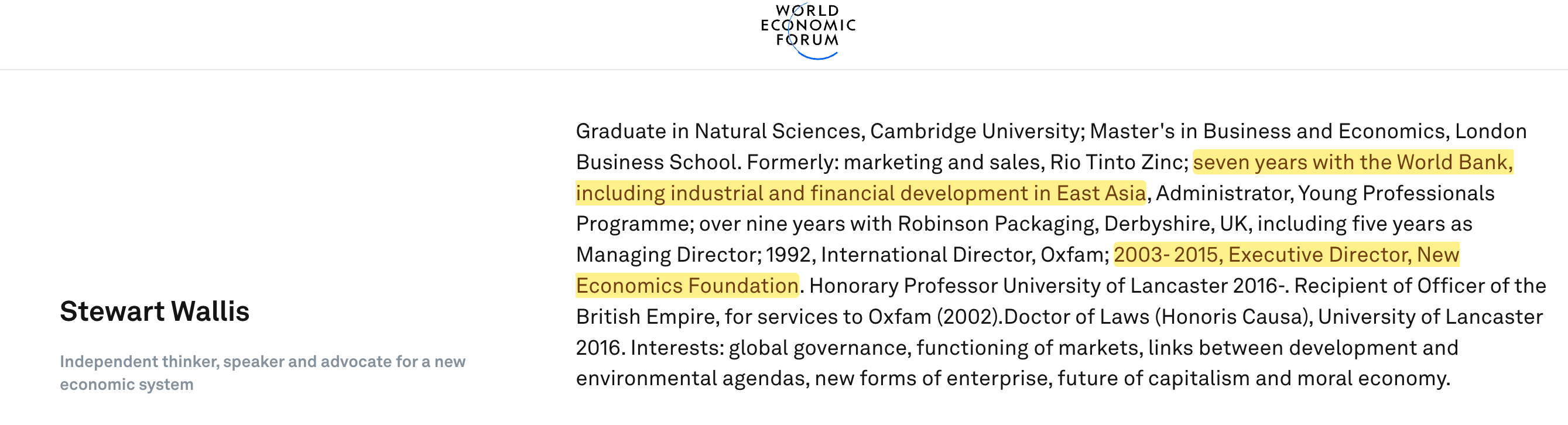
Wallis was NEF’s Executive Director from 2003 to 201536, running the organisation through the founding of the Green New Deal group37 (2008), the sovereign money programme (2011), and the Monetary Allocation Committee proposal (2013). After NEF, he became Vice Chair of the World Economic Forum’s Global Agenda Council on Values and a Steward of its Inclusive Growth Initiative38, then founded the Wellbeing Economy Alliance39 (WEAll), the network promoting wellbeing economics to replace GDP-based measurement.
NEF Executive Director to WEF values governance to the Wellbeing Economy Alliance. The ethical layer defining what counts as ‘wellbeing’, ‘values’ and ‘inclusive growth’ was staffed from the same think tank that designed the monetary allocation mechanism.

Ed Mayo — The Cooperative Economy Layer
Mayo ran NEF from 1992 to 200340, growing it from two staff to fifty. He then became Secretary General of Co-operatives UK41 — the trade body for the UK cooperative sector. The cooperative economy runs on mutual ownership, shared governance and stakeholder models, and it’s the economic form the trisectoral governance architecture works through. NEF’s director built the think tank, then moved to lead the institutional form its proposals favour.
Michael Jacobs — The Thirty-Year Thread
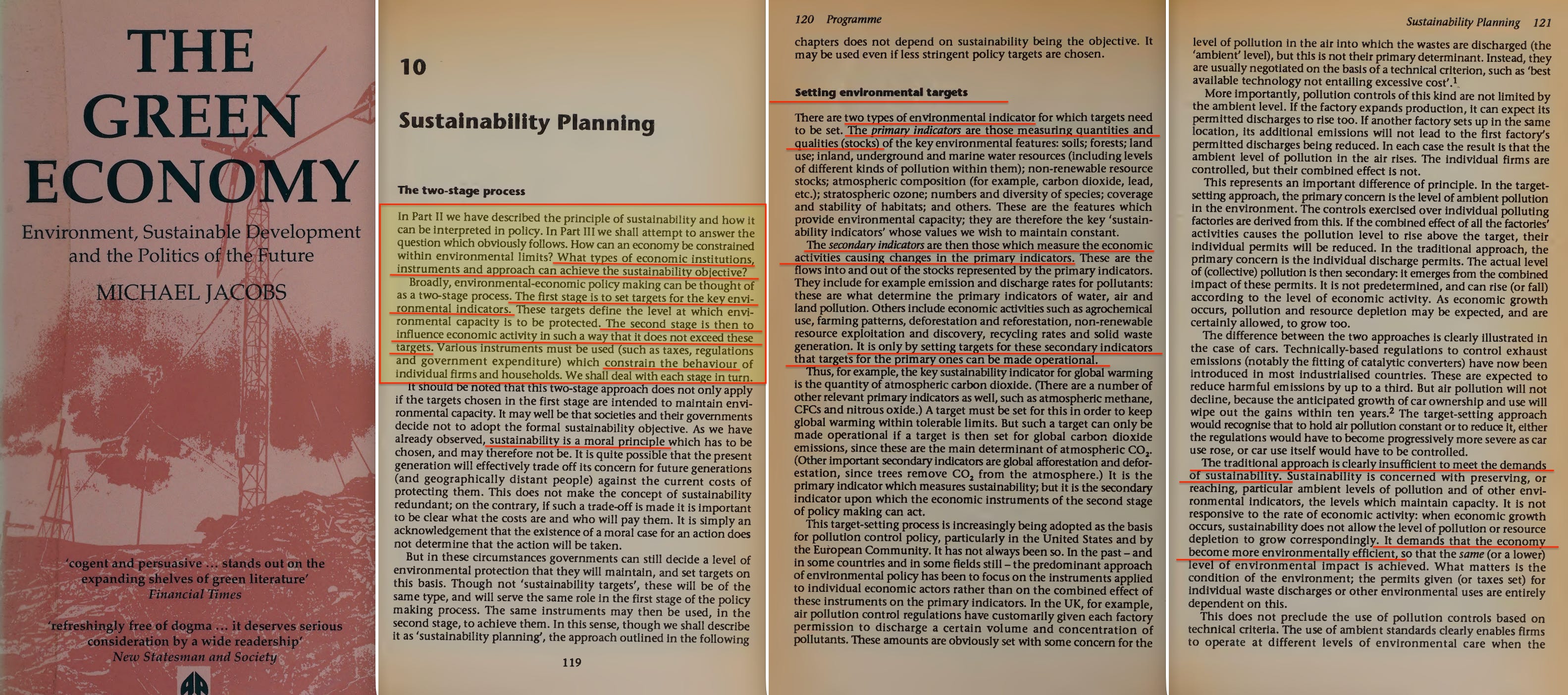
Jacobs is listed on NEF’s own website42 — he’s not an external co-author. In 1991, he published The Green Economy43, arguing for ‘sustainability planning’ where the state would constrain the economy within ‘biophysically-informed and publicly-decided environmental limits’. The book stated the operational logic plainly:
… environmental-economic policy making can be thought of as a two-stage process. The first stage is to set targets for the key environmental indicators... The second stage is then to influence economic activity in such a way that it does not exceed these targets. Various instruments must be used (such as taxes, regulations and government expenditure) which constrain the behaviour of individual firms and households.
Define indicators, set targets, constrain behaviour. The clearing function stated as environmental economics methodology — thirty-two years before Jacobs co-designed the implementing body.
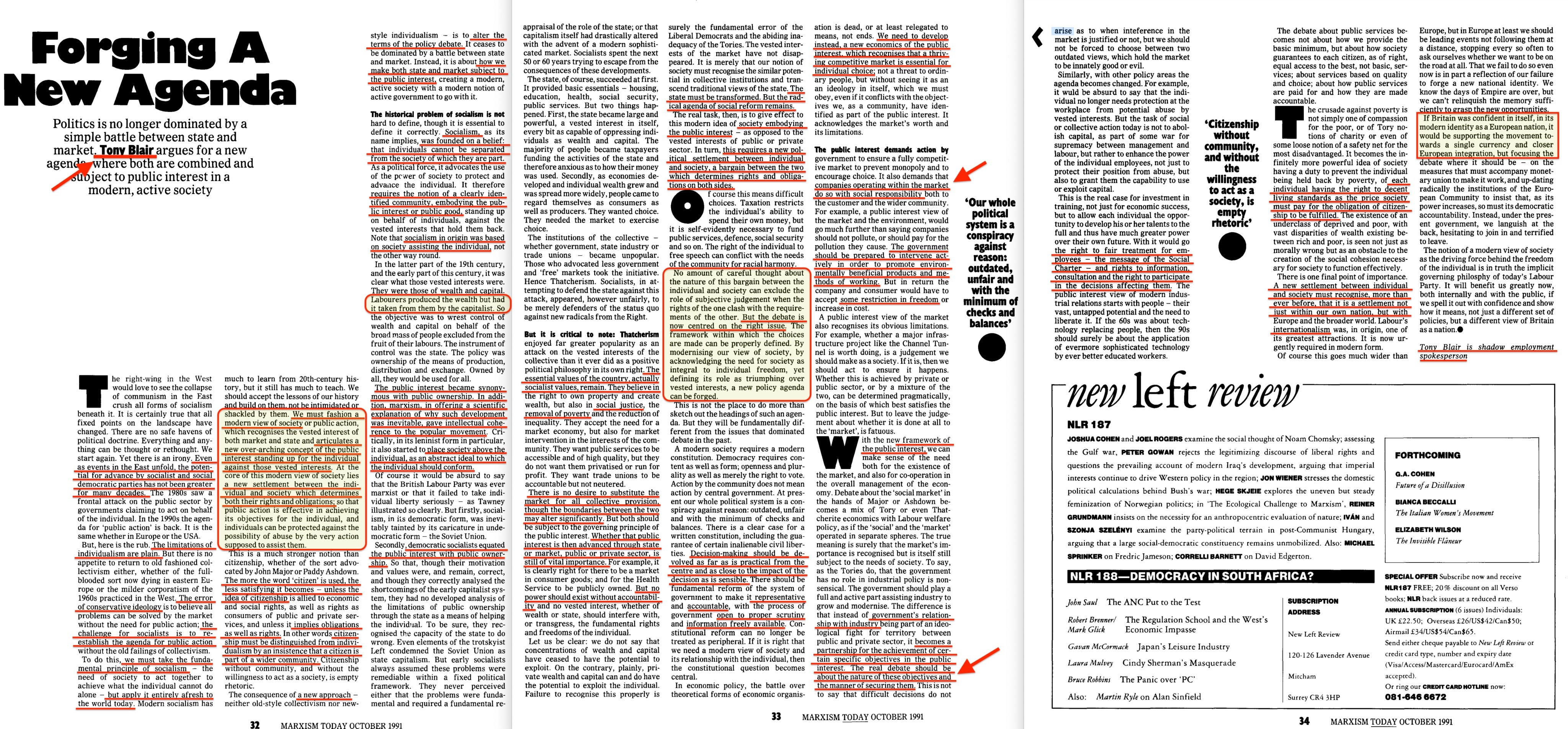
The same year, Tony Blair published ‘Forging a New Agenda’ in Marxism Today44 — arguing that public-private relations should be reoriented around the ‘common good’, with both parties accepting ‘some loss of freedom’ through balancing ‘rights and responsibilities’. Jacobs specified the methodology for constraining economic activity. Blair specified the political programme that would create the governance conditions for implementing it. Six years later, Blair would be prime minister, and Jacobs the General Secretary of the Fabian Society.
In the early 1990s he helped develop local environmental auditing and sustainable development principles in land use planning — the same domain NEF’s 2024 Social Purpose of Land Framework now governs — and from 1993 to 1996 he co-founded and coordinated the Real World Coalition of NGOs45 across environment, development, poverty, and democracy, building trisectoral coalition-building across domains.
In 1997, Jacobs was appointed General Secretary of the Fabian Society46. As General Secretary, he oversaw the 2003 Fabian Commission on the Future of the Monarchy47 — the report that recommended incremental reforms that stripped the monarchy of formal political powers.
In 2023, Jacobs co-authored In Tandem with van Lerven through the Fabian Society, proposing the EPCC — the statutory coordination body48.
Van Lerven links the monetary specifications across seven years, and Jacobs links the sustainability planning concept across three decades.


The Institutional Offspring
NEF didn’t just train people. It created institutions that carried pieces of the programme into different domains.
AccountAbility49 — founded by Zadek from NEF. This international standards body for corporate social responsibility defines what counts as 'accountability' in corporate governance.
Ethical Trading Initiative50 — co-founded by Zadek. It sets ethical standards for international trade.
Time Banking UK51 — launched from NEF. Alternative currency and community exchange, the same domain Bendell's IFLAS later researched through NEF's Community Currencies in Action programme.
Community Development Finance Association52 — launched from NEF. It represents community development finance institutions.
London Rebuilding Society53 — launched from NEF. It provides community lending.
Each institution works in a different domain but uses the same governance model: trisectoral, stakeholder-based and purpose-directed, with the ‘social good’ defined by the civil society body that NEF trained and placed. The think tank’s the trunk and the offspring are the branches. The programme spreads through institutional speciation — each new body looks independent but carries the same operational DNA.

The Metrics
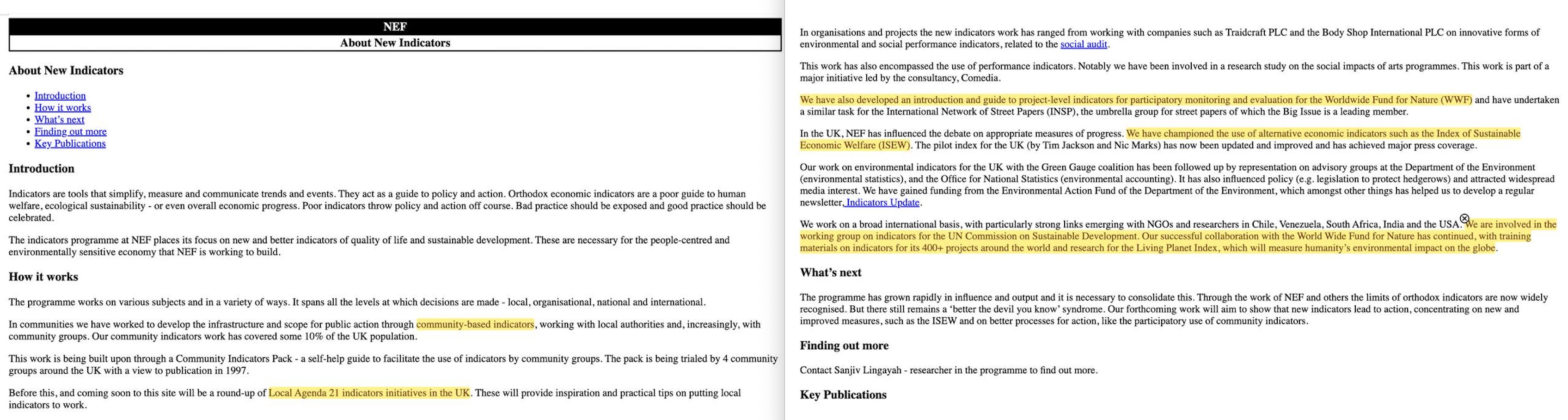
NEF didn’t just design the allocation mechanism. It built the entire measurement infrastructure — the audit methodology, the alternative indicators, and the metrics that supply the content the mechanism processes.
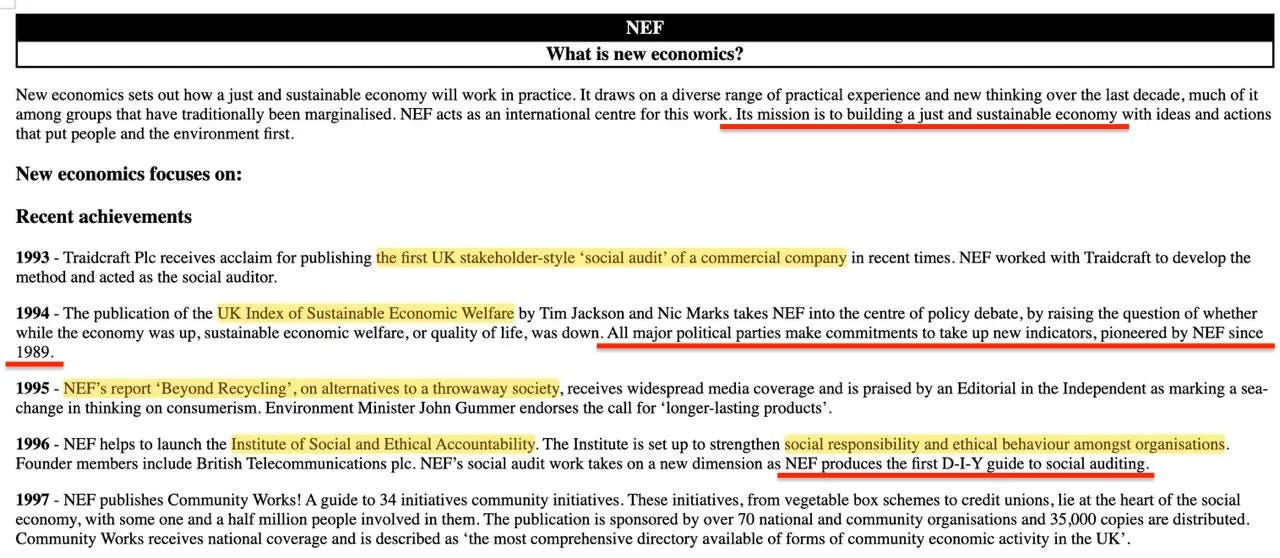
In 1993, NEF developed the method for the first UK social audit of a commercial company — Traidcraft Plc — and acted as the social auditor54. That’s the origin of social auditing in the UK. Social audit → stakeholder reporting → ESG metrics → TCFD → ISSB mandatory disclosure baseline. In 1996, NEF helped launch the Institute of Social and Ethical Accountability55 — AccountAbility, the international standards body the NEF essay documents Zadek founding.
The alternative indicators came even earlier. NEF had been pioneering new economic indicators since 1989. In 1994, Tim Jackson and Nic Marks published the UK Index of Sustainable Economic Welfare through NEF — ‘beyond GDP’ metrics measuring whether quality of life was declining while the economy grew. NEF’s own history records that ‘all major political parties make commitments to take up new indicators, pioneered by NEF since 1989’.
The alternative indicators that Stewart Wallis’s Wellbeing Economy Alliance now promotes globally were pioneered by NEF five years before the internet reached the public.
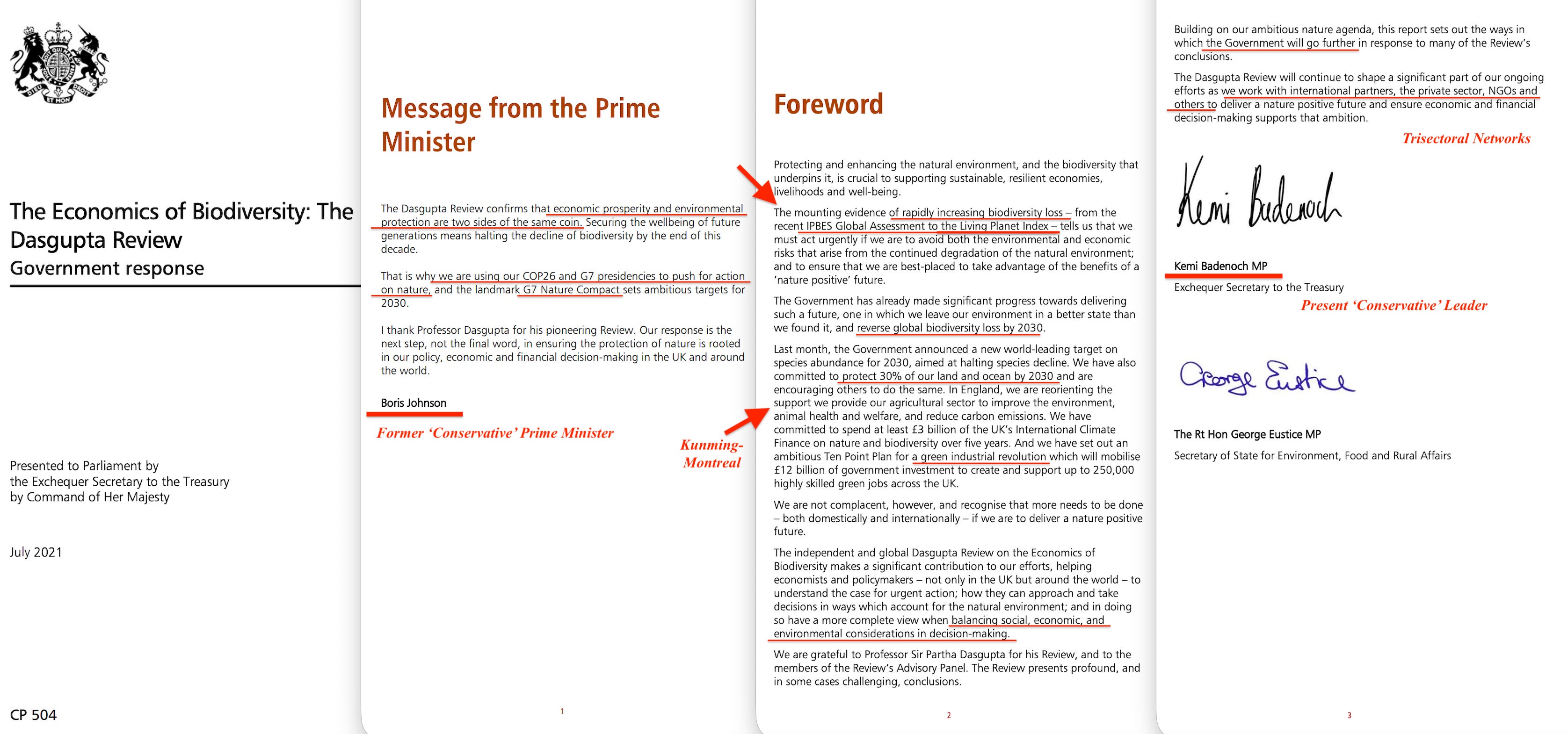
By 1999, NEF was collaborating with the World Wide Fund for Nature on the Living Planet Index56 — the metric that measures ‘humanity’s environmental impact on the globe’. The Living Planet Index57 is now one of the key biodiversity metrics58 referenced by the Convention on Biological Diversity59, the Dasgupta Review60, and the Taskforce on Nature-related Financial Disclosures61 — the disclosure framework that extends the enforcement architecture from carbon to nature.
NEF helped develop the metric that feeds the scenario models that determine what is funded and what is ‘stranded’.

Simultaneously, NEF sat on the working group on indicators for the UN Commission on Sustainable Development — the measurement framework that evolved into the SDG indicators62. The SDGs are the ethic the Monetary Allocation Committee essay identifies as the current operating purpose of the content-agnostic mechanism. NEF helped design the indicators that measure compliance with the purpose it also helped specify.
The same institution designed…
The audit methodology (1993)
The alternative indicators (1989-1994)
The standards body (1996)
The environmental metrics (1999)
The sustainability indicators (UN CSD)
The allocation mechanism (2013)
The coordination body (2021-2023)
The land governance framework (2026).
NEF supplied both the content-agnostic architecture and the content.
Every Alternative
NEF didn’t just design the centralised allocation mechanism — it designed every apparent alternative too.
In 1997, Ed Mayo published Community Banking63 through NEF — ‘an overview of the growing range of finance initiatives in industrialised countries directed towards social and environmental regeneration’. This was community finance and decentralised delivery aimed at social and environmental goals. The same institution designed this ‘alternative’ and the centralised programme, sixteen years before the Monetary Allocation Committee was proposed.
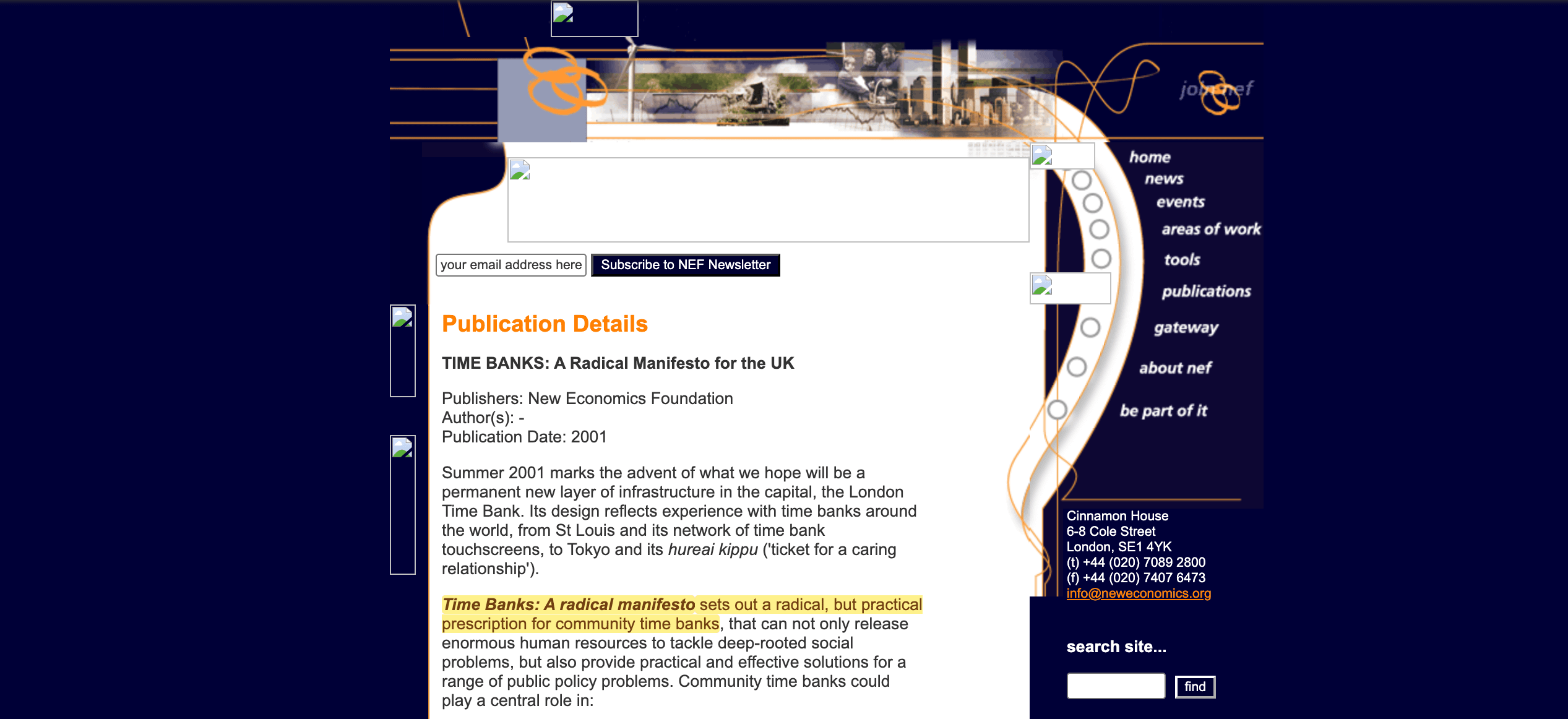
Simultaneously, NEF was building the alternative currency domain64. It evaluated Local Exchange Trading Systems in 1996. David Boyle published Time Banks: A Radical Manifesto for the UK65 through NEF in 2001, and Mayo published Community Development Credit Unions66 with Mick Brown and Pat Conaty in 2003. NEF’s Community Currencies in Action programme ran the research network that later fed into Jem Bendell’s IFLAS — the institute Epstein recruited Bendell to found in 2012 — where doctoral research on complementary currencies took place.
The alternative currency space Epstein wanted to enter was NEF territory, and had been for over a decade.
In December 2012, NEF published Stakeholder Banks: Benefits of Banking Diversity67 — a 65-country survey of cooperative banks, credit unions, CDFIs, and German Sparkassen, funded by the European Union. The report made the case for community banking: local institutions, stakeholder governance, geographical restrictions, collaborative networks with central service institutions. NEF published the academic justification for the decentralised model in December 2012 and proposed the centralised allocation body in July 2013.
Every model originates from the same institution:
Centralised creation: sovereign money (Robertson, 2000)
Centralised allocation: MAC → GFAT → EPCC (Ryan-Collins 2013, van Lerven 2021-2023)
Decentralised delivery: community banking for social and environmental regeneration (Mayo, 1997)
Alternative currencies: LETS, time banks, community currencies (1996-2003)
The metrics that supply the content: social auditing, Living Planet Index, UN CSD indicators (1989-1999)
The personnel who carry the programme: Zadek, Ryan-Collins, van Lerven, Wallis, Mayo, Jacobs
The main position and the backup position were both designed by the same institution. Every door leads to the same room — there is no outside.

The Architecture of a Pipeline
The pipeline runs on a three-sector governance model that gives government, business and civil society each a formal seat at the table. But NEF didn’t just advocate for this model and wait for others to adopt it. It built three-sector institutions itself: social auditing with stakeholder criteria in 1993, the Real World Coalition across environment, development, poverty and democracy from 1993 to 1996, AccountAbility as a multi-stakeholder standards body in 1996, and the Ethical Trading Initiative as an explicitly three-sector partnership in 1998.
When Kofi Annan’s UN reforms adopted multi-stakeholder governance as policy in 1997-2000, the seats were already fitted for NEF’s offspring. The think tank built the institutions that embodied the model before the model was adopted, and its alumni filled the civil society positions the model created at the UNEP Inquiry, the UN Secretary General’s Taskforce, the G20 Green Finance Study Group, the TNFD, the Bank of England and the ECB.

The pattern is straightforward:
NEF hires researchers and policy professionals who publish across monetary policy, sustainable finance, land governance, corporate responsibility, wellbeing economics and cooperative economics.
These publications go on the authors’ CVs and qualify them for jobs at institutions where their work becomes policy.
The alumni move to UCL IIPP to build academic credentials, UNEP and the UN Secretary General’s office to shape international structures, the WEF to manage stakeholder governance, government departments to write direct policy, the G20 to coordinate between nations, and the TNFD/ISSB to design disclosure frameworks.
Each alumnus carries part of the programme into a different layer, and these layers connect through documented links between institutions like INSPIRE, the Grantham Institute, the Council on Economic Policies and the Fabian Society that the Monetary Allocation Committee essay traces.
Meanwhile, NEF creates new institutions like AccountAbility, the Ethical Trading Initiative and Time Banking UK. Each operates independently in its own field, carries the same governance model, and looks like a separate organisation while implementing the same programme under a different name in a different sector.
The programme starts at the think tank. The publications are the seeds, grown by the alumni. The institutions NEF creates become permanent infrastructure that outlasts any individual career.
NEF was founded in 1986. Forty years later, its alumni sit at the Bank of England, UCL, the UN Secretary General’s office, UNEP, the TNFD, the G20 Green Finance Study Group, the WEF, the Wellbeing Economy Alliance, Co-operatives UK, the UK government’s Department of Levelling Up, and the ECB’s strategy review process. The think tank has forty-three staff — but the programme has no boundary.
The destination has a name: Inclusive Capitalism. Inclusion depends on meeting the metrics NEF designed, the indicators NEF pioneered, the audit methodology NEF invented, and the ethical framework the Council for Inclusive Capitalism supplies. The current ethic is the Sustainable Development Goals — measured by the indicators NEF helped design for the UN Commission on Sustainable Development. The ethic will migrate, but the permissions won't.
Participation in the financial system is no longer a right — it’s a permission granted to those who meet the criteria, withheld from those who don’t, and administered through the architecture one institution built across forty years.
Inclusive capitalism is ‘permission-based capitalism’. And the permissions were written by the people documented above.


view-source:https://neweconomics.org/about/our-missions
Keeping this data. Thanks so much. When the same ones who are designing all of this are the very ones that are making trillions, looting us and all under the lie it is benevolent and for our good, that is an easy way to show the horrific and criminal conflicts of interests we will reject wholly. People can locally explain and then the lightbulbs will go off on why so much wealth is shifting up and the methods they use to do it and get government reps to do it for them.
What a most unfortunate conundrum, that these vampires keep using the word “stakeholder”
Power, position, and property of those within two steps of both the Rockefellers and the Bauers, should be stripped. And,… the world would be a better place.