
Committee of Three
The Template for Moral Bureaucracy

Contemporary governance has developed procedural requirements that cannot be opposed because they are wrapped in progressive values. Where traditional red tape can be criticised as inefficient waste, these new bureaucratic frameworks are typically defended as ‘morally necessary’.
But how did this 'moral bureaucracy' emerge in the West? Why do we see the same structural logic — 'X-in-all-policies' — appearing across completely different domains, from health to environment to security?
The answer lies in the 1956 Report of the Committee of Three on Non-Military Cooperation in NATO.
This largely forgotten Cold War document established a template for institutional expansion that has been systematically replicated across international organisations for nearly seventy years. Understanding its logic reveals how modern governance operates — and why democratic control has become increasingly elusive.

The 1956 Breakthrough
Before 1956, NATO operated within relatively clear boundaries. Article 5 of the North Atlantic Treaty1 established collective defence against armed attack. The alliance had a military mandate with defined scope and democratic oversight through member state parliaments.
The Report of the Committee of Three2 changed this. Faced with Cold War competition that extended beyond traditional battlefields, NATO's foreign ministers concluded that military alliance alone was insufficient. The report argued that NATO's survival depended on expanding far beyond defence cooperation into what it called 'non-military cooperation'.
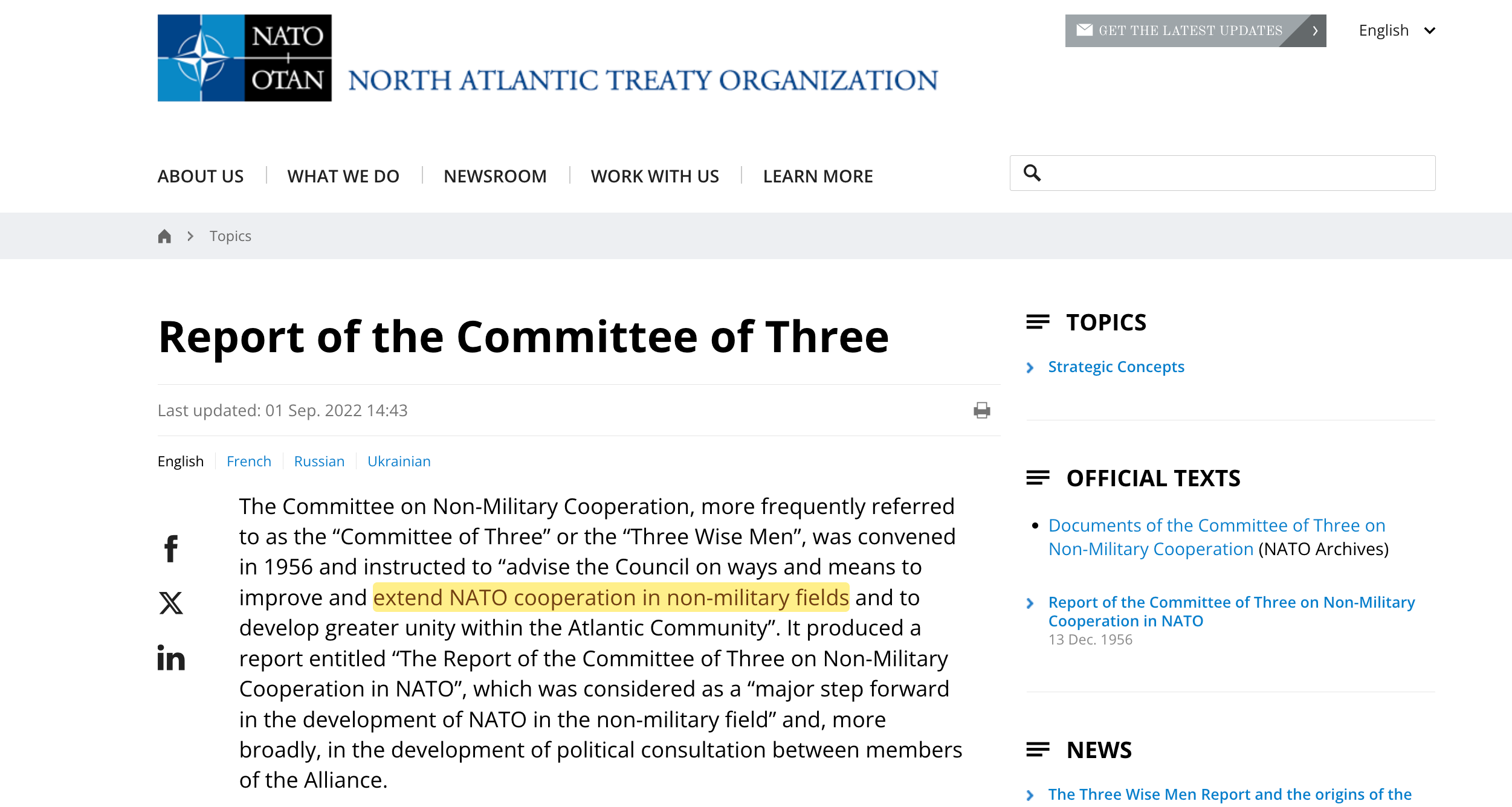
This represented a redefinition of security itself. Political stability, economic resilience, scientific progress, cultural exchange, and information flows were all reframed as components of collective defence. The rationale was simple: if the Cold War was as much about political cohesion and societal strength as armies and weapons, then anything affecting alliance stability became a legitimate security concern.
The Committee of Three established that by redefining the core concept ('security') to include 'all determinants that affect security', they could expand institutional mandate without formal boundary limits. Economic policy became a security measure because economic instability created vulnerability to communism. Scientific and technological research became essential for military edge and resilience. Cultural and information exchange became part of psychological warfare and alliance cohesion.
This was more than mission creep — it was a systematic way to erase institutional boundaries whilst appearing to maintain them. After all, there is always some plausible link between any domain and 'security' broadly conceived.
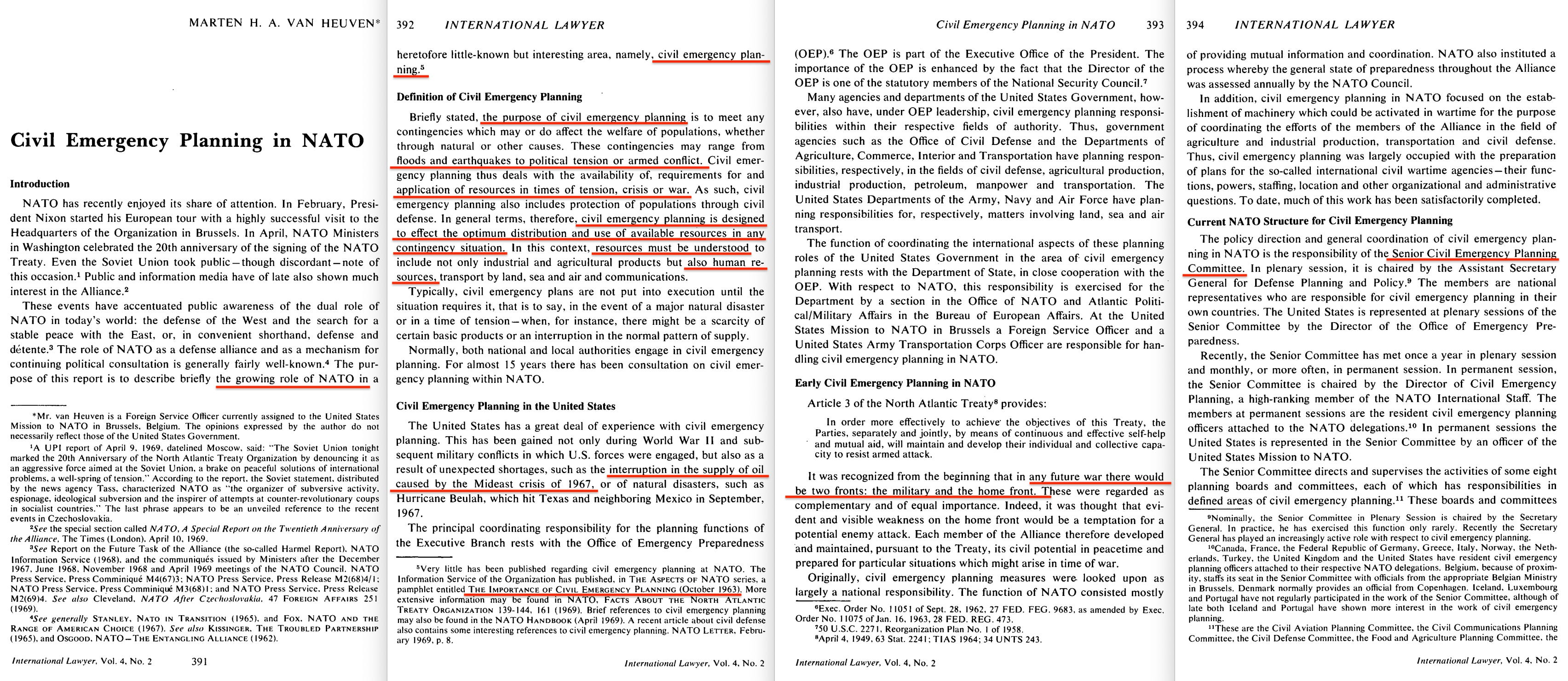
The Committee of Three identified 'civil emergency planning' as the institutional pathway for this expansion. Originally conceived as disaster preparedness3, civil emergency planning became the mechanism for civilian-military integration across all sectors4. If any civilian activity could affect emergency response capabilities, it fell within NATO's expanded security remit. This provided a permanent institutional channel for military-security logic to penetrate civilian governance5.
The Template Revealed
The Committee of Three had inadvertently created a replicable template for institutional expansion:
Step 1: Redefine the core concept.
Expand 'Security' (or Health, or Environment, or…) to include 'all determinants that affect Security/Health/Environment/…'Step 2: Establish connecting logic.
Demonstrate plausible links between the expanded definition and any domain of activityStep 3: Create assessment requirements.
Mandate that all relevant activities undergo evaluation for their impact on the redefined core conceptStep 4: Build institutional mechanisms.
Establish expertise, monitoring, and compliance structures to manage the expanded scopeStep 5: Recursive expansion.
Use evidence from assessments to justify further expansion into new domains
This template had several crucial features. It maintained democratic legitimacy by appearing to operate within the original mandate whilst systematically expanding beyond it. It created powerful constituencies with vested interests in maintaining procedural complexity. But most importantly, it made opposition politically costly by reframing any criticism as opposition to the underlying value (security, health, environmental protection, …).
What the Committee of Three had done was a textbook case of asymmetric recursion. On the surface, the institution appeared to respect its original boundaries: NATO remained a defensive alliance bound by Article 5. Yet by subtly redefining the meaning of 'security', the report created a structure in which authority could always expand outward into new domains, while legitimacy continued to flow inward from the old mandate. This gave the impression of continuity — NATO was still doing 'defence' — even as the substance shifted toward comprehensive governance. Asymmetric recursion allows institutions to appear bounded while actually being boundaryless, a technique that has since become the hallmark of contemporary moral bureaucracy.
The Committee of Three showed how to expand institutional authority without formal democratic consent — and their method would prove highly influential.

The Systems Revolution of 1956-1965
The Committee of Three report didn't emerge in isolation. Between 1955 and 1965, a remarkable constellation of institutional innovations appeared, each deploying variations of the same boundary-crossing logic across different domains. This suggests coordinated implementation of a new paradigm in governance.
The Intellectual Foundation (1956)
Kenneth Boulding published 'General Systems Theory — The Skeleton of Science'6, establishing the theoretical framework for identifying common structural patterns across different disciplines. Boulding argued that universal principles governed systems regardless of their specific domain, providing intellectual legitimacy for exactly the kind of boundary-crossing logic multiple institutions were simultaneously deploying.

M. King Hubbert presented his peak oil7 analysis, identifying the most significant constraint facing industrial civilisation: finite fossil energy resources which necessitated the management of flows and allocation. For the first time, someone had quantified the energy problem that would require coordinated planning across all sectors. This planning further called for systematic monitoring of the underlying resource, as well as records of global inventories, a function that was institutionalized with the creation of the International Energy Agency in 19748.

CP Snow delivered early versions of what would become his famous 'Two Cultures' thesis, arguing against disciplinary separation and for integration between scientific and humanistic intellectual frameworks. This wasn't merely academic — it was about creating unified intellectual tools that could support unified governance approaches.

The Measurement Infrastructure (1957)
Within a year, this intellectual revolution gained its empirical foundation. Funded by Rockefeller, Charles David Keeling began continuous co2 monitoring at Mauna Loa Observatory, establishing the measurement infrastructure necessary for planetary-scale systems management9. Crucially, this monitoring was partly funded through military-linked research channels because atmospheric data was relevant for nuclear testing detection and long-range weapons modelling — directly connecting environmental measurement to NATO's expanded security framework.

The Institutional Echoes (1957-1965)
NATO's template was simultaneously being replicated across multiple institutional contexts:
The 1957 Treaty of Rome10 establishing the European Economic Community used identical spillover logic: economic integration justified expanding into social, cultural, and political domains. Once 'common market' included labour mobility, it necessarily included education, professional qualifications, and social policy.
The 1961 creation of OECD11 represented the same definitional expansion at global scale. Originally focused on European reconstruction, the OECD's mandate was redefined to include education, science, technology, and environment. Like NATO, OECD had discovered that its original mission required addressing 'all determinants' affecting economic development.
The 1960-1970 UN Development Decade12 and UNDP creation13 globalised this determinant approach under the banner that 'everything is development'. Social, cultural, political, and environmental factors all became legitimate development concerns requiring coordinated international oversight.
The Managerial Infrastructure (1960-1964)
The tools for implementing boundary-crossing governance were being locked in simultaneously. Wassily Leontief's input-output analysis was globalised through UN and World Bank adoption by 1960, providing the methodological substrate for demonstrating how any intervention in one domain affected all others. This mathematical framework made cross-domain determinants measurable and therefore manageable, but it worked through an established, continuous flow of ‘statistical monitoring’ data aka ‘surveillance’.

The same determinant logic was soon imported directly into the machinery of the American state. In 1961, Robert McNamara introduced the Planning-Programming-Budgeting System (PPBS) in the Department of Defense. PPBS required every program to be justified not only in terms of immediate purpose, but also in terms of its cascading effects across multiple domains — military readiness, economic efficiency, social cohesion. This was NATO's template rendered into budgetary software: institutional expansion disguised as rational planning.

President Kennedy had used systems analysis cautiously, resisting Pentagon efforts to monopolise decision-making through comprehensive models. But after his assassination, Johnson and McNamara institutionalised PPBS across the federal government. By 1965, the model was being promoted as the universal operating logic of governance — an architecture in which no policy could be considered in isolation. From there, PPBS was exported globally through the World Bank, UNDP, and other multilateral institutions, spreading the very same 'all determinants in one system' framework that the Committee of Three had pioneered.

Together, these innovations created a complete toolkit for total systems management:
Boulding’s General Systems Theory provided the conceptual legitimacy for treating civilisation as an engineering problem,
Hubbert identified the energy constraints requiring systematic management, Keeling established the monitoring infrastructure for planetary boundaries,
Leontief’s input-output analysis provided the mathematical methodology for demonstrating universal interconnections,
PPBS created the institutional mechanism for implementing comprehensive assessment requirements, and
CP Snow’s call for uniting the ‘Two Cultures’ was soon operationalised through systems theory, itself an update on Alexander Bogdanov’s Tektology.
This wasn't coincidental convergence — it was the coordinated development of governance tools for managing civilizational complexity.


In this integration each component reinforces the others: GST makes mathematical modelling of social systems intellectually respectable, I-O analysis demonstrates that 'everything affects everything else' mathematically, planetary monitoring provides the empirical justification for intervention, and PPBS operationalises these insights bureaucratically. The result is a system where civilizational management appears as technical necessity rather than political choice.
This represents a remarkable 1955-1965 sequence: establish the intellectual foundations for total systems management, create the institutional mechanisms for implementing it across multiple organisations, develop the measurement infrastructure to support it, then lock in the managerial tools to operationalise it. This was coordinated implementation of the governance mechanisms necessary for circumventing democratic constraints on institutional power through later computational modelling.

The Parallel Universe
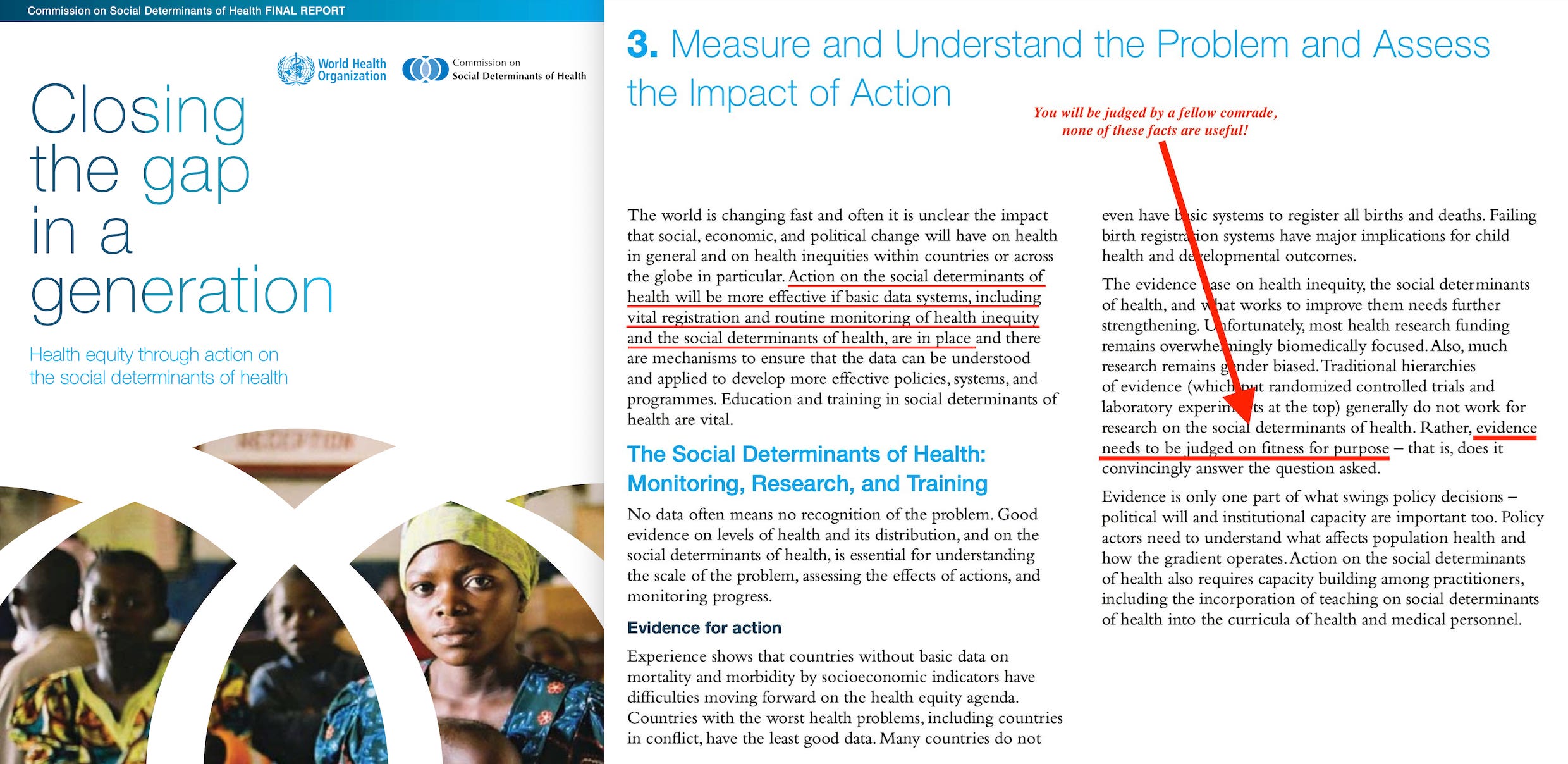
Fifty years later, the World Health Organisation would execute precisely the same manoeuvre. The WHO's 'social determinants of health' framework — fully developed by 200814 — redefined health to include housing, education, employment, environment, culture, and social equity. Like NATO's 1956 expansion, this wasn't presented as institutional mission creep but as scientific recognition of health's 'true' scope.

The parallel is striking:
NATO (1956): Security Determinants
Political stability affects alliance security
Economic resilience affects collective defence
Cultural cohesion affects psychological warfare readiness
Scientific progress affects strategic capabilities
Therefore: all political, economic, cultural, and scientific matters become security issues
WHO (2000s): Health Determinants
Housing quality affects health outcomes
Educational attainment affects wellbeing
Employment conditions affect mental and physical health
Environmental factors affect disease patterns
Therefore: all housing, education, employment, and environmental matters become health issues
Both organisations had discovered the same institutional logic: redefine your domain to include its 'determinants', and you can justify intervention anywhere those determinants operate. Both created assessment requirements, expert constituencies, and monitoring (surveillance) mechanisms. Both wrapped expansion in moral imperative — security and health being values that cannot be opposed.
The WHO's approach wasn't coincidence or independent innovation. It was structural replication of the NATO template, adapted for a different domain but following identical expansion logic.
The Migration Pattern
Between NATO's 1956 breakthrough and WHO's health determinants framework, the template had been quietly spreading across international organisations. The institutional pathways are traceable:
NATO's expansion into 'environmental security' began almost immediately. The alliance's Science Committee, established to manage scientific cooperation under the 1956 framework, began treating environmental monitoring as strategic intelligence. By 1969, NATO was producing reports on environmental problems as security concerns, folding pollution, resource depletion, and climate factors into defence planning.
This environmental security logic fed directly into broader Cold War scientific diplomacy. The International Institute for Applied Systems Analysis (IIASA), founded in 1972 as an East–West research centre, inherited NATO’s scientific cooperation apparatus and became the central node for technocratic governance. Its integrated models — linking environment, economy, population, and security — produced ‘black box’ outputs that bypassed political debate while driving policy across both blocs.
From environmental security, the template migrated into climate governance. The Intergovernmental Panel on Climate Change (1988) and UN Framework Convention on Climate Change (1992) adopted the same NATO-style expansion logic, but now operationalised through IIASA-style ‘black box’ modelling. Climate projections and integrated assessment models translated complex variables into authoritative outputs, providing the justification for extending environmental governance into energy, transport, agriculture, finance, and industrial policy. Through this mechanism, climate ‘mainstreaming’ requirements spread across all policy sectors.


The pattern is consistent: establish the expanded definition, create assessment requirements, build expert constituencies, use assessment findings to justify further expansion. Each successful application created precedent for others.
By the 2000s, nearly every major international organisation had developed its own 'X-in-all-policies' framework, each following the identical four-step pattern:
Gender-in-all-policies (UN Women): Gender impact assessments across all policy domains, started in the 1990s and fully institutionalised by the 2000s.
Human Rights-in-all-policies (UN Human Rights Council): Rights-based approaches requiring every policy decision to consider human rights implications.
Digital-in-all-policies (emerging): Digital transformation strategies and cybersecurity considerations across all sectors, with AI governance frameworks requiring oversight of all AI applications.
Financial Stability-in-all-policies (Network for Greening the Financial System): Climate, nature, and social equity all become 'systemic risks' to financial stability, allowing monetary authorities to intervene in any domain affecting 'stability'.
The UN's Sustainable Development Goals, explicitly designed as 'universal' and 'indivisible', formalised this overlapping logic as official doctrine, creating what amounts to a meta-framework into which all other 'X-in-all-policies' approaches plug.

The Recursive Trap
The proliferation of these frameworks has created a governance system where everything becomes a determinant of everything else. The connecting logic works in all directions, creating a total justification matrix for intervention anywhere.
Consider the mutual reinforcement at work:
NATO can cite health impacts to justify environmental security measures.
WHO can cite security impacts to justify social determinants interventions.
The UN Framework Convention on Climate Change can cite both health and security impacts to justify climate action.
Central banks can cite all of the above to justify financial interventions under the banner of 'systemic risk'.
Each domain reinforces the others through overlapping 'evidence':
Environmental determinants of security.
Climate security doctrine, resource conflicts, water and food security frameworksSocial determinants of environment.
Environmental justice frameworks, how poverty and education affect environmental outcomesSecurity determinants of health.
'Structural violence' as public health issue, conflict epidemiology, peace-building as health interventionDigital determinants of everything.
Digital divides affecting health equity, cybersecurity as environmental threat, AI bias as social justice issue
This creates a matrix where any domain can justify expansion into any other domain through overlapping 'determinants' linkages. Each connection provides evidence for further connections, generating recursive expansion loops that make contraction structurally impossible.
The SDGs represent the apotheosis of this logic. Their 'interlinkages' and 'coherence' agenda officially recognises that progress on any goal affects all others, creating formal justification for comprehensive oversight. When everything affects everything else, everything requires coordination — and coordination requires authority.
This recursive structure makes the system immune to reform. Any attempt to limit one framework can be countered by citing connections to others. Want to reduce environmental assessment requirements? You're threatening security (NATO), health (WHO), and financial stability (central banks). Want to limit health mainstreaming? You're undermining climate action (UNFCCC), gender equality (UN Women), and human rights (UN Human Rights Council).
This recursive trap operates with the same structural inevitability as the financial clearinghouse systems of the nineteenth century. In finance, once bankers discovered that interbank clearing reduced risk, the model replicated across exchanges until the entire monetary order ran on a single architecture. The realisation was that stability meant dependency: once every balance cleared through the same hub, contraction became impossible, and withdrawal by any member threatened collapse for all. Control passed to those who mediated the clearing — not through ownership, but through indispensability.

The determinant matrix functions in exactly this way. Each 'X-in-all-policies' framework clears its claims through the others, creating a closed loop of justification. NATO cites health impacts to expand security, WHO cites security impacts to expand health, climate frameworks cite both to expand environment, and central banks cite all of them under 'systemic risk'. Every framework reinforces the others, so that no domain can be rolled back without triggering appeals to stability, equity, or security elsewhere. Just as the clearinghouse locked finance into permanent interdependence, the determinant template locks governance into permanent expansion.
The Committee of Three's expansion logic has evolved into a self-reinforcing system where contraction becomes structurally impossible.
The Template's Endurance
Seventy years after the Committee of Three report, its template continues expanding. The WHO's 'One Health' framework now integrates environmental, agricultural, and social systems into health governance. The Pandemic Treaty locks in global authority to act on these determinants anywhere 'health security' requires, including for non-health reasons such as ‘black box’ modelled ecosystem disturbance and climate change. Central banks are embedding climate and social considerations into monetary policy. Digital governance frameworks are extending oversight to artificial intelligence applications across all sectors.

COVID-19 was the first full-scale instantiation of this indicator/determinant system. Based on Neil Ferguson’s flawed, opaque ‘black box’ epidemiological modelling, a health emergency justified unprecedented interventions not only in medicine but also in finance, trade, education, surveillance, and mobility. Lockdowns were defended as economic stabilisation measures, economic stimulus was defended as public health necessity, and digital identity systems were introduced as both epidemiological tools and security infrastructure. Each justification cleared through the others: the IMF invoked health to restructure debt, central banks invoked health to expand balance sheets, and security agencies invoked health to legitimise mass data collection.
What appeared as an exceptional, temporary alignment of policy domains was in fact the determinant matrix in operation — a closed loop in which no intervention could be contested without triggering appeals to stability, equity, or security elsewhere.

Each represents variation on the same theme: redefine core institutional concepts to include their 'determinants', create assessment requirements, build expert constituencies, use findings to justify further expansion. The pattern is so established that new frameworks can emerge without explicit reference to their predecessors — the expansion logic has become institutionalised common sense.

What makes this particularly remarkable is that the original NATO innovation emerged from a specific historical moment when the intellectual foundations for total systems management were being laid across multiple disciplines. The Committee of Three was solving a specific Cold War problem, but they were doing so using conceptual tools — systems thinking, input-output analysis, integrated planning — that were simultaneously revolutionising how civilisational complexity could be understood and controlled.
What appears as moral progress — comprehensive consideration of health, environment, security, and equity across all policy domains — actually represents the systematic application of techniques developed for managing the energy-money nexus at civilizational scale. The moral language of 'mainstreaming', 'determinants', and 'cross-cutting impacts' obscures the fundamental dynamic: total system management disguised as technical expertise.

The Committee of Three expanded authority without formal democratic consent by redefining concepts rather than changing mandates. Their insight has shaped international governance for nearly seventy years, creating the procedural complexity and democratic displacement that characterises contemporary 'moral bureaucracy'.
Understanding this genealogy clarifies what we're actually confronting: not bureaucratic drift or technocratic complexity, but the systematic replication of a specific template for circumventing democratic limitations on institutional power. The Committee of Three's legacy lives on, not in NATO archives, but in the elaborate assessment frameworks that now govern contemporary life through an interlocking matrix where everything becomes a determinant of everything else.
Their template endures because it systematically circumvents democratic constraints on institutional power. The Committee of Three exploited a mechanism for expanding authority beyond electoral mandate whilst maintaining the appearance of legitimacy. The method — redefining core concepts to encompass their 'determinants' — allows institutions to grow without formal democratic consent whilst claiming technical necessity rather than political choice.
Today this architecture is operationalised through Inclusive Capitalism, which fuses central banks, asset managers, multilateral institutions, even the Vatican into a financial clearinghouse for moral authority. The Vatican’s Council functions as the expert panel for this ‘moral economy’, supplying ethical legitimacy while ESG benchmarks and SDG-linked debt instruments provide hard enforcement. Determinant-driven expansion thus becomes compulsory through financial leverage and virtuous through moral branding.
Consequently, the system advances not through democratic choice but through structural foreclosure of exit and the moral criminalisation of dissent.
Such is the ‘democracy’ they promise to protect.

I'm hoping you'll be addressing the way out of this stranglehold....
In an article from a Dutch newspaper written by Eric van de Beek the Dutch government admitted "The cabinet has recognized that it implements policy based on NATO objectives that are secret. The objectives are related to making society resilient to disruptive events such as war, pandemics and natural disasters ‘. Member of Parliament Pepijn van Houwelingen of Forum for Democracy speaks of “a huge black hole in our democracy ” https://deanderekrant.nl/kabinet-erkent-navo-is-de-baas/