
Ratified by G20

Two years after the New Delhi G20 summit1, the India-Middle East-Europe Economic Corridor2 is still the West’s flagship infrastructure project.
Ursula von der Leyen called it ‘nothing less than historic’, Narendra Modi said it was a generational opportunity, and Joe Biden — who announced it — took credit for two years of work by his administration3.
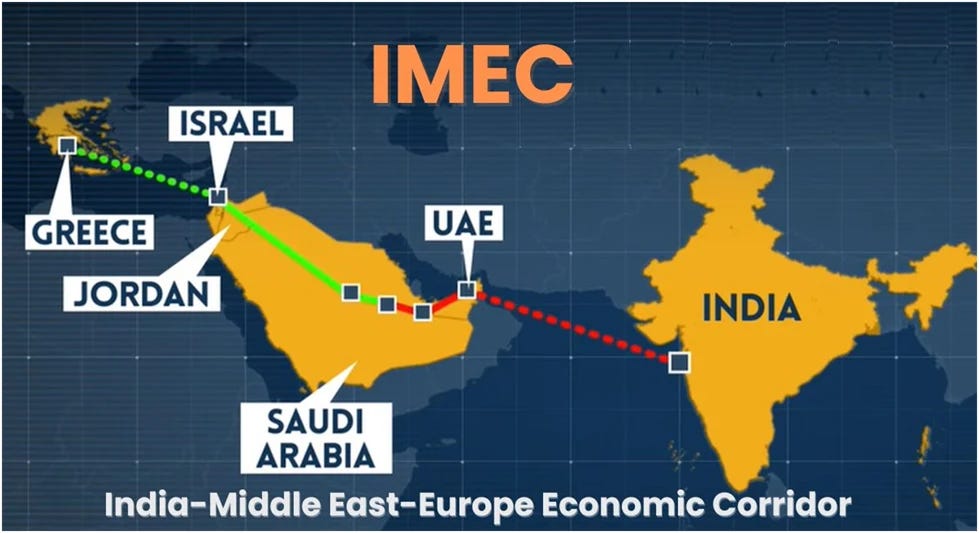
The way it’s commonly told, IMEC was decided at the September 2023 summit. But the corridor’s features — conditional, programmable, ESG-aligned, and settlement-integrated by design — were fixed four years earlier by standards drawn up at the OECD and BIS.
The 2018 Israeli rail proposal provided the geography, while the standards provided everything else — and they’d have done the same for any corridor the G7 backed.


The standards came first
It all started at the G20 Osaka Summit in June 20194, when world leaders endorsed the Principles for Quality Infrastructure Investment5. Drafted by the OECD with help from the BIS, these principles established ‘quality infrastructure’ as the standard every future G20 project would have to meet. The framework boiled down to five parts — SDG alignment, ESG factors, climate resilience, debt management and governance — and you’ll see the same five in the conditions attached to almost any modern multilateral document today6.
Five months later, at the Indo-Pacific Business Forum in Bangkok7, the Blue Dot Network launched8. Led by the US with backing from Japan and Australia, it created a certification system for ‘high-quality’ infrastructure projects worldwide. The US State Department put up $2 million to get the steering committee started and invited other G7 governments to join9. To get the Blue Dot label10, a project would have to meet the network’s standards — and that meant satisfying those Quality Infrastructure Investment principles from Osaka.
By the end of 2019, the certification system for infrastructure that G7 governments would later fund was already in place, though the corridor was yet to be named.

The financing followed
The OECD spent 2020 and 2021 turning the political endorsement into practical requirements. The Global Outlook on Financing for Sustainable Development 2021 set out the basic thinking11, while De-risking institutional investment in green infrastructure12 (June 2021) explained how private capital would be pulled into projects that met the standards. Mobilising institutional investors for financing sustainable development13 (July 2021) covered the developing-country angle, and The Implementation Handbook for Quality Infrastructure Investment14 (July 2021) pulled the operational guidance together.
These OECD documents explicitly back ‘the priorities of the Italian G20 Presidency in 2021’15 and the UK’s G7 and COP26 presidencies, since they were written for the political vehicles that would carry them.
In June 2021, the G7 in Cornwall announced Build Back Better World16 — the political packaging. The initiative had plenty of framing but little detail, and not much emerged over the next year.
In June 2022, the G7 in Germany rebranded BBB as the Partnership for Global Infrastructure and Investment17. The PGII fact sheet lists its toolkit: the G20 Compendium of Quality Infrastructure Investment Indicators18, the World Bank’s Public-Private Infrastructure Advisory Facility19, the Global Infrastructure Facility20, the Quality Infrastructure Investment Partnership21, and the Debt Management Facility22. All of them existed before PGII; the partnership merely bundled them.

The settlement architecture arrived in parallel
The BIS published its Annual Economic Report in late June 202223, days after the PGII rebrand. It introduced the programmability, composability and tokenisation framework that would become the unified-ledger architecture — central bank digital currencies, tokenised deposits and tokenised central bank reserves running on a shared programmable platform24.
Eight months later, in February 2023, BIS general manager Agustín Carstens gave a keynote at the Monetary Authority of Singapore that spelled out the unified ledger25. Money would carry its conditions inside it, with compliance checks, identity verification and purpose codes all happening at settlement. The setup would be a public-private partnership, with the central bank ‘tasked with underpinning the trust in money’.
By the time IMEC was announced in September 2023, the settlement infrastructure that would clear the corridor’s financial flows had been blueprinted. Project Agorá26 was launched in 2024 to test the unified ledger across seven central banks and forty-three private financial institutions. Project Rosalind27, Project Mandala28, Project Promissa29 and Project Pine30 followed.

The identity layer was assembled at the same time
A settlement system built around identity needs an identity system to call on. Without one, the unified ledger has nobody to onboard and no compliance checks to run.
That system is Digital Public Infrastructure31. The model came from India — Aadhaar for identity, UPI for payments, DigiLocker for documents, all branded as the India Stack. Built with the World Bank, UNDP, Gates Foundation and Co-Develop32 (Rockefeller-backed DPI funding vehicle launched in 2023), DPI offers three interoperable layers designed to plug straight into financial settlement and regulatory compliance.
The precedent was Covid. Between 2021 and 2022, the EU Digital COVID Certificate33, the NHS COVID Pass34 and similar systems elsewhere built population-scale credential architecture — a QR code on your phone, shown at the door, checked against a centralised database, returning a yes or no in milliseconds35. Hundreds of millions across Europe and the Anglosphere accepted credentials as the condition for entering restaurants, boarding planes, attending weddings or visiting hospitals. The technical standards, verification readers, issuer-and-validator architecture and public familiarity with presenting credentials at every transaction were all built then. When DPI was ratified at New Delhi in September 2023, the infrastructure and behavioural training were already in place. DPI extends what the vaccine passport previously established.
Three months before New Delhi, the WHO completed the handover. On 5 June 2023, the WHO and the European Commission announced the EU Digital COVID Certificate would form the foundation of the WHO’s Global Digital Health Certification Network36. The regional system became the global template the same week the EU’s Covid-specific authorisation expired. The certificate didn’t disappear. It moved up a level and broadened from Covid to digital health certification generally.
The same G20 summit that announced IMEC also ratified DPI. The New Delhi Leaders’ Declaration named it as a development priority37, with $400 million in initial public pledges and the substantive financing routing through World Bank lending and Gates Foundation grants. Two months later, the 50-in-5 Campaign committed fifty countries to building their own DPI within five years38, providing the political packaging for an identity architecture the World Bank and UNDP had been assembling for years.
IMEC’s digital pillar isn’t separate from this. The corridor’s cross-border fibre and identity integration form the layer through which flows along the corridor can be conditioned at the individual level. A shipment, a transaction, a worker on the project — each connects to a DPI system that can identify, authenticate, and clear or block participation.
The corridor was ratified at New Delhi. So was the infrastructure that gives its conditionality something to attach to.

The corridor inherited its properties
By the time IMEC was announced in September 2023, the design specs were already finished.
PGII funding required Quality Infrastructure Investment standards39, so the infrastructure had to meet them. These conditions covered the physical, digital and financial layers together since the standards applied across the board. The settlement system would use the BIS unified-ledger architecture because it’s the only setup matching the digital layer’s identity and compliance needs. Enforcement would come through ISO certification, EU CBAM conditionality40 and Basel risk weightings41 — all frameworks the corridor needed to clear.
The Israeli rail proposal supplied the variable. Any corridor from the other seven countries involved would have looked the same. The features came from the framework, not the corridor, and any G7-backed project would have had them too.

What the announcement actually was
The September 2023 G20 summit did exactly what political layers are designed for. Leaders stuck a name and a map on an architecture the standards bodies had spent four years building. They signed a memorandum of understanding and made speeches.
The substance was settled long before. ESG alignment, conditional financing, digital identity integration, routing through a settlement layer controlled by central banks — all decided in technical committees the public can’t access and has no say in.
The pattern keeps repeating. Every G7 infrastructure initiative since 2019 applies the same standards architecture to different places — the Lobito Corridor42 in Africa, the Just Energy Transition Partnerships43 with Indonesia, Vietnam and South Africa, and the EU’s various Global Gateway projects44. Each carries identical conditions, financing structure, settlement requirements and compliance overhead.
Conflict reconstruction achieves the same thing by a different path. Ukraine’s Diia digital ID45, running since 2020 and sped up by the invasion, has become the EU’s reference model for its digital identity wallet. Estonia, Zambia, Kosovo and others have adopted versions through the Diia.Open platform. The Gaza Humanitarian Foundation hands out aid using biometric checks at controlled sites46. The WFP’s SCOPE biometric system and UNHCR’s refugee enrolment cover displaced people across the region47. Post-Assad reconstruction in Syria is being built around digital identity as a condition for aid, banking and property restitution48. Displaced people are the proof of concept. The reconstruction turns the humanitarian rollout into permanent administrative infrastructure, and the identity system is in place before the conflict ends.
The real question about IMEC isn’t the route, it’s the standards. The route could have been anywhere. Those properties were fixed years before anyone chose where the corridor should run.

The political layer downstream
The usual story about IMEC goes like this. G7 leaders worried about Chinese influence in 2019, came up with B3W in 2021, turned it into PGII in 2022, and unveiled IMEC as the flagship project in 2023. The story suggests political decisions drove the technical architecture.
But it happened the other way round. Technical committees at the OECD, the BIS and the Blue Dot Network secretariat built the standards architecture between 2019 and 2022. The political layer showed up at G7 summits to add a name, a financing pledge and a press release. The corridor announced in 2023 inherited properties written long before any specific corridor existed.
By the time von der Leyen called IMEC historic49, the design specifications had been waiting for it. The Israeli rail proposal supplied the variable; the conditionality, digital identity integration, ESG alignment and BIS settlement dependency were all fixed in advance.
The political announcement supplied the name. The standards supplied everything else, and they’d been developed upstream.
The architecture’s purpose is straightforward once the cascade is visible. A closed-loop control system can’t tolerate flows it can’t see, because the model can’t predict against information it doesn’t generate. Every payment channel outside the ledger — cash, bearer instruments, informal trade, unbanked populations — is a source of unpredictability the operators have to absorb. The technical answer is to enrol every individual into digital identity, route every transaction through conditional settlement, and replace store-of-value money with programmable credit. Money in the older sense is a buffer between the individual and the operator. Credit is permission, granted on terms set upstream.
The same standards that decide whether a shipment moves along IMEC decide whether a loan clears, a payment settles, a certification holds. The conditionality built into the corridor is the conditionality built into the digital wallet, the bank account, the building permit and the export licence.
The architecture doesn’t end at the port of Haifa. It runs from the nation state, through the corporation, and right down to the individual transaction through Central Bank Digital Currencies with conditionality embedded — and the individual was never consulted about the rules which trigger a conditional failure of transaction.


More outstanding content. Unfortunately Substack is shadowing your site. Its all part of the control system you describe.
A scene from “Chitty Chitty Bang Bang”, came to mind.
The luring is, learned later, lurid.
https://youtu.be/LehcJeNbFBw?feature=shared