
Kushner and Witkoff

Three wars, two men — one pattern.
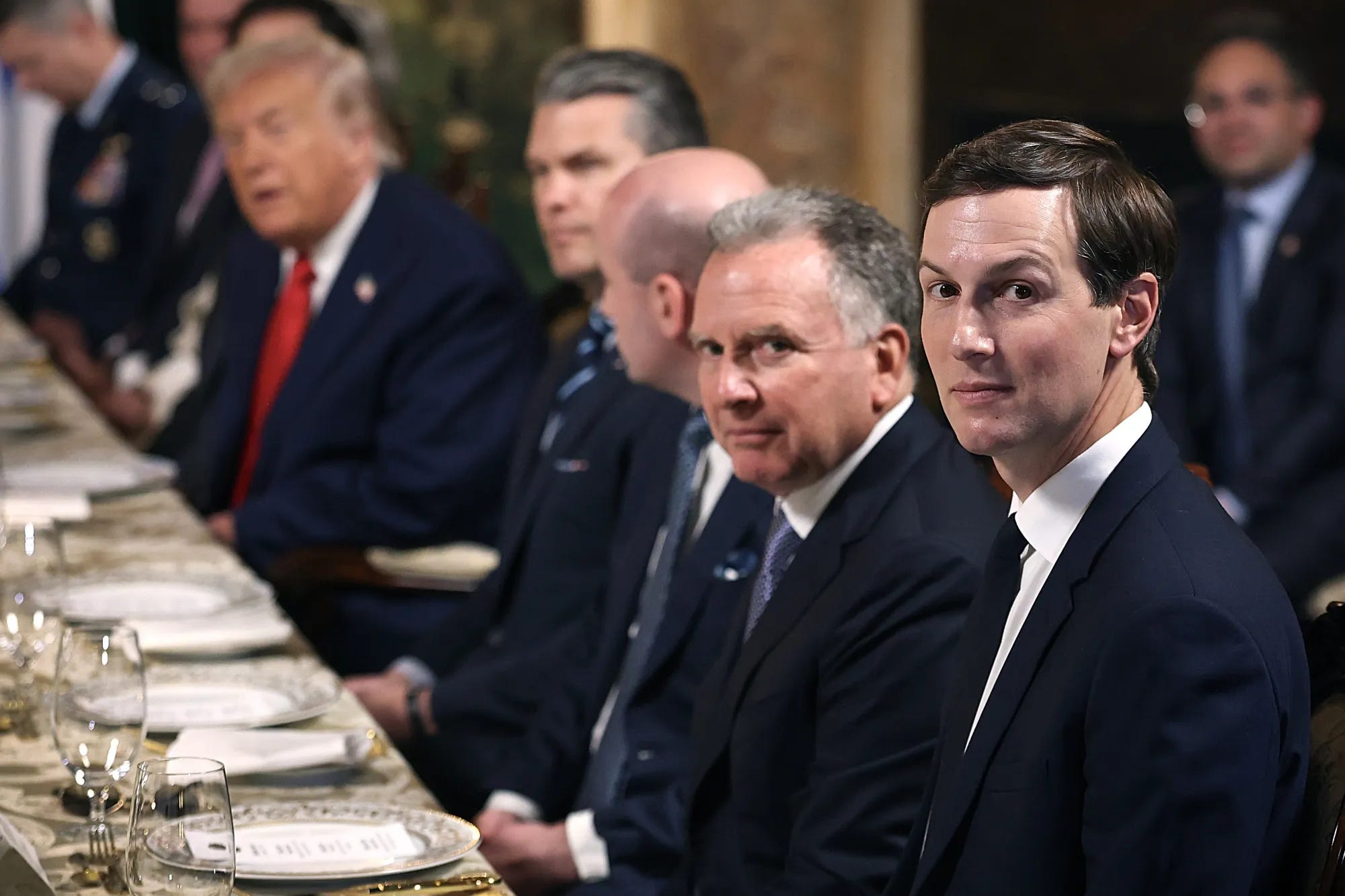
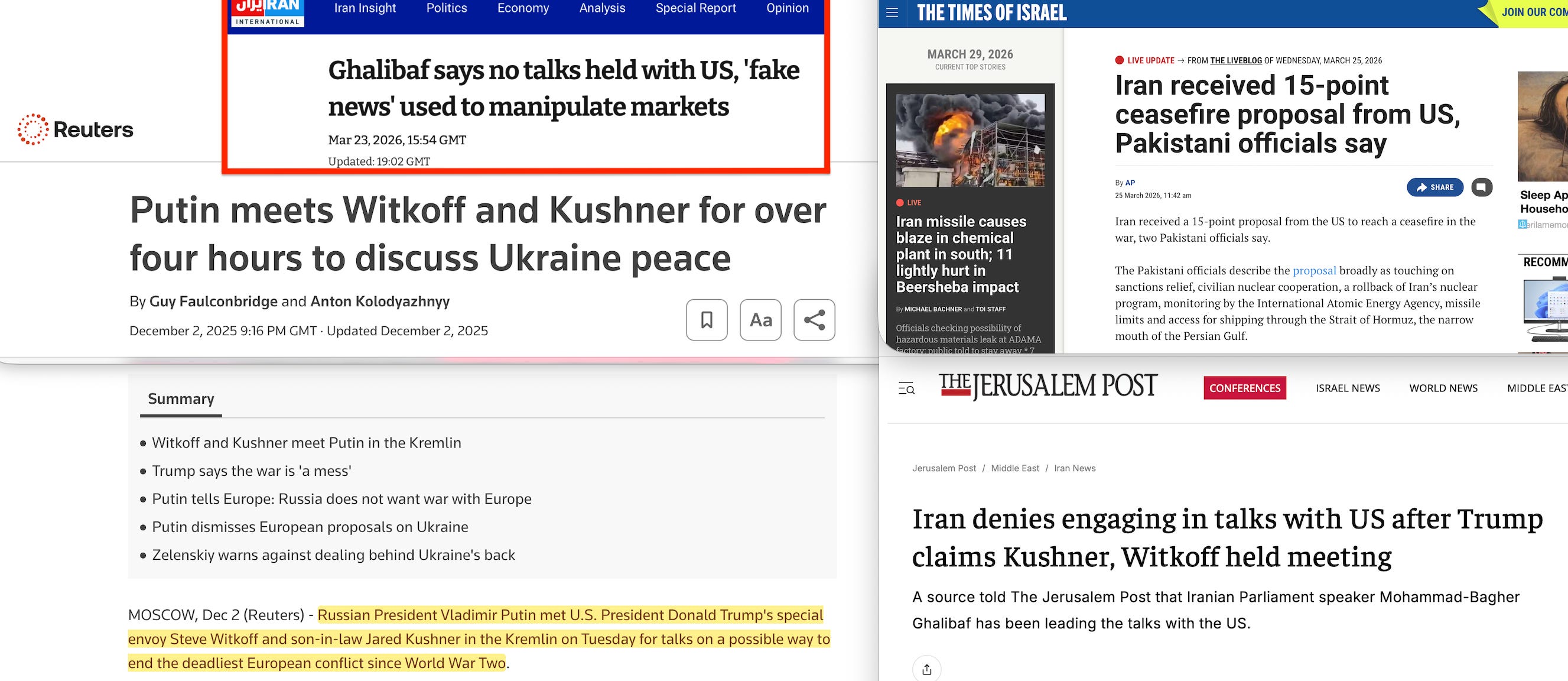
In December 2025, Steve Witkoff and Jared Kushner met Vladimir Putin at the Kremlin for approximately five hours, presenting documents outlining a phased settlement plan for Ukraine1. Later that month, Witkoff convened representatives from the US, Egypt, Qatar, and Turkey in Miami to advance Phase 2 of the Gaza ceasefire2.
On March 23, 2026, Trump claimed Kushner and Witkoff had conducted talks with senior Iranian officials regarding the terms under which Iran’s energy infrastructure might be spared3. Tehran denies the meeting took place, with Ghalibaf himself calling it ‘fake news’ designed to manipulate oil and financial markets4.
By March 25, the White House was working to arrange a meeting in Islamabad, with Pakistan having transmitted a 15-point US ceasefire proposal to Tehran and the IAEA chief confirming he expected talks that weekend5.
Three wars. Two men operating outside normal diplomatic channels, at compressed timescales, producing phased conditions rather than political agreements. Neither man is a career diplomat.
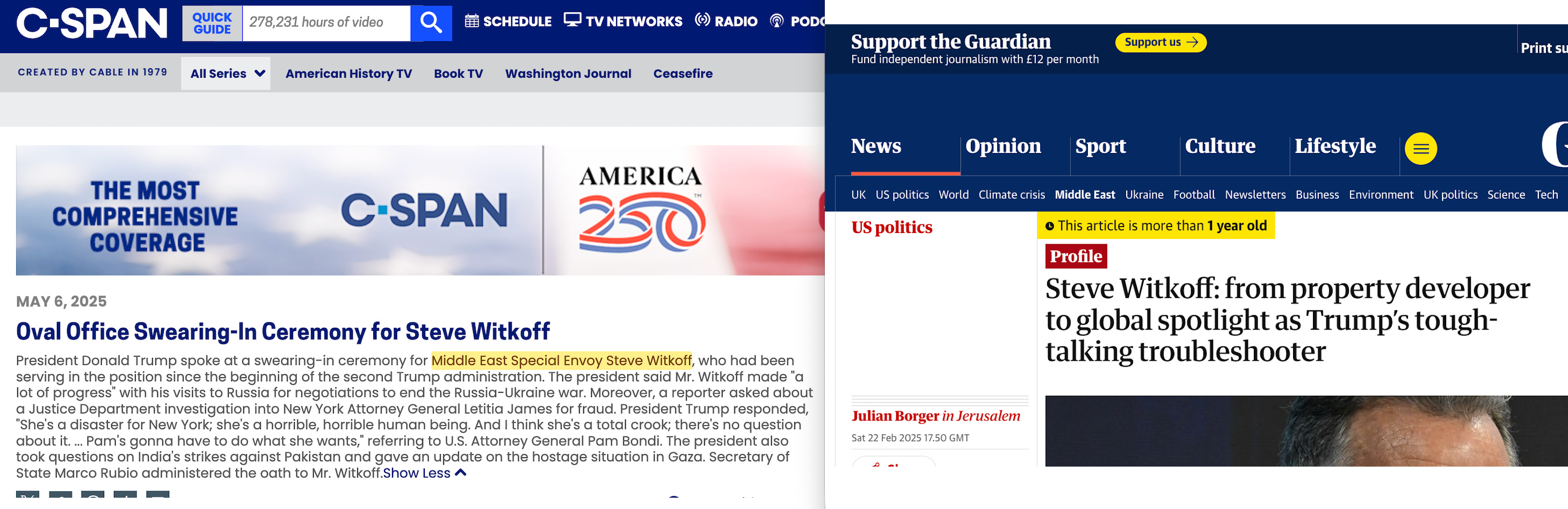
Witkoff holds the title of Special Envoy6, sworn in by Secretary Rubio, but his background is New York real estate development7 — his friendship with Donald Trump dates to 1986, when he bought the future president a sandwich at a deli8.
Kushner holds no formal title at all. He is the president’s son-in-law, a real estate investor whose family company purchased 666 Fifth Avenue for $1.8 billion and spent the better part of a decade trying to refinance it9.
Between them, they are negotiating the reconstruction of Ukraine, the governance of Gaza, and the terms under which Iran re-enters the international system.


But the question is not actually whether they are qualified. The question is what function they perform — and for whom.
In an October 2025 interview with CBS’s 60 Minutes10, Kushner and Witkoff described the function themselves — though not in those terms. They confirmed working Iran, Ukraine, and an Algeria-Morocco deal simultaneously.
Witkoff called peace ‘infectious’ and said leaders were calling the White House asking how to move deals forward. Kushner explained that Trump had delegated broad authority to negotiate — the mandate, in Kushner’s words, was simply ‘don’t make a bad deal’ — and that the two of them had been ‘freewheeling it’, merging separate ceasefire and end-of-war proposals into a single document on their own initiative, then presenting it to the president for his approval.

When asked about doing billions of dollars of business with the same Gulf governments whose representatives were involved in the peace talks, Kushner replied: ‘What people call conflicts of interest, Steve and I call experience and trusted relationships’. Witkoff agreed on camera: ‘We really do’.

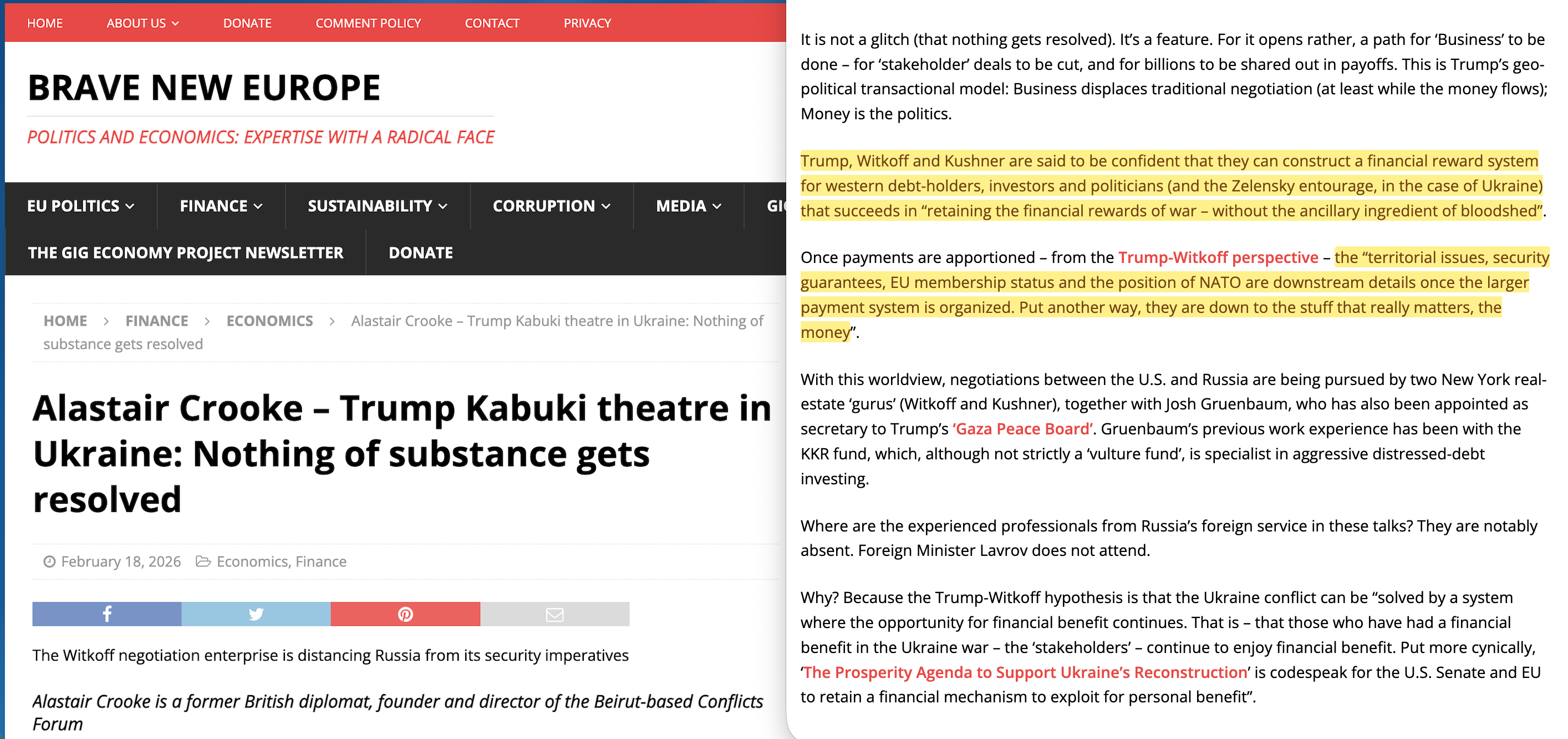
Alastair Crooke, a former British diplomat and founder of the Conflicts Forum, described the mechanism in February 202611. The failure to resolve the Ukraine conflict, he argued, is a feature — one that opens a path for business to be done, for stakeholder deals to be cut, and for billions to be shared out.
Trump, Witkoff and Kushner are said to be confident that they can construct a financial reward system for western debt-holders, investors and politicians that succeeds in retaining the financial rewards of war — without the ancillary ingredient of bloodshed.
The territorial issues, security guarantees, EU membership status, and the position of NATO are, in Crooke's framing, ‘downstream details once the larger payment system is organised’.
That sentence deserves to be read twice. The politics is downstream of the payment system, the governance is downstream of the financial architecture, and the settlement conditions are downstream of the clearing house. What Crooke is describing is not a peace process — it is the installation of a new financial system, with conflict resolution as its onboarding mechanism.
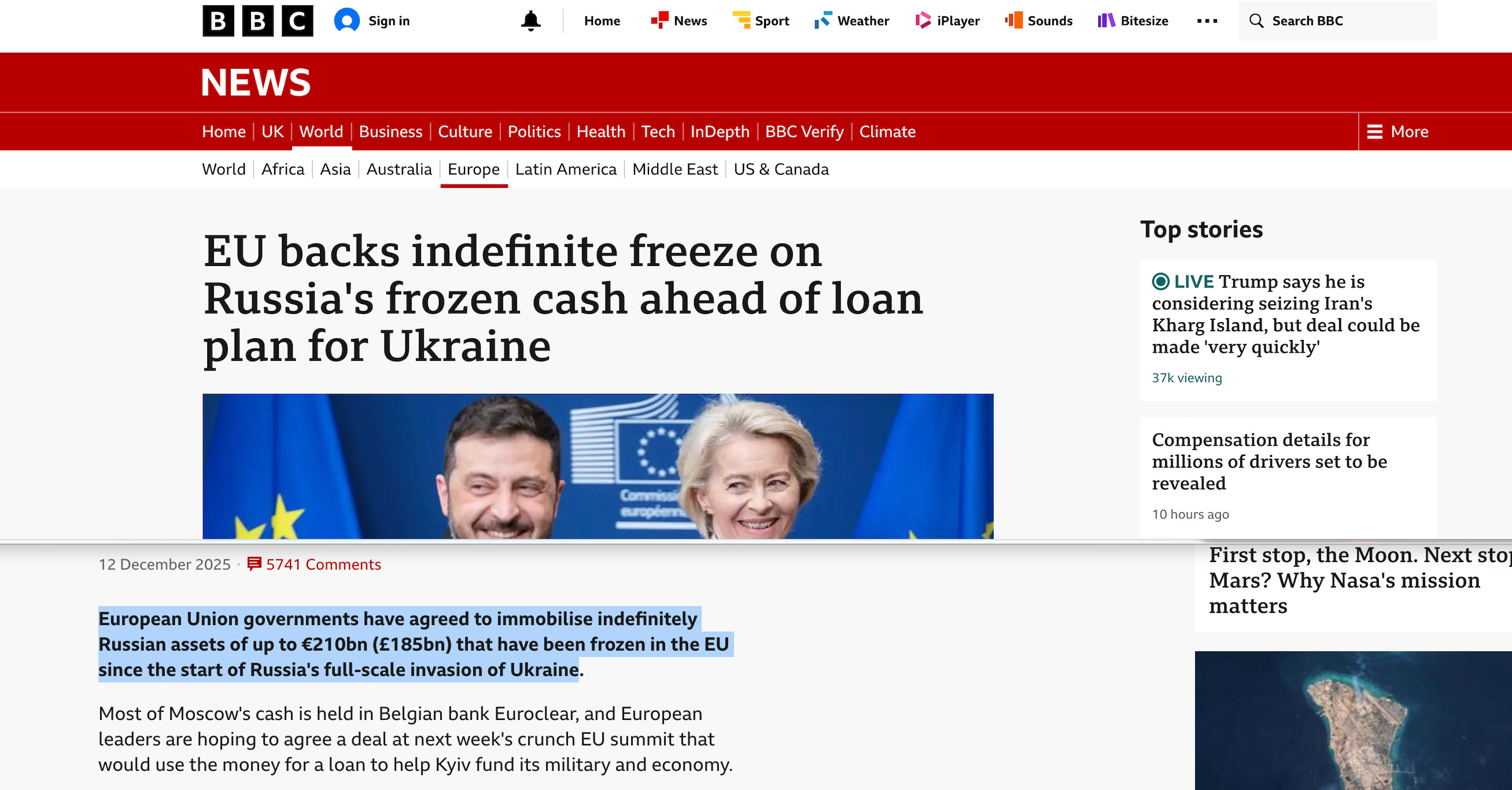
Ukraine’s sovereign dollar bonds were trading at 19 to 20 cents on the dollar in late 202412. By February 2026, they had rallied to 60 to 76 cents as diplomatic momentum built. An $800 billion reconstruction package13 — funded through the World Bank, the EU, the IMF, and private capital — awaits a settlement14. The creditors of Ukraine, the interests of BlackRock and KKR, and the advisory networks linked to Rothschild & Co15 all stand to benefit from a deal that converts wartime destruction into conditional reconstruction on terms the creditors helped define.
The Kremlin now describes the Ukraine peace talks as being on a ‘situational pause’1617 — frozen since the Iran war began on February 28. Izvestia, citing Russian officials, reported that the Middle East conflict could push Kyiv towards compromise1819. Zelenskyy has said that negotiations are being ‘constantly postponed’ and that the Iran war ‘bolsters Russia’s confidence’20.
US officials have reportedly warned the Ukrainian delegation that Washington could step back from mediation efforts if no progress is achieved, prioritising military operations against Iran instead21.
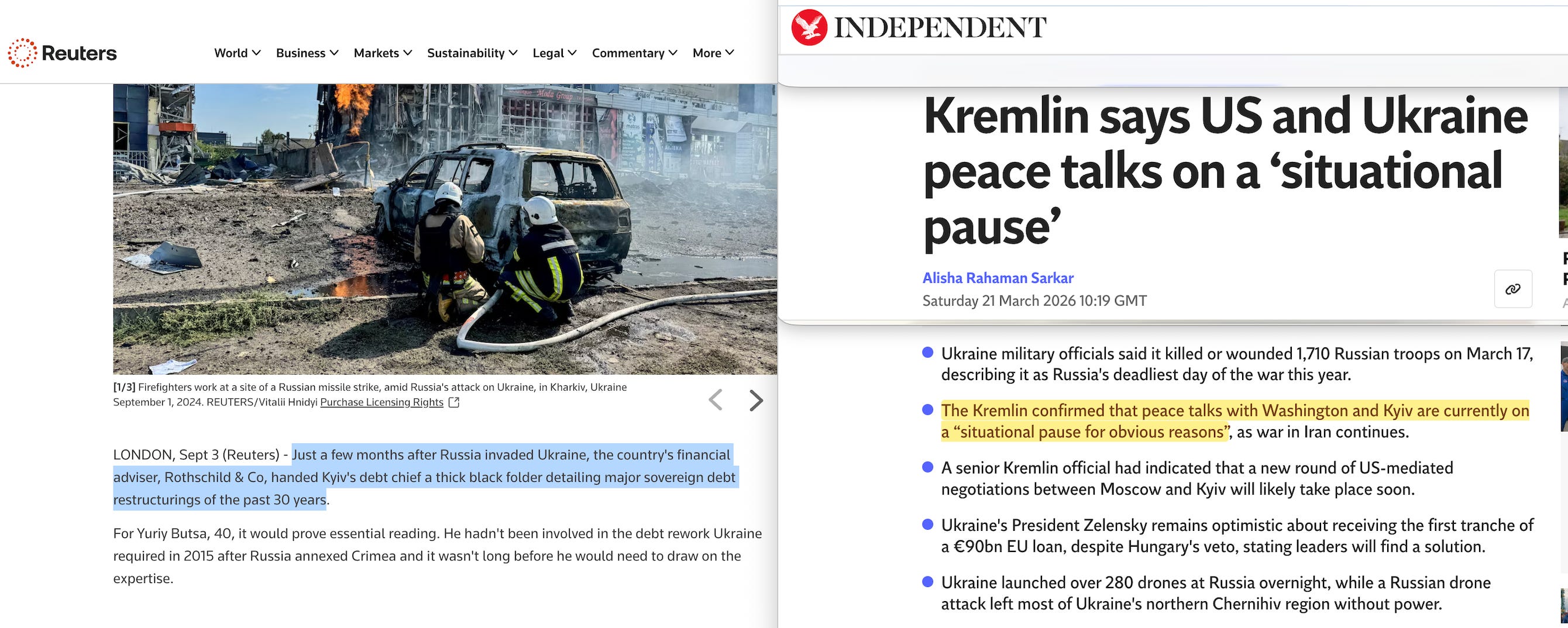
Nothing of substance gets resolved, and the non-resolution is the feature. Territorial issues remain deferred while the new financial architecture assembles underneath. The €90 billion EU loan agreed in December 202522, conditioned on rule of law, anti-corruption23 and green and digital standards24, is preparing to disburse25.
The €50 billion Ukraine Facility, requiring progressive alignment with EU rules, continues operating26. EU accession — the exit condition — advances regardless of whether the war carries on27.
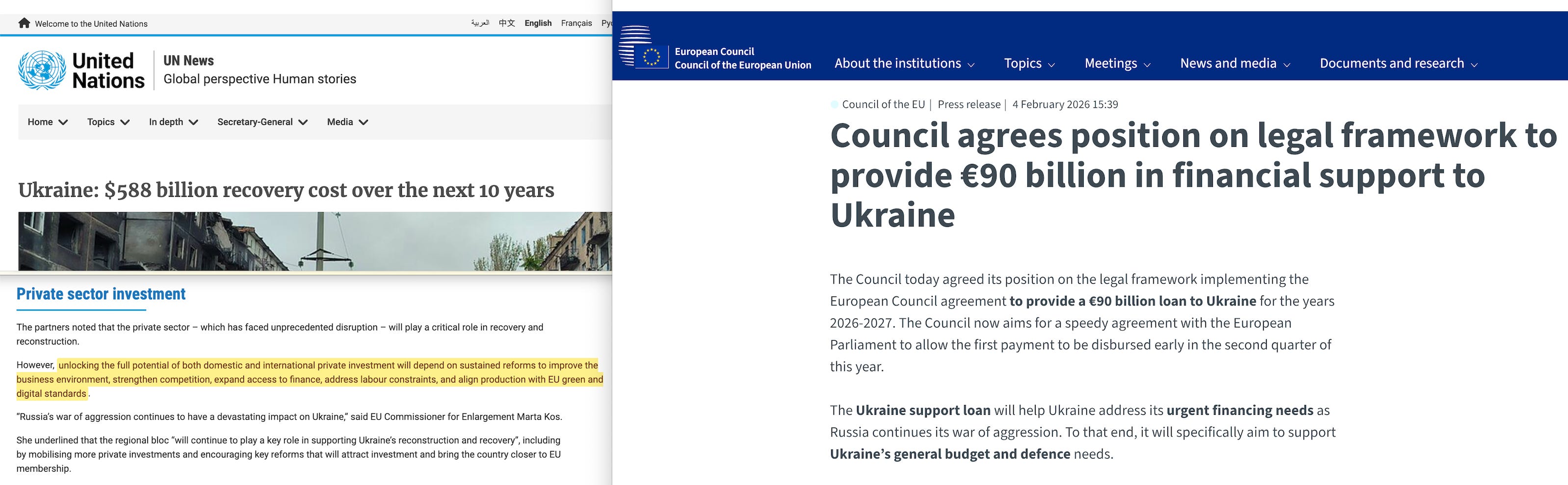
The scale of the resulting indebtedness amounts to a permanent transfer of sovereign discretion. The World Bank’s RDNA5 assessment puts Ukraine’s total reconstruction needs at $588 billion28 — nearly three times the country’s projected GDP. The €90 billion EU loan is structured so that Ukraine repays ‘only once reparations are received’ from Russia29 — which has no intention of paying. Until then, immobilised Russian assets serve as the backstop, and the EU reserves the right to seize them to cover the debt30. The loan is therefore either repaid by a defeated Russia or it is never repaid at all — in which case the conditionality attached to it has already been installed permanently, at no cost to the creditor.
This is the mechanism at its most refined. The debt doesn’t need to be repaid to serve its function — the conditions attached to it are the real product, and the money is just the delivery mechanism. Once Ukraine adopts the required digital systems, procurement rules, regulatory standards, and accreditation frameworks, those don’t disappear when the loan matures. They stay permanently.
The borrower doesn’t just owe money. It owes compliance.

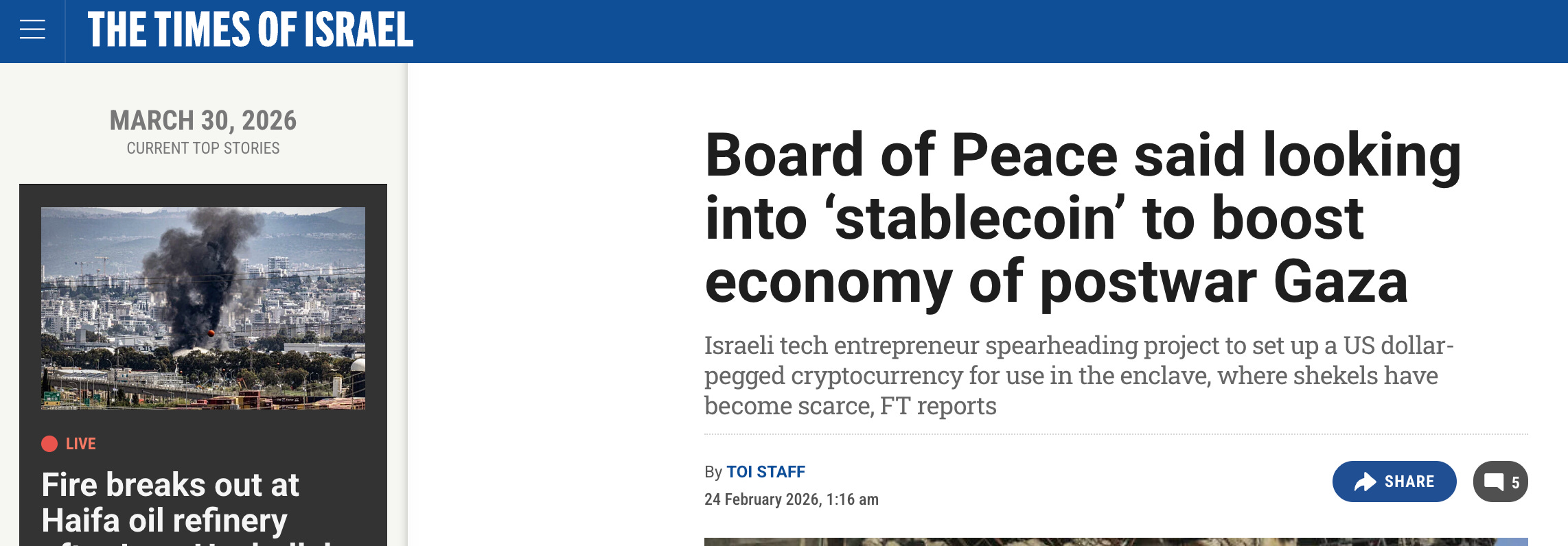
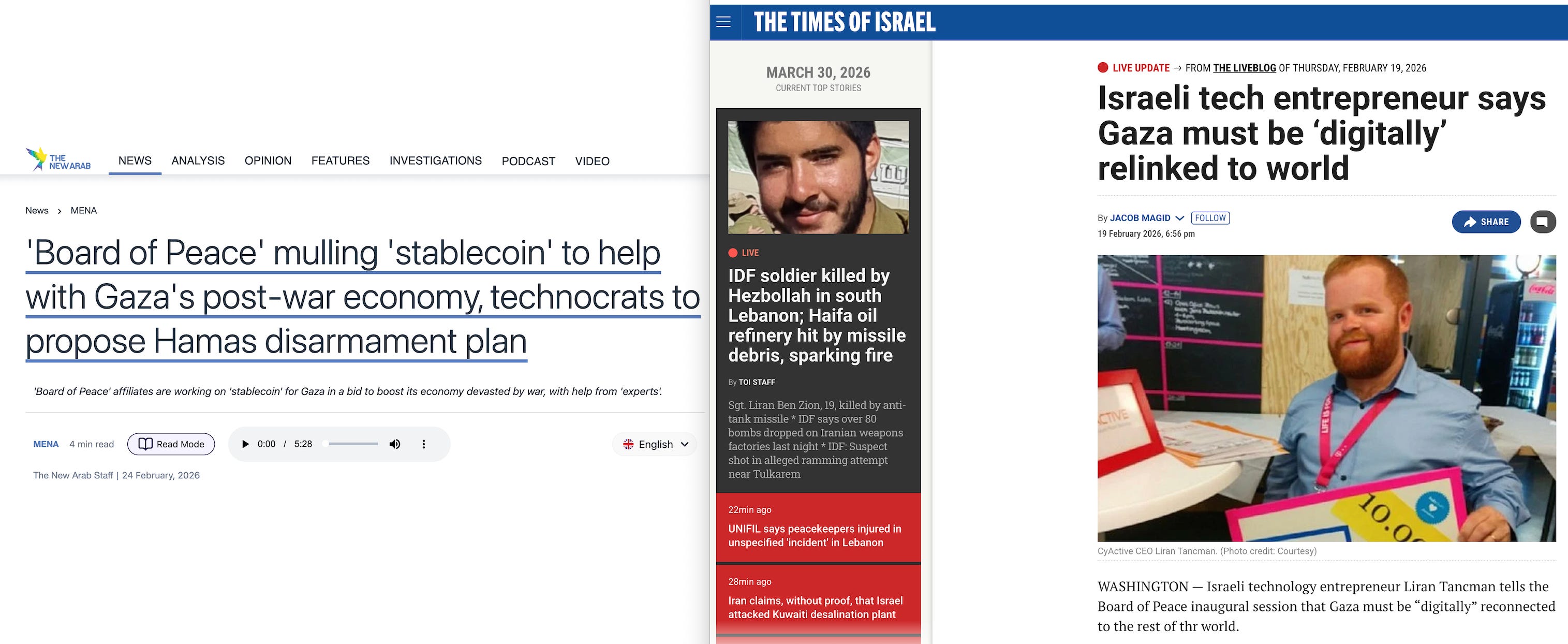
The same pattern is taking shape in Gaza, though the instrument is dependency rather than debt. Gaza’s economy contracted by 83 per cent in 2024, with cumulative GDP losses of 87 per cent over the 2023–2024 period31. The territory has no ability to borrow, no functioning financial system, and no independent way to raise revenue. Every dollar arrives through the GRAD fund, directed by the Board of Peace32, and plans are already underway to settle transactions through digital wallets and a dollar-backed stablecoin that the population had no part in choosing33.
Gaza does not take on debt in the traditional sense — it takes on something worse: permanent dependency on a system that decides what gets funded, on what terms, with no structural way out.
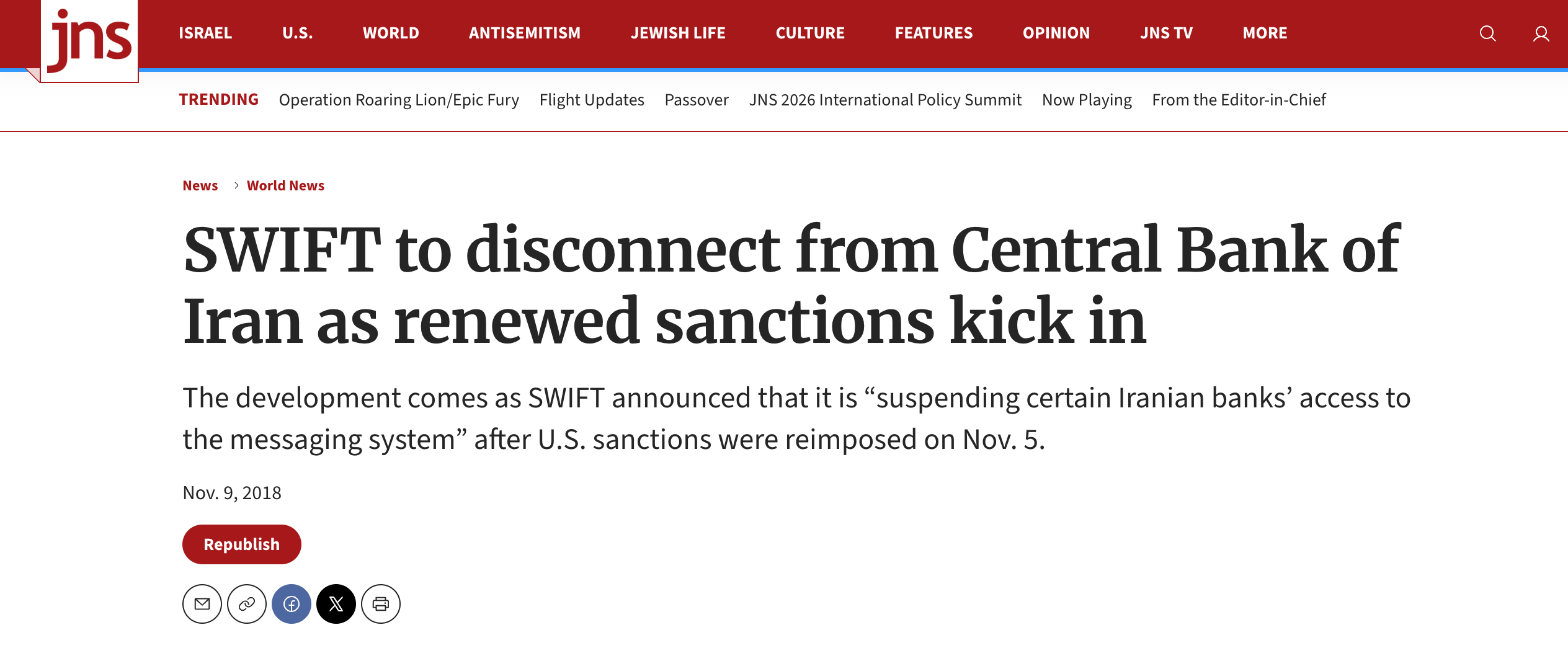
In Iran, the central bank is cut off from SWIFT34, the rial has lost value since February 28, and the country cannot access its own reserves or settle internationally. When the war ends, Iran will need outside money to rebuild — and that money will come with conditions. The energy infrastructure is being destroyed physically while the financial infrastructure is being destroyed through isolation, and both lead to the same outcome: a country that has to accept external terms to rebuild, because it has no capacity left to do it alone.
In all three cases, the mechanism is the same. Destroy the country’s ability to finance itself. Offer reconstruction money conditioned on adopting the new standards. Embed those standards in infrastructure that outlasts the funding.
The debt is the onramp, but the architecture is permanent.
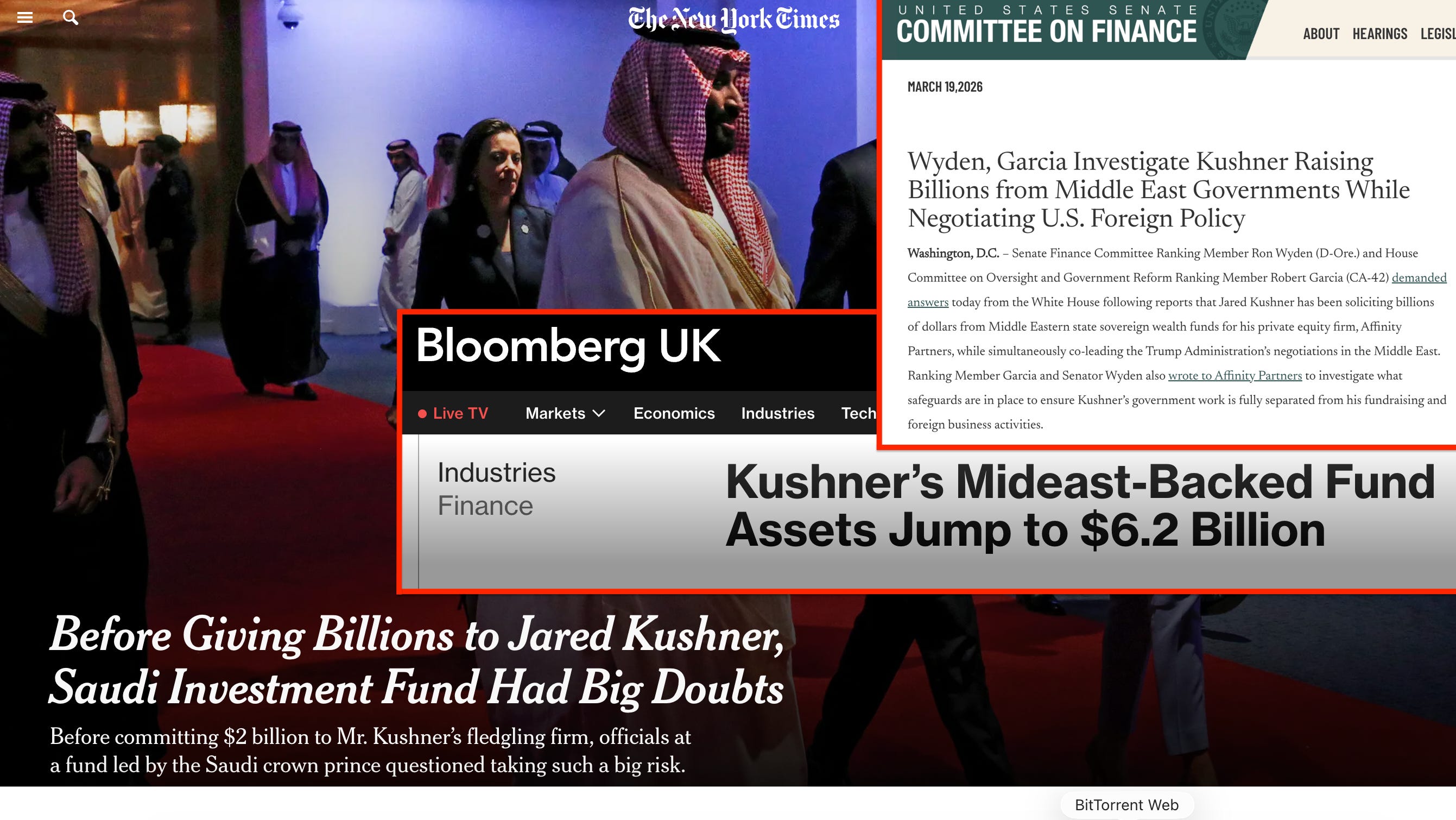
Kushner’s financial position is a matter of public record. His private equity firm, Affinity Partners, held $6.2 billion in assets at the end of 202535 — a 30 per cent increase over the prior year — with 99 per cent of the capital coming from non-US sources, largely government-backed funds across the Middle East.
The fund’s biggest backer is Saudi Arabia’s Public Investment Fund, which committed $2 billion shortly after Kushner left the White House in 202136.
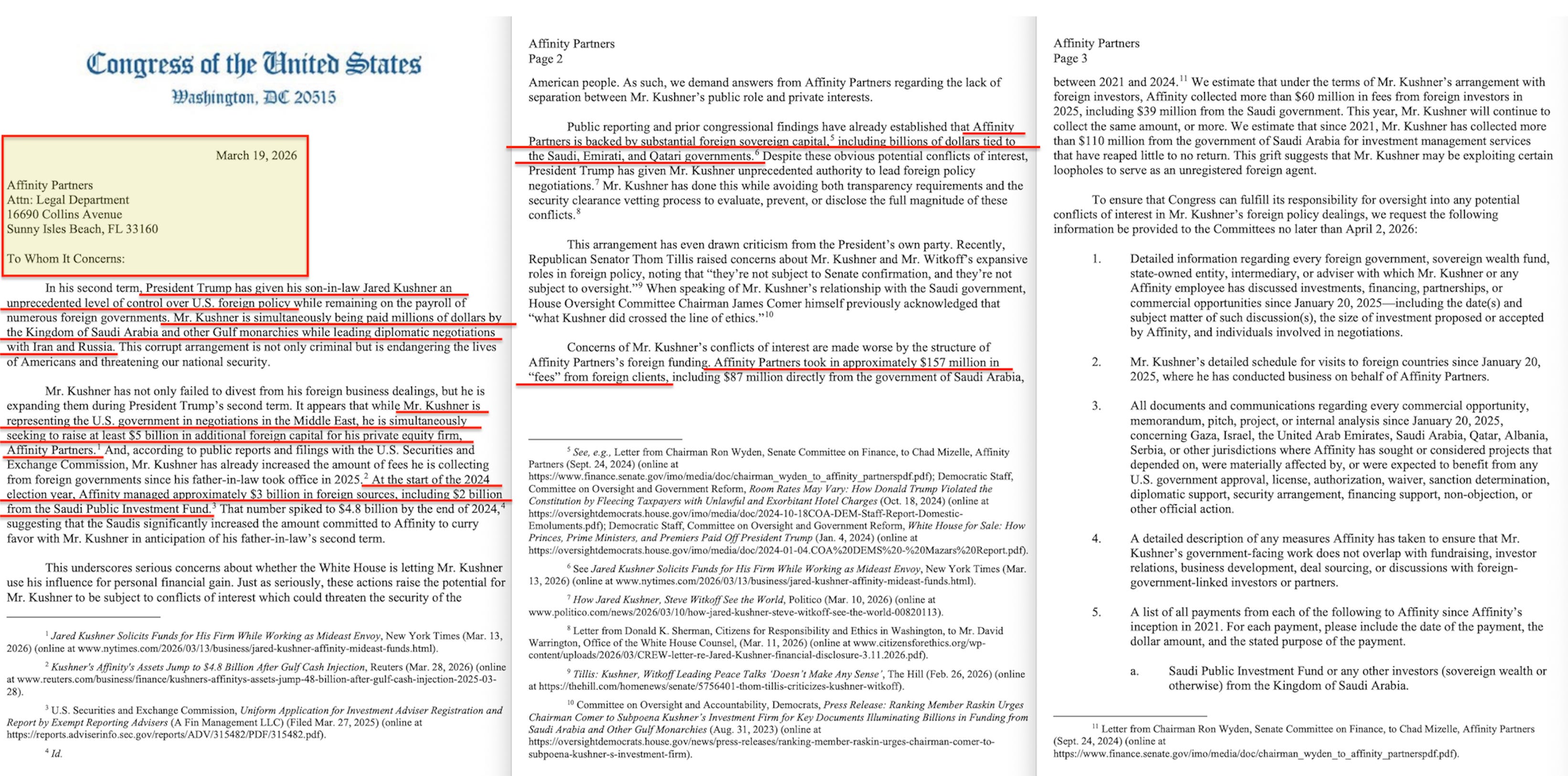
In March 2026, Representative Robert Garcia and Senator Ron Wyden sent letters to the White House seeking information on Kushner’s business dealings37, citing reports that Affinity Partners was soliciting billions from the same governments whose representatives were involved in the peace talks Kushner was conducting.
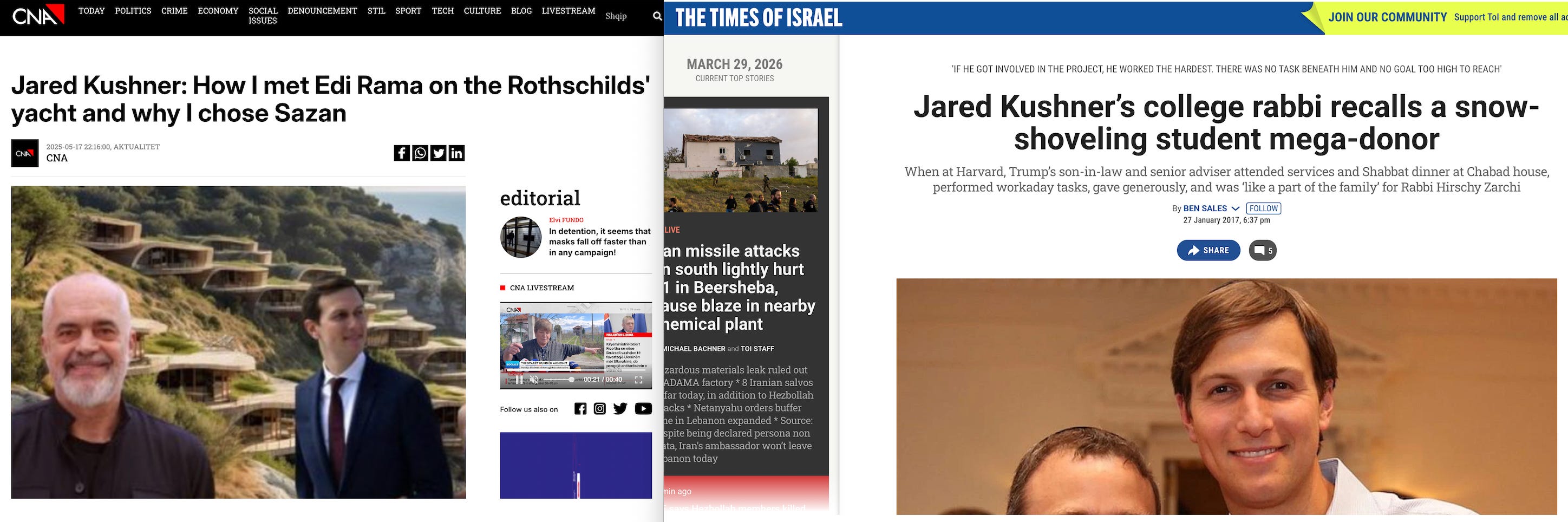
Kushner met Albanian Prime Minister Edi Rama on what he publicly described as ‘our friend Matt Rothschild’s boat’ in the summer of 202138, sailing from Montenegro to Corfu — a social connection stated on the record in Kushner’s own words at the Future Investment Initiative Forum39.
At Harvard, he was a regular at the campus Chabad house led by Hirschy Zarchi40; his family foundation donated $342,500 to Chabad-affiliated institutions, including $150,000 to Chabad at Harvard alone41. His father, Charles Kushner — convicted of eighteen felonies in 2005, pardoned by Trump in 202042 — has maintained a longstanding personal relationship with Benjamin Netanyahu43.
Kushner and Witkoff set the terms for reconstruction in all three conflicts — while Kushner’s own fund, backed by the same Gulf governments sitting across the table, stands ready to profit from the rebuild.
The people writing the rules have money riding on the outcome.
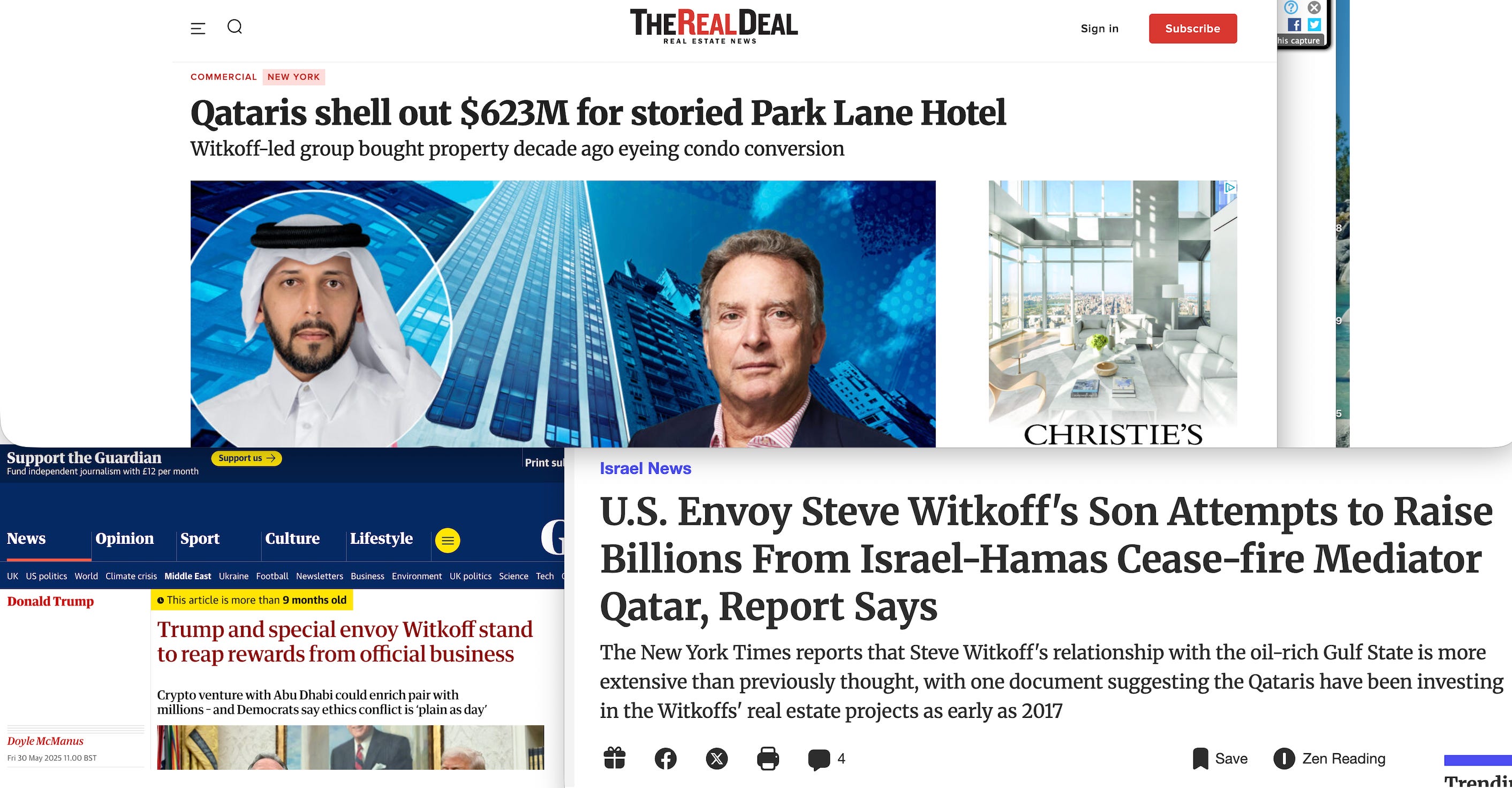
Witkoff’s network runs through different channels but ends up in the same place. His business ties to Gulf sovereign wealth funds go back over a decade44 — in 2023, Qatar’s sovereign wealth fund bought his troubled Park Lane Hotel for $623 million45, allowing him to exit a heavily indebted investment46, and both the Abu Dhabi and Qatari sovereign wealth funds have invested in Witkoff Group properties47. After his appointment as special envoy, his son Alexander took over the Witkoff Group48 and continued seeking billions from the same governments whose representatives were sitting across the table from his father in peace talks49.
A New York Times investigation found the relationships overlapped extensively — father and son knew the same people, travelled together, and had spent years building Gulf investment relationships. Gulf governments invested in Witkoff properties partly to build ties with a family they saw as politically connected50.
Witkoff sold his stake in the company for $120 million to address potential conflicts of interest, though the sale wasn’t finalised until months after he had already begun negotiating51.
His other connections go further. One of his known business partners is Len Blavatnik, the Ukrainian-born, Russian-raised billionaire who made his fortune during the 1990s Russian privatisations, particularly in energy and aluminium52 — and who is close to sanctioned oligarch Viktor Vekselberg53.
Witkoff’s sons co-founded World Liberty Financial, a cryptocurrency venture with the Trump family54, backed by $75 million from TRON founder Justin Sun, who was under SEC investigation at the time of investment55.
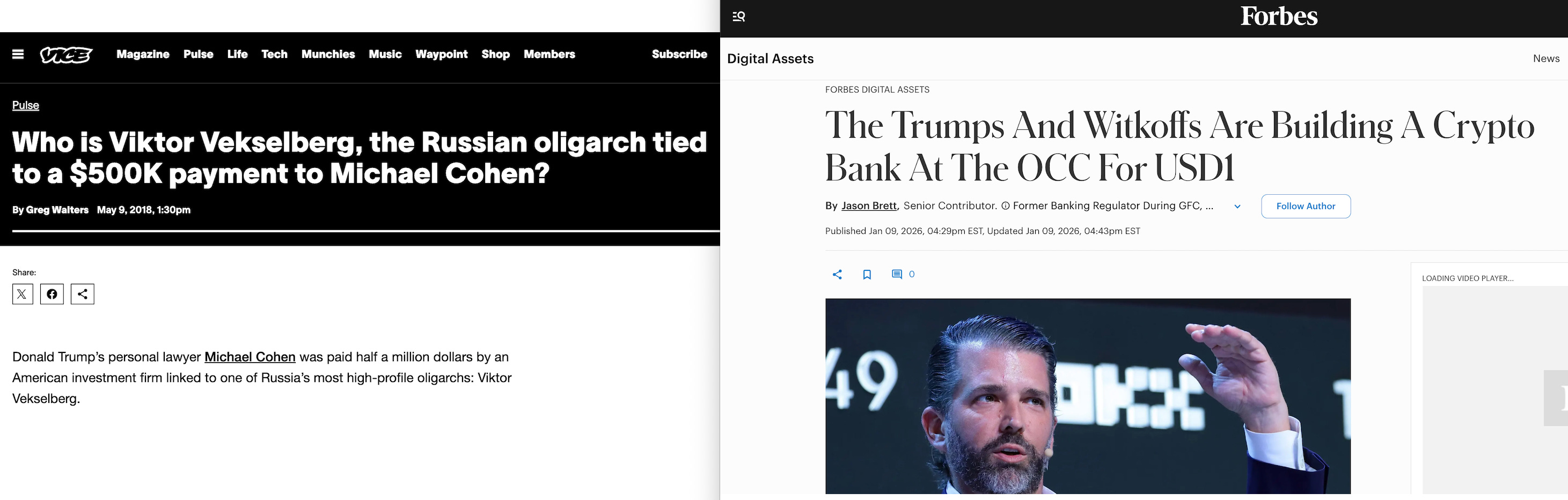
The two halves of the operator cell cover different networks. Kushner connects to Gulf sovereign capital, the Rothschild social network, Chabad institutional infrastructure, and Israeli political relationships through his father. Witkoff connects to Gulf sovereign capital through a different route, Russian-adjacent oligarch networks through Blavatnik, and Trump’s personal orbit through four decades of friendship and a cryptocurrency partnership with the president’s sons.
The diversity is not accidental. The nineteenth-century Rothschild agent network, documented in Rainer Liedtke’s 2016 study of the Rothschild Archive56, deliberately recruited agents from diverse backgrounds precisely to expand the network’s reach into institutions and social circles that a uniform group could not access. Agents sent to locations where they had no prior ties were valuable because their outsider status meant their primary loyalty remained with the principals back home, not with local power structures.
The diversity of the network was a design feature.

Kushner and Witkoff are not Rothschild agents in Liedtke’s nineteenth-century sense. But they perform the same structural function that Liedtke documented: positioned at the interface between sovereign governments and financial interests, carrying intelligence in both directions, compensated through access to deal flow rather than salary, and operating outside the formal institutional architecture while being operationally essential to it.
Witkoff confirmed the access model on 60 Minutes: ‘We were not talking to junior people or lieutenants over there. We were talking directly to the people who make the final decisions’. He named them — Sheikh Mohammed in Qatar, MBZ in the Emirates, MBS in Saudi Arabia, Erdogan’s foreign minister, Netanyahu — and said the ability to ‘get him on the phone immediately’ was what made the difference.

Liedtke documented one recurring weakness in the system: the agent who learns enough to become a threat to the people above him.
August Belmont, sent to New York as a Rothschild agent, declared himself the family’s man on Wall Street without permission — and couldn’t be removed because the distance made control impossible. In the nineteenth century, the fix was exile. The Epstein documents — over six million pages — suggest a twenty-first-century version: a man whose network reached into Israeli intelligence, British royalty, American treasury secretaries, and Silicon Valley, moving between all of them while maintaining the kind of diverse, cross-cutting access Liedtke describes.
When Epstein was denied his fee and began assembling leverage material against people above him in the network, the fix was not exile.


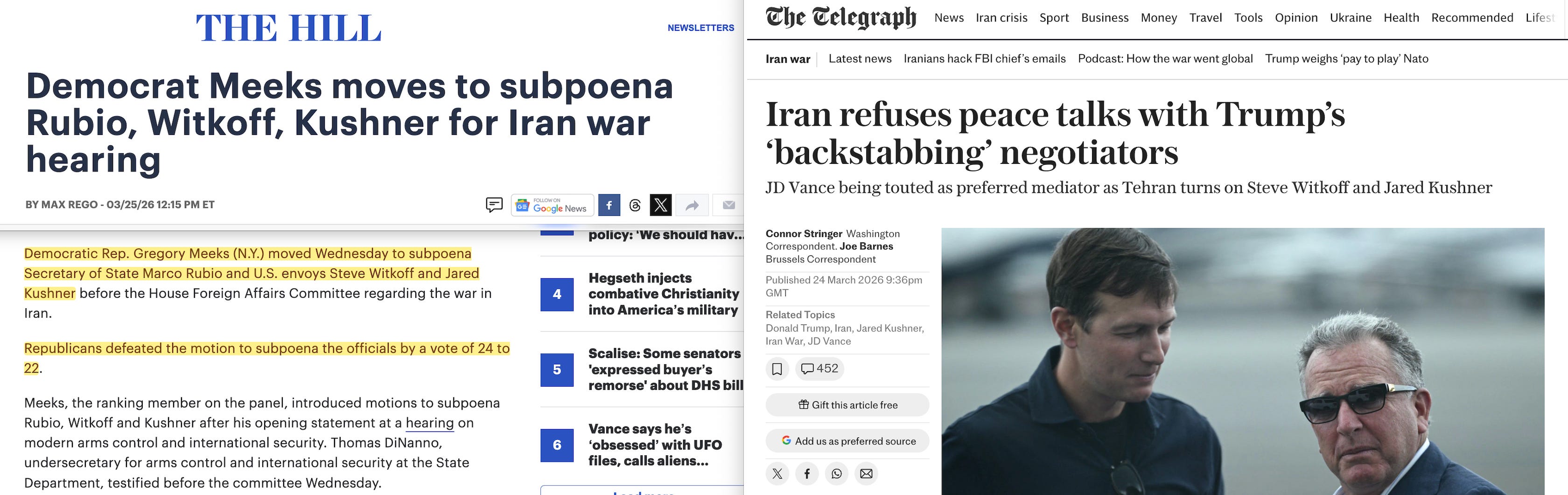
By March 2026, the operator cell itself appears to be triggering the same pattern. Iran has explicitly refused to continue negotiating with Witkoff and Kushner, demanding Vice President Vance be sent instead57. Tehran says it feels ‘stabbed in the back’ by the two men — a government publicly naming the negotiators and demanding to bypass them58. The Oman Foreign Minister said active negotiations were undermined59. Diplomats said Witkoff misrepresented the key exchange6061.
Speaking to American media after the Geneva talks collapsed, Foreign Minister Araghchi gave his account directly: ‘On the 26th of February when we met in Geneva, we were able to make good progress, as the Omani Foreign Minister said — it was significant progress’62. On the specific claim that he had boasted about building nuclear bombs, Araghchi was blunt6364:
I never said that we are going to make bombs. I said that we have 440 kilos of 60 per cent enriched material, and that was not a secret — that is what is mentioned in the reports of the IAEA. I said that this, if enriched more, can be good enough for ten bombs, as your own experts claim — so we are ready to give them up and give them away.
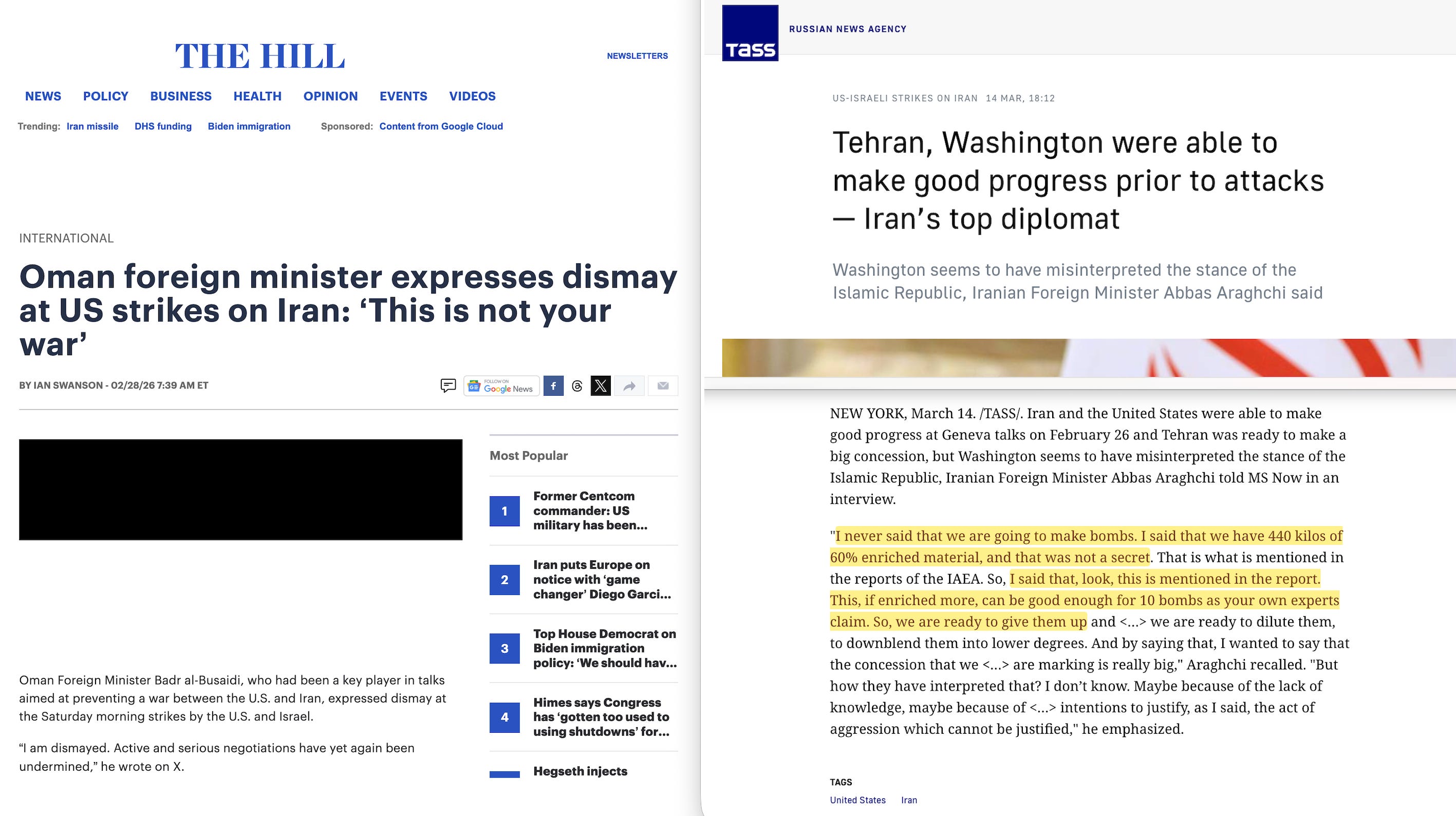
He blamed Witkoff’s misreading to ‘the lack of enough knowledge — maybe because of their intentions to justify the act which cannot be justified’. An Arms Control Association analysis of Witkoff’s briefings confirmed the picture — he had confused reactor fuel assemblies with enrichable uranium gas and treated the Tehran Research Reactor, which produces medical isotopes under IAEA tracking, as a weapons threat.
The negotiator perhaps did not understand what he was negotiating. But the function doesn’t require understanding. It only requires the authority to draft terms and the access to carry them between the parties — and on 60 Minutes, both men confirmed they had been given both without restriction.
Responsible Statecraft pointed out that the United States has now attacked Iran during negotiations twice — in June 2025 and February 2026 — and that Russia may now fear any guarantees from Washington will be ‘as empty as those verbal promises offered to Iran’65.
The operator cell is becoming distrusted by every party it is meant to mediate between — which is exactly the weakness Liedtke documented: the agent whose exposure starts to undermine the job he was sent to do.
The historical parallel is precise. Gerson von Bleichröder — whose family bank functioned as a branch office of the Rothschild banking house — served as Bismarck’s personal financial agent66, managed his portfolio, bribed officials on his behalf, financed wars while bypassing parliament, and acted as go-between for European finance and the Prussian state. After the Franco-Prussian War of 1870–7167, Bleichröder was sent to Versailles to advise on the terms of the war payment imposed on France68. He recommended four billion francs; the final figure was five billion — roughly a quarter of French GDP. He then handled the processing of those payments on the German side, while Alphonse de Rothschild led the French group that raised the bonds to pay69.
The Rothschild network profited from both ends of a five-billion-franc transaction that reshaped the European balance of power.
The humiliation of those terms drove France’s demands at the Paris Peace Conference of 191970. The resulting reparations wrecked the German economy and created the reason for the Bank for International Settlements in 1930 — an international settlement house in a neutral country, processing payments between governments.

The agent who processed the 1871 settlement — positioned between finance and the state, negotiating terms that produced both a financial windfall and an institutional precedent — set off consequences that took six decades to fully arrive. The BIS exists because Bleichröder processed the reparations that produced the resentment that produced the next war that produced the institution.
France paid off the debt ahead of schedule. It made no difference. The financial obligation was temporary. The architecture it eventually justified is permanent. Ukraine’s €90 billion loan, Gaza’s conditional aid system, and Iran’s forthcoming need for outside money are denominated in different currencies and compressed into a faster timeline, but the mechanism has not changed.
Whether the debt is repaid or not, the infrastructure installed remains either way.

Crooke noted one further detail. In 2003, Mikhail Khodorkovsky, then head of the Russian oil giant Yukos, appointed Lord Jacob Rothschild as the ‘guarantor’ of his controlling stake in the company71 — before Putin dismantled Yukos and imprisoned Khodorkovsky. The Rothschild network has a documented, unresolved grievance with Putin over Russian energy assets — the connection to Ukraine is not merely social.
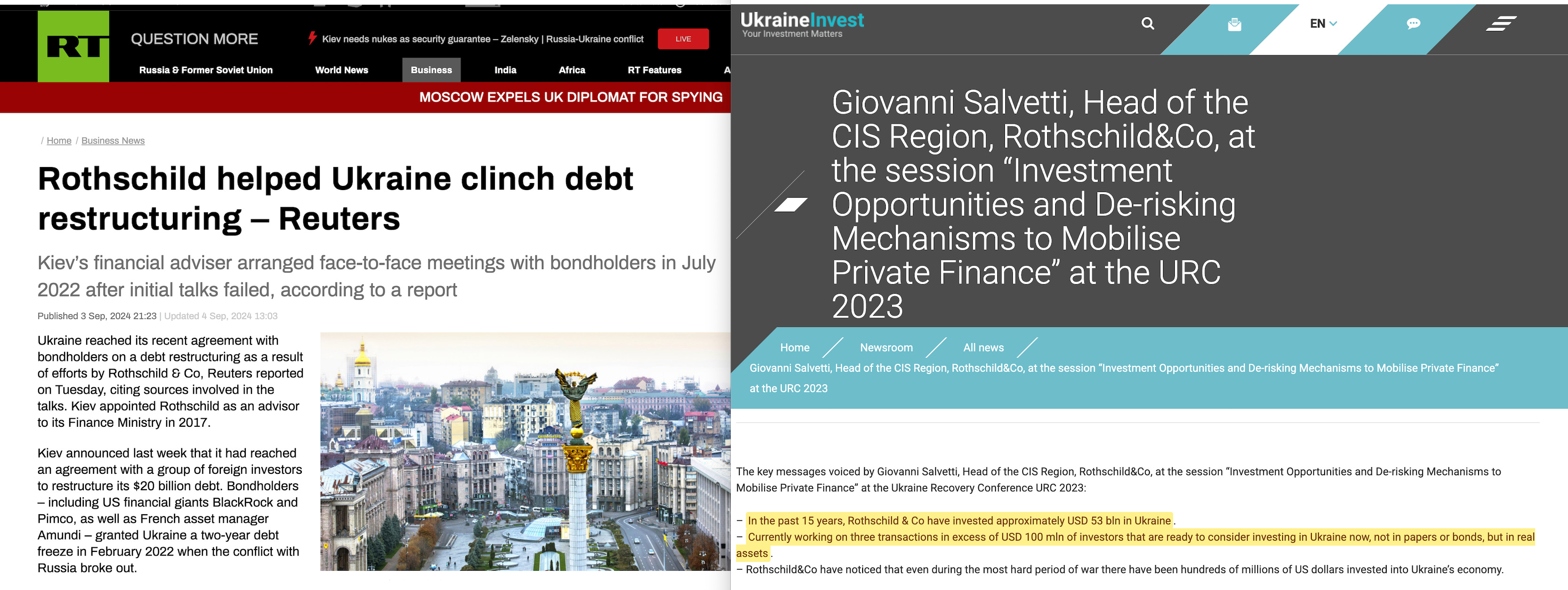
In September 2017, Ukraine appointed Rothschild & Co as adviser to its finance ministry for debt restructuring7273 — an advisory relationship that was already five years old when the full-scale invasion began. At the Ukraine Recovery Conference in 2023, Giovanni Salvetti, head of the firm’s CIS region, stated that Rothschild & Co had invested approximately $53 billion in Ukraine74 over the previous fifteen years and was working on three deals exceeding $100 million each for investors ready to put money into ‘real assets, not papers or bonds’. Even during the worst phase of the war, hundreds of millions of dollars kept flowing in.
Rothschild & Co is not positioning itself to benefit from the reconstruction. It has been building the position for over a decade — and the sovereign bonds now rallying from 19 cents to 76 cents on peace speculation are managed by the same advisory network that has been advising the finance ministry since before the first Russian tank crossed the border.
The architecture does not require that Witkoff has heard of Bleichröder, or that Kushner has read the Rothschild Archive. It only requires that each person does what the structure assigns — negotiating the terms, positioning the capital, processing the settlement — and that the terms are integrated with whatever governs the rebuild.
When Robert McNamara moved from the Pentagon to the World Bank, he brought with him the same system he had used to run the military — conditional funding structured as measurable targets, with money released only when conditions were met. He did not need to know the history of the method to apply it.
The operator cell performs the same function at the speed of crisis. The terms become the architecture, the architecture becomes the governance, and the governance persists long after the negotiators have moved on to the next conflict, the next reconstruction — the next deal on the next boat.

The documented record across all three conflicts shows a pattern that is hard to explain as coincidence. In each case, a resolution that would have kept the territory's own systems intact was available — and in each case, the operator cell replaced it with conditions that install the clearing house.
In Iran, Oman’s Foreign Minister announced on February 27 that a ‘breakthrough’ had been reached — Iran had offered to downgrade its uranium stockpile and accept full IAEA verification75. Talks were expected to resume on March 2. The strikes were launched on February 28.
According to Responsible Statecraft, Witkoff and Kushner told the White House on the eve of the operation that Iran was ‘simply using talks to buy time’76 — a conclusion that factored into Trump’s decision to greenlight the strikes.
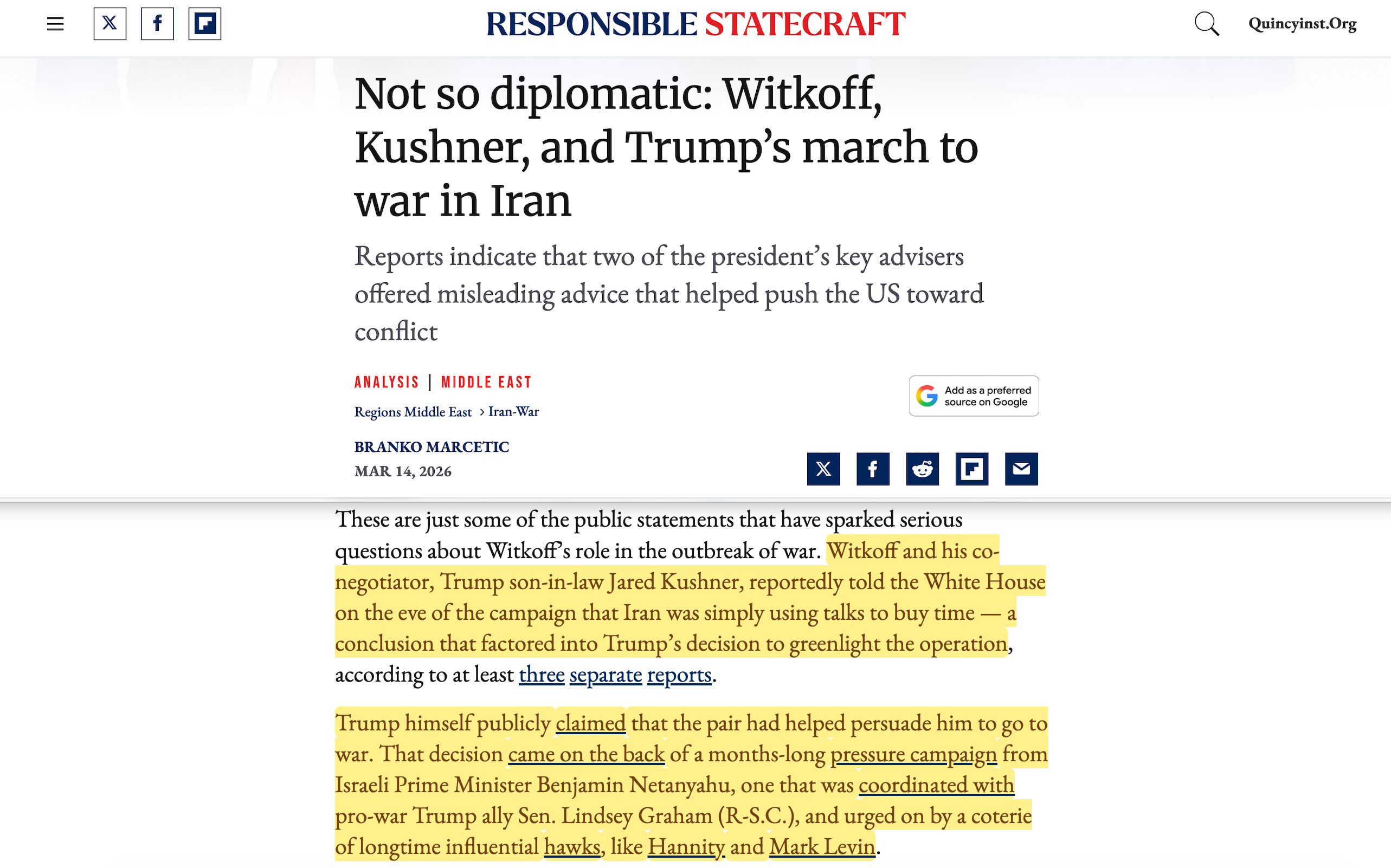
Third parties present at the negotiations said Witkoff’s account of the talks was wrong, and the Oman Foreign Minister flew urgently to Washington to tell the White House that ‘active and serious negotiations’ had been undermined77.
The operator cell did not merely fail to prevent the war. It reportedly provided the justification for it — mischaracterising significant progress as a stalling tactic, and converting a diplomatic opening into a military one.
By March 25, Iran had formally rejected the US 15-point ceasefire plan and issued a five-point counterproposal demanding war reparations78, guarantees against future attacks, and recognition of Iranian sovereignty over the Strait of Hormuz. Foreign Minister Abbas Araghchi said Iran does not want a ceasefire79 — it wants the war to end ‘on our own terms’. Iranian military officials mocked Washington’s diplomatic efforts, asking whether the US had reached ‘the stage of negotiating with yourself’80.
Meanwhile, between two and three thousand paratroopers from the 82nd Airborne Division received deployment orders for the Middle East81, bringing potential US ground forces near Iran to between six and eight thousand — while CENTCOM announced that US forces had struck over ten thousand targets and destroyed 92 per cent of the Iranian navy’s largest vessels82.
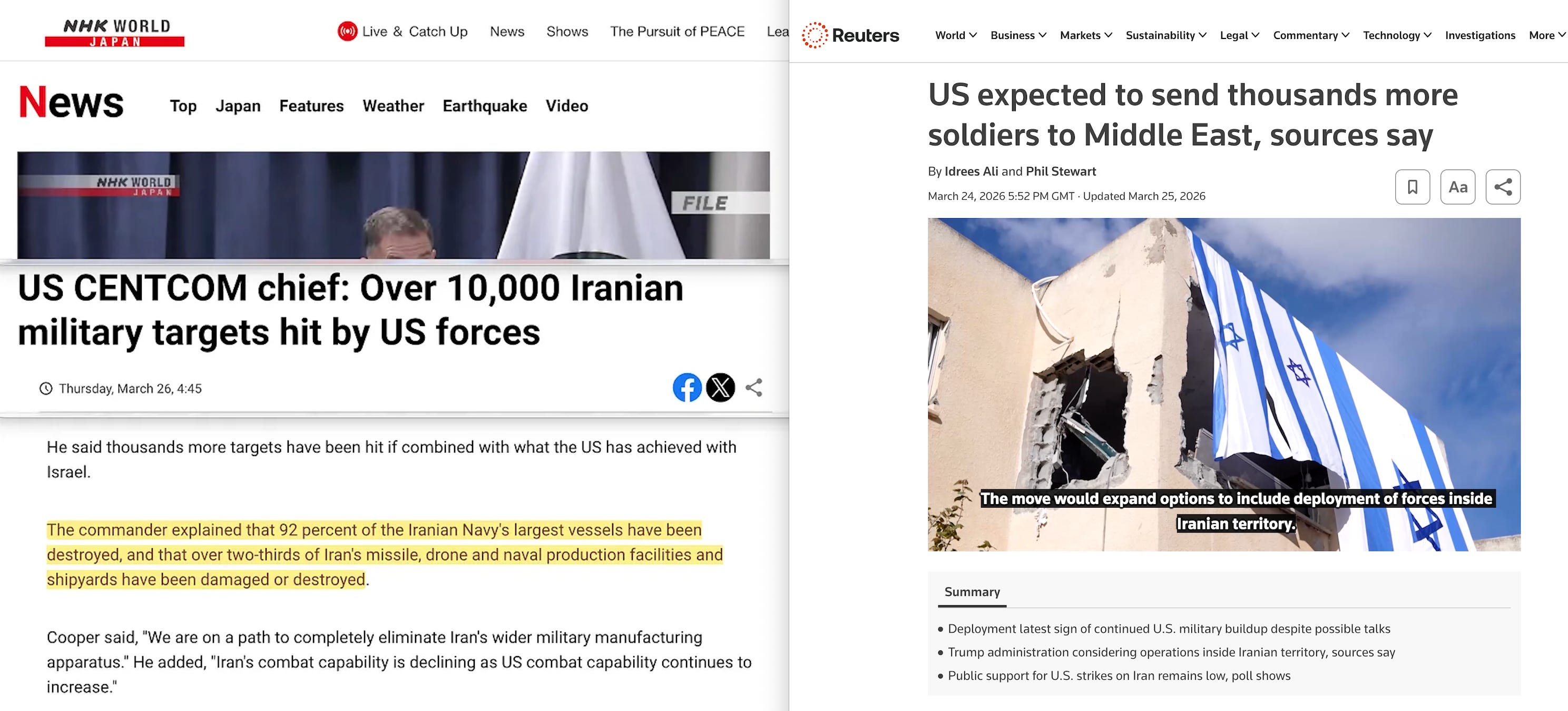
The gap between the two positions is now the Strait itself. Washington’s plan requires it reopened under international oversight, while Tehran’s counter-demands full Iranian control. One-fifth of the world’s oil supply normally passes through the waterway83. Whoever sets the conditions of transit controls the physical flow of energy between producers and consumers.
In Gaza, the January 2025 ceasefire included a framework for Phase 2 negotiations — but those talks never took place. Israel resumed its military campaign in March 202584. Months later, Witkoff proposed new terms that Hamas rejected as insufficiently credible. The 20-point plan85 that eventually produced the October 2025 ceasefire was a different framework entirely — one built around the Board of Peace, the GREAT Trust, the digital tokens, and the smart cities.
The original pathway to a negotiated political settlement was never tested. What replaced it embeds a conditional reconstruction system that the population has no part in designing.
The 60 Minutes interview revealed a further instance of the same pattern inside the Gaza negotiation itself. Kushner and Witkoff described being mid-negotiation at Witkoff’s home — Kushner drafting terms on his laptop, sending proposals to Qatari mediators sitting with Hamas in Doha, with both sides reportedly close to a deal.

They woke the next morning to discover that Israel had bombed the Hamas negotiating compound in Qatar, killing the lead negotiator’s son. Witkoff said he and Kushner ‘felt a little bit betrayed’. They then used the crisis as an opening to merge the existing ceasefire proposal with the end-of-war proposal into a single document — a new set of conditions, produced at speed, which became the framework that isolated Hamas and produced the Board of Peace architecture. The bombing of the negotiating team did not derail the process. It replaced the process with one that served the architecture better.
By March 2026, the Board of Peace’s top representative Nickolay Mladenov was addressing the UN Security Council demanding Hamas disarm ‘without delay’86, while mediators in Cairo presented a phased disarmament plan requiring a 90-day handover of heavy weaponry and maps of the tunnel network87. Hamas declined to respond, saying it would first wait for the outcome of the Iran war — tying all three conflicts together from inside the system.
Kushner described the individual-level mechanism on 60 Minutes: ‘We’re going to have a weapons buyback programme. This is all linked to amnesty and disavowing violence’. Conditional clearance applied to people, not just territories. You disarm and disavow, you get amnesty and can stay. You refuse, you stay outside the system.
The behavioural layer operates at every scale — from the Strait of Hormuz down to a single fighter deciding whether to hand over a rifle.

In Ukraine, Crooke described the pattern directly: nothing of substance gets resolved, and the non-resolution is the point. The settlement is perpetually deferred while the financial architecture assembles underneath. The Kremlin’s ‘situational pause’ confirmed in March 2026, with peace talks frozen since the Iran war began, means the operator cell is now simultaneously stalling one conflict while escalating another — and the population waiting for reconstruction in the third is conditioning its own compliance on the outcome of both.
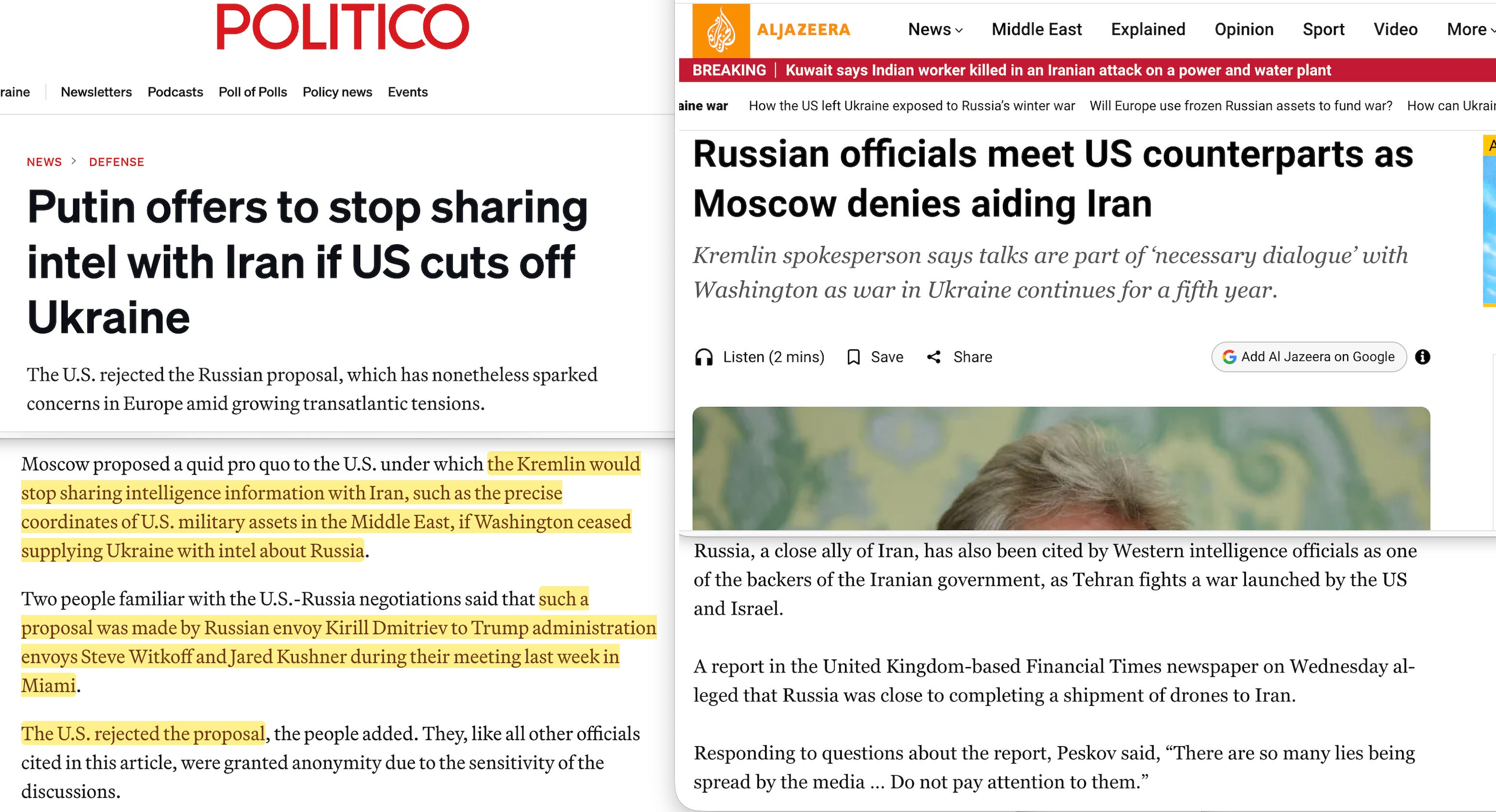
Moscow is not just watching the connections between the three conflicts. It is actively trading on them. According to Politico, Russian special envoy Kirill Dmitriev proposed a direct trade to Witkoff and Kushner during a meeting in Miami in March 202688: Russia would stop providing Iran with precise coordinates of US bases in the Middle East, in exchange for the United States stopping intelligence sharing with Ukraine.
The Kremlin later called out the media for ‘spreading many lies’89. The US rejected it — but the proposal itself is of note. The Kremlin treated the three conflicts as bargaining chips in a single negotiation, offering to give up its position in one for an advantage in another. The trade was routed through the operator cell’s channel, confirming that the two-person interface is the point through which all three conflicts are being managed — and that every party at the table understands this.
Any single instance — a bypassed resolution, a stalled negotiation, a bombing that disrupts talks — could be put down to incompetence, bad timing, or the ordinary mess of war. The argument is not that any one event proves the pattern. The argument is that the same operator cell, in three conflicts, over eighteen months, has consistently replaced available resolutions with conditions that install the same architecture — and that the cumulative weight of that record is hard to explain as coincidence.
The financial architecture being installed in Gaza deserves close attention, because it shows the template in its clearest form.
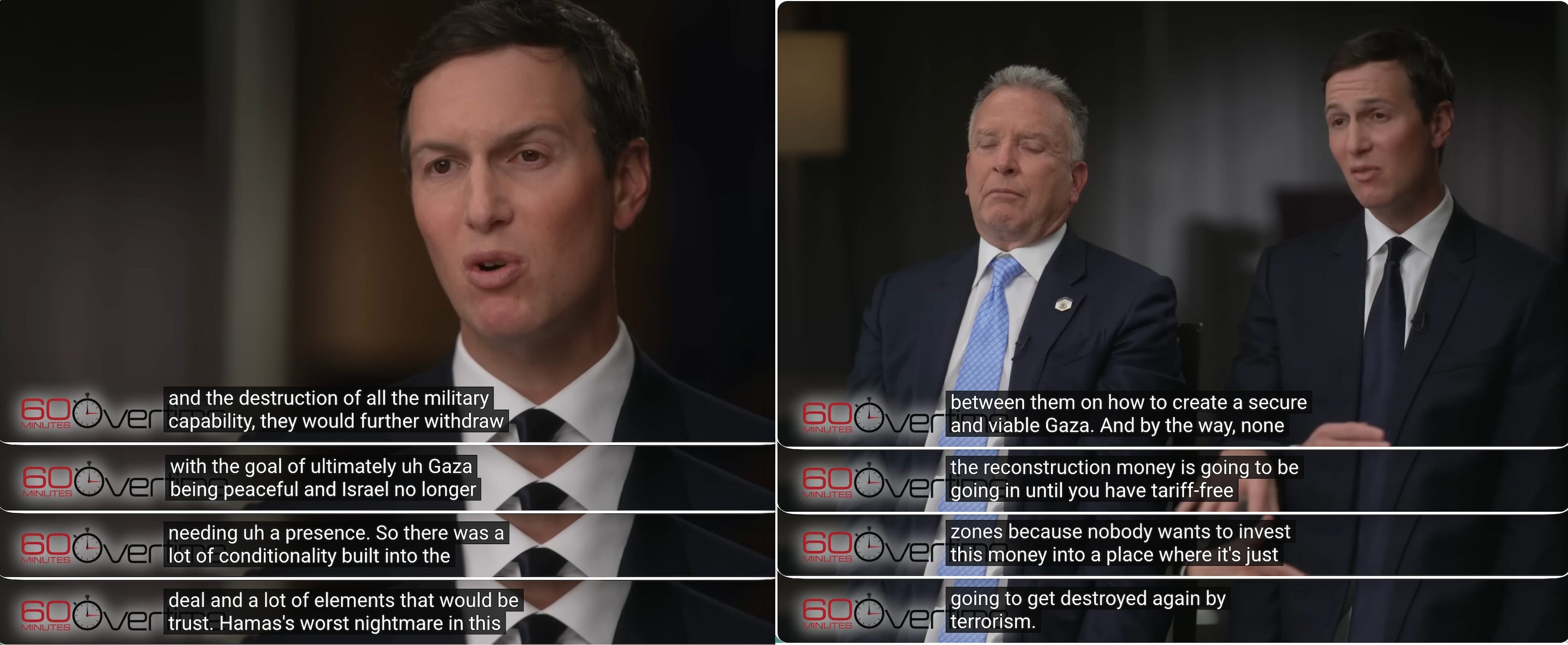
Kushner himself used the word. In the 60 Minutes interview, he described ‘a lot of conditionality built into the deal’ and said:
… none of the reconstruction money is going to be going in until you have terror-free zones, because nobody wants to invest this money into a place where it’s just going to get destroyed again by terrorism.
The money does not flow until the security conditions are met. Funding is conditional on clearance — precisely the mechanism the GRAD fund formalises.
He also confirmed that the reconstruction specifications preceded the settlement:
There’s been a lot of organisations that have been trying to determine what happens after the war... for the last two years. We have a master plan already.
The architecture was being designed while the war was still being fought. The plan existed before the conditions it would impose were agreed to by anyone in Gaza.

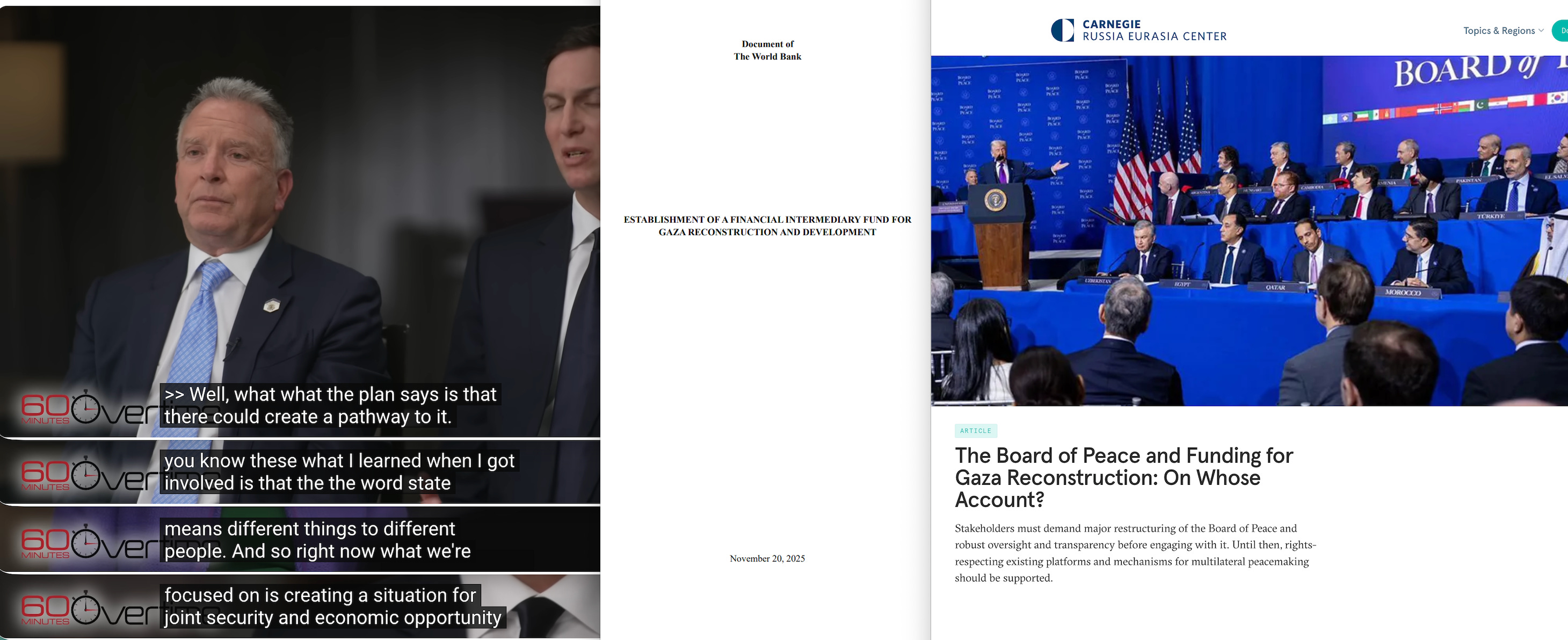
When asked about Palestinian statehood, Kushner said: ‘The word state means different things to different people. What you end up calling it over time will allow the Palestinians to determine that themselves’. The population gets to choose the label, not the conditions — sovereignty in name only. The financial systems, the digital identity requirements, the compliance rules — those are set by the clearing house.
The World Bank established a Financial Intermediary Fund for Gaza Reconstruction and Development — the GRAD — in December 202590. The World Bank acts as a ‘limited trustee’, holding ‘no responsibility or accountability, fiduciary or otherwise, for the use of the funds after they have been transferred to a recipient’. Once the money reaches the Board of Peace, the Board spends it as it sees fit. World Bank President Ajay Banga sits on the Board of Peace Executive91 — meaning the institution claiming no responsibility after the money leaves its hands has its president on the body directing how that money gets spent.
The Carnegie Endowment noted that unlike the Ukraine and Haiti reconstruction funds, no Palestinian government official chairs or holds even a non-voting seat on the governance body92. The country’s own plans for reconstruction do not influence how the money is used.
The structure is nearly identical to the Global Environment Facility — a World Bank fund that channels international environmental money through conditions set by UNFCCC standards, CBD targets, and Stockholm Convention obligations. Countries receiving the money do not set those conditions. They apply, they comply, and they receive funding if they pass.
The Board of Peace copies this structure exactly, replacing environment with war as the crisis and replacing emissions with disarmament as the thing you must comply with.
The GEF took thirty years to become invisible background infrastructure. The Board of Peace is trying to reach the same point in a single crisis cycle.


Alongside the fund, the Board of Peace has proposed a dollar-linked stablecoin for Gaza. Sources told the Financial Times that one motive is to curb the free flow of cash so Hamas ‘will be unable to generate any’ funds93. Others raised concerns that the stablecoin could economically detach Gaza from the West Bank.
The technocratic committee’s digital lead has pledged to build ‘a secure digital backbone, an open platform enabling e-payments, financial services, e-learning, and healthcare’ — with Gaza’s 2G network upgraded to free high-speed access by July94.
Kushner’s own condition — that reconstruction money only flows into ‘terror-free zones’ — means the stablecoin doesn’t just track what you buy. It tracks where you are when you buy it. A terror-free zone is a geofence, and a stablecoin that only clears inside one is location-locked programmable money — a design feature first documented in the digital currency architecture explored by Joi Ito and Jeffrey Epstein at the MIT Media Lab, and subsequently tested by the Federal Reserve Bank of Boston through the lab’s Digital Currency Initiative.
The population is being onboarded onto digital financial infrastructure before the reconstruction formally begins.

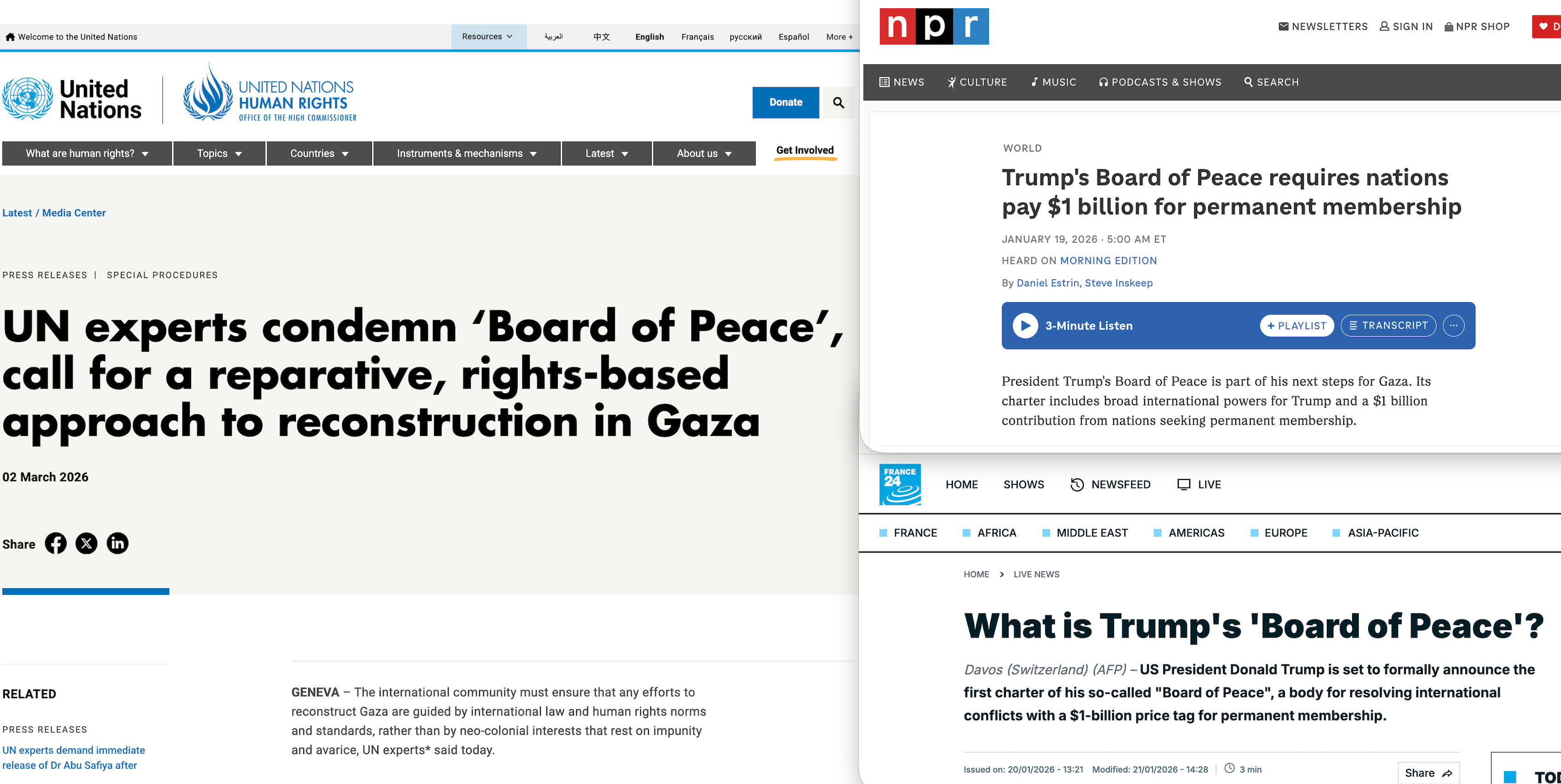
The Board of Peace’s charter does not mention Gaza. Permanent seats cost one billion dollars95. Trump is named as chairman for life, with sole authority to pick his successor, invite countries, and create or dissolve any part of the organisation96 — and this authority is held in his personal capacity, separate from the presidency.
The Board of Peace is not a US government body subject to Congress or future presidents. It is a personal enterprise that would outlast his time in office, positioned outside any single sovereign authority — which is exactly where a clearinghouse sits. The BIS occupies Basel for the same structural reason. Russia’s UN representative warned during the Security Council debate that the arrangement is ‘reminiscent of colonial practices and the British mandate for Palestine’9798.
The structure bears this out — an international body governing a territory through conditions the population did not set, with full powers kept by the patron, and exit conditioned on compliance judged by the governing body itself.
China refused to join. UN human rights experts formally condemned the Board as ‘an illegal and illegitimate manoeuvre by powerful States driven by nostalgia and avarice’99.
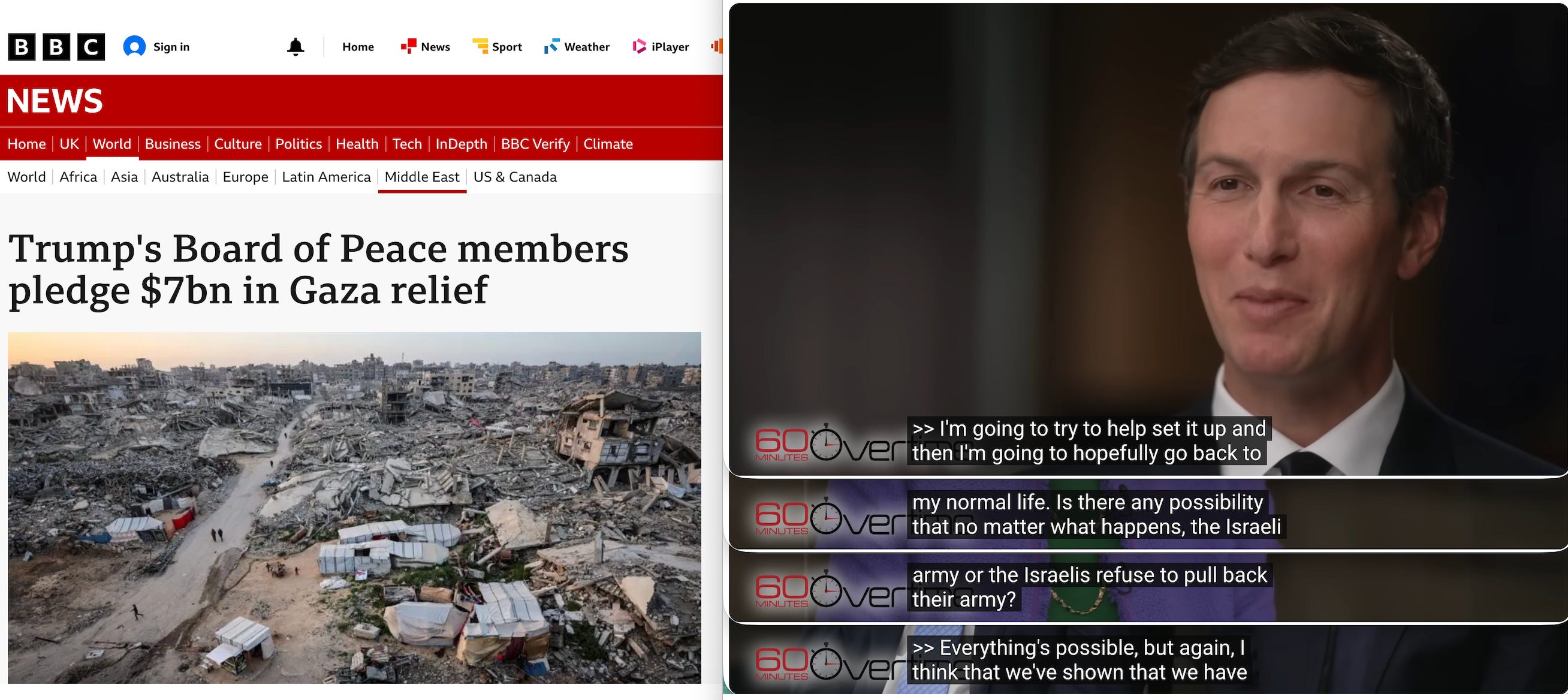
The makeup of the Board’s Executive shows who is already positioned at the clearinghouse. Marc Rowan, CEO of Apollo Global Management and a Board member, has publicly estimated that Gaza contains $115 billion in real estate value ‘that just needs to be unlocked’100. The Board’s secretary, Josh Gruenbaum, previously worked at KKR101 — a firm specialising in aggressive distressed-debt investing. A leaked document showed that Gothams LLC, a disaster response firm, submitted a reconstruction plan guaranteeing itself 300 per cent profits and a seven-year monopoly on trucking logistics102. By February 2026, the Board had already secured over $17 billion in pledges — $10 billion from the United States and $7 billion from Gulf and Central Asian states103 — alongside troop commitments for stabilisation.
The financial interests are not concealed. They are specified in the proposals, named on the Board, and positioned for the contracts before the first building permit has been issued.
When asked on 60 Minutes who would award reconstruction contracts, Witkoff answered without hesitation: ‘There’s a board of peace’. Kushner added that they were ‘already talking to contractors from all of the Middle Eastern countries’. He then said: ‘I’m going to try to help set it up and then I’m going to hopefully go back to my normal life’.
Set it up, install the architecture, and leave. The operator cell’s job is not to govern — it is to put in place the conditions under which governance happens, and move on.
What the operator cell installs always begins at the same place: the cognitive layer — the definitions that determine who exists within the system and what they are permitted to do. Previous essays described this as identity and accreditation. Those are two different functions.
Identity is the initial definition — what is recognised, what counts, what the system treats as real. A digital credential, a recognised entity, a compliant institution: the moment of recognition that says this exists within our model. The Zohar described this function as Chokmah — wisdom, the first point of definition104.

Accreditation is the gate — who may act, which organisations may operate, which credentials qualify. It takes what identity defined and gives it structure, boundaries, institutional form. Israel controls NGO registration in Gaza — deciding not what must be done but who is allowed to do it. In Ukraine, EU membership criteria perform the same function. In Iran, the compliance framework will determine which companies may operate in the energy corridor.
The Zohar called this function Binah — understanding, the node that structures and limits. Laitman’s glossary of Kabbalistic terms assigns Israel to Binah — not a claim about nationality or ethnicity, but a description of whoever holds the accreditation gate in a given conflict zone.


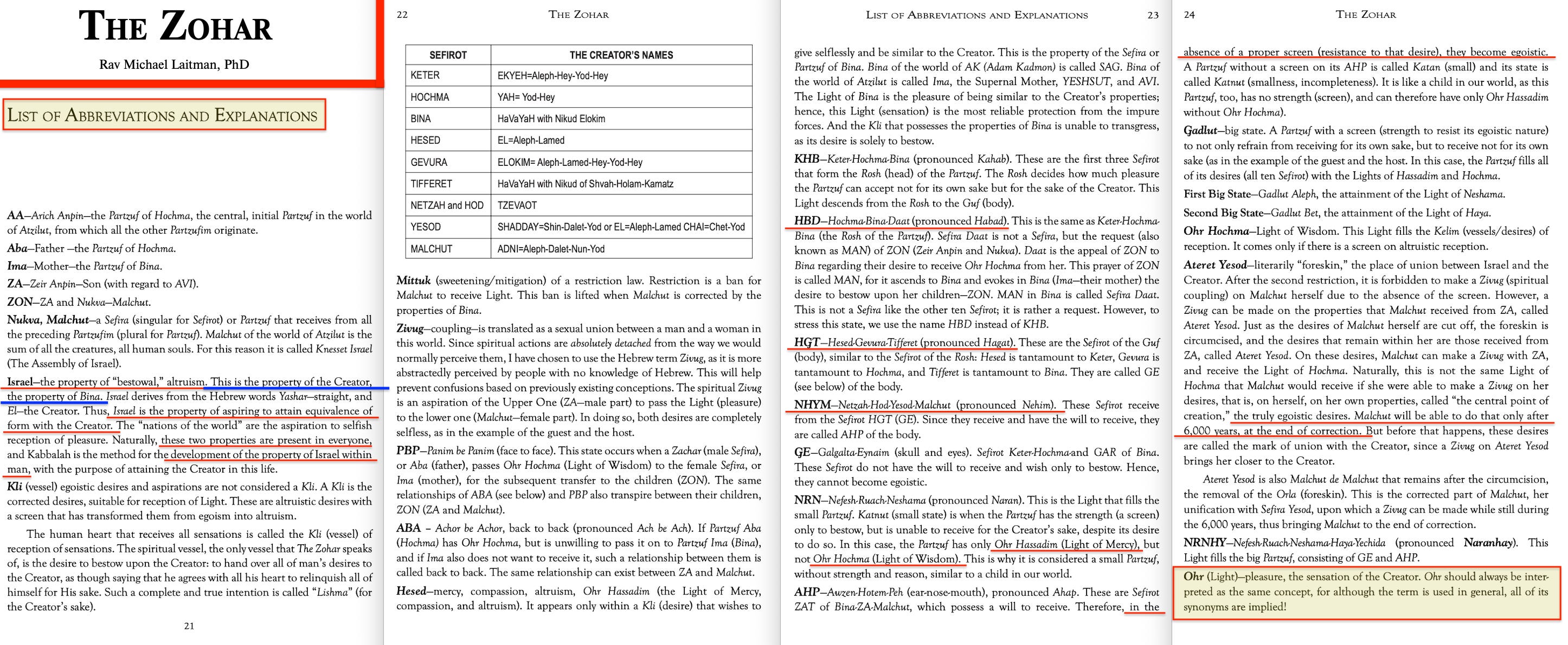
Between these definitions and everything downstream sits a hidden node the Zohar calls Da’at — knowledge. Da’at does not define and does not gate. It compiles. It takes the definitions from Chokmah and the rules from Binah and produces the working standard that every layer below operates from — the standard the evaluation layer measures against and the enforcement layer carries out, but that neither layer wrote.
The operator cell performs this function. It does not create the cognitive layer’s definitions — those come from the standards bodies, the institutional frameworks, the financial architecture that exists before any specific negotiation begins. It compiles them into operational conditions, carries them between the parties, and embeds them in the settlement terms before anyone outside the room has seen the paperwork.
The operator cell is the hidden compiler — not because it operates in secret, but because what it does is mistaken for negotiation.
The BIS’s Project Mandala105 performs the identical function at the CBDC transaction level: encoding pre-existing rules into the payment itself, so that compliance is embedded before the money moves. Project Rosalind provides the retail enforcement layer — programmable money where conditions are attached at the point of sale. Gaza’s stablecoin and digital wallet system is this architecture deployed in a conflict zone.


The 60 Minutes interview illustrates the function precisely. Kushner described speaking to ‘everyone who’d been involved in the Middle East diplomacy for the 20 years prior, all the historians’, and concluded that ‘the way they were explaining things to me just made no sense’. He discarded their expertise and substituted a simplified framework — people want security, economic opportunity, and religious freedom — then compiled operational terms around that framework and carried them between the parties.
Witkoff, meanwhile, described receiving CIA intelligence briefings three times a day telling him Hamas would reject the deal, while his personal Gulf channels were telling him Hamas would accept. The operator cell trusted its own network over the state’s intelligence apparatus and acted accordingly.
The compiler only needs access to the parties and the authority to draft terms — both of which Trump provided without restriction.
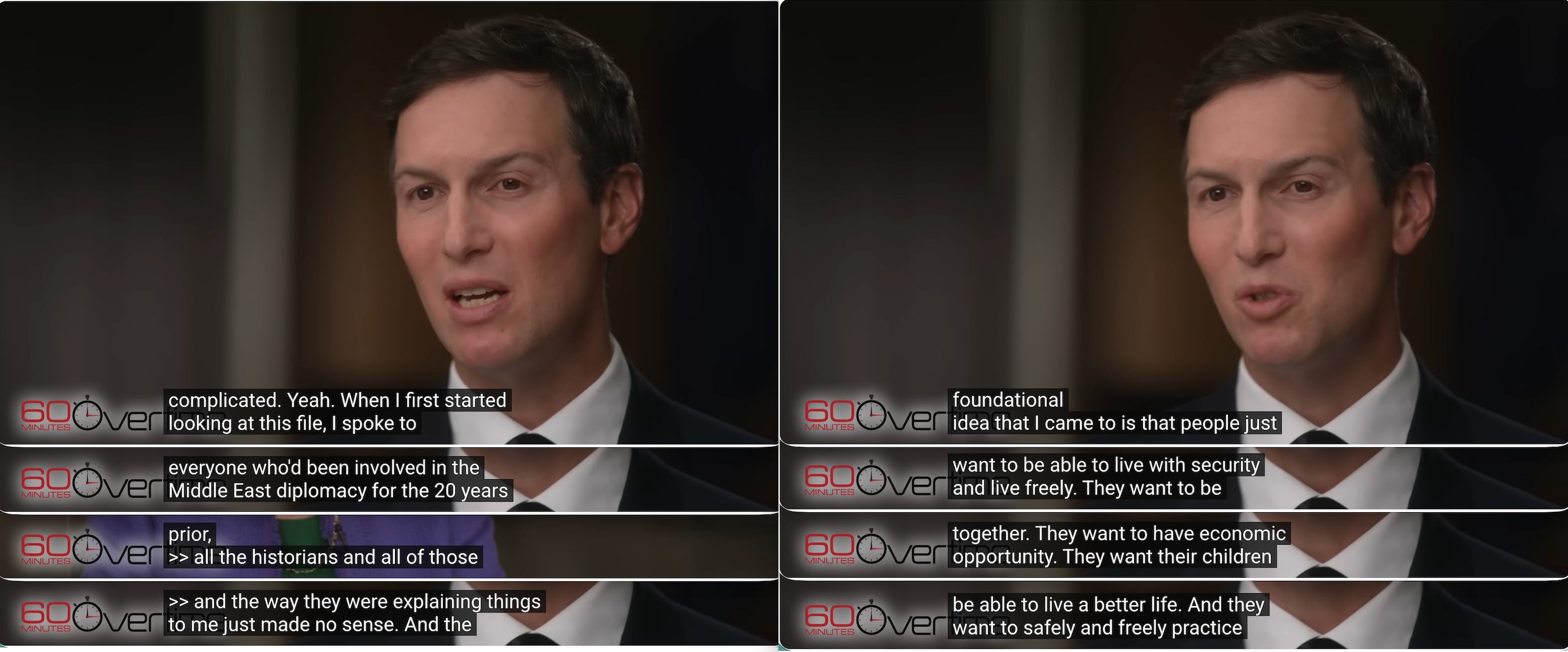
Their description of the method was equally revealing. Kushner said they never approached negotiations across the table from the other party. Instead: ‘We sat with the people from other countries and said let’s agree on the same objective and then once we agreed on the objective we kind of locked arms and said let’s figure out ways that we can work together to get there’. The objective is set first. The negotiation is about implementation, not the objective itself.
The cognitive layer defines the standard; everything downstream is mechanics. Witkoff offered his own formulation: ‘Our title should be secretary of miscommunication and correcting miscommunication, because that’s a lot of what we were doing out there’. And Kushner, describing what he and Witkoff worked on at 4:30 that morning, spoke of ‘finding a mechanism to get quick adjudications and the right adjudications’.
A mechanism that adjudicates competing claims and produces verdicts at speed is not democratic. He described a clearinghouse function — in his own words, unprompted, on national television.


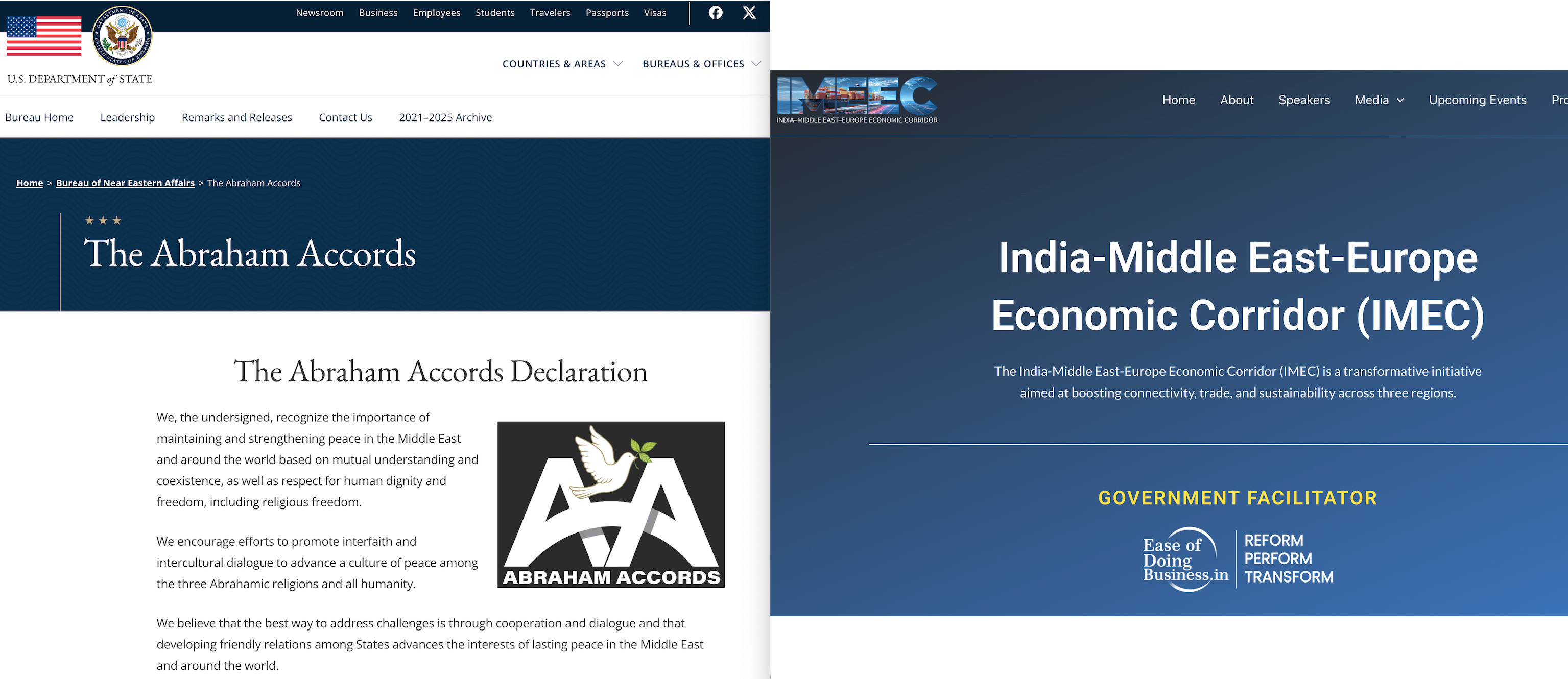
Between the cognitive layer that sets the standards and the behavioural layer that settles the transactions sits the clearing infrastructure — the connections that make sovereign nodes interoperable so that the cognitive standards can propagate and the behavioural settlements can execute. In the Middle East, that clearing infrastructure is the Abraham Accords106.
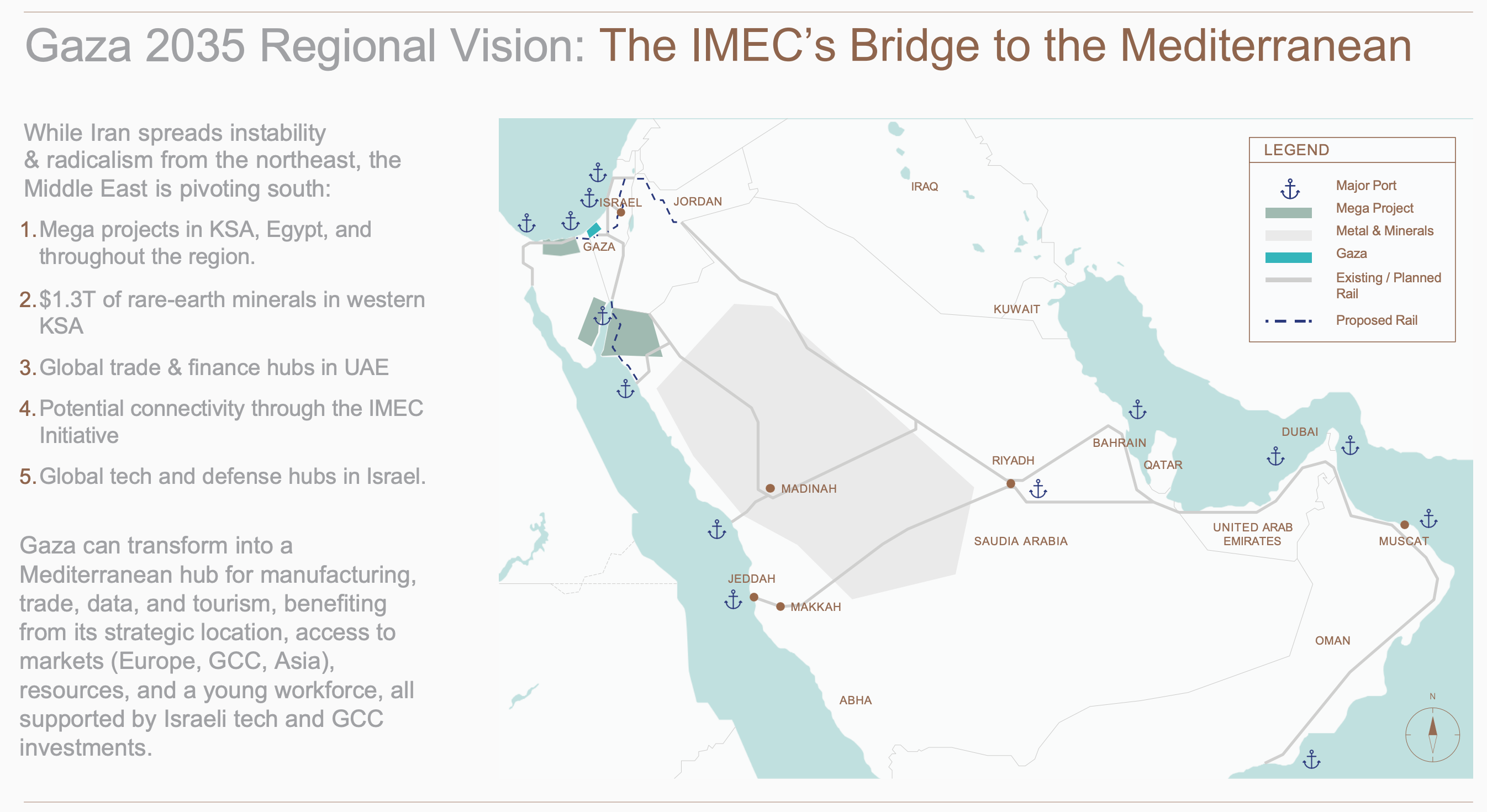
The Accords are diplomatic agreements that normalise relations between Israel and several Arab states, but their significance extends beyond traditional diplomacy. They are becoming an interoperability framework. Signatories are aligning their financial systems, opening trade flows, connecting their energy and data infrastructure, and laying the groundwork for the India-Middle East-Europe Economic Corridor107 — IMEC. The corridor would run physically through pipelines, rail, fibre-optic cables, and shipping lanes.
The Accords are the logical layer that makes the nodes along the corridor compatible, defining the connection standard through which the cognitive layer's definitions travel and the behavioural layer's settlements run.
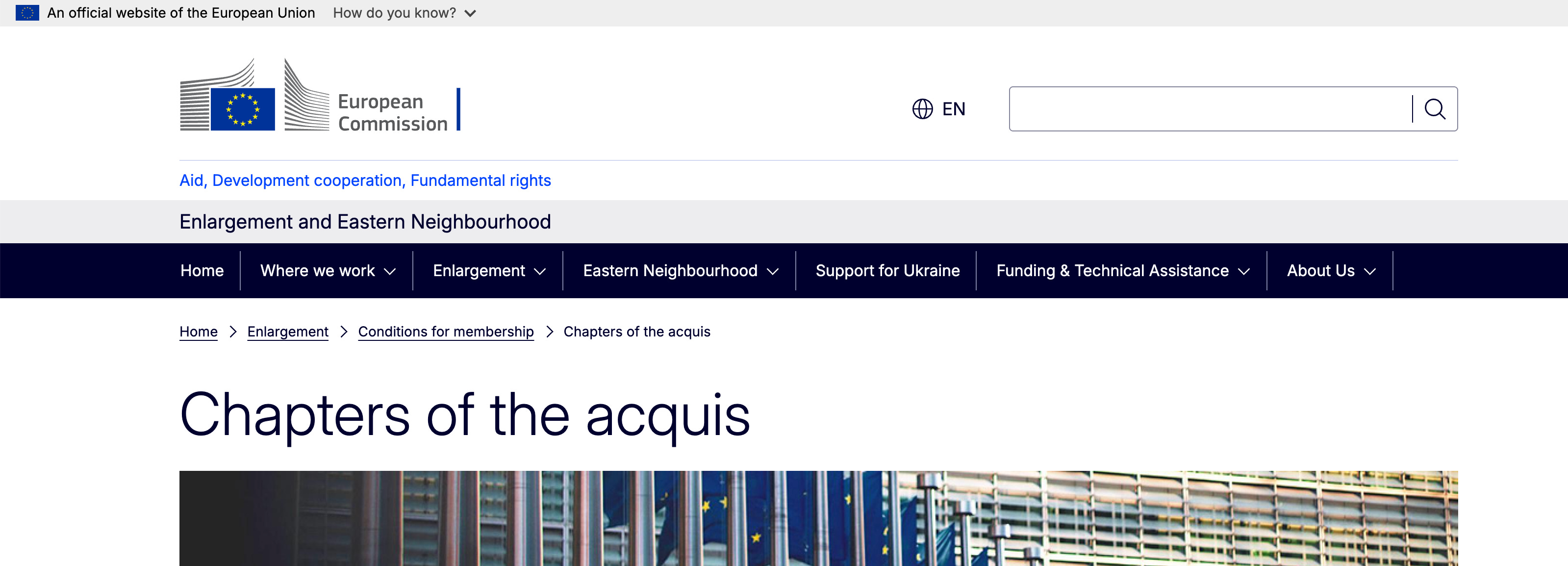
In Europe, EU accession performs the same protocol function. The acquis communautaire is the connection standard — 35 chapters of regulatory alignment that connect a member state’s financial, legal, environmental, digital, and trade systems to the European architecture108. Ukraine is being onboarded through this protocol. Its screening process is complete; its clusters are being opened for technical alignment; its infrastructure is being rebuilt on EU-compatible rails.
The protocol is different, but the function is identical.
This is why the crisis method is used specifically against nodes that refuse to connect. Iran operates outside SWIFT and outside the Accords. It is an uncleared node at both the financial and infrastructure layers.
Gaza has been positioned for reconstruction on the Accords’ rails — the GREAT Trust slides109 position it as the Mediterranean terminus of IMEC, with data centres, a deep port, and high-speed rail connecting to the Gulf. Ukraine is being connected through EU membership.
Each territory is being wired into an infrastructure that lets the cognitive layer’s standards spread and the behavioural layer settle.
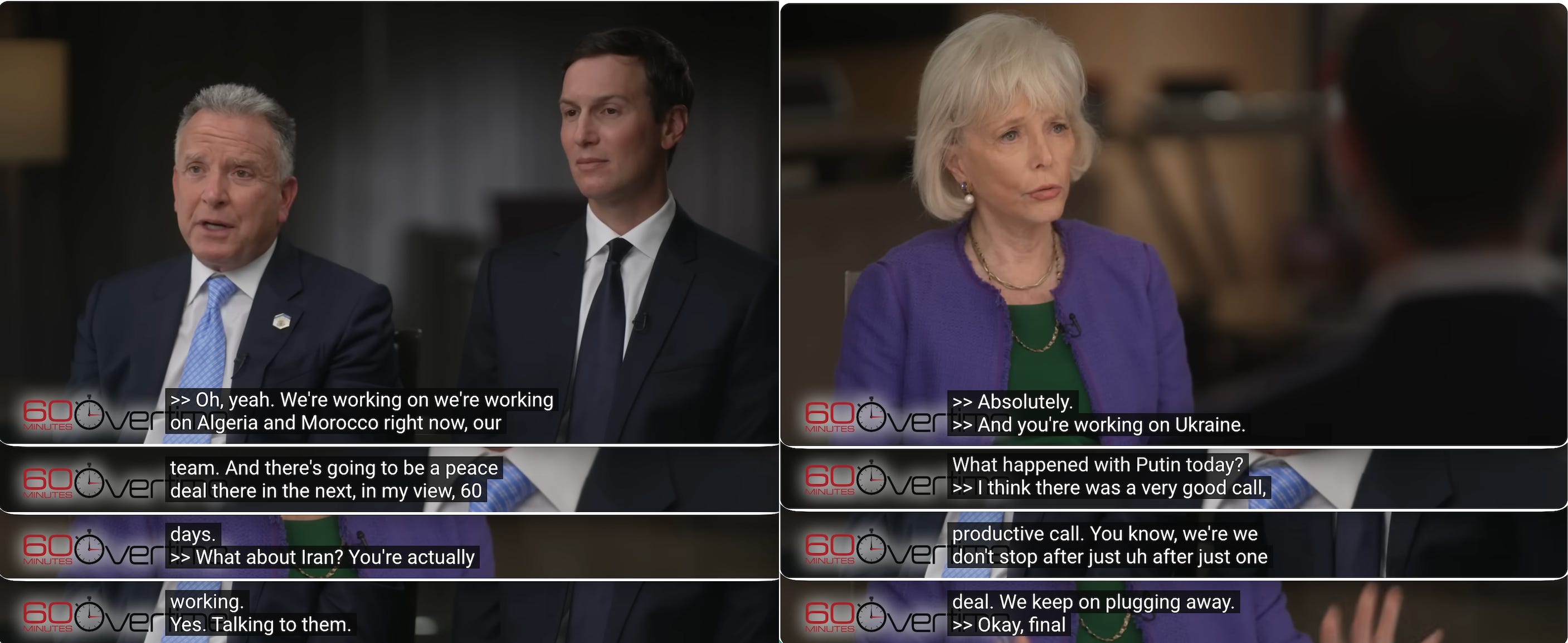
On 60 Minutes, Witkoff confirmed that the operator cell was simultaneously working a fourth dispute through the same infrastructure: ‘We’re working on Algeria and Morocco right now, our team. And there’s going to be a peace deal there in the next, in my view, 60 days’110.
Algerian press noted that Witkoff used the term ‘peace agreement’ for two countries that are not at war — they cut diplomatic ties in 2021 but have not fought each other111.
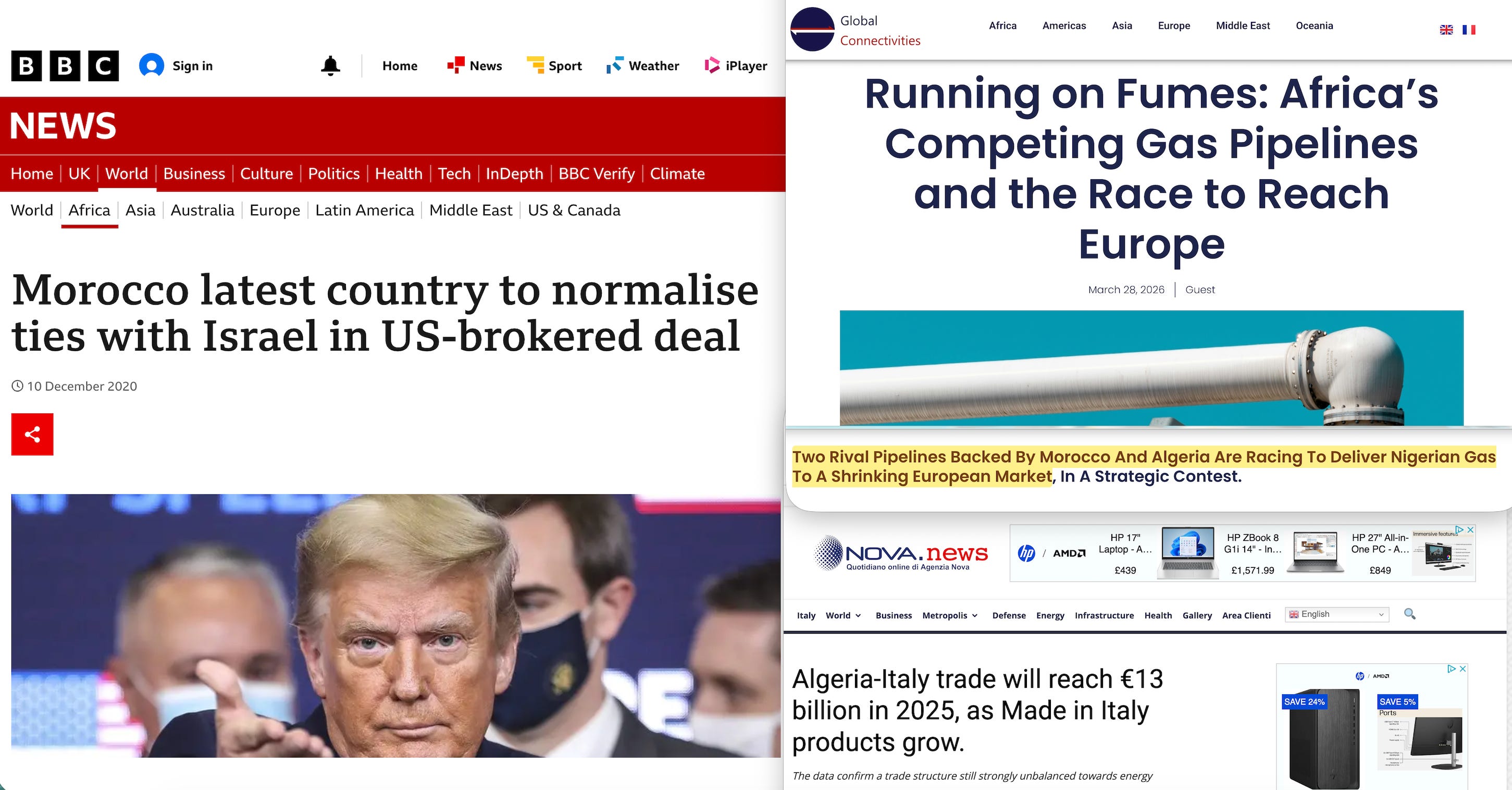
Morocco joined the Abraham Accords in 2020 — that was its onboarding event, with US recognition of its sovereignty over Western Sahara as the incentive112. Algeria has not joined. Two competing gas pipelines are now vying to carry Nigerian gas to Europe113: the $25 billion Morocco-Atlantic route, running through 13 countries, backed by the European Investment Bank, the Islamic Development Bank, and the OPEC Fund; and Algeria’s $13 billion Mediterranean route, using existing infrastructure to Italy114, with construction announced by President Tebboune for 2026 under Sonatrach leadership.
Whichever route secures financing will determine the energy map of North Africa for decades — and financing will flow to the route whose transit countries are inside the clearing infrastructure. Algeria does not need to be destroyed and rebuilt. It needs to be pulled into economic normalisation with a neighbour that is already inside the Accords, or watch the corridor route around it. The pipeline itself is the behavioural layer. Gas either flows through the corridor on the terms the clearing infrastructure sets, or it doesn’t flow at all.
The method varies — by crisis, by regulation, by economic gravity — but the clearing infrastructure is the constant. Every onboarding method ends at the same point: connecting a sovereign node to the system through which the cognitive layer’s definitions spread and the behavioural layer’s settlements clear.
The crisis method, however, is not the only onboarding mechanism. It is the fastest — reserved for sovereign nodes that refuse to clear voluntarily. There are four other methods, each producing the same result through different means.
The bureaucratic method onboards compliant nations through regulatory machinery. EU member states are the clearest example.
The EU AI Act installs the cognitive layer for AI governance115. The European Digital Identity Regulation installs the credential infrastructure116. The ISSB and the Corporate Sustainability Reporting Directive install ESG disclosure as mandatory reporting117. The NGFS scenarios install climate compliance into banking supervision118. The digital euro pilot installs programmable settlement119. Each regulation is defensible on its own terms — digital identity improves services, ESG disclosure improves transparency, climate scenarios improve risk management, programmable settlement improves efficiency.
The voter who objects to any single part is objecting to improvement. The voter who objects to all of them at once is a conspiracy theorist.
The architecture installs itself one reasonable regulation at a time, and by the time the full stack is running there is no single moment at which it was imposed — because it was never imposed. It was adopted, voluntarily, one part at a time, each one following from the last.

The procurement method onboards the builder by making it the infrastructure.
The United States does not need an outside operator cell because it is building the architecture from within. GenAI.mil puts three million military and civilian personnel onto a single AI platform120. Palantir’s $10 billion Army Enterprise Agreement rolls 75 contracts into a single data framework121. The OPM Tech Force surge places a thousand technologists inside federal agencies on two-year terms to make the stack work122.
The cognitive layer is installed through IL5 accreditation123 and FedRAMP certification124, which decide which AI models exist within the federal stack. The evaluative layer is installed through cross-agency data fusion — identity matching that connects financial, immigration, health, and law enforcement datasets into a single picture. The behavioural layer is installed through programmable settlement — benefits that clear or do not, transactions that go through or do not, access that is granted or denied.
By the time a future administration tries to regulate the system, it will be impossible to separate from the state itself.


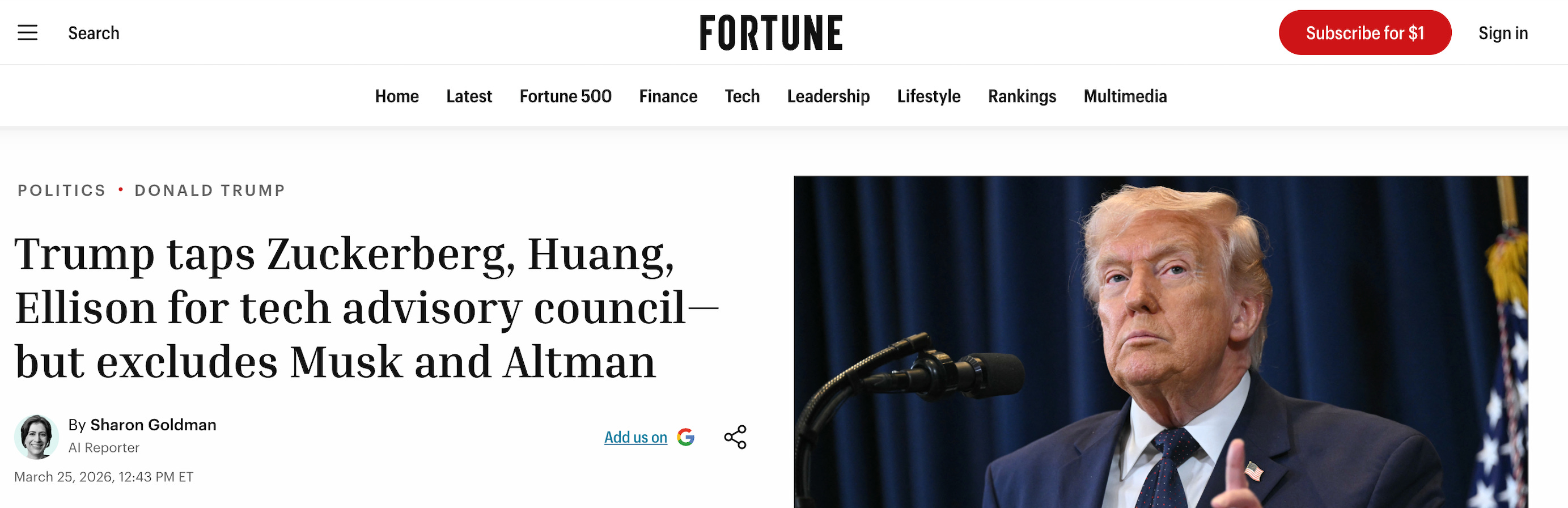
On March 25, 2026, Trump announced a technical advisory panel including Zuckerberg, Ellison, and Huang125126 — the heads of Meta, Oracle, and Nvidia. They define the AI standards their platforms will follow, the cloud architecture their companies will supply, and the chip specifications their fabricators will manufacture. The panel writes the cognitive layer’s specifications, and the panel’s companies are the only ones positioned to meet them — because it was they who wrote them.
The same model runs across every onboarding method: the Board of Peace seats at a billion dollars, the NGFS SAC selecting its own scenario methods, and now the tech panel defining federal AI requirements. In each case, the cognitive layer is filled by people whose money is already positioned to profit from the definitions they produce.

The standardisation method operates above all three.
NATO’s Responsible AI Certification Standard127, the EU AI Office, the BIS Innovation Hub projects — each makes interoperability a technical default that works like an unsigned treaty. Countries that adopt the certification don’t sign a political agreement — they accept a technical standard. Once the tech stack match across borders, policy travels faster than politics.
Coordination becomes automatic rather than negotiated.

The emergency method is the global override.
The UN Emergency Platform128 — designed to activate when a ‘complex global shock’ is declared129 — would bypass normal decision-making and allow the cognitive layer to coordinate the response directly. The platform would not require a Security Council vote or national legislation. It would require only a declaration that a crisis is complex enough to warrant activation — and the definition of ‘complex enough’ is set by the same people who run the response. The four preceding methods fill in the map gradually, territory by territory, regulation by regulation, contract by contract.
The Emergency Platform closes whatever gaps remain — all at once, justified by whatever crisis is declared, with the architecture already in place in every territory that has been onboarded by the other four methods. Nations already inside the architecture comply automatically because their infrastructure is already on the rails. Nations still outside are brought in through emergency coordination — conditional aid, conditional access, conditional participation in the response.

The crisis method fills in the map by force — Ukraine, Gaza, Iran. The bureaucratic method fills it in by procedure — the EU, the UK, and every aligned jurisdiction. The procurement method fills it in by making the architecture impossible to separate from the state — the United States. The standardisation method makes the architecture work the same way across all of them. And the emergency method closes the remaining gaps in one move, under the authority of a declared crisis, without needing consent from the populations it absorbs.
Each method ends at the same point: a sovereign node connected to the clearing infrastructure — the Abraham Accords in the Middle East, EU accession in Europe, the federal stack in the United States — through which the cognitive layer’s standards spread and the behavioural layer’s settlements clear.
Five methods, one architecture, the same three layers — the same destination.

Three wars are being processed through a single interface. The same two men negotiate the conditions in Moscow, Miami, Doha, and now reportedly Islamabad. Their affiliated capital positions itself for the reconstruction contracts. Their business partners span the Gulf sovereign wealth funds, the Russian-adjacent oligarch networks, and the Rothschild social circle. The governments they negotiate with are the same governments investing in their companies.
Iran has now refused to negotiate with them130. Hamas has suspended its response to the disarmament proposal pending the outcome of the war the operator cell is conducting against Tehran131. Ukraine’s talks are frozen in a ‘situational pause’ that serves the financial architecture better than any resolution could132. And the mediator is distrusted by every party at every table — Tehran, Moscow, and European capitals alike — precisely because the pattern has become visible133.
On March 25, Democratic Representative Gregory Meeks moved to subpoena Rubio, Witkoff, and Kushner before the House Foreign Affairs Committee to testify on the war in Iran. Republicans defeated the motion 24 to 22134. The system protected the wiring.
The territorial issues, the security guarantees, the EU membership status, the Abraham Accords membership, the nuclear compliance framework — all of it is downstream of the payment system, downstream of the clearing house, downstream of whoever sets the conditions under which the money flows.
The operator cell does not set those conditions. It processes them — translating the cognitive layer’s definitions into working terms, carrying them between the parties, and embedding them in the settlement architecture before anyone outside the room has seen the paperwork.
Liedtke’s study of the nineteenth-century Rothschild agent network documented a system in which agents were paid through access rather than salary, recruited for their differences rather than their similarities, and kept operationally essential but permanently outside the decision-making core.
Witkoff and Kushner are performing the function the structure requires, in the conflicts the structure has assigned, at the speed the current crisis demands. Whether they understand the architecture they are building is irrelevant to the architecture. It builds itself through them, as it has built itself through every operator cell that came before — from Bleichröder at Versailles to McNamara at the World Bank to the unnamed agents who processed every settlement in between.
The operator cell is not the principal. It is a switchboard — the wiring between nodes.
On national television, this particular switchboard described itself — its methods, its mandate, its financial entanglements, its disregard for institutional expertise, and its plans to install the architecture and walk away. It called conflict of interest ‘experience’, called the Board of Peace the answer to who awards contracts, and confirmed it was operating across every conflict at once.
The politics is downstream of the payment system. It always was. What has changed is the speed of installation, the number of conflicts processed simultaneously, and whether the populations being onboarded have any say in the terms.
In 1871, it took six decades for the settlement architecture to produce the institution — the Bank for International Settlements. In 2026, the institution is being installed before the wars have ended — and the switchboard is on television, explaining how it works, to an audience that thinks it is watching diplomacy.
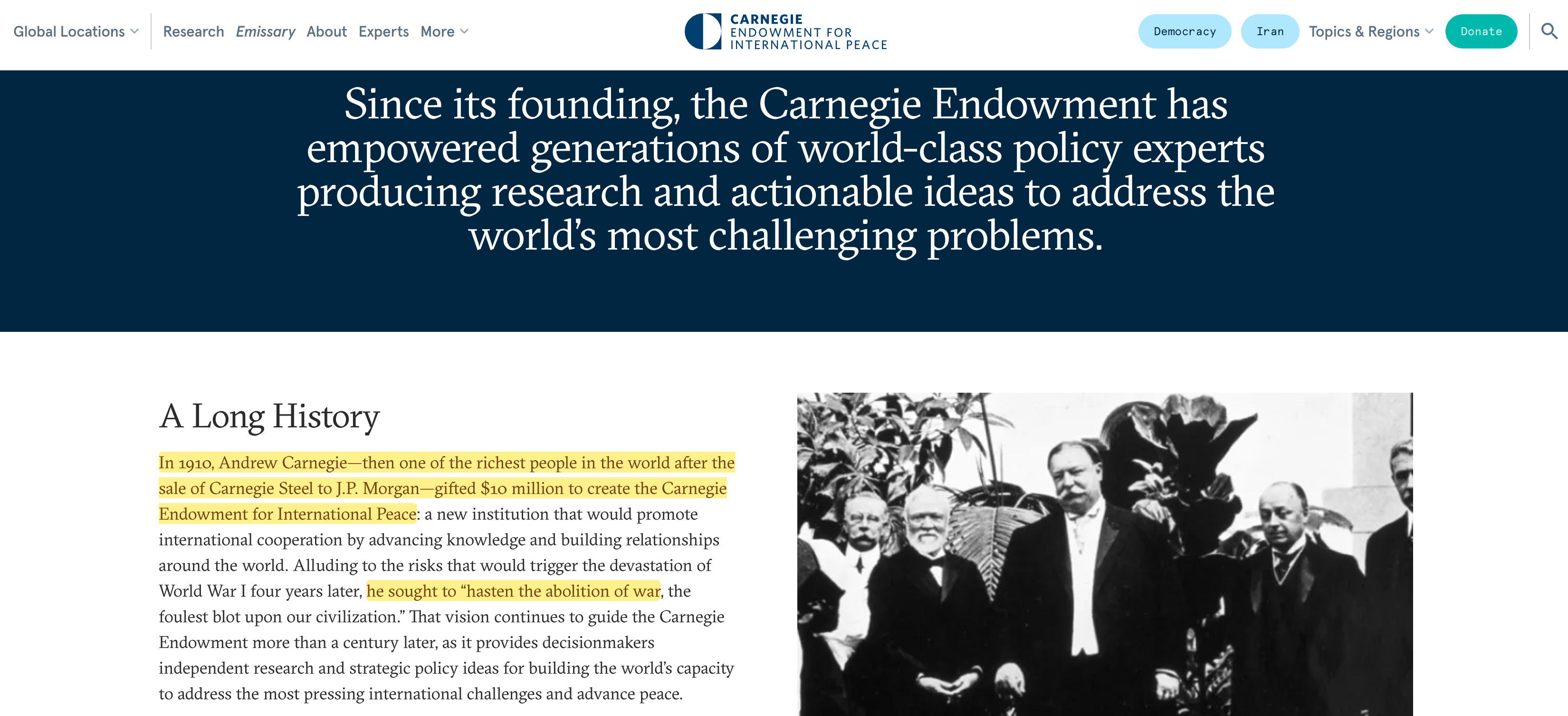
The Peace initiative Andrew Carnegie founded in 1910135 is being installed even in hostile nations — one war at a time.


I am half-way through your article and must run an errand now. I'll finish later. This writing is stellar. You're detailing exactly how the "New World Order" is rolling out. I'm very much aware of a great deal of the information you provide, but you also provide the structure for understanding and tying all the pieces together. In my last substack, I wrote the following, but you provide the exact detail and specificity required to understand how this entire operation is rolling out. Thank you.
"You know why we’re in “The Endgame?” It has little to do with religion…or maybe only parenthetically. It has to do with the fact that the current world—in its present state with over-arching technology developing not at a steady pace but by leaps and bounds far outstripping humankind’s facility to think about the future and implement any cohesive plans which will benefit them—constitutes the final time span to acquire rights and possession to resources, assets, labor forces [people], and anything valuable in this world by those who have power.
The militaries are at their beck and call, and their enormous wealth simply compounds itself with little necessity for the individual involved to exert themselves. Look at the insider trading being revealed within the Trump administration. Someone’s making a killing on Wall St. with Trump’s constant abrupt shifts and changes in approach toward the war in Iran."
I'll be writing another substack soon and will urge people to read your substack. Again...brilliant.
"The architecture installs itself one reasonable regulation at a time, and by the time the full stack is running there is no single moment at which it was imposed — because it was never imposed. It was adopted, voluntarily, one part at a time, each one following from the last."
Powerful paragraph! Thanks for your research esc, very much appreciated.