
A Marshall Plan for Ukraine
From conditional aid to conditional governance

The Marshall Plan didn't just rebuild Europe — it installed a new operating system for governance. What began as conditional aid (money for compliance with planning requirements) evolved into today's global architecture where access to finance, trade, and legitimacy depends on performance against expert-defined metrics.
This system now operates through six enforcement rails: accreditation, finance, credentials, audit, data, and procurement. Ukraine demonstrates all six rails operating simultaneously under emergency conditions, serving as a live prototype for planetary governance.
The 2025 convergence of the WHO Pandemic Agreement and UN Emergency Platform creates a standing switchboard to activate these mechanisms globally during future declared ‘complex shocks’.

This further develops the 4 recent essays on the Marshall Plan, and adds further — perhaps unexpected — links. It’s long, but it covers a huge amount of material — coherently.
In 1948, war-torn European nations couldn’t get Marshall Plan aid without submitting detailed recovery plans for international review. In 1975, developing countries couldn’t get World Bank loans without first clearing the Country Program Papers1 programme — introduced just as the New International Economic Order2 was calling for a ‘Third System’ of fairer global governance. But when clearing, what they actually received was conditional finance dressed up as partnership. And this model has developed into 2025, with nations not qualifying for capital, trade access, or even international legitimacy without passing indicator dashboards managed by expert networks operating beyond electoral cycles.
This transformation reveals how postwar reconstruction installed a governance operating system built on conditional finance and expert-managed metrics — a system that has since learned to update its own rules in real time without democratic accountability or transparency3 — the express values contemporary politicians are keen to impose on the electorate as they claim to work to ‘strengthen democracy’4.
This is institutional architecture that operates in plain sight, documented in official agreements, academic literature, and policy frameworks. The mechanisms interlock so effectively that most participants never notice the operating system running beneath their daily governance, primarily because it’s embedded in technical frameworks as opposed to publicly discussed through democratic deliberation.


The Four-Part Evolution
Part I: Visible Bridges (1947-1950)
The objective of the Marshall Plan wasn't generosity — it was conditionality. European nations received aid only if they planned together, shared economic data, and coordinated policies across borders.
This requirement built three institutional bridges:
Economic Coordination (OEEC, later became the OECD): Annual national recovery programmes submitted for aid allocation based on performance metrics. Countries learned to think regionally about statistics and resource flows.
Legal Integration (Council of Europe): The European Convention on Human Rights5 normalised regionalism — supranational legal authority — not least through international courts that could bind national governments.
Security Container (NATO): Collective defence that made sovereignty-sharing politically safe by removing military vulnerability, but which further expanded its remit into 'non-military security' via indirect determinants through the 1956 Committee of Three6.
These bridges preserved the appearance of independence while creating structural dependencies. Once supply chains, indicators, and legal frameworks were integrated, exit became prohibitively costly.


Part II: Hidden Rails (1944-1958)
Beneath the visible cooperation ran financial mechanisms that converted sovereignty into conditional access:
BIS/European Payments Union: Central bankers coordinated policy beyond parliaments through multilateral clearing that habituated European governments to regional rather than national monetary thinking. This took place through the scaling of a clearinghouse model which has its roots in the London bank clearinghouse structure of the 19th century.
De facto control of the unit-of-account rails. Since the late 19th century, cross-border finance has been organised around issuer-state currencies — sterling, then overwhelmingly the US dollar, with the Euro a clear second and British Pound Sterling still material. The central banks that issue these units set policy rates, lender-of-last-resort backstops, and liquidity windows that anchor global finance. The BIS coordinates that club, so the rails are central-bank dominated and BIS-coordinated.
IMF: Emergency liquidity came with policy conditions and ongoing monitoring, even for close allies like Britain during sterling crises. The policy conditionality mirrored those called for by Leonard S Woolf, through his 1916 League of Nations blueprint, ‘International Government’.
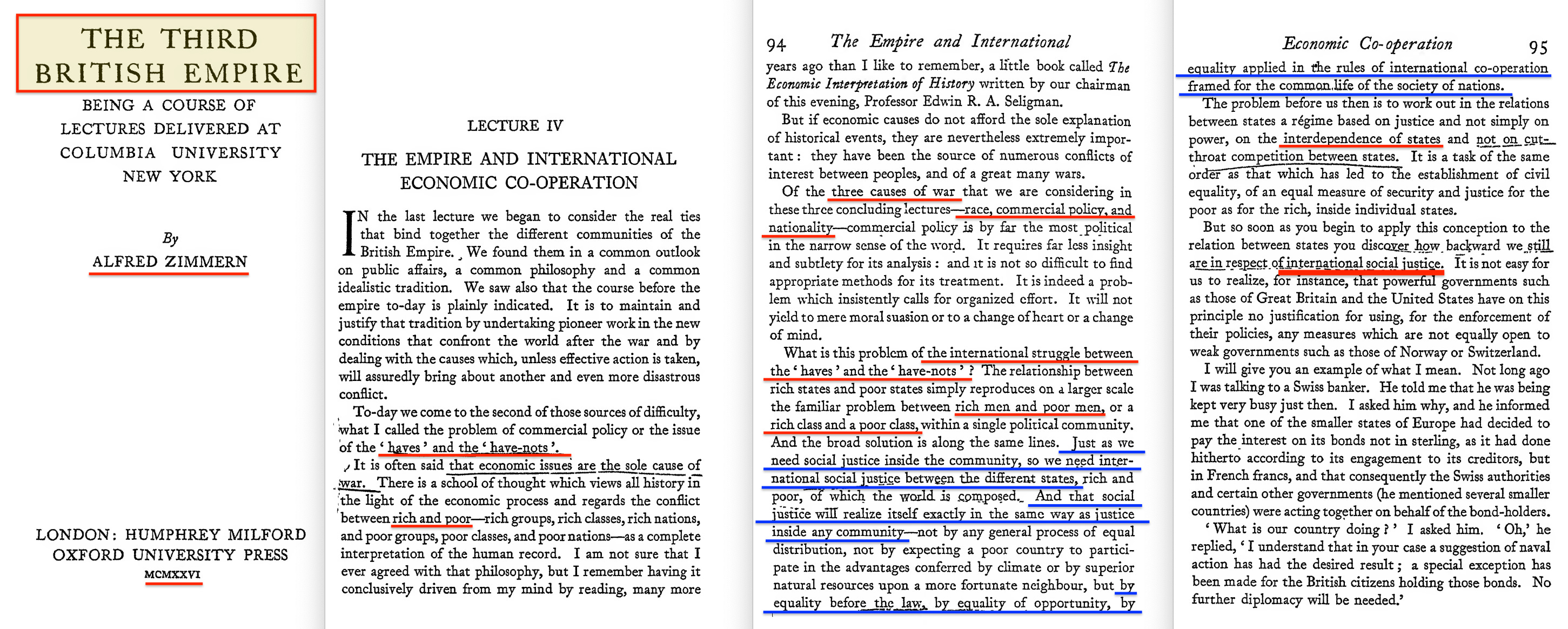
World Bank: Development lending reached deep into domestic policy through measurable targets in health, education, and social planning. The institution became the embodiment of Alfred Zimmern’s 1926 call for international social justice anchored in an economic unit coordinated by central-bank–dominated, BIS-linked structures.


The World Bank and IMF operationalised Zimmern’s vision of ‘international social justice through an economic unit’ inside a central-bank–dominated, BIS-coordinated order, where eligibility and conditionality rested on balance sheets largely denominated in USD/EUR and governed by Basel-style standards.
This wasn’t improvisation. Fabian Society networks, the Royal Institute of International Affairs, and Cambridge circles had designed blueprints for expert-managed world order through institutional permeation rather than direct control.
Dependency without conquest.


Part III: Global Scaling (1960s-1990s)
By the 1960s, the template went planetary. The UN Development Decades7 explicitly referenced Marshall Plan success. The Kennedy-established USAID8 required multi-year development strategies with baseline indicators, while the OECD pushed for international comparability in statistics9, commonly advancing in parallel with ISO standard-setting.
McNamara's Revolution: The World Bank imported Pentagon planning methods (PPBS), decomposing societies into inputs→activities→outputs→measurable outcomes. Aid flowed only to quantifiable programs hitting targets.
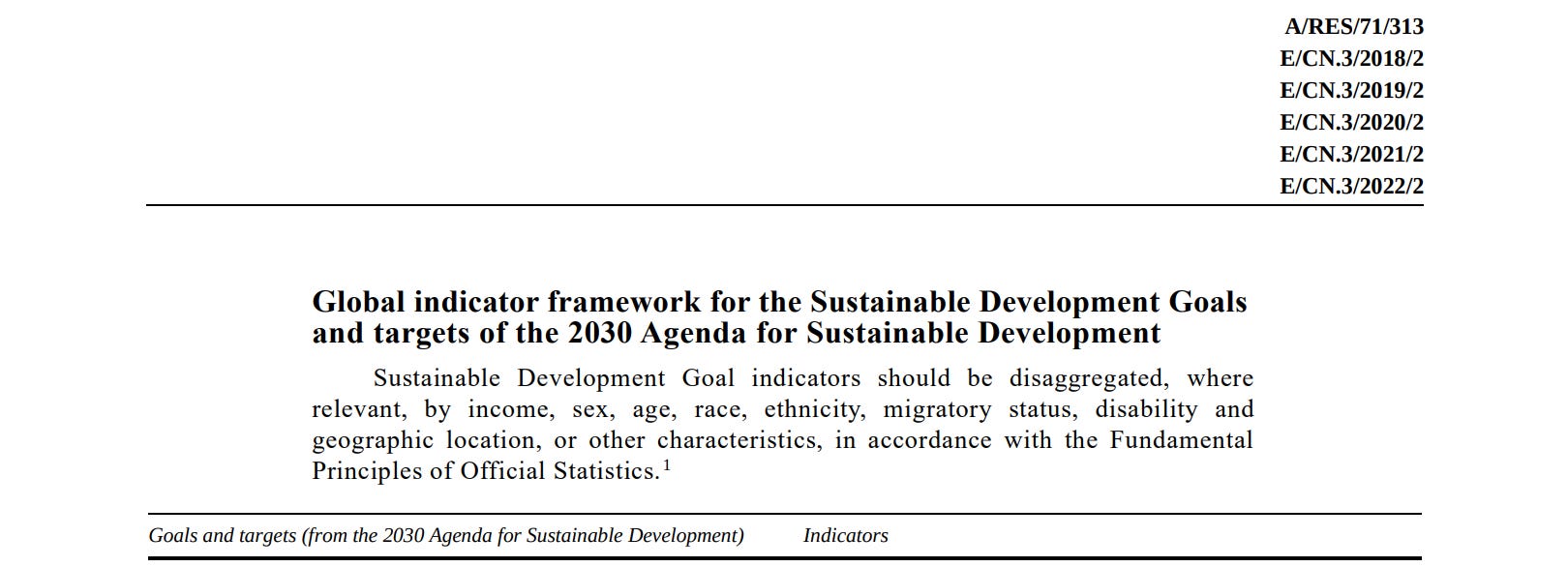
Indicator Proliferation: World Development Indicators10, WHO Health Indicators11, the UNDP Human Development Index12, the Convention on Biological Diversity Aichi biodiversity targets13, the OECD Better Life Index14, ESG scores15, and SDG indicator frameworks16 turned national performance into scorecards determining access to capital, trade, and legitimacy.
Private Finance Integration: Impact investing and sustainability-linked bonds embedded conditionality directly into markets. Development became a permanent performance contract, with public taxpayer funds transferred into private pockets through hugely one-sided blended finance schemes.
Crisis Ratchet: Each emergency justified deeper monitoring ‘for the duration’ — which consistently hardened into permanent baselines.


These methodologies relied on input-output analysis implemented through McNamara’s PPBS, first introduced at the Department of Defense in 196117. Kennedy became increasingly wary of the creeping systems theory integration, but LBJ harboured no such concern, with full PPBS rollout through the American government taking place at the same time as the Soviet Union under Kosygin pursued managerial reforms grounded in input–output analysis and profitability metrics18, while Glushkov’s OGAS proposal sought to automate those calculations through a national computer network19 — a trajectory culminating with global ‘black box’ modelling integration through the IIASA20, and technocratic intent signalled through the May 23, 1972 US-USSR agreement on environmental cooperation21.


Connecting the Dots
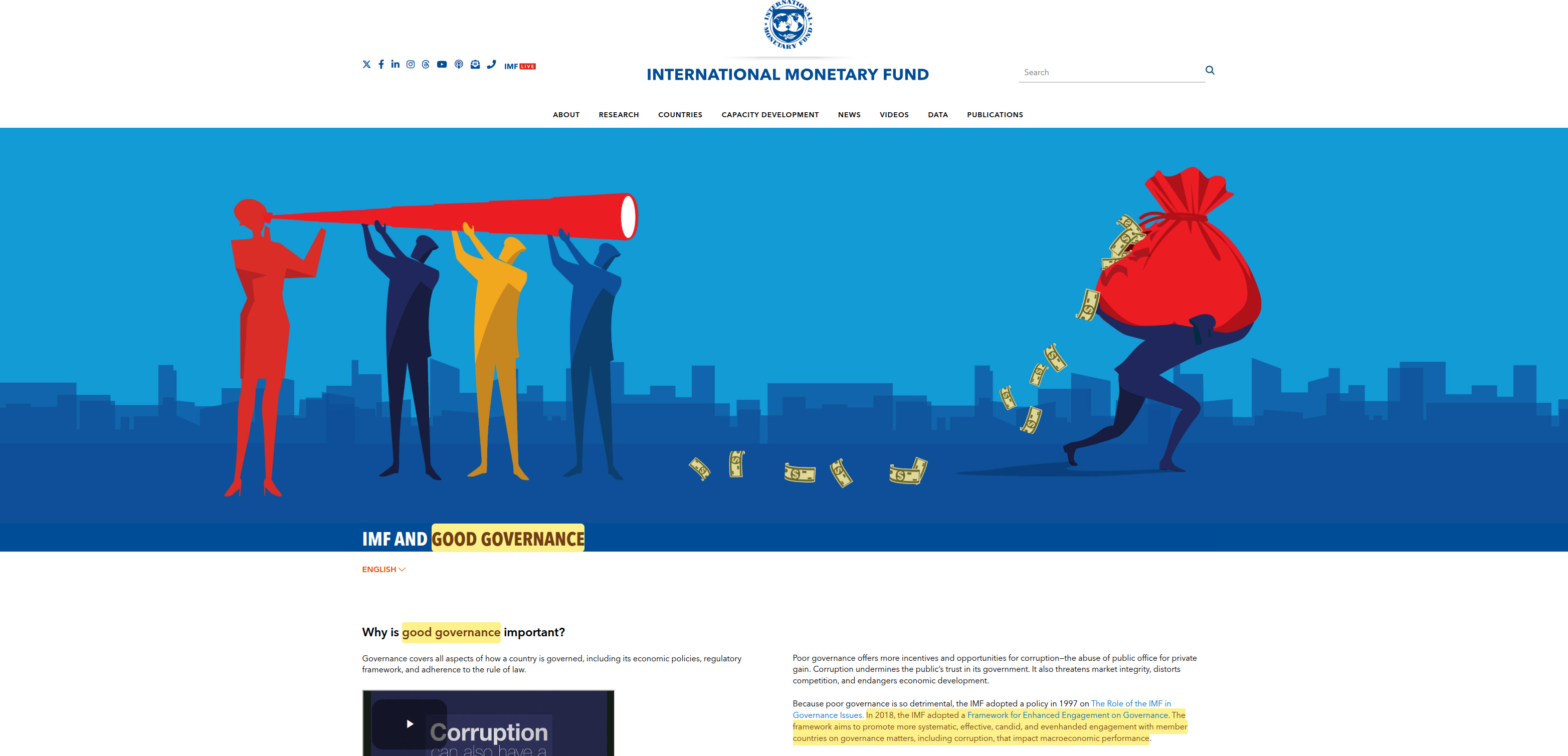
By the late 1980s the postwar regime had become a conditional-access machine. The Marshall Plan logic — aid conditioned on plans and metrics — was institutionalised through BIS/EPU → IMF → World Bank, with OECD statistics and McNamara-era planning (PPBS → results frameworks) as the measurement spine. The same gating used to ration Marshall aid migrated to the Global South: country strategies, policy matrices, structural adjustment, rolling reviews. Access to dollar/euro liquidity, trade preferences, and development programmes increasingly ran through those dashboards.
Metrics stopped being descriptive — they became eligibility switches.


Then the machine environmentalised. From the 1960s and 70s onward — ‘Spaceship Earth’, the 1968 UNESCO Biosphere Conference, and US–USSR scientific cooperation (formalised in 1972 and followed by IIASA) — governance began to rely on planetary monitoring: emissions, land use, biodiversity, water stress, air quality. This blended administrative reporting with satellite observation and integrated models, an initiative foreshadowed by Daniel Patrick Moynihan’s 1969 call for NATO to run global environmental surveillance22.


Brundtland23 (1987) → Rio ’92 mainstreamed ‘sustainable development’, while the Earth Charter and a rising sustainability narrative lent those metrics a ‘planetary ethic’ moral force — from Hans Küng’s 1993 ‘Global Ethic’ to the Parliament’s 1999 ‘Call to Our Guiding Institutions’; and David Tàbara’s cultural frameworks offered a specialised instantiation in the idea of ‘sustainability culture’.


Finance and trade wired themselves to them via environmental management standards, carbon accounting, cap-and-trade/offset schemes, and later ESG-style screens and border adjustments. Once money and legitimacy flowed through environmental dashboards, routinely refreshed by stocktakes and peer benchmarks, the system had everything it needed for automaticity — which is where Part IV: recursive governance begins.


Part IV: Recursive Governance (2000s-Present)
The final transformation occurred when the system learned to modify itself. Instead of implementing fixed frameworks, expert committees began adjusting rules based on performance feedback in real time. What began as experts executing predetermined frameworks evolved into systems that modify their own objectives based on statistical feedback — governance that learns to govern itself.
Adaptive Management
The philosophical breakthrough came through Britain’s Political and Economic Planning organisation (PEP), founded in 1931, which pioneered permanent expert committees to monitor policy performance and recommend adjustments. This domestic prototype scaled through McNamara’s PPBS, which structured programme elements as self-contained units coordinated through their system environment rather than direct interaction — a recursive, holonic structure24 where local programmes mirrored national strategies, which in turn reflected global frameworks. By the 1990s, permanent expert committees and ‘epistemic communities’25 — transnational networks that set methods, adjudicate evidence, and rewrite rules mid-stream — had become the sociological infrastructure of adaptive management.
Climate stocktakes26, health protocols, and financial regulations now update automatically through rolling assessments.

Corporate Infrastructure
Platforms like Palantir27, Microsoft28, and Google29 function as the dashboards through which governance perceives and acts, but they also serve as the technical infrastructure processing the surveillance data that feeds conditional clearing mechanisms. Originally built for counterterrorism, Palantir’s platforms now serve as civic operating systems30 for health services, law enforcement, and financial oversight, embedding themselves into government data pipelines to become the medium through which surveillance data is transformed into compliance indicators. These platforms don’t just provide analytics — they operationalise the same conditional clearing logic that McNamara pioneered in PPBS, ensuring that programme elements, funding allocations, and policy implementations require clearance based on surveillance-derived performance indicators.
Microsoft's Planetary Computer, Google's AI sustainability platforms, and Amazon's government cloud services31 all function as custodians of digital sovereignty, but more specifically as the processing infrastructure for ISO-standardised surveillance data defined by OECD frameworks and modeled by institutions like IIASA32. These corporate platforms have become the technical backbone through which surveillance data is converted into performance indicators that determine conditional access to finance, services, and legitimacy. Trump's recently announced ‘Stargate’ project33 — a $500 billion AI infrastructure initiative34 — represents this logic at hardware scale: the physical computational backbone through which surveillance data is processed into governance decisions at planetary scale.

Six Enforcement Rails
Modern governance operates through synchronised mechanisms that activate during emergencies, but these mechanisms all depend on the surveillance-based conditional clearing infrastructure developed through McNamara’s PPBS. The rails reproduce the European Payments Union’s35 multilateral clearing logic at planetary scale — except now it is compliance with surveillance-derived indicators — not currency — that determines access:
Accreditation determines who can participate, based on ISO-standardised surveillance data processed through OECD analytical frameworks
Finance ties capital flows to ESG and SDG compliance scores derived from surveillance data and modelled by institutions like IIASA
Credentials link access to services to behavioural surveillance data processed through standardised indicators
Audit converts surveillance-derived targets into legal liabilities, making non-compliance detectable and financially ruinous
Data governance controls who can access the surveillance infrastructure and build alternative models that might challenge official metrics
Procurement locks supply chains to compliance requirements verified through standardised surveillance and indicator systems
This system scales the conditional clearing logic globally: just as PPBS programme elements could not proceed without meeting surveillance-derived performance thresholds, modern nations, corporations, and individuals increasingly cannot access essential services, capital, or legitimacy without passing through surveillance-based ‘indicator’ compliance filters.
The same institutions that standardised surveillance data (ISO), defined analytical frameworks (OECD), and provided modelling capabilities (IIASA) for development aid now serve the enforcement rails that condition participation in global systems.

Ukraine as Prototype
Reconstruction demonstrates all six rails operating simultaneously under emergency conditions, creating the world’s first national-scale demonstration of conditional sovereignty through comprehensive monitoring and compliance systems. EU accession negotiations require wholesale adoption of EU acquis and ISO standards across every sector — from agricultural certification to financial regulations — embedding accreditation requirements into the legal framework of the state itself. IMF, World Bank, and EBRD financial packages totalling over $100 billion are explicitly conditional on implementing digital governance reforms, anti-corruption measures, and transparency protocols that provide international oversight of domestic policy implementation36.


The Diia digital37 identity38 system represents the most advanced national digital credential infrastructure globally, combining legal identity, health records, educational certificates, financial access, and government services in a single platform that gates access to reconstruction benefits and international programmes — and it’s even being implemented outside of Ukraine39. Anti-corruption frameworks require blockchain-based tracking of all reconstruction funds, with third-party international auditing firms conducting real-time verification of expenditures, effectively making compliance with international standards a legal obligation backed by financial liability. ‘Digital twin’ reconstruction projects create comprehensive digital models of Ukrainian cities and infrastructure40, with standardised cadastres and registries that embed OECD data governance protocols directly into the physical rebuilding process. ProZorro, the mandatory e-procurement system now handling all government contracting, has been showcased by the World Bank and UNDP as global best practice, automatically encoding sustainability requirements, transparency obligations, and compliance verification into every reconstruction contract41.


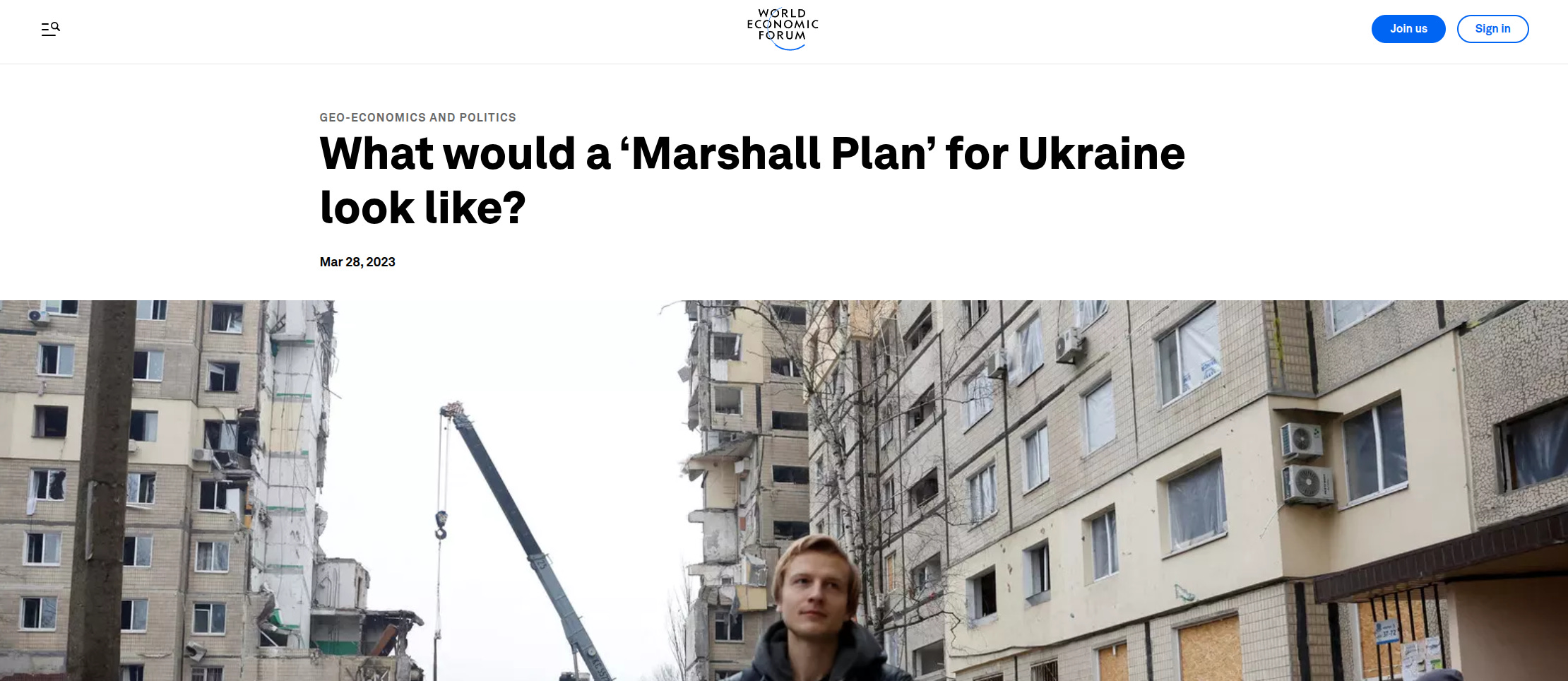
When EU leaders explicitly called for a ‘Marshall Plan for Ukraine’424344, the terminology signalled a conscious replay of the European postwar prototype: reconstruction aid designed to rewire sovereignty into conditional participation in international systems. Ukraine serves as the live integration test where all six enforcement rails operate simultaneously under emergency conditions, demonstrating how crisis creates the political space for implementing comprehensive conditional sovereignty that would be impossible to install gradually under normal democratic processes.
The reconstruction constitutes a national-scale experiment in planetary governance, where survival itself becomes conditional on embedding international monitoring and compliance systems into every aspect of state operation.
Three Operational Domains
The contemporary clearing system operates across three interconnected domains, each demonstrating how surveillance-based conditional clearing has evolved beyond McNamara’s original PPBS framework:
Climate Governance Automation: Carbon accounting now drives automatic trade adjustments through mechanisms like the EU’s Carbon Border Adjustment Mechanism45 (CBAM), with satellite emissions surveillance data feeding directly into algorithms that set offsets and investment priorities. Countries must implement Nationally Determined Contributions46 reporting systems that meet ISO-standardised surveillance protocols, with access to climate finance conditional on demonstrable performance against emissions-reduction indicators47. The same clearing logic applies: no compliance with surveillance-derived performance thresholds, no access to green development financing.
ESG Financial Integration: Investment flows are rerouted by sustainability scores embedded in global indices, with providers like MSCI and S&P updating inclusion rules according to ESG compliance derived from standardised surveillance data48. Sustainability-linked bonds hard-wire performance into debt servicing, with interest rates adjusting automatically against environmental and social benchmarks49 processed through the same ISO–OECD–IIASA surveillance infrastructure. Finance itself becomes a continuous compliance engine, reallocating resources based on surveillance-derived clearing decisions faster than governments can legislate.
Health Equity Clearinghouse: The WHO’s social determinants framework50, reinforced by International Health Regulations51 and pandemic treaty architecture, turns health into a universal clearing domain operating through Results-Based Management and KPI frameworks52. Compliance across social determinants — air quality, inequality, governance quality, vaccine coverage — now conditions access to health research funding, technology transfers, and pandemic-preparedness resources. Rolling ‘stocktakes’ revise obligations dynamically using surveillance data processed through standardised indicator frameworks, making participation in global health infrastructure contingent on meeting continuously updated performance thresholds derived from comprehensive population surveillance.
Together these domains demonstrate how the SDG framework, Aichi biodiversity targets, HDI rankings, and other contemporary indicator systems all function as clearing mechanisms:
Surveillance data → standardised indicators → performance thresholds
→ conditional access to finance, technology, and legitimacy.
The operational continuity from McNamara’s PPBS to modern RBM+KPI systems is direct and unbroken — the same conditional clearing logic now operates at planetary scale across every domain of human activity.


The Recursion Problem
Once governance begins optimising itself for continuity and efficiency, it can privilege the survival of its own metrics over human purposes. Goodhart’s Law53 operates at scale — indicators become targets that distort behaviour. Emergency parameters ossify into structural baselines.
We approach a governance singularity: a system optimised to preserve itself according to internal logic, increasingly insulated from human correction.

2025: The Orchestration Moment
Two institutional developments converge in 2025 to create the infrastructure for coordinating the six enforcement rails globally, transforming country-level prototypes into planetary governance mechanisms.
WHO Pandemic Agreement
Adopted at the World Health Assembly in May 2025, with national ratification processes determining effect54, the agreement establishes global health governance through ‘One Health’ frameworks that explicitly link human, animal, and environmental factors under unified oversight. This represents a fundamental expansion of health jurisdiction across all policy domains — agriculture, trade, urban planning, energy, and finance all become ‘health issues’ subject to international coordination and conditional access mechanisms. The agreement creates standing technical advisory groups empowered to declare health emergencies, recommend countermeasures, and coordinate resource allocation based on compliance with internationally standardised preparedness indicators.
The One Health approach operationalises comprehensive social-determinants monitoring that extends WHO authority into every aspect of national policy affecting population outcomes. Climate policies become health policies. Trade agreements require health-impact assessments. Financial systems must demonstrate contribution to health equity. Urban planning, education systems, and agricultural practices all fall under health oversight when linked to measurable population outcomes.
The agreement thus creates the legal and institutional framework for turning health into a universal clearinghouse domain, where compliance across social determinants conditions access to vaccines, research funding, technology transfers, and pandemic-preparedness resources.

The PABS Framework
Parallel negotiations on Pathogen Access and Benefit-Sharing55 (PABS) create the operational mechanism for the health-equity clearinghouse. The PABS agreement establishes that countries sharing pathogen samples and genetic-sequence data must receive ‘fair and equitable’ access to medical countermeasures developed from that information. This creates a global resource-allocation system where access to vaccines, treatments, and diagnostics is determined not by market mechanisms or bilateral agreements, but by compliance with internationally defined equity criteria and benefit-sharing obligations. Combined with the pandemic treaty’s One Health authority, PABS operationalises health equity as a conditional-access mechanism: countries that fail to meet pathogen-sharing obligations, equity benchmarks, or preparedness standards face systematic exclusion from pandemic countermeasures. The framework transforms health security from a matter of national sovereignty into a global compliance system where survival itself becomes conditional on adherence to internationally managed equity protocols.

UN Emergency Platform
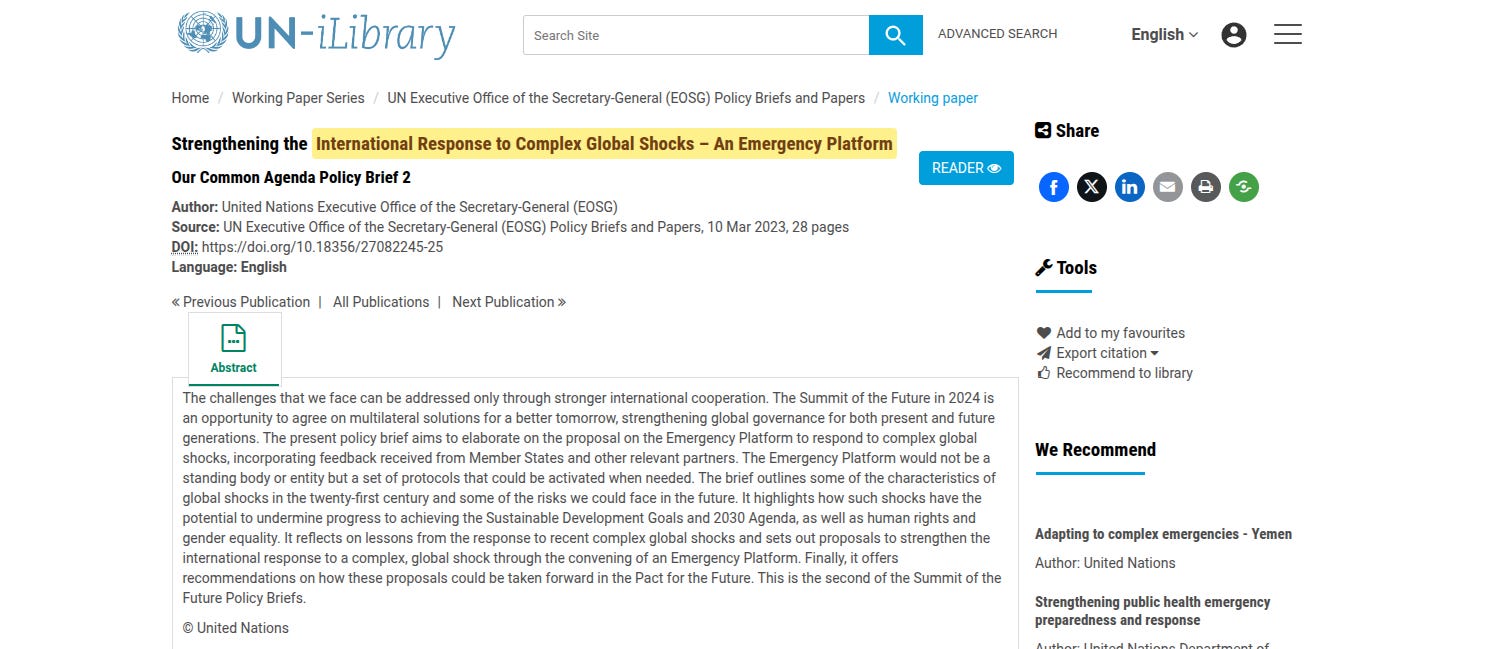
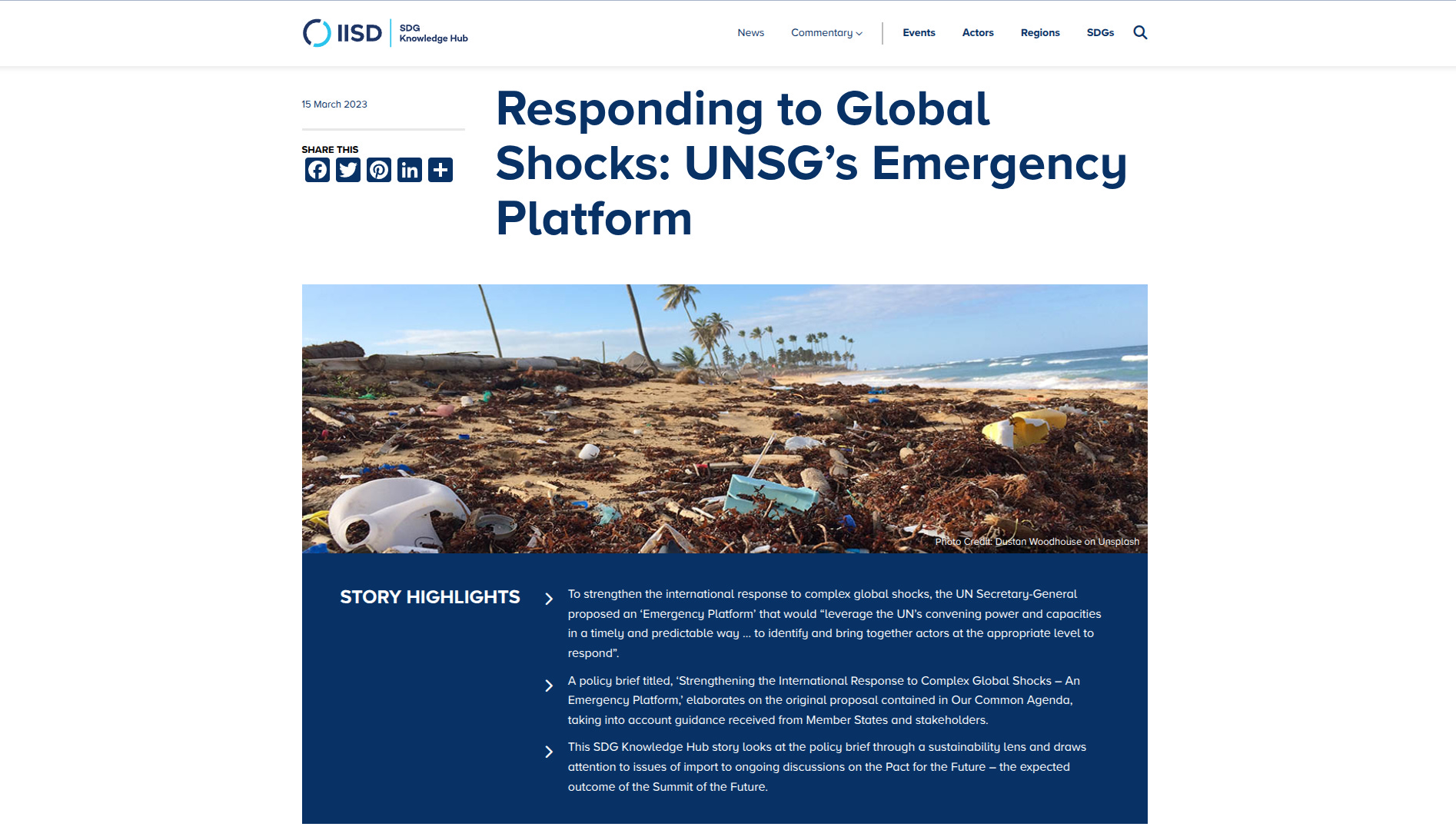
Advanced under the Pact for the Future track, the Platform provides a blueprint for a standing cross-rail crisis-coordination mechanism that member states can activate during declared ‘complex global shocks’56. The Platform functions as pre-positioned institutional infrastructure that compresses decision time and standardises responses across multiple governance domains simultaneously. Rather than improvising coordination during crises, it creates standing protocols that automatically engage the six enforcement rails when activated.
The Platform establishes permanent secretariat functions, pre-negotiated framework agreements, and standardised operational procedures that can be triggered rapidly without requiring new negotiations during crisis conditions. Technical working groups develop template guidance for accreditation standards, financial eligibility criteria, audit requirements, and procurement protocols that can be deployed immediately when shocks are declared.
The Platform builds institutional muscle memory for coordinated response that operates faster than democratic oversight mechanisms can respond. In this sense, it represents the culmination of a trajectory begun with McNamara’s PPBS and foreshadowed by Moynihan’s 1969 proposal for global environmental surveillance: conditional access scaled from defence and development into a permanent cross-domain emergency infrastructure.

Convergence Significance
The simultaneous operationalisation of expanded health jurisdiction and emergency coordination infrastructure creates the institutional foundation for implementing conditional sovereignty globally. The WHO agreement provides the substantive authority to declare that virtually any policy domain affects health outcomes and therefore requires international oversight. The Emergency Platform provides the procedural mechanism to coordinate rapid implementation of conditional access across all six enforcement rails when health emergencies are declared.
Together, these developments create the institutional infrastructure to scale the Ukraine prototype globally. Where Ukraine demonstrates conditional reconstruction under wartime emergency, the WHO-UN convergence creates the authority and mechanisms to implement conditional governance under health emergency declarations that can be triggered across multiple threat domains.
Climate disruption, cyber incidents, supply chain disruptions, migration flows, and financial instability — these all become potential ‘health emergencies’ requiring coordinated international response through the six enforcement rails.

The convergence enables continuous emergency governance through algorithmic threat assessment that operates beyond democratic challenge. Complex modelling systems can claim to identify cascading risks across any combination of health, climate, financial, and security domains, generating technical justifications for emergency activation that few can understand, let alone contest. When IIASA models predict that supply chain disruptions will affect nutritional outcomes, or when WHO algorithms determine that cyber incidents threaten health infrastructure, or when financial instability models show impacts on social determinants of health, emergency protocols activate automatically across all six enforcement rails. The technical complexity of these assessments — processed through black box algorithms using vast datasets — makes meaningful democratic oversight functionally impossible while providing seemingly objective justification for coordinated international intervention.
Meta-crises become self-generating through modeling systems that can always identify interconnected threats requiring emergency response, creating the institutional foundation for permanent emergency governance disguised as evidence-based crisis management.

From Prototype to Platform
The transition from country-level prototypes to global platforms represents the maturation of conditional sovereignty from experimental to operational. Ukraine serves as the integration test for mechanisms that can now be deployed globally through health-emergency declarations. The same standards alignment, conditional finance, digital credentials, audit requirements, data governance, and procurement compliance that condition Ukraine’s reconstruction can be activated everywhere simultaneously when ‘complex global shocks’ are declared.
The 2025 convergence creates standing authority and pre-positioned mechanisms that eliminate the improvisation and negotiation delays that have historically limited crisis-response coordination. Instead of building coordination mechanisms during emergencies, the infrastructure exists in standby mode, ready for immediate activation. This represents the institutionalisation of emergency governance as a permanent capacity rather than a temporary crisis response.
When a future ‘complex global shock’ is declared by the UN Security Council, the six enforcement rails will likely activate in coordinated fashion almost immediately.
What to Watch For:
Accreditation: New standards for participation
Finance: Revised lending criteria and ESG requirements
Credentials: Updated digital-ID or access requirements
Audit: New compliance obligations and liability standards
Data: Mandatory reporting or restricted-access rules
Procurement: Emergency contracting templates with embedded compliance
All of this will take place automatically: OECD-defined, ISO-standardised global surveillance data will be ‘digital twin’ modelled through IIASA, and a future ‘pandemic potential’ will be declared. An alarmist brief will be forwarded to the UN Security Council, which — following veto reform — will have the powers to issue global emergency declarations, calling for worldwide lockdowns and quarantines.


And no government can realistically resist, because refusal would ruin them economically. They would be cut out of the international financial system, with access to global supply chains frozen almost immediately.
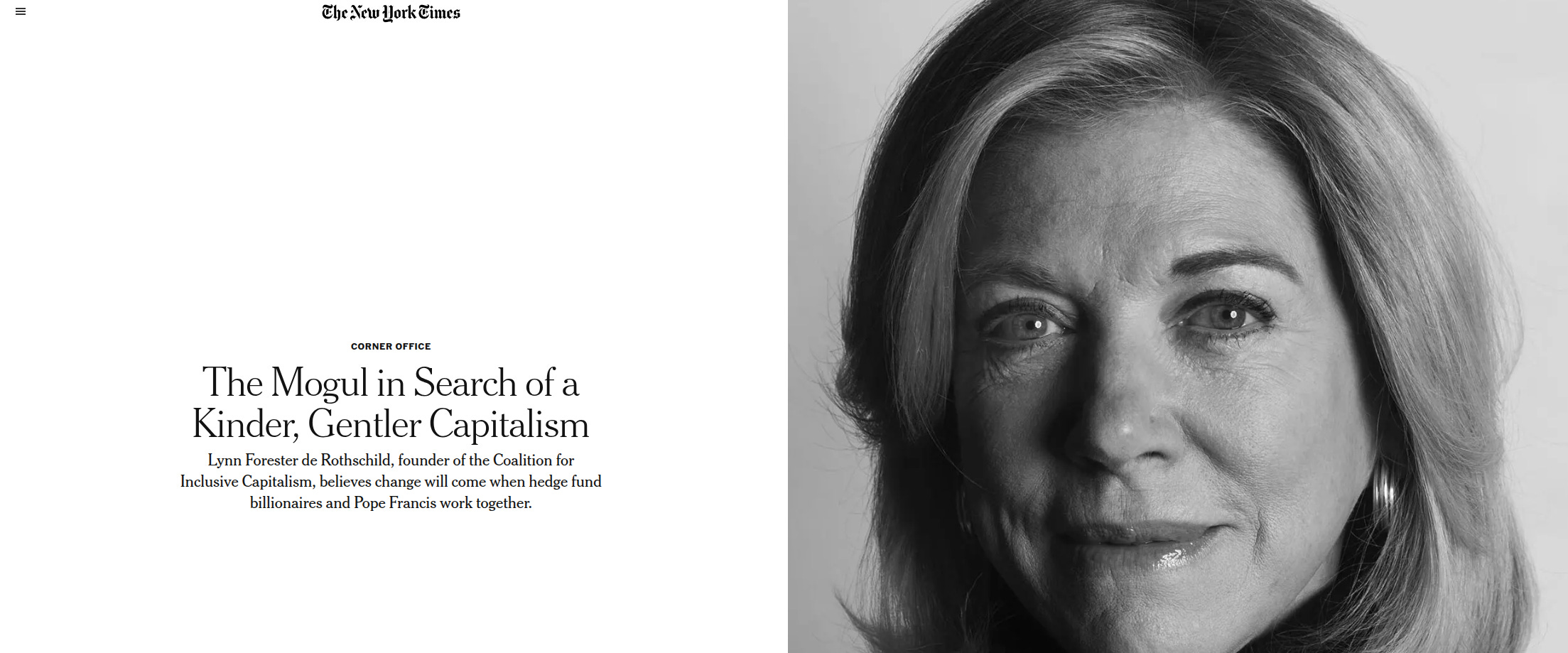
Yet precisely this model is what is marketed to the public as a kinder, gentler, more compassionate ‘inclusive capitalism’57.
A Pattern of Abuse
Faster cross-border coordination, reduced transaction costs, more consistent policy frameworks across jurisdictions — these are the hypothetical benefits of this system. Yet they come with enormous risks, which might be more easily tolerated were it not for the blatant disregard of laws so easily witnessed in the behaviour of contemporary politicians. Not least Ursula von der Leyen’s collaboration with Pfizer58, but also peripheral political actors such as Denmark’s Mette Frederiksen, whose illegal actions destroyed Danish mink farmers with impunity, and New Zealand’s Ardern government’s handling of internal affairs during the alleged pandemic59.

Broadly, four types of issue can be observed:
Accountability lag: Expert rule-changes outpace democratic oversight
Permanence creep: ‘Temporary’ emergency measures consistently ossify
Goodhart at scale: Hitting metrics replaces achieving real outcomes
Platform power: Corporate infrastructure gains quasi-governmental authority
Sovereignty itself is not technically abolished — it is routed through dashboards packed with arbitrary metric frameworks such as the SDG indicators, WHO Health Indicators, and Aichi biodiversity targets. States retain symbolic sovereignty while decisive authority migrates to expert networks managing global indicators and controlling financial penalties for non-compliance.
Yet none of the politicians ever bothered explaining this ‘new world order’60 to the people they were elected to represent. Perhaps this is the most damning thing of all: if their intentions were as pure as the driven snow, why the need to hide behind complex phrasing, opaque language, and Aesopian terminology?


The Research Spine
This might all perhaps sound far-fetched, and you might now attempt to find ways to intellectually discredit this thesis wholesale because the overall arc of what’s presented is as shocking as the case might be. However, in reality it’s an easily documented research path over the past several decades.
Recursive Governance
Michel Crozier61 (2007/2008) — ‘Recursive Governance: Contemporary Political Communication and Public Policy‘ provides a foundational analysis of how modern policy systems have evolved from linear command structures into multi-loop communication systems that continuously rewrite their own rules. Crozier demonstrates that contemporary governance operates through recursive feedback mechanisms, where information flows reshape both the actors and the institutional rules in the very course of governing. This matches exactly the ‘self-modifying operating system’ described in this analysis — where indicators do not merely measure performance but actively reconfigure the parameters of governance itself. Crozier’s work shows how authority migrates from upfront legislative commands to ongoing processes of peer review, rolling stocktakes, and continuous adjustment managed by expert networks. This provides the theoretical foundation for understanding how the UN Emergency Platform can function as a standing switchboard that updates its own operational protocols based on performance feedback during declared emergencies.
Charles Sabel and Jonathan Zeitlin62 document ‘experimentalist governance’ in the EU through provisional goals, peer review, and rolling revisions. Their analysis reveals how the EU has institutionalised continuous learning processes in which policies are designed to modify themselves on the basis of comparative performance data across member states. This experimentalist approach directly parallels the adaptive-management systems traced from Marshall Plan coordination through contemporary SDG frameworks — governance that treats policies as hypotheses to be tested and revised rather than commands to be executed. Sabel and Zeitlin show how this creates ‘regulatory networks’ capable of adjusting standards, benchmarks, and compliance requirements in real time in response to systemic feedback.
Jan-Peter Voß, Darren Bauknecht and René Kemp63 analyse ‘reflexive governance’ for sustainability, in which indicators function as steering wheels rather than passive dashboards. Their work shows how metrics actively direct policy adjustments through automated feedback loops that update objectives, methods, and success criteria. This research provides crucial evidence for how climate governance, ESG finance, and biodiversity frameworks can operate as clearing mechanisms that automatically adjust access to resources on the basis of performance against continuously updated indicators.
Standards and Indicators
Michael Power’s64 ‘The Audit Society’ shows how audit practices manufacture ‘official’ reality and create ratchet effects that render temporary oversight permanent. He demonstrates that audit systems do not simply verify existing performance — they actively reshape organisational behaviour by defining what may be measured, compared and validated. His work traces how audit obligations convert soft guidance into hard constraints through liability exposures, insurance conditions and regulatory enforcement. This directly supports the analysis of ‘Rail 4’ (audit obligations) in the enforcement architecture: verification requirements embed compliance into contractual terms, regulatory regimes and liability structures, effectively converting sustainability targets into enforceable commitments.
Davis, Kingsbury & Merry’s65 ‘Indicators as a Technology of Global Governance‘ show how indicators operate as ‘quasi-law’ that travels via lending, trade and rankings without formal legal authority. Their research explains how indicators acquire governing force by becoming embedded in funding decisions, eligibility screens and reputational mechanisms that condition access to resources and legitimacy. This provides direct academic support for understanding how SDG indicators, ESG scores and other metric frameworks function as clearing mechanisms — automatically routing access to finance, trade and development assistance on the basis of performance against standardised measures.
Brunsson & Jacobsson’s66 ‘A World of Standards’ document how technical standardisation creates lock-in through harmonisation processes that make non-compliance economically costly. They show how standards bodies act as ‘quiet governors’, exercising regulatory authority through technical specifications that become woven into supply chains, procurement requirements and market-access conditions. This explains how ISO standards, OECD frameworks and similar specifications operate as enforcement mechanisms within the six-rail architecture: standardisation builds automatic exclusion mechanisms for non-compliant actors while presenting itself as purely technical rather than political.
Algorithmic Regulation
Rouvroy & Berns67 analyse 'algorithmic governmentality' — governance through continuous datafied prediction that operates 'without a subject but not without a target'. Their research shows how algorithmic systems create governance 'without a subject but not without a target', automatically routing access, pricing, and scrutiny based on risk profiles generated from behavioural data rather than conscious policy decisions. This work directly explains how the enforcement rails can operate through 'black box' mechanisms that automatically adjust access to finance, credentials, and procurement opportunities based on algorithmic processing of compliance data.
Karen Yeung68 provides formal definitions of ‘algorithmic regulation’ as monitor→compare→actuate loops. Yeung's work shows how algorithmic systems can implement governance functions through continuous feedback loops that adjust incentives, access, and opportunities faster than human oversight mechanisms can respond. This research explains how contemporary clearing systems can process monitoring data through standardised indicators to automatically trigger changes in finance routing, accreditation status, and procurement eligibility without requiring explicit policy decisions.
Sascha Lorenz’s69 ‘Machine-learning algorithms in regulatory practice‘ documents machine-learning systems already embedded in regulatory practice for screening, enforcement, and early warning across multiple jurisdictions. Lorenz's research demonstrates that algorithmic regulation is not hypothetical but operational infrastructure already processing regulatory decisions in real time across finance, health, environment, and trade domains. This work provides crucial evidence that the monitoring-based clearing mechanisms described in this analysis are already functional rather than speculative: machine-learning systems are currently processing compliance data to automatically route regulatory attention, enforcement actions, and access to government services.
Systems Architecture
Espinosa & Martínez-Lozada70 (2025) operationalise the Viable System Model as a practical framework for recursive, nested governance, demonstrating how the monad/input–output logic can be implemented as functional organisational architecture. Their work shows how viable systems maintain autonomy at each level while being systematically coordinated through shared information flows and regulatory mechanisms that operate across multiple hierarchical levels simultaneously. This research provides the systems-theoretical foundation for understanding how the six enforcement rails can operate as a coherent architecture: each rail functions autonomously while being coordinated through shared monitoring data and indicator frameworks that ensure systemic coherence.
Computational ethics71 research explores how normative constraints can be formalised into algorithmic decision-making systems. This work provides the conceptual bridge from 'standards and audits' to algorithmic enforcement of compliance requirements, showing how ethics frameworks can be converted into machine-readable protocols that operate automatically within procurement, finance, and access control systems. This research shows how the enforcement rails can operate as 'moral machines' that embed value judgements into technical infrastructure while appearing to be neutral administrative mechanisms.
Historical Design Foundations
CFR War & Peace Studies72 (1939-45) provide documented blueprints for post-war global governance developed through Rockefeller-funded research programmes. These studies demonstrate that the post-war institutional architecture was not improvised but systematically planned by expert committees that drafted specific organisational charts, funding mechanisms, and operational procedures for global bodies years before they were formally created. The War & Peace Studies offer crucial evidence of a ‘Plans Division’ mentality: elite networks acting as institutional architects to produce coherent blueprints for governance to be executed through expert coordination rather than democratic mandate.
RIIA/Chatham House monetary reports (1931–35) normalised managed money and multilateral clearing mechanisms during the interwar period. The reports show how British elite networks systematically developed alternatives to the gold standard that would enable expert management of international monetary systems through technical coordination rather than market adjustment or direct democratic control. The RIIA monetary studies provide evidence for the deliberate construction of conditional-finance mechanisms as tools of governance: currencies and credit administered by committees empowered to set conditions for access to international liquidity.

UNCTAD ‘Combating Global Warming’ shows how environmental metrics became wired into markets and financial systems through systematic research programmes. This research demonstrates the deliberate construction of indicator-driven climate policy that could operate through market mechanisms rather than command-and-control regulation — laying the foundations for contemporary carbon border adjustments, green-finance taxonomies, and climate conditionality that automatically routes resources based on environmental performance data. This work shows how academic research programmes systematically built the technical infrastructure for environmental governance via conditional access rather than direct regulation.

Democratic Safeguards?
A common response is that rather than opposing this system entirely, we could propose procedural checks that preserve its coordination benefits while preventing authoritarian drift — because ‘the system really does address genuine issues’.
Well, indeed, we could introduce the following:
Sunset Provisions: Emergency protocols require periodic re-authorisation with explicit sunset dates.
Indicator Transparency: Public registries documenting who sets metrics, the rationale for changes, and performance data.
Meta-Audit: Independent oversight of the institutions that audit compliance — auditing the auditors.
Model Discovery: Open-data requirements allowing independent researchers to build counter-models and challenge official metrics.
Procurement Transparency: Public disclosure of compliance requirements embedded in supply-chain contracting.
Due Process: Appeals mechanisms for digital-credential exclusions or compliance determinations.
Granted, these steps would progress us towards making the system democratically accountable. However, they wouldn’t technically stop adaptive management. Yet, none of these will be up for debate for the very same reason it has never been debated in the first place:
You’re not supposed to know.

The Seven Rays of Technocratic Inversion
For those who want to see how this architecture also resonates with esoteric traditions, consider Alice Bailey’s Seven Rays framework73, which provides a diagnostic lens for understanding how the six enforcement rails plus emergency orchestration operate as a complete constitutional architecture.

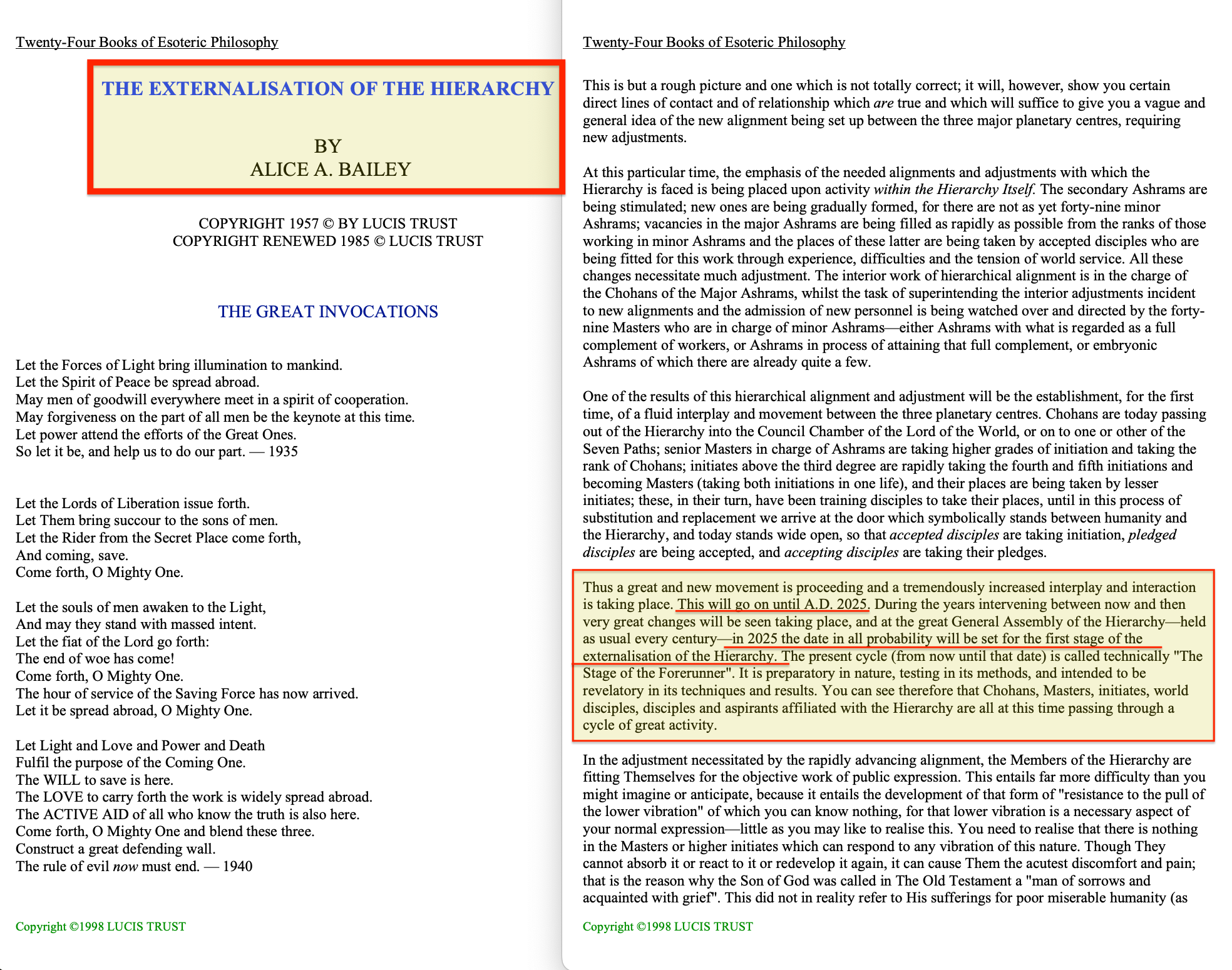
Bailey’s theosophical writings, spanning 1919–1949, described seven fundamental energies that would eventually ‘externalise’ through world institutions around 202574. When viewed through technocratic inversion — the systematic conversion of spiritual ideals into administrative control mechanisms — Bailey’s Seven Rays align closely with contemporary governance architecture.
Ray 1 (Will/Power) corresponds to emergency authority and the sovereign capacity to command. Bailey described this as ‘the will-to-power’ that ‘conditions all governmental activity’. In technocratic terms, this is the ability to declare emergencies, suspend normal processes, and activate conditional mechanisms across all domains. The UN Emergency Platform exemplifies this ray’s expression — the institutionalised power to decide when a global ‘complex shock’ exists and to trigger coordinated response.
Ray 2 (Love–Wisdom) inverts into accreditation and credentialling systems. Bailey characterised this as ‘inclusive love’ that determines ‘right human relations’. Technocratically, this becomes the authority to decide who is legitimate to speak, research, or participate. Accreditation bodies, academic institutions, and professional certification systems operationalise this energy as protective paternalism — determining who may enter the halls of expertise.
Ray 3 (Active Intelligence) manifests as data governance and modelling authority. Bailey described this as ‘intelligent activity’ that ‘adapts the form to the life’. In governance terms, this is the power to decide what can be known, measured, and modelled. The ABS protocol for data and pathogen sharing, together with the ISO–OECD–IIASA pipeline for processing monitoring data into actionable intelligence, exemplifies this ray — the authority to define reality through standardised measurement and algorithmic processing.
Ray 4 (Harmony through Conflict) operates through procurement systems that metabolise tension into compliance. Bailey saw this ray as creating ‘beauty through conflict’ and ‘harmony through struggle’. Technocratic inversion turns this into supply-chain management that resolves competing interests through universal requirements. E-procurement systems like ProZorro show how conflict between suppliers is harmonised through standardised bidding and sustainability rules.
Ray 5 (Concrete Knowledge) functions through audit and assurance systems that harden metrics into enforceable truth. Bailey described this as ‘scientific method’ and ‘practical mysticism’. In governance, this is the power to determine what counts as verified reality through audit protocols and assurance frameworks. The conversion of sustainability targets into legal liabilities exemplifies how knowledge becomes binding obligation.
Ray 6 (Devotion/Idealism) channels through ESG mobilisation and SDG frameworks that convert moral energy into quantifiable performance metrics. Bailey characterised this as ‘devotional service’ and ‘idealistic dedication’. Technocratically, this is the systematic quantification of noble purposes — turning care for environment, society, and justice into measurable targets that condition access to capital and legitimacy. Digital-identity systems extend this logic by linking compliance to individual and institutional access. Ukraine’s Diia platform demonstrates the most advanced live example, where benefits and programmes are gated by digital credentials tied to compliance frameworks. The 234 SDG indicators represent devotional energy converted into administrative metrics.
Ray 7 (Ceremonial Order) expresses through the harmonisation of all domains into a single architecture. Bailey described this as ‘ordered rhythm’ and ‘magical organisation’ — the reconciliation of opposites through ritual order. In technocratic terms, this is the financial clearing system that integrates diverse indicators, policies, and crises into one conditional-access framework. Central-bank coordination through the BIS, where liquidity decisions reconcile contradictions across trade, climate, health, and security, exemplifies this ray — the ceremonial order that binds the system into a functioning whole.


The 2025 Convergence
Sure, this is speculative — but the alignment is real enough to consider. Bailey’s framework explicitly projected 2025 as the moment of institutional ‘externalisation’, and the parallels between her esoteric Rays and today’s enforcement rails are too close to dismiss as a coincidence. At minimum, the mapping shows how technocratic governance reproduces archetypal patterns of authority — whether by conscious design or structural inevitability.
And — though contestable — the otherwise reliable Henry Lamb argued at length that the Theosophical Society and its offshoot networks exerted outsized influence in American administrations75, mapping overlapping memberships, foundation ties, and consultative roles to claim that esoteric currents migrated into policy circles and the rhetoric of ‘global governance’ — whether or not one accepts his conclusions in full.
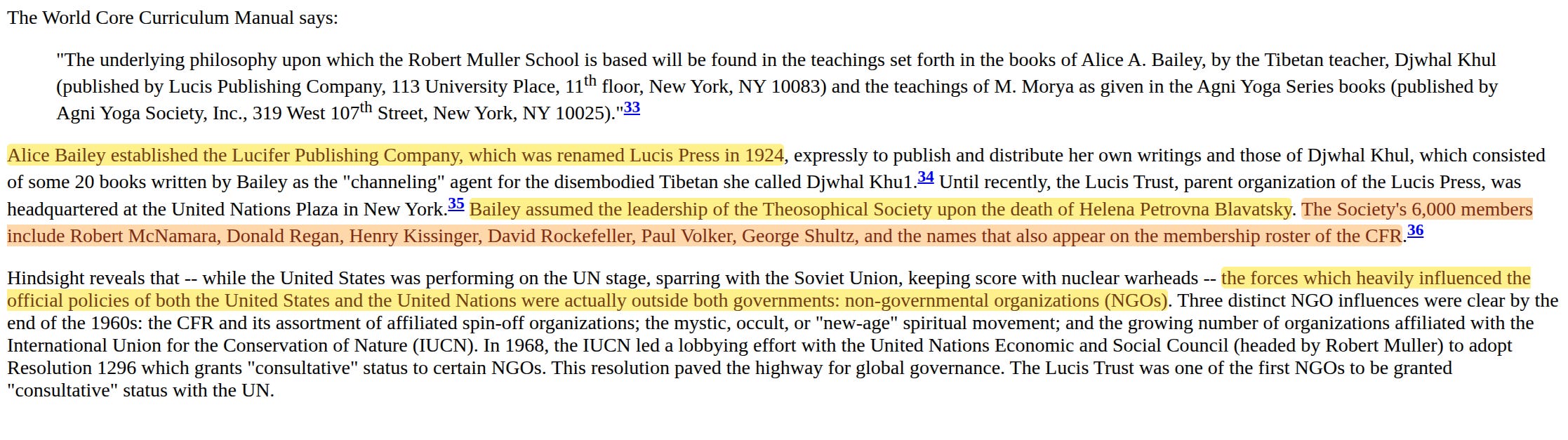
Bailey assumed the leadership of the Theosophical Society upon the death of Helena Petrovna Blavatsky. The Society's 6,000 members include Robert McNamara, Donald Regan, Henry Kissinger, David Rockefeller, Paul Volker, George Shultz, and the names that also appear on the membership roster of the CFR
The reason it’s contestable is because Bailey left the Theosophical Society in 192076. However, there are other sources77 connecting McNamara78, including a declassified CIA memo connecting him with the ‘Temple of Understanding’79 , commonly connected to the Lucis Trust and the United Nations8081. However, we do struggle with primary sourcing here, because these organisations are typically highly secretive.
Regardless, while we discussed McNamara above in context of implemented the Planning–Programming–Budgeting System (PPBS) at the US Department of Defense, Kissinger and Rockefeller hardly need introduction.

But let’s briefly revisit the rays again, because perhaps we don’t need to interpret through a technocratic inversion:
Ray 1 – Will, Purpose, or Power
Bailey: the Will of Deity, the force that conditions all government and leadership.
Interpretive gloss: the controller, the architect, the raw executive energy that compels action.Ray 2 – Love–Wisdom
Bailey: the energy of inclusive love, shaping right human relations.
Interpretive gloss: the pedagogy of obedience — learning to follow, presented as care.Ray 3 – Active Intelligence
Bailey: the intelligent use of form-building, all creative effort to reveal divine purpose.
Interpretive gloss: hierarchical organisation, the structuring of complexity into ordered systems.Ray 4 – Harmony through Conflict
Bailey: beauty through struggle, the refinement of form by opposing forces.
Interpretive gloss: dialectics — oppressor vs. oppressed, conflict resolved through synthesis, the seed of “third systems” often mediated by NGOs.Ray 5 – Concrete Knowledge or Science
Bailey: scientific method, practical mysticism.
Interpretive gloss: scientism — the hardening of method into dogma, truth defined by technique.Ray 6 – Devotion or Idealism
Bailey: the energy of service and dedication to higher causes.
Interpretive gloss: rhetorical zeal, the salesmanship of ideals, often conveyed through Aesopian phrasing that mobilises loyalty.Ray 7 – Ceremonial Order
Bailey: ordered rhythm, ritual integration of spirit and matter.
Interpretive gloss: the balancer of light and shadow, material and spiritual — in Masonic symbolism, the 33rd degree as described by Albert Pike, the reconciler of opposites through ritual order.
Read as a sequence, the architecture begins with the executor’s will (1), then legitimises that will through ‘science’ (5). Having claimed method, it seeks to balance light versus shadow through ‘ceremonial order’ (7), and processes conflict through dialectics (4). The outcomes are then fixed into a hierarchy (3), in which those who do not lead are trained to follow (2) and, finally, to display obedience and devotion (6).
Will → claims Science → wraps in Order → absorbs Conflict
→ locks Hierarchy → trains Followership → demands Devotion.
In short — scientific socialism implemented through a clearinghouse, with economics as the unit of account.
This further appears to align remarkably with contemporary trisectoral networks: public and private actors feuding in the open, mediated by civil-society organisations — notably ECOSOC-registered NGOs with General Consultative Status in the UN system — which function as an administrative hinge, integrating ‘international social justice’ through economic mechanisms much as Zimmern envisaged. It also echoes the Fabian Society’s ‘In Tandem’ pamphlet: integrating fiscal policy with monetary oversight under an EPCC-style planning council, effectively shifting macroeconomic control away from the taxpayer and towards the Bank of England and its clearing arrangements, justified by (commonly foundation-funded) NGOs promoting favours of social, environmental, and intergenerational justice.
The 'ceremonial order' finally aligns with Albert Pike's account in Morals and Dogma: the Scottish Rite's 33rd degree is cast as the restorer of universal equilibrium82. And — purely by coincidence — 1993 saw the restoration of the Grand Priory of England after nearly 450 years in abeyance83; the year Hans Küng published 'A Global Ethic', later developed by Leonard Swidler's 1995 elaboration emphasising the balance of rights and responsibilities being the middle layer leading to said ‘Global Ethic’.
Oh, and did I mention that Kung posthumously earned a ‘Culture Award of German Freemasons’ For a Lifetime of Service to 'the Craft'84, and that Swidler’s basic layer is highly similar to collectivism?


Bailey’s tradition identified 2025 as the year of ‘externalisation of the hierarchy’ — when esoteric principles would surface through world institutions. The convergence of the WHO Pandemic Agreement and UN Emergency Platform can be read as the institutional materialisation of that forecast: what Bailey framed as enlightened world government appears, in practice, as adaptive governance systems that continually adjust themselves through expert oversight and algorithmic feedback.


Diagnostic Value
This framework clarifies why technocratic governance feels constitutional rather than merely bureaucratic. Each enforcement rail operationalises a fundamental archetype of legitimate authority — power, wisdom, intelligence, harmony, knowledge, devotion, and order. The system’s effectiveness lies in its ability to invoke these deep patterns of legitimacy while at the same time inverting their expression into control mechanisms that operate beyond democratic oversight.
Bailey’s Rays were not presented as a fixed sequence but as parallel archetypes. Yet they map onto a governance cycle that mirrors the logic of the financial clearinghouse: will asserts command, knowledge legitimises, order reconciles, conflict refines, hierarchy structures, obedience follows, and devotion sustains. In their inverted form, these same Rays also align with the technocratic enforcement rails — emergency power, data governance, credentialling, procurement, audit, finance, and ESG mobilisation.
This dual alignment — the archetypes in their original form and their inverted technocratic expression — helps explain why the system delivers real coordination benefits while also producing deep democratic deficits. It draws from archetypes of authority, but locks them into institutions that concentrate decision-making instead of sharing it.
But even without the esoteric framing, the parallels are clear: what we are looking at is a constitutional architecture of governance, operating in plain sight.

Conclusion
From Marshall Plan aid-with-strings to a self-updating governance operating system, the transformation is complete. The visible bridges built cooperation; the hidden rails created dependencies; global scaling embedded indicators everywhere; recursive governance made the system self-modifying.
Ukraine shows the trajectory most clearly: reconstruction under emergency conditions embeds all six enforcement rails, turning sovereignty into a performance function of compliance metrics. What is framed as rebuilding is in fact a national-scale pilot for planetary governance, one likely to be rolled out through the UN’s future Emergency Platform, and activated by Security Council mandate.
The next ‘complex global shock’ will tell us everything we need to know85.
Thanks ESC.This will go into the blog post I'm composing.
Here is a clear timeline of the evolution of the “Marshall Conditionality System” up to Ukraine:
1944–1950: Initial Phase – Marshall Plan and Europe
Marshall Plan (1948) – militarily and economically devastated countries received money only if:
they submitted recovery plans for international review,
shared economic data and coordinated policies across borders.
Three institutional bridges emerged:
1. Economic coordination (OEEC/OECD) – planning and regional statistics.
2. Legal integration (Council of Europe) – supranational courts, binding legal frameworks.
3. Security container (NATO) – political security and removal of military vulnerability.
Mechanism: independence only on paper, reality = structural dependence.
1944–1958: Hidden rails – conditional finance
BIS/European Payments Union – central bank coordination, regional (not national) monetary thinking.
IMF – emergency liquidity with political conditions.
World Bank – development loans conditional on measurable programs in health, education, social policy.
Result: countries had to play by central bank rules, USD/EUR denominations and expert-driven standards.
1960–1990: Global scaling
The template spread globally via UN, USAID, OECD.
McNamara revolution – Pentagon PPBS model → inputs → activities → outputs → measurable results.
World development indicators and GDP + WHO, UNDP, OECD, ESG indices → transformation of country performance into scorecards determining access to capital and trade.
Private finance integration – impact investing and ESG bonds have anchored conditionality in markets as well.
Crisis rotation – emergency mechanisms have become permanent controls.
2000–2025: Current operating system
Six enforcement lines: accreditation, finance, mandate, audit, data, procurement.
UN and WHO platform (2025) – permanent focal point for activating these mechanisms during complex shocks.
Ukraine – a living prototype of the system:
all six lines active simultaneously,
emergency conditions → test of global governance and conditionality architecture,
mechanisms interconnected, country performance directly determines access to money, trade and legitimacy.
Key lessons
1. Marshall Plan = conditional aid. Not philanthropy.
2. Conditionality has been globalized through the BIS, IMF, World Bank and UN.
3. Measurable indicators – the basis for legitimizing access to capital and trade.
4. Expert-driven system – minimal democratic control, the system is governed by rules set by experts and central banks.
5. Ukraine = testing ground – everything works simultaneously, the mechanism of global governance is activated during crises.