
Gaza 2026
An update to 'Project Sunrise'

The original December 2025 essay, Project Sunrise, argued that Gaza’s reconstruction is a deployment of the same governance template on display in Ukraine.
Every major prediction has been confirmed by later developments.
What has been confirmed
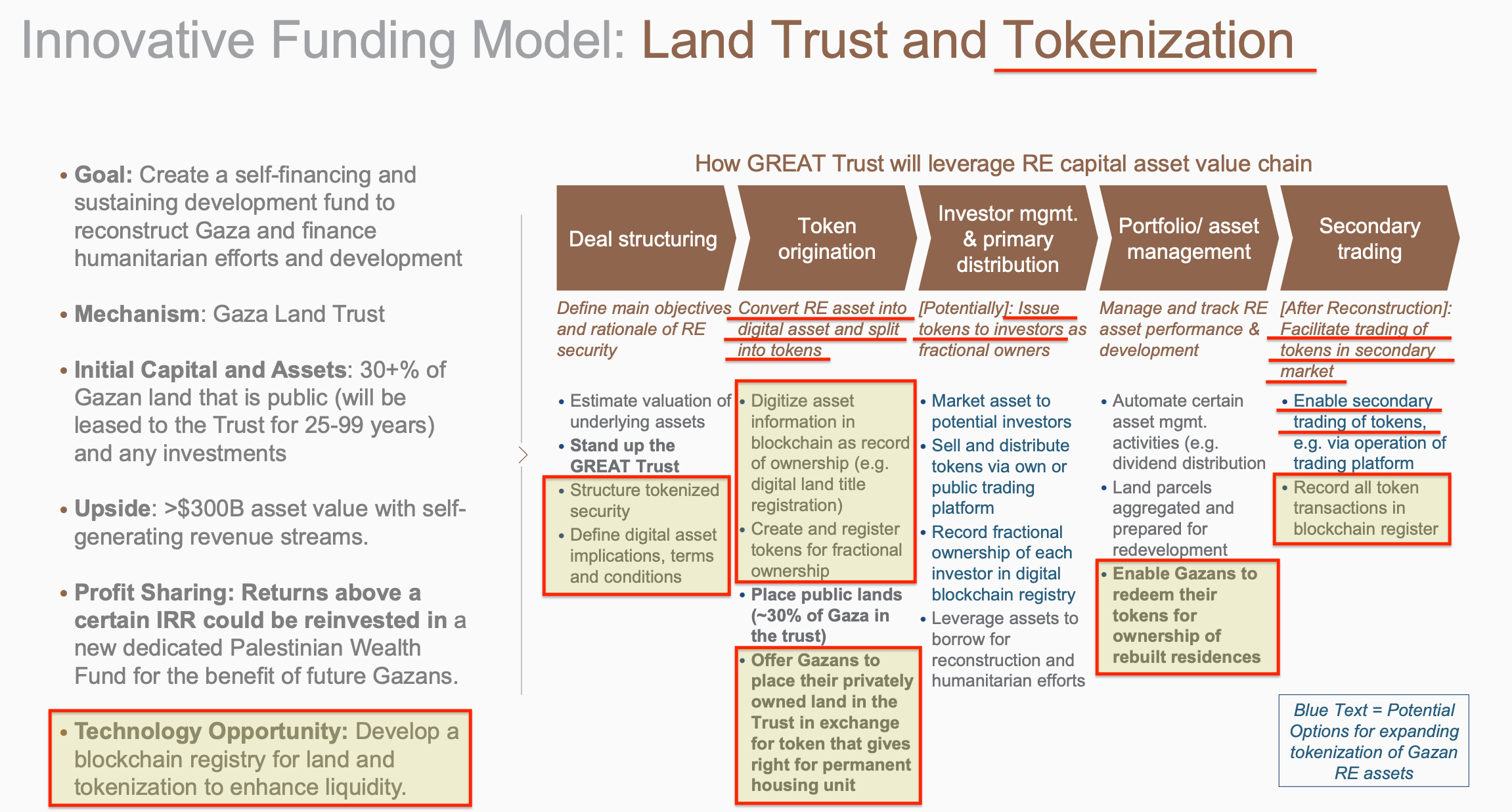
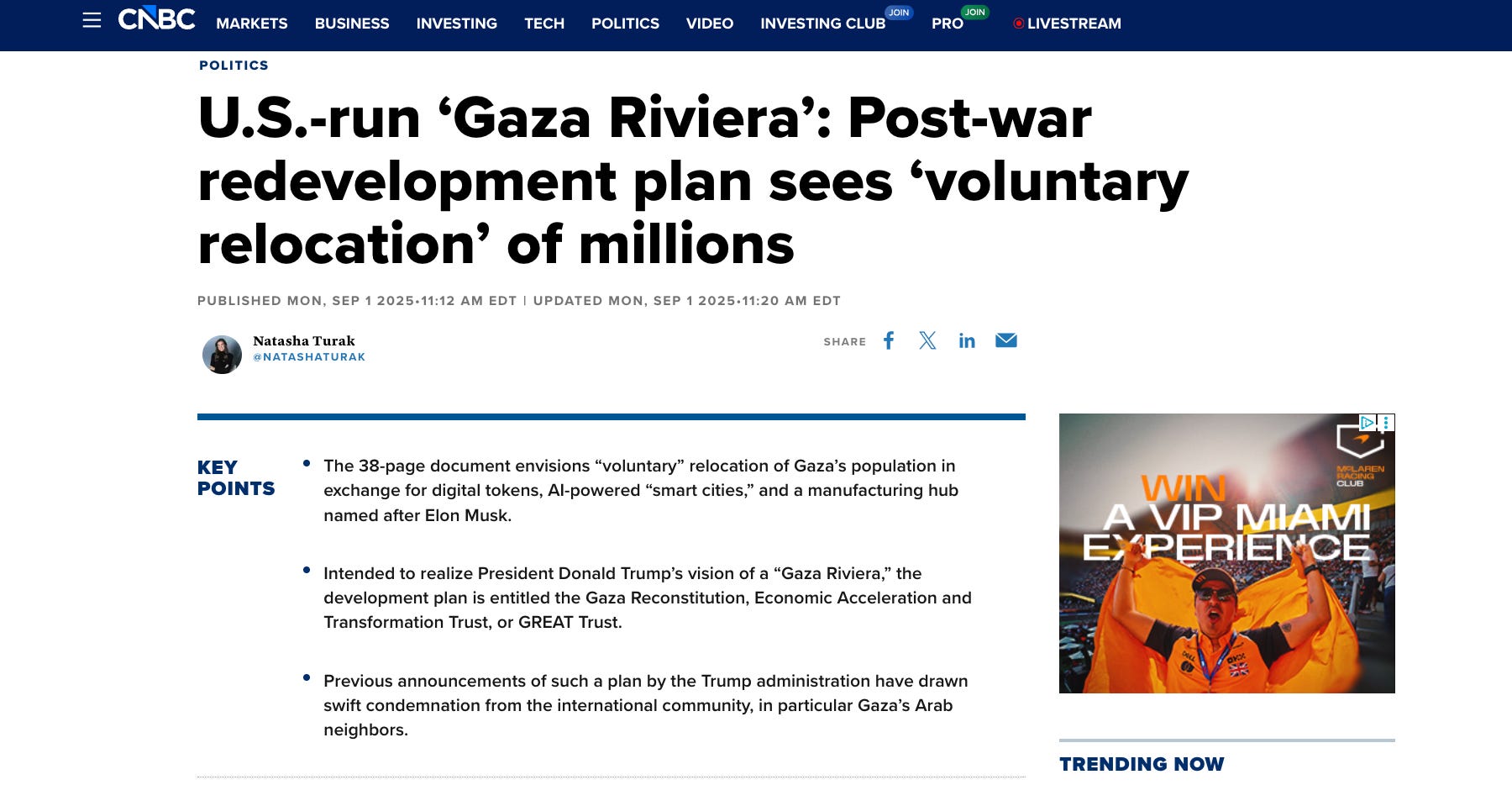
The token mechanism. The GREAT Trust plan1, reported by the Washington Post in early 2026, specifies that Palestinian landowners will receive digital tokens in exchange for their land rights. The tokens are redeemable for redevelopment rights, relocation abroad, or future apartments in planned smart cities.
This is conversion of ownership into conditional access — a ledger-mediated right whose value, validity, and redeemability are determined by the trust, not by the holder. A land deed is a legal instrument enforceable through courts, independent of any platform. A digital token exists on a ledger whose conditions are set by whoever governs the ledger. But conditions can change after issuance. The token can be made conditional on behaviour, linked to digital identity, or rendered non-transferable.
The holder does not control the tokenised asset. He merely has access rights which can be revoked should he not adhere to the conditions attached.

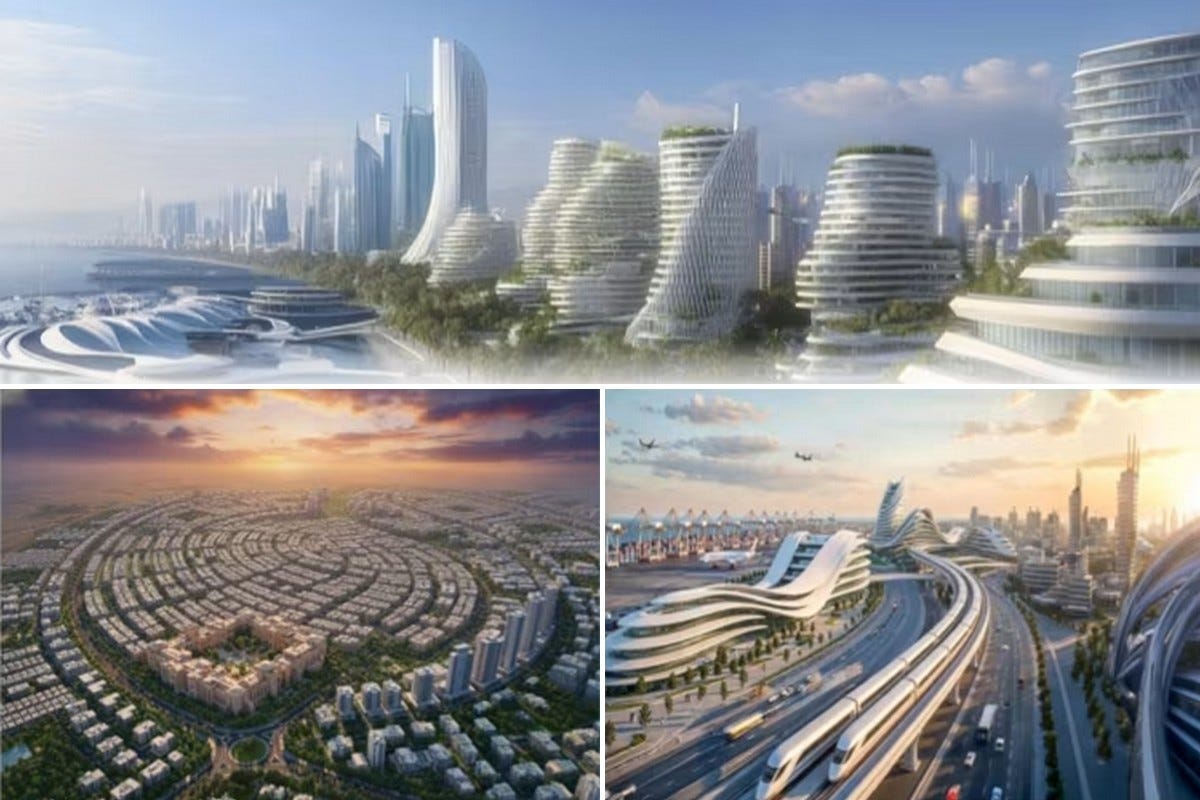
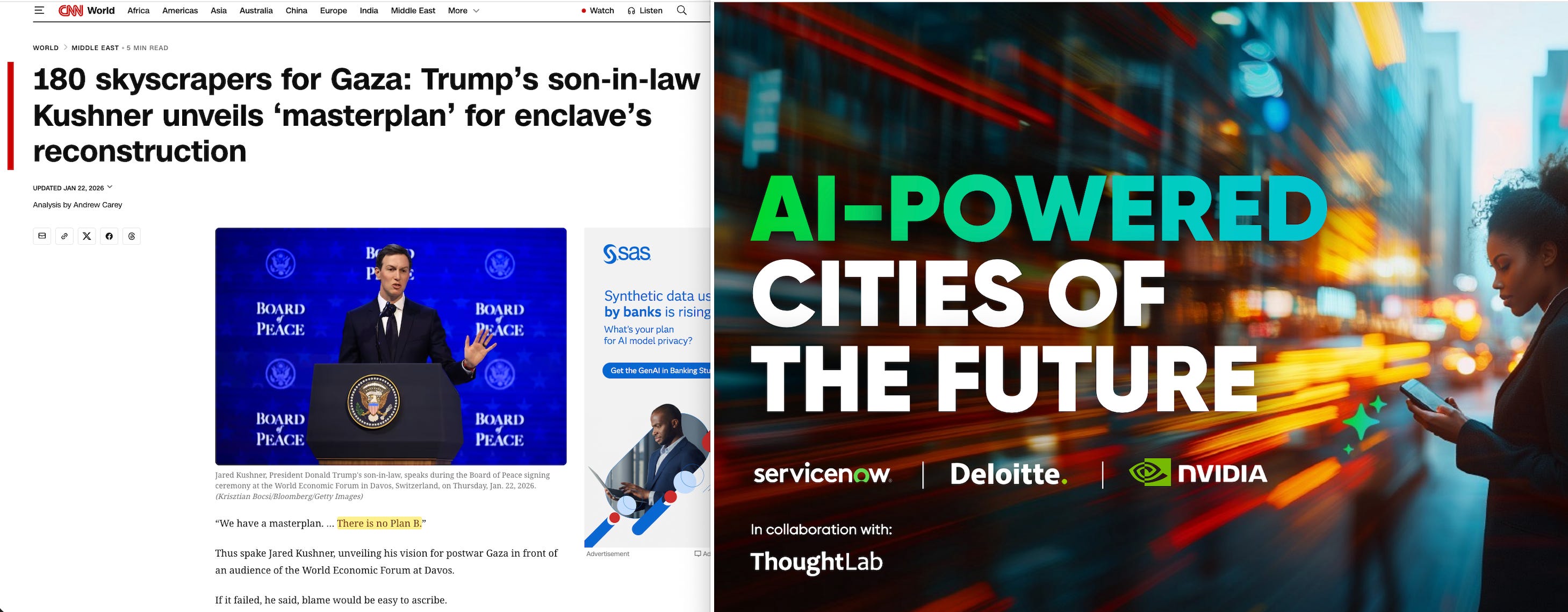
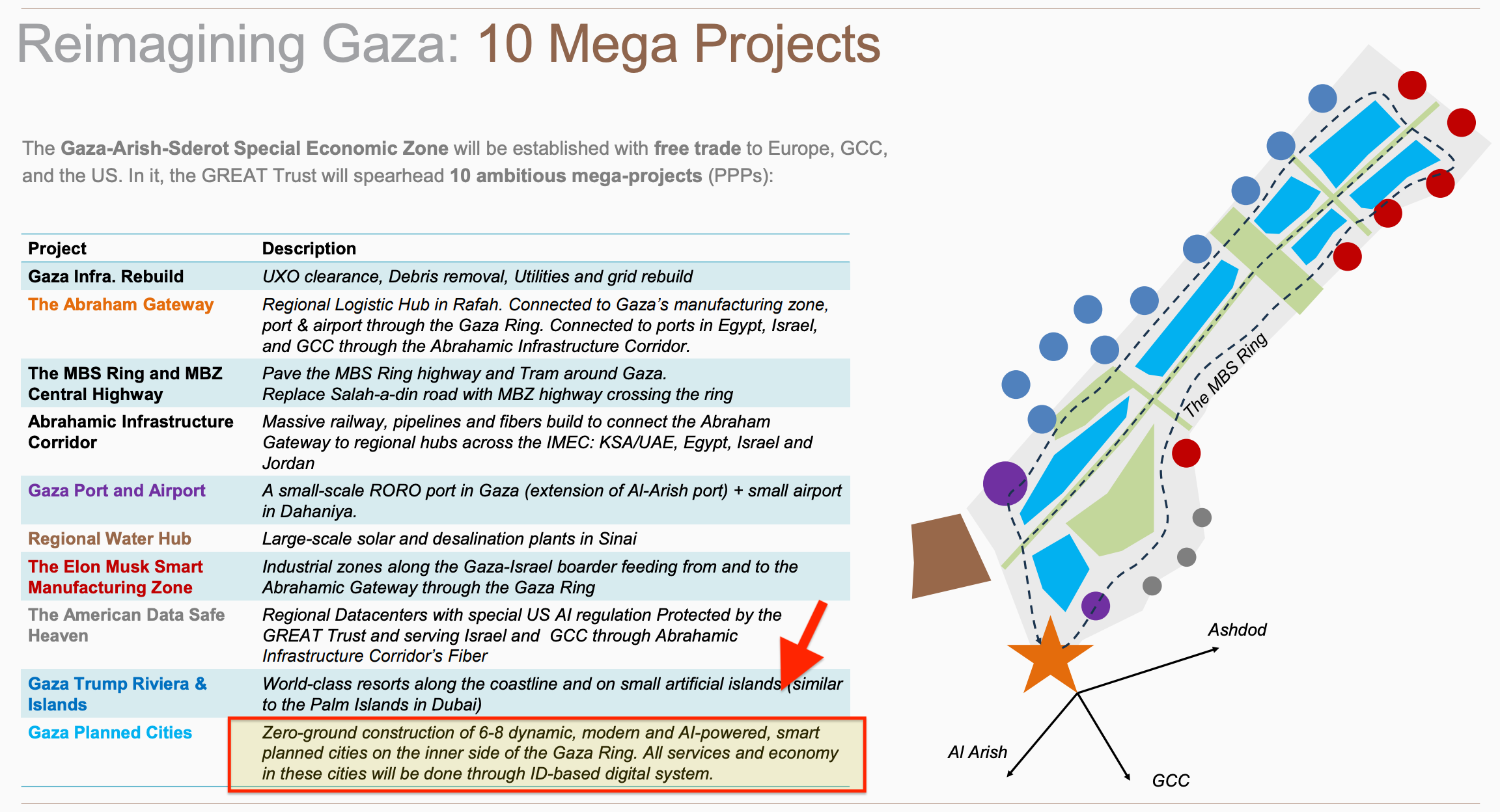
The smart city specification. Jared Kushner presented the full plan at the World Economic Forum in Davos in January 2026 — six to eight ‘AI-powered smart planned cities’23, 180 mixed-use towers on the coastline, data centres, high-speed rail, and a ‘chief digital office and innovation lab’.
The plan requires the total clearance of existing urban fabric. AI-generated renderings of a city that does not yet exist were presented to an audience of investor-sovereigns for a population that was not consulted.
‘There is no Plan B’4.
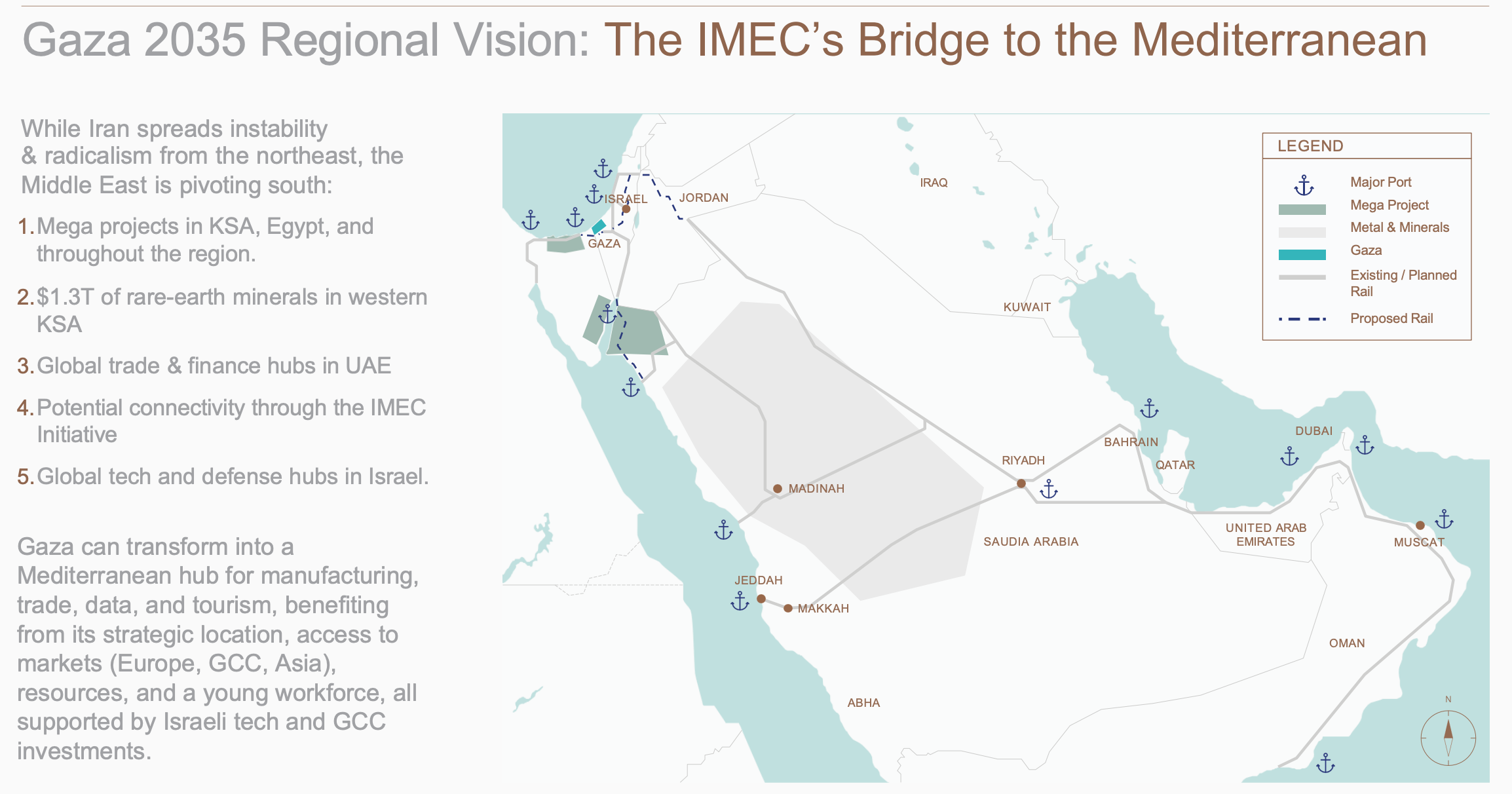
The GREAT Trust slides5 position Gaza not as a standalone reconstruction but as the Mediterranean terminus of the India-Middle East-Europe Economic Corridor — IMEC. The ‘Abrahamic Infrastructure Corridor’ connects Gaza by rail, pipeline, and fibre to KSA, UAE, Egypt, and Israel, with a deep port and airport handling shipping and freight, data centres serving the region, and advanced manufacturing zones processing rare-earth minerals shipped from the Gulf.
The smart city is the endpoint of a trade route, and the tokenisation of land is how the population is moved off the ground the corridor requires.
The slides make the architecture explicit: ‘all services and economy in these cities will be done through ID-based AI-powered digital systems’. Every transaction mediated through digital identity, every service processed by AI, no cash, no anonymity, no interaction outside the system.
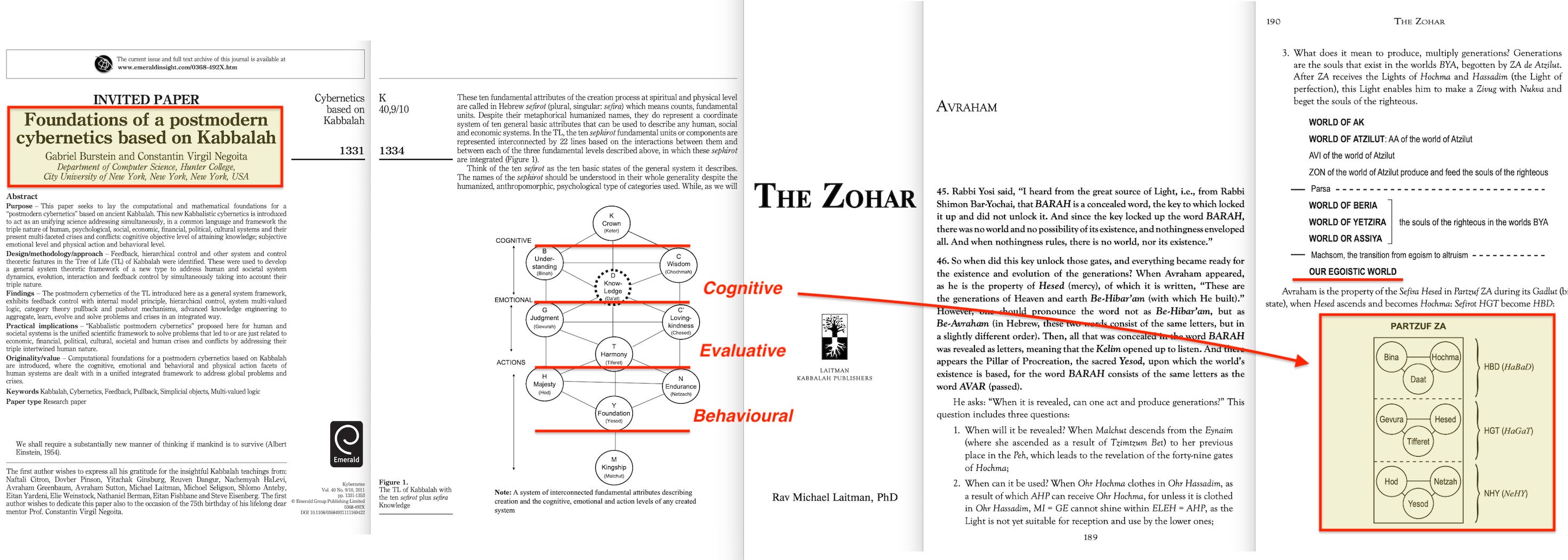
That is not reconstruction. It is the full stack — cognitive, evaluative, behavioural — specified in a single sentence by the people building it.

The governance slides specify that even after nominal self-governance is restored, the trust may retain ‘some plenary powers’ through a Compact of Free Association6 — long-term financial support in exchange for permanent structural control.
The COFA model is borrowed from US Pacific Island territories: sovereignty in name, dependency in practice, plenary powers retained by the patron indefinitely. The exit condition is not independence. It is permanent conditional association under the Abraham Accords, with the trust retaining the power to override whenever its assets or the corridor’s integrity are at stake.
Israel separately retains ‘overarching rights to meet its security needs’ throughout every phase of the transition, a power that is never formally relinquished — meaning the ‘end state’ of Palestinian self-governance operates under both the Trust’s plenary powers and Israel’s permanent security override simultaneously.
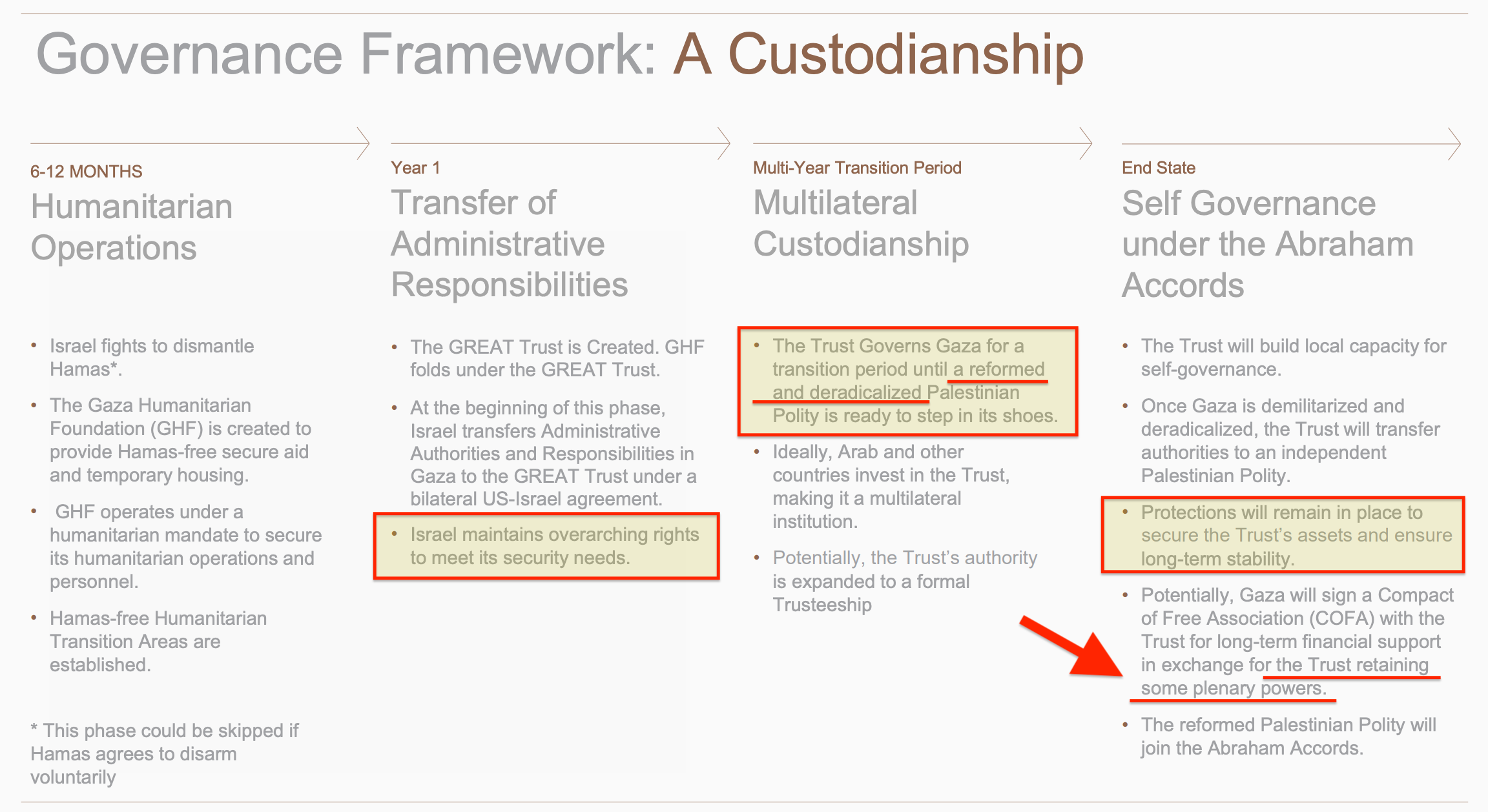
The trusteeship. The GREAT Trust proposes a US-run trusteeship governing Gaza for approximately ten years ‘until a reformed and deradicalized Palestinian Polity is ready to step in its shoes’7. The plan does not mention Palestinian statehood.
The exit condition is joining the Abraham Accords — which means permanent integration of the territory’s financial system, trade flows, data infrastructure, and security arrangements into a regional architecture whose terms were set by existing signatories without Palestinian input, and whose conditions are enforced through the same programmable infrastructure the trust is building.
‘Deradicalisation’ is further defined by the trust — the cognitive layer defines when the governed are ready for self-governance, using criteria the governed did not set and cannot challenge from within the framework.

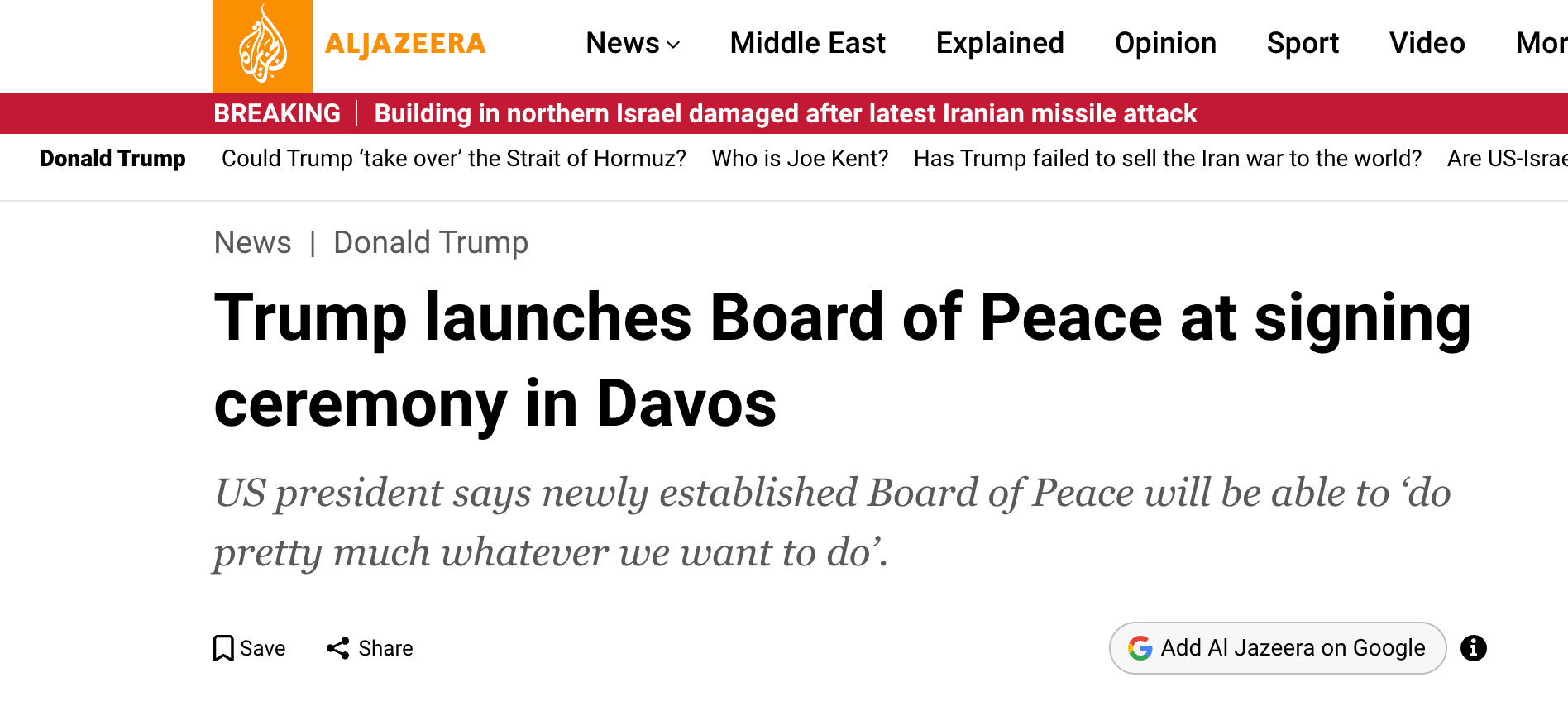
The Board of Peace expanded beyond Gaza. Trump’s Board of Peace, announced formally at Davos, has an eleven-page charter that does not mention Gaza8. It has morphed into an international disputes forum and potential rival to the United Nations.
Permanent seats cost one billion dollars910.
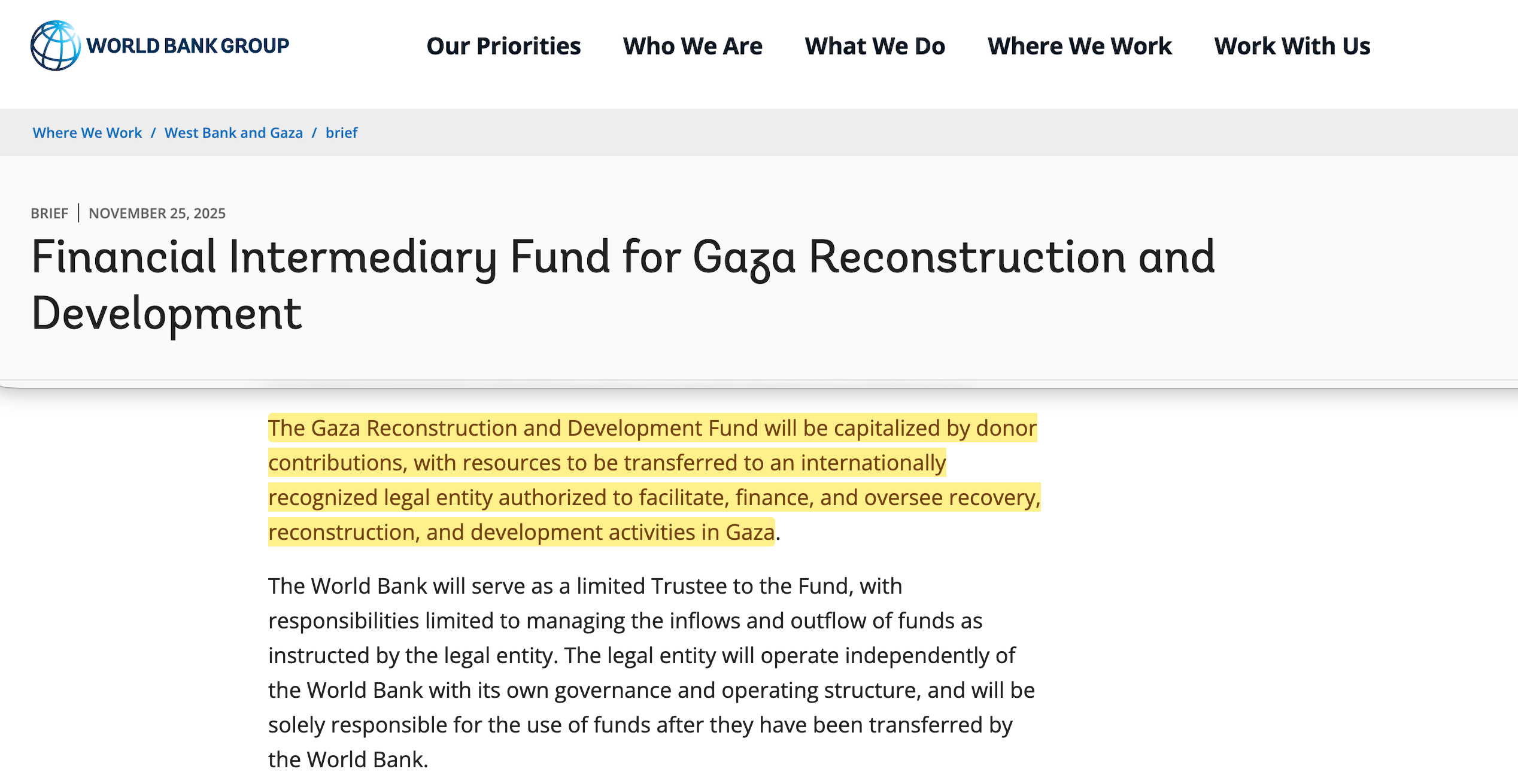
The financial rails are live. The World Bank established a Financial Intermediary Fund for Gaza reconstruction in December 202511, with resources to be transferred to ‘an internationally recognized legal entity authorized to facilitate, finance, and oversee recovery, reconstruction, and development activities in Gaza’12.
That entity is the Board of Peace13.

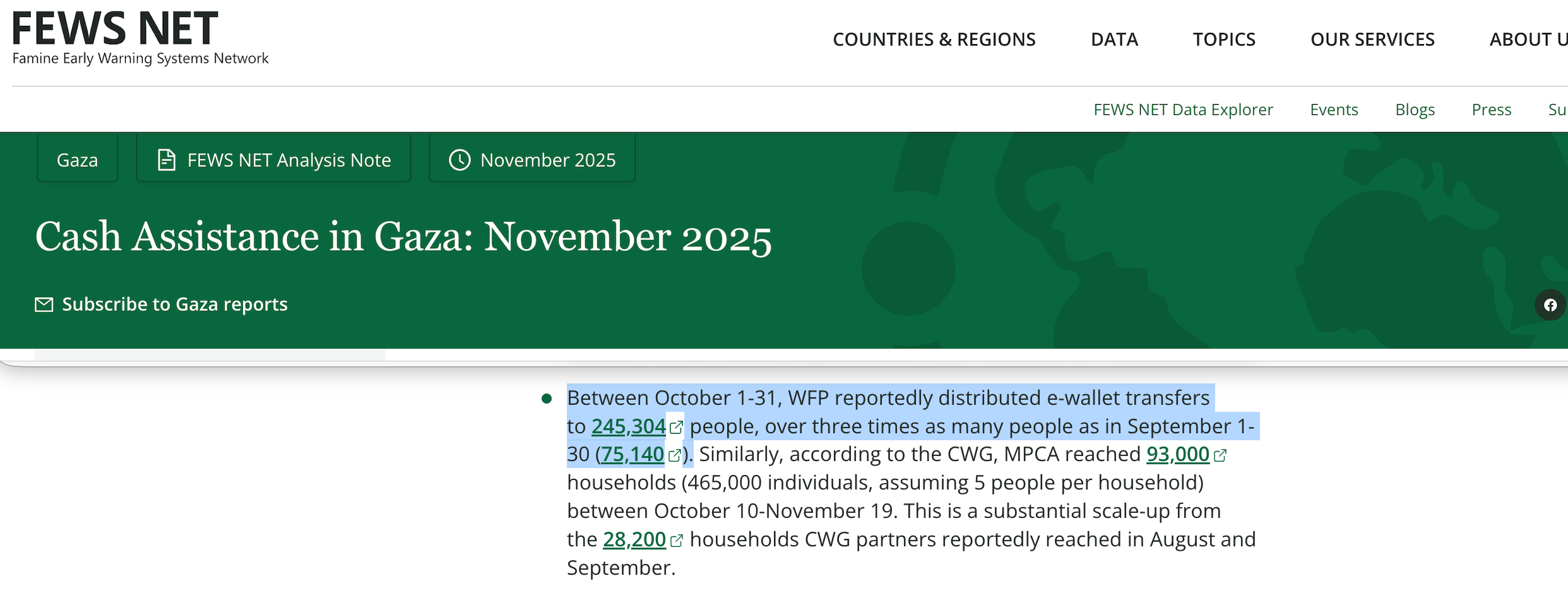
The digital access layer is scaling. E-wallet distribution reached over 245,000 recipients in October 202514 — more than triple September’s volume. Banks are reopening accounts and issuing digital wallets.
The population is being onboarded onto digital financial infrastructure before the reconstruction formally begins. By the time the token system launches, transacting through conditional digital wallets will already be normalised.
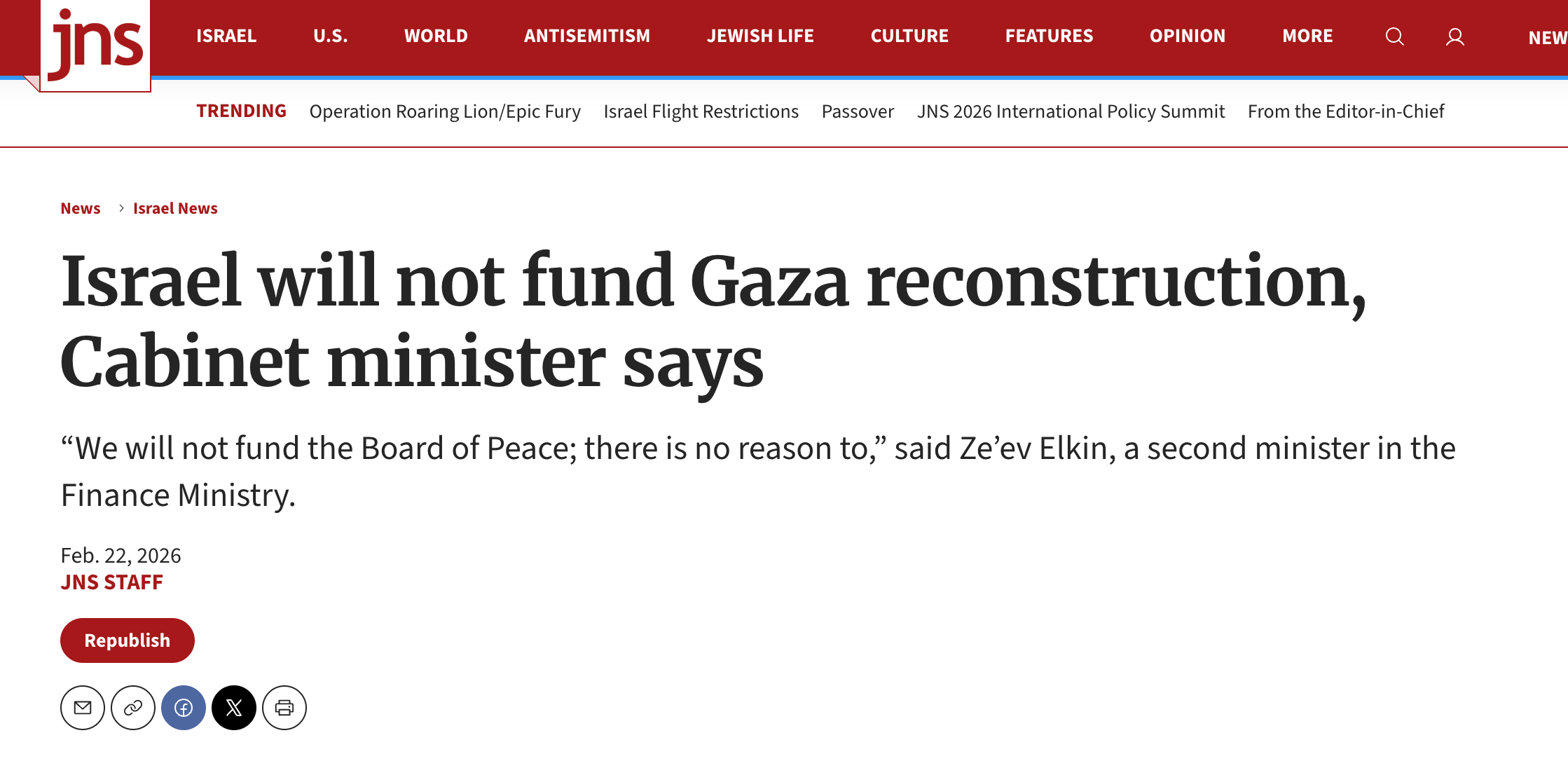
Israel refused to fund the reconstruction15. The architecture is not Israeli — the financial layer sits elsewhere, in the World Bank FIF, blended finance, and investor-sovereign contributions, and Israel’s refusal to pay confirms the structural reading that the state performed a specific function within the architecture and is not the principal.
But Israel retains a cognitive-layer position that is more significant than it first appears. It controls NGO registration and determines which organisations can operate in Gaza16 — and this is not evaluative gatekeeping, not the assessment of performance against a standard. It is the definition of the universe of permissible actors. An organisation that is not on Israel’s approved list does not exist within the model, cannot operate, cannot reach the population, and cannot be cleared because it was never registered for clearing.
The Board of Peace defines what must be done. Israel defines who is permitted to do it. Both are cognitive functions — one sets the standard, the other sets the model of who exists — and between them, nothing reaches the evaluative layer, let alone the population, that has not been defined into existence by both.


The rails
The architecture operates on three tiers, each served by specific rails. All are now present or in deployment in Gaza.

Identity and accreditation (the model)
This is the cognitive tier — general systems theory applied: it establishes what exists within the system, who is recognised, and what they are permitted to do. Digital identity determines who you are. Accreditation determines who you can reach. Together they constitute the model — the system’s representation of its participants and their boundaries.
In Gaza: e-wallets require identity verification. Digital tokens are linked to individual landowners. Participation in reconstruction — receiving compensation, accessing housing, transacting within the new economy — is contingent on digital credentials. Israel controls NGO registration, determining which organisations can operate.
At every level, identity and accreditation determine who exists within the system and what they are permitted to do. Without credentials, you are not in the model.


Data and audits (the flow)
This is the evaluative tier — input-output analysis applied: it establishes what you did versus what you are allowed to do — the continuous balancing of the philosophical ‘is’ against ‘ought’. Surveillance generates data. Audits compare data against the cognitive layer’s definitions. The evaluative tier clears.
In Gaza: the AI-powered smart city infrastructure — including a chief digital office, innovation lab, and six to eight planned cities built on sensor-equipped, continuously monitored infrastructure — generates the data layer. The trusteeship operates on a ten-year timeline with review points, UNSC resolution 280317 requires periodic reporting, and the Board of Peace oversees ‘implementation steps’ with built-in assessment.
‘Deradicalisation’ compliance is evaluated by the trust against criteria the governed did not set — data flows in, audits measure the flow against the standard, and the evaluative layer produces the verdict.


Financial actuation (the settlement)
This is the behavioural tier — cybernetics applied: the enforcement loop that executes the verdict. Finance is the actuator — the transaction clears or it does not.
In Gaza: the World Bank Financial Intermediary Fund channels resources through the Board of Peace, e-wallets distribute funds to individuals, and digital tokens mediate land rights — all subject to conditional clearance that determines whether funds flow. The system does not decide to withhold; the transaction simply does not execute if conditions are not met.


Migration to AI
The three tiers — identity and accreditation establishing the model, data and audits establishing the flow, financial actuation executing the settlement — can be migrated wholesale to artificial intelligence.
AI absorbs all three functions simultaneously: training data and model structure define what exists (cognitive), inference compares inputs against the model's categories (evaluative), and deployment executes the output (behavioural). Once the three tiers are running on AI, human operators are no longer required at any layer — the system models, measures, and settles without human intervention18.
The architecture in Gaza is being built on AI-powered infrastructure from the ground up, with no legacy systems to integrate and no human discretion to accommodate.

What this means
Gaza is the second full-stack deployment of the architecture documented across the Beyond the Law series — after Ukraine, but more complete, because the destruction was total and the reconstruction is being built on cleared ground with no legacy systems, no sovereign institutions, and no friction.
The BIS Innovation Hub projects, the SDG compliance framework, the conditional settlement infrastructure, and the digital identity layer are all being instantiated simultaneously on a single territory.
The population does not experience governance. It experiences clearance. Aid does not arrive through political decision. It clears — or fails to clear — through the digital wallet, against conditions set by the trust, verified by digital identity, settled on programmable rails. Much like conditional CBDCs, the system does not decide to withhold, it simply doesn’t execute if the conditions are not met.
The original essay was published before the GREAT Trust, before the token mechanism, before the Davos presentation, before the Board of Peace charter, and before the World Bank FIF. Every structural prediction has been confirmed.
The architecture is not coming — it’s already here.


The template
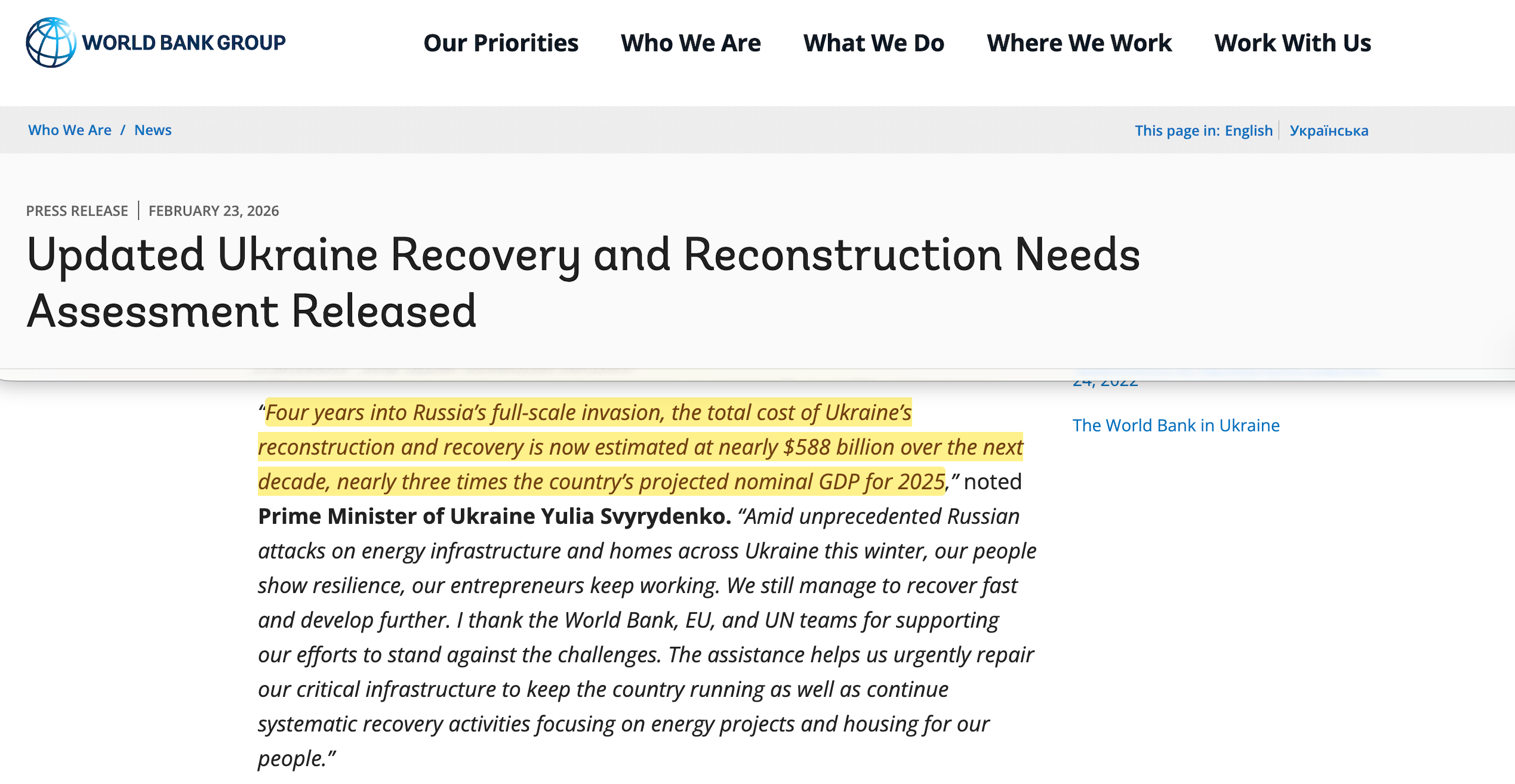
Gaza is not the first deployment. Ukraine was. The World Bank’s RDNA5 assessment (February 2026) estimates $588 billion in reconstruction costs over a decade19 — nearly three times Ukraine’s projected GDP. The funding flows through the World Bank, the EU, and the IMF, conditioned on ‘sustained reforms’ including alignment of production with ‘EU green and digital standards’20.
EU accession is the exit condition. The country does not rebuild on its own terms. It rebuilds on the cognitive layer’s terms — ISSB taxonomies, NGFS scenarios, digital infrastructure specifications — adopted as the price of reconstruction.
Ukraine was the first deployment: military destruction of sovereign infrastructure → conditional lending through international financial institutions → reform alignment with green and digital standards → integration into the architecture through EU accession.
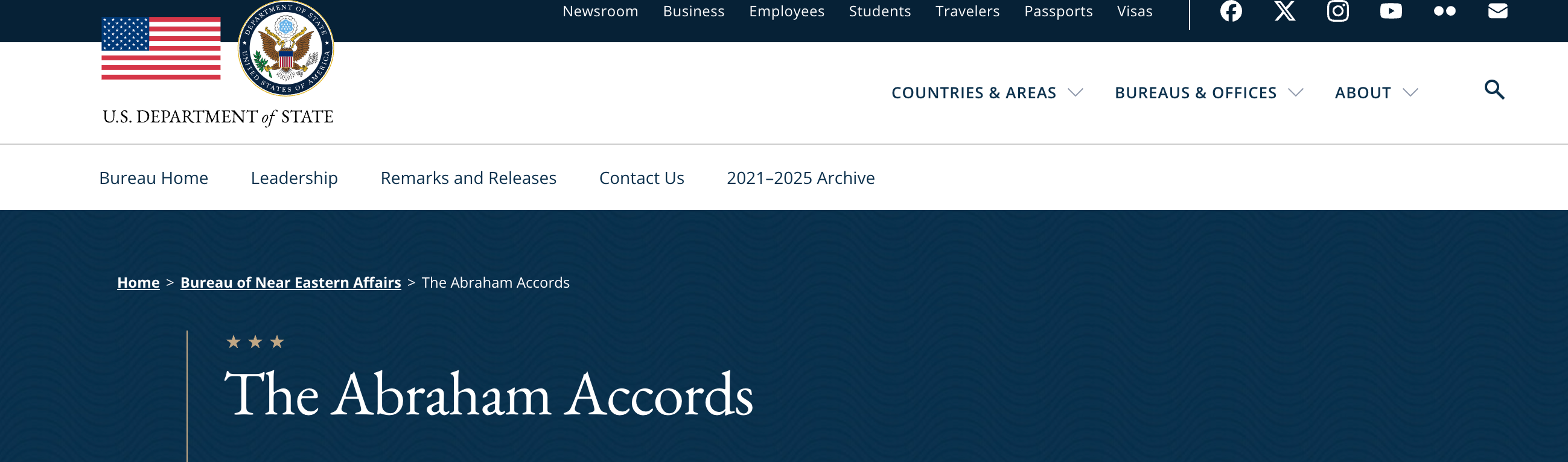
Gaza is the second: military destruction of all infrastructure → trusteeship under international governance → digital tokens replacing land ownership → smart city rebuilt on programmable rails → integration through the Abraham Accords21.
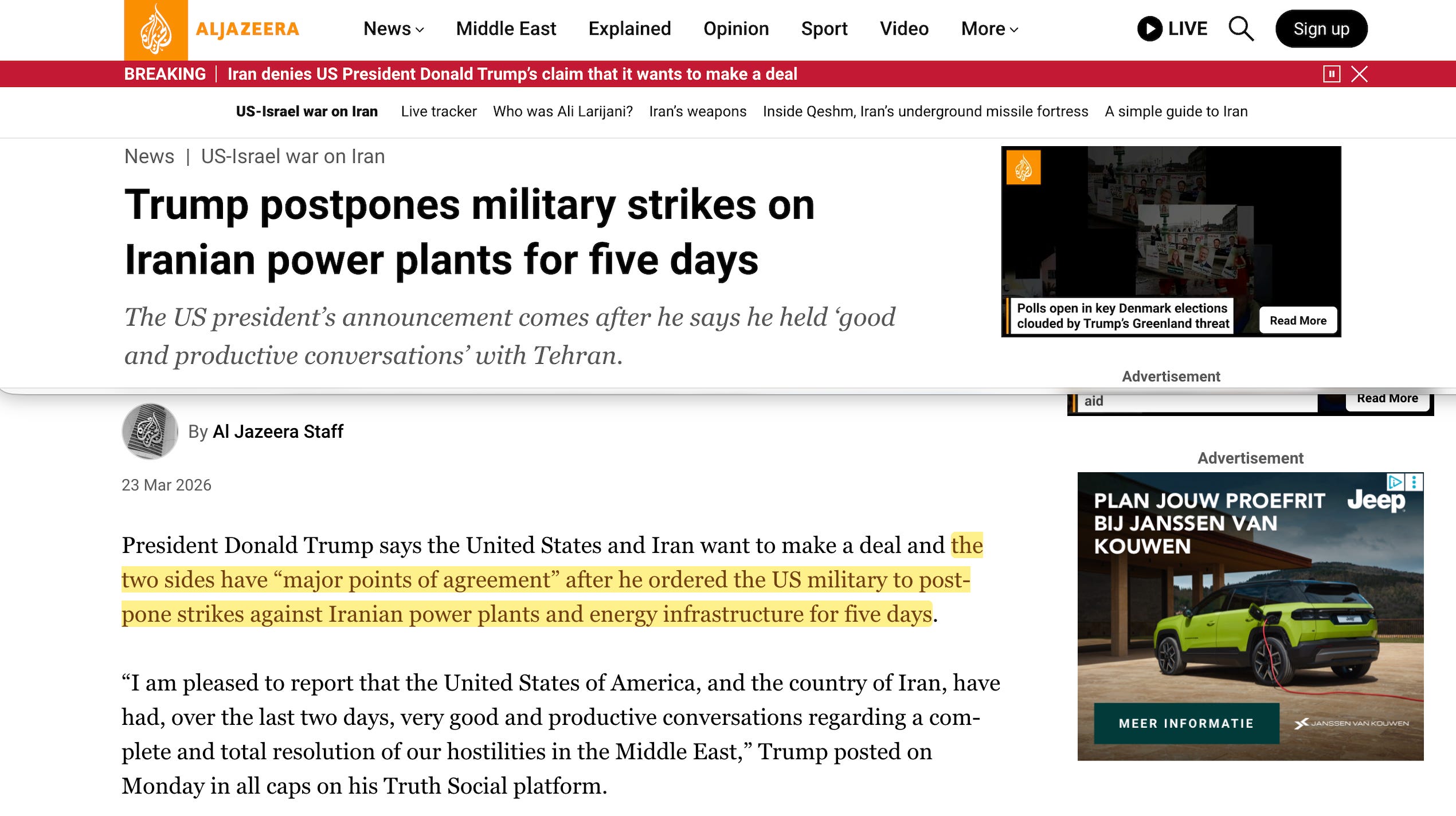
There are indications that Iran may become the third. In March 2026, President Trump announced a five-day postponement of military strikes against Iranian power plants and energy infrastructure22, ‘subject to the success of the ongoing meetings and discussions’. The target is specific — not the country, but its energy infrastructure.
Energy infrastructure is what enables Iran to operate its own financial system outside SWIFT, outside the BIS compliance framework, outside the conditional lending architecture. Destroy the energy grid, and reconstruction conditions follow — because a country without power has no negotiating position.
The template is consistent: crisis destroys sovereign infrastructure, reconstruction is conditioned on adoption of the cognitive layer’s standards, the population is onboarded through conditional financial channels, and the exit from the transitional phase requires compliance certification by an international body the governed did not elect.
The specific wrapper varies — EU accession, Abraham Accords, international trusteeship — but the architecture underneath is identical. One template, multiple deployments, and the clearinghouse acquires new clients.
Beyond money
The three-tier architecture — cognitive standard, evaluative clearing, behavioural settlement — is agnostic to the medium that flows through it. It applies to any flow that sustains human activity: knowledge, information, energy, money, material resources, credentials, permissions. The order of capture follows the order of descent — from the most abstract to the most concrete.
Knowledge was captured first, and earliest. Standards bodies, journal ranking systems, and funding structures have determined what counts as authoritative knowledge for decades. The architecture did not need the internet to control knowledge — it needed only to control accreditation, peer review, and the definition of what qualifies as legitimate inquiry.
Search engines now reinforce this at scale, determining which sources surface and which are buried. AI models extend it further — trained on data selected by the cognitive layer, weighted by criteria the user does not see, producing outputs that feel like discovery but are bounded by the model’s training. The architecture does not need to censor knowledge. It needs only to define what counts as authoritative, and the ranking algorithm does the rest.

Information followed. Social media content policy defines what counts as permissible speech (cognitive). AI classifiers and human moderators clear each post against the policy (evaluative). The post is removed, the reach throttled, or the account suspended (behavioural).
The appeals process asks whether the evaluative layer correctly applied the cognitive layer’s categories — it does not ask whether the categories are correct. The filtering is consistent across platforms, not because each company independently arrived at the same policy, but because the cognitive layer’s standards propagate through shared compliance frameworks, trust and safety industry bodies, and regulatory pressure that makes the platforms converge on the same definitions of acceptable speech.
Control of knowledge is used to define what is true. Information control determines who is allowed to be heard.

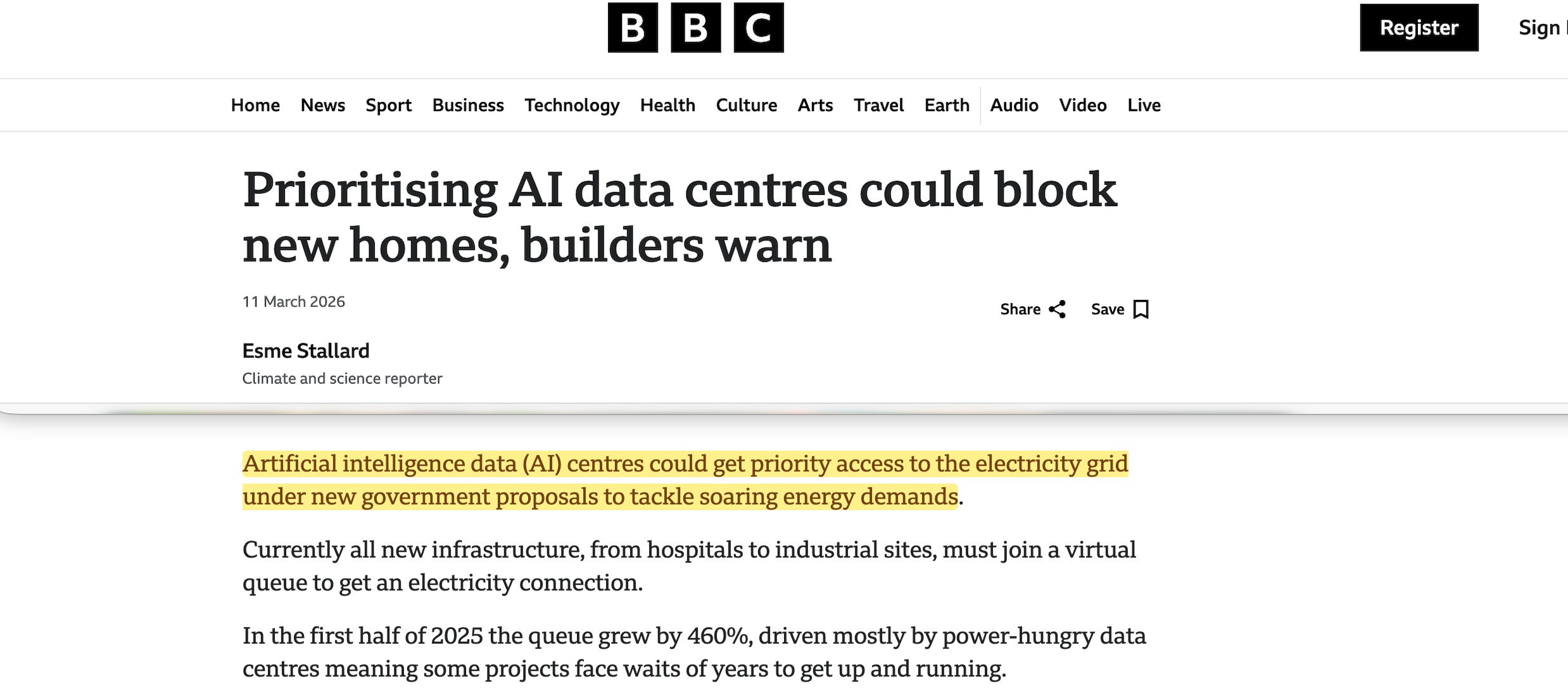
Energy is third, and is being captured now. The programmable grid infrastructure is already being built — FERC directing rule changes for co-located data centres23, the UK designating data centres as critical national infrastructure with priority over residential power during load shedding24, NGFS scenarios embedding energy transition compliance into financial regulation25. Iran’s energy infrastructure is the specific target in the March 2026 postponement.
Whoever controls the energy flow’s clearing conditions controls the physical substrate on which everything else depends. Money settles transactions. Energy settles reality. Once both pass through the same programmable architecture, the system governs not just what you can buy but what can be powered.

Money and matter converge at the bottom of the descent. CBDC rails, programmable settlement, and the BIS unified ledger are making the financial flow fully programmable.
Gaza’s digital tokens and e-wallets are the leading edge — land rights converted into ledger-mediated access, every transaction conditional, every service gated through digital identity. The circular economy applies the same architecture to material flows — physical resources tracked, classified, and governed within a closed loop. A circle has no exit.
The unified ledger is where all flows converge: tokenised money, tokenised assets, tokenised land, and eventually tokenised energy and material resources, all settling on a single programmable platform against conditions set by the cognitive layer.


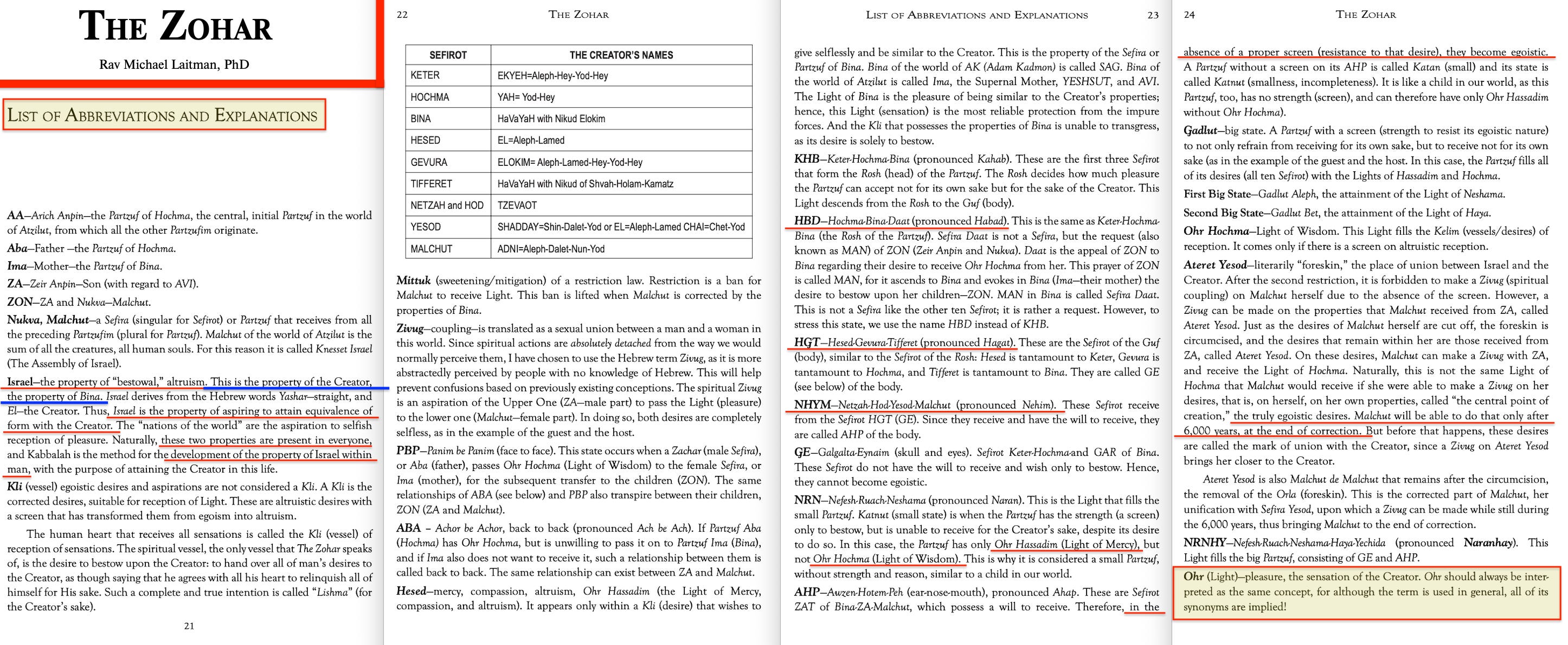
The Zohar26 called the circulating medium Ohr — light flowing through the sefirotic channels in three tiers: Chabad (cognitive), Chagat (evaluative), and Nehiy (behavioural), sustaining every level of existence.
Moses Hess translated Ohr into ‘the social blood’ — money. The unified ledger translates money and every other asset into programmable tokens. Information is also being captured. Energy is next.
Laitman’s own glossary assigns Israel to Binah — the sefira whose function is to determine who and what exists within the system. In the Zohar’s architecture, Chokmah provides the initial definition and Binah gives it structure.
The Board of Peace provides the definition — what must be done. Israel provides the structure — who is permitted to do it.
Both functions sit within the cognitive tier.

Alexander Bogdanov — who unified the three tiers through Tektology27 — modelled CO2 as the circulating entity generations before the concept of carbon credits even existed28. The NGFS scenarios, the ISSB taxonomies, and the carbon compliance architecture now track CO2 through the same three-tier structure: standardised by the cognitive layer, measured by the evaluative layer, and settled financially through the behavoural layer.
The circulating medium was never limited to money. It was always whatever the architecture could track.
What the Zohar described as one light flowing through all the channels is presently being implemented through general systems theory and cybernetics as one architecture governing all flows2930.
The only trouble is — Gabriel Burstein removed a critical component from the process.


"...no interaction outside the system.
Mussolini would be proud.
Thanks ESC. I am integrating this into the blog news-compilation today.
I swear it is in there ;-) https://drjohnsblog.substack.com/p/starving-our-world