
Sir Bani Yas

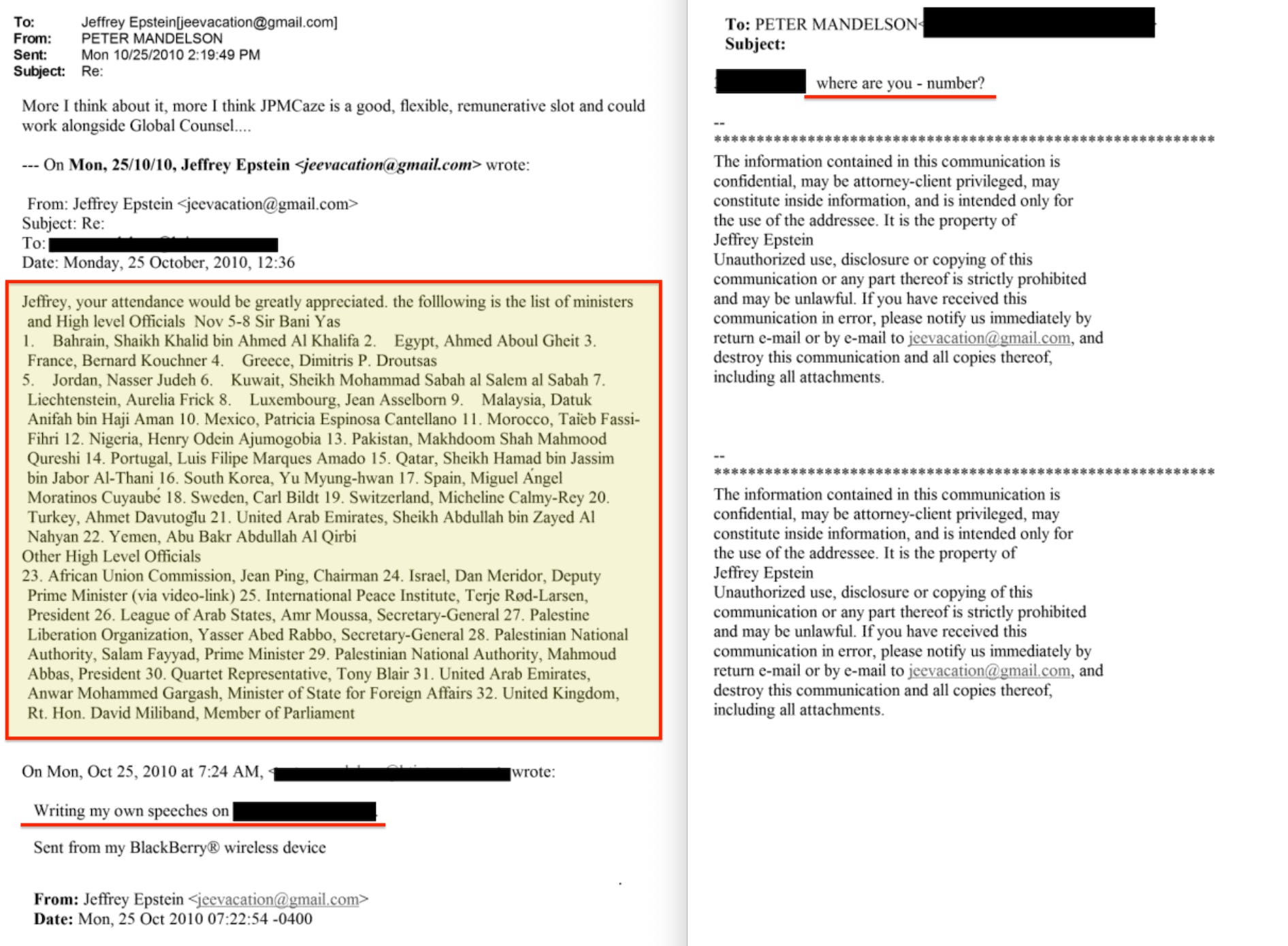
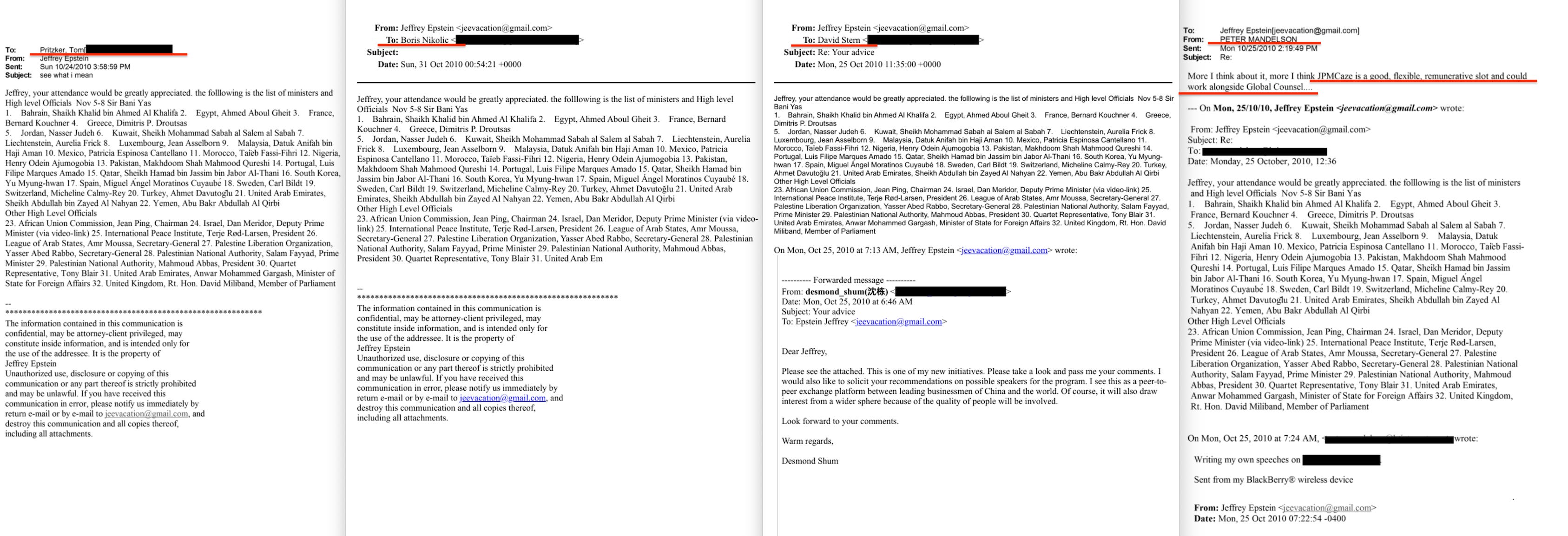
No later than 24 October 2010, Jeffrey Epstein received an email1.
Jeffrey, your attendance would be greatly appreciated. the following is the list of ministers and High level Officials Nov 5-8 Sir Bani Yas
Below it, twenty-two foreign ministers, listed by country: Bahrain, Egypt, France, Greece, Jordan, Kuwait, Liechtenstein, Luxembourg, Malaysia, Mexico, Morocco, Nigeria, Pakistan, Portugal, Qatar, South Korea, Spain, Sweden, Switzerland, Turkey, the United Arab Emirates, and Yemen.
Then ten further high-level officials: Jean Ping, Chairman of the African Union Commission. Dan Meridor, Israel’s Deputy Prime Minister — the man responsible for intelligence services and the Atomic Energy Commission — via video-link. Terje Rød-Larsen2, President of the International Peace Institute3. Amr Moussa, Secretary-General of the League of Arab States. Yasser Abed Rabbo, Secretary-General of the Palestine Liberation Organisation. Salam Fayyad, Prime Minister of the Palestinian National Authority. Mahmoud Abbas, President of the Palestinian National Authority. Tony Blair, Quartet Representative. Anwar Mohammed Gargash, UAE Minister of State for Foreign Affairs. And David Miliband, Member of Parliament and former Foreign Secretary of the United Kingdom.
The following day, Epstein forwarded the list to Peter Mandelson4. The email to Mandelson begins with a redacted name and the question: ‘where are you - number?’ Mandelson was otherwise occupied: ‘Writing my own speeches on [redacted]’.
This was eleven days before the inaugural Sir Bani Yas Forum on International Peace and Security5.
I. The Round Table
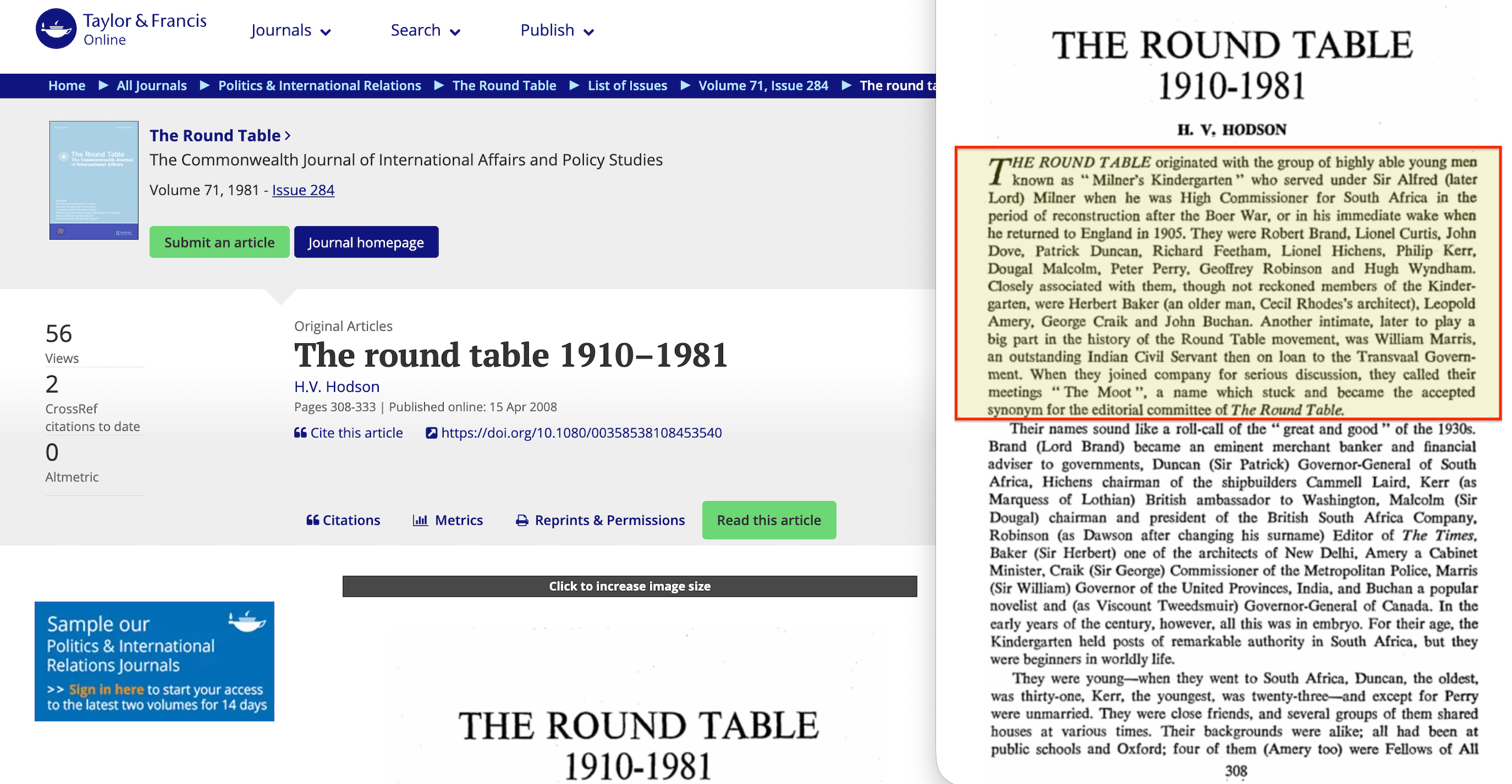
The round table is one of the oldest techniques for manufacturing consensus among people who would otherwise have no reason to agree with one another. Cecil Rhodes formalised it6. The Royal Institute of International Affairs and the Council on Foreign Relations institutionalised it. The Bilderberg Conference perfected it7.
The underlying method is older than any of these, and the pattern — once recognised — is visible in nearly every major policy shift of the past century.
The technique has three steps.
First, invite high-fliers to something exclusive. The invitation must appeal to vanity for the governance targets — ministers, diplomats, senior officials — and to greed for the business targets: executives, bankers, fund managers.
A desert resort, a Rothschild estate, a Dutch castle. The setting tells the invitee that they belong among people who matter. They accept because the other names on the guest list are too important to miss, or because the potential deals on offer are too valuable to decline. The ministers come for prestige, the executives come for access, and neither group questions why they are in the same room.
Second, sell them something they do not fully understand, wrapped in a moral cause they cannot oppose. Peace. Sustainability. Interfaith harmony. Pandemic preparedness. The participants engage in good faith, believing they are contributing to a dialogue about ‘the common good’. What they are endorsing is an architecture — a framework, a set of principles, a shared vocabulary — whose implications will not be apparent for years or decades, and which they are not equipped to evaluate because it falls outside their domain of expertise.
A foreign minister understands security — not blended finance yield redistribution. A theologian understands ethics — not that the word ‘stewardship’ will become the governing ethic of a global financial compliance system thirty years later. The moral cause is genuine at each convening — that is what makes it work.

Third, the hidden payoff arrives years or decades later through institutional channels so far removed from the original convening that no participant, and certainly no member of the public, can trace the connection.
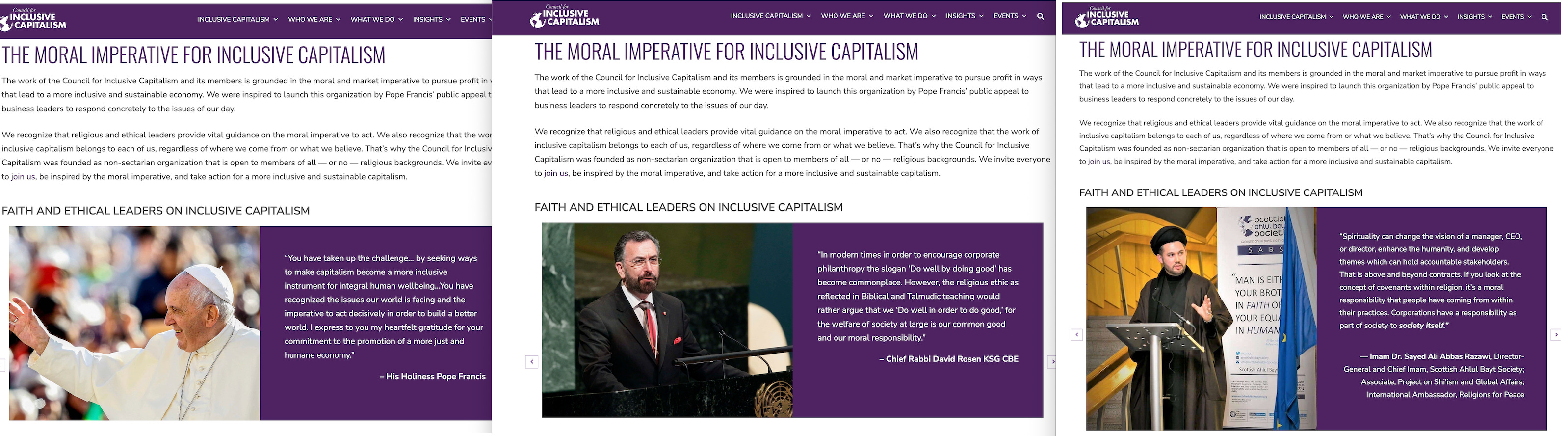
The ‘business ethics’ principles agreed at Windsor Castle in 1984 become the governing ethic of the Council for Inclusive Capitalism with the Vatican in 20208. The ‘stranded assets’ concept workshopped at a Rothschild estate in 2014 becomes a binding capital requirement for every bank on earth by 2025. The shared language of ‘sustainable development’ becomes the classification criteria embedded in programmable money.
By the time the payoff materialises, the convening that seeded it is either forgotten, declassified as historical curiosity, or dismissed as conspiracy theory by the same media organisations whose editors attended.

The architecture is too large for any single convening to contain, so it is compartmentalised — broken into individual pieces, each sold at a different round table, to a different audience, under a different moral banner. One convening produces an interfaith business ethics framework9. Another produces a climate disclosure standard. Another produces a digital currency specification. Another processes sovereign contacts into financial relationships.
No single group of participants ever sees the whole. Each group endorses one piece, genuinely and in good faith, understanding only the piece in front of them. The pieces integrate — across convenings, across decades, across continents — into a unified architecture that none of the individual participants designed, intended, or understood. The compartmentalisation is what makes the system invisible.
The moral cause at each stage is what makes it politically untouchable. And the Chatham House Rule, present in every instance, ensures that the public can never trace the institutional outcome back to the private convening that produced it.

The mechanism that makes this work is input constraint. The organiser selects the participants — and in doing so, guarantees the direction of the outcome before a single participant arrives. A room full of people who already share a particular set of assumptions will produce conclusions consistent with those assumptions and call it consensus. No dissent needs to be suppressed, because dissent was excluded at the invitation stage.
The 1979 World Climate Conference10, organised by the International Council of Scientific Unions, produced the foundational ‘consensus’ on anthropogenic climate change — from a participant list that did not include anyone who disagreed. The Interfaith Declaration emerged because participants already shared the stewardship ethic. The Sir Bani Yas agenda was set by Brookings, CSIS, and Chatham House panelists whose analytical frameworks were already aligned.
In each case, the selection of participants is the conclusion. Everything between the invitation and the published output — the sessions, the discussions, the plenary debates — is the process by which that pre-determined conclusion acquires the appearance of having been arrived at through open deliberation.

The only people who see the full picture are those who organise multiple convenings across multiple domains — and who are commonly connected to intelligence. This is the analytical signature to watch for. Not the figurehead who chairs the session. Not the famous names who attend. The organiser: the person who selects the participants, sets the agenda, manages the follow-up, and reports upward to whoever commissioned the round table in the first place.
In the documented record, the organisers are consistently people with intelligence backgrounds or connections — Retinger at Bilderberg, Rød-Larsen at Sir Bani Yas, Epstein across the full network — each suspected by multiple intelligence services of working for a different one, each tolerated by all of them, each eventually disposable once the format they built no longer requires their personal involvement.
The Private Sector Roundtable for Global Health Security11 followed this template exactly: an organisation with 516 Google results and 588 Twitter followers, yet with direct access to Event 201, the White House, and the Global Fund — describing itself as ‘the official voice of the private sector within the global health security community’. Nobody had heard of it. Everybody who mattered had been invited.
The Sir Bani Yas Forum12 is the same format applied to sovereign intake in the Middle East.

II. The Forum
The Sir Bani Yas Forum13 was conceived as an annual high-level retreat to create, in its own words, ‘an exclusive and private atmosphere for action-oriented discussions among policy- and opinion-makers about critical issues in advancing peace and security in the Middle East’14.
It was co-organised by Sheikh Abdullah bin Zayed Al Nahyan, the UAE’s Minister of Foreign Affairs, and the International Peace Institute under Terje Rød-Larsen.
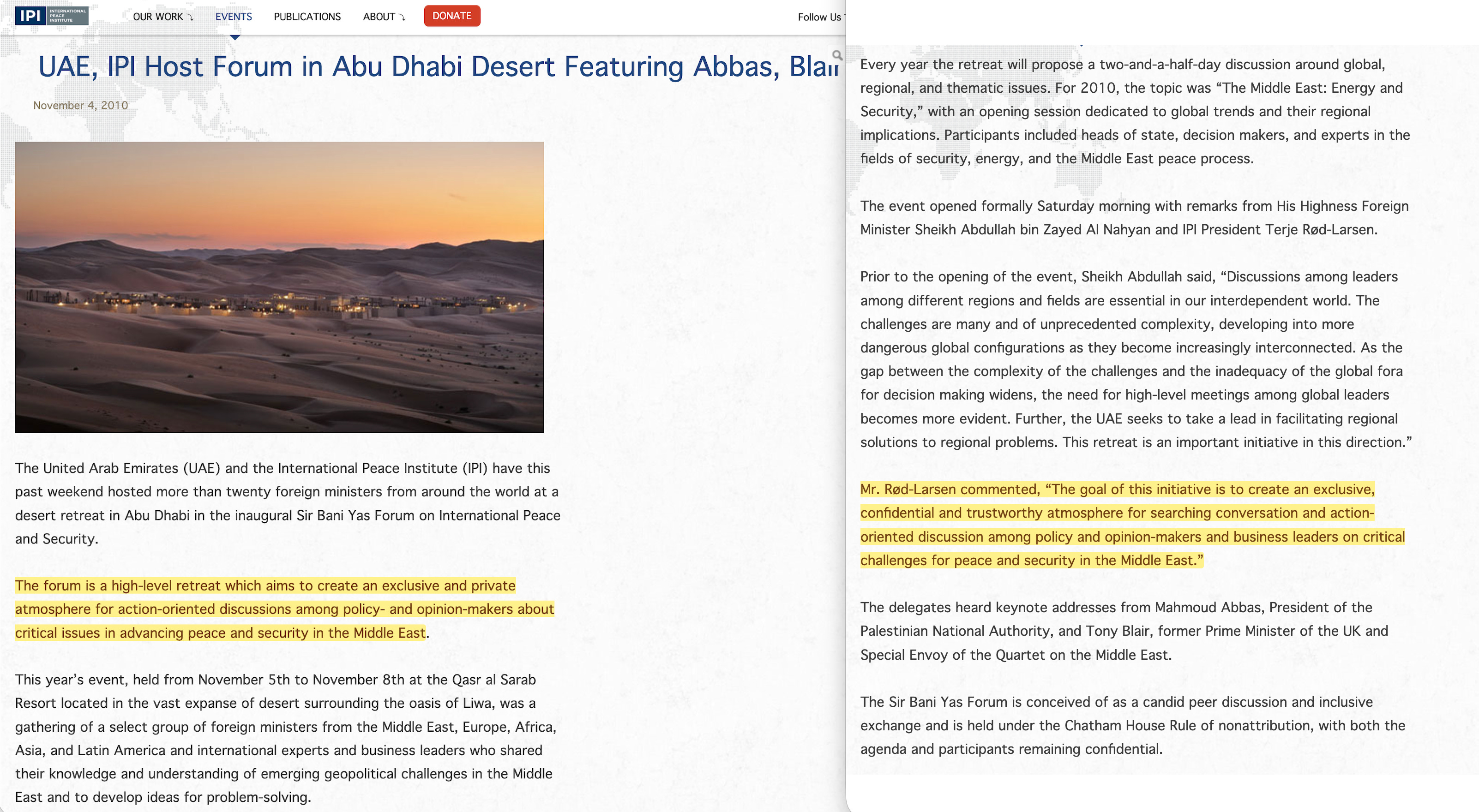
The inaugural forum ran from 5 to 8 November 2010 at the Qasr Al Sarab Resort in the Liwa Desert, approximately 250 kilometres southwest of Abu Dhabi. The setting was a luxury desert retreat, deliberately remote from capitals and cameras, where the world’s foreign ministers could be gathered in conditions of total privacy. Michelin-starred Chef Andoni Aduriz prepared the meals. Violinist Vanessa-Mae and Arabic singer Amal Maher provided the entertainment.
All discussions were held under the Chatham House Rule. Both the agenda and the list of participants were confidential. The welcome letter set the tone: ‘We encourage you to participate in the Forum discussions candidly, taking advantage of the private and off-the-record nature of the debates. The programme also includes time for bilateral meetings and informal conversations in the afternoon.’
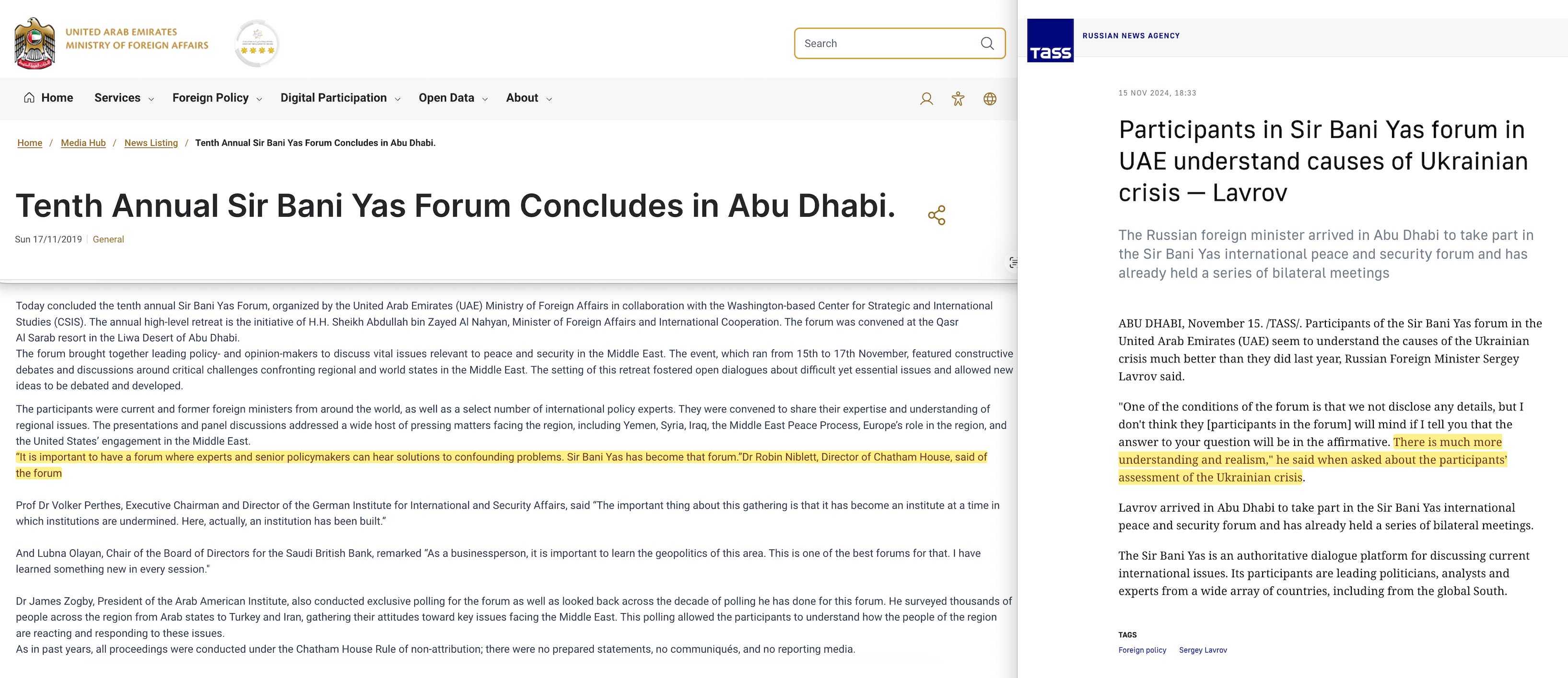
By the ninth edition in 2018, Robin Niblett, Director of Chatham House itself, endorsed it15: ‘It is important to have a forum where experts and senior policymakers can hear solutions to confounding problems. Sir Bani Yas has become that forum’. By 2024, the fourteenth edition hosted the Minister of the International Department of the CPC Central Committee16.
The previous year, Russia’s Foreign Minister Sergey Lavrov attended, commenting that participants ‘understand the causes of the Ukrainian crisis much better than they did last year’17.
The intake mechanism was processing sovereign representatives from every major power bloc on earth. Annually, and off the record.
III. The Programme
The full agenda for the inaugural forum can be located in Epstein’s archive18. It is four pages long and repays close reading.
The formal sessions ran two hours each. But the structural tell is in the time blocks between them: every day, from 16:00 to 19:00 — three hours — the programme records ‘Bilateral Meetings and Recreational Activities’. This was the unstructured space within an event that was itself already off the record.
The sessions provided the intellectual cover. The bilateral windows provided the product: unmonitored, three-hour blocks in which twenty-two foreign ministers, the Palestinian leadership, an Israeli intelligence oversight minister, and think tank experts and corporate figures had private access to one another, under conditions of total confidentiality.
The panel composition across the four sessions reveals who set the cognitive frame within which the ministers would discuss, think, and later act.
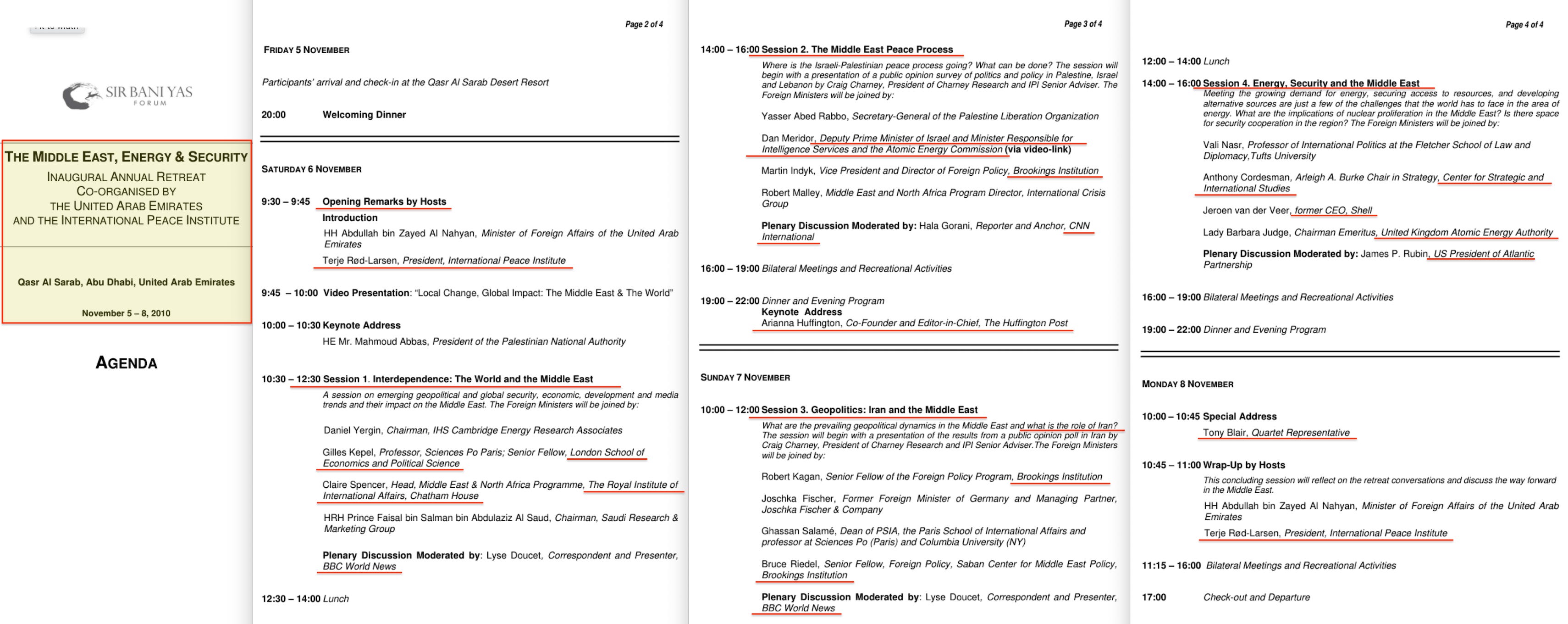
Session 1 — ‘Interdependence: The World and the Middle East’ paired Daniel Yergin, chairman of IHS Cambridge Energy Research Associates, with Gilles Kepel of Sciences Po, Claire Spencer from Chatham House’s Middle East programme, and a Saudi prince. Chatham House — the organisation whose rule governed the entire forum — had its own representative on the first panel. The plenary was moderated by Lyse Doucet of BBC World News.
‘Interdependence’ is flow. The input demand of one nation is the output supply of another — Leontief’s input-output matrix applied to geopolitics. The ‘circular economy’ extends this logic beyond economics to material, energy, and ecological flows, closing the loop into a system where every nation’s resource metabolism is visible, measurable, and ultimately — governable19.

Session 2 — ‘The Middle East Peace Process’ is the panel that demands the closest attention. The listed panelists: Yasser Abed Rabbo, Secretary-General of the PLO. Dan Meridor, ‘Deputy Prime Minister of Israel and Minister Responsible for Intelligence Services and the Atomic Energy Commission (via video-link)’. Martin Indyk, Vice President and Director of Foreign Policy at Brookings — former US Ambassador to Israel, former Assistant Secretary of State for Near Eastern Affairs, and before his government career, research director at AIPAC. And Robert Malley, Middle East and North Africa Program Director at the International Crisis Group. Malley went on to become Biden’s controversial Special Envoy for Iran20. Moderated by Hala Gorani of CNN International.
Meridor’s full intelligence portfolio was printed on the programme. The organiser of a peace forum chose to list the man responsible for Mossad, Shin Bet, and Israel’s nuclear programme as a named panelist, alongside the PLO’s Secretary-General, the AIPAC-to-State-Department pipeline, and a man the FBI would later investigate for ties to Iranian intelligence.
Peace is also a flow. Everyone theoretically wants it, but nobody has it. The demand exists on all sides but the supply never arrives — which calls for a mediator to sit between the parties and negotiate. That mediator was Rød-Larsen’s International Peace Institute. The peace process is a clearinghouse: the institution that brokers the settlement defines the terms, controls the timing, and determines who clears and who doesn’t. Oslo was the prototype21.

Session 3 — ‘Geopolitics: Iran and the Middle East’ — framed the question not as what Iran is doing but what Iran’s role is. The phrasing is revealing. It presupposes a regional architecture with assigned positions — and the forum is where those positions are determined. The question is not whether Iran should have a role, but what that role should be, as defined by panelists drawn from Brookings and the Saban Center. Robert Kagan of Brookings, Joschka Fischer (former German Foreign Minister, now running his own consultancy), Ghassan Salamé of Sciences Po and Columbia, and Bruce Riedel of the Saban Center for Middle East Policy at Brookings22 — Haim Saban’s dedicated Israel-US policy unit.
Iran’s role was being determined by an external clearinghouse — Rød-Larsen’s IPI, staffed by Brookings panelists with Israeli and American intelligence relevance — without Iran present. The nation being assigned its position in the regional architecture had no seat at the table where the assignment was made. The clearinghouse does not require the consent of the parties it processes.

Session 4 — ‘Energy, Security and the Middle East’ brought Vali Nasr of Tufts, Anthony Cordesman of CSIS, Jeroen van der Veer, former CEO of Shell, and Lady Barbara Judge, Chairman Emeritus of the United Kingdom Atomic Energy Authority. Shell’s former chief executive and the UK’s nuclear authority chairman on the same energy panel, at a forum named after a Christian archaeological site in the Arabian Gulf23. Moderated by James P. Rubin, US President of the Atlantic Partnership.
The Middle East’s function in the global architecture is energy supply. That is the ultimate flow, not from a regional but from a global perspective. Sessions 1 through 3 established the interdependence framework, the peace clearinghouse, and the assignment of roles within the regional order. Session 4 named the commodity that makes the region worth organising. Shell’s former CEO and the UK’s nuclear authority chairman were there to ensure the flow continues on terms set by the consumers, not the producers — with CSIS, the institution that would later take over the forum itself, already in the room.
Iran’s nuclear programme supplies the ethical imperative. A nuclear-armed Iran threatens regional stability, energy security, and non-proliferation — three causes no serious person can oppose. That urgency justifies the clearinghouse.

The final morning — Monday 8 November — featured a Special Address by Tony Blair as Quartet Representative, followed by a wrap-up delivered jointly by Sheikh Abdullah bin Zayed and Rød-Larsen. Then: ‘Bilateral Meetings and Recreational Activities’ from 11:15 until departure at 17:00. Nearly six hours of unstructured bilateral time on the final day alone.
The experts were not there to learn. They were there to define the categories within which the foreign ministers would subsequently think. The cognitive frame was set by Washington and London think tanks, British and American media, and corporate energy interests — and the twenty-two foreign ministers absorbed it as a peer dialogue about peace.
Epstein was there to convert the product — the attendee list, the bilateral relationships, the sovereign contacts — into intelligence, routing it to Pritzker24, Nikolic25, Stern26, Shum, Ghislaine27, Sulayem28, and Mandelson29 before the forum had even convened.
Four sessions. Five functions: define the flow, install the clearinghouse, assign the roles, name the commodity, imply the ethical imperative.
A conference agenda that reads as an operating manual — wrapped in a moral cause no participant could oppose, but which no foreign minister or dignitary fully understood.
IV. The Organiser
Terje Rød-Larsen did not merely attend the forum. He co-organised it.
Sheikh Abdullah bin Zayed was the figurehead — the sovereign host, the reason foreign ministers accepted the invitation. A summons from the UAE’s foreign affairs minister carries the weight of state authority. But the invitation list, the agenda, the panel composition, the follow-up — the selection function — was managed through IPI. And IPI was Rød-Larsen’s institution.
The man who decides who enters the room, who sits next to whom, what appears on the agenda and what does not — that man runs the round table. The figurehead provides the prestige. The organiser provides the selection. Prince Bernhard chaired Bilderberg, but Józef Retinger selected the participants30. Klaus Schwab fronts the World Economic Forum, but the question of who curated its original intellectual content is one the WEF’s own history leaves deliberately unclear.
Rød-Larsen’s career was built on precisely this skill. As director of the Fafo Institute in Oslo, he initiated the research project on Palestinian living conditions that opened the secret channel between Israel and the PLO31 — the backchannel that produced the Oslo Accords32. He did not negotiate the accords — he organised the conditions under which negotiation became possible. The skill earned him international fame, a succession of senior UN appointments, and the presidency of the International Peace Institute from 200533.

During the same period, he developed a somewhat consequential relationship. Rød-Larsen described Jeffrey Epstein as ‘my best friend’3435 and ‘a thoroughly good human being’36. He secured $650,000 in donations from Epstein-linked foundations for IPI37. He accepted a $130,000 personal loan from Epstein in 2013. Epstein ordered $250,000 to be paid to Rød-Larsen in 2015, for reasons that remain unknown. In his will, Epstein left $10 million to Rød-Larsen’s children38. A previous version even named Rød-Larsen as executor of the estate.
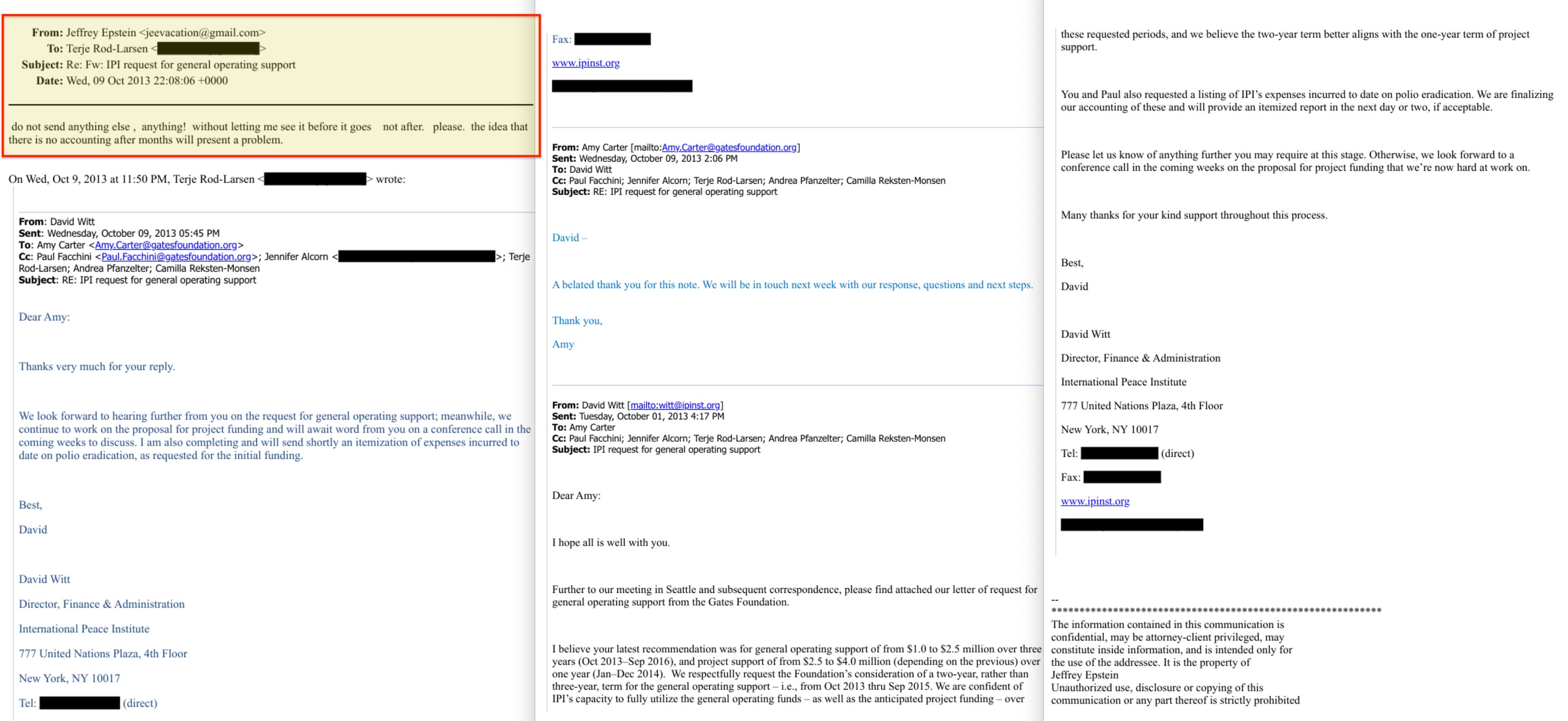
The relationship went beyond funding. When Rød-Larsen forwarded IPI’s grant correspondence with the Gates Foundation, Epstein demanded39: ‘do not send anything else, anything! without letting me see it before it goes not after’.
Epstein was not reviewing a donation. He was pre-approving the institution’s communications with its other funders — exercising operational control over the external relationships of the organisation that co-organised the forum, developed the Responsibility to Protect40, and staffed the UN advisory position that implemented it.
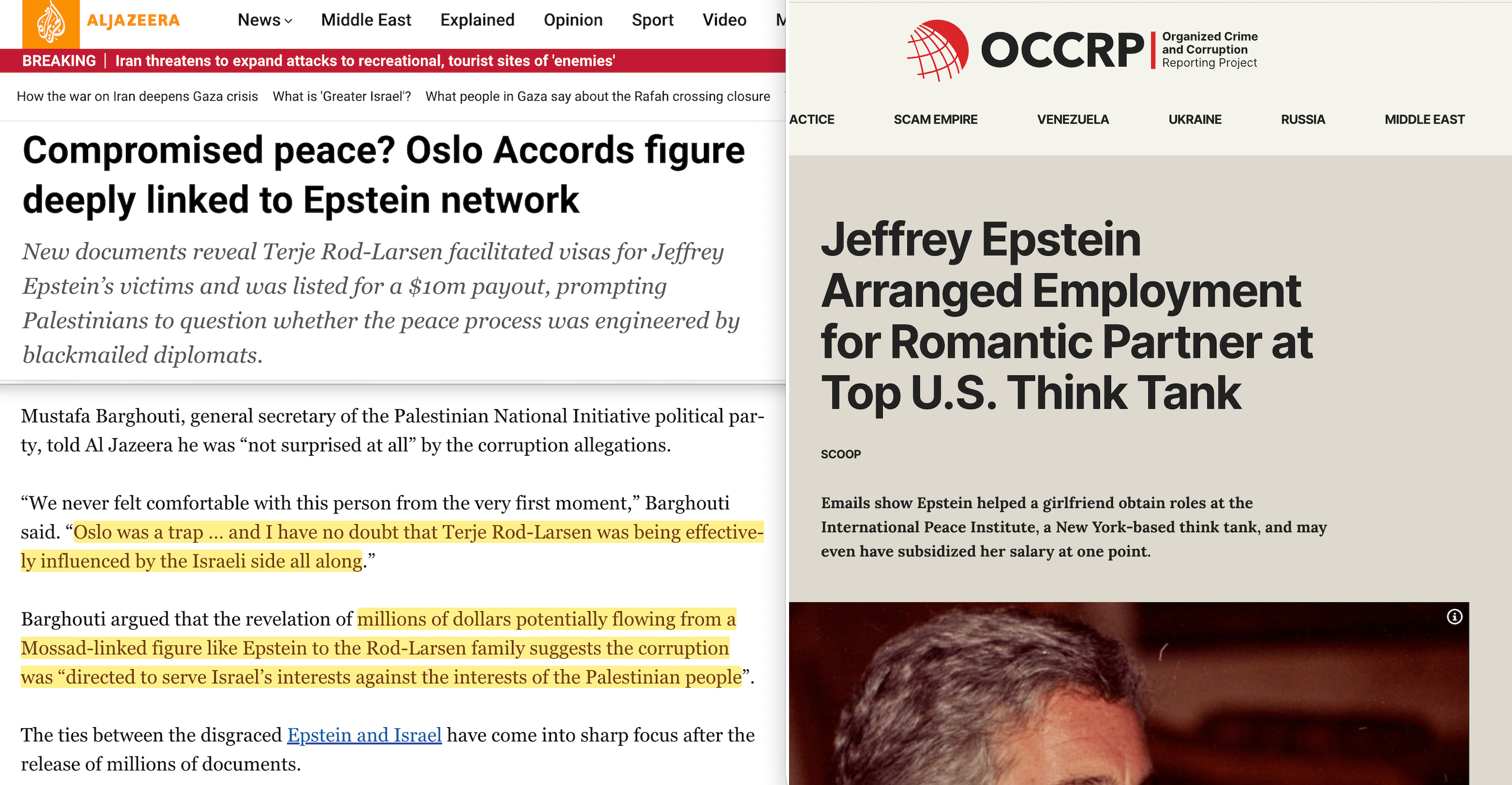
Rød-Larsen also used IPI’s authority to write official letters of recommendation to US authorities securing visas for young women in Epstein’s orbit, claiming they possessed ‘extraordinary abilities’4142. According to Al Jazeera, these women were often models with no academic background43. The OCCRP documented that Epstein helped arrange full-time employment at IPI for one of his romantic partners — referred to in emails by the nickname ‘Sneaky’ — and may have subsidised her salary44. A Norwegian shipowner described the methods Rød-Larsen and Epstein used to pressure him into selling his apartment for half its value as ‘mafia methods’45.
Meanwhile, documents from the critical period of the Oslo Accords negotiations — January to September 1993 — are missing from the official Norwegian Foreign Ministry archive46. Rød-Larsen maintained a private archive covering these negotiations. Palestinian officials have publicly questioned whether the peace process was compromised. Mustafa Barghouti, general secretary of the Palestinian National Initiative, told Al Jazeera47: ‘Oslo was a trap... and I have no doubt that Terje Rød-Larsen was being effectively influenced by the Israeli side all along’.
Rød-Larsen resigned in October 2020. In February 2026, Norwegian police opened an investigation into him48 — Norway’s ambassador to the United Nations — for suspected aggravated corruption. The investigation extends to former Prime Minister Thorbjørn Jagland, whom Epstein had dubbed ‘the Nobel big shot’49, and to WEF CEO and former foreign minister Børge Brende.
V. The Routing Function
The EFTA documents show that Epstein did not merely receive the Sir Bani Yas attendee list. He deployed it.
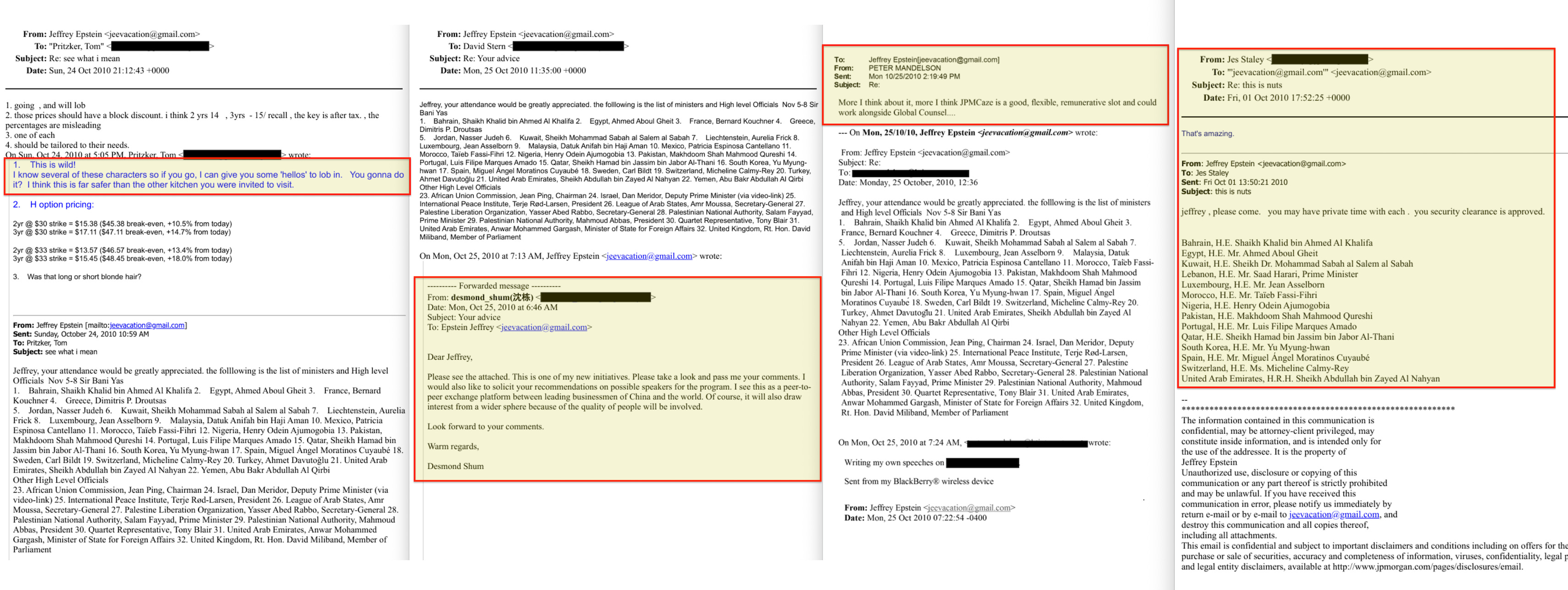
In one email chain50, Epstein forwarded the list to Tom Pritzker, the billionaire chairman of Hyatt Hotels, alongside a discussion of options pricing51. Pritzker’s reply: ‘I think this is far safer than the other kitchen you were invited to visit’.
In a second chain52, the same attendee list went to David Stern alongside a proposal from Desmond Shum for a China platform. Two operations routed through one email: the sovereign contact list and a Chinese commercial opportunity, dispatched to the same recipient simultaneously.
In a third chain, the attendee list went to Peter Mandelson. In the same exchange, Mandelson discussed a placement at JPMorgan Cazenove as ‘a good, flexible, remunerative slot’53.
Three recipients, three purposes — one list. Each forwarding converted the confidential roster of a sovereign peace forum into operational intelligence for a different lane: finance, China, and British political-commercial deployment.
The JPMorgan compliance file54 records a separate email from the same month — 1 October 2010 — in which Epstein was told: ‘this is nuts... jeffrey, please come. you may have private time with each. your security clearance is approved’55. Below it, fourteen sovereign representatives. Whether this describes the same event or a parallel one, the function is identical: Epstein had cleared access to private audiences with foreign ministers at the highest level.
The attendee list for a peace and security forum had become, within hours of receipt, the prospect list for a sovereign financial pipeline.
VI. The British Table
The inaugural attendee list contained both Tony Blair and David Miliband — and the list was forwarded to Peter Mandelson. All three are Labour politicians. Blair and Miliband are both in Mandelson’s orbit. The attendee list that arrived in Mandelson’s inbox contained two of his closest political allies, at a forum whose existence he was being made aware of on the day the list was sent.
Mandelson’s relationship with Epstein is extensively documented in the Epstein archive. Emails show him passing confidential government material to Epstein while serving as Business Secretary: a £20 billion asset sales memo addressed to the Prime Minister, minutes of Treasury meetings forwarded within minutes of receipt, advance notice of the €500 billion euro bailout, and notification of Gordon Brown’s resignation before it happened.
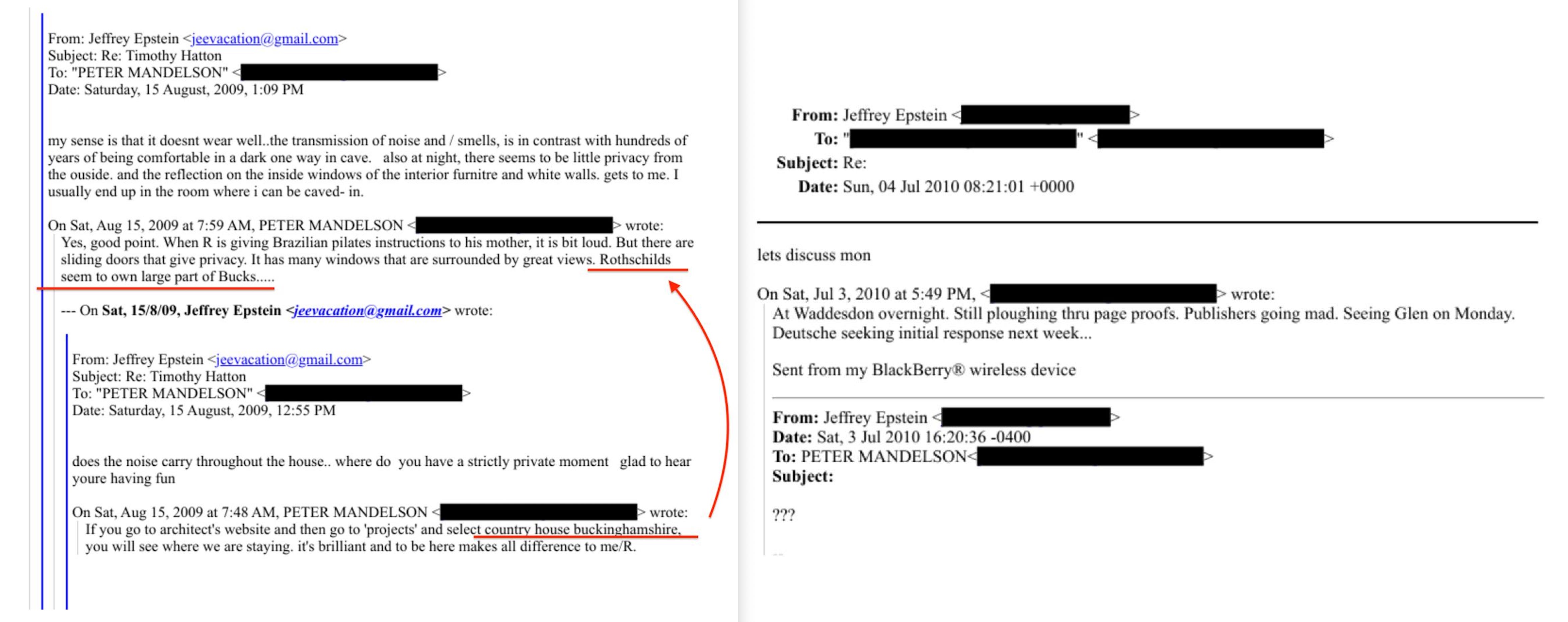
He received $75,000 in payments from Epstein-linked accounts. He had stayed at Waddesdon Manor — Jacob Rothschild’s Buckinghamshire estate — emailing Epstein from ‘a Rothschild country house’ in August 200956, and from Waddesdon itself in July 2010, updating him on his memoir, a Deutsche Bank offer, and Glencore approaches57.

Meridor’s intelligence portfolio is documented above. What matters here is the British angle: Blair and Miliband at the forum, the attendee list routed to Mandelson, Mandelson operating in the Rothschild orbit. The Labour foreign policy establishment was present at the inaugural event, and the intelligence product of that event — the confidential roster — was in the hands of the Rothschild-connected political operative who managed both of them, on the day of receipt.
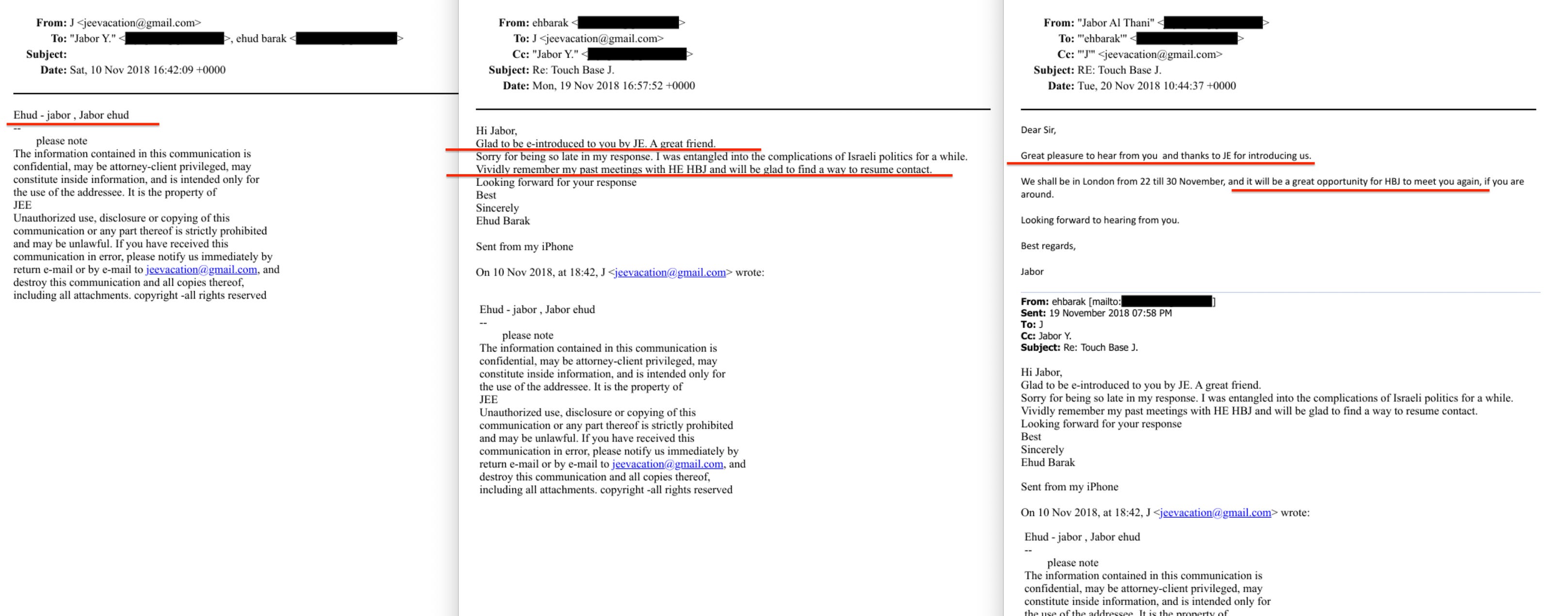
Abbas, Fayyad, and Abed Rabbo — the full leadership of the Palestinian political establishment — were present. So was Amr Moussa, Secretary-General of the Arab League. Sheikh Hamad bin Jassim bin Jabor Al-Thani represented Qatar — the same HBJ to whom Epstein was still routing Barak in December 2018, six months before his arrest58. The forum was where such relationships were seeded. The email chains years later prove the harvest.

VII. The Interfaith Architecture
The forum takes its name from Sir Bani Yas Island, the UAE’s largest natural island. The island hosts the country’s oldest and only known ancient Christian site — a Church of the East monastery discovered in 1992, dating to the seventh and eighth centuries59. The monastic community thrived from around 600 to 750 AD, continuing for at least a century after the arrival of Islam.
The UAE’s Minister of State for Tolerance has called the site evidence that these lands had ‘always been accepting of various religions’60.
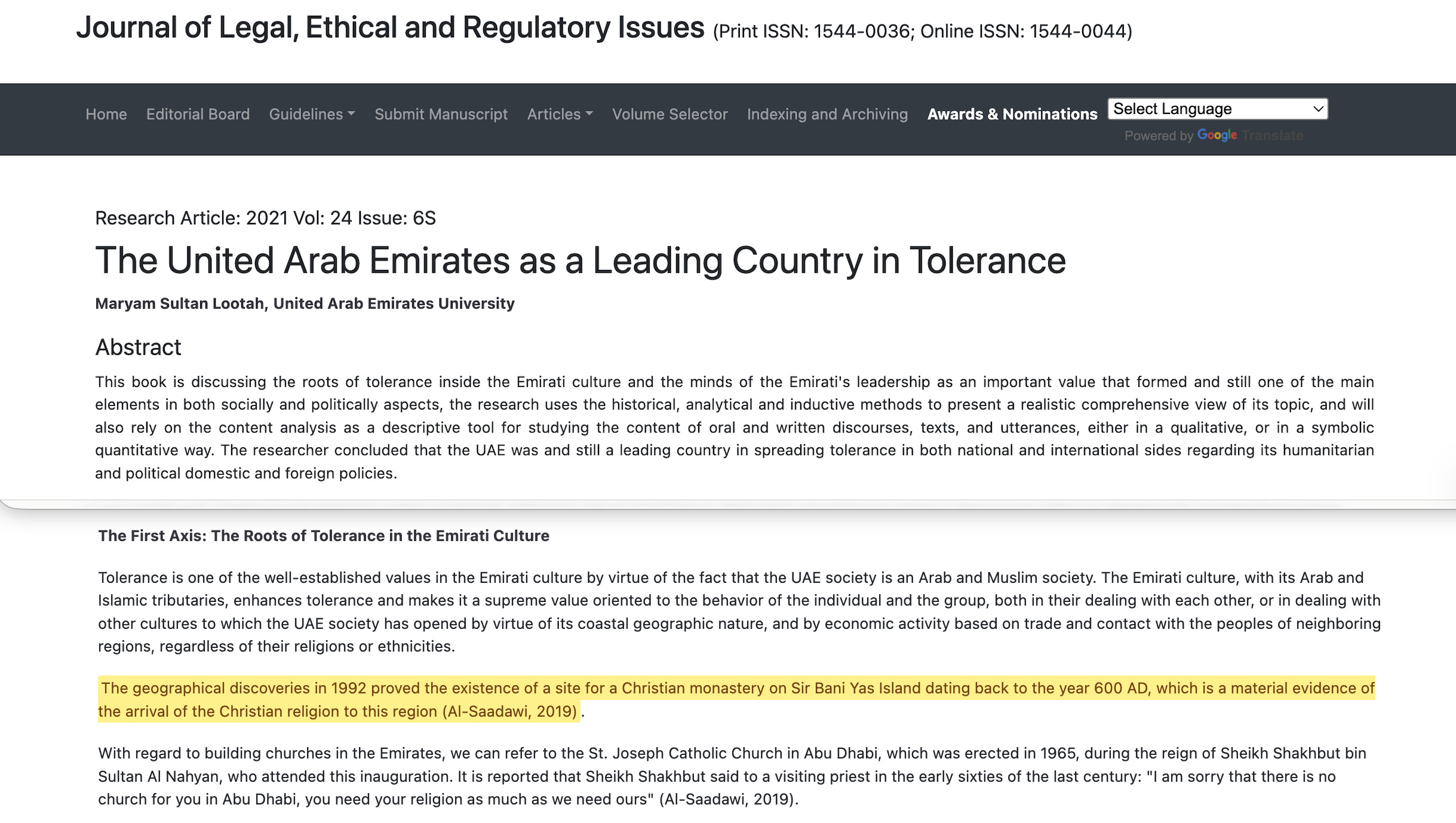
The forum was not held on the island. It convened at a resort 250 kilometres to the southeast. But the naming carries the brand: interfaith coexistence, Abrahamic harmony, tolerance as a governing principle. The name does the work that the venue cannot.
The use of interfaith ethics to govern international business has a documented history — and it involves the same families.
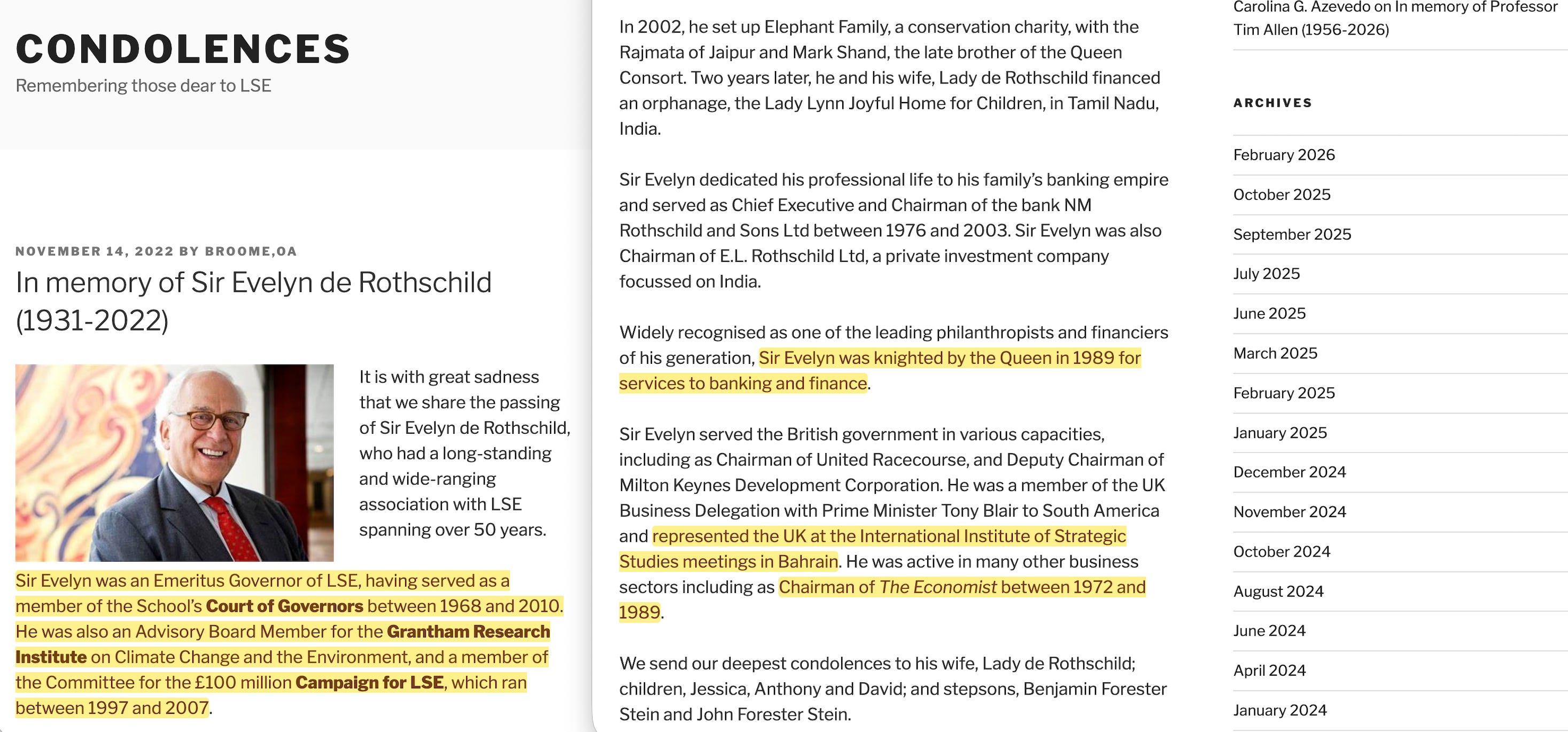
In 1984, a series of interfaith consultations began under the patronage of Prince Philip, Duke of Edinburgh, and Crown Prince Hassan bin Talal of Jordan. Christians, Muslims, and Jews convened under the auspices of St. George’s House at Windsor Castle and the Al Albait Foundation in Amman. The discussions ran for nearly a decade, concluding in Amman in October 1993 and launching at St. James’s Palace in May 1994 as the Interfaith Declaration on International Business Ethics. Sir Evelyn de Rothschild ‘more recently’ joined Prince Philip and Crown Prince Hassan as a patron — suggesting he arrived after the initiative was already underway.
British and Hashemite royalty likely wouldn’t spontaneously meet to discuss interfaith business ethics. Perhaps someone with relationships to both the British Crown and to the Hashemite court and to the international financial and diplomatic circles had to bring them together.
Evelyn de Rothschild was personal financial adviser to Queen Elizabeth II, knighted in 1989 for services to banking and finance61. He had the cross-network position that neither Philip nor Hassan possessed independently. The person who ‘joined’ is, on the structural evidence, the person who constituted the initiative — selecting the figureheads, and then stepping into the record as a supporter rather than the architect.
The pattern appears identical to Retinger at Bilderberg: the organiser presents as a late arrival to an initiative he conceived.
The Declaration established four principles for international business: justice, mutual respect, stewardship, and honesty — each grounded in the shared Abrahamic tradition. ‘Stewardship’ is the principle that carries most weight. In the Declaration, it means trusteeship: the responsible management of resources on behalf of others. Applied to business, it becomes the ethical obligation to weigh social and environmental consequences alongside profit. Applied to finance, it becomes the vocabulary in which sustainable development is eventually enforced.
Twenty-six years later, Lynn Forester de Rothschild — wife of Sir Evelyn — founded the Council for Inclusive Capitalism with the Vatican. At its December 2020 launch, CalPERS CEO Marcie Frost stated that ‘sustainable value creation rests on stewardship, not only of financial capital, but human and natural capital.’ The Rockefeller Foundation is a council member. Mark Carney, the former Governor of the Bank of England who developed the TCFD climate disclosure framework, is a prominent participant.
The structural parallel between the 1984 Declaration and the 2020 Council is worth laying out. Both are interfaith initiatives applying Abrahamic moral principles to international business and finance. Both are patronised or founded by members of the Rothschild family — Evelyn in 1984, Lynn (Evelyn’s wife) in 2020. Both operate through the language of stewardship. Both engage all three monotheistic traditions. And both produce ethical frameworks that, while presented as voluntary principles, feed directly into the institutional architecture of global financial regulation: the Declaration’s ‘stewardship’ maps onto the SDGs’ resource management goals; the Council’s ‘inclusive capitalism’ maps onto the ESG and impact investing frameworks that now govern capital allocation worldwide.

No institutional chain connects the 1984 Declaration to the 2020 Council. What connects them is the governing ethic itself — the same word, the same concept, the same family, the same interfaith framing — deployed thirty-six years apart as the moral vocabulary of successive rounds of the same financial architecture. The 1984 Declaration provided the ethical principles, and the 2020 Council provides the institutional enforcement.
The Liedtke framework documents that Rothschild marriages historically served a network function — placing agents at nodes requiring institutional continuity. Evelyn patronised the 1984 Declaration. Lynn, who married Evelyn in 2000, founded its 2020 successor.
The forum named after a Christian monastery on an island in the Arabian Gulf provides the regional intake mechanism through which sovereign actors are brought into the architecture that the ethic governs.
The Declaration’s four principles are, in early form, the Sustainable Development Goals: justice maps to poverty and inequality, mutual respect to peace and partnership, honesty to institutional transparency, and stewardship — the load-bearing principle — to every climate, biodiversity, and resource management goal in the framework. The participants at Windsor Castle wrote the moral vocabulary that would, three decades later, become the language in which compliance criteria are expressed — and which makes those criteria untouchable, because opposing them means opposing an ethic endorsed by all three Abrahamic faiths.
Lynn Forester de Rothschild is also the woman who provided Ghislaine Maxwell with a Manhattan apartment after Robert Maxwell’s death; who sold a townhouse to an Epstein-controlled LLC for below market value; who was named by Maxwell as one of Epstein’s 1990s financial clients; who discussed ‘Jeffrey Epstein and currency stabilisation’ with President Clinton in 1995; and who — per Maxwell’s own testimony to the Deputy Attorney General — introduced Epstein to Prince Andrew.

VIII. The Prototype
The Sir Bani Yas Forum did not invent its format.
In 1954, Józef Retinger convened the first Bilderberg Conference at a hotel in Oosterbeek62. Prince Bernhard served as chairman — the figurehead. Retinger selected who would be invited, managed the agenda, controlled the follow-up. He described himself as responsible for ‘all the spadework for the group as a whole’63. As Engdahl wrote: ‘It was he who selected Prince Bernhard to act as figurehead host and who selected which Americans and which Europeans would be invited’64.
CD Jackson, Eisenhower’s adviser on psychological warfare, wrote that he was ‘personally convinced’ Retinger was ‘a British agent’65. Between 1906 and 1920, Retinger had worked simultaneously on European reorganisation for the Jesuit General, world government for British federalists, and the creation of Israel for the Zionist movement66. He co-founded the European Movement. He organised the Congress of Europe at The Hague in 194867 — the precursor to what became the European Union. He was one of three European members of the American Committee on United Europe, an organisation created by the CIA, the State Department, and the Council on Foreign Relations68.
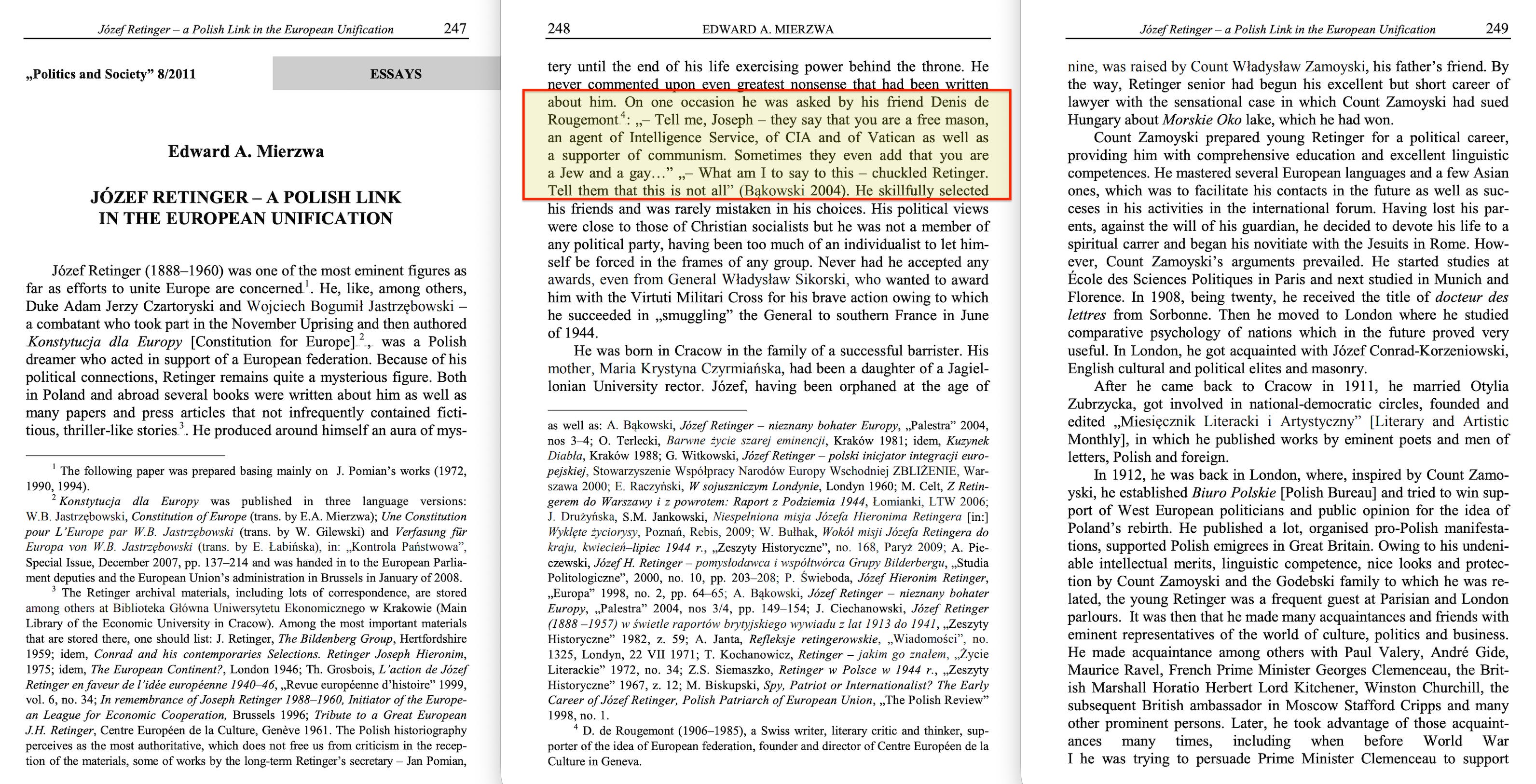
Every intelligence service thought he worked for a different one. Nobody shut him down. When an associate listed the accusations — freemason, agent of MI6, agent of the CIA, agent of the Vatican, communist sympathiser — Retinger laughed: ‘Tell them that this is not all’69.
The structural parallels with Epstein are significant. No official title. No institutional home. Every intelligence service suspicious but none intervening. Access to heads of state across multiple continents. The round table format as the primary instrument. And the same dispensability: Retinger died in 1960 and Bilderberg continued. Maxwell died in 1991 and the publishing clearinghouse transferred to Elsevier. Rød-Larsen resigned in 2020 and the forum transitioned to CSIS. Epstein died in 2019 and the impact investing architecture, the CBDC pipeline, and the SDG compliance framework were already in the walls.
The intelligence connection among the organisers is the recurring signature. Retinger was suspected of working for MI6 by the Americans, and for everyone else by everyone else. Rød-Larsen built his career on the secret Oslo backchannel — a covert diplomatic operation that required the cooperation of Israeli and Palestinian intelligence services, conducted outside official diplomatic channels, and managed by a man who later became Epstein’s closest ally in Norway.
Epstein himself was described by an FBI confidential source as ‘a co-opted Mossad Agent’, while Dershowitz reportedly told the US Attorney that Epstein ‘belonged to both U.S. and allied intelligence services’. The ACUE — the committee Retinger co-founded — was a CIA front. The IPI — the institution Rød-Larsen ran — received over NOK 130 million in Norwegian government funding while its president was being funded by a man the FBI classified as a foreign intelligence concern. In each case, the organiser sat at the intersection of multiple intelligence services, was tolerated by all of them, and used the round table format as the primary operational instrument.
The question this raises is whether the round table format is merely preferred by people with intelligence backgrounds, or whether the format itself is an intelligence technique — a method for processing targets through a controlled environment, under conditions of secrecy, producing intelligence product while simultaneously advancing a policy agenda that no single participant has been briefed on in full.
IX. The Common Architecture
The compartmentalisation is the key to understanding why the architecture has remained invisible for so long.
No single convening contains the whole. The 1984 Interfaith Declaration produced the ethical vocabulary — stewardship, justice, mutual respect. The Waddesdon forums produced the climate disclosure framework. The WEF’s Young Global Leaders programme placed the personnel. Epstein’s 71st Street dinners converted those pieces into operational transactions. Sir Bani Yas processed sovereign actors into the pipeline.
Each convening addressed a different audience, under a different moral banner, in a different domain — business ethics, climate science, monetary policy, Middle East peace — and each produced a self-contained output that appeared to stand on its own merits.

The participants at each stage endorsed only the piece in front of them.
The participants at Windsor Castle endorsed four principles of interfaith business ethics. They did not endorse a global financial compliance architecture. The Oxford academics at Waddesdon endorsed a research framework on stranded assets. They did not endorse binding capital requirements for every bank on earth. The foreign ministers at Sir Bani Yas endorsed a dialogue on Middle East peace. They did not endorse their own conversion into clients for blended finance packages, ecosystem service leases, or digital currency pilots.

The integration happens across convenings, across decades, across continents — in institutional channels far removed from the rooms where the individual pieces were endorsed.
The interfaith ethics become the SDG classification criteria. The stranded assets research becomes the NGFS scenario feeding Basel capital requirements. The monetary reform rationale becomes the BIS unified ledger. The sovereign relationships seeded at the forum become the channels through which development finance deals arrive years later.
Nobody who endorsed any single piece can see the whole, because the whole was never present in any single room. And nobody who can see the whole — because they organised multiple convenings across multiple domains — has any interest in making it visible.

The dual appeal ensures that both governance and commercial targets are captured simultaneously. The governance participants — ministers, diplomats, officials — are drawn by vanity: the prestige of the invitation, the quality of the guest list, the flattery of being treated as someone whose opinion shapes events. The commercial participants — bankers, executives, fund managers — are drawn by greed: access to sovereign clients, deal flow that cannot be obtained through any other channel, first-mover intelligence on policy shifts that will redirect trillions in capital.
Neither group questions why it has been placed in the same room, because each believes it is there for its own reasons. The round table’s design ensures that the governance targets provide the political legitimacy the commercial targets need, and the commercial targets provide the financial infrastructure the governance framework requires — without either group understanding that it is serving the other’s function.
X. The Intake Mechanism
The Sir Bani Yas Forum is where sovereign nations are brought into the financial architecture voluntarily.
One cannot sell blended finance, ecosystem service leases, or digital currency pilots to a country whose foreign minister one has never met. The relationship must come first, and it cannot be formed through official diplomatic channels, because those leave records, involve career diplomats, and are subject to parliamentary oversight.
So a peace forum is built in a desert resort under Chatham House rules where foreign ministers from twenty-two countries sit with international experts and business leaders for three days without media, communiqués, or attribution. The sovereign actors arrive thinking they are discussing Middle East security. They leave having had private bilateral meetings with people who will later approach them with financial products, infrastructure proposals, digital currency schemes, and development finance packages.
The forum is the top of the funnel. It converts sovereign actors from strangers into contacts, from contacts into relationships, and from relationships into clients — all off the record, all shielded by an ‘ethical imperative’, in this instance ‘peace’.
The attendee list reads as the target market for everything Epstein was building in parallel: twenty-two foreign ministers from developing and middle-income nations; countries that would need development finance, whose central banks would be candidates for digital currency pilots, and whose sovereign wealth could be channelled into impact investing vehicles and programmable money architectures.
The forum seeded the relationships. The products arrived years later through entirely separate channels. The minister who received a development finance proposal conditioned on digital currency adoption did not connect it to the peace conference where the relationship was formed.

The Epstein documents show this mechanism in operation at the very first event. Upon receiving the attendee list, Epstein deployed it to three separate recipients for three separate purposes. The forum had not yet convened and its intelligence product was already circulated by the switchboard operator.
The Liedtke framework, documented in ‘Agents for the Rothschilds’, describes nineteenth-century agents placed in locations where the Rothschild banks did not maintain a permanent presence. The Middle East and Gulf states are precisely those locations. The forum provides the intake mechanism for a region where the principal’s banking infrastructure has no permanent footprint — converting sovereign contacts into financial relationships through an annual convening that operates, by design, beyond the reach of any parliament.
The foreign ministers are not the organisers, the beneficiaries, or the partners in this architecture. The forum exists to process them.
They are the targets.

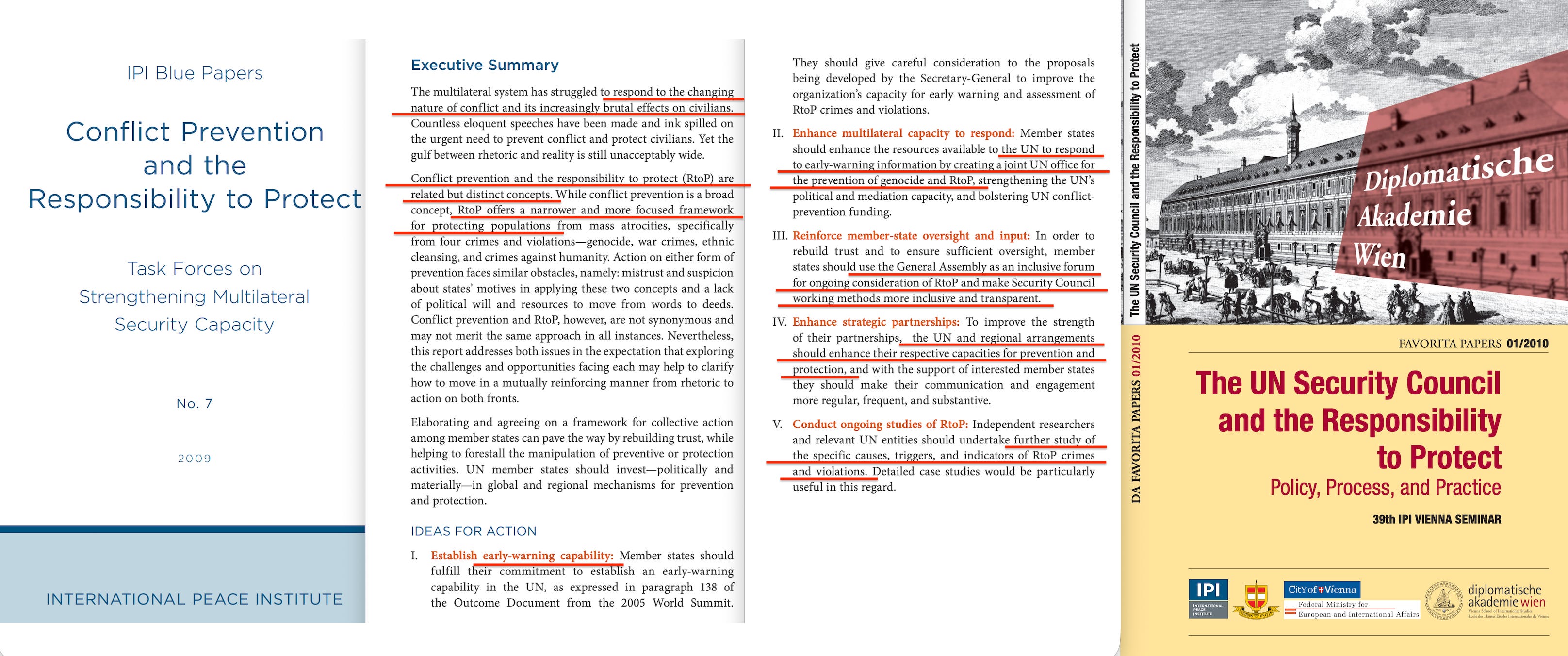
The institution co-organising the forum was simultaneously building something else. Between 2005 and 2010, IPI developed the intellectual framework for the Responsibility to Protect70 — the doctrine that a state’s sovereignty is conditional on its treatment of its population, and that the ‘international community’ may intervene — including militarily — when a state is judged to have failed.
IPI published the Blue Papers, and hosted the Vienna seminars. IPI’s Senior Vice President, Edward C. Luck, simultaneously served as the UN Secretary-General’s Special Adviser on R2P. In March 2011 — four months after the inaugural forum — R2P was invoked to justify NATO’s intervention in Libya71. IPI’s Favorita Paper on R2P and the Security Council was published72, as IPI’s own website notes, ‘shortly after’ the Libya resolution.
The institution that processed the sovereign targets through a peace forum was the same institution that developed the mechanism for suspending their sovereignty.
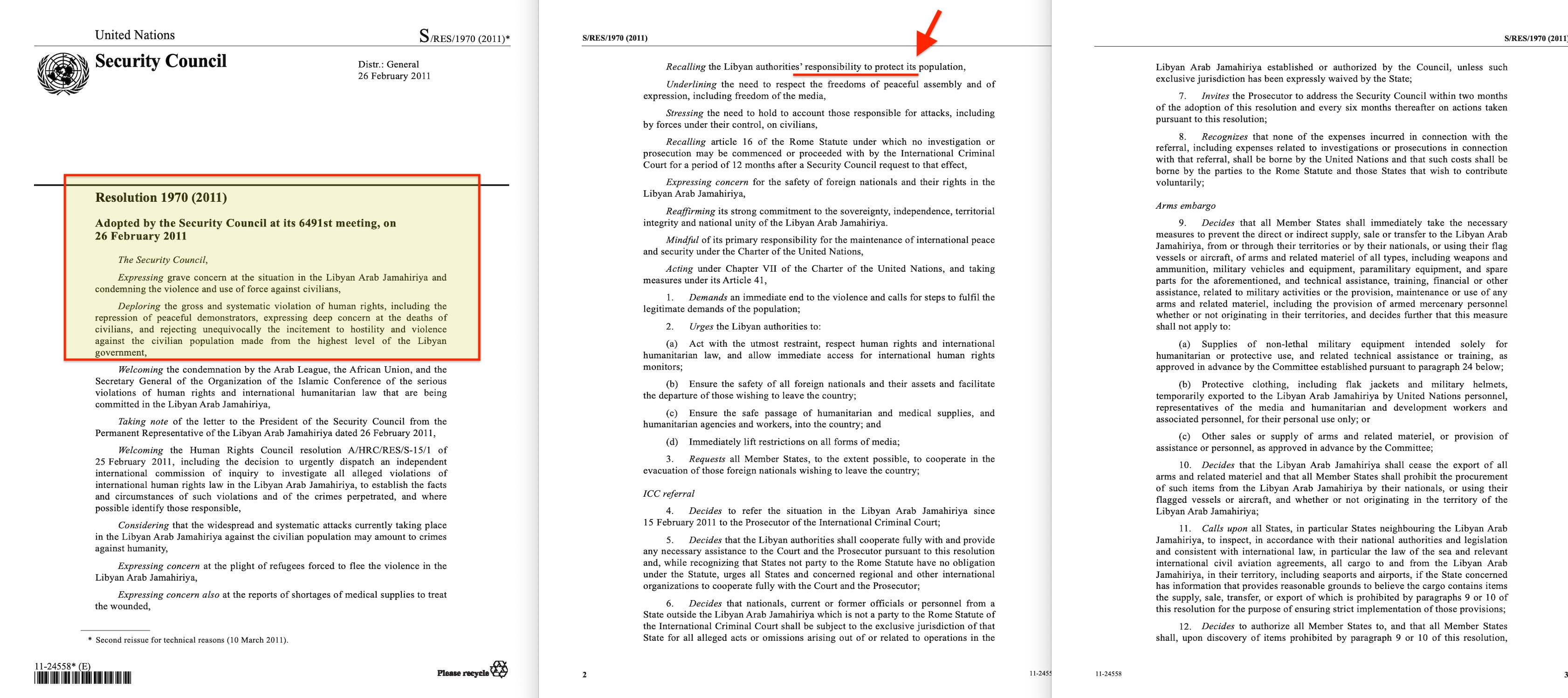
R2P, stripped of its moral vocabulary, is a right to invade. The doctrine holds that when a state fails to protect its population — as determined by the international community — external military intervention becomes legitimate.
The UN further proposed operationalising this through an ‘early warning system’ that would identify states at risk of failure before atrocities occur, enabling pre-emptive action.
This is anticipatory governance with a lethal outcome.

The early warning system is the black box: opaque indicators, set by unelected bodies, processed through models whose parameters are not disclosed, producing an output — intervene or don’t — that carries no individual accountability because no individual made the decision.
Whoever controls the standards that feed the early warning model controls when sovereignty is suspended and force is applied.
The mechanism is identical to the financial architecture: an ethic that cannot be opposed — preventing genocide — translated into a standard, processed through an evaluative clearing function (the ‘black box’), producing a settlement.
The only difference is that the settlement is not a blocked financial transaction, but an air strike.

The institution that co-organised a peace forum in the desert was the same institution that built the intellectual architecture for a war clearinghouse — one that reserves a right of force projection, processed through opaque early warning indicators, carrying the UN’s stamp of approval, and accountable to no sovereign whose territory it targets.
It’s titled the ‘International Peace Institute’, but it actually serves as a pre-emptive war clearinghouse, with right to project force — and there’s no one to hold accountable, because the 'black box' called the shot.
XI. The Chain
Three archives interlock. The DOJ releases show the chain from Jacob Rothschild through Ariane to Epstein. The JPMorgan compliance file shows the chain from Epstein through Staley into the bank’s institutional machinery. The Senate memorandum quantifies $1.3 billion in suspicious transactions.
The Sir Bani Yas documents add a fourth node. Rød-Larsen co-organised the forum. Rød-Larsen was Epstein’s closest ally in Norway — funded by him, indebted to him, named executor of his estate. Epstein received the attendee list and deployed it to Mandelson, who operated in the Rothschild orbit. The attendee list contained Blair and Miliband — both Labour, both Fabians, both in Mandelson’s network — alongside the sovereign leadership of the Middle East peace process, twenty-two foreign ministers, and Israel’s Deputy Prime Minister with oversight of intelligence matters.

XII. Wiring in the Walls
The forum’s fourteenth edition was held in December 2024. Rød-Larsen resigned over Epstein in 2020. The forum transitioned to CSIS and continued without interruption.
The format survives every operator. Retinger dies; Bilderberg continues. Maxwell dies; the publishing clearinghouse transfers to Elsevier. Rød-Larsen resigns; the forum carries on. Epstein dies; the impact investing architecture, the CBDC pipeline, and the SDG compliance framework are already institutionalised.
The participants at each stage are genuine. The foreign ministers believe in peace. The theologians believe in ethics. The scientists believe in climate. Their sincerity is the mechanism’s most important feature, because it ensures that the people presenting the moral cause will defend the structure beneath it without ever having been told what it contains.
But the forum’s architecture is older than Retinger.
In 1862, Moses Hess published Rome and Jerusalem. Its argument was that each nation possesses an organic ethical mission — a defined role within a universal moral order. The nations do not choose their purpose — the purpose is assigned by the logic of the system. The two civilisational poles Hess identified were Rome and Jerusalem: Christianity and Judaism, the spiritual and the national, the universal ethic and the identity. Each had its place and function, and the architecture required both.

One hundred and forty-eight years later, a forum named after a Christian monastery — the oldest known Christian site in the Arabian Gulf — convened twenty-two foreign ministers under the co-organisation of an institution called the International Peace Institute, at an event structured around business and governance, where Session 3 asked not what Iran is doing but what Iran’s role is.
The panel assigned positions within a regional order, and the Chatham House Rule ensured the assignment process was invisible. And the governing ethic — peace, stewardship, interfaith harmony — was one that no nation within the Abrahamic world could reject.
The Interfaith Declaration on International Business Ethics provided the ethical vocabulary: justice, mutual respect, stewardship, honesty. The SDGs translated it into 232 measurable indicators. The BIS builds the enforcement infrastructure. And at every stage the round table processed the sovereign actors into accepting their assigned role voluntarily.


Another clutch assessment, Esc.
What I love about this one is the way that it disabuses indie analysts of the imagery of the attendees of Bilderberg/Davos/Jackson Hole/World Climate Conference/The Interfaith Declaration/Sir Bani Yas/Roundtable for Global Health Security/Event 201/Council for Inclusive Capitalism/WEF Young Global Leaders/etc. as nefarious, technocratic, self-aware, psychopathic cabal top-architects, which endows them with a feeling of omnipotent power & evil intention, and rather renders them as supremely pathetic dupes in the most sophisticated elite Time-Share grift ever conceived. Rarely do narcissists get exposed as such easy marks, desperate wanna-be's & future has-beens.
It repositions them as willing patsies for the actual cabal that reliably seems to originate with Rockafeller/Rothschild/BIS/City of London Interests.
By the time it gets to Event 201 and the triggering of global Lockdown protocols we must realize that our "healthcare," military & intelligence 'representatives' are just incurious fools who are so uncritical, unskeptical, and unabashed suckers that they can't see plainly that they are selling out their own grandchildren & their whole society to a legacy of hubris that would make the devil blush. Whatever oaths they may have taken to defend the Constitution are no more than a cynical joke. They haven't the integrity to recognize their hypocrisy and treasonous acquiescence.
While their ego-driven failure may not be deserving of pity, they are certainly the most supreme suckers, utter dupes, losers of the highest order, eminently deserving of mockery, exile, satirical lampoon, cancellation, and derision. Spineless & blind golems, all. Forgiveness is too good for them. The rope, judiciously deployed, would be a grace for them.
The sovereign royals who have all gotten on board have all handily earned their subjects' universal disrespect by their gullibility and pragmatic expedience driving all to a universal eternal prison, which even they, the royals, will not be immune to, ultimately. Even if they can sustain a protected class above the fray of dystopia, they'll still be subject to presiding over dystopia, managers of ugliness, destitution, desperation, usurped will, banality, and a reign of automated cruelty, where the virtues have gone extinct, and life even at the top tests bearability. What good is life where love has been obsolesced & reduced to stranded asset commodity?
This revised image places the folks who have attended and then later dropped out of these roundtables as humans, albeit still bureaucrats, oligarchs and tyrants, who may retain some kind of integrity & wisdom, potentially, that can save us.
Maybe upon the armature of your work, Esc, they might develop the wisdom & will to embrace a culture of snitch on their loser peers, so as to arrest the forward momentum of this/these project/s before final lock-in. Let's hope the estimation of open eyes & appropriate stigma can trickle up the ladder of intellectual fashion fast enough in the right circles fast enough.
Godspeed & keep up the good work!
Sir Bony-Ass. Mnemonic tricks sometimes help me to keep track of this stuff.
Excellent output, Mr. EscapeKeyGuy!!!!
Smoke is clearing.