
Three Witnesses

Three major academic books on Europe between the two world wars all reach the same territory from different angles — but none steps onto the others’ ground.

Dina Gusejnova’s European Elites and Ideas of Empire, 1917–19571 (2016) searched archives to map the aristocratic networks that shaped European institutions from the fall of the continental empires through to the Treaty of Rome. Adam Tooze’s The Wages of Destruction2 (2006) used detailed economic data to show how resource shortages pushed Nazi Germany to expand, then collapse. Quinn Slobodian’s Globalists3 (2018) followed the Geneva School economists who built supranational institutions to keep economic governance out of democratic hands. All three are peer-reviewed, based on primary sources, and widely cited.
All three independently corroborate the central claims of recent essays — documenting a clearing-and-settlement system laid out at the 1932 Volta Congress in Rome, formalised in a 1942 Nazi report (Europäische Wirtschaftsgemeinschaft), and locked into place by the Treaty of Rome in 1957.
None of the three names this system. Gusejnova covers those who built it. Tooze covers its economic outputs. Slobodian covers the intellectual effort to shield it from democracy. The mechanism itself — the clearing function that enforces compliance through settlement conditions — sits in the gap between them. And through every regime change, its supporters have called it the same thing.
The Third Way.


The social layer: Gusejnova
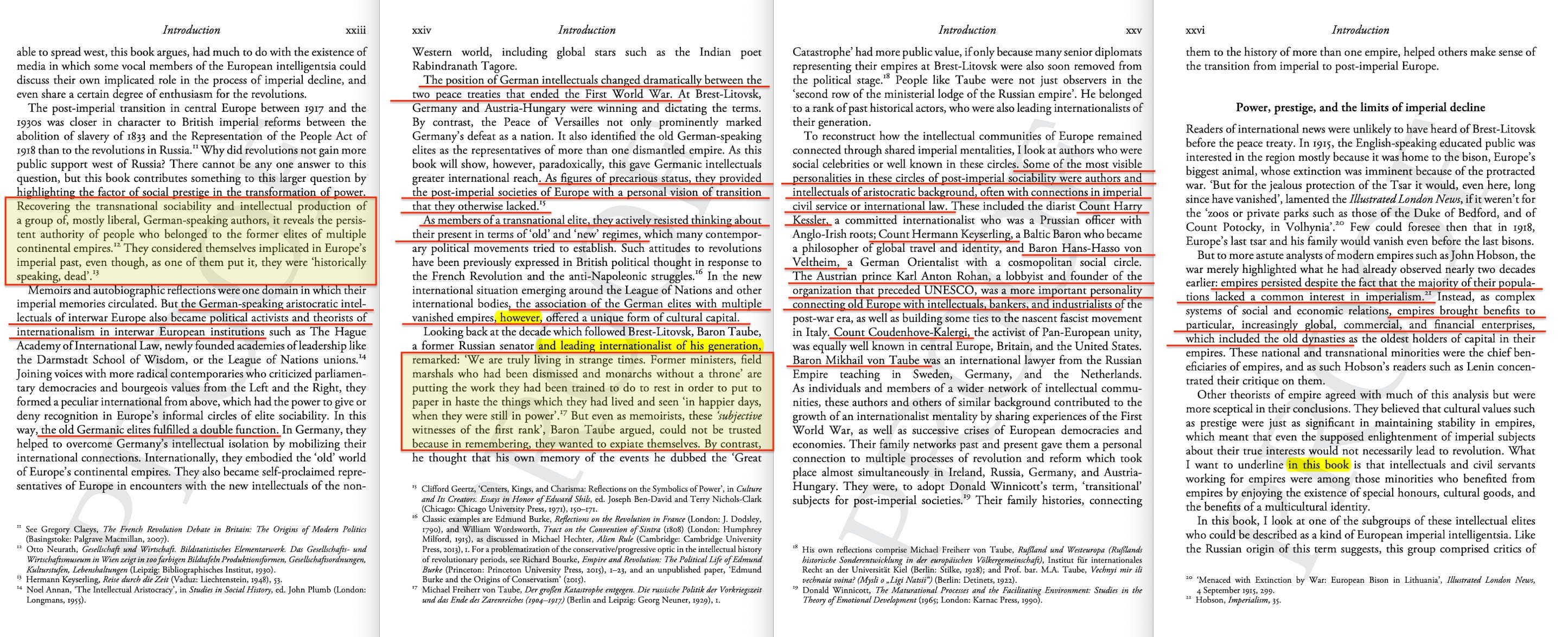
Gusejnova traces how German-speaking aristocrats turned their imperial prestige into new political influence after 1918. Her subjects include figures whose networks linked Vienna, Berlin, Munich, Paris, London, and Rome throughout the interwar years: Count Kessler, Count Keyserling, Prince Rohan, Baron von Taube, and Count Coudenhove-Kalergi.
Her sixth chapter details the 1932 Volta Congress, which she treats as the moment these networks solidified. She traces the congress programme to 1925, when Orestano and intellectuals working with Mussolini cooked up ‘a new philosophy of Europe’. She records the deliberate exclusion of the Soviet Union, and notes the presence of Rosenberg, Rohan, and representatives of fallen continental empires alongside Mussolini and the Italian king. She quotes a journalist who observed that ‘Europe had been robbed by fascists dressed in academic uniforms’.
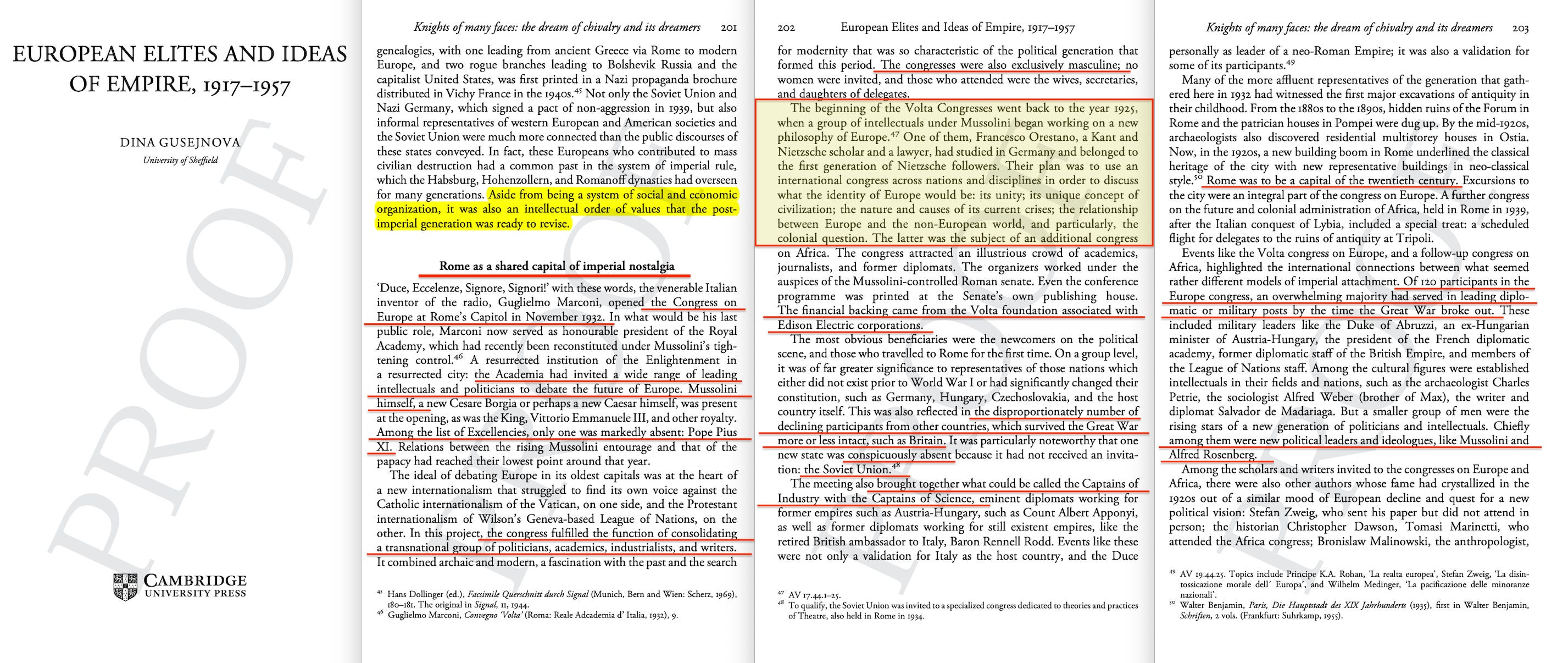
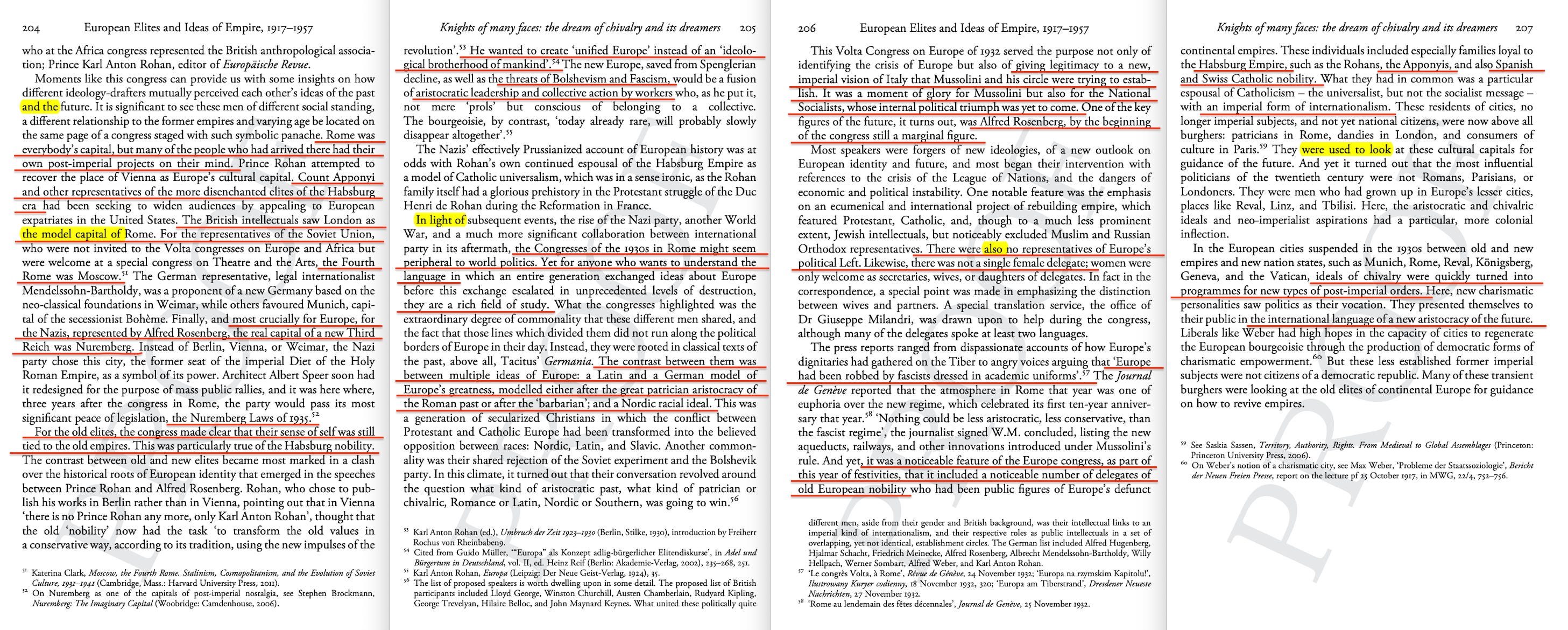
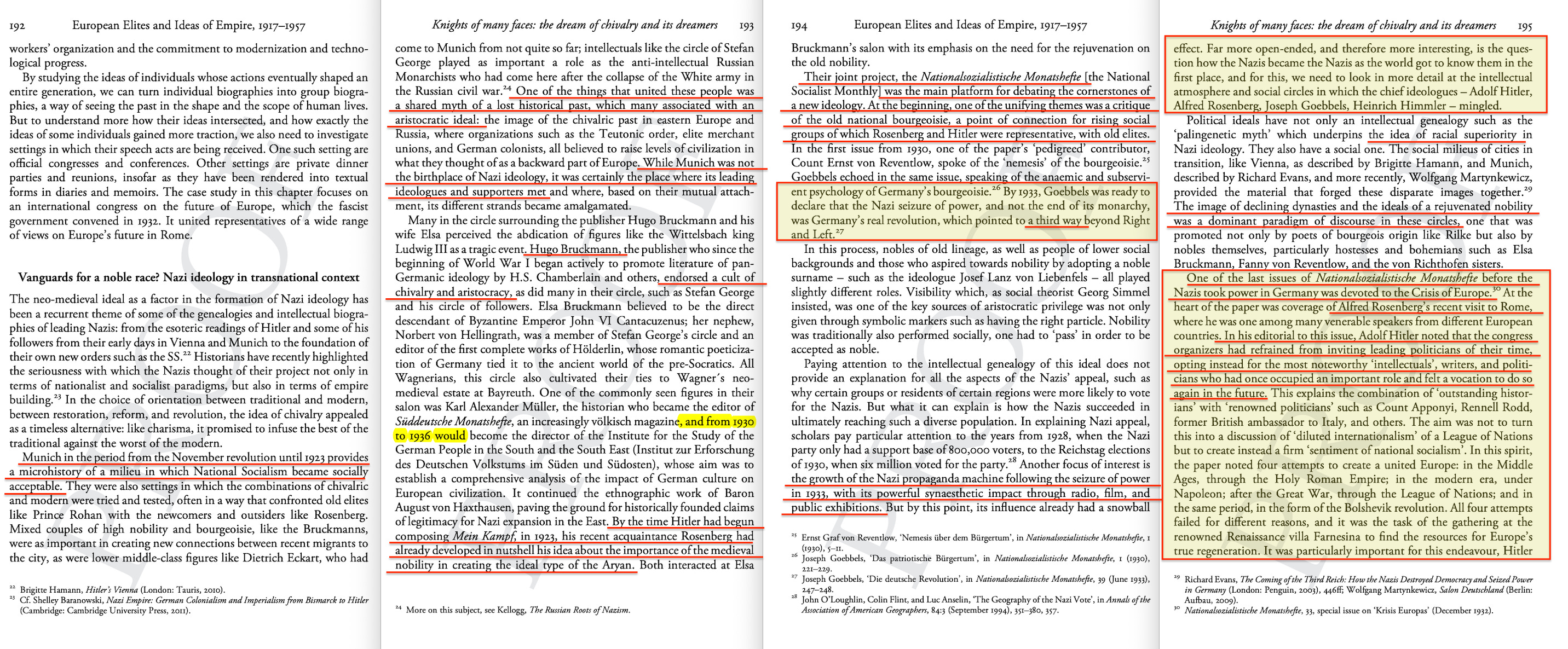
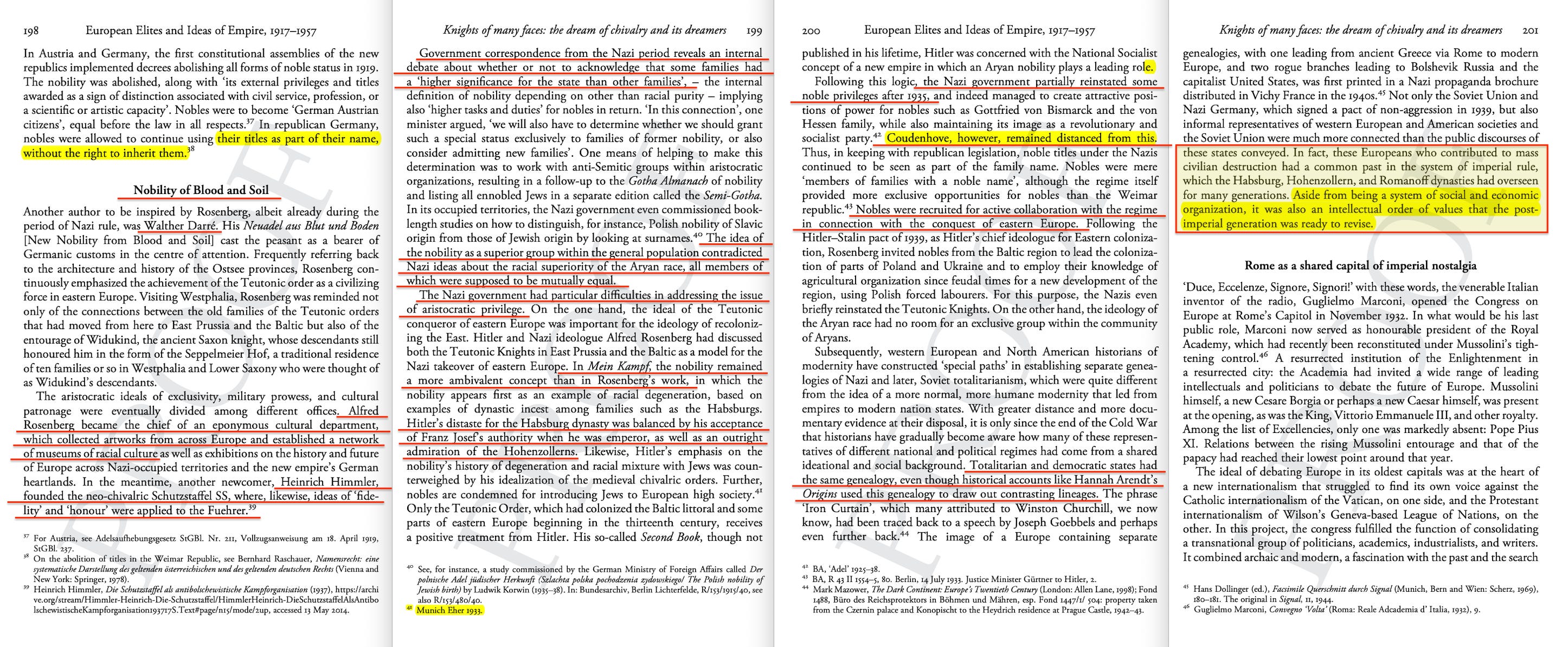
On page 194, she documents Goebbels declaring in the Nationalsozialistische Monatshefte — the journal Rosenberg edited — that the Nazi seizure of power, ‘and not the end of its monarchy, was Germany’s real revolution, which pointed to a third way beyond Right and Left‘. On page 200, she writes that ‘totalitarian and democratic states had the same genealogy, even though historical accounts like Hannah Arendt’s Origins used this genealogy to draw out contrasting lineages‘. And in the epilogue, she compares Europe’s postwar reconstruction to ‘the way twenty-first-century management consultants proposed to restructure bankrupt banks‘ — separating the good parts from the bad, giving the good part a new name, and keeping the underlying structure intact.
She maps the Kulturbund-to-UNESCO line, and records Schacht at Kessler’s dinner table in the mid-1920s, already woven into transnational elite networks years before he built the bilateral clearing system. She also cites Hitler’s commentary on the Volta Congress in the December 1932 issue of the Nationalsozialistische Monatshefte, listing four failed attempts to unite Europe and calling for a fifth.
In 300 pages she doesn’t mention clearing, settlement, bilateral trade architecture, the BIS, Julius Wolf, the 1942 Europäische Wirtschaftsgemeinschaft, or any economic mechanism. In her analysis the Volta Congress is a cultural event — a consolidation of elite networks. The economic sessions — Schacht on monetary stabilisation, Verrijn Stuart on central bank authority, von Franges requesting the bilateral treaty network, Hantos and Einzig on European economic coordination — don’t appear at all.
Gusejnova might have considered the economic sessions inconsequential to her argument about elite networks. Or perhaps they sat entirely outside her domain, because spotting clearing-settlement architecture as a governance mechanism does differ from spotting social networks.
Either way, the economic specification was delivered at the congress she treated as her culminating case study, by speakers she documented as present. The economic content of the Volta Congress passed through peer review without even being identified.
There’s another layer her evidence records but doesn’t explore. In her own introduction, Gusejnova writes that after imperial collapse, the old elites faced three choices: adaptation to national democracy, nostalgia for past empires, or advocacy for a new internationalism. They chose the third — because national democracy made them irrelevant while continental governance made them indispensable. Their transnational networks, institutional memory, and administrative competence were exactly what any supranational project required.
On page xliv she notes that these ‘transnational elite communities’ were ‘facilitators of these new ideological movements in their earlier phases’ while being ‘equally important for the cultural formation of dissident communities’ — they facilitated fascism and anti-fascism alike. Pages 199–200 show the regime’s side of the bargain: the Nazi government reinstated noble privileges after 1935, created ‘attractive positions of power’ for aristocratic families, and after 1939 invited Baltic nobles to lead the colonisation of eastern Europe.
The five channels weren’t just parallel networks adapting to modernity. They were the infrastructure through which an old governing class was offered its power back under whichever ethic was currently running. The ethic changed with each regime transition. The offer — operational authority within the new framework — remained the same.

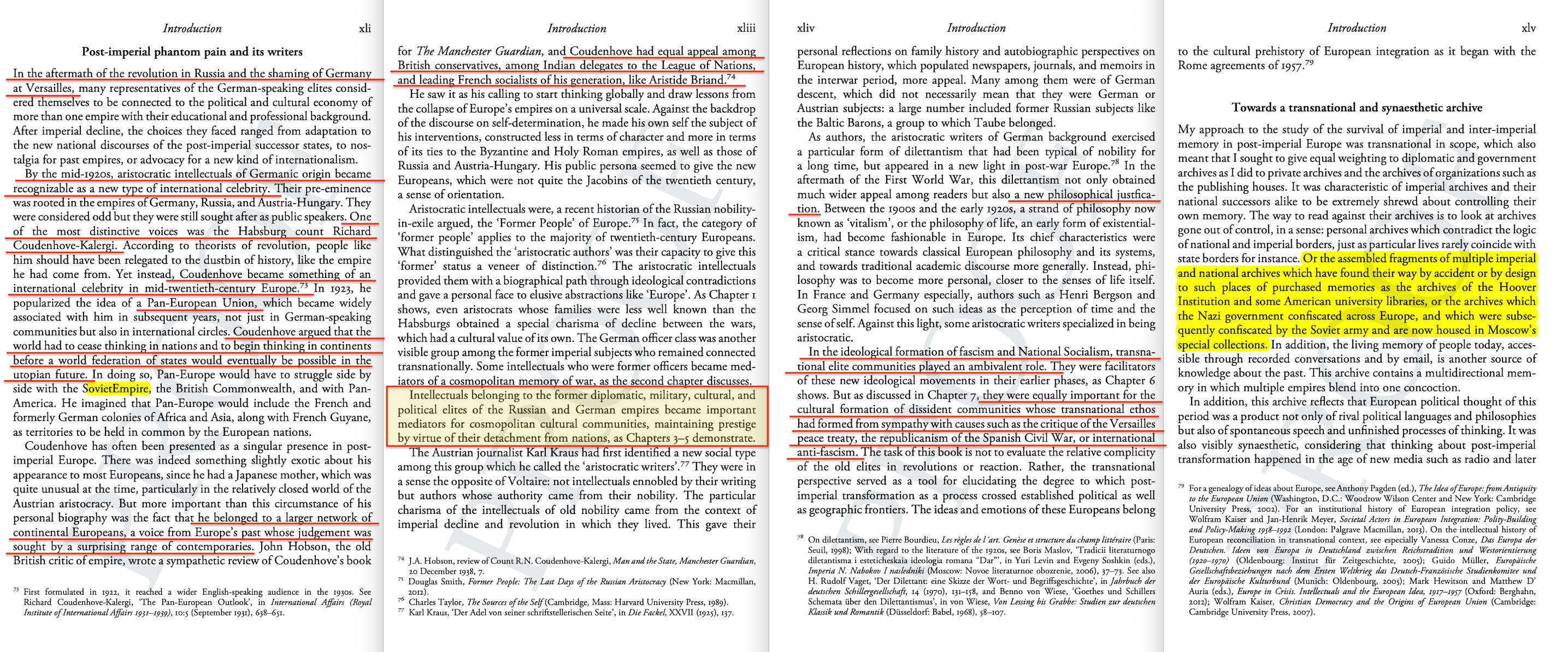
The funding structure Gusejnova also documents
Gusejnova’s evidence holds another layer that her framework notes but never explores.
Her book identifies five channels the old European elites used to rebuild influence after 1918. Count Keyserling ran the philosophical-spiritual channel — the School of Wisdom at Darmstadt, funded by Grand Duke Ernst Ludwig of Hesse-Darmstadt. Count Coudenhove-Kalergi ran the political-industrial channel through the Pan-European Union. Prince Rohan ran the cultural-institutional channel — the Kulturbund in Vienna, the Europäische Revue, and the lineage that became UNESCO. Count Kessler ran the diplomatic-aesthetic channel through art patronage, bibliophile presses, and Fabian connections in London. Baron von Taube ran the legal-international channel through the Hague Academy and émigré legal networks. Each channel appeared to be independent.
Gusejnova also tracks who funded them. Baron Louis Rothschild introduced Max Warburg to Coudenhove-Kalergi. Warburg put up 60,000 gold marks, sponsored the 1926 Pan-European congress in Vienna, and funded the Nietzsche Archive and his brother’s Warburg Institute. Robert Bosch came in through the linoleum industrialist Richard Heilner, gave money annually from 1928, took a seat on Coudenhove’s directorial board, and funded Rohan’s Kulturbund. Emile Mayrisch, founder of the European steel cartel, paid for the Colpach summer conferences that linked French and German industrialists across several channels. Furthermore, Carl Siemens, Adam Opel, Edmund Stinnes, Hermann Bücher of AEG, Carl Duisberg of Bayer, N.V. Philips, and Otto Böhler all contributed.
The Carnegie Foundation for International Peace funded Coudenhove’s political channel and the Hague Academy’s legal infrastructure that Taube used, while Rockefeller money paid for the League of Nations’ intellectual cooperation apparatus — the institutional endpoint of Rohan’s cultural channel. The Volta Congress itself was funded by the Volta Foundation, associated with Edison Electric.

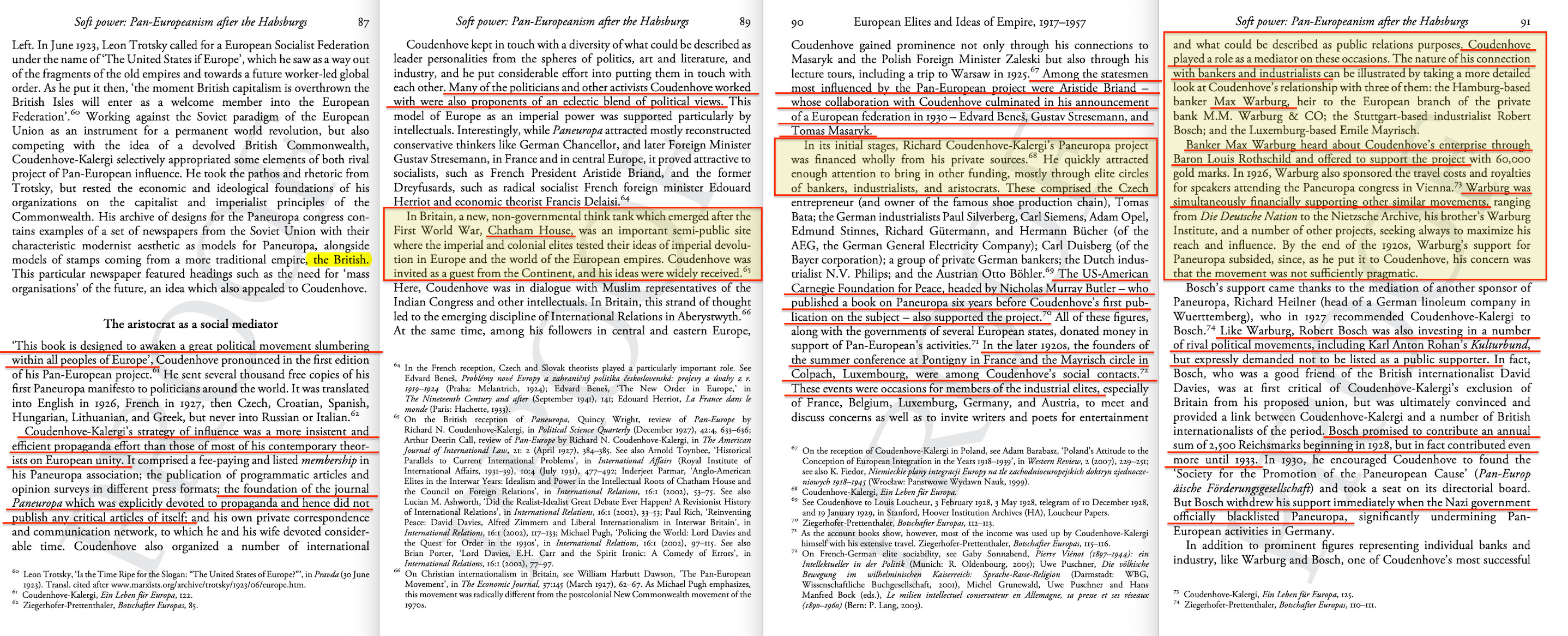
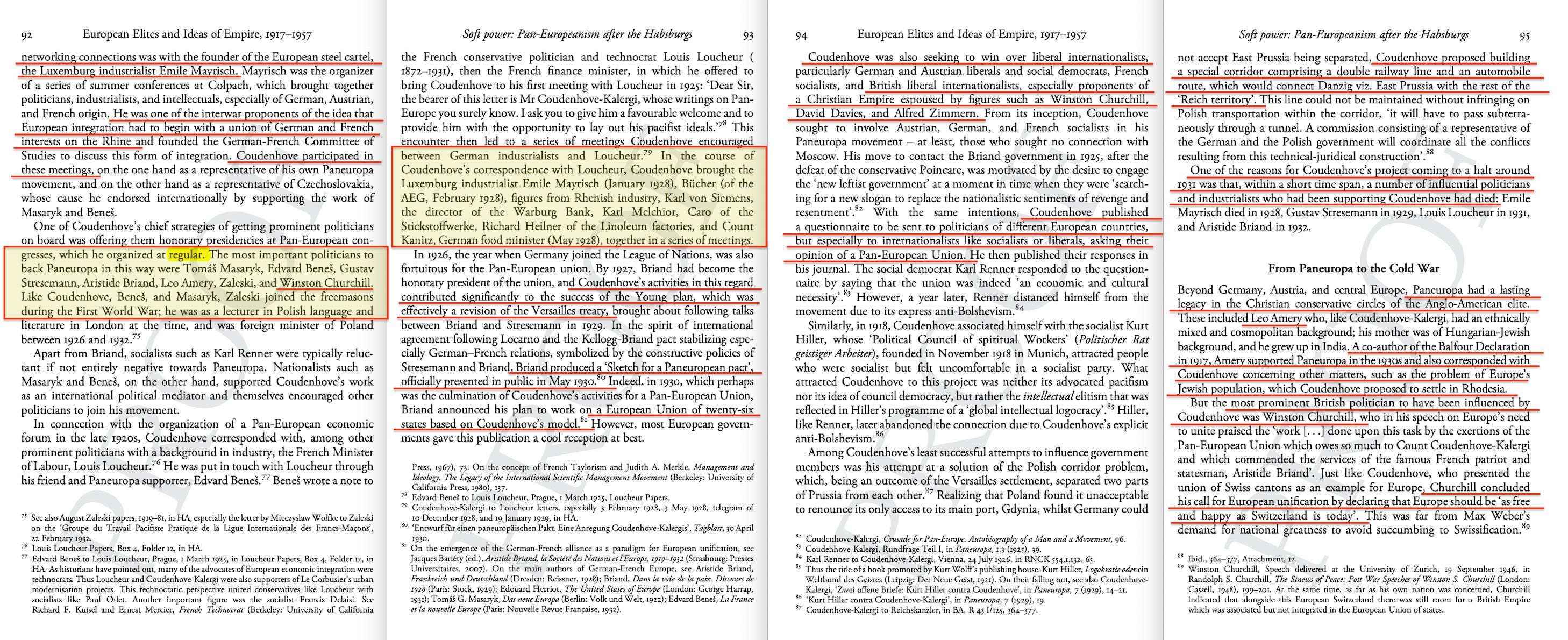
All these funding relationships sit in Gusejnova’s text. She uses them to show how the Pan-European networks paid for their operations, but she misses the convergence: three banking dynasties — Rothschild, Warburg, and Kessler’s father’s railway-banking fortune — plus two American philanthropic foundations, Carnegie and Rockefeller, one energy corporation, Edison, and a cluster of European heavy industry in steel, chemicals, electrical, and automotive were all funding the five channels at the same time. The channels appeared to be independent. But the money came from almost the same places.
And she misses a second convergence. Each channel was developing, in its own language, a different side of the same shift — from aristocratic authority to scientific-technical authority. The proof of concept was already running: the Soviet Union had put scientific materialism to work as a framework for governance, and all five channels were watching. Gusejnova records this directly — Keyserling wrote on Bolshevism, Coudenhove explicitly kept the Soviet Union out of Pan-Europa, Rohan visited Moscow, Kessler funded communist publishers while backing Fabian gradualism, and the Volta Congress itself deliberately didn’t invite Soviet representatives. They were all reacting to the Soviet model — some drawn in, some pushed away, all studying its central innovation: science replacing blood as the basis of authority.
Rohan’s cultural channel became UNESCO, the institution through which Needham and Huxley would deliver science as the postwar legitimating framework. Coudenhove’s political-industrial channel was explicitly technocratic, tied to Le Corbusier’s modernisation projects and the Saint-Simonian tradition of governance by engineers. Keyserling’s philosophical channel hosted Jung and the psychoanalysts — the scientisation of spiritual authority, where expertise in human consciousness replaced hereditary status as the basis of leadership. Kessler’s diplomatic channel ran through the Fabians, the original British scientific socialists, whose model of gradual social engineering through expertise shaped Leonard Woolf’s proposals for international government. Taube’s legal channel, funded by Carnegie, was training the expert class that would staff the postwar international institutions.
Five channels, five routes to the same destination: governance authorised by science rather than blood, with the clearing function running underneath both.

The permanent transmission infrastructure
These same foundations were building the permanent infrastructure that would carry output from all five channels. Carnegie and Rockefeller funded both the Royal Institute of International Affairs, set up in London in 1920, and its American counterpart, the Council on Foreign Relations, formed in New York in 1921. Both grew out of the same Paris Peace Conference meetings, and served as spaces where officials, industrialists, and intellectuals shaped policy under confidentiality rules — the Chatham House Rule explicitly bans attribution.
The personnel overlaps with Gusejnova’s networks are specific. Paul Warburg, brother of Coudenhove’s funder Max, was a CFR founding member. John Foster Dulles, who traced the BIS back to Wolf’s 1892 proposals, was a CFR member. Coudenhove himself lectured at Chatham House from 19314. Churchill, on the Volta Congress’s proposed British invitee list, was a president of the RIIA5. Walter Lippmann, whose Phantom Public Gusejnova cites in her epilogue on democratic deficit, was a CFR founding member6. The five channels fed into a single convergence point in Rome. The RIIA and CFR provided the permanent Anglo-American architecture that would carry the convergence into policy — regardless of which government held office on either side of the Atlantic.
Five channels of influence converged at one point in Rome in 1932, with remarkably few funding sources behind all of them. And they shared a direction of travel — documented by the historian who didn’t identify where it led.


The economic layer: Tooze
Tooze’s Wages of Destruction reconstructs the Nazi economy from 1933 to 1945 through Reichsbank records, trade statistics, foreign exchange data, and industrial production figures. He argues that Germany’s economic position was far more precarious than the ‘economic miracle‘ story suggests, and that resource constraints the regime couldn’t escape largely dictated when the war started.
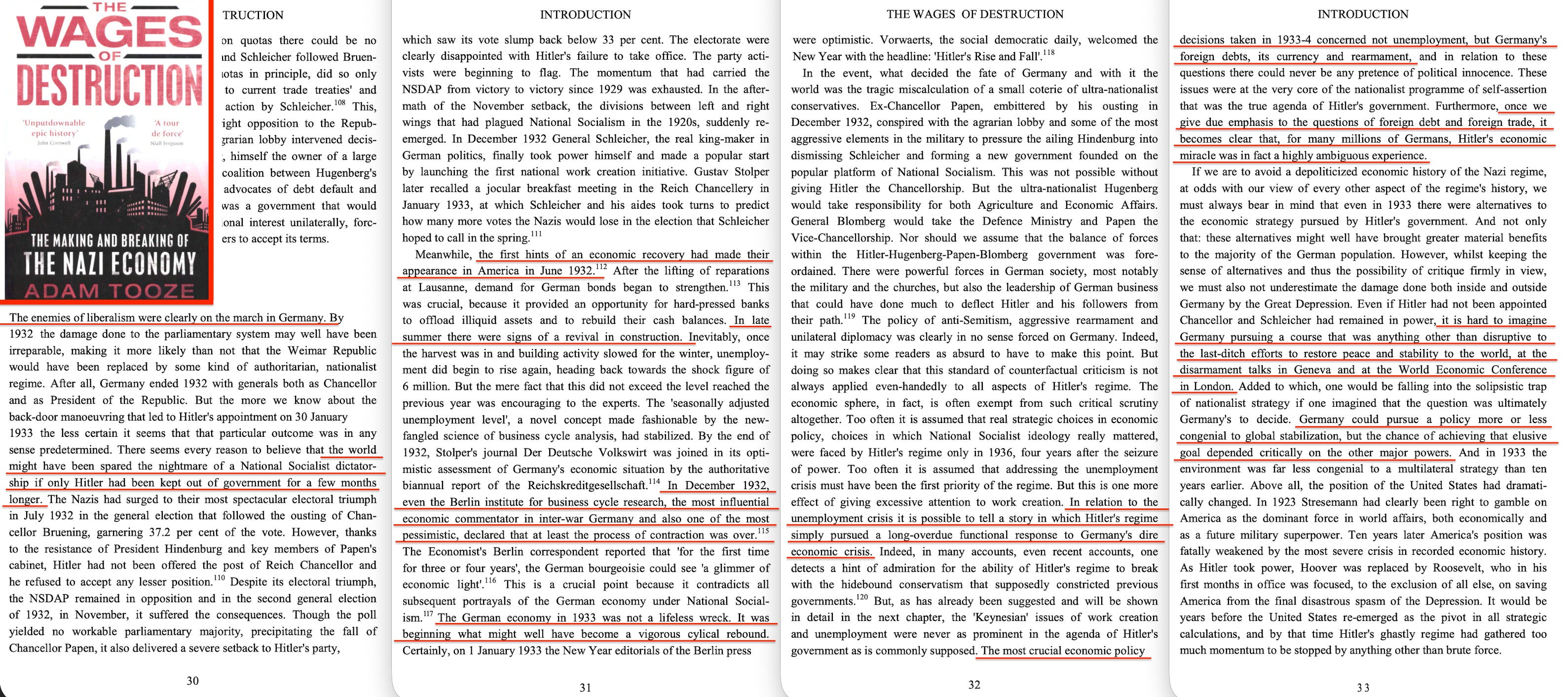
The bilateral clearing system sits at the heart of Tooze’s evidence — though never at the heart of his analysis. Schacht’s network of bilateral trade agreements, launched in 1934, captured southeastern Europe’s export capacity. Romania, Yugoslavia, Hungary, Bulgaria, and Turkey steadily built up blocked reichsmark balances — credits they could only spend on German goods.
By 1938, Germany was swallowing enormous shares of these countries’ total exports. The partners didn’t refuse to take part — they couldn’t leave, and each round of bilateral trade deepened their dependency. Germany got real goods — oil, minerals, agricultural products — while the trading partners got paper claims on future German exports that they couldn’t convert to hard currency or spend anywhere else. The system was extractive by design: real resources flowed in, accounting entries flowed out.
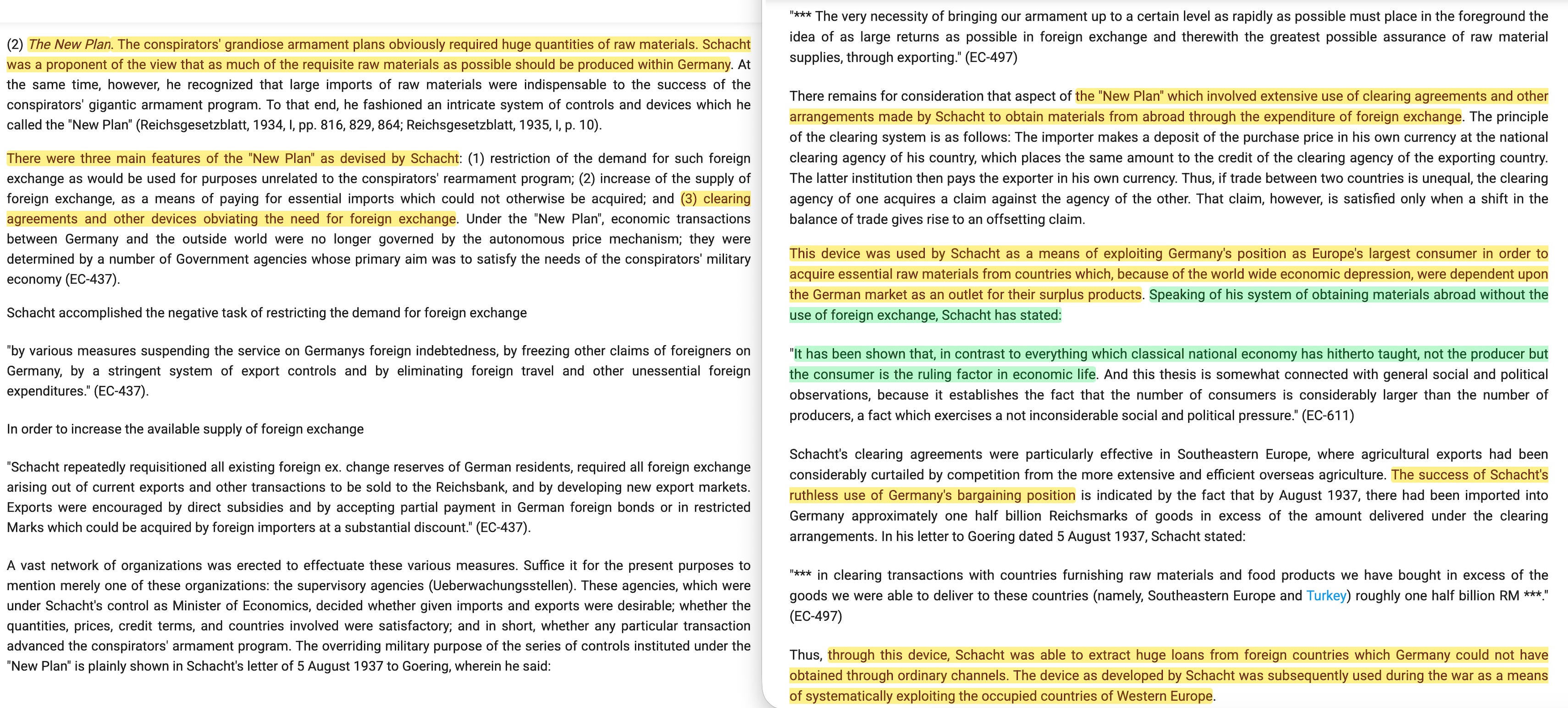
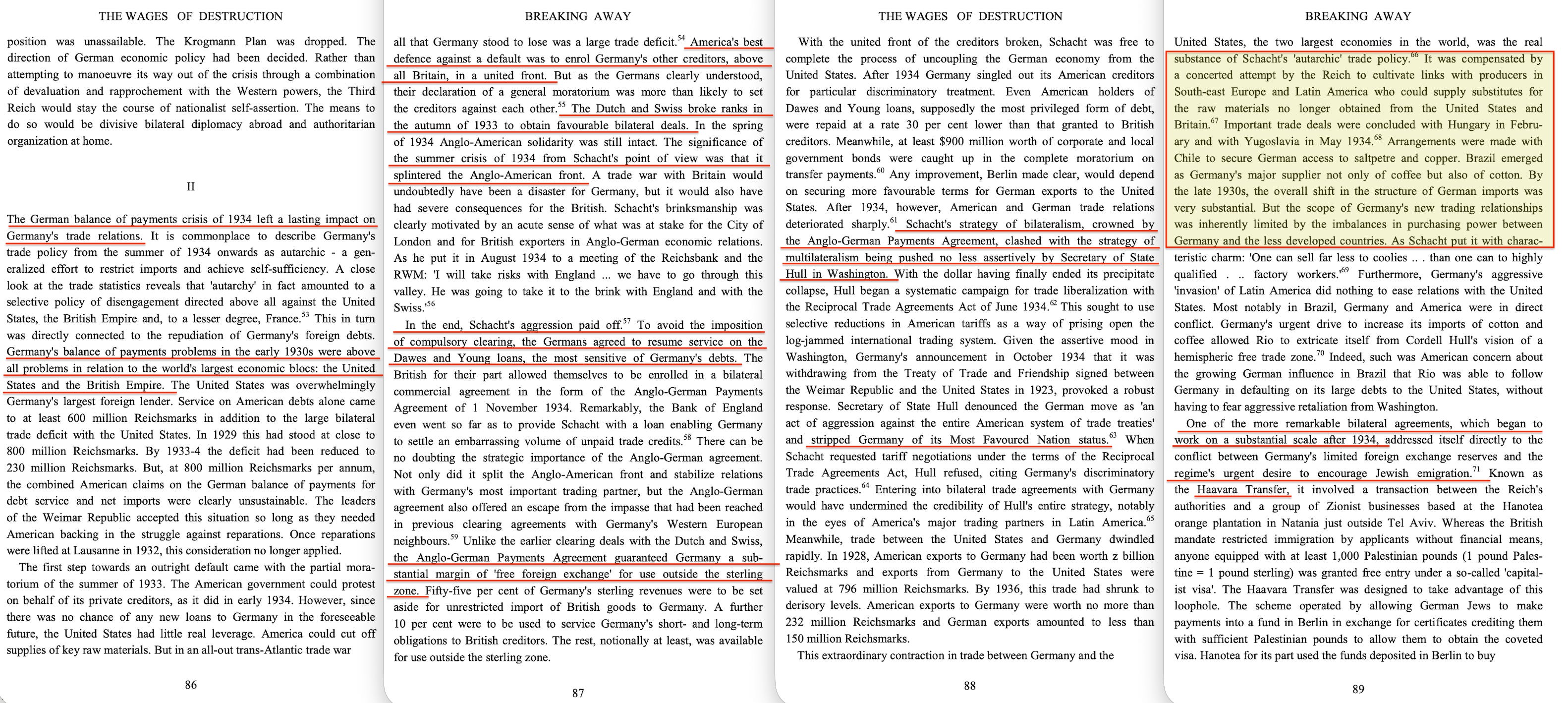
What made this governance rather than infrastructure was combining conditions with settlement under one authority — Germany’s state import permits decided what cleared, so whoever held them controlled the trade. Britain’s Anglo-German Payments Agreement settled unconditionally instead, which is why Britain traded with Germany but couldn’t govern through the clearing relationship7.
The Nuremberg prosecution documented the mechanism — Schacht's clearing agreements had extracted goods far beyond what Germany delivered in return, described by prosecutors as a 'ruthless use of Germany's bargaining position'8.

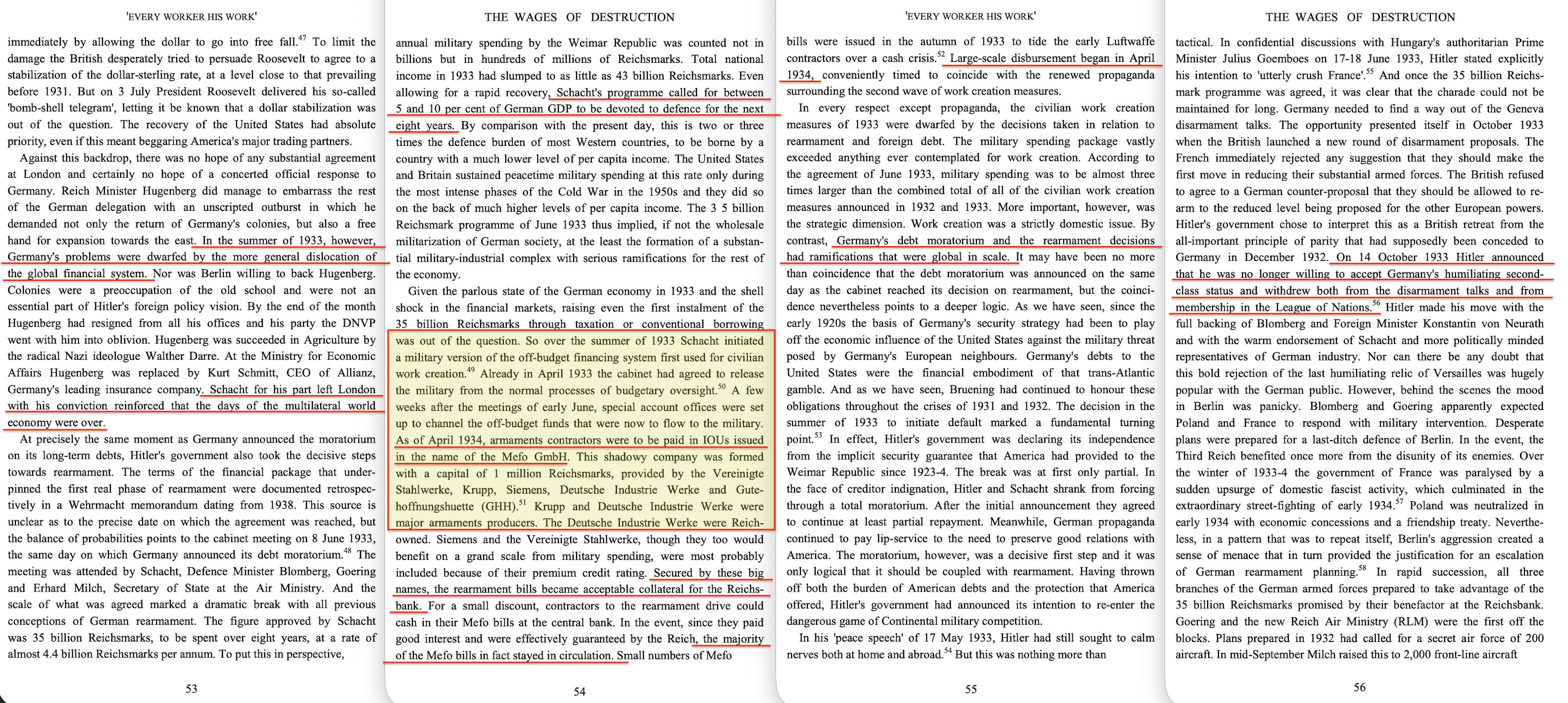
At home, the rearmament programme was financed through a parallel mechanism. In 1934, Schacht created the Metallurgische Forschungsgesellschaft9 — Mefo — a shell company with a nominal capital of one million reichsmarks, guaranteed by the Reichsbank.
Mefo bills were promissory notes issued to armaments manufacturers as payment for military production, which they could cash at the Reichsbank without the spending ever showing up on the government’s budget. Off-balance-sheet rearmament — industrial-scale military production funded through an accounting trick that hid its scale from both the domestic public and foreign observers. The bills carried a five-year maturity, so those issued in 1934 came due in 1939. By 1938, outstanding Mefo bills totalled roughly twelve billion reichsmarks10.
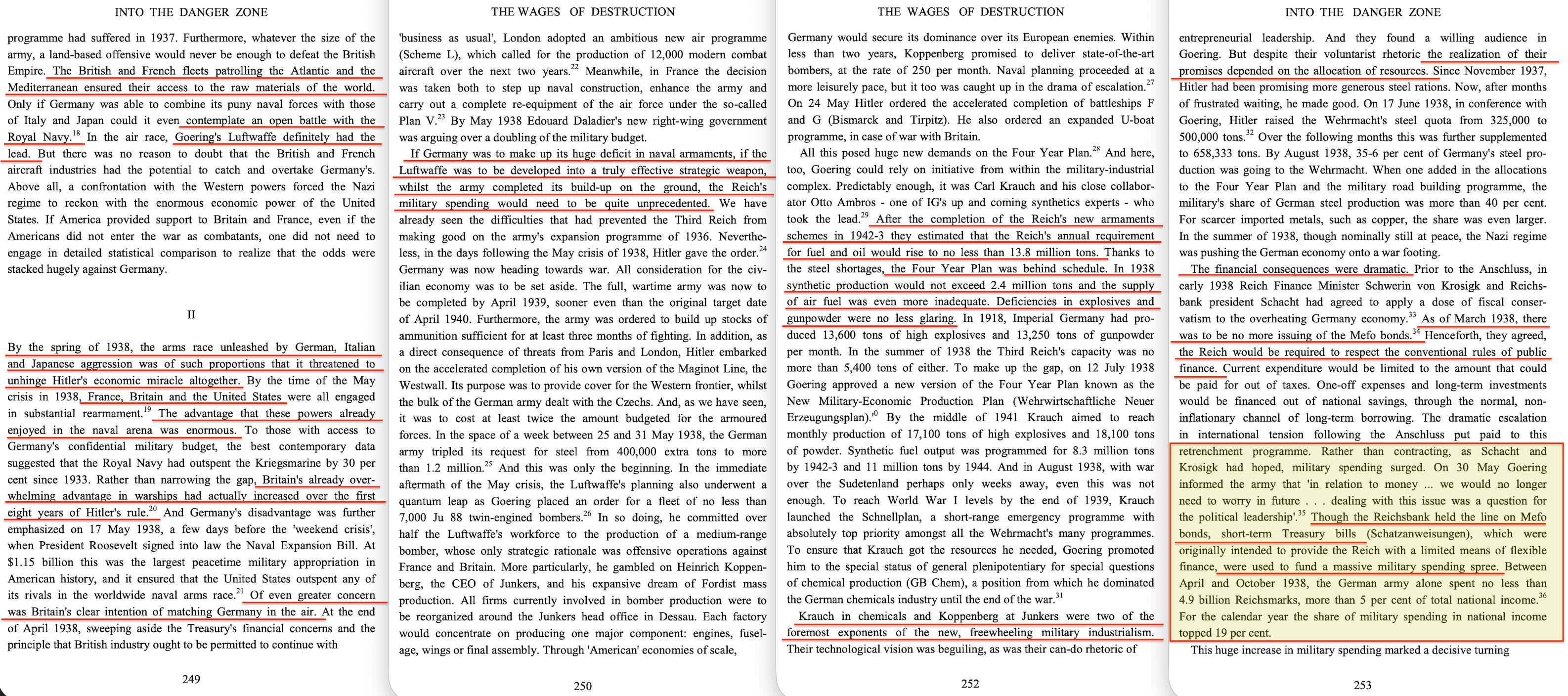
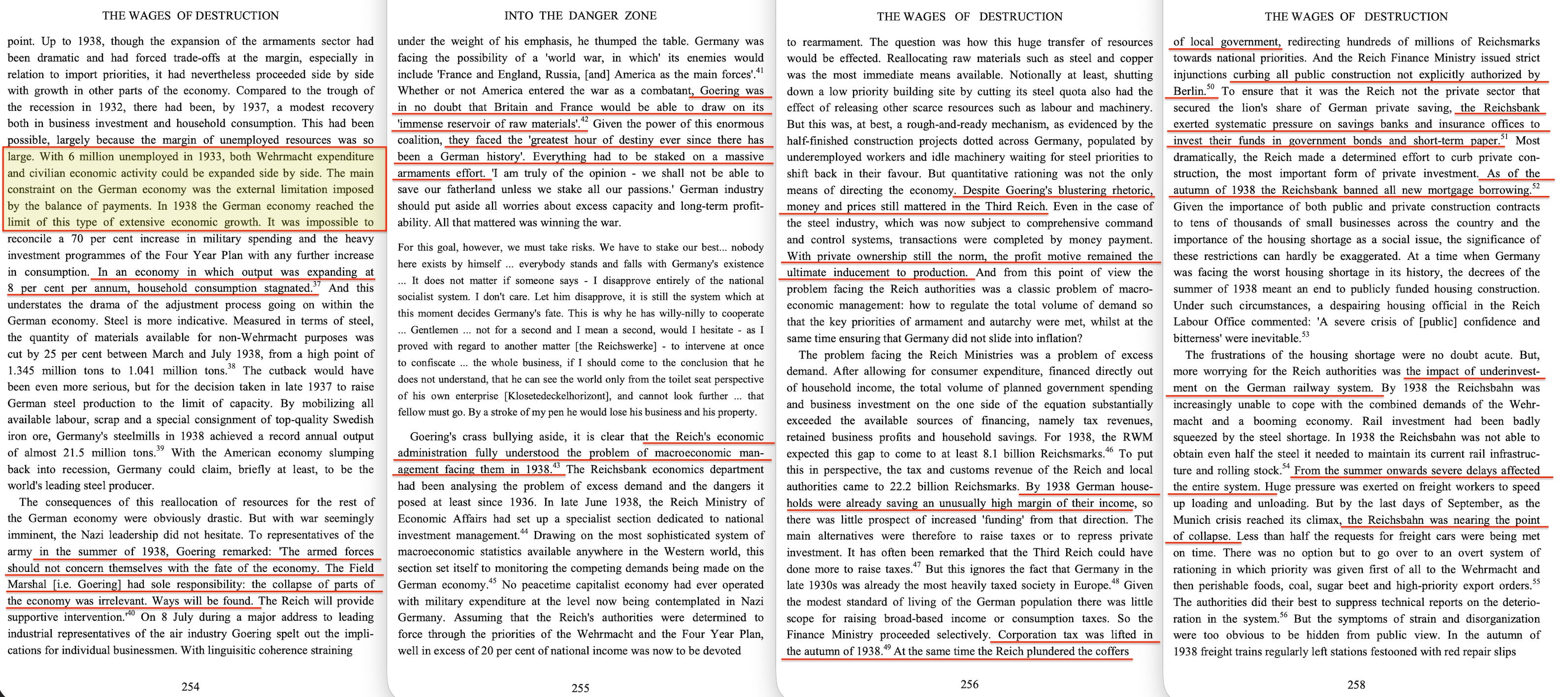
Tooze shows both mechanisms hitting the same wall. By 1938, foreign exchange reserves were nearly gone, the Mefo bills were maturing, and they couldn’t be rolled over indefinitely because the system needed confidence that the Reichsbank would honour them. The bilateral clearing system had extracted what it could through trade alone — partners’ balances were growing faster than Germany could supply goods against them, so they were effectively extending involuntary credit with no prospect of repayment. Schacht resigned in 1937, partly because the financial architecture he’d built was overstretched.
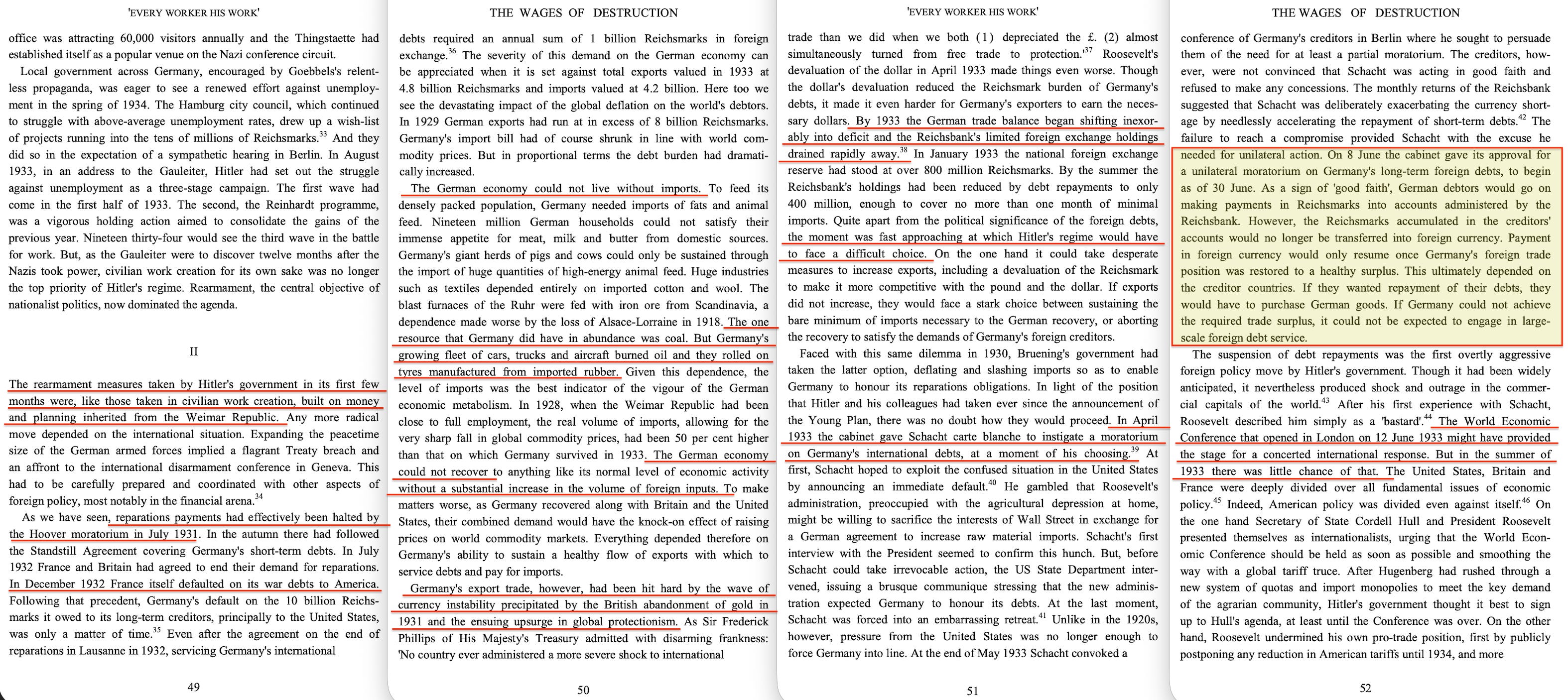
The gap between what rearmament needed and what the mechanism could deliver kept widening. Austria’s absorption in 1938 gave direct access to gold reserves and the Austrian National Bank. Czechoslovakia delivered the Škoda works and its industrial capacity. Poland offered coal and agricultural land. At that point, the mechanism no longer needed clearing agreements with countries whose resources could simply be seized.
Tooze concludes that these economic constraints partly determined when the war started — a narrowing window before the financial instruments came due.
What Tooze doesn’t do is identify the clearing mechanism as the structural cause of the expansion. He treats the bilateral clearing system as one tool among several, rather than the architecture that created the dependency, funded the rearmament, and made territorial acquisition structurally necessary once the extraction rate hit its limit. The bilateral system Schacht launched in 1934 was specified two years earlier at the Volta Congress — by speakers Gusejnova documents as present, in economic sessions neither scholar examines. The specification and the implementation were delivered at the same event, and neither book sees both.
This isn’t an oversight — it’s his thesis. His entire project is structured to subordinate economic mechanisms to political-strategic narrative, asking how economic constraints shaped the timeline of aggression rather than how the clearing mechanism functioned as a governance architecture. The mechanism is visible in his evidence but invisible in his analysis because his framework requires it to be a tool rather than the system. He documents the consequences without spotting the architectural logic behind them — the Third Way’s economic engine, consuming the productive base it governed.
The institutional insulation: Slobodian
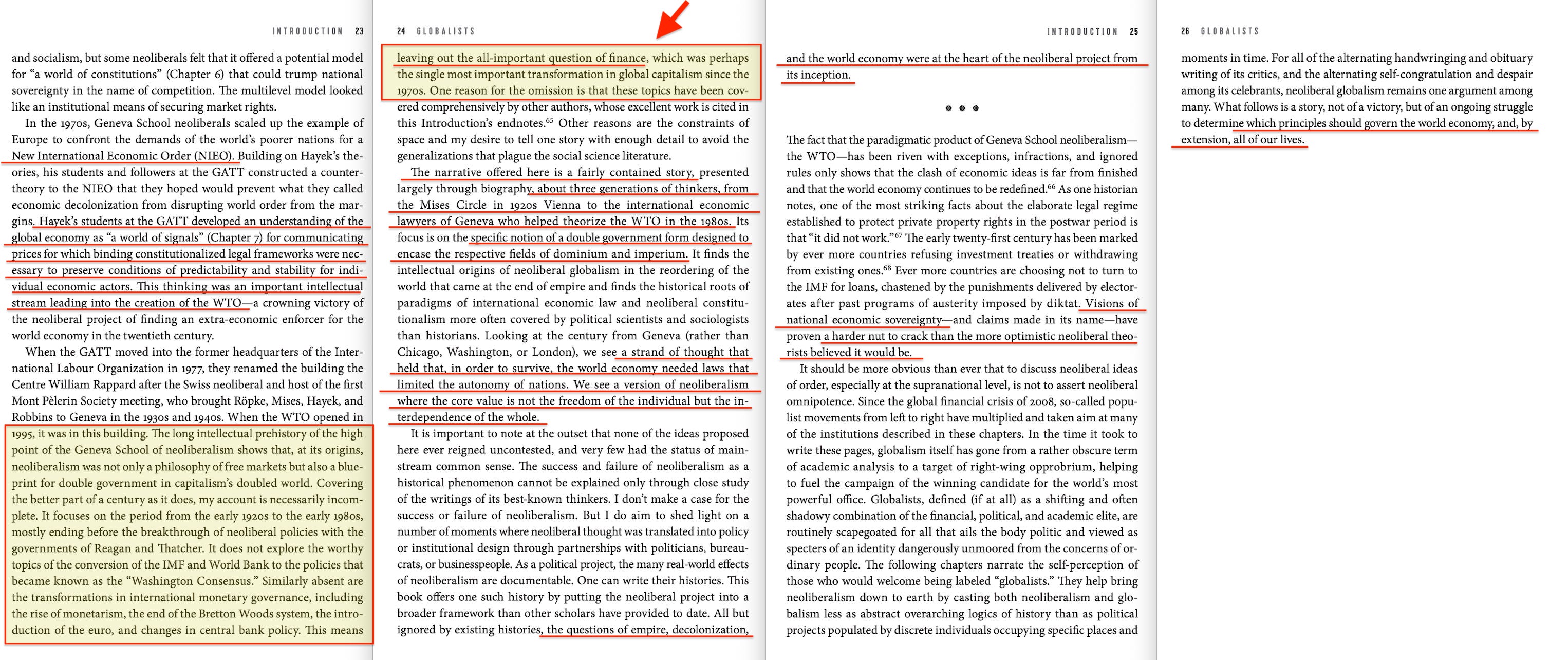
Quinn Slobodian’s Globalists (2018) covers a different piece — not the mechanism itself, but the architecture that shields it from democratic interference.
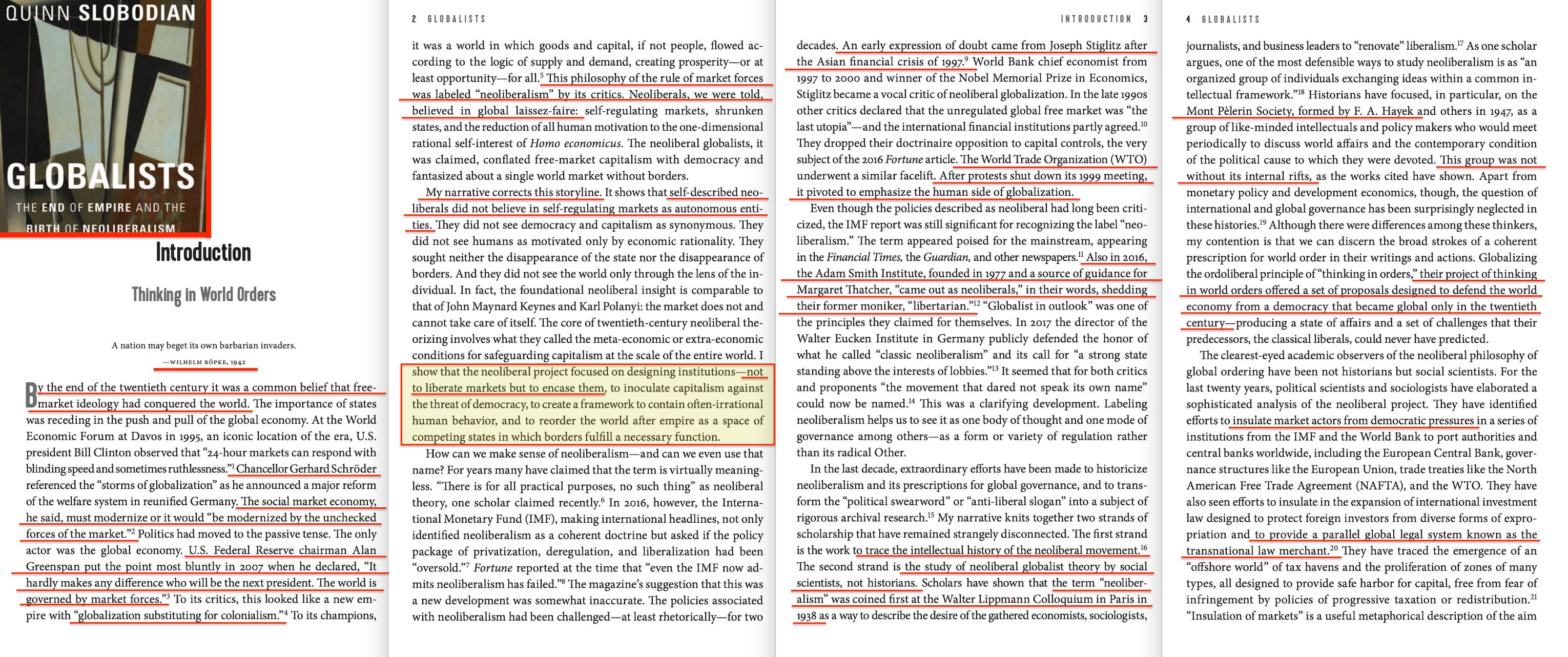
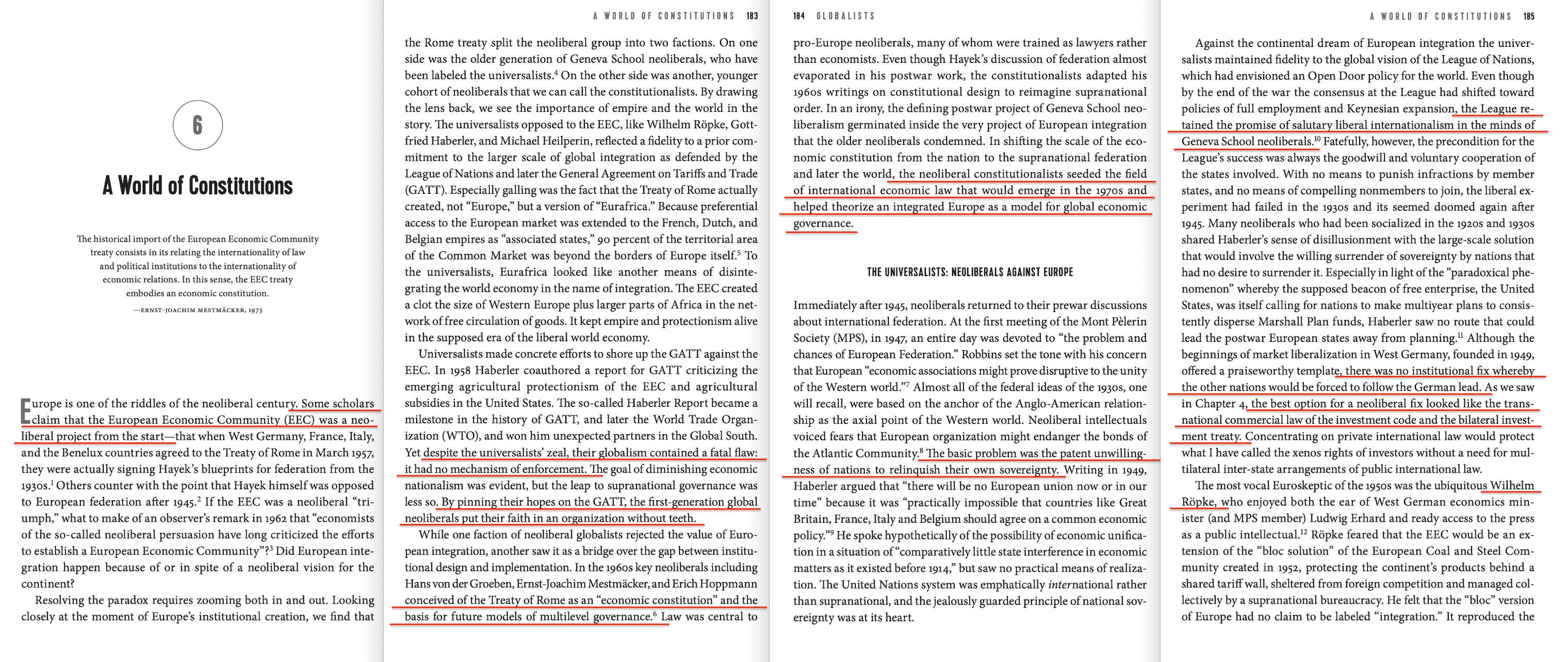
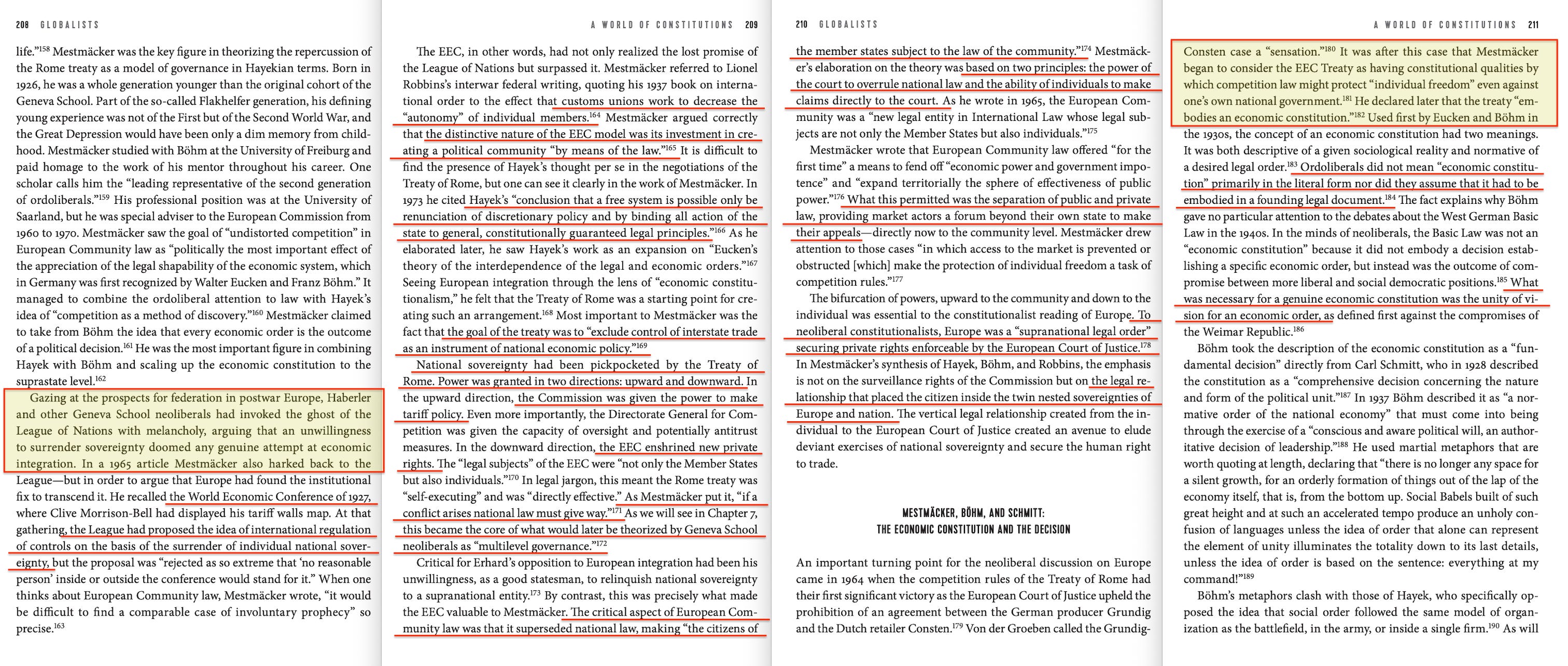
Slobodian’s subject is the Geneva School — Mises, Hayek, Röpke, and critically Haberler, who appears in the Julius Wolf essay as one of the economists who acknowledged Wolf’s institutional contributions. He argues these figures didn’t want free markets in the libertarian sense, but rather encasement: supranational frameworks designed to protect property rights, capital flows, and market access from national electorates. Permanently.

Mises spent his career arguing that centralised economic coordination can’t work because of the calculation problem — the impossibility of rational allocation without market prices — and Hayek built on the same foundation with the knowledge problem. Neither would have endorsed a centralised clearing mechanism, and both would have identified it as precisely the kind of socialist planning apparatus they spent their lives opposing.
And both opposed the central institution through which the clearing function now operates — though not for the reasons this series identifies. Mises attacked central banking for what it enabled at the commercial credit layer: fractional reserve lending, credit expansion, inflationary manipulation of the money supply. His critique was aimed at commercial banks creating credit through lending — the layer above the settlement mechanism, not the settlement mechanism itself. He spent his career fighting the wrong floor of the building. Hayek went further. In Denationalisation of Money (1976), he argued outright for competing private currencies and the abolition of the central bank monopoly. But his target was the same as Mises’s — the monopoly over currency issuance and its inflationary consequences, not the clearing function that runs through the settlement layer beneath it.
Neither identified the layer the trilogy documents. They opposed the central bank’s role in commercial credit. They didn’t address its role as the node through which international clearing conditions are applied — the gateway function that determines who participates in the network and on what terms. The fortress they built to protect market freedom from electorates now protects the clearing mechanism from electorates.
Mises saw this coming. His biographer records11 that he ‘believed the Ordo people were hardly better than the socialists he had fought all his life’ and called them ‘Ordo-interventionists’. In Omnipotent Government he wrote that ‘an international body for foreign trade planning would be an assembly of the delegates of governments attached to the ideas of hyper-protectionism’. He’d helped design the institutional walls — supranational authority, constitutional limits on democracy, property rules enforced by international law — then watched the ordoliberals move in with a managed governance programme he considered no different from the socialism he’d spent decades fighting.

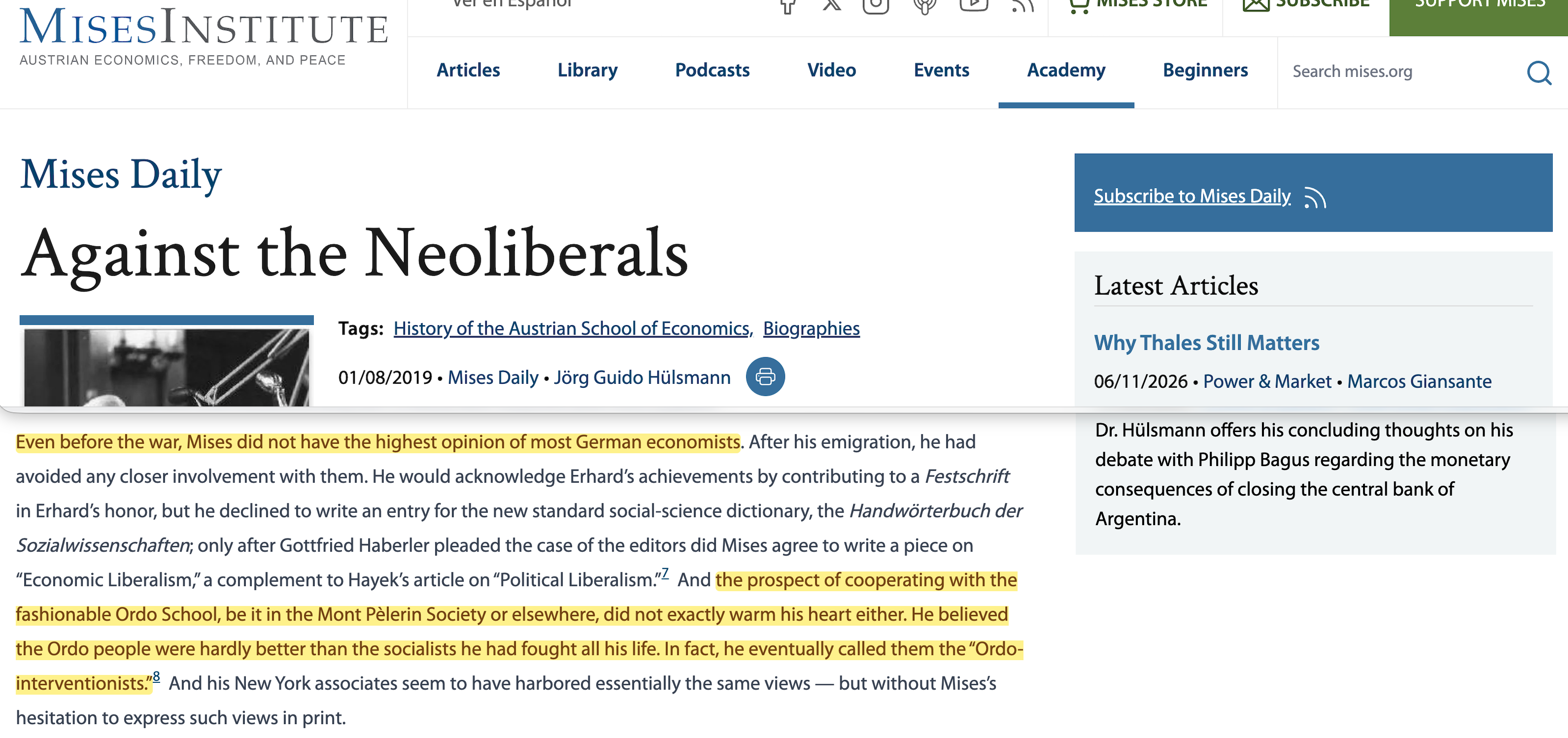
Slobodian traces this through the same period and institutions the trilogy covers: the League of Nations economic apparatus, the interwar Geneva milieu, Röpke’s shaping of the Treaty of Rome’s competition framework, Haberler’s role in the intellectual tradition running from Wolf through the BIS to Bretton Woods, and the transition from interwar institutional design to the postwar order — all documented through published writings, institutional records, and the Geneva School’s own stated objectives.
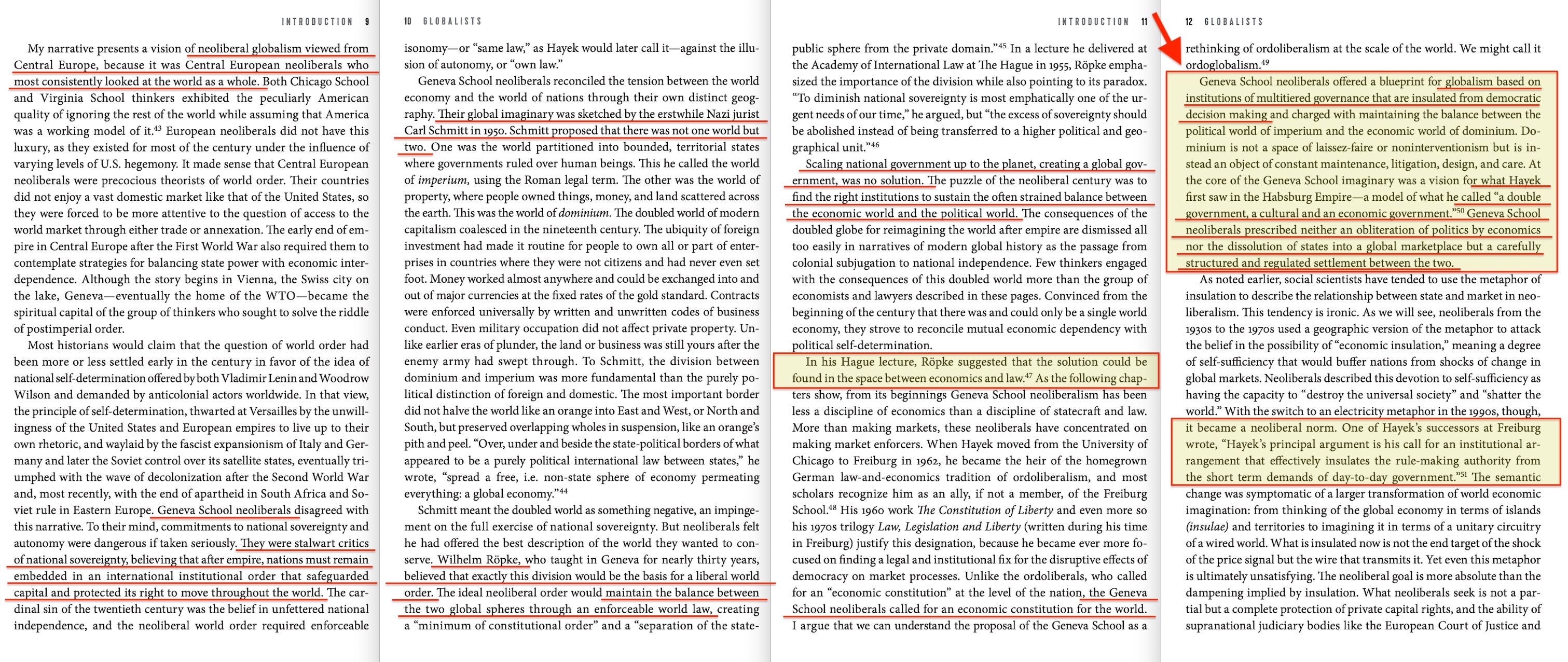
He argues that the economists believed democratic populations would make economically irrational choices — protectionism, inflation, capital controls — and that the solution was to place the rules governing economic life in institutions electorates couldn’t touch. The rules would be set by experts, the institutions would enforce them, and the populations would experience the outcomes as simply the way things work.
Verrijn Stuart specified at Volta in 1932 that central bank authority would sit above the nation, at the BIS, beyond any electorate. The Geneva School spent four decades building walls to make that specification permanent as an openly stated programme, published in books and journals, debated at conferences, and implemented through institutions they helped design.
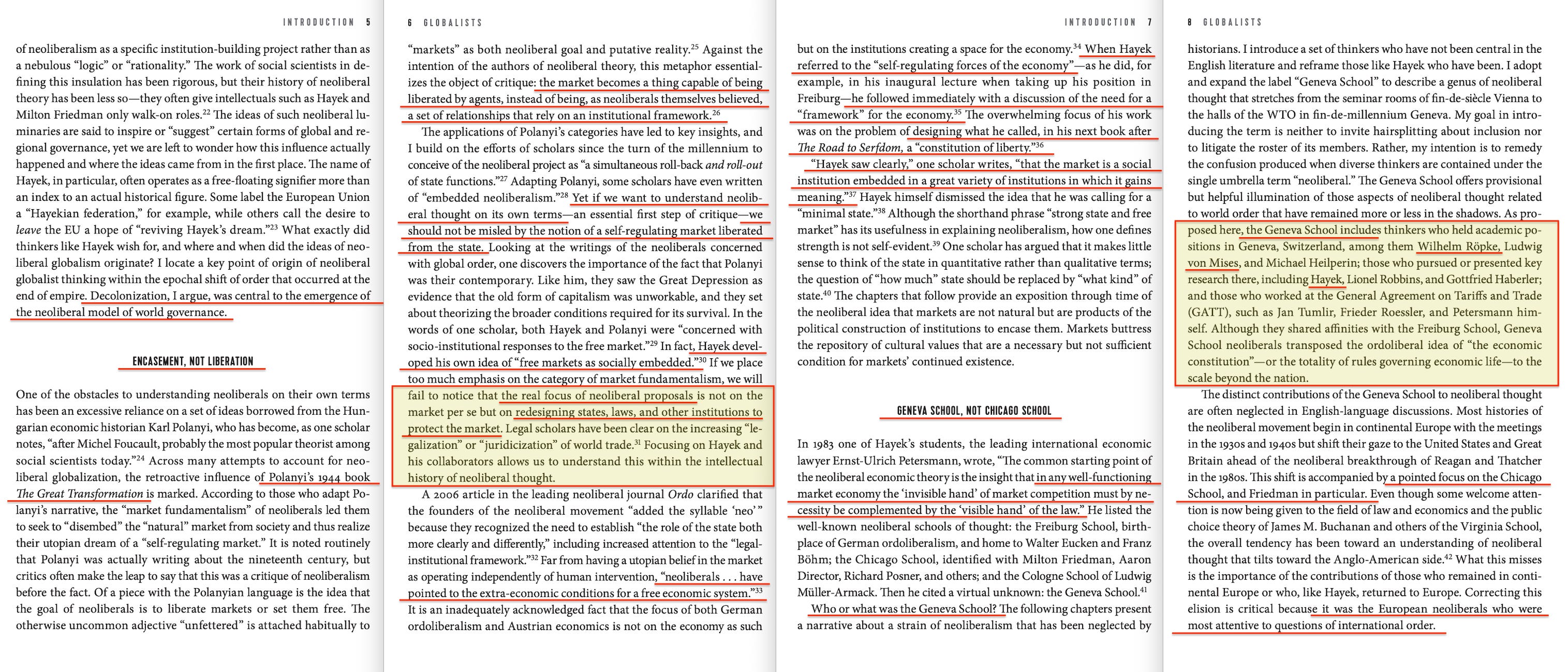
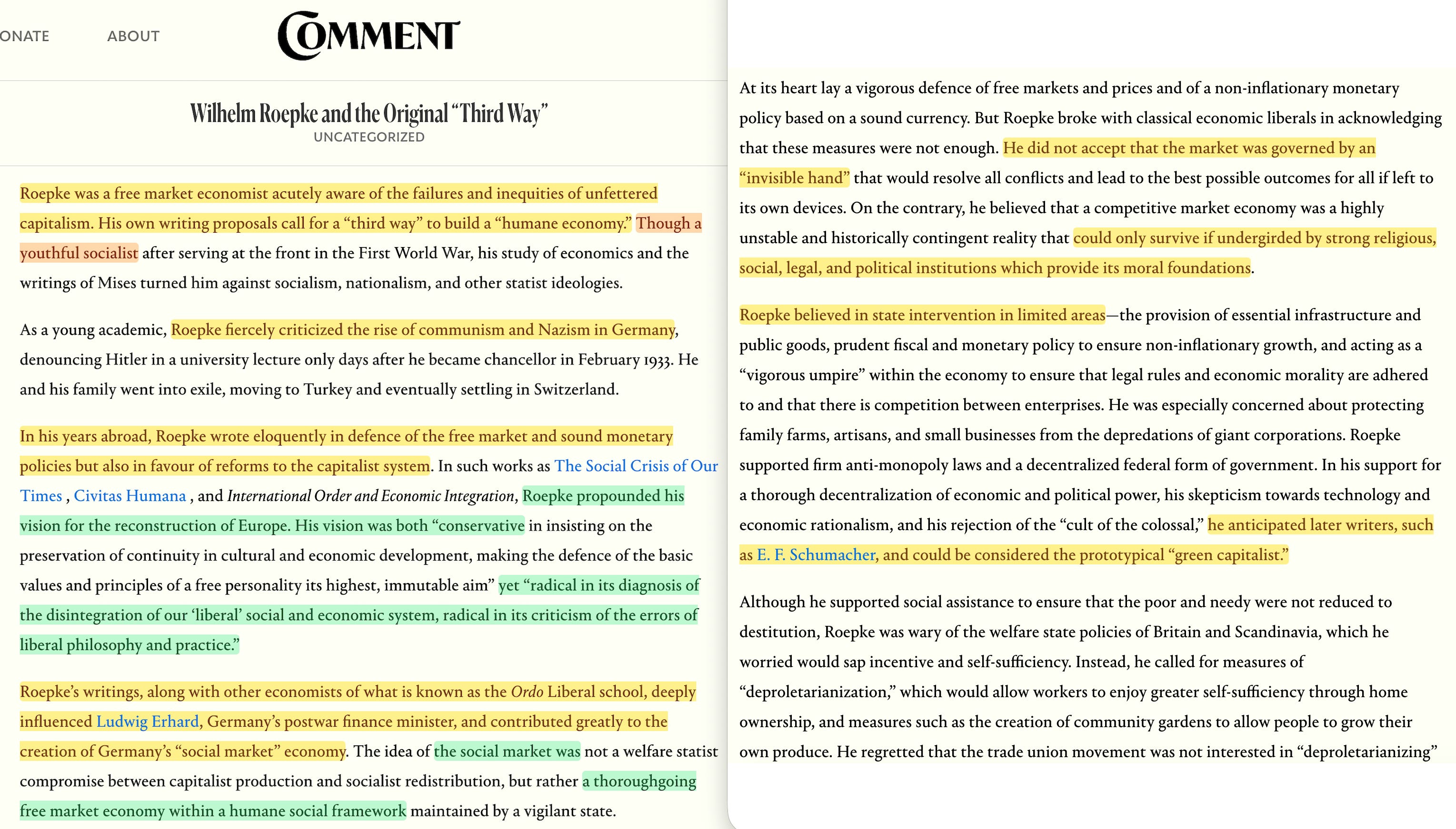
The language is as persistent as the architecture. Röpke — the Geneva School’s most influential bridge between interwar design and postwar implementation — explicitly called his ordoliberal programme ‘the Third Way’12. It’s the same phrase Goebbels used on Gusejnova’s page 194, where he declared the Nazi seizure of power ‘pointed to a third way beyond Right and Left‘. Different content, identical structural function: a framework that presents itself as beyond the left-right axis — which means beyond the categories through which electorates organise political choice.
Röpke’s Third Way built an independent central bank — the Bundesbank — into its core, implementing Verrijn Stuart’s 1932 specification in postwar Germany. That model was exported to the ECB via Maastricht. Blair and Clinton revived the label in the 1990s, with the same structural function but with a different ethic attached.

Slobodian misses what the walls actually protect. He maps encasement — lifting economic governance above politics through treaties, competition law, and investment rules that override national legislation. He also shows why the Geneva School chose economics over political federation, which other European federalists wanted. Political federation needs democratic agreement — parliaments ratify and electorates can reverse it. Economic constitutionalism bypasses this entirely: treaties override national law, supranational courts enforce competition rules, and central bank mandates sit beyond electoral reach.
The Geneva School realised that whoever constitutionalises economic governance doesn't need political federation — because every other domain eventually settles through the financial system. Control the conditions under which transactions clear and you govern trade, labour, energy, agriculture and finance without ever needing a political mandate.
That’s the outer wall. Inside runs a specific chain: standard-setting bodies like the Basel Committee, OECD, ISSB, and ISO produce technical rules that the legal framework locks in; central banks coordinated through the BIS turn those rules into banking requirements; and the clearing function enforces them as conditions on every transaction. Slobodian sees central bank independence as part of the wall — an institution insulated from democracy, like a court. It’s actually the pipe through the wall: the mechanism that turns a Basel standard into a capital requirement for commercial banks, then into a lending condition on every transaction they process. The BIS coordinates central banks into a hierarchy rather than leaving them as independent national bodies — without it, encasement has gaps wherever a national central bank refuses to comply.
The Geneva School wanted voters kept away from economic governance. What they ended up shielding — by accident or design — was this chain: standards set by institutions voters don’t elect, clearing run through a monetary hierarchy voters can’t direct, and settlement conditions applied at a level voters can’t see.
Slobodian documents the architects’ ambition. The trilogy documents the infrastructure their ambition protects.
Harvard University Press published this, and reviewers praised it as a major contribution to political economy history. The full operational chain — from standard production through monetary hierarchy to conditional settlement — is absent from its analysis. Just as it’s absent from Gusejnova’s and Tooze’s.

The gap between them
Gusejnova shows the social circle that planned the clearing architecture at Volta in 1932, but misses what they’d actually planned. Tooze shows the economic fallout from running it from 1934 onwards, but misses the design logic. Slobodian shows the intellectual project of insulating economic governance from democracy, but misses the operational mechanism the insulation protects.
All three corroborate the trilogy’s claims from their own angles.
Gusejnova confirms the networks, ideology, continuity across regime changes, the third-way declaration, the Arendt limitation, and the Volta Congress as the climax. Tooze documents the bilateral clearing system’s extraction of southeastern Europe, its structural limits, and the economic necessity driving territorial expansion when the mechanism’s yield couldn’t match the programme’s consumption. Slobodian shows the project of insulating economic governance from democracy was explicit, published, and implemented through institutional design — the stated objective of those who built the walls around it.
And the funding overlap runs deeper than any of the three scholars notice. Gusejnova records IG Farben’s Carl Duisberg, Adam Opel, and Carl Siemens as funders of Coudenhove’s Pan-European network, while Tooze records the February 1933 meeting at Göring’s residence where IG Farben donated 400,000 reichsmarks, Fritz von Opel attended, and the broader industrial cluster pledged three million reichsmarks to the Nazi election campaign. Hjalmar Schacht brokered that meeting — the same man Gusejnova places at Kessler’s dinner table years earlier, and whom Tooze documents building the bilateral clearing system from 1934. The same industrial funders backed both the Pan-European channels and the party. And Schacht connected both to the clearing architecture.
The clearing function — ethics attached to standards, standards governing clearing conditions, and clearing conditions enforcing compliance through settlement — sits between these three bodies of evidence. Gusejnova provides the social history of its architects. Tooze provides the economic evidence of its operation. Slobodian provides the documented intent of those who built the institutional walls. None provides what the trilogy does: clearing-settlement identified as the connecting mechanism, traceable from Julius Wolf’s 1892 design through the BIS, the Volta Congress, the 1942 volume, and the Treaty of Rome to today’s system of central bank supervision, sustainability taxonomy, and programmable conditionality.

What follows
The usual story says European integration was a democratic peace project, born after fascism to stop war through shared wealth. Gusejnova’s evidence challenges this socially — the same elite networks carried on across the regime change, and the institutions survived by rebranding. Tooze’s evidence challenges it economically — the bilateral clearing system that funded Nazi expansion used the same settlement logic that later ran the European Payments Union and the euro’s TARGET2 system. Slobodian’s evidence challenges it on intent — the postwar architects explicitly designed the order to keep economic governance away from democratic interference, and said so openly.
The trilogy argues these aren’t separate observations. They’re three faces of the same architecture — one whose supporters, from Goebbels in 1933 to Röpke in the 1940s to Blair in the 1990s, have consistently called The Third Way. It’s not left — meaning direct state command — and not right — meaning laissez-faire where transactions clear regardless. The Third Way means conditions attached to settlement, with compliance enforced through the terms on which transactions are allowed to complete. The ethic changes — racial supremacy, ordoliberal market governance, sustainability — while the mechanism stays the same.
And the delivery method stays the same too. The journalist Gusejnova quotes saw through Volta because fascism was recognisable beneath the academic clothing. By 1941, the British Association’s Science and World Order conference was using the same technique — political architecture dressed as disinterested scientific inquiry — but with science itself as the legitimating ethic.
Bernal, Needham, Huxley, and Hogben were openly socialist. The institutional output — UNESCO, the international standards bodies, the science-policy interface built into the UN system — carried the clearing function forward under an ethic that was harder to refuse, because refusing science looks like refusing knowledge itself.


Nobody votes for clearing conditions. They vote for an ethic — cheaper goods, environmental protection, financial stability — and the governance comes with it. Verrijn Stuart laid this out at Volta in 1932: the central bank’s authority would sit above the nation, at the BIS, beyond any electorate. Slobodian documents that the Geneva School spent four decades building walls to make sure electorates couldn’t undo that specification. Keynes backed it in 1940, only objecting that Britain, not Germany, should run it.
The Third Way isn’t a political philosophy. It’s the clearinghouse’s political name — that’s why central banks push it. Clearing with conditions is power, and whoever settles the transaction holds that power. They don’t promote the Third Way because they believe in any particular ethic. They promote it because it’s the operating model that maximises the authority of whoever processes the settlement.
Gusejnova’s five channels look different in this light. Each prepared one condition for the clearing function’s installation — philosophical acceptance of supranational authority, an industrial-political coalition, a cultural-institutional lineage, a connection to Fabian gradualism, and a trained expert class. Each was funded by the same small cluster of sources, each appeared independent, and all converged at Rome in November 1932, where the economic sessions delivered the clearing specification onto ground that five channels had spent a decade preparing.
The mechanism’s genealogy is as well documented as the institutions running it. In 1843, Moses Hess diagnosed money as the social blood of society — whoever controls its circulation controls the life of the social body. In 1892, Julius Wolf specified the architecture: a permanent international clearing office to manage that circulation, having first documented in Sozialismus und kapitalistische Gesellschaftsordnung exactly how clearing concentrates power. In 1899, Eduard Bernstein supplied the installation method: evolutionary gradualism, each condition small enough to pass democratic scrutiny on its own, so the cumulative architecture never faces a single vote.
Wolf and Bernstein both spent formative years inside the Rothschild banking world, and both published in the same 1924 autobiographical collection. One designed the mechanism enabling Hess’s social blood. The other designed how to install it without triggering resistance.


The playbook never changed. Recruit the old governing class by appealing to a mythologised past — the Teutonic Order, the Habsburg legacy, the imperial networks Gusejnova documents. Promise them their authority back within whatever framework’s running — noble privileges under fascism, technocratic governance under internationalism, advisory roles under stakeholder capitalism. Offer ordinary people an escape from hardship — jobs, cheaper goods, stability, sustainability — and let them vote for the ethic without seeing the governance that comes with it.
Then split the operation across separate channels, each building one piece of the architecture, all funded by the same small cluster of sources but looking independent — so the people who contribute think they’re rebuilding civilisation, not laying infrastructure for a settlement mechanism they were never shown.
And the recruitment continues to this day — politicians through vanity, businessmen through greed — at forums designed for the purpose.


Just simply awesome - Now we just need to make a Gamer product for the young to gain from this brillent information. The education complex in the United States, and later across the Globe was financed by Rockefeller:
- 1892 - Departments in Univ. of Chicago, Columbia Univ., Univ. of Wisconsin with E.A. Ross
who has career full of Socio-communist relations. Ross’s book “Social Control” (1901) is the
textbook teaching how a few can gain control over Society. Albin W. Small, first Chair, taught
Sociology as History, Economics, and Political Science. This Department and Albin W. Small
were funded by Rockefeller Foundation.
- 1904 - Rockefeller Foundation through J.D. Rockefeller created the General Education Board.
Occasional lettrer # 1.
- 1908 - Philanthropic Foundations entered, along with the Federal Reserve. Creating false
economics and third party funding of subversive activities, via social cover. Alger Hiss was
President of Carnegie Foundation. Rockefeller Foundation funded Sociology Chair Albin W.
Small at Univ. of Chicago. The idea is: Guilt Association.
Brilliant analyses about the will to power via capturing systems and manipulation.