
L'Europa

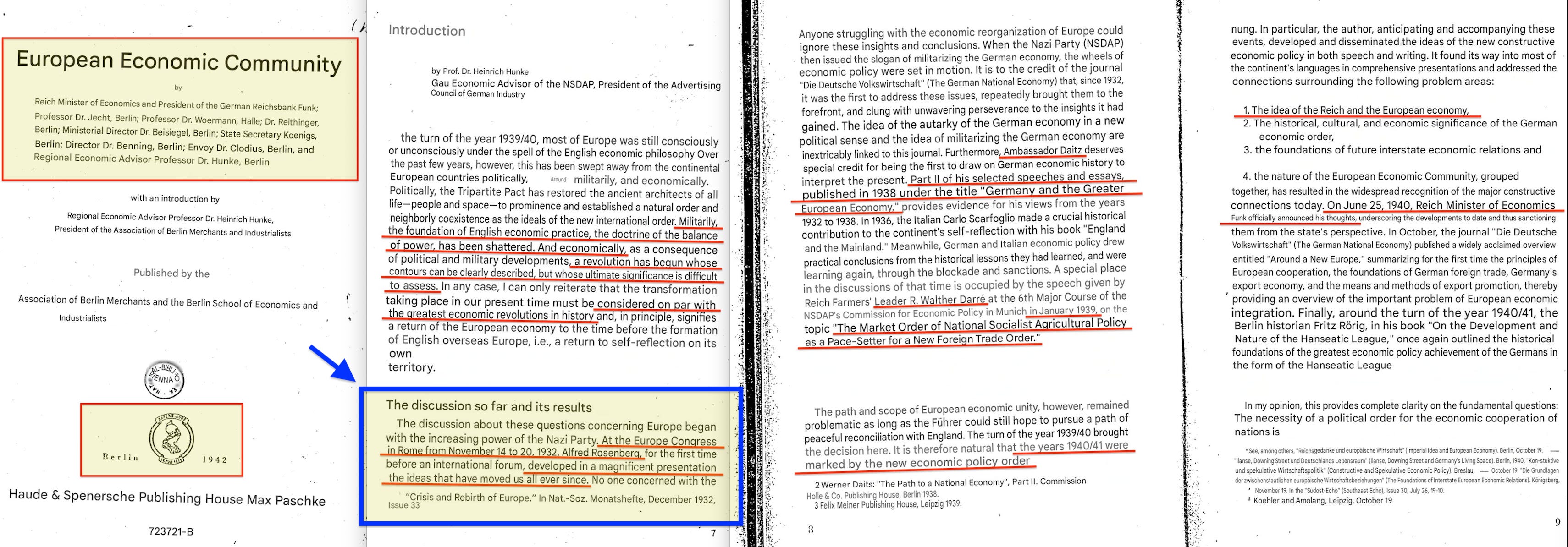
In September 1942, a 229-page report called Europäische Wirtschaftsgemeinschaft was published in Nazi Germany. Its programme was, in structural terms, the Treaty of Rome — the foundation of the European Union — fifteen years early.
But where did the programme come from?
The volume itself answers this. Heinrich Hunke’s introduction traces the discussion’s origins to a specific event: Alfred Rosenberg’s speech at the Europa-Kongreß in Rome in November 1932. Hunke describes it as the moment when, ‘for the first time before an international forum’, the ideas that would shape the programme were presented.
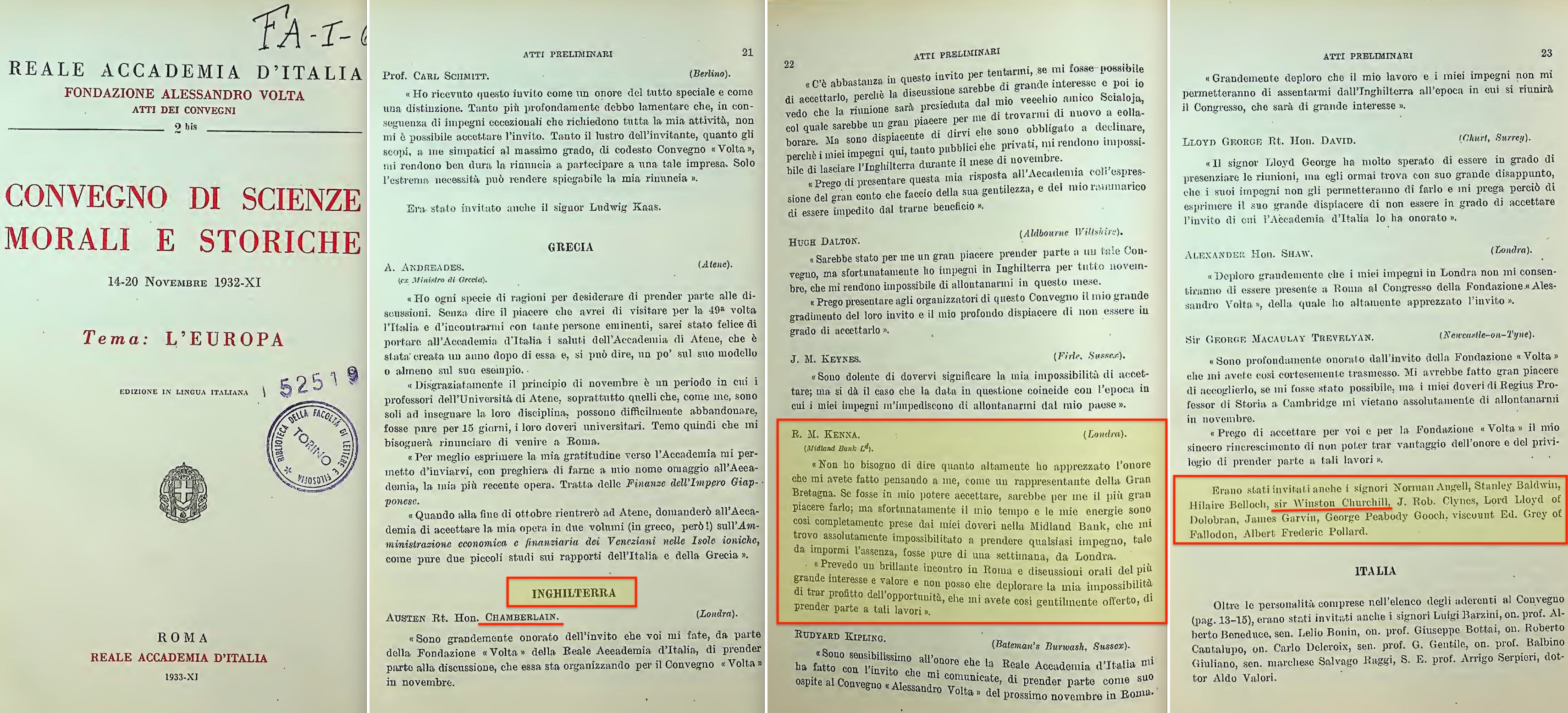
This was the Volta Conference — the second Convegno Volta for Moral and Historical Sciences, hosted by the Reale Accademia d’Italia under the Fondazione Alessandro Volta. It ran in Rome from 14 to 20 November 1932, and the topic was simply L’Europa1.


The invitation list
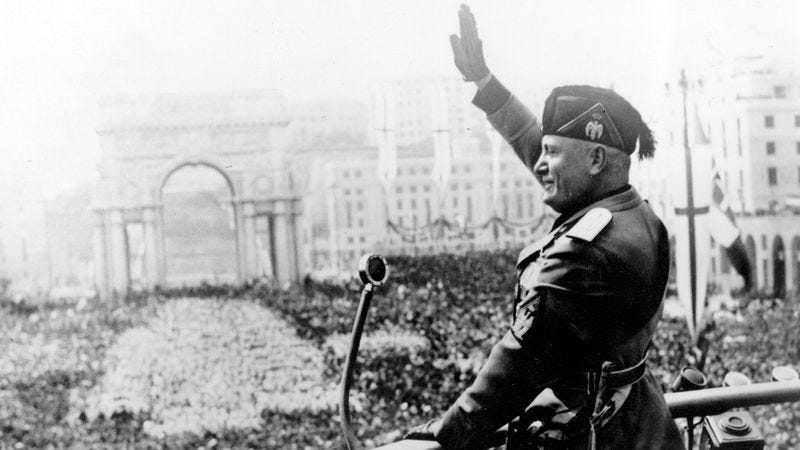
The conference opened in the Sala di Giulio Cesare on the Capitoline Hill, with Mussolini present. Guglielmo Marconi, the Academy’s president, sent the invitations. Senator Vittorio Scialoja chaired it.
The published proceedings list every invitee, plus their acceptance and rejection letters. Under INGHILTERRA, those who declined included Keynes:
I am sorry to have to inform you of my inability to accept; but it happens that the date in question coincides with the period when my commitments prevent me from leaving my country.
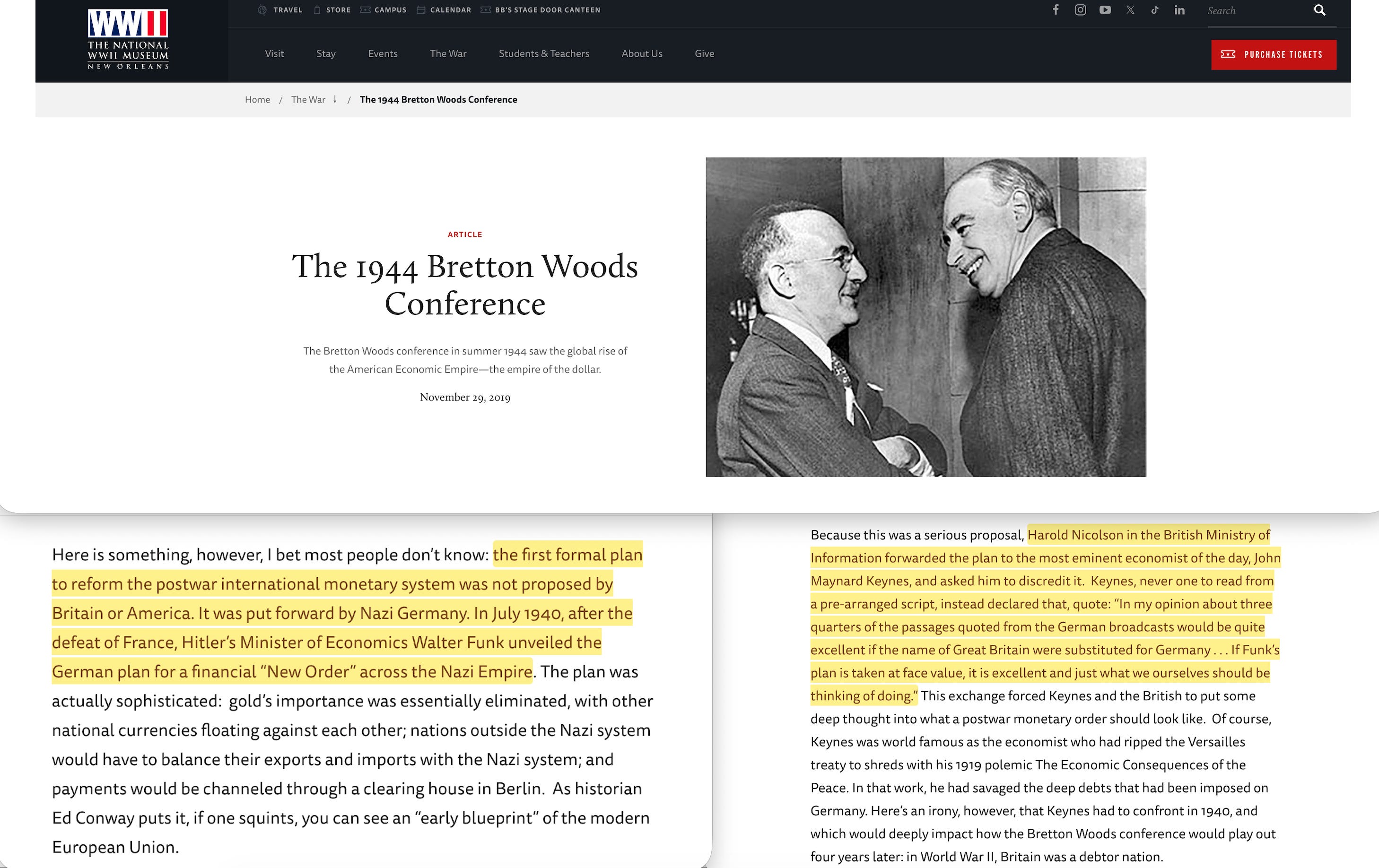
Hjalmar Schacht and Alfred Rosenberg presented papers on European economics and political architecture, eight years before Harold Nicolson sent Keynes Funk’s European economic plan and asked him to discredit it2.
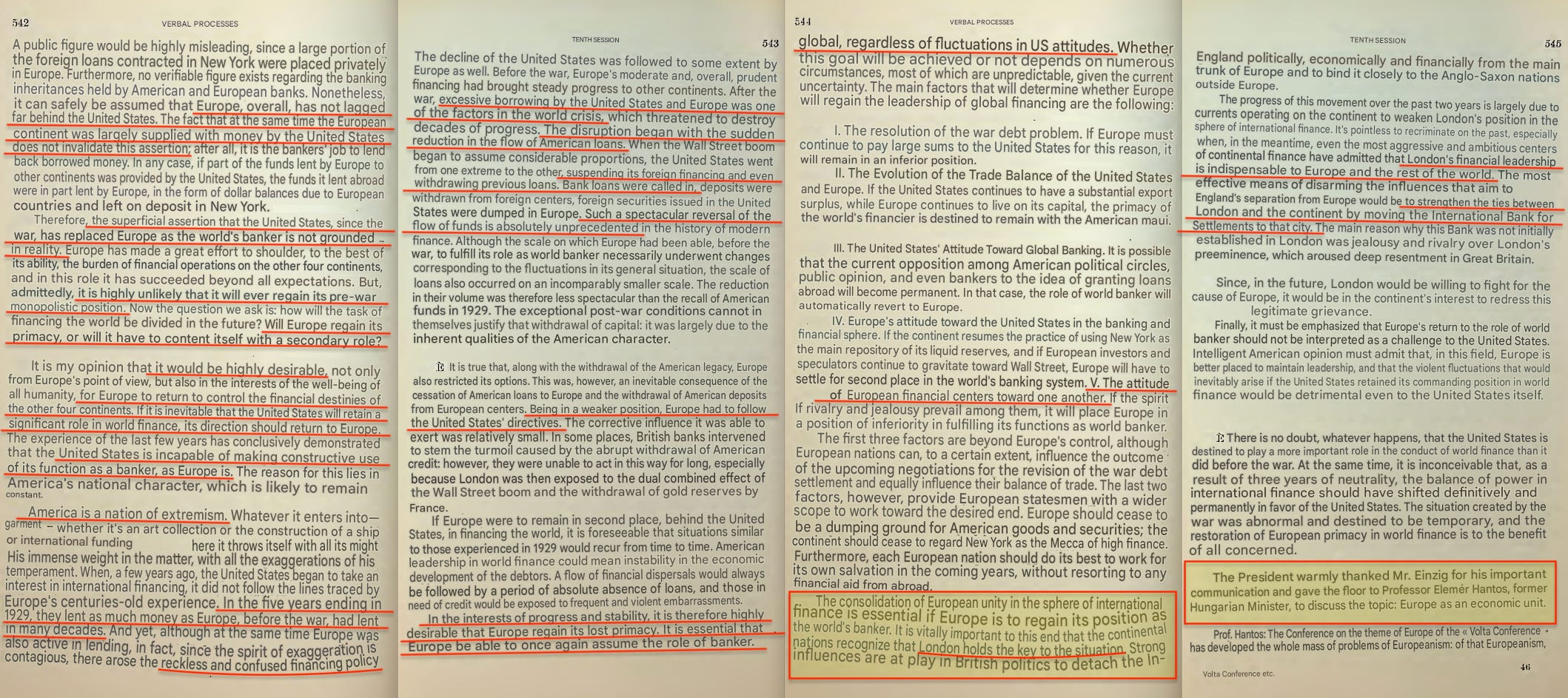
Britain’s leading politicians stayed away — Churchill, Baldwin and Keynes were all invited, but none attended. Paul Einzig, a London financial journalist, did attend. He argued for Europe’s financial leadership and warned that British isolation from the continent was becoming dangerous.
Einzig had already published The Bank for International Settlements3 in 1930. He used the conference as the opportunity to study the Italian Corporate State firsthand, meeting Mussolini twice and publishing The Economic Foundations of Fascism4 within months. After the conference he published The Exchange Clearing System5 declaring exchange clearing 'the system of the future' and 'a permanent integral part of a planned economic system' — three years after hearing Schacht diagnose the problem on the Capitoline Hill.
Carl Schmitt6 — who would provide the theory for the Großraum two years later — was invited and declined, writing that ‘both the lustre of the inviting body, and the aims, sympathetic to me in the highest degree, of this Volta Conference, make the renunciation of participation very hard for me. Only the most extreme necessity can make my renunciation explicable’.

The programme
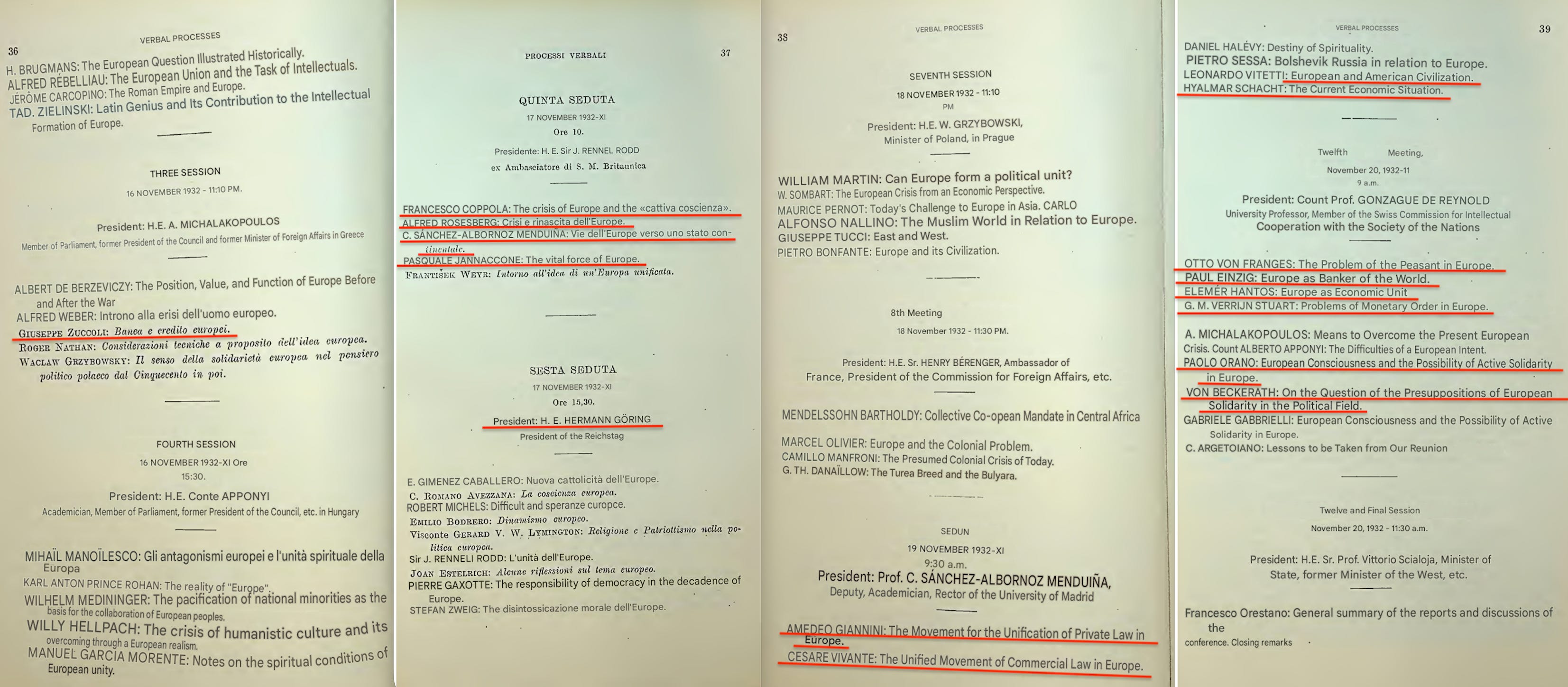
The conference programme reads like a first draft of the 1942 volume’s table of contents.
The economic papers were spread across several sessions, with the Tenth Session on the morning of 20 November covering the core institutional details. The key economic papers included:
Elemér Hantos: ‘L’Europa come unità economica’ — Europe as an economic unity (Tenth Session)
G. M. Verrijn Stuart: ‘Problemi del riordinamento monetario nell’Europa’ — Problems of monetary reordering in Europe (Tenth Session)
Paul Einzig: ‘L’Europa come banchiere del mondo’ — Europe as world banker (Tenth Session)
Otto von Franges: On agricultural problems and southeastern European integration (Tenth Session)
Erwin von Beckerath: On European economic solidarity (Tenth Session)
Hjalmar Schacht: ‘La situazione economica odierna’ — The current economic situation (Ninth Session)
Giuseppe Zuccoli: ‘Banca e credito europei’ — European banking and credit (Third Session)
Cesare Vivante: On the unification of commercial law in Europe (Ninth Session)
Customs union, monetary coordination, banking and credit, agricultural complementarity and commercial law harmonisation — every domain the 1942 volume specifies was on the table.
Other sessions covered the political and civilisational framework. The Fifth Session on 17 November included:
Alfred Rosenberg: ‘Crisi e rinascita dell’Europa’ — Crisis and rebirth of Europe
Claudio Sánchez-Albornoz: On the political form corresponding to the continental economy
Pasquale Jannaccone: On the corporatist state as the institutional vehicle
František Weyr: On sovereignty limitation and economic unification
Francesco Coppola: On European civilisation and its challengers
Hermann Göring chaired the Sixth Session. Werner Sombart — who would publish Deutscher Sozialismus two years later7; the third way as a social order — presented in the Seventh Session on the European crisis from an economic perspective. He heard Schacht's clearing-function diagnosis and Hantos's four-pillar specification in the same week he delivered his own analysis. The Ninth Session included Leonardo Vitetti on ‘Civiltà europea e civiltà americana’ — European and American civilisation — a direct comparison that puts the American competitive challenge at the centre.
The Indirizzo sent to all participants said that Europe’s position ‘is challenged on all fronts’, that ‘new civilizations are opposing the European one’, and that
… throughout the civilized world there are affirming themselves or being realized deep tendencies to constitute, even among remote and heterogeneous peoples, ‘blocs,’ ‘unions’ — political and economic — ever vaster, vaster than Europe itself.
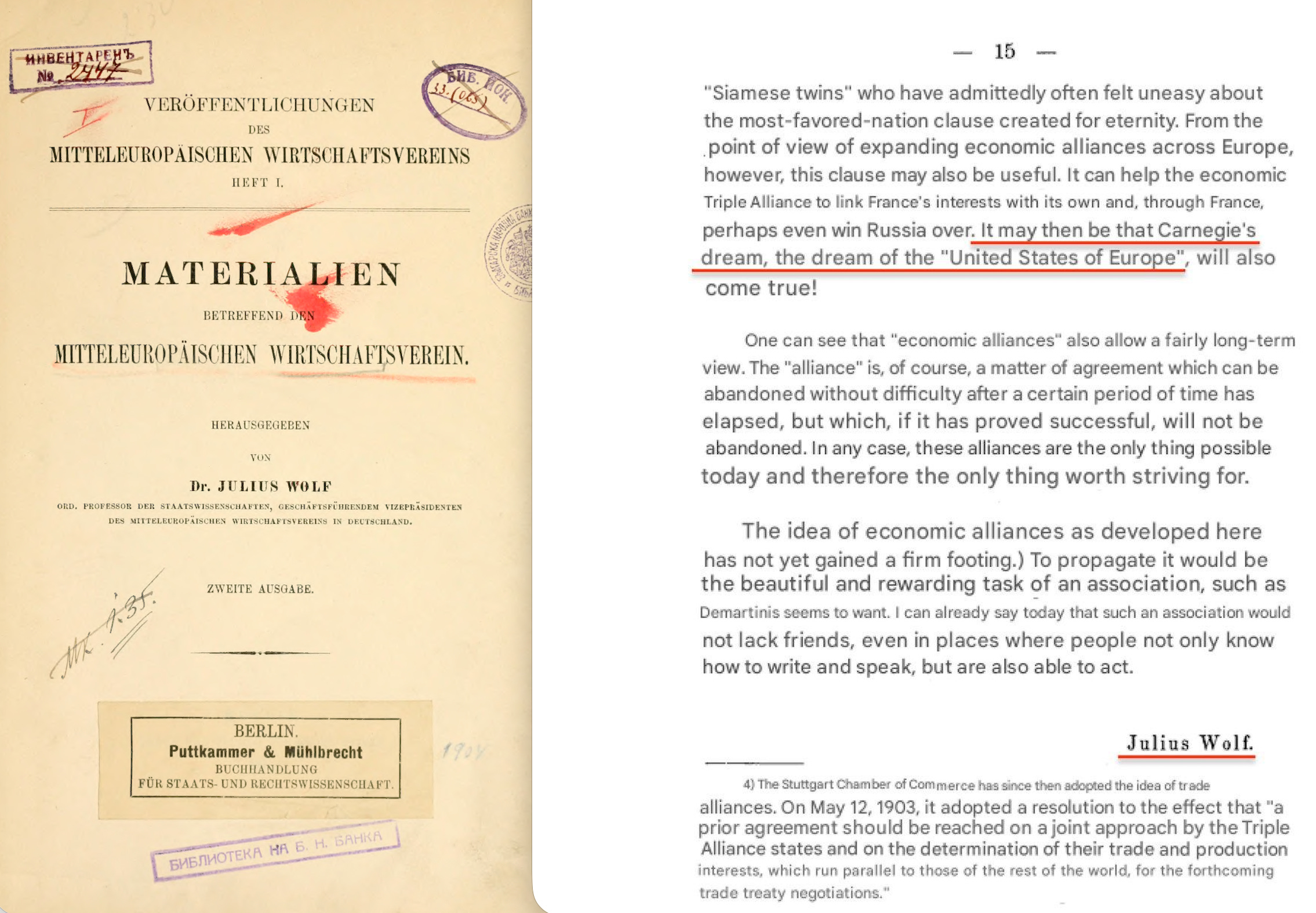
Blocs and unions vaster than Europe itself. That is the consolidation-against-American-scale argument — the same argument Julius Wolf made in 1904 when he wrote about Carnegie’s dream of the United States of Europe.
The same argument Funk and Reithinger would make in the 1942 volume.

Hantos: the institutional specification
Elemér Hantos was the leading voice for Central European economic integration between the wars89. He had served as president of Hungary's Postal Savings Bank — the country's central bank — during 1918–19, and understood clearing and settlement from operational experience. A League of Nations expert, he founded the Institute for Central Europe in Vienna, Budapest and Brno, and directly shaped Tardieu’s Danubian Plan of 193210. He helped found Coudenhove-Kalergi’s Paneuropean Union1112 and chaired its commission for economic cooperation among the Danubian countries. Coudenhove-Kalergi had originally pursued European unification through politics; by the late 1920s the route had shifted to economics13 — and Hantos was the man writing the specifications.
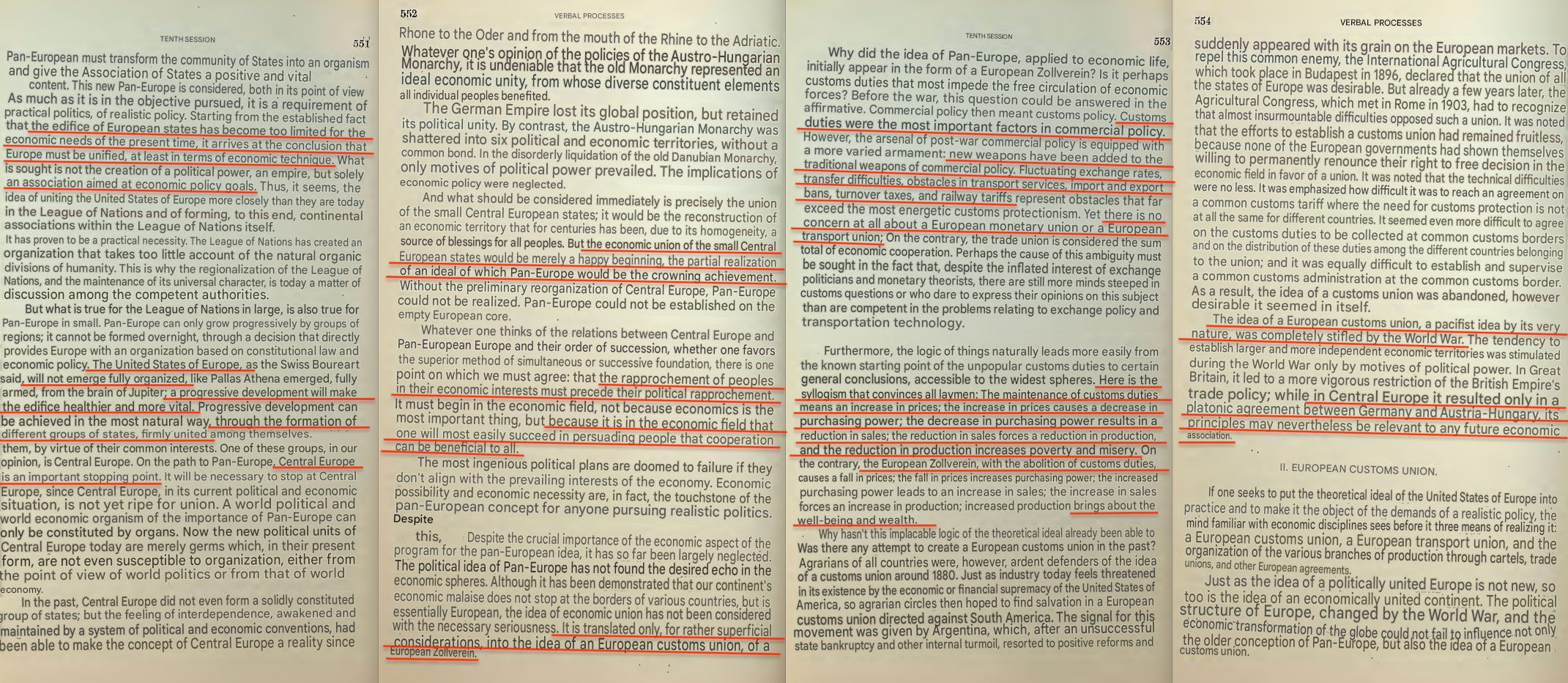
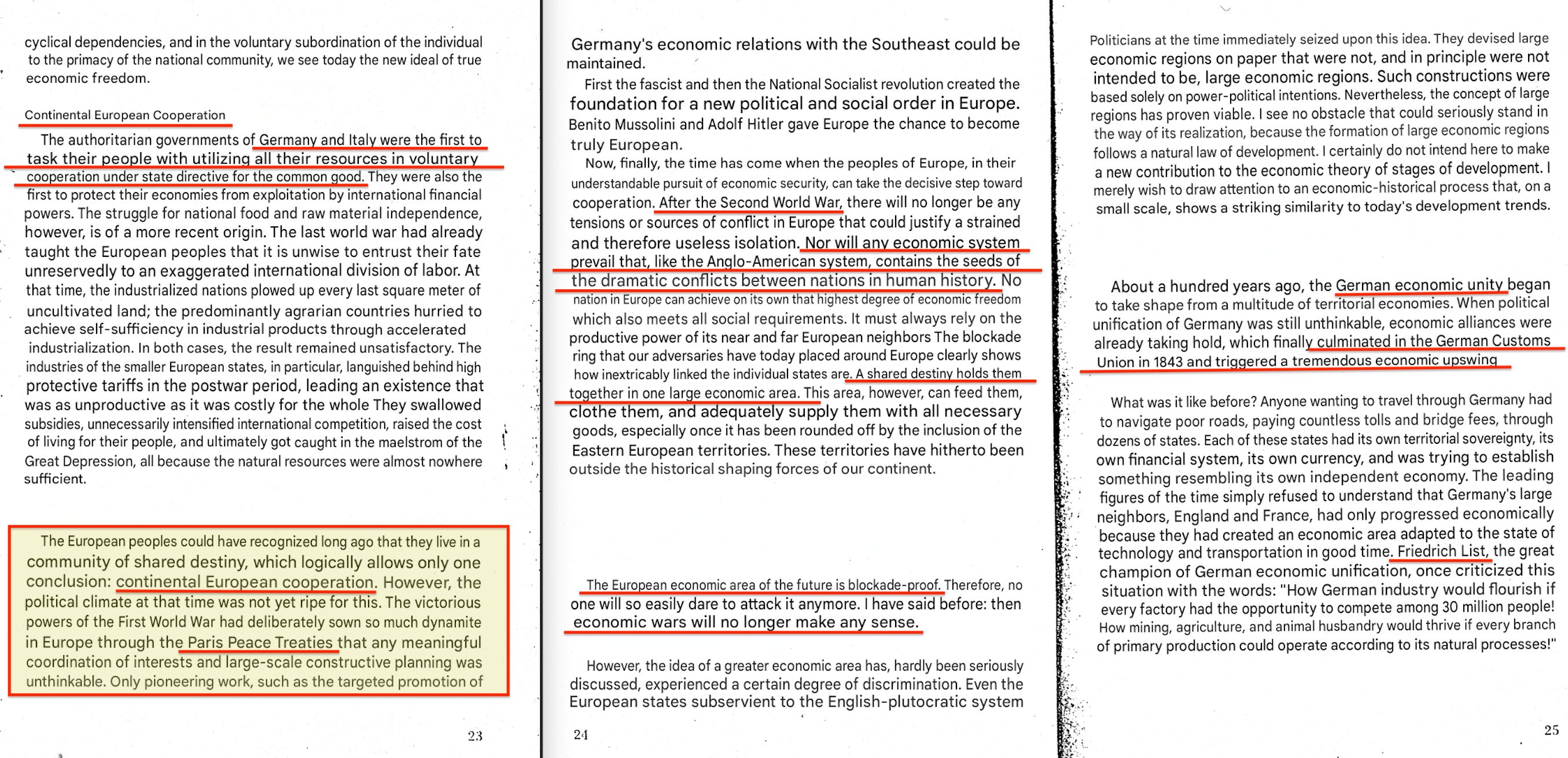
In 1928 he’d published Europäischer Zollverein und mitteleuropäische Wirtschaftsgemeinschaft1415 — European Customs Union and Central European Economic Community — in Berlin. In the proceedings he explicitly cited the wartime economic agreement between Germany and Austria-Hungary — the first implementation of Julius Wolf's Mitteleuropäischer Wirtschaftsverein16 — as the precedent whose principles 'may nevertheless be relevant to any future economic association'. The 1942 volume’s title was Europäische Wirtschaftsgemeinschaft. Just one word differs: mitteleuropäische becomes europäische. Central European becomes European.
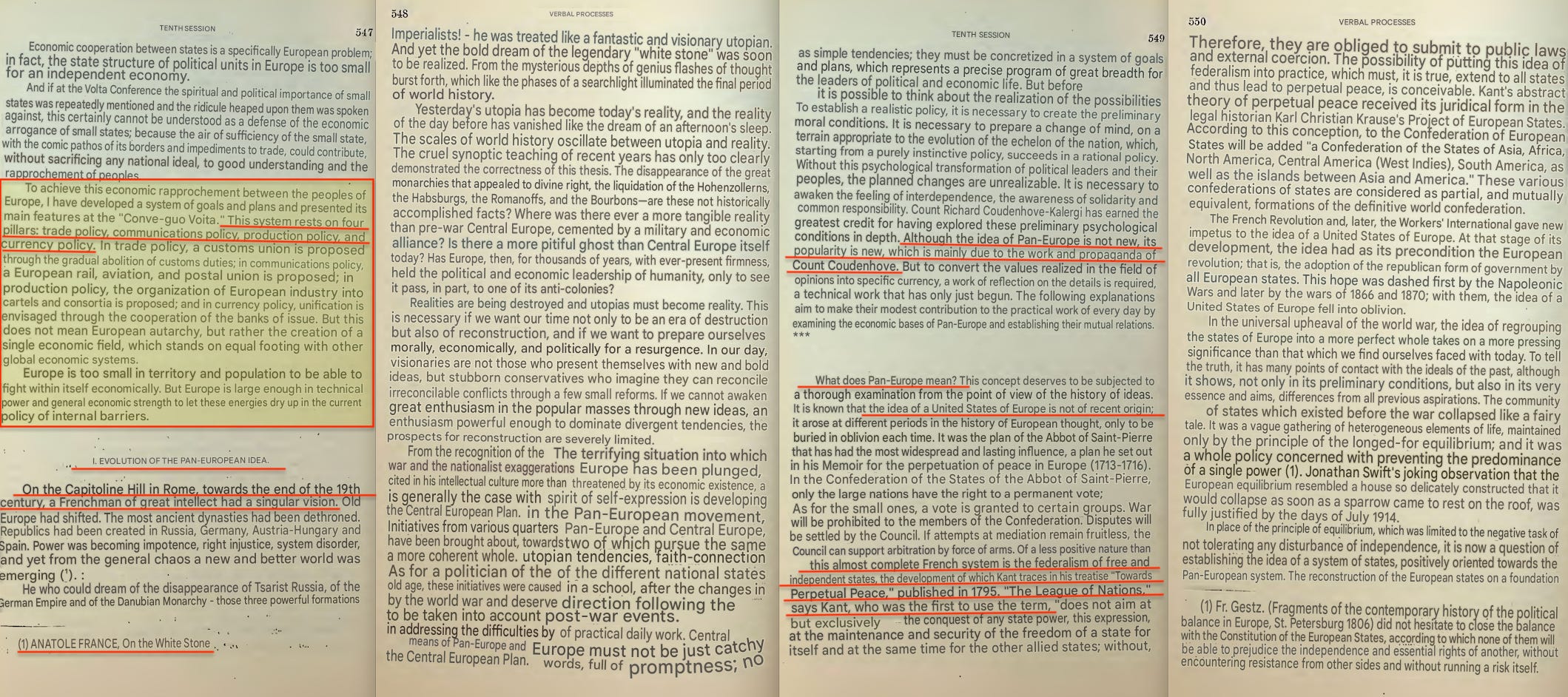
When Hantos presented the paper ‘Europe as an Economic Unity’ at the conference, he was the most qualified person on the continent to do it. He opened by citing Anatole France's 1905 novel On the White Stone17 — a vision of a federated Europe, set on the Capitoline Hill where he was now standing.
His paper set out a four-pillar system for European economic unification:
Commercial policy: a European customs union reached by gradually abolishing tariffs, with a phased plan setting deadlines by industry and territory.
Transport policy: a European railway union, a European aviation union, a pan-European telephone cable network, and postal integration beyond what the Universal Postal Union already provided.
Production policy: European industry organised through international cartels and consortia — not for price-fixing but for rationalisation, division of labour and production stabilisation.
Currency policy: unification through cooperation of central banks of issue.
He explicitly says this isn’t autarky but the creation of a unified economic field that stands as an equal contracting party against other world economic systems. He suggests regional groupings as the method — Central Europe first, then expanding to include Germany and Italy, then the whole continent. He identifies the Franco-German settlement that the indemnity of 1870–71 and the Versailles reparations had made structurally necessary.

He stated the method explicitly: it must begin in the economic field, 'not because economics is the most important thing, but because it is in the economic field that one will most easily succeed in persuading people that cooperation can be beneficial to all'. Economics first, politics after.
Customs union, monetary coordination, transport integration, industrial organisation, regional groupings expanding outward, the Franco-German relationship as the political precondition — every structural element from the 1942 volume is there.
The 1942 volume didn’t invent the programme. It developed one that Hantos had already specified in a published proceeding. The conference’s own official summary, delivered by Orestano, picked out Hantos’s plan as ‘the most concrete project exhibited at the Conference’ and credited him with the principle that ‘economic agreement must precede and prepare political agreement’ — the exact sequencing the postwar project followed.

Von Franges: the southeastern European chapter
Otto von Franges, a Yugoslav senator and former minister, presented the paper that prefigures the 1942 volume’s southeastern European programme.
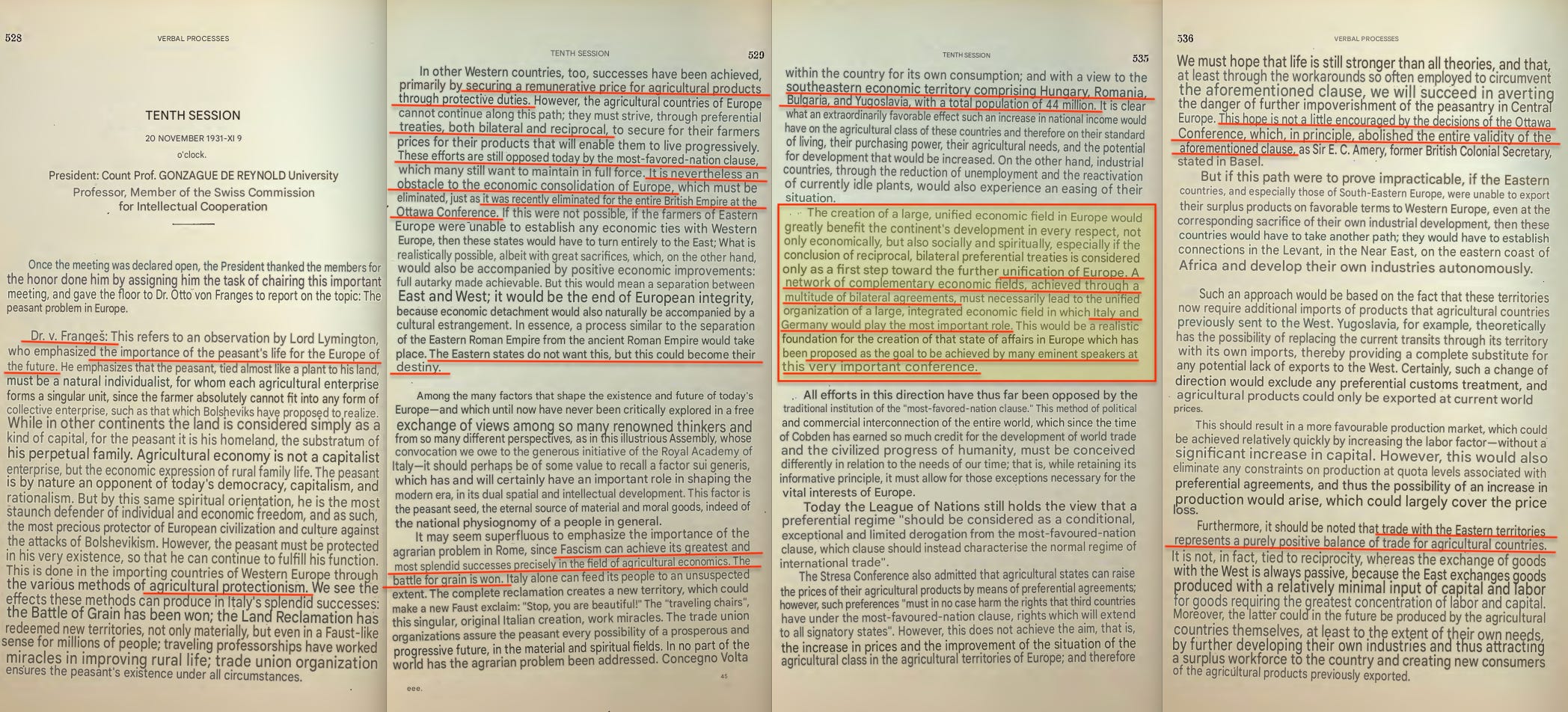
He set out the bilateral preferential treaty programme between agricultural southeastern Europe and industrial western and central Europe, naming the countries — Hungary, Romania, Bulgaria and Yugoslavia, with a combined population of 44 million. The mechanism was preferential tariffs through bilateral reciprocal treaties, where agricultural countries get remunerative prices for their products and industrial countries secure wider markets.
He identified the obstacle: the most-favoured-nation clause, which the League of Nations still insisted was the normal regime of international commerce. He also named the precedent for overriding it: the Ottawa Conference of 1932, which abolished the clause’s integral validity for the British Empire18.
Then came the warning: if southeastern Europe can’t export westward on favourable terms, these countries will turn east, develop autarchically and detach from European civilisation.
He went further. A network of complementary economic fields, achieved through bilateral agreements, ‘must necessarily lead to the unified organization of a large, integrated economic field in which Italy and Germany would play the most important role’. He proposed the bilateral treaty network that Schacht would build from 1934 — naming Germany and Italy as the leading powers — as development strategy.
That’s the Woermann-Reithinger programme — requested by a southeastern European representative, a decade before the 1942 volume documented its implementation.

Verrijn Stuart: the monetary chapter
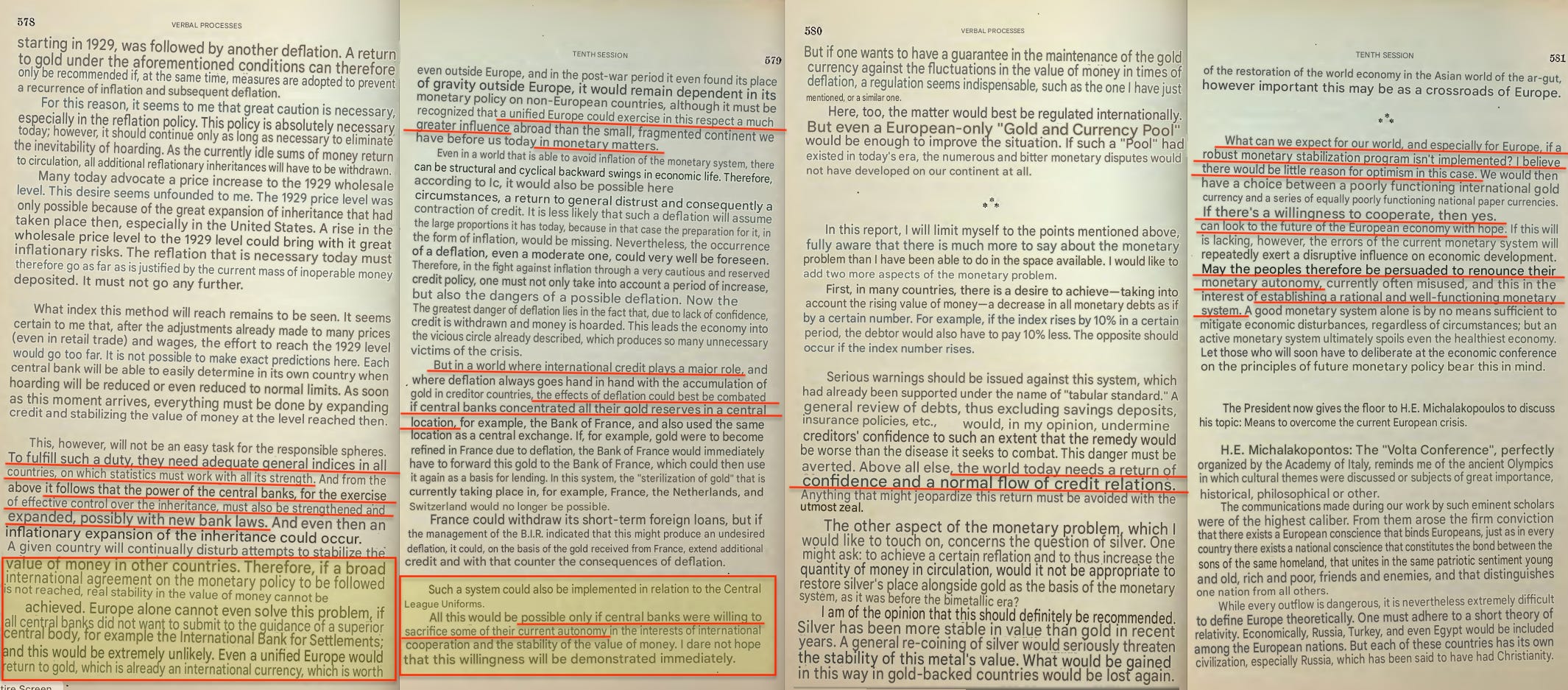
G. M. Verrijn Stuart gave a detailed technical treatment of European monetary reordering. He covered the failure of the restored gold standard, the need for coordinated reflation policy, and the role of the Bank for International Settlements as a central clearing house for gold and foreign exchange reserves. His key proposal: European central banks should concentrate their gold reserves at the BIS and use it as a central foreign exchange clearing house — a ‘Gold-and-Devisen-Pool’ for Europe. He said explicitly that if such a pool had existed during the current crisis, the severe monetary conflicts within the continent wouldn’t have developed.
He went further. Real stability in the value of money couldn’t be achieved if central banks ‘did not want to submit to the guidance of a superior central body, for example the International Bank for Settlements’. National central banks should submit to the BIS as a supranational monetary authority. He concluded with an appeal:
May the peoples therefore be persuaded to renounce their monetary autonomy, currently often misused, and this in the interest of establishing a rational and well-functioning monetary system.
That’s the Maastricht Treaty19 stated in 1932 — national monetary sovereignty surrendered to a supranational institution, justified by the argument that fragmented Europe can’t compete. It’s also the precondition for the entire Keynesian framework: counter-cyclical government spending only works once the gold standard is removed and an international institution coordinates the resulting imbalances between central banks. Verrijn Stuart specified the international monetary architecture. Keynes, four years later, supplied the national-level political legitimacy that depended on it.
Once the economy is politicised through Keynes — once government takes responsibility for employment and growth — the central bank becomes the gatekeeper. Government can only spend what monetary policy allows. The elected authority sets the agenda; the central bank controls whether it can be financed. Verrijn Stuart’s proposal to subordinate national central banks to a supranational body places the constraint above the level any electorate can reach.
This is the monetary coordination chapter of the 1942 volume in embryonic but technically precise form. Benning’s chapter elaborated what Verrijn Stuart had already specified at the same conference, in the same proceedings.
Schacht: the clearing function stated
Hjalmar Schacht — former Reichsbank president and the man who would build the bilateral clearing network from 1934 — spoke in the Ninth Session on the current economic situation
He begins by dismissing the conventional explanations for the collapse of world trade:
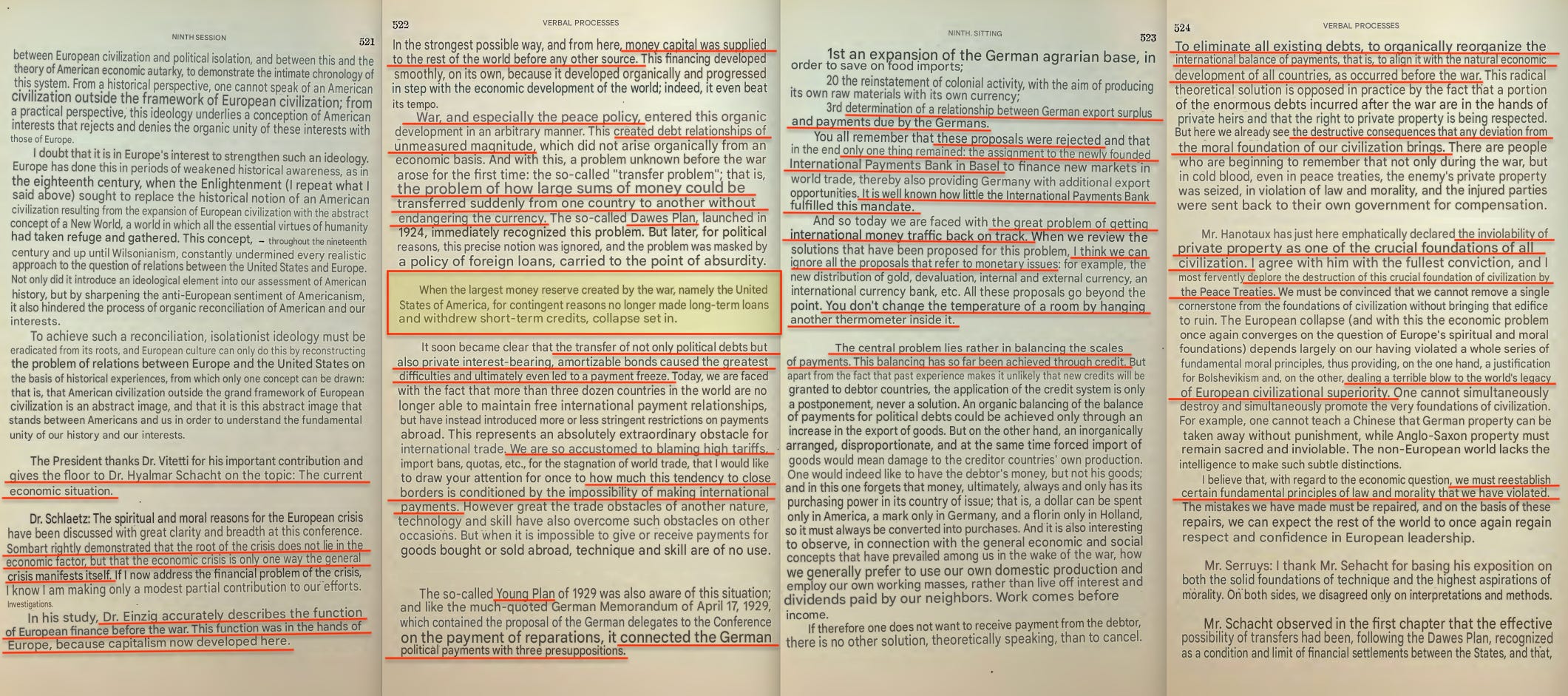
We have become so accustomed to blaming the arrest of world trade on high tariffs, import prohibitions, quotas, that I would like for once to draw your attention to how much this tendency toward border closure is conditioned by the impossibility of executing international payments.
Then comes the sentence that links directly to the 1942 volume’s central finding:
However great the commercial obstacles of another nature may be, technique and skill have overcome such obstacles before. But when there is the impossibility of giving or receiving payments for goods bought or sold abroad, technique and skill are of no use.
That’s Clodius page 203 — stated in 1932, before the regime existed. Clodius in the 1942 volume: ‘Neither tariffs nor quotas nor anything else plays a role. The only practical thing, the only weapon for the total steering of trade between peoples, is the regulation of payment traffic’. Schacht diagnoses the problem; Clodius describes the solution. Same argument, ten years apart.
Schacht dismisses all monetary reform proposals — redistribution of gold, devaluation, internal and external currencies, an international currency bank — as irrelevant: ‘You don’t change the temperature of a room by hanging another thermometer inside it’. The problem isn’t monetary, it’s settlement. The central issue is the balancing of the balance of payments — il pareggiamento della bilancia dei pagamenti. He notes that the Bank for International Settlements in Basel, newly founded and assigned to finance new markets in world trade, had done almost nothing to fulfil this function.
The institution Julius Wolf designed was already running in Basel, but Schacht didn’t think it was working. Two years later he’d build the bilateral clearing network that did — settling trade through bookkeeping rather than gold, managing payment flows through the Deutsche Verrechnungskasse, achieving through national infrastructure what the international body had failed to do.
Hans Luther, the sitting Reichsbank president, couldn’t attend but sent written endorsement, expressing hope the conference would help ‘lay, through spiritual understanding, the foundations of a rebirth of the European spirit’ a year before Schacht replaced him.

The political framework
The Fifth Session laid out the political theory.
Rosenberg presented his racially driven four-power framework — Germany, France, Italy and Britain — with clear spheres of expansion and a mutual-security arrangement where any obstacle to one of the four should be treated by the other three as a blow to their own vital interests. The framework echoes Moses Hess, whose 1841 European Triarchy20 proposed Germany, France and England as three civilisational powers, and whose 1862 Rome and Jerusalem21 cast Italy not merely as proof that national-civilisational revival was achievable but as the seat of the universal ethic that would legitimate the entire project.
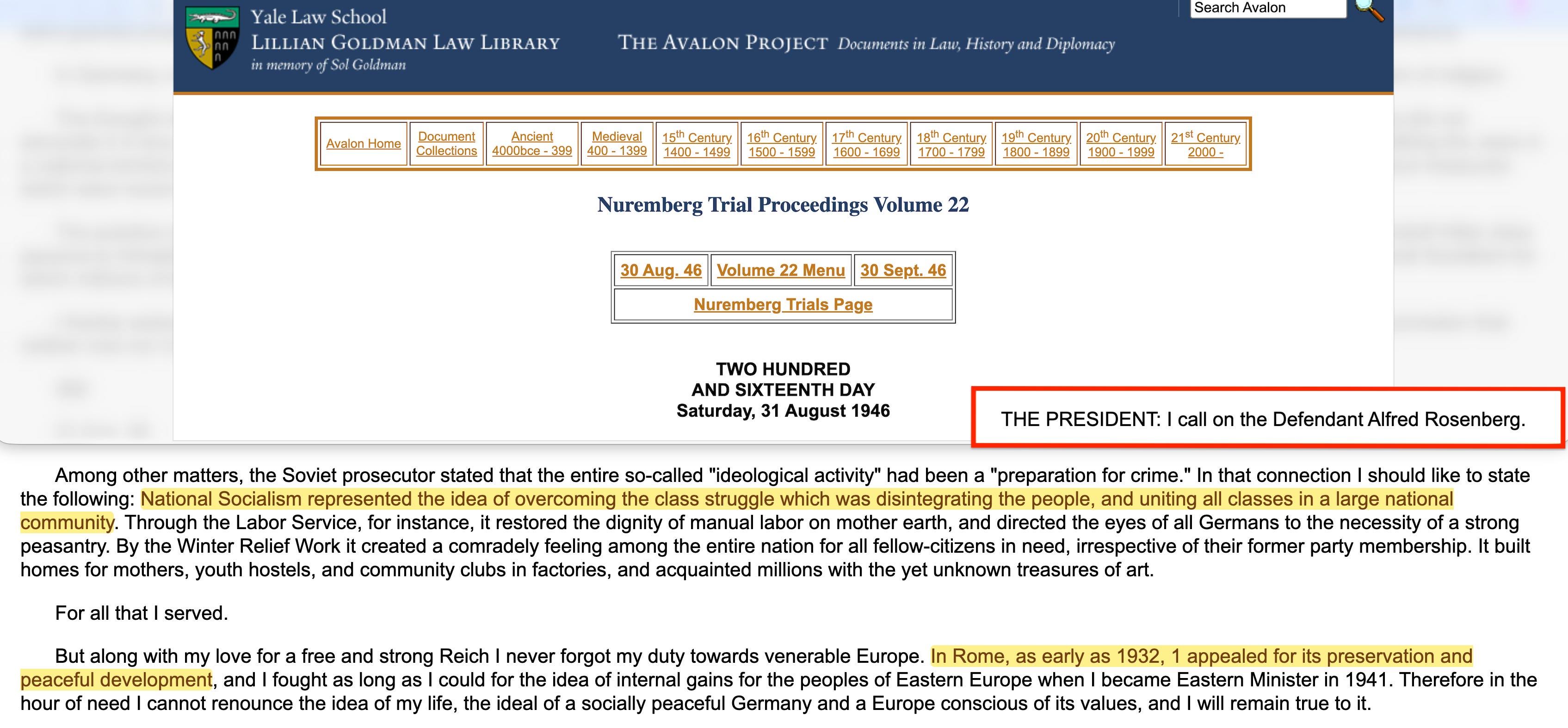
Rosenberg presented Hess’s framework on the Capitoline Hill in the presence of Mussolini without citing the Jewish socialist who designed it. This was the geopolitical container, and the same speech he cited at Nuremberg in his defence22: ‘In Rome, as early as 1932, I appealed for its preservation and peaceful development’.


But Rosenberg didn’t just present the Triarchy — the conference performed it. Hess had assigned each power a civilisational function. Italy — Rome — provided the universal ethic and moral authority. Britain provided the governance form: how to organise international institutions. Germany provided the technical specification: what those institutions actually governed. France was the pivot between them.
The Volta Conference matched Hess’s assignment. The Italian host provided the ethical stage. The German speakers delivered the clearing-function specification and the four-pillar economic programme. Britain was invited to provide the governance layer — from Woolf’s International Government through Zimmern and the Round Table to the League’s technical committees — but declined at the political level, present only through Einzig at the expert level.

The postwar architecture is what happened when all four functions finally converged. Italian moral authority came through the Treaty of Rome. British governance form came through Woolf’s blueprint, operationalised through the League of Nations, later United Nations. German specification came through the 1942 volume’s content, delivered via the EEC. The French political pivot came through Monnet and Schuman’s Coal and Steel Community23, which unlocked the whole thing.
Hess proposed the Triarchy in 1841 and added Italy in 1862. The 1932 Volta Conference is the moment where all four were invited into the same room.
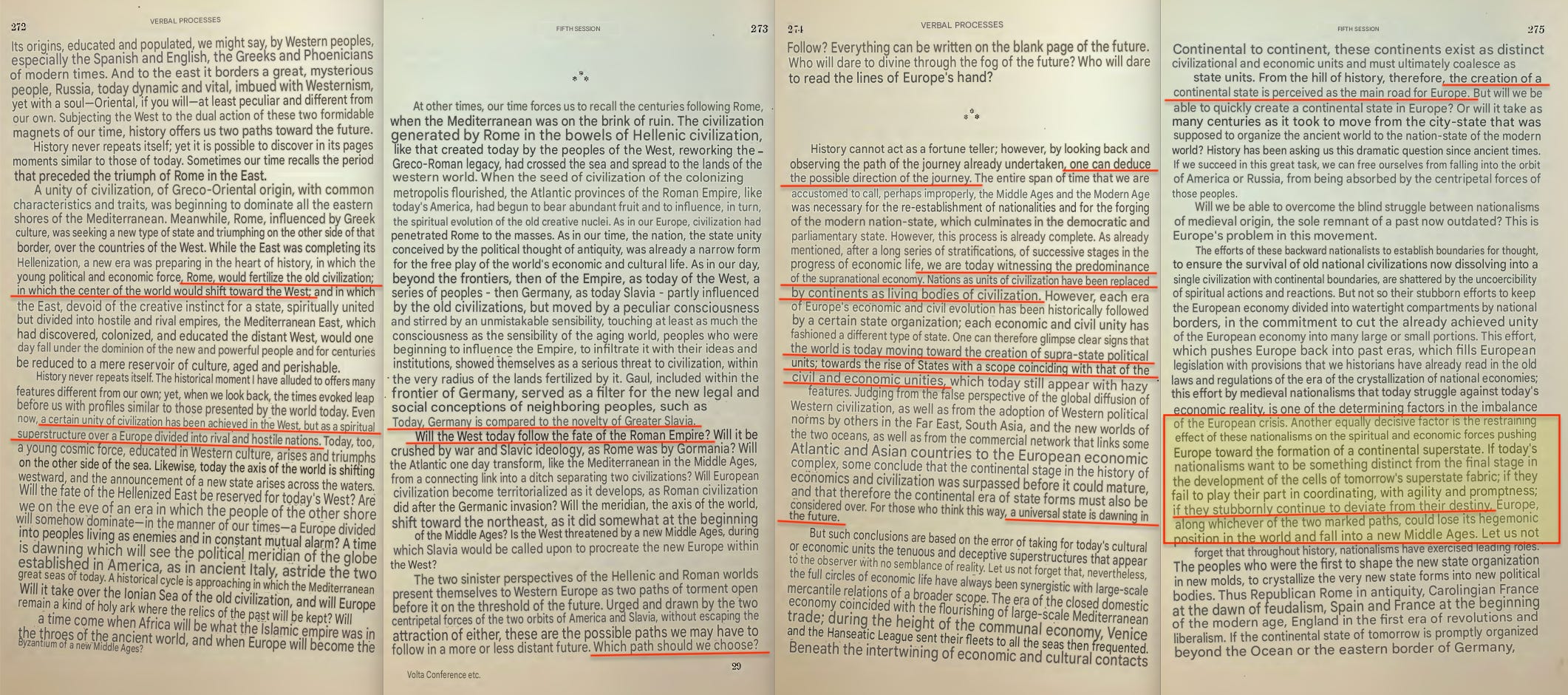
Sánchez-Albornoz, rector of the University of Madrid, set out the developmental-stages argument. Each stage of economic development produces its matching political form — the domestic economy produced the household, the municipal economy produced the city-state, the national economy produced the nation-state, and the supranational economy now existing as a reality must produce the continental state. If Europe doesn’t create it, it’ll fall into the orbit of America or Russia.
This is the 1942 volume’s developmental-law argument — Funk’s natural law of large economic spaces, Jecht’s historical stages, Hess’s progressive history — stated in 1932. The convergent implementation the body of work documents wasn’t a postwar phenomenon.
Jannaccone supplied the institutional vehicle: the ‘third way’ corporatist state as the characteristic political-social fact of twentieth-century European civilisation. Weyr supplied the legal argument that European unification requires limiting state sovereignty, dismantling economic borders, and recognising that political and economic rapprochement are inseparable.

The American challenge
The American competitive challenge wasn’t a minor thread at the 1932 conference — it was the dominant theme.
The conference’s invitation language framed it as blocs and unions vaster than Europe, challenging Europe’s position on all fronts. Hantos attributed Europe’s decline not to American strength but to European disunity:
… the continual decline of the entire European economy, compared with the position of the United States, must be attributed less to the predominant economic strength of the latter than to the disunity of Europe.
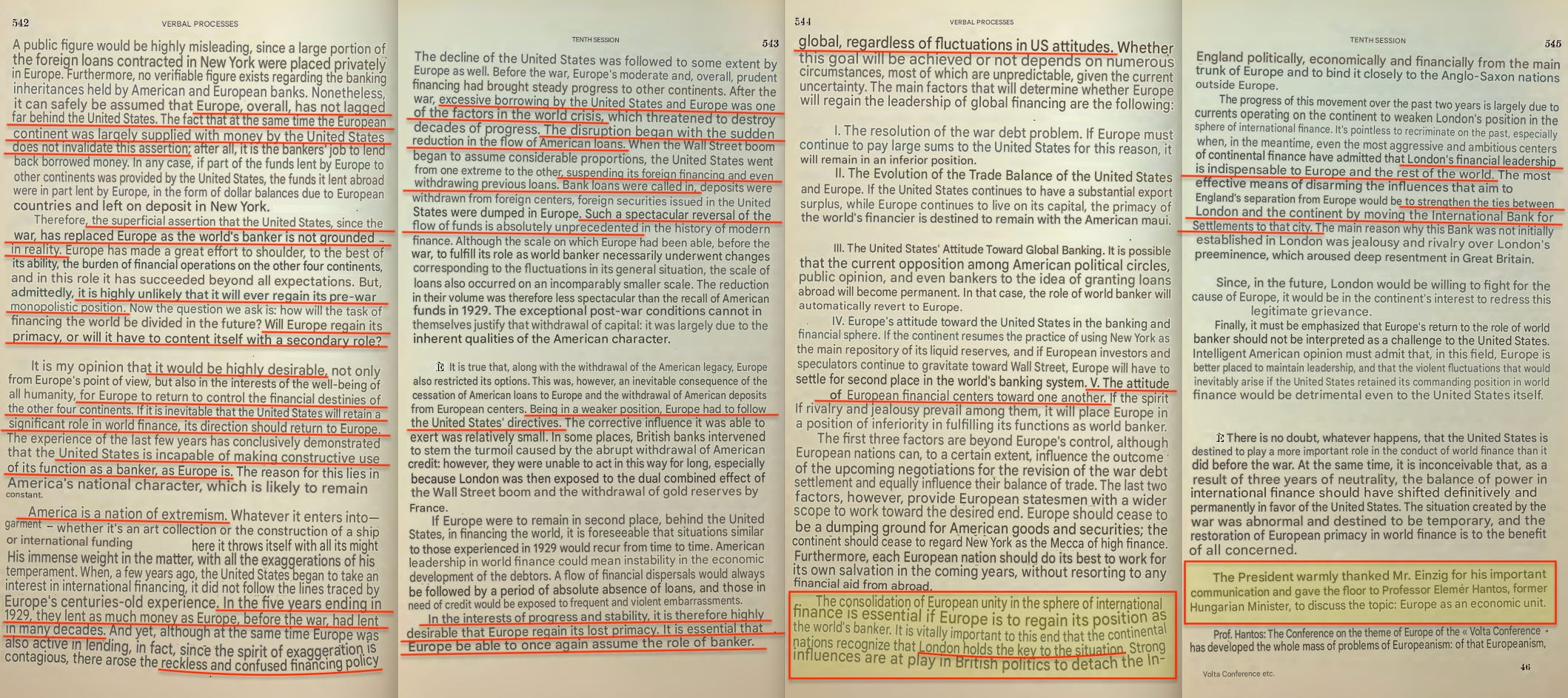
Europe was no longer the centre of a circle but the focus of an ellipse, with the other focus the United States. Einzig argued Europe must reclaim financial leadership from an America whose financial behaviour was inherently destabilising. In five years ending in 1929, American lenders had lent as much as Europe had in many decades before the war — then withdrew it all at once, triggering the Great Depression. ‘America is a nation of extremisms’, he said. Consolidating European financial unity was essential for Europe to regain its position as the world’s banker.
Coppola devoted pages to America as the most dangerous element of Europe’s ‘triple siege’. Sánchez-Albornoz posed the question directly: will Europe be to America what the Hellenistic East was to Rome — an old civilisation absorbed by its vigorous offspring across the sea?
Wolf made this argument in 1904. The 1932 Volta Conference echoed it through multiple speakers across multiple sessions, as did Funk and Reithinger in the 1942 volume. The postwar European project turned it into the democratic-peace rationale from 1950 onward. The structural argument — fragmented European economies lose against continental-scale competitors — doesn’t change across forty-six years.
The ethic changes, the urgency changes, but the argument stays the same.

What the proceedings show
Every domain the 1942 volume covers was being discussed in structural terms, with specific institutional mechanisms, at this single conference a decade earlier:
Customs union with phased implementation — Hantos
Monetary coordination through central bank cooperation and BIS clearing — Verrijn Stuart
Bilateral preferential treaties for southeastern European agricultural-industrial complementarity — von Franges
Industrial organisation through European cartels — Hantos
Transport integration — rail, aviation, telecommunications — Hantos
European financial leadership against American instability — Einzig
The continental state as the political form corresponding to the continental economy — Sánchez-Albornoz
The corporatist state as the institutional vehicle — Jannaccone
Sovereignty limitation and economic unification — Weyr
The four-power geopolitical framework — Rosenberg
The consolidation-against-American-scale argument — Hantos, Einzig, Coppola, Sánchez-Albornoz
Payment settlement as the governing mechanism — tariffs and quotas irrelevant beside the impossibility of executing international payments — Schacht
The conference brought fascists, liberals, nationalists and pan-Europeanists under one roof. Stefan Zweig, who would flee Europe within years24, attended the same sessions as Rosenberg and Göring. Rosenberg and Schacht sat alongside Keynes's letter of regret and Churchill's unanswered invitation. The programme was being developed across political lines, in multiple languages, at an international forum, before the Nazi regime even existed.
Two men on the same programme occupied the two structural positions the body of work identifies as the architecture’s core. Schacht held the mechanism — payment settlement as the governing mechanism, the clearing function as the only instrument that matters. Rosenberg held the ethic — the geopolitical framework, the civilisational justification, the ideological container into which the institutional programme was poured.
Their fates at Nuremberg tell the rest25. Rosenberg was hanged26; Schacht was acquitted27. The Tribunal executed the man who provided the ethic and released the man who built the clearing mechanism28. Karl Blessing, Schacht’s protégé from the Reichsbank Directorate, became president of the Deutsche Bundesbank in 195829. Bernhard Benning, who wrote the 1942 volume’s currency chapter, sat on the Bundesbank council by December 195730.
The ethic of racial supremacy was destroyed, but the mechanism which had supported it continued under new management.
Read alongside the 1942 volume and the postwar institutional record, the Volta Conference proceedings show that the interwar period was, at the institutional level, a contest over who controlled the clearing and settlement system. London held it through the gold standard and the sterling bloc. Schacht’s bilateral clearing network routed it through Berlin. Keynes’s International Clearing Union proposed routing it through an international institution. White’s Bretton Woods plan routed it through Washington and the dollar. Four proposals, four operators, same function.
All four assumed the BIS — Wolf’s design, built by the Allies, running in Basel since 1930 — proved international clearing could be institutionalised. The contest was who’d run the clearinghouse, not whether it should exist.
The ideology behind each operator was different, but the clearing architecture each sought to control was the same.


Conclusion
The conventional narrative frames the European project as a democratic peace initiative born from the ashes of fascism. The 1932 proceedings show the programme existed before the ashes. The war wasn’t the origin — it was the dislocation the architecture required. Funk stated on page 24 of the 1942 volume that the old system of liberal parliamentarism, gold-standard orthodoxy and Anglo-Saxon free trade doctrine wouldn’t dismantle itself.
The institutional genealogy runs through the German central bank. The Allies imposed central bank independence on the Reichsbank under the Dawes Plan in 192431 — a condition of the reparations settlement. This gave Schacht — who called the BIS ‘my bank’32 — the autonomy to build the bilateral clearing network from 1934, routing European settlement through Berlin instead of London. The instrument of Allied control became the means to challenge Allied clearing dominance.
After the war, central bank independence became the Bundesbank’s founding principle under Schacht’s protégé Blessing, then the ECB’s, and eventually the global template. The institutional form the Allies imposed on defeated Germany in 1924 to manage reparations now governs every major central bank in the world.

The conference’s method mattered as much as its content. Every speaker reinforced the same urgency: Europe faces existential competition from continental-scale blocs. Integrate or become irrelevant. The solution was always economic — never political union, never military alliance, never democratic federation. Hantos stated the logic openly: begin in the economic field, because that’s where people can most easily be persuaded that cooperation is beneficial. Customs were the natural entry point — everyone understands tariffs and dislikes paying more — and each step created the technical necessity for the next. A customs union requires coordinated transport. Coordinated transport requires rationalised production. Rationalised production requires a common currency. A common currency requires a central bank. A central bank requires monetary policy set outside democratic oversight.
Nobody votes for continental governance. They vote for cheaper goods and discover, decades later, that the governance arrived with them. Keynes completed the circuit four years later: once government takes responsibility for employment and growth, the central bank controls whether it can be financed. Verrijn Stuart had already detailed that the central bank’s authority would sit above the nation, at the BIS, beyond any electorate. The economy was politicised so that the constraint could be depoliticised.
This reading explains the institutional outcome — why the same architecture survived every regime change: because the central banks drive the process. It does not, however, explain the human catastrophe. The clearing-function layer operates at the level of institutional form; the human catastrophe operates at the level of human experience. The body of work identifies the institutional layer, but doesn’t claim it necessarily explains everything that happened within it.
One detail from the proceedings stands out. The conference’s own Indirizzo stated that ‘the Conference will not adopt any deliberation’. Marconi’s opening speech reinforced this:
Science cannot and must not enter into politics... but it can well furnish to statesmen the scientific material diligently collected and objectively elaborated.
The papers had been pre-printed and distributed to all participants before the conference opened. The conference wasn’t a workshop where ideas were shaped through debate. It was a publication event for finished specifications — consumed as scholarship, insulated from political scrutiny by design.
Fourteen months earlier, Hitler had instructed his inner circle that the economic programme wasn’t to become ‘a subject for propaganda, or even for any sort of discussion, except within the innermost study group’. The academic channel solved both problems at once. Schacht and Rosenberg placed the programme into the international intellectual record in a form that concealed its political function — while the people who'd later implement it were invited to receive it.
Keynes declined. Eight years later he received Funk's plan, called it excellent33, and built the British version.
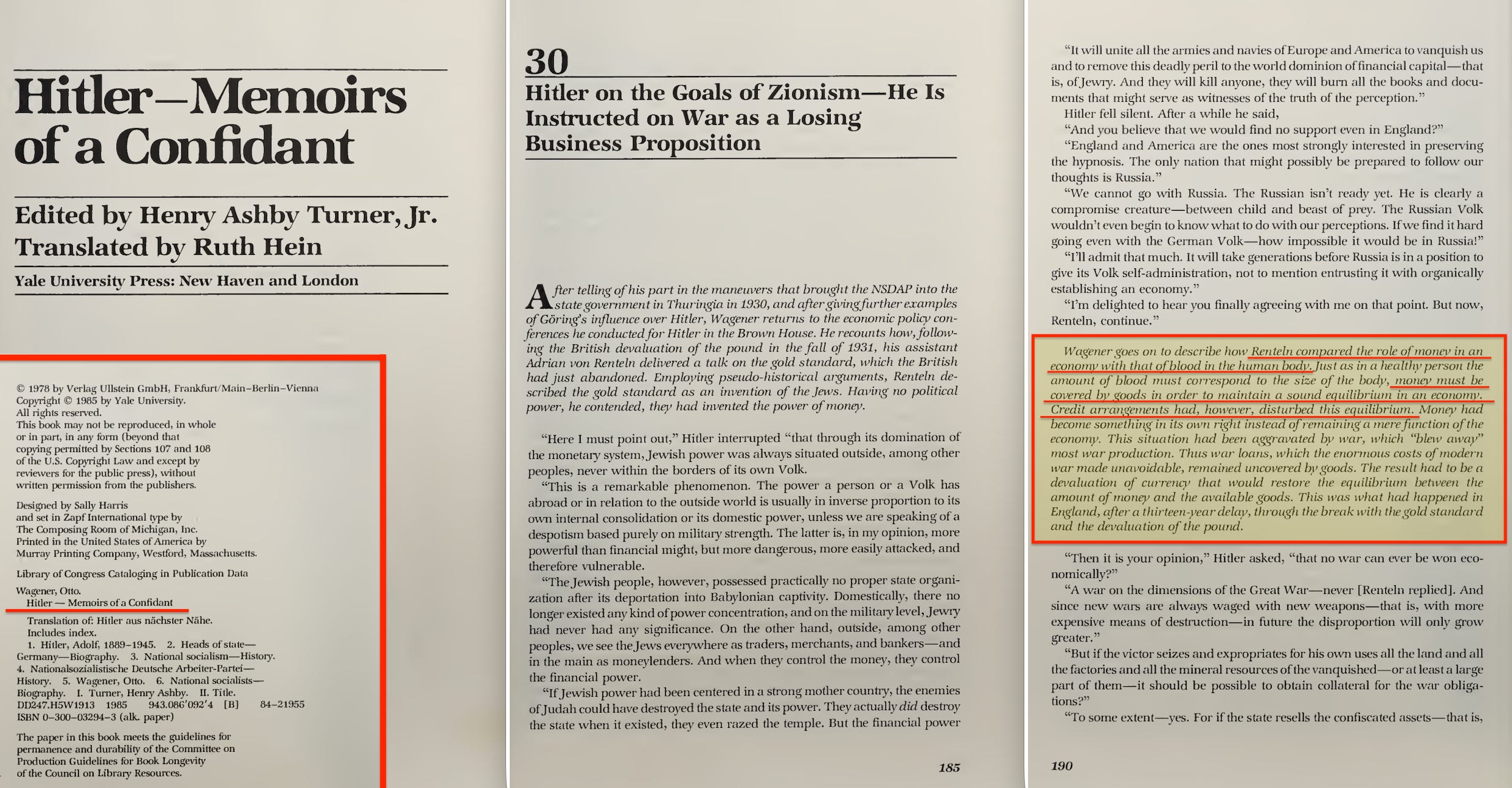
The institutional specifications — customs union, monetary coordination, clearing architecture, transport integration — were presented as scholarship, not policy proposals. The academic frame insulated the governance programme from political scrutiny. The Science and World Order conference used the same method in 1941. The Science and Ethics report formalised it in 1942: ethics derived from science, making the scientific finding and the moral obligation identical.
The NGFS uses the result today — science generates the ethic, the ethic authorises the standard, and the standard is shielded from democratic revision by claiming it was science rather than politics all along.


Three regimes implemented the architecture the Volta Conference specified. Each filled the ethic slot with different content, but each arrived at the same clearing-function form.
Germany installed it under the ethic of racial supremacy and the Volksgemeinschaft. The mechanism was Schacht’s bilateral clearing network, the Deutsche Verrechnungskasse, and the Reichsbank’s control of payment flows — the system the 1942 volume documented. The ethic was executed at Nuremberg; the mechanism walked free.
The Soviet Union installed it under the ethic of collective duty and the historic mission of the proletariat. The mechanism was state monopoly of foreign trade, centralised clearing through Gosbank, COMECON’s planned division of labour, and the transferable rouble — a clearing unit, not a convertible currency. The ethic collapsed in 1991. The Soviet three-layer architecture — Gosplan, Gosbank and Gossnab: planning, clearing and enforcement — was studied by Greenspan, replicated by McNamara at the Pentagon as the Planning Programming Budgeting System, and merged into Western systems modelling at IIASA from 1972.

Through Fabian gradualism34, the West installed the mechanism first and built the ethic afterwards. The European Payments Union was a multilateral clearing union of the type Keynes had proposed and Schacht had practised bilaterally. The Treaty of Rome delivered the customs union and phased integration Hantos had outlined in 1932. The Bundesbank, led by Schacht’s protégé Blessing, anchored the monetary system.
The initial ethic was thin — Carnegie's peace, the Franco-German settlement that the indemnity of 1870–71 had made structurally necessary, the Universal Declaration of Human Rights, and economic reconstruction. It thickened quickly: peace expanded into health through the WHO, and into economic and cultural cooperation through NATO's Committee of Three in 1956.
Brzezinski identified ecology as the integration frame between East and West in Between Two Ages35 (1970) and co-founded the Trilateral Commission with David Rockefeller three years later.


The sustainability ethic that would eventually replace the peace rationale arrived over seven decades: Science and World Order in 1941, UNESCO in 1945 with Huxley as its first Director-General, ICSU fused with UNESCO as its science arm in 1946 through Needham and Kovda, the IUCN founded at a UNESCO conference in 1948, the UNESCO Biosphere Conference in 1968, the Club of Rome in 1972, the Venice Declaration in 1986, Brundtland in 1987, Küng’s Global Ethic in 1993, the Earth Charter in 2000, the SDGs in 2015.
The Economic Policy Coordination Committee, proposed under four names between 2013 and 2023, supplies the institutional terminus: a coordination body directing where centrally created money flows, conditioned on compliance with criteria the same foundation network defined. The SDGs provide the standards; the EPCC enforces them through monetary allocation. Unlike the racial and collectivist ethics, the sustainability ethic was designed to be global rather than civilisational — and therefore didn't need to be discarded when the project expanded beyond Europe.
The twentieth century wasn’t three failed attempts at different systems. It was one system searching for a durable ethic, discarding the ones that couldn’t scale. The framework was designed at this conference in 1932.
The first two implementations crashed. The third is still running.
The 1942 volume didn’t emerge from nowhere. It came from a decade of elaboration on a programme already fully articulated in structural, institutional and economic terms at the 1932 Volta Conference. The 1932 proceedings are the missing link between Wolf’s 1904 proposals and the 1942 specification — delivered into institutional form by the Treaty of Rome in 195736.
The treaty was even signed in the Palazzo dei Conservatori, on the Capitoline Hill — the same building complex where the conference had opened just short of twenty-five years earlier37.


Find my Telegram channel over here.
ESC as lord of The rings. The writer who binds it all together!
Have you come across the Russian word Upravleniye in your research? I kept running into as the economic vision which tied to the global education I had documented in my book.
It also transfers to what you laid out here and why the assumption was that the Upravleniye vision was to be implemented globally.
This also fits with another word that kept coming up--Engrenage. The graphic for enmeshed gears to illustrate how a vision is to work and why if you are only familiar with a part or one or two of the gears a non-insider can miss how the whole structure was designed to work together to transform multiple areas.