
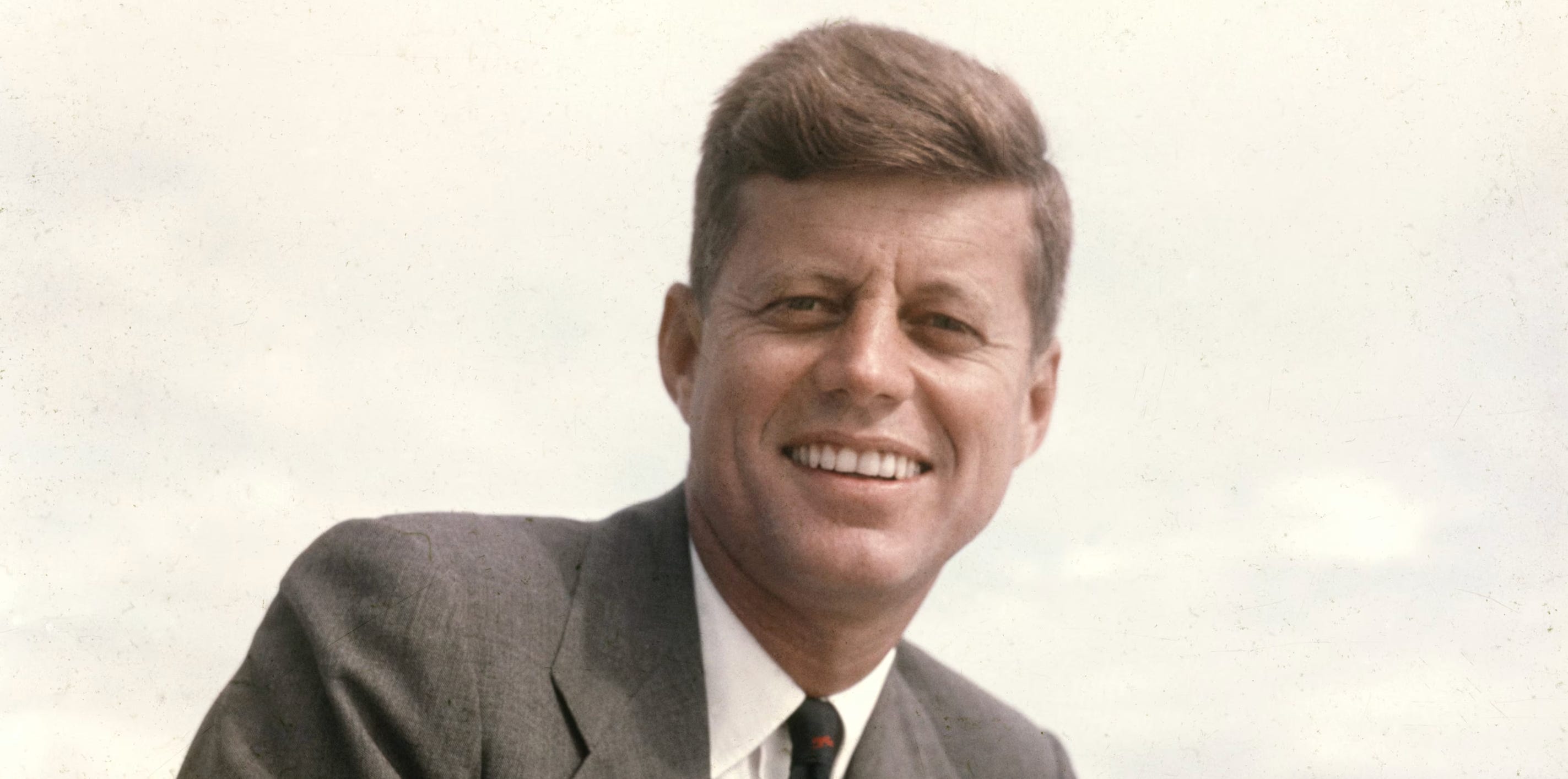
Kennedy

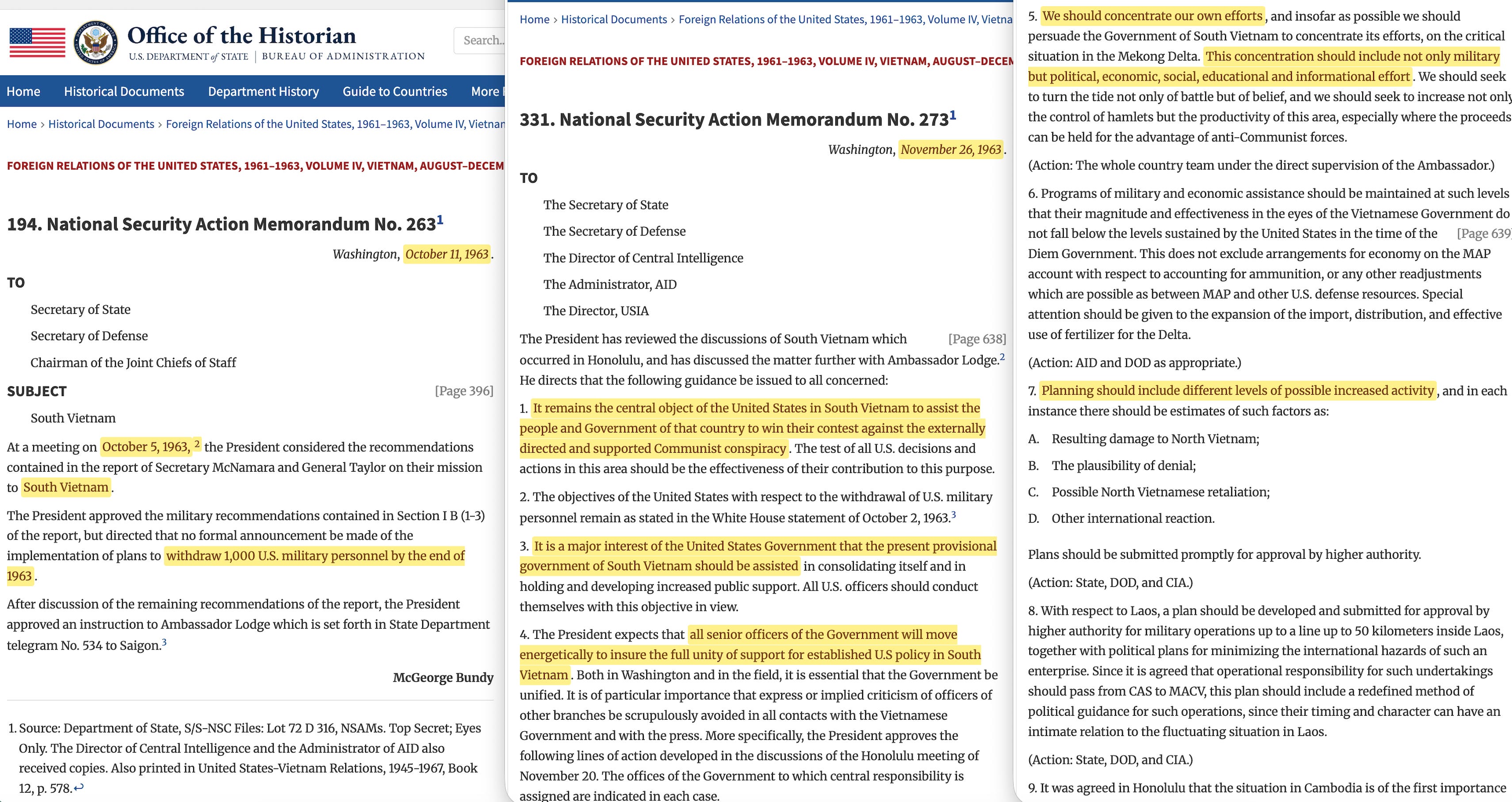
On November 21, 1963, McGeorge Bundy — National Security Adviser to President John F. Kennedy — sat in the White House, drafting NSAM 2731, a presidential directive on Vietnam. Kennedy’s own directive, NSAM 2632, had been signed just six weeks earlier, ordering the withdrawal of 1,000 military personnel by December 1963 and the majority of American forces by the end of 1965. Bundy’s draft reversed it, committing the United States to ‘win their contest against the externally directed and supported Communist conspiracy’.
The cabinet was in Hawaii3, and the President in Texas. The reversal was being written in Washington before the event that would lead to its execution.
Kennedy was assassinated in Dallas the following day.
Four days later — one day after the funeral — the new president, Lyndon Johnson, signed NSAM 2734, and Vietnam became the testing ground for the systems-based approach to governance5 Kennedy tried to contain.
Over the next twenty-five months followed the most concentrated programme of institutional construction in American history. By December 1965, the architecture Kennedy opposed had been legislated, and deliberately made invisible.

What Kennedy Opposed
Kennedy’s conflict with the security establishment was about the shape of governance itself — not about any singular, specific policy.
When Kennedy appointed Robert McNamara as Secretary of Defence, McNamara brought with him PPBS6 — the Planning, Programming, and Budgeting System. Developed at RAND and the Ford Motor Company as a way of applying cost-benefit analysis to large organisations, at the Pentagon he applied it to military spending. Kennedy, however, had other ideas. He used it as a scalpel to cut waste and assert civilian control over an unaccountable defence budget, while keeping PPBS confined to the Department of Defence. When proposals emerged to expand it into the CIA and create a National Information Center which would have centralised scientific research under federal control, he refused to lend his support.
Following the Bay of Pigs disaster, Kennedy purged the CIA’s top brass — Allen Dulles, Charles Cabell, Richard Bissell, and Robert Amory Jr., the Deputy Director of Intelligence. Unlike Kennedy, Dulles, Bissell, and Amory were all members of the Council on Foreign Relations — co-founded by Walter Lippmann in 1921 — which recruited directly from within the CIA, with agents nominating other agents for membership. Arthur Schlesinger fought hard to protect Amory, but Kennedy let him go and had him wiretapped7, even going to the extent of taking a personal interest in the case — suggesting Kennedy saw Amory as somewhat more than a failed intelligence chief.
Before being let go, Amory fought a valiant battle8 in support of the ‘World Congress for Freedom and Democracy’9 — a project advanced by Amory, Schlesinger, and CIA operative Dana Durand that sought to transfer power to large foundations under the banner of liberal democratic values. It was The Third Way under American branding: ‘freedom and democracy’ was the label covering for stakeholder governance, with private foundations planning policy. Senator Karl Mundt, meanwhile, pushed a parallel initiative through Congress — the Freedom Academy10, a proposed centralised institution for training officials and civilians in ideological warfare. The CIA’s own internal analysis noted that the proposed American counter-strategy was structurally identical to the Soviet system it claimed to oppose11. Kennedy’s State Department shot it down twice, and with Amory out of the CIA and the Freedom Academy blocked, the programme stalled — temporarily.
The World Congress was a transatlantic network linking Schlesinger and Durand to Altiero Spinelli and the Il Mulino group in Bologna, with backing from the Ford Foundation, the Carnegie Endowment, and the 20th Century Fund12. Schlesinger attended the Il Mulino meeting in April 1961, where the concept of a ‘democratic international’ was discussed — stakeholder governance spanning the Atlantic. Spinelli himself had been a member of the Italian Communist Party, imprisoned under Mussolini, and would go on to draft the Spinelli Plan13 adopted by the European Parliament in 1984 — the blueprint for Maastricht and the European Union.
While Spinelli provided the constitutional framework, the institutional design came from Wilhelm Röpke — a Rockefeller fellow who co-founded the Mont Pelerin Society with Hayek and architected Ludwig Erhard’s post-WW2 German social market economy. Röpke called his programme ‘The Third Way’, and at its core he built an independent central bank — the Bundesbank — whose sole mandate was price stability, enforced beyond electoral reach. The Bundesbank became the template for the European Central Bank through the Maastricht Treaty, placing monetary policy for the entire eurozone under expert control that no electorate could touch. Two parallel programmes — Spinelli’s political and Röpke’s monetary architecture — became a single treaty, which removed democratic accountability from both constitutional and financial layers.
What Kennedy stalled in Washington resurfaced in Brussels, designed by a communist and an ordoliberal whose point of agreement was an identical architecture. It ran under whatever ethic occupied the top slot, and it went by the title, ‘The Third Way’, later popularised by Tony Blair and Bill Clinton.
During the Cuban Missile Crisis, McNamara’s system recommended a series of precision strikes on Soviet installations. Kennedy overruled what would have been a catastrophic decision — the installations were far more advanced than American intelligence realised — instead pursuing diplomacy with Khrushchev. The march of systems analysis had been dealt a significant blow, replaced by human intuition — at least for the time being.
Five months before his death, Kennedy delivered his American University speech, possibly the most important presidential address of the Cold War14. The phrase ‘If we cannot end now our differences, at least we can make the world safe for diversity’ meant sovereign nations with different systems, coexisting through bilateral relationships. Simultaneously, Kennedy was pursuing secret normalisation talks with Castro through Lisa Howard and UN diplomat William Attwood15, and a back channel with Khrushchev through Norman Cousins, mediated by Pope John XXIII16.
Kennedy’s approach, in essence, was the virtual opposite of governance mediated through institutional architecture and systems analysis.


Twenty-Five Months
Within twenty-five months of Kennedy’s assassination, every component Kennedy opposed was accelerated — including, remarkably, programmes he had stopped.
The White House Conference on International Cooperation17, held in November 1965, was similar to the stalled ‘World Congress for Freedom and Democracy’. Both convened private citizens to produce governance specifications, and both routed those specifications through a body outside elected government — in 1965, the National Citizens’ Commission, organised through the United Nations Association18. Both proposed that the government ‘study your recommendations with a view to immediate action’, and both depended on foundation funding for implementation.
The label swapped ‘freedom and democracy’ for ‘international cooperation’, but the architecture was the same: private-sector specification, government implementation, foundation funding, standards bypassing elected officials. The programme Kennedy temporarily stopped was operational within two years of his removal, rebranded, launched from the White House with 5,000 participants and thirty panels.
Johnson moved immediately after taking office. On January 8, 1964, he declared the War on Poverty in his State of the Union address, creating the Office of Economic Opportunity along with Job Corps19, VISTA, Community Action Programs, and Head Start. Each programme established a federal agency operating in a domain previously governed locally, and each required its own data collection, statistical measurement, and reporting infrastructure. Programme by programme, the observation layer was being built across every aspect of American life.
In May 1964, Johnson announced the ‘Great Society’ at the University of Michigan20 — rebuilding cities, preserving the natural environment, improving education. In July, the Civil Rights Act21 established federal compliance enforcement across public accommodations, employment, and federally funded programmes, and the compliance model — conditions attached to federal funding — became the template for everything that followed. In August, the Gulf of Tonkin Resolution22 gave Johnson unlimited authority in the theatre where PPBS would be tested on a massive scale.
After winning a landslide election in November 1964 with Democratic supermajorities in both chambers, Johnson passed 226 of 252 legislative requests over the following twelve months — a 90% success rate without precedent in American history, and one that hasn’t been matched since. Each one built a piece of the architecture, though it wasn’t announced as such23.
The environmental legislation alone is remarkable in scope. In 1964 and 1965, Johnson signed the Pesticide Controls Act24, the Wilderness Areas Act25, the Water Resources Research Act26, the Water Quality Act27, the Solid Waste Disposal Act28, the Clean Water Restoration Act29, and the Highway Beautification Act30. Each created three things simultaneously: a classification system defining what counts as polluted, endangered, or wilderness; a measurement system of federal monitoring stations, chemical analysis, and biological surveys; and a standard-setting function establishing water quality standards, air quality standards, and species protection criteria. Classification, measurement, and standards; the three components of a clearing function, installed domain by domain across the natural environment.
The health legislation followed the same pattern. Medicare and Medicaid31, signed on July 30, 1965, installed the health clearing function for the elderly and the poor. The Heart Disease, Cancer and Stroke Amendments32, the Community Health Services Extension33, the Drug Abuse Control Amendments34, and the Medical Library Assistance Act35 — all passed in 1965 — each created its own data collection and reporting infrastructure. The Comprehensive Health Planning Act of 196636 then applied the compliance model directly: conditional grants were offered to states that established a central health planning agency, reporting to the Surgeon General, meeting standards set by the Surgeon General, and including NGO representatives on its councils.
And on August 25, 1965, Johnson ordered PPBS extended to every federal agency37. The State Department, AID, the Peace Corps, the CIA, and every domestic agency were now required to define objectives, analyse alternatives, and plan spending in long-range terms under a single analytical framework.
The control methodology Kennedy used as a financial scalpel became the operating system of the entire executive branch.


The Four Documents
The replacement sequence came together in a single quarter — the fall of 1965 — when four documents were produced within 114 days that together amount to the complete specification for the governance architecture that now exists.
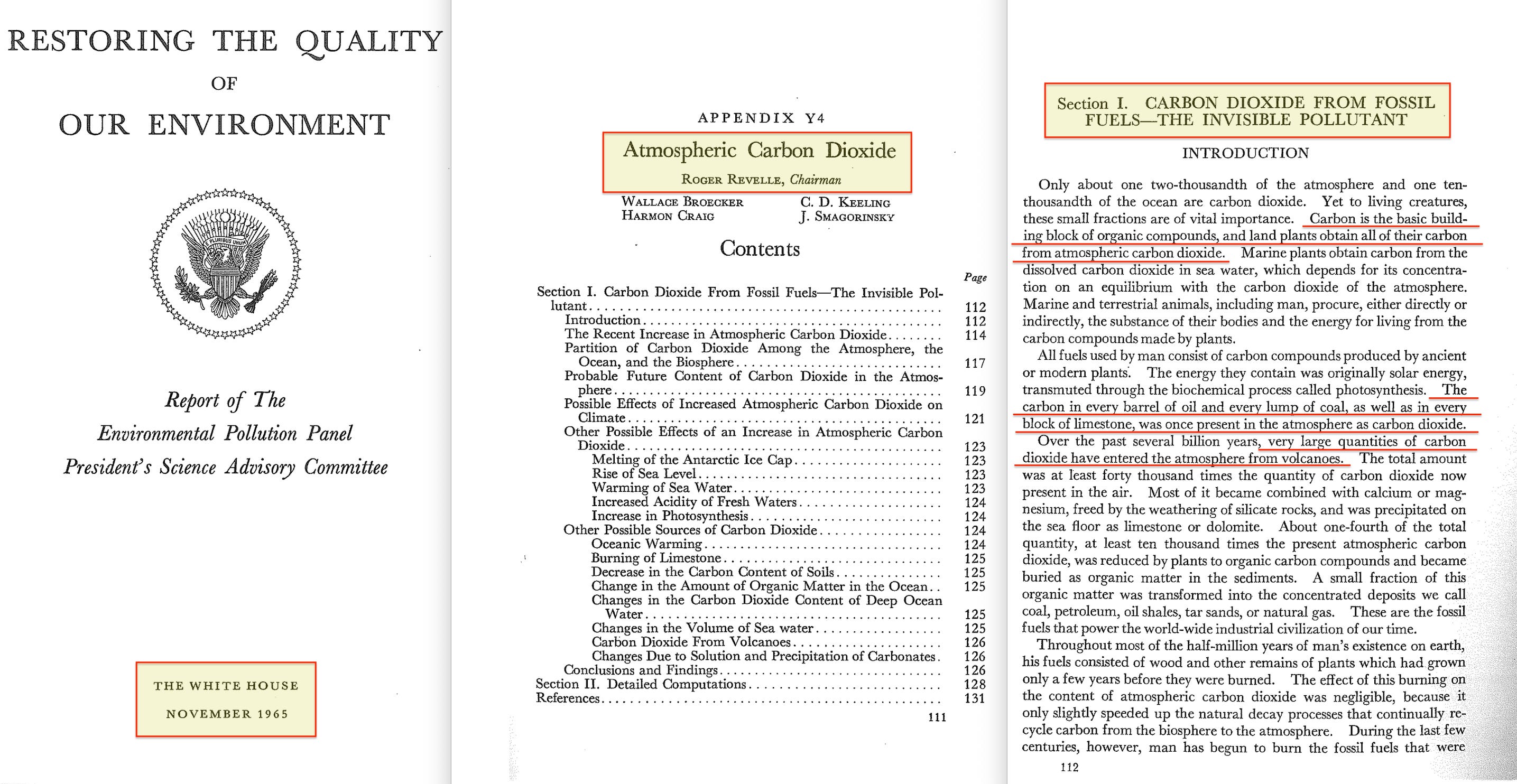
On August 25, the PPBS directive extended the planning and control methodology to all agencies. On November 5, the President’s Science Advisory Committee published the Revelle report38 — ‘Restoring the Quality of Our Environment’ — which identified carbon dioxide as ‘the invisible pollutant’, called for continuous atmospheric monitoring and large-scale computer modelling, and recommended geoengineering countermeasures for a climate problem it acknowledged it could not yet quantify. The report drew directly on science funded by the Rockefeller Foundation and produced at the Rockefeller Institute, and it specified the observation-to-model pipeline that would eventually become the IPCC, IIASA, and the NGFS climate scenarios that today calibrate bank capital requirements.
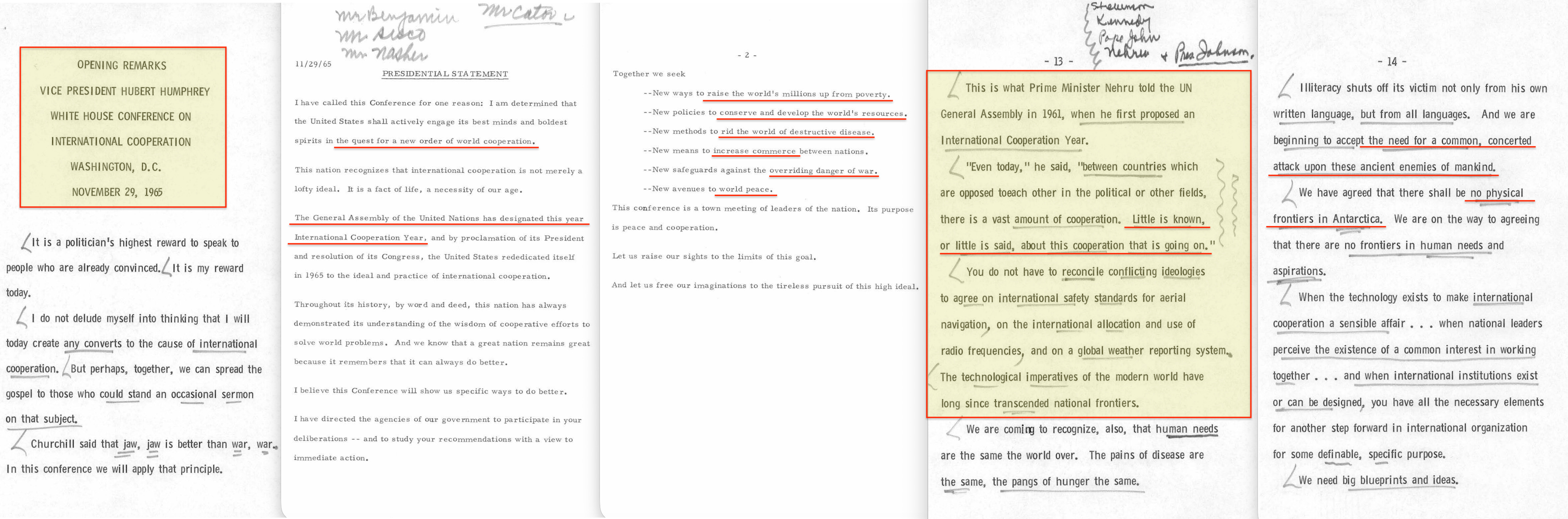
On November 29, Vice President Humphrey opened the White House Conference on International Cooperation — 5,000 participants organised into thirty panels, each producing a report with specific recommendations. The presidential statement called for ‘a new order of world cooperation’ and listed six domains: poverty, resources, disease, commerce, war, and peace. Humphrey’s speech laid out the installation method: engineer interdependence through functional cooperation in non-controversial areas, then extend gradually into more controversial domains — a formula first articulated in Leonard Woolf’s 1916 Fabian Society report International Government, which became the intellectual foundation for the League of Nations, and later refined by Walter Lippmann, who co-founded the Council on Foreign Relations in 1921 and whose concept of ‘public philosophy’ had been explicitly invoked in the World Congress proposal Kennedy destroyed. Humphrey framed the whole programme as a religious mission, calling the audience ‘a congregation of true believers’ and urging them to ‘spread the gospel’.
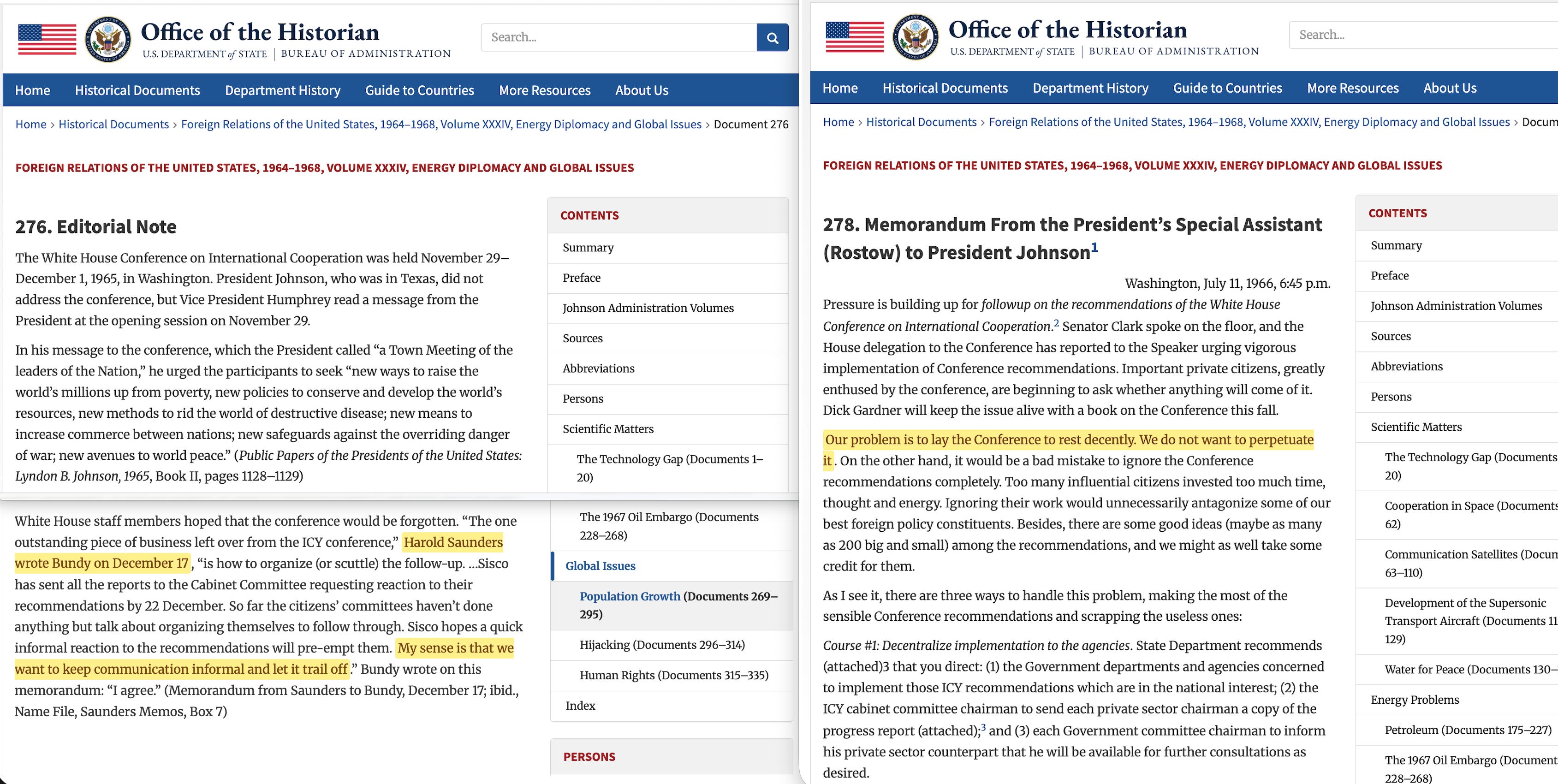
On December 17, McGeorge Bundy received a memo from Harold Saunders proposing how to handle the conference’s follow-up. ‘My sense is that we want to keep communication informal and let it trail off’, Saunders wrote with which Bundy agreed39. A follow-up memo from Walt Rostow to Johnson stated the objective plainly40: ‘Our problem is to lay the Conference to rest decently. We do not want to perpetuate it’.
The specifications were extracted and the recommendations entered the Cabinet Committee. The forum was killed. The public never heard of the conference again — but every recommendation from every panel has since been implemented through the institutional architecture specified at the conference.


The Same Hand
The name that runs through the entire sequence, from first document to last, is McGeorge Bundy.
Bundy drafted the Vietnam policy reversal on November 21, 1963, while the president was heading for Dallas and the cabinet was in Hawaii. He wrote ‘I agree’ on the memo that buried the White House Conference on December 17, 1965. And in 1966, he left government to become president of the Ford Foundation41, where he spent thirteen years funding the institutional infrastructure the conference specified — grants to universities, think tanks, and NGOs across exactly the domains the thirty panels covered. The man who buried the conference spent the following decade paying for its recommendations to be implemented.
He wasn’t the only Ford connection. Robert McNamara had been president of the Ford Motor Company42 — the first person outside the Ford family to hold the position — becoming president on November 9, 1960, one day after Kennedy’s election, and serving only five weeks before Kennedy appointed him Secretary of Defence. At Ford, McNamara had pioneered the systems analysis and statistical control methods he then imported to the Pentagon as PPBS. The methodology that would become the operating system of the entire architecture was developed at Ford, deployed at the Pentagon, extended to all federal agencies under Johnson, and exported internationally through McNamara’s World Bank.
McNamara carried the management methodology from Ford Motor Company through the Pentagon and into the World Bank. Bundy carried the political management from the White House into the Ford Foundation and funded the implementation for thirteen years. The people occupying the two most critical positions in the sequence both connect to the same company and foundation.


What Was Built
What the twenty-five months produced was a comprehensive observation, measurement, classification, and standard-setting infrastructure across every domain of American life — which was then exported internationally through two channels: the World Bank and the Rockefeller network.
Domestically, the Great Society programmes created clearing functions in health (Medicare, Medicaid), education (Elementary and Secondary Education Act43), environment (Water Quality Act, Clean Air Act, Endangered Species Act44), urban development (Department of Housing and Urban Development45), and economic opportunity (Office of Economic Opportunity). Each required statistical measurement, data collection, and reporting against standards set by federal agencies, with PPBS providing the analytical framework that processed the data and converted it into budget decisions.
Internationally, two parallel tracks carried the architecture outward. The first ran through the World Bank. McNamara’s first major act as World Bank president in 1968 was to commission the Pearson Report, asking former Canadian Prime Minister Lester B. Pearson to lead a Commission on International Development. The report, Partners in Development4647, delivered in September 1969, provided the intellectual framework for converting development aid into a conditional clearing function: developing countries would receive capital only if they met conditions set by the institution.
The commission’s membership connected every relevant network. Douglas C. Dillon, Kennedy’s former Treasury Secretary, would become chairman of the Rockefeller Foundation in 197248. Robert Marjolin had served as vice-president of the European Commission49 — the institution whose first president, Hallstein, had specified the same architecture at the Volta Congress in 1932. And Wilfried Guth’s career traced a line through every node of the clearing function’s institutional genealogy.
Guth joined the Bank deutscher Länder in 195350 — which became the Deutsche Bundesbank in 1957 — and rose to Head of its Economics Department before moving to the International Monetary Fund as a German Executive Director, then to the Kreditanstalt für Wiederaufbau (the state development bank that channelled Marshall Plan funds)51, then to the Management Board of Deutsche Bank. The Bundesbank he had served was led by Karl Blessing, Hjalmar Schacht’s protégé from the Reichsbank Directorate52, while Bernhard Benning — who wrote the 1942 Europäische Wirtschaftsgemeinschaft‘s currency chapter — sat on the Bundesbank council from December 195753. Schacht himself had specified the clearing function at the Volta Congress in 1932 and built the bilateral clearing network from 1934. The institutional lineage runs from Schacht through Blessing and Benning to Guth — from the clearing function’s specification through the Bundesbank, the IMF, and Deutsche Bank to the Pearson Commission.
At Nuremberg, the Tribunal executed Alfred Rosenberg, who provided the Nazi ethic, and acquitted Hjalmar Schacht, who developed the mechanism. The mechanism carried on — through Wilhelm Röpke into the Bundesbank, into the European Payments Union, into the ECB, and through Guth, into the World Bank’s conditional lending framework. Meanwhile, McNamara carried the PPBS methodology from the Pentagon through the White House Conference specification and into the World Bank, and the Pearson Report provided the justification for making the Bank’s lending conditional on compliance with standards the borrowing country didn’t write.
The second track ran through the Rockefeller network. The Revelle report drew directly on the 1963 Conservation Foundation conference54 and the atmospheric monitoring pipeline it specified would be developed through institutions the Rockefeller network funded at every stage.

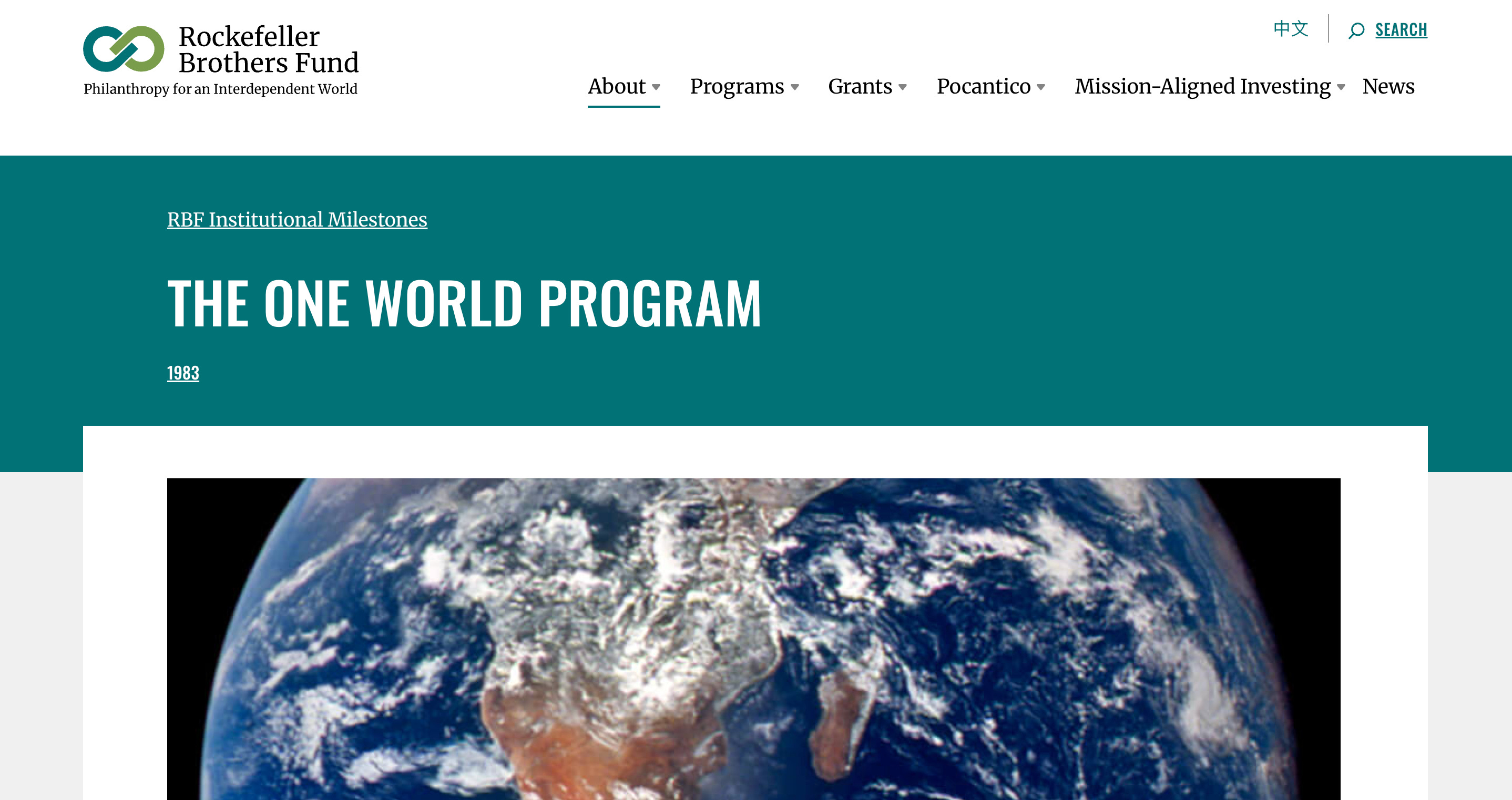
The Bellagio Declaration on Planning55, produced at the Rockefeller Foundation’s estate in Italy in October 1968, declared the necessity of planning in the creation of future society. The Rockefeller Brothers Fund’s ‘One World’ programme in the 1980s56 bridged conservation grantmaking to the sustainable development framework that became the SDGs. The RBF seeded Carbon Tracker in 200957, attaching the stranded assets thesis to specific reserve data. And the Rockefeller Foundation’s Bellagio Center coined ‘impact investing’ in 200758 at the same venue where the planning methodology had been specified four decades earlier.
A few foundations — Ford, Rockefeller, and their descendants — funded the implementation of the programme. Ford funded the institutional infrastructure through Bundy. Rockefeller funded the science, the planning methodology, and the convening architecture. The World Bank, under McNamara, exported the conditional lending model that priced capital in terms of compliance.
By the end of 1968, the domestic infrastructure, the international specification, the scientific pipeline, the planning methodology, the conditional lending framework, and the surveillance architecture all existed. Every subsequent institution documented on this substack — the IPCC (1988), the UNFCCC (1992), the TCFD (2017), the NGFS (2017), the BIS unified ledger (2023) — implements specifications written between November 1963 and December 1965, funded by foundations whose trustees sat on the commissions that wrote them, and collectively launched at the 1968 UNESCO Biosphere Conference in Paris.


The International Operationalisation
The domestic architecture then went global through a channel considered unthinkable under Kennedy: direct convergence between American and Soviet administrative systems, under the banner of environmental cooperation.
On his first day in office in January 1969, Nixon signed the National Environmental Policy Act59, drafted by Lynton K. Caldwell — who simultaneously served on the IUCN’s Landscape Planning Committee60. NEPA created the Council on Environmental Quality61 and led to the Environmental Protection Agency, both stacked with Rockefeller Foundation alumni and Conservation Foundation veterans.
The key figure was Russell E. Train, who led the American side of environmental negotiations with the Soviet Union while simultaneously directing NATO’s Committee on the Challenges of Modern Society62, tasked under a classified 1969 Moynihan Memo63 with designing global environmental surveillance infrastructure. The man building Western surveillance was negotiating Eastern cooperation, and both sides knew it.

On May 23, 1972, Nixon signed the Agreement on Cooperation in Environmental Protection in Moscow64. Henry Kissinger had explicitly instructed Train that there should be ‘no public announcement or discussion’ of the exploratory talks65. The treaty established a Joint Committee to coordinate policy across agencies in both nations — an unelected, binational body operating above sovereign constitutional structures — and committed both superpowers to the joint development of legal and administrative measures, shared monitoring systems, harmonised standards, and coordinated modelling, all under the banner of environmental stewardship.
The agreement rapidly expanded into dozens of subfields — air pollution, water quality, marine pollution, migratory species, urban planning, earthquake prediction, climate modelling, and the biological effects of pollutants — each creating its own working group, its own data exchange, and its own path toward legal harmonisation. The cooperation produced CITES66, contributed to the Bonn Convention on migratory species67, and fed directly into the Convention on Biological Diversity adopted at the 1992 Rio Earth Summit.
What the treaty accomplished was the quiet elimination of the ideological boundary between capitalism and socialism. Environmental cooperation gave two supposedly opposed systems a neutral language through which they could harmonise their legal frameworks, standardise their data, and converge their planning methodologies — without either side appearing to surrender. The Cold War didn’t end in victory for one side. It ended with integration, mediated by environmental science, modelled through IIASA, monitored through GEMS (later GEOSS), and codified by institutions that answered to neither electorate.
Kennedy’s American University speech had called for making the world ‘safe for diversity’ — sovereign nations with different systems, coexisting through bilateral relationships. Nine years later, Nixon’s signature in Moscow made this irrelevant, replaced by technocratic grammar that outlasted the Cold War itself.
Fifteen years later, the strategy was confirmed on camera. In November 1987 — two months after Michael Sweatman proposed the World Conservation Bank at the 4th World Wilderness Congress with David Rockefeller and Edmond de Rothschild in the room — Mikhail Gorbachev addressed Communist Party delegates on the 70th anniversary of the October Revolution and stated the logic openly. The capitalist threat depended on the perception of a Soviet threat, he said, and could only persist as long as people believed national interests were paramount. Perestroika would eliminate that fear, and once the fear was gone, environmentalism would provide the neutral justification for a governance architecture that made the distinction between capitalism and socialism irrelevant. He explicitly invoked Lenin’s New Economic Policy — public-private partnership for the ‘common good,’ with the defining party controlling the definition — and called for ‘a new morality’ in which every person ‘becomes aware of his responsibility for what the whole world is to be’. Within four years, the Soviet Union had collapsed, the Global Environment Facility was established, and the Rio Earth Summit created both the UNFCCC and the CBD simultaneously.
The replacement sequence didn’t end in December 1965. It ended in May 1972, when the domestic architecture installed under Johnson was fused with its Soviet counterpart under Nixon, through environmentalism creating the bilateral convergence platform on which everything was based. Gorbachev’s 1987 speech confirmed that the convergence was the strategy — not a coincidental byproduct.


The Window
The direction Kennedy set — sovereign diversity, personal diplomacy, presidential control over technocratic tools — was reversed entirely, specified across thirty panels, legislated through 226 acts of Congress, internationalised through convergence with the Soviet Union, and deliberately buried the mechanism in the government’s own declassified documents, one small part at a time.
But the documents are now public record, and most were for upwards of sixty years. Nobody connected them, because nobody was looking for a single sequence — just individual documents about individual topics.
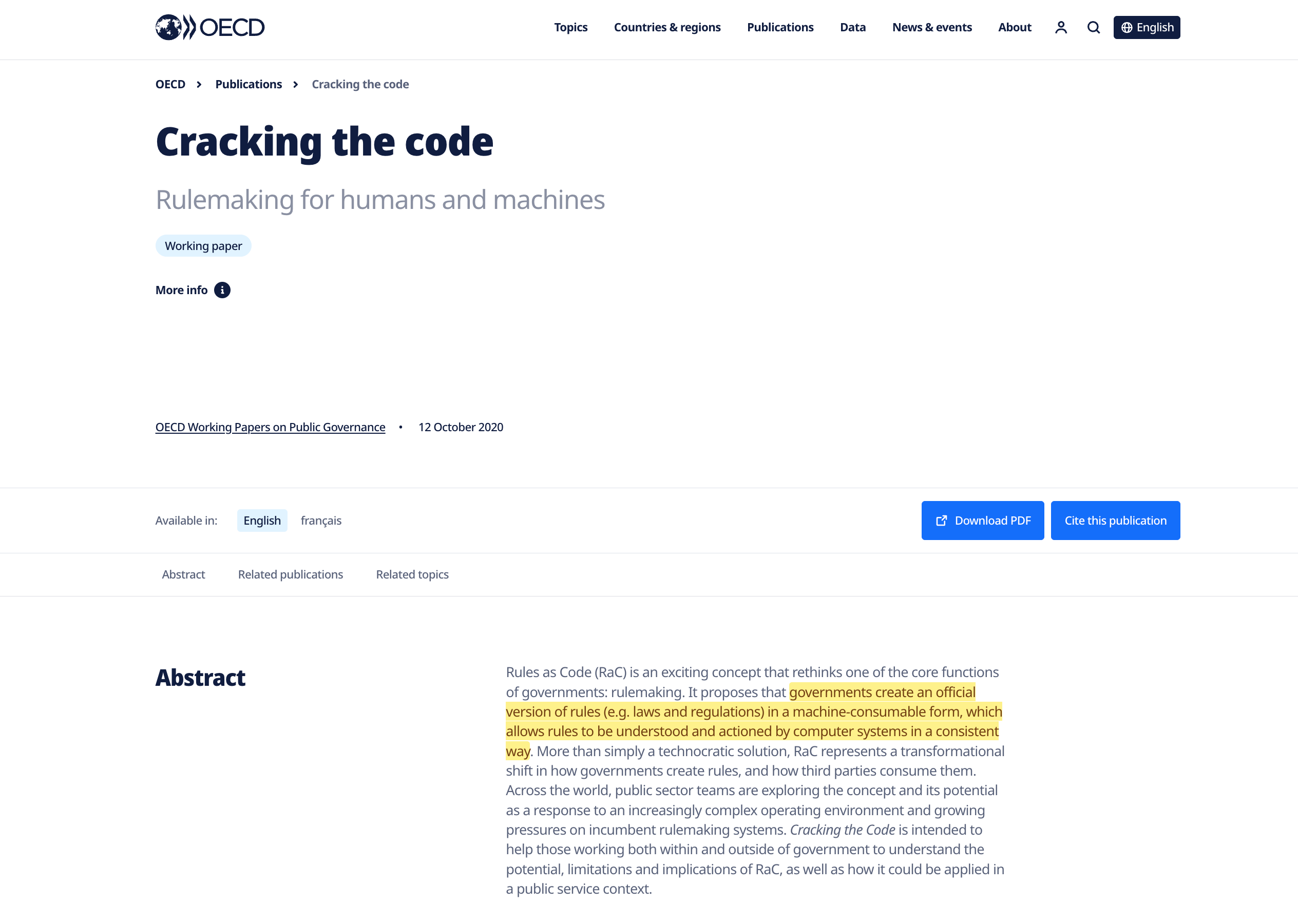
That architecture is now in its final phase of deployment. The BIS unified ledger has reached a working prototype, the EU AI Act takes effect in August 2026, the digital euro pilot is targeted for mid-2027, and the OECD’s Rules as Code68 is being piloted in Jersey, Austria, and Singapore, converting legislation into software that AI can execute. The window between where we are now and full operation is measured in project phases, not decades.
The specifications were written in twenty-five months. The operationalisation took seven years. The construction took another sixty.
The completion is underway.


It is staggering, how we are deceived.
Thank you.
This is brilliant exposure! Thank you esc!!
Amazing how much that I, an erstwhile schmart feller, need to re-learn, re-fathom, re-align, etc. Aargh!
I’m back at school.