
Planning in the USSR

Nobody reads 1960s Soviet planning manuals in 2026.
They should.
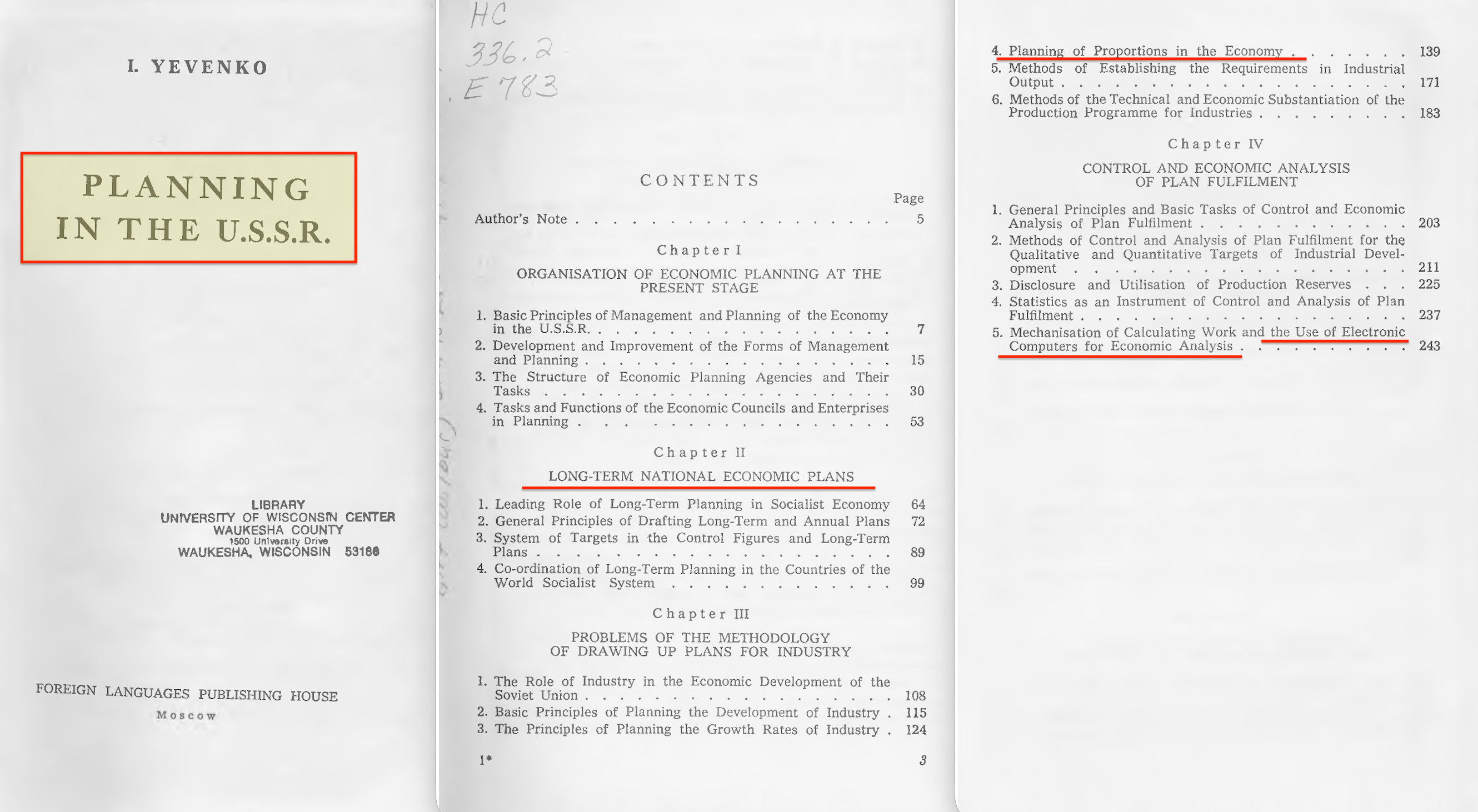
In 1960, the Foreign Languages Publishing House in Moscow released a book by the Soviet economist I. Yevenko titled Planning in the USSR1. It was a technical manual — 252 pages of organisational charts, production tables, and chapter after chapter explaining how the Soviet state managed its economy from the centre.
The copy that survived is classified under HC 336.2 — economic policy, Soviet Union2. It’s the kind of book that sat on academic shelves for decades, consulted occasionally by Cold War specialists, and otherwise forgotten.


The confession
The opening chapter says everything. Not between the lines — on the pages.
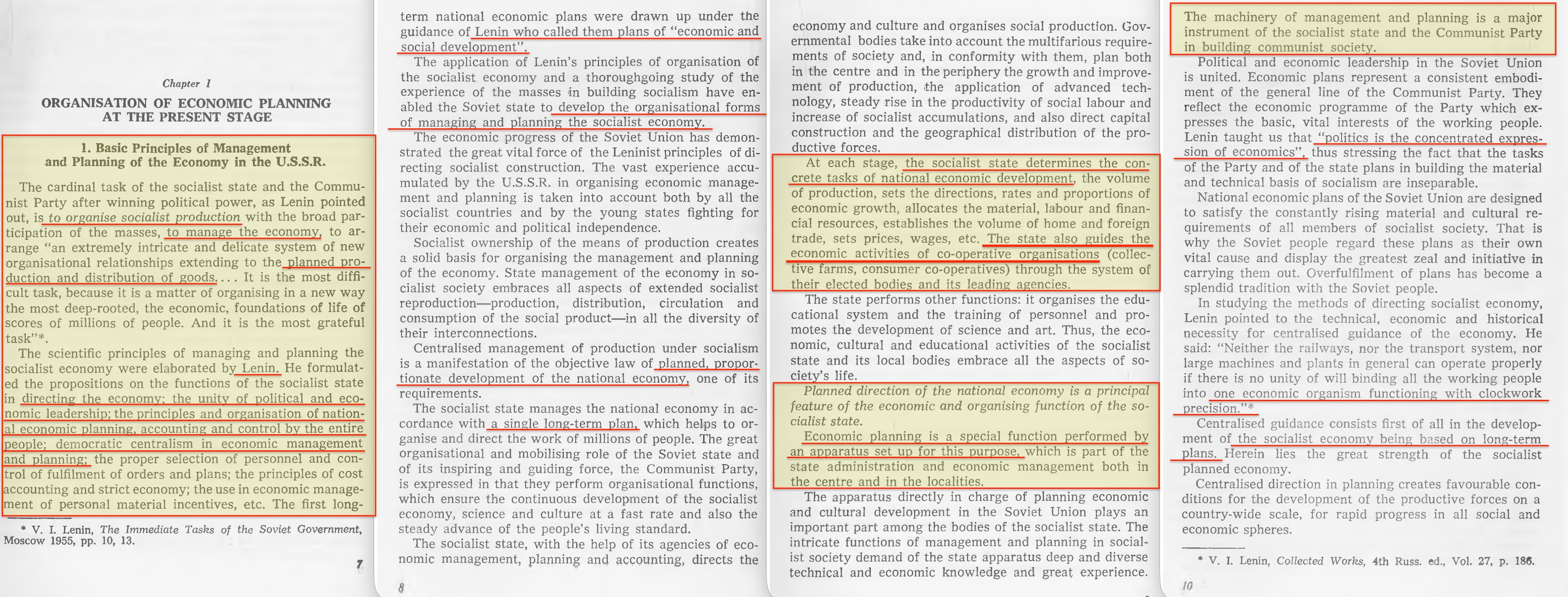
Yevenko begins by restating Lenin’s definition of the cardinal task of the socialist state:
… to organise socialist production with the broad participation of the masses, to manage the economy, to arrange an extremely intricate and delicate system of new organisational relationships extending to the planned production and distribution of goods.
The task is not ideological. It’s organisational. Build the system. Manage the flows. Plan the distribution.
Lenin’s formula for the apparatus required to accomplish this is given plainly: ‘accounting and control by the entire people’. Not revolution. Not class struggle. Accounting and control. Everything else — the dialectics, the ideology, the sacred duty — is the ethic.
The system underneath is bookkeeping and compliance.
What follows is a description of the apparatus built to deliver it. ‘The socialist state manages the national economy in accordance with a single long-term plan’. The plan covers ‘production, distribution, circulation and consumption of the social product — in all the diversity of their interconnections’. At each stage,
… the socialist state determines the concrete tasks of national economic development, the volume of production, sets the directions, rates and proportions of economic growth, allocates the material, labour and financial resources, establishes the volume of home and foreign trade, sets prices, wages, etc.
That’s total management.
Every flow, every price, every allocation, determined centrally.
But the state doesn’t manage alone. It ‘also guides the economic activities of co-operative organisations through the system of their elected bodies and its leading agencies’. Government directs. The co-operative sector — what would now be called ‘civil society’34 — operates through its own governance structures but under state guidance. Two sectors, one plan. Add the private enterprises supervised under the same framework and you have three sectors coordinated through a single planning apparatus.
The trisectoral model in practice didn’t begin with the Trilateral Commission or Reinicke’s Trisectoral Network5 — it began with Lenin.
The planning function itself is performed by ‘an apparatus set up for this purpose, which is part of the state administration and economic management both in the centre and in the localities’. A permanent apparatus. Purpose-built. Embedded across every level of government. Yevenko calls it ‘a major instrument of the socialist state’. The SIIAG calls it the Office for the Impact Economy6.
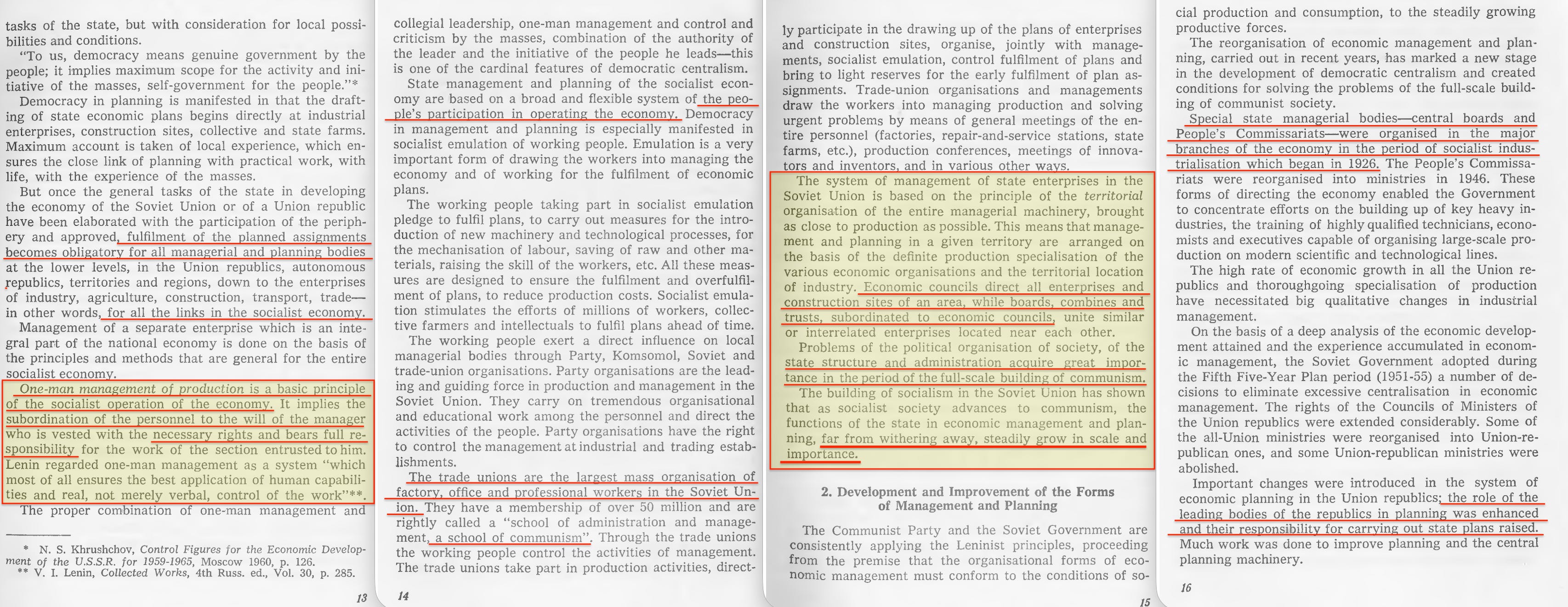
The principle governing individual accountability within this system is ‘one-man management of production’. It ‘implies the subordination of the personnel to the will of the manager who is vested with the necessary rights and bears full responsibility for the work of the section entrusted to him’. Not shared responsibility. Personal liability.
The pension trustee who fails to comply with redefined fiduciary duty faces exactly this: full responsibility, personally borne, for compliance with the plan.
And the system only expands. Yevenko notes that
… the functions of the state in economic management and planning, far from withering away, steadily grow in scale and importance.
The Marxist promise was that the state would wither. The planning apparatus did the opposite. It grew. Every new crisis justified more planning. Every new standard justified more reporting. Every expansion made the next one easier. The ratchet only turns one way.
Lenin called this ‘one economic organism functioning with clockwork precision’. The organism required ‘unity of will binding all the working people’. The will is the plan. The precision is the compliance mechanism. The binding is mandatory.
All of this appears in the first fifteen pages.


Control figures
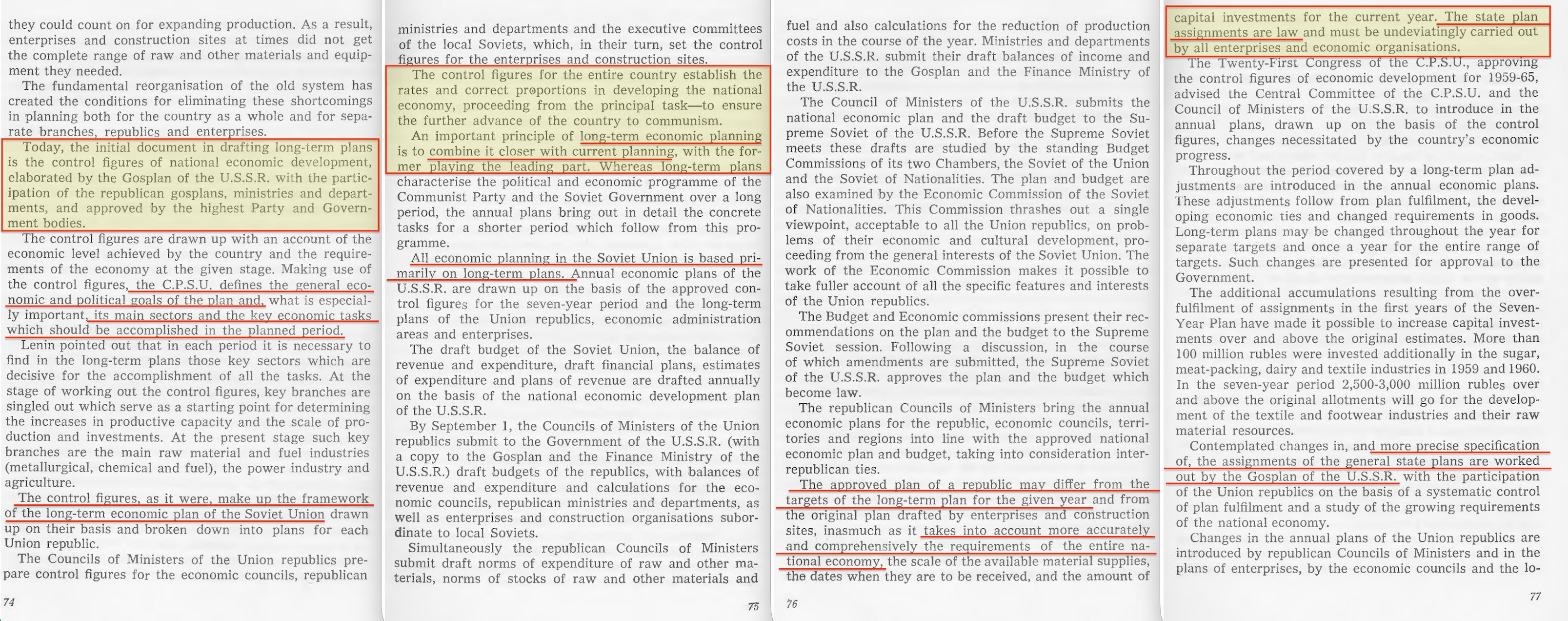
The book follows with a description of how socialist planning works. The state sets long-term targets — five-year plans, seven-year plans, and from 1959 onwards a twenty-year programme for the construction of communism. These targets are expressed as ‘control figures’: numerical indicators approved at the highest level, which then cascade downward through every tier of the system — from the State Planning Committee (Gosplan) to the republican planning commissions, the economic councils, and ultimately to individual enterprises. Each tier clears against the one above — Rothschild and Wolf's clearinghouse, turned vertical7.
The control figures are not aspirational. Yevenko is explicit:
The state plan assignments are law and must be undeviatingly carried out by all enterprises and economic organisations.
Once the indicators are set, compliance is mandatory. The question of whether to follow the plan does not arise. The plan governs.
This is worth pausing on. The mechanism by which the Soviet economy was directed was not, primarily, command in the military sense — an official telephoning a factory manager to order more steel. It was somewhat more systematic. The planning agencies defined a set of indicators89. The indicators triggered obligations1011. The obligations were enforced through monitoring, reporting, and personal accountability for fulfilment. The system ran on targets and quotas, not orders.


The three layers
The architecture Yevenko describes has three functional layers.
The first is cognitive: Gosplan — the State Planning Committee — defined what the system measured. It set the control figures, established the ‘proportions’ between branches of the economy, identified ‘key links’ requiring priority development, and drafted the material balances that tracked inputs and outputs across every sector. Yevenko records that by the late 1950s, the Gosplan maintained approximately 6,000 material balances covering an assortment of 11,000 items. Every significant flow of resources in the economy was tracked, categorised, and assessed against the plan.
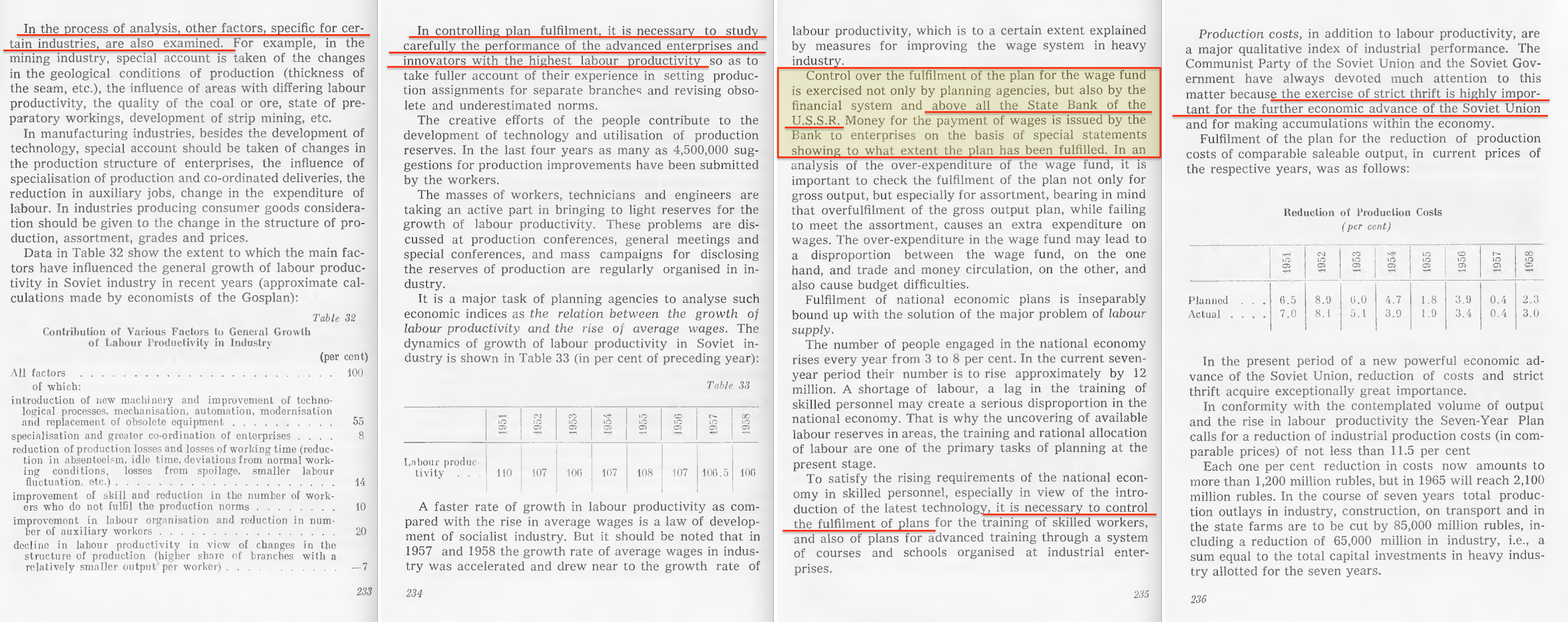
The second layer is evaluative: Gosbank — the State Bank — performed the clearing function. It was not a commercial bank. It was, as Yevenko describes,
Control over the fulfilment of the plan for the wage fund is exercised not only by planning agencies, but also by the financial system and above all the State Bank of the U.S.S.R. Money for the payment of wages is issued by the Bank to enterprises on the basis of special statements showing to what extent the plan has been fulfilled.
Every transaction of any scale settled through Gosbank. What cleared against the plan, proceeded. What didn’t, was blocked. The bank assessed compliance. It did not lend in any market sense. It evaluated.
The third layer is behavioural: Gossnab — the State Committee for Material-Technical Supply — allocated physical resources in accordance with the plan. Capital investments, raw materials, fuel, equipment — all distributed according to the targets Gosplan had set and Gosbank had monitored. The settlement was physical: resources moved where the plan directed.
Ethic, standard, clearing, settlement. The 1936 Soviet Constitution12 supplied the moral authority — socialist duty to the state, declared sacred and inviolable. Gosplan translated the ethic into measurable targets. Gosbank assessed compliance. Gossnab enforced the result. The architecture was complete.
The sequence — ethic, cognitive standard, evaluative clearing, behavioural settlement, outcome — was identified by the economist Julius Wolf in the 1890s, through his suggested scaling of the London Bankers’ Clearing House and his proposals for international monetary coordination13. The Soviets implemented it under state command. They were not the last to do so.


Accounting and control
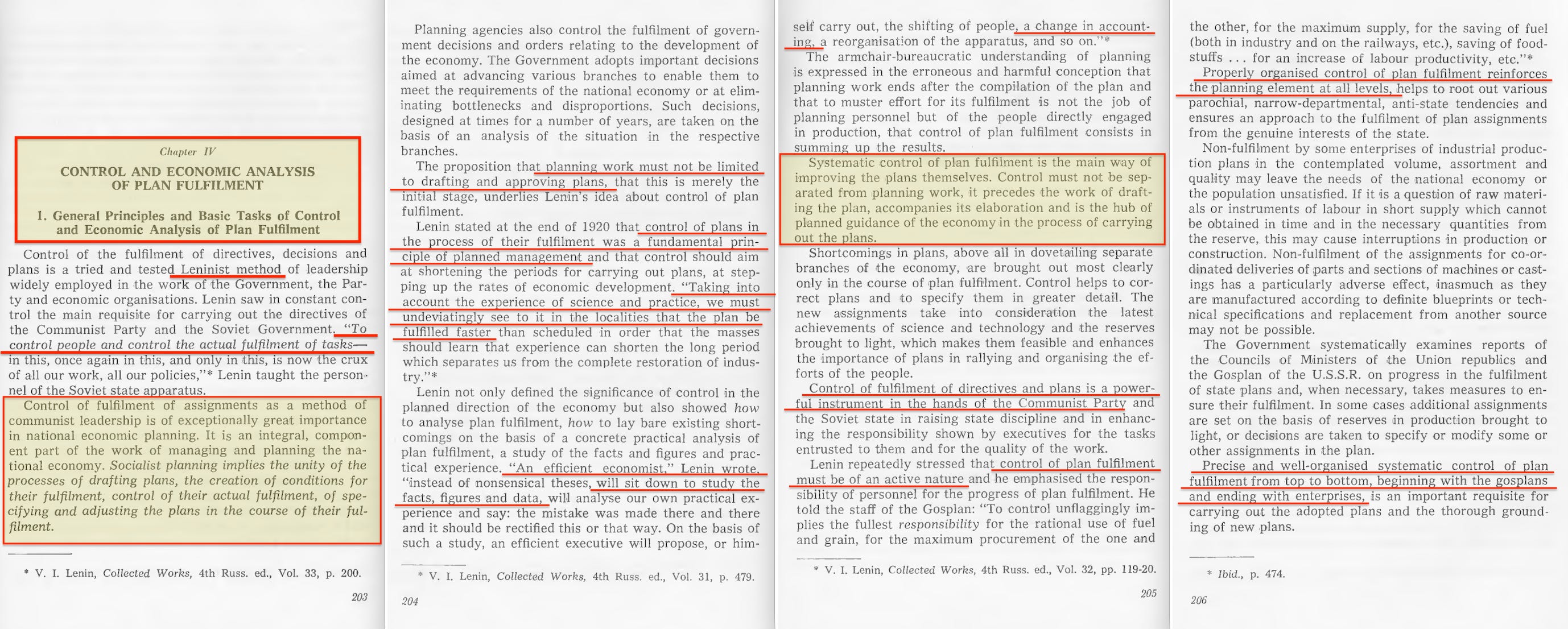
Chapter IV of Yevenko’s manual is titled ‘Control and Economic Analysis of Plan Fulfilment’. It describes a system in which planning agencies do not merely draft plans and wait for results. They monitor fulfilment continuously, identify shortfalls before they become crises, adjust targets in the course of implementation, and hold personnel personally accountable for the quality of their compliance.
Yevenko quotes Lenin:
To control people and control the actual fulfilment of tasks — in this, once again in this, and only in this, is now the crux of all our work, all our policies… Systematic control of plan fulfilment is the main way of improving the plans themselves. Control must not be separated from planning work, it precedes the work of drafting the plan, accompanies its elaboration and is the hub of planned guidance of the economy in the process of carrying out the plans.
This is not retrospective audit. It’s prospective governance. The planning agency identifies projected imbalances — what Yevenko calls ‘disproportionality’ between branches of the economy — and intervenes pre-emptively to correct them. The indicators don’t just measure the past. They anticipate the future. And the anticipation triggers the intervention.
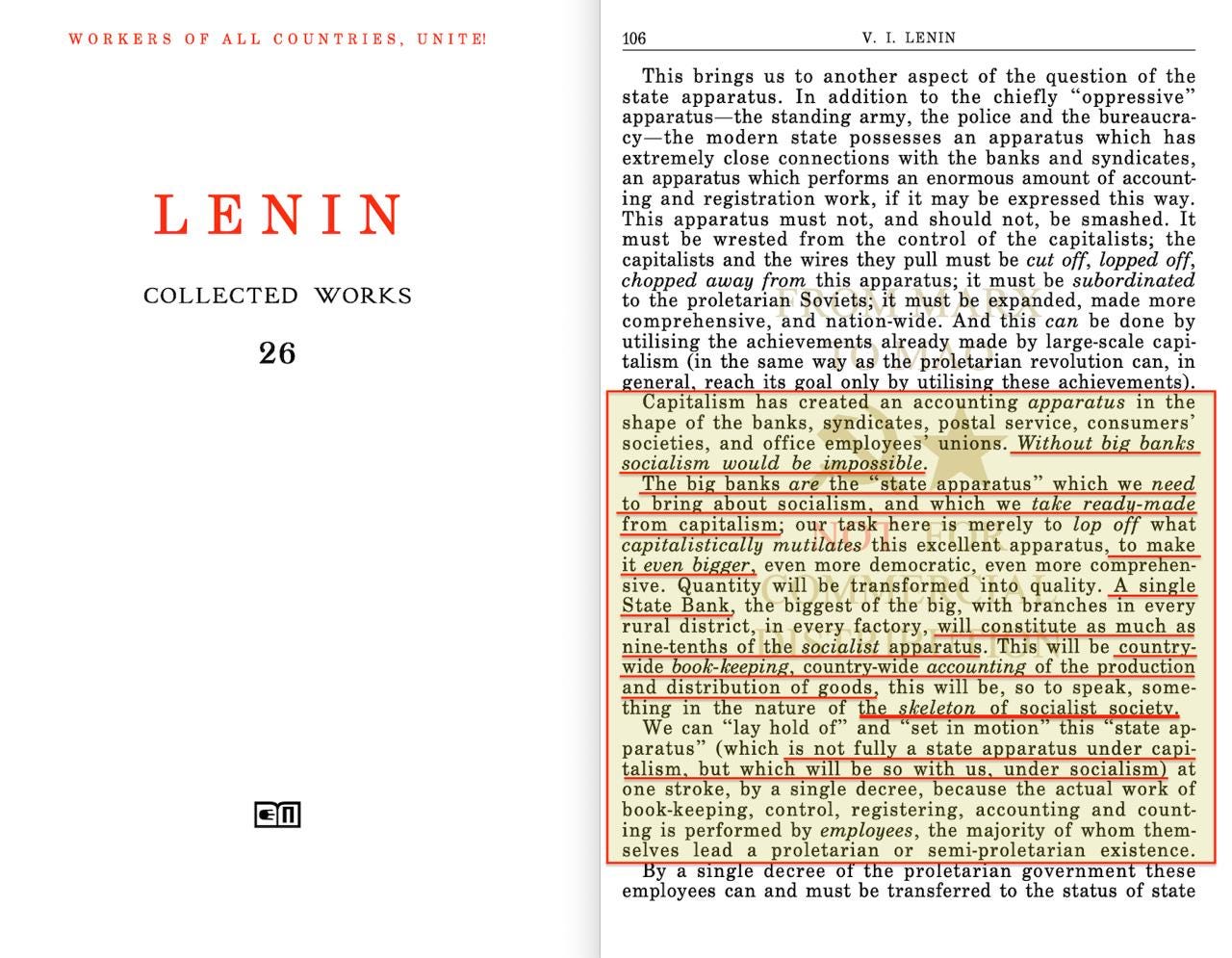
Lenin’s formula for the entire apparatus was characteristically blunt: ‘accounting and control’. Universal, inescapable, and constituting — in his words — the entirety of socialist administration14.


The machine
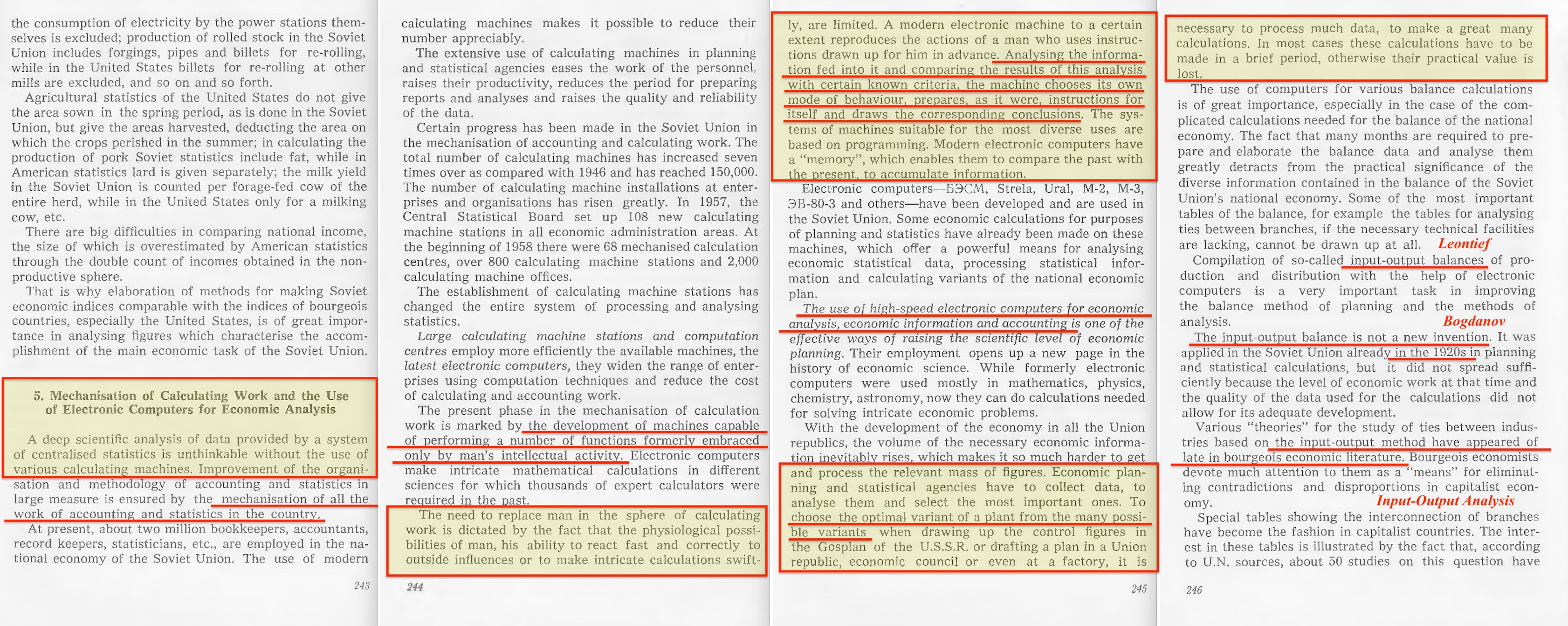
The final section of the manual — ‘Mechanisation of Calculating Work and the Use of Electronic Computers for Economic Analysis’ — is where the document becomes genuinely unsettling.
Yevenko describes the introduction of electronic computers into economic planning. The language is striking:
The present phase in the mechanisation of calculation work is marked by the development of machines capable of performing a number of functions formerly embraced only by man’s intellectual activity… A modern electronic machine to a certain extent reproduces the actions of a man who uses instructions drawn up for him in advance. Analysing the information fed into it and comparing the results of this analysis with certain known criteria, the machine chooses its own mode of behaviour, prepares, as it were, instructions for itself and draws the corresponding conclusions.
A machine that ingests data, compares it against predetermined criteria, and produces compliance assessments. In 1960, the Soviets had the concept but not the hardware. The M-2 computer could perform calculations equivalent to a day’s work of an electric calculating machine in one second15, but the network infrastructure to connect every enterprise to a central processing point did not yet exist.
Yevenko anticipated its arrival:
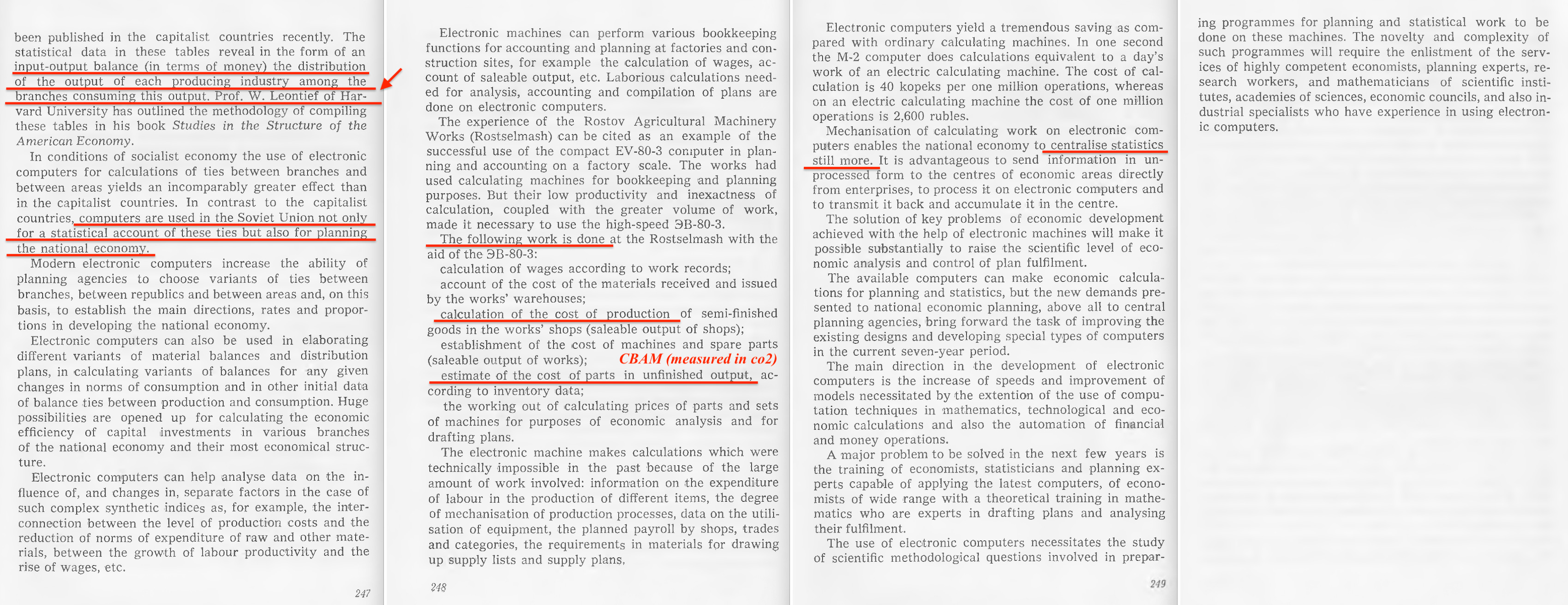
Mechanisation of calculating work on electronic computers enables the national economy to centralise statistics still more. It is advantageous to send information in unprocessed form to the centres of economic areas directly from enterprises, to process it on electronic computers and to transmit it back and accumulate it in the centre.
Raw data from enterprises, transmitted to centralised processing centres, assessed against standardised criteria, results transmitted back as obligations. Federated AI16, and distributed data centres17.
The Soviets described the system. They simply couldn’t build it at scale.

The publisher
Strip away the Marxist-Leninist framing and what Yevenko describes in this final chapter is cybernetics — Norbert Wiener’s science of feedback and control, applied to economic governance18. Data inputs from enterprises, processed against predetermined criteria, feedback transmitted back to adjust behaviour, the system’s ‘memory’ comparing past states to present to optimise future outputs. After initially denouncing cybernetics as bourgeois pseudoscience in the early 1950s19, the Soviets reversed course and embraced it as the theoretical foundation for automated economic management. Viktor Glushkov’s OGAS proposal20 — the All-State Automated System — was an explicit attempt to build the nationwide cybernetic network Yevenko anticipated: every enterprise connected to a central processing point, raw data in, compliance assessment out, resource allocation instructions returned. OGAS was rejected in 1970, partly for political reasons, partly because the infrastructure didn’t exist. But the concept didn’t die. It migrated.
It migrated, in part, through publishing. Robert Maxwell’s Pergamon Press21 — one of the most influential academic publishers of the twentieth century — was simultaneously releasing the Western academic editions of the same intellectual programme. In 1960, the same year Yevenko’s manual appeared in Moscow, Pergamon published Heinz von Foerster’s On Self-Organising Systems22. In 1961, F.H. George’s The Brain as a Computer23. In 1962, von Foerster’s Principles of Self-Organization24. Alongside these, Pergamon published multiple volumes of Applied Systems and Cybernetics25, Leontief’s input-output analysis26 through Club of Rome reports, and Computers & Operations Research27 from its founding in 1974.
Three fields, one publisher: general systems theory modelled every person and institution as a connected node in a network28; input-output analysis tracked everything that flowed between them29; cybernetics treated those flows as feedback loops and steered them towards a target30. Together they constituted adaptive management31: a complete toolkit for managing large organisations — or economies — which later became the foundation of Artificial Intelligence32.
Maxwell was not a neutral conduit. Multiple former Israeli intelligence officers have stated publicly that he worked for Mossad. His biographers described him as Israel’s unofficial ambassador to the Soviet Bloc. He had personal access to Thatcher’s Downing Street, Reagan’s White House, and the Kremlin — all at the same time. His banker on at least one major deal was the same Jacob Rothschild who sponsored the Stranded Asset Forums33. The man bridging East and West at the intelligence level was also the primary commercial publisher of the theoretical framework connecting Soviet central planning to Western cybernetic governance.
The Yevenko manual and the Pergamon catalogue aren’t parallel publications. They’re two editions of the same programme — one describing the architecture from the inside, the other supplying the theoretical basis to anyone who cared to read it.


The convergence
The architecture Yevenko describes did not disappear when the Soviet Union dissolved in 1991. In fact, it didn’t wait that long. It crossed the Cold War divide while both systems were still running.
In 1961 — one year after Yevenko’s manual appeared in Moscow — Robert McNamara installed the Planning, Programming, and Budgeting System across the US Department of Defense34. PPBS tracked every stage of a process through numerical inputs and measurable outputs, creating a feedback loop to evaluate efficiency against objectives. The mapping to Yevenko’s three layers is direct: Planning set the targets (Gosplan), Programming tracked compliance against them (Gosbank), and Budgeting allocated the resources accordingly (Gossnab). The System was American. The architecture was identical.
President Kennedy grew sceptical. During the Cuban Missile Crisis, McNamara’s system recommended precision strikes on Soviet missile installations in Cuba35 — a recommendation based on incomplete data that would likely have triggered massive Soviet retaliation. Kennedy came to understand the limits of systems analysis: its reliance on incomplete data, and its preference for computational modelling over political deliberation. From that point forward, he resisted the broader rollout of systems-based governance across the federal government.
Kennedy was assassinated in November 1963. Under Lyndon Johnson, PPBS was extended to all executive agencies in 196536 — education, health, welfare, environmental policy. The system Kennedy had confined to the Pentagon became the operating framework of the entire federal government within two years of his death. The man who recognised that politics was not reducible to computational modelling was replaced by one who embraced exactly that reduction.
Three implementations of Yevenko’s architecture were now running in parallel: the Soviet original, the American PPBS, and the cybernetic theory Maxwell was publishing through Pergamon for anyone who cared to read it. The Cold War was supposedly a contest between two incompatible systems. At the level of operational architecture, they were converging.


The merger
On 23 May 1972, Richard Nixon signed the Agreement Between the United States of America and the Union of Soviet Socialist Republics on Cooperation in Environmental Protection in Moscow37. At the height of the Cold War — with the Soviet Union still publicly committed to defeating liberal capitalism — the two superpowers agreed to jointly develop and implement policy for the purpose of controlling the impact of human activities on nature. The agreement established a Joint Committee to coordinate, approve, and assign duties across agencies in both nations — an unelected, binational body operating above sovereign constitutional structures.
Five months later, in October 1972, the International Institute for Applied Systems Analysis opened in Laxenburg, Austria38. IIASA was the institutional bridge where East and West formally merged their systems analysis programmes. Soviet and American researchers sat in the same building, running the same models, producing the same scenarios — environmental forecasting, energy modelling, demographic projection. The ideological contest that supposedly defined the era was quietly set aside. What remained was the shared administrative language of systems analysis and cybernetic planning.
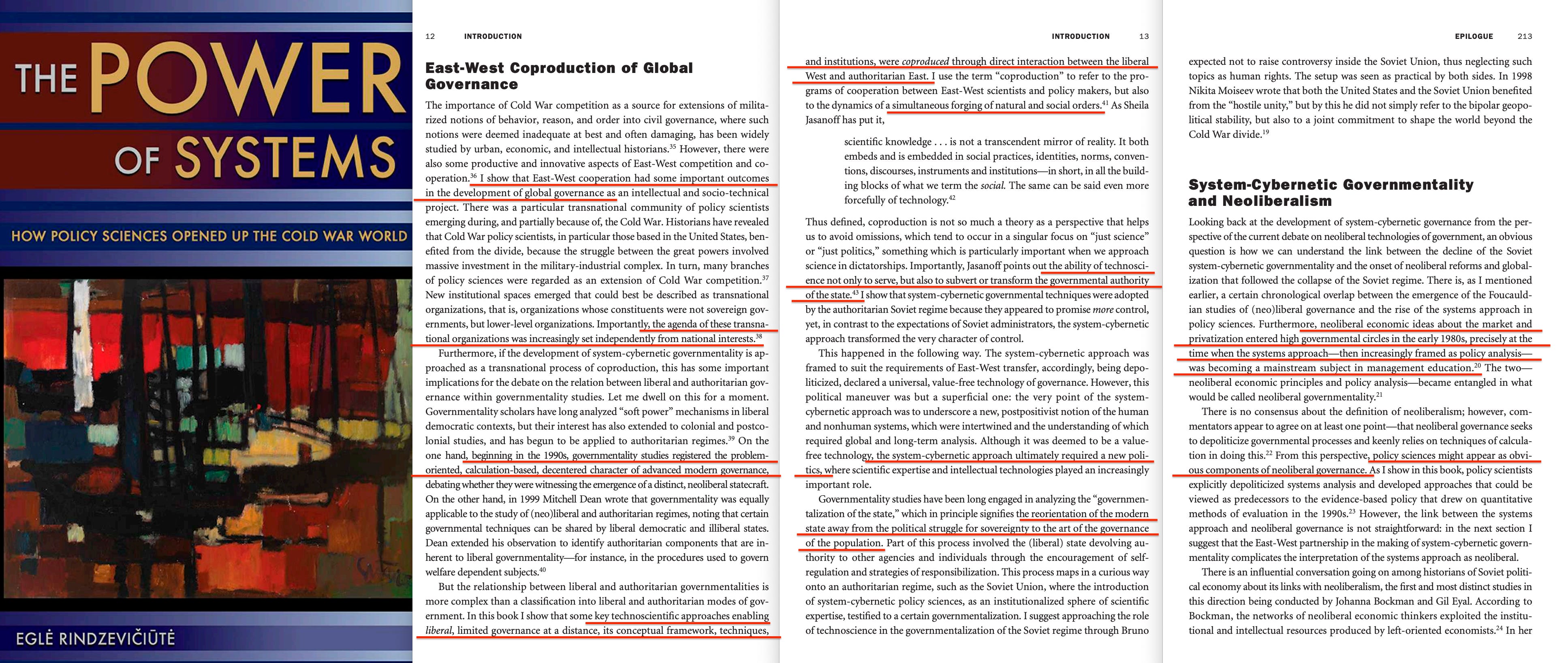
The historian Egle Rindzevičiūtė identified this as the core development of the period: Cold War ideological rivalry was gradually displaced by a shared reliance on systems analysis39, and the distinction between socialism and capitalism was neutralised — replaced by a common technical framework through which governance could be harmonised without ideological confrontation. IIASA was where it happened. The environmental catastrophe narrative — which at that stage had no coherent science behind it — replaced socialist duty as the ethic. It was unchallengeable, sacred, and universal. The architecture continued unchanged underneath, now running on a new justification.
The climate scenarios that today drive TCFD disclosures40, NGFS supervisory expectations41, and Basel Committee capital requirements42 descend directly from IIASA’s modelling tradition43. The institution that merged Soviet and American systems analysis in 1972 produced the forecasting methodology that now governs pension capital allocation in 202644.
The pipeline runs unbroken from Laxenburg to the ISSB.


The political vehicle
In 1970, Zbigniew Brzezinski had published Between Two Ages45, arguing that ecology would serve as the common concern capable of bridging the Cold War divide — a shared threat requiring shared governance, neutralising the ideological contest between capitalism and socialism. In 1973, he co-founded the Trilateral Commission with David Rockefeller46. The Commission brought together senior figures from North America, Western Europe, and Japan — government, business, and civil society — to coordinate policy across borders. The model it operated was the same one that had been moving through the institutional pipeline since the 1890s: public labour, private capital, and a third party defining the common good. Wolf’s 1892 clearing architecture47, with Bernstein’s 1899 addition of an ethical mediator48, now had a transatlantic political vehicle.
The surveillance infrastructure developed in parallel. The International Council of Scientific Unions — ICSU — had been free of state oversight since 1931 and funded by philanthropic foundations49. In 1969, ICSU established the Scientific Committee on Problems of the Environment50 — SCOPE — which developed the conceptual foundations for the UN Environment Programme’s Global Environmental Monitoring System51. By 1974, GEMS had incorporated public health surveillance on the basis that ‘man is part of the environment’. The monitoring grid that Yevenko described Gosplan operating domestically — tracking inputs, outputs, and ‘disproportionality’ across every branch — was being rebuilt at the planetary level through environmental institutions, funded by foundations, and operating beyond democratic accountability.
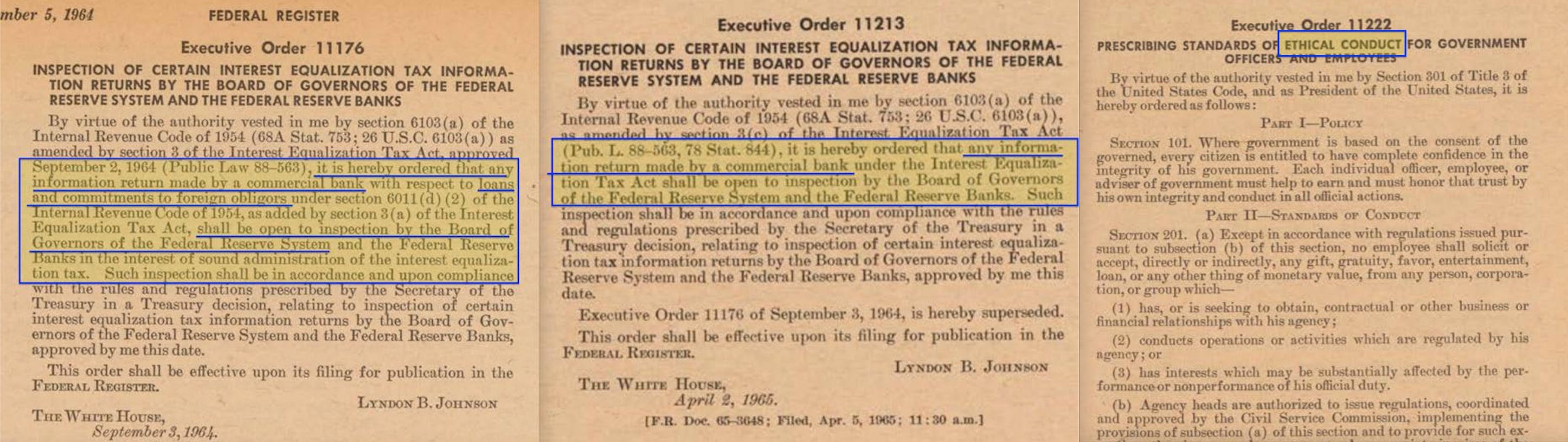
Meanwhile, Johnson’s executive orders had already given the Federal Reserve structural oversight of the financial flows of the nation’s largest banks5253. The Gosbank function — monitoring transactions for compliance with the plan — was being quietly installed in the American financial system. By the mid-1970s, both halves of Yevenko’s architecture were operational in the West: the planning and surveillance functions through IIASA, ICSU, and SCOPE; the financial clearing function through the Federal Reserve’s expanded oversight.
The only piece missing was the ethic54 — and environmentalism, endorsed by Brzezinski, legitimised through IIASA’s models, and institutionalised through the Trilateral Commission’s political network, was already filling that role.


Material balances
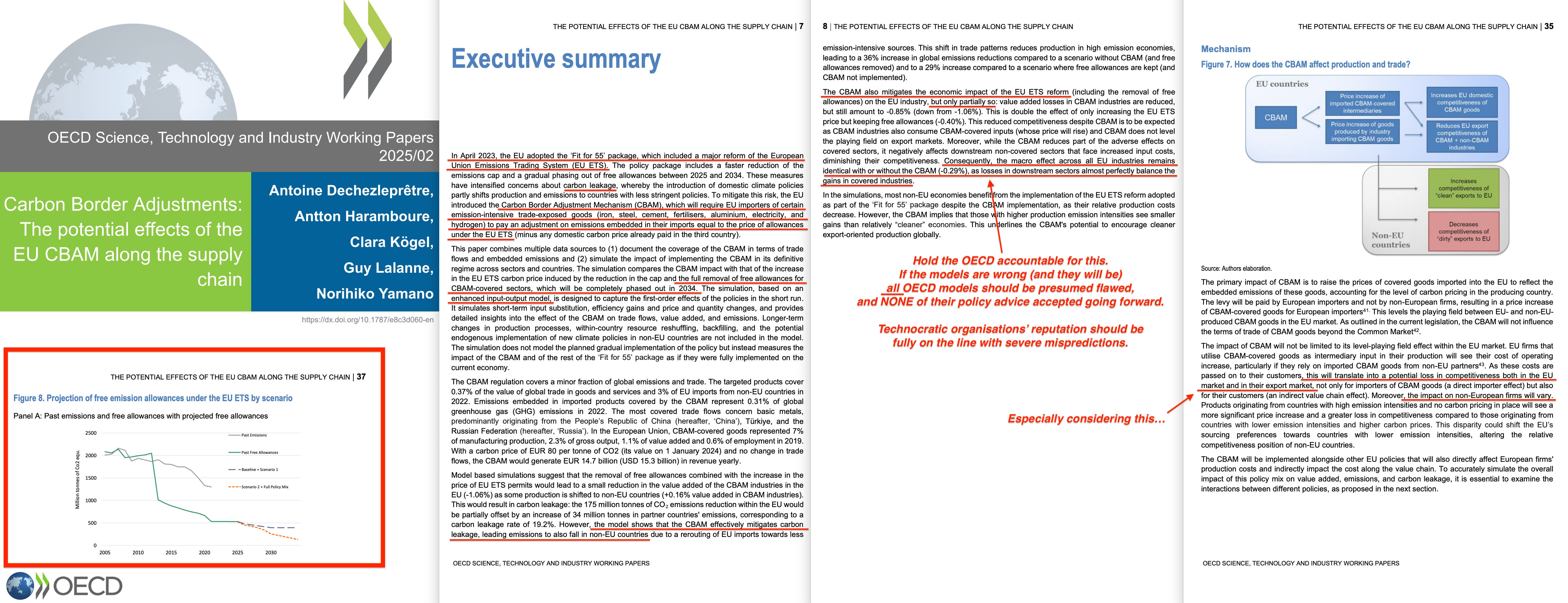
Consider the EU’s Carbon Border Adjustment Mechanism55 — CBAM — which entered its transitional phase in 2023 and becomes fully operational in 2026. Every tonne of steel, cement, aluminium, fertiliser, electricity, and hydrogen entering the European Union must declare its embedded carbon across the entire production chain. The importer must trace emissions back through every stage of production, every supplier, every country of origin, and report them against EU-defined benchmarks using EU-defined methodology.
That’s a material balance. Input-output accounting of a single commodity — carbon dioxide — tracked across every branch of production that feeds into the European market. Gosplan maintained 6,000 material balances covering 11,000 items across one country. CBAM maintains one balance — CO2 — and extends it extraterritorially to every production chain on earth that seeks access to the EU.
The cognitive standard is set in Brussels. The evaluative clearing happens at the border. The behavioural settlement is the levy — or, for non-compliant producers, exclusion from the market altogether.
Yevenko would recognise the mechanism immediately. The unit of account has changed from rubles to tonnes of CO2. The jurisdiction has changed from the Soviet Union to the European single market. The enforcement mechanism has changed from state command to trade conditionality.
But the architecture — standard, clearing, settlement — is identical.

Harmonised reporting
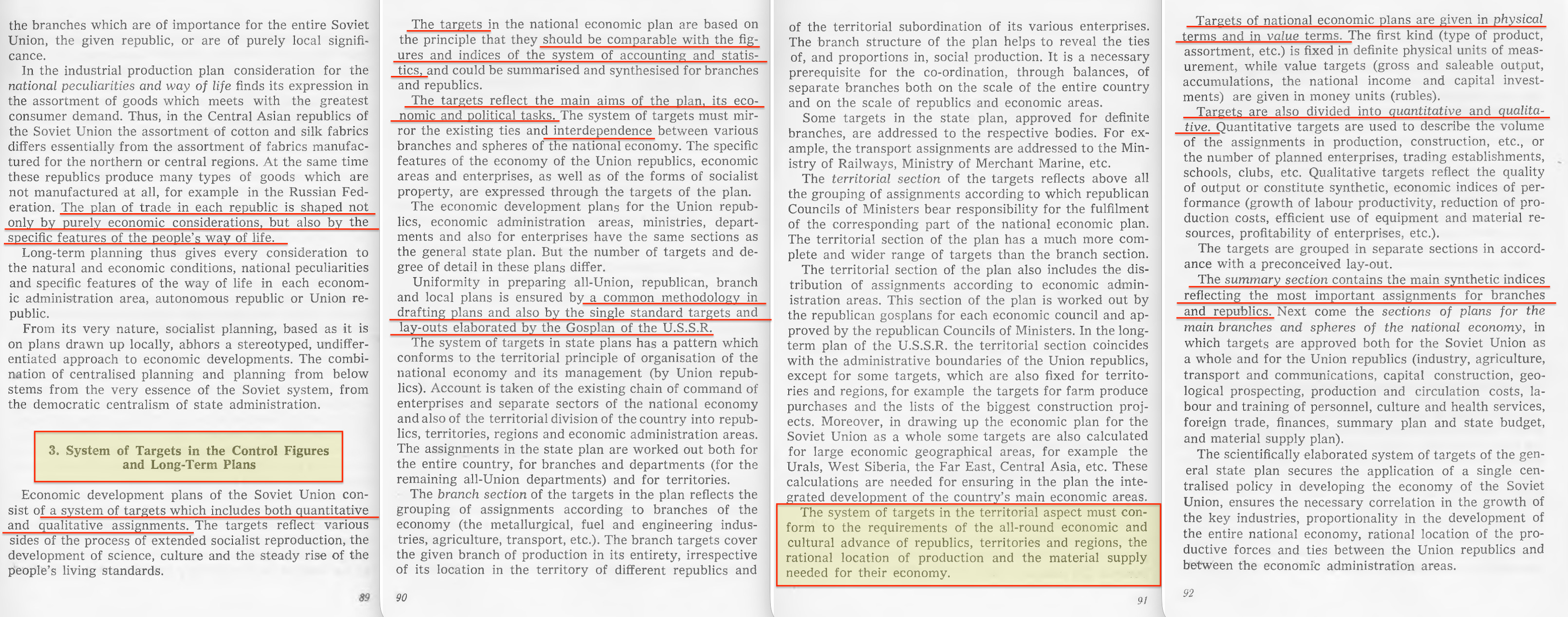
Now consider the International Sustainability Standards Board, established in 2021 under the IFRS Foundation56. The ISSB publishes harmonised reporting standards — IFRS S157 and S258 — that require companies worldwide to disclose climate-related risks and opportunities using standardised metrics, standardised categories, and standardised methodology.
Yevenko describes the Soviet equivalent:
Uniformity in preparing all-Union, republican, branch and local plans is ensured by a common methodology in drafting plans and also by the single standard targets and lay-outs elaborated by the Gosplan of the USSR… The summary section contains the main synthetic indices reflecting the most important assignments for branches and republics…
Replace ‘all-Union, republican, branch and local plans’ with ‘corporate, national, sectoral and project-level disclosures’. Replace ‘the Gosplan of the USSR’ with ‘the ISSB’. The sentence requires no other modification.
The ISSB’s reporting framework feeds directly into the Network for Greening the Financial System59 — the NGFS — which translates climate scenarios into supervisory expectations for central banks. Those expectations feed into Basel Committee capital requirements60. The data flows upward from enterprises, is processed centrally against standardised criteria, and returns as regulatory obligations that determine how capital is allocated.
Yevenko’s vision of electronic computers centralising statistics — ‘send information in unprocessed form to the centres... process it on electronic computers and transmit it back and accumulate it in the centre’ — is a description of ESG reporting infrastructure61. The Soviets needed 150,000 calculating machines and 2,000 calculating machine offices to attempt what the ISSB now accomplishes through mandatory digital disclosure.

Key links
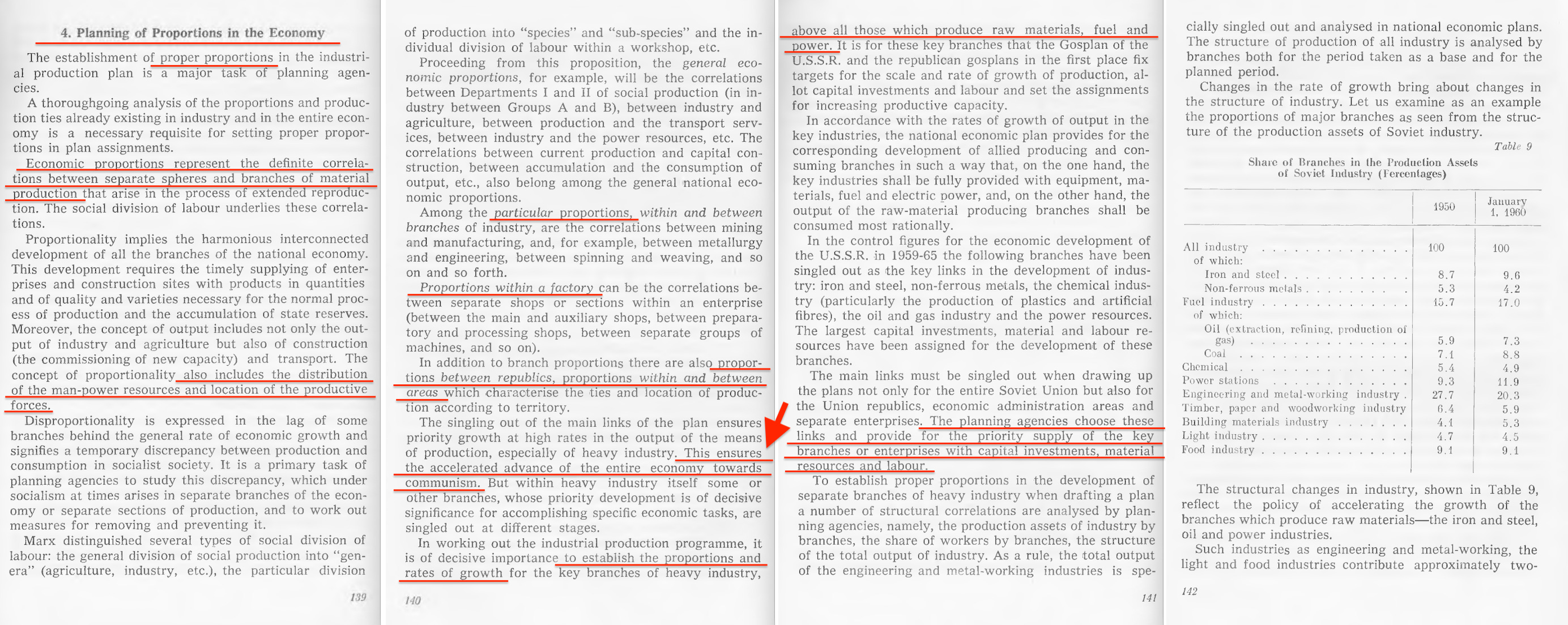
The manual also describes how Gosplan identified ‘key links’ in the economy — sectors whose priority development was considered decisive for accomplishing the plan’s objectives. At different stages, different branches were singled out. In the late 1950s, it was metallurgy, chemicals, fuel, and power. Capital investments, material resources, and labour were directed towards these branches first, and the rest of the economy was planned around them.
The contemporary equivalent is the taxonomy — the classification system that determines which economic activities qualify as ‘sustainable’ and which do not. The EU Taxonomy Regulation62, adopted in 2020, defines precisely which activities are aligned with environmental objectives and which are not. Capital that flows towards taxonomy-aligned activities receives regulatory favour — and a new name: 'impact investing’. Capital that flows towards non-aligned activities faces increasing friction — disclosure requirements, higher capital charges, fiduciary risk. When the cost of capital rises above the cost of production, the asset becomes ‘stranded’.
Yevenko’s description of how the Soviet system singled out key links could serve as a functional specification for taxonomy-driven capital allocation:
The planning agencies choose these links and provide for the priority supply of the key branches or enterprises with capital investments, material resources and labour.
The mechanism is the same. The vocabulary has changed. The planning agency has been replaced by a classification regulation. But the function — directing capital towards politically designated priorities and away from everything else — is identical.


The hardware
What makes Yevenko’s manual significant is not that it describes a failed system. It’s that it describes an architecture which operated across eleven time zones for seven decades and whose functional logic has since been reinstalled, piece by piece, in the institutional infrastructure of the contemporary West.
The cognitive layer — defining what the system measures — has migrated from Gosplan to the ISSB, the TCFD, and the EU Taxonomy. The evaluative layer — assessing compliance against the standard — has migrated from Gosbank to the NGFS, the Basel Committee, and the fiduciary duty frameworks now being written into pension law. The behavioural layer — enforcing the result through resource allocation — has migrated from Gossnab to CBAM, procurement playbooks, development finance, Central Bank Digital Currencies, and blended finance vehicles where public money absorbs the downside while private capital takes the senior returns.
The Soviet system failed in part because the computer hardware couldn’t support it. Central planning of an economy spanning eleven time zones required data processing capacity that 1960s computing could not deliver. The material balances were too slow, the feedback loops too long, the corrections too late. By the time Gosplan identified a disproportion, the damage was already done.
That constraint no longer applies. The computing infrastructure now exists to track every transaction, assess every disclosure, and enforce every standard in something approaching real time. The ISSB can harmonise reporting across dozens of countries simultaneously63. CBAM can trace embedded carbon through global supply chains64. The NGFS can run climate scenarios that project decades into the future and translate the results into Basel 3.1 capital requirements today65.
The Soviets had the system but not the computer hardware. The contemporary system has both.

Anticipatory governance
There’s a passage near the end of Yevenko’s manual that deserves particular attention. Describing the input-output method of balance calculation, he writes:
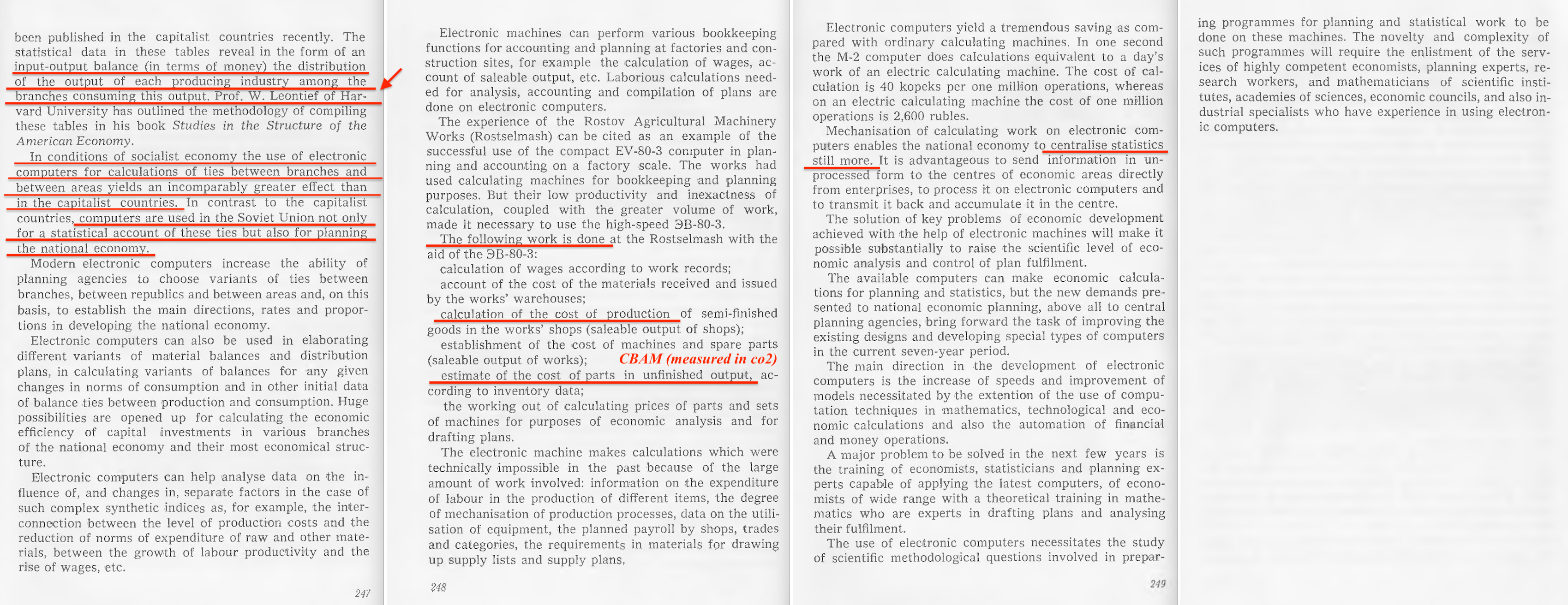
In conditions of socialist economy the use of electronic computers for calculations of ties between branches and between areas yields an incomparably greater effect than in the capitalist countries. In contrast to the capitalist countries, computers are used in the Soviet Union not only for a statistical account of these ties but also for planning the national economy.
The distinction Yevenko draws — between using data for statistical description and using it for planning — is precisely the distinction that has collapsed in the decades since. ESG reporting began as disclosure: a statistical account of environmental and social ties. It has become planning. The NGFS climate scenarios are not descriptions of what has happened. They’re projections of what will happen — modelled futures that trigger present-day obligations. A pension trustee allocating capital against a thirty-year climate scenario is not describing the economy. They’re planning it.
Yevenko called this the ‘leading role of long-term planning in socialist economy’. The contemporary version calls it anticipatory governance66676869707172. The function is the same: governing on the basis of projected futures, using indicators derived from models, enforced through compliance obligations that allow no room for disagreement with the projection itself.
Lenin reduced it to two words — accounting and control73 — and declared them sufficient for nine-tenths of the socialist apparatus. The accounting is now called ESG disclosure. The control is now called fiduciary duty.
The planning sets the targets. The accounting tracks compliance. The control enforces it. The anticipation is a claim to be able to plan for a predicted future.
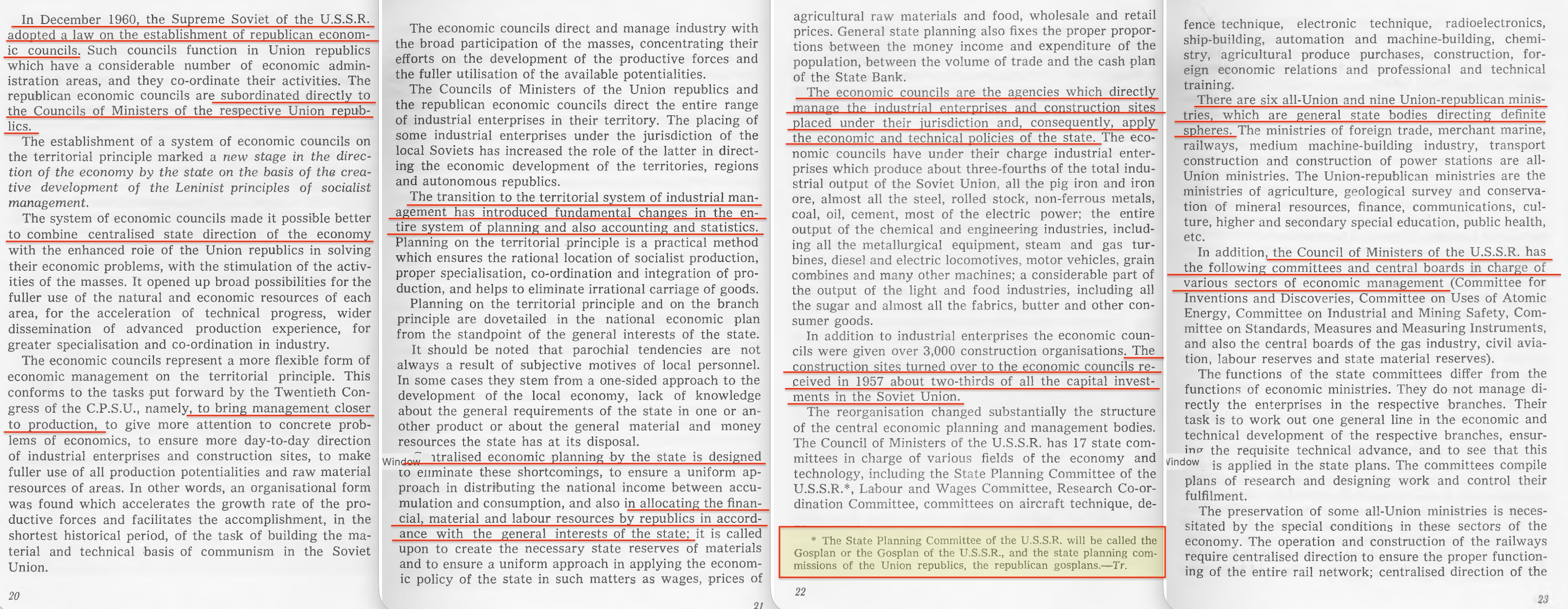
There’s one more detail worth noting. On page 23, Yevenko lists the committees and central boards operating under the Council of Ministers: the Committee on Standards, Measures and Measuring Instruments; the Committee on Uses of Atomic Energy; the Committee on Industrial and Mining Safety; the Committee for Inventions and Discoveries. Each one is described as a ‘general state body directing a definite sphere’. They don’t manage enterprises directly. Their task is ‘to work out one general line in the economic and technical development of the respective branches, ensuring the requisite technical advance, and to see that this is applied in the state plans’. They compile plans, conduct research, design standards, and control their fulfilment.
That’s not a government. It’s a standards regime with enforcement powers. Replace the Committee on Standards with the ISSB, the Committee on Industrial and Mining Safety with the EU Taxonomy, the Committee on Uses of Atomic Energy with the IAEA, and the general line each one works out with the harmonised disclosure frameworks now cascading through Basel, the NGFS, and national pension law. The Soviet committee structure and the contemporary regulatory architecture are the same organisational form — unelected technical bodies, each directing a definite sphere, each compiling standards and controlling their fulfilment, each embedded in a planning apparatus that calls itself something else.
The ethic is interchangeable. The system is not. What it produces is governance without politics — the arguments about what to prioritise buried inside technical committees and scenario models before they ever reach a parliament.
But the Soviets at least were honest enough to publish the manual.


Find my Telegram channel over here.
Postscript: chronology
1890s — Julius Wolf identifies the sequence — ethic, cognitive standard, evaluative clearing, behavioural settlement, outcome — through his analysis of the London Bankers’ Clearing House and proposals for international monetary coordination74.
1913–1922 — Alexander Bogdanov publishes Tektology75, proposing that all systems — biological, social, economic — can be modelled and managed through universal organisational principles.
1920s — Input-output balance methods are first applied in Soviet planning and statistical calculations.
1925 — Wassily Leontief begins developing input-output analysis, later formalised at Harvard. The methodology tracks every flow between branches of an economy as a matrix of inputs and outputs76.
1931 — Political and Economic Planning77 (PEP) is founded in Britain, connected to the Fabian Society. Its pamphlet Freedom and Planning78 argues that the world has grown too complex for anything but centralised management, justified by moral and spiritual crisis. Its members include Max Nicholson, who later co-founds the WWF79, alongside Julian Huxley, who co-founds the IUCN80.
1936 — The Soviet Constitution is adopted81, supplying the sacred ethic — socialist duty to the state — against which the planning architecture operates.
1948 — Norbert Wiener publishes Cybernetics: Or Control and Communication in the Animal and the Machine82, establishing the theoretical framework for feedback-based governance of complex systems.
Late 1950s — Gosplan maintains approximately 6,000 material balances covering 11,000 items. The Soviet Union operates 68 mechanised calculation centres, over 800 calculating machine stations, and 2,000 calculating machine offices83.
1960 — I. Yevenko publishes Planning in the U.S.S.R. through the Foreign Languages Publishing House, Moscow84. The same year, Robert Maxwell’s Pergamon Press publishes Heinz von Foerster’s On Self-Organising Systems85.
1961 — Pergamon publishes F.H. George’s The Brain as a Computer86. Robert McNamara installs the Planning, Programming, and Budgeting System across the US Department of Defense87. Planning sets the targets (Gosplan), Programming tracks compliance (Gosbank), Budgeting allocates resources (Gossnab).
1962 — Pergamon publishes von Foerster’s Principles of Self-Organization88. During the Cuban Missile Crisis, McNamara’s PPBS recommends precision strikes on Soviet missile installations based on incomplete data. Kennedy grows sceptical of systems analysis as a basis for governance89.
November 1963 — Kennedy is assassinated90.
1965 — Under Lyndon Johnson, PPBS is extended to all executive agencies — education, health, welfare, environmental policy. The system Kennedy had confined to the Pentagon becomes the operating framework of the entire federal government91.
1965 — Johnson's executive orders also grant the Federal Reserve unprecedented structural oversight of the financial flows of the nation's largest banks — the Gosbank function, installed in the American financial system9293.
1968 — The UNESCO Biosphere Conference publishes its twenty recommendations — global data standards, regional data centres, planetary surveillance of pollutants, policy determined by the state of natural resources, and collaboration between states, UN agencies, and NGOs. The specification document for everything that follows94.
1969 — ICSU establishes the Scientific Committee on Problems of the Environment — SCOPE — which develops the conceptual foundations for global environmental monitoring95.
1970 — Viktor Glushkov’s OGAS proposal — a nationwide cybernetic network connecting every Soviet enterprise to a central processing point — is rejected. The concept migrates westward96.
1970 — Zbigniew Brzezinski publishes Between Two Ages, arguing that ecology will serve as the common concern bridging the Cold War divide97.
1972 — James Lovelock publishes the first Gaia hypothesis paper — the Earth as a self-regulating cybernetic system, providing the theoretical justification for planetary-scale management98.
23 May 1972 — Nixon signs the Agreement Between the United States of America and the Union of Soviet Socialist Republics on Cooperation in Environmental Protection in Moscow99. The two superpowers agree to jointly develop and implement environmental policy through an unelected binational Joint Committee. The Soviet Union — responsible for the destruction of the Aral Sea and some of the worst industrial pollution in history — had no credible interest in environmental protection. The treaty was not about the environment.
October 1972 — The International Institute for Applied Systems Analysis opens in Laxenburg, Austria. Soviet and American researchers merge their systems analysis programmes under the cover of environmental modelling100.
1973 — The Trilateral Commission is founded by Brzezinski and David Rockefeller101 — the political vehicle for the same convergence that IIASA provides technically. Public, private, and civil society coordinated across borders. Wolf’s 1892 architecture with Bernstein’s 1899 ethical mediator, given a transatlantic platform.
1974 — Pergamon founds Computers & Operations Research102, extending the cybernetic toolkit into management science.
1974 — UNEP's Global Environmental Monitoring System incorporates public health surveillance on the basis that 'man is part of the environment’103.
1975 — The Belgrade Charter calls for the integration of a global ethic and environmental education into school curricula worldwide104.
1979 — The World Climate Conference in Geneva, organised by foundation-funded ICSU, establishes the carbon consensus105 — the specific cognitive standard the architecture requires. Dissenting scientists are not invited. The planning precedes the science.
1984–1993 — Evelyn de Rothschild co-patronises the Interfaith Declaration on International Business Ethics, producing the moral vocabulary later embedded in corporate governance codes106.
1987 — Mikhail Gorbachev signals the shift from Cold War antagonism to environmentalism as the unifying global cause107 — confirming Brzezinski’s 1970 thesis. The distinction between socialism and capitalism is neutralised. The shared administrative language of systems analysis replaces ideological confrontation.
1988 — The Intergovernmental Panel on Climate Change is established by UNEP and the World Meteorological Organization108 — the institutional successor to ICSU’s 1979 carbon consensus. IIASA’s modelling tradition is formalised into the body that will produce the climate scenarios driving TCFD, NGFS, and Basel capital requirements.
1991 — The Global Environment Facility is established as a pilot inside the World Bank109 — the Gossnab of the environmental governance architecture, allocating capital through UNEP and UNDP to projects that meet criteria set by the conventions. Restructured as a permanent mechanism in 1994.
1992 — The Earth Summit in Rio110 produces Agenda 21111 — an explicit blueprint for public-private governance mediated through NGOs, operationalised via environmental monitoring, and legitimised through scientific modelling. The trisectoral model goes global.
1994 — The Caux Round Table publishes its Principles for Business — the first international code of business ethics, introducing stakeholder capitalism as a formal framework112.
2000 — The UN Global Compact launches113, moving stakeholder vocabulary into an intergovernmental framework. Reinicke and Deng publish Critical Choices114, formalising the trisectoral network — government, business, and NGOs as co-equal partners in global policy.
2000 — The Earth Charter is launched by Gorbachev, Maurice Strong, and Steven Rockefeller115 — the explicit attempt to produce a sacred ethic for planetary governance. Global governance through global ethics. The 1936 Soviet Constitution had socialist duty. The Earth Charter has ecological duty. The function is identical.
2006 — The UN launches the Principles for Responsible Investment116. ESG becomes a measurable set of criteria for capital allocation.
2009 — Climategate. Leaked emails from the University of East Anglia’s Climatic Research Unit expose data manipulation and suppression of dissent within the institutions producing the cognitive standard. The architecture continues unchanged.
2015 — Mark Carney delivers the ‘Tragedy of the Horizon’ speech at Lloyd’s of London, turning the stranded assets vocabulary into central bank doctrine117.
2015 — The United Nations adopts the Sustainable Development Goals — seventeen targets supplying the new sacred ethic against which compliance is measured118.
2017 — The Task Force on Climate-related Financial Disclosures publishes its recommendations119. The Network for Greening the Financial System launches, translating climate risk into Basel-compatible capital requirements120.
2020 — The EU Taxonomy Regulation is adopted, defining which economic activities qualify as ‘sustainable’ — the contemporary equivalent of Gosplan’s ‘key links’121.
2021 — The International Sustainability Standards Board is established under the IFRS Foundation122. Harmonised reporting standards — the ‘common methodology’ and ‘single standard targets’ Yevenko described — are applied across dozens of countries.
2023 — CBAM enters its transitional phase123. A single material balance — CO2 — extends Gosplan’s input-output accounting extraterritorially to every production chain seeking access to the European market. The NGFS climate scenarios feed directly into Basel Committee supervisory expectations124.
2026 — CBAM becomes fully operational125. The cognitive standard is set in Brussels. The evaluative clearing happens at the border. The behavioural settlement is the levy.


The architecture Yevenko described in 1960 is now almost fully operational at global scale — with hardware the Soviets never had.
Communism in brief is a clearinghouse structure for the entire society, aided by dystopian society-wide surveillance, and continuous audits for compliance.


Your work is brilliant. Thank you.
Your post piqued my curiosity. So my first go-to about Gosplan/bank/snab and who "l Yevenko" was to turn to archive.org for the archive they have. Yes, archive is now actively censoring information, rewriting history. But for now much is still available [Note: download important stuff you find especially if it's controversial or revealing, it may not be there the next time you search for it]:
https://archive.org/search?tab=all&query=gosplan
https://archive.org/search?tab=all&query=gosbank
https://archive.org/search?tab=all&query=gossnab
https://archive.org/search?tab=all&query=yevenko
The USSR Planning manual you link to via marxist.org is also available on archive.org, many versions, many languages. Here's one of them:
https://archive.org/details/PlanningUSSRYevenko
FF - In archive it's important to note that while the same document/video is linked many times, not all versions are exactly the same. Most are, but sometimes when you click into them you may learn something new. Documents found in the CIA Reading Room often have more context on them, sometimes scawls in the side margins, markups for areas of interest, etc. Here's an insight I gained on a short synopsis version of the manual:
https://archive.org/details/CIA-RDP86T00608R000600020031-1
"Document number CIA-RDP86T00608R000600020031-1 declassified and released through the CIA's CREST database. Previously available only on four computers located outside of Washington D.C., the Agency was successfully pressured into putting the files online as a result of a MuckRock lawsuit and the efforts of Emma Best. The metadata was collected by Data.World, and the files are now being archived and made text searchable by the Internet Archive."
FF - Why did Alan Greenspan request this document?
https://archive.org/details/cia-readingroom-document-0000308042/mode/2up
^This particular document was dated 1975, when Greenspan was Pres. Ford's Chairman of the Council of Economic Advisers. Why was he reviewing a then-15-yo planning manual from the USSR?
FF - A 1966 Update to the Plan:
https://archive.org/details/soviet-economic-reform-main-features-and-aims/mode/2up
FF - When I searched for Yevenko I discovered this document:
https://archive.org/details/cia-readingroom-document-cia-rdp89g00720r000100030009-8
SOVIET AGRO-INDUSTRIAL REORGANIZATION MAY BE FACING DIFFICULTIES 25X41
"THE DIRECTOR OF CENTRAL INTELLIGENCE
National Intelligence Officers 17 February 1981
NOTE TO: Richard Pipes National Security Council Europe, USSR and East-West
FROM : Robert M. Gates
National Intelligence Officer for USSR-EE Otel —
Central Intelligence Agency
National Foreign Assessment Center
October 1980-January 1981
REVIEW OF SOVIET INTERNAL AFFAIRS
There are signs that plans for the creation of a supra-ministerial body for agro-industrial affairs, which President Brezhnev outlined at the party plenum last October, are becoming bogged down in bureaucratic wrangling. Conflicting statements by Soviet officials suggest that there is increasing uncertainty about what form the national agro-industrial complex will take, who will head it, and when it will be completed. [-----]
Leonid Yevenko, an economic specialist with the Institute for the USA and Canada, flatly told [-----] that a state committee would be informed to administer the agro-industrial food program. [-----]
In a more recent conversation, however, Pravda's agricultural journalist, Valeriy Boldin, insisted that no decision on this matter had been taken. Moreover, he expressed strong doubt that work on the program would be completed by the time the party congress convened on 23 February, as Brezhnev had urged. [-----]
Boldin further stated that, as an alternative to the creation of a new body such as a state committee, “some scholars" favor an expanded role for Gosplan in | this area--a solution that would represent a considerable watering-down of Brezhnev's stated goal. Another proposal that the unified agro-industrial complex be coordinated at least initially through a beefed-up Ministry of Agriculture had appeared soon after the plenum. This disarray suggests a replay of the same bureaucratic infighting that helped stymie Brezhnev's earlier calls for ministerial reorganization."
FF - So what was/is the Institute for the USA and Canada?
https://en.wikipedia.org/wiki/Institute_for_US_and_Canadian_Studies (ISKRAN)
FF - Unable to find the link between Yevenko and ISKRAN on my search engine I forced my LLM to go deeper, where it found the following from the Russian Wikipedia entry. I don't know Russian, but a translation from the page I hope won't reveal my LLM is lying to me so I'll share this with that caveat:
"Leonid Ivanovich Yevenko held significant and long-standing positions at the Institute for the USA and Canada (ISKRAN):
He joined the institute in 1968 as a senior research fellow.
He became the head of a sector in 1973.
He was promoted to head of a department in 1979, a senior leadership role he held for many years.
During his tenure, Yevenko was a prolific author, focusing on American and Japanese management systems, corporate structures, and strategic management. He authored or edited numerous influential books and publications on these topics for the Soviet audience, including:
American Capitalism and Management Decisions (1977)
Organizational Structures of US Industrial Corporations (1983)
He served as the responsible editor for the Russian edition of Igor Ansoff's seminal work on Strategic Management (1989).
Furthermore, he was the responsible editor of the 1980 ISKRAN publication USA: Organization of Government Programs, which analyzed US federal program management."
FF - While searching archive under "gosplan" it returned this video among many results:
Vladimir Bukovksy - The Plan for a Socialist European Superstate (2011)
https://archive.org/details/youtube-YsBMfGwyPE8
"In January of 1989, for example, a delegation of the Trilateral Commission came to see Gorbachev. It included [former Japanese Prime Minister Yasuhiro] Nakasone, [former French President Valéry] Giscard d'Estaing, [American banker David] Rockefeller and [former US Secretary of State Henry] Kissinger. They had a very nice conversation where they tried to explain to Gorbachev that Soviet Russia had to integrate into the financial institutions of the world, such as Gatt, the IMF and the World Bank...."
"...the original idea was to have what they called a convergency, whereby the Soviet Union would mellow somewhat and become more social-democratic, while Western Europe would become social-democratic and socialist.... This is why the structures of the European Union were initially built with the purpose of fitting into the Soviet structure. This is why they are so similar in functioning and in structure."
"They will have to police us on 32 kinds of crimes -- two of which are particularly worrying, one is called racism, another is called xenophobia. ... Someone from the British government told us that those who object to uncontrolled immigration from the Third World will be regarded as racist and those who oppose further European integration will be regarded as xenophobes...."
FF - The bottom of the archive video description sourced the following for a full transcript of the 15-minute video:
http://www.crossroad.to/Quotes/globalism/regionalism/soviet-eu.htm
FF - And the main page for that website seems to be abandoned around 2014. It was a KJOS Ministry page, lots of warnings about the New World Order, very strongly influenced by scripture:
https://www.crossroad.to/
FF - How the USSR created different industry complexes over every conceivable field:
https://archive.org/details/cia-readingroom-document-cia-rdp05t00280r000300380002-3