
Closing the Loop

The last five essays traced the structure from foundation meetings down to your wallet. This one covers what happens next.
Originally, the individual was the endpoint — five layers flowing one direction. What’s being built closes the loop. Your responses — purchases, movements, biometrics, votes, searches — feed back as data the system uses to adjust.

The clearinghouses are fusing
The BIS clears the global monetary system1. The FATF clears countries on money-laundering rules2. The IMF reviews sovereigns3. Credit-rating agencies and the big auditors clear corporations4. KYC and credit scores clear individuals5. Laboratories cleared public health during Covid6. Programmable CBDCs7 are being built to clear individual transactions against purpose codes and compliance rules8.
These look like separate regimes because they emerged in different decades to handle different scales of the same problem. But they’re now being integrated. The BIS unified ledger9, Digital Public Infrastructure10, AI clearing11, OECD indicators12 and ISO standards layer13 are the technical integration of clearing functions that previously sat at different scales in different institutions.
The result is one clearing system operating at every scale from global to personal, with the same standards, verification and conditions applied to every actor. A jurisdiction, a sovereign, a corporation, a citizen — each routes through the same logic.
The institutions keep their names, but the clearing function underneath them integrates.


Replacing discrete decisions
This merged system works through constant feedback instead of one-off decisions. It’s called indicator governance1415. A metric’s monitored, and when it crosses a threshold, policy adjusts automatically. Lockdowns, quarantines, school closured… it’s all automatic. There’s no legislative moment, no judicial review, no parliamentary debate. The body that defined the metric set the threshold, and the AI clearinghouse reads it and rules at machine speed.
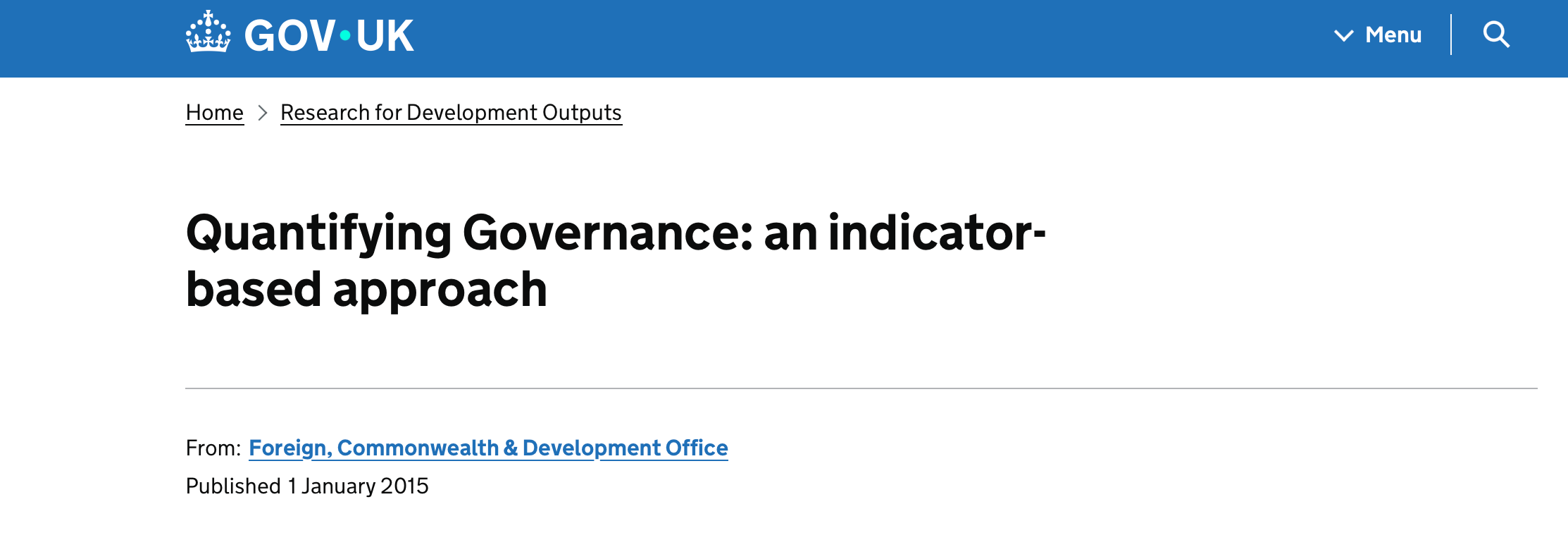
Leon Fuerth, Al Gore’s National Security Adviser from 1993 to 200116, called this Forward Engagement17, later Anticipatory Governance1819. The framework needs constant feedback systems that monitor performance and adjust policy in real time. Workshops at the National Defense University refined the ideas from 2011 to 2012 under Chatham House rules20. The Rockefeller Foundation funded its formalisation21.
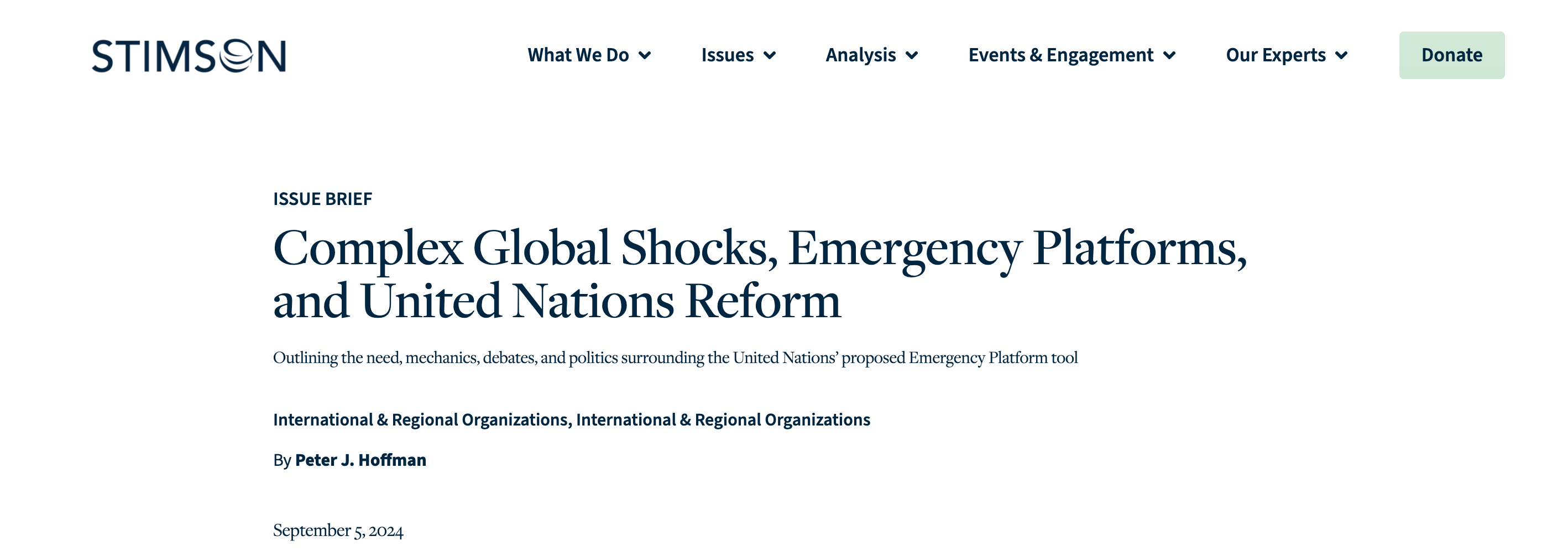
The doctrine’s now operational at the UN level. In September 2021, Secretary-General António Guterres put forward Our Common Agenda22, proposing an UN Emergency Platform that triggers automatically when large-scale crises hit23. The policy brief came out in March 202324, and the mechanism was adopted at the Summit of the Future in September 2024 as part of the Pact for the Future25. The Emergency Platform isn’t a standing body but protocols for bringing together key ‘stakeholders’26 — UN agencies, member states, private sector, civil society, international financial institutions — when complex global shocks27 hit, typically computationally modelled by a ‘black box’, with no accountability assigned anywhere. It applies to any substrate: pandemics, climate emergencies, financial instability, food crises, conflict-related events28.
The four-stage pipeline Convened in Private described — technical committee, secretariat, general assembly — assumes there’s time to deliberate. But the Emergency Platform compresses all three into instant activation when the data demands it29. When you further ‘holistically’ integrate surveillance data streams from various domains such as finance, climate and biodiversity, you create a system so complex that only AI can make sense of it. The ‘complex global shock’ called by AI is the logical conclusion, because the integration of domains makes human comprehension structurally impossible.
This constant-adjustment system has no room for the one-off legislative moments democracy was built on. Parliament passing a bill, a court reviewing a regulation, a referendum on a treaty — each runs at human speed and produces something the legislative process treats as binding for a set period. The current architecture, however, runs at machine speed and treats every output as provisional, ready for instant adjustment when the next indicator readings come in.
The institutional and political theatre continues. But what politicians actually do within the system has changed.


Democracy becomes a data feed
You still vote, your ballot still gets counted, and MPs still take their seats. Parties still campaign and win or lose elections. The theatre of democratic participation carries on in full view. But what that democratic act actually does has changed.
Inside the architecture, votes, polling responses, protests, petitions and social-media posts are all inputs. A street demonstration produces mobility data, sentiment data and attendance data — all inputs too. The architecture reads these alongside emissions data, transaction data, biometric data, search queries, and the dozens of other continuous indicator streams the clearinghouse processes.
The listening apparatus has a name. The Global Listening Project30, launched in 2021 with MacArthur Foundation funding, runs a seventy-country research programme that maps public concerns through interviews, focus groups, population surveys and media monitoring. Policymakers use the output to refine delivery. Heidi Larson, the founder, did corporate user-experience research at Apple and Xerox PARC, then moved through UNICEF, Gavi, the WHO and the London School of Hygiene31. She founded the Vaccine Confidence Project in 201032. The Global Listening Project broadened the same approach beyond vaccines to climate, food, migration, conflict and what Larson calls ‘youth loneliness’33. The institutional model’s corporate UX research applied to governance. The product’s predetermined; research identifies the friction; messaging’s refined to overcome it.

What’s listened to is how the population objects. What’s adjusted is how the architecture delivers, primarily through shaping the message. The objectives themselves don’t change. Vote Conservative or Labour — it ultimately doesn’t matter. They both agree on the Sustainable Development Goals, the Convention on Biological Diversity, the UNFCCC Paris Agreement, and so forth. The difference primarily relates to how the message is delivered, and in what order the policy is implemented.
The system listens and adjusts. The voter hasn’t chosen a policy in the old sense. Rather, they’ve chosen a way to implement the same policy, yielding a parameter update in a continuous optimisation system. The next election produces new telemetry, and the system updates again. Replace Keir, and you receive the same policy outcome through different rhetoric.
The institutional theatre’s preserved while the surrounding architecture runs continuously on indicator-driven adjustment. The vote keeps its visible form, but the work it performs has become data-generation. The voter who turns out at the ballot box perhaps feels they’re exercising democratic agency, but in the architecture, all they generate is a signal, which the system reads and adjusts its parameters. The next round of indicator-driven policy proceeds with the new parameters in place.
This is what democracy becomes when the institutional theatre is preserved and the surrounding architecture is recoded to run on continuous feedback. It’s not abolished. It’s demoted from decision to input.


Malchut and the closed loop
The Tree of Life layout shows where the individual fits in. Malchut is the point where the process becomes physical reality. The ethic (keter) at the top flows down through compiled standards, clearing and settlement until it reaches the individual transaction.
In Kabbalistic tradition, the flow doesn’t end at Malchut. The individual’s response — their actions, intentions and participation in the wider pattern — feeds back up, allowing the upper sefirot to adjust.
The architecture now being developed is the technical version of that pattern. Keter — the ethic, the SDG framework, the moral authorisation — flows down through Da’at (standards; ISO, OECD, FATF, …), Tipheret (the clearinghouse, soon to become AI) and Yesod (the settlement layer; conditional CBDCs) to Malchut (the individual transaction). The individual’s response is captured as data and routed back up as input that lets the upper sefirot adjust. However, the crucial difference being that the contemporary system merely adjusts its messaging. The policy objectives themselves rarely change.
The loop closes. The engineering rule documented across the Zohar, Marx, Laitman and the unified ledger has always said the loop must close, that nothing can escape the ledger. In practice, the individual at the endpoint becomes the data source that keeps the chain running.
But now that the citizen passes through the architecture’s clearing, they no longer count as subjects affecting the system — rather, they now count as objects the system processes. That system reads the citizen continuously. Their responses, including those framed as democratic votes, feed the system that determines what they’re permitted to do next.
And that is the democracy they seek to ‘strengthen’.


This makes me think about C S Lewis's little book, "The Abolition of Man" in which he presciently forsaw the future rise of technocracy (he did not call it that) and described the role that would be occupied by the elite class which he called "the conditioners".
This following bit generated by AI:
Key Points about "The Conditioners":
Manipulation of Human Nature: The conditioners seek to control humanity by shaping values and behaviors, rather than allowing them to develop naturally.
Undermining Morality: Lewis argues that this manipulation ultimately undermines true morality. By imposing artificial values, the conditioners risk erasing the inherent dignity and worth of individuals.
Consequences for Society: The approach of the conditioners can lead to a society where genuine moral understanding is replaced by a superficial adherence to imposed norms, resulting in a loss of authentic human experience.
"The Abolition of Man" written in the 1960's was very prescient about what is going on with increasing intensification today! Worth reading!
Escape Key,
Great synopsis of the system of feedback-based control. Since January this year, China has been utilizing "smart contracts" (programmable money) and is boasting at how efficient it is. China is the anti-Hayek, meaning that, while Hayek (and Mises) proved that central planning cannot ever work, Chinese officials want to continue to believe that they will be able to control things.
In farm subsidies and rural social programs, China boasts that 22% of leakage has been removed by programmable funding. It also conducted a test-run of expiring currency, and found that 94% of poor households given money which expires in 30 days spent it in the first 7 days. Because they do not acknowledge the fundamental truth discovered by Hayek and Mises, they are set up to fail.
It would be a benefit to the West if China fails so fast, and so hard, that it sends the signal to not attempt technocratic totalitarianism in the West (even if we are already 80% to that goal).
One can hope.