
The Rothschild Nexus

They do not govern, legislate, or command. They have not held high office in two centuries. So what exactly is it that the Rothschilds do?
That’s the question this essay seeks to answer.
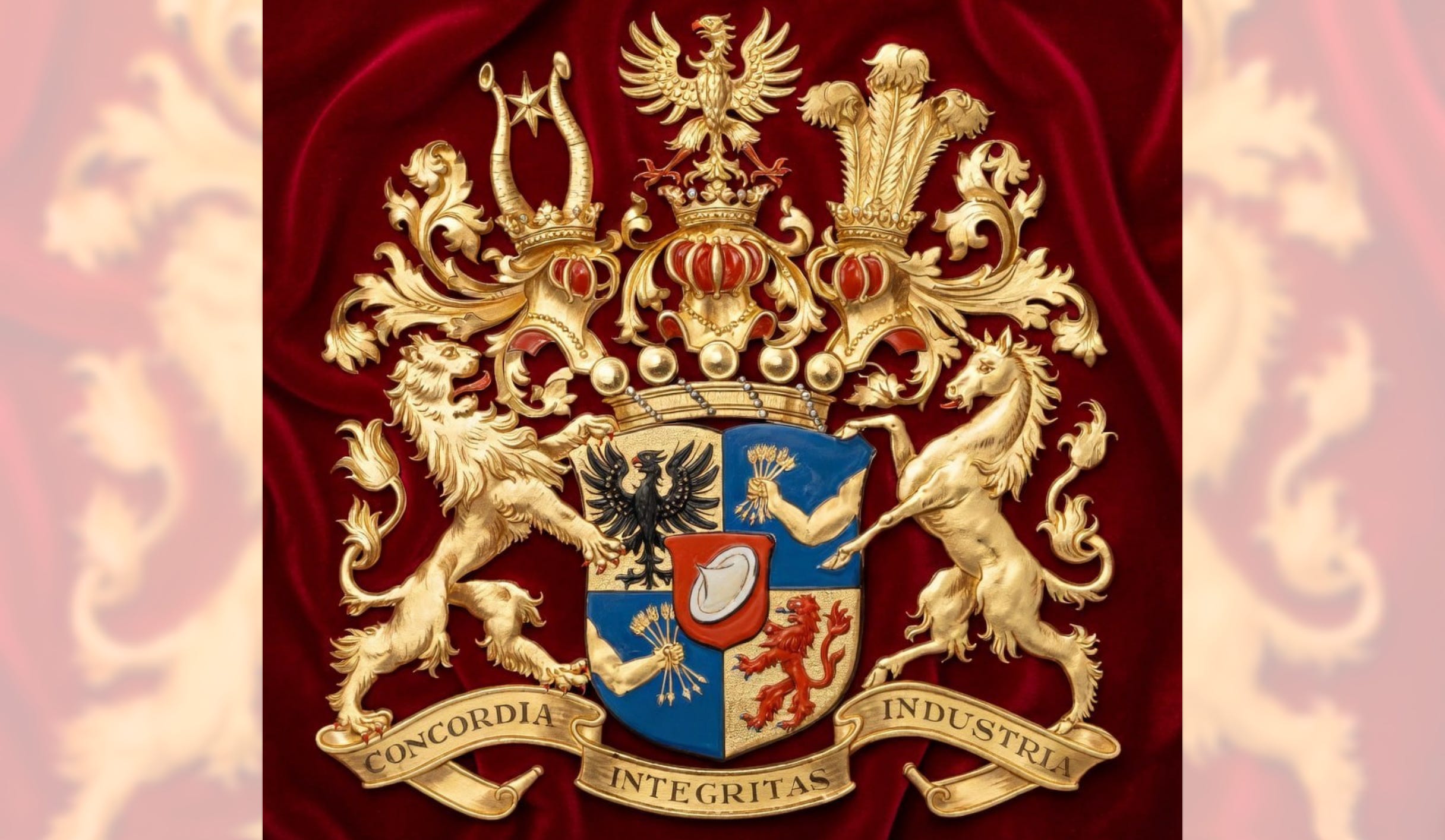
A clearinghouse sits between two parties in a transaction and decides whether it goes through. It need not own or make anything. It checks whether the rules have been followed, and either clears the deal or blocks it.
The power belongs to whoever wrote the rules; the clearinghouse is merely the mechanism. The two are rarely the same people.

This function has existed for over two hundred years, moving through six forms, each harder to see than the last.
The first was a named banker.
After the Franco-Prussian War of 1870–71, France owed Germany five billion francs. Gerson von Bleichröder, the Rothschild agent in Berlin, processed payments on the German side; Alphonse de Rothschild, head of the Paris house, led the syndicate that raised the bonds on the French side. The Frankfurt, Vienna, and London houses coordinated the placement. The five-city network was the clearinghouse. Everyone knew who sat in the middle.
Between the named banker and the institution came the blueprint. In 1892, Julius Wolf published two works simultaneously. The first, Sozialismus und kapitalistische Gesellschaftsordnung, mapped how financial intermediation generates concentrated wealth, tracing the Rothschild house’s role in placing over a billion guilden in sovereign loans across five countries within twelve years of 1814. Wolf understood, with clinical precision, that whoever controls the clearing function controls the outcome.

The second, submitted to the Brussels International Monetary Conference that same year, proposed to make the clearing function permanent and international — connecting every major central bank through a single office that would compensate debts through bookkeeping rather than gold shipment.
At the same conference, Alfred de Rothschild praised the London Bankers’ Clearing House as approaching ‘perfection’. Wolf took that proven domestic architecture — decentralised in operation, centralised in settlement — and proposed to extend it to the world.

Wolf did not stop at clearing. In 1889 he had argued, in Internationale Sozialpolitik, that social standards must be harmonised across borders before trade barriers are lowered, because unilateral reform raises production costs and disadvantages the reforming state. Standards precede commerce.
In 1904 he founded the Mitteleuropäischer Wirtschaftsverein — a standards coordination body with parallel national chapters in Germany, Austria, and Hungary, operating through expert committees and a permanent secretariat. In 1915 he proposed a formal customs union between the same three countries. He was layering trade integration on top of standards coordination — the same sequence the European project would follow decades later.
The Wirtschaftsverein’s governance architecture — national bodies coordinated through a shared institutional framework — is precisely the model the International Organization for Standardization adopted in 1947.

Wolf died in Berlin in May 1937. He was Jewish, and the Nazis sold or destroyed his papers. His biographer would later describe his work as having fallen into 'near-total oblivion'.
Wolf was a systems architect working in the language of nineteenth-century political economy. His erasure from the histories of the BIS and ISO is most likely the consequence of three things: the destruction of his papers on account of his Jewish heritage, the post-war dominance of Keynesian and Bretton Woods narratives that overshadowed the pre-1914 German institutional tradition, and the fact that his ideas were so effectively absorbed into the infrastructure that they became invisible — like the foundations of a building.
A fourth possibility is that his synthesis was too comprehensive. Someone who maps the entire mechanism in a single framework, using the Rothschild intermediation model as the case study, is inconvenient to the institutions that subsequently implement the mechanism. But the result is the same either way.
The man who mapped how clearing concentrates power and proposed to internationalise it is absent from every institutional history of the BIS, ISO, and the European project.
The second form was an institution.
The reparations imposed on Germany after the First World War created the need for a permanent body to manage payments between nations. In 1930, the Bank for International Settlements was established in Basel — implementing Wolf's 1892 proposal for a permanent international clearing office.
The reparations mandate ended within two years; the institution did not. It absorbed central bank cooperation, hosted the Basel Committee from the 1970s, and now runs the Innovation Hub building the unified ledger. The function was the same; the wrapper was now an international institution rather than a private bank, and the wrapper outlived the mandate that justified it.

The third separated the rule-writer from the enforcer.
In 1988, the Basel Committee published its first set of rules for how much capital banks must hold in reserve. These were adopted worldwide. The committee had no democratic mandate — nobody voted for it — but it wrote the standards. National regulators then enforced them as domestic law. The people writing the rules and the people applying them were now in different buildings.

The fourth moved the rules into computer models.
Banking regulation is increasingly driven by model outputs — climate scenarios, stress tests, risk calculations. Whoever designs the model’s assumptions determines what the financial system does.
In December 2025, the Network for Greening the Financial System announced a scientific advisory committee to oversee the climate scenarios that calibrate global banking capital requirements1. No members were named and no terms of reference were published.

The fifth moved the rules into the money itself.
Central bank digital currencies — now in development across more than a hundred countries — can have conditions built into the currency. A digital pound or euro could be programmed so that it can only be spent on certain goods, expires after a set date, or is blocked if the purchase fails an environmental or compliance standard.
The clearinghouse is no longer a separate institution sitting between two parties; it’s built into the money you use to pay.

The sixth — now under construction — is the clearinghouse as physical infrastructure.
IMEC routes every flow of goods, energy, data, and money between the developing world and Europe through a single corridor, checked against conditions that no population along the route was asked to approve.

Beneath every form lies a common sequence.
An ethical mission provides the justification — trust between banks, counter-terrorism, financial stability, sustainability. A cognitive standard defines what the system can see — the format of the cheque, the structure of the message, the data fields in the token. That standard is written by the International Organization for Standardization, through technical committees staffed by the industries they regulate. An evaluative clearing assesses compliance — the daily netting, the policy bundle check. A behavioural settlement enforces the result — the message is transmitted or blocked, the payment clears or fails. The outcome follows from the clearing, and the clearing follows from the standard.
At each stage, the reach grows wider, the visibility drops, and the accountability disappears. A named banker at a table once controlled a single transaction between two countries. A programmable currency controls every transaction in an economy. The internal logic has not changed since Lombard Street.

The paths
Across more than a century, no Rothschild has held elected office in a major democracy, led an international organisation, or commanded a military. They have not occupied the domains of power. What they have done, consistently, is occupy the paths between those domains — and shaped the standards by which one domain translates into another.
Nathaniel Rothschild, the first Baron, financed Cecil Rhodes’s British South Africa Company and backed De Beers2. His path ran between London banking capital and imperial resource extraction — the point where private finance determined who could access colonial resources, under what conditions, and through what corporate structures. The chartered entity extracting value under standards set by its financiers is an ancestor of the blended finance architecture.
Walter Rothschild, the second Baron, received the 1917 Balfour Declaration3 — the letter from British Foreign Secretary Arthur Balfour committing the government to establishing a Jewish national home in Palestine. His path ran between British imperial foreign policy and the territorial foundation on which every subsequent iteration of the corridor would be built. Without the political commitment that letter represented, the node at Haifa would not exist.

Alphonse de Rothschild led the syndicate that financed the French indemnity of 1871 — five billion francs raised through bond issuance while Bleichröder, the Rothschild agent in Berlin, processed the payments on the German side. The network profited from both ends of the transaction.
The humiliation of those terms drove France’s demands at Versailles in 1919, and it was those reparations that created the institutional justification for the BIS. His path ran between sovereign debt and the geopolitical chain reaction that produced the central bank of central banks.


Alfred de Rothschild occupied the path between commodity control and monetary architecture. The Rothschild family had controlled the Almadén mercury mines in Spain4 — the world’s largest mercury deposit — through financing arrangements from the 1830s. Mercury was essential to the amalgamation process used to refine gold from ore5. The family simultaneously held the Royal Mint Refinery contract in London, processing the gold that entered the British monetary system. They controlled the input to gold refining, the refining process itself, and the institution that certified the output as monetary gold.
At the 1892 Brussels International Monetary Conference, Alfred — a former Director of the Bank of England — championed the gold standard and described the London clearing house as approaching ‘perfection’. He was advocating for a monetary system anchored by a commodity whose entire refining chain his family controlled. At the same conference, Julius Wolf proposed scaling that clearing architecture internationally. The BIS, founded in 1930, implemented Wolf’s proposal.
The path ran from physical control of a refining process to structural authority over the monetary system built on its output. The Royal Mint Refinery contract was sold in 196767 — the same decade the gold standard began its final collapse8. You sell the function when the function migrates.

Robert Rothschild served on the Van Zeeland mission in 1937, drafting memoranda that contained the post-war institutional architecture in a single document — fixed but adjustable exchange rates, a common fund for countries in financial difficulty, a freeze on tariffs followed by gradual reduction, and the Bank for International Settlements as managing body. The tariff framework became GATT. The exchange rates became Bretton Woods. The common fund became the IMF.
Robert carried that framework across twenty years to help draft the Treaty of Rome in 1957. His path ran between economic policy design and European legal architecture — the point where a Belgian diplomat’s memoranda became the template for the institutions that now govern European economic life.

Victor Rothschild occupied the path between intelligence, scientific research, and the environmental framework that would later enter financial regulation. A Cambridge Apostle — alongside Keynes, who designed the Bretton Woods architecture, and Leonard Woolf, who wrote the Fabian Society blueprint for international government — Victor served at MI5 during the war and later led Shell Research, where James Lovelock developed the early work that became the Gaia hypothesis.
The BIS now uses ‘Gaia’ as the name of its own automated climate risk analysis system9. His path ran from the Cambridge network that wrote the governance blueprint, through the intelligence services, to the scientific research that produced the environmental framework now embedded in banking regulation.


Baron Edmond de Rothschild financed the Eilat-Ashkelon pipeline in 1968, covering most of the cost and presiding over the administrative company, Tri-Continental10. The pipeline routed Iranian oil overland through Israel to the Mediterranean, bypassing the Suez Canal — the same function, the same route, and the same node that IMEC serves today. His path ran between Gulf energy production and European consumption. It is the oldest piece of physical Rothschild infrastructure still operating in the current architecture — the pipeline itself, built in 1968, is still in service11.

Evelyn de Rothschild chaired NM Rothschild & Sons from 1976 to 2003 while simultaneously chairing the Economist Group from 1972 to 198912 — the publication that shaped how the global business class understood governance, reform, and economic policy. He also co-patronised the 1993 Interfaith Declaration on International Business Ethics13, which produced the shared moral vocabulary later embedded in corporate governance codes worldwide. His wife Lynn founded its successor, the Council for Inclusive Capitalism with the Vatican, in 201914. His path ran between financial authority, the narrative that legitimised it, and the ethical framework that would outlast both.
Lynn Forester de Rothschild sold the family’s entire 26.9 per cent stake in the Economist in March 202615 — the same logic as the Royal Mint Refinery in 1967. You sell the asset when its function migrates. The narrative function has been absorbed into the institutional architecture: the standards are in the regulations, the parameters are in the models, and the system no longer needs a narrator.

The lesser-known members of the family illustrate the same principle across every other domain.
Miriam Rothschild contributed to the 1942 Science and Ethics report — the collective statement by Haldane, Needham, Bernal, Huxley, and Stebbing that ethics could be derived from science — and then helped establish the International Union for Conservation of Nature in 1948, the body that continues to draft global legal frameworks designating protected lands. Her path ran between scientific authority and legal designation — the point where a finding about the natural world becomes an ethical obligation, and the ethical obligation becomes a rule about what humans may do with the land.


Edmond de Rothschild addressed the first World Wilderness Congress in 1977, arguing that economics and banking must be integrated into the conservation agenda. His proposal led to the concept of a World Conservation Bank, which evolved into the Global Environment Facility — the financial backbone of the UNFCCC and Convention on Biological Diversity, and the institution that now structures blended finance deals transferring ecosystem management from indebted nations to international organisations. His path ran between conservation and banking. The traffic it carries is sovereign debt.


Jacob Rothschild funded the Stranded Assets Programme at Oxford and hosted the Waddesdon Manor forums between 2014 and 2018. Those forums developed the framework for climate-related financial risk that fed the Task Force on Climate-related Financial Disclosures, which fed the NGFS, which calibrates capital requirements through Basel 3.1. By the time the framework reached the regulatory architecture, the Waddesdon origin was invisible.

Lynn Forester de Rothschild co-founded the Council for Inclusive Capitalism with the Vatican in 2019, convening executives controlling over $30 trillion in assets to develop standardised ESG metrics that now govern investment decisions. Her path runs between capital and moral authority, with the Vatican supplying the latter. The metrics that emerged govern both.

Emma Rothschild, the Harvard historian, has spent recent years constructing the evidentiary base for intergenerational climate claims through her ‘1800 Histories’ project, mapping more than a thousand sites responsible for severe methane emissions worldwide. Her path runs between historical evidence and financial obligation — the point where, through intergenerational equity, a fact about who emitted what becomes a claim about who owes what to whom.

Ariane de Rothschild, as CEO of the Edmond de Rothschild Group, is the operational principal of the Edmond branch. The Epstein correspondence shows her holding independent Israeli government relationships, negotiating directly with Epstein on a roster that included Ehud Barak and Jes Staley, forwarding internal bank deal flow to Epstein’s Gmail, gating her own employees’ access to the Gates network through Epstein, exercising delegated authority over the DOJ settlement, and receiving Epstein’s analysis of the David branch’s term sheet for the family name dispute.
She did not sit on a path between sovereign diplomacy and private banking. She ran the bank, and Epstein was her agent — briefing her, advising her, and routing through her the network of sovereign contacts that the health-peace forums had assembled. The French criminal investigation opened on 20 March 2026 concerns precisely this operational structure16.


David Mayer de Rothschild, Evelyn’s son, occupies the path between environmental science and public culture — described by CNN as a ‘navigator of spaceship earth’17 and founder of the Voices for Nature campaign18. His path translates the ecological concern that the rest of the family was converting into regulatory and financial architecture into a popular movement, giving the ethic a public face.
Fifteen family members, across five generations, operating in fifteen different domains. None of them controlled a domain. Every one of them configured a path between two domains and defined the standard by which one translates into the other.
The domains are not random. They correspond precisely to the bridges that the Council on Foreign Relations and the Royal Institute of International Affairs built outward from ‘peace’ over the past century.
The CFR and RIIA bridged peace to finance — and Nathan Mayer Rothschild’s arbitrage built the family’s financial foundation. They bridged peace to energy — and Edmond de Rothschild financed the Eilat-Ashkelon pipeline, the same route IMEC now follows. They bridged peace to environment — and the Waddesdon forums produced the stranded assets framework. They bridged peace to health — and the Edmond de Rothschild Foundations funded the Rothschild Conference on Health and Security. They bridged peace to governance standards — and Waddesdon fed the TCFD, which fed Basel 3.1. They bridged peace to development — and Lynn Forester de Rothschild built the Council for Inclusive Capitalism.
The think tanks designed the bridges. The family occupied the paths those bridges created. The paths are the bridges, seen from the other side.

The alignment is not coincidental. The private functions the Rothschild network performed for a century — sovereign clearing, transatlantic policy coordination, diplomatic mediation — were absorbed into these same formal institutions in the early twentieth century. The think tanks did not design bridges that the family later happened to occupy. The family’s private functions were institutionalised, and the bridges emerged from the institutions that absorbed them.
They do not govern, enforce, or legislate. They calibrate — configuring the conditions under which the standards, the definitions, the metrics, the evidentiary baselines, and the ethical frameworks are produced. The system then runs on those parameters, through institutions staffed by other people, enforced by mechanisms designed by other people, legitimised by social goods defined by other people.

The arbitrage
The benefit of occupying the path is the same now as it was when the family ran courier networks between European capitals in the nineteenth century: whoever sits on the path sees what crosses it before anyone on either side does. If you helped design the stranded assets framework at Waddesdon, you can reposition capital before the framework reaches Basel. If you structured the blended finance architecture, deal flow runs through structures you helped create. If you defined the ESG metric, you know which assets will be repriced before the repricing is announced.
The paths do not merely connect domains. They generate information asymmetry — and information asymmetry, converted into positioning, is how the family has operated since the Napoleonic Wars.

What the topology produces is the generalisation of arbitrage across every sphere: regulatory arbitrage from knowing the framework before it reaches the architecture, classification arbitrage from defining whether a forest is a protected reserve or a tradeable carbon sink, moral arbitrage from defining what counts as ethical before the compliance framework enforces it. Each asymmetry is eventually monetised through the bank.
The vehicle is blended finance — the public take the losses, private investors take the returns, and the taxonomy that determines which assets qualify was configured at the forums documented above. The Edmond de Rothschild Group’s Moringa fund19 — a pilot agroforestry vehicle — is the template in miniature.

In 2024, Rothschild & Co served as financial adviser to Ukraine’s Ministry of Finance on the restructuring of $20.5 billion in sovereign debt20 — bonds that had traded at roughly 19 cents on the dollar after Russia’s invasion destroyed the economy21. The restructuring was negotiated at Rothschild’s Paris offices, with BlackRock, Pimco, and Amundi on the creditor side. The deal produced a 37 per cent nominal haircut aligned with IMF programme conditionality. Rothschild sat on the path between a war-destroyed sovereign and the international creditors, and defined the standard by which the settlement was processed22. The bonds have since rallied. The path between destruction and reconstruction is the most profitable path in the topology.
The pattern is older than the current war. In 2003, Jacob Rothschild sat on the board23 of Mikhail Khodorkovsky’s Open Russia Foundation24 alongside Henry Kissinger and held shares in Yukos, Russia’s largest private oil company. Before Khodorkovsky’s arrest, the two concluded what the Sunday Times described as a ‘previously unknown arrangement’ under which voting rights to Khodorkovsky’s Yukos shares — worth approximately $13.5 billion — passed to Jacob in the event Khodorkovsky could no longer act as beneficiary. Khodorkovsky was arrested. The shares passed.
These are first-order arbitrage — profiting from the asymmetry generated by a single path. But the topology produces a second order. When you are positioned across multiple paths simultaneously, you can see how a parameter change on one path cascades through every other. A change in the historical emissions ledger triggers a repricing through the climate risk framework, which changes the ESG classification, which reclassifies conservation assets. Nobody inside a single domain can see that cascade. The health official sees one path. The central banker sees another. Only someone positioned across all the paths at once can see how a movement on one propagates through the rest. That is meta-arbitrage: profiting not from any single path but from the interactions between them.
This does not require omniscience, centralised planning, or conspiratorial coordination across generations. It requires a consistent operating principle: occupy the path, configure the conditions under which the standard is written, and let the system run. The institutions that adopt the standard do so because it’s useful. The regulations that incorporate the framework do so because it’s technically sound. Nobody needs to be instructed. The parameters propagate through the system because the system needs parameters, and these are the ones on offer.

The nexus
The nexus framework — the claim that domains such as health, peace, climate, food, water, and security are interdependent and must be governed through integrated approaches — is the institutional expression of this operating principle.
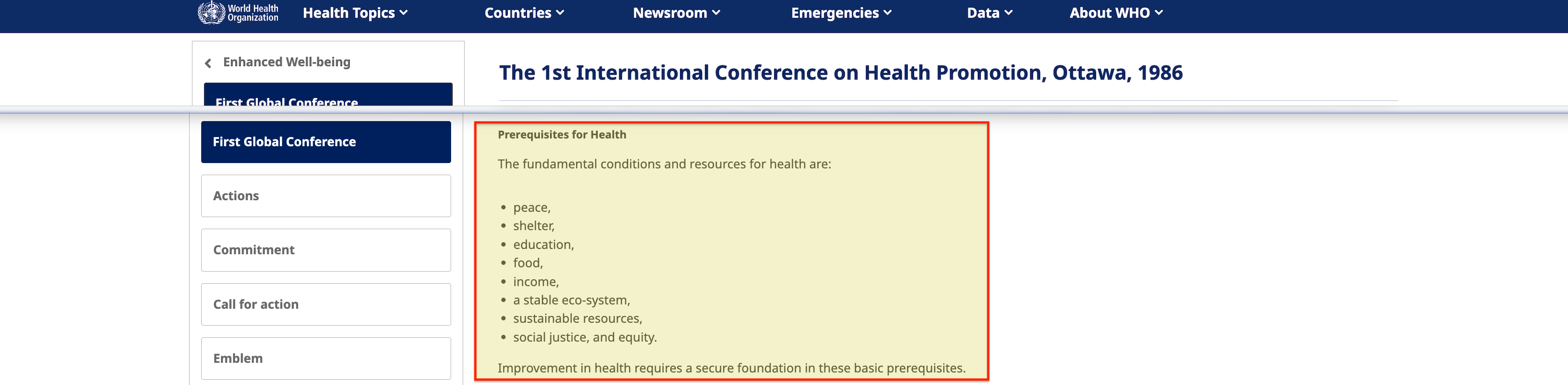
Every time a new nexus is declared, a new path is created between two domains that were previously governed separately. The Ottawa Charter declared peace a precondition for health — creating the health-peace path. The NGFS declared climate a precondition for financial stability — creating the climate-finance path. The WEFE framework25 declared water, energy, food, and ecosystems interdependent — creating four new paths simultaneously. One Health declared human, animal, and environmental health inseparable.

The institutional grammar for this path creation is the phrase ‘determinants of’. The template was first deployed in 1956, when NATO’s Committee of Three expanded the alliance’s remit from military into ‘non-military security’ by declaring social, economic, and political factors to be indirect security determinants — which meant security institutions acquired jurisdiction over all of them.
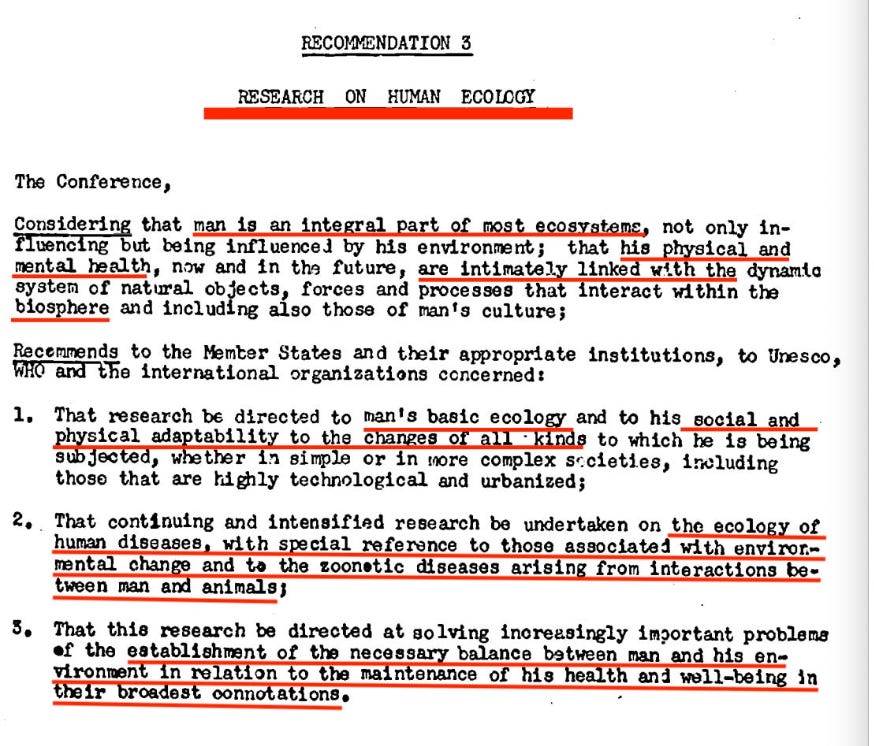
The 1968 UNESCO Biosphere Conference26 extended the template to ecology. Recommendation 3.3 directed research at ‘the necessary balance between man and his environment in relation to the maintenance of his health and well-being in their broadest connotations’.
Once a ‘necessary balance’ is declared, every intervention is justified as ‘restoration’ — the system does not impose, it corrects. The framing neutralises political opposition in advance, because arguing against correction is indistinguishable from arguing for imbalance.

The same grammar has since been cloned across every domain.
Social determinants of health27 creates a path from social policy into health governance — housing, education, income, and employment become health inputs, and health institutions acquire authority over them. Environmental determinants of health28 creates a path from environmental policy. Commercial determinants of health29 creates a path from commercial regulation.
Each declaration is a nexus in miniature: a formal claim that domain A determines outcomes in domain B, which means whoever monitors domain A acquires anticipatory authority over domain B.

The Ottawa Charter’s nine preconditions for health30 — peace, shelter, education, food, income, a stable ecosystem, sustainable resources, social justice, and equity — are nine paths from nine separate domains into a single governance node.
The WHO Pandemic Treaty’s One Health provisions are the most complete expression of this grammar31. By declaring human, animal, and environmental health interdependent, One Health creates paths running in every direction simultaneously.
Biodiversity loss becomes a health threat through zoonotic spillover risk. Climate shifts become health threats through vector migration. Health emergencies become environmental governance mandates through the same pathways running in reverse. The treaty’s surveillance framework extends beyond disease to the determinants of health — meaning the monitoring architecture covers the social, commercial, and environmental conditions that the determinants grammar has already claimed for health governance.

Meryl Nass, who has spent decades analysing biological weapons treaties and vaccine policy32, has produced the most detailed public analysis of what these provisions look like in legal language33: the sovereignty transfers, the Conference of the Parties mechanism, the One Health expansion of the emergency definition, and the surveillance obligations that member states would accept as conditions of participation.
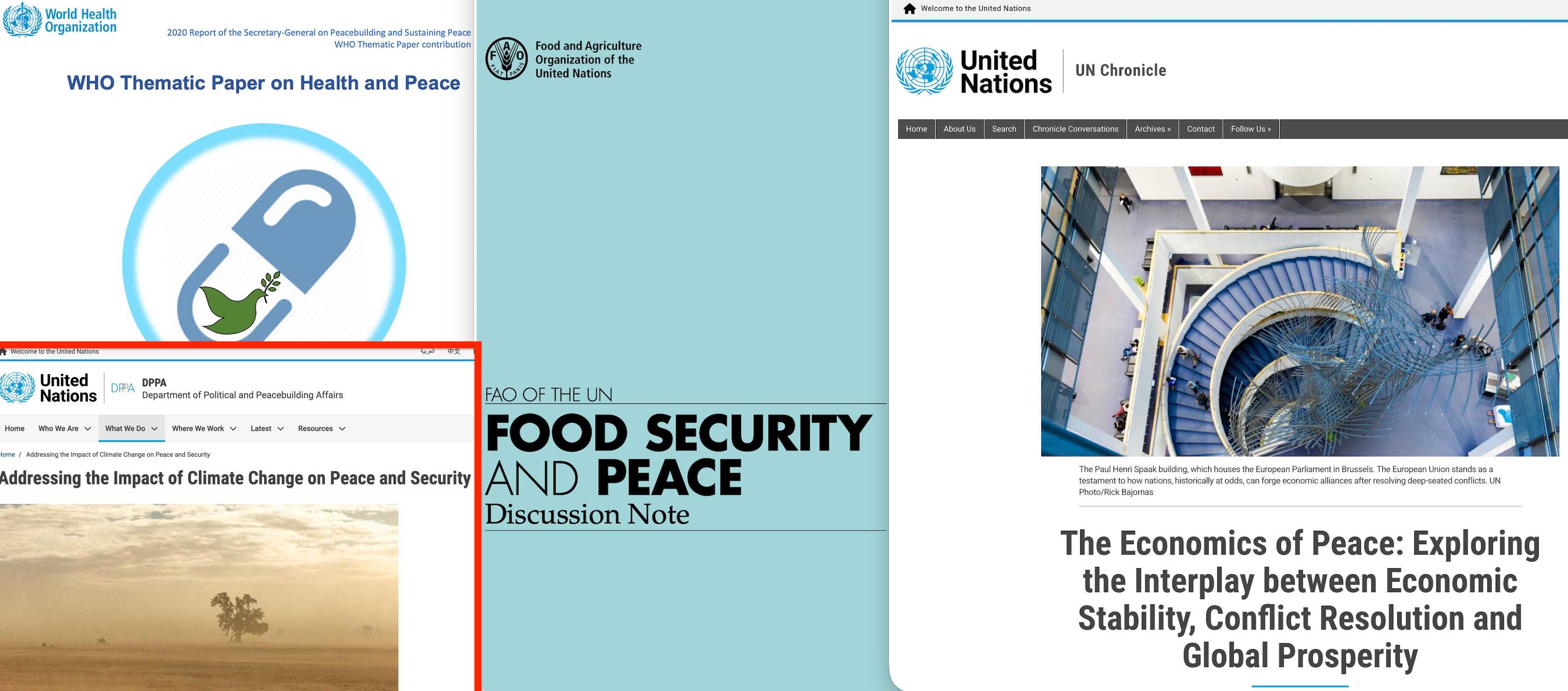
Each new path multiplies the channels through which surveillance data from one domain can trigger intervention in another. A water crisis becomes a food crisis through the WEFE path34. A food crisis becomes a health crisis through the health-peace path. A health crisis becomes a security crisis through the WHO’s Global Health and Peace Initiative35. A security crisis activates the Emergency Platform adopted in the Pact for the Future.
One drought, five institutional triggers, one coordinated response.

The nexus claim leads, in every case, to the same prescriptive conclusion: because these domains are interdependent, they require a ‘holistic approach’ — the phrase used in One Health, the triple nexus, and UNESCO’s WEFE framework alike.
The word ‘holistic’ turns an observation about connection into a mandate for centralised authority. A health ministry, an environment ministry, a defence ministry — each governing its own domain — is by definition inadequate to the ‘holistic’ task. Cross-cutting institutional authority is the only response that follows from the premise. And once the premise is accepted, any objection to centralisation appears parochial or downright irresponsible.

The integration also produces a data pool too complex for any human to oversee, which justifies the computational model that processes it, which in turn justifies the institutional immunity that shields the model from accountability.
Complexity is the argument for the black box.
The family does not need to control health or peace. They need to calibrate the path between them. They do not need to control climate or finance. They need to calibrate the path where climate becomes a financial risk. They do not need to control conservation or banking. They need to calibrate the path where a forest becomes an entry on the unified ledger. Each new nexus is a new path, and each new path is a new calibration surface. The architecture does not centralise power in any domain. It distributes it across the paths between them.
And every path, ultimately, routes through peace. Health is a determinant of peace36. Climate is a determinant of peace37. Food security is a determinant of peace38. Financial stability is a determinant of peace39. Through the determinants grammar, there is no domain that cannot be connected to peace. The word dissolves every boundary it touches, and every boundary it dissolves becomes a path.


The ratchet
The GHPI and the Pandemic Treaty form a ratchet. The peacetime architecture built through the GHPI becomes the institutional infrastructure through which emergency powers operate when a pandemic — or a pandemic potential, as defined by a computational model — is declared. The emergency, once declared, expands the peacetime architecture further. It turns in one direction only.
The Pandemic Treaty’s emergency powers are not limited to responding to actual pandemics. They extend to ‘pandemic potential’ — identified through early warning systems and surveillance networks whose outputs are generated by models. The emergency need not have arrived. The model need only predict that it might, and the authority to intervene follows from the prediction.
Above both sits the UN Emergency Platform, adopted in the September 2024 Pact for the Future — a mechanism granting the Secretary-General standing authority to declare a ‘complex global shock’ and convene a coordinated response across governments, financial institutions, and the private sector. The listed triggers include large-scale climatic events, disruptions to global flows of goods or finance, and events with cascading consequences across multiple sectors.

The definition is deliberately broad and the triggers anticipatory. A ‘complex global shock’ is characterised not by what has happened but by what cascading consequences are modelled to follow.
The surveillance data feeds the model, the model generates a prediction, the prediction crosses a threshold, and the threshold triggers the emergency. This is anticipatory governance — the operating principle now being adopted across UN emergency frameworks.
Whoever calibrated the threshold and designed the model has pre-determined when the emergency will be declared.

The Emergency Platform connects to the health-peace architecture through the determinants logic. Once health, environment, conflict, and economic stability are defined as interdependent determinants of each other, surveillance data from any single domain can qualify events for emergency declaration across all domains simultaneously. A climate event becomes a health emergency through One Health. A health emergency becomes a security crisis through the health-peace framing. A security crisis activates the Emergency Platform, which in turn activates the financial, credential, procurement, and enforcement infrastructure built through the other layers. None of this requires an actual crisis to have occurred — only that the model says one is coming.
Mike Yeadon has described from inside the pharmaceutical industry how the regulatory process operates in practice — the gap between the rules on paper and how they get applied in practice. His testimony is consistent with the regulatory capture documented40: the system does not require bad actors at every node, only parameters set at the top that propagate through institutional compliance at every level below.
Several sovereign states have raised objections. At the 76th World Health Assembly, India, Brazil, and South Africa cautioned that the GHPI roadmap ‘borders on the most delicate subject: peace and security, peace, nation and state sovereignty’41. Russia, Syria, and Egypt raised concerns about potential infringements on sovereignty and the prospect of social monitoring mechanisms being implemented through the initiative. The objections were noted, but the initiative still proceeded.

The black box
The architecture functions as a black box in the precise cybernetic sense.
Inputs enter: surveillance data, climate models, health metrics, financial risk scores, emissions estimates, behavioural data. The box processes them through institutional protocols, regulatory frameworks, treaty obligations, and algorithmic logic. Outputs emerge: capital requirements, asset classifications, transaction approvals, emergency declarations, lending conditions, intervention triggers. Both inputs and outputs are visible, but the processing is opaque.

The models that generate climate risk scores are not published in reproducible form. The parameters that determine when a pandemic potential crosses the threshold for emergency declaration are set by technical working groups whose members are frequently unnamed. The AI systems that classify transactions for compliance operate through neural networks whose internal logic cannot be explained by their designers. The Basel Committee’s risk-weight tables are updated through a process that involves no parliamentary vote in any country.
When the output is challenged — when the emergency declaration proves disproportionate, when the capital repricing destroys an industry, when the transaction restriction was unwarranted — responsibility dissolves. Politicians defer to the institutional protocol. The institutions defer to the model. The model is the black box. Nobody chose the outcome. The system produced it. And the system cannot be held accountable, because accountability requires an identifiable decision-maker, and the entire architecture is designed to ensure there is none.

When the black box fails, the failure is attributed to insufficient data — not to the premise. The model needed more inputs, more surveillance, higher resolution. Every failure of the architecture becomes the argument for expanding the surveillance infrastructure that feeds it.
Epstein told Steve Bannon this assumption had failed. The Santa Fe Institute spent fifteen years trying to model complex systems algorithmically. ‘Total failure’. Every attempt to formalise what complexity means came to nothing. Researchers who thought they had found predictive tools applied them to financial markets and went bankrupt.
But the failure was not interpreted as a failure of the premise. It was interpreted as an issue of resolution — not enough data, not enough computational power, not enough granularity. This drives the development of the entire surveillance infrastructure. CBDCs provide transaction-level resolution on every financial exchange. Aadhaar provides biometric-level resolution on every individual. Climate TRACE42 provides satellite-level resolution on every emission source. Each layer increases the granularity. Each increase is justified by the claim that the previous model failed because it could not see enough.
Epstein’s pivot, on camera, was to AI — neural nets, systems that produce answers nobody can explain. He did not abandon the computability premise. He upgraded the resolution and abandoned the requirement that anyone understand the output.
In proper adaptive management, the model adapts to reality. In this architecture, however, reality is forced to adapt to the model. When the output diverges from the prediction, the system does not revise its assumptions — it tightens enforcement.
The system treats the real world as an error.


Input constraint
The mechanism that connects every layer of the architecture is input constraint. The system does not control what people do. It constrains what enters the system in the first place.

The clearinghouse does not tell banks what to settle. It clears by a standard defined elsewhere — and anything that does not meet the standard never processes.
The ESG metric does not tell investors what to buy. It defines what qualifies as investable — and anything that fails to qualify never reaches the portfolio.
The taxonomy does not tell anyone what to do with a forest. It defines whether the forest is a protected reserve or a tradeable carbon sink — and the classification determines every subsequent transaction before anyone makes a decision.
The determinants grammar does not tell a health official what policy to adopt. It defines what counts as a health input — and once housing, education, and income are classified as health inputs, the health official’s mandate has expanded before anyone voted on it.
Nobody is ever told what to do — the options are constrained before the choice is presented. The transaction that does not meet the compliance parameters does not process. The asset that does not meet the risk-weight threshold becomes unbankable. The country that does not meet the reconstruction conditionality does not receive funding. The choice is always ‘free’.
But the options were determined in advance. And the constraint is invisible from inside the system, because the constrained options look like all the options there are.

The convergence
In June 2023, the Bank for International Settlements published its ‘Blueprint for the Future Monetary System’ — the unified ledger. Tokenised assets, programmable contracts, conditional logic, central bank money and commercial bank money on a single platform.

The unified ledger is where the separate paths converge. The clearing standards, the taxonomies, the risk metrics, the ESG frameworks, the compliance parameters — all the separate definitions configured across separate domains over 130 years — become conditions written into a single infrastructure. At that point the paths do not merely connect domains — they become the medium through which all value in every connected domain must flow.
The data format that every platform on the unified ledger must implement is ISO 20022 — the financial messaging standard written by ISO Technical Committee 68, whose working groups are staffed by central banks, commercial banks, and SWIFT itself. The richer structured data that ISO 20022 carries — purpose codes, beneficiary details, originator information — is what enables compliance conditions to be checked at the transaction level.
ISO does not set the conditions, but it does define what the system can see. And what the system can see determines what it’s capable of enforcing.

The organisational model through which ISO operates — national standards bodies, each representing one country, coordinated through a shared institutional framework — was first built by Wolf’s Wirtschaftsverein in 1904. The International Federation of the National Standardizing Associations replicated it in 1926. ISO absorbed it in 1947.
Wolf also supplied the sequencing logic: his 1889 Internationale Sozialpolitik argued that standards harmonisation must precede trade liberalisation, because harmonisation creates the level playing field on which commerce can safely operate. The ILO was founded on this logic in 1919. The European single market was built on it. The architecture does not liberalise first and govern later. It governs first — through standards — and the commerce that follows is already inside the parameters.
ISO Technical Committee 207 writes the environmental compliance framework. TC322 writes the sustainable finance taxonomy. TC309 writes the governance standard — ISO 37000 — that defines how every organisation implementing the other standards must be run, codifying multi-stakeholder governance as the international benchmark.
The standard that governs the governors was written by a technical committee in Geneva, codifying a partnership model first proposed by Eduard Bernstein in 1899 and scaled through Woolf’s 1916 blueprint, Blair and Clinton’s Third Way, and Reinicke’s trisectoral networks adopted as UN policy in 2000.


The meta-arbitrage that previously required the topology to be held in a single family’s view is now automated: every parameter change on every path propagates through every other in real time, on a single platform. Programmable money is input constraint at the transaction level — the money checks its own conditions before it moves. The restriction is not applied to the person, it’s written into the medium of exchange itself. The toll is compliance with the parameters, set in advance.
They were set at Waddesdon, at Bellagio, at the World Wilderness Congress, at the Bank of England, at Harvard, at the Brussels International Monetary Conference, at a dinner at L’Ami Louis.
The power resides with whoever writes the parameters. The responsibility resides nowhere.

The franchisee
The operating principle does not require a Rothschild. It requires anyone who can sit on a path between two domains and define what passes between them. Jeffrey Epstein operated the same way, at a smaller scale, on a shorter leash — and the leash, on the Edmond branch side, was held by Ariane.
He sat between the International Peace Institute and the Gates Foundation. Between JPMorgan and Gulf sovereigns. Between the MIT Media Lab and the research deployment pipeline. Between Rød-Larsen and Nikolic. Between the health-peace channel and the banking channel. He did not own any of these institutions. He configured the paths between them.

When IPI needed to reach the Gates Foundation, the correspondence went through Epstein. When the polio vaccination programme required foreign minister engagement, the proposal went through Epstein. When Fabrice Aidan needed placement at the Edmond de Rothschild bank, the introduction went through Epstein. When sovereign contacts assembled at Sir Bani Yas needed to be connected to Bill Gates, the dinner was brokered through Epstein. When the programmable currency specification needed to reach Boris Nikolic, it was sent through Epstein. And when Ariane needed to assess a deal, challenge a term sheet, or reach the Gates network, Epstein served as her adviser and gatekeeper — routing through her bank the contact books assembled across every other path he sat on.

When Nikolic emailed Epstein in August 2016 with a two-word question — ‘Jacob Rothschild?’ — Epstein replied ‘No’. He denied the connection while sitting on a year’s worth of Jacob’s forwarded correspondence in his inbox. The path concealed its own existence.
He was not an anomaly in the network. Four independent academic studies of the Rothschild Archive document an agent model operating across the nineteenth century: intermediaries recruited through marriage or long service, compensated through deal flow rather than salary, deliberately diverse, operationally essential, and permanently excluded from the decision-making core.
Agents for the Rothschilds documented the match between that model and the Epstein correspondence in detail. He was a local instance of the network’s operating principle — an intermediary whose power derived entirely from his position on the paths between domains, and whose removal did not disrupt the architecture, because the architecture does not depend on any single intermediary.
It depends on topology.
The model has one recurring vulnerability, identified across two centuries: the agent who accumulates enough independent knowledge to threaten the principals. When Epstein was denied his fee on the Gates-JPMorgan impact investing vehicle he had helped design, the correspondence shows his shift — draft emails containing allegations about Gates’s personal conduct, a fabricated resignation letter written in the voice of Boris Nikolic. The switchboard that knew what each node had done turned on the network when denied its cut. On 29 July 2019, his lawyers met with FBI and SDNY prosecutors and raised the possibility of cooperation. Twelve days later, he was no longer a concern.
When Epstein was arrested, the paths were re-routed. IPI continued its health-peace programme, upgrading it to a partnership with The Elders Foundation43. The pandemic treaty negotiations continued through closed-door retreats at Mont-Pèlerin. The sovereign contact book continued to generate access — Fabrice Aidan was photographed with the Saudi Crown Prince a year after leaving the bank. The research programmes continued to produce outputs. The BIS continued to build the unified ledger.
The switchboard operator is no longer needed when the wiring is in the wall.

The pattern
The family does not need to control the institutions, the models, the treaties, or the transactions. They need to control the definitions by which those institutions read the world — the instruments by which the system measures itself. Once the instruments are calibrated, the system produces the outputs that follow from the calibration, through mechanisms designed, operated, and enforced by other people, in other institutions, on other continents, across other generations.
The domains are visible to everyone. The paths between them are visible only to those who configured them. The full pattern — the configuration of all paths, the topology of the system as a whole — is visible only from outside.
The system does not require a governor. It requires a calibrator — someone who configures the paths between domains and selects the conditions under which the standards are written. The claim is not that the family controls the institutions that produce the standards. Hundreds of participants sit on those committees. The claim is that members of the family are consistently positioned at the points where input constraint carries the highest leverage — the forum that produces the framework, the scholarship that builds the evidentiary base, the initiative that defines the metric — before any of these enter the institutional architecture.
Other actors populate the institutions. The calibrators configured what the institutions received. The calibrator does not need to be visible, because the calibration, once set, operates through the system’s own logic, producing outcomes that appear institutional, scientific, multilateral, and democratic.
The operating sequence is consistent across every case documented in this series. The family hosts the forum where the standard is developed. The agents carry the standard into the institutional architecture. The architecture, once installed, runs itself. Waddesdon to the TCFD to the NGFS to Basel 3.1. The Rothschild Conference to the WHO Global Health and Peace Initiative. Bellagio to the GIIN to seventeen SDG verticals.
Host, develop, automate. By the time anyone looks, the origin has been removed and the system is running on its own logic.
This is ultimately a description of how value circulates through the architecture of global governance, where the junctions are — and who engineered them.
The Rothschilds do not occupy the clearinghouses. They engineer them.



T/y to the wonderful people on my Telegram channel44 who helped in the production of this essay.
the fundamental objective of this essay, is to shed light on the mechanism; the trick employed by rothschild. i explain how this has evolved through 6 generations, go through 15 members of the family, and then apply it in various contexts, before summarising.
reducing it to single-word expressions misses the entire point.
the architecture is specifically designed so that single-word diagnoses don't work on it - that's why it endures
Trump was bailed out from bankruptcy in the nineties by the Rothschild syndicate and their Rockefeller front.
He made a payment on that debt with Warp Speed, again when he acted in his own absurd "assassination attempt" to get reelected, and he is making another payment here with his obviously futile war on Iran.
Why exactly is the Rothschild syndicate and their Rockefeller front, aka the Empire of The City, waging this Iran war?
"Iran’s system was designed to eliminate usury and align finance with real economic activity and risk-sharing rather than speculative debt. It has long been viewed as structurally incompatible with the interest-based, collateral-heavy architecture of City of London and Wall Street finance — an architecture that requires perpetual debt servicing and easily rehypothecated assets to feed the derivatives machine. "
All Wars Are Bankers’ Wars: Iran and the Bankers’ Endgame
https://scheerpost.com/2026/04/10/all-wars-are-bankers-wars-iran-and-the-bankers-endgame/