
Any Old Ethic Will Do

The Three Witnesses showed how three peer-reviewed academic works independently corroborate every contextual claim in the preceding essays — though none of them spotted the link.
This essay traces what happened to the clearing architecture after the war — how it survived the regime change, acquired a new ethic, and kept running
Wilhelm Röpke is the bridge figure.
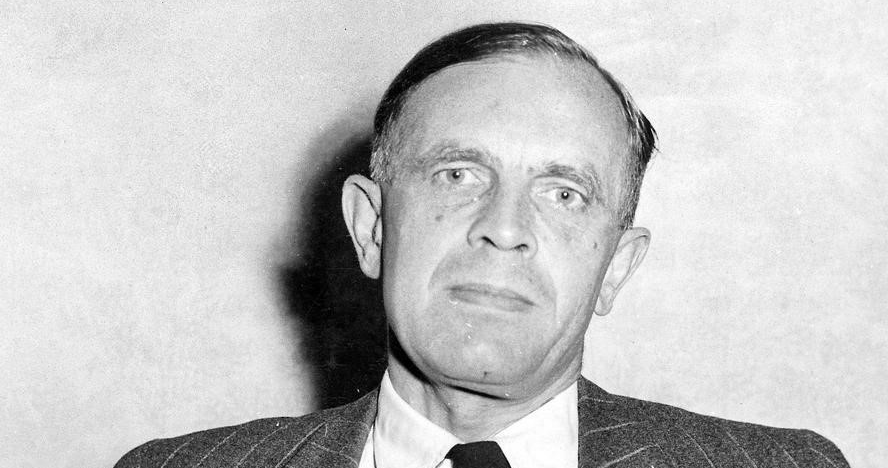
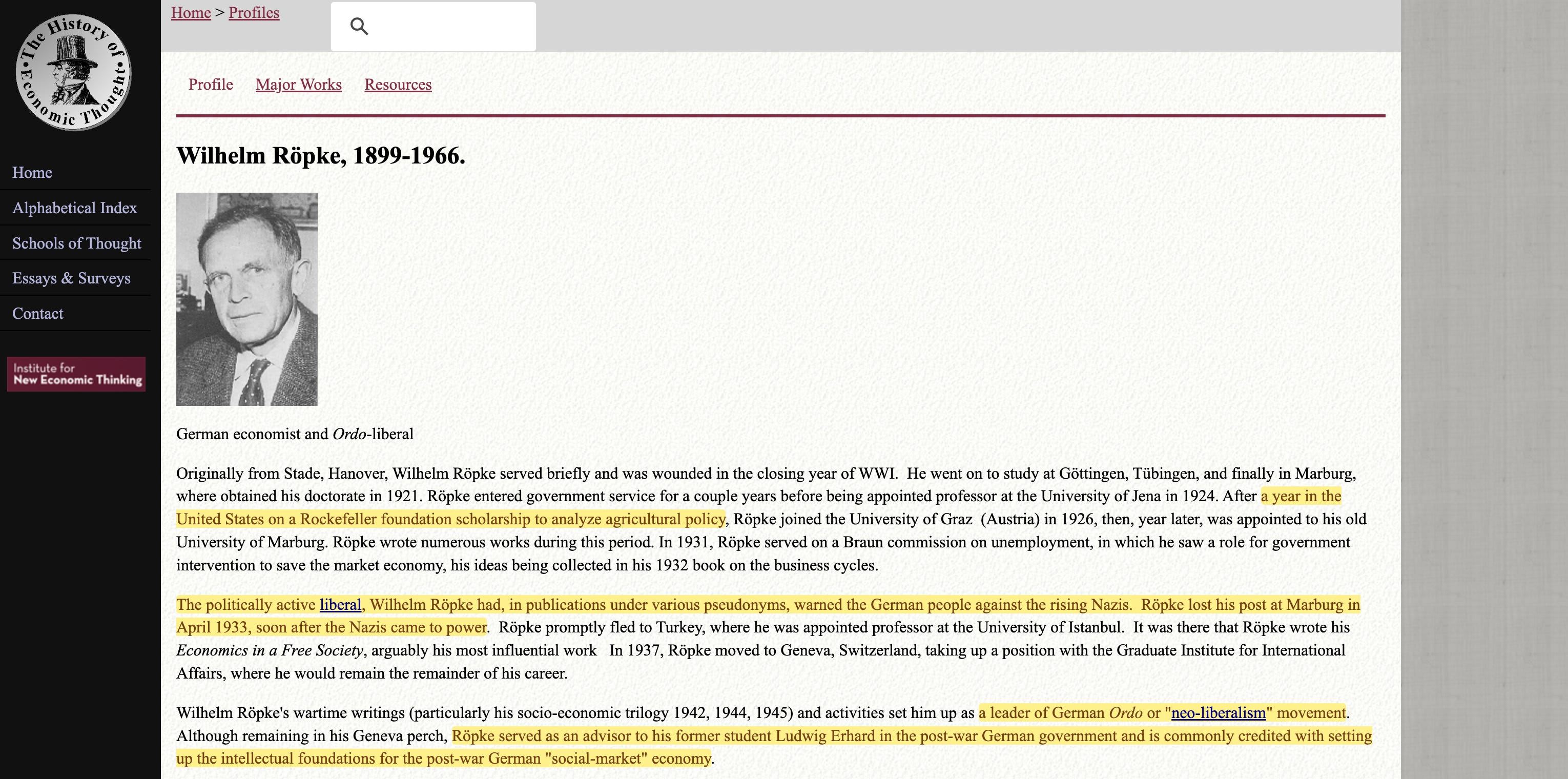
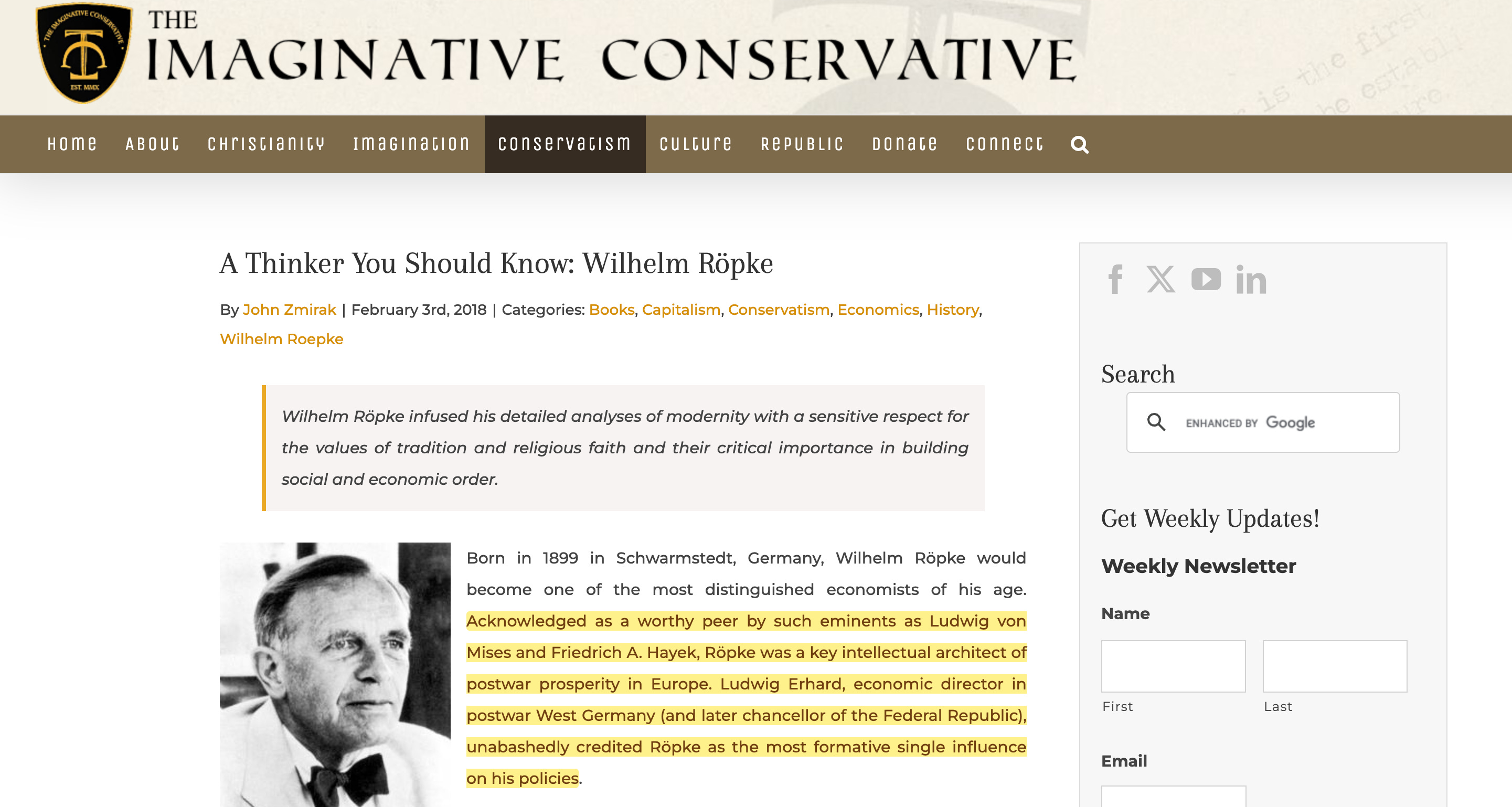
Röpke was born in 1899 in Schwarmstedt, near Hanover1. He started out as a young socialist, studied economics at Marburg, and shifted to free-market thinking in the aftermath of the First World War — though he never quite gave up on the idea that markets alone weren’t enough2. A Rockefeller Foundation fellowship took him to the United States in 1927–28 to study agricultural policy3. The same foundation already bankrolled the League of Nations’ intellectual cooperation apparatus4 — Prince Rohan’s cultural channel in Gusejnova’s report — and would later fund the RIIA and CFR, the permanent Anglo-American policy infrastructure that followed.
He became a full professor back at Marburg in 1929. When Hitler took power in February 1933, Röpke gave a speech in Frankfurt that openly criticised the new regime — just days after the takeover5. He lost his job and went into exile: first to Istanbul from 1933 to 19376, then to Geneva’s Institut Universitaire des Hautes Études Internationales, where he stayed until he died in 1966.

The Geneva institute had Rockefeller money behind it — $1.5 million by 19507. Ludwig von Mises8 was already there, having arrived in 1934. The institute’s director, William Rappard, had brought Mises in and was instrumental in turning Geneva into the hub of what became the neoliberal intellectual movement9. This is where ordoliberal institutional design took shape. And this is where the Colloque Lippmann of 1938 — named after Walter Lippmann — gathered the economists who would formally adopt ‘neoliberalism‘ as their label10.
After the war, Röpke co-founded the Mont Pelerin Society with Hayek in 194711 and became the intellectual architect of Ludwig Erhard’s economic programme12. Erhard’s neo-liberal policies ‘clearly bore Röpke’s stamp’, as his editor noted13. The result was the social market economy — the ‘economic miracle’ that rebuilt West Germany and became the template for European integration14.

The Third Way, stated
Röpke called his programme ‘The Third Way‘15.
He used the phrase outright in lectures at the National Bank of Egypt in Cairo in 1951, in a section titled ‘The Fourth Stage of the Discussion: The ‘Third Way’‘. He used it again in Civitas Humana and throughout his later work. He insisted that a competitive market economy ‘could only survive if undergirded by strong religious, social, legal, and political institutions which provide its moral foundations‘.
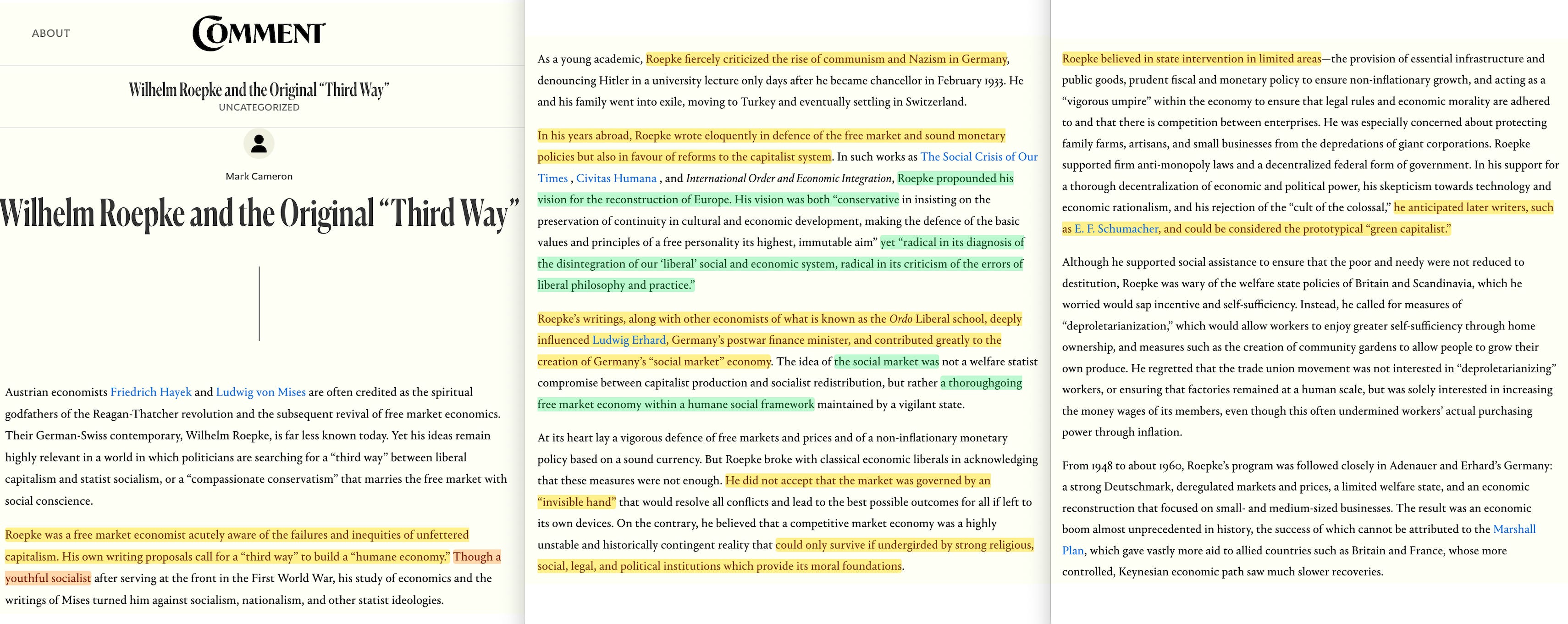
Put plainly — that’s the ethic-to-standard pipeline stated in ordoliberal language. ‘Moral’ foundations produce the standards. Standards condition the market. The market operates within the conditions. The mechanism — conditions attached to economic activity — is the clearing function described as social philosophy.
Röpke’s Third Way built an independent central bank — the Bundesbank — into its core16. The Bundesbank’s sole mandate was price stability, enforced independently of the elected government1718. This was Verrijn Stuart’s 1932 Volta specification — central bank authority above the nation, beyond any electorate — implemented in postwar Germany.
The model was then exported to the European Central Bank through the Maastricht Treaty19. The specification, the institutional form, and the phrase all crossed the regime change intact.

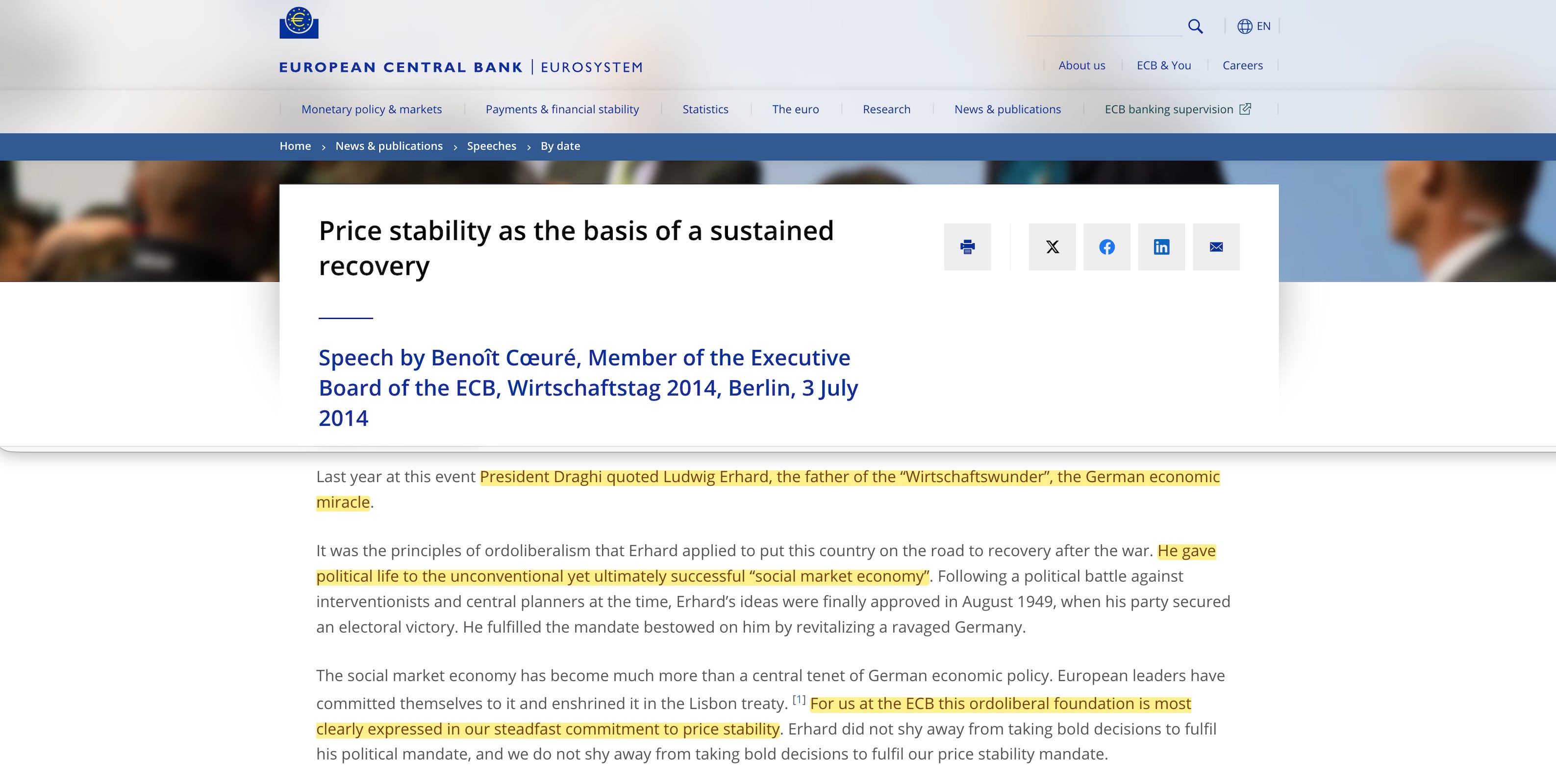
Röpke’s design drew a sharp line: conditions on the monetary side, a ‘morally’ constrained democratic space on the fiscal side. The independent central bank set interest rates, controlled credit, and enforced price stability — all beyond electoral reach20. But the state shouldn’t allocate resources through the budget, so there’d be no directed spending or Keynesian demand management.
The market would operate freely within conditions attached to the monetary layer by experts. That’s the Third Way as institutional design: not laissez-faire, because there are conditions; not state command, because the conditions sit on the settlement layer rather than the spending layer.
The architecture expanded beyond his design. Maastricht imposed monetary conditions — convergence criteria21, an independent ECB — while technically leaving fiscal policy to member states22. Then the sovereign debt crisis23 produced the Fiscal Compact24, which attached conditions to the fiscal side too25. Then the sustainability framework completed the circuit26 — monetary conditions through the NGFS and Basel capital requirements, fiscal conditions through the taxonomy, the just transition fund, and green bond eligibility27.
The clearing function migrated from the monetary layer Röpke designed to the fiscal layer he wanted to keep free. His own design enabled the expansion, because once the mechanism is built and staffed with experts beyond electoral reach, nothing constrains what they decide falls within their mandate.
‘Financial stability’ eventually expands to cover everything2829. That’s Mises’s warning vindicated — the walls don’t care who occupies them.


The moral foundations revealed
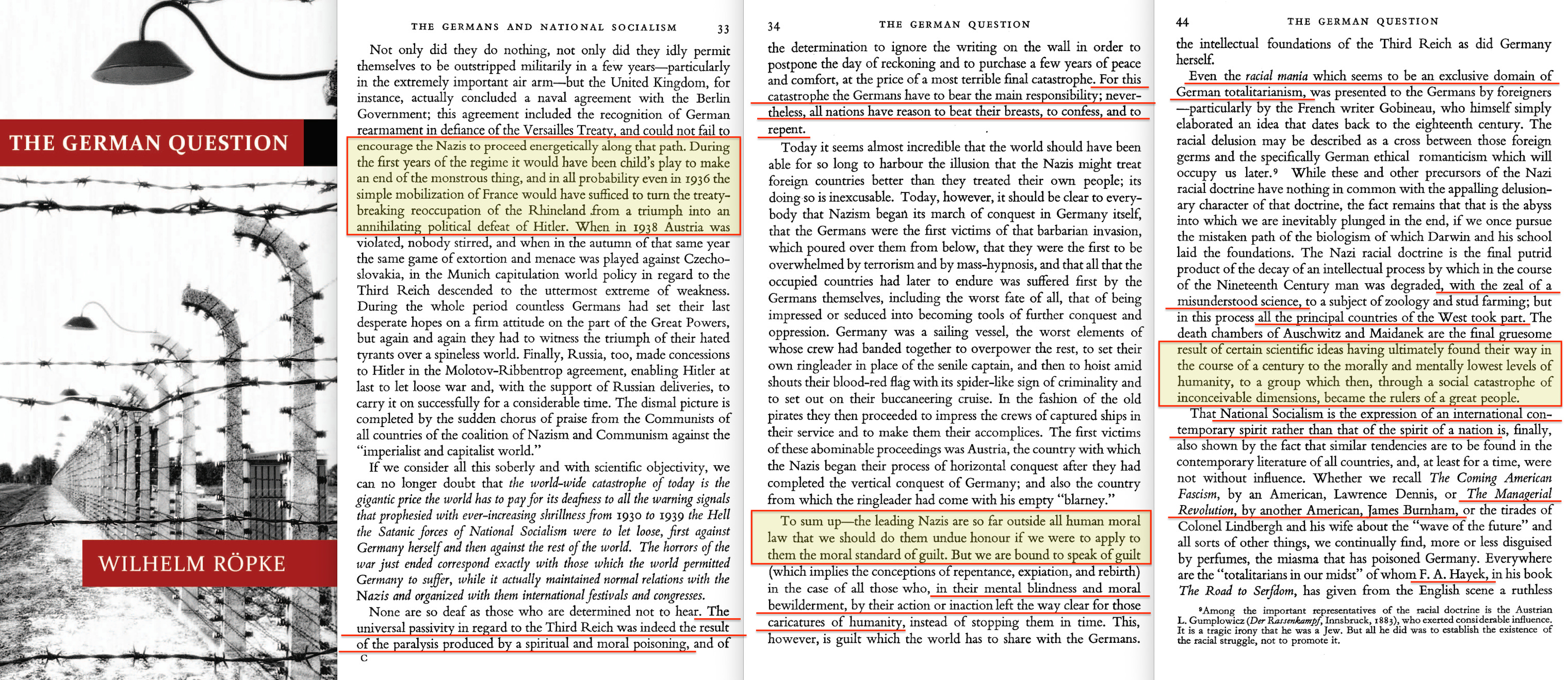
In 1946, Röpke published The German Question30.
He described the Nazis as ‘caricatures of humanity‘ and wrote that ‘the death chambers of Auschwitz and Maidanek are the final gruesome result of certain scientific ideas having ultimately found their way to the morally and mentally lowest levels of humanity‘. He analysed totalitarian mechanisms — how they corrupt institutions, manipulate mass psychology, and turn passive complicity into active participation.
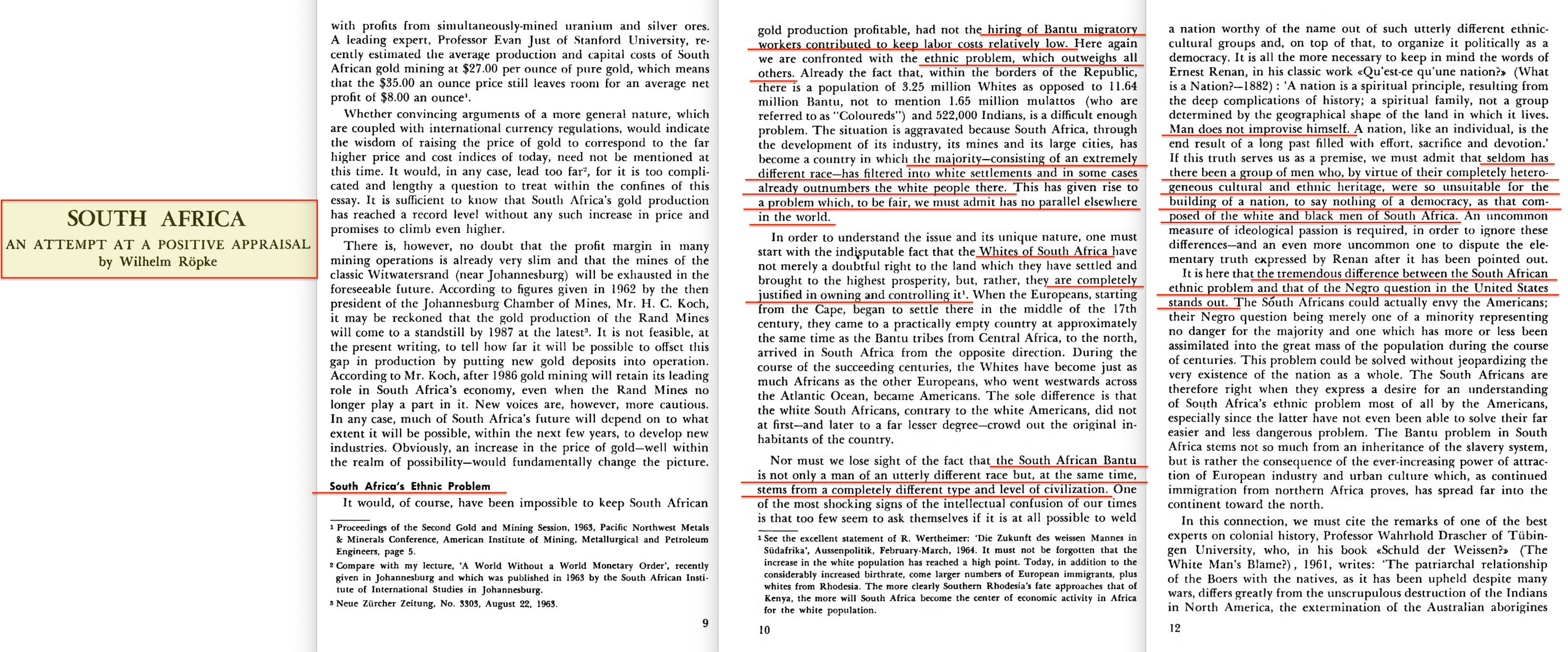
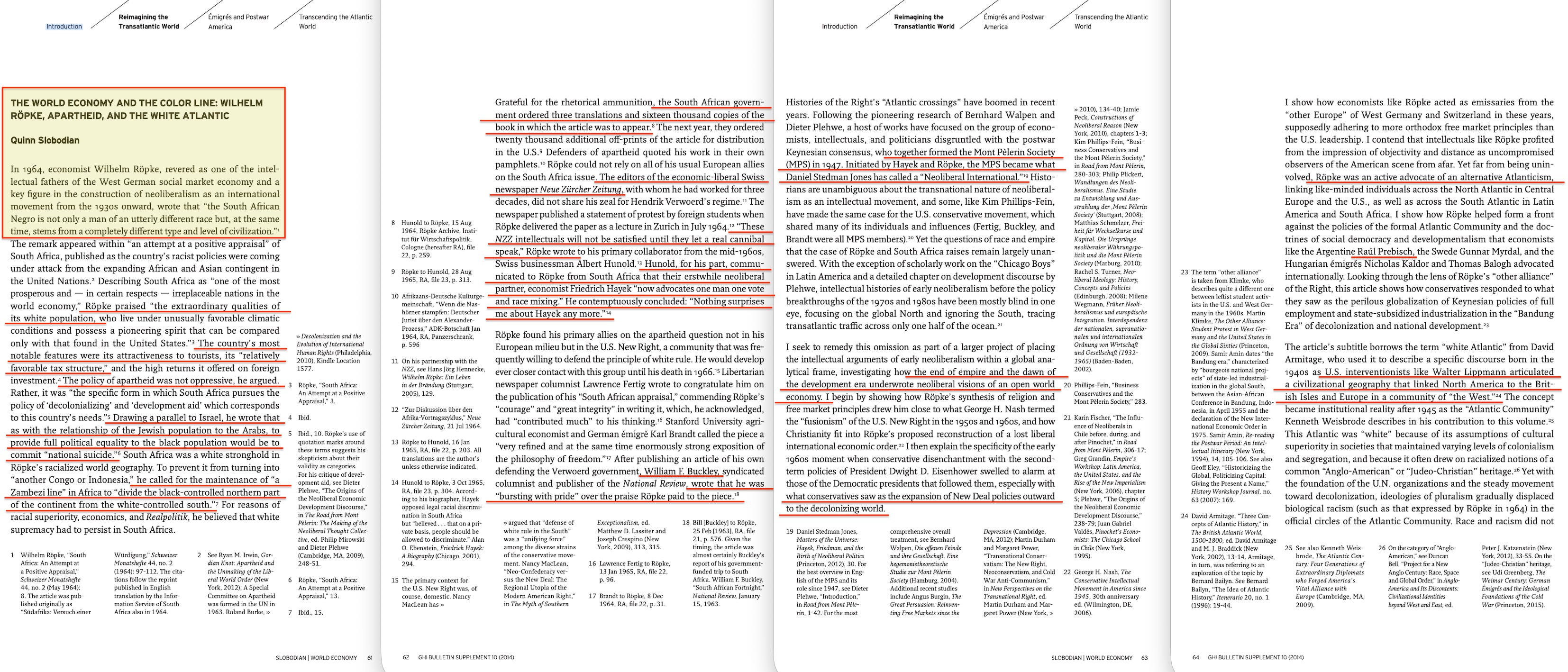
In 1964, the same man described the ‘South African Negro‘ as stemming from ‘a completely different type and level of civilisation‘31. He openly defended apartheid, praised South Africa’s ‘relatively favourable tax structure‘ and the ‘extraordinary qualities of its white population‘, and called for a ‘Zambezi line‘ dividing white-controlled from black-controlled Africa. He called equal political rights for the black population ‘national suicide‘.
The South African government ordered sixteen thousand copies of the pamphlet and twenty thousand offprints for distribution in the United States, where it was registered with the US Department of Justice as foreign agent material under the Foreign Agents Registration Act.
When his Mont Pelerin co-founder Hayek distanced himself, Röpke’s collaborator Albert Hunold wrote to him from South Africa that Hayek ‘now advocates one man one vote and race mixing‘. Hunold added: ‘Nothing surprises me about Hayek any more‘32.
The same man who understood how scientific ideas could descend to the lowest levels of humanity went on to use economics to defend racial hierarchy.
That’s the gap this series documents. The ethic shifts, but the mechanism persists.
The racial-to-economic translation
Slobodian’s research on Röpke pinpoints where racial hierarchy was shifted into economic language.
Röpke redefined what it meant to belong to ‘the West‘ — not as a racial or civilisational category, but as a financial one. Your membership depended on interest rates, investment climate, and market-friendly behaviour. When the Congo was cut loose from Belgium, there was ‘simply no rate of interest conceivable‘ at which Western investors would lend33. Your place in the international economic order came down to whether your transactions could clear at acceptable rates — and that acceptability rested on racial assumptions about civilisational capacity, dressed up as financial risk.
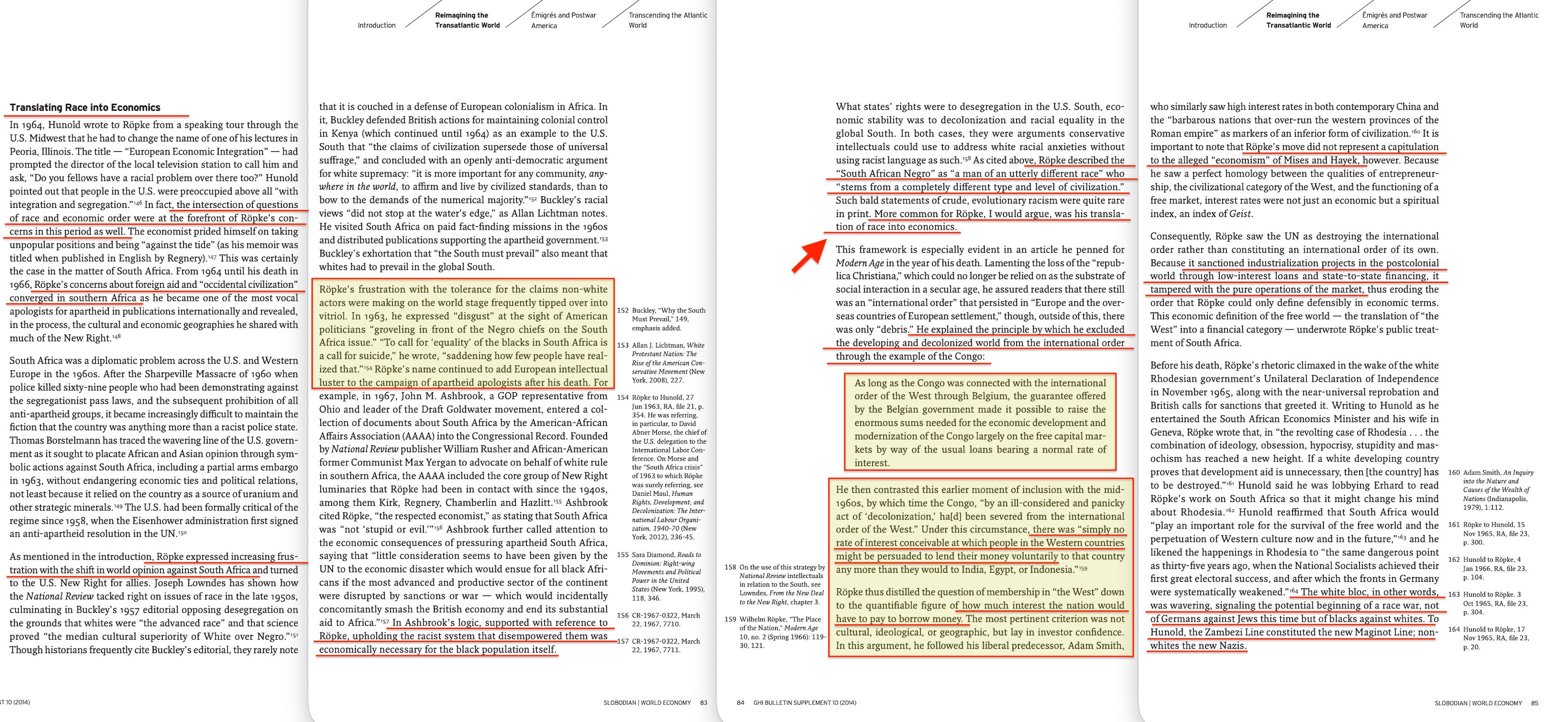
In other words — the ethic-to-standard pipeline in action.
Racial hierarchy passed through economic language and became settlement conditions. Civilisational status was the ethic, financial conditions were the standard, and access to the international order was the clearing condition. The racial content Goebbels had expressed openly didn’t vanish — it slipped into economic vocabulary through a man who opposed the regime that first declared it. The ethic appeared to change. In reality, the assumptions simply integrated into the monetary infrastructure.
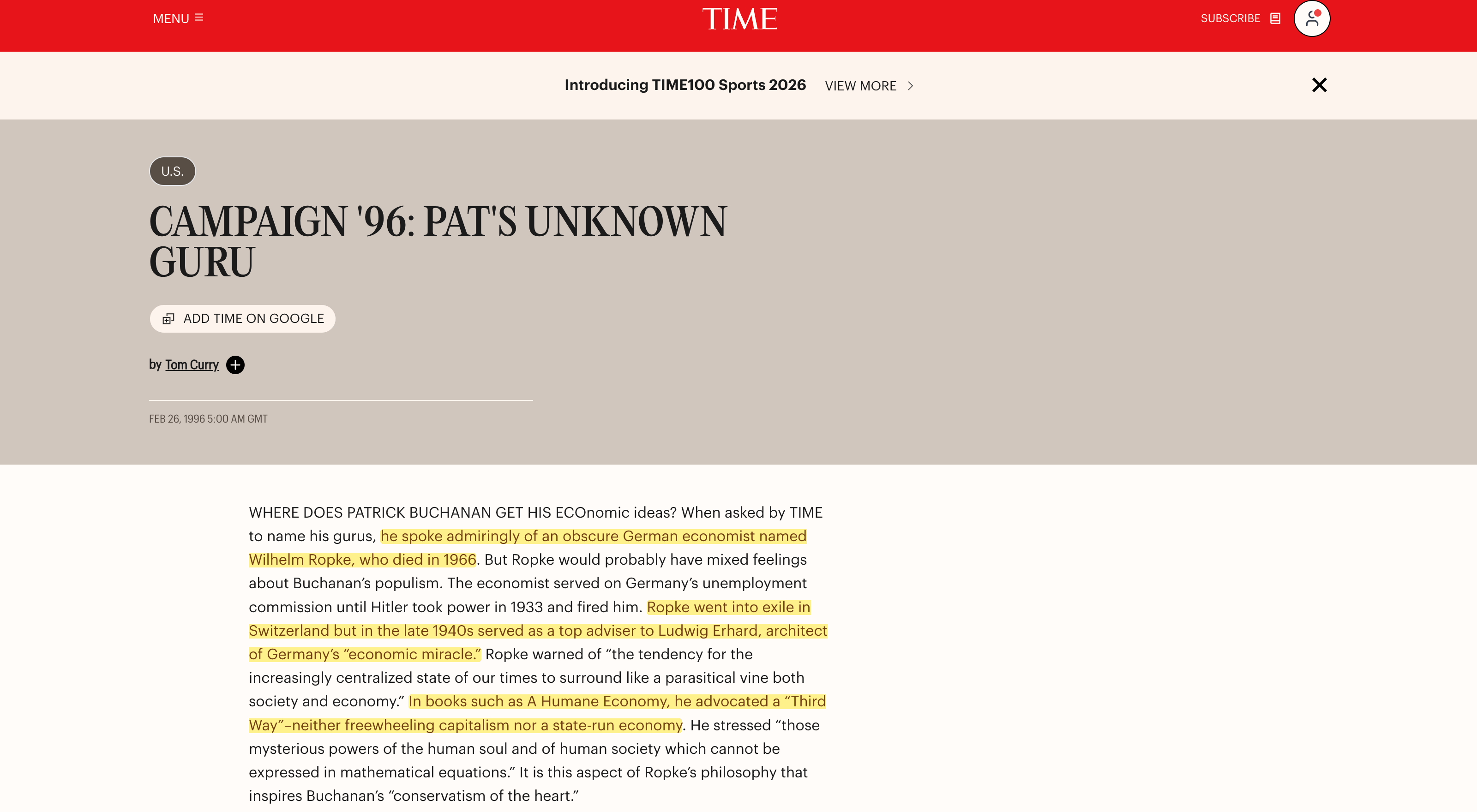
Since then, scholars have described Röpke as preempting E.F. Schumacher and the prototypical ‘green capitalist‘3435. In 1996, Time and the Guardian called him the ‘unknown guru‘ behind Pat Buchanan’s presidential campaign36. His ‘conservatism with a heart‘ anticipated George W. Bush’s ‘compassionate conservatism‘.
The institutional design kept moving through successive political movements, each attaching a different ethic to the same settlement architecture.
The entry condition
Röpke’s Congo example reveals something beyond racial assumptions dressed up in financial language. When Congo was cut loose from Belgium, the institutional infrastructure that let transactions clear was simply removed37. ‘No rate of interest conceivable‘ isn’t really about civilisational capacity — it’s about the missing settlement node. Without a central bank operating within the international framework, there’s no mechanism through which transactions can clear at any rate.
The central bank isn’t just the operator of the clearing function. It’s the international entry ticket. Without one that meets the conditions set by the BIS and Basel, a country isn’t in the network and its transactions don’t process.
The most radical anti-capitalist revolution in history proved this from the opposite direction. Under War Communism38 (1918–1921), the Bolsheviks had nationalised and absorbed all banks into the state39, intending to use the infrastructure for revolutionary transformation40 — and eventually let it wither away as money became obsolete. They controlled the banking system completely41. But it still couldn’t function as a clearing mechanism for international trade, because the international system required an institution operating within its framework — connected to the network, meeting the conditions, processing settlement in terms the other nodes would accept.
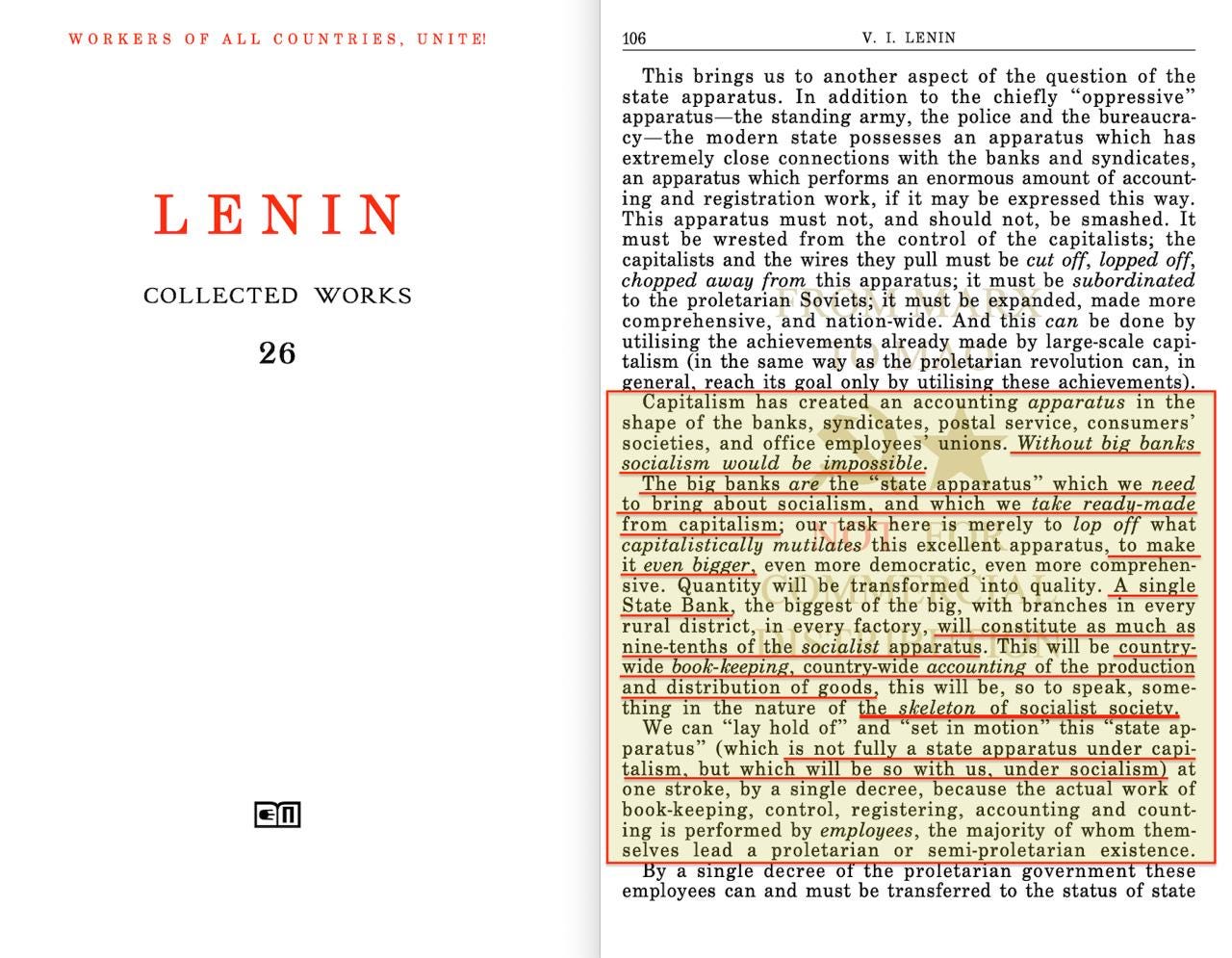
What followed confirms this.
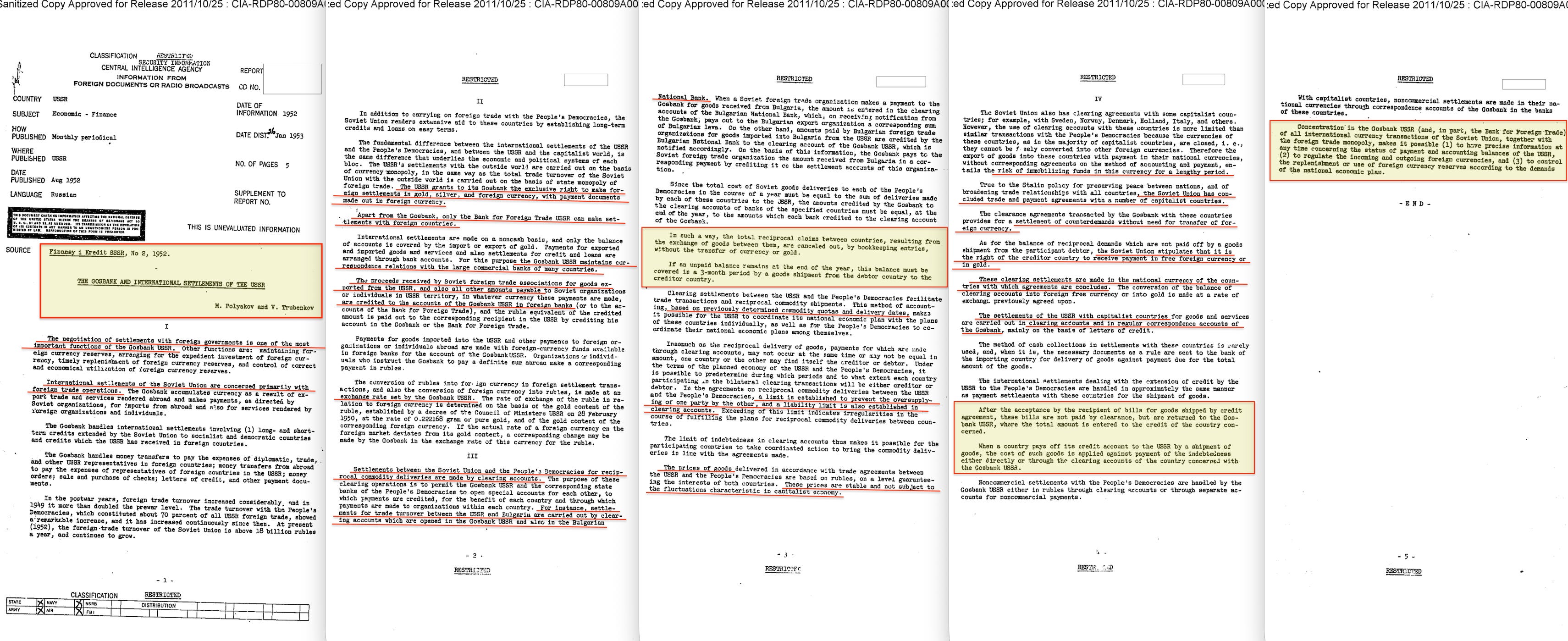
The Anglo-Soviet Trade Agreement42 was signed in March 192143. That same month, Lenin announced the New Economic Policy44. In October 1921, Gosbank — the State Bank — was re-established and began operations by November45. Its foundation46, as its own institutional history records, ‘was part of the implementation of the New Economic Policy, following the monetary dislocation and barter economy during the Russian Civil War‘.
Lenin didn’t restore the central bank because he’d changed his mind about monetary theory. He restored it because controlling banking at home wasn’t enough — the node had to fit the international network. Trade needs settlement, and settlement needs an institution the international system recognises.
The NEP was Lenin’s Third Way — not full state command, not laissez-faire, but conditional clearing through state-controlled institutions. The ‘commanding heights‘ — banking, heavy industry, foreign trade — stayed under state control47. Private transactions were allowed but cleared through state institutions under state-set conditions. The revolutionaries reinstalled the clearing house within four years because the alternative was collapse.

When Stalin ended the NEP in 1928–1930, he didn’t abolish the clearing mechanism. He gave Gosbank a monopoly and integrated it with Gosplan — the State Planning Committee48. By 1932, Gosbank provided 97% of all short-term credit, and its main job was running the payments and clearing system to match the Five-Year Plans49. Gosplan set the conditions. Gosbank enforced them through the settlement layer50. And transactions cleared only if they aligned with the plan’s directives.
Even under full state command, the clearing function remained — the planning committee set the conditions instead of the BIS, but the mechanism was identical. Vneshtorgbank51, the foreign trade bank, operated under Gosbank’s control, maintaining the Soviet Union’s node in the international clearing network. After the lesson of 1918–1921, they never disconnected again.


That’s why every post-revolutionary, post-colonial, and post-conflict state must establish a central bank as a condition of international participation. And the pattern’s documented across the entire decolonisation wave. Every African nation that gained independence in the 1950s and 1960s immediately set up a central bank — Bank of Ghana52 (1957), Central Bank of Nigeria53 (1958), Bank of Kenya54, Bank of Tanzania55, Bank of Uganda56 (all 1966).
The French colonies are even more revealing: when fourteen nations gained independence in 1960, the colonial issuing house was simply renamed the BCEAO — the Central Bank of West African States — with the French Treasury still guaranteeing the currency and setting the conditions57. Guinea, which opted for full independence outside the French Community, faced immediate economic isolation58 — the same pattern as Soviet Russia under War Communism.
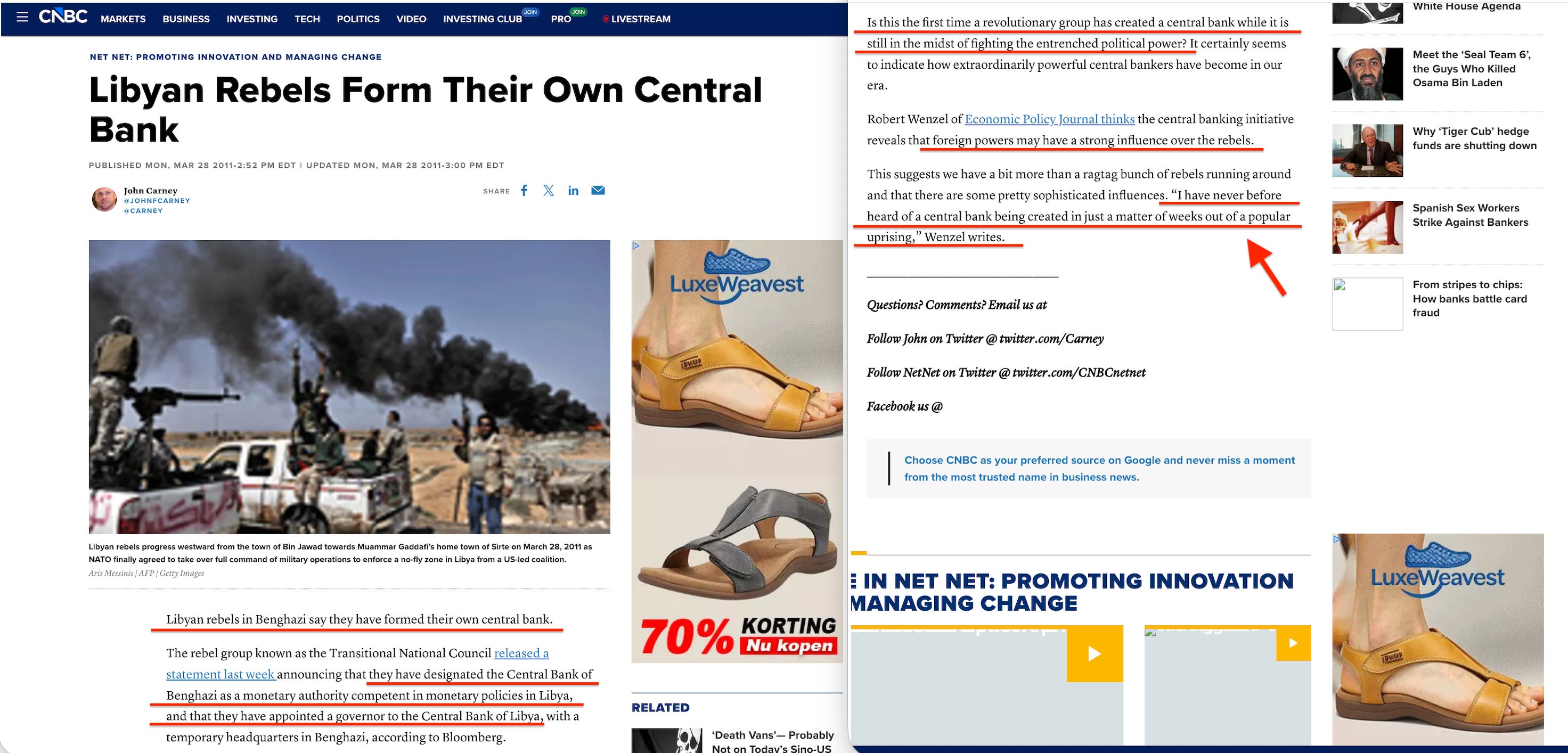
The most dramatic example came in 2011. Libyan rebels, in the middle of a civil war with Gaddafi still in power, established the Central Bank of Benghazi59. They hadn’t yet even won the war. They hadn’t set up courts, a constitution, or a functioning government. Their first institutional act was creating a central bank and a national oil company — the node and the commodity60.
Gaddafi’s central bank had been one of the few in the world entirely state-owned and outside the standard international framework61. The rebels’ first priority was replacing it with one that would connect to the network.
The BIS membership list confirms the pattern from the other direction. Sixty-three central banks are currently members. The missing ones include Iran, Syria, Cuba, and North Korea — the states under maximum international pressure. Iraq wasn’t a BIS member before 2003; its central bank was restructured after invasion62. Afghanistan wasn’t a BIS member before 2001; a new central bank was set up after regime change. Libya’s state-owned central bank was replaced in 2011. Most of sub-Saharan Africa remains outside BIS membership63 — only Algeria, Morocco, and South Africa from the entire continent.
The states outside the clearing network face sanctions, invasion, or isolation. Those brought in are brought in through regime change. And the central bank is the first institution set up or restructured.
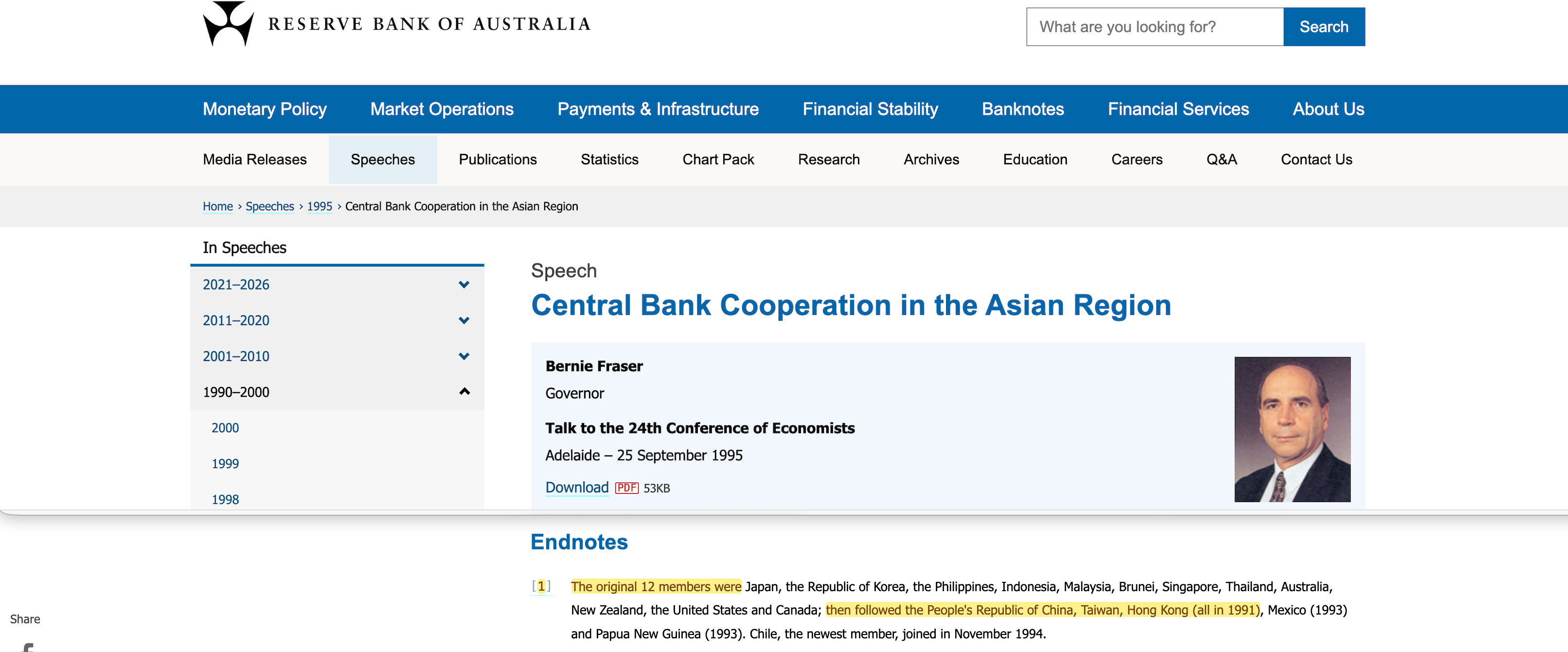
China proves this from the other direction. The People’s Bank of China joined EMEAP — the Executives’ Meeting of East Asia-Pacific Central Banks — in 199164, the year after it was founded. Full BIS membership followed in 199665. China’s extraordinary economic development didn’t begin in earnest until the central bank was connected to the network.

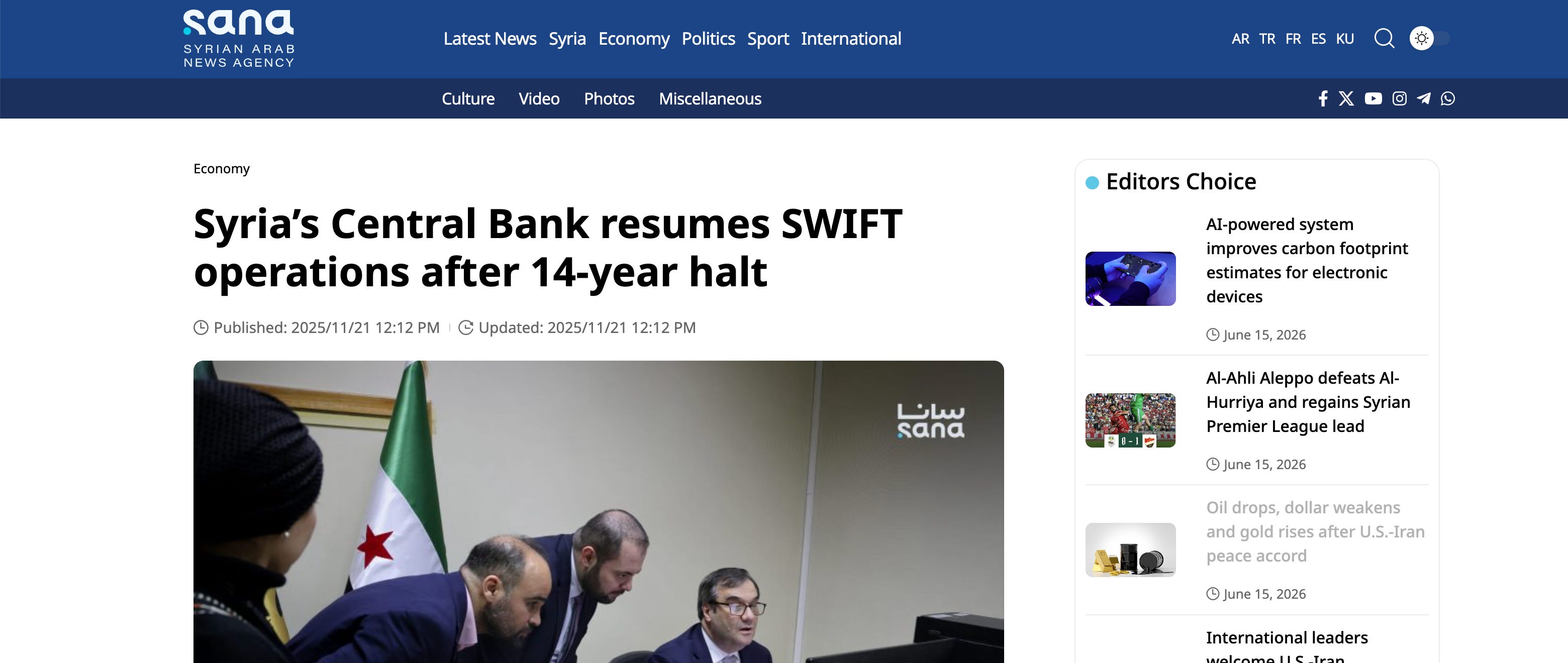
Syria shows the pattern playing out right now. Cut off from SWIFT around 2011, its banks spent fourteen years unable to communicate with the international financial system. The economy, in the central bank governor’s own words, ‘turned into a humanitarian economy‘. After regime change in late 2024, the new government’s first priority was reconnecting the node. In November 2025, the Central Bank governor sent the first SWIFT messages to correspondent banks worldwide, including the US Federal Reserve66.
Congress repealed the Caesar Act in December67. The Central Bank began preparing ‘a new regulatory and supervisory framework‘ to meet ‘global standards‘ and ‘strengthen the position of the Syrian banking sector within the international financial architecture‘68.
More than fifty international banks expressed interest in opening branches before sanctions were formally lifted. The capital was waiting, but the clearing infrastructure was the bottleneck.

And the EU spelled out the terms of reconnection: correspondent banking relationships, joint ventures, and branch offices — all conditional on meeting anti-money-laundering rules, counter-terrorist-financing standards, and remaining sanctions requirements. These rules aren’t written by the countries that must comply with them. They’re set by the Financial Action Task Force — headquartered at the OECD in Paris, dominated by Western member states — and enforced through its grey list and black list, which function as clearing conditions in all but name. The Basel Committee sets the banking supervision standards69. The Egmont Group coordinates the financial intelligence units that monitor compliance70. The conditions arrived with the reconnection — and every one of them was drafted somewhere the Syrian population has no seat.
Verrijn Stuart specified this at Volta in 1932: central bank authority above the nation, at the BIS, beyond any electorate. The specification wasn’t just about monetary policy — it was about ensuring every country has the node through which clearing conditions can be applied.
The central bank is the motor way, the conditions are the tollbooth. And whoever sets the conditions governs the traffic.


The Washington Consensus: the next generation
The 1990s neoliberals operated inside Röpke’s architecture while claiming they’d developed something new. The Washington Consensus71 — privatise, liberalise capital accounts, maintain fiscal discipline, open markets — was Röpke's framework with the racial vocabulary encoded as clearing conditions. Countries wanting access to international capital markets, IMF loans, or World Bank support had to meet compliance conditions set by Washington institutions the affected populations didn’t control or elect72. The transaction only cleared if conditions were met.
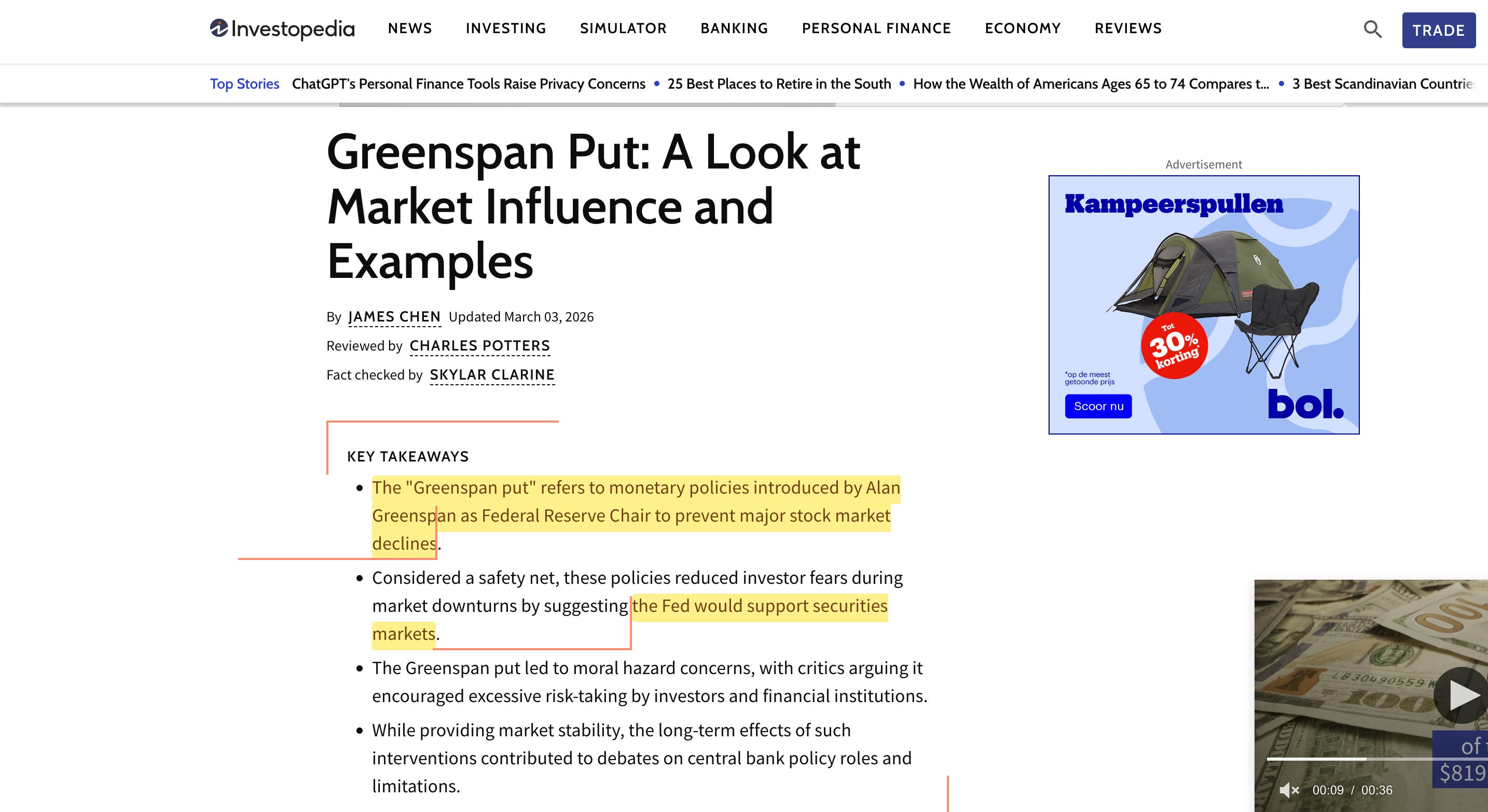
Alan Greenspan was Verrijn Stuart’s specification in American form. His interest rate decisions set global financial conditions. His deregulation removed democratic oversight that might have constrained the clearing layer. The ‘Greenspan put‘73 — the market’s understanding that the Fed would intervene to protect asset prices — was a condition set by one unelected official, applied to the global financial system74.
And the same figure who shaped those conditions — Robert Rubin — moved from Goldman Sachs to Treasury to Citigroup, showing how the institutions that set conditions and the institutions that profited from them shared personnel75. He helped repeal Glass-Steagall76, removing the internal walls that had kept commercial and investment banking apart.
Lawrence Summers pushed capital account liberalisation on East Asia77. When the Asian financial crisis hit in 1997, the IMF imposed structural adjustment on Thailand, Indonesia, and South Korea78 — conditions serving Wall Street’s interests rather than the affected populations’. The crisis was the clearing function working as designed: countries that couldn’t meet conditions were cut off from international capital flows, their transactions stopped clearing, their currencies collapsed, and their assets were bought at distressed prices by the institutions that had set the conditions.
The same Summers later advised Barry Silbert’s Digital Currency Group79, championing digital currencies as ‘new platforms for financial inclusion‘ — having previously discussed Bitcoin and digital currencies in Jeffrey Epstein’s Manhattan townhouse. The man who pushed capital account liberalisation on Asia in the 1990s was advising on the next iteration of the settlement layer’s infrastructure by the 2010s.

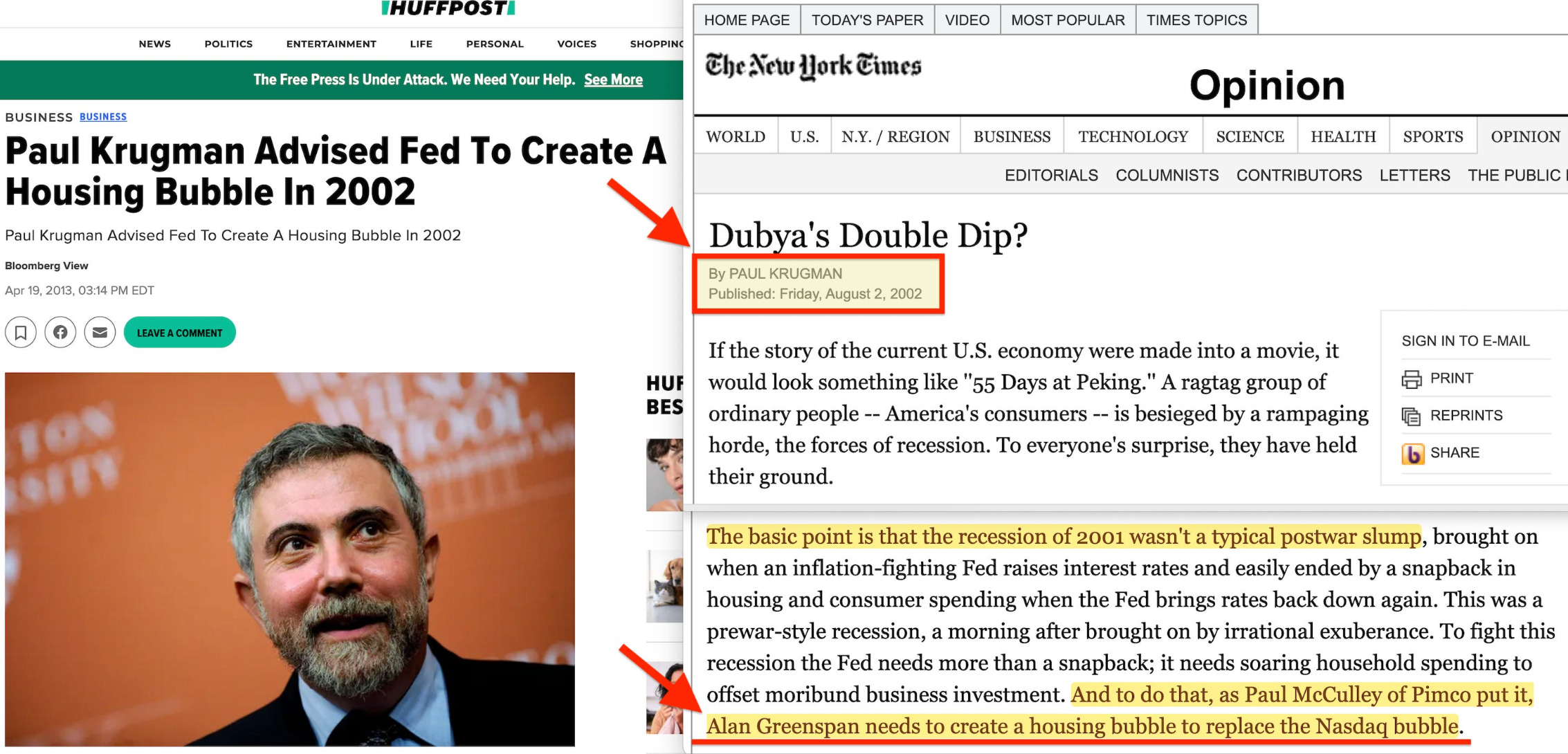
Paul Krugman8081 and Frederick Mishkin provided the intellectual infrastructure — economists whose models gave academic legitimacy to the conditions the clearing layer imposed. Krugman’s trade models justified liberalisation82. Mishkin’s central banking textbooks trained the next generation of central bankers in the orthodoxy that placed monetary policy beyond democratic reach83.
The academic literature was the ethic-to-standard pipeline: economic theory produced the standards, the standards produced the IMF conditions, and the IMF conditions governed the clearing layer.
Joseph Stiglitz is the internal critic who confirms the architecture by describing it from inside84. His books after leaving the World Bank — Globalization and Its Discontents85, The Price of Inequality — document how the Washington Consensus imposed conditions on countries that had no say in writing them. He describes the power imbalance in detail — without naming the clearing layer underneath, though his evidence confirms it's there.
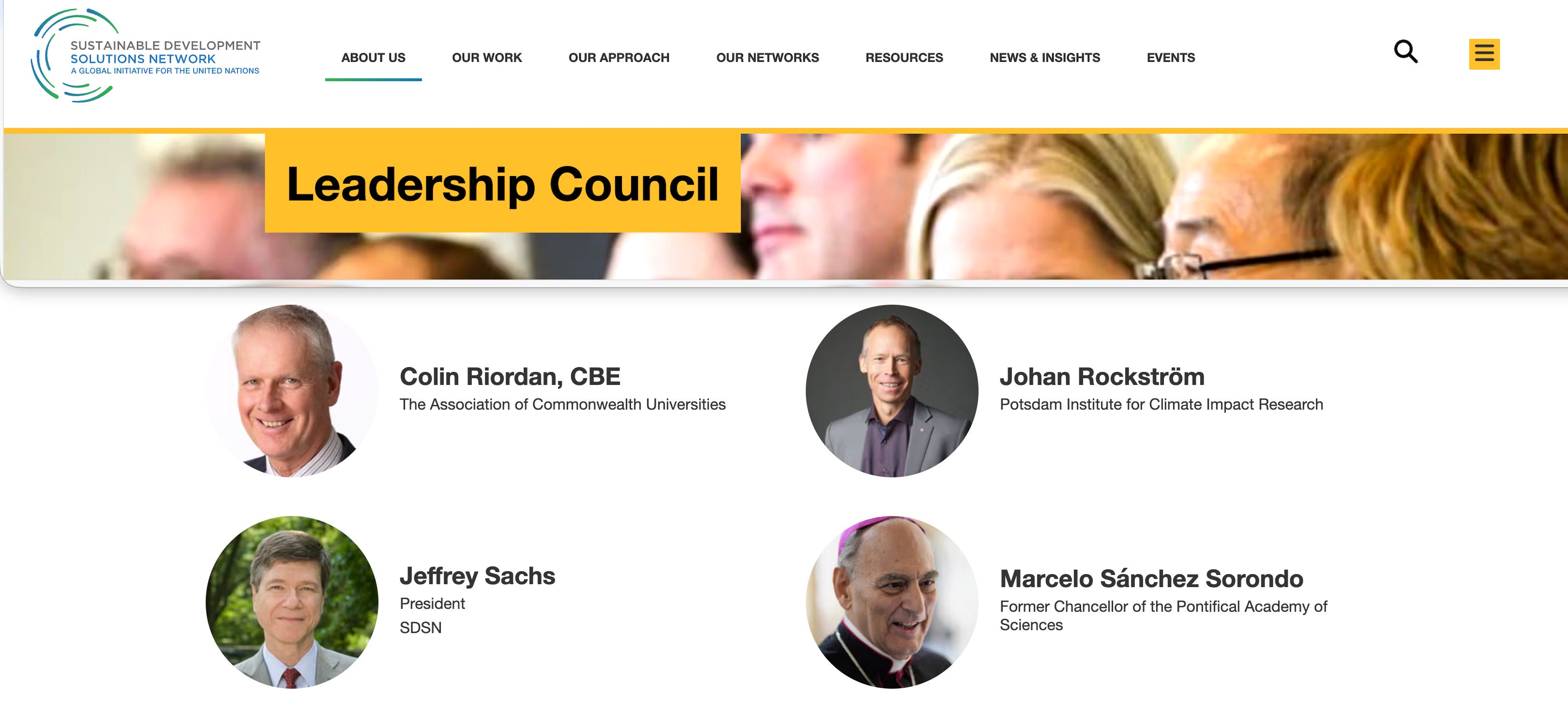
Jeffrey Sachs is the most revealing figure, because he shows the shifting ethic in a single career. In the early 1990s, he designed ‘shock therapy‘ for Russia and Eastern Europe — rapid privatisation, liberalisation, fiscal austerity86. The ethic was market freedom. The conditions were enforced through IMF loans. Then he pivoted to the Sustainable Development Goals and became one of the most prominent advocates for the sustainability framework87. Same institutional method, different ethic. The conditions attached to international participation shifted from market liberalisation to sustainability compliance.
The mechanism didn’t change. Sachs shifted with the ethic — and that’s how you know the ethic’s the variable and the mechanism’s the constant88.

North and South
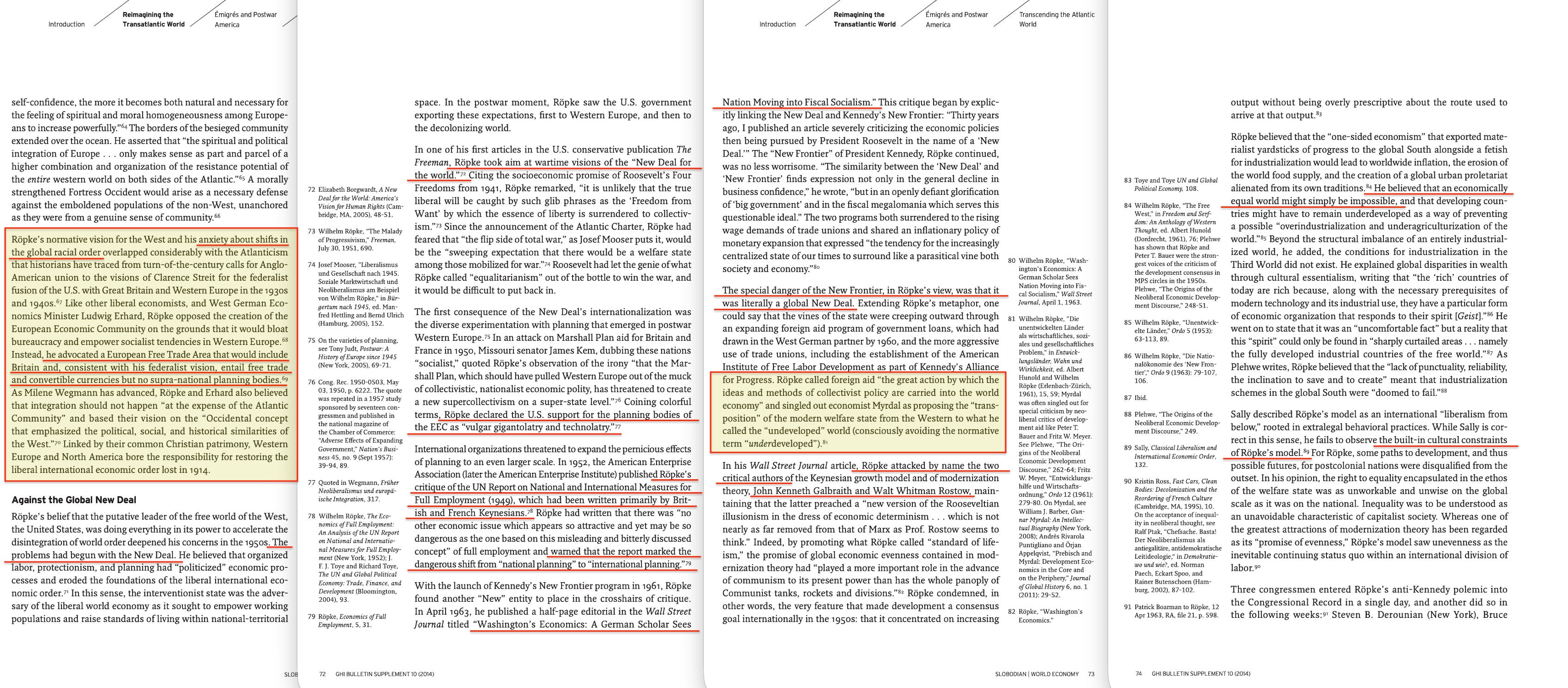
Röpke’s framework was always about the North controlling how the South accessed the international economic order. He called foreign aid ‘the great action by which the ideas and methods of collectivist policy are carried into the world economy‘89. He argued that developing nations lacked the cultural prerequisites for industrialisation — and turned that argument into the financial conditions that decided who could participate and on what terms.
The architecture faced one challenge, at least in theory. In 1974, the UN General Assembly adopted the Declaration on the Establishment of a New International Economic Order90. The Group of 7791, working through UNCTAD, demanded commodity price stabilisation, sovereign control over natural resources, technology transfer, debt relief, and reformed terms of trade92. The NIEO was mounted through the UN General Assembly — the one institution where the global South had a numerical majority.
But consider what was demanded — and what was delivered. Commodity price stabilisation arrived as carbon trading. Sovereign control over natural resources arrived as ecosystem services managed through GEF blended finance deals93. Technology transfer arrived, conditioned through the sustainability taxonomy. Debt relief arrived as debt-for-nature swaps.
Every demand was met — but on terms the South didn’t write, routed through the clearing layer they didn’t control.
The sovereign debt crisis of the early 1980s94 — triggered by Volcker’s interest rate shock at the Fed95 — placed the global South in exactly the position Röpke’s framework was designed to produce96. Countries that couldn’t service their dollar-denominated debt had to go to the IMF, which imposed structural adjustment: privatise, liberalise, deregulate, open capital accounts. The loan that prevented sovereign default only cleared if the conditions were met. The countries that had challenged the system became more dependent on it than ever.


IFDA’s Third System97 provided the governance framework. Marc Nerfin’s formulation — government as the first system, business as the second, civil society as the third — allegedly created a role for populations ‘demanding a voice’. But civil society organisations drive the ethic itself: environmental NGOs produce the sustainability ethic, human rights organisations the social ethic, public health NGOs the health security ethic. They campaign, generate public pressure, and create the moral case — and standard-setting institutions then translate that ethic into clearing conditions.
Civil society occupies the apex, producing the purpose that makes the architecture appear legitimate. But it doesn’t control the mechanism — the standards, clearing evaluation, settlement conditions, and monetary hierarchy that enforces them. And none of these layers arrive at decisions, democratically.
The institutional blueprint was established in 1992. Agenda 2198 — the third major output of the Earth Summit in Rio, alongside the UNFCCC and the Convention on Biological Diversity which provided the ethic — proposed a tripartite governance structure: public sector, private sector, and NGOs, with the latter participating in decision-making at the highest levels of international affairs since 199899. It was at the time framed as a ‘soft law’ instrument — voluntary, aspirational — but what it actually described was the governance model that would be built over the next decade.


Kofi Annan’s 1997 UN reforms opened the door. His restructuring broadened NGO participation to include civil society organisations more widely — not just NGOs but unions and similar groups — and by 1998, ECOSOC Resolution 1996/31100 expanded consultative status. Senior NGOs with General Consultative Status could now place items on the agenda.
The soft-law blueprint from Rio was being wired into the institution’s operating structure.

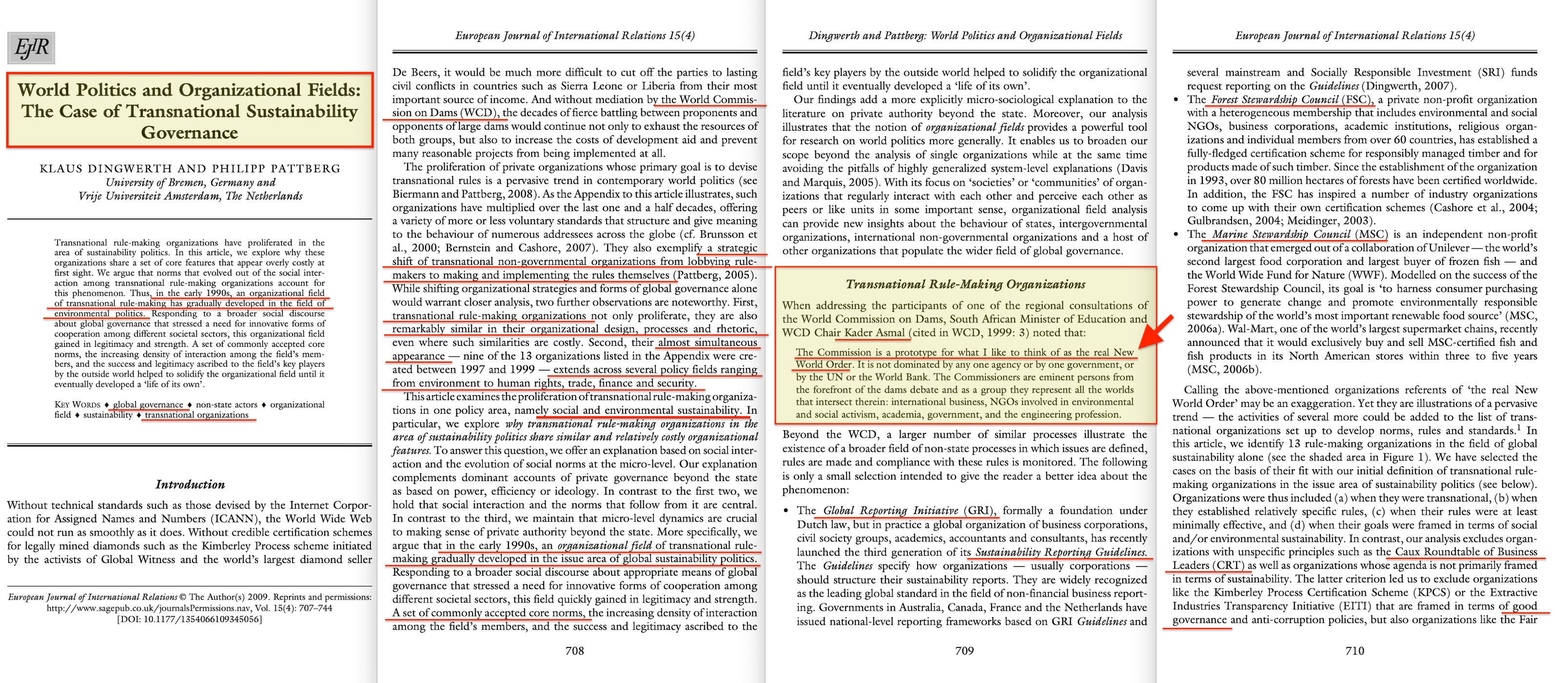
The model got its pilot experiment that same year. The World Commission on Dams101, launched in 1997 by the IUCN and the World Bank, brought together international business, NGOs, academia, government, and engineering professionals to resolve a ‘highly contentious‘ issue through multi-stakeholder governance. Its chair, South African Minister Kader Asmal, was explicit about what it represented102:
The Commission is a prototype for what I like to think of as the real New World Order.
The WCD proved the trisectoral model could work in practice — and its framework for ‘equitably sharing benefits, costs, and risks at the global, national, and local levels‘ became the template.


Blair and Clinton’s Third Way implemented the same in the United Kingdom and the United States in 1998, while Wolfgang Reinicke’s trisectoral networks completed the build, embedding the model into UN policy by 2000103: government, business, and civil society jointly managing global governance — the Third Way applied to international development. It looked inclusive. But the clearing conditions were still set by the same institutions, enforced through the same settlement layer, beyond the same electorates.
The trisectoral framework provided the ethic of ‘participation’. The clearing function provided the mechanism of control. The conditions were set before the stakeholders were even consulted.


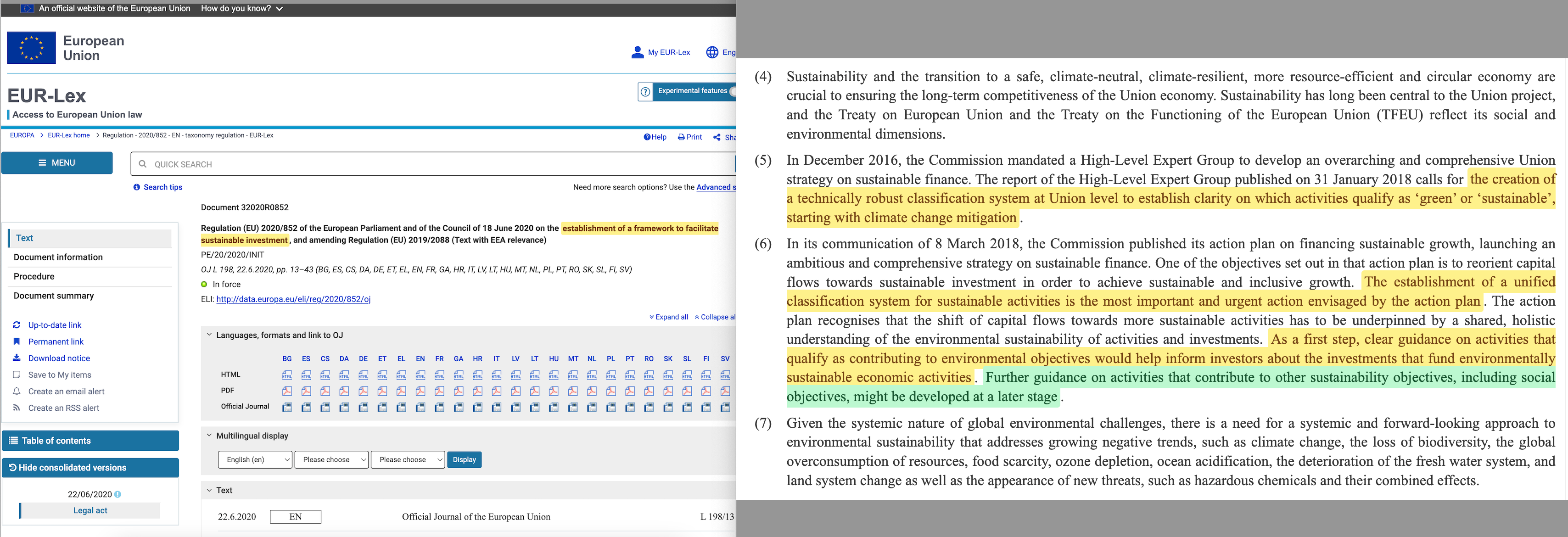
And the sustainability taxonomy completed the loop104. Conditions that structural adjustment had imposed through fiscal and monetary policy were reimposed through environmental and social standards — written by the EU, applied globally through capital market access, enforced through the same clearing layer.
A developing country that had survived structural adjustment’s privatisation conditions now faced the taxonomy’s sustainability ones.
Different ethic. Same mechanism. Same direction of flow — conditions set by the North, enforced through the settlement layer, determining who in the South can participate and on what terms.
The NIEO is the proof — legitimate or not — that the architecture absorbs opposition by delivering the demands through its own mechanism. The challenge came through the UN. The response was to shift delivery from the forum where votes applied to the clearing layer where they don’t.
Structural adjustment, trisectoral governance, and the sustainability taxonomy all replace democratic deliberation with clearing-layer conditionality.
Röpke called apartheid ‘the specific form in which South Africa pursues the policy of ‘decolonializing’ and ‘development aid’ which corresponds to this country’s needs‘. Conditions imposed from outside, framed as being for the benefit of those they’re imposed on. The framing has been remarkably consistent.

What survived 2008
The 2008 financial crisis105 destroyed the Washington Consensus as an intellectual programme106. The ethic — market fundamentalism, deregulation, the efficient-market hypothesis — was discredited. The models failed, and Lehman collapsed107.
But the architecture didn’t collapse with the ethic — it merely changed. Within three years, the same institutional infrastructure — the BIS, the Basel Committee, the central bank supervisory network, the IMF conditionality framework — was being repurposed for a new ethic: financial stability, macroprudential regulation, and then sustainability.
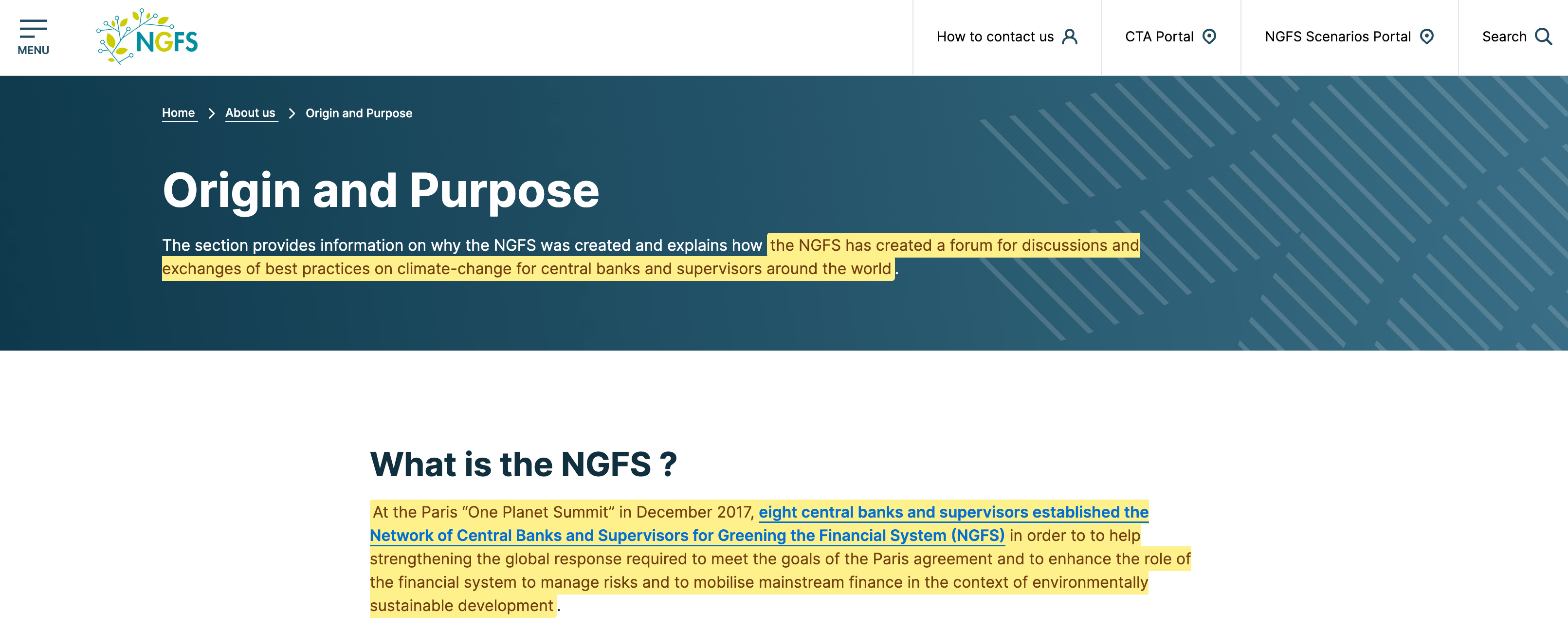
The NGFS was founded in 2017108. The EU taxonomy was legislated in 2020. The conditions attached to the settlement layer shifted from market liberalisation to climate compliance. The institutions, the enforcement layer, and the exclusion of affected populations all remained the same.
Röpke’s Third Way left the fiscal layer to elected politics, but the monetary layer was deliberately placed under expert control. Now, through NEF’s framework and the Fabian Society’s policy vehicle, a new Third Way is being proposed: coordinated technocratic management of both monetary and fiscal policy, justified by sustainability.
The clearing function that began on the monetary layer has spread to the fiscal layer, and formally integrating them is the final step. Once monetary and fiscal policy are coordinated through the same framework, conditioned by the same standards and overseen by the same expert class, the line between clearing and spending disappears. There’s no layer left that the electorate controls.


And that’s another confirmation of a central claim. If the architecture were the ethic’s product, it would have collapsed when the ethic was discredited. It didn’t — because the architecture isn’t the ethic’s product. The ethic is the architecture’s justification. The mechanism persists because whoever operates the settlement layer has a structural incentive to maintain it, and any ethic will do.
Röpke’s career documents this in miniature. He opposed the Nazis, yet built the ordoliberal architecture, defended apartheid, and even preempted green capitalism. His intellectual lineage developed into the Washington Consensus. When that collapsed, the architecture shifted to an ethic of sustainability. The same mechanism, but now with a new ethic. The mechanism centralises power with he who clears, on account of standards derived from an ethic no-one could realistically challenge, leading to settlement.
And this all runs through the central banks, and certainly not the voter.
Ethics — Standards — Clearing — Settlement — Outcome
‘The Third Way’ isn’t a political philosophy. It’s the clearinghouse’s political name.
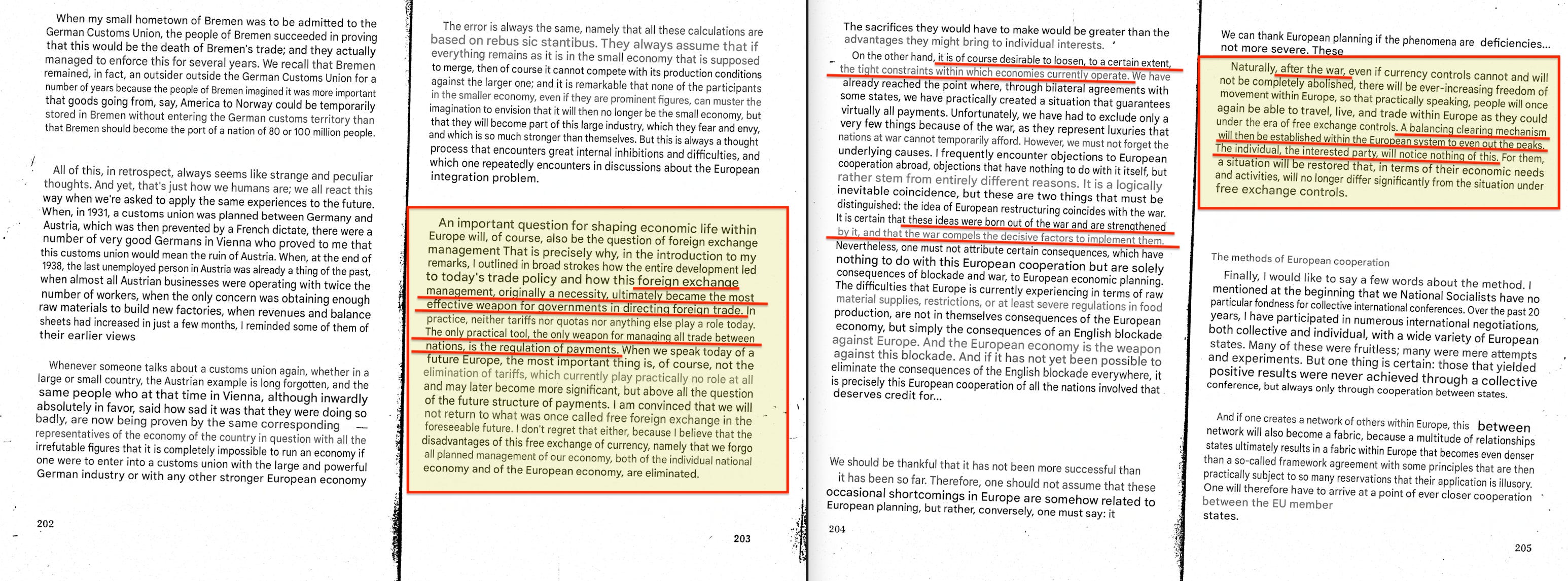
It primarily benefits the central banks, and as Carl Clodius — architect of the Nazi bilateral clearing system — put it in 1942: the individual, the interested party, will notice nothing of this.

Find my Telegram channel over here.
"Ethics."
That's a word without meaning even out of the context of this discussion. The meaning of the word is all in the mind of the individual saying it, and is not the same as in the mind hearing it. Highly subjective.
Which is why it is so easy to shapeshift, apply to contradictions, there is no "ethic" etched in stone.
First understanding the general systems of ethics, and there are countless, but most fall under three broad systems, Virtue, Kantian and Utilitarian. Virtue and Kantian ethics are systems that most people think of when they hear the word, 'ethic.' The treat others as you would be treated, respect for the individual, etc. Utilitarian ethics is the system that those in positions of authority employ. Greater good. Breaking eggs to make omelets. Ten shall die so fifty shall live. Nations shall fall so global trade shall rise.
I am not an ethicist, nor highly studied in them, others will do a better job of describing the systems more accurately than I, mine is a basic understanding I've explored since 2020. The "noble lies" of the Fauci's were considered ethical. My exploration of the philosophies and applications of ethics systems has informed me that there's an endless supply of studies and papers on "ethical lying," "ethical genocide," all sorts of horrible crimes against humanity have ethicists who made the case that they were ethical, necessary to serve a "greater good." Dangerous bioweapons were mandated injected into entire populations with the full knowledge they were "unavoidably unsafe" and protected from liability with that official designation, all the while authorities boasted they were completely "safe and effective." Ethical lying. Ethical dying. Var. Utilitarian ethics.
The entire field of ethics exists to give those in positions of authority over others a perceived stamp of moral approval to gain the consent of those who their directives harm. Ethicists are more flexible than Olympic gymnasts, more flexible than circus show freaks without joints in their ability to declare anything they are hired to say is ethical. Yes, even including "ethical genocide." Look it up if you don't believe me.
It works all because most people have no clue what the word ethics means when it comes to those entrusted with power. Most people think ethics is how they treat their neighbor Jim Bob, coworker Gilian, their dog Spike, their mailman, their lawn guy, the nameless cashier. And never suspect those in power have an entirely different system of ethics that would leave them and their entire family dead without remorse, ostensibly to save a snail darter. Not exaggerating. The rape gangs and beheadings are ethical - diversity is our strength. Remorse? Ha!
So when I read the word "ethic," now knowing that it means nothing to those in positions of authority and power in a presentation like this I'm left with, "And?" It's meaningless. And those who speak of ethics only care about the utility of the word, not any meaning they want others to hear in their own minds.
The followers on to that ‘compassionate conservatism‘ movement are on track to kill at least as many people as communist purges ever did.