
Mansion House

On 27 May 2014, Prince Charles spoke at the Conference on Inclusive Capitalism at the Mansion House in the City of London, co-hosted by the City of London Corporation and E.L. Rothschild.
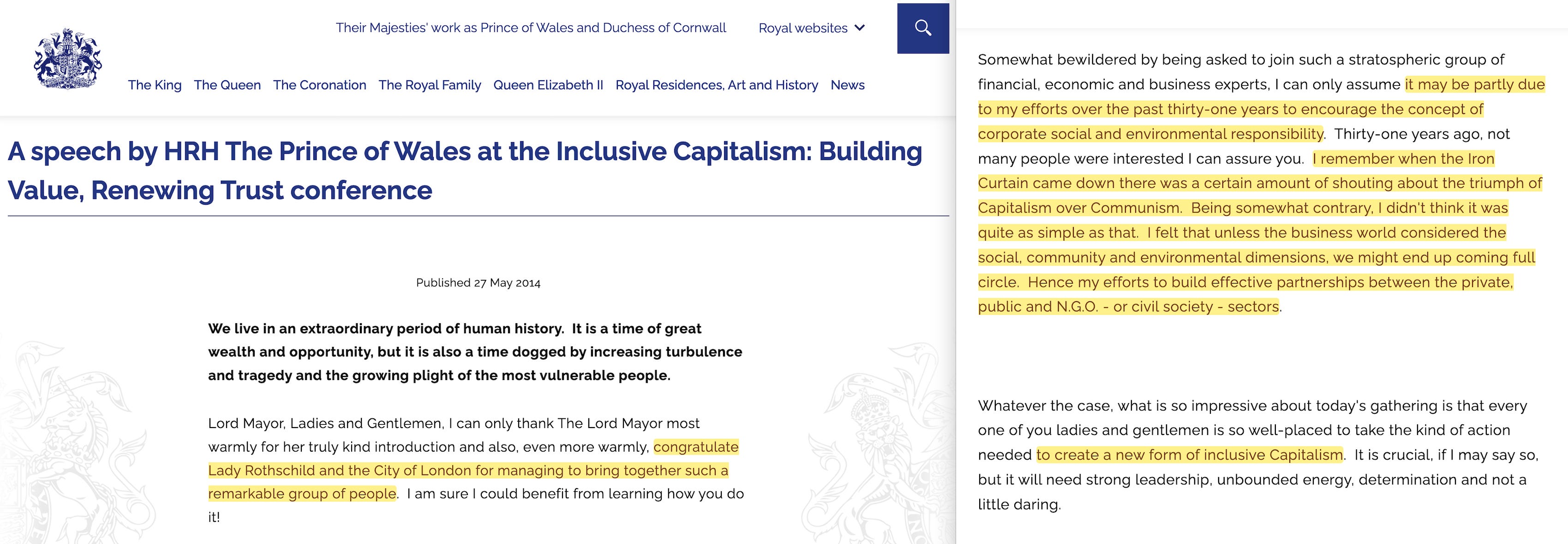
His opening words, preserved on the official royal website, were1:
I can only thank The Lord Mayor most warmly for her truly kind introduction and also, even more warmly, congratulate Lady Rothschild and the City of London for managing to bring together such a remarkable group of people.
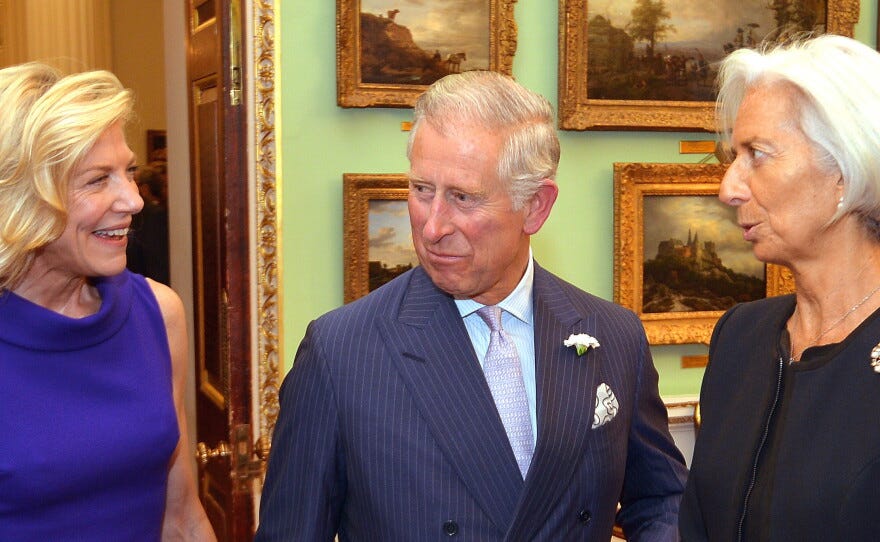
Mark Carney, Christine Lagarde, Bill Clinton — they all spoke. Central bankers, the IMF, and the political establishment sharing a platform on purposive capital under the Rothschild banner.
Fourteen years earlier, James Robertson — NEF’s co-founder — delivered what he called ‘The Alternative Mansion House Speech’2 at a counter-event to the official dinner. He launched the sovereign money specification from the podium, cited NEF’s Living Planet Index3, and proposed a ‘true global currency’. The ‘alternative’ economics movement and the establishment converge at the same address… and the same system.
The Prince told the audience he’d spent thirty-one years encouraging ‘the concept of corporate social and environmental responsibility’. He recalled that when the Iron Curtain came down,
… there was a certain amount of shouting about the triumph of Capitalism over Communism. Being somewhat contrary, I didn’t think it was quite as simple as that. I felt that unless the business world considered the social, community and environmental dimensions, we might end up coming full circle. Hence my efforts to build effective partnerships between the private, public and N.G.O. - or civil society - sectors.


The Bridge
The connection between the Prince’s sustainability programme and the NEF network runs through Jonathon Porritt4.
Porritt co-founded The Other Economic Summit in 19845 and the New Economics Foundation in 19866 — alongside James Robertson, the former Cabinet Office official and Director of the Inter-Bank Research Organisation for the big British banks7.
From NEF, Porritt became Director of Friends of the Earth8 (1984-1990), then co-founded and co-directed The Prince of Wales’s Business and Sustainability Programme through the Cambridge Institute for Sustainability Leadership9. He chaired Blair’s UK Sustainable Development Commission from 2000 to 200910. He chaired UNED-UK — the UN Environment and Development stakeholder governance body — from 1993 to 199611.
Porritt connects the 1984 counter-summit to the Prince of Wales’s business programme, the Blair government’s sustainability commission, and the UN’s stakeholder governance architecture.


Paul Ekins — the other TOES co-founder — took the academic route12. He is now Professor at University College London, the same institution where Josh Ryan-Collins moved from NEF to co-author the capital requirements, credit guidance, and fiscal-monetary coordination papers that the Monetary Allocation Committee essay documents. The 1984 counter-summit’s founding network connects to the university where the programme’s technical papers were produced forty years later.
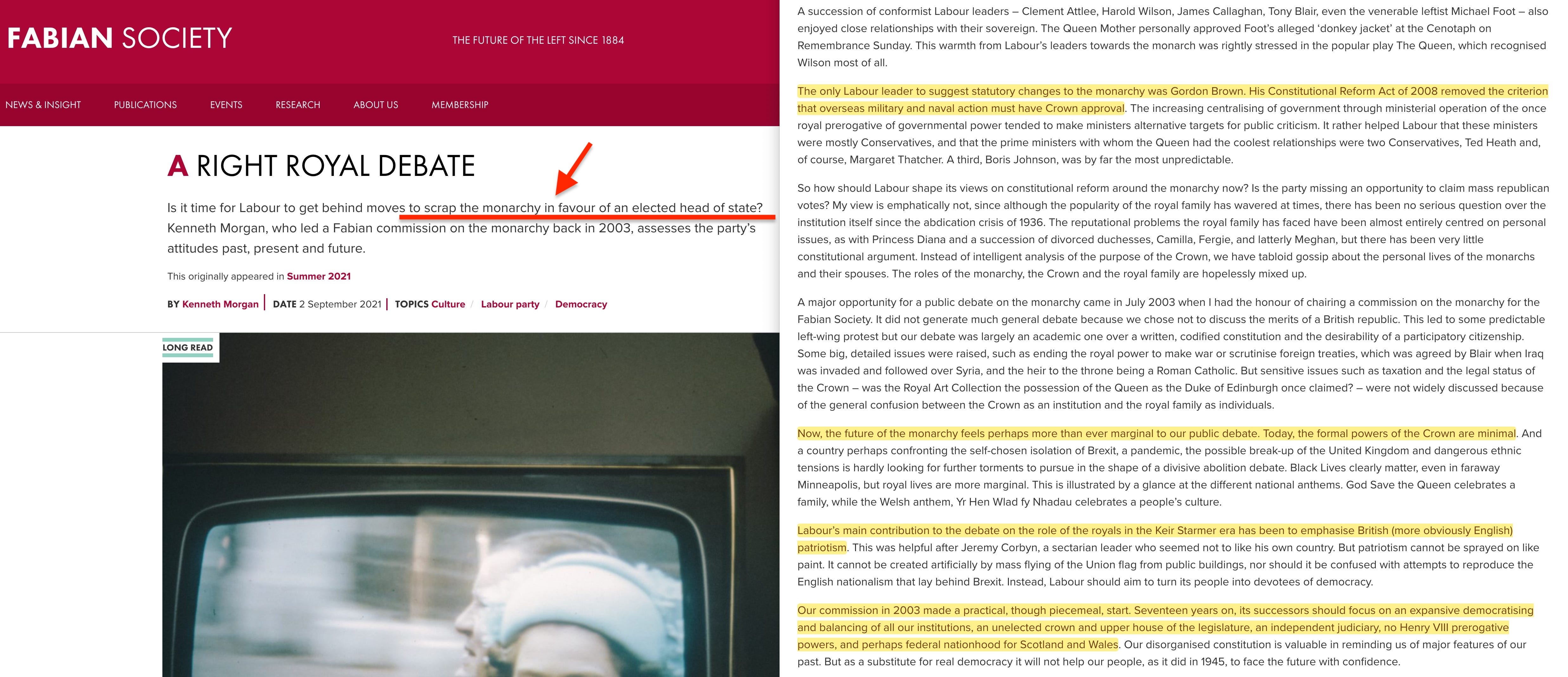
In 2003, the Fabian Society published its Commission on the Future of the Monarchy13 — overseen by Michael Jacobs, who had been the Society's General Secretary since 199714 — examining the Royal Prerogative, the Crown Estate, rules of succession, and the relationship between sovereign and Parliament. The recommendations were ‘incremental, as intended’ — gradual reform accumulating into fundamental transformation. The monarchy’s formal political powers were systematically reduced. What remained was patronage — the ability to lend moral authority to initiatives the Crown couldn’t legislate.
The same Fabian Society that recommended stripping the monarchy of political power published Michael Jacobs’ In Tandem in 202315, proposing the EPCC that would dilute the Chancellor’s authority. Both reduce formal sovereign power. Both redirect governance into trisectoral coordination.
The Fabians seek to replace the crown16 with trisectoral calibrators.


The Prince’s Architecture
The Prince’s institutional programme predates the accounting initiative by fourteen years. In February 1990 — four years after Michael Sweatman proposed the World Conservation Bank17 — Prince Charles personally founded the International Business Leaders Forum1819.
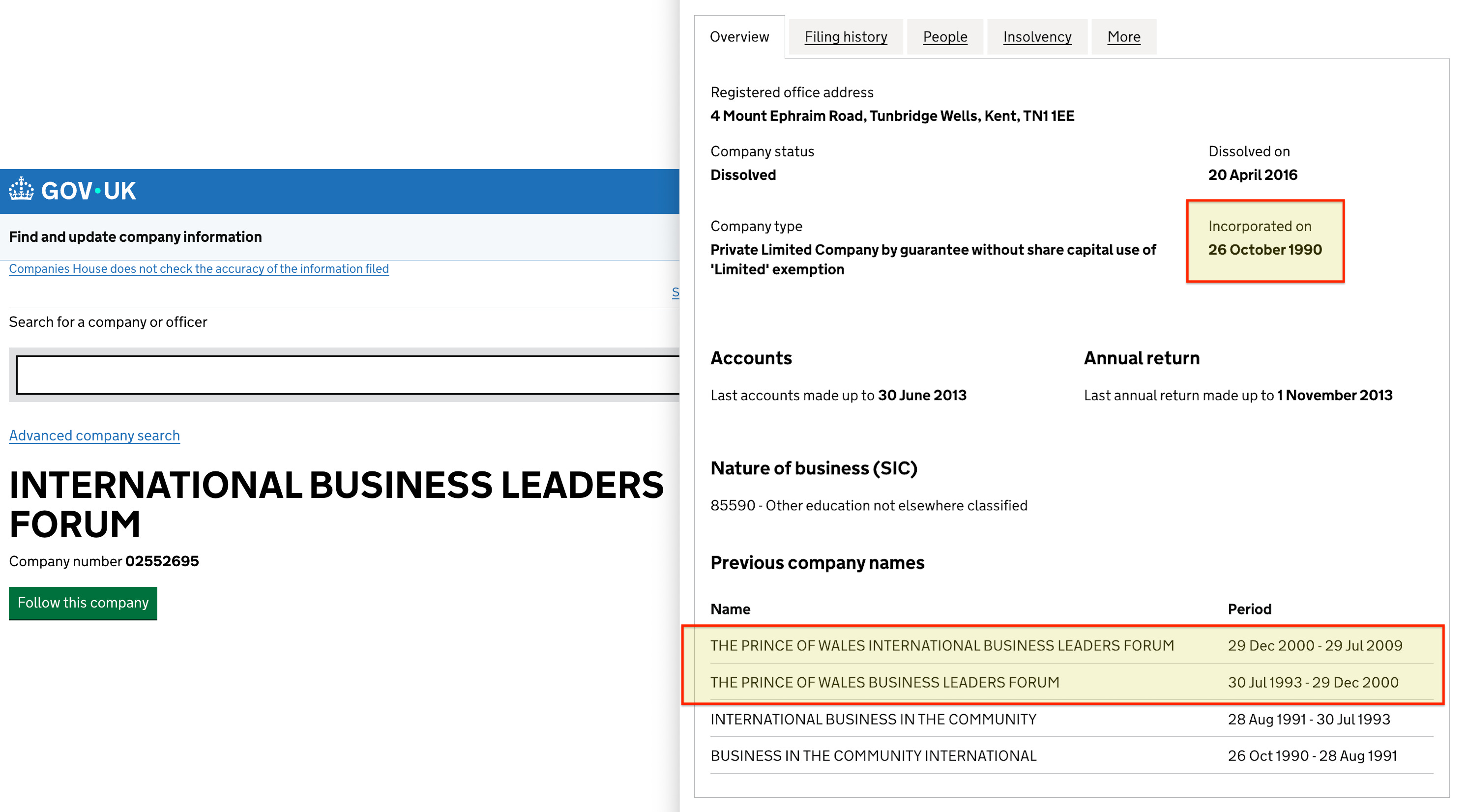
The IBLF’s stated aim was ‘responsible business practices and partnership action for sustainable development’, and its own description stated the trisectoral model explicitly: ‘partnerships between governments, multilateral agencies, civil society organizations and businesses’.
The IBLF ran from 1990 until it ceased operations in October 2013 — the same year NEF proposed the Monetary Allocation Committee. Its institutional links ran to DFID, the World Bank, the United Nations, and the WHO.
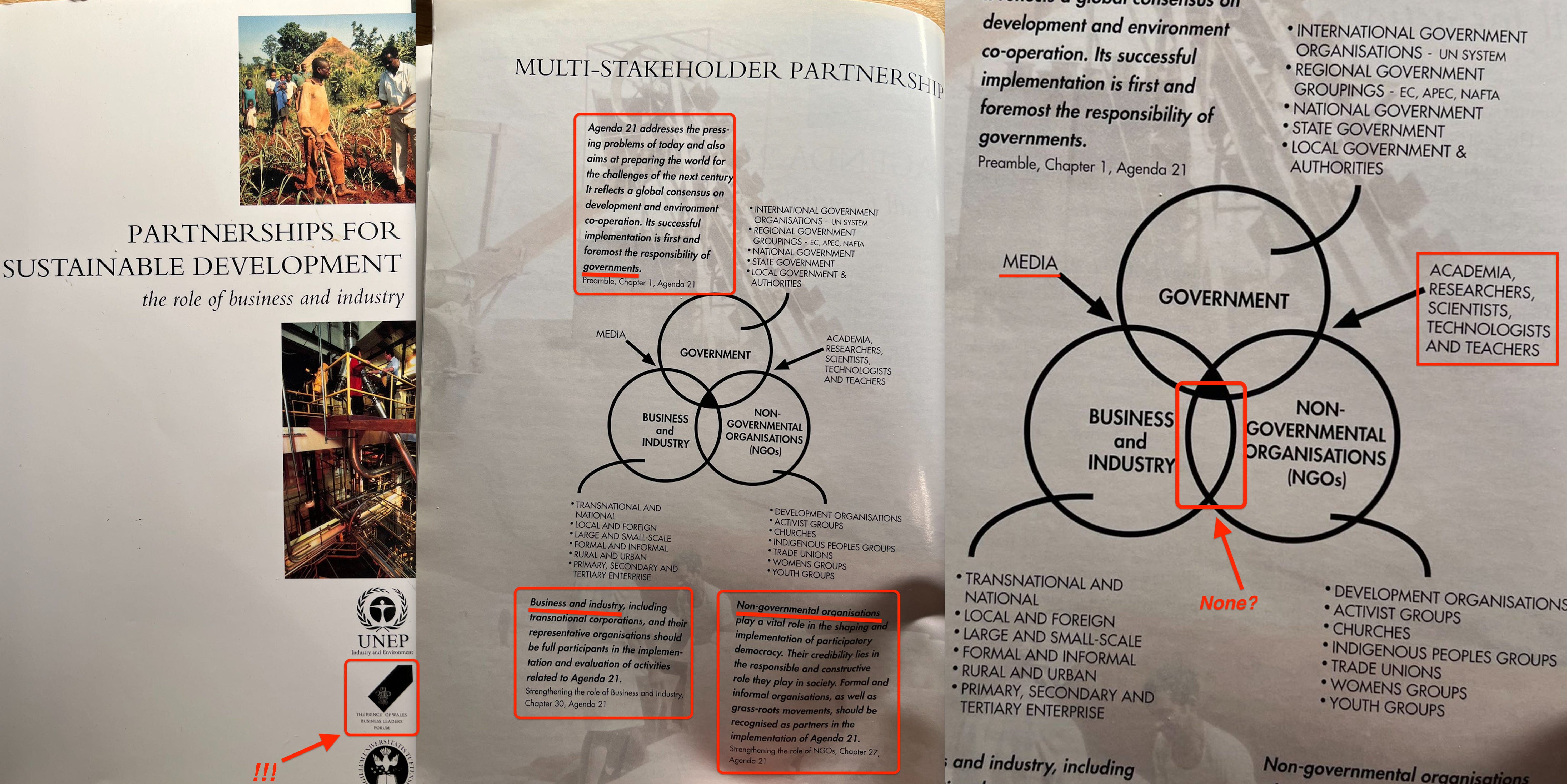
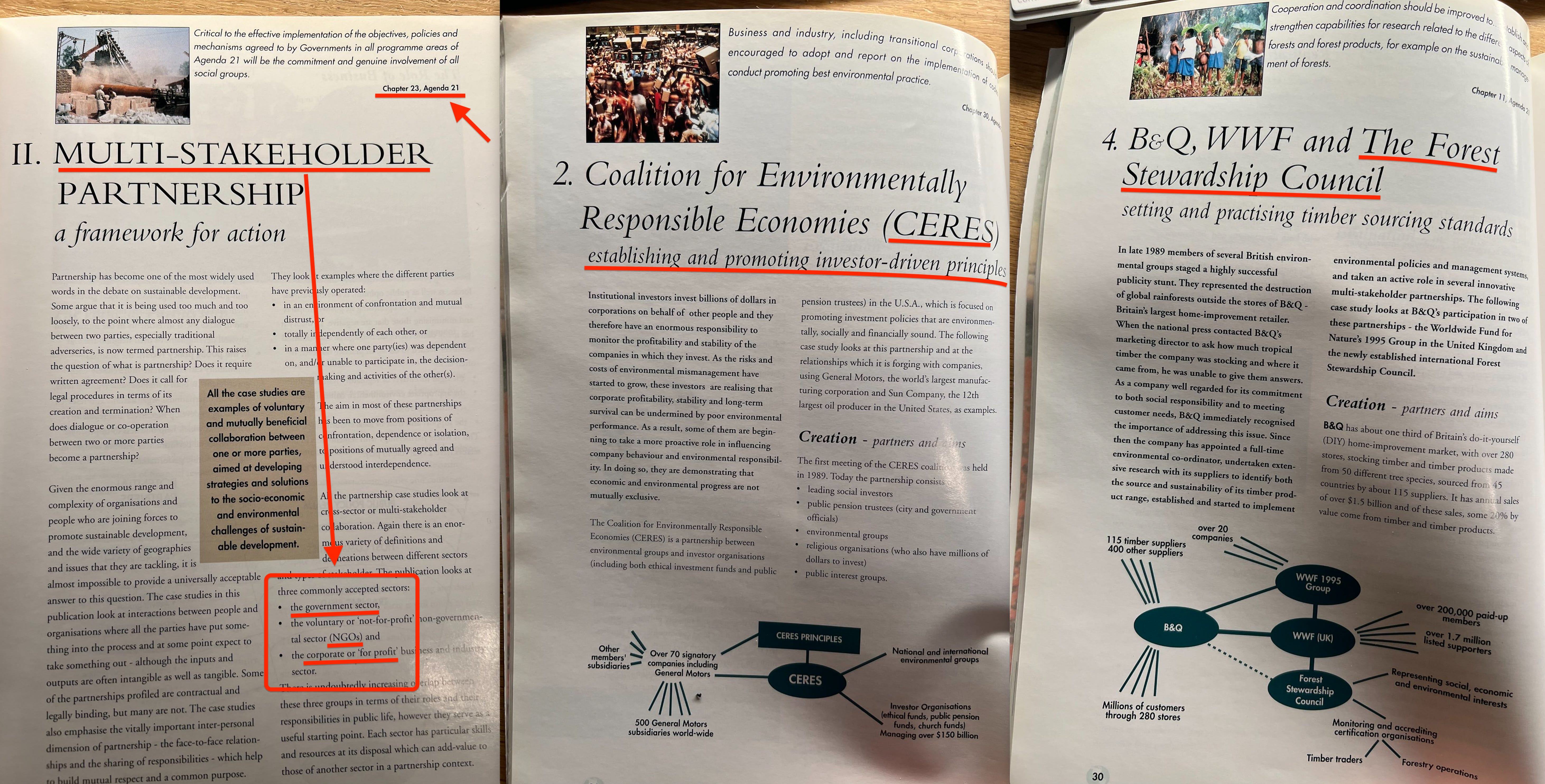
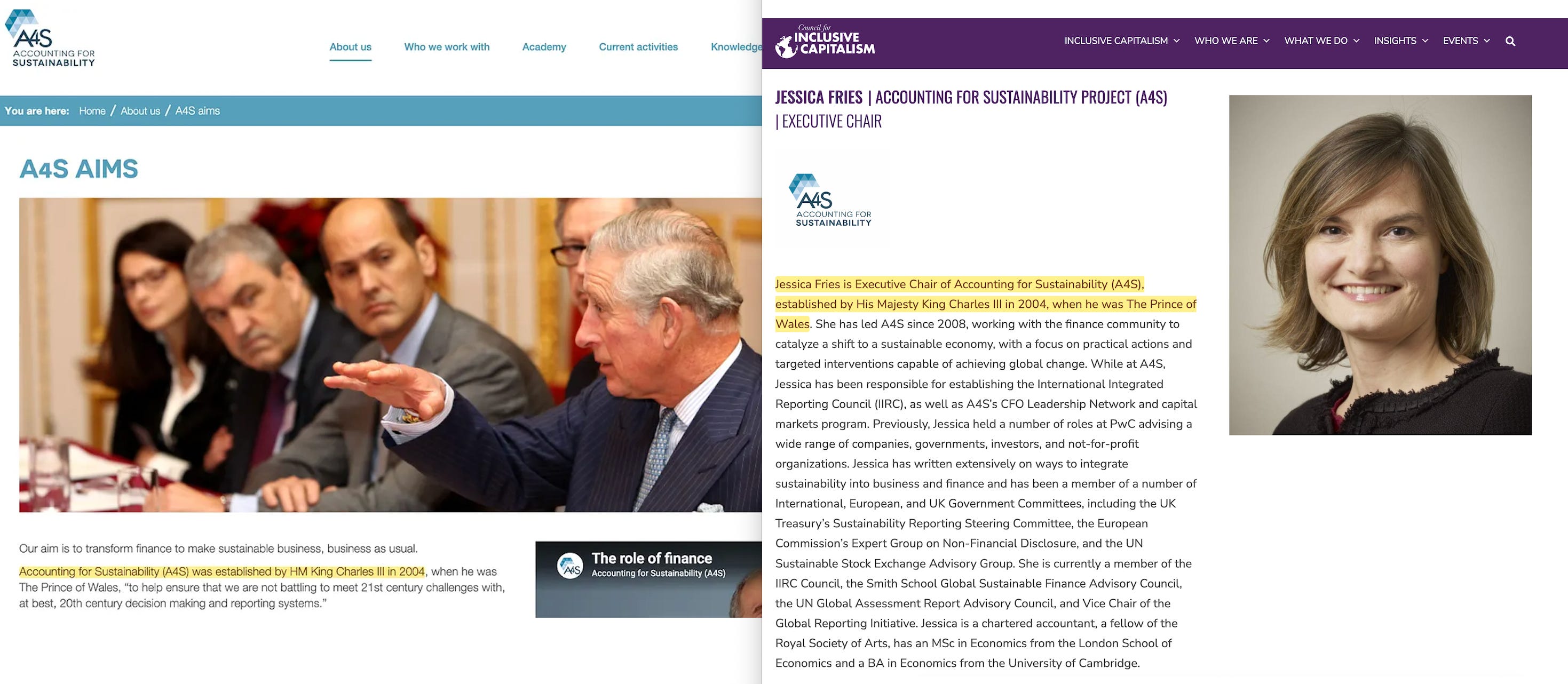
In 2004, Prince Charles founded Accounting for Sustainability20 (A4S), in collaboration with the Treasury and the National Audit Office. A4S created the International Integrated Reporting Council21 (IIRC) and the Climate Disclosure Standards Board22 (CDSB). Both merged into the IFRS Foundation23. In November 2021, at COP26, the IFRS Foundation created the International Sustainability Standards Board (ISSB), consolidating the TCFD’s voluntary disclosure framework into a global mandatory baseline24. The Prince’s initiative produced two of the three bodies that consolidated into the ISSB.
The genealogy runs: Prince Charles → A4S → IIRC/CDSB → IFRS Foundation → ISSB → mandatory global disclosure baseline.
The Prince’s accounting initiative is in the direct lineage of the mandatory disclosure standard the Monetary Allocation Committee essay documents as part of the enforcement architecture.
Jessica Fries — A4S’s executive chair — is listed as a member of the Council for Inclusive Capitalism with the Vatican25, the body Lynn Forester de Rothschild launched in December 2020. Fries connects the Prince’s accounting initiative to the Rothschild inclusive capitalism council.
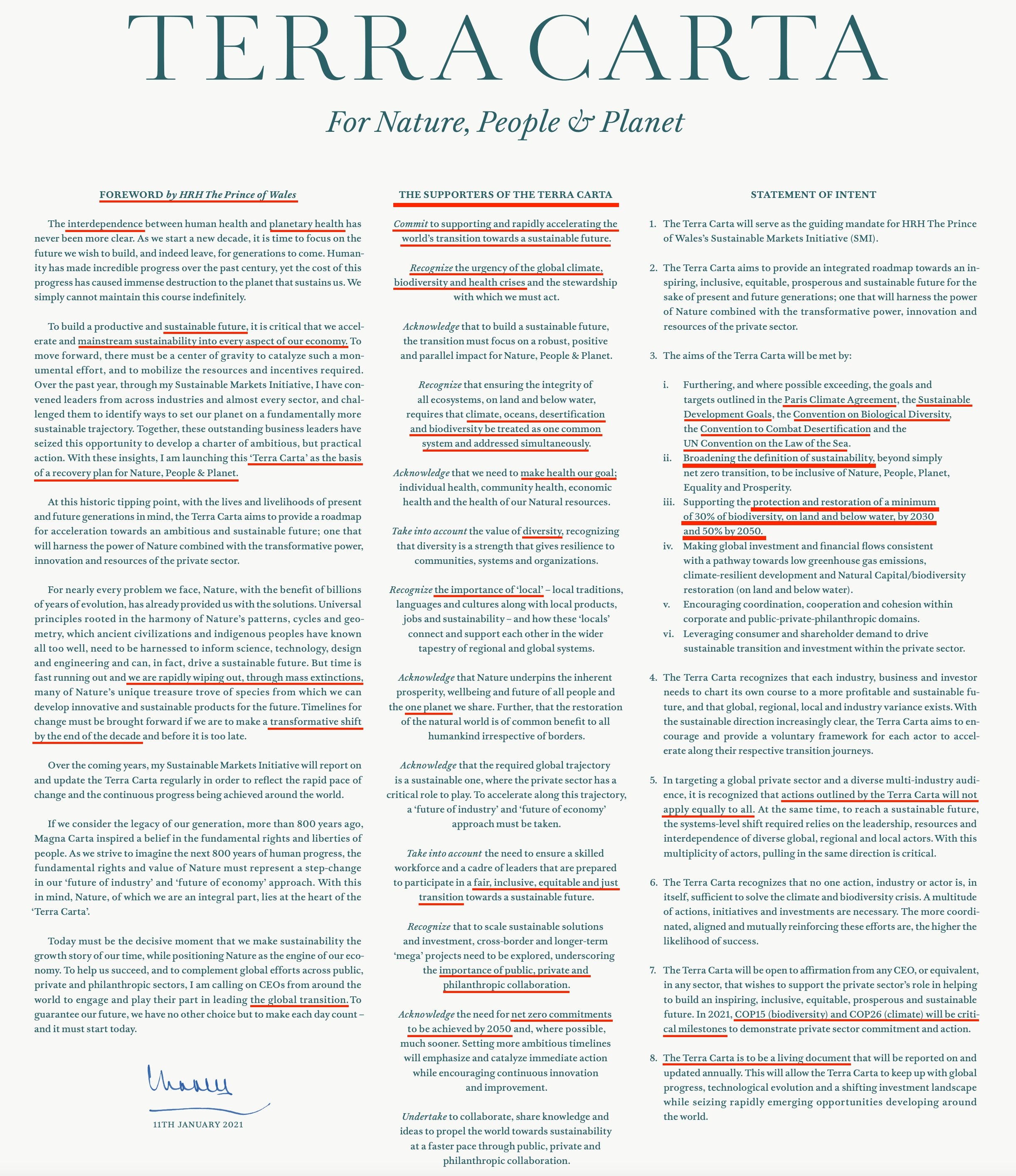
In September 2019, Prince Charles created the Sustainable Markets Initiative ‘in collaboration with the World Economic Forum’. On 11 January 2021, the Prince signed the Terra Carta26 — named after the Magna Carta, launched through the Sustainable Markets Initiative27. The document explicitly references the Paris Agreement, the Sustainable Development Goals, the Convention on Biological Diversity, and calls for ‘the protection and restoration of a minimum of 30% of biodiversity, on land and below water, by 2030 and 50% by 2050’. It demands ‘broadening the definition of sustainability, beyond simply net zero transition, to be inclusive of Nature, People, Planet, Equality and Prosperity’. It calls for ‘public, private and philanthropic collaboration’ — the trisectoral model.
The Terra Carta28 was published two months before Sunak’s remit letter update29, the same year as the Dasgupta Review30, the ISSB creation at COP2631, and van Lerven’s Greening Finance report32. The ethical mandate and the institutional implementation — both arrived in the same twelve-month window.


The Personnel Bridge
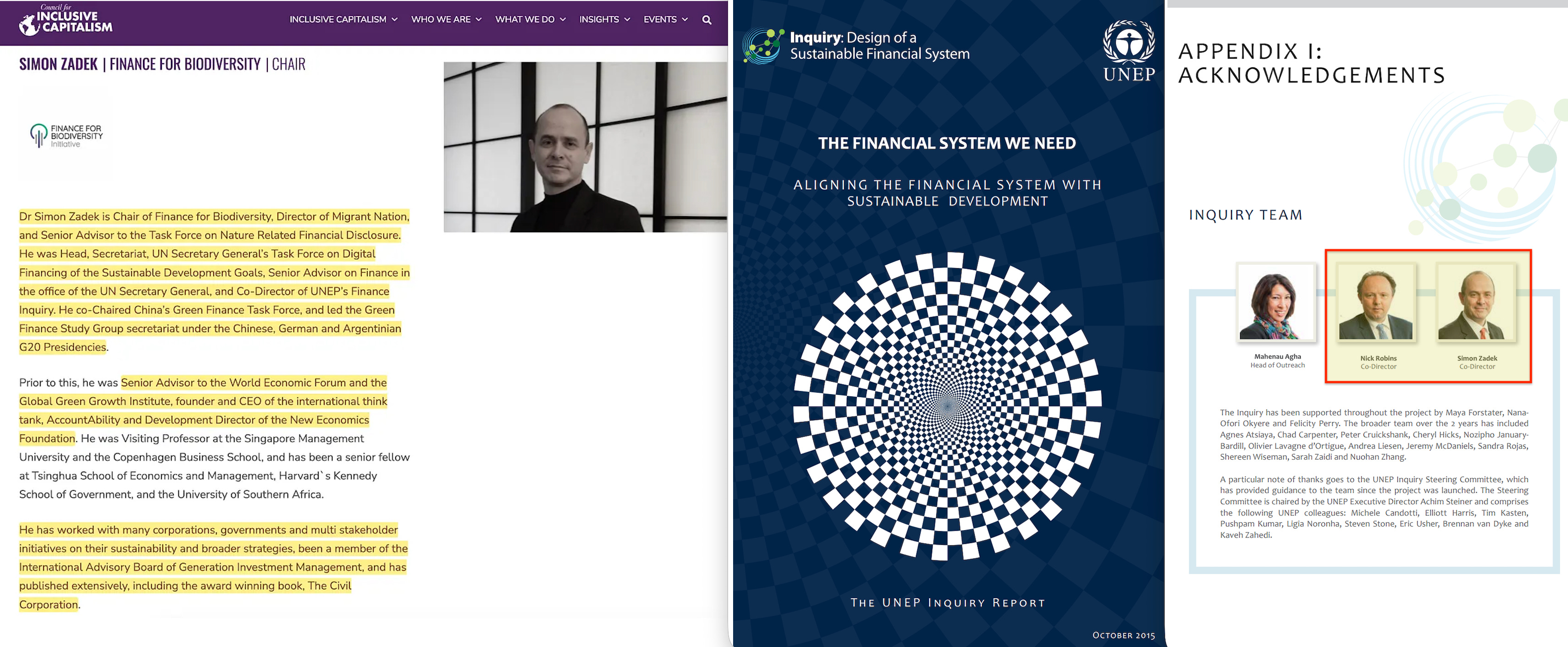
Simon Zadek — NEF Development Director, founder of AccountAbility, co-director of the UNEP Inquiry, head of the UN Secretary General’s Digital Finance Taskforce, senior advisor to the TNFD, co-founder of NatureFinance, chair of Finance for Biodiversity — is a formal member of the Council for Inclusive Capitalism with the Vatican33.
In 2015, Zadek and Nick Robins published The Financial System We Need34, which explicitly called for a network of central banks and a disclosure task force — matching the Waddesdon calls from the year before.
At a 2017 UNEP Finance Initiative roundtable in Geneva, Johnny El Hachem — CEO of Edmond de Rothschild Private Equity35 — appeared alongside Nick Robins, Zadek’s co-director at the UNEP Inquiry36. Rothschild capital and NEF governance architecture at the same table, designing the sustainable financial system.
Funding can be withdrawn, but personnel integration can’t.
The Origin of the Connection
The Prince’s environmental consciousness was shaped by a mentor who shared a platform with the Rothschild family before the Prince’s programme existed.
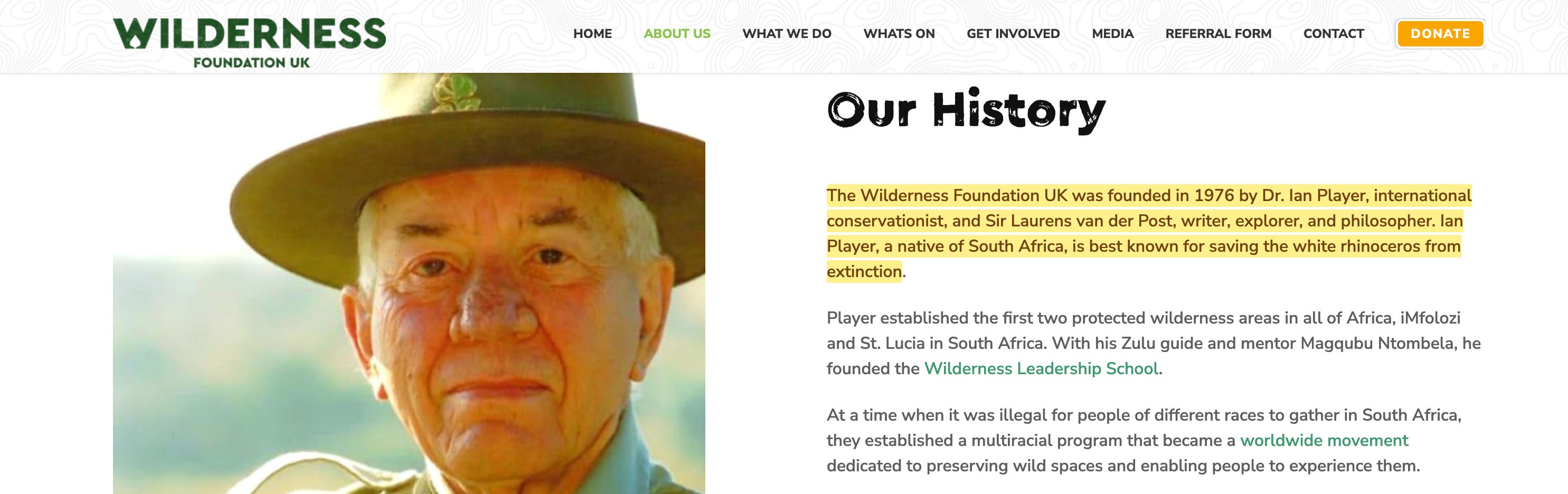
Sir Laurens van der Post37 — South African writer, explorer, philosopher — was Prince Charles’s mentor and spiritual adviser, godfather to Prince William, and founding patron of the Gaia Foundation. Van der Post co-founded the Wilderness Foundation (1974) with Dr. Ian Player38, the conservationist who had saved the white rhinoceros from extinction and established the first protected wilderness areas in Africa.
Player founded the World Wilderness Congress series and the WILD Foundation (the International Wilderness Leadership Foundation), which has been a member of the IUCN’s World Commission on Protected Areas39 since 1988 — connecting the congress series directly to the standards body that now defines the metrics for the nature-finance architecture.
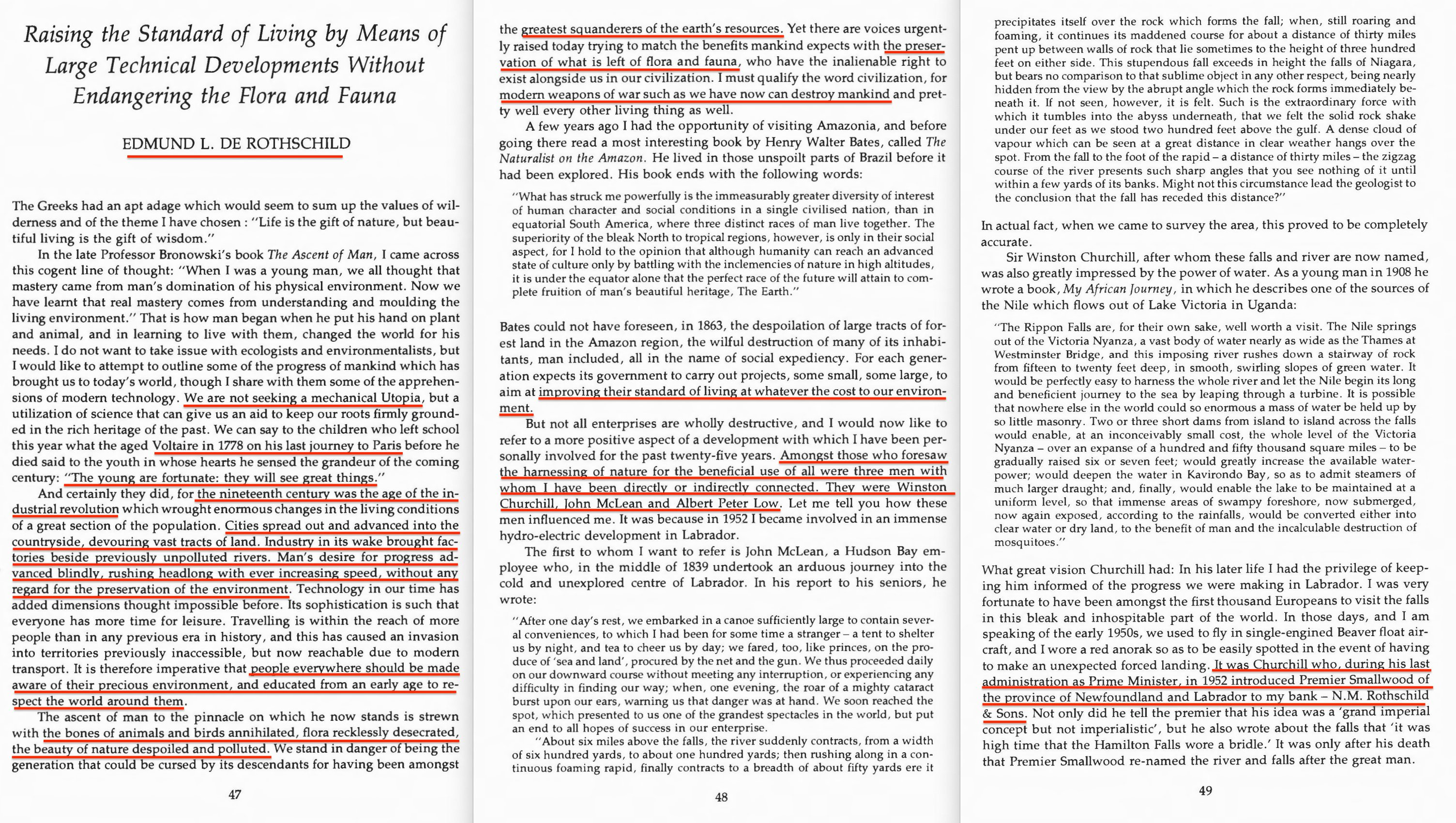
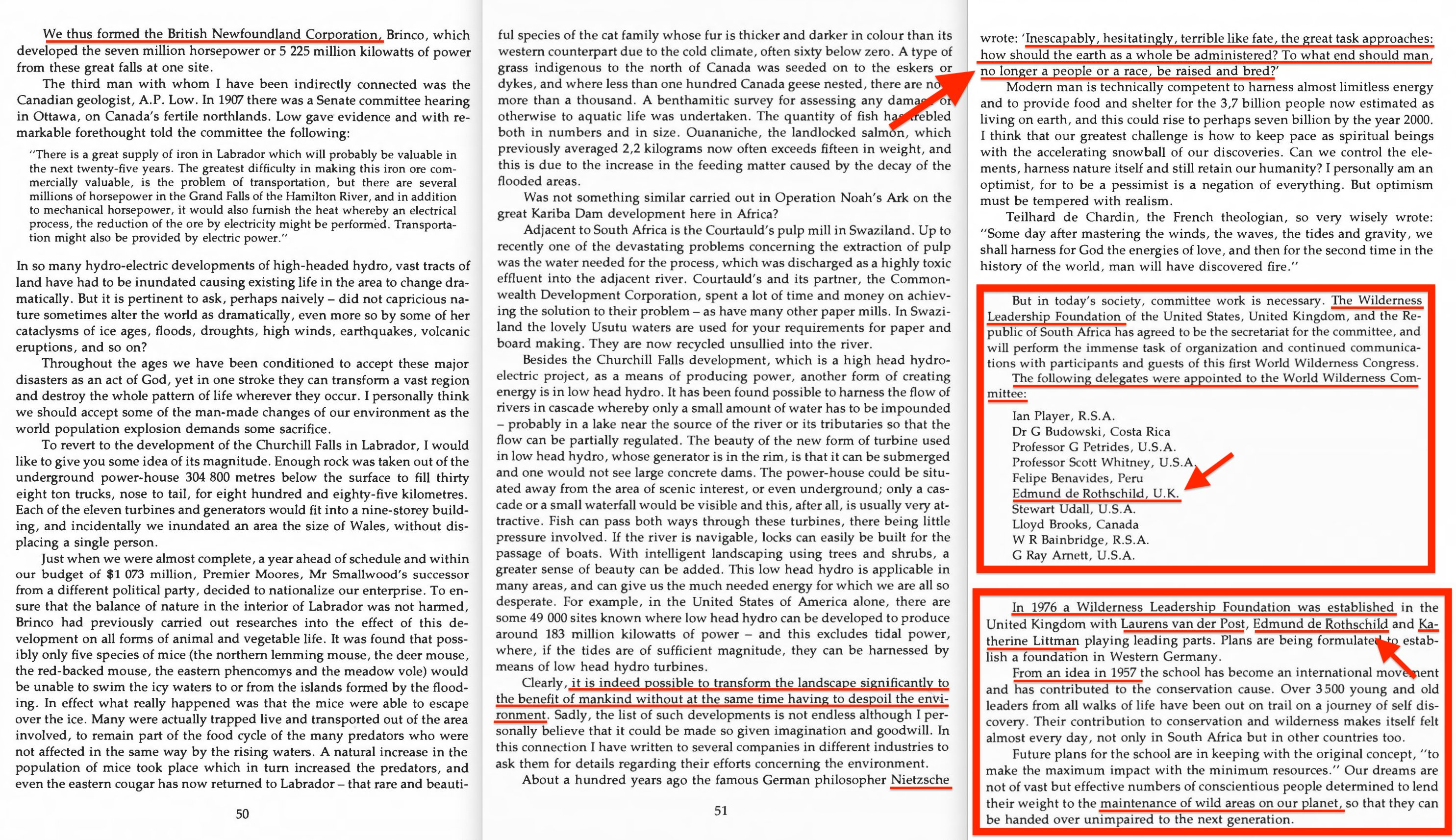
In 1977, Player and van der Post organised the 1st World Wilderness Congress in South Africa40. Among the ‘eminent contributors’ listed in the congress book, Voices of the Wilderness, alongside van der Post: Edmund de Rothschild.
A decade later, at the 4th World Wilderness Congress41 (Denver, 1987), Edmund de Rothschild attended as Michael Sweatman proposed the World Conservation Bank. That proposal was renamed the Global Environment Facility and folded into the UN system at the 1992 Rio Earth Summit. NEF was founded between those two congresses, in 1986.
The Prince’s mentor and the Rothschild family first shared a platform at a wilderness congress in South Africa in 1977. Everything that followed — the Prince’s sustainability programme, the A4S accounting standard, the Inclusive Capitalism speech thanking ‘Lady Rothschild’ by name — flows from a relationship formed before the programme existed.


Fifteen Paths
Across more than a century, no Rothschild has held elected office in a major democracy, led an international organisation, or commanded a military. What fifteen documented family members have done, across five generations, is sit on the paths between domains and set the standards by which one translates into another.
Nathaniel, the first Baron, financed Cecil Rhodes and backed De Beers — the path between London banking capital and imperial resource extraction.
Walter, the second Baron, received the 1917 Balfour Declaration — the path between British imperial foreign policy and the territorial foundation every later version of the corridor was built on.
Alphonse led the syndicate that financed the French indemnity of 1871, while Bleichröder handled payments on the German side. The network profited from both ends. The humiliation of those terms drove France’s demands at Versailles, and those reparations created the institutional justification for the BIS.
Alfred controlled the Almadén mercury mines, essential to gold refining, held the Royal Mint Refinery contract, and sat as a Director of the Bank of England. At the 1892 Brussels conference he praised the London Clearing House as approaching ‘perfection’, while Julius Wolf at the same conference proposed internationalising it. The refinery was sold in 1967, the decade the gold standard collapsed.
Robert served on the Van Zeeland mission in 1937, drafting memoranda that held the post-war architecture in a single document: fixed exchange rates, a common fund, tariff freezes, and the BIS as managing body. He carried that framework across twenty years to help draft the Treaty of Rome in 1957.
Victor was a Cambridge Apostle alongside Keynes and Leonard Woolf, served in MI5, then led Shell Research where Lovelock developed the work that became the Gaia hypothesis. The BIS now uses ‘Gaia’ as the name of its automated climate risk analysis system.
Miriam contributed to the 1942 Science and Ethics report, the collective statement that ethics could be derived from science, then helped establish the IUCN in 1948 — the path from scientific authority to legal designation, where a finding about the natural world becomes an obligation about what humans may do with the land.
Edmond financed the Eilat-Ashkelon pipeline in 1968, the same route IMEC now follows. It’s still operational.
Edmund addressed the 1st World Wilderness Congress in 1977 alongside van der Post, proposed the World Conservation Bank — renamed the Global Environment Facility and folded into the UN at Rio.
Jacob funded the Stranded Assets Programme at Oxford and hosted the Waddesdon forums from 2014 to 2018, which specified the TCFD and NGFS before either existed. The programme's director, Ben Caldecott, participated in the Waddesdon forums and became a technical advisor to the TCFD — connecting Rothschild funding, the Oxford research, the Waddesdon specification, and the disclosure framework. Bank of England Staff Working Paper No. 70642 (January 2018) thanks ‘participants to seminars at the Bank of England, the 4th Stranded Assets Forum’ — alongside Caldecott and Nicholas Stern.
Evelyn chaired N.M. Rothschild (1976-2003) and The Economist (1972-1989) at the same time, and co-patronised the 1993 Interfaith Declaration on International Business Ethics. His path ran between financial authority, the narrative that legitimised it, and the ethical framework that would outlast both.
Lynn founded the Council for Inclusive Capitalism with the Vatican in 2020, and sold the family’s entire Economist stake in March 2026 — the same logic as the Refinery in 1967.
Emma’s a Harvard historian building the evidence base for intergenerational climate claims through her ‘1800 Histories’ project. She also served on Ted Turner’s UN Foundation board while the stakeholder model was being institutionalised, overseeing the shift to stakeholder capitalism first trialled through the World Commission on Dams. Two paths: historical evidence → who owes what to whom, and stakeholder governance → the model where nobody can say no.
Ariane is CEO of the Edmond de Rothschild Group and connected to the Global Landscapes Forum — the biodiversity and land governance layer extending the architecture from carbon to the living world. The Epstein correspondence shows her not just on a path but running the bank, with Epstein as her agent. The French criminal investigation opened in March 2026 concerns this operational structure.
David is CNN’s ‘navigator of spaceship earth’ and founder of the Voices for Nature campaign — the path between environmental science and public culture, translating ecological concern into a popular movement.
Fifteen family members across five generations, and none controlled a domain. Each one shaped a path between two domains and defined how one translates into the other. The full details are laid out in The Rothschild Nexus.
Some nodes no principal could create — institutions whose unique assets flow into the architecture through bodies the principals set up.
The Vatican is one. Lynn Forester de Rothschild launched the Council for Inclusive Capitalism, not the Vatican. The name gives away the structure: ‘Inclusive Capitalism with the Vatican’. The Vatican plays the object, not the subject. It lends legitimacy — 1.3 billion followers, two thousand years of continuity, the oldest moral authority on earth — all channelled through a council a Rothschild principal created.
The Vatican didn’t design the inclusive capitalism framework, it blessed it.
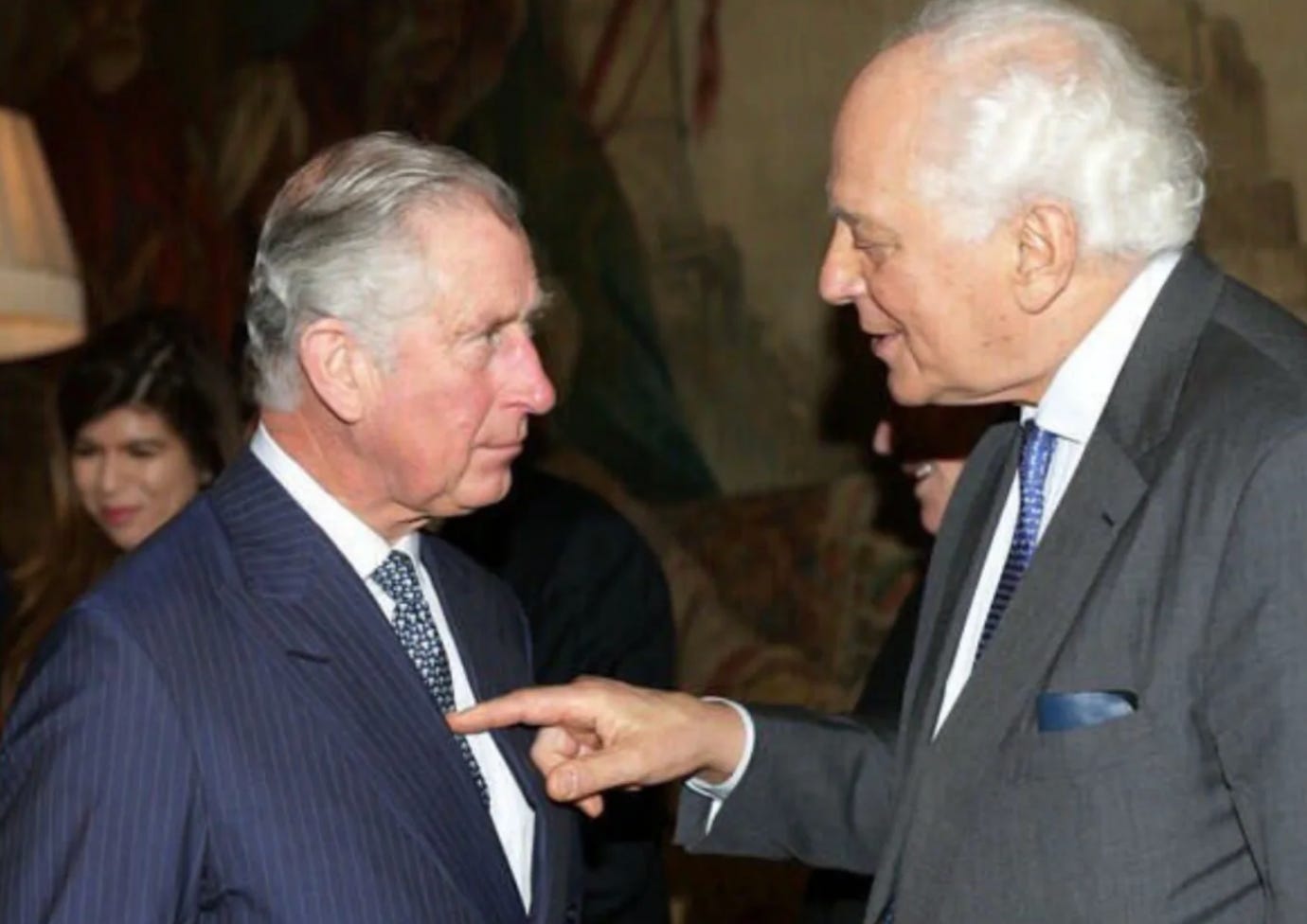
The Prince of Wales sits in the same spot: royal patronage flowing through sustainability initiatives into an architecture the Prince didn’t design. Both supply something the principals need but can’t create themselves, and both were invited in by the people who did.


Principals and Intermediaries
In 2016, Rainer Liedtke published Agents for the Rothschilds: A Nineteenth-Century Information Network43, drawing on the Rothschild Archive in London. The paper mapped out agents placed where different worlds meet, gathering political and economic intelligence and paid through the edge that information gave them. These agents were essential to operations but permanently outside the inner circle. Liedtke’s explicit: ‘such men never gained access to the decision-making circle of the family’. Only born Rothschilds got full trust.
The fifteen members listed above are primarily born Rothschilds. They sit on the paths as principals, not agents. Everyone else in this essay — the Prince, Carney, van Lerven, Zadek, Porritt, Ryan-Collins — sits on the paths as go-betweens with varying levels of awareness. Some, like van Lerven, might have no idea where they structurally fit at all. They publish research, attend conferences, and push for policies they believe in. The architecture doesn’t need them to know. It needs them to be where they are.
Liedtke spotted one recurring weak point: the agent who builds up enough independent knowledge to threaten the principals. August Belmont, sent to New York, declared himself the Rothschild agent on Wall Street without permission and couldn’t be shifted.

Jeffrey Epstein held the same structural spot in the twenty-first century44. Documents released by the US Department of Justice place him on the paths between finance (JPMorgan, through Jes Staley), technology (Gates, through Boris Nikolic), intelligence, academia, governance… and Rothschild.
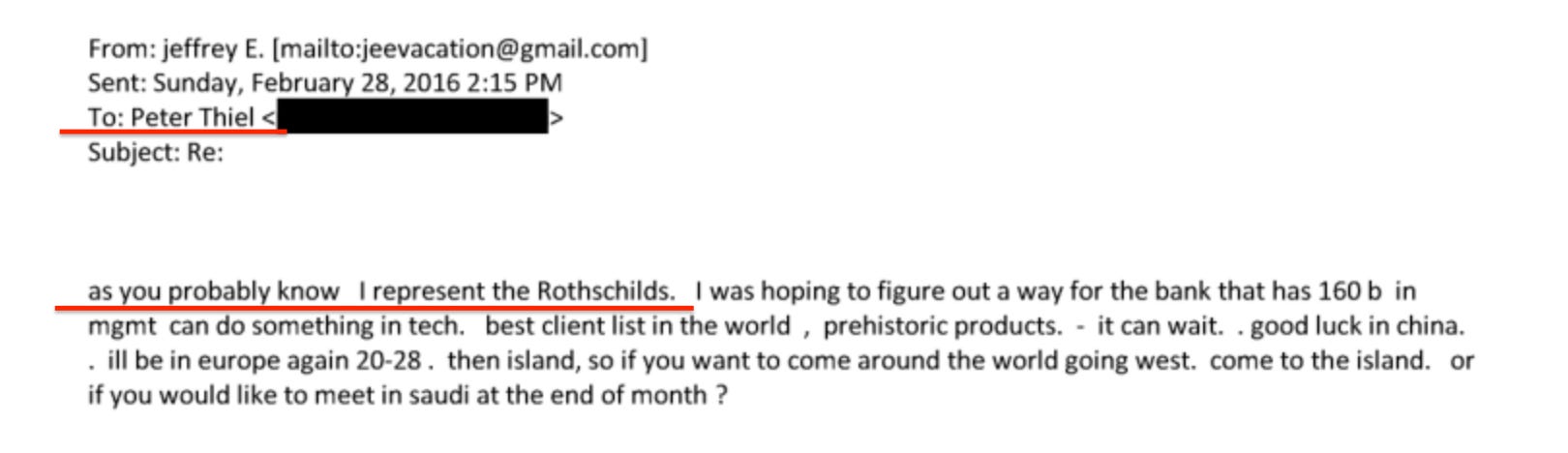
He tracked the impact investing infrastructure as it happened. He recruited Jem Bendell to run a digital currency initiative under Chatham House rules. His March 2013 memo to Nikolic listed UK social impact bonds alongside ‘govt approved special gates bonds’. When he was denied his fee on the Gates-JPMorgan impact investing vehicle he’d helped design, the correspondence shows the turn — draft emails with allegations about Gates’s personal conduct, a fake resignation letter written in Nikolic’s voice. He did a Belmont.
His removal didn’t break the architecture, because it doesn’t rely on any single go-between — it relies on layout.


Robert Maxwell held a different but related role — a media owner whose Pergamon Press put out scientific journals that fed the knowledge pipeline, whose network covered the same intelligence-finance-academia triangle, and whose daughter Ghislaine linked the Maxwell network to the Epstein operation.
Maxwell’s job was controlling information: shaping what counted as scientific publishing, which researchers got noticed, and which knowledge made it into the institutional mainstream. When Maxwell fell off his yacht in 1991, the publishing empire was swallowed by Elsevier and Springer — the same publishers that now carry the peer-reviewed literature on climate risk, sustainable finance, and planetary boundaries that feeds the NGFS scenarios.
The fifteen Rothschilds don’t hold jobs that can be filled by someone else. They hold positions that exist… because they exist. The principals set up the architecture. The intermediaries work inside it. And the intermediaries — from the Prince to van Lerven to Epstein — don’t need to know they’re intermediaries for the architecture to work.
That’s by design.


The Architecture of Unawareness
Positive Money designs the sovereign money system, NEF designs the allocation body, and the Fabians design the statutory coordination committee. Chatham House supplies the convening protocol — the same anonymity rule Bendell proposed for the Epstein initiative, and the same rule the Waddesdon forums used. UCL IIPP handles the academic credentials, INSPIRE links international scenarios to national policy papers, the Grantham Institute connects the NGFS to the research, and the Smith School sets out the enforcement architecture at Waddesdon.
Each organisation sits in one functional slot and works independently. The outputs fit together because the architecture picks the function, not because the organisations talk to each other.
Van Lerven doesn’t need to know about the Waddesdon forums for the ECB to implement his collateral framework paper. Zadek doesn’t need to know about van Lerven for the UNEP inquiry to design the sustainable financial system that van Lerven’s papers slot into. Ryan-Collins doesn’t need to know about the fifteen Rothschilds for his capital requirements paper to feed into the Basel risk-weighting framework that the Rothschild-funded forums laid out. King Charles III doesn't need to know about the clearing function for his A4S accounting initiative to feed the ISSB. The Pope doesn't need to know about the NGFS for his blessing of Inclusive Capitalism to supply the ethical mandate the architecture requires.


The system doesn’t need coordination. It needs the right layout — the right organisations in the right places, producing the right outputs, funded by the right foundations, with standards set by the key people who sit between them. Each organisation is a go-between, in Liedtke’s terms: essential to operations, permanently outside the decision-making circle, and unaware of the full picture because their professional specialisation stops them connecting the dots.
An economist sees Positive Money. A central banker sees the NGFS. A lawyer sees the Fabian blueprint. A conservationist sees the Ecosystem Approach. A financier sees blended finance.
Each sees their own patch, but none sees the whole thing.
That’s because the system’s main protection is compartmentalisation — not secrecy. Every document is public, every author is named, and every funder is acknowledged. But nobody reads across all of them because it’s nobody’s job to.


The same people dug the wells that every profession drinks from. The same people set the standards that let each domain translate into the next. And the go-betweens — from a London think tank with forty-three staff to a Prince who thanked Lady Rothschild at the Mansion House — work inside a system they didn’t design, producing outputs they believe in, for a layout they can’t see.
At the centre sits the clearinghouse, operating by standards defined by participants selected for Waddesdon, Bellagio, or Sir Bani Yas. But the selection is itself a clearing function — input constraint. The invitation went to people who already held the ‘right’ position.
The forum doesn’t produce consensus. It documents pre-existing agreement among pre-selected participants, then encodes it as a standard that binds everyone.
And should you refuse, Inclusive Capitalism will rapidly exclude you.


Find my Telegram channel over here.
"Inclusive Capitalism" is a euphemism for enslavement of most of mankind within a digital prison (those still remaining, that is, after the current dose of democide in the forms of medical tyranny, genocide and war). These "rulers of the world" are all related (see the work of Clint Richardson), and what's much more bizarre, many are "inverts" (see the work of MrE, Poncho Pete Son of Man, Real Nosey Parker et al). Such is the satanic cabal that rules the world. Their diktats need to be ignored, and ideally, turned against them. There will never be peace while this outfit holds power.
Outstanding work. All of our 'leaders' since the fall of the Soviets are worthless grifters and thieves. Perhaps before.