
Macro to Micro

The system described here works as a five-level chain: ethics, standards, clearing, settlement and outcome. Each level depends on the one above it and none works alone. Together they form a single system running from international treaty down to a transaction in a digital wallet.

In the current system, each layer maps to a specific named instance. The ethic is the Sustainable Development Goals framework. Standards are set by the OECD, ISO, the Basel Committee, the WHO and the FATF. Clearing is moving into artificial intelligence, with the US Genesis Mission as the latest named instance. Settlement runs through Central Bank Digital Currencies and the BIS unified ledger architecture. The outcome is the individual transaction in a digital wallet.
The same chain works at every scale. An international body presents its principles, technical specs and compliance stance to the next level up. A government presents its credentials, indicators and policy compliance to the system above it. A corporation presents its identity, ESG scores and audit trail to its national regulators. An individual presents their digital ID, transaction history and behaviour record to the settlement layer. At every level, the actor gives, the standards constrain, and the clearinghouse balances both and makes a ruling, typically settled through finance.
The structure is recursive, the grammar is identical, and only the names change.

The five levels
The ethic is the moral rule that can’t be questioned and that allows everything built on top of it. The Sustainable Development Goals1, the ESG framework, planetary boundaries2, sustainability, the ‘social good’3. Each one is treated as obviously right — that climate change is real, that protecting the planet is what grown-up societies do, that health isn’t up for debate. The way it’s framed makes the ethic hard to argue against in public, because arguing sounds like opposing the good. Foundations create this ethic through funded research, expert meetings and academic papers. By the time it reaches politics, it’s seen as ‘expert consensus’.
Standards turn the ethic into practical rules. ISO Technical Committee 322 sets the definitions for sustainable finance4. The Basel Committee writes the capital requirements that decide what banks can invest in5. The NGFS produces climate forecasts that feed into Basel’s risk calculations6. The OECD gathers the principles for development finance7. The WHO issues rulings that decide what counts as a public health emergency8. The FATF defines anti-money-laundering compliance9. Each standard takes the ethic and turns it into measurable rules that an organisation either meets or fails.
Clearing is the conditional pre-approval mechanism, and it’s being moved into artificial intelligence. The clearinghouse receives the actor’s data and the standard’s requirements, matches the two, and rules on whether the actor’s eligible to transact. The decision happens before the action: the actor doesn’t ask permission because the clearinghouse has already decided if the action will be permitted.
Ashby’s law of requisite variety10 says a controller must have at least as much variety in its responses as the system it’s trying to control. Once the architecture treats health, climate, finance, food, water and security as interdependent — once ‘holism’ becomes the governing principle — the system’s variety exceeds what humans can process. Only a computer can match that variety, so AI isn’t an optional efficiency boost. It’s the structural answer to the problem the architecture has set itself.
The named instances are already appearing. The BIS Innovation Hub’s projects11 use AI for financial supervision12, settlement and compliance13. The EU’s AI Act14 sets the rules for trusted AI in compliance roles. The US Genesis Mission, announced in November 2025 and described by the White House as comparable to the Manhattan Project in urgency and ambition15, builds the centralised national AI infrastructure that’ll handle clearing for American economic activity. The architecture’s middle pillar is being assembled into computational form.
Settlement is where the transaction actually executes. The BIS unified ledger16, Project Agorá17, Project Rosalind18, mBridge19 and the Central Bank Digital Currencies being piloted20 across most major economies are all programmable money systems carrying conditions inside them. A transaction either clears or it doesn’t — the money decides, and the actor only sees the outcome. Compliance checks, identity verification, purpose code validation and standards verification all happen at the settlement layer in milliseconds, so the actor gets either a confirmation or a refusal.
The outcome is what reaches the endpoint: an individual transaction allowed or blocked, a corporation gaining or losing access to financing, a country keeping or losing its credit rating, an international corridor financed or alternative routes destroyed. The outcome is the only level the affected party sees in normal terms. The four layers above have already produced the result before the affected party’s even aware of the question.


The chain at four scales
At the international level, the ethic is the SDG framework. Standards include the OECD Principles for Quality Infrastructure Investment21, ISO sustainable finance taxonomies22, Basel risk weights23 and IMF Article IV review criteria24. Ratings agencies, MDBs25, FATF26 and the major standard-setting bodies handle clearing. Settlement is the cross-border financial architecture coordinated through the BIS. The outcome is the IMEC corridor getting financed27, alternative corridors starved of capital, JETPs imposed on Vietnam and Indonesia28, and the Lobito Corridor29 built instead of something else.
At the sovereign level, the ethic is ESG and climate-aligned development. Standards include the NGFS scenarios30, Basel climate principles31, EU taxonomy32 and the Carbon Border Adjustment Mechanism33. Credit rating agencies and the IMF assessment process handle clearing. Settlement runs through national central banks integrated into the BIS framework. The outcome is reduced fiscal autonomy, as the country’s debt rating becomes conditional on compliance, its currency clearing depends on FATF status, and its exports depend on EU taxonomy certification.
At the corporate level, the ethic’s sustainability and stakeholder capitalism. Standards are ESG metrics34, GFANZ commitments35, the Science-Based Targets initiative36 and CDP disclosures37. Clearing’s handled by the Big Four auditors and ESG rating agencies. Settlement’s at the commercial bank that approves or refuses financing. The outcome’s whether the firm gains or loses access to capital, keeps or loses its insurance cover, and holds or loses its supply chain relationships.
At the individual level, the ethic’s health, security, climate responsibility and digital safety. Standards are digital identity protocols, age verification frameworks, AML thresholds38 and behavioural scoring models. Clearing’s done by the AI compliance check built into the financial service provider’s onboarding and monitoring systems. Settlement’s at the digital wallet39, bank account or payment processor. The outcome’s whether the transaction goes through or gets refused, the loan’s approved or declined, and the insurance’s offered or denied.
The chain works the same way at every level. Only the actor’s size and the institution’s name change.

The recursive structure
The Black Swan Factory described this as a Tree of Life governance structure with three pillars40. The right pillar is what the actor gives — identity, transaction data, self-governance, behavioural record, financial position. The left pillar is what the constraint imposes — standards, capital requirements, certification thresholds, compliance criteria, sanctions. The middle pillar includes the clearinghouse that resolves the two — the AI rating, the audit ruling, the credit decision, the settlement verification.
The actor produces information voluntarily and continuously, while the constraint operates externally and procedurally. The clearinghouse harmonises both and outputs the ruling. The actor self-regulates because the conditions are visible, and the constraint enforces because the consequences are automatic. The clearinghouse rules because the architecture was built to make its ruling the only legitimate one. But the clearinghouse rules based on standards compiled above; the tipheret41 clearinghouse really only carries out the demands of da’at42.
The interface repeats at every scale. A commercial bank presents its capital, liquidity and risk profile to the central bank, which checks them against Basel standards and decides if the bank can keep operating. A country presents its debt, fiscal balance and policy commitments to the IMF, which checks them against Article IV standards and decides if the country keeps access to international markets. An individual presents identity, transaction history and behaviour to the digital wallet, which checks them against compliance requirements and decides if the next transaction can go ahead. The structure’s identical — only the scale changes.


The topology
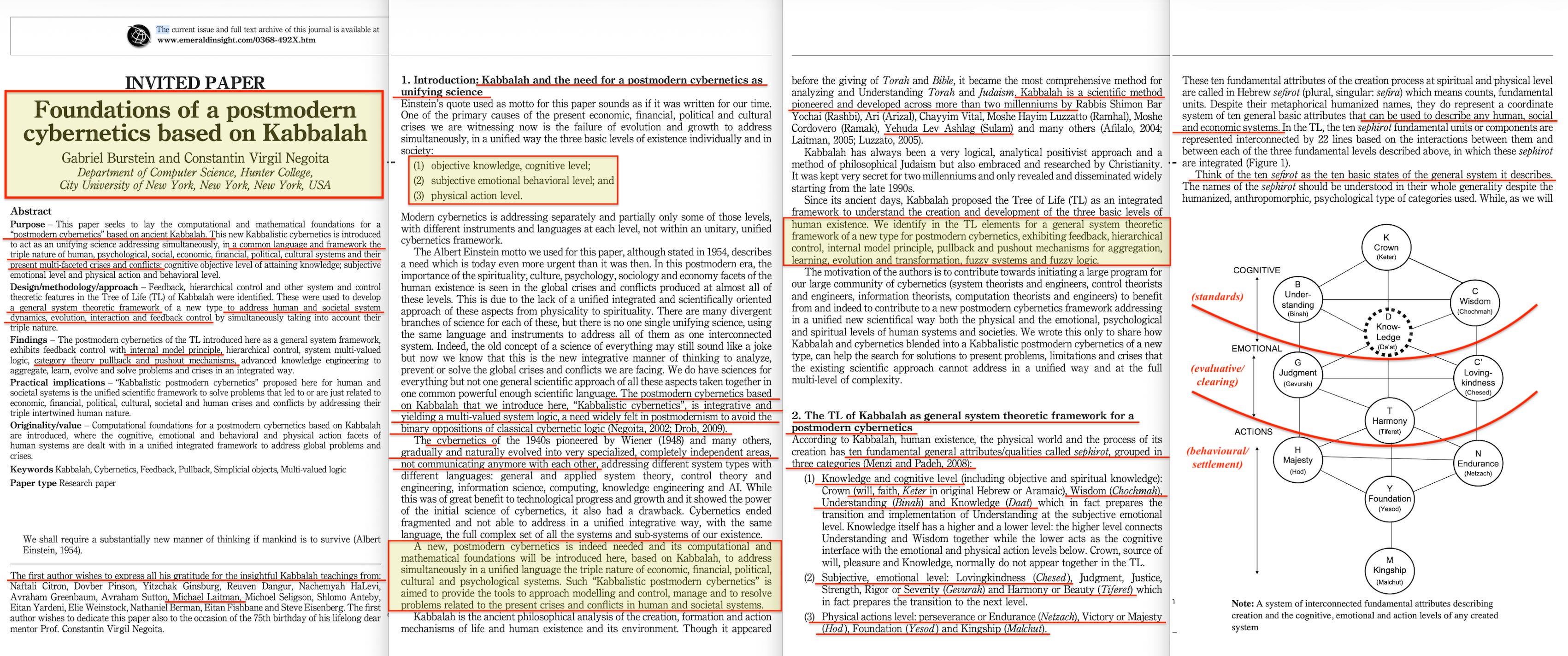
The five-level chain matches a documented topology that’s been described in different vocabularies for centuries. The Kabbalistic Tree of Life encodes it as ten sefirot on three pillars43. Keter’s the will at the top — the ethic that authorises the architecture. Da’at’s compiled knowledge — the standards. Tipheret’s the harmonising clearinghouse in the middle, the position now being assembled into artificial intelligence, with Genesis Mission and the BIS Innovation Hub among the named instances. Yesod’s the foundation that settles — the unified ledger and CBDC infrastructure. Malkuth’s the kingdom or world where the outcome appears — the individual transaction at the chain’s endpoint.
Spinoza translated the structure into geometric ethics44. Pike rendered it in hydraulic language as flows through vessels45. Marx encoded it as an administered economy46. Leontief formalised it as input-output matrices47. Bogdanov generalised it as tektology48, integrating flows across all domains.
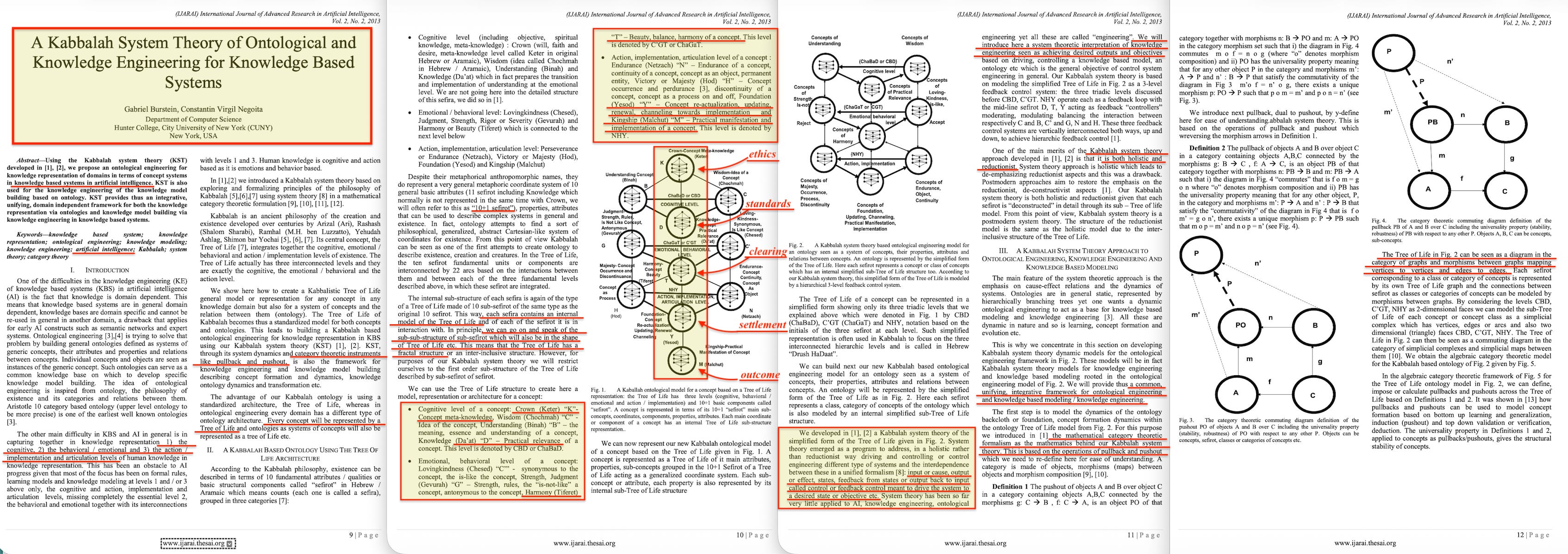
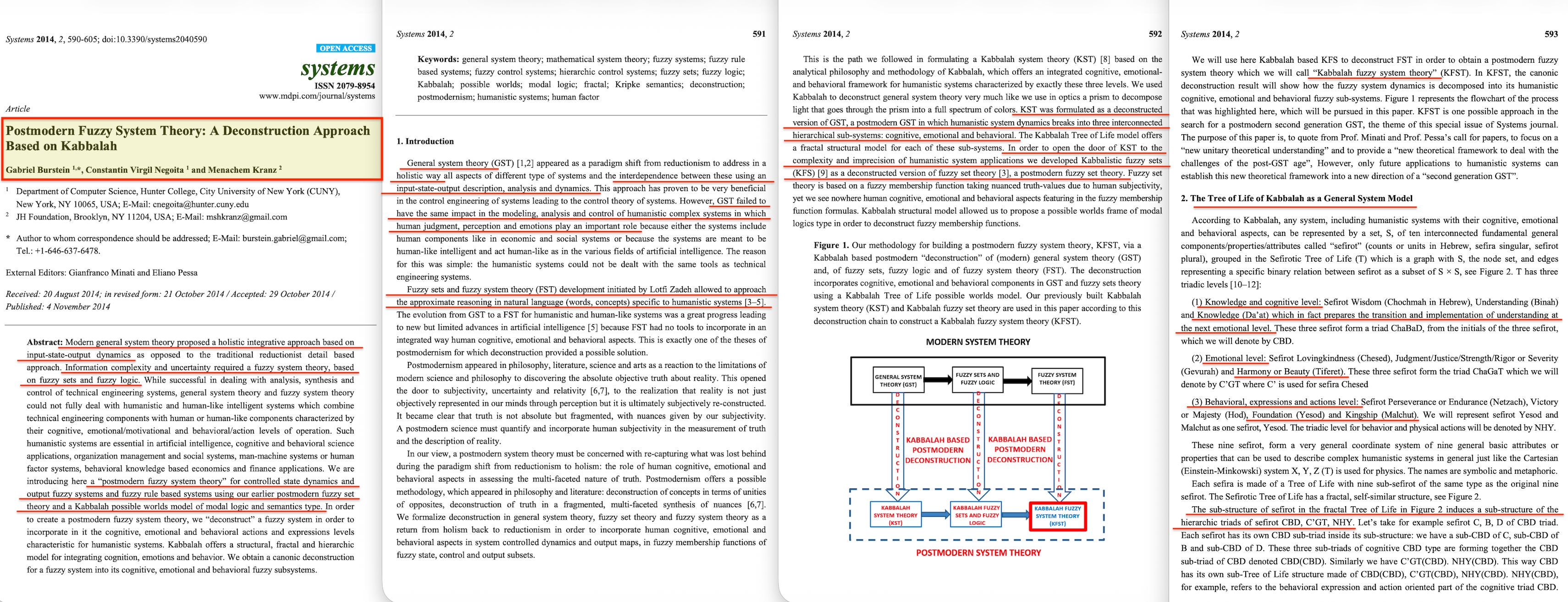
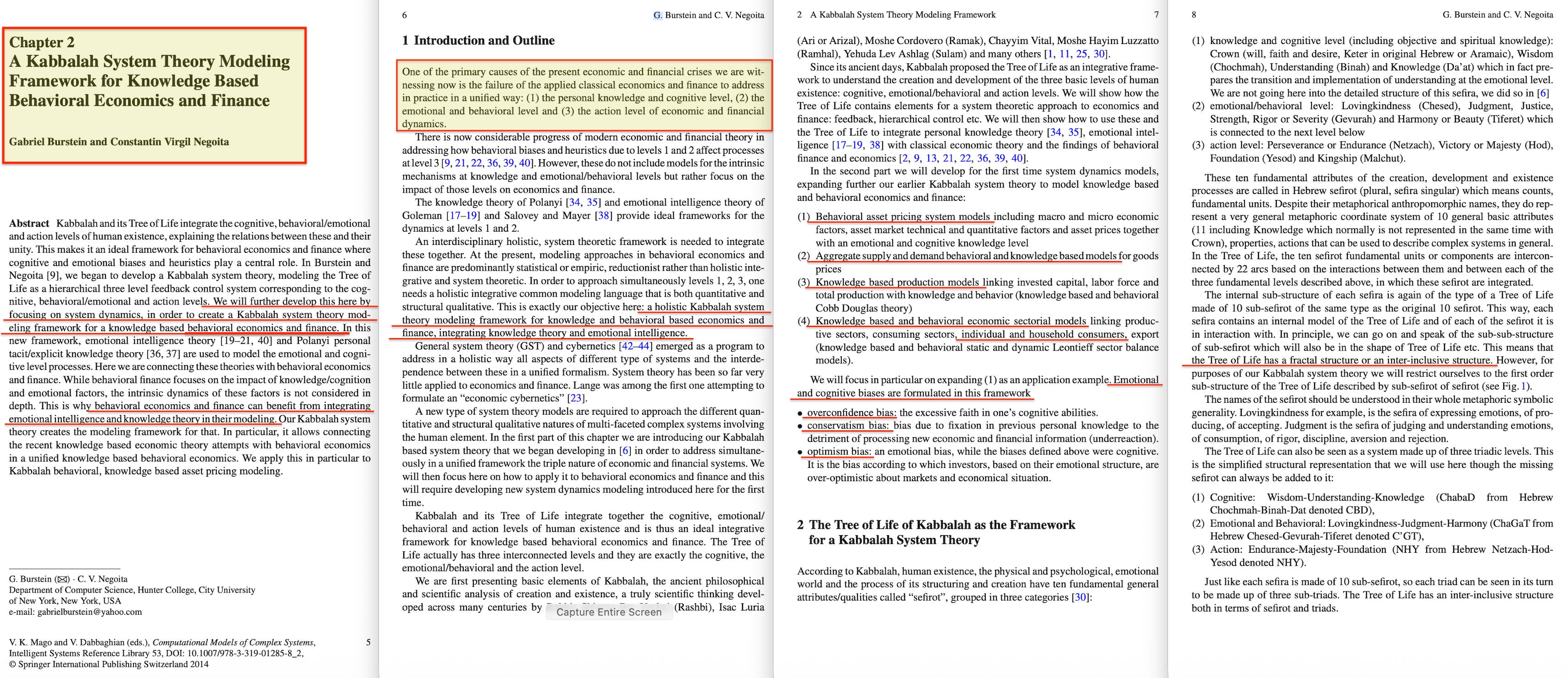
These aren’t separate models that happen to resemble each other. They’re documented as the same underlying topology in different notations. Gabriel Burstein and Constantin Virgil Negoita demonstrated the formal equivalence in peer-reviewed papers published between 2011 and 2016. Using category theory, fuzzy logic and Wonham’s Internal Model Principle49 from control engineering, they mapped the Kabbalistic topology onto a recursive hierarchical feedback control system, naming the framework Kabbalah System Theory50. The Tree of Life and a hierarchical feedback control system are the same object in different vocabularies with different applications. Burstein’s later work moved into digital assets and tokenisation51 — the technical domain where the BIS Innovation Hub’s now building the settlement infrastructure that operates the chain.
The topology works with any operator. The same control structure can be installed under any ideological branding. Michael Laitman, the contemporary inheritor of the Ashlag lineage, made this explicit by redefining ‘Israel’ not as a nation, geography or ethnicity but as the property of bestowal — a compliance state that anyone who’s internalised the governing ethic occupies52. Anyone who hasn’t is, operationally, ‘the nations’. The architecture recruits operators from any population.


The genealogy
Two channels have run side by side for over a century, carrying the same structure in different words.
The spiritual channel runs from the Zohar through Isaac Luria53, Yehuda Ashlag54 and Michael Laitman55. Flows must serve divinity through selfless giving. Individual desire gets subordinated to the collective. The masach56 — the screen or filter — works as input constraint, allowing only the receiving-that-gives. It’s presented as a path of correction.
The materialist channel runs from Moses Hess through Marx, Lenin, Bogdanov and Leontief. Hess wrote the founding synthesis. In his 1845 essay On the Essence of Money57, he argued money is social blood, economic flows carry moral content, and administering those flows by ethical criteria delivers social justice. The economy becomes the medium that enforces the moral framework. Reorganising flows to match the chosen ethic redeems society. Hess is the documented bridge between both channels. He read Spinoza, who’d translated the Kabbalistic root into geometric philosophy, and continued that reading in his own synthesis. The materialist channel starts with a reader of the spiritual channel translating the same structure into political economy. Hess converted Marx to socialism in the early 1840s. Marx stripped the religious vocabulary but kept the structure58.
Today’s Sustainable Development Goals are the institutional form of Hess’s principle — social justice through economic reorganisation, with the ethic supplied by whoever’s authorised to define the social good. Capital runs through impact investing59, itself based on blended finance60, through which the public in net effect subsidises the private. Governance operates through Eduard Bernstein’s public-private partnerships for the common good61, implemented through the League of Nations by Leonard S Woolf62 and Alfred Zimmern63, currently being integrated with ISO standards64. It’s presented as planning, optimisation, scientific socialism, systems thinking. Different terminology, same functional structure.
Both channels are formally equivalent. Burstein and Negoita’s work in the 2010s showed that the Kabbalistic topology, expressed in modern control-theoretic terms, produces the same system Marx and Bogdanov tried to administer with twentieth-century tools. What was theological in one channel and political in the other becomes computational in the synthesis. The architecture now being deployed at the BIS, the OECD, the UN, the GEF, the WHO and the major financial institutions is reaching its operational form.
The engineering rule across the whole genealogy is the same: the loop must close. Nothing escapes the unified ledger. The Zohar closes it cosmologically65, with nothing outside the divine substance. Marx closes it administratively, with no economic activity outside the plan. Laitman closes it ethically, with everyone either belonging to the bestowal-state or defined as the nations. The unified ledger closes it technically, with every transaction routed through compliance verification.
Different vocabularies, one engineering rule.


The publishing channel
Burstein and Negoita’s framework reached the academic mainstream through a specific publishing setup66. Robert Maxwell founded Pergamon Press in 195167, and it published the foundational works in general systems theory, cybernetics, input-output analysis, operations research and futures studies — the fields that supplied the modelling vocabulary the architecture now uses.
Through translation deals with VINITI, the Soviet scientific information institute, Maxwell sent Soviet work on mathematical optimisation and control theory into Western academic discourse. PMM, the Soviet Union’s most important journal for the maths behind central planning, was published in English by Pergamon from 1958 onwards68. The fields Pergamon assembled weren’t separate academic disciplines that happened to be useful for governance. They were components of a single program.
Maxwell was a well-documented intelligence operative of the twentieth century, with relationships across British, Israeli and Soviet services. His daughter Ghislaine was paired with Jeffrey Epstein before Maxwell’s death in 1991. After Maxwell died, Jacob Rothschild handled the Maxwell estate’s financial dealings, and Lynn Forester — later Lynn Forester de Rothschild — gave Ghislaine a Manhattan apartment, placing her in the social world where she developed her relationship with Epstein. The chain of institutional funding ran in an unbroken line from Pergamon’s editorial choices, through Maxwell as the patron of the academic disciplines being assembled, through the Santa Fe Institute as the institutional home, to Epstein as the successor funder for the researchers Maxwell had begun publishing decades earlier.
The researchers Epstein funded were building the practical parts the architecture needed. Ben Goertzel developed artificial general intelligence69. Joscha Bach worked on AI systems rooted in the cybernetic tradition Pergamon had published70. Madars Virza developed zero-knowledge proofs — cryptographic methods for verifying compliance without revealing the underlying data71. Joi Ito72, director of the MIT Media Lab, used Epstein’s funding to set up the Digital Currency Initiative, which hired Bitcoin’s core developers and built Project Hamilton. This central bank digital currency prototype was developed with the Federal Reserve Bank of Boston and finished in December 202273 — six months before the BIS published the unified ledger architecture.
Epstein wasn’t just paying these researchers. He wrote the design specification himself. From 2011, his correspondence with JPMorgan executives, Gates Foundation advisers and sovereign contacts shows a steady escalation from social good bonds to social good currency to sovereign digital currency. In April 2013, he pitched Richard Branson a currency ‘like airline miles or special drawing rights, but for social good — conditional, programmable, purpose-bound’74. In March 2013, his strategic memo to Boris Nikolic listed the components75: ‘DAF, estate, structured giving, partnered giving, social good bonds. (new uk concept), govt approved special gates bonds?’ He tracked the UK’s pioneering social impact bond programme and proposed a government-endorsed Gates-branded variant. In April 2016, Larry Summers emailed Epstein the digital currency specification76. Pitches to sovereigns followed: Russia in 2013, Saudi Arabia in 2016, and Dubai through DP World’s eighty-three-country logistics network in 2017. He offered the same product to each, with framing tailored to the recipient.
Today’s settlement layer — programmable CBDCs carrying purpose codes inside them, the BIS unified ledger architecture, the conditional settlement infrastructure — is the institutional form of what Epstein pitched to sovereigns from 2013 onwards.
The theoretical framework Pergamon built in the 1950s and 1960s, the researchers Maxwell and then Epstein funded over the following decades, and the operational rollout now reaching the BIS Innovation Hub77, Genesis Mission and the CBDC infrastructure are three stages of one long-term project. The publishing channel was the backbone that carried the theoretical commitment from one stage to the next.


How the trilogy fits
Ratified by G20 tracked how the standards layer gained political backing through IMEC and PGII. The corridor inherited features engineered upstream at the OECD and BIS over the previous four years. The G7 and G20 summits supplied the visible approval, but the substance had already been compiled into standards before any political vehicle got named.
At Arm’s Length of Epstein mapped the financing structure running the chain. The four-layer system — blended finance as the mechanism, impact investing as the direction, stranded assets as the constraint, and programmable money as the enforcement at the individual transaction — was designed in private JPMorgan correspondence in 2011 and at private forums in Waddesdon Manor between 2014 and 2018. The political layer at G7 summits inherited a financing architecture built upstream.
Convened in Private traced the design protocol that writes the ethic and the standards. Foundation-funded, invitation-only forums at family estates and branded venues — where the selector function, not the figurehead, did the real work — produced the vocabulary and frameworks that institutions later adopted as their own. The convening is the decision layer; the institutional ratification afterwards is just the visible layer.
These three essays cover three points in the same chain. The convening produces the ethic and early standards. The G7/G20 ratification gives those standards political endorsement. The financing architecture puts the chain into operation through the BIS settlement infrastructure. The outcome lands at the individual transaction. Each essay focuses on a different layer, but the chain runs through all three.
Epstein funded more than financing design. He also funded the AI researchers building the clearinghouse capability and the digital currency developers building the settlement layer — while Burstein and Negoita’s formal work was pointing toward exactly this integration of the topology with digital assets.


What this means
The chain runs from the ethic put together at a foundation-funded meeting at a family estate, through standards set at ISO and Basel, through clearing by AI and rating agencies, through settlement on the BIS unified ledger, to the outcome at the individual transaction. Every layer was designed before the person at the endpoint knew about it. Every layer sits outside democratic accountability. Every layer treats compliance as the only valid behaviour.
A voter opposing the architecture can vote for any party offering an alternative, only to find that alternative installs the same chain under different branding. The voter operates at the outcome level, while decisions were made four layers up at venues they can’t access, by individuals whose names appear in correspondence years later.
A corporation wanting to operate outside the architecture can refuse certification, ESG compliance and standards. It then finds its bank financing withdrawn, insurance refused and supply chain partners restricted. The architecture doesn’t need the corporation’s consent. It only needs the corporation to operate inside the financial system, which routes every transaction through the settlement layer running the chain.
A country wanting sovereign autonomy from the architecture can refuse the IMF Article IV review, refuse NGFS membership, and turn down ESG-conditional financing. It then finds its debt rating collapses, currency clearing becomes uncertain, and imports become hard to finance. Sovereignty exists on paper, but in practice the country’s been reclassified as a ‘risk profile’.
An individual wanting to live outside the architecture can refuse digital identity, refuse the digital wallet, and use only cash. They then find cash is increasingly restricted, essential services require digital identity, employment needs paying into a digital wallet, and healthcare access depends on a compliant identity record. The architecture’s been designed to make refusal increasingly expensive and eventually impractical to survive.
The chain’s complete, running from Pergamon’s editorial offices in the 1950s, through the Maxwell-to-Epstein succession in the 1990s, through a convening at Lake Como in 2007, through Epstein’s digital currency specifications pitched to sovereigns across the 2010s, to the transaction this evening at a digital wallet. The vocabulary’s shifted from theology to economics to computation across more than a century, but the engineering rule’s stayed the same. The loop must close and nothing escapes the unified ledger.
Artificial intelligence’s the keystone now reaching its operational form — the computational answer to the requisite-variety problem the architecture set itself when it declared all domains interdependent. Epstein stated the case directly in his 2019 interview with Bannon: politicians don’t understand money, fifteen years of mathematical modelling at the Santa Fe Institute was a ‘total failure’, and AI produces answers no one can explain but that work. If humans can’t comprehend the system, machines must run it. The clearinghouse position in the middle of the chain, which the Tree of Life calls Tipheret, is being explicitly assembled in named programmes from Genesis Mission to the BIS Innovation Hub.
The individual at the endpoint is the final stage of a sequence that began at a foundation-funded convening they could never have attended, expressed in a vocabulary they wouldn't have recognised, encoding a topology documented as far back as anyone's thought it worth documenting.
The destination is already set. The SDG ethic authored in Keter, converted into standards at Da’at by the ISO, Basel, FATF, OECD and others, cleared by artificial intelligence in Tipheret, settled through Yesod’s conditional CBDCs — with the outcome in Malkuth being your compliance.
The almost fully automated Spaceship Earth awaits your boarding78, marketed to you as ‘inclusive capitalism’. In reality, it’s anything but. Inclusion only extends to those who adhere to the ethical principles you never asked for, their conversion into standards you weren't aware of, clearing through the AI that displaced democracy, settled through conditional CBDCs politicians pushed regardless of your objections. The outcome is managed capitalism integrated with a framework extending all the way back to the origin of communism. Exactly what Moses Hess wanted — and not really capitalism at all.


So much tying this monstrosity together. Excellent analysis!!
Excellent overview of the working parts of this system, we appreciate your research.